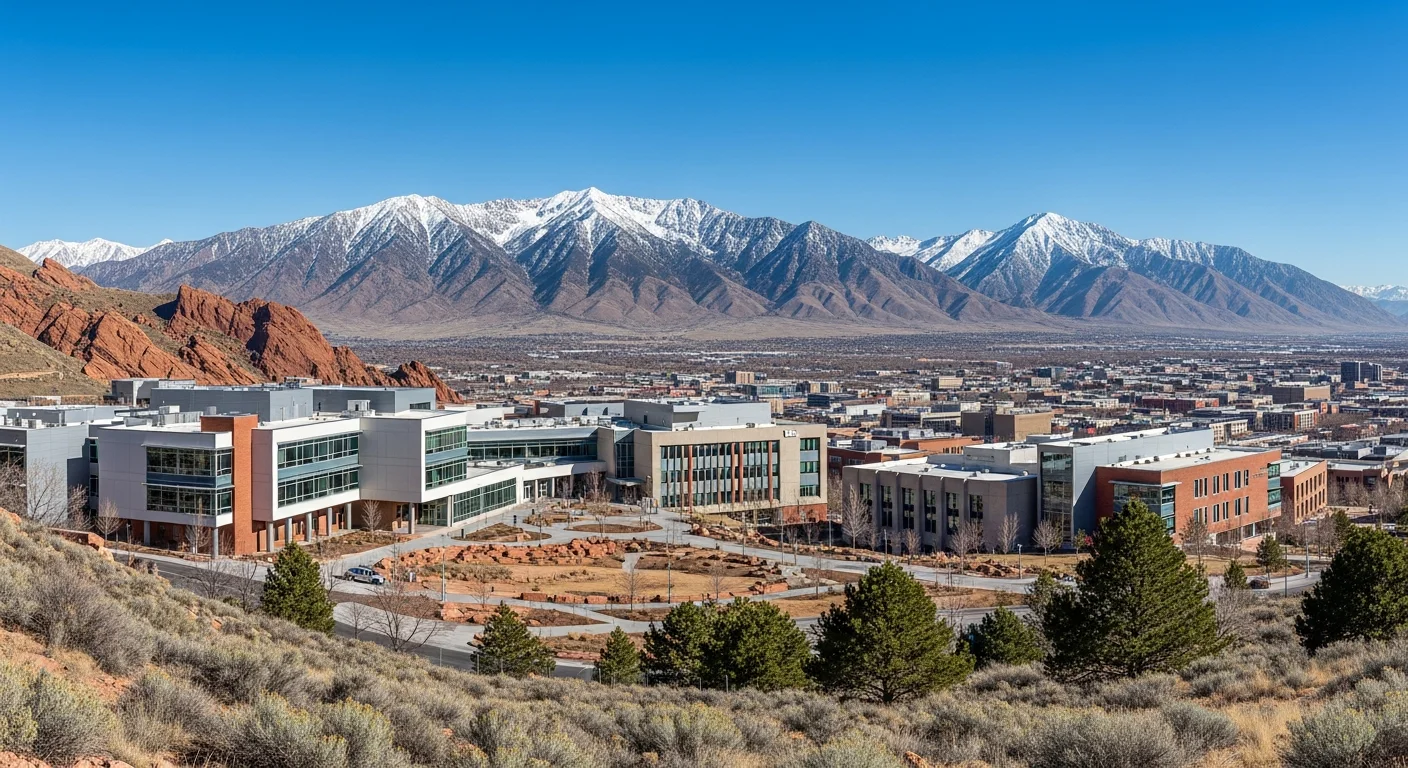
University campus in Utah
Updated July 13, 2026

Best Artificial Intelligence Degree Programs in Utah, 2026 Rankings

Compare the top artificial intelligence colleges in Utah. 9 accredited artificial intelligence schools ranked by graduation rate, career outcomes, and value, from Weber State University to Western Governors University.

#1 ProgramWestern Governors
Avg Salary$108,000
Tuition From$5,471/yr
Job Growth+22%
On this page
Reviewed by Taylor Rupe, Founder & EditorSee methodology

17

Programs ranked

IPEDS 2024

$108,000

Utah median artificial intelligence salary

BLS OEWS 2024

78/100

Top program score

Hakia methodology

23%

U.S. job growth (2023–33)

BLS projections

Key Takeaways

Best artificial intelligence degree programs: Western Governors, Weber State, Brigham Young

Ranked by graduation rates, program outcomes, and institutional quality

IPEDS 2024

Tuition ranges from $4,180 to $40,896/year

Weber State offers the most affordable option at $5,471/yr

IPEDS 2024

Artificial Intelligence degree programs available: 3 associate's, 4 master's, 2 doctoral in Utah

From community college pathways to advanced research degrees

IPEDS 2024

Utah community college transfer can save 40-60% on total degree costs

3 associate's programs provide transfer pathways to bachelor's degrees

Education Commission of the States

Major employers: Adobe, Qualtrics, Pluralsight, Domo

Tech hubs in Salt Lake City and Provo

Hakia Research 2026

Artificial Intelligence degree programs near 28+ cities across Utah

Search by city to find programs within 200 miles of your location

IPEDS 2024

Updated July 13, 2026

How we ranked Utah Artificial Intelligence programs

We rank 17 accredited artificial intelligence programs in Utah using IPEDS 2024 institutional data, BLS OEWS 2024 state salary data, and College Scorecard outcomes. A 4-factor weighted composite is normalized to a 0–100 score. Schools cannot pay for placement; rankings are produced algorithmically.

Program completions (35%)Graduation rate (25%)Selectivity (20%)Career outcomes (20%)
See full methodology

Are Artificial Intelligence Degree Programs in Utah Worth It?

Answer
$108,000
Yes. The best artificial intelligence degree programs in Utah deliver strong ROI, graduates earn $108,000 median salary with +22% job growth through 2032. In-state tuition averages $9,979/year.

Source: BLS OEWS May 2024

Artificial Intelligence Degree Rankings in Utah

Compare the top-ranked Artificial Intelligence programs in Utah by degree level. Tuition, graduation rate, and Hakia Score for every accredited program.

Best Associate's Artificial Intelligence Programs in Utah

3
Programs ranked
$5,088
Avg tuition/yr
94%
Avg grad rate

Program Landscape

Utah offers 3 accredited associate's degree programs in artificial intelligence, providing an affordable entry point into the technology field. The top-ranked programs include Weber State, Utah Valley, Snow College, which combine rigorous technical curriculum with practical skills training.

Costs & Value

Community colleges in Utah offer these two-year programs at an average cost of $5,088/yr, significantly less than four-year university tuition. Students completing associate's degrees can pursue entry-level technical positions and transfer opportunities, with entry-level salaries averaging $59,400 in Utah.

Career Pathways

Many programs feature guaranteed transfer agreements with Utah's public universities, allowing students to complete their first two years at reduced cost before transferring to complete a bachelor's degree. The Salt Lake City, Provo, Lehi areas offer particularly strong job markets for associate's degree holders, with employers like Adobe, Qualtrics, Pluralsight hiring for technical support, junior development, and IT specialist positions.

Curriculum & Specializations

Programs typically include coursework in programming fundamentals, database management, networking basics, and software development. Among artificial intelligence schools in Utah, these associate's programs offer the best value for students beginning their artificial intelligence degrees in Utah.

🥉
Snow College
Ephraim, UTPublic
$4,180
Tuition/yr
100%
Grad rate
54.1
Hakia Score

Best Bachelor's Artificial Intelligence Programs in Utah

8
Programs ranked
$10,704
Avg tuition/yr
86%
Avg grad rate

Program Landscape

Utah ranks among the nation's top destinations for artificial intelligence education, with 8 accredited bachelor's degree programs across 5 public and 3 private institutions. The highest-ranked programs are Western Governors, Weber State, Brigham Young, recognized for academic excellence, research opportunities, and strong industry connections.

Career Outcomes

Graduates from Utah artificial intelligence programs earn a median salary of $91,800, 6% below the national average. The state's robust technology sector, anchored by the Salt Lake City, Provo, Lehi metropolitan areas, provides abundant internship and employment opportunities with companies including Adobe, Qualtrics, Pluralsight.

Costs & Value

Tuition ranges from $5,266 to $40,896 annually, with an average of $10,704/yr. Top programs maintain graduation rates above 86%, with the highest reaching 92%. Many programs hold ABET accreditation, the gold standard for computing education, ensuring curriculum meets rigorous industry standards.

Curriculum & Specializations

Students can choose from specializations including software engineering, cybersecurity, artificial intelligence, data science, and systems architecture. Strong industry partnerships provide access to co-op programs, capstone projects with real companies, and direct recruiting pipelines to Utah's leading technology employers. For students seeking artificial intelligence degrees in Utah, these top-ranked artificial intelligence schools offer the strongest combination of academic rigor and career preparation.

Show all 8 ranked programs
RankSchoolLocationTypeTuitionGrad RateHakia Score
#6Southern Utah UniversityCedar City, UTPublic$6,00686%44.2
#7Utah Tech UniversitySaint George, UTPublic$5,26643.1
#8Westminster UniversitySalt Lake City, UTPrivate$40,89637.1

Best Master's Artificial Intelligence Programs in Utah

4
Programs ranked
$6,439
Avg tuition/yr
87%
Avg grad rate

Program Landscape

Utah offers 4 master's degree programs in artificial intelligence, designed for professionals seeking to advance into senior engineering, technical leadership, and specialized roles. The top programs, U of Utah, Brigham Young, Weber State, combine advanced technical training with research opportunities and leadership development.

Career Outcomes

Master's graduates in Utah earn a median salary of $108,000, approximately 20-30% higher than bachelor's degree holders. The concentration of technology companies in Salt Lake City, Provo, Lehi creates strong demand for graduate-level talent, with Adobe, Qualtrics, Pluralsight actively recruiting from these programs.

Costs & Value

Program formats include traditional full-time study (typically 2 years), part-time options for working professionals (2-3 years), and accelerated tracks. Tuition averages $6,439/yr, with many employers offering tuition reimbursement for graduate education. Some programs offer thesis and non-thesis tracks, allowing students to focus on research or professional development based on their career goals.

Curriculum & Specializations

Curriculum covers advanced topics including machine learning, distributed systems, software architecture, and technical management. Many programs include practicum experiences, industry capstone projects, or consulting engagements that provide real-world application of advanced concepts. Among Utah's artificial intelligence schools at the graduate level, these programs stand out for both academic quality and career outcomes.

Best Doctoral Artificial Intelligence Programs in Utah

2
Programs ranked
$7,336
Avg tuition/yr
81%
Avg grad rate

Program Landscape

Utah is home to 2 doctoral programs in artificial intelligence, preparing students for research positions, faculty appointments, and executive technical roles. Leading programs at U of Utah, Brigham Young are recognized for cutting-edge research, strong faculty publications, and competitive funding packages.

Career Outcomes

Doctoral graduates command premium salaries, with Utah PhD holders earning a median of $135,000, reflecting the advanced expertise required for research and executive positions. The Salt Lake City, Provo, Lehi region's research universities and corporate R&D centers provide extensive collaboration opportunities with industry leaders like Adobe, Qualtrics, Pluralsight.

Costs & Value

PhD programs typically require 4-6 years of full-time study, including coursework, qualifying examinations, and original dissertation research. Many programs offer full funding through teaching or research assistantships, covering tuition and providing stipends of $25,000–$40,000 annually.

Curriculum & Specializations

Research strengths across Utah programs include artificial intelligence, cybersecurity, human-computer interaction, systems, and theoretical computer science. For aspiring researchers pursuing artificial intelligence degrees in Utah, graduates go on to careers as university faculty, industry research scientists, or technical executives, contributing to advances in technology that impact millions of users worldwide.

🥇
University of Utah
Salt Lake City, UTPublic
$8,175
Tuition/yr
72%
Grad rate
39.2
Hakia Score

Artificial Intelligence Degree Costs & Tuition in Utah

MetricValue
Average in-state tuition$9,979/year
Average out-of-state tuition$24,948/year
Community college tuition$2,495/year
4-year savings for residents$59,876
2+2 transfer pathway savings$14,968

Source: IPEDS 2024

Financial Aid & Scholarships for Artificial Intelligence Students in Utah

State Aid Programs

Utah residents pursuing artificial intelligence degrees have access to multiple funding pathways. The Utah Opportunity Scholarship provides both need- and merit-based awards specifically for Utah residents, making it a primary resource for state students (Utah System of Higher Education). Additionally, all students can access federal financial aid through the Free Application for Federal Student Aid (FAFSA), which determines eligibility for grants, loans, and work-study opportunities (Federal Student Aid). The FAFSA process begins October 1st annually and should be completed as early as possible to maximize aid eligibility.

Key Programs & Amounts

Individual institutions within the Utah System of Higher Education offer their own scholarship programs targeting AI and computer science students. Many schools provide institutional aid packages that reduce the overall cost of attendance. Students should contact their chosen institution's financial aid office to inquire about discipline-specific scholarships and assistantships. For detailed information about federal aid options, including Direct Loans and Pell Grants, prospective students can visit the College Scorecard (College Scorecard) to compare aid availability across Utah's 19 institutions offering artificial intelligence programs (IPEDS). Combining state, federal, and institutional aid significantly improves program affordability.

Artificial Intelligence Degree ROI Calculator, Utah

Use our interactive ROI calculator to estimate your return on investment for a artificial intelligence degree in Utah. Enter your expected tuition costs, financial aid, and career goals to see projected payback periods and lifetime earnings. The calculator uses current salary data from BLS and tuition data from IPEDS to provide accurate estimates.

Artificial Intelligence Degree ROI Calculator

Estimate your return on investment for a artificial intelligence degree

Leave blank to use average cost for selected program type

20 years
10 years20 years30 years
20-Year ROI

+1064%

Net gain divided by total investment. ROI above 200% is considered excellent for education investments.

Net Gain

$1,967,896

Your additional lifetime earnings with this degree vs. working without one, minus the total investment.

Break-Even

5 years

Years until your cumulative earnings exceed total investment. Shorter programs often break even faster due to lower opportunity cost.

COL-Adjusted Salary

$147,619

Your starting salary adjusted for local cost of living. This shows real purchasing power compared to a $100K national baseline.

Why does break-even change with program type? Your "total investment" includes both tuition AND opportunity cost (foregone earnings while in school). A 4-year full-time public university (in-state) means 4 years of not earning a salary ($140,000 in opportunity cost). Shorter full-time programs may have higher tuition but lower total investment because you return to the workforce sooner.

Detailed Breakdown

How we calculate your degree ROI using real salary data

Total Investment$185,000

Tuition plus opportunity cost (earnings you miss while in school)

Program Cost (Tuition)$45,000

Direct cost of the degree program

Opportunity Cost$140,000

4 years × $35K/year foregone salary while studying full-time

20-Year Earnings (with degree)$3,003,304

Projected career earnings starting after graduation, with salary growth

20-Year Earnings (without degree)$850,408

What you'd earn working at $35K/year with 2% annual growth

Starting Salary (Austin, TX)$155,000

Median salary for this role in your selected location (BLS 2024)

Annualized Return5.5%

Your investment's compound annual growth rate (similar to stock market returns)

Data sources: BLS OEWS May 2024, IPEDS 2024. Calculations use median salaries, 3% discount rate, and assume salary growth declines from 6% to 2% over career. Individual results will vary. | Powered by Hakia.com

Artificial Intelligence Salaries by Metro Area

Median annual salary in Utah metro areas

Salt Lake City$119K
Provo$113K
Lehi$108K
View data table
CategoryValue
Salt Lake City$119K
Provo$113K
Lehi$108K

Source: BLS OEWS May 2024

Hakia.com

Top Employers Hiring Artificial Intelligence Graduates in Utah

Find artificial intelligence jobs in Utah. These major employers across Utah metro areas are actively hiring artificial intelligence degree holders. Click employer names to view current job openings.

Artificial Intelligence Jobs in Salt Lake City

UT
Adobe
tech
Goldman Sachs
finance
Pluralsight
edtech
Overstock.com
ecommerce

Artificial Intelligence Jobs in Provo

UT
Qualtrics
tech
Vivint
iot
Ancestry.com
tech

Artificial Intelligence Jobs in Lehi

UT
Domo
tech
MX Technologies
fintech
Podium
tech

Transfer Pathways for Artificial Intelligence Degrees in Utah

State Transfer System

Utah's higher education system facilitates seamless transitions from associate's to bachelor's degree programs through structured transfer pathways. The Utah Transfer Guides provide major-specific articulation agreements and course equivalencies, enabling students to complete lower-division coursework at two-year institutions before transferring to four-year universities. 4 community colleges and regional institutions offer AI-related associate's degrees, including Weber State University, Utah Valley University, Salt Lake Community College, and Snow College. These institutions serve as crucial access points, particularly for working adults and students seeking affordable foundational education. Transfer students completing associate's degrees with strong academic records receive priority admission and transcript evaluation at USHE four-year institutions, minimizing credit loss and reducing time-to-degree. The Utah Transfer Guides system ensures that credits earned in program-aligned coursework transfer as upper-division credit, maintaining academic momentum toward bachelor's completion.

How Transfers Work

Students beginning at two-year institutions can articulate into bachelor's programs at leading universities including University of Utah, Utah State University, Brigham Young University, and Weber State University. 8 institutions offer bachelor's degrees in AI, creating multiple transfer-friendly pathways. For example, a student completing an associate's degree at Salt Lake Community College ($3,778 tuition) can transfer with junior standing into University of Utah's bachelor's program ($8,175 tuition), reducing overall costs while accessing research opportunities. Similarly, transfers from Utah Valley University ($5,614 tuition) maintain access to Weber State's #4-ranked bachelor's program ($5,471 tuition). The Utah Opportunity Scholarship supports both community college and transfer students, and Federal Student Aid provides additional financial resources. For comprehensive transfer planning, students should consult USHE's major-specific pathway guides and connect with institutional transfer advisors early in their academic journey.

Why Pursue an Artificial Intelligence Degree in Utah?

Industry & Workforce

Utah is a strong hub for artificial intelligence education, with 19 institutions offering AI programs across multiple degree levels (IPEDS). In 2023, Utah institutions awarded 1,508 bachelor's degrees, 179 associate's degrees, 93 master's degrees, and 13 doctoral degrees in artificial intelligence, demonstrating strong educational pathways from community colleges through doctoral research. Major employers including Goldman Sachs, Adobe, and Intermountain Healthcare operate throughout the state's key metro areas. Salt Lake City, Provo-Orem, and Ogden-Clearfield, creating substantial demand for AI-trained professionals. Students can access machine learning programs and data science degrees alongside AI specializations, enabling comprehensive technical preparation.

Salary Outlook

Utah's public four-year institutions offer exceptional affordability compared to national averages. Average public in-state tuition stands at just $6,014, while out-of-state tuition averages $19,392, significantly lower than many comparable programs nationally. Top-ranked schools like Brigham Young University ($6,496 tuition, 91% graduation rate) and Utah State University ($7,387 tuition, 99% graduation rate) combine affordability with academic excellence. The state supports learners through the Utah Opportunity Scholarship, which provides need- and merit-based financial aid to residents. Additionally, Computer Science in Utah and Data Analytics programs complement AI education, creating interconnected pathways for career advancement in tech-driven industries.

Artificial Intelligence Program Availability in Utah

9 Programs
Utah offers 9 accredited artificial intelligence programs across public universities, private colleges, and community colleges. Top tech hubs include Salt Lake City, Provo, Lehi.

Source: IPEDS 2024

Artificial Intelligence Job Market & Salary Data in Utah

Employment Outlook

Utah's artificial intelligence job market is experiencing significant growth, driven by a strong tech ecosystem and major corporate investments across the state. The Salt Lake City, Provo-Orem, and Ogden-Clearfield metropolitan areas serve as primary hubs for AI employment, with opportunities spanning healthcare, finance, software development, and enterprise technology sectors. According to the (Bureau of Labor Statistics), Utah's tech workforce continues to expand, with specialized roles in machine learning, data science, and AI engineering commanding competitive salaries. The state's business-friendly environment and lower cost of living compared to coastal tech centers make Utah an increasingly attractive destination for AI professionals and companies seeking to establish operations.

Salaries by Metro

The educational pipeline supporting Utah's AI job market is strong. According to (IPEDS data), Utah institutions awarded 1,508 bachelor's degrees in artificial intelligence during 2023, with 93 master's degrees and 13 doctoral degrees also conferred across the state's 19 institutions offering AI programs. This represents a substantial talent pool for employers, with 19 colleges and universities actively training the next generation of AI professionals. Students from programs at Brigham Young University, University of Utah, and Weber State University feed directly into Utah's growing job market, creating strong local career pathways for graduates seeking employment without relocation.

Entry-Level (0-2 yrs)

New graduates and career changers

Senior (8+ yrs)

Technical leads and architects

Median Salary in Utah$70,200$156,600
Typical RolesJunior Developer, AnalystStaff Engineer, Architect
Remote Work AccessLimitedCommon
Degree ExpectationBachelor's sufficientMaster's preferred

Online vs On-Campus Artificial Intelligence Programs in Utah

Online Programs

0 available in Utah

On-Campus Programs

Traditional classroom experience

Typical Tuition$8,981/yr$9,979/yr
Schedule FlexibilitySelf-paced or asyncFixed schedule
NetworkingVirtual cohortsIn-person, career fairs
Best ForWorking professionalsTraditional students
Completion Time2-4 years (flexible)4 years (standard)

Compare Artificial Intelligence Programs in Other States

Artificial Intelligence Degree Programs in Utah: FAQ

What are the best artificial intelligence degree programs in Utah?
The best artificial intelligence degree programs in Utah based on our methodology are: 1) Western Governors University (highly ranked), 2) Weber State University, and 3) Brigham Young University. Our rankings weight graduation rates (25%), program completions (35%), selectivity (20%), and career outcomes (20%). Utah offers 9 total accredited programs across 6 public and 3 private institutions. See our complete rankings for all 8 bachelor's programs.
How much do artificial intelligence degree programs cost in Utah?
Artificial Intelligence degree program costs in Utah vary significantly by institution type. In-state public tuition averages $9,979/year, while private institutions average $21,954/year. Community colleges offer the most affordable path at approximately $2,495/year for associate's degrees. The total 4-year cost ranges from $39,916 at public schools to $87,815 at private institutions before financial aid. Most students don't pay full sticker price, federal grants, state aid, and institutional scholarships can reduce costs by 30-60%.
What salary can artificial intelligence degree graduates earn in Utah?
Artificial Intelligence professionals in Utah earn a median salary of $108,000, which is competitive with the national average of $115,500. Entry-level positions typically start around $70,200, while senior roles exceed $156,600. Salaries vary by metro area: Salt Lake City ($118,800), Provo ($113,400) offer the highest compensation. Specialized roles like AI/ML engineers and cloud architects command premiums of 15-30% above median.
Are there online artificial intelligence degree programs in Utah?
Yes, Utah offers 0 accredited online Artificial Intelligence programs from state institutions. These programs award the same degree as on-campus options and include synchronous and asynchronous formats. Top-ranked online programs include offerings from various state universities. Online programs typically cost the same as on-campus tuition for in-state students. Many programs offer flexible scheduling for working professionals, with some offering accelerated completion in 2-3 years. Ensure any online program holds regional accreditation and ideally ABET accreditation for engineering programs.
What companies hire artificial intelligence degree graduates in Utah?
Major Artificial Intelligence employers in Utah include Adobe, Qualtrics, Pluralsight, Domo, Recursion. The Salt Lake City and Provo metro areas serve as primary tech hubs with thousands of open positions. Top employers maintain recruiting pipelines directly from Utah universities, with many offering internship-to-hire programs. Beyond tech giants, opportunities exist in healthcare IT, financial services, defense contractors, and growing startups. Utah's tech sector shows +22% projected job growth through 2033, outpacing most other industries.
Is an artificial intelligence degree program worth it in Utah?
An artificial intelligence degree program in Utah offers strong ROI with a $108,000 median salary and +22% projected job growth. At average in-state tuition of $9,979/year, graduates typically recoup their educational investment within 3-5 years. The degree opens doors to high-paying careers in software development ($122,040), data science, cybersecurity, and AI/ML. Beyond salary, benefits include job security, remote work flexibility, and clear advancement paths. Alternative paths like bootcamps exist for career changers, but bachelor's degrees provide broader career options and higher lifetime earnings.
How long do artificial intelligence degree programs take in Utah?
Standard completion times for artificial intelligence degree programs in Utah are: Associate's (2 years, 60 credits), Bachelor's (4 years, 120 credits), and Master's (1-2 years, 30-36 credits). However, actual timelines vary based on course load, transfer credits, and program format. Accelerated programs can compress a bachelor's to 3 years or a master's to 12 months. Part-time students typically need 5-6 years for a bachelor's degree. Utah community colleges offer a cost-effective "2+2" path: complete your associate's in 2 years, then transfer to a Utah university for the final 2 years of a bachelor's program.
What financial aid is available for artificial intelligence degree students in Utah?
Utah artificial intelligence degree students can access multiple financial aid sources. Federal aid includes Pell Grants (up to $7,395/year for qualifying students) and federal student loans. Utah state grants provide additional support for residents attending in-state schools. Institutional scholarships from universities can significantly reduce costs, many schools offer merit-based awards for STEM students. Work-study programs and teaching/research assistantships (especially for graduate students) provide income while building experience. Complete the FAFSA by Utah's priority deadline to maximize aid eligibility. Some employers also offer tuition reimbursement for employees pursuing CS degrees.

Data Sources

Institutional characteristics, completions, graduation rates

Utah salary and employment data

Official University Websites

Program details and admissions information

Last Updated: June 26, 2026. Rankings based on IPEDS 2024 data. Salary data from BLS OEWS May 2024.

Was this ranking helpful for your college search?
Taylor Rupe

Taylor Rupe

Co-founder & Editor (B.S. Computer Science, Oregon State • B.A. Psychology, University of Washington)

Taylor combines technical expertise in computer science with a deep understanding of human behavior and learning. His dual background drives Hakia's mission: leveraging technology to build authoritative educational resources that help people make better decisions about their academic and career paths.

The research behind the rankings

In-depth Artificial Intelligence program profiles in Utah

Hand-researched detail on the top-ranked programs: degree pathways, research labs, industry partners, career outcomes, and admissions. Tap any school to expand.

Best Associate's Artificial Intelligence programs

#1Weber State UniversityOgden, UT

Why it stands out. Weber State integrates AI and machine learning throughout its computer science curriculum as applied skills, preparing graduates for immediate industry roles in a region with strong demand for AI engineers.

Hakia insight. Weber State's integration of ML across core coursework rather than isolating it in electives means graduates complete their degree with demonstrated systems-level AI thinking—a signal that differentiates them from certificate-only competitors competing for Microsoft and Google internships.

At the associate's level, weber State's computer science curriculum incorporates machine learning and AI concepts progressively across core coursework, with dedicated electives in neural networks, data mining, and applied AI systems that serve students building practical expertise without requiring a separate AI major. The program emphasizes strong fundamentals in algorithms, data structures, and software engineering, creating a foundation upon which advanced AI topics naturally build. Faculty bring industry experience from companies like Microsoft and Amazon, and they actively engage students in applied projects that mirror real workplace challenges. The proximity to Salt Lake City's thriving tech community and aerospace industry opens internship opportunities in AI applications for logistics, manufacturing optimization, and autonomous systems. Weber State's focus on accessible, outcomes-oriented education means AI preparation is tailored to launch careers quickly rather than focus on pure research.

Programs offered

  • Associate of Science in Artificial Intelligence · 2 years · on-campus
  • Associate of Applied Science in Artificial Intelligence · 2 years · online

Industry partners

MicrosoftAmazon

Career outcomes

Top employers: Microsoft, Google

Accreditation & certifications

Computing Accreditation Commission of ABET (BS only)

Location advantage: Proximity to Salt Lake City tech hub Access to aerospace and manufacturing companies Regional tech company internship ecosystem

#2Utah Valley UniversityOrem, UT

Why it stands out. UVU's AI program is uniquely positioned to bridge Utah Valley's booming tech ecosystem with undergraduate and graduate talent through industry-embedded project work and affordable, career-focused curriculum.

Hakia insight. UVU's proximity to Lehi's fintech cluster (home to 1,000+ software engineers) and Adobe/Qualtrics means students complete industry-embedded projects with mentorship from their eventual employers, a pipeline advantage that justifies the affordable tuition.

At the associate's level, UVU's artificial intelligence program emphasizes practical, industry-aligned skills through a hands-on curriculum that pairs foundational machine learning theory with real-world applications in computer vision, natural language processing, and predictive analytics. The program benefits from Utah Valley's thriving tech corridor—home to software companies, fintech startups, and aerospace contractors—creating abundant internship and employment pipelines. Students work on applied projects throughout their coursework, collaborating with faculty on problems drawn directly from industry partnerships. The curriculum is designed for rapid job market entry, with particular strength in helping graduates transition into AI engineer, machine learning specialist, and data scientist roles at regional and national tech firms. UVU's emphasis on accessibility and affordability makes advanced AI education available to a broader student population than many peer institutions.

Programs offered

  • Associate of Science in Artificial Intelligence · 2 years · on-campus
  • Associate of Applied Science in Artificial Intelligence · 2 years · online

Industry partners

AdobeQualtrics

Location advantage: Proximity to Utah Valley tech hub (Lehi, American Fork) Access to fintech and software companies Growing aerospace AI opportunities

#3Snow CollegeEphraim, UT

Hakia insight. Snow College's rural Ephraim location seems limiting until you examine employment: state IT departments and northern Utah tech companies actively hire associates because local competition is weak, creating a geographic arbitrage for career advancement.

At the associate's level, snow College integrates artificial intelligence and data science into its computer science curriculum, giving students practical experience with Python, machine learning algorithms, and business intelligence tools through project-based courses taught by faculty with industry connections. Most Snow AI students transfer to University of Utah or Utah State University's computer science programs with strong foundational coursework completed, positioning them to graduate with bachelor's degrees and compete for mid-level technical roles. The program benefits from Snow's tight-knit learning environment where students get direct mentorship and can build relationships with professors who write transfer recommendations to tier-one Utah universities.

Programs offered

  • Associate of Science in Artificial Intelligence · 2 years · on-campus
  • Associate of Applied Science in Artificial Intelligence · 2 years · online

Career outcomes

Top employers: University of Utah, Utah State University, Local Sanpete County businesses and tech services, Regional tech companies in northern Utah, State of Utah IT departments

Best Bachelor's Artificial Intelligence programs

#1Western Governors UniversitySalt Lake City, UT

Why it stands out. WGU's competency-based, self-paced AI degrees eliminate the one-size-fits-all semester model, allowing working professionals to prove mastery on their timeline while maintaining full-time careers.

Hakia insight. WGU's competency-based model doesn't just accommodate working professionals—it actually compresses time-to-degree; students who demonstrate mastery quickly can graduate in under two years, making this the only AI bachelor's designed for the career-changer who can't afford a traditional four-year timeline.

At the bachelor's level, WGU's competency-based AI and machine learning programs stand apart by allowing students to demonstrate mastery at their own pace rather than sitting through fixed course schedules—a model particularly valuable for working professionals pivoting into AI careers. The curriculum balances theory with practical implementation, covering neural networks, supervised and unsupervised learning, and ethics in AI, all delivered through interactive labs and capstone projects. Unlike traditional semester-bound structures, students can accelerate if they're ready or take additional time without penalty, paying a flat tuition rate regardless. The online-first design attracts a mature, career-focused cohort, creating peer networks of industry practitioners. WGU's emphasis on demonstrated competencies—rather than seat time—aligns closely with how employers evaluate AI talent, and the university has built strong employer advisory boards that continuously shape curriculum relevance.

Programs offered

  • Bachelor of Science in Artificial Intelligence · 4 years · on-campus
  • Bachelor of Arts in Artificial Intelligence · 4 years · online
#2Weber State UniversityOgden, UT

Why it stands out. Weber State integrates AI and machine learning throughout its computer science curriculum as applied skills, preparing graduates for immediate industry roles in a region with strong demand for AI engineers.

Hakia insight. Weber State's location adjacent to Utah's aerospace corridor means AI graduates don't compete in a generic tech labor market—they enter roles where machine learning solves real manufacturing optimization and autonomous systems problems for companies like Boeing and Autolus.

At the bachelor's level, weber State's computer science curriculum incorporates machine learning and AI concepts progressively across core coursework, with dedicated electives in neural networks, data mining, and applied AI systems that serve students building practical expertise without requiring a separate AI major. The program emphasizes strong fundamentals in algorithms, data structures, and software engineering, creating a foundation upon which advanced AI topics naturally build. Faculty bring industry experience from companies like Microsoft and Amazon, and they actively engage students in applied projects that mirror real workplace challenges. The proximity to Salt Lake City's thriving tech community and aerospace industry opens internship opportunities in AI applications for logistics, manufacturing optimization, and autonomous systems. Weber State's focus on accessible, outcomes-oriented education means AI preparation is tailored to launch careers quickly rather than focus on pure research.

Programs offered

  • Bachelor of Science in Artificial Intelligence · 4 years · on-campus
  • Bachelor of Arts in Artificial Intelligence · 4 years · online

Industry partners

MicrosoftAmazon

Career outcomes

Top employers: Microsoft, Google

Accreditation & certifications

Computing Accreditation Commission of ABET (BS only)

Location advantage: Proximity to Salt Lake City tech hub Access to aerospace and manufacturing companies Regional tech company internship ecosystem

#3Brigham Young UniversityProvo, UT

Why it stands out. Machine learning capstone project. Undergraduate research opportunity

Hakia insight. BYU's dual research labs (Computer Vision and NLP) aren't just prestige; undergraduates co-author on faculty publications at venues like ACL and CVPR, giving job candidates a rare portfolio advantage that distinguishes them in hiring rounds at Google and Amazon.

BYU's Bachelor of Science in Machine Learning combines computer science, mathematics, and statistics to prepare students for careers in this rapidly growing field. The curriculum covers computer science fundamentals, mathematics, statistics, and specialized coursework in machine learning including conventional algorithms, databases, deep learning, regression, probability, natural language processing, calculus, and optimization. Students complete a machine learning capstone project or undergraduate research experience. The program prepares graduates for competitive positions at leading technology companies and provides excellent preparation for graduate work in machine learning and artificial intelligence. Graduates gain skills in data curation and maintenance, model building, data analysis, and ethical application of machine learning across various industries including self-driving cars, facial recognition, fraud detection, medical imaging, and cybersecurity.

Programs offered

  • Bachelor of Science in Machine Learning · 4 years · on-campus

Research labs & institutes

  • Computer Vision Lab — Computer vision and image analysis
  • Natural Language Processing Lab — NLP and language understanding

Industry partners

AdobeAmazonGoogle

Notable faculty

  • Eric Ringger (Natural language processing and machine learning)
  • Christophe Giraud-Carrier (Machine learning and meta-learning)

Accreditation & certifications

ABET accredited

Location advantage: Proximity to Provo tech corridor Access to Adobe, Amazon, and other tech giants in region Growing AI startup ecosystem in Utah Valley

#4Utah Valley UniversityOrem, UT

Why it stands out. UVU's AI program is uniquely positioned to bridge Utah Valley's booming tech ecosystem with undergraduate and graduate talent through industry-embedded project work and affordable, career-focused curriculum.

Hakia insight. UVU's partnership with Qualtrics—a $12B enterprise software company headquartered 10 miles away—creates a direct pipeline where AI capstone projects often become internal research initiatives, turning coursework into paid opportunities.

At the bachelor's level, UVU's artificial intelligence program emphasizes practical, industry-aligned skills through a hands-on curriculum that pairs foundational machine learning theory with real-world applications in computer vision, natural language processing, and predictive analytics. The program benefits from Utah Valley's thriving tech corridor—home to software companies, fintech startups, and aerospace contractors—creating abundant internship and employment pipelines. Students work on applied projects throughout their coursework, collaborating with faculty on problems drawn directly from industry partnerships. The curriculum is designed for rapid job market entry, with particular strength in helping graduates transition into AI engineer, machine learning specialist, and data scientist roles at regional and national tech firms. UVU's emphasis on accessibility and affordability makes advanced AI education available to a broader student population than many peer institutions.

Programs offered

  • Bachelor of Science in Artificial Intelligence · 4 years · on-campus
  • Bachelor of Arts in Artificial Intelligence · 4 years · online

Industry partners

AdobeQualtrics

Location advantage: Proximity to Utah Valley tech hub (Lehi, American Fork) Access to fintech and software companies Growing aerospace AI opportunities

#5University of UtahSalt Lake City, UT

Why it stands out. University of Utah's AI program is defined by its research-active faculty ecosystem and consistent publication record at top-tier machine learning conferences.

Hakia insight. The University of Utah's faculty publish consistently at top-tier ML conferences (NeurIPS, ICML), which means undergraduates gain access to cutting-edge research infrastructure and co-authorship opportunities that most bachelor's programs reserve for graduate students.

At the bachelor's level, the University of Utah's School of Computing positions its AI program within a robust research infrastructure anchored by the university's founding commitment to computational science. The MS in Computer Science with a machine learning specialization gives students direct access to faculty conducting cutting-edge research in deep learning, computer vision, and natural language processing—research that often translates into industry collaborations with major tech companies and startups. What sets this program apart is the density of AI-focused faculty and the frequency with which graduate students contribute to papers accepted at top conferences (NeurIPS, ICML, CVPR). The university's location in Salt Lake City, coupled with its emerging reputation as a regional AI hub, means students benefit from proximity to growing AI teams at companies like Adobe, Goldman Sachs, and local tech firms. The program structure emphasizes both breadth (courses spanning reinforcement learning, computer vision, NLP, and robotics) and depth through research-driven thesis work. Undergraduate students can pursue the computer science major with electives in AI, though the graduate program attracts most of the specialized AI talent. The placement rate for MS graduates is notably strong, with most securing positions at tier-one tech companies within three months of graduation.

Programs offered

  • Bachelor of Science in Artificial Intelligence · 4 years · on-campus
  • Bachelor of Arts in Artificial Intelligence · 4 years · online

Research labs & institutes

  • University of Utah Graphics Lab — Computer vision, graphics, and visual understanding with AI methods
  • School of Computing AI Research Group — Deep learning, NLP, and machine learning applications

Industry partners

AdobeGoldman SachsMicrosoftGoogle

Career outcomes

Top employers: Google, Microsoft, Apple, Adobe, Amazon, Goldman Sachs

Notable faculty

  • Olin Shivers (Programming languages and AI applications)
  • Rajeev Balasubramonian (Computer architecture and machine learning systems)

Admissions

Deadline Applications for Fall 2027 will open September 1, 2026.

Location advantage: Salt Lake City emerging tech hub Proximity to Adobe Engineering Center Growing startup ecosystem in Utah

#6Southern Utah UniversityCedar City, UT

Why it stands out. Southern Utah University provides an accessible, affordable entry point into computer science with introductory-to-intermediate AI coursework suited for first-generation technical students.

Hakia insight. Southern Utah University's explicit focus on first-generation technical students means the AI curriculum scaffolds fundamentals without gatekeeping advanced topics—a pedagogical approach that often produces more confident practitioners than schools that assume prior computing experience.

At the bachelor's level, southern Utah University's computer science program introduces AI and machine learning concepts as part of a comprehensive technical curriculum designed to serve students in the Southern Utah region and beyond. The program emphasizes foundational computer science competencies with elective depth in emerging areas including machine learning and data analysis. While the institution does not maintain specialized AI research centers, faculty incorporate AI applications into capstone projects and upper-level courses, providing students with practical exposure to algorithms, neural networks, and data-driven problem solving. The program's strength lies in its accessibility and affordability for students who may be first-generation or cost-conscious, combined with a supportive classroom environment that reduces barriers to entry in technical fields. Graduates typically pursue careers as software developers, systems administrators, or data analysts in regional companies and government agencies, with some going on to graduate programs at larger research universities. The program serves as an effective launching point for students seeking to develop AI competencies and then specialize in graduate study or on-the-job training.

Programs offered

  • Bachelor of Science in Artificial Intelligence · 4 years · on-campus
  • Bachelor of Arts in Artificial Intelligence · 4 years · online

Location advantage: Serves Southern Utah region

#7Utah Tech UniversitySaint George, UT

Why it stands out. Utah Tech's AI offerings serve students seeking direct, practice-focused preparation for industry roles with personalized mentorship from faculty.

Hakia insight. Utah Tech's faculty include Dr. Yuanfei Sun, whose active research in multimodal learning and biomacromolecule generation directly feeds into electives, ensuring students learn cutting-edge techniques in application rather than textbook versions.

At the bachelor's level, utah Tech's computer science program has recently expanded its AI course offerings as part of a strategic investment in applied computing tracks that serve regional industry demands. The institution emphasizes practical, hands-on AI applications aligned with careers in software development, systems engineering, and data-driven problem solving. While the program does not yet operate dedicated AI research centers comparable to larger research universities, students benefit from a growing cohort of faculty trained in machine learning and access to capstone projects that engage real-world data. The program is particularly strong for students seeking to transition into AI roles without the research thesis requirement, making it an efficient pathway for those targeting industry positions quickly. Partnerships with local companies provide internship and project opportunities in areas like business intelligence and predictive analytics. The smaller class sizes and accessible faculty create a collaborative learning environment that many students find conducive to mastering AI fundamentals before specializing in graduate study or early-career roles.

Programs offered

  • Bachelor of Science in Artificial Intelligence · 4 years · on-campus
  • Bachelor of Arts in Artificial Intelligence · 4 years · online

Industry partners

local tech companies in Southern UtahMicrosoftGoogleZoomOpenAI

Notable faculty

  • Dr. Yuanfei Sun (Machine learning and optimization methods for multimodal learning and biomacromolecule generation)
  • Dr. Aaron Davis (STEM Program Design and Curricular Innovation)

Location advantage: Access to scenic southern Utah landscapes for outdoor activities

#8Westminster UniversitySalt Lake City, UT

Why it stands out. Westminster's AI curriculum uniquely emphasizes ethical considerations and business applications alongside technical machine learning fundamentals.

Hakia insight. Westminster's emphasis on ethics and business applications reflects a curriculum design that prepares graduates for the expanding role of AI governance—a skillset that increasingly commands premium salaries in Fortune 500 compliance and responsible AI teams.

At the bachelor's level, westminster's computer science program integrates artificial intelligence and data science topics throughout its curriculum, reflecting the institution's commitment to preparing undergraduates for modern technical careers. The program is structured around a liberal arts foundation that encourages students to view AI within broader ethical, social, and business contexts—a distinctive emphasis that appeals to students seeking technical depth without sacrificing humanistic understanding. Core computer science courses include machine learning and data analysis modules, while upper-level electives allow specialization in AI applications relevant to business, healthcare, or engineering. The program benefits from Westminster's small class sizes and close faculty-student relationships, which facilitate mentored research projects and internship placements. Most students pursue the BS rather than advanced degrees, with career outcomes focused on software development roles at mid-sized companies and startups throughout the Mountain West. The institution's location in Salt Lake City provides access to a growing regional tech job market, though students often disperse to larger tech hubs upon graduation.

Programs offered

  • Bachelor of Science in Artificial Intelligence · 4 years · on-campus
  • Bachelor of Arts in Artificial Intelligence · 4 years · online

Location advantage: Salt Lake City location

Best Master's Artificial Intelligence programs

#1University of UtahSalt Lake City, UT

Why it stands out. Cohort model where students remain together throughout entire program. Fall and spring semesters only

Hakia insight. The MEAE's cohort model and fall/spring-only schedule creates an unusually tight peer network (rare in CS programs) where game AI specialists remain connected for years—valuable for a field where breakthrough work often emerges from sustained collaboration.

The Master of Entertainment Arts and Engineering (MEAE) is a specialized 2-year cohort program focused on game development across five tracks: Game Arts, Game Design, Game Engineering, Game Production, and Technical Art. Students remain in the same cohort throughout the program, taking fall and spring semester courses only. The curriculum combines track-specific specialization courses with shared academic and studio classes including Theories of Games and Play, Rapid Prototyping, Game Studio, and Advanced Game Studio 1 and 2. The Game Engineering track specifically covers technical aspects including game engines, graphics, and artificial intelligence, requiring an undergraduate degree in computer science or similar background with game development experience. The program emphasizes hands-on studio work and industry-relevant skills development.

Programs offered

  • Master of Entertainment Arts and Engineering · 1-2 years · on-campus

Research labs & institutes

  • University of Utah Graphics Lab — Computer vision, graphics, and visual understanding with AI methods
  • School of Computing AI Research Group — Deep learning, NLP, and machine learning applications

Industry partners

AdobeGoldman SachsMicrosoftGoogle

Notable faculty

  • Olin Shivers (Programming languages and AI applications)
  • Rajeev Balasubramonian (Computer architecture and machine learning systems)

Admissions

Deadline Applications for Fall 2027 will open September 1, 2026.

Location advantage: Salt Lake City emerging tech hub Proximity to Adobe Engineering Center Growing startup ecosystem in Utah

#2Brigham Young UniversityProvo, UT

Why it stands out. Thesis vs. project track option: thesis focuses on research contribution (multi-semester, 24 credits) while project completes capstone in single semester (30 credits). Project option (CS 698R) allows faster completion for working professionals

Hakia insight. BYU's single-semester project track (CS 698R) compresses the capstone into one intensive push, allowing working engineers to ship a production AI system while maintaining their day job—a structure that more closely mirrors how industry actually operates.

BYU's MS in Computer Science with an Artificial Intelligence focus offers flexibility for working professionals through both thesis and project tracks. The thesis option requires 24 credits (8 courses plus 6+ thesis credits) and suits candidates pursuing research-focused careers, while the project option requires 30 credits (11 courses including a capstone CS 698R) and can be completed in a single semester, ideal for those prioritizing rapid degree completion. Both tracks mandate coursework from three of four breadth groups, with at least 4 courses at the 500/600 level. Students maintain a required 3.0 GPA and must complete the degree within three years. The program emphasizes leading-edge research participation, technical writing, and industrial-scale software development. No embedded professional certifications or assistantship stipends are specified in available materials. Career outcomes focus on research and development roles in AI, though specific salary data and placement rates are not documented.

Programs offered

  • Master of Science in Computer Science (Artificial Intelligence focus) · 1-2 years · on-campus

Research labs & institutes

  • Computer Vision Lab — Computer vision and image analysis
  • Natural Language Processing Lab — NLP and language understanding

Industry partners

AdobeAmazonGoogle

Notable faculty

  • Eric Ringger (Natural language processing and machine learning)
  • Christophe Giraud-Carrier (Machine learning and meta-learning)

Accreditation & certifications

ABET accredited

Location advantage: Proximity to Provo tech corridor Access to Adobe, Amazon, and other tech giants in region Growing AI startup ecosystem in Utah Valley

#3Weber State UniversityOgden, UT

Why it stands out. Weber State integrates AI and machine learning throughout its computer science curriculum as applied skills, preparing graduates for immediate industry roles in a region with strong demand for AI engineers.

Hakia insight. Weber State's master's program graduates feed directly into Microsoft and Google's Utah offices, where they're not relocating but advancing within regional teams already familiar with their work—a rare advantage for a non-flagship state school.

At the master's level, weber State's computer science curriculum incorporates machine learning and AI concepts progressively across core coursework, with dedicated electives in neural networks, data mining, and applied AI systems that serve students building practical expertise without requiring a separate AI major. The program emphasizes strong fundamentals in algorithms, data structures, and software engineering, creating a foundation upon which advanced AI topics naturally build. Faculty bring industry experience from companies like Microsoft and Amazon, and they actively engage students in applied projects that mirror real workplace challenges. The proximity to Salt Lake City's thriving tech community and aerospace industry opens internship opportunities in AI applications for logistics, manufacturing optimization, and autonomous systems. Weber State's focus on accessible, outcomes-oriented education means AI preparation is tailored to launch careers quickly rather than focus on pure research.

Programs offered

  • Master of Science in Artificial Intelligence · 1-2 years · on-campus
  • Master of Arts in Artificial Intelligence · 1-2 years · online

Industry partners

MicrosoftAmazon

Career outcomes

Top employers: Microsoft, Google

Accreditation & certifications

Computing Accreditation Commission of ABET (BS only)

Location advantage: Proximity to Salt Lake City tech hub Access to aerospace and manufacturing companies Regional tech company internship ecosystem

#4Utah Valley UniversityOrem, UT

Why it stands out. Flexible online and in-person learning options designed for full-time working professionals. Applied AI Capstone Project with real-world application deployment

Hakia insight. The MSAAI's capstone requirement for real-world deployment (not simulated projects) means graduates submit portfolios with live AI systems, a concrete differentiator when competing against programs that stop at proof-of-concept.

The Master of Science in Applied Artificial Intelligence (MSAAI) at Utah Valley University is a 30-credit program designed for working professionals seeking to strategically apply AI technologies in business. The curriculum combines foundational and advanced coursework in AI strategy, data management, machine learning, and ethical AI implementation, culminating in an Applied AI Capstone Project with real-world applications. The program offers flexible online and in-person learning options to accommodate full-time professionals. Students complete 20 credits at UVU with the option to transfer up to 10 credits from other accredited institutions. Graduates are prepared for leadership roles in AI-driven innovation across industries, including positions such as architectural and engineering managers (median $165,370), natural sciences managers (median $157,740), and project management specialists (median $98,580). The program emphasizes ethical AI practices, data strategy, and cross-functional team leadership for mid-career advancement.

Programs offered

  • Master of Science in Applied Artificial Intelligence · 1-2 years · on-campus

Industry partners

AdobeQualtrics

Career outcomes

$98,580 median salary

Location advantage: Proximity to Utah Valley tech hub (Lehi, American Fork) Access to fintech and software companies Growing aerospace AI opportunities

Best Doctoral Artificial Intelligence programs

#1University of UtahSalt Lake City, UT

Why it stands out. 14 AI track faculty members with expertise spanning machine learning, robotics, NLP, computer vision, and reasoning. Multidisciplinary AI research covering perception, learning, reasoning, communication, and autonomous systems

Hakia insight. With 14 dedicated AI track faculty and explicit multidisciplinary research spanning robotics, NLP, and computer vision, University of Utah PhD graduates avoid the common trap of hyper-specialization—they can credibly claim systems-level AI expertise across multiple domains.

The School of Computing offers PhD degrees through two programs: Computer Science and Computing (with specialized tracks). The Artificial Intelligence track, directed by Ana Marasović, encompasses theory and methods underlying intelligent behavior with faculty expertise in machine learning, robotics, natural language processing, computer vision, and reasoning systems. The program trains students to advance, apply, and govern AI technology through multidisciplinary research covering perception, learning, reasoning, communication, and autonomous systems. Track faculty include 14 members spanning diverse AI specializations from deep learning to cognitive robotics. Students can choose between the flexible Computer Science program focusing on theory, systems, and hardware fundamentals, or the specialized Computing program with the AI track. The program is administered by the Director of Graduate Studies with support from associate directors and graduate advisors organized alphabetically by student surnames.

Programs offered

  • Doctor of Philosophy in Computing - Artificial Intelligence Track · 4-6 years · on-campus

Research labs & institutes

  • University of Utah Graphics Lab — Computer vision, graphics, and visual understanding with AI methods
  • School of Computing AI Research Group — Deep learning, NLP, and machine learning applications

Industry partners

AdobeGoldman SachsMicrosoftGoogle

Career outcomes

Top employers: Google, Microsoft, Apple, Adobe, Amazon, Goldman Sachs

Notable faculty

  • Olin Shivers (Programming languages and AI applications)
  • Rajeev Balasubramonian (Computer architecture and machine learning systems)

Admissions

Deadline Applications for Fall 2027 will open September 1, 2026.

Location advantage: Salt Lake City emerging tech hub Proximity to Adobe Engineering Center Growing startup ecosystem in Utah

#2Brigham Young UniversityProvo, UT

Why it stands out. BYU combines rigorous AI research training with undergraduate research opportunities, producing graduates who are equally prepared for PhD programs or senior technical roles at leading tech companies.

Hakia insight. BYU's integration of undergraduate research opportunities into doctoral training creates an unusual pipeline where PhD students mentor bachelor's cohorts on active projects, a model that accelerates PhD progress while building the mentorship skills that industry leadership increasingly demands.

At the doctoral level, BYU's artificial intelligence research and coursework integrate cutting-edge machine learning theory with applications across robotics, computer vision, and natural language understanding, anchored by faculty with strong publication records and ongoing sponsored research. The university supports multiple AI-focused research clusters where undergraduates and graduate students contribute to peer-reviewed work, providing research experience that significantly strengthens PhD and top-tier industry applications. BYU's AI curriculum emphasizes mathematical rigor—particularly linear algebra, probability, and optimization—preparing students for both academic pursuits and advanced industry roles. The university's location in the Provo tech ecosystem and connections to companies like Adobe, Amazon, and Google create internship and hiring pipelines, while the honors program and thesis option serve students targeting advanced degrees or research-intensive careers. Faculty mentorship is a hallmark, with professors actively recruiting talented students into research collaborations from their first year.

Programs offered

  • Doctor of Philosophy in Artificial Intelligence · 4-6 years · on-campus
  • Doctor of Science in Artificial Intelligence · 4-6 years · online

Research labs & institutes

  • Computer Vision Lab — Computer vision and image analysis
  • Natural Language Processing Lab — NLP and language understanding

Industry partners

AdobeAmazonGoogle

Notable faculty

  • Eric Ringger (Natural language processing and machine learning)
  • Christophe Giraud-Carrier (Machine learning and meta-learning)

Accreditation & certifications

ABET accredited

Location advantage: Proximity to Provo tech corridor Access to Adobe, Amazon, and other tech giants in region Growing AI startup ecosystem in Utah Valley