🥇
$69,904
Tuition/yr
92%
Grad rate
90.2
Hakia Score
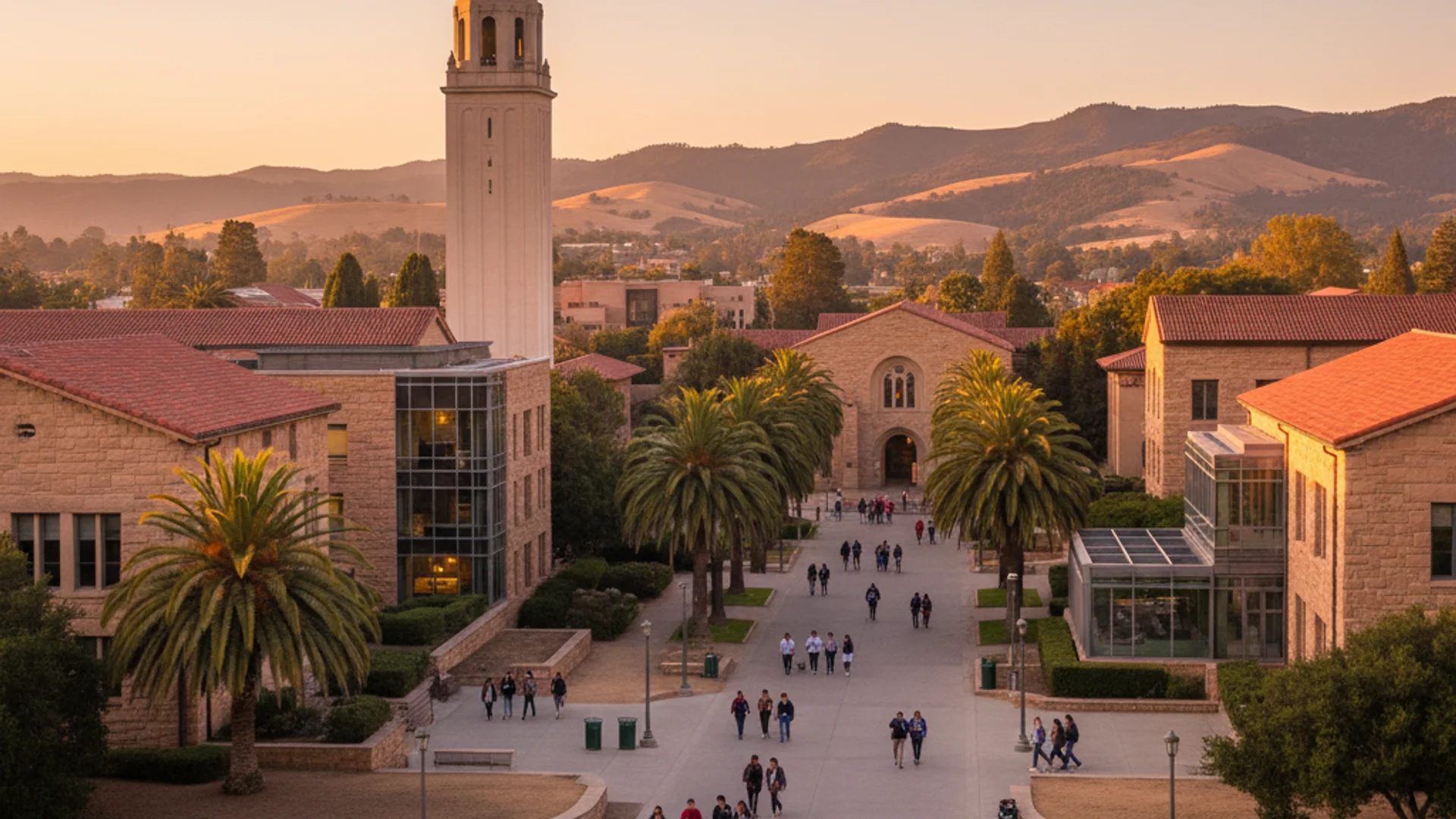
Compare the top artificial intelligence colleges in California. 130 accredited artificial intelligence schools ranked by graduation rate, career outcomes, and value, from De Anza College to University of California-Berkeley.
Best artificial intelligence degree programs: UC Berkeley, U of California-Irvine, UCLA
Ranked by graduation rates, program outcomes, and institutional quality
Tuition ranges from $1,104 to $66,640/year
De Anza College offers the most affordable option at $1,395/yr
Artificial Intelligence degree programs available: 72 associate's, 38 master's, 13 doctoral in California
From community college pathways to advanced research degrees
28 online artificial intelligence degree programs in California
Flexible scheduling for working professionals
California community college transfer can save 40-60% on total degree costs
72 associate's programs provide transfer pathways to bachelor's degrees
Education Commission of the States
Major employers: Google, Apple, Meta, Netflix
Tech hubs in San Francisco and San Jose
Hakia Research 2026
Artificial Intelligence degree programs near 230+ cities across California
Search by city to find programs within 200 miles of your location
Updated October 19, 2026
We rank 177 accredited artificial intelligence programs in California using IPEDS 2024 institutional data, BLS OEWS 2024 state salary data, and College Scorecard outcomes. A 4-factor weighted composite is normalized to a 0–100 score. Schools cannot pay for placement; rankings are produced algorithmically.
Are Artificial Intelligence Degree Programs in California Worth It?
Source: BLS OEWS May 2024
Compare the top-ranked Artificial Intelligence programs in California by degree level. Tuition, graduation rate, and Hakia Score for every accredited program.
California offers 38 master's degree programs in artificial intelligence, designed for professionals seeking to advance into senior engineering, technical leadership, and specialized roles. The top programs, U of Southern California, U of California-San Diego, U of California-Irvine, combine advanced technical training with research opportunities and leadership development.
Master's graduates in California earn a median salary of $145,770, approximately 20-30% higher than bachelor's degree holders. The concentration of technology companies in San Francisco, San Jose, Los Angeles creates strong demand for graduate-level talent, with Google, Apple, Meta actively recruiting from these programs.
Program formats include traditional full-time study (typically 2 years), part-time options for working professionals (2-3 years), and accelerated tracks. Tuition averages $17,657/yr, with many employers offering tuition reimbursement for graduate education. Some programs offer thesis and non-thesis tracks, allowing students to focus on research or professional development based on their career goals.
Curriculum covers advanced topics including machine learning, distributed systems, software architecture, and technical management. Many programs include practicum experiences, industry capstone projects, or consulting engagements that provide real-world application of advanced concepts. Among California's artificial intelligence schools at the graduate level, these programs stand out for both academic quality and career outcomes.
| Metric | Value |
|---|---|
| Average in-state tuition | $12,423/year |
| Average out-of-state tuition | $31,058/year |
| Community college tuition | $3,106/year |
| 4-year savings for residents | $74,540 |
| 2+2 transfer pathway savings | $18,634 |
Source: IPEDS 2024
Verdict: California AI students benefit from the strongest US state aid stack (Cal Grant, UC Blue and Gold Opportunity Plan, Middle Class Scholarship) combined with the world's deepest concentration of AI research funding and industry-track scholarships. Stanford HAI, Berkeley BAIR, USC Information Sciences Institute, and Caltech each carry substantial AI-specific institutional aid for admitted students. For California-resident AI-track students at UC campuses, the path from low-income family to debt-free CS/AI bachelor's plus PhD-funded research stipend is one of the most financially-efficient AI career trajectories anywhere in the world.
Cal Grant flows automatically from FAFSA, and the UC Blue and Gold Opportunity Plan covers full UC tuition for California families under $80,000. For UC Berkeley EECS, UCLA CS, UC San Diego CS, and UC Irvine CS, all AI-strong programs, this combination plus federal Pell can produce essentially-free AI-track bachelor's degrees for qualified Californians. The Middle Class Scholarship extends support to families up to ~$217,000.
California's AI-specific institutional aid concentration is unmatched anywhere in the world: Stanford offers no-loan financial aid for admitted students plus Stanford HAI graduate fellowships and Stanford AI Lab (SAIL) research funding. UC Berkeley offers substantial CS-with-AI-emphasis aid plus BAIR (Berkeley AI Research) graduate research stipends and NSF GRFP CS funding. Caltech offers no-loan undergraduate aid plus substantial AI research funding through CMS (Computing + Mathematical Sciences). USC offers institutional CS aid plus ISI (Information Sciences Institute) research stipends. UC San Diego, UCLA, and UC Irvine each have growing AI programs with substantial financial-aid commitments.
California Dream Act Application (CADAA) extends state-aid eligibility to undocumented California residents. Federal Pell stacks. Industry-track AI scholarships and research grants from California-based AI employers, Google DeepMind (Mountain View), OpenAI (San Francisco), Anthropic (San Francisco), Meta FAIR (Menlo Park), Apple AI/ML Research (Cupertino), Nvidia AI Research (Santa Clara), xAI (Palo Alto), Inflection, Adept, Character.AI, plus the substantial academic-industry AI fellowship pipeline (Google AI Residency, Meta AI Residency, OpenAI Residency, Anthropic Residency), provide additional funding that California students access at substantially higher rates than students from any other US state simply due to geographic proximity to recruiting events, on-campus information sessions, and the dense San Francisco/South Bay AI community.
Estimate your return on investment for a artificial intelligence degree
Leave blank to use average cost for selected program type
+1640%
Net gain divided by total investment. ROI above 200% is considered excellent for education investments.
$3,033,585
Your additional lifetime earnings with this degree vs. working without one, minus the total investment.
5 years
Years until your cumulative earnings exceed total investment. Shorter programs often break even faster due to lower opportunity cost.
$116,667
Your starting salary adjusted for local cost of living. This shows real purchasing power compared to a $100K national baseline.
Why does break-even change with program type? Your "total investment" includes both tuition AND opportunity cost (foregone earnings while in school). A 4-year full-time public university (in-state) means 4 years of not earning a salary ($140,000 in opportunity cost). Shorter full-time programs may have higher tuition but lower total investment because you return to the workforce sooner.
How we calculate your degree ROI using real salary data
Tuition plus opportunity cost (earnings you miss while in school)
Direct cost of the degree program
4 years × $35K/year foregone salary while studying full-time
Projected career earnings starting after graduation, with salary growth
What you'd earn working at $35K/year with 2% annual growth
Median salary for this role in your selected location (BLS 2024)
Your investment's compound annual growth rate (similar to stock market returns)
Data sources: BLS OEWS May 2024, IPEDS 2024. Calculations use median salaries, 3% discount rate, and assume salary growth declines from 6% to 2% over career. Individual results will vary. | Powered by Hakia.com
Median annual salary in California metro areas
| Category | Value |
|---|---|
| San Francisco | $160K |
| San Jose | $153K |
| Los Angeles | $146K |
| San Diego | $138K |
Source: BLS OEWS May 2024
Hakia.com
Find artificial intelligence jobs in California. These major employers across California metro areas are actively hiring artificial intelligence degree holders. Click employer names to view current job openings.
Silicon Valley remains the global center of tech innovation. Headquarters for Google, Apple, Meta, and thousands of startups.
Nearby cities: San Jose, Palo Alto, Mountain View, Sunnyvale, Santa Clara, Cupertino, Menlo Park, Redwood City
San Francisco is a major fintech and enterprise software hub. Salesforce Tower anchors a dense tech ecosystem.
Nearby cities: Oakland, Berkeley, Daly City, South San Francisco, San Mateo, Fremont
LA has a diverse tech scene spanning entertainment tech, aerospace, and ecommerce. SpaceX and Snap are headquartered here.
Nearby cities: Santa Monica, Culver City, Burbank, Pasadena, Long Beach, Irvine, El Segundo
San Diego is a biotech and defense technology hub. Qualcomm is headquartered here alongside major military contractors.
Nearby cities: La Jolla, Carlsbad, Chula Vista, Oceanside, Escondido, El Cajon
California concentrates roughly a third of all U.S. venture capital investment and houses the headquarters of every company in the top five U.S. tech market caps. For a CS graduate, that translates into denser-than-anywhere hiring pipelines — but it also means the supply of CS graduates is unusually large, and competition for entry-level roles at named employers is intense.
San Francisco, San Jose, Oakland, Berkeley
Global center for consumer internet, AI/ML research, and high-growth software startups. Entry-level total compensation at named employers regularly clears $200,000 for new bachelor's graduates from top programs.
Los Angeles County
Quieter but substantial tech market centered on entertainment-tech (Netflix, Disney Streaming, Riot, Activision-Blizzard), aerospace-adjacent software (SpaceX, Anduril, Northrop), and emerging fintech and consumer-app clusters.
San Diego County
Smaller but dense in defense, biotech-adjacent software, and Qualcomm-anchored wireless engineering.
California does not levy a separate state-level tech tax credit at scale; the federal R&D credit is the relevant lever for most tech employers.
Several California laws directly shape what CS graduates work on — particularly anyone joining a privacy, security, data, or AI team. These create both job market demand (compliance is a substantial employer concern) and constrain technical decisions in ways federal law does not.
Strongest US state privacy law. Requires explicit consumer rights around data access, deletion, and sale opt-out for any business serving California residents at scale.
Engineers joining privacy, data, or security teams at California employers engage with CCPA daily.
Read moreRequires data minimization, default privacy protections, and impact assessments for online products likely to be accessed by minors.
Drove significant engineering work at every consumer internet company headquartered in California.
Read moreCalifornia has issued executive-branch guidance on generative AI in state government and is the most active US state legislature on AI policy.
Engineers building AI products serving California users should expect material compliance overhead.
Read moreFirst US state privacy enforcement agency. Issues regulations under CCPA/CPRA and brings enforcement actions.
Tech-adjacent compliance work has grown substantially since CPPA stood up.
Read moreCalifornia recognizes Professional Engineer (PE) licensure in software engineering, but it is rarely required for industry work. ABET-EAC accredited SE degrees count toward PE eligibility; ABET-CAC CS does not. Most California CS graduates never seek PE licensure.
California licensing boardUp to ~$12,570/yr for UC, ~$5,742/yr for CSU, ~$1,094/yr for community college
California residents pursuing undergraduate degrees with demonstrated financial need
Varies by income tier
California undergrads at UC and CSU with family income up to $217,000
Full enrollment fee waiver
California residents at community college with financial need
Up to $5,000/yr
Current or former foster youth pursuing vocational training or college
Verdict: California's ASSIST.org articulation system supports AI-track transfer pathways well at the foundational level (calculus through multivariable, linear algebra, probability and statistics, discrete math, intro programming, data structures). The AI-specific consideration is that strong AI undergraduate coursework at UC Berkeley, UCLA, Stanford, and Caltech is genuinely difficult to access via transfer, these programs admit very few transfer students and the transfer admission process screens heavily on demonstrated mathematics depth and research-coding evidence. For California AI-track students, the more reliable pathways go through UC San Diego, UC Irvine, UC Davis, UC Santa Barbara, UC Santa Cruz, San Jose State, and Cal Poly San Luis Obispo, all of which have growing AI-emphasis CS programs with substantially more accessible transfer admission.
Best California community college AI-track-feeder schools: De Anza College (Cupertino, strong UC Berkeley, UCLA, and SJSU transfer record, refined AI/ML-prerequisite mathematics sequences including linear algebra and probability theory), Foothill College (Los Altos Hills, adjacent Bay Area AI industry exposure), Diablo Valley College (East Bay, strong UC Berkeley pipeline), Mt. San Antonio College (Mt. SAC) (Walnut, strong Cal Poly Pomona pipeline), Pasadena City College (strong Caltech and UCLA pipeline), and Santa Monica College. Each has refined mathematics and intro-CS sequences via ASSIST articulation that transfer cleanly into AI-strong UC and CSU programs.
The De Anza → UC Berkeley CS-with-AI-track pathway is genuinely difficult but not impossible, Berkeley CS transfer admission is roughly 5-15% for highly-qualified applicants. The De Anza → San Jose State AI-track pathway is substantially more accessible (transfer admission roughly 50-70% for qualified applicants) and produces graduates well-placed into Silicon Valley AI employment. The De Anza → UC San Diego CS-with-AI-track pathway is moderately competitive (transfer admission roughly 20-35%) and feeds the substantial San Diego AI cluster (Qualcomm AI Research, UCSD-affiliated AI startups, Salk Institute computational biology).
Beyond UC Berkeley: Stanford and Caltech effectively don't admit transfers for AI-track CS (transfer admission rates are typically 2-5% with admission heavily concentrated in non-engineering majors). UCLA CS is similarly competitive for transfers. The realistic California transfer pathways for AI-track CS are: UC San Diego, UC Irvine, UC Davis, UC Santa Barbara, UC Santa Cruz, San Jose State, Cal Poly San Luis Obispo, Cal Poly Pomona, and CSU Long Beach, each with growing AI-emphasis CS programs. For California AI-track students, the SJSU pathway is the accessible Silicon Valley optimization; UC San Diego is the strong UC AI optimization with substantial AI research depth; UC Davis and UC Santa Cruz are the affordable accessible UC alternatives; Berkeley/UCLA/Stanford/Caltech are the elite optimization for the most competitive applicants only.
Artificial Intelligence Job Growth in California
Source: BLS Occupational Outlook
Verdict: California has the largest AI job market on Earth by every meaningful metric. The San Francisco / Bay Area region hosts substantially every major frontier AI lab (Anthropic, OpenAI, Google DeepMind US, xAI, Inflection, Adept, Character.AI), plus the AI engineering organizations at every Big Tech employer (Google Brain/DeepMind, Meta FAIR, Apple AI/ML Research, Nvidia AI Research), plus the deepest AI startup ecosystem anywhere. Senior AI research scientist and ML engineer compensation at named Bay Area AI employers regularly clears $400,000-$800,000+ total compensation; principal/staff AI roles at frontier labs routinely exceed $1,000,000+ total compensation including equity.
By metro: Bay Area (San Francisco / San Jose / Oakland) averages ~$220,000-$320,000 for ML engineer roles and $250,000-$500,000+ for AI research scientist roles per Levels.fyi and frontier-lab compensation reporting. New-grad ML engineer offers at named frontier labs commonly start at $250,000-$400,000 total compensation; PhD-track AI research scientist offers often start at $400,000-$700,000+ at frontier labs. Major Bay Area AI employers: Anthropic (San Francisco), OpenAI (San Francisco), Google DeepMind (Mountain View, substantially the world's largest AI research organization following the Brain/DeepMind merger), xAI (Palo Alto), Meta FAIR (Menlo Park), Meta AI applied (Menlo Park), Apple AI/ML Research (Cupertino), Nvidia AI Research (Santa Clara, including the substantial Nvidia GPU-software/CUDA/cuDNN engineering organization), Inflection, Adept, Character.AI, Mistral US operations, Cohere US operations, plus a deep startup ecosystem.
Los Angeles averages ~$180,000-$240,000 for ML engineer roles with concentrations at Netflix ML platform engineering, Disney AI/ML applied research, Riot Games AI (game AI and player-modeling ML), SpaceX AI applications, plus the growing LA-area AI startup scene. San Diego averages ~$165,000-$215,000 anchored by Qualcomm AI Research (one of the largest US edge-AI and on-device ML research organizations), Illumina computational biology, Salk Institute computational neuroscience, plus the substantial UCSD-CS AI research pipeline.
Three California AI-specific dynamics: (1) The frontier AI lab compensation tier is meaningfully separate from typical Big Tech AI compensation, Anthropic, OpenAI, Google DeepMind, and xAI total compensation for senior AI research scientists and senior ML engineers regularly exceeds traditional Big Tech by $150,000-$400,000+ per year, primarily through equity. (2) California's AI hiring concentration creates exceptional career mobility, AI engineers and researchers who don't fit at their initial employer have dozens of substantially-equivalent alternatives within a 30-mile radius. (3) AI research residencies (Google AI Residency, Meta AI Residency, OpenAI Residency, Anthropic Residency) are increasingly the dominant new-grad AI research pipeline, substantially more selective than typical Big Tech engineering hiring and increasingly required for PhD-track AI research scientist roles. See AI/ML Engineer Career Guide and Machine Learning Engineer Career Guide.
New graduates and career changers
Technical leads and architects
28 available in California
Traditional classroom experience
Institutional characteristics, completions, graduation rates
California salary and employment data
Program details and admissions information
Last Updated: June 26, 2026. Rankings based on IPEDS 2024 data. Salary data from BLS OEWS May 2024.

Co-founder & Editor (B.S. Computer Science, Oregon State • B.A. Psychology, University of Washington)
Taylor combines technical expertise in computer science with a deep understanding of human behavior and learning. His dual background drives Hakia's mission: leveraging technology to build authoritative educational resources that help people make better decisions about their academic and career paths.
Hand-researched detail on the top-ranked programs: degree pathways, research labs, industry partners, career outcomes, and admissions. Tap any school to expand.
Why it stands out. Thesis option available (Thesis Option program listed separately). Coursework-only track available (no cumulative exam required)
Hakia insight. USC's MS in CS (AI) offers both thesis and coursework-only tracks with no cumulative exam required—a structural flexibility that appeals to working professionals, but the real edge is DoD partnerships that actively sponsor students for security clearances, converting tuition into immediate defense-sector employment.
The Master of Science in Computer Science (Artificial Intelligence) at USC Viterbi provides rigorous training in deep learning and AI applications including machine learning, statistics, computer vision, natural language processing, and robotics. The 32-unit program requires 20 units of core courses and 12 units of electives chosen from three specialized groups: Machine Learning and Deep Learning, Natural Language Processing and Speech Recognition, and Computer Vision and Robotics. Students must maintain a 3.0 GPA and have the option to pursue a thesis or complete coursework-only track. The program positions graduates for advanced roles in AI engineering, research, and leadership at major technology companies, with typical mid-career salary advancement of 40-60% over bachelor's degree holders in AI-focused roles.
Programs offered
Research labs & institutes
Industry partners
Notable faculty
Admissions
GPA 2.0. Deadline December 15.
Why it stands out. SJSU's Silicon Valley location and deep industry partnerships create a uniquely practical pipeline from coursework directly into competitive AI engineering roles at major tech firms.
Hakia insight. While proximity to tech giants matters, SJSU's real competitive advantage is its established alumni network already embedded across Google, Intel, and Cisco—meaning peer mentorship and referral pipelines begin before graduation, not after.
At the master's level, SJSU's computer science program benefits directly from its Silicon Valley location, where students gain internship and networking opportunities at leading AI companies integrated into the curriculum itself. The school offers specialized courses in machine learning, deep learning, computer vision, and data mining, with faculty who actively consult for industry—bringing cutting-edge techniques and real project challenges into the classroom. The capstone and senior design projects often partner with tech companies, allowing students to work on AI problems they'd encounter in their first industry roles. Graduates from SJSU are well-known in the Valley's hiring pipelines, particularly at companies like Google, Intel, Apple, and Cisco, where many alumni hold senior technical positions. The program strikes a practical balance: solid theoretical foundations paired with immediate industry relevance. Students benefit from a large, collaborative peer network and the constant influx of visiting engineers and recruiters on campus. SJSU's reputation in the Valley makes the degree a direct pathway to well-compensated ML and AI roles.
Programs offered
Industry partners
Career outcomes
Top employers: Google, Intel, Apple, Cisco, Nvidia, Amazon
Accreditation & certifications
Location advantage: Silicon Valley location provides direct access to Google, Intel, Apple, Cisco, Nvidia, and hundreds of AI-focused startups Established alumni networks at major tech companies facilitate recruiting and mentorship Proximity to cutting-edge AI research and product development centers