🥇
DigiPen Institute of Technology
Redmond, WAPrivate for-profit
$38,600
Tuition/yr
61%
Grad rate
72.6
Hakia Score
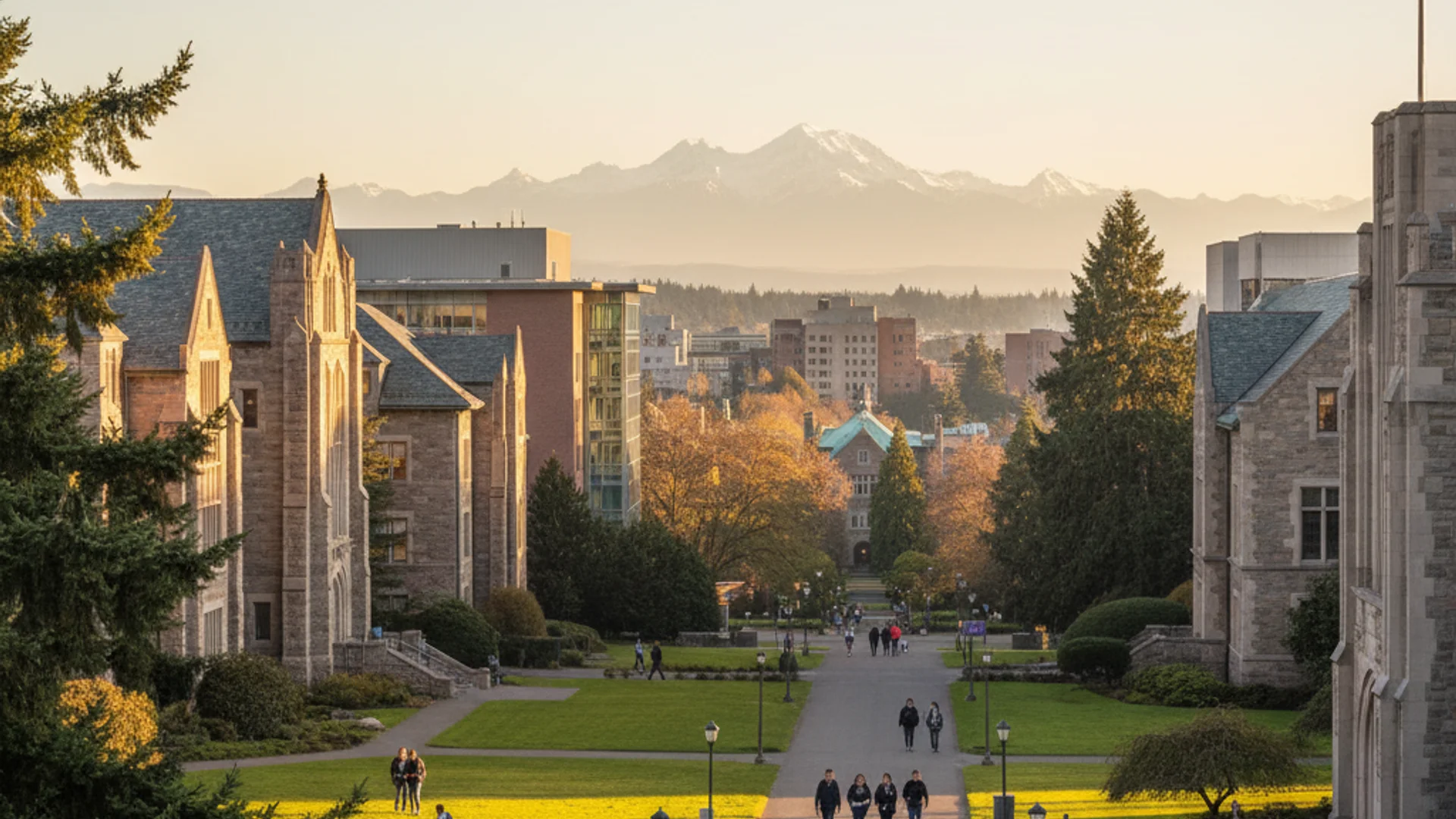
Compare the top artificial intelligence colleges in Washington. 31 accredited artificial intelligence schools ranked by graduation rate, career outcomes, and value, from Tacoma Community College to University of Washington-Seattle Campus.
Best artificial intelligence degree programs: U of Washington-Seattle, Seattle, Bellevue College
Ranked by graduation rates, program outcomes, and institutional quality
Tuition ranges from $3,195 to $59,340/year
Tacoma Community College offers the most affordable option at $4,477/yr
Artificial Intelligence degree programs available: 14 associate's, 8 master's, 1 doctoral in Washington
From community college pathways to advanced research degrees
16 online artificial intelligence degree programs in Washington
Flexible scheduling for working professionals
Washington community college transfer can save 40-60% on total degree costs
14 associate's programs provide transfer pathways to bachelor's degrees
Education Commission of the States
Major employers: Microsoft, Amazon, Boeing, Expedia
Tech hubs in Seattle and Bellevue
Hakia Research 2026
Artificial Intelligence degree programs near 43+ cities across Washington
Search by city to find programs within 200 miles of your location
Updated October 19, 2026
We rank 38 accredited artificial intelligence programs in Washington using IPEDS 2024 institutional data, BLS OEWS 2024 state salary data, and College Scorecard outcomes. A 4-factor weighted composite is normalized to a 0–100 score. Schools cannot pay for placement; rankings are produced algorithmically.
Are Artificial Intelligence Degree Programs in Washington Worth It?
Source: BLS OEWS May 2024
Compare the top-ranked Artificial Intelligence programs in Washington by degree level. Tuition, graduation rate, and Hakia Score for every accredited program.
Washington ranks among the nation's top destinations for artificial intelligence education, with 15 accredited bachelor's degree programs across 5 public and 9 private institutions. The highest-ranked programs are U of Washington-Seattle, Seattle, Bellevue College, recognized for academic excellence, research opportunities, and strong industry connections.
Graduates from Washington artificial intelligence programs earn a median salary of $123,446, 26% above the national average. The state's robust technology sector, anchored by the Seattle, Bellevue, Redmond metropolitan areas, provides abundant internship and employment opportunities with companies including Microsoft, Amazon, Boeing.
Tuition ranges from $4,074 to $59,340 annually, with an average of $31,993/yr. Top programs maintain graduation rates above 90%, with the highest reaching 100%. Many programs hold ABET accreditation, the gold standard for computing education, ensuring curriculum meets rigorous industry standards.
Students can choose from specializations including software engineering, cybersecurity, artificial intelligence, data science, and systems architecture. Strong industry partnerships provide access to co-op programs, capstone projects with real companies, and direct recruiting pipelines to Washington's leading technology employers. For students seeking artificial intelligence degrees in Washington, these top-ranked artificial intelligence schools offer the strongest combination of academic rigor and career preparation.
Washington offers 8 master's degree programs in artificial intelligence, designed for professionals seeking to advance into senior engineering, technical leadership, and specialized roles. The top programs, U of Washington-Seattle, Seattle, U of Washington-Bothell, combine advanced technical training with research opportunities and leadership development.
Master's graduates in Washington earn a median salary of $145,230, approximately 20-30% higher than bachelor's degree holders. The concentration of technology companies in Seattle, Bellevue, Redmond creates strong demand for graduate-level talent, with Microsoft, Amazon, Boeing actively recruiting from these programs.
Program formats include traditional full-time study (typically 2 years), part-time options for working professionals (2-3 years), and accelerated tracks. Tuition averages $20,421/yr, with many employers offering tuition reimbursement for graduate education. Some programs offer thesis and non-thesis tracks, allowing students to focus on research or professional development based on their career goals.
Curriculum covers advanced topics including machine learning, distributed systems, software architecture, and technical management. Many programs include practicum experiences, industry capstone projects, or consulting engagements that provide real-world application of advanced concepts. Among Washington's artificial intelligence schools at the graduate level, these programs stand out for both academic quality and career outcomes.
| Metric | Value |
|---|---|
| Average in-state tuition | $18,234/year |
| Average out-of-state tuition | $45,585/year |
| Community college tuition | $4,559/year |
| 4-year savings for residents | $109,404 |
| 2+2 transfer pathway savings | $27,350 |
Source: IPEDS 2024
Verdict: Washington AI students benefit from the strong Washington College Grant (WA Grant), the STEM-specific Opportunity Scholarship, and the substantial AI-specific institutional aid at UW Allen School of Computer Science & Engineering, one of the strongest US AI research programs anywhere, plus the substantial AI-research training pipeline through Allen Institute for AI (AI2) in Seattle. The combination of strong state aid + tier-1 UW Allen School AI programs + Microsoft's substantial post-OpenAI AI investment + Amazon AI/AGI labs creates one of the strongest AI funding-to-outcomes equations in US tech education.
WA Grant covers full tuition and fees at UW Seattle for in-state families at or below ~65% of state median income (~$70,000), with coverage scaling down to ~$108,000 family income. The College Bound Scholarship extends commitment-based aid for low-income 7th-8th graders. The STEM-specific Opportunity Scholarship adds up to $22,500 (across 5 years) for WA students pursuing STEM at participating WA institutions, AI/ML CS-track students qualify.
Washington's AI-specific institutional aid is concentrated at the UW Allen School of Computer Science & Engineering, one of the strongest US AI research programs by any meaningful metric (faculty depth, research-funding scale, frontier-lab placement, PhD program selectivity). UW Allen School AI faculty have trained substantial fractions of the senior leadership at Microsoft AI, Amazon AI, and OpenAI's earlier Seattle-area founding team. Allen Institute for AI (AI2) in Seattle, founded by Paul Allen and currently led by AI research veterans, offers substantial AI research training, predoctoral fellowships, and applied-AI research employment. Washington State University has growing CS-with-AI-emphasis programs at lower in-state tuition. Seattle University offers ABET-EAC CS with growing AI-emphasis.
Washington's particular AI-funding strength is the combined cost-and-outcomes equation: WA Grant + Opportunity Scholarship + UW Allen School AI research depth + the substantial Microsoft AI / Amazon AI / AI2 employment pipeline + no state income tax on post-graduation salaries. For Washington-resident AI-track students with appropriate eligibility, the path from low-income family to debt-free AI-track bachelor's at UW Allen School to high-paying Microsoft AI or Amazon AI engineering role is one of the most financially-efficient AI career trajectories in US tech. Industry-track scholarships from Microsoft AI, Amazon AI, AI2, and Washington-based AI employers provide additional funding most students don't pursue.
Estimate your return on investment for a artificial intelligence degree
Leave blank to use average cost for selected program type
+1430%
Net gain divided by total investment. ROI above 200% is considered excellent for education investments.
$2,646,062
Your additional lifetime earnings with this degree vs. working without one, minus the total investment.
5 years
Years until your cumulative earnings exceed total investment. Shorter programs often break even faster due to lower opportunity cost.
$126,667
Your starting salary adjusted for local cost of living. This shows real purchasing power compared to a $100K national baseline.
Why does break-even change with program type? Your "total investment" includes both tuition AND opportunity cost (foregone earnings while in school). A 4-year full-time public university (in-state) means 4 years of not earning a salary ($140,000 in opportunity cost). Shorter full-time programs may have higher tuition but lower total investment because you return to the workforce sooner.
How we calculate your degree ROI using real salary data
Tuition plus opportunity cost (earnings you miss while in school)
Direct cost of the degree program
4 years × $35K/year foregone salary while studying full-time
Projected career earnings starting after graduation, with salary growth
What you'd earn working at $35K/year with 2% annual growth
Median salary for this role in your selected location (BLS 2024)
Your investment's compound annual growth rate (similar to stock market returns)
Data sources: BLS OEWS May 2024, IPEDS 2024. Calculations use median salaries, 3% discount rate, and assume salary growth declines from 6% to 2% over career. Individual results will vary. | Powered by Hakia.com
Median annual salary in Washington metro areas
| Category | Value |
|---|---|
| Seattle | $160K |
| Bellevue | $152K |
| Redmond | $145K |
Source: BLS OEWS May 2024
Hakia.com
Find artificial intelligence jobs in Washington. These major employers across Washington metro areas are actively hiring artificial intelligence degree holders. Click employer names to view current job openings.
Seattle is home to Amazon and Microsoft headquarters, plus major engineering offices for Google, Meta, and other tech giants.
Nearby cities: Bellevue, Redmond, Kirkland, Tacoma, Renton
The Eastside corridor houses Microsoft's main campus in Redmond, Nintendo of America, and T-Mobile's headquarters.
Nearby cities: Redmond, Kirkland, Issaquah, Sammamish
Washington's tech economy is essentially defined by Microsoft and Amazon. The Seattle metro hosts the headquarters of both, plus major engineering offices for Google, Meta, Apple, and a dense second-tier of cloud, AI, and enterprise tech employers. With no state income tax and University of Washington's CS program at the top of the western US, Washington consistently posts the highest tech-job concentration per capita of any US state.
Seattle metropolitan area
Headquarters of Microsoft (Redmond) and Amazon (Seattle); major engineering offices for Google, Meta, Apple, Tableau, Tableau, Expedia, Zillow, Costco IT. UW is the dominant CS feeder; total-comp at named employers regularly clears $200K for new bachelor's grads.
Spokane metro
Smaller tech market focused on healthcare-IT (Providence), defense (Fairchild AFB-adjacent), and growing remote-work tech employment. Whitworth and WSU-Spokane feed the local market.
No state income tax. Washington levies a Business and Occupation tax on gross receipts that tech employers factor into compensation structures.
Washington has emerged as one of the more active state legislatures on AI, biometric privacy, and consumer health data. The 2024 My Health My Data Act in particular is among the strictest US consumer health-data laws and shapes engineering practice at any company touching health-adjacent data.
Effective March 2024. Imposes strict requirements on collection, use, and sharing of consumer health data — broadly defined to include data inferring health status. Provides a private right of action.
Engineers at any company processing wellness, fitness, mental-health, or biometric data of WA users must implement consent, geofencing, and data-sharing restrictions. The law's broad scope of 'health data' makes it relevant for surprising amounts of consumer-tech work.
Read moreRequires notice and consent before enrolling biometric identifiers in a database for commercial purposes.
Similar in shape to Illinois BIPA though narrower; engineers building biometric features for WA users must implement consent flows.
Read moreWashington has passed and continues to develop AI-specific legislation around government use, deepfake elections content, and consumer disclosure.
AI/ML engineers building products serving WA users should monitor evolving disclosure and bias-audit requirements.
Read moreWashington does not currently administer a separate Software Engineering PE license. Standard engineering disciplines require ABET-EAC accreditation for PE eligibility; software engineering is not a Washington-recognized PE discipline.
Washington licensing boardUp to $11,840/yr at public 4-year, up to $4,180/yr at community college
WA residents with family income up to ~70% of state median income (~$70,000)
Covers tuition and fees at participating WA institutions
WA students who sign up in 7th-8th grade with family income at or below 65% state median income; must maintain 2.0+ GPA and stay crime-free
N/A — application channel
WA students ineligible for federal FAFSA (e.g., undocumented) — opens access to state aid programs
Up to $22,500 total (across 5 years)
WA students pursuing STEM or healthcare bachelor's at participating WA institutions with family income at or below 125% state median
Verdict: Washington's Direct Transfer Agreement (DTA) provides guaranteed junior-standing admission at Washington public 4-year institutions for AA-degree graduates. The AI-specific consideration is that UW Allen School AI-track CS transfer admission is genuinely competitive (Allen School is one of the most selective US CS programs, AI-track included) while UW Bothell, UW Tacoma, Washington State, Seattle University, and Western Washington University have substantially more accessible transfer admission and produce graduates well-placed into Microsoft AI, Amazon AI, and AI2-adjacent employment.
Best Washington community college AI-track-feeder schools: Bellevue College (strong UW transfer record, refined AI-prerequisite mathematics including linear algebra, multivariable calculus, probability theory, and discrete mathematics, geographically adjacent to Microsoft Redmond and Bellevue tech employers), Edmonds College, Highline College, Seattle Central College, and Tacoma Community College. Each has DTA-aligned coursework that transfers cleanly into Washington public 4-year AI-track CS programs.
The Bellevue College → UW Bothell or UW Tacoma AI-track CS pathway is more reliable than the Bellevue College → UW Seattle Allen School AI path, both UW-system alternatives have substantially more open transfer admission while still producing well-placed graduates into Microsoft AI and Amazon AI engineering. Bellevue College → Seattle University CS-with-AI-emphasis is the substantially-accessible private alternative with strong Microsoft and Amazon recruiting relationships.
Beyond UW Seattle: UW Bothell and UW Tacoma are substantially more accessible than UW Seattle Allen School and feed Seattle-area AI employment effectively. Washington State University has growing AI programs across multiple departments. Western Washington University (Bellingham) has CS programs with AI-emphasis at affordable in-state tuition. Seattle University is the standout ABET-EAC CS with growing AI-emphasis. Whitworth University, Gonzaga University, and Pacific Lutheran University offer CS programs with growing AI-emphasis at small-private scale. For Washington AI-track students, the UW Bothell pathway is the accessible UW-system AI optimization; Seattle University is the substantially-accessible private optimization with strong Microsoft/Amazon placement; WSU is the affordable comprehensive option; UW Seattle Allen School is the elite optimization for the most competitive AI-track applicants only.
Washington Take-Home Pay Advantage
Source: Washington Department of Revenue
Verdict: Washington has one of the largest US AI job markets following Microsoft's substantial AI investment post-OpenAI partnership and Amazon's substantial AI/AGI organizational expansion. Microsoft AI (across Azure AI, Microsoft AI Research, GitHub Copilot, Bing Chat / Copilot, M365 Copilot, plus the substantial Microsoft AI Research Lab Redmond) employs thousands of AI engineers and AI researchers in the Seattle-Bellevue-Redmond area. Amazon AI / AGI (across AWS AI, Alexa AI, Amazon AGI Labs, plus Amazon Science) similarly employs thousands of AI engineers and AI researchers. Allen Institute for AI (AI2) in Seattle is one of the substantial US non-profit AI research organizations. Plus the substantial Seattle-area AI startup ecosystem. Nominal Seattle AI compensation rivals Bay Area frontier-lab levels, and adjusted for no state income tax, Seattle AI take-home compensation often exceeds equivalent Bay Area roles.
By metro: Seattle / Bellevue / Redmond averages ~$230,000-$330,000 for ML engineer roles and $300,000-$550,000+ for AI research scientist roles per Levels.fyi and frontier-AI compensation reporting. Microsoft AI is the dominant employer, the Microsoft AI Research Lab Redmond is one of the world's largest industrial AI research operations with substantial research output across foundation models, reinforcement learning, AI safety, and applied AI for healthcare and science. Microsoft's substantial OpenAI partnership has created tens of thousands of Microsoft-internal AI engineering roles building Azure OpenAI Service, GitHub Copilot, Bing Chat / Copilot, M365 Copilot, Windows Copilot, plus enterprise-AI integrations across the entire Microsoft product portfolio.
Amazon AI / AGI is similarly substantial, Amazon AGI Labs (formerly Amazon AGI organization) employs senior AI research leadership. AWS AI services (Bedrock, SageMaker, Comprehend, Polly, Rekognition, Personalize) employ thousands of ML engineers. Alexa AI is one of the largest US voice-AI organizations. Amazon Science is a substantial industrial AI research publication arm. Allen Institute for AI (AI2) is the distinctive Seattle AI employer, non-profit AI research with substantial output across OLMo (open foundation models), Aristo (scientific reasoning), Mosaic (commonsense reasoning), plus the substantial AI2 predoctoral fellowship pipeline that has trained substantial fractions of senior US AI researchers. Other Seattle-area AI employers: Apple's substantial Seattle AI/ML engineering office, Google's substantial Seattle AI/ML engineering office, Meta's growing Seattle AI presence, plus the Seattle AI startup ecosystem (XaiPient, Curai, Modulate, plus dozens of applied-AI startups).
Three Washington AI-specific dynamics: (1) The Microsoft + Amazon combined AI hiring pipeline is structurally unique, both companies hire substantial AI-track new-grad cohorts annually and have aggressively expanded AI engineering organizations through 2024-2026 even as broader tech hiring contracted. (2) AI2's role as an AI research training pipeline is meaningfully different from frontier-lab employment, AI2 predoctoral fellows often go on to top US AI PhD programs, providing a meaningful alternative to direct industry entry. (3) Microsoft's OpenAI partnership creates exceptional Azure OpenAI Service engineering opportunities that don't exist anywhere else, building enterprise-grade infrastructure for substantially every major US enterprise's GenAI deployment is a substantially-differentiated AI engineering career path. See AI/ML Engineer Career Guide and Machine Learning Engineer Career Guide.
New graduates and career changers
Technical leads and architects
16 available in Washington
Traditional classroom experience
Institutional characteristics, completions, graduation rates
Washington salary and employment data
Program details and admissions information
Last Updated: June 26, 2026. Rankings based on IPEDS 2024 data. Salary data from BLS OEWS May 2024.

Co-founder & Editor (B.S. Computer Science, Oregon State • B.A. Psychology, University of Washington)
Taylor combines technical expertise in computer science with a deep understanding of human behavior and learning. His dual background drives Hakia's mission: leveraging technology to build authoritative educational resources that help people make better decisions about their academic and career paths.
Hand-researched detail on the top-ranked programs: degree pathways, research labs, industry partners, career outcomes, and admissions. Tap any school to expand.
Why it stands out. Fully online part-time option for working professionals. Stackable certificate pathway—students can earn certificates individually before completing master's
Hakia insight. UW-Seattle's stackable certificate pathway deliberately targets Boeing engineers mid-career: they can earn a Systems AI certificate while staying employed, then layer it toward a full MS without restarting, cutting time-to-advanced-credential from 2 years to as little as 6 months.
The Master of Science in Artificial Intelligence and Machine Learning for Engineering is a flexible, stackable degree designed for working engineers to advance their careers by applying modern AI and ML methods to engineering problems. The program offers fully online, part-time options alongside full-time attendance. Students earn the degree by completing two stackable graduate certificates (one required AI/ML certificate plus a discipline-specific certificate in areas like dynamic systems, data analytics, materials engineering, or human-centered AI) followed by a 2-quarter applied capstone project. No standardized test (GRE) is required for admission. The program emphasizes real-world engineering applications with physical constraints (manufacturing, robotics, chemical processes) and includes industry partnerships, notably with Boeing. Graduates advance to roles applying AI/ML in their engineering domains, with mid-career salary increases typical for engineers gaining advanced AI competency.
Programs offered
Research labs & institutes
Industry partners
Career outcomes
Top employers: Boeing
Notable faculty
Admissions
GPA 3.0.
Accreditation & certifications
Why it stands out. City University delivers flexible, accelerated AI and machine learning education designed for working professionals, with evening/hybrid delivery and faculty maintaining active industry roles.
Hakia insight. City University's faculty who maintain active industry roles create an unusual dynamic: your algorithms professor is debugging production systems by day, so lectures embed real failure modes and recovery patterns that textbooks never capture.
City University of Seattle serves a distinct student population—working professionals, adult learners, and career-changers—through flexible, accelerated degree programs designed around real-world schedules. The Master's in Computer Science includes specializations in data science and machine learning, offered in evening and hybrid formats so students can work full-time while studying. Coursework covers foundational machine learning theory alongside practical applications in Python, TensorFlow, and cloud platforms. The program's strength lies in its accessibility and relevance to Seattle's vibrant tech market; many faculty maintain active roles in industry, and classmates are practitioners bringing immediate workplace context to discussions. Cohort-based learning in smaller groups creates peer networks that often extend into collaborative projects and job referrals post-graduation. Tuition is competitive, and the program explicitly targets career advancement rather than academic prestige. Students often enter with IT, engineering, or analytical backgrounds and emerge qualified for AI/ML engineer, data scientist, or analyst roles. For career-focused adults seeking practical skills and direct market relevance without leaving employment, City University's accelerated format and industry-connected curriculum offer a pragmatic, time-efficient pathway into AI.
Programs offered
Location advantage: Seattle tech hub proximity; cohort-based learning with local industry professionals