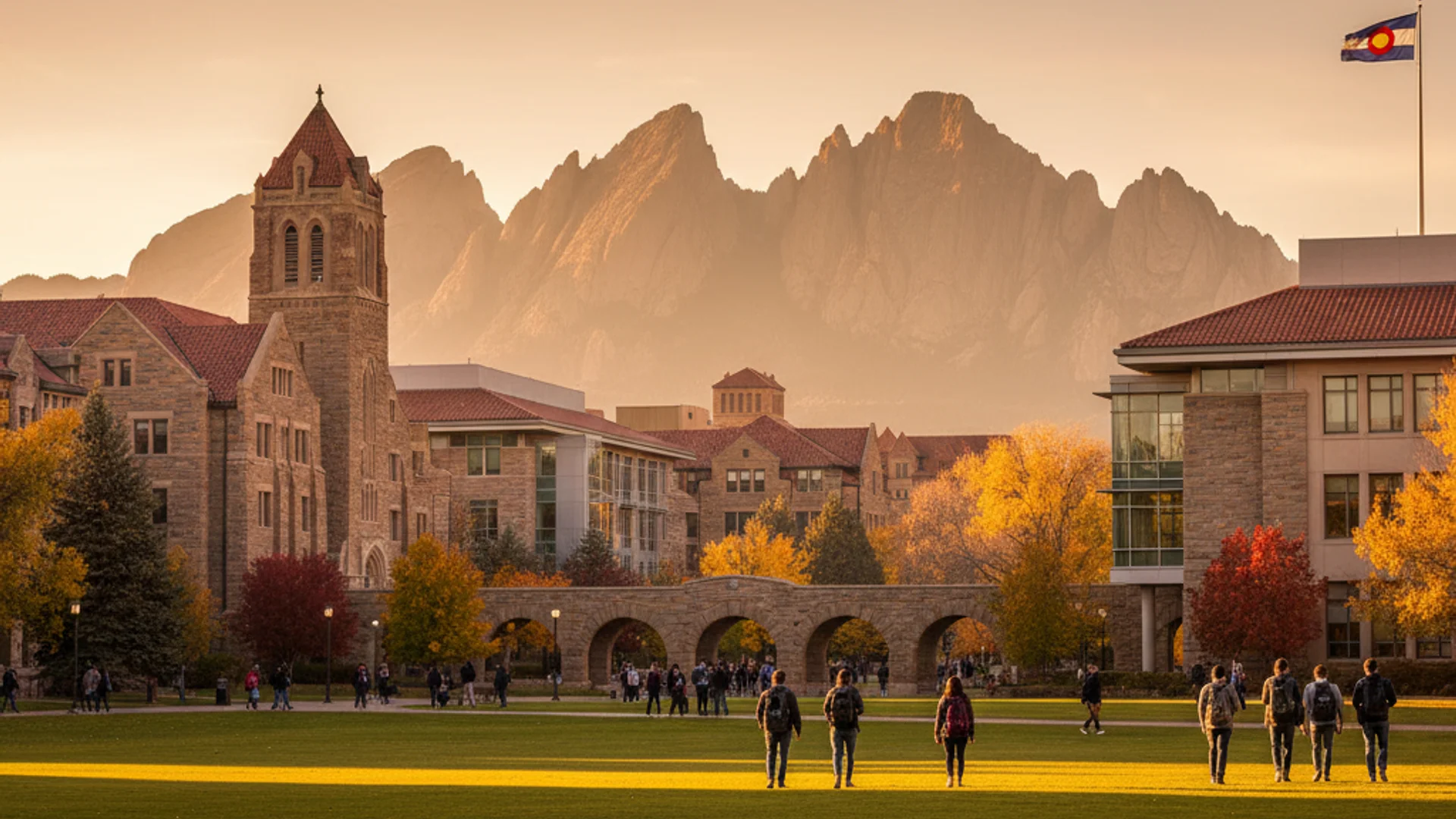
University campus in Colorado
Updated June 28, 2026

Best Artificial Intelligence Degree Programs in Colorado, 2026 Rankings

Compare the top artificial intelligence colleges in Colorado. 9 accredited artificial intelligence schools ranked by graduation rate, career outcomes, and value, from Community College of Aurora to University of Colorado Boulder.

#1 ProgramU of Colorado Boulder
Avg Salary$121,440
Tuition From$3,754/yr
Job Growth+22%
On this page
Reviewed by Taylor Rupe, Founder & EditorSee methodology

17

Programs ranked

IPEDS 2024

$121,440

Colorado median artificial intelligence salary

BLS OEWS 2024

88/100

Top program score

Hakia methodology

23%

U.S. job growth (2023–33)

BLS projections

Key Takeaways

Best artificial intelligence degree programs: U of Colorado Boulder, Colorado Technical Univer..., Colorado School of Mines

Ranked by graduation rates, program outcomes, and institutional quality

IPEDS 2024

Tuition ranges from $3,754 to $58,032/year

Community College of Aurora offers the most affordable option at $3,754/yr

IPEDS 2024

Artificial Intelligence degree programs available: 1 associate's, 5 master's, 3 doctoral in Colorado

From community college pathways to advanced research degrees

IPEDS 2024

Colorado community college transfer can save 40-60% on total degree costs

1 associate's programs provide transfer pathways to bachelor's degrees

Education Commission of the States

Major employers: Arrow Electronics, IHS Markit, Lockheed Martin, Ping Identity

Tech hubs in Denver and Boulder

Hakia Research 2026

Artificial Intelligence degree programs near 31+ cities across Colorado

Search by city to find programs within 200 miles of your location

IPEDS 2024

Updated June 28, 2026

How we ranked Colorado Artificial Intelligence programs

We rank 17 accredited artificial intelligence programs in Colorado using IPEDS 2024 institutional data, BLS OEWS 2024 state salary data, and College Scorecard outcomes. A 4-factor weighted composite is normalized to a 0–100 score. Schools cannot pay for placement; rankings are produced algorithmically.

Program completions (35%)Graduation rate (25%)Selectivity (20%)Career outcomes (20%)
See full methodology

Are Artificial Intelligence Degree Programs in Colorado Worth It?

Answer
$121,440
Yes. The best artificial intelligence degree programs in Colorado deliver strong ROI, graduates earn $121,440 median salary with +22% job growth through 2032. In-state tuition averages $20,723/year.

Source: BLS OEWS May 2024

Artificial Intelligence Degree Rankings in Colorado

Compare the top-ranked Artificial Intelligence programs in Colorado by degree level. Tuition, graduation rate, and Hakia Score for every accredited program.

Best Associate's Artificial Intelligence Programs in Colorado

1
Programs ranked
$3,754
Avg tuition/yr
0%
Avg grad rate

Program Landscape

Colorado offers 1 accredited associate's degree programs in artificial intelligence, providing an affordable entry point into the technology field. The top-ranked programs include Community College of Aurora, which combine rigorous technical curriculum with practical skills training.

Costs & Value

Community colleges in Colorado offer these two-year programs at an average cost of $3,754/yr, significantly less than four-year university tuition. Students completing associate's degrees can pursue entry-level technical positions and transfer opportunities, with entry-level salaries averaging $66,792 in Colorado.

Career Pathways

Many programs feature guaranteed transfer agreements with Colorado's public universities, allowing students to complete their first two years at reduced cost before transferring to complete a bachelor's degree. The Denver, Boulder, Colorado Springs areas offer particularly strong job markets for associate's degree holders, with employers like Arrow Electronics, IHS Markit, Lockheed Martin hiring for technical support, junior development, and IT specialist positions.

Curriculum & Specializations

Programs typically include coursework in programming fundamentals, database management, networking basics, and software development. Among artificial intelligence schools in Colorado, these associate's programs offer the best value for students beginning their artificial intelligence degrees in Colorado.

Best Bachelor's Artificial Intelligence Programs in Colorado

8
Programs ranked
$23,147
Avg tuition/yr
85%
Avg grad rate

Program Landscape

Colorado ranks among the nation's top destinations for artificial intelligence education, with 8 accredited bachelor's degree programs across 5 public and 2 private institutions. The highest-ranked programs are U of Colorado Boulder, Colorado Technical Univer..., Colorado School of Mines, recognized for academic excellence, research opportunities, and strong industry connections.

Career Outcomes

Graduates from Colorado artificial intelligence programs earn a median salary of $103,224, 5% above the national average. The state's robust technology sector, anchored by the Denver, Boulder, Colorado Springs metropolitan areas, provides abundant internship and employment opportunities with companies including Arrow Electronics, IHS Markit, Lockheed Martin.

Costs & Value

Tuition ranges from $8,738 to $58,032 annually, with an average of $23,147/yr. Top programs maintain graduation rates above 85%, with the highest reaching 89%. Many programs hold ABET accreditation, the gold standard for computing education, ensuring curriculum meets rigorous industry standards.

Curriculum & Specializations

Students can choose from specializations including software engineering, cybersecurity, artificial intelligence, data science, and systems architecture. Strong industry partnerships provide access to co-op programs, capstone projects with real companies, and direct recruiting pipelines to Colorado's leading technology employers. For students seeking artificial intelligence degrees in Colorado, these top-ranked artificial intelligence schools offer the strongest combination of academic rigor and career preparation.

Show all 8 ranked programs
RankSchoolLocationTypeTuitionGrad RateHakia Score
#6University of Colorado Colorado SpringsColorado Springs, COPublic$8,73864.1
#7Metropolitan State University of DenverDenver, COPublic$8,86862.0
#8Regis UniversityDenver, COPrivate$41,99050.6

Best Master's Artificial Intelligence Programs in Colorado

5
Programs ranked
$22,234
Avg tuition/yr
85%
Avg grad rate

Program Landscape

Colorado offers 5 master's degree programs in artificial intelligence, designed for professionals seeking to advance into senior engineering, technical leadership, and specialized roles. The top programs, Colorado Technical Univer..., U of Colorado Boulder, Colorado School of Mines, combine advanced technical training with research opportunities and leadership development.

Career Outcomes

Master's graduates in Colorado earn a median salary of $121,440, approximately 20-30% higher than bachelor's degree holders. The concentration of technology companies in Denver, Boulder, Colorado Springs creates strong demand for graduate-level talent, with Arrow Electronics, IHS Markit, Lockheed Martin actively recruiting from these programs.

Costs & Value

Program formats include traditional full-time study (typically 2 years), part-time options for working professionals (2-3 years), and accelerated tracks. Tuition averages $22,234/yr, with many employers offering tuition reimbursement for graduate education. Some programs offer thesis and non-thesis tracks, allowing students to focus on research or professional development based on their career goals.

Curriculum & Specializations

Curriculum covers advanced topics including machine learning, distributed systems, software architecture, and technical management. Many programs include practicum experiences, industry capstone projects, or consulting engagements that provide real-world application of advanced concepts. Among Colorado's artificial intelligence schools at the graduate level, these programs stand out for both academic quality and career outcomes.

Best Doctoral Artificial Intelligence Programs in Colorado

3
Programs ranked
$30,111
Avg tuition/yr
83%
Avg grad rate

Program Landscape

Colorado is home to 3 doctoral programs in artificial intelligence, preparing students for research positions, faculty appointments, and executive technical roles. Leading programs at U of Colorado Boulder, Colorado School of Mines, U of Denver are recognized for cutting-edge research, strong faculty publications, and competitive funding packages.

Career Outcomes

Doctoral graduates command premium salaries, with Colorado PhD holders earning a median of $151,800, reflecting the advanced expertise required for research and executive positions. The Denver, Boulder, Colorado Springs region's research universities and corporate R&D centers provide extensive collaboration opportunities with industry leaders like Arrow Electronics, IHS Markit, Lockheed Martin.

Costs & Value

PhD programs typically require 4-6 years of full-time study, including coursework, qualifying examinations, and original dissertation research. Many programs offer full funding through teaching or research assistantships, covering tuition and providing stipends of $25,000–$40,000 annually.

Curriculum & Specializations

Research strengths across Colorado programs include artificial intelligence, cybersecurity, human-computer interaction, systems, and theoretical computer science. For aspiring researchers pursuing artificial intelligence degrees in Colorado, graduates go on to careers as university faculty, industry research scientists, or technical executives, contributing to advances in technology that impact millions of users worldwide.

Artificial Intelligence Degree Costs & Tuition in Colorado

MetricValue
Average in-state tuition$20,723/year
Average out-of-state tuition$51,808/year
Community college tuition$5,181/year
4-year savings for residents$124,340
2+2 transfer pathway savings$31,084

Source: IPEDS 2024

Financial Aid & Scholarships for Artificial Intelligence Students in Colorado

State Aid Programs

The College Opportunity Fund (COF) provides $116 per credit hour for eligible Colorado residents at public institutions (CDHE COF). For full-time students (15 credits/semester), COF contributes $1,740/semester or $3,480/year. Lifetime maximum is 145 undergraduate credit hours. To receive COF, create an account and authorize your institution. Combined with need-based Colorado Student Grant and federal Pell Grant (up to $7,395 for 2025-26), in-state students can significantly reduce out-of-pocket costs.

Key Programs & Amounts

AI-specific scholarship opportunities: Tech companies with Colorado presence fund scholarships at partner universities - Google, Lockheed Martin, and Arrow Electronics all sponsor computing scholarships. The Colorado Promise programs at various institutions cover tuition for students with family income below $60,000-$70,000. CU Boulder's Promise program, CSU's Tuition+ Promise, and similar programs eliminate tuition for qualifying students. STEM-focused scholarships from professional organizations (ACM, IEEE) also apply to AI programs.

Institutional Scholarships

Graduate funding for AI programs: Research assistantships (RAs) and teaching assistantships (TAs) at CU Boulder cover tuition plus $25,000-$35,000 annual stipend for PhD students. MS students may receive partial funding. Industry-sponsored research in AI (Google, Lockheed Martin, NCAR partnerships) provides additional funding opportunities. Graduate students should apply for NSF Graduate Research Fellowships ($37,000/year stipend plus tuition) - AI/ML research proposals are highly competitive. Colorado's aerospace industry funds graduate research in autonomous systems and space AI.

Artificial Intelligence Degree ROI Calculator, Colorado

Use our interactive ROI calculator to estimate your return on investment for a artificial intelligence degree in Colorado. Enter your expected tuition costs, financial aid, and career goals to see projected payback periods and lifetime earnings. The calculator uses current salary data from BLS and tuition data from IPEDS to provide accurate estimates.

Artificial Intelligence Degree ROI Calculator

Estimate your return on investment for a artificial intelligence degree

Leave blank to use average cost for selected program type

20 years
10 years20 years30 years
20-Year ROI

+959%

Net gain divided by total investment. ROI above 200% is considered excellent for education investments.

Net Gain

$1,774,135

Your additional lifetime earnings with this degree vs. working without one, minus the total investment.

Break-Even

5 years

Years until your cumulative earnings exceed total investment. Shorter programs often break even faster due to lower opportunity cost.

COL-Adjusted Salary

$131,818

Your starting salary adjusted for local cost of living. This shows real purchasing power compared to a $100K national baseline.

Why does break-even change with program type? Your "total investment" includes both tuition AND opportunity cost (foregone earnings while in school). A 4-year full-time public university (in-state) means 4 years of not earning a salary ($140,000 in opportunity cost). Shorter full-time programs may have higher tuition but lower total investment because you return to the workforce sooner.

Detailed Breakdown

How we calculate your degree ROI using real salary data

Total Investment$185,000

Tuition plus opportunity cost (earnings you miss while in school)

Program Cost (Tuition)$45,000

Direct cost of the degree program

Opportunity Cost$140,000

4 years × $35K/year foregone salary while studying full-time

20-Year Earnings (with degree)$2,809,543

Projected career earnings starting after graduation, with salary growth

20-Year Earnings (without degree)$850,408

What you'd earn working at $35K/year with 2% annual growth

Starting Salary (Denver, CO)$145,000

Median salary for this role in your selected location (BLS 2024)

Annualized Return5.1%

Your investment's compound annual growth rate (similar to stock market returns)

Data sources: BLS OEWS May 2024, IPEDS 2024. Calculations use median salaries, 3% discount rate, and assume salary growth declines from 6% to 2% over career. Individual results will vary. | Powered by Hakia.com

Artificial Intelligence Salaries by Metro Area

Median annual salary in Colorado metro areas

Denver$134K
Boulder$128K
Colorado Springs$121K
View data table
CategoryValue
Denver$134K
Boulder$128K
Colorado Springs$121K

Source: BLS OEWS May 2024

Hakia.com

Top Employers Hiring Artificial Intelligence Graduates in Colorado

Find artificial intelligence jobs in Colorado. These major employers across Colorado metro areas are actively hiring artificial intelligence degree holders. Click employer names to view current job openings.

Artificial Intelligence Jobs in Denver/Boulder

CO

Denver/Boulder is a growing tech hub with aerospace heritage, outdoor lifestyle appeal, and a thriving startup ecosystem.

Nearby cities: Boulder, Westminster, Broomfield, Englewood, Littleton

Google
Search/Cloud/AI
Amazon
E-commerce/Cloud
Microsoft
Enterprise Software
Meta
Social/VR/AI
Apple
Consumer Electronics
Oracle
Enterprise Software
Lockheed Martin
Defense/Aerospace
Arrow Electronics
Electronics Distribution
DISH Network
Telecommunications
Palantir
Data Analytics
Ibotta
Fintech/Rewards
SendGrid (Twilio)
Communications API

Transfer Pathways for Artificial Intelligence Degrees in Colorado

State Transfer System

Colorado's gtPathways system facilitates transfer of general education courses between public institutions (CDHE gtPathways). However, AI-focused programs fall under Computer Science or Engineering, where gtPathways has limitations. Engineering and CS programs often require specific prerequisite sequences that may not transfer under general gtPathways agreements. Students should consult directly with their target university's engineering advising office before completing coursework at community college.

How Transfers Work

Strategic transfer planning for AI programs:

  1. 1Complete calculus through differential equations at community college (MATH 1401, 1402, 2301)
  2. 2Take discrete mathematics, linear algebra, and probability/statistics
  3. 3Complete CS1 and CS2 (data structures) - verify specific course requirements with target university
  4. 4Build Python programming skills with AI-relevant projects
  5. 5Maintain 3.5+ GPA for competitive admission to CU Boulder Engineering
  6. 6Consider summer research programs (REUs) to strengthen graduate applications

Transfer Planning Tips

Community college pathways: Arapahoe Community College, Front Range Community College, and Community College of Denver all offer pre-engineering and CS transfer programs. The Associate of Science in Computer Science at these institutions is designed for four-year transfer. Complete in two years for approximately $5,000-$7,000 total (after COF stipend), then transfer to CU Boulder or CSU for upper-division AI coursework. This pathway saves $20,000-$30,000 compared to starting at a four-year university. Online community college options allow flexible scheduling for working students.

Why Pursue an Artificial Intelligence Degree in Colorado?

Industry & Workforce

Colorado is a major AI hub, with the Denver-Boulder corridor experiencing 35% growth in AI/ML job postings since 2023 (Colorado Technology Association 2024 Report). The state's tech workforce of 129,040 workers includes a rapidly growing AI segment, driven by both established tech giants and innovative startups. Google's Boulder office houses significant machine learning operations, while companies like The Aerospace Corporation and Lockheed Martin are pioneering AI applications in defense and space systems. Colorado ranks as the third most concentrated tech economy nationally, creating exceptional opportunities for AI specialists (CompTIA State of Tech Workforce 2025).

Salary Outlook

AI salaries in Colorado are exceptional.

Machine Learning Engineers in Boulder command $151,000-$226,000 annually at top employers, with AI Research Scientists earning even higher at specialized firms (Levels.fyi). Data Scientists with AI focus earn a median of $140,000 in Denver, while entry-level AI positions start around $95,000-$110,000. The national median for AI-related roles is approximately $150,000, but Colorado's combination of competitive salaries and lower cost-of-living compared to California or New York means greater purchasing power for AI professionals.

Regional Tech Hubs

Colorado's AI ecosystem spans multiple industries.

Beyond traditional tech, Colorado leads in aerospace AI (autonomous systems, satellite intelligence), healthcare AI (medical imaging, drug discovery), and clean energy AI (smart grid optimization, renewable energy prediction). The National Center for Atmospheric Research (NCAR) in Boulder applies AI to climate modeling and weather prediction. CU Boulder's AI research programs collaborate with NIST Boulder on AI standards and safety. This diverse application landscape means AI graduates can pursue careers beyond Silicon Valley-style tech companies. Compare programs in California, Texas, or explore our national AI rankings.

Artificial Intelligence Job Growth in Colorado

15%
The Bureau of Labor Statistics projects 15% growth for artificial intelligence occupations in Colorado through 2024-2034. The median salary stands at $121,440 with 9 accredited programs statewide.

Source: BLS Occupational Outlook

Artificial Intelligence Job Market & Salary Data in Colorado

Employment Outlook

Colorado's AI job market shows exceptional growth.

The BLS projects 36% growth for AI-related occupations (data scientists, machine learning engineers) from 2024-2034, far exceeding the national average (BLS Occupational Outlook). Colorado's tech industry added 47,440 net new jobs over five years, with AI roles representing an increasing share. The state's defense sector drives significant AI demand: Lockheed Martin, Northrop Grumman, and Raytheon all seek AI specialists for autonomous systems, predictive maintenance, and intelligence analysis. Google Boulder has expanded its ML engineering team, while Amazon's Denver operations hire AI talent for Alexa and AWS AI services.

Salaries by Metro

Metro-specific AI opportunities:

  • Boulder: AI/ML hub with Google, Twitter/X labs, and 50+ AI startups. Machine Learning Engineers earn $151,000-$226,000. Strong university-industry pipeline from CU Boulder's AI programs. Venture capital actively funds AI ventures.
  • Denver: Corporate AI adoption drives demand. Data Scientists with AI skills earn $125,000-$160,000. Major employers include Arrow Electronics, Ibotta, and Guild Education applying AI to business problems.
  • Colorado Springs: Defense AI dominates. NORAD and Space Force installations seek AI specialists with security clearances. Lockheed Martin pays $129,300-$213,400 for senior AI roles. Clearance-eligible candidates have significant advantages.

High-Growth Sectors

High-growth AI sectors in Colorado: autonomous aerospace systems (drones, satellites, missile defense), natural language processing (enterprise chatbots, document analysis), computer vision (medical imaging, security applications), and predictive analytics (energy grid optimization, supply chain). Colorado's unique position in aerospace means AI graduates can work on advanced autonomous systems unavailable elsewhere. The state's renewable energy leadership creates opportunities in AI for grid management and clean tech. For related career paths, explore machine learning programs, data science rankings, or computer science programs.

Entry-Level (0-2 yrs)

New graduates and career changers

Senior (8+ yrs)

Technical leads and architects

Median Salary in Colorado$78,936$176,088
Typical RolesJunior Developer, AnalystStaff Engineer, Architect
Remote Work AccessLimitedCommon
Degree ExpectationBachelor's sufficientMaster's preferred

Online vs On-Campus Artificial Intelligence Programs in Colorado

Online Programs

0 available in Colorado

On-Campus Programs

Traditional classroom experience

Typical Tuition$18,651/yr$20,723/yr
Schedule FlexibilitySelf-paced or asyncFixed schedule
NetworkingVirtual cohortsIn-person, career fairs
Best ForWorking professionalsTraditional students
Completion Time2-4 years (flexible)4 years (standard)

Compare Artificial Intelligence Programs in Other States

Artificial Intelligence Degree Programs in Colorado: FAQ

What are the best artificial intelligence degree programs in Colorado?
The best artificial intelligence degree programs in Colorado based on our methodology are: 1) University of Colorado Boulder (87% graduation rate), 2) Colorado Technical University-Colorado Springs, and 3) Colorado School of Mines. Our rankings weight graduation rates (25%), program completions (35%), selectivity (20%), and career outcomes (20%). Colorado offers 9 total accredited programs across 6 public and 2 private institutions. See our complete rankings for all 8 bachelor's programs.
How much do artificial intelligence degree programs cost in Colorado?
Artificial Intelligence degree program costs in Colorado vary significantly by institution type. In-state public tuition averages $20,723/year, while private institutions average $45,591/year. Community colleges offer the most affordable path at approximately $5,181/year for associate's degrees. The total 4-year cost ranges from $82,892 at public schools to $182,362 at private institutions before financial aid. Most students don't pay full sticker price, federal grants, state aid, and institutional scholarships can reduce costs by 30-60%.
What salary can artificial intelligence degree graduates earn in Colorado?
Artificial Intelligence professionals in Colorado earn a median salary of $121,440, which is 5% above the national average of $115,500. Entry-level positions typically start around $78,936, while senior roles exceed $176,088. Salaries vary by metro area: Denver ($133,584), Boulder ($127,512) offer the highest compensation. Specialized roles like AI/ML engineers and cloud architects command premiums of 15-30% above median.
Are there online artificial intelligence degree programs in Colorado?
Yes, Colorado offers 0 accredited online Artificial Intelligence programs from state institutions. These programs award the same degree as on-campus options and include synchronous and asynchronous formats. Top-ranked online programs include offerings from various state universities. Online programs typically cost the same as on-campus tuition for in-state students. Many programs offer flexible scheduling for working professionals, with some offering accelerated completion in 2-3 years. Ensure any online program holds regional accreditation and ideally ABET accreditation for engineering programs.
What companies hire artificial intelligence degree graduates in Colorado?
Major Artificial Intelligence employers in Colorado include Arrow Electronics, IHS Markit, Lockheed Martin, Ping Identity, Guild Education. The Denver and Boulder metro areas serve as primary tech hubs with thousands of open positions. Top employers maintain recruiting pipelines directly from Colorado universities, with many offering internship-to-hire programs. Beyond tech giants, opportunities exist in healthcare IT, financial services, defense contractors, and growing startups. Colorado's tech sector shows +22% projected job growth through 2033, outpacing most other industries.
Is an artificial intelligence degree program worth it in Colorado?
An artificial intelligence degree program in Colorado offers strong ROI with a $121,440 median salary and +22% projected job growth. At average in-state tuition of $20,723/year, graduates typically recoup their educational investment within 3-5 years. The degree opens doors to high-paying careers in software development ($137,227), data science, cybersecurity, and AI/ML. Beyond salary, benefits include job security, remote work flexibility, and clear advancement paths. Alternative paths like bootcamps exist for career changers, but bachelor's degrees provide broader career options and higher lifetime earnings.
How long do artificial intelligence degree programs take in Colorado?
Standard completion times for artificial intelligence degree programs in Colorado are: Associate's (2 years, 60 credits), Bachelor's (4 years, 120 credits), and Master's (1-2 years, 30-36 credits). However, actual timelines vary based on course load, transfer credits, and program format. Accelerated programs can compress a bachelor's to 3 years or a master's to 12 months. Part-time students typically need 5-6 years for a bachelor's degree. Colorado community colleges offer a cost-effective "2+2" path: complete your associate's in 2 years, then transfer to a Colorado university for the final 2 years of a bachelor's program.
What financial aid is available for artificial intelligence degree students in Colorado?
Colorado artificial intelligence degree students can access multiple financial aid sources. Federal aid includes Pell Grants (up to $7,395/year for qualifying students) and federal student loans. Colorado state grants provide additional support for residents attending in-state schools. Institutional scholarships from universities can significantly reduce costs, many schools offer merit-based awards for STEM students. Work-study programs and teaching/research assistantships (especially for graduate students) provide income while building experience. Complete the FAFSA by Colorado's priority deadline to maximize aid eligibility. Some employers also offer tuition reimbursement for employees pursuing CS degrees.

Data Sources

Institutional characteristics, completions, graduation rates

Colorado salary and employment data

Official University Websites

Program details and admissions information

Last Updated: June 26, 2026. Rankings based on IPEDS 2024 data. Salary data from BLS OEWS May 2024.

Was this ranking helpful for your college search?
Taylor Rupe

Taylor Rupe

Co-founder & Editor (B.S. Computer Science, Oregon State • B.A. Psychology, University of Washington)

Taylor combines technical expertise in computer science with a deep understanding of human behavior and learning. His dual background drives Hakia's mission: leveraging technology to build authoritative educational resources that help people make better decisions about their academic and career paths.

The research behind the rankings

In-depth Artificial Intelligence program profiles in Colorado

Hand-researched detail on the top-ranked programs: degree pathways, research labs, industry partners, career outcomes, and admissions. Tap any school to expand.

Best Associate's Artificial Intelligence programs

#1Community College of AuroraAurora, CO

Hakia insight. Community College of Aurora's evening-friendly structure for working adults fills a gap most universities ignore: it produces job-ready AI practitioners in 2 years rather than 4-6, with employers like Arrow Electronics and local fintech hiring directly from cohorts.

At the associate's level, community College of Aurora's AI program is built specifically for working adults and career-switchers who need flexible, evening-friendly schedules without sacrificing rigor—you can earn your AAS while keeping your day job, and many students complete internships during their second year. The program's secret weapon is its location in the tech-heavy Denver metro area combined with aggressive partnerships with local employers who actively recruit CCA graduates, often before graduation. You'll learn applied Python, data analytics, and cloud fundamentals in cohort-based classes where everyone's balancing real-world responsibilities, so the peer network becomes invaluable for job placement and ongoing support. Graduates routinely transition into junior analyst roles, quality assurance positions, and cloud support jobs at companies within 15 minutes of campus.

Programs offered

  • Associate of Science in Artificial Intelligence · 2 years · on-campus
  • Associate of Applied Science in Artificial Intelligence · 2 years · online

Career outcomes

Top employers: Arrow Electronics, Teradyne, Centura Health, Denver metro healthcare systems, Local fintech companies

Best Bachelor's Artificial Intelligence programs

#1University of Colorado BoulderBoulder, CO

Why it stands out. Mandatory year-long senior capstone project with three options: Software Design Project with industry/research/faculty sponsor, Entrepreneurial Capstone for business launch preparation, or Senior Thesis for original research. Multiple specialization tracks available including AI & Machine Learning with focus on practical applications

Hakia insight. CU Boulder's mandatory capstone with three pathways—industry-sponsored, entrepreneurial, or research—is rare at the bachelor's level; students graduate with either a portfolio project already deployed, a business pitch investors have reviewed, or a co-authored research paper.

The Bachelor of Science in Computer Science at CU Boulder emphasizes an engineering approach to computing, covering all levels from circuits and computer architecture to large application systems. Students gain strong foundations in mathematics, theoretical computing, and software engineering principles. The program requires a year-long senior capstone project where students work on real-world software engineering projects, entrepreneurial ventures, or original research under faculty supervision. Students must earn a grade of C- or better in both semesters of capstone to graduate. The AI & Machine Learning specialization track is particularly strong, combining algorithms, probability, statistics, and machine learning courses. CU Boulder's program emphasizes hands-on learning through capstone projects with industry sponsors and research opportunities. Post-graduation, graduates pursue careers at major tech companies and research institutions.

Programs offered

  • Bachelor of Science in Computer Science · 4 years · on-campus

Research labs & institutes

  • NSF National AI Institute for Student-AI Teaming (iSAT) — AI in K-12 STEM education
  • Environmental Data Science Innovation & Inclusion Lab (ESIIL) — Environmental data science and machine learning
  • Autonomous Robotics & Perception Group (ARPG) — Autonomous systems and robotics
  • Boulder Language and Social Technologies research group (BLAST) — Natural language processing and social technologies
  • Bradley Lab — Research focus not specified
  • Center for the Brain, A.I. and Child (BAIC) — AI applications in child development
  • Collaborative Artificial Intelligence and Robotics Lab (CAIRO) — Human-robot collaboration
  • Clauset Lab — Research focus not specified
  • Climate & Machine Learning Boulder (CLIMB) — Climate science and machine learning
  • Correll Lab — Research focus not specified
  • D'Mello Emotive Computing Lab — Emotion detection and processing
  • Human Interaction and RObotics Group (HIRO) — Human-robot interaction
  • Image and Video Computing (IVC) — Computer vision
  • Kann Natural Language Processing Group (NALA) — Natural language processing
  • Center for Computational Language and Education Research (CLEAR) — Language processing in education

Industry partners

Army Research LaboratoryDARPABoston DynamicsCoursera

Career outcomes

Top employers: Google

Notable faculty

  • Sean Humbert (Autonomous systems and bio-inspired robots)
  • Christoffer Heckman (Computer vision and robotic perception)
  • Eric Frew (Aerospace engineering and autonomous systems)
  • Morteza Lahijanian (Formal verification and autonomous systems)
  • Brad Hayes (Human-robot collaboration and machine learning)
  • Alessandro Roncone (Human-robot collaboration)
  • James H. Martin (Natural language processing)
  • Maria Pacheco (Large language models and knowledge integration)
  • Danna Gurari (Computer vision and accessibility)
  • Tom Yeh (Human-computer interaction and AI education)
  • Esther Rolf (Geospatial AI and environmental monitoring)
  • Professor Monteleoni (Machine learning)

Accreditation & certifications

Fully accredited program

Location advantage: Boulder location provides access to tech industry Proximity to aerospace and defense contractors Access to environmental monitoring networks in mountain west

#2Colorado Technical University-Colorado SpringsColorado Springs, CO

Hakia insight. Colorado Tech's performance-based admissions model—admission via B-grade pathway courses rather than standardized tests—removes a genuine barrier for career-switchers and non-traditional students who may have stronger applied skills than test scores.

At the bachelor's level, the MS-AI program offers performance-based admissions where students can gain admission by completing pathway courses with B or better grades, eliminating traditional application barriers. The program is delivered entirely online through Coursera with flexible course sequencing.

Programs offered

  • Bachelor of Science in Artificial Intelligence · 4 years · on-campus
  • Bachelor of Arts in Artificial Intelligence · 4 years · online
#3Colorado School of MinesGolden, CO

Why it stands out. Colorado School of Mines' AI program distinguishes itself through its strong emphasis on interdisciplinary collaboration and practical applications, combining computer science fundamentals with engineering approaches to solve real-world problems.

Hakia insight. Mines' dual focus on electromagnetics and mining reclamation through labs like ARC and CAUSE creates an unusual niche: students can deploy AI to solve billion-dollar problems in subsurface imaging and environmental remediation, not just consumer apps.

At the bachelor's level, colorado School of Mines offers a unique Business Engineering and Management Science program that fuses rigorous analytical problem-solving of engineering with essential business acumen, preparing students with STEM aptitude to be leaders in a data- and technology-driven business world through systematic, data-driven approaches to complex organizational challenges.

Programs offered

  • Bachelor of Science in Artificial Intelligence · 4 years · on-campus
  • Bachelor of Arts in Artificial Intelligence · 4 years · online

Research labs & institutes

  • Antennas, RFID, and Computational Electromagnetics (ARC) Group — Computational electromagnetics and AI applications
  • Center for Underground — AI applications in tunneling and underground construction
  • Center to Advance the Science of Exploration to Reclamation in Mining — AI and machine learning for mineral exploration
  • MMC Facility — Microanalytical techniques and AI applications
  • Heavy Construction Studio — AI applications in construction engineering

Industry partners

Office of Naval ResearchNational Science FoundationARPA-ENISTARDCNational Renewable Energy LaboratorySandia National LaboratoryUniversity of Virginia

Notable faculty

  • Dr. Iris Bahar (Security and privacy, systems research)
  • Dr. Tom Williams (Human-centered computing and robotics)
  • Dr. Dinesh Mehta (Algorithms and machine learning)
  • Dr. Bo Wu (Machine learning and data science systems)
  • Dr. Kaveh Fathian (Algorithms, machine learning, and robotics)
  • Dr. Katharina Pfaff (Artificial intelligence applications in geology)
#4United States Air Force AcademyUSAF Academy, CO

Why it stands out. The Air Force Academy's AI program uniquely combines rigorous computer science with military applications and direct AFRL partnership, producing officer-leaders prepared for AI's role in national defense.

Hakia insight. The Air Force Academy's proximity to AFRL and direct research access means undergraduates aren't just learning AI theory—they're contributing to classified defense systems, an advantage that translates into rare clearance eligibility and national-security-sector recruiting attention immediately upon commissioning.

At the bachelor's level, artificial intelligence education at the Air Force Academy integrates deep technical training with military applications, preparing officers to lead in an era where AI shapes national defense. Cadets pursuing computer science and engineering tracks gain rigorous instruction in machine learning, autonomous systems, computer vision, and data analysis, alongside their core military curriculum. The program's distinctive advantage lies in access to cutting-edge Air Force research challenges, partnerships with Air Force Research Laboratory (AFRL) located nearby in Colorado Springs, and direct involvement in defense-relevant AI problems that other universities cannot offer. Faculty include both civilian computer scientists and military officers with operational experience, creating a unique perspective on AI ethics, security, and responsible deployment in high-stakes environments. Capstone projects often address real Air Force needs—from predictive maintenance of aircraft to UAV autonomy to cyber threat analysis—providing graduates with portfolio work that demonstrates immediate operational impact. Graduates commission as officers with AI expertise, positioned for roles in cyber operations, space command, intelligence analysis, and acquisition roles where AI strategy increasingly matters. The emphasis on trustworthy AI systems, adversarial robustness, and human-machine teaming reflects the Academy's focus on developing leaders who understand not just AI's technical capabilities but its strategic and ethical implications in defense and national security contexts.

Programs offered

  • Bachelor of Science in Artificial Intelligence · 4 years · on-campus
  • Bachelor of Arts in Artificial Intelligence · 4 years · online

Research labs & institutes

  • Air Force Research Laboratory (AFRL) — AI, autonomous systems, and defense applications

Industry partners

Air Force Research Laboratory

Accreditation & certifications

ABET accredited

Location advantage: Colorado Springs proximity to AFRL Access to cutting-edge defense AI research Direct partnerships with military AI initiatives

#5University of DenverDenver, CO

Why it stands out. DU's data-centric, application-focused AI curriculum with strong regional industry partnerships and emphasis on responsible AI differentiates it from purely theory-heavy competitors.

Hakia insight. DU's emphasis on responsible AI paired with IBM and Google partnerships suggests graduates are trained not just to build models, but to audit them for bias and fairness—a skillset that increasingly commands premium hiring in regulated industries like fintech and healthcare.

At the bachelor's level, the Daniel Felix Ritchie School of Engineering and Computer Science at the University of Denver has developed a data-centric approach to artificial intelligence education that emphasizes practical machine learning applications across finance, healthcare, and energy sectors. What sets this program apart is its integration of AI coursework with real-world problem-solving through capstone projects partnered with Denver-area companies and research institutions. Students can specialize in machine learning, natural language processing, or robotics, with access to modern computational facilities and collaborative labs. The program benefits from DU's location in the Denver metropolitan area, a growing tech hub with significant presence from companies like IBM, Google, and numerous fintech startups. Faculty members actively engage in research spanning deep learning, computer vision, and AI ethics, with opportunities for graduate students to contribute to published work. The curriculum balances theoretical foundations in algorithms and statistics with hands-on experience using industry-standard frameworks like TensorFlow and PyTorch. Career outcomes reflect strong placement in tech companies, consulting firms, and research institutions, with many graduates pursuing roles in data science, AI engineering, and machine learning operations. The program's emphasis on ethics and responsible AI development increasingly appeals to employers seeking thoughtful practitioners who understand both technical and societal implications of their work.

Programs offered

  • Bachelor of Science in Artificial Intelligence · 4 years · on-campus
  • Bachelor of Arts in Artificial Intelligence · 4 years · online

Research labs & institutes

  • Pioneer Hall Computing and Innovation Labs — Machine learning and applied AI research

Industry partners

IBMGoogle

Accreditation & certifications

ABET accredited

Location advantage: Denver metropolitan area tech hub Proximity to IBM, Google, and fintech startups Growing AI talent market in Colorado

#6University of Colorado Colorado SpringsColorado Springs, CO

Why it stands out. ABET accreditation. Specialized track in Artificial Intelligence and Machine Learning with courses in machine learning, neural networks, data mining, big data, evolutionary computation, bioinformatics, and computational linguistics

Hakia insight. UCCS's ABET accreditation plus direct pipelines to Lockheed Martin and Northrop Grumman mean students complete specialized coursework in evolutionary computation and bioinformatics while employers are already recruiting from the same building—rare compression of academic credibility and job placement.

The Bachelor of Science in Computer Science at UCCS is an ABET-accredited program designed to prepare students for immediate professional employment upon graduation. The 120-credit curriculum integrates theoretical foundations with practical experience in hardware and software development. Students complete 43 credits in core computer science competencies (programming, architecture, software engineering, algorithms, ethics, and security) and choose a 12-credit specialty track, including Artificial Intelligence and Machine Learning—featuring courses in AI, machine learning, neural networks, data mining, big data, evolutionary computation, bioinformatics, and computational linguistics. The program emphasizes breadth through integration with sciences and humanities. Graduates develop competency in problem-solving, team collaboration, and lifelong learning. The curriculum culminates in CS 4300 (Advanced Software Engineering), a writing-intensive capstone course. The program prepares students for careers in technical development, project management, and technical sales across all branches of computer science.

Programs offered

  • Bachelor of Science in Computer Science with Artificial Intelligence and Machine Learning track · 4 years · on-campus

Research labs & institutes

  • Autonomous Systems and Robotics Laboratory — Robotics, autonomous vehicles, and intelligent control systems

Industry partners

Lockheed Martin Space SystemsU.S. Department of DefenseNorthrop Grumman

Location advantage: Proximity to U.S. Air Force Academy and Cheyenne Mountain Space Force Station Access to Colorado Springs aerospace and defense sector employers Nearness to Fort Carson military installation

#7Metropolitan State University of DenverDenver, CO

Why it stands out. Metro State Denver's AI program stands out for making rigorous, industry-relevant machine learning education accessible to working professionals and diverse learners while maintaining strong ties to Denver's expanding AI job market.

Hakia insight. Metro State Denver succeeds by making machine learning accessible to working professionals rather than competing on selectivity; the tradeoff is real earning potential in Denver's ML job market without the prestige premium of selective peers.

At the bachelor's level, metropolitan State University of Denver's artificial intelligence program is designed for accessibility and workforce relevance, offering students a clear pathway into machine learning and AI engineering roles through a curriculum that prioritizes practical skills and industry-aligned projects. The program emphasizes hands-on experience with contemporary tools and frameworks—Python-based machine learning libraries, cloud platforms, and production ML workflows—ensuring graduates can immediately contribute to AI initiatives upon employment. Teaching emphasizes real-world problem-solving: students work with actual datasets, build deployed models, and engage with industry mentors who help translate academic concepts into professional practice. Denver's thriving tech economy and startup scene provide abundant internship and employment connections, with faculty maintaining active relationships across the city's growing AI and data science communities. The program serves a diverse student body, including working professionals and first-generation college students, through flexible scheduling and evening classes that don't sacrifice rigor for accessibility. Graduates emerge with portfolio projects demonstrating end-to-end machine learning capabilities—from data acquisition and preprocessing through model evaluation and deployment—positioning them competitively for junior ML engineer roles, data science positions, and AI-focused careers across Denver's rapidly expanding tech sector.

Programs offered

  • Bachelor of Science in Artificial Intelligence · 4 years · on-campus
  • Bachelor of Arts in Artificial Intelligence · 4 years · online

Career outcomes

Top employers: Denver tech companies, Startups, Established software firms

Location advantage: Located in Denver tech hub with abundant ML engineering and data science positions Access to startup ecosystem and established tech companies Growing AI and machine learning job market in metro Denver area

#8Regis UniversityDenver, CO

Why it stands out. Regis's AI program uniquely serves working professionals with a cohort-based, industry-embedded curriculum that delivers production-ready machine learning skills without requiring full-time study.

Hakia insight. Regis's cohort-based model means students learn alongside peers from Google, Amazon, and Microsoft while still employed—creating an instant professional network and real-world problem sets that most full-time programs can't replicate.

At the bachelor's level, regis University's AI program takes a career-accelerated approach, blending rigorous machine learning theory with immediate industry application through cohort-based learning models designed for working professionals. The curriculum emphasizes practical AI implementation across business contexts—including natural language processing, predictive analytics, and data-driven decision systems—with flexibility for students balancing education and employment. Faculty bring hands-on experience from tech companies and startups, infusing coursework with real project examples and case studies from active deployments. The program's strength lies in its ability to take students from foundational statistics and programming through advanced neural architectures and reinforcement learning while maintaining accessibility for mid-career professionals seeking technical depth without sacrificing work flexibility. Denver's booming tech ecosystem provides abundant opportunities for applied learning through partnerships with local fintech firms, healthcare analytics companies, and software enterprises. Graduates emerge ready to architect machine learning systems in production environments, lead AI initiatives, or transition into specialized ML engineering roles—paths particularly well-suited to professionals already embedded in industry looking to deepen technical credibility.

Programs offered

  • Bachelor of Science in Artificial Intelligence · 4 years · on-campus
  • Bachelor of Arts in Artificial Intelligence · 4 years · online

Industry partners

Google CloudIBM

Career outcomes

Top employers: Google, IBM, Amazon, Microsoft, Local Denver tech companies

Location advantage: Located in Denver tech corridor with major cloud computing and SaaS companies Access to Colorado's growing fintech and health tech sectors

Best Master's Artificial Intelligence programs

#1Colorado Technical University-Colorado SpringsColorado Springs, CO

Hakia insight. Colorado Tech's performance-based admissions at the master's level bypasses GRE friction for experienced professionals pivoting into AI, allowing engineers with strong GPAs but weak standardized test history to enter immediately.

At the master's level, the MS-AI program offers performance-based admissions where students can gain admission by completing pathway courses with B or better grades, eliminating traditional application barriers. The program is delivered entirely online through Coursera with flexible course sequencing.

Programs offered

  • Master of Science in Artificial Intelligence · 1-2 years · on-campus
  • Master of Arts in Artificial Intelligence · 1-2 years · online
#2University of Colorado BoulderBoulder, CO

Why it stands out. Available on-campus at CU Boulder. Online option through Coursera partnership

Hakia insight. CU Boulder's Coursera partnership makes its research-backed curriculum (iSAT, ESIIL, ARPG) accessible online at scale, but the real advantage is that online cohorts access the same faculty and publications as on-campus students—most universities isolate online learners from research.

The Professional Master's in Artificial Intelligence at CU Boulder prepares engineers, applied scientists, and technical professionals for career advancement into advanced technical leadership roles in AI engineering. The 30-credit program launches fall 2026 and is available both on-campus and online through Coursera. Students complete foundational AI courses, core AI coursework covering machine learning, statistical learning, data mining, and ethics, plus nine credit hours of electives across AI sub-disciplines and two interdisciplinary courses. The coursework-based track (no thesis option mentioned) must be completed within four years, accommodating working professionals. While specific salary data, assistantship opportunities, embedded certifications, and employer tuition partnerships are not detailed in available materials, the program emphasizes rapid advancement into technical leadership positions within the growing AI industry.

Programs offered

  • Professional Master's in Artificial Intelligence · 1-2 years · on-campus

Research labs & institutes

  • NSF National AI Institute for Student-AI Teaming (iSAT) — AI in K-12 STEM education
  • Environmental Data Science Innovation & Inclusion Lab (ESIIL) — Environmental data science and machine learning
  • Autonomous Robotics & Perception Group (ARPG) — Autonomous systems and robotics
  • Boulder Language and Social Technologies research group (BLAST) — Natural language processing and social technologies
  • Bradley Lab — Research focus not specified
  • Center for the Brain, A.I. and Child (BAIC) — AI applications in child development
  • Collaborative Artificial Intelligence and Robotics Lab (CAIRO) — Human-robot collaboration
  • Clauset Lab — Research focus not specified
  • Climate & Machine Learning Boulder (CLIMB) — Climate science and machine learning
  • Correll Lab — Research focus not specified
  • D'Mello Emotive Computing Lab — Emotion detection and processing
  • Human Interaction and RObotics Group (HIRO) — Human-robot interaction
  • Image and Video Computing (IVC) — Computer vision
  • Kann Natural Language Processing Group (NALA) — Natural language processing
  • Center for Computational Language and Education Research (CLEAR) — Language processing in education

Industry partners

Army Research LaboratoryDARPABoston DynamicsCoursera

Notable faculty

  • Sean Humbert (Autonomous systems and bio-inspired robots)
  • Christoffer Heckman (Computer vision and robotic perception)
  • Eric Frew (Aerospace engineering and autonomous systems)
  • Morteza Lahijanian (Formal verification and autonomous systems)
  • Brad Hayes (Human-robot collaboration and machine learning)
  • Alessandro Roncone (Human-robot collaboration)
  • James H. Martin (Natural language processing)
  • Maria Pacheco (Large language models and knowledge integration)
  • Danna Gurari (Computer vision and accessibility)
  • Tom Yeh (Human-computer interaction and AI education)
  • Esther Rolf (Geospatial AI and environmental monitoring)
  • Professor Monteleoni (Machine learning)

Accreditation & certifications

Fully accredited program

Location advantage: Boulder location provides access to tech industry Proximity to aerospace and defense contractors Access to environmental monitoring networks in mountain west

#3Colorado School of MinesGolden, CO

Why it stands out. Colorado School of Mines' AI program distinguishes itself through its strong emphasis on interdisciplinary collaboration and practical applications, combining computer science fundamentals with engineering approaches to solve real-world problems.

Hakia insight. Mines' faculty in human-centered robotics and systems security combined with ARPA-E and ONR funding means master's students aren't just studying AI—they're embedded in government-funded projects where their thesis work may directly influence defense and energy policy.

At the master's level, colorado School of Mines offers a unique Business Engineering and Management Science program that fuses rigorous analytical problem-solving of engineering with essential business acumen, preparing students with STEM aptitude to be leaders in a data- and technology-driven business world through systematic, data-driven approaches to complex organizational challenges.

Programs offered

  • Master of Science in Artificial Intelligence · 1-2 years · on-campus
  • Master of Arts in Artificial Intelligence · 1-2 years · online

Research labs & institutes

  • Antennas, RFID, and Computational Electromagnetics (ARC) Group — Computational electromagnetics and AI applications
  • Center for Underground — AI applications in tunneling and underground construction
  • Center to Advance the Science of Exploration to Reclamation in Mining — AI and machine learning for mineral exploration
  • MMC Facility — Microanalytical techniques and AI applications
  • Heavy Construction Studio — AI applications in construction engineering

Industry partners

Office of Naval ResearchNational Science FoundationARPA-ENISTARDCNational Renewable Energy LaboratorySandia National LaboratoryUniversity of Virginia

Notable faculty

  • Dr. Iris Bahar (Security and privacy, systems research)
  • Dr. Tom Williams (Human-centered computing and robotics)
  • Dr. Dinesh Mehta (Algorithms and machine learning)
  • Dr. Bo Wu (Machine learning and data science systems)
  • Dr. Kaveh Fathian (Algorithms, machine learning, and robotics)
  • Dr. Katharina Pfaff (Artificial intelligence applications in geology)
#4University of DenverDenver, CO

Why it stands out. Flexible hybrid schedule with fully online option available. Fast-track degree by transferring up to 12 credits from industry certifications (Oracle, others)

Hakia insight. DU's 36-48 credit structure lets working professionals transfer up to 12 credits from industry certs (Oracle, cloud platforms), effectively compressing a traditional 18-24 month timeline; this matters because Denver's AI salary floor is rising fast enough that 6 months of lost income is a real opportunity cost.

The MS in Applied Data Science and AI is a 36-48 credit, 18-24 month program designed for working professionals seeking career elevation and salary advancement. Offered in hybrid (online and on-campus) and fully online formats with flexible scheduling, the program allows fast-tracking through up to 12 transferable credits from industry certifications like Oracle. Students customize their degree through innovative electives and gain hands-on experience via an optional for-credit internship with leading employers including McKesson Health Solutions, Xcel Energy, Nike, and Charles Schwab. The curriculum integrates data engineering, AI modeling, and neural networks aligned with real-world industry standards. Median salary for data science graduates is $108k, with 84% of alumni employed in the US. Federal financial aid and employer tuition partnerships are available. The program emphasizes responsible data practices, analytical expertise, and portfolio development to position graduates for advanced tech roles.

Programs offered

  • Master of Science in Applied Data Science and AI · 1-2 years · on-campus

Research labs & institutes

  • Pioneer Hall Computing and Innovation Labs — Machine learning and applied AI research

Industry partners

IBMGoogle

Career outcomes

$108 median salary

Accreditation & certifications

ABET accredited

Location advantage: Denver metropolitan area tech hub Proximity to IBM, Google, and fintech startups Growing AI talent market in Colorado

#5University of Colorado Colorado SpringsColorado Springs, CO

Why it stands out. UCCS's AI program uniquely emphasizes defense and autonomous systems applications within a curriculum designed around cybersecurity-aware machine learning and AI safety.

Hakia insight. UCCS's explicit focus on cybersecurity-aware machine learning and AI safety within autonomous systems reflects Colorado Springs' actual employer needs—Lockheed and Northrop recruit heavily for students who can build robust, adversarial-resistant models, not just accurate ones.

At the master's level, UCCS's artificial intelligence program stands out for its integration of AI theory with practical cybersecurity and autonomous systems applications—a curriculum design that reflects the school's proximity to major defense and security contractors. The program emphasizes machine learning, neural networks, and intelligent systems through a combination of foundational computer science courses and specialized AI electives. What distinguishes the experience is the opportunity to work on real-world problems in robotics and autonomous vehicles through partnerships with local industry and government agencies. Students benefit from faculty actively researching AI safety, adversarial machine learning, and human-computer interaction, which shapes both coursework and capstone projects. The location in Colorado Springs—home to significant military installations and aerospace companies—creates internship and employment pathways that many peer programs cannot match. Graduates typically transition into roles involving AI systems engineering, machine learning operations, and intelligent automation, particularly within defense contracting and government technology sectors. The program balances depth in mathematical foundations with breadth in application domains, making it especially attractive to students interested in trustworthy AI and high-stakes decision systems.

Programs offered

  • Master of Science in Artificial Intelligence · 1-2 years · on-campus
  • Master of Arts in Artificial Intelligence · 1-2 years · online

Research labs & institutes

  • Autonomous Systems and Robotics Laboratory — Robotics, autonomous vehicles, and intelligent control systems

Industry partners

Lockheed Martin Space SystemsU.S. Department of DefenseNorthrop Grumman

Career outcomes

Top employers: Lockheed Martin, Northrop Grumman, U.S. Air Force, National Security Agency

Location advantage: Proximity to U.S. Air Force Academy and Cheyenne Mountain Space Force Station Access to Colorado Springs aerospace and defense sector employers Nearness to Fort Carson military installation

Best Doctoral Artificial Intelligence programs

#1University of Colorado BoulderBoulder, CO

Why it stands out. CU Boulder leads the $20 million NSF AI Institute for Student-AI Teaming and combines world-class fundamental AI research with major interdisciplinary applications spanning education, environmental science, emergency response, and space exploration.

Hakia insight. CU Boulder's $20 million NSF AI Institute for Student-AI Teaming funds doctoral students to reshape how AI supports human learning—meaning PhD students aren't just publishing, they're co-designing national education infrastructure, a rare position for influencing policy beyond academia.

At the doctoral level, university of Colorado Boulder's MS-AI offers performance-based admissions requiring no bachelor's degree or extensive work experience, with flexible 8-week sessions and pay-as-you-go tuition. The program provides advanced theoretical understanding and practical skills in AI technologies while emphasizing ethics, bias mitigation, and societal impact.

Programs offered

  • Doctor of Philosophy in Artificial Intelligence · 4-6 years · on-campus
  • Doctor of Science in Artificial Intelligence · 4-6 years · online

Research labs & institutes

  • NSF National AI Institute for Student-AI Teaming (iSAT) — AI in K-12 STEM education
  • Environmental Data Science Innovation & Inclusion Lab (ESIIL) — Environmental data science and machine learning
  • Autonomous Robotics & Perception Group (ARPG) — Autonomous systems and robotics
  • Boulder Language and Social Technologies research group (BLAST) — Natural language processing and social technologies
  • Bradley Lab — Research focus not specified
  • Center for the Brain, A.I. and Child (BAIC) — AI applications in child development
  • Collaborative Artificial Intelligence and Robotics Lab (CAIRO) — Human-robot collaboration
  • Clauset Lab — Research focus not specified
  • Climate & Machine Learning Boulder (CLIMB) — Climate science and machine learning
  • Correll Lab — Research focus not specified
  • D'Mello Emotive Computing Lab — Emotion detection and processing
  • Human Interaction and RObotics Group (HIRO) — Human-robot interaction
  • Image and Video Computing (IVC) — Computer vision
  • Kann Natural Language Processing Group (NALA) — Natural language processing
  • Center for Computational Language and Education Research (CLEAR) — Language processing in education

Industry partners

Army Research LaboratoryDARPABoston DynamicsCoursera

Career outcomes

Top employers: leading tech companies, financial institutions, healthcare organizations, research labs, startups

Notable faculty

  • Sean Humbert (Autonomous systems and bio-inspired robots)
  • Christoffer Heckman (Computer vision and robotic perception)
  • Eric Frew (Aerospace engineering and autonomous systems)
  • Morteza Lahijanian (Formal verification and autonomous systems)
  • Brad Hayes (Human-robot collaboration and machine learning)
  • Alessandro Roncone (Human-robot collaboration)
  • James H. Martin (Natural language processing)
  • Maria Pacheco (Large language models and knowledge integration)
  • Danna Gurari (Computer vision and accessibility)
  • Tom Yeh (Human-computer interaction and AI education)
  • Esther Rolf (Geospatial AI and environmental monitoring)
  • Professor Monteleoni (Machine learning)

Accreditation & certifications

Fully accredited program

Location advantage: Boulder location provides access to tech industry Proximity to aerospace and defense contractors Access to environmental monitoring networks in mountain west

#2Colorado School of MinesGolden, CO

Why it stands out. Colorado School of Mines' AI program distinguishes itself through its strong emphasis on interdisciplinary collaboration and practical applications, combining computer science fundamentals with engineering approaches to solve real-world problems.

Hakia insight. Mines' doctoral program in electromagnetics and mining AI creates specialists in an unglamorous but capital-intensive sector where a single innovation in subsurface imaging can unlock billions in stranded mineral resources—PhD graduates here have leverage institutional partners lack.

At the doctoral level, colorado School of Mines offers a unique Business Engineering and Management Science program that fuses rigorous analytical problem-solving of engineering with essential business acumen, preparing students with STEM aptitude to be leaders in a data- and technology-driven business world through systematic, data-driven approaches to complex organizational challenges.

Programs offered

  • Doctor of Philosophy in Artificial Intelligence · 4-6 years · on-campus
  • Doctor of Science in Artificial Intelligence · 4-6 years · online

Research labs & institutes

  • Antennas, RFID, and Computational Electromagnetics (ARC) Group — Computational electromagnetics and AI applications
  • Center for Underground — AI applications in tunneling and underground construction
  • Center to Advance the Science of Exploration to Reclamation in Mining — AI and machine learning for mineral exploration
  • MMC Facility — Microanalytical techniques and AI applications
  • Heavy Construction Studio — AI applications in construction engineering

Industry partners

Office of Naval ResearchNational Science FoundationARPA-ENISTARDCNational Renewable Energy LaboratorySandia National LaboratoryUniversity of Virginia

Notable faculty

  • Dr. Iris Bahar (Security and privacy, systems research)
  • Dr. Tom Williams (Human-centered computing and robotics)
  • Dr. Dinesh Mehta (Algorithms and machine learning)
  • Dr. Bo Wu (Machine learning and data science systems)
  • Dr. Kaveh Fathian (Algorithms, machine learning, and robotics)
  • Dr. Katharina Pfaff (Artificial intelligence applications in geology)
#3University of DenverDenver, CO

Why it stands out. DU's data-centric, application-focused AI curriculum with strong regional industry partnerships and emphasis on responsible AI differentiates it from purely theory-heavy competitors.

Hakia insight. DU's data-centric doctoral focus paired with IBM and Google partnerships means dissertations are shaped by industry needs rather than pure theory; graduates often transition directly into applied researcher roles rather than postdocs, compressing the path to senior technical leadership.

At the doctoral level, the Daniel Felix Ritchie School of Engineering and Computer Science at the University of Denver has developed a data-centric approach to artificial intelligence education that emphasizes practical machine learning applications across finance, healthcare, and energy sectors. What sets this program apart is its integration of AI coursework with real-world problem-solving through capstone projects partnered with Denver-area companies and research institutions. Students can specialize in machine learning, natural language processing, or robotics, with access to modern computational facilities and collaborative labs. The program benefits from DU's location in the Denver metropolitan area, a growing tech hub with significant presence from companies like IBM, Google, and numerous fintech startups. Faculty members actively engage in research spanning deep learning, computer vision, and AI ethics, with opportunities for graduate students to contribute to published work. The curriculum balances theoretical foundations in algorithms and statistics with hands-on experience using industry-standard frameworks like TensorFlow and PyTorch. Career outcomes reflect strong placement in tech companies, consulting firms, and research institutions, with many graduates pursuing roles in data science, AI engineering, and machine learning operations. The program's emphasis on ethics and responsible AI development increasingly appeals to employers seeking thoughtful practitioners who understand both technical and societal implications of their work.

Programs offered

  • Doctor of Philosophy in Artificial Intelligence · 4-6 years · on-campus
  • Doctor of Science in Artificial Intelligence · 4-6 years · online

Research labs & institutes

  • Pioneer Hall Computing and Innovation Labs — Machine learning and applied AI research

Industry partners

IBMGoogle

Accreditation & certifications

ABET accredited

Location advantage: Denver metropolitan area tech hub Proximity to IBM, Google, and fintech startups Growing AI talent market in Colorado