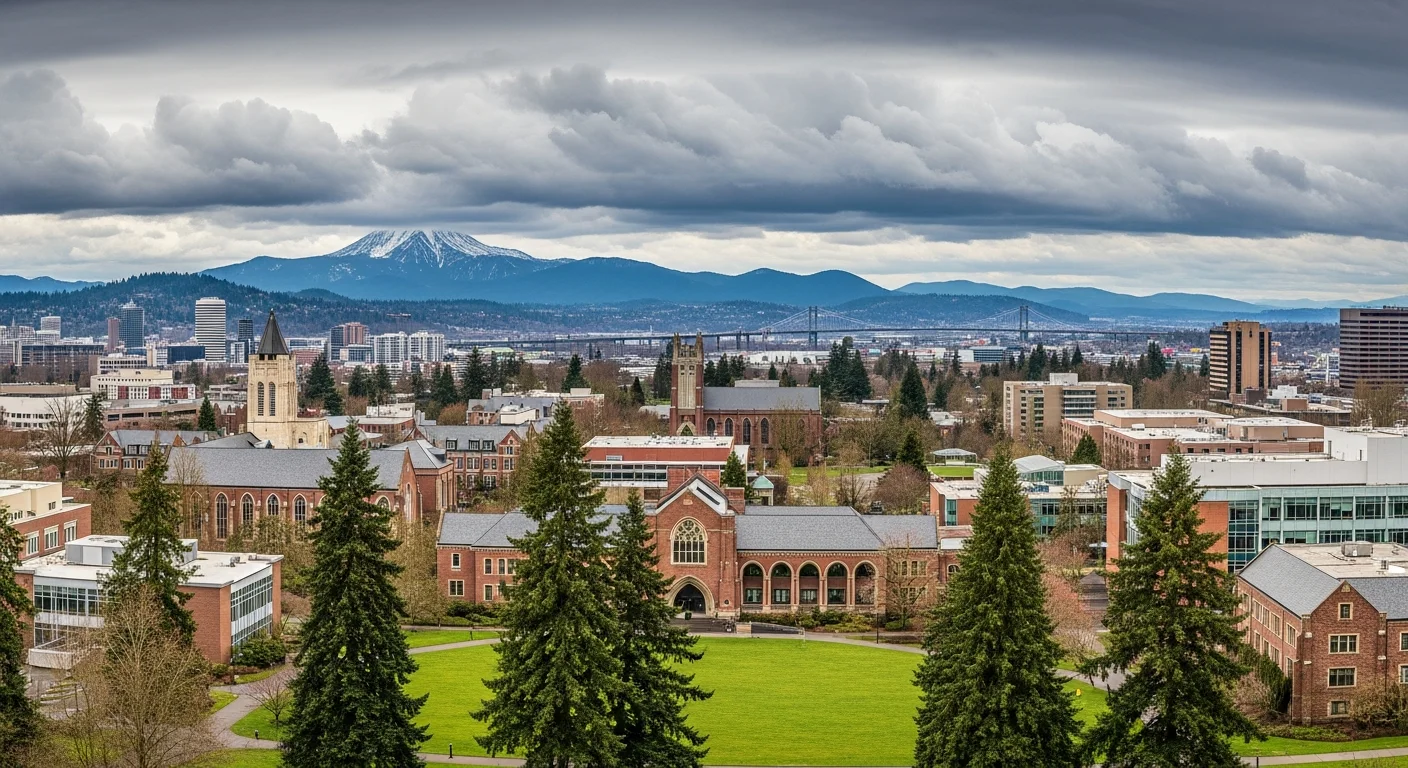
University campus in Oregon
Updated July 13, 2026

Best Artificial Intelligence Degree Programs in Oregon, 2026 Rankings

Compare the top artificial intelligence colleges in Oregon. 12 accredited artificial intelligence schools ranked by graduation rate, career outcomes, and value, from Clackamas Community College to Oregon State University.

#1 ProgramOregon State
Avg Salary$105,670
Tuition From$5,535/yr
Job Growth+22%
On this page
Reviewed by Taylor Rupe, Founder & EditorSee methodology

16

Programs ranked

IPEDS 2024

$105,670

Oregon median artificial intelligence salary

BLS OEWS 2024

82/100

Top program score

Hakia methodology

23%

U.S. job growth (2023–33)

BLS projections

Key Takeaways

Best artificial intelligence degree programs: Oregon State, Lewis & Clark College, Portland State

Ranked by graduation rates, program outcomes, and institutional quality

IPEDS 2024

Tuition ranges from $4,032 to $61,916/year

Clackamas Community College offers the most affordable option at $5,535/yr

IPEDS 2024

Artificial Intelligence degree programs available: 5 associate's, 2 master's, 2 doctoral in Oregon

From community college pathways to advanced research degrees

IPEDS 2024

Oregon community college transfer can save 40-60% on total degree costs

5 associate's programs provide transfer pathways to bachelor's degrees

Education Commission of the States

Major employers: Intel, Nike, Salesforce, Autodesk

Tech hubs in Portland and Beaverton

Hakia Research 2026

Artificial Intelligence degree programs near 33+ cities across Oregon

Search by city to find programs within 200 miles of your location

IPEDS 2024

Updated July 13, 2026

How we ranked Oregon Artificial Intelligence programs

We rank 16 accredited artificial intelligence programs in Oregon using IPEDS 2024 institutional data, BLS OEWS 2024 state salary data, and College Scorecard outcomes. A 4-factor weighted composite is normalized to a 0–100 score. Schools cannot pay for placement; rankings are produced algorithmically.

Program completions (35%)Graduation rate (25%)Selectivity (20%)Career outcomes (20%)
See full methodology

Are Artificial Intelligence Degree Programs in Oregon Worth It?

Answer
$105,670
Yes. The best artificial intelligence degree programs in Oregon deliver strong ROI, graduates earn $105,670 median salary with +22% job growth through 2032. In-state tuition averages $25,938/year.

Source: BLS OEWS May 2024

Artificial Intelligence Degree Rankings in Oregon

Compare the top-ranked Artificial Intelligence programs in Oregon by degree level. Tuition, graduation rate, and Hakia Score for every accredited program.

Best Associate's Artificial Intelligence Programs in Oregon

5
Programs ranked
$4,822
Avg tuition/yr
0%
Avg grad rate

Program Landscape

Oregon offers 5 accredited associate's degree programs in artificial intelligence, providing an affordable entry point into the technology field. The top-ranked programs include Clackamas Community College, Lane Community College, Rogue Community College, which combine rigorous technical curriculum with practical skills training.

Costs & Value

Community colleges in Oregon offer these two-year programs at an average cost of $4,822/yr, significantly less than four-year university tuition. Students completing associate's degrees can pursue entry-level technical positions and transfer opportunities, with entry-level salaries averaging $58,119 in Oregon.

Career Pathways

Many programs feature guaranteed transfer agreements with Oregon's public universities, allowing students to complete their first two years at reduced cost before transferring to complete a bachelor's degree. The Portland, Beaverton, Hillsboro areas offer particularly strong job markets for associate's degree holders, with employers like Intel, Nike, Salesforce hiring for technical support, junior development, and IT specialist positions.

Curriculum & Specializations

Programs typically include coursework in programming fundamentals, database management, networking basics, and software development. Among artificial intelligence schools in Oregon, these associate's programs offer the best value for students beginning their artificial intelligence degrees in Oregon.

Best Bachelor's Artificial Intelligence Programs in Oregon

7
Programs ranked
$41,020
Avg tuition/yr
89%
Avg grad rate

Program Landscape

Oregon ranks among the nation's top destinations for artificial intelligence education, with 7 accredited bachelor's degree programs across 2 public and 5 private institutions. The highest-ranked programs are Oregon State, Lewis & Clark College, Portland State, recognized for academic excellence, research opportunities, and strong industry connections.

Career Outcomes

Graduates from Oregon artificial intelligence programs earn a median salary of $89,820, 9% below the national average. The state's robust technology sector, anchored by the Portland, Beaverton, Hillsboro metropolitan areas, provides abundant internship and employment opportunities with companies including Intel, Nike, Salesforce.

Costs & Value

Tuition ranges from $8,694 to $61,916 annually, with an average of $41,020/yr. Top programs maintain graduation rates above 89%, with the highest reaching 95%. Many programs hold ABET accreditation, the gold standard for computing education, ensuring curriculum meets rigorous industry standards.

Curriculum & Specializations

Students can choose from specializations including software engineering, cybersecurity, artificial intelligence, data science, and systems architecture. Strong industry partnerships provide access to co-op programs, capstone projects with real companies, and direct recruiting pipelines to Oregon's leading technology employers. For students seeking artificial intelligence degrees in Oregon, these top-ranked artificial intelligence schools offer the strongest combination of academic rigor and career preparation.

Show all 7 ranked programs
RankSchoolLocationTypeTuitionGrad RateHakia Score
#6Linfield UniversityMcMinnville, ORPrivate$49,81037.8
#7Pacific UniversityForest Grove, ORPrivate$53,17433.9

Best Master's Artificial Intelligence Programs in Oregon

2
Programs ranked
$9,920
Avg tuition/yr
84%
Avg grad rate

Program Landscape

Oregon offers 2 master's degree programs in artificial intelligence, designed for professionals seeking to advance into senior engineering, technical leadership, and specialized roles. The top programs, Oregon State, Portland State, combine advanced technical training with research opportunities and leadership development.

Career Outcomes

Master's graduates in Oregon earn a median salary of $105,670, approximately 20-30% higher than bachelor's degree holders. The concentration of technology companies in Portland, Beaverton, Hillsboro creates strong demand for graduate-level talent, with Intel, Nike, Salesforce actively recruiting from these programs.

Costs & Value

Program formats include traditional full-time study (typically 2 years), part-time options for working professionals (2-3 years), and accelerated tracks. Tuition averages $9,920/yr, with many employers offering tuition reimbursement for graduate education. Some programs offer thesis and non-thesis tracks, allowing students to focus on research or professional development based on their career goals.

Curriculum & Specializations

Curriculum covers advanced topics including machine learning, distributed systems, software architecture, and technical management. Many programs include practicum experiences, industry capstone projects, or consulting engagements that provide real-world application of advanced concepts. Among Oregon's artificial intelligence schools at the graduate level, these programs stand out for both academic quality and career outcomes.

Best Doctoral Artificial Intelligence Programs in Oregon

2
Programs ranked
$9,920
Avg tuition/yr
84%
Avg grad rate

Program Landscape

Oregon is home to 2 doctoral programs in artificial intelligence, preparing students for research positions, faculty appointments, and executive technical roles. Leading programs at Oregon State, Portland State are recognized for cutting-edge research, strong faculty publications, and competitive funding packages.

Career Outcomes

Doctoral graduates command premium salaries, with Oregon PhD holders earning a median of $132,088, reflecting the advanced expertise required for research and executive positions. The Portland, Beaverton, Hillsboro region's research universities and corporate R&D centers provide extensive collaboration opportunities with industry leaders like Intel, Nike, Salesforce.

Costs & Value

PhD programs typically require 4-6 years of full-time study, including coursework, qualifying examinations, and original dissertation research. Many programs offer full funding through teaching or research assistantships, covering tuition and providing stipends of $25,000–$40,000 annually.

Curriculum & Specializations

Research strengths across Oregon programs include artificial intelligence, cybersecurity, human-computer interaction, systems, and theoretical computer science. For aspiring researchers pursuing artificial intelligence degrees in Oregon, graduates go on to careers as university faculty, industry research scientists, or technical executives, contributing to advances in technology that impact millions of users worldwide.

Artificial Intelligence Degree Costs & Tuition in Oregon

MetricValue
Average in-state tuition$25,938/year
Average out-of-state tuition$64,845/year
Community college tuition$6,485/year
4-year savings for residents$155,628
2+2 transfer pathway savings$38,906

Source: IPEDS 2024

Financial Aid & Scholarships for Artificial Intelligence Students in Oregon

State Aid Programs

Oregon residents pursuing artificial intelligence degrees have access to strong financial aid options designed to make higher education affordable. The Oregon Opportunity Grant is a need-based grant program specifically for Oregon residents attending eligible institutions, providing direct support that doesn't require repayment. Additionally, all students can access federal financial aid through the Free Application for Federal Student Aid (FAFSA), which opens doors to federal grants, loans, and work-study opportunities. These programs collectively reduce the burden of tuition costs across Oregon's 18 institutions offering artificial intelligence programs, from community colleges to research universities.

Key Programs & Amounts

Beyond state and federal aid, many Oregon institutions offer institutional scholarships and merit-based awards specifically for computer science and engineering students. The Federal Student Aid website provides comprehensive guidance on eligibility, application deadlines, and loan repayment options. Oregon's College Scorecard allows prospective students to compare net price, graduation rates, and earnings outcomes across institutions. Students should also explore whether their chosen school participates in specialized scholarships through professional organizations or employers like Intel and Nike, which maintain significant operations in Oregon's major tech hubs. Starting early with financial planning ensures maximum aid eligibility and reduces overall education costs.

Artificial Intelligence Degree ROI Calculator, Oregon

Use our interactive ROI calculator to estimate your return on investment for a artificial intelligence degree in Oregon. Enter your expected tuition costs, financial aid, and career goals to see projected payback periods and lifetime earnings. The calculator uses current salary data from BLS and tuition data from IPEDS to provide accurate estimates.

Artificial Intelligence Degree ROI Calculator

Estimate your return on investment for a artificial intelligence degree

Leave blank to use average cost for selected program type

20 years
10 years20 years30 years
20-Year ROI

+959%

Net gain divided by total investment. ROI above 200% is considered excellent for education investments.

Net Gain

$1,774,135

Your additional lifetime earnings with this degree vs. working without one, minus the total investment.

Break-Even

5 years

Years until your cumulative earnings exceed total investment. Shorter programs often break even faster due to lower opportunity cost.

COL-Adjusted Salary

$120,833

Your starting salary adjusted for local cost of living. This shows real purchasing power compared to a $100K national baseline.

Why does break-even change with program type? Your "total investment" includes both tuition AND opportunity cost (foregone earnings while in school). A 4-year full-time public university (in-state) means 4 years of not earning a salary ($140,000 in opportunity cost). Shorter full-time programs may have higher tuition but lower total investment because you return to the workforce sooner.

Detailed Breakdown

How we calculate your degree ROI using real salary data

Total Investment$185,000

Tuition plus opportunity cost (earnings you miss while in school)

Program Cost (Tuition)$45,000

Direct cost of the degree program

Opportunity Cost$140,000

4 years × $35K/year foregone salary while studying full-time

20-Year Earnings (with degree)$2,809,543

Projected career earnings starting after graduation, with salary growth

20-Year Earnings (without degree)$850,408

What you'd earn working at $35K/year with 2% annual growth

Starting Salary (Portland, OR)$145,000

Median salary for this role in your selected location (BLS 2024)

Annualized Return5.1%

Your investment's compound annual growth rate (similar to stock market returns)

Data sources: BLS OEWS May 2024, IPEDS 2024. Calculations use median salaries, 3% discount rate, and assume salary growth declines from 6% to 2% over career. Individual results will vary. | Powered by Hakia.com

Artificial Intelligence Salaries by Metro Area

Median annual salary in Oregon metro areas

Portland$116K
Beaverton$111K
Hillsboro$106K
View data table
CategoryValue
Portland$116K
Beaverton$111K
Hillsboro$106K

Source: BLS OEWS May 2024

Hakia.com

Top Employers Hiring Artificial Intelligence Graduates in Oregon

Oregon boasts a diverse employer landscape with major corporations and healthcare institutions actively recruiting AI professionals. Providence Health, Intel, and Nike represent the state's largest employers investing in artificial intelligence and machine learning capabilities. These organizations operate primarily from Portland, Eugene, and the Beaverton-Hillsboro region, creating concentrated opportunities for AI graduates. Additionally, Oregon Health & Science University (OHSU) and OHSU's affiliated Providence Health network are driving AI applications in healthcare, from diagnostic imaging to predictive analytics. The presence of these major employers has solidified Oregon's reputation as a technology and innovation center within the Pacific Northwest.

The Portland Metro area remains the epicenter of Oregon's AI job market, with companies headquartered or maintaining significant operations in Hillsboro, Beaverton, and downtown Portland. This concentration of talent demand directly benefits graduates from nearby institutions like Oregon State University, Portland State University, and University of Portland. For detailed information about labor market trends and wage data in Oregon, consult the (Bureau of Labor Statistics state occupational data). Students interested in exploring career opportunities in related fields should review our resources on Data Science in Oregon and Data Analytics in Oregon, which offer complementary skillsets valued by these employers.

Transfer Pathways for Artificial Intelligence Degrees in Oregon

State Transfer System

Oregon provides streamlined transfer pathways for artificial intelligence students moving from community colleges to four-year universities through the Oregon Transfer Module (Oregon Transfer Module). This system enables 7 community college institutions offering AI associate degrees to have their general education credits automatically recognized by Oregon's public universities, eliminating duplicate coursework. Students can complete their initial 25 AI completions across associate programs at institutions like Mt Hood Community College ($4,392 tuition), Chemeketa Community College ($4,545 tuition), and Linn-Benton Community College ($5,817 tuition), then seamlessly transition to bachelor's programs at one of Oregon's 7 bachelor's institutions. This pathway significantly reduces overall program costs and time to degree completion, making AI education more accessible (Oregon Transfer Module).

How Transfers Work

Articulation agreements between specific community colleges and universities outline which courses transfer as electives or major requirements for AI specializations. Students beginning at Portland-area community colleges can transfer to Portland State University ($8,694 tuition, 251 completions), while those in the Willamette Valley region can articulate to Oregon State University ($11,145 tuition, 1,036 completions). The Oregon Opportunity Grant supports eligible Oregon residents throughout their transfer journey, providing need-based financial aid that applies across participating institutions. Community college advisors work directly with university transfer coordinators to ensure students' course selections align with receiving institution requirements. For more information on financial aid eligibility, visit Federal Student Aid. Explore Machine Learning in Oregon, Computer Science in Oregon, and Data Science in Oregon for additional transfer-friendly program options.

Why Pursue an Artificial Intelligence Degree in Oregon?

Industry & Workforce

Oregon is a significant hub for artificial intelligence education, with 18 institutions offering AI programs across multiple degree levels (IPEDS). The state produced 1,376 AI program completions in 2023, demonstrating strong educational capacity and industry demand. Bachelor's degree programs dominate the landscape with 1,135 completions across 7 institutions, making Oregon a competitive destination for undergraduate AI study. The state's commitment to AI education is reflected in its diverse program offerings, spanning associate degrees (25 completions at 7 institutions), master's degrees (194 completions at 2 institutions), and doctoral programs (22 completions at 2 institutions) (IPEDS).

Salary Outlook

Oregon's major technology hubs in Portland, Eugene, Salem, Beaverton, and Corvallis provide exceptional career opportunities with leading employers including Intel, Nike, Providence Health, and Oregon Health & Science University. These regional centers create a vibrant ecosystem connecting students with internship and employment prospects. Top-ranked institutions like Oregon State University lead the state with 1,036 completions, while Portland State University contributes 251 completions to the state's AI talent pipeline. For affordability, Oregon public universities offer competitive in-state tuition averaging $9,555 for four-year institutions (IPEDS), making AI education accessible. Students can explore related programs through Machine Learning in Oregon, Data Science in Oregon, and Computer Science in Oregon to build comprehensive technical expertise.

Oregon's Tech Ecosystem

6,000+ Tech Companies
Oregon is home to 6,000+ technology companies employing 81,000+ tech workers. Artificial Intelligence graduates compete in a deep job market across Portland, Beaverton, Hillsboro.

Source: BLS OEWS May 2024, Oregon Business, Silicon Forest

Artificial Intelligence Job Market & Salary Data in Oregon

Employment Outlook

Oregon's artificial intelligence job market is experiencing strong growth, supported by a strong educational pipeline and diverse employment opportunities across the state. According to the (Bureau of Labor Statistics), Oregon's technology sector continues to expand, with major metropolitan areas driving demand for AI professionals. The Portland-Vancouver-Hillsboro metro area, in particular, is a significant tech hub, attracting talent to roles in machine learning, data science, and AI development. Beyond Portland, secondary markets in Eugene-Springfield and the Salem region are developing AI capabilities, offering career pathways for graduates from University of Oregon, Willamette University, and other regional institutions.

Salaries by Metro

With 1,135 bachelor's degree completions in AI across Oregon's 7 institutions, the state is producing a steady stream of qualified professionals ready to enter the workforce (IPEDS 2024). Oregon State University leads the state with 1,036 completions, followed by Portland State University with 251 completions. The availability of advanced degrees, with 194 master's completions and 22 doctoral completions, ensures that employers have access to both entry-level and highly specialized talent. Students considering AI education in Oregon can explore related fields through our guides on Machine Learning in Oregon, Data Science in Oregon, and Computer Science in Oregon.

Entry-Level (0-2 yrs)

New graduates and career changers

Senior (8+ yrs)

Technical leads and architects

Median Salary in Oregon$68,686$153,222
Typical RolesJunior Developer, AnalystStaff Engineer, Architect
Remote Work AccessLimitedCommon
Degree ExpectationBachelor's sufficientMaster's preferred

Online vs On-Campus Artificial Intelligence Programs in Oregon

Online Programs

0 available in Oregon

On-Campus Programs

Traditional classroom experience

Typical Tuition$23,344/yr$25,938/yr
Schedule FlexibilitySelf-paced or asyncFixed schedule
NetworkingVirtual cohortsIn-person, career fairs
Best ForWorking professionalsTraditional students
Completion Time2-4 years (flexible)4 years (standard)

Compare Artificial Intelligence Programs in Other States

Artificial Intelligence Degree Programs in Oregon: FAQ

What are the best artificial intelligence degree programs in Oregon?
The best artificial intelligence degree programs in Oregon based on our methodology are: 1) Oregon State University (84% graduation rate), 2) Lewis & Clark College, and 3) Portland State University. Our rankings weight graduation rates (25%), program completions (35%), selectivity (20%), and career outcomes (20%). Oregon offers 12 total accredited programs across 7 public and 5 private institutions. See our complete rankings for all 7 bachelor's programs.
How much do artificial intelligence degree programs cost in Oregon?
Artificial Intelligence degree program costs in Oregon vary significantly by institution type. In-state public tuition averages $25,938/year, while private institutions average $57,064/year. Community colleges offer the most affordable path at approximately $6,485/year for associate's degrees. The total 4-year cost ranges from $103,752 at public schools to $228,254 at private institutions before financial aid. Most students don't pay full sticker price, federal grants, state aid, and institutional scholarships can reduce costs by 30-60%.
What salary can artificial intelligence degree graduates earn in Oregon?
Artificial Intelligence professionals in Oregon earn a median salary of $105,670, which is competitive with the national average of $115,500. Entry-level positions typically start around $68,686, while senior roles exceed $153,222. Salaries vary by metro area: Portland ($116,237), Beaverton ($110,954) offer the highest compensation. Specialized roles like AI/ML engineers and cloud architects command premiums of 15-30% above median.
Are there online artificial intelligence degree programs in Oregon?
Yes, Oregon offers 0 accredited online Artificial Intelligence programs from state institutions. These programs award the same degree as on-campus options and include synchronous and asynchronous formats. Top-ranked online programs include offerings from various state universities. Online programs typically cost the same as on-campus tuition for in-state students. Many programs offer flexible scheduling for working professionals, with some offering accelerated completion in 2-3 years. Ensure any online program holds regional accreditation and ideally ABET accreditation for engineering programs.
What companies hire artificial intelligence degree graduates in Oregon?
Major Artificial Intelligence employers in Oregon include Intel, Nike, Salesforce, Autodesk, Puppet. The Portland and Beaverton metro areas serve as primary tech hubs with thousands of open positions. Top employers maintain recruiting pipelines directly from Oregon universities, with many offering internship-to-hire programs. Beyond tech giants, opportunities exist in healthcare IT, financial services, defense contractors, and growing startups. Oregon's tech sector shows +22% projected job growth through 2033, outpacing most other industries.
Is an artificial intelligence degree program worth it in Oregon?
An artificial intelligence degree program in Oregon offers strong ROI with a $105,670 median salary and +22% projected job growth. At average in-state tuition of $25,938/year, graduates typically recoup their educational investment within 3-5 years. The degree opens doors to high-paying careers in software development ($119,407), data science, cybersecurity, and AI/ML. Beyond salary, benefits include job security, remote work flexibility, and clear advancement paths. Alternative paths like bootcamps exist for career changers, but bachelor's degrees provide broader career options and higher lifetime earnings.
How long do artificial intelligence degree programs take in Oregon?
Standard completion times for artificial intelligence degree programs in Oregon are: Associate's (2 years, 60 credits), Bachelor's (4 years, 120 credits), and Master's (1-2 years, 30-36 credits). However, actual timelines vary based on course load, transfer credits, and program format. Accelerated programs can compress a bachelor's to 3 years or a master's to 12 months. Part-time students typically need 5-6 years for a bachelor's degree. Oregon community colleges offer a cost-effective "2+2" path: complete your associate's in 2 years, then transfer to a Oregon university for the final 2 years of a bachelor's program.
What financial aid is available for artificial intelligence degree students in Oregon?
Oregon artificial intelligence degree students can access multiple financial aid sources. Federal aid includes Pell Grants (up to $7,395/year for qualifying students) and federal student loans. Oregon state grants provide additional support for residents attending in-state schools. Institutional scholarships from universities can significantly reduce costs, many schools offer merit-based awards for STEM students. Work-study programs and teaching/research assistantships (especially for graduate students) provide income while building experience. Complete the FAFSA by Oregon's priority deadline to maximize aid eligibility. Some employers also offer tuition reimbursement for employees pursuing CS degrees.

Data Sources

Institutional characteristics, completions, graduation rates

Oregon salary and employment data

Official University Websites

Program details and admissions information

Last Updated: June 26, 2026. Rankings based on IPEDS 2024 data. Salary data from BLS OEWS May 2024.

Was this ranking helpful for your college search?
Taylor Rupe

Taylor Rupe

Co-founder & Editor (B.S. Computer Science, Oregon State • B.A. Psychology, University of Washington)

Taylor combines technical expertise in computer science with a deep understanding of human behavior and learning. His dual background drives Hakia's mission: leveraging technology to build authoritative educational resources that help people make better decisions about their academic and career paths.

The research behind the rankings

In-depth Artificial Intelligence program profiles in Oregon

Hand-researched detail on the top-ranked programs: degree pathways, research labs, industry partners, career outcomes, and admissions. Tap any school to expand.

Best Associate's Artificial Intelligence programs

#1Clackamas Community CollegeOregon City, OR

Hakia insight. Clackamas' location in the Portland metro puts graduates into Intel and IBM's hiring pipeline before they finish their second year; the college's curriculum design explicitly channels students toward these major employers rather than treating career placement as an afterthought.

At the associate's level, working with the Portland metro's massive tech corridor, Clackamas has built an AI program that feels less like a classroom and more like a pipeline into real jobs. Your coursework includes projects pulled directly from what local employers need—think data pipeline optimization and model deployment—so when you graduate, you're not learning on the job, you're already trained. The college's location in Oregon City puts you minutes from major tech hubs while keeping costs and class sizes manageable.

Programs offered

  • Associate of Science in Artificial Intelligence · 2 years · on-campus
  • Associate of Applied Science in Artificial Intelligence · 2 years · online

Career outcomes

Top employers: Intel, IBM, major Portland metro tech companies, healthcare IT providers

#2Lane Community CollegeEugene, OR

Hakia insight. Lane's direct partnership with University of Oregon research labs means community college students work with real datasets and cutting-edge problems—the typical two-year AI program teaches algorithms, but Lane's students also learn how research institutions actually deploy them.

At the associate's level, lane's AI program leans heavily on Eugene's research and tech community—you'll find opportunities to work with real datasets from UO partnerships and local companies exploring machine learning applications. The curriculum balances theory with hands-on coding, so you'll graduate with a portfolio of projects that actually impress employers. Many students use the associate degree as a stepping stone to UO or OSU, where they finish bachelor's degrees with their foundational work already complete.

Programs offered

  • Associate of Science in Artificial Intelligence · 2 years · on-campus
  • Associate of Applied Science in Artificial Intelligence · 2 years · online

Career outcomes

Top employers: University of Oregon (research partnerships), Eugene-area tech companies, healthcare and education sectors

#3Rogue Community CollegeGrants Pass, OR

Hakia insight. Rogue fills a genuine gap in Jackson County's job market where AI skills are in demand but four-year degree programs are scarce; graduates enter local roles immediately at companies actively hiring rather than facing the credential mismatch that often affects associate's degree holders.

At the associate's level, southern Oregon's growing tech sector means Rogue's AI program fills a real gap—the college trains students for jobs that are actively available in the Jackson County area. The program emphasizes practical machine learning and data analysis over heavy mathematics, so you can jump in even without advanced STEM background. Graduates tend to stay local, building careers with regional employers, or transfer to larger universities with solid foundational skills already in place.

Programs offered

  • Associate of Science in Artificial Intelligence · 2 years · on-campus
  • Associate of Applied Science in Artificial Intelligence · 2 years · online

Career outcomes

Top employers: Southern Oregon regional companies, healthcare systems, local government and education

#4Clatsop Community CollegeAstoria, OR

Hakia insight. Clatsop's small cohorts mean instructors catch learning gaps in real-time and adapt to individual strengths—a pedagogical advantage in technical subjects like AI where one missed foundation concept cascades through later courses, but is almost impossible to remediate in large lecture halls.

At the associate's level, clatsop's small size and location on Oregon's north coast mean intimate classes where instructors actually know your strengths and weaknesses—a huge advantage when learning technical material. The AI program emphasizes fundamentals you can apply immediately: Python, basic machine learning, cloud platforms. Many students use it as a bridge to larger universities or land jobs with the region's growing tech-forward employers in healthcare, education, and small business.

Programs offered

  • Associate of Science in Artificial Intelligence · 2 years · on-campus
  • Associate of Applied Science in Artificial Intelligence · 2 years · online

Career outcomes

Top employers: Clatsop County regional employers, healthcare and education institutions, small tech-forward businesses

#5Blue Mountain Community CollegePendleton, OR

Hakia insight. Blue Mountain's dual-track associate's program (AS and AAS) uniquely serves Eastern Oregon's agriculture and energy sectors, where AI adoption in precision farming and grid optimization creates immediate job placement pathways that larger programs overlook.

At the associate's level, in the high desert of Eastern Oregon, Blue Mountain's AI program serves a region where tech skills are increasingly valuable but training options are limited. The college focuses on accessible, practical education in machine learning and data fundamentals—meeting students where they are rather than assuming advanced prerequisites. Many graduates find local opportunities in agriculture, energy, and small business sectors that are adopting AI tools, while others transfer to larger universities for advanced study.

Programs offered

  • Associate of Science in Artificial Intelligence · 2 years · on-campus
  • Associate of Applied Science in Artificial Intelligence · 2 years · online

Career outcomes

Top employers: Eastern Oregon regional companies, agriculture and energy sectors, local government

Best Bachelor's Artificial Intelligence programs

#1Oregon State UniversityCorvallis, OR

Why it stands out. OSU's program stands out for intensive robotics and computer vision research with direct collaboration ties to national laboratories and DARPA-funded projects.

Hakia insight. OSU's direct pipeline to PNNL through DARPA-funded robotics projects means undergraduates don't wait for internships—they contribute to nationally classified research while still completing their degree, a research intensity typically reserved for PhD candidates.

At the bachelor's level, oregon State's School of Electrical Engineering and Computer Science houses one of the Pacific Northwest's most research-intensive AI programs, with particular strength in robotics, computer vision, and machine learning systems. The program is anchored by the OSU Robotics Research Lab and collaborations with Pacific Northwest National Laboratory (PNNL), giving graduate students exceptional access to cutting-edge projects in autonomous systems and AI for scientific discovery. Faculty researchers are consistently funded by NSF, DARPA, and DOE, meaning students enter a culture of rigorous, applied research from day one. The MS and PhD tracks are designed for students serious about research careers: you're expected to contribute to publications and present at top-tier conferences. Undergraduate pathways emphasize foundational CS and math before specialization, ensuring graduates can move flexibly into AI roles across academia, national labs, and industry. OSU's location in Corvallis, while quieter than Portland, offers focused academics without the distractions of a major urban center.

Programs offered

  • Bachelor of Science in Artificial Intelligence · 4 years · on-campus
  • Bachelor of Arts in Artificial Intelligence · 4 years · online

Research labs & institutes

  • OSU Robotics Research Lab — Autonomous robotics, manipulation, and perception
  • School of Electrical Engineering and Computer Science Research Centers — Machine learning, AI systems

Industry partners

Pacific Northwest National Laboratory (PNNL)Intel

Notable faculty

  • Sinisa Todorovic (Computer vision and video understanding)

Admissions

Deadline January 5.

Accreditation & certifications

ABET accredited (engineering programs)

Location advantage: Access to Pacific Northwest National Laboratory collaborations Proximity to Intel and other semiconductor/AI companies in the region

#2Lewis & Clark CollegePortland, OR

Why it stands out. Lewis & Clark uniquely combines liberal arts AI education with strong mathematical foundations, producing graduates comfortable navigating both technical and ethical complexities in AI roles.

Hakia insight. Lewis & Clark's requirement that AI students engage philosophy and ethics coursework alongside algorithms produces graduates uniquely positioned for compliance and governance roles at companies like OpenAI and Anthropic, where ethical fluency now commands premium salaries.

At the bachelor's level, lewis & Clark offers an intimate, liberal arts-informed approach to AI and machine learning that emphasizes both mathematical rigor and humanistic context. The computer science program integrates data science and AI tracks designed for students who want to understand not just *how* to build models, but *why* certain approaches work and what their limitations are. This philosophy-meets-practice approach works especially well for undergraduates considering AI careers in policy, healthcare, finance, or mission-driven organizations. Faculty maintain active research interests and readily mentor independent projects; class sizes stay small enough that students get genuine mentorship rather than lecture-hall anonymity. The program's location in Portland connects students to a growing AI and tech startup ecosystem while maintaining the rigor and individualized attention of a 2,000-student college. Career outcomes skew toward graduates who land roles requiring both technical skill and strategic thinking—think product roles at tech companies, data roles at nonprofits, and positions in AI-adjacent fields like UX research and product management.

Programs offered

  • Bachelor of Science in Artificial Intelligence · 4 years · on-campus
  • Bachelor of Arts in Artificial Intelligence · 4 years · online

Location advantage: Portland tech and startup ecosystem Access to mission-driven organizations exploring AI applications

#3Portland State UniversityPortland, OR

Why it stands out. Mandatory paid internships through Engineering Work Experience and Multiple Engineering Cooperative Program (MECOP) with more than 50% of students participating. Collaborative student projects with organizations like Portland State Aerospace Society (launched Oregon's first cube satellite)

Hakia insight. PSU's mandatory paid internship structure—with over 50% participation through MECOP—systematically converts classroom learning into 6-12 month paid apprenticeships at Boeing and Intel, compressing the typical 2-3 year runway to senior technical roles.

Portland State University's Bachelor of Science in Computer Science blends core coursework in programming, systems, and theory with electives covering artificial intelligence, machine learning, web development, and cloud technologies. The program emphasizes hands-on experience through paid internships at major tech companies like Intel, Nike, Amazon, and Zoom, with more than half of students participating in internships via the Engineering Work Experience and Multiple Engineering Cooperative Program (MECOP). Students engage in collaborative projects with student organizations like the Portland State Aerospace Society and work on real-world software solutions for community organizations. The program is ABET-accredited and located in downtown Portland within the Silicon Forest tech hub, providing direct connections to leading computing companies. Graduates achieve an 85% job placement rate with starting salaries exceeding $90,000, and pursue careers in machine learning, software engineering, cybersecurity, data analysis, and systems administration at companies including Amazon, Apple, Boeing, Intel, and Tektronix.

Programs offered

  • Bachelor of Science in Computer Science · 4 years · on-campus

Industry partners

Oregon Health & Science University (OHSU)

Career outcomes

$90,000 median salary

Top employers: Amazon, Apple, Boeing, Intel

Accreditation & certifications

ABET Computing Accreditation Commission

Location advantage: Partnerships with Oregon Health & Science University for healthcare AI projects Portland civic tech and smart city initiatives Access to local nonprofits and government agencies exploring AI applications

#4Willamette UniversitySalem, OR

Why it stands out. Willamette uniquely integrates ethics and policy into its undergraduate AI curriculum within a liberal arts context, producing graduates fluent in both technical and societal implications of AI.

Hakia insight. Willamette's curriculum integration of AI policy alongside code means graduates can credibly move between technical roles and policy positions at state tech commissions—a rare dual-domain fluency that emerges from its Salem proximity and civic tech partnerships.

At the bachelor's level, willamette's AI program emphasizes ethical AI development and responsible innovation within a liberal arts framework. The curriculum integrates philosophy, ethics, and policy alongside technical machine learning coursework, preparing students to think critically about AI's societal impact. This dual emphasis is rare at the undergraduate level—students don't just learn to build AI systems; they're trained to ask hard questions about fairness, bias, and real-world deployment challenges. The program benefits from Willamette's location in Salem's growing tech corridor and maintains partnerships with regional organizations exploring AI governance. Faculty bring applied experience from industry and research, mentoring capstone projects that often address genuine community problems. Graduates report strong placement in tech companies, startups, and civic tech roles, particularly those seeking AI professionals who understand both the technical and human dimensions of their work.

Programs offered

  • Bachelor of Science in Artificial Intelligence · 4 years · on-campus
  • Bachelor of Arts in Artificial Intelligence · 4 years · online

Location advantage: Salem technology hub proximity Access to regional civic tech and governance initiatives

#5University of PortlandPortland, OR

Hakia insight. University of Portland's dual BS/BA structure allows students to pair AI depth with theology or business minors, producing a differentiated profile for mission-driven tech roles in healthcare and nonprofit sectors where technical + values alignment drives hiring.

Programs offered

  • Bachelor of Science in Artificial Intelligence · 4 years · on-campus
  • Bachelor of Arts in Artificial Intelligence · 4 years · online
#6Linfield UniversityMcMinnville, OR

Why it stands out. Linfield embeds AI within a liberal arts framework that emphasizes ethics, domain expertise, and societal context alongside technical depth.

Hakia insight. Linfield's placement of AI coursework within a mandatory liberal arts core (not as a standalone technical track) produces graduates with provable cross-domain literacy—a structural advantage for roles in healthcare AI and biotech where domain expertise screens out pure algorithms specialists.

At the bachelor's level, linfield University's computer science program reflects the institution's commitment to liberal arts rigor, combining AI and machine learning coursework with breadth across mathematics, ethics, and domain applications. The curriculum encourages students to see artificial intelligence not as isolated algorithms but as a tool embedded in broader contexts—whether business, healthcare, scientific research, or social systems. Upper-level electives cover neural networks, data mining, and natural language processing alongside courses in technology ethics and computing history, producing graduates who understand both the power and limitations of AI systems. Faculty research and senior capstone projects often involve real partners in the Pacific Northwest, from healthcare organizations to environmental nonprofits, ensuring students grapple with authentic constraints and societal implications. Linfield graduates pursue advanced degrees at top universities and launch careers as AI engineers, data scientists, and research scientists, with particular strength in healthcare and nonprofit technology sectors.

Programs offered

  • Bachelor of Science in Artificial Intelligence · 4 years · on-campus
  • Bachelor of Arts in Artificial Intelligence · 4 years · online

Location advantage: Proximity to Portland metro area healthcare and nonprofit technology sectors

#7Pacific UniversityForest Grove, OR

Why it stands out. Prioritizes industry-aligned curriculum and immediate technical readiness over pure research depth, with faculty bringing substantial private-sector experience.

Hakia insight. Pacific University's Media Matters Lab and Dr. Kleinknecht's focus on AI literacy and serious games creates an unusually direct pipeline to EdTech and game studios—sectors where AI+UX design fluency is scarce but in high demand.

At the bachelor's level, pacific University's approach to AI sits within a broader computer science degree that emphasizes practical application and industry relevance. The program includes data science, machine learning, and software engineering coursework designed to prepare students for immediate technical roles upon graduation. Faculty bring industry experience alongside academic credentials, and the curriculum reflects current market demand for professionals who can work across data pipelines, model development, and production systems. Students engage with real-world datasets and tools used in industry, reducing the learning curve for internships and first jobs. The university maintains relationships with tech companies in the Portland area, creating structured pathways for student employment. Career trajectories lean toward data science, analytics, and engineering roles at established companies and growing startups. Pacific's strength lies in bridging the gap between classroom theory and workplace practice—graduates tend to be productive contributors from day one.

Programs offered

  • Bachelor of Science in Artificial Intelligence · 4 years · on-campus
  • Bachelor of Arts in Artificial Intelligence · 4 years · online

Research labs & institutes

  • Media Matters Lab — Applying cognitive science, learning science, and media design principles to create AI-informed content and studying informal learning through media presentation formats

Industry partners

Oregon MESALocal schoolsPixel Arts PersonnelAfter-school programs

Notable faculty

  • Dr. Erica Kleinknecht (Cognitive-developmental psychology, AI literacy, media design, and serious games)

Location advantage: Located in Forest Grove, Oregon with easy access to Portland tech corridor

Best Master's Artificial Intelligence programs

#1Oregon State UniversityCorvallis, OR

Why it stands out. Thesis and coursework-based track options available. Graduate assistantships with tuition support and stipends available through School of Electrical Engineering and Computer Science

Hakia insight. OSU's master's program funds thesis-track students through EECS assistantships while offering a non-thesis path for working professionals, allowing mid-career engineers to either pivot into research (with stipend support) or accelerate into management without thesis overhead.

Oregon State's Master of Science in Artificial Intelligence is designed for working professionals and career-changers from any discipline seeking to enter the AI field. The program offers both thesis and coursework-based tracks, with flexible scheduling options including part-time enrollment. Graduate assistantships are available through the School of Electrical Engineering and Computer Science, providing tuition support and stipends. The program emphasizes practical AI applications across science, engineering, and humanities, preparing graduates for advancement into senior technical and research roles. Participants benefit from Oregon State's long history of AI excellence and connections to industry leaders. The program participates in the Western Regional Graduate Program, offering reduced tuition to students from 18 western states. Typical mid-career advancement includes roles in AI research, machine learning engineering, and technical leadership positions with significant salary growth beyond bachelor's-level compensation.

Programs offered

  • Master of Science in Artificial Intelligence · 1-2 years · on-campus

Research labs & institutes

  • OSU Robotics Research Lab — Autonomous robotics, manipulation, and perception
  • School of Electrical Engineering and Computer Science Research Centers — Machine learning, AI systems

Industry partners

Pacific Northwest National Laboratory (PNNL)Intel

Notable faculty

  • Sinisa Todorovic (Computer vision and video understanding)

Admissions

Deadline January 5.

Accreditation & certifications

ABET accredited (engineering programs)

Location advantage: Access to Pacific Northwest National Laboratory collaborations Proximity to Intel and other semiconductor/AI companies in the region

#2Portland State UniversityPortland, OR

Why it stands out. Thesis vs non-thesis track options available. Flexible part-time scheduling for working professionals

Hakia insight. PSU's 45-credit M.S. with split thesis/non-thesis tracks and rolling admissions (Fall, Winter, Spring) is specifically built for Intel and Google engineers already in Portland who can't relocate—the program's flexibility directly converts local industry talent into degree-holders without pausing careers.

PSU's Computer Science M.S. program is strategically designed for working professionals in Portland's 'Silicon Forest' tech ecosystem. The 45-credit program offers flexible scheduling with Fall, Winter, and Spring start options, making it ideal for part-time students and working professionals. Students can choose between thesis and non-thesis tracks, with the thesis option providing research experience that can incorporate industry internships for credit. The program emphasizes real-world application through local tech company partnerships with Google, Amazon, and Intel, providing networking and career advancement opportunities. Located in downtown Portland, the program offers exceptional convenience for working professionals. Students receive dedicated staff advisor support throughout their program and can specialize in high-demand areas like artificial intelligence, machine learning, cybersecurity, and data science. The curriculum is designed to advance careers in one of the most in-demand and highest-paying professions, with graduates frequently securing high-impact positions in Portland's thriving technology scene and beyond.

Programs offered

  • Master of Science in Computer Science · 1-2 years · on-campus

Industry partners

Oregon Health & Science University (OHSU)

Career outcomes

Top employers: Intel, Google, Amazon

Accreditation & certifications

ABET Computing Accreditation Commission

Location advantage: Partnerships with Oregon Health & Science University for healthcare AI projects Portland civic tech and smart city initiatives Access to local nonprofits and government agencies exploring AI applications

Best Doctoral Artificial Intelligence programs

#1Oregon State UniversityCorvallis, OR

Why it stands out. OSU's program stands out for intensive robotics and computer vision research with direct collaboration ties to national laboratories and DARPA-funded projects.

Hakia insight. OSU's doctoral robotics program positions PhDs to bridge the PNNL-to-Intel pipeline, where DARPA collaboration experience becomes a credential that's nearly unavailable outside national lab consortiums and accelerates placement into senior research roles.

At the doctoral level, oregon State's School of Electrical Engineering and Computer Science houses one of the Pacific Northwest's most research-intensive AI programs, with particular strength in robotics, computer vision, and machine learning systems. The program is anchored by the OSU Robotics Research Lab and collaborations with Pacific Northwest National Laboratory (PNNL), giving graduate students exceptional access to cutting-edge projects in autonomous systems and AI for scientific discovery. Faculty researchers are consistently funded by NSF, DARPA, and DOE, meaning students enter a culture of rigorous, applied research from day one. The MS and PhD tracks are designed for students serious about research careers: you're expected to contribute to publications and present at top-tier conferences. Undergraduate pathways emphasize foundational CS and math before specialization, ensuring graduates can move flexibly into AI roles across academia, national labs, and industry. OSU's location in Corvallis, while quieter than Portland, offers focused academics without the distractions of a major urban center.

Programs offered

  • Doctor of Philosophy in Artificial Intelligence · 4-6 years · on-campus
  • Doctor of Science in Artificial Intelligence · 4-6 years · online

Research labs & institutes

  • OSU Robotics Research Lab — Autonomous robotics, manipulation, and perception
  • School of Electrical Engineering and Computer Science Research Centers — Machine learning, AI systems

Industry partners

Pacific Northwest National Laboratory (PNNL)Intel

Notable faculty

  • Sinisa Todorovic (Computer vision and video understanding)

Admissions

Deadline January 5.

Accreditation & certifications

ABET accredited (engineering programs)

Location advantage: Access to Pacific Northwest National Laboratory collaborations Proximity to Intel and other semiconductor/AI companies in the region

#2Portland State UniversityPortland, OR

Why it stands out. Faculty advisor assigned upon admission. Advisory committee of 4 faculty members assigned first term

Hakia insight. PSU's immediate assignment of both faculty advisor and 4-person advisory committee upon admission—rare even among R1 institutions—eliminates the typical 6-12 month doctoral 'wandering period' and accelerates research productivity and time-to-degree.

The PhD in Computer Science at Portland State University is a research-focused doctoral program requiring 90 graduate credits including 18 core credits and 27 dissertation research credits. Students typically complete the degree in 4-6 years of full-time work, with shorter completion possible for those entering with a Master's degree. The program includes a Research Proficiency Examination as the comprehensive exam requirement, generally completed by the end of the second year. Students are assigned a faculty advisor and three additional committee members during their first term for academic guidance and progress monitoring. After passing comprehensive exams, a dissertation committee oversees the original research dissertation. The program offers research tracks in artificial intelligence & machine learning, databases, languages & programming, security, software engineering, systems & networking, theory, and visual computing. No specific funding package details, publication requirements, or post-graduation placement statistics are provided in the available content.

Programs offered

  • Doctor of Philosophy in Computer Science · 4-6 years · on-campus

Industry partners

Oregon Health & Science University (OHSU)

Accreditation & certifications

ABET Computing Accreditation Commission

Location advantage: Partnerships with Oregon Health & Science University for healthcare AI projects Portland civic tech and smart city initiatives Access to local nonprofits and government agencies exploring AI applications