🥇
$61,990
Tuition/yr
96%
Grad rate
95.4
Hakia Score
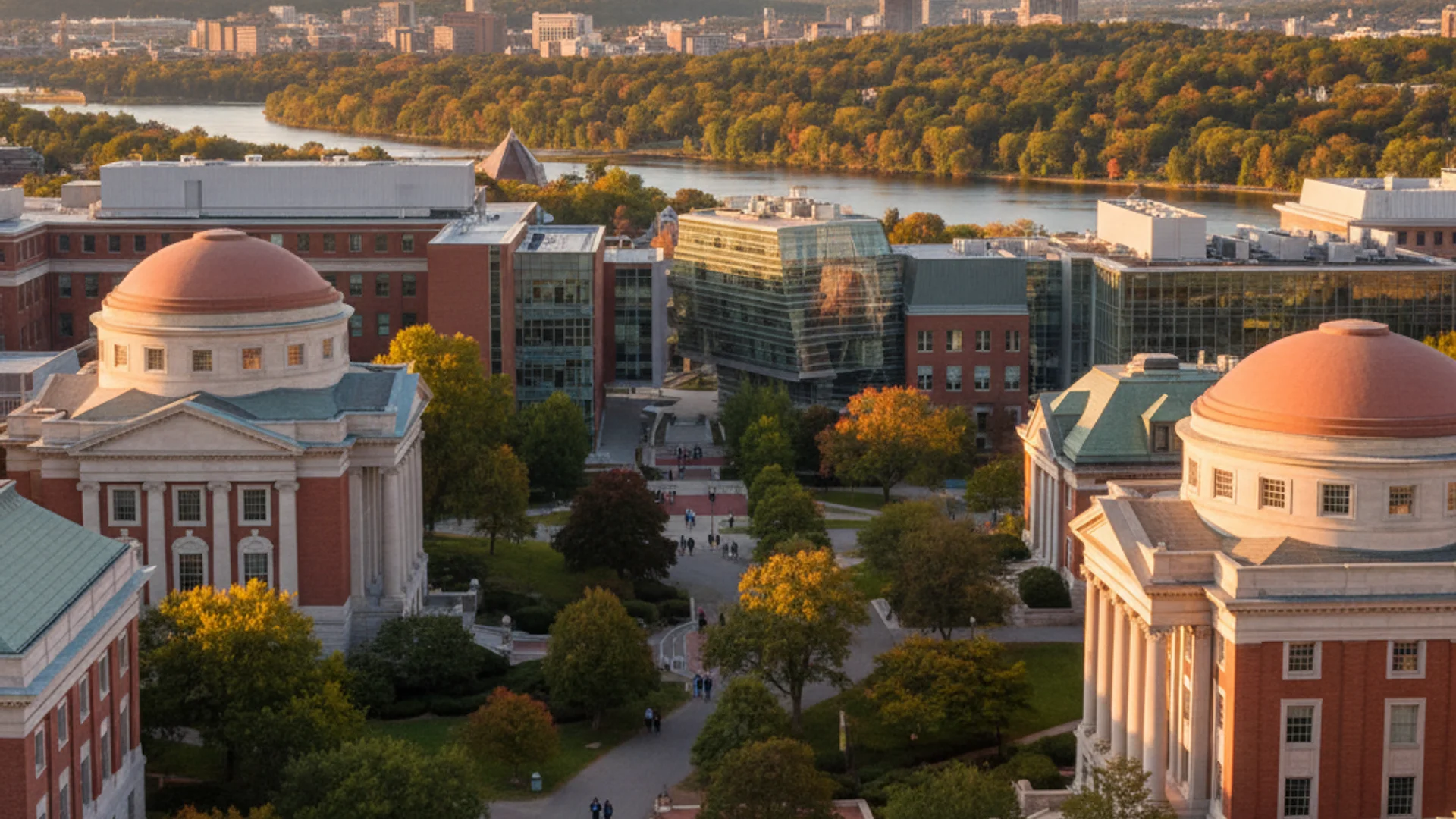
Compare the top artificial intelligence colleges in Massachusetts. 46 accredited artificial intelligence schools ranked by graduation rate, career outcomes, and value, from Bunker Hill Community College to University of Massachusetts-Amherst.
Best artificial intelligence degree programs: U of Massachusetts-Amherst, Massachusetts Institute o..., Tufts
Ranked by graduation rates, program outcomes, and institutional quality
Tuition ranges from $576 to $66,650/year
Bunker Hill Community Col... offers the most affordable option at $576/yr
Artificial Intelligence degree programs available: 10 associate's, 16 master's, 9 doctoral in Massachusetts
From community college pathways to advanced research degrees
11 online artificial intelligence degree programs in Massachusetts
Flexible scheduling for working professionals
Massachusetts community college transfer can save 40-60% on total degree costs
10 associate's programs provide transfer pathways to bachelor's degrees
Education Commission of the States
Major employers: Amazon, Google, HubSpot, Wayfair
Tech hubs in Boston and Cambridge
Hakia Research 2026
Artificial Intelligence degree programs near 75+ cities across Massachusetts
Search by city to find programs within 200 miles of your location
Updated October 19, 2026
We rank 70 accredited artificial intelligence programs in Massachusetts using IPEDS 2024 institutional data, BLS OEWS 2024 state salary data, and College Scorecard outcomes. A 4-factor weighted composite is normalized to a 0–100 score. Schools cannot pay for placement; rankings are produced algorithmically.
Are Artificial Intelligence Degree Programs in Massachusetts Worth It?
Source: BLS OEWS May 2024
Compare the top-ranked Artificial Intelligence programs in Massachusetts by degree level. Tuition, graduation rate, and Hakia Score for every accredited program.
Massachusetts ranks among the nation's top destinations for artificial intelligence education, with 35 accredited bachelor's degree programs across 7 public and 28 private institutions. The highest-ranked programs are U of Massachusetts-Amherst, Massachusetts Institute o..., Tufts, recognized for academic excellence, research opportunities, and strong industry connections.
Graduates from Massachusetts artificial intelligence programs earn a median salary of $109,344, 11% above the national average. The state's robust technology sector, anchored by the Boston, Cambridge, Worcester metropolitan areas, provides abundant internship and employment opportunities with companies including Amazon, Google, HubSpot.
Tuition ranges from $910 to $66,650 annually, with an average of $42,907/yr. Top programs maintain graduation rates above 92%, with the highest reaching 99%. Many programs hold ABET accreditation, the gold standard for computing education, ensuring curriculum meets rigorous industry standards.
Students can choose from specializations including software engineering, cybersecurity, artificial intelligence, data science, and systems architecture. Strong industry partnerships provide access to co-op programs, capstone projects with real companies, and direct recruiting pipelines to Massachusetts's leading technology employers. For students seeking artificial intelligence degrees in Massachusetts, these top-ranked artificial intelligence schools offer the strongest combination of academic rigor and career preparation.
Massachusetts offers 16 master's degree programs in artificial intelligence, designed for professionals seeking to advance into senior engineering, technical leadership, and specialized roles. The top programs, U of Massachusetts-Amherst, Massachusetts Institute o..., Boston, combine advanced technical training with research opportunities and leadership development.
Master's graduates in Massachusetts earn a median salary of $128,640, approximately 20-30% higher than bachelor's degree holders. The concentration of technology companies in Boston, Cambridge, Worcester creates strong demand for graduate-level talent, with Amazon, Google, HubSpot actively recruiting from these programs.
Program formats include traditional full-time study (typically 2 years), part-time options for working professionals (2-3 years), and accelerated tracks. Tuition averages $41,811/yr, with many employers offering tuition reimbursement for graduate education. Some programs offer thesis and non-thesis tracks, allowing students to focus on research or professional development based on their career goals.
Curriculum covers advanced topics including machine learning, distributed systems, software architecture, and technical management. Many programs include practicum experiences, industry capstone projects, or consulting engagements that provide real-world application of advanced concepts. Among Massachusetts's artificial intelligence schools at the graduate level, these programs stand out for both academic quality and career outcomes.
| Metric | Value |
|---|---|
| Average in-state tuition | $35,288/year |
| Average out-of-state tuition | $88,220/year |
| Community college tuition | $8,822/year |
| 4-year savings for residents | $211,728 |
| 2+2 transfer pathway savings | $52,932 |
Source: IPEDS 2024
Massachusetts offers substantial state-funded financial aid beyond federal programs. The MASSGrant program provides need-based aid to Massachusetts residents attending public or independent colleges (OSFA MASSGrant). Awards vary by institution type and demonstrated financial need. The Massachusetts High Demand Scholarship Program supports students in STEM fields (High Demand Scholarship):
Use our interactive ROI calculator to estimate your return on investment for a artificial intelligence degree in Massachusetts. Enter your expected tuition costs, financial aid, and career goals to see projected payback periods and lifetime earnings. The calculator uses current salary data from BLS and tuition data from IPEDS to provide accurate estimates.
Estimate your return on investment for a artificial intelligence degree
Leave blank to use average cost for selected program type
+1273%
Net gain divided by total investment. ROI above 200% is considered excellent for education investments.
$2,355,419
Your additional lifetime earnings with this degree vs. working without one, minus the total investment.
5 years
Years until your cumulative earnings exceed total investment. Shorter programs often break even faster due to lower opportunity cost.
$112,903
Your starting salary adjusted for local cost of living. This shows real purchasing power compared to a $100K national baseline.
Why does break-even change with program type? Your "total investment" includes both tuition AND opportunity cost (foregone earnings while in school). A 4-year full-time public university (in-state) means 4 years of not earning a salary ($140,000 in opportunity cost). Shorter full-time programs may have higher tuition but lower total investment because you return to the workforce sooner.
How we calculate your degree ROI using real salary data
Tuition plus opportunity cost (earnings you miss while in school)
Direct cost of the degree program
4 years × $35K/year foregone salary while studying full-time
Projected career earnings starting after graduation, with salary growth
What you'd earn working at $35K/year with 2% annual growth
Median salary for this role in your selected location (BLS 2024)
Your investment's compound annual growth rate (similar to stock market returns)
Data sources: BLS OEWS May 2024, IPEDS 2024. Calculations use median salaries, 3% discount rate, and assume salary growth declines from 6% to 2% over career. Individual results will vary. | Powered by Hakia.com
Median annual salary in Massachusetts metro areas
| Category | Value |
|---|---|
| Boston | $142K |
| Cambridge | $135K |
| Worcester | $129K |
Source: BLS OEWS May 2024
Hakia.com
Find artificial intelligence jobs in Massachusetts. These major employers across Massachusetts metro areas are actively hiring artificial intelligence degree holders. Click employer names to view current job openings.
Boston/Cambridge is a biotech and AI research hub, anchored by MIT, Harvard, and major tech company R&D centers.
Nearby cities: Cambridge, Somerville, Waltham, Burlington, Quincy
MassTransfer provides guaranteed pathways from community colleges to public universities (MassTransfer). The program enables students to start at any of Massachusetts' 15 community colleges and transfer to state universities or UMass campuses with guaranteed credit transfer and tuition discounts. Key MassTransfer benefits:
Massachusetts ranks among the top states for artificial intelligence employment and education, with the Boston-Cambridge metro area recognized as an AI and technology "Star Hub" by Brookings Institution (Brookings AI Economy 2025). The state hosts thousands of technology companies and leads the nation in computing research, with MIT, Harvard, Northeastern, and UMass institutions driving innovation. Massachusetts offers 8+ ABET-accredited computing programs that include artificial intelligence specializations, ensuring graduates meet rigorous national standards (ABET). The salary premium is substantial. Computer and Information Research Scientists earn a median salary of $140,910 nationally, with Massachusetts positions paying 15-25% above national averages (BLS OEWS May 2024). The BLS projects 26% job growth for this occupation from 2024-2034. Entry-level positions in the Boston area start around $100,000-$120,000, while experienced professionals can command significantly higher salaries. The concentration of technology companies, financial services, healthcare/biotech, and research institutions creates exceptional demand. Massachusetts offers unique advantages for artificial intelligence students: The Route 128 technology corridor and Kendall Square in Cambridge house hundreds of tech companies actively recruiting talent. The state's innovation ecosystem, including major employers like Google, Microsoft, Amazon, Fidelity, and hundreds of startups, provides diverse career opportunities. Compare programs in California, Texas, or explore our national artificial intelligence rankings.
Artificial Intelligence Job Growth in Massachusetts
Source: BLS Occupational Outlook
Massachusetts offers exceptional career prospects for artificial intelligence graduates. The Bureau of Labor Statistics reports strong demand for computer and information research scientists, with employment projected to grow 26% from 2024-2034 (BLS OOH 2024). Massachusetts ranks among the top states for technology employment, with the Boston-Cambridge-Newton metro area employing tens of thousands of computing professionals. The state's innovation economy continues driving demand for qualified graduates. Salaries in Massachusetts exceed national averages by 15-25%:
New graduates and career changers
Technical leads and architects
11 available in Massachusetts
Traditional classroom experience
Institutional characteristics, completions, graduation rates
Massachusetts salary and employment data
Program details and admissions information
Last Updated: June 26, 2026. Rankings based on IPEDS 2024 data. Salary data from BLS OEWS May 2024.

Co-founder & Editor (B.S. Computer Science, Oregon State • B.A. Psychology, University of Washington)
Taylor combines technical expertise in computer science with a deep understanding of human behavior and learning. His dual background drives Hakia's mission: leveraging technology to build authoritative educational resources that help people make better decisions about their academic and career paths.
Hand-researched detail on the top-ranked programs: degree pathways, research labs, industry partners, career outcomes, and admissions. Tap any school to expand.
Why it stands out. MIT's AI research is uniquely integrated across engineering disciplines, with particular strength in applying AI and machine learning to infrastructure monitoring, materials science, and structural engineering applications.
Hakia insight. MIT's AI strength in infrastructure monitoring and materials science through LISS and CSAIL represents a deliberate focus away from consumer tech—undergraduates work on problems like AI-driven structural health monitoring for bridges, creating rare expertise in a critical but undersaturated field.
At the bachelor's level, MIT's AI programs offer the largest computing majors at the institution with rigorous, hands-on curriculum led by world-class faculty. The program demonstrates exceptional industry connections with graduates placed at 115+ leading companies worldwide, achieving 98% job placement rates within six months.
Programs offered
Research labs & institutes
Industry partners
Career outcomes
Top employers: Balyasny Asset Management, Bank of America, Barclays, BlackRock, Boston Consulting Group, Citadel, Goldman Sachs, JP Morgan Chase & Co., McKinsey & Company, Morgan Stanley
Notable faculty
Why it stands out. MIT's AI research is uniquely integrated across engineering disciplines, with particular strength in applying AI and machine learning to infrastructure monitoring, materials science, and structural engineering applications.
Hakia insight. While peers chase fintech and software roles, MIT's infrastructure-focused AI labs (partnered with Shell and United Engineers) position graduates for the emerging $trillions market in AI-driven climate tech and smart infrastructure, a sector where deep technical training in materials science applications creates genuine scarcity.
At the master's level, MIT's AI programs offer the largest computing majors at the institution with rigorous, hands-on curriculum led by world-class faculty. The program demonstrates exceptional industry connections with graduates placed at 115+ leading companies worldwide, achieving 98% job placement rates within six months.
Programs offered
Research labs & institutes
Industry partners
Career outcomes
Top employers: Balyasny Asset Management, Bank of America, Barclays, BlackRock, Boston Consulting Group, Citadel, Goldman Sachs, JP Morgan Chase & Co., McKinsey & Company, Morgan Stanley
Notable faculty
Why it stands out. Full-time and part-time enrollment options for working professionals. Optional paid co-op/internship program: 4–8 months full-time paid work with 700+ industry partners (Amazon, Ford, Roche, Goldman Sachs, etc.); students can work with current employer
Hakia insight. Northeastern's co-op model isn't just internship window-dressing—the paid 4-8 month placements with 700+ partners mean students can prototype their post-graduation employer fit while building a salary-backed financial buffer, a structural advantage that directly reduces career risk during degree completion.
The MS in Artificial Intelligence at Northeastern University is a 2–2.5 year interdisciplinary program available full-time or part-time, preparing working professionals for leadership roles in AI. Students choose from eight industry-aligned concentrations spanning machine learning, robotics, computer vision, energy systems, bioengineering, health data, and sustainability. The program features optional paid co-ops/internships (4–8 months) with 700+ industry partners including Amazon, Ford, and Goldman Sachs, providing real-world experience while earning. Students develop expertise in AI design, ethics, and responsible implementation through hands-on projects and research partnerships. Northeastern's R1 research status provides access to the Institute for Experiential AI and cutting-edge facilities. Part-time and full-time formats accommodate working professionals; GRE waivers available for applicants with 10+ years relevant work experience. Career outcomes include AI specialist, developer, and researcher roles with strong advancement potential in high-demand sectors.
Programs offered
Research labs & institutes
Industry partners
Career outcomes
Top employers: Amazon
Notable faculty
Admissions
Deadline Fall: May 1 (international), August 30 (domestic); Spring: November 1 (international), December 1 (domestic).
Location advantage: Access to Boston tech ecosystem Multi-campus research community Silicon Valley presence through faculty appointments
Why it stands out. Flexible thesis vs. coursework-only track options. Optional MS thesis with literature review, methodology development, and public defense
Hakia insight. Boston University's thesis-optional structure explicitly serves working professionals who need flexibility—but the real advantage is that students choosing the thesis track work directly with Google, Meta, and Microsoft partners, converting capstone projects into industry-vetted research with publication potential.
The MS in Artificial Intelligence is a 32-unit (8-course) program designed for working professionals with computer science backgrounds or equivalent experience. Students gain deep technical training in machine learning, computer vision, and natural language processing through core courses and electives. The program offers flexibility with optional thesis and independent project tracks, allowing students to tailor their learning to career goals. Graduates are prepared for roles as AI Engineers in information technology companies or can pursue doctoral studies. The curriculum emphasizes practical skills in coding, algorithm design, and building scalable AI systems, with opportunities to work on industry-relevant challenges and develop portfolio-worthy projects.
Programs offered
Research labs & institutes
Industry partners
Career outcomes
Top employers: Intel
Notable faculty
Accreditation & certifications
Location advantage: Boston biotech and healthcare system partnerships for medical AI Dense startup ecosystem and venture capital presence Proximity to MIT, Harvard, and other research institutions for collaboration
Why it stands out. Brandeis uniquely combines theoretical AI research through the Volen Center's interdisciplinary approach to brain and intelligence studies with practical applications in the Michtom School's specialized labs covering machine learning, natural language processing, and visual analytics.
Hakia insight. Brandeis splits the difference between pure theory and applied work through the Volen Center's brain-intelligence research and Michtom's specialized labs in NLP and visual analytics—an architecture that lets students who typically choose between neuroscience and engineering actually study both.
At the master's level, brandeis University's artificial intelligence program is primarily housed within the Michtom School of Computer Science and the Volen National Center for Complex Systems. The Michtom School offers AI education through its Bachelor of Arts and Bachelor of Science in Computer Science programs, as well as Master of Science and PhD programs with AI specializations. The school operates several specialized AI research labs, including the Core Machine Learning Lab led by Professor Hongfu Liu, focusing on cutting-edge machine learning research including consensus clustering, data-centric learning, and fairness in AI. The Multilingual Language Processing Lab, directed by Professor Nianwen Xue, conducts research at the intersection of linguistics and NLP, with notable projects including the Chinese Treebank and Abstract Meaning Representation parsers. The Brandeis Visual Analytics Laboratory, led by Professor Dylan Cashman, develops interpretable interfaces to neural architecture searches and AI metalearning. The historically significant DEMO lab, led by retiring Professor Jordan Pollack, has made groundbreaking contributions to AI and robotics, including the GOLEM project published in Nature in 2000. The Volen National Center for Complex Systems, established for studying brain and intelligence, brings together faculty specializing in artificial intelligence, cognitive science, and neuroscience, representing an interdisciplinary approach to AI research. Additionally, Brandeis offers an MSBA program with an Artificial Intelligence concentration through its business school, providing practical AI applications in business contexts. The university's location near Boston provides access to a major technology and innovation hub.
Programs offered
Research labs & institutes
Career outcomes
Top employers: The Knot Worldwide, IMF, Takeda, Washington University in St. Louis
Notable faculty
Admissions
GPA 3.3 average.
Location advantage: Proximity to Boston technology and innovation hub Access to multicultural finance and tech center