🥇
$66,020
Tuition/yr
87%
Grad rate
90.7
Hakia Score
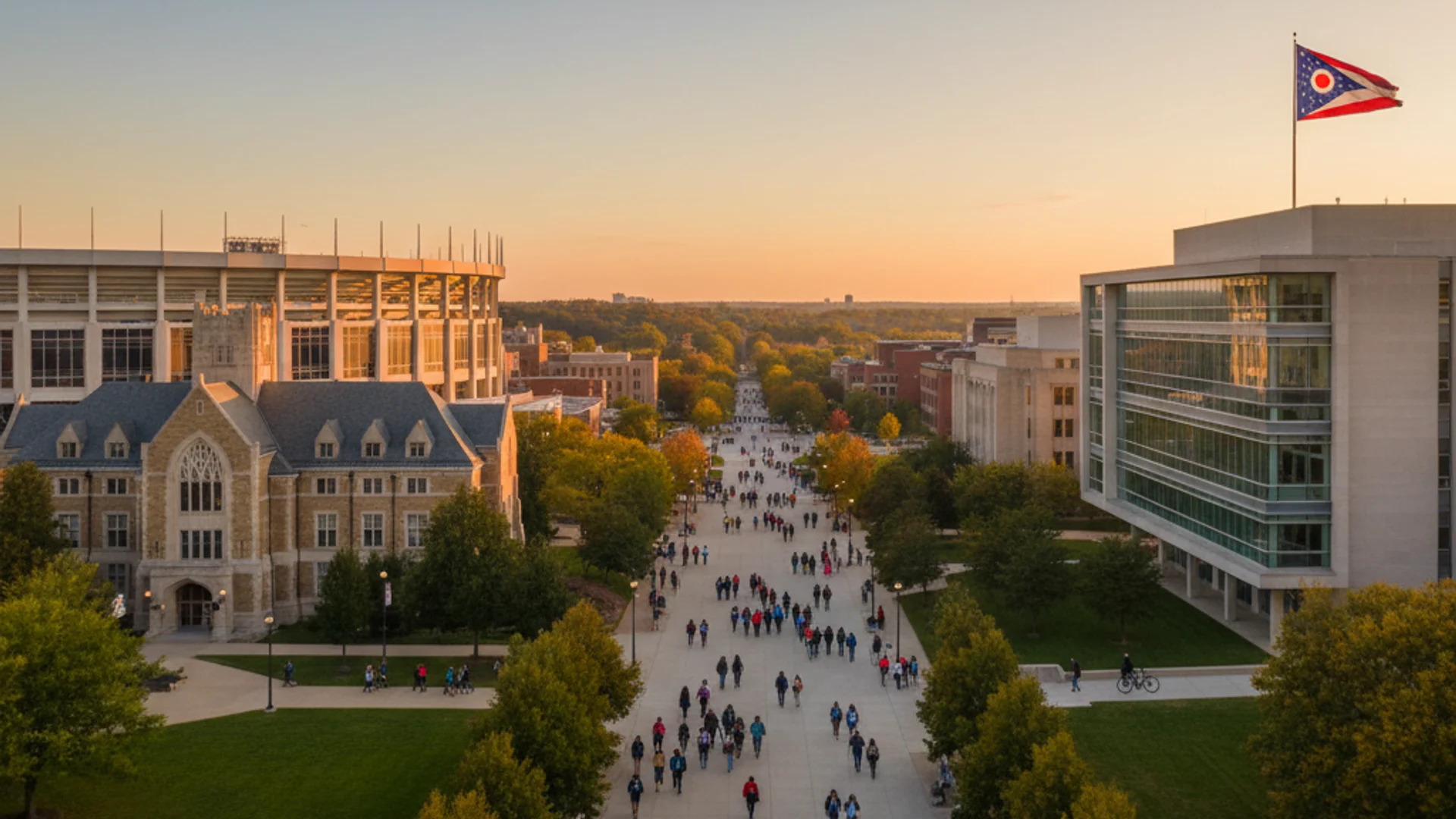
Compare the top data science colleges in Ohio. 40 accredited data science schools ranked by graduation rate, career outcomes, and value, from Lakeland Community College to Case Western Reserve University.
Best data science degree programs: Case Western Reserve, Miami University-Oxford, Denison
Ranked by graduation rates, program outcomes, and institutional quality
Tuition ranges from $3,889 to $64,100/year
Lakeland Community College offers the most affordable option at $4,057/yr
Data Science degree programs available: 4 associate's, 13 master's, 6 doctoral in Ohio
From community college pathways to advanced research degrees
16 online data science degree programs in Ohio
Flexible scheduling for working professionals
Ohio community college transfer can save 40-60% on total degree costs
4 associate's programs provide transfer pathways to bachelor's degrees
Education Commission of the States
Major employers: JPMorgan Chase, Nationwide, Root Insurance, CoverMyMeds
Tech hubs in Columbus and Cleveland
Hakia Research 2026
Data Science degree programs near 140+ cities across Ohio
Search by city to find programs within 200 miles of your location
Updated October 19, 2026
We rank 59 accredited data science programs in Ohio using IPEDS 2024 institutional data, BLS OEWS 2024 state salary data, and College Scorecard outcomes. A 4-factor weighted composite is normalized to a 0–100 score. Schools cannot pay for placement; rankings are produced algorithmically.
Are Data Science Degree Programs in Ohio Worth It?
Source: BLS OEWS May 2024
Compare the top-ranked Data Science programs in Ohio by degree level. Tuition, graduation rate, and Hakia Score for every accredited program.
Ohio ranks among the nation's top destinations for data science education, with 36 accredited bachelor's degree programs across 11 public and 25 private institutions. The highest-ranked programs are Case Western Reserve, Miami University-Oxford, Denison, recognized for academic excellence, research opportunities, and strong industry connections.
Graduates from Ohio data science programs earn a median salary of $85,153, 13% below the national average. The state's robust technology sector, anchored by the Columbus, Cleveland, Cincinnati metropolitan areas, provides abundant internship and employment opportunities with companies including JPMorgan Chase, Nationwide, Root Insurance.
Tuition ranges from $5,404 to $64,100 annually, with an average of $29,995/yr. Top programs maintain graduation rates above 89%, with the highest reaching 97%. Many programs hold ABET accreditation, the gold standard for computing education, ensuring curriculum meets rigorous industry standards.
Students can choose from specializations including software engineering, cybersecurity, artificial intelligence, data science, and systems architecture. Strong industry partnerships provide access to co-op programs, capstone projects with real companies, and direct recruiting pipelines to Ohio's leading technology employers. For students seeking data science degrees in Ohio, these top-ranked data science schools offer the strongest combination of academic rigor and career preparation.
| Rank | School | Location | Type | Tuition | Grad Rate | Hakia Score |
|---|---|---|---|---|---|---|
| #6 | University of Mount Union | Alliance, OH | Private nonprofit | $36,100 | 59% | 65.5 |
| #7 | Cleveland State University | Cleveland, OH | Public | $12,872 | 51% | 61.1 |
| #8 | Ohio Dominican University | Columbus, OH | Private nonprofit | $35,110 | 41% | 54.4 |
Ohio offers 13 master's degree programs in data science, designed for professionals seeking to advance into senior engineering, technical leadership, and specialized roles. The top programs, U of Dayton, Case Western Reserve, Ohio State, combine advanced technical training with research opportunities and leadership development.
Master's graduates in Ohio earn a median salary of $100,180, approximately 20-30% higher than bachelor's degree holders. The concentration of technology companies in Columbus, Cleveland, Cincinnati creates strong demand for graduate-level talent, with JPMorgan Chase, Nationwide, Root Insurance actively recruiting from these programs.
Program formats include traditional full-time study (typically 2 years), part-time options for working professionals (2-3 years), and accelerated tracks. Tuition averages $19,015/yr, with many employers offering tuition reimbursement for graduate education. Some programs offer thesis and non-thesis tracks, allowing students to focus on research or professional development based on their career goals.
Curriculum covers advanced topics including machine learning, distributed systems, software architecture, and technical management. Many programs include practicum experiences, industry capstone projects, or consulting engagements that provide real-world application of advanced concepts. Among Ohio's data science schools at the graduate level, these programs stand out for both academic quality and career outcomes.
Ohio is home to 6 doctoral programs in data science, preparing students for research positions, faculty appointments, and executive technical roles. Leading programs at Ohio State, Case Western Reserve, U of Cincinnati are recognized for cutting-edge research, strong faculty publications, and competitive funding packages.
Doctoral graduates command premium salaries, with Ohio PhD holders earning a median of $125,225, reflecting the advanced expertise required for research and executive positions. The Columbus, Cleveland, Cincinnati region's research universities and corporate R&D centers provide extensive collaboration opportunities with industry leaders like JPMorgan Chase, Nationwide, Root Insurance.
PhD programs typically require 4-6 years of full-time study, including coursework, qualifying examinations, and original dissertation research. Many programs offer full funding through teaching or research assistantships, covering tuition and providing stipends of $25,000–$40,000 annually.
Research strengths across Ohio programs include artificial intelligence, cybersecurity, human-computer interaction, systems, and theoretical computer science. For aspiring researchers pursuing data science degrees in Ohio, graduates go on to careers as university faculty, industry research scientists, or technical executives, contributing to advances in technology that impact millions of users worldwide.
| Metric | Value |
|---|---|
| Average in-state tuition | $28,179/year |
| Average out-of-state tuition | $70,448/year |
| Community college tuition | $7,045/year |
| 4-year savings for residents | $169,076 |
| 2+2 transfer pathway savings | $42,268 |
Source: IPEDS 2024
Verdict: Ohio data science students benefit from one of the most STEM-friendly US state aid programs, Choose Ohio First Scholarship provides STEM-specific funding averaging ~$4,700/year and explicitly includes DS-track programs at participating Ohio institutions. Combined with Ohio State's Buckeye Opportunity Program (full in-state tuition for Pell-eligible Ohio residents) and OCOG (need-based), an in-state OSU DS-track student with appropriate eligibility can attend at essentially zero net cost.
Ohio College Opportunity Grant (OCOG) provides need-based aid up to ~$5,500/year. Choose Ohio First is the cyber-specific lever, STEM-specific scholarships explicitly including DS at participating Ohio institutions (Ohio State, University of Cincinnati, Ohio University, Bowling Green State, Kent State, Miami University, Wright State, University of Dayton). Awards average ~$4,700/year and stack with other state and federal aid.
Ohio State University's Department of Statistics and Department of Computer Science and Engineering offer strong DS-track programs. The Ohio State Translational Data Analytics Institute (TDAI) is one of the larger US public-university applied DS research centers with substantial federal and industry funding.
University of Cincinnati's DS programs through Carl H. Lindner College of Business and CS Department have strong P&G + Kroger + Fifth Third Bank industry partnerships. Case Western Reserve University (Cleveland) has substantial DS programs through its Statistics Department. Miami University (Oxford) has growing DS programs at competitive in-state tuition. Federal Pell stacks on top. Industry-track scholarships from Ohio-based DS employers (Nationwide DS, Cardinal Health DS, P&G DS, Kroger 84.51° DS, Progressive Insurance DS, JPMorgan Columbus DS, plus growing Intel DS) provide additional funding most students don't pursue.
Use our interactive ROI calculator to estimate your return on investment for a data science degree in Ohio. Enter your expected tuition costs, financial aid, and career goals to see projected payback periods and lifetime earnings. The calculator uses current salary data from BLS and tuition data from IPEDS to provide accurate estimates.
Estimate your return on investment for a data science degree
Leave blank to use average cost for selected program type
+645%
Net gain divided by total investment. ROI above 200% is considered excellent for education investments.
$1,192,850
Your additional lifetime earnings with this degree vs. working without one, minus the total investment.
6 years
Years until your cumulative earnings exceed total investment. Shorter programs often break even faster due to lower opportunity cost.
$109,524
Your starting salary adjusted for local cost of living. This shows real purchasing power compared to a $100K national baseline.
Why does break-even change with program type? Your "total investment" includes both tuition AND opportunity cost (foregone earnings while in school). A 4-year full-time public university (in-state) means 4 years of not earning a salary ($140,000 in opportunity cost). Shorter full-time programs may have higher tuition but lower total investment because you return to the workforce sooner.
How we calculate your degree ROI using real salary data
Tuition plus opportunity cost (earnings you miss while in school)
Direct cost of the degree program
4 years × $35K/year foregone salary while studying full-time
Projected career earnings starting after graduation, with salary growth
What you'd earn working at $35K/year with 2% annual growth
Median salary for this role in your selected location (BLS 2024)
Your investment's compound annual growth rate (similar to stock market returns)
Data sources: BLS OEWS May 2024, IPEDS 2024. Calculations use median salaries, 3% discount rate, and assume salary growth declines from 6% to 2% over career. Individual results will vary. | Powered by Hakia.com
Median annual salary in Ohio metro areas
| Category | Value |
|---|---|
| Columbus | $110K |
| Cleveland | $105K |
| Cincinnati | $100K |
Source: BLS OEWS May 2024
Hakia.com
Find data science jobs in Ohio. These major employers across Ohio metro areas are actively hiring data science degree holders. Click employer names to view current job openings.
Columbus is Ohio's tech hub with a strong insurtech and fintech presence, plus major data center investments.
Nearby cities: Dublin, Westerville, Worthington, Grove City
Cleveland combines healthcare IT innovation with industrial automation and aerospace research.
Nearby cities: Akron, Parma, Independence, Beachwood
Ohio's tech market is reshaping rapidly around Intel's $20+ billion New Albany semiconductor fab (the largest single private investment in state history) and Honda's EV/battery joint venture with LG Energy Solution. Beyond the new chip and EV manufacturing footprint, Ohio's three major metros each host substantial enterprise/financial-services tech operations.
Columbus metro
Fastest-growing Ohio tech metro by employment. Intel Ohio chip fab (online 2026-2027), Nationwide Insurance IT, Cardinal Health, Honda IT, Huntington Bank tech. Ohio State University is the principal CS graduate producer.
Cincinnati metro
P&G's substantial IT and analytics organization, Kroger's digital transformation (84.51° data science arm), Fifth Third Bank tech, GE Aviation. Strong consumer-products data-engineering market.
Cleveland-Akron metro
Progressive Insurance HQ, KeyBank tech, Sherwin-Williams IT, Cleveland Clinic and University Hospitals medical-IT. Smaller but stable enterprise-tech market.
Ohio has a graduated state income tax (top rate ~3.5%). InvestOhio and JobsOhio's R&D tax credit are the principal state-level tech-employer incentives.
Ohio is unusual among states for offering an explicit cybersecurity safe-harbor through the Ohio Data Protection Act — businesses that voluntarily adopt a recognized cybersecurity framework gain affirmative defense against data-breach tort claims. This makes Ohio a relatively favorable jurisdiction for security-engineering work.
Provides an affirmative defense against data-breach tort claims for businesses that maintain a written cybersecurity program conforming to recognized frameworks (NIST CSF, ISO 27001, PCI-DSS, HITRUST, etc.).
Strong incentive for OH-based businesses to invest in formal security programs — drives security-engineer hiring and consulting demand. Engineers building security-program-compliant systems in Ohio operate with this legal benefit in mind.
Read moreHB 376 / SB 11 (varying sessions) propose CCPA-style consumer privacy rights for Ohio residents. None has yet passed as of 2026.
Engineers should watch this space; Ohio passing comprehensive privacy would create a new compliance lane.
Read moreOhio Revised Code 1349.19 — requires data-breach notification for OH residents whose personal information was compromised.
Standard data-protection compliance for any OH-resident-serving business.
Read moreOhio does not currently administer a separate Software Engineering PE license. ABET-EAC accreditation is recognized for traditional engineering PE tracks (mechanical, electrical, computer engineering); software engineering specifically is not a recognized Ohio PE discipline.
Ohio licensing boardUp to $5,500/yr (varies by institution type)
Ohio residents with demonstrated financial need at OH public and private nonprofit institutions
Average ~$4,700/yr (varies by institution and award)
Ohio residents pursuing STEM degrees at participating Ohio institutions; merit + financial need
Tuition + fees
Children/spouses of OH safety officers killed in the line of duty
Up to ~$5,950/yr
Children of qualifying veterans pursuing higher education in Ohio
Verdict: Ohio's Ohio Transfer Module (OTM) and Course Transfer Assurance Guides (CTAGs) provide one of the better US state transfer systems for DS-track students. Ohio State and University of Cincinnati both have accessible DS-track admissions plus a relatively open Ohio DS transfer ecosystem, substantially less competitive than UC Berkeley CS, Carnegie Mellon ML, or Georgia Tech ISyE.
Best Ohio community college DS-feeder schools: Columbus State Community College (strong OSU transfer record, including direct articulation agreements for STEM majors), Cuyahoga Community College (Cleveland metro, strong Case Western Reserve and Cleveland State pipelines), Sinclair College (Dayton, strong University of Dayton and Wright State pipelines), Lorain County Community College, Lakeland Community College, Stark State College (Akron-Canton area), and Eastern Gateway Community College.
The Columbus State → Ohio State DS-track pathway is well-supported with direct articulation. OSU's DS-track is housed across Statistics Department, CS Department, and TDAI, students can choose the disciplinary emphasis that best fits their career interests.
Beyond OSU: University of Cincinnati has CAE-CD designation (for cyber overlap) with substantial Cincinnati-area enterprise DS industry placement (P&G's substantial DS operation, Kroger's 84.51° subsidiary, Fifth Third Bank DS). Ohio University (Athens) has DS programs in a smaller-school environment. Kent State University has growing DS programs through its Department of Mathematical Sciences. Miami University (Oxford) has DS programs at competitive in-state tuition. Wright State University and University of Dayton have DS programs aligned with Wright-Patterson Air Force Base-adjacent defense DS work. For Ohio DS-track students, the OSU pathway is the comprehensive research-and-industry optimization; University of Cincinnati is the CPG and consumer-DS optimization; Miami University is the affordable strong-academics option; University of Dayton is the defense-DS pathway.
Data Science Job Growth in Ohio
Source: BLS Occupational Outlook
Verdict: Ohio has a substantial and underrated data science job market anchored by Columbus's growing tech employer base (Intel chip fab cybersecurity and DS expanding through 2026-2027), Cincinnati's CPG and retail DS (Procter & Gamble, one of the largest US CPG DS operations, Kroger's 84.51° subsidiary, strong consumer DS at scale, Fifth Third Bank DS), Cleveland's insurance and healthcare DS (Progressive Insurance, one of the largest US auto insurance DS operations, Cleveland Clinic medical DS, KeyBank DS), and Dayton's defense DS (University of Dayton, Wright-Patterson Air Force Base, plus federal contractor DS at scale).
By metro: Columbus averages ~$105,000-$135,000 for data scientist roles per BLS and industry surveys, with substantial growth expected as Intel's New Albany chip fab DS needs scale up. Major Columbus DS employers: Nationwide Insurance DS (one of the larger US insurance DS operations), Cardinal Health DS (healthcare-IT DS at scale, supply chain, drug commercialization analytics), Honda North America IT DS, JPMorgan Chase Columbus DS (substantial and growing), Huntington Bank DS, plus Battelle Memorial Institute DS (one of the largest US scientific R&D organizations, headquartered in Columbus, substantial scientific DS work).
Cincinnati averages ~$100,000-$130,000 with Procter & Gamble's substantial DS organization (one of the largest US consumer-products DS operations, supply chain, marketing analytics, R&D DS), Kroger's 84.51° subsidiary (consumer DS leveraging Kroger's massive grocery purchase data), Fifth Third Bank DS, GE Aviation DS, Macy's DS (Cincinnati corporate headquarters). Cleveland averages ~$95,000-$125,000 with Progressive Insurance DS (one of the largest US auto insurance DS operations, pricing, claims, customer analytics), Cleveland Clinic medical DS (one of the largest US healthcare DS operations leveraging extensive clinical research data), KeyBank DS, Sherwin-Williams DS, Hyland Software analytics, University Hospitals medical DS.
Two distinctive Ohio DS dynamics: (1) Procter & Gamble's substantial DS organization in Cincinnati is one of the most-underrated US enterprise DS career destinations, substantial CPG industry DS work, stable employment, lower cost of living than coastal markets. P&G's DS work spans supply chain optimization, brand analytics, R&D experimentation, and consumer behavior modeling at global scale. (2) 84.51° (Kroger's data analytics arm) is one of the more interesting US enterprise DS operations, substantial consumer DS leveraging one of the largest US retail-transaction datasets. The Ohio Data Protection Act (ODPA) creates favorable cybersecurity-engineering work that overlaps with DS at OH-based businesses. See AI/ML Engineer Career Guide and Data Analyst Career Guide.
New graduates and career changers
Technical leads and architects
16 available in Ohio
Traditional classroom experience
Institutional characteristics, completions, graduation rates
Ohio salary and employment data
Program details and admissions information
Last Updated: June 26, 2026. Rankings based on IPEDS 2024 data. Salary data from BLS OEWS May 2024.

Co-founder & Editor (B.S. Computer Science, Oregon State • B.A. Psychology, University of Washington)
Taylor combines technical expertise in computer science with a deep understanding of human behavior and learning. His dual background drives Hakia's mission: leveraging technology to build authoritative educational resources that help people make better decisions about their academic and career paths.
Hand-researched detail on the top-ranked programs: degree pathways, research labs, industry partners, career outcomes, and admissions. Tap any school to expand.
Why it stands out. Full-time paid co-op opportunities. Summer internships
Hakia insight. Case Western's paid full-time co-op model is structural advantage most peer programs lack: students graduate with 6–12 months of real engineering experience on their résumé, not an internship line.
Case Western's BS in Data Science and Analytics is one of the first undergraduate programs nationwide in this field. The rigorous curriculum covers mathematical and statistical modeling, informatics, data systems and analytics, and project-based applications across various data domains. Students gain hands-on experience with programming for data analytics, working with structured and unstructured data from different sources. The program explores data management, statistics and data analytics, data mining, machine learning for big data, large-scale data systems, and signal processing. Students can pursue full-time paid co-ops and summer internships for real-world experience. The program prepares graduates for diverse applications from health data-driven diagnosis to tackling big data challenges in nonprofit, government, transportation, energy, and medicine sectors. Career opportunities include predicting financial market movements, analyzing biological systems through DNA sequences, and optimizing user experiences. The program is ABET-accredited under the Computing Accreditation Commission's criteria for Data Science programs.
Programs offered
Research labs & institutes
Accreditation & certifications
Why it stands out. Denison embeds data science within a liberal arts framework, producing graduates who pair technical rigor with domain expertise and ethical reasoning—a distinctive positioning for roles demanding both analytical depth and strategic business judgment.
Hakia insight. Denison's liberal arts framing produces a rare graduate profile: employers hiring data scientists for strategy, product, or leadership roles—not just pure analytics—find that Denison alumni combine technical credibility with the communication and ethical reasoning those roles demand.
At the bachelor's level, denison's data science education emerges from its liberal arts tradition—meaning students develop technical skills without abandoning the kind of critical thinking, communication, and ethical reasoning that matter when data science intersects public policy, business strategy, or social systems. The program leverages small class sizes and close faculty-student mentorship to guide undergraduates through real datasets in contexts they care about: political analytics, environmental data, economics, psychology, and public health. Rather than isolated coursework, data science at Denison is woven across the curriculum, with students often combining quantitative training with deep domain expertise in a second discipline—a pairing that makes graduates distinctly competitive for roles where technical skills alone aren't enough. Faculty encourage undergraduates to contribute to published research, and the college's location near Columbus, Ohio's growing technology and financial services sector creates internship and job placement opportunities without requiring students to migrate to coastal tech hubs immediately. Graduates move into analytics roles at Fortune 500 companies, nonprofits, consulting firms, and startups, often noting that their liberal arts foundation gave them the broader context and communication skills that separated them from purely technical competitors.
Programs offered
Career outcomes
Top employers: Victoria's Secret, DHL, Wendy's
Location advantage: Proximity to Columbus tech and financial services sector
Why it stands out. The program uniquely combines rigorous data science education with liberal arts breadth by requiring minors outside STEM fields, while providing hands-on consulting experience through partnerships with Fortune 500 corporations like Goodyear and Progressive Insurance.
Hakia insight. Wooster's requirement to minor outside STEM while consulting for Goodyear and Progressive Insurance creates an unusual hybrid: graduates leave with both technical credibility and demonstrated ability to translate data findings for non-technical stakeholders—a soft skill that commands 15-20% salary premiums in corporate analytics roles.
At the bachelor's level, the Statistical & Data Sciences program at The College of Wooster offers a comprehensive liberal arts approach to data science education, blending computer science with statistics in a small class environment with dedicated faculty mentors. The program is part of the Department of Mathematical and Computational Sciences and requires students to choose a minor outside of math or computer science, allowing them to apply data science skills in practical fields. Students gain hands-on experience through required internships, including the summer Applied Methods and Research Experience (AMRE) program partnering with Fortune 500 companies like Goodyear and Progressive Insurance. The program emphasizes critical thinking, communication skills, and ethical data analysis while preparing students for careers in data science through a curriculum covering algorithmic analysis, data collection, statistical modeling, and data-driven decision making. All students complete independent study projects culminating in a senior thesis under faculty guidance.
Programs offered
Industry partners
Notable faculty
Location advantage: Small liberal arts college environment with personalized attention Access to STEM Success Initiative community
Why it stands out. CSU's Data Science program uniquely combines comprehensive academic training with direct access to medical research through its partnership with Cleveland Clinic's Lerner Research Institute, offering students unparalleled opportunities in healthcare data science applications.
Hakia insight. Cleveland State's partnership with Cleveland Clinic's Lerner Research Institute—one of the nation's top medical research centers—gives undergraduates direct access to electronic health record datasets and clinical research that would otherwise require a PhD; this institutional proximity alone justifies choosing CSU for healthcare-track students.
At the bachelor's level, cleveland State University's Data Science program offers comprehensive undergraduate and graduate pathways through the Department of Computer Science, housed in the Washkewicz College of Engineering. The Bachelor of Science in Data Science provides flexible entry plans including 4-year calculus entry, 4-year precalculus entry, and 5-year precalculus entry options. The program features cutting-edge research through specialized labs including the Big Data and AI Research Lab, Cleveland Vision & AI Lab, and Human-Robot Collaboration Lab. A standout feature is the PhD in Engineering - Applied Data Science program, developed in partnership with the Cleveland Clinic Foundation's Lerner Research Institute, providing students unique access to medical research applications. The university also offers specialized certificates including Graduate Certificate in Data Analytics in Education delivered 100% online. Research capabilities span biomedical data analysis, machine learning systems, deep neural networks, and image/video analysis, with strong industry collaboration through the CSU T.E.C.H. Hub and Center for Cybersecurity and Privacy Protection.
Programs offered
Research labs & institutes
Industry partners
Notable faculty
Location advantage: Partnership with Cleveland Clinic's Lerner Research Institute Access to one of the nation's top medical research institutes Collaboration with CSU T.E.C.H. Hub and Center for Cybersecurity and Privacy Protection
Why it stands out. This DHS STEM-designated program uniquely blends mathematics, computer science, and interdisciplinary approaches to data science, preparing graduates to solve complex data challenges across natural, health, and social sciences as well as business applications.
Hakia insight. Kent State's DHS STEM designation unlocks Optional Practical Training extensions and visa pathways for international graduates, while its three specialized labs position students for research-heavy roles; this combination appeals equally to domestic students targeting academia and international students needing work authorization pathways.
At the master's level, kent State University's Master of Science in Data Science is a DHS STEM-designated program that provides comprehensive training in data science theory, methods, and tools for solving real-world problems across natural, health, and social sciences, as well as business and industry applications. The program is founded on mathematics and sciences principles, synthesizing mathematics and computer science methodologies. Students gain expertise in analysis, statistics, databases, big data, artificial intelligence, numerical analysis, graph theory, and visualization. The interdisciplinary curriculum situates computing-specific competencies in computer science and statistical-related fields including database management, data mining, machine learning, and big data analytics within broader interdisciplinary contexts. With experienced faculty, hands-on learning opportunities, and cutting-edge technology, graduates are prepared to understand data science theories and apply data science methodologies to research and workplace challenges across diverse sectors.
Programs offered
Research labs & institutes
Notable faculty
Admissions
GPA 3.000.
Accreditation & certifications
Why it stands out. AFIT uniquely integrates data science within a defense-focused engineering ecosystem, offering classified research access and direct pathways into U.S. intelligence and aerospace careers unavailable at civilian universities.
Hakia insight. AFIT's proximity to Wright-Patterson Air Force Base and embedded access to classified defense research creates a moat: graduates walk into NSA, DIA, and Lockheed Martin roles with security clearances and domain expertise in defense systems already in hand—a pipeline civilian universities cannot replicate.
At the master's level, AFIT's graduate engineering programs, including data science and analytics coursework embedded within engineering curricula, are built explicitly around defense and aerospace applications—a distinction that shapes every classroom discussion and capstone project. Students work directly with active-duty military and civilian defense professionals, meaning your machine learning models aren't theoretical exercises but solutions to real operational challenges faced by the Department of Defense. The institute's location at Wright-Patterson Air Force Base in Ohio provides unparalleled access to government research facilities, classified problem sets, and career pathways into the defense and intelligence sectors. Faculty bring deep expertise in signal processing, autonomous systems, and sensor data analysis, often drawing on classified research portfolios that inform unclassified coursework. Graduates typically move into roles at intelligence agencies, defense contractors, and aerospace firms—career trajectories that reflect the program's singular focus on the defense technology pipeline. What distinguishes AFIT is the intensity of its security clearance culture and the expectation that your technical work will serve national security; this appeals strongly to students seeking purposeful technical roles in government service.
Programs offered
Research labs & institutes
Industry partners
Career outcomes
Top employers: U.S. Air Force, National Security Agency, Defense Intelligence Agency, Lockheed Martin, Raytheon
Location advantage: Proximity to Wright-Patterson Air Force Base and AFRL research facilities Access to defense and intelligence sector hubs
Why it stands out. BGSU is widely recognized as having one of the best data science Ph.D. programs in the Midwest and is currently one of the few dedicated Ph.D. data science programs in the U.S.
Hakia insight. Bowling Green holds one of fewer than a dozen dedicated PhD data science programs in the U.S., meaning you're not competing for attention within a mathematics or computer science department but rather studying data science as a primary discipline with faculty whose entire research mission aligns to your field.
At the doctoral level, bowling Green's approach to data science emphasizes flexibility and accessibility—students can pursue analytics training through multiple entry points, from a dedicated data science major to integrated concentrations within computer science, business, or mathematics. The program's strength lies in its practical, applied focus: coursework prioritizes real-world data problems and industry-standard tools over pure theory, making graduates immediately productive in analytics and data engineering roles. Faculty maintain active consulting relationships with regional businesses and nonprofits, meaning students often work on live datasets from actual clients rather than textbook examples. The university's location in northwest Ohio places it within reasonable distance of both Toledo's industrial base and the broader Midwest tech community, with established internship and placement networks in data analytics roles across manufacturing, healthcare, and financial services. Small cohort sizes allow for mentorship and individualized career guidance, and the program cultivates a collaborative rather than cutthroat culture—important for students who want to learn deeply without the pressure-cooker environment of top-ranked programs. Graduates typically land mid-market analytics roles, data engineering positions, and business intelligence specializations, often noting that BGSU's practical orientation and supportive environment accelerated their professional maturation.
Programs offered
Location advantage: Proximity to Toledo industrial and manufacturing sector Regional Midwest data analytics job market