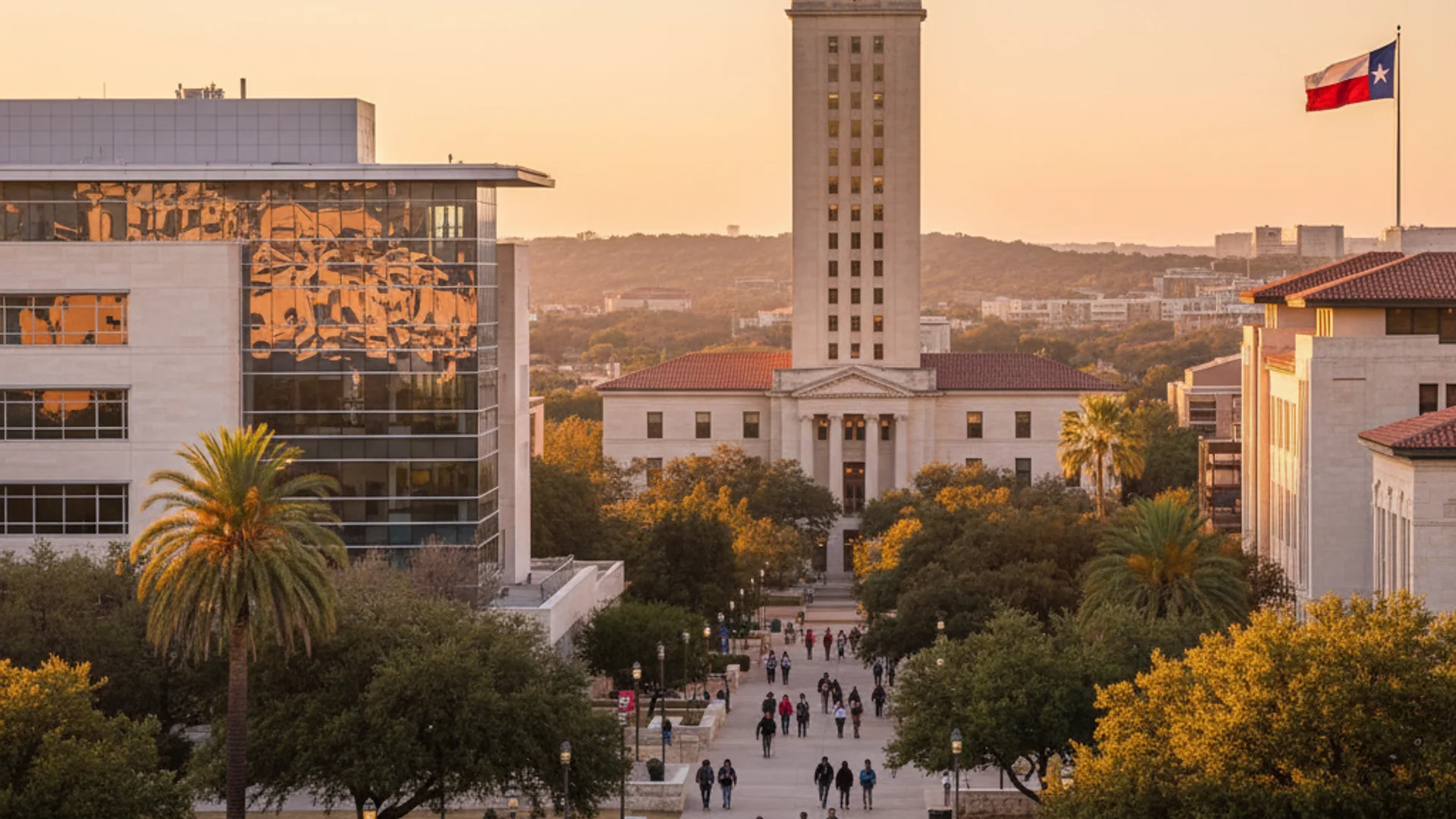
University campus in Texas
Updated July 13, 2026

Best Data Science Degree Programs in Texas, 2026 Rankings

Compare the top data science colleges in Texas. 57 accredited data science schools ranked by graduation rate, career outcomes, and value, from Houston Community College to Texas A & M University-College Station.

#1 ProgramTexas A&M
Avg Salary$115,110
Tuition From$2,904/yr
Job Growth+22%
On this page
Reviewed by Taylor Rupe, Founder & EditorSee methodology

12

Programs ranked

IPEDS 2024

$115,110

Texas median data science salary

BLS OEWS 2024

91.8/100

Top program score

Hakia methodology

36%

U.S. job growth (2023–33)

BLS projections

Key Takeaways

Best data science degree programs: Texas A&M, Southern Methodist, Rice

Ranked by graduation rates, program outcomes, and institutional quality

IPEDS 2024

Tuition ranges from $768 to $57,212/year

Houston Community College offers the most affordable option at $2,904/yr

IPEDS 2024

Data Science degree programs available: 14 associate's, 23 master's, 8 doctoral in Texas

From community college pathways to advanced research degrees

IPEDS 2024

27 online data science degree programs in Texas

Flexible scheduling for working professionals

IPEDS 2024

Texas community college transfer can save 40-60% on total degree costs

14 associate's programs provide transfer pathways to bachelor's degrees

Education Commission of the States

Major employers: Dell, Oracle, AT&T, Texas Instruments

Tech hubs in Austin and Dallas

Hakia Research 2026

Data Science degree programs near 125+ cities across Texas

Search by city to find programs within 200 miles of your location

IPEDS 2024

Updated July 13, 2026

How we ranked Texas Data Science programs

We rank 77 accredited data science programs in Texas using IPEDS 2024 institutional data, BLS OEWS 2024 state salary data, and College Scorecard outcomes. A 4-factor weighted composite is normalized to a 0–100 score. Schools cannot pay for placement; rankings are produced algorithmically.

Program completions (35%)Graduation rate (25%)Selectivity (20%)Career outcomes (20%)
See full methodology

Are Data Science Degree Programs in Texas Worth It?

Answer
$115,110
Yes. The best data science degree programs in Texas deliver strong ROI, graduates earn $115,110 median salary with +22% job growth through 2032. In-state tuition averages $17,345/year.

Source: BLS OEWS May 2024

Data Science Degree Rankings in Texas

Compare the top-ranked Data Science programs in Texas by degree level. Tuition, graduation rate, and Hakia Score for every accredited program.

Best Bachelor's Data Science Programs in Texas

6
Programs ranked
$21,240
Avg tuition/yr
59%
Avg grad rate

Program Landscape

Texas ranks among the nation's top destinations for data science education, with 32 accredited bachelor's degree programs across 11 public and 21 private institutions. The highest-ranked programs are Texas A&M, Southern Methodist, Rice, recognized for academic excellence, research opportunities, and strong industry connections.

Career Outcomes

Graduates from Texas data science programs earn a median salary of $97,844, 0% above the national average. The state's robust technology sector, anchored by the Austin, Dallas, Houston metropolitan areas, provides abundant internship and employment opportunities with companies including Dell, Oracle, AT&T.

Costs & Value

Tuition ranges from $4,416 to $57,212 annually, with an average of $26,465/yr. Top programs maintain graduation rates above 75%, with the highest reaching 99%. Many programs hold ABET accreditation, the gold standard for computing education, ensuring curriculum meets rigorous industry standards.

Curriculum & Specializations

Students can choose from specializations including software engineering, cybersecurity, artificial intelligence, data science, and systems architecture. Strong industry partnerships provide access to co-op programs, capstone projects with real companies, and direct recruiting pipelines to Texas's leading technology employers. For students seeking data science degrees in Texas, these top-ranked data science schools offer the strongest combination of academic rigor and career preparation.

🥇
Baylor University
Waco, TXPrivate nonprofit
$58,100
Tuition/yr
80%
Grad rate
87.2
Hakia Score
Show all 6 ranked programs
RankSchoolLocationTypeTuitionGrad RateHakia Score
#6University of the Incarnate WordSan Antonio, TXPrivate nonprofit$35,05051%57.8

Best Master's Data Science Programs in Texas

6
Programs ranked
$26,308
Avg tuition/yr
80%
Avg grad rate

Program Landscape

Texas offers 23 master's degree programs in data science, designed for professionals seeking to advance into senior engineering, technical leadership, and specialized roles. The top programs, Texas A&M, Rice, Lamar, combine advanced technical training with research opportunities and leadership development.

Career Outcomes

Master's graduates in Texas earn a median salary of $115,110, approximately 20-30% higher than bachelor's degree holders. The concentration of technology companies in Austin, Dallas, Houston creates strong demand for graduate-level talent, with Dell, Oracle, AT&T actively recruiting from these programs.

Costs & Value

Program formats include traditional full-time study (typically 2 years), part-time options for working professionals (2-3 years), and accelerated tracks. Tuition averages $15,509/yr, with many employers offering tuition reimbursement for graduate education. Some programs offer thesis and non-thesis tracks, allowing students to focus on research or professional development based on their career goals.

Curriculum & Specializations

Curriculum covers advanced topics including machine learning, distributed systems, software architecture, and technical management. Many programs include practicum experiences, industry capstone projects, or consulting engagements that provide real-world application of advanced concepts. Among Texas's data science schools at the graduate level, these programs stand out for both academic quality and career outcomes.

🥈
Rice University
Houston, TXPrivate nonprofit
$60,314
Tuition/yr
95%
Grad rate
91.5
Hakia Score
Show all 6 ranked programs
RankSchoolLocationTypeTuitionGrad RateHakia Score
#6University of North TexasDenton, TXPublic$8,31961%73.3

Data Science Degree Costs & Tuition in Texas

MetricValue
Average in-state tuition$17,345/year
Average out-of-state tuition$43,363/year
Community college tuition$4,336/year
4-year savings for residents$104,072
2+2 transfer pathway savings$26,018

Source: IPEDS 2024

Financial Aid for Texas Data Science Students

Verdict: Texas data science students benefit from the same state aid stack as CS students (TEXAS Grant, TEG, TEOG, Top 10% Scholarship) plus growing DS-specific institutional support at UT Austin's School of Data Science (formally launched 2023, one of the newer top US dedicated DS schools), Texas A&M's Statistics and DS programs, and UT Dallas's Naveen Jindal School of Management analytics tracks. Combined with no state income tax, Texas DS education delivers strong cost-to-quality economics, particularly at UT Austin, which has rapidly become a top-tier US public DS destination.

TEXAS Grant (up to ~$5,195/year for need-based in-state students) and Top 10% Scholarship (automatic for Texas HS grads in top 10% of class, $2,000/year + guaranteed admission to most Texas publics) stack with federal Pell. UT Austin's substantial institutional aid plus the Texas Advance Commitment (free tuition for Pell-eligible Texas residents) makes UT Austin DS one of the strongest financial value propositions in US data science.

UT Austin's School of Data Science (launched 2023) consolidates UT Austin's CS, Statistics, Information Studies, and Operations Research/Industrial Engineering data-science offerings into a single school. The MSDS program (Master of Science in Data Science) is among the strongest US public DS master's programs with growing enrollment and Texas-resident-friendly tuition.

Texas A&M's Department of Statistics has substantial DS programs at both undergraduate and graduate levels. UT Dallas's analytics tracks through the Naveen Jindal School of Management have particularly strong Dallas-area enterprise placement. Rice University has substantial DS programs with no-loan financial aid for admitted students with demonstrated need. Federal Pell stacks on top. Industry scholarships from Texas-based DS employers (Capital One Plano DS, USAA, AT&T DS, Indeed Austin DS, Dell Round Rock DS) provide additional industry-track funding most students don't pursue.

Data Science Degree ROI Calculator, Texas

Use our interactive ROI calculator to estimate your return on investment for a data science degree in Texas. Enter your expected tuition costs, financial aid, and career goals to see projected payback periods and lifetime earnings. The calculator uses current salary data from BLS and tuition data from IPEDS to provide accurate estimates.

Data Science Degree ROI Calculator

Estimate your return on investment for a data science degree

Leave blank to use average cost for selected program type

20 years
10 years20 years30 years
20-Year ROI

+697%

Net gain divided by total investment. ROI above 200% is considered excellent for education investments.

Net Gain

$1,289,731

Your additional lifetime earnings with this degree vs. working without one, minus the total investment.

Break-Even

6 years

Years until your cumulative earnings exceed total investment. Shorter programs often break even faster due to lower opportunity cost.

COL-Adjusted Salary

$114,286

Your starting salary adjusted for local cost of living. This shows real purchasing power compared to a $100K national baseline.

Why does break-even change with program type? Your "total investment" includes both tuition AND opportunity cost (foregone earnings while in school). A 4-year full-time public university (in-state) means 4 years of not earning a salary ($140,000 in opportunity cost). Shorter full-time programs may have higher tuition but lower total investment because you return to the workforce sooner.

Detailed Breakdown

How we calculate your degree ROI using real salary data

Total Investment$185,000

Tuition plus opportunity cost (earnings you miss while in school)

Program Cost (Tuition)$45,000

Direct cost of the degree program

Opportunity Cost$140,000

4 years × $35K/year foregone salary while studying full-time

20-Year Earnings (with degree)$2,325,139

Projected career earnings starting after graduation, with salary growth

20-Year Earnings (without degree)$850,408

What you'd earn working at $35K/year with 2% annual growth

Starting Salary (Austin, TX)$120,000

Median salary for this role in your selected location (BLS 2024)

Annualized Return4.1%

Your investment's compound annual growth rate (similar to stock market returns)

Data sources: BLS OEWS May 2024, IPEDS 2024. Calculations use median salaries, 3% discount rate, and assume salary growth declines from 6% to 2% over career. Individual results will vary. | Powered by Hakia.com

Data Science Salaries by Metro Area

Median annual salary in Texas metro areas

Austin$127K
Dallas$121K
Houston$115K
San Antonio$109K
View data table
CategoryValue
Austin$127K
Dallas$121K
Houston$115K
San Antonio$109K

Source: BLS OEWS May 2024

Hakia.com

Top Employers Hiring Data Science Graduates in Texas

Find data science jobs in Texas. These major employers across Texas metro areas are actively hiring data science degree holders. Click employer names to view current job openings.

Data Science Jobs in Austin

TX
~2,606 Open Positions

Austin is the fastest-growing tech hub in the US. Tesla, Oracle, and major tech companies have relocated headquarters here.

Nearby cities: Round Rock, Cedar Park, Georgetown, Pflugerville, San Marcos, Kyle, Leander

Tesla
Electric Vehicles & Energy
Apple
Consumer Electronics
Dell Technologies
Enterprise Technology
Oracle
Enterprise Software
Google
Big Tech
Meta
Social Media & VR
Amazon
E-commerce & Cloud
IBM
Enterprise Technology

Data Science Jobs in Dallas-Fort Worth

TX
~1,205 Open Positions

Dallas-Fort Worth has major corporate headquarters and a growing tech presence. AT&T and Texas Instruments are based here.

Nearby cities: Fort Worth, Plano, Irving, Arlington, Frisco, McKinney, Richardson, Garland

Texas Instruments
Semiconductors
AT&T
Telecommunications
Capital One
Financial Technology
Cisco
Networking
Microsoft
Big Tech
ServiceNow
Enterprise SaaS

Data Science Jobs in Houston

TX
~805 Open Positions

Houston leads in energy tech, healthcare IT, and aerospace. NASA Johnson Space Center drives space technology.

Nearby cities: The Woodlands, Sugar Land, Katy, Pearland, League City, Pasadena, Baytown

ExxonMobil
Energy Technology
Schlumberger (SLB)
Oilfield Services
Halliburton
Energy Services
JPMorgan Chase
Financial Technology
Sysco LABS
Food Tech
Hewlett Packard Enterprise
Enterprise Technology

Data Science Jobs in San Antonio

TX
~795 Open Positions
USAA
Financial Services
Lockheed Martin
Defense & Aerospace
Northrop Grumman
Defense Technology
Raytheon
Defense & Cybersecurity
Deloitte
Professional Services
Booz Allen Hamilton
Defense Consulting

Texas Tech Industry & Infrastructure

Texas now sits second only to California in tech-job employment and has been the destination of the heaviest tech-employer relocations of the last five years — Oracle, Tesla, HPE, Charles Schwab, and CBRE moved headquarters to the state. No state income tax, business-friendly regulation, and a deep pool of state universities have produced one of the largest tech-graduate markets in the country.

Austin

Austin metro

Capital tech hub anchored by Apple, Tesla, Oracle, Indeed, Dell, IBM, and a dense startup/VC scene. UT Austin's CS program feeds directly into this market; entry-level total comp at named employers commonly clears $150,000.

Dallas-Fort Worth

DFW metro

Largest Texas tech-employer concentration: AT&T, Texas Instruments, Toyota North America IT, Capital One, USAA, Charles Schwab. Strong enterprise/IT, telecom, and financial-services tech markets.

Houston

Houston metro

Energy-tech, healthcare-IT (Texas Medical Center), and growing aerospace/defense software. Rice and University of Houston are the principal CS feeders.

No state income tax. Texas Enterprise Fund and R&D franchise-tax credit are the principal state-level tech incentives.

Texas Regulation Affecting Data Science Graduates

Texas passed comprehensive privacy legislation in 2023, joining a small set of states with binding consumer privacy laws. The state's approach generally favors employers and remains less restrictive than California's, but compliance is now a real engineering concern for any business serving Texas residents at scale.

Texas Data Privacy and Security Act (TDPSA)

Effective July 2024. Grants Texas consumers rights to access, correct, delete, and opt out of sale of personal data. Applies to businesses conducting business in Texas that process personal data of Texas residents.

Engineers building consumer-facing products serving Texas users must implement opt-out mechanisms, data-access flows, and breach-notification logic.

Read more

Texas SB 8 (Consumer Data Protection)

Part of the broader TDPSA package establishing the Texas AG as the primary privacy enforcement authority.

Texas AG's office actively investigates non-compliance; tech-employer legal/engineering review of privacy posture has expanded since 2024.

Read more

Texas Cybersecurity Act (HB 8)

Establishes data-breach notification requirements and minimum cybersecurity standards for state agencies and contractors.

Engineers working with state/local government tech in Texas operate under these standards; the law shapes hiring criteria for state-IT and gov-tech roles.

Read more

Professional Engineer Licensure in Texas

Texas is one of the few US states that still actively administers a Software Engineering PE license. ABET-EAC accredited software engineering degrees count toward eligibility; ABET-CAC computer science does not. Most Texas CS graduates do not pursue PE licensure; the credential is most relevant for state agency, infrastructure, or defense-adjacent software work.

Texas licensing board

Texas Financial Aid Programs

Up to ~$5,195/yr for universities, $2,790/yr for community colleges

Texas residents with demonstrated financial need at public colleges/universities

Up to ~$3,800/yr

Texas residents at independent (private) Texas colleges/universities

Up to ~$1,860/yr

Texas residents at public two-year community colleges with financial need

Top 10% Scholarship

State scholarship

$2,000 per academic year

Texas high-school students graduating in top 10% of class enrolling at participating Texas universities

Transfer Pathways for Texas Data Science Students

Verdict: Texas's Common Course Numbering System (TCCNS) supports DS-track transfer pathways at the foundational level (calculus, linear algebra, statistics, intro programming). The DS-specific consideration is that UT Austin's School of Data Science is rapidly emerging as a major US DS destination, transfer admission is competitive but materially more accessible than UT Austin CS for comparable applicants. Texas A&M Statistics, UT Dallas analytics, and the broader Texas public university system all have growing DS programs with accessible transfer admission.

Best Texas community college DS-feeder schools: Houston Community College (largest CS/DS enrollment in Texas, strong UT Houston and Rice transfer record), Austin Community College (well-established UT Austin and Texas State articulation), Dallas College (DFW area, strong UT Dallas, UT Arlington, and Texas A&M transfer pipelines), Lone Star College (suburban Houston), San Jacinto College (Houston metro), and Collin College (Plano area, strong UT Dallas pipeline). Each has refined DS prerequisite sequences via TCCNS articulation.

The Houston Community College → UT Austin School of Data Science pathway is particularly accessible for top-performing transfer applicants, UT Austin DS transfer admission rates are substantially more open than UT Austin CS (estimated 25-40% vs UT Austin CS's tighter admissions). The HCC → Rice DS pathway is more competitive but available for the strongest CS/DS applicants. Collin College → UT Dallas is the strongest DFW-area DS transfer pipeline.

Beyond UT Austin: Texas A&M College Station offers strong undergraduate DS through Statistics and Computer Science departments with accessible transfer admission. UT Dallas has substantial DS/analytics programs with growing transfer admission. Rice University DS transfer admission is competitive (under 15%) but available, Rice's smaller scale produces stronger per-student outcomes. Sam Houston State University has growing DS programs at affordable in-state tuition. For Texas DS-track students, the UT Austin pathway is the research and top-employer optimization; UT Dallas is the DFW enterprise-DS optimization; Texas A&M is the strong Statistics-heavy option; Rice is the elite private option.

Texas Take-Home Pay Advantage

$0 State Income Tax
Texas has no state income tax. At the median data science salary of $115,110, that keeps roughly $5,756 more in your pocket annually compared to states with a 5% income tax rate.

Source: Texas Department of Revenue

Texas Data Science Job Market & Salary

Verdict: Texas has the third-largest US data science job market after California and the NYC-NJ metro, with three meaningfully distinct DS clusters: Austin's tech-company DS (Apple, Tesla, Oracle, Indeed, Dell, plus a substantial AI startup scene), DFW's enterprise and financial-services DS (Capital One Plano, one of the largest US enterprise DS operations outside Big Tech, USAA San Antonio + Plano, Toyota North America IT, Charles Schwab, AT&T DS at scale, American Airlines DS), and Houston's energy DS (ExxonMobil DS, SLB / Schlumberger, Halliburton, operational DS, geophysics ML, predictive maintenance). Combined with no state income tax, Texas DS take-home compensation often exceeds equivalent California roles.

By metro: Austin averages ~$140,000-$175,000 for data scientist roles per Levels.fyi and BLS, with substantial concentrations at Apple Austin DS, Tesla DS (vehicle ML, manufacturing analytics, energy DS), Oracle Austin DS, Indeed search/recommendation DS (one of the largest US DS operations in employment-tech), Dell Round Rock DS, IBM Austin DS, Cisco Austin DS, plus a growing AI startup scene (Anthropic Austin, OpenAI Austin operations, Google Austin DS).

Dallas-Fort Worth averages ~$130,000-$165,000 with Capital One Plano DS as the standout employer, Capital One operates one of the largest US enterprise data science and ML organizations outside Big Tech, with thousands of data scientists and ML engineers across credit modeling, fraud detection, marketing analytics, and AI/ML platform engineering. USAA's combined San Antonio + Plano DS organization, Toyota North America IT analytics (Plano), Charles Schwab DS (Westlake, newer relocation from California), AT&T DS at scale (Dallas), American Airlines operational DS (Fort Worth), JPMorgan Chase DFW operations. Houston averages ~$120,000-$155,000 with energy-DS as the distinctive market, ExxonMobil's substantial industrial DS organization (operational analytics, geophysics ML, predictive maintenance at scale), Schlumberger/SLB digital operations, Halliburton DS, plus a growing healthcare DS market at Texas Medical Center (MD Anderson, Texas Children's, Memorial Hermann).

Texas DS-specific dynamics: (1) Capital One Plano's ML/AI organization is one of the most-overlooked elite US DS destinations, it pays comparable to Big Tech, has substantial ML research scope, and is materially less competitive than Bay Area FAANG DS for new graduate hiring. For DS-track graduates not optimizing for Bay Area location, Capital One Plano is one of the strongest US destinations by per-student outcomes. (2) Austin's AI startup scene has accelerated substantially in 2024-2025 with Anthropic, OpenAI, and similar frontier AI labs adding Austin operations, providing real alternatives to Bay Area frontier AI employment without California cost of living. (3) Houston's energy-DS market is distinctive, operational technology DS, geophysics ML, and predictive-maintenance applications create a DS career path that doesn't really exist elsewhere at this scale. See AI/ML Engineer Career Guide and Data Analyst Career Guide.

Entry-Level (0-2 yrs)

New graduates and career changers

Senior (8+ yrs)

Technical leads and architects

Median Salary in Texas$74,822$166,910
Typical RolesJunior Developer, AnalystStaff Engineer, Architect
Remote Work AccessLimitedCommon
Degree ExpectationBachelor's sufficientMaster's preferred

Online vs On-Campus Data Science Programs in Texas

Online Programs

27 available in Texas

On-Campus Programs

Traditional classroom experience

Typical Tuition$15,611/yr$17,345/yr
Schedule FlexibilitySelf-paced or asyncFixed schedule
NetworkingVirtual cohortsIn-person, career fairs
Best ForWorking professionalsTraditional students
Completion Time2-4 years (flexible)4 years (standard)

Compare Data Science Programs in Other States

Data Science Degree Programs in Texas: FAQ

What are the best data science degree programs in Texas?
The best data science degree programs in Texas based on our methodology are: 1) Texas A & M University-College Station (84% graduation rate), 2) Southern Methodist University, and 3) Rice University. Our rankings weight graduation rates (25%), program completions (35%), selectivity (20%), and career outcomes (20%). Texas offers 57 total accredited programs across 35 public and 22 private institutions. See our complete rankings for all 32 bachelor's programs.
How much do data science degree programs cost in Texas?
Data Science degree program costs in Texas vary significantly by institution type. In-state public tuition averages $17,345/year, while private institutions average $38,159/year. Community colleges offer the most affordable path at approximately $4,336/year for associate's degrees. The total 4-year cost ranges from $69,380 at public schools to $152,636 at private institutions before financial aid. Most students don't pay full sticker price, federal grants, state aid, and institutional scholarships can reduce costs by 30-60%.
What salary can data science degree graduates earn in Texas?
Data Science professionals in Texas earn a median salary of $115,110, which is competitive with the national average of $115,500. Entry-level positions typically start around $74,822, while senior roles exceed $166,910. Salaries vary by metro area: Austin ($126,621), Dallas ($120,866) offer the highest compensation. Specialized roles like AI/ML engineers and cloud architects command premiums of 15-30% above median.
Are there online data science degree programs in Texas?
Yes, Texas offers 27 accredited online Data Science programs from state institutions. These programs award the same degree as on-campus options and include synchronous and asynchronous formats. Top-ranked online programs include offerings from Southern Methodist University and Rice University. Online programs typically cost the same as on-campus tuition for in-state students. Many programs offer flexible scheduling for working professionals, with some offering accelerated completion in 2-3 years. Ensure any online program holds regional accreditation and ideally ABET accreditation for engineering programs.
What companies hire data science degree graduates in Texas?
Major Data Science employers in Texas include Dell, Oracle, AT&T, Texas Instruments, AMD. The Austin and Dallas metro areas serve as primary tech hubs with thousands of open positions. Top employers maintain recruiting pipelines directly from Texas universities, with many offering internship-to-hire programs. Beyond tech giants, opportunities exist in healthcare IT, financial services, defense contractors, and growing startups. Texas's tech sector shows +22% projected job growth through 2033, outpacing most other industries.
Is a data science degree program worth it in Texas?
A data science degree program in Texas offers strong ROI with a $115,110 median salary and +22% projected job growth. At average in-state tuition of $17,345/year, graduates typically recoup their educational investment within 3-5 years. The degree opens doors to high-paying careers in software development ($130,074), data science, cybersecurity, and AI/ML. Beyond salary, benefits include job security, remote work flexibility, and clear advancement paths. Alternative paths like bootcamps exist for career changers, but bachelor's degrees provide broader career options and higher lifetime earnings.
How long do data science degree programs take in Texas?
Standard completion times for data science degree programs in Texas are: Associate's (2 years, 60 credits), Bachelor's (4 years, 120 credits), and Master's (1-2 years, 30-36 credits). However, actual timelines vary based on course load, transfer credits, and program format. Accelerated programs can compress a bachelor's to 3 years or a master's to 12 months. Part-time students typically need 5-6 years for a bachelor's degree. Texas community colleges offer a cost-effective "2+2" path: complete your associate's in 2 years, then transfer to a Texas university for the final 2 years of a bachelor's program.
What financial aid is available for data science degree students in Texas?
Texas data science degree students can access multiple financial aid sources. Federal aid includes Pell Grants (up to $7,395/year for qualifying students) and federal student loans. Texas state grants provide additional support for residents attending in-state schools. Institutional scholarships from universities can significantly reduce costs, many schools offer merit-based awards for STEM students. Work-study programs and teaching/research assistantships (especially for graduate students) provide income while building experience. Complete the FAFSA by Texas's priority deadline to maximize aid eligibility. Some employers also offer tuition reimbursement for employees pursuing CS degrees.

Data Sources

Institutional characteristics, completions, graduation rates

Texas salary and employment data

Official University Websites

Program details and admissions information

Last Updated: June 26, 2026. Rankings based on IPEDS 2024 data. Salary data from BLS OEWS May 2024.

Was this ranking helpful for your college search?
Taylor Rupe

Taylor Rupe

Co-founder & Editor (B.S. Computer Science, Oregon State • B.A. Psychology, University of Washington)

Taylor combines technical expertise in computer science with a deep understanding of human behavior and learning. His dual background drives Hakia's mission: leveraging technology to build authoritative educational resources that help people make better decisions about their academic and career paths.

The research behind the rankings

In-depth Data Science program profiles in Texas

Hand-researched detail on the top-ranked programs: degree pathways, research labs, industry partners, career outcomes, and admissions. Tap any school to expand.

Best Bachelor's Data Science programs

#2The University of Texas at DallasRichardson, TX

Why it stands out. Mandatory capstone project. Undergraduate research opportunities alongside faculty and graduate students

Hakia insight. The mandatory capstone paired with embedded research opportunities alongside graduate students gives UT Dallas undergraduates the rare advantage of co-authoring publishable work before graduation—a credential that typically requires waiting until grad school at peer institutions.

The Bachelor of Science in Data Science at UT Dallas is an interdisciplinary degree jointly offered by the Department of Mathematical Sciences and Department of Computer Science. The 120-credit program provides a solid foundation in computer science, mathematics, and statistics, requiring 65-67 major hours plus 11-13 electives for specialization. Students complete a mandatory capstone project and are encouraged to participate in undergraduate research alongside faculty and graduate students. The curriculum prepares graduates for positions as data scientists, data analysts, machine learning scientists, and related roles in finance, technology, healthcare, retail, and manufacturing sectors. The program leverages UT Dallas' reputation in STEM fields and connects students with the NSM Career Success Center for career development, interview preparation, resume writing, and campus recruiting connections.

Programs offered

  • Bachelor of Science in Data Science · 4 years · on-campus

Industry partners

American AirlinesCitiNikeInfosysMedpace Inc.Baylor College of MedicineConestoga Energy Partners

Notable faculty

  • Dr. Yulia Gel (data science)
  • Dr. Murat Kantarcioglu (computer science/data science)
  • Dr. Sanda M. Harabagiu (computer science)
  • Dr. Latifur Khan (computer science)

Admissions

GPA 3.00.

Location advantage: Dallas region rated #1 Best City for Jobs by Forbes Access to large alumni network Proximity to major employers and internship opportunities

#4The University of Texas at ArlingtonArlington, TX

Why it stands out. UTA's data science programs uniquely serve students from diverse backgrounds including non-technical majors, offering both engineering and science tracks with extensive hands-on experience through community partnerships and workplace integration.

Hakia insight. UTA's dual B.S./B.A. structure with separate engineering and science tracks is rare at the bachelor's level—most programs force students into a single path, but UTA lets non-STEM majors build data science fluency without calculus prerequisites while engineering students access labs like BioMeCIS for AI drug development research.

At the bachelor's level, the University of Texas at Arlington offers multiple data science degree programs designed to meet the growing demand for data science professionals across STEM, healthcare, business, and other industries. The MS in Data Science (College of Engineering) provides 30 credit hours with core courses, electives, and capstone experience, allowing students without computer science backgrounds to develop essential data science skills. The MS in Applied Statistics and Data Science (College of Science) is an 18-month cohort-style program requiring 27 hours plus capstone, focusing on statistical methodologies, machine learning, and big data analytics with hands-on experience. Both programs emphasize practical application through real-world problems, community partnerships, and workplace integration. The programs prepare graduates to draw insights from data, make sound data-driven decisions, and effectively communicate findings across business, engineering, healthcare, and science settings.

Programs offered

  • Bachelor of Science in Data Science · 4 years · on-campus
  • Bachelor of Arts in Data Science · 4 years · online

Research labs & institutes

  • Abacus Cloud and Edge Systems Lab (ACES) — Cloud and edge computing, resource allocation
  • Arlington Computational Linguistics Lab (ACL2) — Natural language processing and knowledge engineering
  • Biomedical Computing and Intelligent Systems Lab (BioMeCIS) — Machine learning, data mining, computer vision for medicine
  • Autonomous and Intelligent Systems Lab — Machine learning, robotics, computer vision

Notable faculty

  • Kenny Zhu (Natural language processing, computational linguistics)
  • Junzhou Huang (AI for drug development)

Admissions

GPA 3.0.

Location advantage: Access to Dallas-Fort Worth job market Excellent job opportunities in DFW region

Best Master's Data Science programs

#1The University of Texas at AustinAustin, TX

Why it stands out. Affordable pricing at $10,000+ fees. Joint program between Statistics/Data Sciences and Computer Science departments

Hakia insight. UT Austin's $10,000 sticker price undercuts peer online programs by 40–60%, but the real edge is Roger Peng's involvement—his textbooks define how data science curricula are structured nationally, so you're learning from someone actively shaping the field's foundations.

The online Master of Science in Data Science at UT Austin is a 30-credit program delivered in 10 semester-length courses, priced at $10,000 plus fees. Offered jointly by the Department of Statistics and Data Sciences and Computer Science, it provides both technical capacity and statistical credibility for data science roles. The program consists of required core courses (12 credits) and electives (15 credits) with flexibility to take core and electives concurrently. Students begin with a gateway course 'Principles of Data Science' covering reproducible workflows, Git/GitHub, and statistical evidence standards. Core courses include Data Structures & Algorithms, Machine Learning, Probability & Inference, and Regression & Predictive Modeling. The curriculum integrates statistics and computer science approaches, covering probability, machine learning, data visualization, optimization, and advanced modeling. Electives include Statistical Modeling and Advanced Predictive Models focusing on time series, spatial data, and matrix analysis. The program is designed for working professionals, taught by tenured faculty from both departments. Graduates gain foundational knowledge applicable across academia, government, healthcare, industry, and nonprofit sectors in one of the fastest-growing fields. The program emphasizes both practical implementation skills and rigorous statistical standards that meet executive and regulatory expectations.

Programs offered

  • Master of Science in Data Science · 1-2 years · on-campus

Notable faculty

  • Roger Peng (Statistics and Data Sciences)
  • Calvin Lin (Computer Science)
  • Adam Klivans (Computer Science)
  • Qiang Liu (Computer Science)
  • Antonio (Tony) Linero (Statistics and Data Sciences)
  • Stephen Walker (Mathematics & Statistics and Data Sciences)
  • Catherine Calder (Statistics and Data Sciences)
  • Purnamrita Sarkar (Statistics and Data Sciences)
  • Claus O. Wilke (Integrative Biology)

Location advantage: Austin technology hub Access to UT Austin research resources Connection to Discovery to Impact commercialization program

#2Rice UniversityHouston, TX

Why it stands out. Non-thesis curriculum. Choice between on-campus full-time or online part-time tracks

Hakia insight. Rice's 31-credit non-thesis design with simultaneous on-campus and online cohorts creates an unusual peer network: part-time professionals and full-time students cross-pollinate projects, so you're not siloed in either track—a flexibility that costs competitors entire semesters to replicate.

Rice University's Master of Data Science is a 31-credit, non-thesis program offering both on-campus and online tracks for interdisciplinary professionals pursuing technical data science careers. The on-campus program operates full-time over three semesters with options for fall-spring-summer completion or external summer internship. Students choose specializations in business analytics, machine learning, or image processing (on-campus only). The curriculum blends computational and statistical foundations with practical application through a capstone project transforming raw data into actionable insights for real-world problems. GRE is recommended but not required. The program emphasizes professional development, networking with industry partners, and hands-on experience. Both tracks maintain identical admissions standards and provide flexibility for working professionals through the online part-time option.

Programs offered

  • Master of Data Science · 1-2 years · on-campus

Research labs & institutes

  • Data to Knowledge Lab (D2K) — Data Science

Notable faculty

  • Chad A. Shaw (Director of Data to Knowledge (D2K) Lab)
  • Christopher M. Jermaine (Department Chair, Computer Science)
  • Huixia Judy Wang (Department Chair, Statistics)
#3Texas A&M University-College StationCollege Station, TX

Why it stands out. Truly interdisciplinary program with four customizable tracks offered by departments in Engineering and Arts & Sciences, administered jointly with the Texas A&M Institute of Data Science, connecting STEM and the humanities.

Hakia insight. Texas A&M's four customizable tracks administered through the Texas A&M Institute of Data Science mean students can legitimately double down on humanities-inflected data science (policy analytics, cultural informatics) rather than being funneled into engineering—a structural advantage over monolithic CS-heavy programs.

At the master's level, texas A&M's interdisciplinary Master of Science in Data Science is offered by the Departments of Computer Science and Engineering, Electrical and Computer Engineering, Mathematics, and Statistics from the College of Engineering and the College of Arts and Sciences. The program provides students with a solid foundation in mathematics, statistics, computer science, and machine learning through core courses.

Programs offered

  • Master of Science in Data Science · 1-2 years · on-campus
  • Master of Arts in Data Science · 1-2 years · online

Career outcomes

$112,590 median salary

Notable faculty

  • Dr. James Caverlee (Presidential Impact Fellow, Computer Science & Engineering)
  • Dr. Shuiwang Ji (Truchard Family Endowed Chair, Presidential Impact Fellow, Chancellor EDGES Fellow)
  • Dr. Dilma Da Silva (Ford Motor Company Design Professor II, Regents Professor)
  • Dr. Nick Duffield (Director, Texas A&M Institute of Data Science)

Location advantage: College Station, TX location Access to Emerging Technologies Building facilities Multiple specialized research facilities

#4Southern Methodist UniversityDallas, TX

Why it stands out. SMU's data science program uniquely leverages R1 research credentials and cross-school partnerships (engineering, business, arts) to prepare graduates for leadership roles in Fortune 500 analytics teams and emerging tech companies.

Hakia insight. SMU's R1 designation with cross-school partnerships (engineering + business + arts) means you can pursue a data science degree that legitimately bridges quantitative rigor and organizational leadership—a positioning most competitors reserve for MBA+Analytics dual degrees.

At the master's level, SMU's data science curriculum reflects the research sophistication and interdisciplinary reach of a R1 research institution located in Dallas's thriving tech corridor. The program attracts faculty with significant publication records in machine learning, statistical inference, and computational methods, ensuring students encounter cutting-edge theory alongside practical implementation. What sets SMU apart is its deliberate integration across engineering, business, and liberal arts—students can tailor their capstone and electives toward domain-specific applications, whether that's finance (bolstered by proximity to Dallas's banking sector), healthcare analytics, or technology innovation. The Cox School of Business partnership creates unique opportunities for students interested in business analytics and strategy roles, while the engineering school emphasizes systems thinking and optimization. Internship placement is notably strong due to SMU's deep connections with Dallas-based tech companies, financial services firms, and consulting practices. The program maintains small cohort sizes that foster close faculty mentorship and peer collaboration, a quality that students frequently cite as transformative for their learning trajectory and professional network building.

Programs offered

  • Master of Science in Data Science · 1-2 years · on-campus
  • Master of Arts in Data Science · 1-2 years · online

Research labs & institutes

  • Data Science Infrastructure Lab — Data Science Infrastructure

Industry partners

EYDeloitteAT&TTexas Instruments

Admissions

GPA 3.000.

Accreditation & certifications

ABET accredited

Location advantage: Located in Dallas tech corridor with robust startup ecosystem Access to major financial services headquarters (JPMorgan, Capital One, Comerica) Proximity to AT&T, Texas Instruments, and major consulting firms Strong connections to Fortune 500 companies across multiple sectors

#5Texas Tech UniversityLubbock, TX

Hakia insight. Texas Tech's $75,000 median salary is the lowest in this cohort, but employer overlap with Fortune 500 leaders (Microsoft, Dell, Charles Schwab) suggests the gap reflects Lubbock's lower cost-of-living rather than placement weakness—graduates may actually retain more salary after housing costs than higher-reporting peers.

At the master's level, texas Tech University offers a robust Bachelor of Science in Data Science through an interdisciplinary approach combining computer science, statistics, and domain expertise. The program prepares students for advanced careers in data science with strong emphasis on machine learning, big data technologies, and research methodologies.

Programs offered

  • Master of Science in Data Science · 1-2 years · on-campus
  • Master of Arts in Data Science · 1-2 years · online

Research labs & institutes

  • High Performance Computing Center — Big data processing and machine learning
  • Statistical Consulting Laboratory — Applied statistics and data analysis
  • Cybersecurity Research Institute — Security analytics and threat detection
  • Bioinformatics Core Facility — Genomic data analysis

Industry partners

IBMSAS InstituteRaytheonUnited SupermarketsCovenant Health

Career outcomes

$75,000 median salary

Top employers: Microsoft, Dell Technologies, Charles Schwab, Southwest Airlines, Texas Instruments

Admissions

GPA 3.0.

Accreditation & certifications

AWS Certified Data AnalyticsMicrosoft Azure Data Scientist AssociateSAS Certified Advanced Analytics Professional
#6University of North TexasDenton, TX

Why it stands out. UNT's Data Science program offers the convenience and flexibility of online, blended and face-to-face classes, taught by experienced and knowledgeable professors in the field, with courses available in Denton, Frisco and Online.

Hakia insight. UNT's three simultaneous delivery formats (online, blended, face-to-face) across Denton, Frisco, and online isn't just convenience; it signals a program mature enough to maintain academic rigor across modalities, rare among schools that treat online as a secondary afterthought.

At the master's level, the Bachelor of Science in Data Science at the University of North Texas is designed to meet the rising demand for professionals in data management, big data, and data analytics fields. The program prepares students for careers in data science with a broad knowledge of the tools, techniques and methods needed to analyze and work with data and information to help drive effective decisions and strategy in organizations.

Programs offered

  • Master of Science in Data Science · 1-2 years · on-campus
  • Master of Arts in Data Science · 1-2 years · online

Research labs & institutes

  • Data Innovation Lab — Applying/developing novel interdisciplinary research methods to tackle data-driven problems
  • Data Science & Industry Innovation (DSII) Center — Data science, data visualization, virtual reality, mixed reality, cyber learning, computer science, artificial intelligence, and machine learning
  • Data Visualization Extreme Reality (DVXR) Lab — Visualization solutions for data sets using augmented reality, mixed reality, and virtual reality
  • Intelligent Data Engineering and Analytics (IDEA) Lab — Machine learning, natural language processing, text mining, and information retrieval for data-centric AI systems
  • Center for Knowledge Solutions — Evidence-based decisions for optimizing learning and performance systems
  • Visual Thinking Laboratory — Human interaction with images and meaning, photographic technology applications

Industry partners

Fidelity InvestmentsCitiBankPepsiCoStateFarmDellGoogle CloudTexas InstrumentsToyotaHitachiIBMTeslaAmazonTexas State Technical CollegeRaytheon7-ElevenLockhead Martin

Career outcomes

$86,000 median salary

Top employers: Texas Instruments, Toyota, PepsiCo, Hitachi, IBM, Tesla, Amazon

Notable faculty

  • Dr. Junhua Ding (Department Chair and Reinburg Endowed Professor)
  • Dr. Lingzi Hong (Director, B.S. in Data Science Program)
  • Dr. Kewei Sha (Director, M.S. in Data Science Program)
  • Dr. Sharad Sharma (Associate Dean for Research)
  • Dr. Ana Cleveland (Health Informatics and Sarah Law Kennerly Endowed Professor)
  • Dr. Orhan Erdem (Behavioral finance, investor psychology, and financial crises)

Admissions

GPA 3.2.

Accreditation & certifications

STEM-approved

Location advantage: 40 miles north of Dallas-Fort Worth area Access to nation's fourth largest concentration of Fortune 500 companies