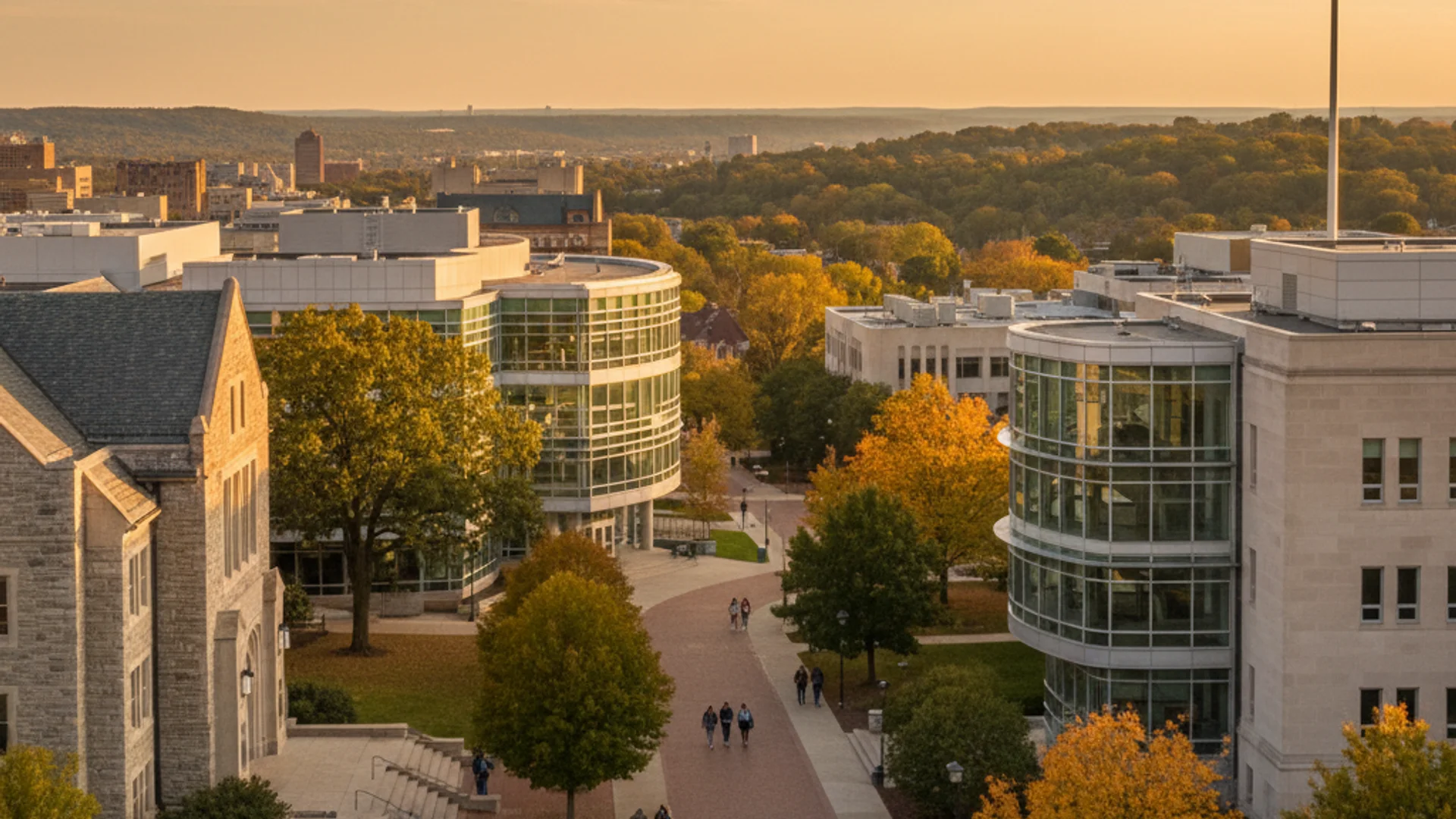
University campus in Ohio
Updated July 13, 2026

Best Computer Science Degree Programs in Ohio, 2026 Rankings

Compare the top computer science colleges in Ohio. 50 accredited computer science schools ranked by graduation rate, career outcomes, and value, from Columbus State Community College to Case Western Reserve University.

#1 ProgramCase Western Reserve
Avg Salary$100,180
Tuition From$5,338/yr
Job Growth+22%
On this page
Reviewed by Taylor Rupe, Founder & EditorSee methodology

48

Programs ranked

IPEDS 2024

$100,180

Ohio median computer science salary

BLS OEWS 2024

92.2/100

Top program score

Hakia methodology

22%

U.S. job growth (2023–33)

BLS projections

Key Takeaways

Intel's $20 billion semiconductor facility and Columbus's growing tech hub make Ohio an emerging powerhouse for CS careers

Google, Amazon, Meta, and JPMorgan Chase all maintain significant Ohio operations, with 18,000+ tech companies statewide

Hakia Research 2026

Ohio State University-Main Campus offers the best public value at $11,826/yr with a 90% graduation rate

Case Western Reserve University ranks #1 overall; Miami University-Oxford follows at #3 with a 97% graduation rate

IPEDS 2024

Ohio CS graduates earn a $100,180 median salary, reaching $110,198 in the Columbus metro

The state's cost of living is roughly 40% lower than Silicon Valley, giving graduates stronger purchasing power

BLS OEWS 2024

Edison State Community College offers the most affordable associate's pathway at $3,728/yr

Ohio's Guaranteed Transfer Pathways ensure community college credits count toward bachelor's degrees at public universities

IPEDS 2024

17 online CS programs available, with Case Western Reserve and Sinclair Community College among the options

Sinclair holds a CAE-2Y cybersecurity designation and charges just $3,889/yr for its associate's program

IPEDS 2024

Cleveland's healthcare IT sector (Cleveland Clinic, UPMC) and NASA Glenn Research Center diversify career paths beyond fintech

Ohio produces 2,893 CS graduates annually, with Columbus, Cleveland, and Cincinnati metros absorbing the majority

Hakia Research 2026

Updated July 13, 2026

How we ranked Ohio Computer Science programs

We rank 64 accredited computer science programs in Ohio using IPEDS 2024 institutional data, BLS OEWS 2024 state salary data, and College Scorecard outcomes. A 4-factor weighted composite is normalized to a 0–100 score. Schools cannot pay for placement; rankings are produced algorithmically.

Program completions (35%)Graduation rate (25%)Selectivity (20%)Career outcomes (20%)
See full methodology

Are Computer Science Degree Programs in Ohio Worth It?

Answer
$100,180
Yes. The best computer science degree programs in Ohio deliver strong ROI, graduates earn $100,180 median salary with +22% job growth through 2032. In-state tuition averages $26,895/year.

Source: BLS OEWS May 2024

Computer Science Degree Rankings in Ohio

Compare the top-ranked Computer Science programs in Ohio by degree level. Tuition, graduation rate, and Hakia Score for every accredited program.

Best Associate's Computer Science Programs in Ohio

2
Programs ranked
$6,805
Avg tuition/yr
18%
Avg grad rate

Program Landscape

Ohio offers 10 accredited associate's degree programs in computer science, providing an affordable entry point into the technology field. The top-ranked programs include Columbus State Community ..., Sinclair Community College, Lakeland Community College, which combine rigorous technical curriculum with practical skills training.

Costs & Value

Community colleges in Ohio offer these two-year programs at an average cost of $9,224/yr, significantly less than four-year university tuition. Students completing associate's degrees can pursue entry-level technical positions and transfer opportunities, with entry-level salaries averaging $55,099 in Ohio.

Career Pathways

Many programs feature guaranteed transfer agreements with Ohio's public universities, allowing students to complete their first two years at reduced cost before transferring to complete a bachelor's degree. The Columbus, Cleveland, Cincinnati areas offer particularly strong job markets for associate's degree holders, with employers like JPMorgan Chase, Nationwide, Root Insurance hiring for technical support, junior development, and IT specialist positions.

Curriculum & Specializations

Programs typically include coursework in programming fundamentals, database management, networking basics, and software development. Among computer science schools in Ohio, these associate's programs offer the best value for students beginning their computer science degrees in Ohio.

🥈
Franklin University
Columbus, OHPrivate nonprofit
$9,552
Tuition/yr
11%
Grad rate
58.5
Hakia Score

Best Bachelor's Computer Science Programs in Ohio

32
Programs ranked
$33,155
Avg tuition/yr
58%
Avg grad rate

Program Landscape

Ohio ranks among the nation's top destinations for computer science education, with 40 accredited bachelor's degree programs across 10 public and 30 private institutions. The highest-ranked programs are Case Western Reserve, Ohio State, Miami University-Oxford, recognized for academic excellence, research opportunities, and strong industry connections.

Career Outcomes

Graduates from Ohio computer science programs earn a median salary of $85,153, 13% below the national average. The state's robust technology sector, anchored by the Columbus, Cleveland, Cincinnati metropolitan areas, provides abundant internship and employment opportunities with companies including JPMorgan Chase, Nationwide, Root Insurance.

Costs & Value

Tuition ranges from $5,404 to $64,100 annually, with an average of $31,574/yr. Top programs maintain graduation rates above 88%, with the highest reaching 97%. Many programs hold ABET accreditation, the gold standard for computing education, ensuring curriculum meets rigorous industry standards.

Curriculum & Specializations

Students can choose from specializations including software engineering, cybersecurity, artificial intelligence, data science, and systems architecture. Strong industry partnerships provide access to co-op programs, capstone projects with real companies, and direct recruiting pipelines to Ohio's leading technology employers. For students seeking computer science degrees in Ohio, these top-ranked computer science schools offer the strongest combination of academic rigor and career preparation.

🥈
Denison University
Granville, OHPrivate nonprofit
$67,000
Tuition/yr
79%
Grad rate
87.4
Hakia Score
Show all 32 ranked programs
RankSchoolLocationTypeTuitionGrad RateHakia Score
#6Franciscan University of SteubenvilleSteubenville, OHPrivate nonprofit$33,50075%83.0
#7The College of WoosterWooster, OHPrivate nonprofit$61,12074%82.8
#8Ohio Northern UniversityAda, OHPrivate nonprofit$38,25075%80.6
#9John Carroll UniversityUniversity Heights, OHPrivate nonprofit$48,70079%78.1
#10Ohio University-Main CampusAthens, OHPublic$14,15865%76.5
#11Ohio Wesleyan UniversityDelaware, OHPrivate nonprofit$53,62459%75.0
#12Baldwin Wallace UniversityBerea, OHPrivate nonprofit$38,83267%74.7
#13Kent State University at KentKent, OHPublic$12,74264%74.6
#14Xavier UniversityCincinnati, OHPrivate nonprofit$49,19569%74.4
#15Walsh UniversityNorth Canton, OHPrivate nonprofit$31,51558%72.2
#16Ashland UniversityAshland, OHPrivate nonprofit$29,94061%71.8
#17Mount St. Joseph UniversityCincinnati, OHPrivate nonprofit$36,95056%70.6
#18Capital UniversityColumbus, OHPrivate nonprofit$42,74460%70.2
#19Youngstown State UniversityYoungstown, OHPublic$9,79050%69.3
#20University of ToledoToledo, OHPublic$10,10257%68.8
#21The University of FindlayFindlay, OHPrivate nonprofit$39,66458%68.7
#22Cleveland State UniversityCleveland, OHPublic$12,87251%68.4
#23Wittenberg UniversitySpringfield, OHPrivate nonprofit$44,96653%68.4
#24Marietta CollegeMarietta, OHPrivate nonprofit$38,50861%67.4
#25Wilberforce UniversityWilberforce, OHPrivate nonprofit$14,71812%67.4
#26Franklin UniversityColumbus, OHPrivate nonprofit$9,55211%64.9
#27Heidelberg UniversityTiffin, OHPrivate nonprofit$32,90052%63.7
#28Malone UniversityCanton, OHPrivate nonprofit$35,84045%62.7
#29Hiram CollegeHiram, OHPrivate nonprofit$26,89755%60.9
#30University of Rio GrandeRio Grande, OHPrivate nonprofit$19,60036%59.1
#31Ohio Dominican UniversityColumbus, OHPrivate nonprofit$35,11041%57.2
#32Central State UniversityWilberforce, OHPublic$5,63823%56.8

Best Master's Computer Science Programs in Ohio

9
Programs ranked
$23,705
Avg tuition/yr
61%
Avg grad rate

Program Landscape

Ohio offers 11 master's degree programs in computer science, designed for professionals seeking to advance into senior engineering, technical leadership, and specialized roles. The top programs, U of Dayton, U of Cincinnati, Case Western Reserve, combine advanced technical training with research opportunities and leadership development.

Career Outcomes

Master's graduates in Ohio earn a median salary of $100,180, approximately 20-30% higher than bachelor's degree holders. The concentration of technology companies in Columbus, Cleveland, Cincinnati creates strong demand for graduate-level talent, with JPMorgan Chase, Nationwide, Root Insurance actively recruiting from these programs.

Costs & Value

Program formats include traditional full-time study (typically 2 years), part-time options for working professionals (2-3 years), and accelerated tracks. Tuition averages $20,534/yr, with many employers offering tuition reimbursement for graduate education. Some programs offer thesis and non-thesis tracks, allowing students to focus on research or professional development based on their career goals.

Curriculum & Specializations

Curriculum covers advanced topics including machine learning, distributed systems, software architecture, and technical management. Many programs include practicum experiences, industry capstone projects, or consulting engagements that provide real-world application of advanced concepts. Among Ohio's computer science schools at the graduate level, these programs stand out for both academic quality and career outcomes.

Show all 9 ranked programs
RankSchoolLocationTypeTuitionGrad RateHakia Score
#6University of Akron Main CampusAkron, OHPublic$10,73552%68.7
#7Cleveland State UniversityCleveland, OHPublic$12,87251%65.3
#8Franklin UniversityColumbus, OHPrivate nonprofit$9,55211%58.1
#9Air Force Institute of Technology-Graduate School of Engineering & ManagementWright-Patterson AFB, OHPublic57.5

Best Doctoral Computer Science Programs in Ohio

5
Programs ranked
$35,194
Avg tuition/yr
71%
Avg grad rate

Program Landscape

Ohio is home to 3 doctoral programs in computer science, preparing students for research positions, faculty appointments, and executive technical roles. Leading programs at Case Western Reserve, Air Force Institute of Te..., Kent State University at ... are recognized for cutting-edge research, strong faculty publications, and competitive funding packages.

Career Outcomes

Doctoral graduates command premium salaries, with Ohio PhD holders earning a median of $125,225, reflecting the advanced expertise required for research and executive positions. The Columbus, Cleveland, Cincinnati region's research universities and corporate R&D centers provide extensive collaboration opportunities with industry leaders like JPMorgan Chase, Nationwide, Root Insurance.

Costs & Value

PhD programs typically require 4-6 years of full-time study, including coursework, qualifying examinations, and original dissertation research. Many programs offer full funding through teaching or research assistantships, covering tuition and providing stipends of $25,000–$40,000 annually.

Curriculum & Specializations

Research strengths across Ohio programs include artificial intelligence, cybersecurity, human-computer interaction, systems, and theoretical computer science. For aspiring researchers pursuing computer science degrees in Ohio, graduates go on to careers as university faculty, industry research scientists, or technical executives, contributing to advances in technology that impact millions of users worldwide.

Computer Science Degree Costs & Tuition in Ohio

MetricValue
Average in-state tuition$26,895/year
Average out-of-state tuition$67,238/year
Community college tuition$6,724/year
4-year savings for residents$161,372
2+2 transfer pathway savings$40,342

Source: IPEDS 2024

Financial Aid for Ohio CS Students

Verdict: Ohio has one of the most STEM-friendly state aid programs in the US, the Choose Ohio First Scholarship provides STEM-specific need-merit funding averaging ~$4,700/year at participating Ohio institutions. Combined with the Ohio College Opportunity Grant (OCOG) for need-based students and Ohio State's substantial institutional aid for in-state applicants, Ohio CS students have unusually strong financial paths compared to most Midwestern states.

Ohio College Opportunity Grant (OCOG) is the primary need-based program, up to ~$5,500/year for Ohio residents with demonstrated financial need at OH public and private nonprofit institutions (the maximum varies by institution type; community college awards are lower).

Choose Ohio First is the distinctive program for CS-bound students: state-funded STEM-specific scholarships at participating Ohio institutions (Ohio State, University of Cincinnati, Ohio University, Bowling Green, Kent State, Miami University, and others). Awards average ~$4,700/year and stack with other aid. The program is specifically designed to retain Ohio STEM talent in Ohio post-graduation, aligning state aid funding with Ohio's tech-workforce strategy.

Federal Pell (up to $7,395) stacks on top of state aid. Ohio State's Buckeye Opportunity Program covers full in-state tuition and mandatory fees for Pell-eligible Ohio residents, making OSU one of the lowest-net-cost flagship CS programs in the Midwest for low-income Ohio students. Combined with Choose Ohio First, an in-state OSU CS student with Pell eligibility can attend at substantially below the published tuition cost. CS-employer scholarships from Ohio-based employers (Procter & Gamble, Cardinal Health, Nationwide Insurance, Honda North America IT) provide additional funding most students don't pursue.

Computer Science Degree ROI Calculator, Ohio

Use our interactive ROI calculator to estimate your return on investment for a computer science degree in Ohio. Enter your expected tuition costs, financial aid, and career goals to see projected payback periods and lifetime earnings. The calculator uses current salary data from BLS and tuition data from IPEDS to provide accurate estimates.

Computer Science Degree ROI Calculator

Estimate your return on investment for a computer science degree

Leave blank to use average cost for selected program type

20 years
10 years20 years30 years
20-Year ROI

+802%

Net gain divided by total investment. ROI above 200% is considered excellent for education investments.

Net Gain

$1,483,492

Your additional lifetime earnings with this degree vs. working without one, minus the total investment.

Break-Even

5 years

Years until your cumulative earnings exceed total investment. Shorter programs often break even faster due to lower opportunity cost.

COL-Adjusted Salary

$123,810

Your starting salary adjusted for local cost of living. This shows real purchasing power compared to a $100K national baseline.

Why does break-even change with program type? Your "total investment" includes both tuition AND opportunity cost (foregone earnings while in school). A 4-year full-time public university (in-state) means 4 years of not earning a salary ($140,000 in opportunity cost). Shorter full-time programs may have higher tuition but lower total investment because you return to the workforce sooner.

Detailed Breakdown

How we calculate your degree ROI using real salary data

Total Investment$185,000

Tuition plus opportunity cost (earnings you miss while in school)

Program Cost (Tuition)$45,000

Direct cost of the degree program

Opportunity Cost$140,000

4 years × $35K/year foregone salary while studying full-time

20-Year Earnings (with degree)$2,518,900

Projected career earnings starting after graduation, with salary growth

20-Year Earnings (without degree)$850,408

What you'd earn working at $35K/year with 2% annual growth

Starting Salary (Chicago, IL)$130,000

Median salary for this role in your selected location (BLS 2024)

Annualized Return4.5%

Your investment's compound annual growth rate (similar to stock market returns)

Data sources: BLS OEWS May 2024, IPEDS 2024. Calculations use median salaries, 3% discount rate, and assume salary growth declines from 6% to 2% over career. Individual results will vary. | Powered by Hakia.com

Computer Science Salaries by Metro Area

Median annual salary in Ohio metro areas

Columbus$110K
Cleveland$105K
Cincinnati$100K
View data table
CategoryValue
Columbus$110K
Cleveland$105K
Cincinnati$100K

Source: BLS OEWS May 2024

Hakia.com

Top Employers Hiring Computer Science Graduates in Ohio

Find computer science jobs in Ohio. These major employers across Ohio metro areas are actively hiring computer science degree holders. Click employer names to view current job openings.

Computer Science Jobs in Columbus

OH

Columbus is Ohio's tech hub with a strong insurtech and fintech presence, plus major data center investments.

Nearby cities: Dublin, Westerville, Worthington, Grove City

Amazon
E-commerce/Cloud (AWS)
Google
Search/Cloud/AI
Meta
Social/VR/AI
JPMorgan Chase
Financial Technology
Nationwide Insurance
Insurance Tech
CoverMyMeds
Healthcare Tech
Upstart
Fintech/AI Lending

Computer Science Jobs in Cleveland

OH

Cleveland combines healthcare IT innovation with industrial automation and aerospace research.

Nearby cities: Akron, Parma, Independence, Beachwood

IBM
Enterprise IT/Cloud
Key Bank
Financial Technology
Progressive Insurance
Insurance Tech
Hyland Software
Enterprise Content
Rockwell Automation
Industrial IoT

Ohio Tech Industry & Infrastructure

Ohio's tech market is reshaping rapidly around Intel's $20+ billion New Albany semiconductor fab (the largest single private investment in state history) and Honda's EV/battery joint venture with LG Energy Solution. Beyond the new chip and EV manufacturing footprint, Ohio's three major metros each host substantial enterprise/financial-services tech operations.

Columbus

Columbus metro

Fastest-growing Ohio tech metro by employment. Intel Ohio chip fab (online 2026-2027), Nationwide Insurance IT, Cardinal Health, Honda IT, Huntington Bank tech. Ohio State University is the principal CS graduate producer.

Cincinnati

Cincinnati metro

P&G's substantial IT and analytics organization, Kroger's digital transformation (84.51° data science arm), Fifth Third Bank tech, GE Aviation. Strong consumer-products data-engineering market.

Cleveland

Cleveland-Akron metro

Progressive Insurance HQ, KeyBank tech, Sherwin-Williams IT, Cleveland Clinic and University Hospitals medical-IT. Smaller but stable enterprise-tech market.

Ohio has a graduated state income tax (top rate ~3.5%). InvestOhio and JobsOhio's R&D tax credit are the principal state-level tech-employer incentives.

Ohio Regulation Affecting Computer Science Graduates

Ohio is unusual among states for offering an explicit cybersecurity safe-harbor through the Ohio Data Protection Act — businesses that voluntarily adopt a recognized cybersecurity framework gain affirmative defense against data-breach tort claims. This makes Ohio a relatively favorable jurisdiction for security-engineering work.

Ohio Data Protection Act (ODPA)

Provides an affirmative defense against data-breach tort claims for businesses that maintain a written cybersecurity program conforming to recognized frameworks (NIST CSF, ISO 27001, PCI-DSS, HITRUST, etc.).

Strong incentive for OH-based businesses to invest in formal security programs — drives security-engineer hiring and consulting demand. Engineers building security-program-compliant systems in Ohio operate with this legal benefit in mind.

Read more

Ohio Personal Information Privacy Act (proposed)

HB 376 / SB 11 (varying sessions) propose CCPA-style consumer privacy rights for Ohio residents. None has yet passed as of 2026.

Engineers should watch this space; Ohio passing comprehensive privacy would create a new compliance lane.

Read more

Ohio Identity Theft & Data Breach Notification Statutes

Ohio Revised Code 1349.19 — requires data-breach notification for OH residents whose personal information was compromised.

Standard data-protection compliance for any OH-resident-serving business.

Read more

Professional Engineer Licensure in Ohio

Ohio does not currently administer a separate Software Engineering PE license. ABET-EAC accreditation is recognized for traditional engineering PE tracks (mechanical, electrical, computer engineering); software engineering specifically is not a recognized Ohio PE discipline.

Ohio licensing board

Ohio Financial Aid Programs

Up to $5,500/yr (varies by institution type)

Ohio residents with demonstrated financial need at OH public and private nonprofit institutions

Choose Ohio First Scholarship

STEM-specific state scholarship

Average ~$4,700/yr (varies by institution and award)

Ohio residents pursuing STEM degrees at participating Ohio institutions; merit + financial need

Tuition + fees

Children/spouses of OH safety officers killed in the line of duty

Up to ~$5,950/yr

Children of qualifying veterans pursuing higher education in Ohio

Transfer Pathways for Ohio CS Students

Verdict: Ohio's Ohio Transfer Module (OTM) is one of the better US state transfer systems, Ohio public institutions guarantee acceptance of OTM-approved general education courses (typically 36-40 credits) across the system. For CS-specific courses, the Course Transfer Assurance Guides (CTAGs) provide major-specific articulation. Combined with Ohio State's substantial transfer-friendly admission practices, in-state Ohio CS-track students have a workable community-college-to-flagship pathway.

Ohio Transfer Module covers general education credits, OTM-approved courses (humanities, social sciences, natural sciences, math) transfer automatically across all Ohio public colleges. For CS prerequisites, the CTAGs for calculus, programming, and discrete math provide additional cross-institutional credit transfer guarantees.

Best Ohio CS-feeder community colleges: Cuyahoga Community College (Cleveland metro), Columbus State Community College, Sinclair College (Dayton), Lorain County Community College, Stark State College, and Lakeland Community College. Each has refined CS prerequisite sequences aligned to OTM/CTAG articulation. Columbus State CC specifically has a strong direct articulation agreement with Ohio State for CS transfer.

Ohio State CS transfer admission is competitive, OSU's CS program is one of the larger US public CS programs and runs roughly 25-40% transfer admit rate depending on the year. The realistic path is to complete the OSU-equivalent prerequisites at a strong Ohio community college (calculus through Calc II, programming I/II, data structures, discrete math) with 3.7+ GPA. For students who don't make the OSU bar, University of Cincinnati, Ohio University (Athens), Kent State, and Miami University all have strong CS programs with more open transfer admissions. Ohio CS graduates from any of these schools have strong employment outcomes, the OSU brand premium is real but not dramatic compared to peer Ohio publics.

Computer Science Job Growth in Ohio

15%
The Bureau of Labor Statistics projects 15% growth for computer science occupations in Ohio through 2024-2034. The median salary stands at $100,180 with 50 accredited programs statewide.

Source: BLS Occupational Outlook

Ohio CS Job Market & Salary

Verdict: Ohio's tech market is transforming rapidly around Intel's $20+ billion New Albany semiconductor fab (online 2026-2027), Honda's substantial EV/battery joint venture, and a continued expansion of consumer-tech and financial-services-tech employment in Columbus, Cincinnati, and Cleveland. Nominal Ohio CS salaries trail coastal markets by 15-25%, but cost of living differentials more than offset; mid-career Ohio CS engineers often have higher take-home purchasing power than equivalent Bay Area peers once housing is factored in.

By metro: Columbus is Ohio's fastest-growing tech market, Intel's chip fab is the highest-profile employer addition in Ohio history, drawing tens of billions of related semiconductor-supplier investment. Beyond Intel, Columbus hosts Nationwide Insurance IT, Cardinal Health (one of the largest US healthcare-distribution tech operations), Honda North America IT, Huntington Bank technology, and JPMorgan Chase's expanding Columbus presence. CS software engineer roles average ~$100,000-$130,000 with Intel's chip-fab opening expected to pull averages higher. Cincinnati anchors around Procter & Gamble's substantial IT and analytics organization, Kroger's 84.51° data science arm, Fifth Third Bank technology, and GE Aviation tech. Cleveland hosts Progressive Insurance, KeyBank technology, Sherwin-Williams IT, Cleveland Clinic and University Hospitals medical IT.

2026 sector picture for Ohio CS graduates: Intel's Ohio fab coming online creates substantial demand for chip-design, semiconductor-manufacturing, and supply-chain-tech engineering roles, a category of US tech employment that essentially didn't exist in the Midwest before this investment. The fab and its suppliers are projected to add 7,000+ direct technical jobs by 2030, with Ohio State and University of Cincinnati expected to provide the bulk of local hiring pipeline.

Ohio's Data Protection Act (ODPA) is uniquely employer-favorable in the US, businesses that voluntarily adopt recognized cybersecurity frameworks (NIST CSF, ISO 27001, PCI-DSS) gain affirmative defense against breach tort claims. This creates ongoing security-engineering work at OH-based businesses and makes Ohio a relatively favorable jurisdiction for security-track CS specialization. See Software Engineer Career Guide and Cybersecurity Career Guide for related paths.

Entry-Level (0-2 yrs)

New graduates and career changers

Senior (8+ yrs)

Technical leads and architects

Median Salary in Ohio$65,117$145,261
Typical RolesJunior Developer, AnalystStaff Engineer, Architect
Remote Work AccessLimitedCommon
Degree ExpectationBachelor's sufficientMaster's preferred

Online vs On-Campus Computer Science Programs in Ohio

Online Programs

17 available in Ohio

On-Campus Programs

Traditional classroom experience

Typical Tuition$24,206/yr$26,895/yr
Schedule FlexibilitySelf-paced or asyncFixed schedule
NetworkingVirtual cohortsIn-person, career fairs
Best ForWorking professionalsTraditional students
Completion Time2-4 years (flexible)4 years (standard)

Compare Computer Science Programs in Other States

Computer Science Degree Programs in Ohio: FAQ

What are the best computer science degree programs in Ohio?
The best computer science degree programs in Ohio based on our methodology are: 1) Case Western Reserve University (85% graduation rate), 2) Ohio State University-Main Campus, and 3) Miami University-Oxford. Our rankings weight graduation rates (25%), program completions (35%), selectivity (20%), and career outcomes (20%). Ohio offers 50 total accredited programs across 20 public and 30 private institutions. See our complete rankings for all 40 bachelor's programs.
How much do computer science degree programs cost in Ohio?
Computer Science degree program costs in Ohio vary significantly by institution type. In-state public tuition averages $26,895/year, while private institutions average $59,169/year. Community colleges offer the most affordable path at approximately $6,724/year for associate's degrees. The total 4-year cost ranges from $107,580 at public schools to $236,676 at private institutions before financial aid. Most students don't pay full sticker price, federal grants, state aid, and institutional scholarships can reduce costs by 30-60%.
What salary can computer science degree graduates earn in Ohio?
Computer Science professionals in Ohio earn a median salary of $100,180, which is competitive with the national average of $115,500. Entry-level positions typically start around $65,117, while senior roles exceed $145,261. Salaries vary by metro area: Columbus ($110,198), Cleveland ($105,189) offer the highest compensation. Specialized roles like AI/ML engineers and cloud architects command premiums of 15-30% above median.
Are there online computer science degree programs in Ohio?
Yes, Ohio offers 17 accredited online Computer Science programs from state institutions. These programs award the same degree as on-campus options and include synchronous and asynchronous formats. Top-ranked online programs include offerings from Case Western Reserve University and Sinclair Community College. Online programs typically cost the same as on-campus tuition for in-state students. Many programs offer flexible scheduling for working professionals, with some offering accelerated completion in 2-3 years. Ensure any online program holds regional accreditation and ideally ABET accreditation for engineering programs.
What companies hire computer science degree graduates in Ohio?
Major Computer Science employers in Ohio include JPMorgan Chase, Nationwide, Root Insurance, CoverMyMeds, Hyland Software. The Columbus and Cleveland metro areas serve as primary tech hubs with thousands of open positions. Top employers maintain recruiting pipelines directly from Ohio universities, with many offering internship-to-hire programs. Beyond tech giants, opportunities exist in healthcare IT, financial services, defense contractors, and growing startups. Ohio's tech sector shows +22% projected job growth through 2033, outpacing most other industries.
Is a computer science degree program worth it in Ohio?
A computer science degree program in Ohio offers strong ROI with a $100,180 median salary and +22% projected job growth. At average in-state tuition of $26,895/year, graduates typically recoup their educational investment within 3-5 years. The degree opens doors to high-paying careers in software development ($113,203), data science, cybersecurity, and AI/ML. Beyond salary, benefits include job security, remote work flexibility, and clear advancement paths. Alternative paths like bootcamps exist for career changers, but bachelor's degrees provide broader career options and higher lifetime earnings.
How long do computer science degree programs take in Ohio?
Standard completion times for computer science degree programs in Ohio are: Associate's (2 years, 60 credits), Bachelor's (4 years, 120 credits), and Master's (1-2 years, 30-36 credits). However, actual timelines vary based on course load, transfer credits, and program format. Accelerated programs can compress a bachelor's to 3 years or a master's to 12 months. Part-time students typically need 5-6 years for a bachelor's degree. Ohio community colleges offer a cost-effective "2+2" path: complete your associate's in 2 years, then transfer to a Ohio university for the final 2 years of a bachelor's program.
What financial aid is available for computer science degree students in Ohio?
Ohio computer science degree students can access multiple financial aid sources. Federal aid includes Pell Grants (up to $7,395/year for qualifying students) and federal student loans. Ohio state grants provide additional support for residents attending in-state schools. Institutional scholarships from universities can significantly reduce costs, many schools offer merit-based awards for STEM students. Work-study programs and teaching/research assistantships (especially for graduate students) provide income while building experience. Complete the FAFSA by Ohio's priority deadline to maximize aid eligibility. Some employers also offer tuition reimbursement for employees pursuing CS degrees.

Data Sources

Institutional characteristics, completions, graduation rates

Ohio salary and employment data

Official University Websites

Program details and admissions information

Last Updated: June 26, 2026. Rankings based on IPEDS 2024 data. Salary data from BLS OEWS May 2024.

Was this ranking helpful for your college search?
Taylor Rupe

Taylor Rupe

Co-founder & Editor (B.S. Computer Science, Oregon State • B.A. Psychology, University of Washington)

Taylor combines technical expertise in computer science with a deep understanding of human behavior and learning. His dual background drives Hakia's mission: leveraging technology to build authoritative educational resources that help people make better decisions about their academic and career paths.

The research behind the rankings

In-depth Computer Science program profiles in Ohio

Hand-researched detail on the top-ranked programs: degree pathways, research labs, industry partners, career outcomes, and admissions. Tap any school to expand.

Best Associate's Computer Science programs

#1Lakeland Community CollegeKirtland, OH

Why it stands out. Part of Ohio's Guaranteed Transfer Pathways (OGTP) program. Clear path to associate degree completion and then to bachelor's degree completion in a related major

Hakia insight. Lakeland's membership in Ohio's Guaranteed Transfer Pathways program eliminates the usual community college uncertainty—students know exactly which credits transfer to Bowling Green, Cleveland State, or Franklin University before they enroll, turning the associate's degree into a predictable launchpad rather than a gamble.

Lakeland Community College's Associate of Science in Computer Science is uniquely positioned as part of Ohio's Guaranteed Transfer Pathways (OGTP) program, ensuring students have a clear pathway to both associate and bachelor's degree completion with guaranteed course transferability. The 63-credit hour program focuses on the theoretical foundations of computing, algorithms, and programming techniques, with applications to operating systems, artificial intelligence, informatics, and other emerging areas. Students engage in comprehensive coursework including Python Programming I and II, Data Structures, Computer Architecture and Organization, and Discrete Structures. The curriculum requires a significant math background, including Calculus and Analytical Geometry I and II, plus Logic. Core programming courses cover Python, with additional opportunities in C Programming, Java Programming, SQL Programming and Database Design, and Network+ certification. The program balances technical computer science courses with general education requirements from Ohio Transfer 36 lists in arts, humanities, social sciences, and natural sciences. Students must earn C grades or higher in technical courses and complete science requirements in either General Chemistry I or Science and Engineering Physics I. This structured approach prepares computer scientists for broad positions ranging from theoretical work to software development, with the assurance that their coursework will seamlessly transfer to four-year institutions for continued study.

Programs offered

  • Associate of Science Degree in Computer Science · 2 years · on-campus

Industry partners

Bowling Green State UniversityCleveland State UniversityFranklin University
#2Franklin UniversityColumbus, OH

Why it stands out. Franklin's competency-based, working-professional-focused CS program delivers industry-aligned skills with demonstrable capstone projects completed for real clients.

Hakia insight. Franklin's competency-based model means students build portfolios with real client deliverables rather than textbook assignments—a distinction that matters when competing for internships, as employers can evaluate actual shipped code.

At the associate's level, franklin University's computer science program prioritizes working professionals and non-traditional learners through a flexible, competency-based curriculum designed for career advancement without sacrificing rigor. The program emphasizes applied problem-solving across core areas including software engineering, data analytics, cybersecurity, and systems design, with courses structured to map directly to industry demands. Students gain hands-on experience through capstone projects that often involve real client work, giving graduates demonstrated portfolio pieces before entering the job market. The faculty blend academic credentials with active industry experience, ensuring curriculum stays current with market trends. Franklin's online-first infrastructure means students can balance education with existing careers, and the cohort-based model creates peer networks that frequently extend into professional collaboration after graduation. Graduates report strong placement in mid-market and enterprise technology roles, with many securing promotions within their current organizations rather than switching jobs.

Programs offered

  • Associate of Science in Computer Science · 2 years · on-campus
  • Associate of Applied Science in Computer Science · 2 years · online

Location advantage: Columbus, Ohio tech corridor Proximity to financial services and insurance sector technology hubs

Best Bachelor's Computer Science programs

#1Case Western Reserve UniversityCleveland, OH

Why it stands out. Mandatory Cooperative Education Program with paid, full-time co-op experiences. Most students participate in summer internships and/or undergraduate research opportunities

Hakia insight. Oberlin's 1-in-3 double major rate reflects a deliberate curricular design: the CS program is built to integrate cleanly with economics, music, philosophy, and physics, making technical breadth an institutional advantage rather than a student afterthought.

Case Western Reserve University's Bachelor of Science in Computer Science is designed for problem-solvers seeking a deep dive into computing fundamentals with hands-on experience. Students master core computer science concepts and select one of six specialization tracks: Algorithms and Theory, Artificial Intelligence, Bioinformatics, Computer Systems/Networks/Security, Databases and Data Mining, or Software Engineering. The program emphasizes practical learning through a Cooperative Education Program offering paid, full-time co-op experiences, with most students participating in summer internships and/or research opportunities. Students gain real-world experience through partnerships like the IoT Collaborative with Cleveland State University, collaborative research with industry professionals, hackathons, and community outreach via Girls Who Code. The program is ABET-accredited and welcomes students with no prior programming experience, providing comprehensive support to quickly develop technical expertise.

Programs offered

  • Bachelor of Science in Computer Science · 4 years · on-campus

Research labs & institutes

  • Algorithms and Theory — theoretical computer science
  • Artificial Intelligence and Machine Learning — AI/ML research
  • Bioinformatics and Systems Biology — computational biology
  • Data Mining and Visualization — data analysis
  • Security and Privacy — cybersecurity
  • Networks and Distributed Systems — networking
  • Software Engineering — software development

Industry partners

IoT Collaborative

Accreditation & certifications

ABET
#2Denison UniversityGranville, OH

Why it stands out. Denison's computer science program is distinctive for its liberal arts integration model, requiring interdisciplinary breadth while maintaining technical rigor, and positioning computing as a tool for inquiry across domains.

Hakia insight. Denison's Red Frame Lab creates a rare liberal arts computing environment where students work on problems that demand both technical rigor and humanistic framing—a training model that produces graduates comfortable in interdisciplinary settings where most CS programs produce specialists.

This page does not contain specific information about a Computer Science program at Denison University. Instead, it presents a general overview of Denison's academic offerings across multiple fields. The university is ranked #4 among the most innovative liberal arts colleges by U.S. News and #2 for career services by Princeton Review. Denison emphasizes small class sizes with world-class faculty who know students by name, providing a rigorous liberal arts education. The institution offers various pathways including Data & Technology fields that prepare students to analyze complex information, design solutions, and apply technology across industries. Students have access to the Red Frame Lab for applied learning with real-world clients and industry leaders. For engineering-minded students, Denison offers dual-degree pathways with Washington University in St. Louis and Rensselaer Polytechnic Institute. The Knowlton Center for Career Exploration provides comprehensive support, and the university maintains a responsive curriculum that balances breadth with depth, building academic specialization on a liberal arts foundation while continually evolving to connect ideas and disciplines in meaningful, modern ways.

Programs offered

  • bachelors program · 4 years · on-campus

Research labs & institutes

  • Red Frame Lab

Industry partners

Washington University in St. LouisRensselaer Polytechnic Institute

Location advantage: Central Ohio location with access to Columbus tech sector

#3Miami University-OxfordOxford, OH

Why it stands out. ABET accreditation in computing. Two-semester Senior Design Project (CSE 448-449) with real-world application

Hakia insight. Miami's two-semester capstone (CSE 448-449) is deliberately sequenced to force sustained engagement with a single problem, producing portfolios dense enough to rival junior-year work at larger universities—a structural edge for small-school students in recruiting.

Miami University's Bachelor of Science in Computer Science is an ABET-accredited program offering 92 semester hours of rigorous coursework in programming, algorithms, computer architecture, operating systems, and specialized applications including networks, security, virtual reality, and AI. Students complete a structured core curriculum including discrete mathematics, applied statistics, and natural sciences, supplemented by 21 hours of electives allowing specialization in areas like machine learning, game development, databases, and cybersecurity. The program culminates in a two-semester Senior Design Project (CSE 448-449) where students apply technical skills to real-world problems. Miami's Computer Science and Software Engineering department emphasizes ethical computing and professional development through the required Career Foundations sequence (CEC 190). Graduates pursue careers as software engineers, consultants, network systems analysts, and database administrators, with starting salaries averaging over $72,000 according to the National Association of Colleges and Employers. The U.S. Bureau of Labor Statistics projects 25% job growth for computer science professionals through 2031.

Programs offered

  • Bachelor of Science in Computer Science · 4 years · on-campus

Industry partners

Google

Career outcomes

$72,000 median salary

Accreditation & certifications

ABET
#5Cedarville UniversityCedarville, OH

Hakia insight. Cedarville's NSA Center of Excellence designation isn't just a credential—it unlocks direct pipeline access to clearance sponsorship and internships with U.S. Cyber Command, a pathway most undergraduate cybersecurity programs can't offer until after graduation.

At the bachelor's level, comprehensive computer science program offering fundamental computing knowledge with hands-on laboratory experiences. Students can specialize in cyber operations while gaining strong technical foundations in software development and system design.

Programs offered

  • Bachelor of Science in Computer Science · 4 years · on-campus
  • Bachelor of Arts in Computer Science · 4 years · online

Research labs & institutes

  • Center for the Advancement of Cybersecurity — Developing future cybersecurity leaders and advancing cyber education
  • Cybersecurity Lab — Attack and defense scenarios with virtual machine capabilities

Industry partners

National Security Agency (NSA)U.S. Cyber Command

Accreditation & certifications

ABETNSA Center of Academic Excellence in Cyber OperationsABET

Location advantage: NSA Center of Excellence designation Strong Christian community integration

#10Ohio University-Main CampusAthens, OH

Why it stands out. ABET-accredited program. Strong endowment support from Dr. C. Paul Stocker providing advanced facilities and resources

Hakia insight. Ohio University's Dr. C. Paul Stocker endowment funds advanced facilities (Avionics Center, Center for Scientific Computing) that are usually reserved for PhD programs, giving undergraduates access to NASA-grade computing infrastructure and real aerospace applications.

The Bachelor of Science in Computer Science at Ohio University, administered by the School of Electrical Engineering and Computer Science in the Russ College of Engineering and Technology, emphasizes both mathematical and practical components of computer science. The program is ABET-accredited and covers software design, development, analysis, and maintenance across domains including graphics, artificial intelligence, database systems, mobile computing, and web applications. Students develop problem-solving, mathematical reasoning, and interpersonal communication skills essential for software engineers and computer scientists. The program encourages undergraduate research participation through significant research support from industrial and governmental agencies. Recent graduates have secured positions at major employers including Google, Microsoft, Amazon, Boeing, Lockheed Martin, the National Security Agency, and Verizon, while others have pursued graduate degrees at top universities including Ohio State, Purdue, and Wisconsin. The program prepares graduates to use technical acumen to improve human conditions while demonstrating integrity, ethical behavior, and leadership capabilities.

Programs offered

  • Bachelor of Science in Computer Science · 4 years · on-campus

Research labs & institutes

  • Avionics Engineering Center — avionics research
  • Center for Scientific Computing and Immersive Technologies — scientific computing and immersive technologies

Industry partners

NASA

Career outcomes

Top employers: Google, Microsoft, Amazon, Boeing, Expedia

Accreditation & certifications

ABET
#13Kent State University at KentKent, OH

Why it stands out. CEPH-accredited. 100% online

Hakia insight. Kent State University at Kent graduates earn $112,000, 12% above the Ohio median — driven by the program's industry connections and hands-on curriculum.

Kent State University's Bachelor of Science in Public Health stands out as a CEPH-accredited, 100% online program designed for working professionals. The 120-credit program offers exceptional flexibility with asynchronous courses and three annual start dates (Fall, spring, and summer), allowing students to study on their own schedule. What makes this program distinctive is its three specialized concentrations: Allied Health, Health Services Administration, and Clinical Trials Research. Students in the Allied Health concentration can earn up to 12 credits for accepted licenses or certifications, while those with associate degrees can complete the program in as little as two years. The program features a unique Combined Program opportunity where qualifying juniors and seniors can apply up to 9 credit hours toward both bachelor's and master's degrees, accelerating their career timeline. With affordable tuition rates of approximately $559 per credit for in-state and $569 for out-of-state students, graduates enter a strong job market with earning potential ranging from $112,000 for Project Managers to $148,000 for Environmental Health and Safety Directors. The program's Military Friendly Gold Designation and global study abroad opportunities in over 200 programs across 60 countries further enhance its appeal to diverse student populations.

Programs offered

  • Bachelor of Science in Public Health · 4 years · on-campus

Industry partners

Kent State University has engaged Everspring, a leading provider of education and technology services, to support aspects of program delivery

Career outcomes

$112,000 median salary
#22Cleveland State UniversityCleveland, OH

Why it stands out. Accredited by the Computing Accreditation Commission of ABET. Senior year capstone project applying cumulative knowledge to solve significant computing problem

Hakia insight. Cleveland State embeds Dr. Sathish Kumar's Department of Energy-funded AI research into its undergraduate capstone requirement, meaning seniors solve problems using live research infrastructure rather than textbook case studies.

Cleveland State University's Bachelor of Science in Computer Science stands out as an ABET-accredited program that combines rigorous theoretical training with extensive hands-on experience. The program requires a minimum of 120 credit hours and offers flexible entry pathways including 4-year calculus entry, 4-year precalculus entry, and a 5-year precalculus plan. Students receive comprehensive training in core computer science topics including algorithms, data structures, computer systems, and programming languages, while elective courses allow specialization in cutting-edge areas like artificial intelligence, data science, software engineering, cybersecurity, and database systems. A distinctive feature is the mandatory senior year capstone project where students apply their cumulative knowledge to solve significant computing problems. The program emphasizes real-world application through partnerships with local industry and research opportunities with faculty. Graduates consistently secure positions with leading employers including Hyland Software, Progressive Insurance, Cleveland Clinic, Keybank, Sherwin-Williams, government organizations, and startups. Career prospects span diverse roles from Computer and Information Research Scientist to Software Developer, Database Administrator, and System Administrator, preparing students for the evolving technology landscape.

Programs offered

  • Bachelor of Science in Computer Science · 4 years · on-campus

Research labs & institutes

  • Located in Fenn Hall Room 212

Industry partners

Local industry partnerships for real-world problem engagement

Notable faculty

  • Dr. Sunnie Chung (associate professor of practice)
  • Dr. Sathish Kumar (AI research funded by Department of Energy)

Accreditation & certifications

Graduate Certificate in Cybersecurity TechnologyGraduate Certificate in Software Engineering

Best Master's Computer Science programs

#1Case Western Reserve UniversityCleveland, OH

Why it stands out. Flexible thesis vs coursework track options (56% of students choose research-focused track). Paid co-op opportunities — full-time, two-semester experiences that often lead to permanent employment

Hakia insight. Case Western's co-op structure—full-time, two-semester placements that frequently convert to permanent roles—functions as a paid extended interview with employers like Expedia, a hiring model that sidesteps the resume-screening bottleneck.

Case Western Reserve University's Master of Science in Computer Science is a 30-credit-hour program designed for working professionals seeking career advancement in a highly regarded engineering school. The program offers flexibility through both course-focused and research-focused tracks, allowing students to tailor their studies to interests like machine learning, cybersecurity, data science, and software engineering. Students gain experiential learning through paid co-ops—full-time, two-semester experiences that often serve as pipelines to permanent positions—and research opportunities across AI, security, and privacy. With a 5:1 student-faculty ratio and 12% projected job market growth (2018-2028), graduates develop in-demand expertise. The program emphasizes real-world application, combining rigorous coursework with hands-on projects that mirror industry practices. Final project requirements showcase practical work that serves genuine purposes, preparing graduates for senior technical roles and career advancement.

Programs offered

  • Master of Science in Computer Science · 1-2 years · on-campus

Research labs & institutes

  • Algorithms and Theory — theoretical computer science
  • Artificial Intelligence and Machine Learning — AI/ML research
  • Bioinformatics and Systems Biology — computational biology
  • Data Mining and Visualization — data analysis
  • Security and Privacy — cybersecurity
  • Networks and Distributed Systems — networking
  • Software Engineering — software development

Industry partners

IoT Collaborative

Career outcomes

Top employers: Expedia

Accreditation & certifications

ABET
#2University of DaytonDayton, OH

Why it stands out. Thesis vs. coursework-based tracks: CPS 599 Thesis OR CPS 595/596 Software Engineering Project I & II. Graduate assistantships available with full tuition remission (6 semester hours per term) plus stipend for 20 hours/week work assisting with introductory CS courses or faculty research

Hakia insight. University of Dayton's graduate assistantships fully remit tuition while paying a stipend for 20 hours/week—a rare structure that makes a 30-credit master's effectively free for students willing to mentor intro courses or join faculty projects.

The Master of Computer Science at University of Dayton is a 30-semester-hour program designed for working professionals, offering both full-time and part-time study options. Students choose between a thesis track (CPS 599) or coursework-based culminating experience (Software Engineering Projects I & II), providing flexibility for career-focused learners. Graduate assistantships are available with full tuition remission for 6 semester hours per term plus stipends for 20 hours/week of work assisting with introductory courses or faculty research. The program accommodates mid-career professionals with a firm foundation in computer science theory and application across multiple sub-disciplines. Graduates advance into specialized technical roles with enhanced earning potential. The curriculum requires strong fundamentals in algorithms, data structures, and object-oriented programming, with electives allowing customization toward areas like cybersecurity, data science, or systems design.

Programs offered

  • Master of Computer Science · 1-2 years · on-campus

Industry partners

GE AviationJPMorgan Chase and Co.FOX SportsNovobi, LLCRiverside Research

Admissions

GPA C- or better in CPS 150, CPS 151, and CPS 350.

#3Miami University-OxfordOxford, OH

Why it stands out. Two distinct tracks: thesis-based MSCS and non-thesis MCS. MSCS can be completed in 24 months, MCS in as little as 12 months

Hakia insight. Miami's 12-month accelerated MCS track combined with Google partnership access creates a rare speed-to-market option: students can earn a non-thesis master's and interview with a tier-one employer in the same calendar year.

Miami University-Oxford offers two distinct Computer Science master's programs designed for different career paths. The Master of Science in Computer Science (MSCS) is a thesis-based, 31-credit hour program completed in 24 months, preparing students for research-intensive careers and potential Ph.D. pursuit. The Master of Computer Science (MCS) is a non-thesis, 30-credit hour program that can be completed in as little as 12 months, focusing on practical skills in high-demand areas like artificial intelligence, cybersecurity, data science, and software engineering. What sets Miami apart is its flexibility: MCS students choose from three culminating experiences (internship, project, or capstone course), while MSCS students conduct independent research with faculty advisors. The program boasts exceptional career outcomes - students routinely receive job offers before graduation, with the Class of 2022 averaging $117,000 starting salaries. Students learn from published, award-winning faculty in small classes covering artificial intelligence, machine learning, computer graphics, and cryptography. For accelerated completion, Miami offers a unique combined Bachelor's/Master's program completable in five years. MSCS students are eligible for competitive graduate assistantships, while the computer science field projects 11% job growth with graduates earning more than double the median wage across all occupations.

Programs offered

  • Computer Science, M.S. and Master of Computer Science · 1-2 years · on-campus

Research labs & institutes

  • McVey Data Science Building

Industry partners

Google

Career outcomes

$117,000 median salary

Accreditation & certifications

ABET
#4Kent State University at KentKent, OH

Why it stands out. CEPH-accredited. 100% online

Hakia insight. Kent State University at Kent graduates earn $112,000, 12% above the Ohio median — driven by the program's industry connections and hands-on curriculum.

The provided content is about Kent State University's Public Health programs, not Computer Science programs. The page details various public health degree offerings including Master of Public Health (MPH), Master of Science in Clinical Epidemiology, and Bachelor of Science in Public Health programs. No information about Computer Science master's programs is available on this page. To extract facts about Kent State's Computer Science master's program, the correct program page would need to be provided.

Programs offered

  • Bachelor of Science in Public Health · 4 years · on-campus
  • masters program · 1-2 years · on-campus

Industry partners

Kent State University has engaged Everspring, a leading provider of education and technology services, to support aspects of program delivery

Career outcomes

$112,000 median salary
#5Ohio University-Main CampusAthens, OH

Why it stands out. Strong ties with mathematics and engineering, emphasis on both mathematical and practical components, and significant research support from industrial and governmental agencies with undergraduate research participation

Hakia insight. Ohio University's Avionics Engineering Center and NASA partnerships embed aerospace systems research into the CS curriculum, giving students expertise in safety-critical computing that defense contractors actively recruit for.

At the master's level, ohio University's Bachelor of Science in Computer Science program prepares students to work in businesses, carry out research, and develop expertise in the art and science behind modern technology. The program emphasizes both mathematical and practical components of computer science with strong ties to mathematics and engineering.

Programs offered

  • Master of Science in Computer Science · 1-2 years · on-campus
  • Master of Arts in Computer Science · 1-2 years · online

Research labs & institutes

  • Avionics Engineering Center — avionics research
  • Center for Scientific Computing and Immersive Technologies — scientific computing and immersive technologies

Industry partners

NASA

Accreditation & certifications

ABET
#7Cleveland State UniversityCleveland, OH

Why it stands out. Thesis vs. non-thesis track options for different career goals. Industry partnerships with local companies (Hyland Software, Progressive Insurance, Cleveland Clinic)

Hakia insight. Cleveland State pairs its thesis/non-thesis flexibility with mentorship from Dr. Sathish Kumar (Department of Energy AI funding) and Dr. Sunnie Chung, giving non-thesis students access to faculty research experience that most coursework-only tracks don't provide.

The Master of Computer Science (MCS) at Cleveland State University is designed for working professionals seeking advanced expertise in computing. The program offers flexibility through two distinct tracks: a thesis option (32 credits including 6 thesis credits) ideal for research-focused careers, and a non-thesis option (32 credits with 18 electives) enabling rapid specialization and career advancement. Core coursework covers computer architecture, algorithms, operating systems, and programming languages, with electives in AI, cybersecurity, data science, and software engineering. Students engage with real-world industry partnerships through local collaborations with employers like Hyland Software, Progressive Insurance, and Cleveland Clinic. Graduates advance into roles such as Software Developer, Computer Research Scientist, and Database Administrator, with strong placement at leading regional and national companies.

Programs offered

  • Master of Computer Science · 1-2 years · on-campus

Notable faculty

  • Dr. Sunnie Chung (associate professor of practice)
  • Dr. Sathish Kumar (AI research funded by Department of Energy)

Accreditation & certifications

Graduate Certificate in Cybersecurity TechnologyGraduate Certificate in Software Engineering
#8Franklin UniversityColumbus, OH

Why it stands out. Franklin's competency-based, working-professional-focused CS program delivers industry-aligned skills with demonstrable capstone projects completed for real clients.

Hakia insight. Franklin's competency-based, real-client capstone model—rare among master's programs—means graduates have deployed software in their portfolio, not hypothetical projects, directly addressing employer skepticism about non-thesis degrees.

At the master's level, franklin University's computer science program prioritizes working professionals and non-traditional learners through a flexible, competency-based curriculum designed for career advancement without sacrificing rigor. The program emphasizes applied problem-solving across core areas including software engineering, data analytics, cybersecurity, and systems design, with courses structured to map directly to industry demands. Students gain hands-on experience through capstone projects that often involve real client work, giving graduates demonstrated portfolio pieces before entering the job market. The faculty blend academic credentials with active industry experience, ensuring curriculum stays current with market trends. Franklin's online-first infrastructure means students can balance education with existing careers, and the cohort-based model creates peer networks that frequently extend into professional collaboration after graduation. Graduates report strong placement in mid-market and enterprise technology roles, with many securing promotions within their current organizations rather than switching jobs.

Programs offered

  • Master of Science in Computer Science · 1-2 years · on-campus
  • Master of Arts in Computer Science · 1-2 years · online

Location advantage: Columbus, Ohio tech corridor Proximity to financial services and insurance sector technology hubs

#9Air Force Institute of Technology-Graduate School of Engineering & ManagementWright-Patterson AFB, OH

Hakia insight. AFIT's $95K median salary reflects not just military placement but the fact that all students enter as officers or cleared civilians, bypassing the clearance bottleneck that delays careers at other defense-focused programs by 6–18 months.

At the master's level, AFIT provides advanced graduate education in computer science and related fields specifically for military officers and civilian personnel. The programs focus on cutting-edge research in areas critical to national defense, including cybersecurity, artificial intelligence, and advanced computing systems.

Programs offered

  • Master of Science in Computer Science · 1-2 years · on-campus
  • Master of Arts in Computer Science · 1-2 years · online

Research labs & institutes

  • Center for Cyberspace Research — Cybersecurity and cyber operations
  • Autonomy and Navigation Technology Center — Autonomous systems and AI
  • Information Institute — Information warfare and data science
  • Multi-Scale Computation Laboratory — High-performance computing

Industry partners

Lockheed MartinRaytheon TechnologiesBoeingMITRE Corporation

Career outcomes

$95,000 median salary

Top employers: U.S. Air Force, U.S. Space Force, Defense Contractors, Department of Defense

Admissions

GPA 3.0.

Accreditation & certifications

CISSPCEHCISMSecurity+ (required for military)

Best Doctoral Computer Science programs

#1Case Western Reserve UniversityCleveland, OH

Why it stands out. The program offers an 'Introduction to Connected Devices' course jointly with Cleveland State University through the IoT Collaborative, providing real-world software firm experience and emphasizing multidisciplinary collaboration.

Hakia insight. The 'Introduction to Connected Devices' course co-taught with Cleveland State through the IoT Collaborative exposes doctoral students to startups and industry partners during coursework, compressing the timeline from dissertation to commercialization.

At the doctoral level, case Western Reserve University's Computer Science program offers a comprehensive education in computer science fundamentals with specialization options in six technical areas. The program welcomes students with no prior programming experience and provides both Bachelor of Science and Bachelor of Arts degree pathways.

Programs offered

  • Doctor of Philosophy in Computer Science · 4-6 years · on-campus
  • Doctor of Science in Computer Science · 4-6 years · online

Research labs & institutes

  • Algorithms and Theory — theoretical computer science
  • Artificial Intelligence and Machine Learning — AI/ML research
  • Bioinformatics and Systems Biology — computational biology
  • Data Mining and Visualization — data analysis
  • Security and Privacy — cybersecurity
  • Networks and Distributed Systems — networking
  • Software Engineering — software development

Industry partners

IoT Collaborative

Accreditation & certifications

ABET
#3Kent State University at KentKent, OH

Why it stands out. CEPH-accredited. 100% online

Hakia insight. Kent State's doctoral programs partner with Everspring for delivery infrastructure, positioning students in a cohort designed for working professionals—a model that trades campus density for flexibility, ideal if your research agenda can thrive outside traditional lab proximity.

At the doctoral level, kent State University's Bachelor of Science in Public Health stands out as a CEPH-accredited, 100% online program designed for working professionals. The 120-credit program offers exceptional flexibility with asynchronous courses and three annual start dates (Fall, spring, and summer), allowing students to study on their own schedule. What makes this program distinctive is its three specialized concentrations: Allied Health, Health Services Administration, and Clinical Trials Research. Students in the Allied Health concentration can earn up to 12 credits for accepted licenses or certifications, while those with associate degrees can complete the program in as little as two years. The program features a unique Combined Program opportunity where qualifying juniors and seniors can apply up to 9 credit hours toward both bachelor's and master's degrees, accelerating their career timeline. With affordable tuition rates of approximately $559 per credit for in-state and $569 for out-of-state students, graduates enter a strong job market with earning potential ranging from $112,000 for Project Managers to $148,000 for Environmental Health and Safety Directors. The program's Military Friendly Gold Designation and global study abroad opportunities in over 200 programs across 60 countries further enhance its appeal to diverse student populations.

Programs offered

  • Doctor of Philosophy in Computer Science · 4-6 years · on-campus
  • Doctor of Science in Computer Science · 4-6 years · online

Industry partners

Kent State University has engaged Everspring, a leading provider of education and technology services, to support aspects of program delivery

Career outcomes

$112,000 median salary
#5Air Force Institute of Technology-Graduate School of Engineering & ManagementWright-Patterson AFB, OH

Hakia insight. AFIT's doctoral graduates command $95K median salary immediately upon graduation because they graduate *already holding* security clearances and direct relationships with Lockheed Martin, Raytheon, and Boeing—a competitive advantage unmatched by civilian PhD programs.

At the doctoral level, AFIT provides advanced graduate education in computer science and related fields specifically for military officers and civilian personnel. The programs focus on cutting-edge research in areas critical to national defense, including cybersecurity, artificial intelligence, and advanced computing systems.

Programs offered

  • Doctor of Philosophy in Computer Science · 4-6 years · on-campus
  • Doctor of Science in Computer Science · 4-6 years · online

Research labs & institutes

  • Center for Cyberspace Research — Cybersecurity and cyber operations
  • Autonomy and Navigation Technology Center — Autonomous systems and AI
  • Information Institute — Information warfare and data science
  • Multi-Scale Computation Laboratory — High-performance computing

Industry partners

Lockheed MartinRaytheon TechnologiesBoeingMITRE Corporation

Career outcomes

$95,000 median salary

Top employers: U.S. Air Force, U.S. Space Force, Defense Contractors, Department of Defense

Admissions

GPA 3.0.

Accreditation & certifications

CISSPCEHCISMSecurity+ (required for military)