🥇
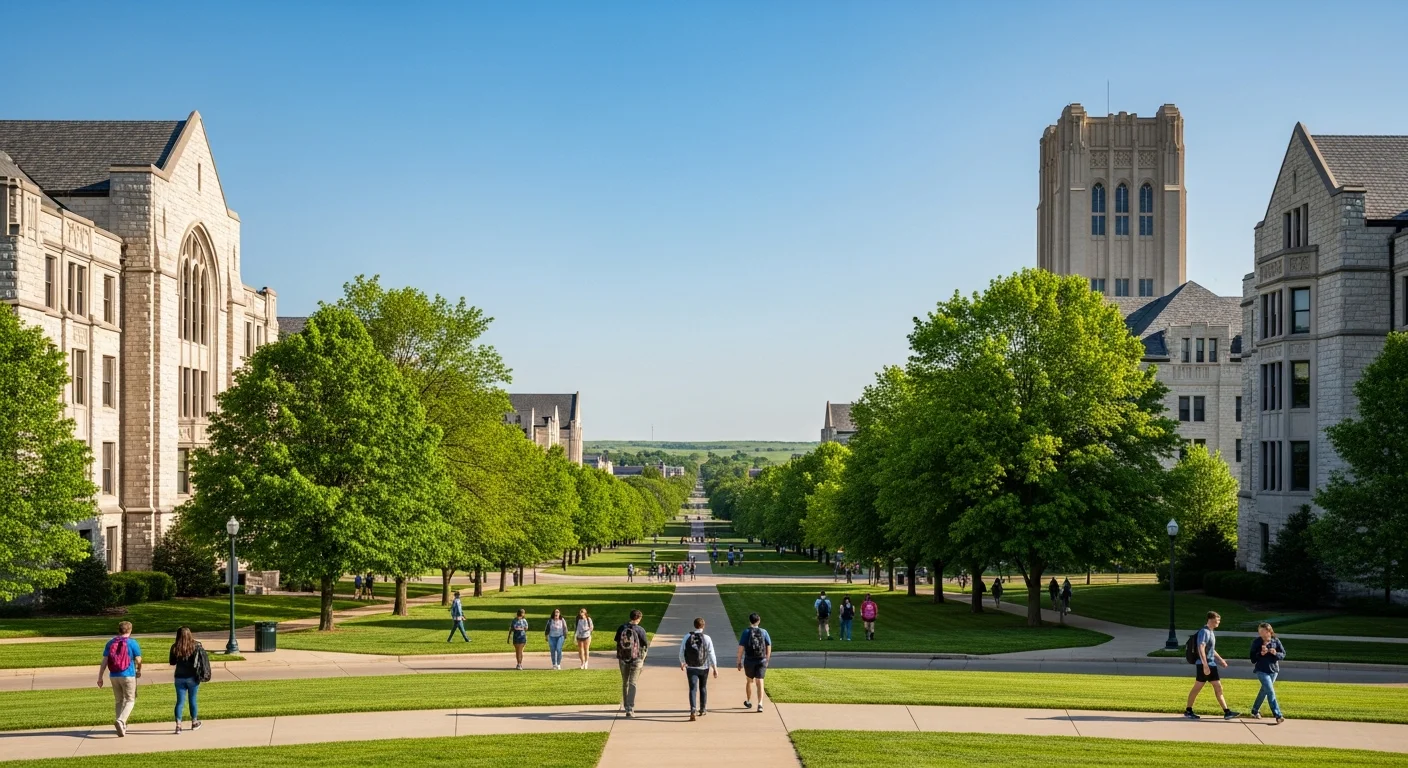
Kansas State University
Manhattan, KSPublic
K-State Regenerative Agriculture Overview with Dr. Chuck Rice$10,243
Tuition/yr
71%
Grad rate
73.7
Hakia Score
Compare the top computer engineering colleges in Kansas. 9 accredited computer engineering schools ranked by graduation rate, career outcomes, and value, from Butler Community College to Wichita State University.
Best computer engineering degree programs: Wichita State, Southwestern College, Kansas State
Ranked by graduation rates, program outcomes, and institutional quality
Tuition ranges from $2,432 to $38,330/year
Butler Community College offers the most affordable option at $3,090/yr
Computer Engineering degree programs available: 3 associate's, 3 master's, 2 doctoral in Kansas
From community college pathways to advanced research degrees
2 online computer engineering degree programs in Kansas
Flexible scheduling for working professionals
Kansas community college transfer can save 40-60% on total degree costs
3 associate's programs provide transfer pathways to bachelor's degrees
Education Commission of the States
Major employers: Garmin, Sprint, Cerner, Koch Industries
Tech hubs in Kansas City and Wichita
Hakia Research 2026
Computer Engineering degree programs near 44+ cities across Kansas
Search by city to find programs within 200 miles of your location
Updated June 28, 2026
We rank 14 accredited computer engineering programs in Kansas using IPEDS 2024 institutional data, BLS OEWS 2024 state salary data, and College Scorecard outcomes. A 4-factor weighted composite is normalized to a 0–100 score. Schools cannot pay for placement; rankings are produced algorithmically.
Are Computer Engineering Degree Programs in Kansas Worth It?
Source: BLS OEWS May 2024
Compare the top-ranked Computer Engineering programs in Kansas by degree level. Tuition, graduation rate, and Hakia Score for every accredited program.
Kansas ranks among the nation's top destinations for computer engineering education, with 6 accredited bachelor's degree programs across 3 public and 3 private institutions. The highest-ranked programs are Wichita State, Southwestern College, Kansas State, recognized for academic excellence, research opportunities, and strong industry connections.
Graduates from Kansas computer engineering programs earn a median salary of $78,489, 20% below the national average. The state's robust technology sector, anchored by the Kansas City, Wichita, Overland Park metropolitan areas, provides abundant internship and employment opportunities with companies including Garmin, Sprint, Cerner.
Tuition ranges from $7,247 to $38,330 annually, with an average of $22,223/yr. Top programs maintain graduation rates above 83%, with the highest reaching 96%. Many programs hold ABET accreditation, the gold standard for computing education, ensuring curriculum meets rigorous industry standards.
Students can choose from specializations including software engineering, cybersecurity, artificial intelligence, data science, and systems architecture. Strong industry partnerships provide access to co-op programs, capstone projects with real companies, and direct recruiting pipelines to Kansas's leading technology employers. For students seeking computer engineering degrees in Kansas, these top-ranked computer engineering schools offer the strongest combination of academic rigor and career preparation.
Kansas offers 3 master's degree programs in computer engineering, designed for professionals seeking to advance into senior engineering, technical leadership, and specialized roles. The top programs, Wichita State, U of Kansas, Kansas State, combine advanced technical training with research opportunities and leadership development.
Master's graduates in Kansas earn a median salary of $92,340, approximately 20-30% higher than bachelor's degree holders. The concentration of technology companies in Kansas City, Wichita, Overland Park creates strong demand for graduate-level talent, with Garmin, Sprint, Cerner actively recruiting from these programs.
Program formats include traditional full-time study (typically 2 years), part-time options for working professionals (2-3 years), and accelerated tracks. Tuition averages $9,269/yr, with many employers offering tuition reimbursement for graduate education. Some programs offer thesis and non-thesis tracks, allowing students to focus on research or professional development based on their career goals.
Curriculum covers advanced topics including machine learning, distributed systems, software architecture, and technical management. Many programs include practicum experiences, industry capstone projects, or consulting engagements that provide real-world application of advanced concepts. Among Kansas's computer engineering schools at the graduate level, these programs stand out for both academic quality and career outcomes.
| Metric | Value |
|---|---|
| Average in-state tuition | $16,888/year |
| Average out-of-state tuition | $42,220/year |
| Community college tuition | $4,222/year |
| 4-year savings for residents | $101,328 |
| 2+2 transfer pathway savings | $25,332 |
Source: IPEDS 2024
Kansas students pursuing computer engineering degrees have access to multiple layers of financial support. At the federal level, the Free Application for Federal Student Aid (FAFSA) is the gateway to grants, loans, and work-study opportunities through (Federal Student Aid). Beyond federal programs, Kansas offers the Kansas Comprehensive Grant, a need-based aid program specifically designed for students attending Kansas independent institutions. This state-level support complements federal aid and can significantly reduce out-of-pocket costs for eligible students. More information on Kansas state financial aid is available through the (Kansas Board of Regents).
Individual institutions in Kansas also offer merit-based and need-based scholarships to computer engineering students. For example, Wichita State University, the state's leading producer of computer engineering graduates, provides institutional aid packages alongside federal and state grants. Students should explore scholarship opportunities directly with their chosen institution and review financial aid pages on college websites. The (College Scorecard) tool allows students to compare net price and financial aid packages across Kansas schools. Additionally, prospective students should investigate transfer agreements through the (Kansas Transfer Equivalency System), which can reduce time-to-degree and associated costs for community college transfers entering four-year programs.
Use our interactive ROI calculator to estimate your return on investment for a computer engineering degree in Kansas. Enter your expected tuition costs, financial aid, and career goals to see projected payback periods and lifetime earnings. The calculator uses current salary data from BLS and tuition data from IPEDS to provide accurate estimates.
Estimate your return on investment for a computer engineering degree
Leave blank to use average cost for selected program type
+907%
Net gain divided by total investment. ROI above 200% is considered excellent for education investments.
$1,677,254
Your additional lifetime earnings with this degree vs. working without one, minus the total investment.
5 years
Years until your cumulative earnings exceed total investment. Shorter programs often break even faster due to lower opportunity cost.
$133,333
Your starting salary adjusted for local cost of living. This shows real purchasing power compared to a $100K national baseline.
Why does break-even change with program type? Your "total investment" includes both tuition AND opportunity cost (foregone earnings while in school). A 4-year full-time public university (in-state) means 4 years of not earning a salary ($140,000 in opportunity cost). Shorter full-time programs may have higher tuition but lower total investment because you return to the workforce sooner.
How we calculate your degree ROI using real salary data
Tuition plus opportunity cost (earnings you miss while in school)
Direct cost of the degree program
4 years × $35K/year foregone salary while studying full-time
Projected career earnings starting after graduation, with salary growth
What you'd earn working at $35K/year with 2% annual growth
Median salary for this role in your selected location (BLS 2024)
Your investment's compound annual growth rate (similar to stock market returns)
Data sources: BLS OEWS May 2024, IPEDS 2024. Calculations use median salaries, 3% discount rate, and assume salary growth declines from 6% to 2% over career. Individual results will vary. | Powered by Hakia.com
Median annual salary in Kansas metro areas
| Category | Value |
|---|---|
| Kansas City | $102K |
| Wichita | $97K |
| Overland Park | $92K |
Source: BLS OEWS May 2024
Hakia.com
Find computer engineering jobs in Kansas. These major employers across Kansas metro areas are actively hiring computer engineering degree holders. Click employer names to view current job openings.
Kansas provides structured transfer pathways for students pursuing computer engineering through the Kansas Transfer Equivalency System, a statewide framework that facilitates course transfer and credit recognition among public institutions. According to the Kansas Board of Regents, the system includes comprehensive articulation agreements ensuring that credits earned at two-year institutions transfer seamlessly to four-year bachelor's degree programs. With 28 two-year institutions and 34 four-year institutions throughout Kansas, students have numerous entry points and transfer options. Community colleges such as Butler Community College (which awarded 15 computer engineering completions in 2023) and Barton County Community College offer associate's degrees in computer engineering designed specifically to prepare students for upper-level coursework at universities like Wichita State University and Kansas State University.
Transfer students benefit from pre-established course equivalencies and reduced admission requirements when moving from Kansas two-year to four-year institutions. Many four-year universities offer dedicated transfer advising to ensure that associate's degree holders complete prerequisites and maintain progress toward bachelor's degree completion. The transfer system is particularly valuable for students managing costs, as community college tuition averages significantly below four-year institution rates, allowing students to complete general education and foundational engineering courses affordably before transfer. Students should consult the Kansas Transfer Equivalency System website for program-specific articulation agreements and work with institutional advisors at both sending and receiving institutions. Additionally, exploring related technical programs in Information Technology or Network Administration may provide complementary credentials for computer engineering careers.
Kansas offers a strong computer engineering education landscape with 18 institutions delivering programs across all degree levels, from associate's to doctoral studies (IPEDS). In the 2023 academic year, Kansas computer engineering programs awarded 198 bachelor's degrees, 287 master's degrees, and 20 associate's degrees, demonstrating strong pipeline development at multiple credential levels. The state's four-year public institutions maintain an average in-state tuition of just $7,625, making Kansas one of the most affordable regions for engineering education compared to national averages.
Wichita and the Kansas City metropolitan area are significant tech hubs, home to major employers like Spirit AeroSystems and Textron Aviation that actively recruit computer engineering graduates. Top-ranked programs such as University of Kansas, Wichita State University, and Kansas State University provide pathways to high-demand roles in aerospace, manufacturing, and software development. For students exploring related fields, Kansas also offers strong programs in Computer Science, Software Engineering, and Information Technology, allowing flexibility in engineering specialization. According to the Bureau of Labor Statistics, Kansas's technology sector continues to expand, creating sustained employment opportunities for graduates.
Computer Engineering Program Availability in Kansas
Source: IPEDS 2024
Kansas offers a strong job market for computer engineering graduates, with strong demand across multiple metropolitan regions. The state's major employment hubs include the Kansas City Metro, Wichita, and Topeka areas, each supporting diverse technology sectors. According to the Bureau of Labor Statistics, Kansas maintains competitive salary standards and steady growth projections for engineering professionals. The state's 18 institutions offering computer engineering programs reflect strong regional demand, with 198 bachelor's degree completions annually demonstrating the pipeline of qualified graduates entering the workforce.
Wichita State University leads the state in computer engineering production with 357 total completions across all degree levels, positioning graduates strategically for employment in South Central Kansas's aerospace and defense sectors. Kansas State University and University of Kansas follow with 63 and 50 completions respectively, each maintaining strong connections to regional employers. The diversity of degree pathways, from associate's programs at community colleges to doctoral programs at research institutions, ensures that graduates at all educational levels can enter the market. Students can explore career pathways through resources like College Scorecard to compare outcomes across Kansas institutions and make informed decisions about their educational investment.
New graduates and career changers
Technical leads and architects
2 available in Kansas
Traditional classroom experience
Institutional characteristics, completions, graduation rates
Kansas salary and employment data
Program details and admissions information
Last Updated: June 26, 2026. Rankings based on IPEDS 2024 data. Salary data from BLS OEWS May 2024.

Co-founder & Editor (B.S. Computer Science, Oregon State • B.A. Psychology, University of Washington)
Taylor combines technical expertise in computer science with a deep understanding of human behavior and learning. His dual background drives Hakia's mission: leveraging technology to build authoritative educational resources that help people make better decisions about their academic and career paths.
Hand-researched detail on the top-ranked programs: degree pathways, research labs, industry partners, career outcomes, and admissions. Tap any school to expand.
Why it stands out. Hands-on, laboratory-based curriculum emphasizing project development. Undergraduate research opportunities at 90+ research centers
Hakia insight. Kansas State's 90+ research centers create an atypical undergraduate advantage: most students at larger schools watch grad students do the research, but here you're statistically likely to land a hands-on role before senior year, giving you publishable work for job applications.
Kansas State University's Bachelor of Science in Computer Engineering offers a hands-on, laboratory-based curriculum designed to prepare students for careers in hardware and software design across consumer, healthcare, academic, and defense industries. The program emphasizes project development and problem-solving through coursework in three core areas: Architecture and Design (hardware design from system to component level), Embedded Systems (processor-based computing in appliances, automobiles, and wearable devices), and Networking (communication protocols and networked systems). Students have direct access to undergraduate research opportunities through K-State's 90+ research centers, with specific focus areas including IoT applications, cyber-physical systems, and computer networks. The Robotics Competition Team provides hands-on experience competing against other universities. A makerspace within the department supports student innovation. K-State's Career Center offers extensive resources including job search training, employer connections, and salary data tracking for graduates. Study abroad opportunities are available through partnerships in 85+ countries.
Programs offered
Research labs & institutes
Industry partners
Accreditation & certifications
Location advantage: Growing tech corridor in Manhattan with emerging startups Proximity to agricultural technology innovation sector Access to major tech employers through recruiting partnerships
Why it stands out. Two-semester capstone sequence (EECS 541 and EECS 542) with hands-on computer systems design laboratory. Intensive laboratory component throughout curriculum including General Physics Laboratory, Circuits labs, and Digital Systems Design
Hakia insight. The two-semester capstone sequence (EECS 541/542) is notably intensive compared to one-off senior projects elsewhere—you're essentially running a mini systems design firm for two consecutive semesters, which employers consistently cite as the difference between understanding computer architecture in theory versus being able to architect it.
The Bachelor of Science in Computer Engineering at the University of Kansas is a 127-credit, four-year program designed to prepare students for careers in computer architecture, embedded systems, networking, and digital design. The curriculum combines foundational mathematics and physics with core computer engineering courses including digital logic design, circuits, programming, signal analysis, and computer architecture. Students complete a two-semester capstone sequence (EECS 541 and EECS 542: Computer Systems Design Laboratory I & II) that culminates in a substantial design project. The program emphasizes hands-on experience through laboratory courses and senior electives in advanced EECS topics (400+ level). Graduates pursue careers in computer industry, telecommunications, government/defense, software companies, and consulting firms. Within a few years of graduation, alumni demonstrate technical proficiency through accomplishments in industry and academia, participate in multidisciplinary projects, and engage in continuous professional development. The program requires a minimum grade of C in all prerequisite and upper-level eligibility courses to ensure student preparedness for advanced coursework.
Programs offered
Research labs & institutes
Accreditation & certifications
Location advantage: Close proximity to Kansas City tech hub Access to regional tech employers and startups
Why it stands out. Guaranteed applied learning or research experience built into every degree. Two-semester senior capstone project with real-world focus
Hakia insight. Wichita State's guaranteed applied learning requirement and two-semester capstone aren't optional polish—they're embedded into the degree, ensuring every graduate exits with Boeing or Spirit AeroSystems project artifacts in their portfolio.
Wichita State University's Bachelor's in Computer Engineering emphasizes applied learning with guaranteed hands-on experience built into the curriculum. Students develop foundational knowledge in math, science, and general engineering while engaging in design throughout the program. As seniors, students complete a two-semester capstone project providing real-world experience. The program leverages WSU's extensive industry connections in Kansas's manufacturing and aerospace hub, enabling students to gain professional experience, build networks, and earn income while studying. Graduates pursue careers in avionics, process control systems, information processing, IT, manufacturing, telecommunications, and aerospace. The university's collaborative projects—such as GoBabyGo!, where engineering students modify toy vehicles for children with disabilities—provide additional hands-on learning opportunities alongside traditional coursework.
Programs offered
Research labs & institutes
Industry partners
Accreditation & certifications
Location advantage: Situated in aerospace and advanced manufacturing hub with major employers (Boeing, Spirit AeroSystems) Strong pipeline to defense and industrial automation sectors
Why it stands out. Three completion tracks: thesis (publishable research), project (creative system design), and coursework-only (accelerated for working professionals). Thesis option typically completes in 2 semesters with publication-quality outcomes
Hakia insight. The thesis track completing in two semesters with publication-quality outcomes suggests UKansas prioritizes depth over padding—you're not grinding through 31 credits of busywork; you're potentially publishing within your first year, which accelerates your visibility to employers.
The Master of Science in Computer Engineering at the University of Kansas offers three flexible completion tracks: thesis, project, and coursework-only options, all requiring 31 credit hours. The thesis track (typically 2 semesters) involves original research with publishable outcomes, while the project option emphasizes creative system design and implementation. The coursework-only track suits working professionals seeking accelerated completion without research requirements. Graduate assistantships are available for qualified applicants (priority deadline December 15 for Fall, September 30 for Spring). All students complete EECS 802 on professional issues in their first semester. The program prepares graduates for advanced engineering roles in telecommunications, computer networks, avionics, and emerging technologies. Career advancement typically leads to senior engineering, research, or technical leadership positions in Fortune 500 technology and aerospace companies.
Programs offered
Research labs & institutes
Accreditation & certifications
Location advantage: Close proximity to Kansas City tech hub Access to regional tech employers and startups