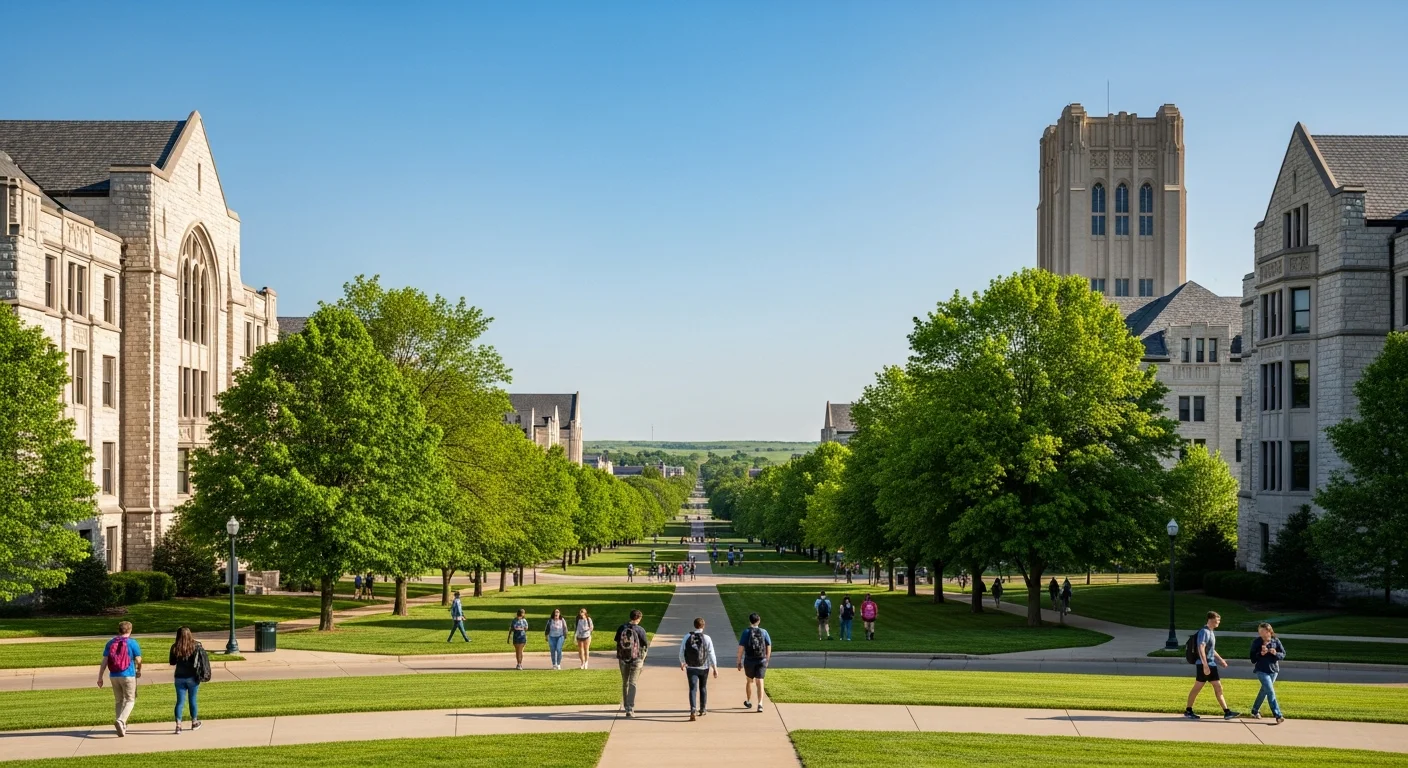
University campus in Kansas
Updated June 28, 2026

Best Software Engineering Degree Programs in Kansas, 2026 Rankings

Compare the top software engineering colleges in Kansas. 13 accredited software engineering schools ranked by graduation rate, career outcomes, and value, from Johnson County Community College to Wichita State University.

#1 ProgramWichita State
Avg Salary$92,340
Tuition From$2,400/yr
Job Growth+22%
On this page
Reviewed by Taylor Rupe, Founder & EditorSee methodology

16

Programs ranked

IPEDS 2024

$92,340

Kansas median software engineering salary

BLS OEWS 2024

74/100

Top program score

Hakia methodology

17%

U.S. job growth (2023–33)

BLS projections

Key Takeaways

Best software engineering degree programs: Wichita State, Southwestern College, Fort Hays State

Ranked by graduation rates, program outcomes, and institutional quality

IPEDS 2024

Tuition ranges from $2,100 to $38,330/year

Johnson County Community ... offers the most affordable option at $2,400/yr

IPEDS 2024

Software Engineering degree programs available: 6 associate's, 3 master's in Kansas

From community college pathways to advanced research degrees

IPEDS 2024

3 online software engineering degree programs in Kansas

Flexible scheduling for working professionals

IPEDS 2024

Kansas community college transfer can save 40-60% on total degree costs

6 associate's programs provide transfer pathways to bachelor's degrees

Education Commission of the States

Major employers: Garmin, Sprint, Cerner, Koch Industries

Tech hubs in Kansas City and Wichita

Hakia Research 2026

Software Engineering degree programs near 44+ cities across Kansas

Search by city to find programs within 200 miles of your location

IPEDS 2024

Updated June 28, 2026

How we ranked Kansas Software Engineering programs

We rank 16 accredited software engineering programs in Kansas using IPEDS 2024 institutional data, BLS OEWS 2024 state salary data, and College Scorecard outcomes. A 4-factor weighted composite is normalized to a 0–100 score. Schools cannot pay for placement; rankings are produced algorithmically.

Program completions (35%)Graduation rate (25%)Selectivity (20%)Career outcomes (20%)
See full methodology

Are Software Engineering Degree Programs in Kansas Worth It?

Answer
$92,340
Yes. The best software engineering degree programs in Kansas deliver strong ROI, graduates earn $92,340 median salary with +22% job growth through 2032. In-state tuition averages $12,761/year.

Source: BLS OEWS May 2024

Software Engineering Degree Rankings in Kansas

Compare the top-ranked Software Engineering programs in Kansas by degree level. Tuition, graduation rate, and Hakia Score for every accredited program.

Best Associate's Software Engineering Programs in Kansas

6
Programs ranked
$4,687
Avg tuition/yr
0%
Avg grad rate

Program Landscape

Kansas offers 6 accredited associate's degree programs in software engineering, providing an affordable entry point into the technology field. The top-ranked programs include Johnson County Community ..., Butler Community College, Barton County Community C..., which combine rigorous technical curriculum with practical skills training.

Costs & Value

Community colleges in Kansas offer these two-year programs at an average cost of $4,687/yr, significantly less than four-year university tuition. Students completing associate's degrees can pursue entry-level technical positions and transfer opportunities, with entry-level salaries averaging $50,787 in Kansas.

Career Pathways

Many programs feature guaranteed transfer agreements with Kansas's public universities, allowing students to complete their first two years at reduced cost before transferring to complete a bachelor's degree. The Kansas City, Wichita, Overland Park areas offer particularly strong job markets for associate's degree holders, with employers like Garmin, Sprint, Cerner hiring for technical support, junior development, and IT specialist positions.

Curriculum & Specializations

Programs typically include coursework in programming fundamentals, database management, networking basics, and software development. Among software engineering schools in Kansas, these associate's programs offer the best value for students beginning their software engineering degrees in Kansas.

Show all 6 ranked programs
RankSchoolLocationTypeTuitionGrad RateHakia Score
#6Rasmussen University-KansasTopeka, KSFor-Profit$13,13737.3

Best Bachelor's Software Engineering Programs in Kansas

7
Programs ranked
$19,682
Avg tuition/yr
83%
Avg grad rate

Program Landscape

Kansas ranks among the nation's top destinations for software engineering education, with 7 accredited bachelor's degree programs across 4 public and 3 private institutions. The highest-ranked programs are Wichita State, Southwestern College, Fort Hays State, recognized for academic excellence, research opportunities, and strong industry connections.

Career Outcomes

Graduates from Kansas software engineering programs earn a median salary of $78,489, 20% below the national average. The state's robust technology sector, anchored by the Kansas City, Wichita, Overland Park metropolitan areas, provides abundant internship and employment opportunities with companies including Garmin, Sprint, Cerner.

Costs & Value

Tuition ranges from $4,437 to $38,330 annually, with an average of $19,682/yr. Top programs maintain graduation rates above 83%, with the highest reaching 96%. Many programs hold ABET accreditation, the gold standard for computing education, ensuring curriculum meets rigorous industry standards.

Curriculum & Specializations

Students can choose from specializations including software engineering, cybersecurity, artificial intelligence, data science, and systems architecture. Strong industry partnerships provide access to co-op programs, capstone projects with real companies, and direct recruiting pipelines to Kansas's leading technology employers. For students seeking software engineering degrees in Kansas, these top-ranked software engineering schools offer the strongest combination of academic rigor and career preparation.

Show all 7 ranked programs
RankSchoolLocationTypeTuitionGrad RateHakia Score
#6Benedictine CollegeAtchison, KSPrivate$34,00070%40.9
#7Baker UniversityBaldwin City, KSPrivate$33,20029.7

Best Master's Software Engineering Programs in Kansas

3
Programs ranked
$9,269
Avg tuition/yr
83%
Avg grad rate

Program Landscape

Kansas offers 3 master's degree programs in software engineering, designed for professionals seeking to advance into senior engineering, technical leadership, and specialized roles. The top programs, Wichita State, U of Kansas, Kansas State, combine advanced technical training with research opportunities and leadership development.

Career Outcomes

Master's graduates in Kansas earn a median salary of $92,340, approximately 20-30% higher than bachelor's degree holders. The concentration of technology companies in Kansas City, Wichita, Overland Park creates strong demand for graduate-level talent, with Garmin, Sprint, Cerner actively recruiting from these programs.

Costs & Value

Program formats include traditional full-time study (typically 2 years), part-time options for working professionals (2-3 years), and accelerated tracks. Tuition averages $9,269/yr, with many employers offering tuition reimbursement for graduate education. Some programs offer thesis and non-thesis tracks, allowing students to focus on research or professional development based on their career goals.

Curriculum & Specializations

Curriculum covers advanced topics including machine learning, distributed systems, software architecture, and technical management. Many programs include practicum experiences, industry capstone projects, or consulting engagements that provide real-world application of advanced concepts. Among Kansas's software engineering schools at the graduate level, these programs stand out for both academic quality and career outcomes.

Software Engineering Degree Costs & Tuition in Kansas

MetricValue
Average in-state tuition$12,761/year
Average out-of-state tuition$31,903/year
Community college tuition$3,190/year
4-year savings for residents$76,568
2+2 transfer pathway savings$19,142

Source: IPEDS 2024

Financial Aid & Scholarships for Software Engineering Students in Kansas

State Aid Programs

Kansas students pursuing software engineering degrees have access to multiple layers of financial support. At the federal level, the Free Application for Federal Student Aid (FAFSA) is the gateway to grants, loans, and work-study opportunities through Federal Student Aid. The FAFSA determines eligibility for Pell Grants and Direct Loans, which are available to eligible students regardless of institution type. Additionally, Kansas offers the Kansas Comprehensive Grant, a need-based grant program specifically designed to support students attending Kansas independent institutions (Kansas Board of Regents). This state-level aid complements federal programs and can significantly reduce out-of-pocket costs for qualifying families.

Key Programs & Amounts

Beyond state and federal programs, individual Kansas institutions offer institutional scholarships and merit-based aid packages. Public universities like Wichita State University and Kansas State University frequently feature merit scholarships for software engineering majors, while community colleges such as Johnson County Community College provide affordable entry points with lower tuition barriers. Students should complete the FAFSA early and contact financial aid offices directly to inquire about program-specific scholarships. Many four-year institutions also participate in the Kansas Transfer Equivalency System, which allows students to transfer credits from community colleges without losing aid eligibility. For comprehensive aid planning, the College Scorecard provides institution-specific data on average aid packages and net price for enrolled students.

Software Engineering Degree ROI Calculator, Kansas

Use our interactive ROI calculator to estimate your return on investment for a software engineering degree in Kansas. Enter your expected tuition costs, financial aid, and career goals to see projected payback periods and lifetime earnings. The calculator uses current salary data from BLS and tuition data from IPEDS to provide accurate estimates.

Software Engineering Degree ROI Calculator

Estimate your return on investment for a software engineering degree

Leave blank to use average cost for selected program type

20 years
10 years20 years30 years
20-Year ROI

+907%

Net gain divided by total investment. ROI above 200% is considered excellent for education investments.

Net Gain

$1,677,254

Your additional lifetime earnings with this degree vs. working without one, minus the total investment.

Break-Even

5 years

Years until your cumulative earnings exceed total investment. Shorter programs often break even faster due to lower opportunity cost.

COL-Adjusted Salary

$133,333

Your starting salary adjusted for local cost of living. This shows real purchasing power compared to a $100K national baseline.

Why does break-even change with program type? Your "total investment" includes both tuition AND opportunity cost (foregone earnings while in school). A 4-year full-time public university (in-state) means 4 years of not earning a salary ($140,000 in opportunity cost). Shorter full-time programs may have higher tuition but lower total investment because you return to the workforce sooner.

Detailed Breakdown

How we calculate your degree ROI using real salary data

Total Investment$185,000

Tuition plus opportunity cost (earnings you miss while in school)

Program Cost (Tuition)$45,000

Direct cost of the degree program

Opportunity Cost$140,000

4 years × $35K/year foregone salary while studying full-time

20-Year Earnings (with degree)$2,712,662

Projected career earnings starting after graduation, with salary growth

20-Year Earnings (without degree)$850,408

What you'd earn working at $35K/year with 2% annual growth

Starting Salary (Austin, TX)$140,000

Median salary for this role in your selected location (BLS 2024)

Annualized Return4.9%

Your investment's compound annual growth rate (similar to stock market returns)

Data sources: BLS OEWS May 2024, IPEDS 2024. Calculations use median salaries, 3% discount rate, and assume salary growth declines from 6% to 2% over career. Individual results will vary. | Powered by Hakia.com

Software Engineering Salaries by Metro Area

Median annual salary in Kansas metro areas

Kansas City$102K
Wichita$97K
Overland Park$92K
View data table
CategoryValue
Kansas City$102K
Wichita$97K
Overland Park$92K

Source: BLS OEWS May 2024

Hakia.com

Top Employers Hiring Software Engineering Graduates in Kansas

Find software engineering jobs in Kansas. These major employers across Kansas metro areas are actively hiring software engineering degree holders. Click employer names to view current job openings.

Software Engineering Jobs in Overland Park

KS
Sprint/T-Mobile
telecom
Garmin
tech
Netsmart
healthtech
Black & Veatch
engineering

Software Engineering Jobs in Wichita

KS
Spirit AeroSystems
aerospace
Textron Aviation
aerospace
NetApp
tech

Transfer Pathways for Software Engineering Degrees in Kansas

State Transfer System

Kansas provides strong pathways for students to begin their software engineering education at community colleges and transfer seamlessly to bachelor's degree programs. The state's 9 associate's degree programs (IPEDS) at institutions like Johnson County Community College, Butler Community College, and Barton County Community College offer affordable entry points, with tuition as low as $2,400 at Johnson County Community College. These two-year programs provide foundational coursework in programming, data structures, and mathematics that directly articulate to four-year institutions. The Kansas Transfer Equivalency System provides systemwide course transfer agreements, ensuring credits earned at community colleges apply toward bachelor's degrees at universities like Wichita State University, University of Kansas, and Kansas State University (Kansas Board of Regents).

How Transfers Work

Transfer students benefit from structured articulation agreements that eliminate duplicate coursework and reduce time-to-degree. Many Kansas community colleges have formal partnerships with four-year institutions, allowing students to graduate with an associate's degree and transition directly into junior-level coursework at bachelor's degree-granting schools. This pathway is particularly valuable for students seeking to reduce education costs, combining $2,400–$4,960 community college tuition with transfer to universities averaging $7,625–$9,964 in-state tuition represents significant savings compared to four-year enrollment. For detailed articulation information and course equivalency mappings, students should consult the Kansas Transfer Equivalency System and contact their target transfer institution. Explore computer science in Kansas for complementary transfer-friendly programs and national best programs to identify highly-ranked transfer destinations.

Why Pursue a Software Engineering Degree in Kansas?

Industry & Workforce

Kansas offers a strong pathway into software engineering with 22 institutions across the state offering programs at multiple degree levels (IPEDS). Students can choose from 10 bachelor's programs, 9 associate's programs, and 3 master's programs, with a combined 278 master's completions and 248 bachelor's completions annually (IPEDS). The state's affordability stands out: average public in-state tuition for four-year institutions is just $7,625, compared to the national landscape, making Kansas an accessible entry point for aspiring software engineers. Leading institutions like Wichita State University and University of Kansas consistently rank among the nation's best programs while maintaining competitive tuition rates.

Salary Outlook

Kansas is home to major technology employers and innovation hubs that create strong career opportunities for graduates. The state's metro areas, particularly the Kansas City Metro, Wichita, and Topeka, host significant employers including Spirit AeroSystems, Textron Aviation, and Koch Industries, providing internship and employment pipelines directly from campus. Wichita State University leads the state with 357 completions, followed by Fort Hays State University with 82 completions, demonstrating the depth of talent development across the state (IPEDS). For students seeking affordability without sacrificing quality, Kansas delivers exceptional value. Explore national best bachelor's programs to benchmark Kansas schools against peers, and review computer science programs in Kansas for complementary educational pathways.

Software Engineering Program Availability in Kansas

13 Programs
Kansas offers 13 accredited software engineering programs across public universities, private colleges, and community colleges. Top tech hubs include Kansas City, Wichita, Overland Park.

Source: IPEDS 2024

Software Engineering Job Market & Salary Data in Kansas

Employment Outlook

Kansas hosts a growing software engineering job market driven by demand from aerospace, defense, and technology sectors. The state's major metropolitan areas. Kansas City, Wichita, and Topeka, serve as regional hubs for software development careers. According to the Bureau of Labor Statistics, Kansas employers across these metros actively recruit software engineers for roles in enterprise software development, embedded systems, and cloud infrastructure. Wichita, in particular, benefits from its proximity to major aerospace contractors and defense manufacturers, creating a strong demand for skilled software professionals in safety-critical and real-time systems.

Salaries by Metro

The Kansas software engineering pipeline is supported by 22 institutions offering programs at the associate's, bachelor's, and master's levels, with 248 bachelor's completions annually (IPEDS Program Data). Wichita State University leads the state with 357 total completions across all degree levels, making it a primary talent source for regional employers. Kansas also benefits from an affordable education landscape, with average public in-state tuition at four-year institutions at just $7,625, significantly lower than the national average. This affordability attracts students from across the region and helps build a competitive local workforce. For detailed salary expectations and job growth projections specific to Kansas, visit the College Scorecard and BLS occupational data.

Entry-Level (0-2 yrs)

New graduates and career changers

Senior (8+ yrs)

Technical leads and architects

Median Salary in Kansas$60,021$133,893
Typical RolesJunior Developer, AnalystStaff Engineer, Architect
Remote Work AccessLimitedCommon
Degree ExpectationBachelor's sufficientMaster's preferred

Online vs On-Campus Software Engineering Programs in Kansas

Online Programs

3 available in Kansas

On-Campus Programs

Traditional classroom experience

Typical Tuition$11,485/yr$12,761/yr
Schedule FlexibilitySelf-paced or asyncFixed schedule
NetworkingVirtual cohortsIn-person, career fairs
Best ForWorking professionalsTraditional students
Completion Time2-4 years (flexible)4 years (standard)

Compare Software Engineering Programs in Other States

Software Engineering Degree Programs in Kansas: FAQ

What are the best software engineering degree programs in Kansas?
The best software engineering degree programs in Kansas based on our methodology are: 1) Wichita State University (87% graduation rate), 2) Southwestern College, and 3) Fort Hays State University. Our rankings weight graduation rates (25%), program completions (35%), selectivity (20%), and career outcomes (20%). Kansas offers 13 total accredited programs across 9 public and 3 private institutions. See our complete rankings for all 7 bachelor's programs.
How much do software engineering degree programs cost in Kansas?
Software Engineering degree program costs in Kansas vary significantly by institution type. In-state public tuition averages $12,761/year, while private institutions average $28,074/year. Community colleges offer the most affordable path at approximately $3,190/year for associate's degrees. The total 4-year cost ranges from $51,044 at public schools to $112,297 at private institutions before financial aid. Most students don't pay full sticker price, federal grants, state aid, and institutional scholarships can reduce costs by 30-60%.
What salary can software engineering degree graduates earn in Kansas?
Software Engineering professionals in Kansas earn a median salary of $92,340, which is competitive with the national average of $115,500. Entry-level positions typically start around $60,021, while senior roles exceed $133,893. Salaries vary by metro area: Kansas City ($101,574), Wichita ($96,957) offer the highest compensation. Specialized roles like AI/ML engineers and cloud architects command premiums of 15-30% above median.
Are there online software engineering degree programs in Kansas?
Yes, Kansas offers 3 accredited online Software Engineering programs from state institutions. These programs award the same degree as on-campus options and include synchronous and asynchronous formats. Top-ranked online programs include offerings from Independence Community College and Rasmussen University-Kansas. Online programs typically cost the same as on-campus tuition for in-state students. Many programs offer flexible scheduling for working professionals, with some offering accelerated completion in 2-3 years. Ensure any online program holds regional accreditation and ideally ABET accreditation for engineering programs.
What companies hire software engineering degree graduates in Kansas?
Major Software Engineering employers in Kansas include Garmin, Sprint, Cerner, Koch Industries, Spirit AeroSystems. The Kansas City and Wichita metro areas serve as primary tech hubs with thousands of open positions. Top employers maintain recruiting pipelines directly from Kansas universities, with many offering internship-to-hire programs. Beyond tech giants, opportunities exist in healthcare IT, financial services, defense contractors, and growing startups. Kansas's tech sector shows +22% projected job growth through 2033, outpacing most other industries.
Is a software engineering degree program worth it in Kansas?
A software engineering degree program in Kansas offers strong ROI with a $92,340 median salary and +22% projected job growth. At average in-state tuition of $12,761/year, graduates typically recoup their educational investment within 3-5 years. The degree opens doors to high-paying careers in software development ($104,344), data science, cybersecurity, and AI/ML. Beyond salary, benefits include job security, remote work flexibility, and clear advancement paths. Alternative paths like bootcamps exist for career changers, but bachelor's degrees provide broader career options and higher lifetime earnings.
How long do software engineering degree programs take in Kansas?
Standard completion times for software engineering degree programs in Kansas are: Associate's (2 years, 60 credits), Bachelor's (4 years, 120 credits), and Master's (1-2 years, 30-36 credits). However, actual timelines vary based on course load, transfer credits, and program format. Accelerated programs can compress a bachelor's to 3 years or a master's to 12 months. Part-time students typically need 5-6 years for a bachelor's degree. Kansas community colleges offer a cost-effective "2+2" path: complete your associate's in 2 years, then transfer to a Kansas university for the final 2 years of a bachelor's program.
What financial aid is available for software engineering degree students in Kansas?
Kansas software engineering degree students can access multiple financial aid sources. Federal aid includes Pell Grants (up to $7,395/year for qualifying students) and federal student loans. Kansas state grants provide additional support for residents attending in-state schools. Institutional scholarships from universities can significantly reduce costs, many schools offer merit-based awards for STEM students. Work-study programs and teaching/research assistantships (especially for graduate students) provide income while building experience. Complete the FAFSA by Kansas's priority deadline to maximize aid eligibility. Some employers also offer tuition reimbursement for employees pursuing CS degrees.

Data Sources

Institutional characteristics, completions, graduation rates

Kansas salary and employment data

Official University Websites

Program details and admissions information

Last Updated: June 26, 2026. Rankings based on IPEDS 2024 data. Salary data from BLS OEWS May 2024.

Was this ranking helpful for your college search?
Taylor Rupe

Taylor Rupe

Co-founder & Editor (B.S. Computer Science, Oregon State • B.A. Psychology, University of Washington)

Taylor combines technical expertise in computer science with a deep understanding of human behavior and learning. His dual background drives Hakia's mission: leveraging technology to build authoritative educational resources that help people make better decisions about their academic and career paths.

The research behind the rankings

In-depth Software Engineering program profiles in Kansas

Hand-researched detail on the top-ranked programs: degree pathways, research labs, industry partners, career outcomes, and admissions. Tap any school to expand.

Best Associate's Software Engineering programs

#1Johnson County Community CollegeOverland Park, KS

Hakia insight. JCCC's guaranteed transfer pathways into Kansas State and University of Kansas mean you can earn an associate's for a fraction of the cost and transfer directly into a four-year degree without the 'junior college stigma' that haunts many transfer routes.

At the associate's level, with one of Kansas's strongest transfer partnerships, JCCC's software engineering program is designed so you can seamlessly move into Kansas State University or University of Kansas computer science bachelor's degrees without losing credits. You'll spend two years building fundamentals in programming languages, web development, and database design while working alongside instructors who maintain active industry connections. The program emphasizes both theoretical computer science and hands-on project work, meaning you graduate job-ready for help desk, junior developer, or QA roles while holding a guaranteed pathway to a four-year degree. JCCC's location in the Kansas City metro also connects you to regional tech employers hiring associates-level graduates immediately.

Programs offered

  • Associate of Science in Software Engineering · 2 years · on-campus
  • Associate of Applied Science in Software Engineering · 2 years · online

Career outcomes

Top employers: Cerner Corporation, Burns & McDonnell, Black & Veatch, Regional healthcare IT departments

#2Butler Community CollegeEl Dorado, KS

Hakia insight. Butler's lab-intensive model means you graduate with a portfolio of working software—not just coursework—making you immediately credible to the manufacturing IT departments and healthcare systems that dominate Kansas hiring.

At the associate's level, if you want real-world experience before your first job, Butler's software engineering track combines classroom learning with a strong hands-on lab component where you build actual applications and troubleshoot live systems. Located in El Dorado, the program keeps class sizes intentionally small, so professors know your strengths and can guide internship placements at local tech firms and manufacturing companies. You'll graduate with experience in full-stack web development, cloud basics, and IT support fundamentals—skills that employers in south-central Kansas actively recruit for. Many Butler graduates move directly into junior developer or systems support roles while others transfer to Kansas State or Wichita State with junior standing.

Programs offered

  • Associate of Science in Software Engineering · 2 years · on-campus
  • Associate of Applied Science in Software Engineering · 2 years · online

Career outcomes

Top employers: Local manufacturing IT departments, Regional healthcare systems, Small-to-mid-size software firms in central Kansas

#3Barton County Community CollegeGreat Bend, KS

Hakia insight. Barton fills a genuine talent gap in western Kansas where school districts and government agencies struggle to find local tech staff, so your degree comes with built-in regional demand and shorter job search timelines than traditional tech hubs.

At the associate's level, barton's software engineering program stands out for its direct pipeline into workforce roles across western Kansas, where tech talent is in real demand but hard to find. You'll learn programming, web development, and IT fundamentals in a supportive environment where instructors know the hiring managers at regional employers personally. The curriculum balances theory with practical labs, and you can earn industry certifications while completing your degree—giving you a competitive edge when job hunting. Barton also maintains clear articulation agreements with Kansas universities, so if you decide to pursue a bachelor's degree, your credits transfer smoothly.

Programs offered

  • Associate of Science in Software Engineering · 2 years · on-campus
  • Associate of Applied Science in Software Engineering · 2 years · online

Career outcomes

Top employers: Regional school districts, Local government IT departments, Healthcare systems in western Kansas, Small technology service providers

#4Flint Hills Technical CollegeEmporia, KS

Hakia insight. Flint Hills aligns its curriculum to *current* hiring needs rather than generic skills, meaning employers like regional healthcare IT departments are actively recruiting from the program—a direct pipeline most associate programs lack.

At the associate's level, flint Hills Technical College's software engineering and IT programs emphasize applied technical skills that employers in central Kansas are actively hiring for right now. You'll work with current industry tools and technologies in well-equipped labs, learning everything from A+ certification topics to cloud platforms and web development frameworks. The college's focus on workforce readiness means your coursework aligns with real job openings—graduates typically transition into help desk, junior developer, or systems support roles within months of completing the program. Instructors often bring real-world problem-solving into the classroom, so you're not just learning theory but developing the troubleshooting mindset employers value.

Programs offered

  • Associate of Science in Software Engineering · 2 years · on-campus
  • Associate of Applied Science in Software Engineering · 2 years · online

Career outcomes

Top employers: Regional healthcare IT departments, School district technology departments, Local government agencies, Small-to-mid-size tech service firms

#5Independence Community CollegeIndependence, KS

Why it stands out. Independence Community College provides affordable Software Engineering education with flexible scheduling and transfer pathways to four-year universities.

Hakia insight. Independence's transfer pathways to four-year universities let you complete general education affordably at the community college level before specializing, cutting total degree costs by thousands compared to four-year-only institutions.

Independence Community College offers Software Engineering programs in Independence, KS. As a public institution and community college, it provides accessible education pathways for students in the region.

#6Rasmussen University-KansasTopeka, KS

Why it stands out. Rasmussen University-Kansas offers comprehensive Software Engineering programs preparing students for careers in technology.

Hakia insight. Rasmussen's private model enables accelerated scheduling options ideal for working adults, compressing a two-year associate into flexible terms without sacrificing employer recognition in the Topeka region.

Rasmussen University-Kansas offers Software Engineering programs in Topeka, KS. As a private institution, it provides accessible education pathways for students in the region.

Best Bachelor's Software Engineering programs

#1Wichita State UniversityWichita, KS

Why it stands out. Mandatory senior capstone design sequence (CS 598 and CS 599) fulfilling applied learning requirement. Up to 2 credit hours of co-op experience can be applied toward technical electives

Hakia insight. Wichita State's mandatory co-op option and capstone sequence, combined with NIAR labs and Boeing/Spirit Aerosystems partnerships, means you're solving real embedded systems problems for Fortune 500 employers before graduation—rare at the bachelor's level.

The Bachelor of Science in Computer Science at Wichita State University is a 120-credit program designed to develop proficiency in software development, systems design, and computational problem-solving. The curriculum combines foundational mathematics and physics with core computer science courses including programming, data structures, algorithms, operating systems, databases, and computer networks. A distinctive feature is the mandatory applied learning requirement, fulfilled through the two-course senior capstone sequence (CS 598 and CS 599 Senior Design Projects), which provides hands-on experience in real-world software engineering challenges. Students can enhance their education with up to 2 credit hours of co-op experience counted toward technical electives, enabling practical industry engagement. The program requires a minimum 2.0 GPA in major courses and emphasizes computer security and software engineering principles. Graduates are prepared for technical roles in software development, systems engineering, and related computing fields.

Programs offered

  • Bachelor of Science in Computer Science · 4 years · on-campus

Research labs & institutes

  • National Institute for Aviation Research (NIAR) — Aerospace systems and advanced manufacturing

Industry partners

BoeingSpirit AerosystemsTextron

Accreditation & certifications

ABET accredited

Location advantage: Aerospace and manufacturing industry hub Major employers concentrated regionally: Boeing, Spirit Aerosystems, Textron

#2Southwestern CollegeWinfield, KS

Why it stands out. Embeds software engineering within liberal arts education, emphasizing interdisciplinary problem-solving and communication alongside technical depth.

Hakia insight. Southwestern embeds software engineering within a liberal arts framework where you're equally trained in communication and interdisciplinary collaboration—skills that distinguish you when competing for leadership roles, not just entry-level coding positions.

At the bachelor's level, southwestern College's computer science and software development offerings reflect a liberal arts approach to computing education, where technical depth is cultivated alongside communication, ethics, and cross-disciplinary problem-solving. Rather than isolating software engineering as a standalone discipline, the program weaves computer science fundamentals throughout a curriculum that encourages collaboration with other departments—from data visualization projects with business students to computational approaches in the sciences. Small class sizes and a collaborative culture mean students work closely with faculty on projects that matter, developing not just coding skills but the ability to articulate technical ideas to non-technical stakeholders. The program prepares graduates for software roles where they're expected to bridge technical and business domains, a skill increasingly valued in modern development environments. Southwestern's location and liberal arts context attract students who value education as formative rather than purely vocational, though graduates successfully transition into technical careers.

Programs offered

  • Bachelor of Science in Software Engineering · 4 years · on-campus
  • Bachelor of Arts in Software Engineering · 4 years · online
#3Fort Hays State UniversityHays, KS

Why it stands out. Emphasizes immediate industry readiness through integrated hands-on projects and current technology stacks over theoretical depth.

Hakia insight. Fort Hays prioritizes current technology stacks and hands-on projects over theory-heavy academics, so graduates enter roles immediately productive rather than requiring onboarding to modern development practices.

At the bachelor's level, fort Hays State positions its software engineering program as a practical pipeline into industry, with heavy emphasis on hands-on development and contemporary technology stacks. The curriculum prioritizes real-world project experience, web application development, and mobile platforms alongside traditional computer science theory. Faculty maintain active connections to regional employers, facilitating internship placements and guest lectures that keep coursework aligned with current industry demands. Students benefit from a supportive learning environment where professors are accessible and invested in individual success—particularly valuable for students building portfolios for competitive tech job markets. The program graduates developers who are immediately productive, having worked with version control systems, agile methodologies, and CI/CD pipelines before entering their first professional roles. This focus on applied competency rather than pure theory appeals to students seeking direct entry into software development careers.

Programs offered

  • Bachelor of Science in Software Engineering · 4 years · on-campus
  • Bachelor of Arts in Software Engineering · 4 years · online

Accreditation & certifications

ABET accredited
#4University of KansasLawrence, KS

Why it stands out. Capstone project: EECS 582 Computer Science and Interdisciplinary Computing Capstone integrating interdisciplinary computing. Flexible specialization tracks through three elective lists enabling focus on cybersecurity, machine learning, artificial intelligence, database systems, compiler design, and mobile security

Hakia insight. Kansas's elective-driven specialization tracks let you build depth in cybersecurity, ML, or databases *within* your undergrad degree—flexibility that typically requires grad school at peer institutions—while ITTC research labs create publication opportunities for undergrads.

The Bachelor of Science in Computer Science at the University of Kansas is a 126-credit, 4-year program within the School of Engineering that emphasizes technical proficiency, collaborative activities, and professional development. Students complete a rigorous core curriculum in mathematics, physics, and computer science fundamentals, followed by advanced coursework in software engineering, operating systems, computer architecture, and security. The program culminates in EECS 582, a capstone course in Computer Science and Interdisciplinary Computing. Students must achieve Upper Level Eligibility by earning C or better in 13 foundational courses before enrolling in upper-level electives. The curriculum offers specialization flexibility through 21 credit hours of CS electives across three lists, enabling students to focus on areas such as cybersecurity, machine learning, data mining, artificial intelligence, compiler construction, database systems, mobile security, and multicore programming. Graduates pursue careers in software design, systems analysis, artificial intelligence, database management, and cybersecurity at software companies, government agencies, telecommunications firms, and consulting organizations.

Programs offered

  • Bachelor of Science in Computer Science · 4 years · on-campus

Research labs & institutes

  • ITTC (Information and Telecommunication Technology Center) — Distributed systems, networking, cybersecurity

Industry partners

GoogleMicrosoft

Career outcomes

Top employers: intel

Notable faculty

  • null (Systems and distributed computing)

Accreditation & certifications

ABET accredited

Location advantage: Kansas City metropolitan area proximity Regional tech industry presence

#5Kansas State UniversityManhattan, KS

Why it stands out. Capstone project with multiple specialization tracks (Computer Science, Cybersecurity, Software Engineering). Ethics and conduct for computing professionals course (CIS 415)

Hakia insight. Kansas State's mandatory ethics course (CIS 415) and Susan Vrbsky's focus on secure software development create rare institutional emphasis on security fundamentals during undergrad, giving you credibility for security-focused roles that many computer science programs treat as optional.

Kansas State University's Bachelor of Science in Computer Science is a 120-credit program emphasizing a broad foundation in computer organization, software, and mathematics with flexible electives for specialization. The curriculum includes core coursework in programming, data structures, algorithms, software architecture, and database systems, supplemented by technical and upper-division electives. Students complete a capstone project (CIS 598, 599, 643, or DEN 591) allowing choice between Computer Science Project, Cybersecurity Project, or Software Engineering Project tracks. The program includes required coursework in ethics and conduct for computing professionals (CIS 415) and technical writing. Students can tailor their education through systems electives (operating systems, network programming, concurrent software systems), technical electives including courses in image processing, optimization, and data analytics, and nine hours of upper-division electives. The program prepares graduates for careers in software development, systems engineering, cybersecurity, and data science roles.

Programs offered

  • Bachelor of Science in Computer Science · 4 years · on-campus

Research labs & institutes

  • Center for the Study of Suicide and Depression — Software systems for mental health data and analysis

Industry partners

Garmin Ltd.Cerner CorporationKoch Industries

Notable faculty

  • Susan Vrbsky (Software engineering, data security, and secure software development)

Accreditation & certifications

NSA CAE

Location advantage: Growing Kansas tech corridor with Garmin and other engineering-focused companies Proximity to Kansas City technology hub (2 hours east) Strong recruitment pipeline with Midwest defense and industrial contractors

#6Benedictine CollegeAtchison, KS

Why it stands out. Benedictine's program uniquely integrates Catholic intellectual tradition and ethical reasoning into software engineering education, fostering developers who consider technology's human and social dimensions.

Hakia insight. Benedictine's integration of Catholic intellectual tradition into software engineering means graduates develop an unusual professional advantage: the ability to articulate technology's ethical implications in a landscape increasingly concerned with responsible AI and data practices.

At the bachelor's level, benedictine College's computer science and software engineering curriculum is rooted in its Benedictine Catholic identity, emphasizing intellectual formation, ethical development, and service-oriented learning alongside technical skill-building. The program balances classical computer science theory with hands-on software development, incorporating projects that encourage students to think about technology's role in society and its impact on human flourishing. Faculty engage students in collaborative work and independent study, with smaller class sizes enabling deeper mentorship than typical at larger institutions. While Benedictine maintains a liberal arts focus, the engineering program provides the rigor and technical depth that graduates need to compete in software development roles. The Atchison, Kansas campus setting fosters a close-knit academic community where computer science students often collaborate across years and specialties. Graduates pursue careers at regional and national companies, with some continuing to graduate programs in computer science or related fields.

Programs offered

  • Bachelor of Science in Software Engineering · 4 years · on-campus
  • Bachelor of Arts in Software Engineering · 4 years · online

Location advantage: Regional employer networks in Kansas and surrounding states

#7Baker UniversityBaldwin City, KS

Why it stands out. Baker University offers comprehensive Software Engineering programs preparing students for careers in technology.

Hakia insight. Baker's private institution model in Baldwin City emphasizes personalized mentorship and smaller cohorts, translating to stronger faculty references and alumni networks—advantages that compound when recruiting for competitive roles at mid-market tech firms.

Baker University offers Software Engineering programs in Baldwin City, KS. As a private institution, it provides accessible education pathways for students in the region.

Best Master's Software Engineering programs

#1Wichita State UniversityWichita, KS

Why it stands out. Specializes in software engineering for aerospace and embedded systems, leveraging Wichita's industrial base for authentic real-world projects and career pathways.

Hakia insight. Wichita State's aerospace specialization through NIAR and embedded systems focus create a rare master's pathway into Boeing and Spirit Aerosystems roles where software engineers command premium compensation due to domain expertise scarcity.

At the master's level, wichita State's software engineering program distinguishes itself through deep partnerships with Wichita's substantial aerospace and manufacturing industries, giving students access to real engineering problems and internship opportunities unavailable at most universities. The curriculum reflects this industrial context, integrating embedded systems, real-time software, and reliability engineering alongside traditional software development—preparing graduates for careers where software failures have physical consequences. Faculty often collaborate with local industry on research and curriculum development, ensuring coursework stays current with actual engineering practices. The program benefits from being the largest technical university in Kansas, providing resources for specialized labs and facilities while maintaining the accessibility of a regional institution. Students graduate with both theoretical grounding and practical experience in industries that value rigorous software practices, giving them competitive advantage in specialized technical markets. Wichita's concentration of aerospace contractors (Boeing, Spirit Aerosystems, Textron) creates an unusually rich internship and employment ecosystem.

Programs offered

  • Master of Science in Software Engineering · 1-2 years · on-campus
  • Master of Arts in Software Engineering · 1-2 years · online

Research labs & institutes

  • National Institute for Aviation Research (NIAR) — Aerospace systems and advanced manufacturing

Industry partners

BoeingSpirit AerosystemsTextron

Accreditation & certifications

ABET accredited

Location advantage: Aerospace and manufacturing industry hub Major employers concentrated regionally: Boeing, Spirit Aerosystems, Textron

#2University of KansasLawrence, KS

Why it stands out. Three degree completion options: thesis, project, and coursework-only track for flexibility with working professionals. Thesis option produces publishable research results (2-semester timeline)

Hakia insight. Kansas's thesis option with publishable research results—completed in two semesters—lets working professionals add peer-reviewed publications to their credentials without a two-year commitment, a competitive advantage for research-track or senior engineering roles.

The Master of Science in Computer Science at the University of Kansas offers three flexible completion tracks: thesis, project, and coursework-only options, all requiring 31 credit hours. The thesis track (typically 2 semesters) involves 8 graduate courses plus 6 thesis hours and culminates in an oral defense, with results publishable in peer-reviewed venues. The project track requires 9 graduate courses plus 3 project hours with an oral defense. The coursework-only track requires 10 graduate courses with no thesis requirement, ideal for working professionals. Graduate assistantships are available for qualified applicants. The program emphasizes independent research, technical communication, and in-depth expertise in computer science domains. Students must complete a Plan of Study during their first semester and select from specified CS course lists, with flexibility to include up to one course outside EECS with petition approval.

Programs offered

  • Master of Science in Computer Science · 1-2 years · on-campus

Research labs & institutes

  • ITTC (Information and Telecommunication Technology Center) — Distributed systems, networking, cybersecurity

Industry partners

GoogleMicrosoft

Notable faculty

  • null (Systems and distributed computing)

Accreditation & certifications

ABET accredited

Location advantage: Kansas City metropolitan area proximity Regional tech industry presence

#3Kansas State UniversityManhattan, KS

Why it stands out. Capstone project (CIS 895) with specialization in application area of choice. Professional software portfolio development and presentation required

Hakia insight. Kansas State's required professional software portfolio development and specialization capstone produce tangible artifacts for job interviews, while Susan Vrbsky's secure software emphasis positions graduates for high-demand security engineering roles at Garmin, Cerner, and Koch.

Kansas State University's Master of Software Engineering (M.S.E.) is a 33-credit program designed for working professionals with bachelor's degrees in computer science, engineering, or related fields. The program emphasizes practical software engineering skills through a capstone project (CIS 895, 0-6 credits) where students specialize in an application area and develop a professional software portfolio. Core coursework covers software engineering fundamentals, advanced analysis and design, management techniques, specification, and verification/validation. Students complete five additional technical electives at the 600+ level, providing flexibility to tailor coursework to career goals. The program prepares graduates for leadership roles in industry, government, and non-profit sectors where software technology is critical. While specific salary data and assistantship details are not provided in this catalog excerpt, the capstone project structure and application-focused electives support mid-career advancement into senior engineering and management positions.

Programs offered

  • Master of Software Engineering · 1-2 years · on-campus

Research labs & institutes

  • Center for the Study of Suicide and Depression — Software systems for mental health data and analysis

Industry partners

Garmin Ltd.Cerner CorporationKoch Industries

Notable faculty

  • Susan Vrbsky (Software engineering, data security, and secure software development)

Accreditation & certifications

NSA CAE

Location advantage: Growing Kansas tech corridor with Garmin and other engineering-focused companies Proximity to Kansas City technology hub (2 hours east) Strong recruitment pipeline with Midwest defense and industrial contractors