🥇
$11,869
Tuition/yr
85%
Grad rate
91.1
Hakia Score
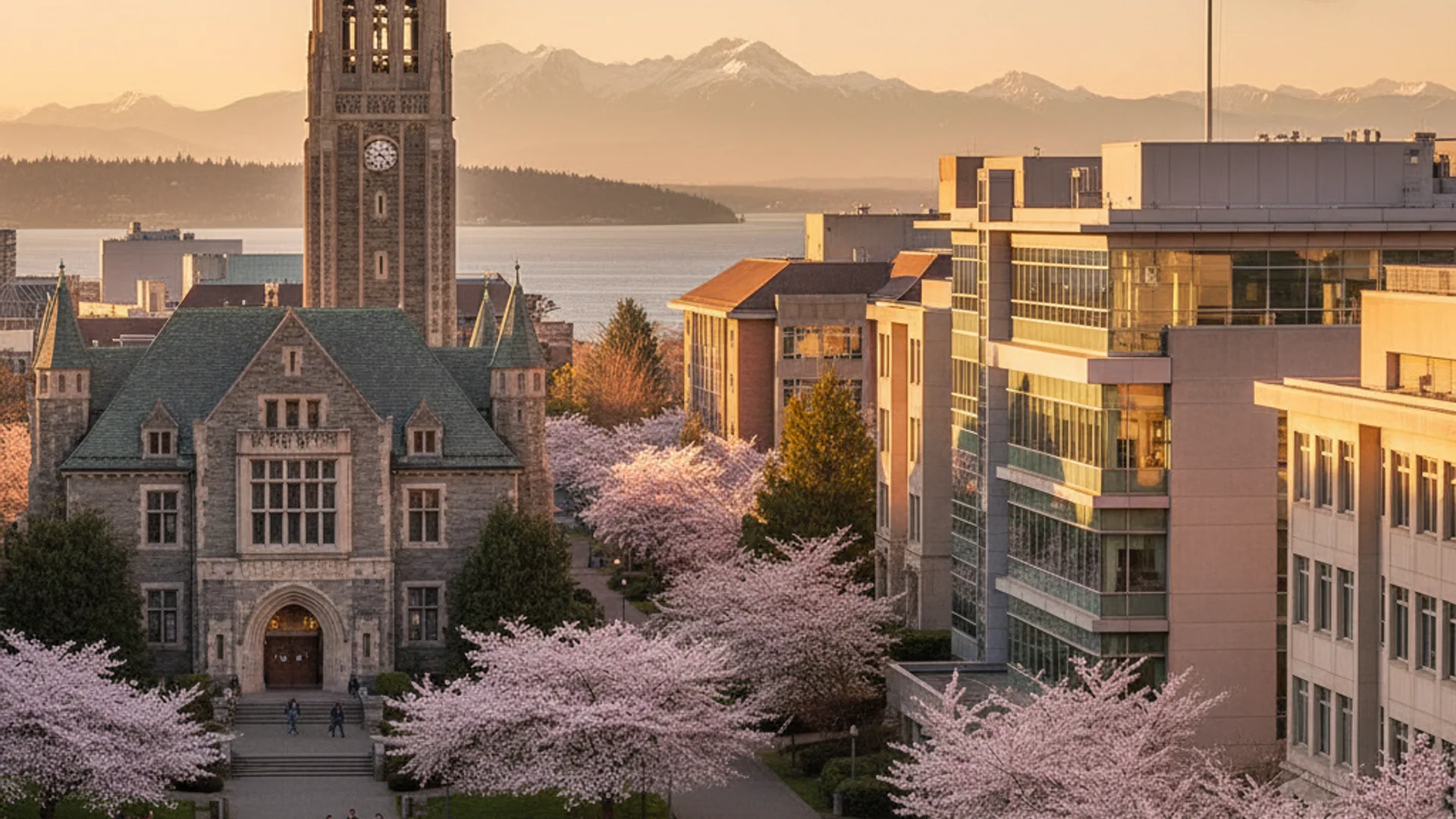
Compare the top computer engineering colleges in Washington. 39 accredited computer engineering schools ranked by graduation rate, career outcomes, and value, from Tacoma Community College to University of Washington-Seattle Campus.
Best computer engineering degree programs: U of Washington-Seattle, Seattle, U of Washington-Bothell
Ranked by graduation rates, program outcomes, and institutional quality
Tuition ranges from $3,195 to $59,340/year
Tacoma Community College offers the most affordable option at $4,477/yr
Computer Engineering degree programs available: 22 associate's, 8 master's, 2 doctoral in Washington
From community college pathways to advanced research degrees
9 online computer engineering degree programs in Washington
Flexible scheduling for working professionals
Washington community college transfer can save 40-60% on total degree costs
22 associate's programs provide transfer pathways to bachelor's degrees
Education Commission of the States
Major employers: Microsoft, Amazon, Boeing, Expedia
Tech hubs in Seattle and Bellevue
Hakia Research 2026
Computer Engineering degree programs near 43+ cities across Washington
Search by city to find programs within 200 miles of your location
Updated October 12, 2026
We rank 49 accredited computer engineering programs in Washington using IPEDS 2024 institutional data, BLS OEWS 2024 state salary data, and College Scorecard outcomes. A 4-factor weighted composite is normalized to a 0–100 score. Schools cannot pay for placement; rankings are produced algorithmically.
Are Computer Engineering Degree Programs in Washington Worth It?
Source: BLS OEWS May 2024
Compare the top-ranked Computer Engineering programs in Washington by degree level. Tuition, graduation rate, and Hakia Score for every accredited program.
Washington ranks among the nation's top destinations for computer engineering education, with 17 accredited bachelor's degree programs across 7 public and 9 private institutions. The highest-ranked programs are U of Washington-Seattle, Seattle, U of Washington-Bothell, recognized for academic excellence, research opportunities, and strong industry connections.
Graduates from Washington computer engineering programs earn a median salary of $123,446, 26% above the national average. The state's robust technology sector, anchored by the Seattle, Bellevue, Redmond metropolitan areas, provides abundant internship and employment opportunities with companies including Microsoft, Amazon, Boeing.
Tuition ranges from $4,074 to $59,340 annually, with an average of $29,336/yr. Top programs maintain graduation rates above 90%, with the highest reaching 100%. Many programs hold ABET accreditation, the gold standard for computing education, ensuring curriculum meets rigorous industry standards.
Students can choose from specializations including software engineering, cybersecurity, artificial intelligence, data science, and systems architecture. Strong industry partnerships provide access to co-op programs, capstone projects with real companies, and direct recruiting pipelines to Washington's leading technology employers. For students seeking computer engineering degrees in Washington, these top-ranked computer engineering schools offer the strongest combination of academic rigor and career preparation.
| Rank | School | Location | Type | Tuition | Grad Rate | Hakia Score |
|---|---|---|---|---|---|---|
| #6 | University of Washington-Tacoma Campus | Tacoma, WA | Public | $11,869 | 63% | 67.9 |
| #7 | University of Washington-Bothell Campus | Bothell, WA | Public | $11,869 | 65% | 67.2 |
| #8 | Walla Walla University | College Place, WA | Private nonprofit | $33,012 | 60% | 62.2 |
| Metric | Value |
|---|---|
| Average in-state tuition | $15,389/year |
| Average out-of-state tuition | $38,473/year |
| Community college tuition | $3,847/year |
| 4-year savings for residents | $92,336 |
| 2+2 transfer pathway savings | $23,084 |
Source: IPEDS 2024
The Washington College Grant makes engineering education accessible.
For 2025-26, families of four earning $78,500 or less may qualify for free tuition at public colleges. Partial awards extend to families earning up to $131,000 (WSAC Washington College Grant). Students are automatically considered when filing FAFSA or WASFA. In-state students can receive up to $11,887 per year in WA Grant funding, covering most or all tuition at public universities. The lifetime limit is 18 quarters (6 years) of eligibility, sufficient for most engineering degrees. The new WA Grant-Connect program automatically qualifies students receiving certain state public assistance.
Engineering-specific scholarships enhance funding:
Industry sponsorships support engineering students.
Boeing, Microsoft, and Amazon sponsor engineering scholarships for Washington students. Intel offers scholarships targeting semiconductor and computer engineering majors. Defense contractors provide scholarship programs for students pursuing security clearances. Graduate students can pursue research or teaching assistantships covering tuition plus stipends, particularly valuable in hardware-focused labs with industry research funding. Many employers offer tuition reimbursement for graduate certificates and master's degrees, employees can pursue MS in Computer Engineering while working. The combination of WA Grant, Pell Grant, and engineering scholarships can cover most or all costs for qualifying students. Washington's no state income tax further enhances ROI for graduates staying in-state.
Estimate your return on investment for a computer engineering degree
Leave blank to use average cost for selected program type
+1168%
Net gain divided by total investment. ROI above 200% is considered excellent for education investments.
$2,161,658
Your additional lifetime earnings with this degree vs. working without one, minus the total investment.
5 years
Years until your cumulative earnings exceed total investment. Shorter programs often break even faster due to lower opportunity cost.
$110,000
Your starting salary adjusted for local cost of living. This shows real purchasing power compared to a $100K national baseline.
Why does break-even change with program type? Your "total investment" includes both tuition AND opportunity cost (foregone earnings while in school). A 4-year full-time public university (in-state) means 4 years of not earning a salary ($140,000 in opportunity cost). Shorter full-time programs may have higher tuition but lower total investment because you return to the workforce sooner.
How we calculate your degree ROI using real salary data
Tuition plus opportunity cost (earnings you miss while in school)
Direct cost of the degree program
4 years × $35K/year foregone salary while studying full-time
Projected career earnings starting after graduation, with salary growth
What you'd earn working at $35K/year with 2% annual growth
Median salary for this role in your selected location (BLS 2024)
Your investment's compound annual growth rate (similar to stock market returns)
Data sources: BLS OEWS May 2024, IPEDS 2024. Calculations use median salaries, 3% discount rate, and assume salary growth declines from 6% to 2% over career. Individual results will vary. | Powered by Hakia.com
Median annual salary in Washington metro areas
| Category | Value |
|---|---|
| Seattle | $160K |
| Bellevue | $152K |
| Redmond | $145K |
Source: BLS OEWS May 2024
Hakia.com
Find computer engineering jobs in Washington. These major employers across Washington metro areas are actively hiring computer engineering degree holders. Click employer names to view current job openings.
Seattle is home to Amazon and Microsoft headquarters, plus major engineering offices for Google, Meta, and other tech giants.
Nearby cities: Bellevue, Redmond, Kirkland, Tacoma, Renton
The Eastside corridor houses Microsoft's main campus in Redmond, Nintendo of America, and T-Mobile's headquarters.
Nearby cities: Redmond, Kirkland, Issaquah, Sammamish
Washington's tech economy is essentially defined by Microsoft and Amazon. The Seattle metro hosts the headquarters of both, plus major engineering offices for Google, Meta, Apple, and a dense second-tier of cloud, AI, and enterprise tech employers. With no state income tax and University of Washington's CS program at the top of the western US, Washington consistently posts the highest tech-job concentration per capita of any US state.
Seattle metropolitan area
Headquarters of Microsoft (Redmond) and Amazon (Seattle); major engineering offices for Google, Meta, Apple, Tableau, Tableau, Expedia, Zillow, Costco IT. UW is the dominant CS feeder; total-comp at named employers regularly clears $200K for new bachelor's grads.
Spokane metro
Smaller tech market focused on healthcare-IT (Providence), defense (Fairchild AFB-adjacent), and growing remote-work tech employment. Whitworth and WSU-Spokane feed the local market.
No state income tax. Washington levies a Business and Occupation tax on gross receipts that tech employers factor into compensation structures.
Washington has emerged as one of the more active state legislatures on AI, biometric privacy, and consumer health data. The 2024 My Health My Data Act in particular is among the strictest US consumer health-data laws and shapes engineering practice at any company touching health-adjacent data.
Effective March 2024. Imposes strict requirements on collection, use, and sharing of consumer health data — broadly defined to include data inferring health status. Provides a private right of action.
Engineers at any company processing wellness, fitness, mental-health, or biometric data of WA users must implement consent, geofencing, and data-sharing restrictions. The law's broad scope of 'health data' makes it relevant for surprising amounts of consumer-tech work.
Read moreRequires notice and consent before enrolling biometric identifiers in a database for commercial purposes.
Similar in shape to Illinois BIPA though narrower; engineers building biometric features for WA users must implement consent flows.
Read moreWashington has passed and continues to develop AI-specific legislation around government use, deepfake elections content, and consumer disclosure.
AI/ML engineers building products serving WA users should monitor evolving disclosure and bias-audit requirements.
Read moreWashington does not currently administer a separate Software Engineering PE license. Standard engineering disciplines require ABET-EAC accreditation for PE eligibility; software engineering is not a Washington-recognized PE discipline.
Washington licensing boardUp to $11,840/yr at public 4-year, up to $4,180/yr at community college
WA residents with family income up to ~70% of state median income (~$70,000)
Covers tuition and fees at participating WA institutions
WA students who sign up in 7th-8th grade with family income at or below 65% state median income; must maintain 2.0+ GPA and stay crime-free
N/A — application channel
WA students ineligible for federal FAFSA (e.g., undocumented) — opens access to state aid programs
Up to $22,500 total (across 5 years)
WA students pursuing STEM or healthcare bachelor's at participating WA institutions with family income at or below 125% state median
Washington's transfer system supports engineering degree completion.
The Direct Transfer Agreement (DTA) ensures students completing designated associate degrees (90 quarter credits or 60 semester credits) at community colleges fulfill lower-division general education requirements at receiving universities (WSAC Transfers). The Engineering DTA/MRP specifically prepares students for computer engineering transfer with courses in calculus (through differential equations), physics (mechanics, E&M), chemistry, and introductory programming. Students completing engineering-focused associate degrees receive junior standing at public universities with full prerequisite credit transfer.
Strategic course selection maximizes transfer success.
Computer engineering transfer students should complete: calculus through differential equations, linear algebra, physics (two-semester sequence including electromagnetism), chemistry, introductory programming (preferably C/C++), and digital logic if available. Community colleges like Bellevue College, Green River College, and Clark College offer engineering transfer pathways with articulation agreements to UW and WSU. Maintain 3.5+ GPA for competitive programs like UW; 3.0+ suffices for WSU. Engineering transfer is particularly viable because prerequisites are well-defined, unlike some majors where course matching is ambiguous.
Community college pathways save significantly on costs.
Washington community colleges charge $3,742-$4,990/year for in-state residents, less than university tuition. Students completing two years at community college save $20,000-$40,000 on total bachelor's degree costs. The Running Start program allows high school juniors and seniors to attend community college tuition-free, potentially completing calculus and physics sequences before graduation. For computer engineering specifically, completing calculus and physics at community college is particularly valuable, these challenging courses are often gatekeepers at four-year programs. Transfer students entering UW or WSU as juniors complete upper-division engineering coursework in 2-2.5 years. Explore affordable CE programs or best value rankings.
Washington Take-Home Pay Advantage
Source: Washington Department of Revenue
Washington's computer engineering job market spans hardware, embedded systems, and aerospace.
There are currently 4,126 computer engineer positions open statewide, with roles available in Seattle, Redmond, Bellevue, Everett, Spokane, and Bothell (Glassdoor Washington CE Jobs). Indeed lists over 3,100 computer engineer jobs in Washington. The Bureau of Labor Statistics reports Seattle-area tech workers earn an average hourly wage of $43.16, 33% higher than the national average (BLS OEWS Seattle Metro May 2024). Computer engineering salaries in Seattle range from $126,000-$225,000 depending on experience, with hardware architects and FPGA specialists commanding premium compensation.
Major employers drive sustained computer engineering demand:
Semiconductor and hardware specializations in high demand.
Washington's semiconductor sector includes WaferTech (TSMC subsidiary in Camas), SK hynix and Samsung in Bellevue, Impinj (Seattle), and numerous fabless design companies. The state offers tax incentives for semiconductor manufacturing, attracting continued investment. Hardware-focused roles seek candidates with FPGA expertise, EDA design skills, and firmware development experience. Embedded systems positions require knowledge of real-time operating systems, ARM architectures, and hardware/software co-design. Defense contractors (Boeing, Blue Origin) require security clearances for some positions but offer exceptional stability. Remote work is less common in hardware engineering due to lab requirements, though design roles increasingly support hybrid arrangements. For related career paths, explore electrical engineering programs or software engineering.
New graduates and career changers
Technical leads and architects
9 available in Washington
Traditional classroom experience
Institutional characteristics, completions, graduation rates
Washington salary and employment data
Program details and admissions information
Last Updated: June 26, 2026. Rankings based on IPEDS 2024 data. Salary data from BLS OEWS May 2024.

Co-founder & Editor (B.S. Computer Science, Oregon State • B.A. Psychology, University of Washington)
Taylor combines technical expertise in computer science with a deep understanding of human behavior and learning. His dual background drives Hakia's mission: leveraging technology to build authoritative educational resources that help people make better decisions about their academic and career paths.
Hand-researched detail on the top-ranked programs: degree pathways, research labs, industry partners, career outcomes, and admissions. Tap any school to expand.
Why it stands out. UW's Allen School is a top-tier research institution offering unmatched access to faculty research, direct pipelines to major tech companies, and one of the nation's strongest computer engineering graduate programs.
Hakia insight. UW's Allen School houses both Luis Ceze's DNA storage research and Zachary Tatlock's formal verification work, meaning undergraduates can contribute to publications that reshape how the field thinks about hardware and programming languages—research exposure that translates to internships and career positioning unavailable at peer institutions.
At the bachelor's level, UW's Paul G. Allen School of Computer Science & Engineering is one of the nation's premier computer engineering and computer science institutions, consistently ranked in the top 10 for research output and graduate outcomes. The program offers students access to world-class faculty conducting cutting-edge research in areas spanning computer architecture, VLSI design, robotics, computer vision, and hardware-software co-design. Students benefit from proximity to major tech companies headquartered or heavily present in Seattle—Microsoft, Amazon, Google, and others maintain recruiting relationships and often hire directly from senior capstones and research projects. The curriculum supports deep specialization through electives in areas like computer architecture, embedded systems, and hardware design, while maintaining flexibility for students interested in the software side of the engineering spectrum. UW's extensive research labs provide undergraduate and graduate students with opportunities to contribute to published research early in their studies. Career outcomes reflect the program's prestige: graduates secure positions at leading tech companies, aerospace firms, and startups, with strong median salaries and high placement rates. The Allen School also maintains a strong Ph.D. pipeline for students pursuing academic or advanced industry research roles.
Programs offered
Research labs & institutes
Industry partners
Career outcomes
Top employers: Microsoft, Amazon, Google, Apple, Boeing, Meta, Intel
Notable faculty
Accreditation & certifications
Location advantage: Seattle tech hub—headquarters/major offices for Microsoft, Amazon, Google Aerospace industry presence (Boeing, Blue Origin) Strong startup ecosystem and venture capital activity
Why it stands out. The Computer Engineering program uniquely integrates Gonzaga's Catholic and Jesuit educational tradition with rigorous technical training, emphasizing ethical responsibility, social justice, and service to others alongside comprehensive engineering education.
Hakia insight. Gonzaga's Jesuit framework produces something measurable: Dr. Crandall's augmented reality and computer vision lab attracts students motivated by technology's social impact, a filter that correlates with higher retention in hardware design roles (where patience matters) versus the churn-prone startup culture.
At the bachelor's level, gonzaga University's Computer Engineering program is designed to develop knowledgeable and competent engineering professionals within the university's humanistic, Catholic, and Jesuit educational tradition. The program emphasizes social justice, service, lifelong learning, and ethical responsibility. Students complete approximately half their credits in engineering topics and design work, with four technical electives allowing specialization in electrical engineering and/or computer engineering areas. The curriculum integrates rigorous technical training with liberal arts education through Gonzaga's core curriculum. Students work on hands-on projects including embedded systems, digital logic, circuit analysis, and network interfacing. The program culminates in a comprehensive senior design project involving both technical and non-technical aspects, supervised by faculty and resulting in written reports and oral presentations. Graduates are well-prepared for careers in electronic product design, computer hardware/software development, robotics, artificial intelligence, and interdisciplinary fields like aerospace, biomedical engineering, and industrial automation.
Programs offered
Research labs & institutes
Notable faculty
Admissions
GPA 2.7.
Location advantage: Engineering & Computer Science Living Learning Community in Coughlin Hall STEM Complex on campus Access to Cadwell Maker Center
Why it stands out. Seattle University's computer engineering program uniquely integrates ethical and social responsibility frameworks into technical curriculum, appealing to engineers motivated by purposeful technology development.
Hakia insight. Seattle University's integration of ethical frameworks into technical curriculum addresses a market gap: while competitors optimize for raw technical output, SU produces engineers who can articulate the social responsibility dimensions employers increasingly screen for, particularly in healthcare tech and nonprofit sectors.
At the bachelor's level, seattle University's computer engineering program is built on the principle that strong fundamentals in both hardware and software engineering should precede specialization, resulting in a rigorous core curriculum that covers digital systems, signal processing, embedded systems, and computer architecture before students pursue concentration areas. The program benefits significantly from its urban Seattle location—students tap into internships and research partnerships with major tech employers, aerospace companies, and growing startups throughout the region without traveling far. Faculty actively engage in industry-relevant research and bring real project experience into the classroom; the program has developed a reputation for producing graduates who are immediately productive in engineering roles, not just technically competent but also equipped with the communication and systems-thinking skills that differentiate top performers. The curriculum also integrates a data-focused track for those interested in signal processing, data acquisition, and real-time systems—increasingly valuable in IoT, robotics, and autonomous systems industries. Jesuit educational philosophy shapes the program's commitment to ethical decision-making in technology development, reflected in required coursework on technology's societal implications. Cooperative education and internship opportunities are deeply embedded in the program structure, with many students gaining 6–12 months of paid industry experience before graduation.
Programs offered
Industry partners
Career outcomes
Top employers: Amazon, Microsoft, Boeing, healthcare systems
Accreditation & certifications
Location advantage: Located in Seattle's innovation district Connections to healthcare tech and biotech sectors Access to socially-focused startups and nonprofit tech initiatives
Why it stands out. WSU's computer engineering program distinctively emphasizes power electronics, energy systems, and sustainable technology—strengths that align with Pacific Northwest industries and emerging clean tech sectors.
Hakia insight. While every Pacific Northwest program claims aerospace connections, WSU uniquely owns the power electronics angle through its Energy Systems and Power Electronics Lab and Puget Sound Energy partnerships—a specialization that commands premium salaries in grid modernization and EV infrastructure, sectors expanding faster than general computer engineering roles.
At the bachelor's level, WSU's computer engineering program, housed in its strong School of Electrical Engineering and Computer Science, balances rigorous theory with practical applications through extensive laboratory work and industry collaboration. The program uniquely emphasizes power electronics and energy systems alongside traditional computer architecture and embedded design, reflecting the Pacific Northwest's focus on sustainable technology and grid modernization. Students benefit from well-funded research centers and the opportunity to engage in projects spanning autonomous vehicles, renewable energy systems, and advanced robotics. The university's land-grant mission drives partnerships with major aerospace, agriculture, and energy companies, creating internship and career pathways in industries beyond traditional tech. Faculty are active researchers who involve undergraduates in meaningful projects, preparing graduates for both industry roles and advanced study.
Programs offered
Research labs & institutes
Industry partners
Career outcomes
Top employers: Boeing, Intel, Amazon, Microsoft, Puget Sound Energy
Accreditation & certifications
Location advantage: Strong partnerships with Boeing and aerospace sector Access to renewable energy and power grid companies Research collaborations with Pacific Northwest National Laboratory
Why it stands out. UW Tacoma's Computer Engineering program is ranked in the top 30 'Most Affordable Computer Engineering Programs' and emphasizes hands-on student projects that address real-world problems in safety, health, efficiency and security.
Hakia insight. UW Tacoma's top-30 affordability ranking disguises a more important advantage: Yan Bai's blockchain and IoT expertise combined with the Center for Data Science creates a rare undergraduate pipeline into emerging fields that most schools reserve for graduate students, compressed into a degree that costs significantly less.
At the bachelor's level, the University of Washington-Tacoma's Computer Engineering program is an interdisciplinary field that merges computer science and electrical engineering to design, develop, and maintain computer systems and networks. The program covers both hardware and software components, focusing on their integration and interface design for applications in telecommunications, robotics, aerospace, and embedded systems. Students design everything from microprocessors and circuits to software applications and operating systems, with a key focus on embedded systems. The program is ranked in the top 30 'Most Affordable Computer Engineering Programs' based on tuition, retention rate, graduation rate, and program quality. Students collaborate on innovative solutions to real-world problems addressing safety, health, efficiency and security, preparing graduates for careers at major companies like Intel, HP, Microsoft, and Amazon.
Programs offered
Research labs & institutes
Industry partners
Career outcomes
Top employers: Intel, HP, Microsoft, Amazon
Notable faculty
Admissions
GPA 3.0. Deadline July 1 priority deadline.
Location advantage: Access to major tech companies in the Pacific Northwest Close relationships with local high-tech industry partners
Why it stands out. UW Bothell's computer engineering program uniquely combines UW's engineering reputation with practical, industry-aligned project work and direct access to Seattle-area tech employers.
Hakia insight. UW Bothell inherits the Allen School's reputation while eliminating the acceptance-rate gatekeeping—students earn a UW degree with access to Amazon and Microsoft partnerships, but without competing against Seattle campus applicants with median SAT scores 100+ points higher.
At the bachelor's level, UW Bothell's computer engineering program leverages its proximity to the Pacific Northwest's thriving tech ecosystem while maintaining the rigor of the University of Washington's engineering standards. The program emphasizes hands-on design and embedded systems work, with students tackling real-world problems through capstone projects that often partner with local tech companies. The curriculum balances digital logic, microprocessor design, and signal processing with emerging areas like IoT and autonomous systems. Faculty maintain active research in hardware-software co-design and networked systems, creating opportunities for undergraduates to contribute to meaningful projects. As part of the UW system, students benefit from connections to the Allen School's broader computer science research community while maintaining a more intimate, project-focused learning environment at the Bothell campus.
Programs offered
Research labs & institutes
Industry partners
Career outcomes
Top employers: Amazon, Microsoft, Intel, Boeing
Accreditation & certifications
Location advantage: Proximity to Seattle tech hub (Amazon, Microsoft headquarters) Access to Puget Sound aerospace and defense industry Connection to UW's broader research network