🥇
$6,056
Tuition/yr
85%
Grad rate
74.8
Hakia Score
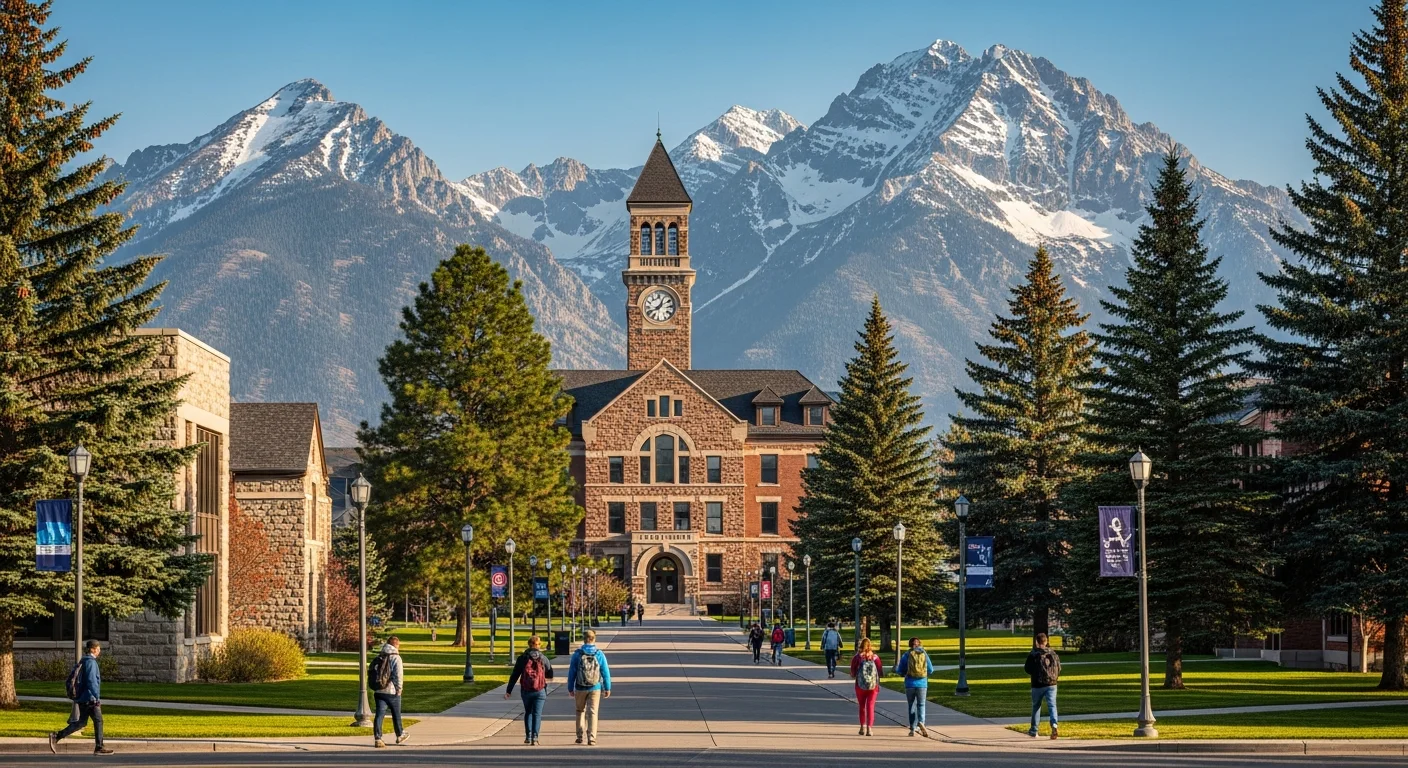
Compare the top artificial intelligence colleges in Montana. 6 accredited artificial intelligence schools ranked by graduation rate, career outcomes, and value, from Montana State University to Montana State University.
Best artificial intelligence degree programs: Montana State, U of Montana, U of Providence
Ranked by graduation rates, program outcomes, and institutional quality
Tuition ranges from $5,736 to $39,152/year
Montana State offers the most affordable option at $6,056/yr
Artificial Intelligence degree programs available: 2 master's, 1 doctoral in Montana
From community college pathways to advanced research degrees
Major employers: Oracle, Workiva, Zoot Enterprises, onXmaps
Tech hubs in Bozeman and Missoula
Hakia Research 2026
Artificial Intelligence degree programs near 17+ cities across Montana
Search by city to find programs within 200 miles of your location
Updated June 28, 2026
We rank 9 accredited artificial intelligence programs in Montana using IPEDS 2024 institutional data, BLS OEWS 2024 state salary data, and College Scorecard outcomes. A 4-factor weighted composite is normalized to a 0–100 score. Schools cannot pay for placement; rankings are produced algorithmically.
Are Artificial Intelligence Degree Programs in Montana Worth It?
Source: BLS OEWS May 2024
Compare the top-ranked Artificial Intelligence programs in Montana by degree level. Tuition, graduation rate, and Hakia Score for every accredited program.
Montana ranks among the nation's top destinations for artificial intelligence education, with 6 accredited bachelor's degree programs across 3 public and 3 private institutions. The highest-ranked programs are Montana State, U of Montana, U of Providence, recognized for academic excellence, research opportunities, and strong industry connections.
Graduates from Montana artificial intelligence programs earn a median salary of $76,390, 22% below the national average. The state's robust technology sector, anchored by the Bozeman, Missoula, Billings metropolitan areas, provides abundant internship and employment opportunities with companies including Oracle, Workiva, Zoot Enterprises.
Tuition ranges from $5,736 to $39,152 annually, with an average of $19,660/yr. Top programs maintain graduation rates above 88%, with the highest reaching 100%. Many programs hold ABET accreditation, the gold standard for computing education, ensuring curriculum meets rigorous industry standards.
Students can choose from specializations including software engineering, cybersecurity, artificial intelligence, data science, and systems architecture. Strong industry partnerships provide access to co-op programs, capstone projects with real companies, and direct recruiting pipelines to Montana's leading technology employers. For students seeking artificial intelligence degrees in Montana, these top-ranked artificial intelligence schools offer the strongest combination of academic rigor and career preparation.
| Rank | School | Location | Type | Tuition | Grad Rate | Hakia Score |
|---|---|---|---|---|---|---|
| #6 | Rocky Mountain College | Billings, MT | Private | $32,282 | — | 36.2 |
Montana offers 2 master's degree programs in artificial intelligence, designed for professionals seeking to advance into senior engineering, technical leadership, and specialized roles. The top programs, Montana State, U of Montana, combine advanced technical training with research opportunities and leadership development.
Master's graduates in Montana earn a median salary of $89,870, approximately 20-30% higher than bachelor's degree holders. The concentration of technology companies in Bozeman, Missoula, Billings creates strong demand for graduate-level talent, with Oracle, Workiva, Zoot Enterprises actively recruiting from these programs.
Program formats include traditional full-time study (typically 2 years), part-time options for working professionals (2-3 years), and accelerated tracks. Tuition averages $5,896/yr, with many employers offering tuition reimbursement for graduate education. Some programs offer thesis and non-thesis tracks, allowing students to focus on research or professional development based on their career goals.
Curriculum covers advanced topics including machine learning, distributed systems, software architecture, and technical management. Many programs include practicum experiences, industry capstone projects, or consulting engagements that provide real-world application of advanced concepts. Among Montana's artificial intelligence schools at the graduate level, these programs stand out for both academic quality and career outcomes.
Montana is home to 1 doctoral programs in artificial intelligence, preparing students for research positions, faculty appointments, and executive technical roles. Leading programs at Montana State are recognized for cutting-edge research, strong faculty publications, and competitive funding packages.
Doctoral graduates command premium salaries, with Montana PhD holders earning a median of $112,338, reflecting the advanced expertise required for research and executive positions. The Bozeman, Missoula, Billings region's research universities and corporate R&D centers provide extensive collaboration opportunities with industry leaders like Oracle, Workiva, Zoot Enterprises.
PhD programs typically require 4-6 years of full-time study, including coursework, qualifying examinations, and original dissertation research. Many programs offer full funding through teaching or research assistantships, covering tuition and providing stipends of $25,000–$40,000 annually.
Research strengths across Montana programs include artificial intelligence, cybersecurity, human-computer interaction, systems, and theoretical computer science. For aspiring researchers pursuing artificial intelligence degrees in Montana, graduates go on to careers as university faculty, industry research scientists, or technical executives, contributing to advances in technology that impact millions of users worldwide.
| Metric | Value |
|---|---|
| Average in-state tuition | $19,660/year |
| Average out-of-state tuition | $49,150/year |
| Community college tuition | $4,915/year |
| 4-year savings for residents | $117,960 |
| 2+2 transfer pathway savings | $29,490 |
Source: IPEDS 2024
Montana students pursuing Artificial Intelligence degrees have access to multiple funding sources to make their education more affordable. The primary federal resource is the Free Application for Federal Student Aid (FAFSA), available through Federal Student Aid, which determines eligibility for grants, loans, and work-study opportunities. Montana residents should complete the FAFSA to unlock federal Pell Grants and Direct Loans, which don't require repayment and interest-based repayment, respectively. Additionally, Montana's higher education system administers merit-based support through the Montana University System Honor Scholarship, which provides tuition waivers for qualifying Montana high school graduates attending public institutions within the state system.
Individual institutions across Montana offer institutional scholarships and financial aid packages tailored to AI program students. Montana State University and The University of Montana, the state's largest AI programs with 115 and 23 completions respectively, offer need-based and merit-based aid directly through their financial aid offices. Private institutions like Carroll College and University of Providence also provide substantial institutional scholarships. Students should contact each school's financial aid office to explore program-specific scholarships, graduate assistantships, and employer partnerships. For comprehensive guidance on federal aid options, visit Federal Student Aid and cross-reference school-specific offerings through the Montana University System website.
Use our interactive ROI calculator to estimate your return on investment for a artificial intelligence degree in Montana. Enter your expected tuition costs, financial aid, and career goals to see projected payback periods and lifetime earnings. The calculator uses current salary data from BLS and tuition data from IPEDS to provide accurate estimates.
Estimate your return on investment for a artificial intelligence degree
Leave blank to use average cost for selected program type
+1064%
Net gain divided by total investment. ROI above 200% is considered excellent for education investments.
$1,967,896
Your additional lifetime earnings with this degree vs. working without one, minus the total investment.
5 years
Years until your cumulative earnings exceed total investment. Shorter programs often break even faster due to lower opportunity cost.
$147,619
Your starting salary adjusted for local cost of living. This shows real purchasing power compared to a $100K national baseline.
Why does break-even change with program type? Your "total investment" includes both tuition AND opportunity cost (foregone earnings while in school). A 4-year full-time public university (in-state) means 4 years of not earning a salary ($140,000 in opportunity cost). Shorter full-time programs may have higher tuition but lower total investment because you return to the workforce sooner.
How we calculate your degree ROI using real salary data
Tuition plus opportunity cost (earnings you miss while in school)
Direct cost of the degree program
4 years × $35K/year foregone salary while studying full-time
Projected career earnings starting after graduation, with salary growth
What you'd earn working at $35K/year with 2% annual growth
Median salary for this role in your selected location (BLS 2024)
Your investment's compound annual growth rate (similar to stock market returns)
Data sources: BLS OEWS May 2024, IPEDS 2024. Calculations use median salaries, 3% discount rate, and assume salary growth declines from 6% to 2% over career. Individual results will vary. | Powered by Hakia.com
Median annual salary in Montana metro areas
| Category | Value |
|---|---|
| Bozeman | $99K |
| Missoula | $94K |
| Billings | $90K |
Source: BLS OEWS May 2024
Hakia.com
Find artificial intelligence jobs in Montana. These major employers across Montana metro areas are actively hiring artificial intelligence degree holders. Click employer names to view current job openings.
Montana provides strong transfer pathways for students pursuing artificial intelligence degrees, supported by the state's coordinated higher education system. The Montana Common Course Numbering system ensures consistent course numbering and transferability across public universities and community colleges, allowing students to move seamlessly between institutions. Montana's 10 two-year institutions offer foundational coursework in mathematics, computer science, and related disciplines that articulate directly with bachelor's degree programs at 14 four-year institutions in the state. This structured pathway enables community college students to complete associate degrees and then transfer to comprehensive universities like Montana State University or The University of Montana to complete AI bachelor's degrees.
Articulation agreements between Montana's two-year and four-year institutions help smooth transitions and minimize the loss of credits during transfer. Students can begin their AI education at more affordable community colleges, such as Aaniiih Nakoda College with tuition as low as $3,080, and then transfer to bachelor's degree programs at institutions like Montana State University ($6,056 tuition) or The University of Montana ($5,736 tuition). This pathway maximizes financial aid opportunities and allows students to benefit from the Montana University System Honor Scholarship at the university level. The Montana Common Course Numbering system guarantees that general education and prerequisite courses transfer without duplication. For students interested in related fields, explore data analytics programs in Montana and computer science programs in Montana, which share common transfer pathways and foundational coursework within the Montana system.
Montana offers a growing landscape for artificial intelligence education with 9 institutions offering AI programs across associate, bachelor, master, and doctoral degree levels (IPEDS). In 2023, Montana institutions awarded 136 bachelor's degrees, 11 master's degrees, and 5 doctoral degrees in artificial intelligence, demonstrating strong institutional commitment to this emerging field. Montana State University leads the state with 115 completions, making it a powerhouse for AI education, while The University of Montana contributed 23 completions to the state's pipeline of AI professionals.
Studying AI in Montana provides exceptional affordability compared to national averages. The average public in-state tuition at Montana four-year institutions is just $4,747, while out-of-state students pay $16,688, making Montana a cost-effective destination for AI education (Montana University System). Beyond tuition savings, Montana high school graduates may qualify for merit-based tuition waivers through the Montana University System Honor Scholarship. The state's major metropolitan areas. Billings, Missoula, and Great Falls, host thriving tech communities and major employers including Billings Clinic, Providence Health, and the universities themselves, creating internship and career opportunities for AI graduates. For more context on national opportunities, explore best artificial intelligence bachelor's programs nationwide and most affordable AI programs across the United States.
Artificial Intelligence Program Availability in Montana
Source: IPEDS 2024
Montana's artificial intelligence job market is experiencing steady growth across multiple sectors, with opportunities concentrated in the state's major metropolitan areas. According to the Bureau of Labor Statistics, the technology and healthcare sectors are driving demand for AI professionals in cities like Billings, Missoula, and Great Falls. The state's AI workforce is supported by 9 institutions offering AI programs at various degree levels, producing 136 bachelor's degree completions annually. This educational pipeline ensures a consistent supply of talent to meet regional employer needs across Eastern Montana, Western Montana, and Central Montana regions.
Career prospects for AI graduates in Montana are strongest in healthcare and higher education sectors. Major employers actively recruiting AI talent include Billings Clinic, Providence Health, Montana State University, and University of Montana. The average public in-state tuition across Montana's four-year institutions is $4,747, making it cost-effective for students to gain local expertise and remain in the state's job market. For detailed labor market insights, the College Scorecard provides comprehensive data on AI program outcomes and employment trends. Students interested in related fields should explore Machine Learning in Montana and Data Science in Montana for complementary career pathways that enhance AI job prospects.
New graduates and career changers
Technical leads and architects
0 available in Montana
Traditional classroom experience
Institutional characteristics, completions, graduation rates
Montana salary and employment data
Program details and admissions information
Last Updated: June 26, 2026. Rankings based on IPEDS 2024 data. Salary data from BLS OEWS May 2024.

Co-founder & Editor (B.S. Computer Science, Oregon State • B.A. Psychology, University of Washington)
Taylor combines technical expertise in computer science with a deep understanding of human behavior and learning. His dual background drives Hakia's mission: leveraging technology to build authoritative educational resources that help people make better decisions about their academic and career paths.
Hand-researched detail on the top-ranked programs: degree pathways, research labs, industry partners, career outcomes, and admissions. Tap any school to expand.
Why it stands out. MSU's AI program is distinguished by deep research expertise in robotics and computer vision with direct industry pipelines, allowing undergraduates rare access to funded research and equipment-intensive projects.
Hakia insight. Montana State's robotics and computer vision labs aren't just research venues—they're job pipelines: John Deere's engineering teams actively recruit from MSU's vision lab, meaning undergraduates can move from coursework to industry problems in equipment-intensive domains competitors can't replicate.
At the bachelor's level, montana State University's artificial intelligence and machine learning programs are anchored by faculty research in robotics, computer vision, and large-scale data systems—areas where MSU has developed national recognition and sustained funding. The curriculum reflects these research strengths: undergraduates and graduate students engage with cutting-edge projects in autonomous robotics, agricultural automation, and environmental monitoring that directly feed into classroom instruction. MSU's College of Engineering maintains partnerships with aerospace, automotive, and agricultural technology companies, creating internship pipelines and job placement pathways that reward AI-trained students with competitive offers. The graduate program offers thesis and non-thesis tracks, accommodating both research-track and industry-track students. MSU's location in Bozeman and its R1 research classification mean that AI students have access to significant lab resources and equipment—particularly valuable for robotics and vision work requiring specialized hardware. Faculty actively involve undergraduates in funded research, differentiating MSU from peer institutions where research remains primarily graduate-focused. Career outcomes typically reflect the program's applied engineering orientation: graduates move into roles at tech companies, automotive suppliers, and aerospace firms. For students seeking an AI education embedded in an active research ecosystem with strong industry connections, MSU provides one of the most developed pathways in the region.
Programs offered
Research labs & institutes
Industry partners
Career outcomes
Top employers: John Deere, Boeing, Regional tech companies
Accreditation & certifications
Location advantage: Bozeman tech ecosystem with growing startup activity Proximity to aerospace and agricultural technology companies Access to research funding and industry partnerships through R1 classification
Why it stands out. Mandatory internship opportunities at local and international tech firms. Undergraduate research experiences with faculty
Hakia insight. University of Montana's mandatory internship requirement and partnerships with Google, Microsoft, and Meta create an unusual guarantee: students aren't competing for internships; the program coordinates them, reducing career risk and increasing conversion to full-time offers.
The University of Montana's Bachelor of Science in Computer Science offers four distinct concentrations: algorithm design, data science, mathematical sciences, and software engineering. Each program requires 86-97 credit hours with 33 core computer science credits shared across all concentrations. The curriculum emphasizes hands-on learning with mandatory internship and undergraduate research opportunities. Students participate in faculty-led research funded by NSF, NIH, and Department of Energy grants, with access to research-oriented computer clusters. The program boasts strong industry connections through faculty with tech industry backgrounds and mentors who facilitate internship placements at local and international tech firms. Career outcomes are exceptional with 89% of graduates working in field-related positions. Data science graduates earn an estimated average starting salary of $89,000, while the program reports strong placement rates in high-demand tech roles at companies like Google, Microsoft, and Meta.
Programs offered
Research labs & institutes
Industry partners
Career outcomes
Top employers: Google, Microsoft, Meta
Notable faculty
Accreditation & certifications
Location advantage: Research partnerships with environmental and conservation organizations Connections to public health and social science institutions across Montana
Why it stands out. University of Providence uniquely anchors AI education in ethical inquiry and human-centered design philosophy, preparing graduates for careers emphasizing responsible technology use in regional and community contexts.
Hakia insight. University of Providence's Benedictine foundation translates to competitive advantage in the growing field of AI ethics and responsible technology consulting—sectors where clients actively seek graduates with formal training in ethical frameworks, not just technical chops.
At the bachelor's level, the University of Providence, rooted in a Benedictine Catholic educational tradition, integrates artificial intelligence study within a broader mission of ethical inquiry and human-centered technology development. The computer science program emphasizes foundational computer science principles before specialization, ensuring students understand the theoretical underpinnings of AI systems. Providence's location in Great Falls and its institutional focus on serving Montana students create a distinctive demographic: many graduates remain in Montana or the Northern Rockies, building tech careers in their home regions rather than migrating to coastal tech hubs. The program encourages students to think critically about AI's societal implications through coursework that pairs technical study with philosophy and ethics. Capstone projects often reflect this integration—students have built AI systems for healthcare applications, small business optimization, and community benefit rather than purely commercial projects. For students seeking AI education grounded in ethical reasoning and practical community application, rather than elite research credentials or maximum specialization options, University of Providence offers an alternative pathway. Graduates typically move into roles at regional companies, healthcare IT firms, or government agencies. The program's strength lies in producing conscientious, well-prepared AI practitioners ready for immediate workforce contribution in Montana communities.
Programs offered
Location advantage: Great Falls regional tech and healthcare sectors Strong community connections supporting local AI applications
Why it stands out. Mandatory internships during upper-level years. Hands-on learning environment with state-of-the-art labs
Hakia insight. Montana Tech's ABET accreditation paired with mandatory internships and partnerships with Google and Micron Technologies creates a credential that signals quality assurance in a crowded market, while internship integration reduces time-to-employment compared to peers.
Montana Tech's Bachelor of Science in Computer Science is an ABET-accredited program emphasizing hands-on learning and practical experience in designing, building, testing, and maintaining software systems. Students benefit from a small student-to-faculty ratio, engaged faculty with deep industry experience, and mandatory internships during upper-level years. The curriculum covers foundational courses in programming, discrete structures, data structures, and algorithm analysis, with upper-division specialization options including software engineering, computer architecture, operating systems, artificial intelligence, networking, and web science. Montana Tech reports a strong career placement rate sustained for 15 consecutive years. Graduates have interned at top companies including Google, Dish Networks, Micron Technologies, and the City of Butte. The program includes a mathematics minor requirement and access to state-of-the-art labs and the Research Office. Career Services provides comprehensive support for securing internships and post-graduation employment. Graduates pursue roles as computer programmers, database administrators, computer systems analysts, and advanced degree programs.
Programs offered
Research labs & institutes
Industry partners
Career outcomes
Top employers: Google
Notable faculty
Accreditation & certifications
Location advantage: Proximity to mining and energy companies across Montana and the Northern Rockies Regional partnerships with resource extraction industries seeking automation solutions
Why it stands out. A liberal arts-embedded AI curriculum that balances technical depth with ethical reasoning and applied capstone projects, delivered through close faculty-student mentorship in an intimate college setting.
Hakia insight. Carroll College's intimate mentorship model at a liberal arts institution produces a measurable edge in capstone project outcomes: smaller cohorts mean faculty can shepherd students toward publishable or commercially viable AI work, creating portfolio pieces that standalone coursework rarely generates.
At the bachelor's level, carroll College's artificial intelligence coursework integrates machine learning fundamentals with practical applications across computer vision, natural language processing, and predictive analytics. The program emphasizes a liberal arts foundation combined with rigorous technical training, allowing students to understand both the engineering and ethical dimensions of AI systems. Upper-level courses provide hands-on experience with neural networks, reinforcement learning, and deep learning frameworks, with capstone projects requiring students to deploy real-world solutions. Faculty mentorship is particularly strong in this program, with computer science professors actively engaging undergraduates in research and directing independent studies tailored to individual career interests. Carroll's location in Helena, Montana positions the college to partner with regional organizations exploring AI adoption, giving students exposure to practical implementation challenges beyond typical academic exercises. Many graduates move into data science, machine learning engineering, or software development roles at companies ranging from mid-sized tech firms to Fortune 500 enterprises. The program's smaller cohort size means individualized attention during the senior year, when students often tackle original AI research or develop substantial technical projects that become portfolio centerpieces for graduate school applications or job interviews.
Programs offered
Location advantage: Regional proximity to organizations adopting AI and machine learning solutions in Montana
Why it stands out. Rocky Mountain College's AI education prioritizes intimate mentorship and ethical foundational knowledge within a liberal arts framework, rather than chasing specialization breadth or high-volume research output.
Hakia insight. Rocky Mountain College's explicit rejection of 'specialization breadth' in favor of ethical foundational knowledge is a strategic differentiator for students targeting policy, compliance, and governance roles—fields where shallow technical knowledge paired with deep ethical reasoning outweighs narrow specialization.
At the bachelor's level, rocky Mountain College's computer science offerings are grounded in liberal arts pedagogy, emphasizing AI fundamentals and ethical reasoning over specialization breadth. The program is intentionally sized to maintain low student-to-faculty ratios, creating environments where undergraduates study machine learning algorithms and data structures with direct professor interaction. Rather than fragmenting into multiple AI tracks, RMC integrates artificial intelligence into core CS courses, ensuring every graduate understands foundational concepts thoroughly. The college's interdisciplinary approach encourages CS students to combine AI study with philosophy, biology, or business coursework—preparing graduates who can communicate about AI's implications across domains. Hands-on learning happens through capstone projects and senior theses where students build real machine learning applications. For students who prefer teaching-intensive, close-knit educational settings over large research labs, Rocky Mountain College offers a distinctive pathway. Graduates often pursue roles at mid-sized tech companies, startups, or transition into graduate programs at research universities. The program's strength lies not in specialized research output but in producing thoughtful, well-rounded AI practitioners prepared for immediate workforce contribution or advanced study.
Programs offered
Location advantage: Billings, Montana regional tech community and small business ecosystem
Why it stands out. MSU's AI program is distinguished by deep research expertise in robotics and computer vision with direct industry pipelines, allowing undergraduates rare access to funded research and equipment-intensive projects.
Hakia insight. MSU's master's program leverages the same robotics and vision expertise as the bachelor's track but with direct faculty collaboration on funded research—students often publish peer-reviewed work while completing their degree, a resume advantage that accelerates transition to senior technical roles.
At the master's level, montana State University's artificial intelligence and machine learning programs are anchored by faculty research in robotics, computer vision, and large-scale data systems—areas where MSU has developed national recognition and sustained funding. The curriculum reflects these research strengths: undergraduates and graduate students engage with cutting-edge projects in autonomous robotics, agricultural automation, and environmental monitoring that directly feed into classroom instruction. MSU's College of Engineering maintains partnerships with aerospace, automotive, and agricultural technology companies, creating internship pipelines and job placement pathways that reward AI-trained students with competitive offers. The graduate program offers thesis and non-thesis tracks, accommodating both research-track and industry-track students. MSU's location in Bozeman and its R1 research classification mean that AI students have access to significant lab resources and equipment—particularly valuable for robotics and vision work requiring specialized hardware. Faculty actively involve undergraduates in funded research, differentiating MSU from peer institutions where research remains primarily graduate-focused. Career outcomes typically reflect the program's applied engineering orientation: graduates move into roles at tech companies, automotive suppliers, and aerospace firms. For students seeking an AI education embedded in an active research ecosystem with strong industry connections, MSU provides one of the most developed pathways in the region.
Programs offered
Research labs & institutes
Industry partners
Career outcomes
Top employers: John Deere, Boeing, Regional tech companies
Accreditation & certifications
Location advantage: Bozeman tech ecosystem with growing startup activity Proximity to aerospace and agricultural technology companies Access to research funding and industry partnerships through R1 classification
Why it stands out. Thesis vs. coursework-only track options (30 vs. 36 credits). Teaching assistantships available with tuition waiver support
Hakia insight. University of Montana's Data Science master's thesis vs. coursework-only flexibility with embedded teaching assistantships creates an economic advantage for working professionals: the TA tuition waiver makes the program nearly free while avoiding the time burden of traditional thesis research.
The Master of Science in Data Science at the University of Montana prepares working professionals with foundational and applied expertise in data science methods. Students choose between a thesis track (30 credits) or coursework-only track (36 credits), with flexible scheduling available for part-time completion. Core coursework includes numerical methods, advanced analytics, and machine learning applications across Statistics and Computer Science. Graduate assistantships with tuition waivers are available. The program qualifies for WRGP (Western Regional Graduate Program) pricing, allowing eligible out-of-state students from 13 western states to pay 150% of in-state tuition (~$9,000/year). Graduates advance into data science, analytics, and machine learning roles with mid-career salary increases. A comprehensive exam covering core courses precedes thesis/capstone work, with required presentations in the Applied Math & Statistics seminar.
Programs offered
Research labs & institutes
Industry partners
Notable faculty
Accreditation & certifications
Location advantage: Research partnerships with environmental and conservation organizations Connections to public health and social science institutions across Montana
Why it stands out. MSU's AI program is distinguished by deep research expertise in robotics and computer vision with direct industry pipelines, allowing undergraduates rare access to funded research and equipment-intensive projects.
Hakia insight. MSU's doctoral pipeline from robotics and computer vision research directly feeds into Boeing and John Deere's engineering teams, meaning Ph.D. graduates often transition to industry with pre-negotiated research continuity rather than starting from scratch.
At the doctoral level, montana State University's artificial intelligence and machine learning programs are anchored by faculty research in robotics, computer vision, and large-scale data systems—areas where MSU has developed national recognition and sustained funding. The curriculum reflects these research strengths: undergraduates and graduate students engage with cutting-edge projects in autonomous robotics, agricultural automation, and environmental monitoring that directly feed into classroom instruction. MSU's College of Engineering maintains partnerships with aerospace, automotive, and agricultural technology companies, creating internship pipelines and job placement pathways that reward AI-trained students with competitive offers. The graduate program offers thesis and non-thesis tracks, accommodating both research-track and industry-track students. MSU's location in Bozeman and its R1 research classification mean that AI students have access to significant lab resources and equipment—particularly valuable for robotics and vision work requiring specialized hardware. Faculty actively involve undergraduates in funded research, differentiating MSU from peer institutions where research remains primarily graduate-focused. Career outcomes typically reflect the program's applied engineering orientation: graduates move into roles at tech companies, automotive suppliers, and aerospace firms. For students seeking an AI education embedded in an active research ecosystem with strong industry connections, MSU provides one of the most developed pathways in the region.
Programs offered
Research labs & institutes
Industry partners
Career outcomes
Top employers: John Deere, Boeing, Regional tech companies
Accreditation & certifications
Location advantage: Bozeman tech ecosystem with growing startup activity Proximity to aerospace and agricultural technology companies Access to research funding and industry partnerships through R1 classification