🥇
$6,056
Tuition/yr
85%
Grad rate
74.8
Hakia Score
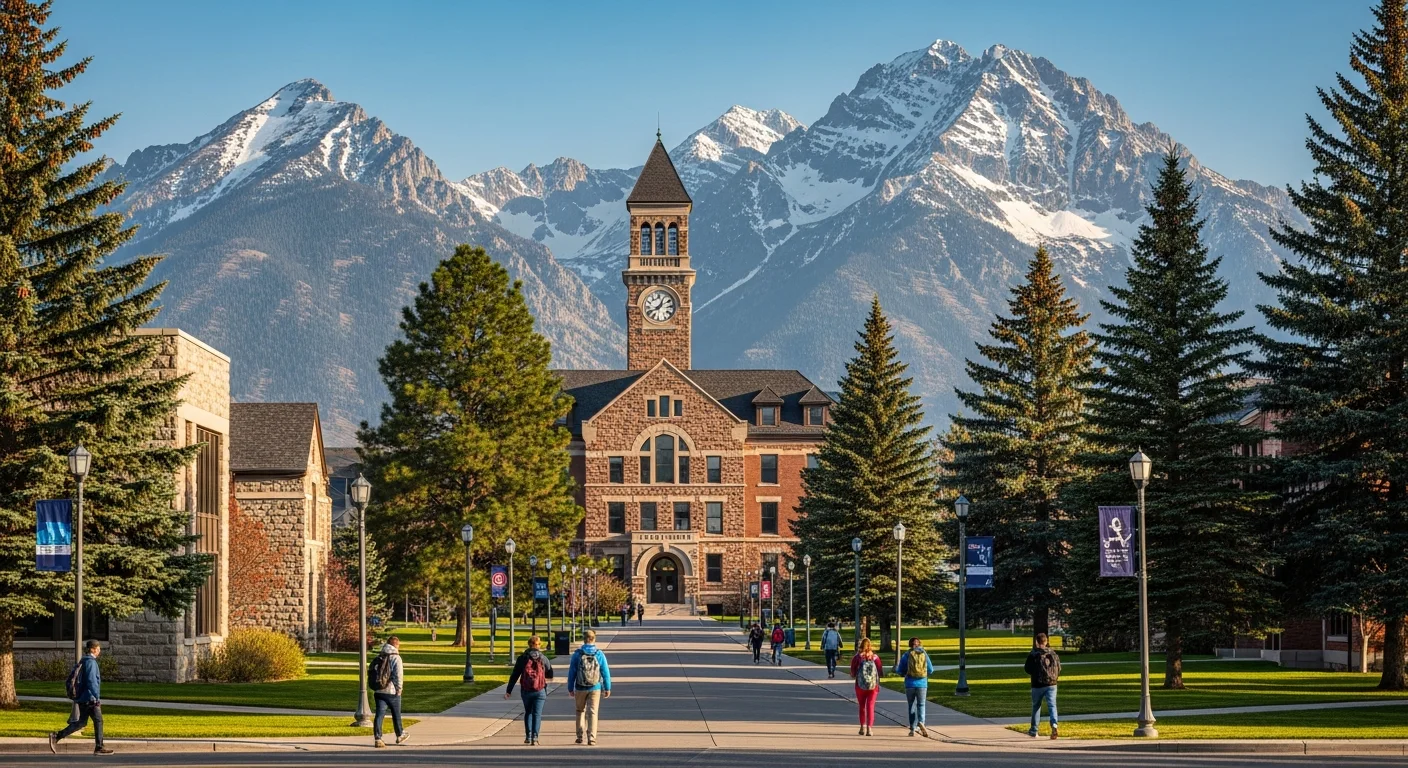
Compare the top data science colleges in Montana. 6 accredited data science schools ranked by graduation rate, career outcomes, and value, from Montana State University to Montana State University.
Best data science degree programs: Montana State, U of Montana, U of Providence
Ranked by graduation rates, program outcomes, and institutional quality
Tuition ranges from $5,736 to $39,152/year
Montana State offers the most affordable option at $6,056/yr
Data Science degree programs available: 2 master's, 1 doctoral in Montana
From community college pathways to advanced research degrees
Major employers: Oracle, Workiva, Zoot Enterprises, onXmaps
Tech hubs in Bozeman and Missoula
Hakia Research 2026
Data Science degree programs near 16+ cities across Montana
Search by city to find programs within 200 miles of your location
Updated October 12, 2026
We rank 9 accredited data science programs in Montana using IPEDS 2024 institutional data, BLS OEWS 2024 state salary data, and College Scorecard outcomes. A 4-factor weighted composite is normalized to a 0–100 score. Schools cannot pay for placement; rankings are produced algorithmically.
Are Data Science Degree Programs in Montana Worth It?
Source: BLS OEWS May 2024
Compare the top-ranked Data Science programs in Montana by degree level. Tuition, graduation rate, and Hakia Score for every accredited program.
Montana ranks among the nation's top destinations for data science education, with 6 accredited bachelor's degree programs across 3 public and 3 private institutions. The highest-ranked programs are Montana State, U of Montana, U of Providence, recognized for academic excellence, research opportunities, and strong industry connections.
Graduates from Montana data science programs earn a median salary of $76,390, 22% below the national average. The state's robust technology sector, anchored by the Bozeman, Missoula, Billings metropolitan areas, provides abundant internship and employment opportunities with companies including Oracle, Workiva, Zoot Enterprises.
Tuition ranges from $5,736 to $39,152 annually, with an average of $19,660/yr. Top programs maintain graduation rates above 88%, with the highest reaching 100%. Many programs hold ABET accreditation, the gold standard for computing education, ensuring curriculum meets rigorous industry standards.
Students can choose from specializations including software engineering, cybersecurity, artificial intelligence, data science, and systems architecture. Strong industry partnerships provide access to co-op programs, capstone projects with real companies, and direct recruiting pipelines to Montana's leading technology employers. For students seeking data science degrees in Montana, these top-ranked data science schools offer the strongest combination of academic rigor and career preparation.
| Rank | School | Location | Type | Tuition | Grad Rate | Hakia Score |
|---|---|---|---|---|---|---|
| #6 | Rocky Mountain College | Billings, MT | Private | $32,282 | — | 36.0 |
Montana offers 2 master's degree programs in data science, designed for professionals seeking to advance into senior engineering, technical leadership, and specialized roles. The top programs, Montana State, U of Montana, combine advanced technical training with research opportunities and leadership development.
Master's graduates in Montana earn a median salary of $89,870, approximately 20-30% higher than bachelor's degree holders. The concentration of technology companies in Bozeman, Missoula, Billings creates strong demand for graduate-level talent, with Oracle, Workiva, Zoot Enterprises actively recruiting from these programs.
Program formats include traditional full-time study (typically 2 years), part-time options for working professionals (2-3 years), and accelerated tracks. Tuition averages $5,896/yr, with many employers offering tuition reimbursement for graduate education. Some programs offer thesis and non-thesis tracks, allowing students to focus on research or professional development based on their career goals.
Curriculum covers advanced topics including machine learning, distributed systems, software architecture, and technical management. Many programs include practicum experiences, industry capstone projects, or consulting engagements that provide real-world application of advanced concepts. Among Montana's data science schools at the graduate level, these programs stand out for both academic quality and career outcomes.
Montana is home to 1 doctoral programs in data science, preparing students for research positions, faculty appointments, and executive technical roles. Leading programs at Montana State are recognized for cutting-edge research, strong faculty publications, and competitive funding packages.
Doctoral graduates command premium salaries, with Montana PhD holders earning a median of $112,338, reflecting the advanced expertise required for research and executive positions. The Bozeman, Missoula, Billings region's research universities and corporate R&D centers provide extensive collaboration opportunities with industry leaders like Oracle, Workiva, Zoot Enterprises.
PhD programs typically require 4-6 years of full-time study, including coursework, qualifying examinations, and original dissertation research. Many programs offer full funding through teaching or research assistantships, covering tuition and providing stipends of $25,000–$40,000 annually.
Research strengths across Montana programs include artificial intelligence, cybersecurity, human-computer interaction, systems, and theoretical computer science. For aspiring researchers pursuing data science degrees in Montana, graduates go on to careers as university faculty, industry research scientists, or technical executives, contributing to advances in technology that impact millions of users worldwide.
| Metric | Value |
|---|---|
| Average in-state tuition | $19,660/year |
| Average out-of-state tuition | $49,150/year |
| Community college tuition | $4,915/year |
| 4-year savings for residents | $117,960 |
| 2+2 transfer pathway savings | $29,490 |
Source: IPEDS 2024
Montana students pursuing data science degrees have access to multiple financial aid pathways, starting with the Free Application for Federal Student Aid (FAFSA). Through Federal Student Aid, eligible students can access federal grants, loans, and work-study programs to finance their education. The FAFSA is the gateway to determining financial need and unlocking federal support regardless of institution type or program focus.
Montana-specific merit aid is available through the Montana University System Honor Scholarship, which provides merit-based tuition waivers for qualified Montana high school graduates. This program represents a significant opportunity for in-state students attending public universities within the Montana University System. Additionally, individual institutions like Montana State University and The University of Montana offer institutional scholarships and assistantships that can substantially reduce out-of-pocket costs. Students should explore both need-based and merit-based options through each school's financial aid office to maximize funding.
For comprehensive information on federal grants, loans, and state-specific aid programs, students should consult College Scorecard, which provides detailed financial aid data for each Montana institution. The Montana University System website also offers resources on transfer credit policies and financial planning across public institutions. Prospective data science students should compare net price calculators across programs to understand true out-of-pocket costs before enrolling.
Use our interactive ROI calculator to estimate your return on investment for a data science degree in Montana. Enter your expected tuition costs, financial aid, and career goals to see projected payback periods and lifetime earnings. The calculator uses current salary data from BLS and tuition data from IPEDS to provide accurate estimates.
Estimate your return on investment for a data science degree
Leave blank to use average cost for selected program type
+697%
Net gain divided by total investment. ROI above 200% is considered excellent for education investments.
$1,289,731
Your additional lifetime earnings with this degree vs. working without one, minus the total investment.
6 years
Years until your cumulative earnings exceed total investment. Shorter programs often break even faster due to lower opportunity cost.
$114,286
Your starting salary adjusted for local cost of living. This shows real purchasing power compared to a $100K national baseline.
Why does break-even change with program type? Your "total investment" includes both tuition AND opportunity cost (foregone earnings while in school). A 4-year full-time public university (in-state) means 4 years of not earning a salary ($140,000 in opportunity cost). Shorter full-time programs may have higher tuition but lower total investment because you return to the workforce sooner.
How we calculate your degree ROI using real salary data
Tuition plus opportunity cost (earnings you miss while in school)
Direct cost of the degree program
4 years × $35K/year foregone salary while studying full-time
Projected career earnings starting after graduation, with salary growth
What you'd earn working at $35K/year with 2% annual growth
Median salary for this role in your selected location (BLS 2024)
Your investment's compound annual growth rate (similar to stock market returns)
Data sources: BLS OEWS May 2024, IPEDS 2024. Calculations use median salaries, 3% discount rate, and assume salary growth declines from 6% to 2% over career. Individual results will vary. | Powered by Hakia.com
Median annual salary in Montana metro areas
| Category | Value |
|---|---|
| Bozeman | $99K |
| Missoula | $94K |
| Billings | $90K |
Source: BLS OEWS May 2024
Hakia.com
Find data science jobs in Montana. These major employers across Montana metro areas are actively hiring data science degree holders. Click employer names to view current job openings.
Montana provides strong transfer pathways for students pursuing data science degrees through the Montana Common Course Numbering system, which ensures consistent course numbering and transferability across institutions. With 10 two-year institutions and 14 four-year universities in the state, students can begin coursework at community colleges and seamlessly transition to bachelor's degree programs at major universities. The Montana University System (MUS) coordinates these transfer agreements, reducing time-to-degree and lowering overall education costs. Community college students completing general education requirements and foundational data science coursework can transfer as juniors to institutions like Montana State University and The University of Montana, where they complete upper-level specializations.
Articulation agreements between Montana's community colleges and four-year institutions specify which courses transfer with full credit, eliminating duplication and maximizing financial efficiency. Students should work with their community college advisors to ensure course selections align with bachelor's degree requirements at their target institution. The Montana University System Honor Scholarship (https://mus.edu/) supports qualifying Montana high school graduates, and transfer students may also access Federal Student Aid resources. For students exploring complementary technical fields, Montana offers transfer pathways in Data Analytics in Montana, Machine Learning in Montana, and Computer Science in Montana, each with distinct transfer agreements and progression requirements within the MUS network.
Montana offers a compelling environment for data science education, with 9 institutions offering programs across bachelor's, master's, and doctoral levels (IPEDS). The state produces over 147 bachelor's degree completions annually, demonstrating strong program capacity and employer demand. Montana State University leads the state with 128 completions, establishing itself as the flagship data science program in the region. The University of Montana and Montana Technological University round out the top three institutions, creating a strong competitive landscape that drives program quality and innovation.
Affordability is a major advantage for data science students in Montana. Public in-state tuition averages just $4,747 annually, compared to out-of-state costs of $16,688 (IPEDS). The top-ranked programs offer exceptional value: The University of Montana leads with tuition of $5,736, followed by Montana State University at $6,056. Students can also access the Montana University System Honor Scholarship, a merit-based program supporting Montana high school graduates (Montana University System). Major employment hubs including Billings, Missoula, and Bozeman provide internship and career opportunities with employers like Billings Clinic and Providence Health, making Montana an attractive destination for affordable, career-focused data science education.
Data Science Program Availability in Montana
Source: IPEDS 2024
Montana's data science job market is growing steadily, with opportunities concentrated in major metropolitan areas and regional hubs. According to the Bureau of Labor Statistics, Montana's labor market shows demand for skilled data professionals across healthcare, education, and technology sectors. The state's largest employers in these fields are actively recruiting data science talent, creating pathways for both entry-level and experienced professionals. Cities like Billings, Missoula, and Great Falls represent the primary metro areas driving job growth in data-intensive roles.
Educational institutions play a dual role in Montana's data science ecosystem, both as employers and talent pipelines. Montana State University and The University of Montana together produced the majority of the state's data science graduates, with 128 and 23 completions respectively according to IPEDS data. This strong local talent supply supports the broader regional economy. Graduates from Montana's 9 institutions offering data science programs contribute to workforce development across Eastern, Western, and Central Montana regions. For detailed salary information and occupation trends specific to Montana, the BLS occupational employment statistics provides comprehensive labor market analysis.
Students pursuing data science in Montana benefit from proximity to established employers and emerging opportunities. Compare your career prospects by exploring data science programs nationally or related fields like data analytics in Montana. The state's relatively low cost of living compared to national averages makes Montana an attractive destination for building a data science career while maintaining financial flexibility.
New graduates and career changers
Technical leads and architects
0 available in Montana
Traditional classroom experience
Institutional characteristics, completions, graduation rates
Montana salary and employment data
Program details and admissions information
Last Updated: June 26, 2026. Rankings based on IPEDS 2024 data. Salary data from BLS OEWS May 2024.

Co-founder & Editor (B.S. Computer Science, Oregon State • B.A. Psychology, University of Washington)
Taylor combines technical expertise in computer science with a deep understanding of human behavior and learning. His dual background drives Hakia's mission: leveraging technology to build authoritative educational resources that help people make better decisions about their academic and career paths.
Hand-researched detail on the top-ranked programs: degree pathways, research labs, industry partners, career outcomes, and admissions. Tap any school to expand.
Why it stands out. Senior capstone project (Data Science Capstone). Interdisciplinary curriculum spanning Computer Science, Statistics, Mathematics, and Business
Hakia insight. Montana State's partnership with John Deere and The Nature Conservancy means capstone projects often become real-world pilots rather than hypotheticals, giving undergrads the rare advantage of seeing their data models deployed across agricultural operations across the Northern Rockies.
Montana State University's Bachelor of Science in Data Science is a 120-credit interdisciplinary program administered by the Gianforte School of Computing in collaboration with the Department of Mathematical Sciences. The curriculum integrates coursework from Computer Science, Statistics, Mathematics, Business, and Information Science, providing students with comprehensive training in extracting knowledge and insights from diverse data. The program includes a senior capstone project (CSCI Data Science Capstone) designed to apply learning to real-world challenges. Students complete foundational courses in data structures, algorithms, calculus, and statistics in their first two years, followed by specialized courses in database systems, data mining, machine learning, and ethics/privacy in big data. The program offers flexibility through multiple data science electives spanning supply chain analytics, artificial intelligence, computational biology, biostatistics, and financial engineering. With strong emphasis on both theoretical foundations and practical applications, graduates are prepared for careers in analytics, machine learning, and data-driven decision-making across diverse industries.
Programs offered
Research labs & institutes
Industry partners
Admissions
Deadline December 15 for funding consideration.
Location advantage: Proximity to agricultural technology companies in the Northern Rockies Access to environmental research organizations and conservation nonprofits Growing tech ecosystem in Bozeman with outdoor recreation and sustainable business focus
Why it stands out. Optional research opportunities through CSCI 390 or CSCI 490. Optional internship/co-op through CSCI 398 or CSCI 498 (up to 3 credits toward electives)
Hakia insight. University of Montana's access to the US Forest Service and glacial datasets through faculty like Douglas Brinkerhoff creates an unusual advantage: students build portfolios on environmental monitoring problems that major tech companies actively hire for, without leaving Montana.
The Bachelor of Science in Computer Science with a Data Science concentration at the University of Montana prepares students for careers in data analysis and machine learning. The program combines core computer science fundamentals with specialized coursework in data visualization, machine learning, probability, linear algebra, and simulation. Students complete 122-130 total credits including required courses in databases, web development, and ethics. The curriculum integrates optional research (CSCI 390/490), internship (CSCI 398/498), and independent study opportunities. The senior year culminates in applied data science projects through electives like BMIS 482 (Big Data Project) or CSCI 426/427 (Software Design & Development), allowing students to work on real-world applications. The program emphasizes both theoretical foundations and practical skills needed for data science careers.
Programs offered
Research labs & institutes
Industry partners
Career outcomes
Notable faculty
Admissions
GPA 2.00.
Location advantage: Strong connections to US Forest Service and regional environmental agencies Access to field research and environmental monitoring datasets
Why it stands out. University of Providence positions data science as a business skill, emphasizing analytics applications and organizational decision-making over research methodology.
Hakia insight. University of Providence's explicit positioning of data science as a business discipline—rather than a computer science subspecialty—appeals to students seeking analytics roles in operations and strategy where domain expertise often outweighs pure algorithmic depth.
At the bachelor's level, data science preparation at University of Providence is embedded in a business and professional context, with emphasis on analytics for decision-making in corporate and organizational settings. The curriculum prioritizes business intelligence, predictive modeling for operational improvement, and data visualization for executive communication—preparing students who understand both technical implementation and stakeholder management. Coursework in statistics, programming (Python/SQL), and analytics tools is paired with business case studies and capstone projects involving real datasets from regional and national companies. The university's location and regional network provide internship opportunities in healthcare administration, financial services, and manufacturing sectors. Career outcomes lean toward analyst and junior data scientist roles in established organizations rather than startups or specialized tech positions, reflecting the program's professional rather than research orientation. Faculty background often includes industry experience, bringing practical perspective on how companies use analytics for competitive advantage.
Programs offered
Why it stands out. Data science internships required/encouraged with national employer partnerships. Hands-on, project-oriented core courses starting early in curriculum
Hakia insight. Montana Tech's required internship model with White Sands Missile Range and Micron Technology means the curriculum is reverse-engineered from what employers actually need, not what academics think is important—a structural advantage that's rare at the undergraduate level.
Montana Tech's Bachelor of Science in Data Science prepares students for high-demand careers through hands-on, project-oriented coursework combining computer science and statistics. Students gain real-world experience via internships at major employers including White Sands Missile Range, Micron Technology, and Figure in San Francisco. The program leverages Montana Tech's high-performance computing cluster (HPC)—the first in the Montana University System—featuring 22 nodes with 362 cores, plus 3D data visualization systems for interactive analysis. Core courses emphasize projects, research, and competitions early in the curriculum. Faculty bring diverse expertise in statistics, machine learning, data analytics, and visualization. The program's relatively small size ensures strong faculty mentorship and one-on-one advising. Graduates command a median annual salary of $108,020, with the field projected to grow 36% through 2031 (BLS), ranking 2nd in technology jobs and 8th overall among 100 best jobs (U.S. News & World Report, 2022).
Programs offered
Research labs & institutes
Industry partners
Career outcomes
Notable faculty
Accreditation & certifications
Location advantage: Proximity to active mining and petroleum operations in Montana Access to natural resource industries for internships and projects
Why it stands out. Small class sizes with individualized faculty mentorship. First-year pilot program resulted in three students placed in machine learning, data science, and forecasting internships
Hakia insight. Carroll College's first-year pilot placing three students in machine learning internships despite being a small liberal arts program signals that personalized faculty mentorship can compress the typical two-year gap between admission and industry-ready status.
Carroll College's Bachelor of Arts in Data Science integrates mathematics, computer science, statistics, and business analytics into a cohesive curriculum designed for modern data science problems. The program emphasizes hands-on learning through small class sizes and individualized faculty mentorship. Students develop competencies in data gathering, wrangling, visualization, machine learning, and handling large datasets across multiple disciplines. During the first-year pilot, three students secured internships in machine learning, data science, and forecasting roles. Graduates are prepared for careers as data scientists, business analysts, statisticians, and operations research analysts. The Bureau of Labor Statistics projects data science jobs will grow over 25% in coming years, with average salaries around $121,000 for well-trained professionals. The program's liberal arts foundation ensures graduates are equipped to apply data science skills across any industry.
Programs offered
Career outcomes
Location advantage: Connections to Helena-based government and nonprofit organizations
Why it stands out. Rocky Mountain College's approach weaves data science into a liberal arts context, emphasizing ethical reasoning and cross-sector applicability over pure technical specialization.
Hakia insight. Rocky Mountain College embeds ethical reasoning into its data science curriculum from day one rather than treating it as an add-on, which positions graduates ahead of peers when employers increasingly screen for candidates who can articulate responsible data use.
At the bachelor's level, rocky Mountain College integrates data science training within a liberal arts framework that emphasizes ethical reasoning and cross-disciplinary application. Rather than a purely technical track, the program encourages students to combine statistical analysis and programming with coursework in business, environmental science, or social policy—preparing graduates who can translate data insights into actionable decisions in non-tech industries. The curriculum balances foundational mathematics and computer science with practical tools like SQL, Python, and Tableau, alongside projects that engage real datasets from regional nonprofits, small businesses, and public agencies. Faculty prioritize mentoring students toward careers in analytics, business intelligence, and data-informed management rather than specialist machine learning roles. The smaller class sizes and strong advising network mean students develop relationships with professors who actively help identify internships at local and regional employers. Graduates from Rocky Mountain's quantitative programs have moved into analyst and reporting roles at healthcare organizations, agricultural cooperatives, and state agencies—employers valuing the combination of technical competence and communication skills.
Programs offered
Location advantage: Regional nonprofit and small business ecosystem for internships
Why it stands out. Three specialization tracks: Computer Science, Mathematics, and Statistics. Foundational courses in algorithms, experimental design, and machine learning mathematics
Hakia insight. Montana State's three-track specialization model (Computer Science, Mathematics, Statistics) lets students prototype a PhD-level depth in one domain while maintaining breadth—a structure that makes the degree simultaneously practical for industry and credible for doctoral applications.
The Master of Science in Data Science at Montana State University is an interdisciplinary 30-credit program housed in the Department of Mathematical Sciences, drawing on Computer Science, Mathematics, and Statistics. The program provides foundational training in data analysis with equal emphasis on algorithmic principles, mathematical theory, and statistical inference. Students develop competency in data classification, clustering, dimensionality reduction, regression, and optimization, with the ability to formulate solutions to real-world data-driven problems. The curriculum offers three specialization tracks—Computer Science, Mathematics, and Statistics—allowing students to tailor their coursework to career goals. The program emphasizes practical implementation in modern software languages and effective communication of technical solutions. The catalog does not specify part-time/evening availability, thesis vs. coursework options, graduate assistantship stipends, embedded professional certifications, or salary advancement data.
Programs offered
Research labs & institutes
Industry partners
Admissions
Deadline December 15 for funding consideration.
Location advantage: Proximity to agricultural technology companies in the Northern Rockies Access to environmental research organizations and conservation nonprofits Growing tech ecosystem in Bozeman with outdoor recreation and sustainable business focus
Why it stands out. Flexible 30-36 credit program allowing customization. Project-based learning emphasis through M 567 Advanced Big Data Analytics Projects
Hakia insight. University of Montana's 30-36 credit flexibility with project-based emphasis through M 567 creates unusual optionality for working professionals: you can compress the degree if your employer funds it, or stretch it without paying extra tuition.
The University of Montana's Master of Science in Data Science is designed for working professionals seeking advanced analytics expertise. The program offers flexibility through a 30-36 credit structure with both thesis and coursework tracks. Students complete core requirements in numerical methods, advanced data science analytics, and big data analytics projects, followed by a comprehensive exam. A minimum of 2 research credits culminates in a final presentation. The curriculum integrates computer science and statistics coursework, with electives from Mathematical Sciences, CSCI, and Business Administration approved by advisors. While specific salary advancement data and assistantship stipends are not detailed in this catalog excerpt, the program emphasizes practical, project-based learning through M 567 Advanced Big Data Analytics Projects. Part-time completion options and employer tuition partnerships are not specified in available materials.
Programs offered
Research labs & institutes
Industry partners
Career outcomes
Notable faculty
Admissions
GPA 2.00.
Location advantage: Strong connections to US Forest Service and regional environmental agencies Access to field research and environmental monitoring datasets
Why it stands out. Most incoming graduate students funded with teaching assistantships for at least first year. Presidential and Meritorious Scholarships available
Hakia insight. Montana State's guarantee of first-year funding for most incoming CS PhD students removes a major financial cliff that deters talented applicants from rural or modest-income backgrounds—a structural equity advantage that directly shapes cohort diversity.
The Computer Science PhD program at Montana State University's Gianforte School of Computing offers research opportunities in machine learning, human-robot interaction, and data science. Most incoming graduate students receive funding through teaching assistantships for at least their first year, with additional Presidential and Meritorious Scholarships available through departmental awards. The program operates within an R1 research institution, providing access to specialized laboratories including the Software Lab, Applied Algorithms Laboratory, Computation Ecology Group, and Numerical Intelligent Systems Laboratory. Post-graduation placement shows 33% of alumni in academia and 60% in for-profit industry within 10 years. No GRE is required for admission. The program benefits from a $662,000 NSF grant supporting genetic variation mapping research and offers WICHE partnership benefits for students from 15 western states, providing reduced tuition rates.
Programs offered
Research labs & institutes
Industry partners
Career outcomes
Admissions
Deadline December 15 for funding consideration.
Location advantage: Proximity to agricultural technology companies in the Northern Rockies Access to environmental research organizations and conservation nonprofits Growing tech ecosystem in Bozeman with outdoor recreation and sustainable business focus