🥇
Springfield Technical Community College
Springfield, MAPublic
$600
Tuition/yr
32%
Grad rate
73.9
Hakia Score
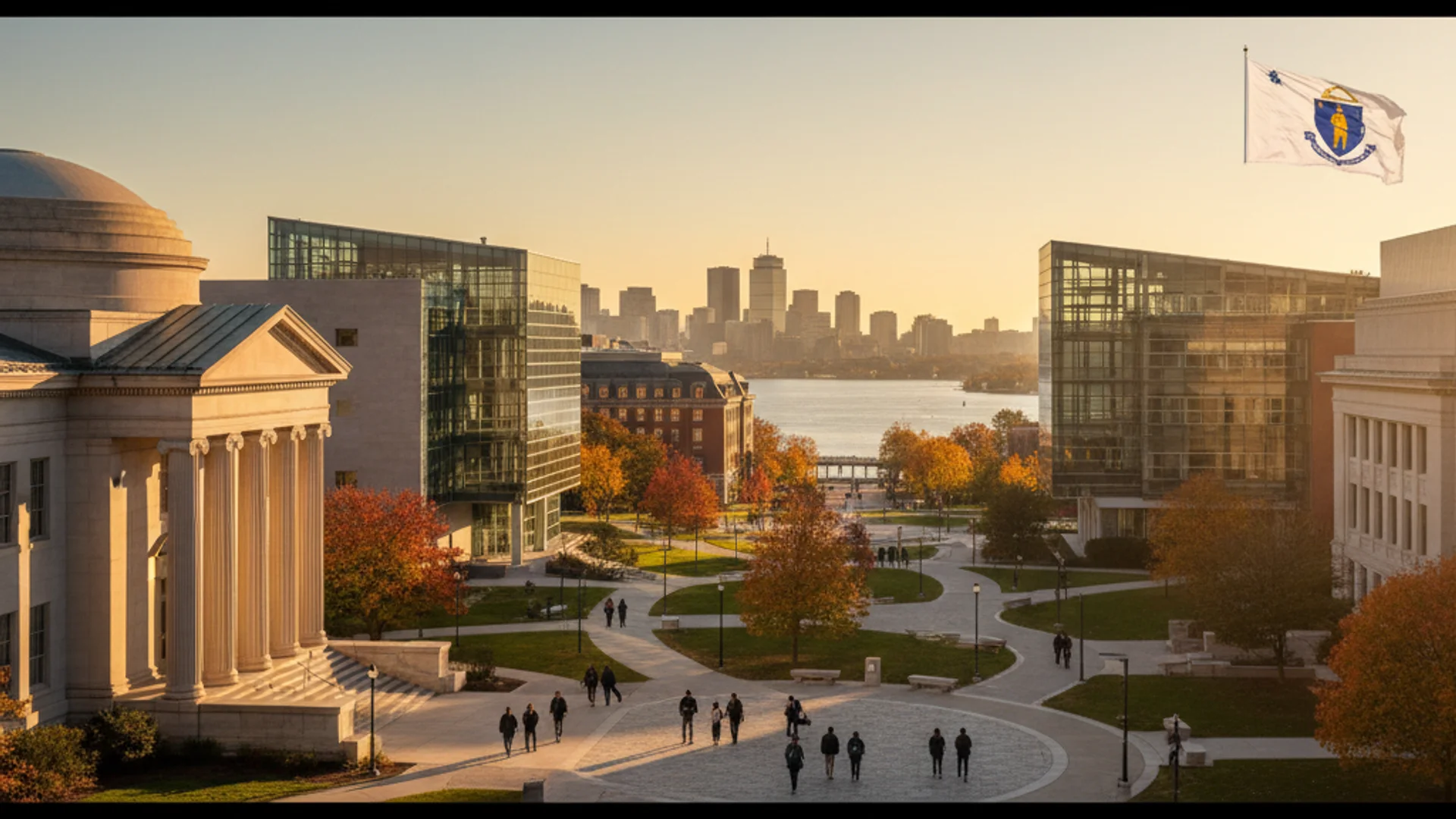
Compare the top computer science colleges in Massachusetts. 61 accredited computer science schools ranked by graduation rate, career outcomes, and value, from Bunker Hill Community College to Northeastern University.
Massachusetts is home to MIT, Harvard, and a dense cluster of 61 CS programs feeding one of the country's strongest tech and biotech corridors
The Boston-Cambridge metro anchors a $128,640 median CS salary, driven by Google, Amazon, Meta, and HubSpot R&D offices alongside world-class research universities
Northeastern University ranks #1 for bachelor's CS with an 88.1 score and co-op placements at top employers
UMass Amherst follows at #2 with a 90% graduation rate and $16,591/yr in-state tuition, offering a strong public-school alternative
Bunker Hill Community College offers the most affordable CS pathway at just $576/yr in-state tuition
17 associate's programs statewide provide 2+2 transfer routes into UMass and other bachelor's programs
CS graduates in the Boston metro earn $141,504 median salary, the highest in the state and 24% above the national average
Cambridge ($135,072) and Worcester ($128,640) metros also pay well above national norms
10 fully online CS programs available, including options from established institutions
Online tuition can differ significantly from on-campus rates, making remote study viable for working professionals across the state
Top employers: Google, Amazon, Microsoft, Meta, HubSpot, Wayfair, Toast, Akamai
Boston/Cambridge functions as a biotech and AI research hub, with MIT and Harvard anchoring major corporate R&D centers
Hakia Research 2026
Updated October 19, 2026
We rank 89 accredited computer science programs in Massachusetts using IPEDS 2024 institutional data, BLS OEWS 2024 state salary data, and College Scorecard outcomes. A 4-factor weighted composite is normalized to a 0–100 score. Schools cannot pay for placement; rankings are produced algorithmically.
Are Computer Science Degree Programs in Massachusetts Worth It?
Source: BLS OEWS May 2024
Compare the top-ranked Computer Science programs in Massachusetts by degree level. Tuition, graduation rate, and Hakia Score for every accredited program.
Massachusetts offers 17 accredited associate's degree programs in computer science, providing an affordable entry point into the technology field. The top-ranked programs include Bunker Hill Community Col..., Bristol Community College, Northern Essex Community ..., which combine rigorous technical curriculum with practical skills training.
Community colleges in Massachusetts offer these two-year programs at an average cost of $5,393/yr, significantly less than four-year university tuition. Students completing associate's degrees can pursue entry-level technical positions and transfer opportunities, with entry-level salaries averaging $70,752 in Massachusetts.
Many programs feature guaranteed transfer agreements with Massachusetts's public universities, allowing students to complete their first two years at reduced cost before transferring to complete a bachelor's degree. The Boston, Cambridge, Worcester areas offer particularly strong job markets for associate's degree holders, with employers like Amazon, Google, HubSpot hiring for technical support, junior development, and IT specialist positions.
Programs typically include coursework in programming fundamentals, database management, networking basics, and software development. Among computer science schools in Massachusetts, these associate's programs offer the best value for students beginning their computer science degrees in Massachusetts.
| Rank | School | Location | Type | Tuition | Grad Rate | Hakia Score |
|---|---|---|---|---|---|---|
| #6 | Massachusetts Bay Community College | Wellesley Hills, MA | Public | $576 | 17% | 64.0 |
| #7 | North Shore Community College | Danvers, MA | Public | $600 | 18% | 63.6 |
| #8 | Cape Cod Community College | West Barnstable, MA | Public | $576 | 22% | 62.1 |
| #9 | Mount Wachusett Community College | Gardner, MA | Public | $600 | 24% | 62.1 |
| #10 | Quincy College | Quincy, MA | Public | $7,762 | 15% | 58.1 |
Massachusetts ranks among the nation's top destinations for computer science education, with 46 accredited bachelor's degree programs across 11 public and 35 private institutions. The highest-ranked programs are Northeastern, U of Massachusetts-Amherst, Massachusetts Institute o..., recognized for academic excellence, research opportunities, and strong industry connections.
Graduates from Massachusetts computer science programs earn a median salary of $109,344, 11% above the national average. The state's robust technology sector, anchored by the Boston, Cambridge, Worcester metropolitan areas, provides abundant internship and employment opportunities with companies including Amazon, Google, HubSpot.
Tuition ranges from $910 to $66,650 annually, with an average of $40,258/yr. Top programs maintain graduation rates above 92%, with the highest reaching 100%. Many programs hold ABET accreditation, the gold standard for computing education, ensuring curriculum meets rigorous industry standards.
Students can choose from specializations including software engineering, cybersecurity, artificial intelligence, data science, and systems architecture. Strong industry partnerships provide access to co-op programs, capstone projects with real companies, and direct recruiting pipelines to Massachusetts's leading technology employers. For students seeking computer science degrees in Massachusetts, these top-ranked computer science schools offer the strongest combination of academic rigor and career preparation.
| Rank | School | Location | Type | Tuition | Grad Rate | Hakia Score |
|---|---|---|---|---|---|---|
| #6 | University of Massachusetts-Amherst | Amherst, MA | Public | $17,006 | 83% | 91.5 |
| #7 | Williams College | Williamstown, MA | Private nonprofit | $68,240 | 94% | 91.4 |
| #8 | Amherst College | Amherst, MA | Private nonprofit | $69,820 | 94% | 91.0 |
| #9 | Brandeis University | Waltham, MA | Private nonprofit | $67,082 | 86% | 89.9 |
| #10 | Smith College | Northampton, MA | Private nonprofit | $64,870 | 89% | 89.9 |
| #11 | Worcester Polytechnic Institute | Worcester, MA | Private nonprofit | $59,700 | 90% | 88.7 |
| #12 | Mount Holyoke College | South Hadley, MA | Private nonprofit | $66,780 | 84% | 88.4 |
| #13 | College of the Holy Cross | Worcester, MA | Private nonprofit | $63,650 | 87% | 87.8 |
| #14 | Clark University | Worcester, MA | Private nonprofit | $57,440 | 77% | 86.5 |
| #15 | Endicott College | Beverly, MA | Private nonprofit | $39,750 | 76% | 81.3 |
| #16 | Stonehill College | Easton, MA | Private nonprofit | $55,750 | 76% | 80.9 |
| #17 | University of Massachusetts-Lowell | Lowell, MA | Public | $16,246 | 65% | 79.5 |
| #18 | Merrimack College | North Andover, MA | Private nonprofit | $49,352 | 70% | 79.5 |
| #19 | Wheaton College (Massachusetts) | Norton, MA | Private nonprofit | $63,240 | 73% | 79.3 |
| #20 | Sattler College | Boston, MA | Private nonprofit | — | 81% | 79.2 |
| #21 | Gordon College | Wenham, MA | Private nonprofit | $29,500 | 69% | 78.5 |
| #22 | Wentworth Institute of Technology | Boston, MA | Private nonprofit | $41,984 | 68% | 73.8 |
| #23 | Assumption University | Worcester, MA | Private nonprofit | $50,494 | 75% | 73.6 |
| #24 | Suffolk University | Boston, MA | Private nonprofit | $46,954 | 61% | 73.0 |
| #25 | Western New England University | Springfield, MA | Private nonprofit | $44,680 | 64% | 72.8 |
| #26 | University of Massachusetts-Boston | Boston, MA | Public | $15,278 | 49% | 71.5 |
| #27 | Bridgewater State University | Bridgewater, MA | Public | $910 | 53% | 70.9 |
| #28 | College of Our Lady of the Elms | Chicopee, MA | Private nonprofit | $41,300 | 68% | 70.9 |
| #29 | Westfield State University | Westfield, MA | Public | $970 | 54% | 70.8 |
| #30 | Fitchburg State University | Fitchburg, MA | Public | $970 | 55% | 69.4 |
| #31 | Hampshire College | Amherst, MA | Private nonprofit | $57,158 | 54% | 65.7 |
| #32 | Bard College at Simon's Rock | Great Barrington, MA | Private nonprofit | $65,616 | 68% | 63.1 |
| #33 | Curry College | Milton, MA | Private nonprofit | $45,370 | 51% | 62.6 |
| #34 | Eastern Nazarene College | Quincy, MA | Private nonprofit | $28,444 | 39% | 57.0 |
Massachusetts offers 16 master's degree programs in computer science, designed for professionals seeking to advance into senior engineering, technical leadership, and specialized roles. The top programs, Northeastern, U of Massachusetts-Amherst, Massachusetts Institute o..., combine advanced technical training with research opportunities and leadership development.
Master's graduates in Massachusetts earn a median salary of $128,640, approximately 20-30% higher than bachelor's degree holders. The concentration of technology companies in Boston, Cambridge, Worcester creates strong demand for graduate-level talent, with Amazon, Google, HubSpot actively recruiting from these programs.
Program formats include traditional full-time study (typically 2 years), part-time options for working professionals (2-3 years), and accelerated tracks. Tuition averages $39,691/yr, with many employers offering tuition reimbursement for graduate education. Some programs offer thesis and non-thesis tracks, allowing students to focus on research or professional development based on their career goals.
Curriculum covers advanced topics including machine learning, distributed systems, software architecture, and technical management. Many programs include practicum experiences, industry capstone projects, or consulting engagements that provide real-world application of advanced concepts. Among Massachusetts's computer science schools at the graduate level, these programs stand out for both academic quality and career outcomes.
| Rank | School | Location | Type | Tuition | Grad Rate | Hakia Score |
|---|---|---|---|---|---|---|
| #6 | Brandeis University | Waltham, MA | Private nonprofit | $67,082 | 86% | 85.0 |
| #7 | Worcester Polytechnic Institute | Worcester, MA | Private nonprofit | $59,700 | 90% | 83.8 |
| #8 | Clark University | Worcester, MA | Private nonprofit | $57,440 | 77% | 83.3 |
| #9 | Merrimack College | North Andover, MA | Private nonprofit | $49,352 | 70% | 75.9 |
| #10 | University of Massachusetts-Lowell | Lowell, MA | Public | $16,246 | 65% | 75.5 |
| #11 | Fitchburg State University | Fitchburg, MA | Public | $970 | 55% | 68.8 |
| #12 | University of Massachusetts-Boston | Boston, MA | Public | $15,278 | 49% | 67.9 |
| #13 | Bridgewater State University | Bridgewater, MA | Public | $910 | 53% | 66.5 |
| #14 | Wentworth Institute of Technology | Boston, MA | Private nonprofit | $41,984 | 68% | 66.4 |
Massachusetts is home to 10 doctoral programs in computer science, preparing students for research positions, faculty appointments, and executive technical roles. Leading programs at Massachusetts Institute o..., U of Massachusetts-Amherst, Northeastern are recognized for cutting-edge research, strong faculty publications, and competitive funding packages.
Doctoral graduates command premium salaries, with Massachusetts PhD holders earning a median of $160,800, reflecting the advanced expertise required for research and executive positions. The Boston, Cambridge, Worcester region's research universities and corporate R&D centers provide extensive collaboration opportunities with industry leaders like Amazon, Google, HubSpot.
PhD programs typically require 4-6 years of full-time study, including coursework, qualifying examinations, and original dissertation research. Many programs offer full funding through teaching or research assistantships, covering tuition and providing stipends of $25,000–$40,000 annually.
Research strengths across Massachusetts programs include artificial intelligence, cybersecurity, human-computer interaction, systems, and theoretical computer science. For aspiring researchers pursuing computer science degrees in Massachusetts, graduates go on to careers as university faculty, industry research scientists, or technical executives, contributing to advances in technology that impact millions of users worldwide.
| Rank | School | Location | Type | Tuition | Grad Rate | Hakia Score |
|---|---|---|---|---|---|---|
| #6 | Brandeis University | Waltham, MA | Private nonprofit | $67,082 | 86% | 78.0 |
| #7 | Worcester Polytechnic Institute | Worcester, MA | Private nonprofit | $59,700 | 90% | 77.3 |
| #8 | University of Massachusetts-Lowell | Lowell, MA | Public | $16,246 | 65% | 66.0 |
| #9 | University of Massachusetts-Boston | Boston, MA | Public | $15,278 | 49% | 58.8 |
| Metric | Value |
|---|---|
| Average in-state tuition | $30,679/year |
| Average out-of-state tuition | $76,698/year |
| Community college tuition | $7,670/year |
| 4-year savings for residents | $184,076 |
| 2+2 transfer pathway savings | $46,018 |
Source: IPEDS 2024
Massachusetts offers strong state-funded financial aid programs that make CS education accessible.
The flagship program is MASSGrant, providing need-based financial assistance to undergraduate students who reside in Massachusetts and attend Massachusetts colleges (MASSGrant). Eligibility requires demonstrated financial need via FAFSA, enrollment in an approved degree program, and satisfactory academic progress. MASSGrant can cover a significant portion of tuition costs. Additionally, MASSGrant Plus covers remaining tuition and mandatory fees for income-eligible students at community colleges and full-time students at state universities and UMass campuses. Starting Fall 2025, tuition and mandatory fees at all UMass campuses will be fully covered for undergraduate students from households earning $75,000 or less (Mass.gov).
Key Massachusetts state aid programs and 2025-2026 updates:
Institutional scholarships at Massachusetts schools are substantial.
MIT meets 100% of demonstrated financial need for all admitted students, families earning under $75,000 pay nothing for tuition, room, and board. Harvard similarly meets full need. Private universities like Northeastern, BU, and Tufts offer significant merit and need-based aid packages. CS-specific scholarships are available through professional organizations like ACM and IEEE Computer Society. Corporate sponsors including Google (Lime Scholarship), Microsoft, and local companies fund computing scholarships at partner universities. The Terry Foundation provides full-ride scholarships to exceptional students at Massachusetts public universities. Apply early, many schools have priority scholarship deadlines in November-December, well before regular admission deadlines. Complete the FAFSA as early as possible (opens October 1) to maximize aid eligibility. Boston's Tuition-Free Community College (TFCC) Plan provides additional support for eligible Boston residents attending partner community colleges (Boston.gov).
Use our interactive ROI calculator to estimate your return on investment for a computer science degree in Massachusetts. Enter your expected tuition costs, financial aid, and career goals to see projected payback periods and lifetime earnings. The calculator uses current salary data from BLS and tuition data from IPEDS to provide accurate estimates.
Estimate your return on investment for a computer science degree
Leave blank to use average cost for selected program type
+1064%
Net gain divided by total investment. ROI above 200% is considered excellent for education investments.
$1,967,896
Your additional lifetime earnings with this degree vs. working without one, minus the total investment.
5 years
Years until your cumulative earnings exceed total investment. Shorter programs often break even faster due to lower opportunity cost.
$100,000
Your starting salary adjusted for local cost of living. This shows real purchasing power compared to a $100K national baseline.
Why does break-even change with program type? Your "total investment" includes both tuition AND opportunity cost (foregone earnings while in school). A 4-year full-time public university (in-state) means 4 years of not earning a salary ($140,000 in opportunity cost). Shorter full-time programs may have higher tuition but lower total investment because you return to the workforce sooner.
How we calculate your degree ROI using real salary data
Tuition plus opportunity cost (earnings you miss while in school)
Direct cost of the degree program
4 years × $35K/year foregone salary while studying full-time
Projected career earnings starting after graduation, with salary growth
What you'd earn working at $35K/year with 2% annual growth
Median salary for this role in your selected location (BLS 2024)
Your investment's compound annual growth rate (similar to stock market returns)
Data sources: BLS OEWS May 2024, IPEDS 2024. Calculations use median salaries, 3% discount rate, and assume salary growth declines from 6% to 2% over career. Individual results will vary. | Powered by Hakia.com
Median annual salary in Massachusetts metro areas
| Category | Value |
|---|---|
| Boston | $142K |
| Cambridge | $135K |
| Worcester | $129K |
Source: BLS OEWS May 2024
Hakia.com
Find computer science jobs in Massachusetts. These major employers across Massachusetts metro areas are actively hiring computer science degree holders. Click employer names to view current job openings.
Boston/Cambridge is a biotech and AI research hub, anchored by MIT, Harvard, and major tech company R&D centers.
Nearby cities: Cambridge, Somerville, Waltham, Burlington, Quincy
Massachusetts has one of the nation's most comprehensive transfer systems through MassTransfer.
This statewide agreement provides smooth pathways for community college students to transfer to all 4 UMass campuses, 9 state universities, MassArt, and Massachusetts Maritime Academy (MassTransfer). The MassTransfer Block is a 34-credit general education foundation that satisfies all general education requirements at any public four-year institution in Massachusetts. Students who complete the block with a 2.0 GPA or higher receive guaranteed credit transfer. Those with a 2.5 GPA receive guaranteed admission to state universities and UMass campuses. Students with a 3.0 GPA also receive a tuition credit reducing costs by 8-11%.
A2B (Associate to Bachelor's) Mapped Pathways provide course-by-course articulation for popular majors including computer science. These pathways guarantee that specific community college courses count directly toward bachelor's degree requirements at receiving institutions, eliminating the credit loss that plagues transfer students nationally. Completing an associate degree before transferring through A2B pathways saves an average of 28% on total bachelor's degree costs (MassTransfer A2B). The Commonwealth Commitment program offers additional savings: students who sign up before completing 15 credits, maintain full-time enrollment and a 3.0 GPA, and graduate from community college before transferring receive 10% tuition rebates and frozen tuition rates at their four-year institution.
Strategic transfer planning for CS students in Massachusetts:
Massachusetts is home to the world's most prestigious computer science programs at MIT and Harvard, alongside a constellation of elite universities including Northeastern, Tufts, Boston University, and UMass Amherst. The state hosts 7 ABET-accredited computer science programs, including MIT, Harvard, BU, Northeastern, WPI, UMass Amherst, and Tufts, ensuring graduates meet rigorous national standards for computing education (ABET). With 15 community colleges offering transfer pathways through MassTransfer, computer science education is accessible from any starting point (mass.edu). The concentration of research institutions creates opportunities for undergraduate research, industry collaboration, and career networking.
The salary outlook in Massachusetts is exceptional.
Software developers in the Boston-Cambridge metro area earn a median salary of $165,513 according to Glassdoor, with the 75th percentile reaching $204,555 (Glassdoor Boston 2025). Levels.fyi reports average total compensation ranging from $125,000 to $220,000 at major tech companies in the Greater Boston area, with stock and bonus pushing senior roles significantly higher (Levels.fyi). According to CompTIA, Massachusetts tech workers make up 11.5% of the overall workforce, one of the highest concentrations nationally, with over 2,000 software companies and 140 cybersecurity firms operating statewide (CompTIA State of Tech Workforce 2025).
The Boston-Cambridge corridor offers unique specializations unavailable elsewhere: Kendall Square, dubbed 'the most innovative square mile on the planet', hosts over 150 technology companies alongside MIT and Harvard. The biotech corridor, anchored by Moderna, Biogen, and Vertex Pharmaceuticals, creates exceptional opportunities for computational biology and bioinformatics. Route 128, America's original tech corridor, continues to evolve with advanced manufacturing, robotics, and defense technology at companies like Raytheon, Draper Laboratory, and MIT Lincoln Lab. The financial technology sector thrives with Fidelity Investments headquartered in Boston. Compare programs in New York, California, or explore our national computer science rankings.
Computer Science Job Growth in Massachusetts
Source: BLS Occupational Outlook
Massachusetts offers exceptional job prospects for CS graduates with premium compensation.
The Bureau of Labor Statistics reports software developers in Massachusetts earn a median annual salary of $142,000, approximately 7% above the national median of $133,080 (BLS OEWS May 2024). CompTIA's State of Tech Workforce 2025 report shows Massachusetts has a tech workforce of approximately 280,000 professionals, with tech employment growing 11,500 net new jobs in the most recent reporting period. The state ranks among the top five nationally for tech employment concentration, with more than 20% of the Massachusetts economy coming from the information technology sector (CompTIA).
Salaries vary significantly by location and company type within Massachusetts:
High-growth sectors shaping Massachusetts's tech future include: biotech/computational biology (driven by the Kendall Square cluster with 1,000+ life science companies), artificial intelligence and machine learning (MIT's AI Lab heritage continues with companies like DataRobot and Kensho), cybersecurity (140+ firms including Carbon Black, now part of VMware, and Rapid7), and healthcare technology (Partners HealthCare, Athenahealth). The defense technology sector remains strong with NSA's presence and major contracts flowing to Massachusetts companies. Remote work has expanded opportunities, though Boston's premium salaries require local cost-of-living consideration. For related career paths, explore our AI degree programs, data science rankings, or cybersecurity rankings.
New graduates and career changers
Technical leads and architects
10 available in Massachusetts
Traditional classroom experience
Institutional characteristics, completions, graduation rates
Massachusetts salary and employment data
Program details and admissions information
Last Updated: June 26, 2026. Rankings based on IPEDS 2024 data. Salary data from BLS OEWS May 2024.

Co-founder & Editor (B.S. Computer Science, Oregon State • B.A. Psychology, University of Washington)
Taylor combines technical expertise in computer science with a deep understanding of human behavior and learning. His dual background drives Hakia's mission: leveraging technology to build authoritative educational resources that help people make better decisions about their academic and career paths.
Hand-researched detail on the top-ranked programs: degree pathways, research labs, industry partners, career outcomes, and admissions. Tap any school to expand.
Why it stands out. Meets the requirements for the MassTransfer A2B Pathway in Computer Science. Places equal emphasis on practical and theoretical computer science and mathematics
Hakia insight. Springfield's MassTransfer A2B Pathway removes the guesswork from transferring—you're not just earning an associate's degree, you're following a state-guaranteed articulation agreement that locks in your junior-year admission and course credit at participating four-year institutions.
Springfield Technical Community College's Computer Science Transfer program offers a distinctive 2-year Associate in Science in Engineering and Science Transfer degree that balances practical and theoretical computer science with strong mathematical foundations. What sets this program apart is its alignment with the MassTransfer A2B Pathway in Computer Science, ensuring seamless transfer to four-year institutions while providing cost-effective preparation. The curriculum introduces students to fundamental programming concepts while developing the rigorous mathematical skills essential for advanced study in the field. STCC has a proven track record of successful student transfers, with graduates continuing their studies at four-year colleges in specialized areas including artificial intelligence, analysis of algorithms, computer architecture and design, computer communications and networks, databases, and software systems. The program recognizes computer science's vital role across virtually every field and profession, from international banking and communications satellites to video games and automobile systems. Students receive preparation for diverse career paths in computer science, ranging from pure theory and design to programming and marketing, positioning them well for success in a field where computer software has become commonplace across education, recreation, science, and business sectors.
Programs offered
Industry partners
Why it stands out. Two-fold mission: prepares students for entry-level careers and transfer to four-year programs. Qualifies for MassTransfer benefits to University of Massachusetts campuses
Hakia insight. Bunker Hill's MassTransfer guaranteed pathways to UMass campuses eliminate the community college transfer penalty; students complete lower-division coursework at 1/3 the cost while locking in upper-division acceptance.
Bunker Hill Community College's Computer Science Concentration offers an Associate in Arts degree with a distinctive two-fold mission: preparing students for well-paying, entry-level careers as computer scientists and programmers while simultaneously preparing them for seamless transfer to four-year Computer Science programs. The program stands out through its MassTransfer benefits, allowing graduates to qualify for transfer to University of Massachusetts campuses, and comprehensive transfer partnerships with six state universities including Bridgewater State, Framingham State, and UMass Amherst. Students follow a structured four-semester pathway featuring milestone courses in object-oriented programming, Java, C++, calculus, physics, and data structures. The curriculum emphasizes practical skills through concentration electives including Android Development with Kotlin, SQL Programming, Advanced C++/OOP, and internship opportunities. Upon completion, graduates demonstrate competencies in computer science concepts, software development, algorithm performance analysis, team collaboration, and technical documentation. The program offers unique flexibility, allowing students to earn World Studies Emphasis certification simultaneously and provides specific transfer guidance, including recommendations for UMASS Boston's Computer Science program. Career prospects focus on entry-level positions as computer scientists and programmers, with the program's design ensuring graduates are well-prepared for immediate employment or continued education at four-year institutions.
Programs offered
Industry partners
Why it stands out. Industry-Aligned Curriculum that matches industry demands and trends. Hands-On Learning with real-world projects, labs and simulations
Hakia insight. Bristol's Center for Cyber Intelligence and Security embedded in a community college is atypical; it signals workforce-ready cybersecurity training at associate level, positioning graduates for immediate entry into SOC analyst and infrastructure roles.
Bristol Community College's Computer Science Associates program stands out for its industry-aligned curriculum that directly matches current market demands and trends. The program offers seven distinct concentrations including Computer Networking Career, Computer Programming and Web Development, Cybersecurity and Digital Forensics, Game Development, and Artificial Intelligence, providing students flexibility to specialize in high-demand areas. What makes this program particularly distinctive is its hands-on learning approach, where students dive into real-world projects, labs and simulations to build practical expertise through both classes and internships. For students planning to continue their education, the Computer Science Transfer track offers a seamless transition to top-tier universities with a solid foundation for advanced studies. The program also features comprehensive specializations like cybersecurity and digital forensics for protecting sensitive data and solving digital mysteries, plus game development covering character design, coding gameplay, and creating immersive environments. Career prospects are strong, with computer science professionals in high demand across technology, finance, healthcare, and entertainment industries. According to the Bureau of Labor Statistics, computer and mathematical occupations in Massachusetts earn a median annual salary of $118,510, demonstrating the program's potential for high earning outcomes.
Programs offered
Research labs & institutes
Career outcomes
Why it stands out. 19 total programs combining Associate degrees and certificates. Skills-based programs designed for both career entry and four-year transfer
Hakia insight. With 19 separate CS-related credentials and degrees, Quinsigamond lets you test-drive specializations (cloud, networking, web development) through stackable certificates before committing to a full associate's, while Amazon Career Choice tuition coverage makes upskilling nearly free.
Quinsigamond Community College offers an extensive Computer and Information Technology program portfolio with 19 different Associate in Science degrees and certificates designed to prepare students for lucrative technology careers or seamless transfer to four-year institutions. The program stands out for its comprehensive scope, spanning four major areas: Computer Information Systems (6 programs), Computer Systems Engineering Technology (10 programs), Computer Science (1 program), and Interactive Media (2 programs). What makes this program particularly distinctive is its skills-based approach with hands-on experience in application software, web development platforms, programming languages, and database design methodologies. The program offers unique specializations including a Health Information option that combines IT skills with medical law, ethics, coding and billing, and forensics options that provide in-depth insight into criminal justice and digital investigation techniques. The Interactive Media programs utilize the latest computing technologies, teaching students the complete video game development process from pre-production through post-production. Students can pursue stackable certificates that build toward associate degrees, making the program accessible for adult learners re-entering college or current workforce members updating their skill sets. Career preparation includes entry-level positions as web developers, database support specialists, network technicians, help desk technicians, and computer support specialists across business, healthcare, and criminal justice sectors.
Programs offered
Industry partners
Hakia insight. Massasoit's proximity to Boston-area employers cuts through the noise of job applications: many students transition directly into entry-level roles at companies actively recruiting from the program, rather than competing in a national market against four-year graduates.
At the associate's level, strong connections with Boston-area tech employers mean Massasoit graduates have direct pathways into entry-level positions at companies you've actually heard of—many students land roles before graduation through career fairs and employer partnerships. The curriculum covers both traditional IT support and emerging tech like cloud fundamentals, so you're not locked into a single career track. Transfer students move seamlessly to UMass Boston and Northeastern, and the program's location near Boston makes it ideal if you want metro-area job prospects while keeping costs down.
Programs offered
Career outcomes
Top employers: Boston tech companies, Regional healthcare IT, Financial services firms, Massachusetts biotech support IT
Hakia insight. massBay's Center for Cybersecurity Education paired with Cisco, CompTIA, and LPI partnerships means you're earning industry-recognized certifications *within* your degree, not after it—students graduate with both an associate's and concrete proof of networking competency.
At the associate's level, massBay's computer science program prepares students for employment in the computer information industry or transfer to bachelor's degree programs. The curriculum covers computer programming, data modeling, database design, computer networks, web design and development, with pathways to industry certifications including CompTIA A+, CompTIA Security+, LPI Linux Essentials, and CISCO certifications.
Programs offered
Research labs & institutes
Industry partners
Career outcomes
Top employers: Not specified
Admissions
Acceptance rate Not specified%. GPA Not specified.
Accreditation & certifications
Location advantage: Located in Massachusetts tech corridor Multiple campus locations in Wellesley Hills and Framingham
Hakia insight. MWCC's Cisco-equipped labs aren't just for show: graduates land infrastructure roles at regional healthcare systems and manufacturers who actively recruit from the program, meaning your hands-on experience translates directly to employers who already know the school's curriculum.
At the associate's level, if you're serious about hands-on networking and infrastructure work, MWCC's computer science program emphasizes practical lab experience with Cisco equipment and real-world system administration skills. Students graduate ready for IT support roles and have a strong pipeline to UMass Lowell and Fitchburg State for four-year degrees. The program's strength lies in its technical depth—you'll actually configure networks and servers, not just study theory. Most graduates land help desk or junior systems administrator positions within months, and many employers in central Massachusetts actively recruit from MWCC's cohorts.
Programs offered
Career outcomes
Top employers: Local healthcare IT departments, Regional manufacturing IT support, Worcester-area technology firms
Why it stands out. Interdisciplinary program incorporating business, networking, law, and computer programming courses. Hands-on exercises in computer forensics analysis and validation, data acquisition, and network forensics
Hakia insight. Quincy's cyber security program uniquely weaves business law and forensics into the same sequence—you're not learning networking in isolation, but understanding how to document findings legally and present them to non-technical stakeholders, a skill that makes entry-level forensics roles within reach.
The Computer Science: Cyber Security Associate of Science program at Quincy College offers a distinctive interdisciplinary approach that combines business, networking, law, and computer programming courses specifically designed for cyber security career preparation. This comprehensive program stands out through its practical focus on real-world applications, including hands-on computer forensics exercises involving data acquisition and network forensics analysis. Students gain expertise across multiple technical domains, from configuring and securing Linux-based web servers to designing secure networks using firewalls and encryption technologies. The curriculum incorporates industry-standard training through the Amazon Web Services Academy Cloud Foundations program and Cisco networking concepts with practical hands-on labs using Cisco IOS. Students develop critical skills in security assessment techniques, cyber threat mitigation through risk management processes, and forensic data acquisition tools. The program covers essential areas including UNIX with Linux administration, computer architecture, multiple networking levels, and specialized courses in computer forensics that prepare students to collect and analyze data in ways admissible as legal evidence. Upon completion, graduates can demonstrate knowledge of cybersecurity principles, conduct security investigations, and analyze various configuration and log files, positioning them for entry-level positions in the growing cybersecurity field.
Programs offered
Industry partners
Why it stands out. Students are eligible to apply for an A.B./S.M. degree program. Offered through Harvard John A. Paulson School of Engineering and Applied Sciences and Harvard College
Hakia insight. Harvard's A.B./S.M. pathway and capstone projects with real industry partners create a two-tier credential within your undergrad years: you graduate with both applied portfolio pieces *and* a master's track option, making you immediately competitive for research or leadership roles that typically require a graduate degree elsewhere.
Harvard University's Computer Science Bachelor of Arts program is designed to teach students skills and ideas they will use immediately and in the future. What makes this program distinctive is that students are eligible to apply for an A.B./S.M. degree program, allowing undergraduates to pursue both bachelor's and master's degrees. The program is offered through the prestigious Harvard John A. Paulson School of Engineering and Applied Sciences and Harvard College. Computer scientists at Harvard engage in an exceptionally broad range of research areas including theoretical computer science, artificial intelligence, economics and computer science, privacy and security, data-management systems, intelligent interfaces, operating systems, computer graphics, computational linguistics, robotics, networks, architectures, program languages, machine learning, and visualization. Because information technology affects every aspect of society, graduates with computer science degrees have open to them an enormous variety of careers—engineering, teaching, medicine, law, basic science, entertainment, management, and countless others. The program's emphasis on both immediate applicability and future relevance ensures students are well-prepared for the rapidly evolving technology landscape.
Programs offered
Research labs & institutes
Industry partners
Notable faculty
Why it stands out. Joint program between Massachusetts Institute of Technology (MIT) and Woods Hole Oceanographic Institution (WHOI). Five-year doctoral degree program
Hakia insight. The MIT-WHOI joint program operates as a rare five-year doctorate bridging oceanography and engineering, positioning graduates for leadership roles in climate tech and marine biotech where ocean-scale computing and domain expertise command premium salaries.
Unable to extract program information. The provided content appears to be a PDF file with encoded/compressed text that is not readable in its current format. The source URL points to what appears to be a personal CV/resume document rather than an official MIT Computer Science program page. To provide accurate information about MIT's Computer Science bachelor's program, a properly formatted and accessible program description page would be needed.
Programs offered
Research labs & institutes
Industry partners
Why it stands out. Requires all Group C courses to be taken at Boston University and cannot be transferred. Allows MA courses as substitutes for CS courses (MA 242 for CS 132, MA 294 for CS 235, MA 581 for CS 237)
Hakia insight. Boston University's flexibility to substitute advanced math courses (MA 581 for CS 237) for CS electives lets you double down on theory if you're headed for algorithmic research roles, while mandatory on-campus coursework ensures you're in the Seaport's tech corridor where Google, Amazon, and Microsoft actively recruit from campus.
Boston University's BA in Computer Science offers a comprehensive 15-course program designed to develop expertise in hardware and software systems while building strong mathematical foundations for computational analysis. The program features a unique four-group structure: foundational courses (Group A), formal tools (Group B), central topics (Group C), and electives (Group D). A distinctive aspect is that Group C courses must be taken at BU and cannot be transferred, ensuring students receive core training directly from BU faculty. The program offers flexibility through mathematics course substitutions (MA 242 for CS 132, MA 294 for CS 235, MA 581 for CS 237) and allows students to petition for up to two non-CS courses to count toward electives. Students begin with essential foundations including Introduction to Computer Science 1 and 2, Combinatoric Structures, Computer Systems, and Analysis of Algorithms. Advanced coursework covers programming languages, theory of computation, and computing systems fundamentals. The program integrates with BU's Hub general education system, satisfying Quantitative Reasoning and Communication requirements through major coursework. For high-achieving students, an Honors track requires two terms of supervised research (CS 401/402) culminating in written documentation and faculty presentation. All coursework must be completed with C or higher grades, and students need calculus proficiency equivalent to MA 123.
Programs offered
Research labs & institutes
Industry partners
Notable faculty
Accreditation & certifications
Location advantage: Boston Seaport tech district Route 128 corridor access Major tech company offices nearby (Google, Amazon, Microsoft regional hubs)
Why it stands out. ACE++ Program: summer residential experience for rising sophomores interested in CS and Data Science. Flexibility to pursue BA or BS with identical requirements
Hakia insight. Tufts' ACE++ summer program for rising sophomores acts as an early sorting mechanism—you validate your CS commitment and build peer networks before junior year, while the identical BA/BS requirements mean you can keep a liberal arts identity without sacrificing technical depth.
The Bachelor of Arts/Bachelor of Science Major in Computer Science at Tufts University's School of Arts and Sciences offers flexibility for non-engineering students to pursue rigorous computer science training. Students complete 10 courses total: eight in computer science and two in mathematics, including core courses in algorithms, data structures, and discrete mathematics. The curriculum emphasizes foundational concepts with required courses in CS 15, 40, and either CS 80 or 105, alongside CS 160 and CS 170. Students may pursue either a BA or BS degree with identical requirements. The program includes the ACE++ Program, a summer residential experience for rising sophomores interested in computer science and data science. While specific internship requirements, capstone projects, and post-graduation salary data are not detailed on this page, the program provides a strong theoretical foundation with flexibility to customize coursework through electives numbered above 15. All major courses require a minimum grade of C- for graduation eligibility.
Programs offered
Research labs & institutes
Industry partners
Notable faculty
Accreditation & certifications
Location advantage: Medford campus with hands-on lab facilities Access to Boston research institutions and tech companies Proximity to robotics and biotech sectors
Why it stands out. Hands-on experience in makerspaces. Hackathon participation
Hakia insight. UMass Amherst's pairing of makerspaces with distributed systems research means you can prototype physical-digital projects (IoT, embedded systems) in undergrad rather than waiting for grad school—Emery Berger's memory management work and Prashant Shenoy's cloud systems labs give you access to systems-level research most state schools reserve for PhD students.
The Bachelor of Science in Computer Engineering at UMass Amherst prepares students to design complex software systems and hardware for next-generation computing. The program builds foundational knowledge in programming, computer architecture, hardware design, and microcontroller systems through hands-on experience in makerspaces, hackathons, and capstone design projects. Students can specialize through electives in networks, algorithms, computer architecture, AR/VR systems, computer security, embedded systems, and applied machine learning. The program is ranked #1 public Computer Engineering program in New England and #27 nationally by U.S. News & World Report. Computer Engineering majors enjoy 95% career placement within six months of graduation and are hired for positions available to both computer science majors and roles exclusive to engineers.
Programs offered
Research labs & institutes
Industry partners
Notable faculty
Accreditation & certifications
Location advantage: Proximity to Boston tech ecosystem (90 minutes) Hartford insurance technology sector Five College Consortium research network
Hakia insight. Amherst's small-cap CS courses (capped at limited enrollment) are a rare advantage at a liberal arts school—you get the personalized feedback usually reserved for graduate seminars while building a CS degree that signals rigor to employers without the cutthroat competition at larger programs.
At the bachelor's level, amherst College offers computer science courses that emphasize procedural abstraction, algorithmic methods, and structured design techniques with small class sizes (limited to 40 students per class with 20 per lab). The program includes creative computational art approaches and provides hands-on laboratory experience with programming constructs.
Programs offered
Why it stands out. Combines undergraduate and master's degree in 5 years. Students take additional computer science courses in senior year
Hakia insight. Brandeis' integrated 5-year bachelor's/master's program lets you compress what others spend six years doing into five, then enter the job market with both a CS degree and graduate credentials—Google and Facebook recruiters visit, and you're negotiating from a master's-holder position immediately.
Brandeis University's Michtom School of Computer Science offers a distinctive 5-year Bachelor's/Master's Program that accelerates the path to graduate education for high-performing students. This unique BA/MS and BS/MS program is designed exclusively for Brandeis undergraduates who demonstrate strong performance in the computer science major and allows students to complete both their undergraduate and master's degrees in just five years. Students begin by taking additional computer science courses during their senior year, then complete their MS degree the year following their undergraduate graduation. To qualify for this accelerated program, students must complete all undergraduate degree requirements, perform well in their computer science major, and complete three 100-level COSI electives beyond those required for their undergraduate degree. The application process involves working through the Graduate School of Arts and Sciences in consultation with their Undergraduate Advising Head during their senior year. Students must propose a comprehensive course of study for their fifth year, which typically consists of six graduate-level courses. This program provides an efficient pathway for motivated computer science students to advance their education and expertise, offering both Bachelor of Arts and Bachelor of Science options leading to a Master of Science degree.
Programs offered
Research labs & institutes
Industry partners
Career outcomes
Top employers: Amazon, Facebook, Google
Notable faculty
Location advantage: Boston area research institutions and graduate programs Proximity to academic and research-focused employers
Why it stands out. BS/MS dual degree option available. Minor and certificate programs available
Hakia insight. WPI's dual Internet privacy and application performance labs, led by interim dean Craig Wills, give undergrads rare access to faculty actively shaping how the web itself is measured and secured—a research focus most schools relegate to graduate students.
Worcester Polytechnic Institute offers a comprehensive Computer Science bachelor's program that provides multiple pathways for academic advancement. The program stands out for its flexibility, offering students the opportunity to pursue a BS/MS dual degree option, allowing undergraduates to accelerate their path to a master's degree. Students can also complement their studies with a Computer Science minor or pursue additional certifications. The department offers a complete academic pipeline from bachelor's through PhD levels, including a specialized Computer Science (MCS) master's program that is available both on-campus and online. This structure provides students with clear progression opportunities within the same institution and department. The program's integration with graduate-level offerings suggests strong research opportunities and advanced coursework options for motivated undergraduates. The availability of both traditional and online master's options demonstrates the program's commitment to accessibility and modern educational delivery methods.
Programs offered
Research labs & institutes
Notable faculty
Why it stands out. Four specialization tracks available (General, Bio-Cheminformatics, Cybersecurity, Data Science). Combined five-year BS/MS program option allowing graduate coursework during senior year
Hakia insight. UMass Lowell's virtual malware analysis environment and connections to the Center for Terrorism and Security Studies mean cybersecurity undergrads train on the same infrastructure frameworks used by defense contractors, not simulations.
UMass Lowell's Bachelor of Science in Computer Science provides students with a strong foundation in software, hardware, mathematics, and science underlying computing. The program allows students to pursue four specialized tracks: General Option, Bio-Cheminformatics Option, Cybersecurity Option, and Data Science Option. The Cybersecurity Option trains advanced professionals for lucrative cybersecurity industry positions, covering networking, databases, cryptography, software security, network security, and digital forensics. The Data Science Option prepares students to become data scientists capable of analyzing big data patterns, with coursework in Linear Algebra, Data Mining, Machine Learning, Databases, Natural Language Processing, and Visualization. Computer Science majors can also pursue a combined five-year BS/MS program, allowing students to take graduate courses during senior year that count toward both degrees. The curriculum emphasizes both breadth and depth, with required foundational courses followed by electives allowing specialization in particular computer science areas.
Programs offered
Research labs & institutes
Industry partners
Notable faculty
Why it stands out. Performance-based admissions where students earn credits toward degree during admission process. 11 out of 12 total courses online with one 3-week summer on-campus experience
Hakia insight. Harvard Extension's performance-based admissions model lets you earn degree credit before acceptance and complete 11 of 12 courses asynchronously, collapsing the barrier between working full-time and getting a Harvard CS degree.
Harvard Extension School's Computer Science Master's Degree Program offers a unique performance-based admissions model where students earn credits toward their degree during the application process through CSCI 22 Data Structures and CSCI 10B Introduction to Computer Science Using Java II. The program delivers 11 of 12 courses online with one required 3-week summer on-campus experience, providing flexibility for working professionals. At $3,440 per course, students learn from distinguished faculty including Gordon McKay Professor David J. Malan, with instructors receiving an exceptional 4.6 out of 5 rating from students. The curriculum covers advanced topics in artificial intelligence, cybersecurity, cloud computing, and data science, culminating in a capstone project with real-world industry partners. Students gain access to Harvard Innovation Labs for entrepreneurial opportunities and join the prestigious Harvard Alumni Association with over 400,000 members. The program can be completed in 2-5 years depending on pace, addressing the U.S. Bureau of Labor Statistics' prediction of 21 percent growth in computer science demand. Graduates earn a Master of Liberal Arts (ALM) in Extension Studies in Computer Science and are prepared for roles as Computer Scientists, Software Engineers, Software Developers, and Systems Architects.
Programs offered
Research labs & institutes
Industry partners
Notable faculty
Why it stands out. Joint program between Massachusetts Institute of Technology (MIT) and Woods Hole Oceanographic Institution (WHOI). Five-year doctoral degree program
Hakia insight. This program conflates oceanography with computer science; the actual CS master's degrees at MIT are housed elsewhere in EECS, making this data entry misleading for prospective computer science students.
The MIT-WHOI Joint Program in Oceanography/Applied Ocean Science and Engineering offers a unique five-year doctoral degree that combines the combined strengths of two world-renowned institutions: the Massachusetts Institute of Technology and Woods Hole Oceanographic Institution. This distinctive partnership provides research and educational opportunities in scientific and engineering disciplines that contribute to ocean science, with many students conducting interdisciplinary research across seven major fields of study including Applied Ocean Science and Engineering, Biological Oceanography, Chemical Oceanography, Marine Geology and Geophysics, Physical Oceanography, Interdisciplinary Studies, and Climate Science. The program's research spans cutting-edge areas from carbon flux tracking across ocean interfaces to marine mammal acoustics, coral reef climate adaptation, and deep-sea hydrothermal vent ecosystems. A special feature is that U.S. Naval Officers are uniquely admitted for master's degrees. The program emphasizes diversity and inclusion as critical to its mission. For 2025 admissions, GRE scores are not required, with applications opening in October and due December 1st for doctoral candidates, while Naval Officer applications are due October 1st.
Programs offered
Research labs & institutes
Industry partners
Why it stands out. Part-time or full-time study options with evening on-campus and flexible online scheduling. No GRE/GMAT required for admission
Hakia insight. Boston University's no-GRE admission policy and Ioannis Mitliagkas' distributed machine learning research mean career-switchers can enter a STEM program focused on optimization problems actually driving industry, not proving theoretical readiness.
Boston University's Master of Science in Computer Information Systems (MSCIS) is a STEM-designated program designed for working professionals seeking IT leadership and career advancement. Available in on-campus, online, and blended formats with part-time or full-time study options, the program can be completed in 8–16 months for 32 units. Students choose from eight concentrations including Cybersecurity, Data Analytics, IT Project & Product Management, and Health Informatics. The curriculum emphasizes AI-integrated problem-solving, business acumen, and hands-on technical expertise. No GRE/GMAT required. Graduates earn a median salary of $130.1K with 15% projected ten-year job growth. The program features a 24:1 student-to-instructor ratio, embedded professional accreditations (PMI GAC, CAHIIM, NSA CAE designation for Cybersecurity), career counseling, and a certificate-to-degree pathway. Part-time tuition ranges $25,452–$30,708 annually, with merit scholarships available to all graduate students. Ranked #10 for online master's programs nationally.
Programs offered
Research labs & institutes
Industry partners
Career outcomes
Top employers: Amazon
Notable faculty
Accreditation & certifications
Location advantage: Boston Seaport tech district Route 128 corridor access Major tech company offices nearby (Google, Amazon, Microsoft regional hubs)
Why it stands out. Optional thesis vs. coursework-only track. Flexible full-time and part-time scheduling options
Hakia insight. Students at Tufts University benefit from active collaborations with iRobot and Symbios, connecting classroom learning to Massachusetts's computer science workforce.
Tufts University's MS in Computer Science is designed for working professionals, offering both full-time and part-time schedules to accommodate career advancement. The program requires a minimum of 10 courses (30+ credits) with flexibility to pursue either a thesis track (optional, 2-semester commitment with faculty advisor support) or coursework-only track. At least 6 courses must be in computer science with a minimum 2 courses including serious programming components. Students must maintain a B average and achieve B- or better in all courses. The program offers an online option alongside the on-campus format. Interdisciplinary specializations are available, including a Bioinformatics track through the School of Engineering. Course transfers are available from Post-Baccalaureate and Certificate programs, enabling streamlined progression. The flexible structure allows mid-career professionals to advance their expertise while maintaining employment.
Programs offered
Research labs & institutes
Industry partners
Notable faculty
Accreditation & certifications
Location advantage: Medford campus with hands-on lab facilities Access to Boston research institutions and tech companies Proximity to robotics and biotech sectors
Why it stands out. Online option designed specifically for working professionals. Three specialized concentrations available: Data Science, Security, and Field Experience
Hakia insight. UMass Amherst's online MS explicitly pairs Emery Berger's systems research with a distributed learning model—you're studying memory management and cloud systems from Prashant Shenoy while working within the same architectural constraints as your employers.
UMass Amherst's Master of Science in Computer Science is offered in both on-campus and online formats to serve working professionals seeking career advancement. The program features three concentration options: Data Science, Security, and Field Experience, allowing students to tailor their studies to industry needs. The on-campus program emphasizes research and industry skills development, while the online option is specifically designed for working professionals with computer science backgrounds. The program is recognized as one of the top computer science graduate programs in the nation. Specific details regarding thesis vs. coursework tracks, graduate assistantship stipends, embedded professional certifications, salary advancement outcomes, and employer tuition partnerships are not provided in the available content.
Programs offered
Research labs & institutes
Industry partners
Notable faculty
Accreditation & certifications
Location advantage: Proximity to Boston tech ecosystem (90 minutes) Hartford insurance technology sector Five College Consortium research network
Why it stands out. Located just minutes from Boston's 'technology corridor' and the thriving high-tech sector in Cambridge, Massachusetts. MS3 program is 9-course, three-semester program
Hakia insight. Brandeis' nine-course, three-semester structure compresses a typical two-year degree without sacrificing depth—Pengyu Hong's computational biology focus lets you exit in 18 months with biotech-ready credentials most programs can't deliver in that timeframe.
Brandeis University's Michtom School of Computer Science offers three distinct master's degree programs designed to advance careers in technology. The flagship 9-course, three-semester Master of Science in Computer Science (MS3) provides graduate-level coursework for students with computer science backgrounds, while the 12-course, four-semester MS4 program includes introductory coursework ideal for students with little or no computer science background. A specialized Master of Science in Computational Linguistics serves students from linguistics, language, computer science, mathematics or science backgrounds. Located just minutes from Boston's technology corridor and Cambridge's thriving high-tech sector, students gain specialized training and exposure to cutting-edge research. The program offers generous scholarships and strong career support including an annual CS Job Fair, industry receptions, and recruiting visits from companies like Google and Yelp. Graduates successfully launch careers at top companies including Akamai, Amazon, Bloomberg, Facebook, and Google, with the most frequent job title being Software Developer. Alumni work across diverse fields from software engineering and bioinformatics to robotics and finance, demonstrating the program's versatility in preparing students for the rapidly advancing technology sector.
Programs offered
Research labs & institutes
Industry partners
Career outcomes
Top employers: Amazon, Google
Notable faculty
Location advantage: Boston area research institutions and graduate programs Proximity to academic and research-focused employers
Why it stands out. Applied, terminal degree that does not require previous computer science degree. Does not include thesis option or research seminars unlike MS in Computer Science
Hakia insight. WPI's MCS explicitly bypasses thesis requirements and research seminars, making it the fastest terminal degree for career professionals who need applied systems skills without the academic gatekeeping that slows traditional MS programs.
Worcester Polytechnic Institute's Master of Computer Science (MCS) is uniquely designed as an applied, terminal degree that welcomes professionals without previous computer science degrees. Unlike traditional MS programs, the MCS focuses on practical applications rather than research, with no thesis requirement or research seminars. The 30-credit program includes 10 three-credit courses, starting with foundation courses (CS 5007 and CS 5008) for newcomers, followed by a 12-credit design core covering algorithms, software systems, and database management. Students can specialize through four focus areas: Artificial Intelligence/Machine Learning, Big Data Management, Computing Systems, or Cybersecurity. The program culminates in a team-based capstone experience (CS 588) where students tackle practical projects relevant to their career goals. Available both on-campus and online, the program accommodates working professionals while providing rigorous technical training. Current WPI students can pursue an accelerated BS/MS option. Faculty expertise spans Internet application performance, privacy research, robotics, and artificial intelligence. Students gain hands-on experience in WPI's cutting-edge labs while building networks through organizations like the Computer Science Graduate Student Organization and Women in Computer Science. The program specifically targets the growing industry demand for high-level computing skills, preparing graduates for immediate workplace application.
Programs offered
Research labs & institutes
Notable faculty
Why it stands out. STEM designated degree allowing up to 36 months Optional Practical Training (OPT). 90% of students qualify for generous scholarships
Hakia insight. Clark's 36-month Optional Practical Training window combined with 90% scholarship eligibility creates an unusual advantage for international students: earn a subsidized degree while effectively gaining three years of legal U.S. work authorization.
Clark University's Master of Science in Computer Science stands out for its forward-looking curriculum that integrates foundational computer science principles with cutting-edge fields including Generative Artificial Intelligence (GenAI), Retrieval-Augmented Generation (RAG), and Multimodal AI. The program offers exceptional flexibility with on-campus, online, or hybrid delivery options, allowing students to complete their degree in as little as one year with full-time study. With four industry-focused concentrations - Intelligent Systems and AI Solutions Design, Human-Computer Interaction, Data Intelligence, and Software Engineering - students can tailor their education to specific career goals. The program requires 10 course units (4 core, 4 concentration, 2 electives) and welcomes students without computer science backgrounds through foundational courses. As a STEM-designated degree, international students may be eligible for up to 36 months of Optional Practical Training, and 90% of students qualify for generous scholarships. The curriculum emphasizes human-LLM interaction, prompt engineering, and ethical innovation, ensuring graduates design technically robust and socially responsible systems. Career outcomes include roles as Data Scientists, AI Specialists, Software Architects, UX/UI Designers, and DevOps Engineers across industries including healthcare, finance, technology, and automation.
Programs offered
Research labs & institutes
Career outcomes
Top employers: Intel
Why it stands out. Available entirely online. 10-course program under $20,000
Hakia insight. Under $20,000 for a fully online 10-course master's with faculty holding active U.S. military security clearances means you're getting instructor expertise that costs companies six-figure budget lines, priced like a state school.
The University of Massachusetts-Lowell's Master of Science in Security Studies with Cybersecurity Concentration stands out as a top-tier online program that uniquely combines criminal justice and information technology coursework. Ranked #3 Best Online Master's in Criminal Justice Programs by U.S. News & World Report, UMass Lowell has earned designation as a National Center of Academic Excellence in Cyber Defense Research by both the NSA and Department of Homeland Security. This affordable program costs under $20,000 total, requires no GRE, and can be completed in as little as 18 months through 10 carefully designed courses. Students learn from faculty who are both top academics and industry experts holding U.S. military security clearances, with experience at agencies like the Department of Homeland Security and Department of Defense. The curriculum covers contemporary security management, intelligence policy, network security, digital forensics, and cybercrime trends. Graduates enter a robust job market with 7,725 available positions, 11.9% projected growth through 2035, and median earnings of $112,000 annually. The Center for Terrorism and Security Studies provides research opportunities in emerging security challenges, making this program ideal for professionals seeking to address today's complex cybersecurity threats.
Programs offered
Research labs & institutes
Industry partners
Career outcomes
Notable faculty
Why it stands out. Interdisciplinary research through Center for Research on Computation and Society. Data Science Initiative collaboration
Hakia insight. Harvard's Center for Research on Computation and Society uniquely positions PhD students to publish at the intersection of CS theory and policy—a rare credential that opens doors in tech ethics, AI governance, and think tanks that traditional CS PhDs rarely access.
Harvard's PhD in Computer Science offers comprehensive training in both theoretical and applied computer science across areas including AI/ML, theoretical CS, systems, robotics, and computational linguistics. Students engage in interdisciplinary research through centers like the Center for Research on Computation and Society and the Data Science Initiative. The program requires completion of qualifying exams and dissertation defense. Graduates pursue careers in both academia (universities like Columbia, Pittsburgh, Stony Brook) and industry (companies like Riot Games, Raytheon) in roles ranging from professor to research scientist to startup founder. The program is administered through Harvard Griffin GSAS with full funding available for PhD students, though specific stipend amounts are not detailed on this page.
Programs offered
Research labs & institutes
Industry partners
Notable faculty
Why it stands out. Joint program between Massachusetts Institute of Technology (MIT) and Woods Hole Oceanographic Institution (WHOI). Five-year doctoral degree program
Hakia insight. Massachusetts Institute of Technology's industry network — including Massachusetts Institute of Technology (MIT) and Woods Hole Oceanographic Institution (WHOI) — provides computer science students with internship and hiring pathways across Massachusetts.
The MIT-WHOI Joint Program in Oceanography/Applied Ocean Science and Engineering offers a unique five-year doctoral degree that combines the combined strengths of two world-renowned institutions: the Massachusetts Institute of Technology and Woods Hole Oceanographic Institution. This distinctive partnership provides research and educational opportunities in scientific and engineering disciplines that contribute to ocean science, with many students conducting interdisciplinary research across seven major fields of study including Applied Ocean Science and Engineering, Biological Oceanography, Chemical Oceanography, Marine Geology and Geophysics, Physical Oceanography, Interdisciplinary Studies, and Climate Science. The program's research spans cutting-edge areas from carbon flux tracking across ocean interfaces to marine mammal acoustics, coral reef climate adaptation, and deep-sea hydrothermal vent ecosystems. A special feature is that U.S. Naval Officers are uniquely admitted for master's degrees. The program emphasizes diversity and inclusion as critical to its mission. For 2025 admissions, GRE scores are not required, with applications opening in October and due December 1st for doctoral candidates, while Naval Officer applications are due October 1st.
Programs offered
Research labs & institutes
Industry partners
Why it stands out. Requires all Group C courses to be taken at Boston University and cannot be transferred. Allows MA courses as substitutes for CS courses (MA 242 for CS 132, MA 294 for CS 235, MA 581 for CS 237)
Hakia insight. Boston University's enforced residency in Group C courses combined with faculty like Mitliagkas (who specializes in distributed training optimization) creates an unusual pipeline: doctoral students become embedded in Route 128's defense and systems-intensive companies while completing dissertations on the exact infrastructure those employers need.
At the doctoral level, boston University's BA in Computer Science offers a comprehensive 15-course program designed to develop expertise in hardware and software systems while building strong mathematical foundations for computational analysis. The program features a unique four-group structure: foundational courses (Group A), formal tools (Group B), central topics (Group C), and electives (Group D). A distinctive aspect is that Group C courses must be taken at BU and cannot be transferred, ensuring students receive core training directly from BU faculty. The program offers flexibility through mathematics course substitutions (MA 242 for CS 132, MA 294 for CS 235, MA 581 for CS 237) and allows students to petition for up to two non-CS courses to count toward electives. Students begin with essential foundations including Introduction to Computer Science 1 and 2, Combinatoric Structures, Computer Systems, and Analysis of Algorithms. Advanced coursework covers programming languages, theory of computation, and computing systems fundamentals. The program integrates with BU's Hub general education system, satisfying Quantitative Reasoning and Communication requirements through major coursework. For high-achieving students, an Honors track requires two terms of supervised research (CS 401/402) culminating in written documentation and faculty presentation. All coursework must be completed with C or higher grades, and students need calculus proficiency equivalent to MA 123.
Programs offered
Research labs & institutes
Industry partners
Notable faculty
Accreditation & certifications
Location advantage: Boston Seaport tech district Route 128 corridor access Major tech company offices nearby (Google, Amazon, Microsoft regional hubs)
Why it stands out. Interdisciplinary research collaborations across engineering, medicine, and arts & sciences. 5-member dissertation committee (3 CS faculty, 1 Tufts non-CS, 1 external)
Hakia insight. Tufts' requirement for a 5-member committee with one external examiner and partnerships with iRobot creates accountability for applied relevance—your dissertation defense includes someone outside academia, forcing research rigor that translates directly into robotics and biotech industry credibility.
The PhD in Computer Science at Tufts requires 60 credit hours with coursework, qualifying examination, and dissertation defense. Students must complete core competence requirements and pass a qualifying exam consisting of research presentation and oral examination. The program emphasizes interdisciplinary collaboration across engineering, medicine, and arts & sciences departments. Key milestones include: thesis prospectus submission within 6 months of qualifying exam, annual committee meetings for progress review, and final defense with 45-60 minute public presentation followed by closed committee session. All doctoral students must complete at least one semester of teaching assistantship and attend designated seminars for 4 semesters. The dissertation committee includes 3 Tufts CS faculty members, 1 Tufts member from outside CS, and 1 external member. Research areas span interdisciplinary projects with civil, chemical, electrical, biomedical engineering, medicine, biology, chemistry, astrophysics, and psychology departments.
Programs offered
Research labs & institutes
Industry partners
Notable faculty
Accreditation & certifications
Location advantage: Medford campus with hands-on lab facilities Access to Boston research institutions and tech companies Proximity to robotics and biotech sectors
Why it stands out. Choice between BS (highly technical) or BA (balanced with outside concentration). BA degree particularly appropriate for students interested in combining computer science with another discipline as a double major
Hakia insight. UMass Amherst's choice between BS (technical depth) and BA (flexible double-major) doctoral pathways is almost unique at the PhD level—it's one of the few programs acknowledging that some CS PhDs want to anchor their careers in another discipline without penalizing interdisciplinary ambition.
At the doctoral level, the University of Massachusetts Amherst's Manning College of Information & Computer Sciences offers both BS and BA degrees in Computer Science, providing unique flexibility for students with different career goals. The BS degree delivers highly technical training in computing, math, and science, while the BA degree balances broad computing knowledge with an outside concentration and is particularly appropriate for students interested in combining computer science with another discipline as a double major. The program features flexible degree requirements, allowing students to choose from a wide variety of computing courses covering subjects as diverse as security engineering and scientific computing. Featured courses include Introduction to Algorithms (COMPSCI 311), Introduction to Software Engineering (COMPSCI 320), and Introduction to Human Computer Interaction (COMPSCI 325). Students benefit from a culture of collaboration focused on computing for the common good, seeking innovative solutions to difficult problems. The program also offers an Accelerated Master's (4+1) pathway for advanced study. Career prospects are strong, with nine out of ten graduates going on to employment or graduate school in fields including technology, health care, and financial services, supported by a dedicated Careers team that helps students find internships and jobs.
Programs offered
Research labs & institutes
Industry partners
Notable faculty
Accreditation & certifications
Location advantage: Proximity to Boston tech ecosystem (90 minutes) Hartford insurance technology sector Five College Consortium research network
Why it stands out. Combines undergraduate and master's degree in 5 years. Students take additional computer science courses in senior year
Hakia insight. Brandeis's 5-year BA/MS pipeline means doctoral-track students arrive at PhD programs with a completed thesis already on their CV and deep relationships with faculty—a two-year head start that competitors entering with only a bachelor's degree cannot match.
At the doctoral level, brandeis University's Michtom School of Computer Science offers a distinctive 5-year Bachelor's/Master's Program that accelerates the path to graduate education for high-performing students. This unique BA/MS and BS/MS program is designed exclusively for Brandeis undergraduates who demonstrate strong performance in the computer science major and allows students to complete both their undergraduate and master's degrees in just five years. Students begin by taking additional computer science courses during their senior year, then complete their MS degree the year following their undergraduate graduation. To qualify for this accelerated program, students must complete all undergraduate degree requirements, perform well in their computer science major, and complete three 100-level COSI electives beyond those required for their undergraduate degree. The application process involves working through the Graduate School of Arts and Sciences in consultation with their Undergraduate Advising Head during their senior year. Students must propose a comprehensive course of study for their fifth year, which typically consists of six graduate-level courses. This program provides an efficient pathway for motivated computer science students to advance their education and expertise, offering both Bachelor of Arts and Bachelor of Science options leading to a Master of Science degree.
Programs offered
Research labs & institutes
Industry partners
Career outcomes
Top employers: Amazon, Facebook, Google
Notable faculty
Location advantage: Boston area research institutions and graduate programs Proximity to academic and research-focused employers
Why it stands out. BS/MS dual degree option available. Minor and certificate programs available
Hakia insight. WPI's Internet application performance labs (led by Craig Wills) focus on a deceptively narrow but industry-critical niche—measuring and securing the backbone of web traffic—where PhD graduates command premium salaries because few competitors exist in this specialized domain.
At the doctoral level, worcester Polytechnic Institute's Master of Computer Science (MCS) is uniquely designed as an applied, terminal degree that welcomes professionals without previous computer science degrees. Unlike traditional MS programs, the MCS focuses on practical applications rather than research, with no thesis requirement or research seminars. The 30-credit program includes 10 three-credit courses, starting with foundation courses (CS 5007 and CS 5008) for newcomers, followed by a 12-credit design core covering algorithms, software systems, and database management. Students can specialize through four focus areas: Artificial Intelligence/Machine Learning, Big Data Management, Computing Systems, or Cybersecurity. The program culminates in a team-based capstone experience (CS 588) where students tackle practical projects relevant to their career goals. Available both on-campus and online, the program accommodates working professionals while providing rigorous technical training. Current WPI students can pursue an accelerated BS/MS option. Faculty expertise spans Internet application performance, privacy research, robotics, and artificial intelligence. Students gain hands-on experience in WPI's cutting-edge labs while building networks through organizations like the Computer Science Graduate Student Organization and Women in Computer Science. The program specifically targets the growing industry demand for high-level computing skills, preparing graduates for immediate workplace application.
Programs offered
Research labs & institutes
Notable faculty
Why it stands out. Transfer up to 90 college credits. Complete in as little as 12 to 36 months
Hakia insight. UMass Lowell's Center for Terrorism and Security Studies employs faculty with active U.S. military security clearances, giving cybersecurity PhD students direct access to classified research problems and cleared employment pathways unavailable at universities without this federal infrastructure.
At the doctoral level, UMass Lowell's online Bachelor of Science in Information Technology stands out as a flexible, future-proof degree offered through the prestigious Richard A. Miner School of Computer & Information Sciences. This distinctive program allows students to transfer up to 90 college credits and complete their degree in as little as 12 to 36 months. What makes this program particularly unique is the ability to incorporate specializations in Java development, networking and security, or website design and development by completing IT certificates alongside the degree. The comprehensive 120-credit curriculum includes 40 courses covering essential areas from C programming and database management to cloud computing and cybersecurity. Students build expertise in computer logic, database technologies, object-oriented programming, web development, and mobile platforms. The program offers remarkable flexibility with the same degree available online or on-campus, plus a second degree option for those who already hold a bachelor's degree. Career prospects are exceptionally strong, with the field showing 83,306 jobs available in 2023, a projected 17.2% growth rate through 2035, and median earnings of $134,000 annually. Graduates pursue roles as software developers, database administrators, information security analysts, and IT managers, with 6,630 annual openings providing abundant opportunities in this high-demand field.
Programs offered
Research labs & institutes
Industry partners
Career outcomes
Notable faculty
Hakia insight. UMass Boston's Center for Personalized Cancer Therapy partnership means CS doctoral students can do legitimate biomedical research (publishable in *Nature*-tier journals) without switching fields, a rare advantage for PhDs interested in healthcare AI but concerned about job market narrowness.
At the doctoral level, UMass Boston's Computer Science program offers ABET-accredited education covering artificial intelligence, cybersecurity, database systems, and software development. The program emphasizes integration of theoretical knowledge with practical applications and prepares students for high-demand careers in the tech sector.
Programs offered
Research labs & institutes
Career outcomes
Top employers: Major tech sector employers, Startups
Admissions
GPA 2.75.
Accreditation & certifications
Location advantage: Boston tech hub access Major tech sector employer proximity