🥇
University of North Carolina at Charlotte
Charlotte, NCPublic
For the Love of Charlotte: The Campaign for UNC Charlotte$3,812
Tuition/yr
69%
Grad rate
78.8
Hakia Score
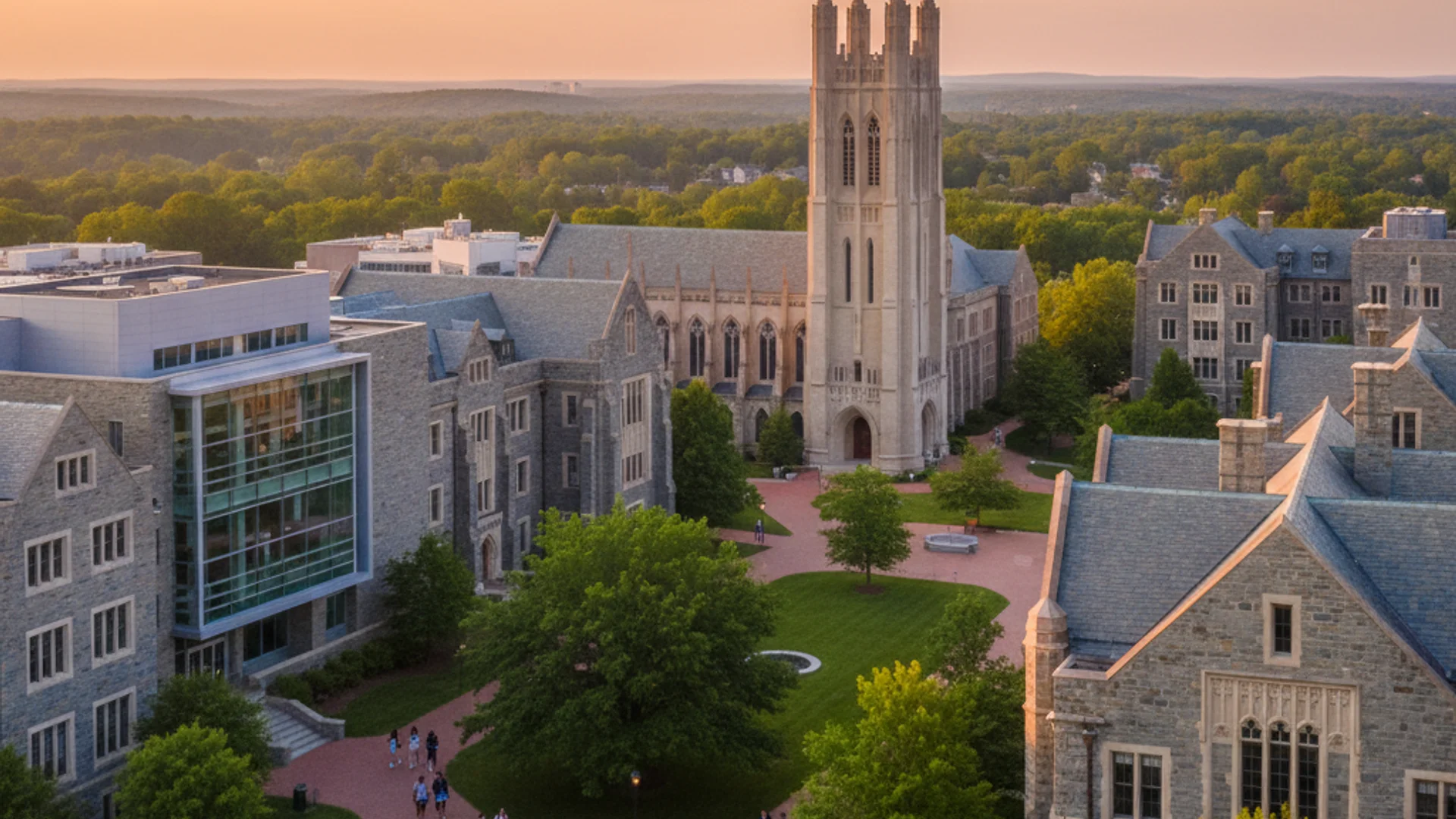
Compare the top data science colleges in North Carolina. 24 accredited data science schools ranked by graduation rate, career outcomes, and value, from University of North Carolina at Charlotte to University of North Carolina at Chapel Hill.
Best data science degree programs: U of North Carolina at Ch..., Duke, North Carolina State Univ...
Ranked by graduation rates, program outcomes, and institutional quality
Tuition ranges from $1,000 to $63,608/year
U of North Carolina at Ch... offers the most affordable option at $3,812/yr
Data Science degree programs available: 11 master's, 4 doctoral in North Carolina
From community college pathways to advanced research degrees
9 online data science degree programs in North Carolina
Flexible scheduling for working professionals
Major employers: IBM, Cisco, Red Hat, SAS
Tech hubs in Raleigh and Charlotte
Hakia Research 2026
Data Science degree programs near 92+ cities across North Carolina
Search by city to find programs within 200 miles of your location
Updated October 19, 2026
We rank 39 accredited data science programs in North Carolina using IPEDS 2024 institutional data, BLS OEWS 2024 state salary data, and College Scorecard outcomes. A 4-factor weighted composite is normalized to a 0–100 score. Schools cannot pay for placement; rankings are produced algorithmically.
Are Data Science Degree Programs in North Carolina Worth It?
Source: BLS OEWS May 2024
Compare the top-ranked Data Science programs in North Carolina by degree level. Tuition, graduation rate, and Hakia Score for every accredited program.
North Carolina ranks among the nation's top destinations for data science education, with 24 accredited bachelor's degree programs across 14 public and 10 private institutions. The highest-ranked programs are U of North Carolina at Ch..., Duke, North Carolina State Univ..., recognized for academic excellence, research opportunities, and strong industry connections.
Graduates from North Carolina data science programs earn a median salary of $91,239, 7% below the national average. The state's robust technology sector, anchored by the Raleigh, Charlotte, Durham metropolitan areas, provides abundant internship and employment opportunities with companies including IBM, Cisco, Red Hat.
Tuition ranges from $1,000 to $63,608 annually, with an average of $19,182/yr. Top programs maintain graduation rates above 86%, with the highest reaching 100%. Many programs hold ABET accreditation, the gold standard for computing education, ensuring curriculum meets rigorous industry standards.
Students can choose from specializations including software engineering, cybersecurity, artificial intelligence, data science, and systems architecture. Strong industry partnerships provide access to co-op programs, capstone projects with real companies, and direct recruiting pipelines to North Carolina's leading technology employers. For students seeking data science degrees in North Carolina, these top-ranked data science schools offer the strongest combination of academic rigor and career preparation.
North Carolina offers 11 master's degree programs in data science, designed for professionals seeking to advance into senior engineering, technical leadership, and specialized roles. The top programs, North Carolina State Univ..., U of North Carolina at Ch..., U of North Carolina at Ch..., combine advanced technical training with research opportunities and leadership development.
Master's graduates in North Carolina earn a median salary of $107,340, approximately 20-30% higher than bachelor's degree holders. The concentration of technology companies in Raleigh, Charlotte, Durham creates strong demand for graduate-level talent, with IBM, Cisco, Red Hat actively recruiting from these programs.
Program formats include traditional full-time study (typically 2 years), part-time options for working professionals (2-3 years), and accelerated tracks. Tuition averages $16,266/yr, with many employers offering tuition reimbursement for graduate education. Some programs offer thesis and non-thesis tracks, allowing students to focus on research or professional development based on their career goals.
Curriculum covers advanced topics including machine learning, distributed systems, software architecture, and technical management. Many programs include practicum experiences, industry capstone projects, or consulting engagements that provide real-world application of advanced concepts. Among North Carolina's data science schools at the graduate level, these programs stand out for both academic quality and career outcomes.
| Metric | Value |
|---|---|
| Average in-state tuition | $19,182/year |
| Average out-of-state tuition | $47,955/year |
| Community college tuition | $4,796/year |
| 4-year savings for residents | $115,092 |
| 2+2 transfer pathway savings | $28,772 |
Source: IPEDS 2024
Verdict: North Carolina data science students benefit from moderate-but-genuine state aid plus a distinctive direct relationship between NC State and SAS Institute (HQ'd in Cary, one of the largest US analytics-vendor operations). NC State's Statistics Department is one of the top US public-university statistics programs, with extensive SAS-funded research partnerships. Combined with strong UNC Chapel Hill, UNC Charlotte, and Duke DS programs, NC offers one of the better US Southeast DS education ecosystems.
NC Education Lottery Scholarship provides up to ~$5,100/year at NC public 4-year institutions for residents with financial need. UNC Need-Based Grant stacks on top for UNC System students. NC Need-Based Scholarship (NCNBS) extends aid up to ~$11,150/year for NC residents at private NC institutions (Duke, Wake Forest, Davidson, Elon).
UNC Chapel Hill's Carolina Covenant and NC State's Pack Promise programs cover full tuition for qualified low-income NC residents at the state flagships. For DS-track students at NC State (one of the strongest US public Statistics departments) or UNC Chapel Hill, these programs combined with federal Pell can produce zero-loan DS-track bachelor's degrees.
NC State's Statistics Department has substantial SAS-funded research and direct industry pipelines into SAS Institute (Cary, NC). Duke University's Department of Statistical Science and Pratt School of Engineering DS programs have substantial institutional aid for admitted students with demonstrated need. UNC Charlotte's Data Science programs through CS and Mathematics departments have CAE-CD designation and accessible transfer admission. Federal Pell stacks on top. Industry-track scholarships from NC-based DS employers (SAS Institute scholarships, IBM RTP, Red Hat, Bank of America DS, Wells Fargo Charlotte DS) provide additional funding most students don't pursue.
Use our interactive ROI calculator to estimate your return on investment for a data science degree in North Carolina. Enter your expected tuition costs, financial aid, and career goals to see projected payback periods and lifetime earnings. The calculator uses current salary data from BLS and tuition data from IPEDS to provide accurate estimates.
Estimate your return on investment for a data science degree
Leave blank to use average cost for selected program type
+592%
Net gain divided by total investment. ROI above 200% is considered excellent for education investments.
$1,095,969
Your additional lifetime earnings with this degree vs. working without one, minus the total investment.
6 years
Years until your cumulative earnings exceed total investment. Shorter programs often break even faster due to lower opportunity cost.
$115,789
Your starting salary adjusted for local cost of living. This shows real purchasing power compared to a $100K national baseline.
Why does break-even change with program type? Your "total investment" includes both tuition AND opportunity cost (foregone earnings while in school). A 4-year full-time public university (in-state) means 4 years of not earning a salary ($140,000 in opportunity cost). Shorter full-time programs may have higher tuition but lower total investment because you return to the workforce sooner.
How we calculate your degree ROI using real salary data
Tuition plus opportunity cost (earnings you miss while in school)
Direct cost of the degree program
4 years × $35K/year foregone salary while studying full-time
Projected career earnings starting after graduation, with salary growth
What you'd earn working at $35K/year with 2% annual growth
Median salary for this role in your selected location (BLS 2024)
Your investment's compound annual growth rate (similar to stock market returns)
Data sources: BLS OEWS May 2024, IPEDS 2024. Calculations use median salaries, 3% discount rate, and assume salary growth declines from 6% to 2% over career. Individual results will vary. | Powered by Hakia.com
Median annual salary in North Carolina metro areas
| Category | Value |
|---|---|
| Raleigh | $118K |
| Charlotte | $113K |
| Durham | $107K |
Source: BLS OEWS May 2024
Hakia.com
Find data science jobs in North Carolina. These major employers across North Carolina metro areas are actively hiring data science degree holders. Click employer names to view current job openings.
Charlotte is the second-largest banking center in the US. Bank of America and Wells Fargo drive fintech demand.
Nearby cities: Huntersville, Concord, Matthews, Gastonia, Rock Hill, Mooresville
North Carolina's Research Triangle (Raleigh-Durham-Chapel Hill) is one of the densest US tech corridors per capita, anchored by three major research universities (NC State, Duke, UNC Chapel Hill) and a 7,000-acre Research Triangle Park hosting hundreds of tech employers. Charlotte separately operates as a top-tier US financial-services tech hub.
Raleigh-Durham-Chapel Hill metros
Home to SAS Institute (analytics), IBM Research Triangle Park, Cisco, Red Hat (now IBM), Lenovo Americas HQ, Epic Games, Citrix, Bandwidth, and the Research Triangle Park complex. NC State CS, Duke CS, and UNC computer science all feed the local market — combined a top-10 US CS graduate pipeline.
Charlotte metro
Bank of America HQ and a top-3 US banking center. Wells Fargo, Truist, LendingTree, and dense fintech employment. Charlotte tech is heavily financial-services-coded; less consumer/startup but exceptionally stable employment.
Asheville metro
Smaller but growing remote-work and outdoor-industry tech market; not a primary tech destination but increasingly relevant for lifestyle-driven talent.
North Carolina has a flat state income tax (4.5% in 2026, scheduled to decline further). The NC Job Development Investment Grant (JDIG) and One NC Fund are the principal tech-employer incentives — Apple's $1B+ RTP campus relocation was supported by these programs.
North Carolina has been more active on legislation around identity theft, biometrics, and AI in employment than on broad consumer privacy. The state's regulatory environment is generally employer-favorable but has tightened on data security since several high-profile state-government breaches.
Requires businesses to notify NC residents of data security breaches and sets minimum data-handling and disposal standards for personal information.
Standard breach-response compliance for any NC-resident-serving business; minimum technical standards have informed security-program design at NC-headquartered employers.
Read moreState cybercrime law parallel to federal CFAA; covers unauthorized computer access, computer-related fraud, and damage to data.
Relevant for cybersecurity professionals doing incident response, penetration testing, or security research within NC.
Read moreAdopted from the NAIC model; requires insurers and insurance-adjacent businesses to maintain comprehensive information security programs with risk assessments, incident response plans, and third-party oversight.
Drives security-engineering hiring at Charlotte-based insurance and financial-services employers; sets the technical bar for NC financial-services security teams.
Read moreNorth Carolina does not currently administer a separate Software Engineering PE license. Standard engineering disciplines require ABET-EAC accreditation for PE eligibility; software engineering is not a recognized NC PE discipline. NC State's ABET-EAC software engineering program does qualify graduates for engineering tracks at federal agencies that recognize software engineering as engineering.
North Carolina licensing boardUp to $11,150/yr
NC residents with demonstrated financial need at NC private colleges/universities
Varies by institution and need; averages ~$3,500/yr
NC residents with financial need attending one of 16 UNC System universities
Up to $5,100/yr at 4-year, $2,800/yr at community college
NC residents at NC public 2-year and 4-year institutions with financial need
Up to $2,800/yr
NC residents at NC community colleges with financial need
Verdict: North Carolina's Comprehensive Articulation Agreement (CAA) between the 58-school NC Community College System and the 16-campus UNC System guarantees transfer admission for AS-degree graduates. The DS-specific dimension is that NC State Statistics, UNC Charlotte DS, and UNC Greensboro DS all have accessible transfer admission while UNC Chapel Hill DS and Duke DS remain competitive for transfers.
Best North Carolina community college DS-feeder schools: Wake Technical Community College (Raleigh, strong NC State transfer pipeline, refined DS prerequisite sequences), Central Piedmont Community College (Charlotte, strong UNC Charlotte pipeline), Forsyth Technical Community College (Winston-Salem area), Guilford Technical Community College (Greensboro), Durham Technical Community College, and Asheville-Buncombe Technical Community College.
The Wake Tech → NC State Statistics or CS DS-track pathway is the most reliable NC DS transfer progression, NC State's transfer admission rates are accessible (25-40% for qualified DS-track applicants) and Wake Tech's CS/Stats prerequisite sequences align well with NC State's program. The Central Piedmont → UNC Charlotte DS pathway is the parallel for Charlotte-area students, UNC Charlotte's CS Department has substantial DS-track curriculum and accessible transfer admission.
Beyond NC State and UNC Charlotte: UNC Greensboro has growing DS programs through its Bryan School of Business and Department of Mathematics and Statistics. East Carolina University has DS programs with substantial military-veteran student support. Appalachian State University (Boone) has growing DS programs in a smaller-school environment. UNC Chapel Hill DS transfer admission is competitive (10-20% for DS-track majors). Duke DS transfer admission is genuinely difficult (under 10%). For NC DS-track students, the NC State pathway is the SAS-connected research-and-industry optimization; UNC Charlotte is the Charlotte banking-DS optimization; UNC Greensboro and Appalachian State are the affordable accessible-DS options; UNC Chapel Hill and Duke are the elite optimizations for the most competitive applicants.
Data Science Job Growth in North Carolina
Source: BLS Occupational Outlook
Verdict: North Carolina has one of the largest US data science job markets outside the coastal centers, anchored by two distinctive clusters: Research Triangle Park's enterprise-tech DS (SAS Institute, one of the largest US analytics-vendor operations, IBM RTP DS, Cisco DS, Red Hat DS, Lenovo DS, Epic Games DS, plus growing Apple RTP DS) and Charlotte's banking DS (Bank of America HQ, Wells Fargo Charlotte operations, Truist DS, collectively one of the largest US bank DS workforces). Combined with substantial NC State + Duke + UNC DS pipelines and materially lower cost of living than coastal markets, NC DS purchasing power often exceeds Bay Area equivalents.
By metro: Research Triangle (Raleigh-Durham-Chapel Hill) averages ~$120,000-$155,000 for data scientist roles per Levels.fyi and BLS, anchored by SAS Institute (Cary, one of the largest US analytics-vendor DS organizations, substantial R&D and applied DS work), IBM Research Triangle Park DS (one of IBM's most significant US DS operations, both research and applied), Cisco DS, Red Hat DS, Lenovo Americas HQ DS, Epic Games DS, Citrix DS, Bandwidth DS, NetApp DS, RTI International (federal DS research consultancy), plus growing Apple RTP DS hiring as Apple's $1B+ campus opens in phases through 2027.
Charlotte averages ~$115,000-$150,000 with Bank of America DS (one of the largest US bank DS organizations, credit modeling, fraud detection, customer analytics, ML platform engineering at scale), Wells Fargo DS (substantial Charlotte operations alongside SF HQ), Truist DS (formed from BB&T-SunTrust merger), LendingTree DS, Honeywell DS, Lowe's DS, Brighthouse Financial DS (Charlotte-headquartered insurance and annuities). Charlotte's banking-DS work is heavily regulated and operationally complex, different skill emphasis than RTP enterprise DS but equally substantial.
Two distinctive NC DS dynamics: (1) SAS Institute's direct relationship with NC State Statistics produces a structurally unique DS pipeline, SAS's substantial R&D operation in Cary employs hundreds of statisticians and data scientists, many with NC State degrees, and the resulting talent feedback loop creates distinctive Triangle-area DS culture and methodology depth. (2) Charlotte banking DS continued aggressive hiring through 2022-2024 broader tech downturns, bank-tech operates on different demand cycles than consumer internet, and Charlotte's big-3-bank base provides ongoing employment stability that's hard to find in less-bank-heavy metros. The NC Insurance Data Security Act intersects with DS work at Charlotte insurance employers. See AI/ML Engineer Career Guide and Data Analyst Career Guide.
New graduates and career changers
Technical leads and architects
9 available in North Carolina
Traditional classroom experience
Institutional characteristics, completions, graduation rates
North Carolina salary and employment data
Program details and admissions information
Last Updated: June 26, 2026. Rankings based on IPEDS 2024 data. Salary data from BLS OEWS May 2024.

Co-founder & Editor (B.S. Computer Science, Oregon State • B.A. Psychology, University of Washington)
Taylor combines technical expertise in computer science with a deep understanding of human behavior and learning. His dual background drives Hakia's mission: leveraging technology to build authoritative educational resources that help people make better decisions about their academic and career paths.
Hand-researched detail on the top-ranked programs: degree pathways, research labs, industry partners, career outcomes, and admissions. Tap any school to expand.
Why it stands out. First School of Data Science in the Carolinas, uniquely positioned in the big data hub, and the first and only to offer a bachelor's degree in Sports Analytics in the southeast region
Hakia insight. UNC Charlotte's exclusive Sports Analytics bachelor's degree in the Southeast captures a growing hiring pipeline (teams, leagues, agencies) that most traditional programs ignore, effectively creating a credential moat in a niche with rising salaries.
At the bachelor's level, UNC Charlotte's School of Data Science is the first in the Carolinas, uniquely centered in the hub of big data and created through innovative collaboration between five colleges. The programs offer a dynamic blend of theory and practical skills, preparing students to lead in the data-driven world.
Programs offered
Admissions
GPA 3.0 undergraduate / 3.5 graduate for PhD; 3.0 for MS programs.
Why it stands out. A small, interdisciplinary program with experienced faculty, team-based science approach, and capstone projects that combines rigorous computational training with field knowledge and repeated practice in critical thinking, teamwork, and collaborative leadership
Hakia insight. Duke's MIDS intentionally stays small and caps cohorts for a two-year program where capstone projects are done in teams with real industry partners (NVIDIA, Carta Healthcare); this prevents the 100+ student cohort problem where mentorship becomes transactional.
Duke's Master in Interdisciplinary Data Science (MIDS) is a small, high-touch, two-year applied data science Master's program that prepares data scientists to solve real-world problems through critical thinking, collaboration, and communication. The program features a project-based learning model with training in cloud, databases, and distributed systems to ensure graduates are ready to deploy solutions immediately.
Programs offered
Industry partners
Career outcomes
Top employers: Carta Healthcare, NVIDIA, Delaware Democratic Party
Hakia insight. Carolina University's 2.0 undergraduate / 2.5 graduate GPA requirements are among the most accessible in this cohort, opening graduate data science to career-switchers and non-traditional students who've improved their trajectory but lack elite transcripts.
At the master's level, the Master of Data Science program is designed to meet the growing demand for data science professionals in various industries. The program focuses on developing advanced analytical and technical skills for data-driven decision making.
Programs offered
Admissions
Acceptance rate Not specified%. GPA 2.0 undergraduate, 2.5 graduate.
Accreditation & certifications
Location advantage: Located in Winston-Salem, North Carolina Vibrant city environment