🥇
$10,034
Tuition/yr
90%
Grad rate
94.9
Hakia Score
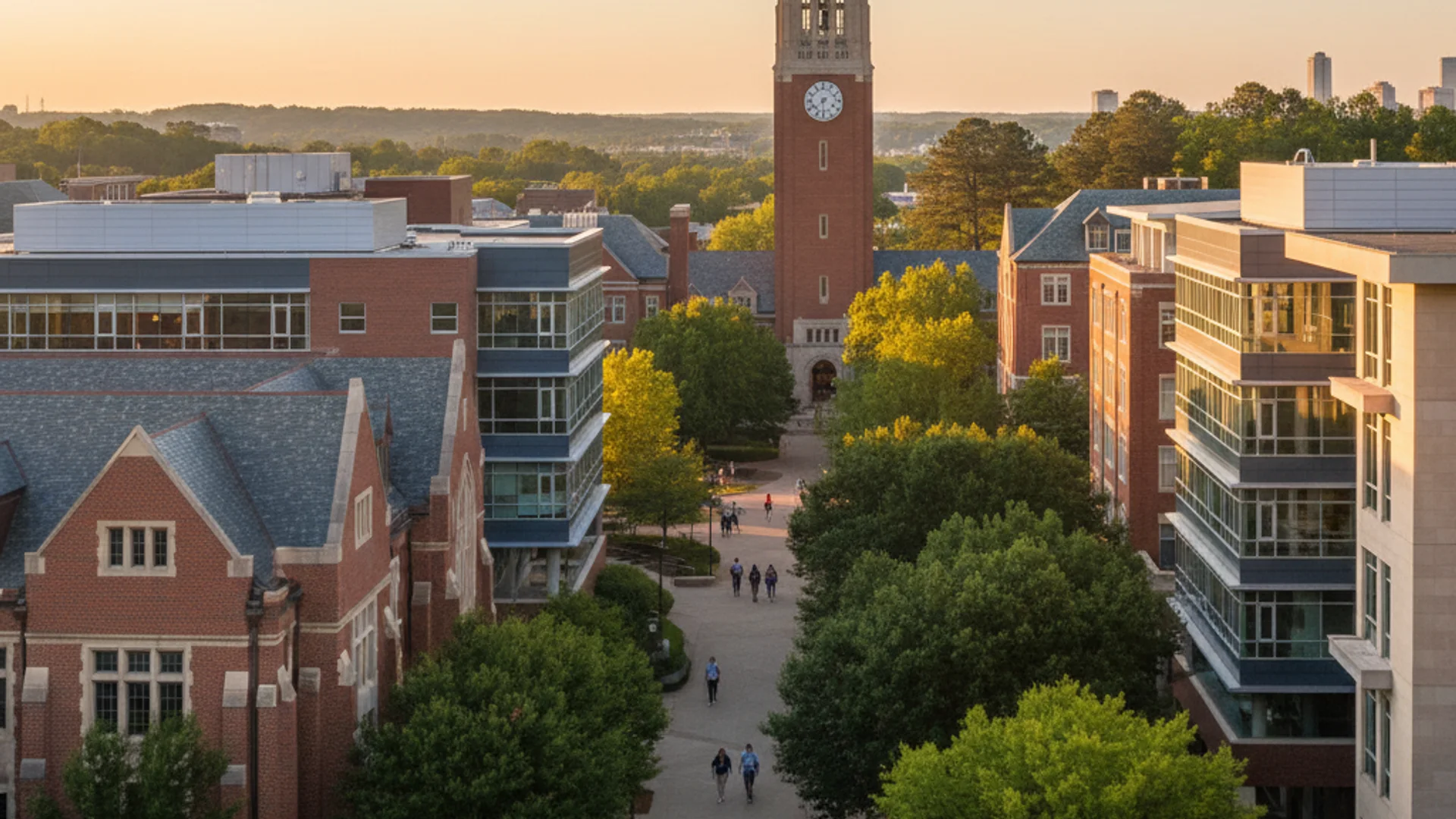
Compare the top computer science colleges in Georgia. 29 accredited computer science schools ranked by graduation rate, career outcomes, and value, from Gordon State College to Georgia Institute of Technology-Main Campus.
Georgia Institute of Technology is a top-5 national CS program with a 76% grad rate at $10,258/yr in-state
Georgia Tech's CS college is one of the largest in the U.S., with CAE-R designation and direct pipelines to Atlanta's Microsoft, Google, and Salesforce offices
Atlanta-area CS salaries reach $118,195, making it the top-paying tech hub in the Southeast
The state median of $107,450 pairs with Georgia's relatively low cost of living to offer strong purchasing power compared to coastal metros
Georgia State University posts a 94% CS grad rate at just $7,158/yr, the best value among bachelor's programs in the state
Located in downtown Atlanta, GSU offers direct access to the city's fintech, retail tech, and enterprise software employers
University of North Georgia reports a 100% CS graduation rate at $4,230/yr, the cheapest public bachelor's option
Holds CAE-CDE cybersecurity designation; a strong budget choice for students outside the Atlanta metro
Top employers: Microsoft, Google, Salesforce, NCR Corporation, The Home Depot, Delta Air Lines, Mailchimp
Atlanta is a major tech hub anchored by Georgia Tech, with strong fintech, retail tech, and enterprise software sectors across Midtown, Buckhead, and Alpharetta
Hakia Research 2026
Updated October 19, 2026
We rank 44 accredited computer science programs in Georgia using IPEDS 2024 institutional data, BLS OEWS 2024 state salary data, and College Scorecard outcomes. A 4-factor weighted composite is normalized to a 0–100 score. Schools cannot pay for placement; rankings are produced algorithmically.
Are Computer Science Degree Programs in Georgia Worth It?
Source: BLS OEWS May 2024
Compare the top-ranked Computer Science programs in Georgia by degree level. Tuition, graduation rate, and Hakia Score for every accredited program.
Georgia ranks among the nation's top destinations for computer science education, with 25 accredited bachelor's degree programs across 16 public and 9 private institutions. The highest-ranked programs are Georgia Institute of Tech..., Georgia State, U of Georgia, recognized for academic excellence, research opportunities, and strong industry connections.
Graduates from Georgia computer science programs earn a median salary of $91,333, 7% below the national average. The state's robust technology sector, anchored by the Atlanta, Savannah, Augusta metropolitan areas, provides abundant internship and employment opportunities with companies including NCR, Mailchimp, SalesLoft.
Tuition ranges from $3,600 to $59,920 annually, with an average of $15,685/yr. Top programs maintain graduation rates above 88%, with the highest reaching 100%. Many programs hold ABET accreditation, the gold standard for computing education, ensuring curriculum meets rigorous industry standards.
Students can choose from specializations including software engineering, cybersecurity, artificial intelligence, data science, and systems architecture. Strong industry partnerships provide access to co-op programs, capstone projects with real companies, and direct recruiting pipelines to Georgia's leading technology employers. For students seeking computer science degrees in Georgia, these top-ranked computer science schools offer the strongest combination of academic rigor and career preparation.
| Rank | School | Location | Type | Tuition | Grad Rate | Hakia Score |
|---|---|---|---|---|---|---|
| #6 | Berry College | Mount Berry, GA | Private nonprofit | $41,160 | 69% | 77.5 |
| #7 | Kennesaw State University | Kennesaw, GA | Public | $4,560 | 52% | 77.0 |
| #8 | Georgia College & State University | Milledgeville, GA | Public | $7,696 | 64% | 75.2 |
| #9 | Clark Atlanta University | Atlanta, GA | Private nonprofit | $25,128 | 49% | 72.1 |
| #10 | Clayton State University | Morrow, GA | Public | $4,176 | 40% | 69.7 |
| #11 | Georgia Southwestern State University | Americus, GA | Public | $4,176 | 41% | 66.3 |
| #12 | Augusta University | Augusta, GA | Public | $7,064 | 49% | 65.0 |
Georgia offers 11 master's degree programs in computer science, designed for professionals seeking to advance into senior engineering, technical leadership, and specialized roles. The top programs, Georgia Institute of Tech..., Georgia State, U of Georgia, combine advanced technical training with research opportunities and leadership development.
Master's graduates in Georgia earn a median salary of $107,450, approximately 20-30% higher than bachelor's degree holders. The concentration of technology companies in Atlanta, Savannah, Augusta creates strong demand for graduate-level talent, with NCR, Mailchimp, SalesLoft actively recruiting from these programs.
Program formats include traditional full-time study (typically 2 years), part-time options for working professionals (2-3 years), and accelerated tracks. Tuition averages $12,648/yr, with many employers offering tuition reimbursement for graduate education. Some programs offer thesis and non-thesis tracks, allowing students to focus on research or professional development based on their career goals.
Curriculum covers advanced topics including machine learning, distributed systems, software architecture, and technical management. Many programs include practicum experiences, industry capstone projects, or consulting engagements that provide real-world application of advanced concepts. Among Georgia's computer science schools at the graduate level, these programs stand out for both academic quality and career outcomes.
| Rank | School | Location | Type | Tuition | Grad Rate | Hakia Score |
|---|---|---|---|---|---|---|
| #6 | University of West Georgia | Carrollton, GA | Public | $4,488 | 43% | 69.7 |
| #7 | Georgia Southern University | Statesboro, GA | Public | $4,488 | 55% | 67.1 |
| #8 | Clark Atlanta University | Atlanta, GA | Private nonprofit | $25,128 | 49% | 66.7 |
| #9 | Georgia Southwestern State University | Americus, GA | Public | $4,176 | 41% | 63.1 |
Georgia is home to 4 doctoral programs in computer science, preparing students for research positions, faculty appointments, and executive technical roles. Leading programs at Georgia Institute of Tech..., Emory, Georgia State are recognized for cutting-edge research, strong faculty publications, and competitive funding packages.
Doctoral graduates command premium salaries, with Georgia PhD holders earning a median of $134,313, reflecting the advanced expertise required for research and executive positions. The Atlanta, Savannah, Augusta region's research universities and corporate R&D centers provide extensive collaboration opportunities with industry leaders like NCR, Mailchimp, SalesLoft.
PhD programs typically require 4-6 years of full-time study, including coursework, qualifying examinations, and original dissertation research. Many programs offer full funding through teaching or research assistantships, covering tuition and providing stipends of $25,000–$40,000 annually.
Research strengths across Georgia programs include artificial intelligence, cybersecurity, human-computer interaction, systems, and theoretical computer science. For aspiring researchers pursuing computer science degrees in Georgia, graduates go on to careers as university faculty, industry research scientists, or technical executives, contributing to advances in technology that impact millions of users worldwide.
| Metric | Value |
|---|---|
| Average in-state tuition | $14,344/year |
| Average out-of-state tuition | $35,860/year |
| Community college tuition | $3,586/year |
| 4-year savings for residents | $86,064 |
| 2+2 transfer pathway savings | $21,516 |
Source: IPEDS 2024
Verdict: Georgia has the most generous merit-based state aid system in the United States. The HOPE Scholarship provides Georgia high school graduates with a 3.0+ GPA significant tuition coverage at Georgia public colleges and universities; the higher Zell Miller Scholarship tier (3.7+ GPA + qualifying test scores) covers 100% of standard undergraduate tuition at Georgia public 4-year institutions. For Georgia residents with strong academic records, this combination produces some of the lowest net-cost CS bachelor's options in the country, particularly at Georgia Tech.
Zell Miller Scholarship is the standout: Georgia high school graduates with 3.7+ GPA and 1200+ SAT (or 26+ ACT) receive full standard undergraduate tuition at Georgia public colleges and universities. For Georgia Tech, one of the top-5 US CS programs, Zell Miller produces full in-state tuition coverage, dropping CS bachelor's tuition cost to essentially zero before considering room/board and fees.
HOPE Scholarship is the more accessible tier: Georgia HS grads with 3.0+ GPA receive partial tuition coverage at Georgia public institutions (the exact percentage varies year-by-year but typically covers ~75-90% of standard tuition). HOPE Grant (for technical college students) and HOPE GED Grant extend coverage to alternative credentials and pathways.
REACH Georgia is a distinctive early-commitment program, selected low-income Georgia students starting in 8th grade who maintain academic and behavioral standards receive guaranteed college support (typically $2,500-$10,000 toward college, paired with HOPE). The Georgia Tuition Equalization Grant (TEG) provides up to ~$900/year for GA residents at eligible private GA institutions. Georgia Tech's institutional aid combined with HOPE/Zell Miller for in-state applicants makes Georgia Tech CS one of the strongest cost-to-quality propositions in US CS education, a 4-year Georgia Tech CS bachelor's can run under $20,000 total tuition for in-state students with Zell Miller eligibility.
Use our interactive ROI calculator to estimate your return on investment for a computer science degree in Georgia. Enter your expected tuition costs, financial aid, and career goals to see projected payback periods and lifetime earnings. The calculator uses current salary data from BLS and tuition data from IPEDS to provide accurate estimates.
Estimate your return on investment for a computer science degree
Leave blank to use average cost for selected program type
+750%
Net gain divided by total investment. ROI above 200% is considered excellent for education investments.
$1,386,612
Your additional lifetime earnings with this degree vs. working without one, minus the total investment.
6 years
Years until your cumulative earnings exceed total investment. Shorter programs often break even faster due to lower opportunity cost.
$125,000
Your starting salary adjusted for local cost of living. This shows real purchasing power compared to a $100K national baseline.
Why does break-even change with program type? Your "total investment" includes both tuition AND opportunity cost (foregone earnings while in school). A 4-year full-time public university (in-state) means 4 years of not earning a salary ($140,000 in opportunity cost). Shorter full-time programs may have higher tuition but lower total investment because you return to the workforce sooner.
How we calculate your degree ROI using real salary data
Tuition plus opportunity cost (earnings you miss while in school)
Direct cost of the degree program
4 years × $35K/year foregone salary while studying full-time
Projected career earnings starting after graduation, with salary growth
What you'd earn working at $35K/year with 2% annual growth
Median salary for this role in your selected location (BLS 2024)
Your investment's compound annual growth rate (similar to stock market returns)
Data sources: BLS OEWS May 2024, IPEDS 2024. Calculations use median salaries, 3% discount rate, and assume salary growth declines from 6% to 2% over career. Individual results will vary. | Powered by Hakia.com
Median annual salary in Georgia metro areas
| Category | Value |
|---|---|
| Atlanta | $118K |
| Savannah | $113K |
| Augusta | $107K |
Source: BLS OEWS May 2024
Hakia.com
Find computer science jobs in Georgia. These major employers across Georgia metro areas are actively hiring computer science degree holders. Click employer names to view current job openings.
Atlanta is a major tech hub anchored by Georgia Tech, with strong fintech, retail tech, and enterprise software sectors.
Nearby cities: Alpharetta, Sandy Springs, Marietta, Buckhead, Midtown
Georgia's tech market is anchored by Atlanta — one of the strongest US tech metros outside Silicon Valley and the East Coast core. Augusta hosts a globally significant cybersecurity cluster around Fort Eisenhower (formerly Fort Gordon) and the Army Cyber Center of Excellence. The state combines no-state-income-tax for tech expansion, the HOPE Scholarship pipeline filling Georgia Tech, and a deep enterprise-IT employer base.
Atlanta metro
Headquarters for Coca-Cola, Home Depot, UPS, Delta, NCR Voyix, Mailchimp (Intuit), Square/Block, and dozens of Fortune 500 IT operations. Strong fintech (Atlanta has been called 'Transaction Alley' for payments), e-commerce, and enterprise-software markets. Georgia Tech is the principal feeder for senior tech roles.
Augusta metro
Home to the Army Cyber Center of Excellence and U.S. Cyber Command operations. Largest US concentration of military cybersecurity professionals outside DC. Cyber-cleared engineering roles dominate the local market, with substantial private-sector cybersecurity employment around the base.
Savannah metro
Logistics-tech (Port of Savannah is the 3rd-largest US container port), defense (Gulfstream Aerospace), and an emerging consumer/startup tech scene. Smaller market but growing.
Georgia has a flat state income tax (5.39% in 2026, declining). The Georgia Investment Tax Credit and Quality Jobs Tax Credit are the principal state-level tech-employer incentives.
Georgia has not enacted a comprehensive consumer privacy law in the CCPA/VCDPA mold, but the state's cybercrime statutes, identity-theft protections, and active legislation around AI in state government shape the engineering compliance environment.
Requires businesses to notify Georgia residents of data breaches involving personal information; sets minimum standards for data security practices.
Standard breach-notification compliance for any GA-resident-serving business.
Read moreState-level cybercrime statute covering unauthorized computer access, computer trespass, computer theft, and identity theft. Establishes Georgia jurisdiction over cyber offenses.
Particularly relevant for cybersecurity, incident response, and ethical-hacking work performed within Georgia.
Read moreMultiple sessions have seen bills introduced to create CCPA-style privacy rights; none has passed as of 2026.
Engineers should watch this — Georgia passing comprehensive privacy would materially change tech compliance overhead in Atlanta-headquartered businesses.
Read moreGeorgia does not currently administer a separate Software Engineering PE license. ABET-EAC accreditation is recognized for traditional engineering PE tracks; software engineering is not a recognized Georgia PE discipline. For cybersecurity professionals, federal clearance requirements (Secret, Top Secret, TS/SCI) are far more relevant in the Augusta market than PE licensure.
Georgia licensing boardCovers a portion of tuition at GA public schools; varies
Georgia high school graduates with 3.0+ GPA attending eligible GA colleges/universities
Full standard undergraduate tuition at GA public schools
Georgia HS grads with 3.7+ GPA + qualifying SAT/ACT scores at eligible GA institutions
Covers tuition at GA technical colleges
GA residents pursuing certificates or diplomas at GA technical colleges (no GPA requirement)
Up to ~$900/yr
GA residents attending eligible private GA institutions
$2,500-$10,000 toward college, often paired with HOPE
Selected low-income Georgia students starting in 8th grade who maintain academic standing
Verdict: Georgia's transfer system is functional but dominated by the relationship between Georgia State University's Perimeter College and the broader University System of Georgia (USG). For Georgia community college students aiming at Georgia Tech CS specifically, one of the most competitive transfer destinations in the country, the path is genuinely difficult and requires deliberate planning. For students targeting the broader USG system (Georgia State, UGA, Kennesaw State, Georgia Southern), transfer pathways are well-supported.
The University System of Georgia (USG) has established transfer pathways across its 26-institution system. Georgia State University's Perimeter College operates as a community-college-equivalent within USG and has the strongest articulation with USG 4-year institutions, including a structured transfer pathway to Georgia State University's main campus CS program.
Best Georgia community college / 2-year college feeders: Perimeter College at Georgia State University, Georgia Highlands College, Atlanta Metropolitan State College, Gwinnett Technical College, and Chattahoochee Technical College. For CS specifically, Perimeter and Gwinnett Tech have the strongest established CS prerequisite sequences and dedicated transfer counseling.
Georgia Tech CS transfer admission is extremely competitive, Georgia Tech's CS program runs roughly 8-15% transfer admit rate, comparable to UC Berkeley CS in difficulty. The realistic pathway requires completing the full lower-division CS sequence (CS 1331, CS 1332 equivalents, calculus through multivariable, discrete math) at the community college with a 3.95+ GPA, plus strong projects and demonstrated CS depth. For Georgia students who don't make the Georgia Tech bar, Georgia State CS, Kennesaw State CS, UGA CS, and Georgia Southern CS all have more open transfer admission and strong industry placement, particularly into Atlanta's substantial tech employer base.
Computer Science Job Growth in Georgia
Source: BLS Occupational Outlook
Verdict: Georgia's CS job market is anchored by Atlanta as one of the strongest US tech metros outside the established coastal centers, plus a globally significant cybersecurity cluster around Augusta's Army Cyber Center of Excellence. Atlanta's tech economy has been called "Transaction Alley" for its dense fintech and payments-processing employer base, a sector that pays exceptionally well and runs counter to consumer-tech hiring cycles. For CS graduates targeting fintech specifically, Atlanta is among the strongest US destinations.
By metro: Atlanta averages ~$110,000-$140,000 for software engineer roles per Levels.fyi, anchored by Coca-Cola, Home Depot, UPS, Delta Air Lines IT, NCR Voyix, Mailchimp (now Intuit), Square/Block, plus dozens of Fortune-500 IT operations headquartered in the Atlanta metro. Atlanta has been called "Transaction Alley" for its dense payments-processing employer base, NCR, FIS, Global Payments, BlackBaud, making it the strongest US fintech hub outside NYC, Charlotte, and Miami. Augusta is materially smaller in absolute size but globally significant: home to the Army Cyber Center of Excellence and Fort Eisenhower (formerly Fort Gordon), with substantial cleared cyber employment plus private-sector cybersecurity contractor operations.
2026 sector picture for Georgia CS graduates: Atlanta's fintech employer base continued aggressive hiring through 2024-2025 while broader consumer tech slowed, payments processing operates on different demand cycles than consumer internet, and Atlanta's specific employer mix benefited. Georgia Tech CS graduates feed Atlanta tech at scale; the Tech-to-Atlanta-tech pipeline is among the strongest local university-to-local-employer relationships in the US tech market.
Two Georgia-specific dynamics: (1) Augusta's federal cyber cluster is unusually significant, for CS graduates interested in cybersecurity careers requiring federal clearance, Augusta is one of the strongest US destinations and Georgia universities (Georgia Tech, Augusta University, Georgia Southern, UGA) all have cybersecurity-specific tracks that feed it. (2) HOPE/Zell Miller graduates have strong financial flexibility post-graduation, Georgia Tech CS graduates with Zell Miller can graduate with substantially less debt than peers from comparable national CS programs, materially affecting risk tolerance for early-career career choices. See Software Engineer Career Guide, Cybersecurity Career Guide, and our Cybersecurity Certifications Guide.
New graduates and career changers
Technical leads and architects
16 available in Georgia
Traditional classroom experience
Institutional characteristics, completions, graduation rates
Georgia salary and employment data
Program details and admissions information
Last Updated: June 26, 2026. Rankings based on IPEDS 2024 data. Salary data from BLS OEWS May 2024.

Co-founder & Editor (B.S. Computer Science, Oregon State • B.A. Psychology, University of Washington)
Taylor combines technical expertise in computer science with a deep understanding of human behavior and learning. His dual background drives Hakia's mission: leveraging technology to build authoritative educational resources that help people make better decisions about their academic and career paths.
Hand-researched detail on the top-ranked programs: degree pathways, research labs, industry partners, career outcomes, and admissions. Tap any school to expand.
Why it stands out. ABET-accredited program. Mandatory teamwork requirement through specific courses
Hakia insight. UGA's HeRoLab and robotics focus under Prof. Parasuraman, combined with COX Enterprises partnership, means undergraduates can publish research and build systems that ship to real customers—not typical for four-year programs outside top 20 universities.
The Bachelor of Science in Computer Science at the University of Georgia provides a strong foundation in computer science theory and practice within a liberal arts education framework. The program requires 121 credit hours and is ABET-accredited by the CAC Commission. Students complete core coursework in software development, theory of computation, data structures, and computer architecture, followed by specialized requirements in computing and society, algorithms, application design, and systems design. An optional Area of Emphasis in Artificial Intelligence is available beginning Fall 2026. The curriculum emphasizes teamwork through required collaborative coursework (CSCI 4050, CSCI 4300, CSCI 4530, or CSCI 4800). Typical graduates pursue careers in software development, systems administration, consulting, project management, and increasingly in AI and cybersecurity roles. The program is supported by professional academic advisors at the Franklin College to ensure timely graduation.
Programs offered
Research labs & institutes
Industry partners
Notable faculty
Admissions
GPA 2.0.
Accreditation & certifications
Why it stands out. Offers students with interests in computing-related areas an opportunity to choose CS electives that fit their aspirations. Cannot be combined with any other CS or AI major/minor
Hakia insight. Emory's BA model (not BS) with elective-driven flexibility and the restriction against double-majoring is a deliberate choice: it targets students who view CS as a tool for biology, business, or social science problems rather than as a primary discipline, a genuinely different cohort most CS programs exclude.
Emory University's Bachelor of Arts in Computer Science is designed for students with diverse computing interests who want flexibility in their academic journey. The program offers students an opportunity to choose CS electives that fit their aspirations, making it highly customizable to individual career goals. The curriculum includes a solid mathematical foundation with Calculus I, Calculus II, and Linear Algebra, followed by core computer science courses from Introduction to Computer Science through advanced topics like Analysis of Algorithms and Systems Programming. Students complete either CS 370 or CS 371W Computer Science Practicum and select specialized electives from areas including Artificial Intelligence, Computational Linguistics, Machine Learning, and Database Systems. The program maintains academic rigor with a minimum 2.0 GPA requirement and mandates that all courses be taken for letter grades. Students benefit from dedicated advising through Dr. Ken Mandelberg, the Undergraduate CS BA Advisor. A unique aspect of this program is its exclusivity - it cannot be combined with any other CS or AI major or minor, ensuring focused study. The program also allows flexibility in topics courses, where students may count multiple CS 485 courses as long as subjects differ, providing opportunities for diverse exploration within computer science.
Programs offered
Notable faculty
Admissions
GPA 2.0.
Hakia insight. Morehouse's Center for Broadening Participation in Computing and partnership with 2U position Atlanta's HBCU not as a regional alternative but as an intentional pipeline into tech leadership—the research infrastructure targets systemic underrepresentation, not just enrollment.
At the bachelor's level, morehouse College offers a comprehensive computer science program as part of its Science, Technology, Engineering, & Mathematics division. The program focuses on developing technical skills while maintaining the college's commitment to leadership development and excellence.
Programs offered
Research labs & institutes
Industry partners
Career outcomes
Top employers: not specified
Admissions
Acceptance rate not specified%. GPA not specified.
Accreditation & certifications
Location advantage: Atlanta metropolitan area Access to tech industry in Georgia
Why it stands out. Internship opportunities with companies ranging from startups to major corporations. Emphasis on teamwork and people skills alongside technical skills
Hakia insight. Georgia State's partnerships with Coca-Cola, Delta, and UPS create routing into Fortune 500 internships without the traditional networking barrier; Atlanta's hub concentration means capstone projects often become production systems, not just assignments.
Georgia State University's Bachelor of Science in Computer Science provides a comprehensive foundation in computation, computer design, programming, and software development. Students complete core required courses in their early stages, then select from several concentration tracks for specialized depth. The program emphasizes both technical mastery and soft skills, preparing graduates for careers in software development, AI/ML, cybersecurity, and game development. Students intern at companies ranging from startups to major corporations including Coca-Cola, Delta, and UPS. The program prepares graduates for immediate industry positions or advanced studies at the M.S. or Ph.D. level.
Programs offered
Industry partners
Notable faculty
Admissions
Deadline Fall: May 1 (Regular), Nov 15 (Honors/Scholarship Priority); Spring: Dec 1; Summer: May 1.
Why it stands out. Hands-on training through labs and classroom work. Team-based group projects simulating real-world computing environments
Hakia insight. Kennesaw State's partnership with Intel as a top employer, combined with its team-based project model simulating real-world environments, creates a pipeline where students prototype solutions that directly mirror the problems they'll solve professionally—rare for regional universities.
The Bachelor of Science in Computer Science at Kennesaw State University provides a comprehensive foundation in computer systems architecture, algorithms, software development, artificial intelligence, and data science. The 120-credit, four-year program emphasizes hands-on learning through laboratory work, classroom projects, and team-based experiences that simulate real-world computing environments. Core curriculum covers programming, computer architecture, operating systems, networking, information assurance and security, big data, machine learning, data mining, cloud computing, database systems, and software engineering. Students gain practical experience through flexible course options including day, evening, and online classes with small class sizes. A Robotics Programming certificate is available as a credentialing option. Graduates are prepared for immediate employment in computing-related fields or graduate studies, with common career paths including software engineer, data analyst, program analyst, web developer, and software consultant. KSU's strong industry connections resulted in 7,100+ companies recruiting students and alumni in 2020. The program also offers the Double Owl Pathway, allowing qualified students to pursue both bachelor's and master's degrees in related fields (Cybersecurity MS, Information Technology MS, Software Engineering MS) at reduced cost and accelerated timeline.
Programs offered
Industry partners
Career outcomes
Top employers: Intel
Why it stands out. Three degree options: coursework-only (30 credits), project-based (21 credits + 9-credit capstone), or thesis-based (18 credits + 12-credit thesis). 11 specialization areas for customized degree planning
Hakia insight. Georgia Tech's 11 specialization areas across three degree formats (coursework, project, thesis) means a student can architect a 30-credit Master's that aligns to their specific exit goal—AI researcher, systems engineer, or startup CTO—rather than following a standardized path.
Georgia Tech's Master of Science in Computer Science is a terminal degree designed to prepare students for highly productive careers in industry. The program offers three flexible options: a 30-credit coursework-only track, a 21-credit course + 9-credit project option, or an 18-credit course + 12-credit thesis option, allowing working professionals to customize their path. Students choose from 11 specialization areas to tailor their degree to career goals. The program requires a strong CS foundation (C programming recommended) and maintains rigorous academic standards (3.0 GPA minimum, B or better in core courses). While specific salary data and assistantship stipends are not detailed on this page, the program targets mid-to-senior career advancement in industry roles. Georgia Tech's reputation and specialized tracks position graduates for significant salary advancement over bachelor's degrees. The flexible project and thesis options appeal to working professionals seeking research depth or applied capstone projects without full-time enrollment requirements.
Programs offered
Accreditation & certifications
Why it stands out. Thesis vs non-thesis track options. Research opportunities with well-funded faculty research groups
Hakia insight. UGA's HeRoLab and well-funded faculty research groups mean non-thesis track students can still access publishable research—avoiding the false binary between speed-to-degree and intellectual credibility.
The MS in Computer Science at the University of Georgia offers both thesis and non-thesis tracks, providing working professionals flexibility in their graduate studies. The program delivers a comprehensive foundation in computer science theory, methodology, and techniques with particular strengths in theory, systems, information systems, and artificial intelligence. Students develop skills in analysis, design, implementation, validation, and documentation of software and hardware, preparing them for technical, professional, or managerial positions in government, business, industry, and education. The department features energetic faculty with research groups and significant external funding. Graduates are well-positioned for career advancement and prepared to pursue doctoral degrees if desired.
Programs offered
Research labs & institutes
Industry partners
Notable faculty
Admissions
GPA 2.0.
Accreditation & certifications
Why it stands out. Three completion tracks: thesis (original research), project-based, or coursework-only. Gateway program for career-changers and professionals from non-CS backgrounds
Hakia insight. Emory's explicit gateway design for career-changers and the 2.0 GPA floor signal institutional commitment to retraining professionals over filtering by pedigree—the three-track model ensures a lateral hire from finance or biology doesn't face unnecessary gatekeeping.
Emory's Master of Science in Computer Science is designed for working professionals and career-changers, offering flexible pathways through three completion tracks: thesis (original research with faculty advisors), project-based, or coursework-only options. The program emphasizes data-oriented computer science with specializations in Artificial Intelligence, Machine Learning, Natural Language Processing, Data Mining, Bio/Health Informatics, High-End Computing, Theory, and Systems. Students complete 3 core courses, 4 concentration electives, and 9 credits in their chosen track, with a required practicum component. The MS serves as an effective gateway for professionals from non-CS backgrounds (basic programming and data structures required). Graduates typically advance into industry roles with increased responsibility and compensation, with some pursuing PhD studies. The program is structured for completion within 2 years, making it accessible to working professionals seeking career advancement in computing fields.
Programs offered
Notable faculty
Admissions
GPA 2.0.
Why it stands out. Thesis vs. project (coursework) track options. Graduate assistantships with full tuition waivers available (research, teaching, office assistantships)
Hakia insight. Georgia State's full tuition waiver assistantships combined with thesis/project flexibility create a rare opportunity for cost-conscious professionals: earn while studying without sacrificing research visibility that boosts hiring outcomes.
Georgia State University's Master of Science in Computer Science offers flexible thesis and project (coursework) track options to accommodate working professionals. The program requires 31-56 semester hours (1.5-3 years depending on undergraduate background) with classes on the downtown Atlanta campus. Graduate assistantships with full tuition waivers are available to top candidates, including research, teaching, and office assistantships. The program emphasizes cutting-edge research areas including AI, machine learning, cybersecurity, and cloud computing. Faculty have secured NSF CAREER awards and grants from NIH and CDC. Graduates are employed within months by major tech companies including Google, Amazon, eBay, and Coca-Cola, with many transitioning to industry roles or pursuing Ph.D. programs. The location in Atlanta's thriving tech hub provides internship and career advancement opportunities.
Programs offered
Industry partners
Career outcomes
Top employers: Google, Amazon
Notable faculty
Admissions
Deadline Fall: May 1 (Regular), Nov 15 (Honors/Scholarship Priority); Spring: Dec 1; Summer: May 1.
Why it stands out. Two flexible tracks: Research Training or Professional Training for Industry Practitioners. 30-credit program completable in 2 years
Hakia insight. Kennesaw's dual-track Master's (Research Training vs. Professional Training) acknowledges a rarely articulated reality: not every CS master's student wants to publish, and explicitly bifurcating the pathway prevents PhD-track design from strangling industry practitioner outcomes.
The Master of Science in Computer Science at Kennesaw State University is a rigorous 30-credit program designed for professionals with or without a CS bachelor's degree. Students choose between two tracks: a Research Training model for those pursuing advanced academic work, or a Professional Training for Industry Practitioners model tailored to working professionals. The curriculum blends theoretical computer science foundations with state-of-the-art technologies in AI, cybersecurity, databases, data science, and high-performance computing. The program offers flexible delivery through face-to-face and online courses with small class sizes, enabling completion in two years. Graduates advance into high-demand fields including data science, cybersecurity, and AI, with KSU recruiting 7,100+ companies engaging students and alumni.
Programs offered
Industry partners
Career outcomes
Top employers: Intel
Why it stands out. Designed for those with or without a CS background. All preparatory coursework is included as part of the degree
Hakia insight. University of West Georgia's explicit welcome to non-CS backgrounds with integrated preparatory coursework, paired with a 45-minute commute to Atlanta's tech market, captures a cohort priced out of Georgia Tech—mid-career career-changers who need credentials without the credential premium.
The University of West Georgia's M.S. in Applied Computer Science stands out as a uniquely accessible program designed for individuals from any academic background, requiring no prior computing experience. What makes this program distinctive is its inclusive approach - all preparatory coursework is included as part of the degree, eliminating traditional barriers to entry. The program offers exceptional flexibility with 100% fully online or face-to-face delivery formats for both full-time and part-time students, with online students paying only a subset of mandatory fees. UWG is often ranked as one of the most affordable accredited universities of its kind, making advanced computer science education accessible to a broader audience. Students can specialize through three focused tracks: Data Science, Cyber Intelligence, or Software Development. All classes are taught by highly qualified faculty with both academic and industry experience. The curriculum is practical, focused, and career-oriented, preparing graduates to enter the information technology job market immediately upon graduation. Career prospects are strong, with the U.S. Department of Labor Bureau of Labor Statistics noting that the median annual wage for computer and information technology occupations was $105,990 in May 2024. Graduates pursue successful careers as Software Developers, Web Developers, Database Administrators, Cybersecurity Analysts, Data Analysts, and Data Scientists.
Programs offered
Research labs & institutes
Industry partners
Career outcomes
Notable faculty
Location advantage: Access to Atlanta tech market (45 minutes away) Growing tech corridor in west Georgia and eastern Alabama
Why it stands out. One of the most affordable computer science programs in Georgia. 30 credit hours to completion
Hakia insight. Georgia Southern's 30-credit Master's at bottom-quartile Georgia pricing, coupled with employer placements at Microsoft and Expedia, inverts the usual cost-prestige trade-off and suggests the university has optimized for competency signal over credential scarcity.
Georgia Southern University's Master of Science in Computer Science stands out as one of the most affordable computer science programs in Georgia, requiring only 30 credit hours to completion. The program offers exceptional flexibility with fully online, hybrid, or in-person learning options available on the Statesboro Campus. Students benefit from personalized learning through small class sizes and hands-on experience in abundant lab and research activities using Georgia Southern's advanced facilities. The curriculum covers essential domains including algorithms, databases, artificial intelligence, and machine learning, with four strategic specializations: Software Engineering, Software and Cyber Security, Machine Learning, and Data and Knowledge Systems. Students complete either a thesis for further studies or a research project to demonstrate problem-solving skills. The program accepts students for fall, spring, and summer terms, requiring a bachelor's degree with minimum 2.5 GPA and GRE scores. Career prospects are excellent, with graduates earning about 30% more than bachelor's degree holders and finding positions at top employers including Microsoft, General Motors, Gulfstream Aerospace, Northrop Grumman, and the U.S. Air Force in roles such as cybersecurity analyst, software development engineer, and information security manager.
Programs offered
Research labs & institutes
Career outcomes
Top employers: Expedia, Microsoft
Notable faculty
Why it stands out. Covers complete life-cycle of computer application development including abstraction, modeling and algorithm development. Offers both thesis and non-thesis options
Hakia insight. Clark Atlanta's emphasis on application lifecycle development—from abstraction through deployment—combined with its AIHUB@CAU and NSF partnerships, positions an HBCU's graduate program as a practical counterweight to research-only curricula at R1 institutions.
Clark Atlanta University's Master of Science in Computer Science offers a comprehensive 33-credit hour program that distinguishes itself by covering the complete life-cycle of computer application development, from abstraction and modeling to algorithm development and software development techniques. The program provides flexibility with both thesis and non-thesis options, accommodating diverse student goals and career paths. Students gain expertise in programming and software development, algorithm design, computer science concepts, and computer and database systems through a structured curriculum including core courses in Algorithm Design & Analysis, Computer Organization, Operating Systems Design, and Database Design. The program is particularly accessible to students from different academic backgrounds, requiring only 2 prerequisites (6 hours of 400-level courses) for those without an undergraduate degree in Computer Science or related fields. Beyond technical skills, the program emphasizes professional development by introducing students to ethical, legal, security and social issues in computer science, while providing current techniques and tools necessary for research-based projects. The curriculum prepares students for advanced studies and professional careers, with graduates typically employed as software developers and engineers in the technology industry.
Programs offered
Research labs & institutes
Industry partners
Why it stands out. Fully online format with 24/7 accessibility. Collaborative assignments and opportunities to connect digitally with classmates and community professionals
Hakia insight. Georgia Southwestern's fully online asynchronous model with embedded peer collaboration isn't just convenience—it's a deliberate design for geographically dispersed professionals who need algorithmic depth without relocating to a tech hub.
Georgia Southwestern State University's Master of Science in Computer Science is designed as a fully online program that provides maximum flexibility for working professionals and students worldwide. The program stands out for its 24/7 accessibility, allowing students to advance their potential from anywhere in the world on their own terms. GSW's online programs are consistently ranked for value and quality, with faculty who work tirelessly to provide collaborative assignments and digital networking opportunities with both classmates and community professionals. The university is SARA approved through the National Council for State Authorization Reciprocity Agreements, ensuring quality standards in distance education. Students appreciate the program's flexibility, as evidenced by current MSCS student George Banketas from Americus, GA, who notes the ability to focus on full-time work during the day while dedicating evenings to coursework. The passionate faculty create an engaging learning environment that makes the online format both effective and enjoyable. As an accredited program from Georgia Southwestern, students receive a quality education that accommodates diverse lifestyles while maintaining academic rigor.
Programs offered
Notable faculty
Accreditation & certifications
Why it stands out. Georgia Tech's CS program uses a unique Threads™ system where students select two focused paths from nine available threads, creating synergistic educational experiences at the intersection of these paths. This allows students to weave a personalized degree while maintaining flexibility and coherent skill development.
Hakia insight. Georgia Tech's Threads™ system doesn't just offer flexibility—it structures interdisciplinary depth by design, letting doctoral students build genuine expertise at intersections (AI + systems, HCI + security) rather than sampling adjacent fields.
At the doctoral level, the undergraduate degree in computer science (CS) offered by the College of Computing provides a solid foundation of knowledge and skills for applying digital processes effectively to issues of broad interest in a global society. The program is based on a unique concept called Threads™, a significant College of Computing innovation in undergraduate CS education.
Programs offered
Accreditation & certifications
Why it stands out. World-class faculty at the cutting-edge of CS research, state-of-the-art facilities with undergraduate research opportunities, constantly-evolving curriculum, and over 97% of graduates in full-time employment or graduate programs at top institutions
Hakia insight. Emory's 97% placement rate into top institutions reflects a deliberate funnel: doctoral candidates inherit relationships built by world-class faculty actively publishing at premier venues, creating natural pathways to post-docs and faculty positions at peer institutions.
At the doctoral level, emory's Computer Science program offers comprehensive undergraduate and graduate degrees with strong emphasis on computing theory, systems, and applications. The program combines technical depth with opportunities for interdisciplinary study and research.
Programs offered
Notable faculty
Admissions
GPA 2.0.
Why it stands out. ABET accredited program within a liberal arts education context, with distinguished faculty actively engaging in cutting-edge research and excellent facilities fostering hands-on learning environments that encourage exploration and experimentation.
Hakia insight. UGA's HeRoLab under Prof. Parasuraman is a rare point: an ABET-accredited program where robotics research isn't isolated in a single lab but permeates upper-level coursework, letting CS doctoral students graduate with both theory credentials and hands-on systems experience.
At the doctoral level, the Bachelor of Science in Computer Science (BS-CS) at the University of Georgia provides a strong foundation in computer science theory and practice in the context of a liberal arts education. The School of Computing is one of the leading centers of innovation and academic excellence in the nation, known for its programs in computer science and information technology.
Programs offered
Research labs & institutes
Industry partners
Notable faculty
Admissions
GPA 2.0.
Accreditation & certifications
Why it stands out. At Georgia State, computer science students learn to solve challenging problems and to master new technologies quickly. We also teach our students to work in teams to develop solutions, preparing students with both technical skills and people skills that employers are looking for.
Hakia insight. Georgia State's partnerships with Coca-Cola, Delta, and UPS aren't just recruiting channels—they embed doctoral students in real-world problem spaces, where dissertation topics align with industry R&D priorities and often convert to employment offers before graduation.
At the doctoral level, computer science is the systematic exploration of all aspects of computation including computer design, computer programming and software, information processing, algorithmic solutions to problems and the algorithmic process itself. The Georgia State University B.S. degree program in computer science provides a good foundation for careers in industry, science, government and business as well as for advanced studies at the M.S. or Ph.D. level.
Programs offered
Industry partners
Career outcomes
Top employers: Coca-Cola, Delta, UPS
Notable faculty
Admissions
Deadline Fall: May 1 (Regular), Nov 15 (Honors/Scholarship Priority); Spring: Dec 1; Summer: May 1.