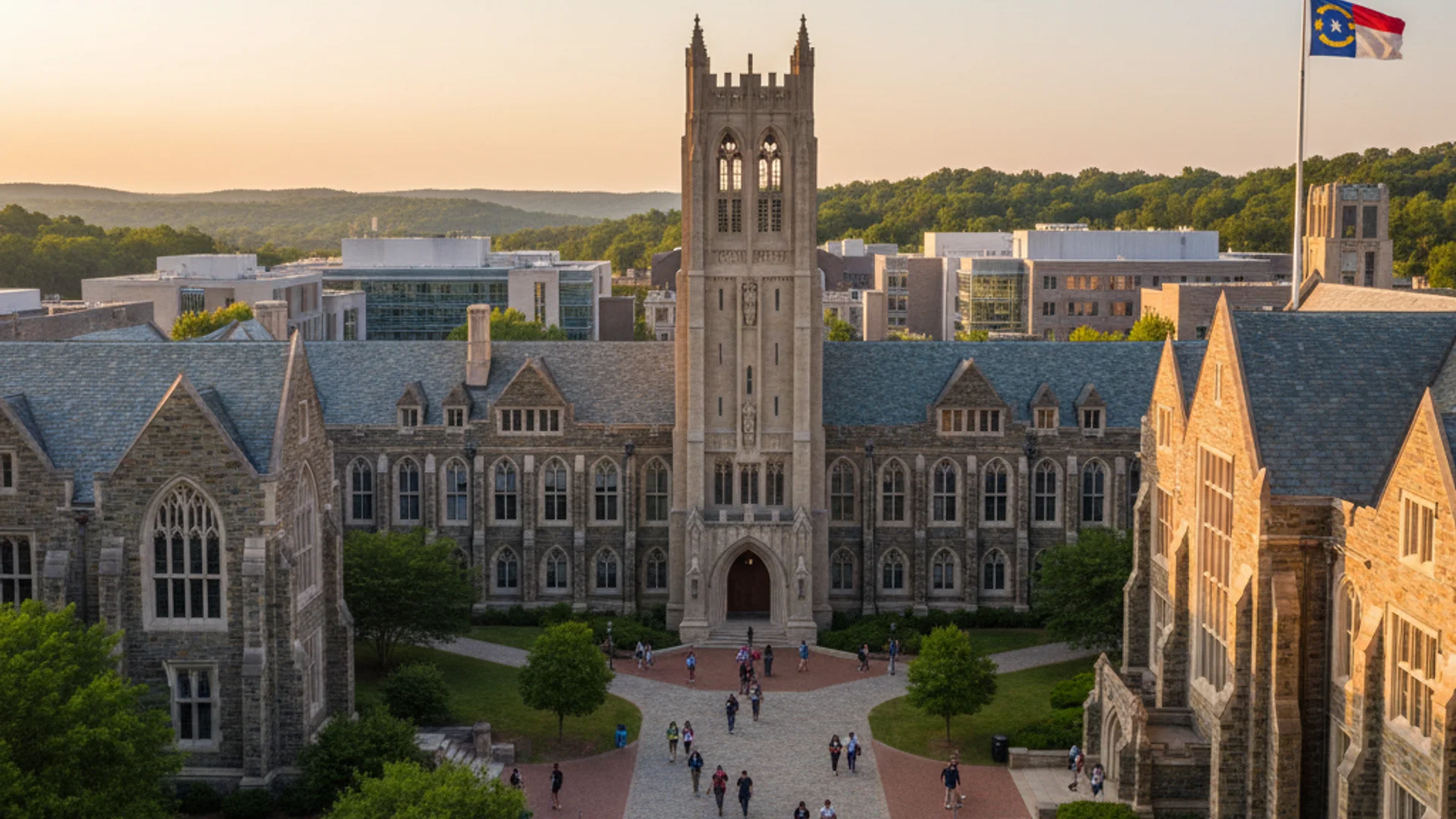
University campus in North Carolina
Updated January 2026

Best Artificial Intelligence Degree Programs in North Carolina — 2026 Rankings

Compare the top artificial intelligence colleges in North Carolina. 25 accredited artificial intelligence schools ranked by graduation rate, career outcomes, and value—from Wayne Community College to University of North Carolina at Chapel Hill.

#1 ProgramU of North Carolina at Ch...
Avg Salary$107,340
Tuition From$2,432/yr
Job Growth+22%
Reviewed by Taylor Rupe, Founder & EditorSee methodology

39

Programs ranked

IPEDS 2023

$107,340

North Carolina median artificial intelligence salary

BLS OEWS 2024

89/100

Top program score

Hakia methodology

23%

U.S. job growth (2023–33)

BLS projections

Key Takeaways

Best artificial intelligence degree programs: U of North Carolina at Ch..., Duke, U of North Carolina at Ch...

Ranked by graduation rates, program outcomes, and institutional quality

IPEDS 2023

Tuition ranges from $1,000 to $63,608/year

Wayne Community College offers the most affordable option at $2,432/yr

IPEDS 2023

Artificial Intelligence degree programs available: 1 associate's, 9 master's, 5 doctoral in North Carolina

From community college pathways to advanced research degrees

IPEDS 2023

13 online artificial intelligence degree programs in North Carolina

Flexible scheduling for working professionals

IPEDS 2023

North Carolina community college transfer can save 40-60% on total degree costs

1 associate's programs provide transfer pathways to bachelor's degrees

Education Commission of the States

Major employers: IBM, Cisco, Red Hat, SAS

Tech hubs in Raleigh and Charlotte

Hakia Research 2026

Artificial Intelligence degree programs near 92+ cities across North Carolina

Search by city to find programs within 200 miles of your location

IPEDS 2023

Updated February 2026

On This Page

How we ranked North Carolina Artificial Intelligence programs

We rank 39 accredited artificial intelligence programs in North Carolina using IPEDS 2023 institutional data, BLS OEWS 2024 state salary data, and College Scorecard outcomes. A 4-factor weighted composite is normalized to a 0–100 score. Schools cannot pay for placement; rankings are produced algorithmically.

Program completions (35%)Graduation rate (25%)Selectivity (20%)Career outcomes (20%)
See full methodology
$107,340
Are Artificial Intelligence Degree Programs in North Carolina Worth It?
Yes. The best artificial intelligence degree programs in North Carolina deliver strong ROI—graduates earn $107,340 median salary with +22% job growth through 2032. In-state tuition averages $18,512/year.

Source: BLS OEWS May 2024

Best Artificial Intelligence Bachelor's Programs in North Carolina, 2026

24
Programs
$107,340
Median Salary
$19,182/yr
Avg Tuition
86%
Avg Grad Rate

Rankings based on program completions, graduation rates, selectivity, and career outcomes. See our methodology

Program Landscape

North Carolina ranks among the nation's top destinations for artificial intelligence education, with 24 accredited bachelor's degree programs across 14 public and 10 private institutions. The highest-ranked programs are U of North Carolina at Ch..., Duke, U of North Carolina at Ch..., recognized for academic excellence, research opportunities, and strong industry connections.

Career Outcomes

Graduates from North Carolina artificial intelligence programs earn a median salary of $91,239—7% below the national average. The state's robust technology sector, anchored by the Raleigh, Charlotte, Durham metropolitan areas, provides abundant internship and employment opportunities with companies including IBM, Cisco, Red Hat.

Costs & Value

Tuition ranges from $1,000 to $63,608 annually, with an average of $19,182/yr. Top programs maintain graduation rates above 86%, with the highest reaching 100%. Many programs hold ABET accreditation, the gold standard for computing education, ensuring curriculum meets rigorous industry standards.

Curriculum & Specializations

Students can choose from specializations including software engineering, cybersecurity, artificial intelligence, data science, and systems architecture. Strong industry partnerships provide access to co-op programs, capstone projects with real companies, and direct recruiting pipelines to North Carolina's leading technology employers. For students seeking artificial intelligence degrees in North Carolina, these top-ranked artificial intelligence schools offer the strongest combination of academic rigor and career preparation.

Earn your bachelor's in Artificial Intelligence

(Sponsored)

Loading programs...

🥇

University of North Carolina at Chapel Hill

Public
Chapel Hill, NC
$7,019
Tuition/yr
$292
Per Credit
93%
Grad Rate
86.8
Score
Website

Why it ranks #1: Scored 87/100 on Hakia's composite, with the strongest signals coming from graduation rate (9.3/10) and program scale (8.7/10). One of the better-positioned artificial intelligence options at this level.

Program Completions(35%)
8.7/10

ExceptionalInferred from composite [IPEDS]

Graduation Rate(25%)
9.3/10

Exceptional93% completion [IPEDS]

Selectivity(20%)
5.8/10

Above averagePublic [IPEDS]

Career Outcomes(20%)
7.2/10

StrongState median salary $107,340 [BLS OEWS]

🥈

Duke University

Private
Durham, NC
$63,450
Tuition/yr
$1,983
Per Credit
77.4
Score
Website

Why it ranks #2: Scored 77/100 on Hakia's composite, with the strongest signals coming from selectivity (8.8/10) and program scale (7.7/10). One of the better-positioned artificial intelligence options at this level.

Program Completions(35%)
7.7/10

StrongInferred from composite [IPEDS]

Graduation Rate(25%)
7.7/10

StrongNot reported [IPEDS]

Selectivity(20%)
8.8/10

ExceptionalPrivate [IPEDS]

Career Outcomes(20%)
7.7/10

StrongState median salary $107,340 [BLS OEWS]

🥉

University of North Carolina at Charlotte

PublicNSA CAE
Charlotte, NC
$3,812
Tuition/yr
$159
Per Credit
76%
Grad Rate
76.3
Score
Website

Why it ranks #3: Scored 76/100 on Hakia's composite, with the strongest signals coming from program scale (7.6/10) and graduation rate (7.6/10). One of the better-positioned artificial intelligence options at this level.

Program Completions(35%)
7.6/10

StrongInferred from composite [IPEDS]

Graduation Rate(25%)
7.6/10

Strong76% completion [IPEDS]

Selectivity(20%)
5.8/10

Above averagePublic [IPEDS]

Career Outcomes(20%)
7.2/10

StrongState median salary $107,340 [BLS OEWS]

#4

North Carolina State University at Raleigh

PublicNSA CAE
Raleigh, NC
$6,535
Tuition/yr
$272
Per Credit
85%
Grad Rate
74.9
Score
Website

Why it ranks #4: Scored 75/100 on Hakia's composite, with the strongest signals coming from graduation rate (8.5/10) and program scale (7.5/10). One of the better-positioned artificial intelligence options at this level.

Program Completions(35%)
7.5/10

StrongInferred from composite [IPEDS]

Graduation Rate(25%)
8.5/10

Exceptional85% completion [IPEDS]

Selectivity(20%)
5.8/10

Above averagePublic [IPEDS]

Career Outcomes(20%)
7.2/10

StrongState median salary $107,340 [BLS OEWS]

#5

Davidson College

Private
Davidson, NC
$59,510
Tuition/yr
100%
Grad Rate
73.6
Score
Website

Why it ranks #5: Scored 74/100 on Hakia's composite, with the strongest signals coming from graduation rate (10.0/10) and program scale (7.4/10). One of the better-positioned artificial intelligence options at this level.

Program Completions(35%)
7.4/10

StrongInferred from composite [IPEDS]

Graduation Rate(25%)
10.0/10

Exceptional100% completion [IPEDS]

Selectivity(20%)
4.5/10

AveragePrivate [IPEDS]

Career Outcomes(20%)
7.2/10

StrongState median salary $107,340 [BLS OEWS]

Best Artificial Intelligence Master's Programs in North Carolina, 2026

9
Programs
$107,340
Median Salary
$17,898/yr
Avg Tuition
86%
Avg Grad Rate

Rankings based on program completions, graduation rates, selectivity, and career outcomes. See our methodology

Program Landscape

North Carolina offers 9 master's degree programs in artificial intelligence, designed for professionals seeking to advance into senior engineering, technical leadership, and specialized roles. The top programs—North Carolina State Univ..., U of North Carolina at Ch..., U of North Carolina at Ch...—combine advanced technical training with research opportunities and leadership development.

Career Outcomes

Master's graduates in North Carolina earn a median salary of $107,340, approximately 20-30% higher than bachelor's degree holders. The concentration of technology companies in Raleigh, Charlotte, Durham creates strong demand for graduate-level talent, with IBM, Cisco, Red Hat actively recruiting from these programs.

Costs & Value

Program formats include traditional full-time study (typically 2 years), part-time options for working professionals (2-3 years), and accelerated tracks. Tuition averages $17,898/yr, with many employers offering tuition reimbursement for graduate education. Some programs offer thesis and non-thesis tracks, allowing students to focus on research or professional development based on their career goals.

Curriculum & Specializations

Curriculum covers advanced topics including machine learning, distributed systems, software architecture, and technical management. Many programs include practicum experiences, industry capstone projects, or consulting engagements that provide real-world application of advanced concepts. Among North Carolina's artificial intelligence schools at the graduate level, these programs stand out for both academic quality and career outcomes.

Advance your career with a Artificial Intelligence master's degree

(Sponsored)

Loading programs...

🥇

North Carolina State University at Raleigh

PublicNSA CAE
Raleigh, NC
$6,535
Tuition/yr
$272
Per Credit
85%
Grad Rate
88.9
Score
Website

Why it ranks #1: Scored 89/100 on Hakia's composite, with the strongest signals coming from program scale (8.9/10) and graduation rate (8.5/10). One of the better-positioned artificial intelligence options at this level.

Program Completions(35%)
8.9/10

ExceptionalInferred from composite [IPEDS]

Graduation Rate(25%)
8.5/10

Exceptional85% completion [IPEDS]

Selectivity(20%)
5.8/10

Above averagePublic [IPEDS]

Career Outcomes(20%)
7.2/10

StrongState median salary $107,340 [BLS OEWS]

🥈

University of North Carolina at Charlotte

PublicNSA CAE
Charlotte, NC
$3,812
Tuition/yr
$159
Per Credit
76%
Grad Rate
76.3
Score
Website

Why it ranks #2: Scored 76/100 on Hakia's composite, with the strongest signals coming from program scale (7.6/10) and graduation rate (7.6/10). One of the better-positioned artificial intelligence options at this level.

Program Completions(35%)
7.6/10

StrongInferred from composite [IPEDS]

Graduation Rate(25%)
7.6/10

Strong76% completion [IPEDS]

Selectivity(20%)
5.8/10

Above averagePublic [IPEDS]

Career Outcomes(20%)
7.2/10

StrongState median salary $107,340 [BLS OEWS]

🥉

University of North Carolina at Chapel Hill

Public
Chapel Hill, NC
$7,019
Tuition/yr
$292
Per Credit
93%
Grad Rate
71.6
Score
Website

Why it ranks #3: Scored 72/100 on Hakia's composite, with the strongest signals coming from graduation rate (9.3/10) and program scale (7.2/10). One of the better-positioned artificial intelligence options at this level.

Program Completions(35%)
7.2/10

StrongInferred from composite [IPEDS]

Graduation Rate(25%)
9.3/10

Exceptional93% completion [IPEDS]

Selectivity(20%)
5.8/10

Above averagePublic [IPEDS]

Career Outcomes(20%)
7.2/10

StrongState median salary $107,340 [BLS OEWS]

#4

Duke University

Private
Durham, NC
$63,450
Tuition/yr
$1,983
Per Credit
65.1
Score
Website

Why it ranks #4: Scored 65/100 on Hakia's composite, with the strongest signals coming from selectivity (8.8/10) and career outcomes (7.7/10). One of the better-positioned artificial intelligence options at this level.

Program Completions(35%)
6.5/10

Above averageInferred from composite [IPEDS]

Graduation Rate(25%)
6.5/10

Above averageNot reported [IPEDS]

Selectivity(20%)
8.8/10

ExceptionalPrivate [IPEDS]

Career Outcomes(20%)
7.7/10

StrongState median salary $107,340 [BLS OEWS]

#5

Wake Forest University

Private
Winston-Salem, NC
$63,608
Tuition/yr
$2,650
Per Credit
97%
Grad Rate
61.8
Score
Website

Why it ranks #5: Scored 62/100 on Hakia's composite, with the strongest signals coming from graduation rate (9.7/10) and career outcomes (7.2/10). One of the better-positioned artificial intelligence options at this level.

Program Completions(35%)
6.2/10

Above averageInferred from composite [IPEDS]

Graduation Rate(25%)
9.7/10

Exceptional97% completion [IPEDS]

Selectivity(20%)
6.2/10

Above averagePrivate [IPEDS]

Career Outcomes(20%)
7.2/10

StrongState median salary $107,340 [BLS OEWS]

Best Artificial Intelligence Associate's Programs in North Carolina, 2026

1
Programs
$107,340
Median Salary
$2,432/yr
Avg Tuition

Rankings based on program completions, graduation rates, selectivity, and career outcomes. See our methodology

Program Landscape

North Carolina offers 1 accredited associate's degree programs in artificial intelligence, providing an affordable entry point into the technology field. The top-ranked programs include Wayne Community College, which combine rigorous technical curriculum with practical skills training.

Costs & Value

Community colleges in North Carolina offer these two-year programs at an average cost of $2,432/yr—significantly less than four-year university tuition. Students completing associate's degrees can pursue entry-level technical positions and transfer opportunities, with entry-level salaries averaging $59,037 in North Carolina.

Career Pathways

Many programs feature guaranteed transfer agreements with North Carolina's public universities, allowing students to complete their first two years at reduced cost before transferring to complete a bachelor's degree. The Raleigh, Charlotte, Durham areas offer particularly strong job markets for associate's degree holders, with employers like IBM, Cisco, Red Hat hiring for technical support, junior development, and IT specialist positions.

Curriculum & Specializations

Programs typically include coursework in programming fundamentals, database management, networking basics, and software development. Among artificial intelligence schools in North Carolina, these associate's programs offer the best value for students beginning their artificial intelligence degrees in North Carolina.

Start your Artificial Intelligence career with an associate's degree

(Sponsored)

Loading programs...

🥇

Wayne Community College

Public
Goldsboro, NC
$2,432
Tuition/yr
$76
Per Credit
33.2
Score
Website

Why it ranks #1: Scored 33/100 on Hakia's composite, with the strongest signals coming from career outcomes (7.2/10) and selectivity (5.8/10). One of the better-positioned artificial intelligence options at this level.

Program Completions(35%)
3.3/10

Below averageInferred from composite [IPEDS]

Graduation Rate(25%)
3.3/10

Below averageNot reported [IPEDS]

Selectivity(20%)
5.8/10

Above averagePublic [IPEDS]

Career Outcomes(20%)
7.2/10

StrongState median salary $107,340 [BLS OEWS]

Best Artificial Intelligence Doctoral Programs in North Carolina, 2026

5
Programs
$107,340
Median Salary
$16,993/yr
Avg Tuition
87%
Avg Grad Rate

Rankings based on program completions, graduation rates, selectivity, and career outcomes. See our methodology

Program Landscape

North Carolina is home to 5 doctoral programs in artificial intelligence, preparing students for research positions, faculty appointments, and executive technical roles. Leading programs at North Carolina State Univ..., U of North Carolina at Ch..., Duke are recognized for cutting-edge research, strong faculty publications, and competitive funding packages.

Career Outcomes

Doctoral graduates command premium salaries, with North Carolina PhD holders earning a median of $134,175—reflecting the advanced expertise required for research and executive positions. The Raleigh, Charlotte, Durham region's research universities and corporate R&D centers provide extensive collaboration opportunities with industry leaders like IBM, Cisco, Red Hat.

Costs & Value

PhD programs typically require 4-6 years of full-time study, including coursework, qualifying examinations, and original dissertation research. Many programs offer full funding through teaching or research assistantships, covering tuition and providing stipends of $25,000–$40,000 annually.

Curriculum & Specializations

Research strengths across North Carolina programs include artificial intelligence, cybersecurity, human-computer interaction, systems, and theoretical computer science. For aspiring researchers pursuing artificial intelligence degrees in North Carolina, graduates go on to careers as university faculty, industry research scientists, or technical executives, contributing to advances in technology that impact millions of users worldwide.

Reach the top of your field with a Artificial Intelligence doctorate

(Sponsored)

Loading programs...

🥇

North Carolina State University at Raleigh

PublicNSA CAE
Raleigh, NC
$6,535
Tuition/yr
$272
Per Credit
85%
Grad Rate
57.1
Score
Website

Why it ranks #1: Scored 57/100 on Hakia's composite, with the strongest signals coming from graduation rate (8.5/10) and career outcomes (7.2/10). One of the better-positioned artificial intelligence options at this level.

Program Completions(35%)
5.7/10

Above averageInferred from composite [IPEDS]

Graduation Rate(25%)
8.5/10

Exceptional85% completion [IPEDS]

Selectivity(20%)
5.8/10

Above averagePublic [IPEDS]

Career Outcomes(20%)
7.2/10

StrongState median salary $107,340 [BLS OEWS]

🥈

University of North Carolina at Chapel Hill

Public
Chapel Hill, NC
$7,019
Tuition/yr
$292
Per Credit
93%
Grad Rate
61.3
Score
Website

Why it ranks #2: Scored 61/100 on Hakia's composite, with the strongest signals coming from graduation rate (9.3/10) and career outcomes (7.2/10). One of the better-positioned artificial intelligence options at this level.

Program Completions(35%)
6.1/10

Above averageInferred from composite [IPEDS]

Graduation Rate(25%)
9.3/10

Exceptional93% completion [IPEDS]

Selectivity(20%)
5.8/10

Above averagePublic [IPEDS]

Career Outcomes(20%)
7.2/10

StrongState median salary $107,340 [BLS OEWS]

🥉

Duke University

Private
Durham, NC
$63,450
Tuition/yr
$1,983
Per Credit
52.8
Score
Website

Why it ranks #3: Scored 53/100 on Hakia's composite, with the strongest signals coming from selectivity (8.8/10) and career outcomes (7.7/10). One of the better-positioned artificial intelligence options at this level.

Program Completions(35%)
5.3/10

AverageInferred from composite [IPEDS]

Graduation Rate(25%)
5.3/10

AverageNot reported [IPEDS]

Selectivity(20%)
8.8/10

ExceptionalPrivate [IPEDS]

Career Outcomes(20%)
7.7/10

StrongState median salary $107,340 [BLS OEWS]

#4

North Carolina A & T State University

PublicNSA CAE
Greensboro, NC
$3,540
Tuition/yr
$148
Per Credit
84%
Grad Rate
50.1
Score
Website

Why it ranks #4: Scored 50/100 on Hakia's composite, with the strongest signals coming from graduation rate (8.4/10) and career outcomes (7.2/10). One of the better-positioned artificial intelligence options at this level.

Program Completions(35%)
5.0/10

AverageInferred from composite [IPEDS]

Graduation Rate(25%)
8.4/10

Strong84% completion [IPEDS]

Selectivity(20%)
5.8/10

Above averagePublic [IPEDS]

Career Outcomes(20%)
7.2/10

StrongState median salary $107,340 [BLS OEWS]

#5

University of North Carolina at Greensboro

Public
Greensboro, NC
$4,422
Tuition/yr
$184
Per Credit
38.6
Score
Website

Why it ranks #5: Scored 39/100 on Hakia's composite, with the strongest signals coming from career outcomes (7.2/10) and selectivity (5.8/10). One of the better-positioned artificial intelligence options at this level.

Program Completions(35%)
3.9/10

Below averageInferred from composite [IPEDS]

Graduation Rate(25%)
3.9/10

Below averageNot reported [IPEDS]

Selectivity(20%)
5.8/10

Above averagePublic [IPEDS]

Career Outcomes(20%)
7.2/10

StrongState median salary $107,340 [BLS OEWS]

Complete Artificial Intelligence Degree Program Rankings in North Carolina

Best Associate's Artificial Intelligence Degree Programs in North Carolina

### Program Landscape North Carolina offers **1 accredited** associate's degree programs in artificial intelligence, providing an affordable entry point into the technology field. The top-ranked programs include **Wayne Community College**, which combine rigorous technical curriculum with practical skills training. ### Costs & Value Community colleges in North Carolina offer these two-year programs at an average cost of **$2,432/yr**—significantly less than four-year university tuition. Students completing associate's degrees can pursue entry-level technical positions and transfer opportunities, with entry-level salaries averaging **$59,037** in North Carolina. ### Career Pathways Many programs feature guaranteed transfer agreements with North Carolina's public universities, allowing students to complete their first two years at reduced cost before transferring to complete a bachelor's degree. The Raleigh, Charlotte, Durham areas offer particularly strong job markets for associate's degree holders, with employers like IBM, Cisco, Red Hat hiring for technical support, junior development, and IT specialist positions. ### Curriculum & Specializations Programs typically include coursework in programming fundamentals, database management, networking basics, and software development. Among artificial intelligence schools in North Carolina, these associate's programs offer the best value for students beginning their artificial intelligence degrees in North Carolina.

  1. #1. Wayne Community College

    Hakia ranks Wayne Community College as the #1 associate's in artificial intelligence degree program in North Carolina. This public institution in Goldsboro, NC has annual tuition of $2,432 ($76/credit). Ranking score: 33.2.

Online Associate's Artificial Intelligence Degree Programs in North Carolina

### Online Program Options North Carolina's community colleges offer 1 online associate's artificial intelligence programs, providing flexible pathways for students balancing education with work or family responsibilities. Top-ranked online programs include **Wayne Community College**, all regionally accredited and recognized by North Carolina employers. ### Costs & Employer Recognition Online associate's programs average **$2,432/yr**—often comparable to or less than on-campus tuition. North Carolina-based employers including IBM, Cisco, Red Hat value online credentials from accredited institutions, recognizing that program quality matters more than delivery format. The Raleigh, Charlotte, Durham job market actively recruits graduates from online programs. ### Program Format These programs feature asynchronous coursework for maximum flexibility, with some offering synchronous sessions for collaborative learning. Students can typically complete **60 credit hours** in 2 years while working full-time. ### Technology & Flexibility Technology requirements include reliable internet access and a modern computer. Programs provide virtual labs, online tutoring, career services, and networking opportunities. Many offer start dates throughout the year and accelerated course formats for motivated students. Graduates earn the same degree as on-campus students, with no distinction on transcripts or diplomas. For students pursuing online artificial intelligence degrees in North Carolina, these accredited artificial intelligence schools offer the flexibility and quality that today's learners demand.

  • Wayne Community College - Goldsboro, NC - Tuition: $2,432/year

Best Bachelor's Artificial Intelligence Degree Programs in North Carolina

### Program Landscape North Carolina ranks among the nation's top destinations for artificial intelligence education, with **24 accredited** bachelor's degree programs across **14 public** and **10 private** institutions. The highest-ranked programs are **U of North Carolina at Ch...**, **Duke**, **U of North Carolina at Ch...**, recognized for academic excellence, research opportunities, and strong industry connections. ### Career Outcomes Graduates from North Carolina artificial intelligence programs earn a median salary of **$91,239**—7% below the national average. The state's robust technology sector, anchored by the Raleigh, Charlotte, Durham metropolitan areas, provides abundant internship and employment opportunities with companies including IBM, Cisco, Red Hat. ### Costs & Value Tuition ranges from **$1,000** to **$63,608** annually, with an average of **$19,182/yr**. Top programs maintain graduation rates above **86%**, with the highest reaching **100%**. Many programs hold ABET accreditation, the gold standard for computing education, ensuring curriculum meets rigorous industry standards. ### Curriculum & Specializations Students can choose from specializations including software engineering, cybersecurity, artificial intelligence, data science, and systems architecture. Strong industry partnerships provide access to co-op programs, capstone projects with real companies, and direct recruiting pipelines to North Carolina's leading technology employers. For students seeking artificial intelligence degrees in North Carolina, these top-ranked artificial intelligence schools offer the strongest combination of academic rigor and career preparation.

  1. #1. University of North Carolina at Chapel Hill

    Hakia ranks University of North Carolina at Chapel Hill as the #1 bachelor's in artificial intelligence degree program in North Carolina. This public institution in Chapel Hill, NC has annual tuition of $7,019 ($292/credit) and a 93% graduation rate. Ranking score: 86.8.

    Watch: Campus Tours Introduce Young Students to Higher Education

  2. #2. Duke University

    Hakia ranks Duke University as the #2 bachelor's in artificial intelligence degree program in North Carolina. This private institution in Durham, NC has annual tuition of $63,450 ($1983/credit). Ranking score: 77.4.

    Watch: Majoring in Music at Duke University: Shauna Bierly

  3. #3. University of North Carolina at Charlotte

    Hakia ranks University of North Carolina at Charlotte as the #3 bachelor's in artificial intelligence degree program in North Carolina. This public institution in Charlotte, NC has annual tuition of $3,812 ($159/credit) and a 76% graduation rate. Ranking score: 76.3. NSA/DHS Center of Academic Excellence designation: CAE-CDE, CAE-R.

    Watch: For the Love of Charlotte: The Campaign for UNC Charlotte

  4. #4. North Carolina State University at Raleigh

    Hakia ranks North Carolina State University at Raleigh as the #4 bachelor's in artificial intelligence degree program in North Carolina. This public institution in Raleigh, NC has annual tuition of $6,535 ($272/credit) and a 85% graduation rate. Ranking score: 74.9. NSA/DHS Center of Academic Excellence designation: CAE-R.

    Watch: Celebrating 40 Years of Innovation on NC State’s Centennial Campus

  5. #5. Davidson College

    Hakia ranks Davidson College as the #5 bachelor's in artificial intelligence degree program in North Carolina. This private institution in Davidson, NC has annual tuition of $59,510 and a 100% graduation rate. Ranking score: 73.6.

  6. #6. Wake Forest University

    Hakia ranks Wake Forest University as the #6 bachelor's in artificial intelligence degree program in North Carolina. This private institution in Winston-Salem, NC has annual tuition of $63,608 ($2650/credit) and a 97% graduation rate. Ranking score: 72.8.

  7. #7. North Carolina A & T State University

    Hakia ranks North Carolina A & T State University as the #7 bachelor's in artificial intelligence degree program in North Carolina. This public institution in Greensboro, NC has annual tuition of $3,540 ($148/credit) and a 84% graduation rate. Ranking score: 60.4. NSA/DHS Center of Academic Excellence designation: CAE-CDE.

  8. #8. University of North Carolina Wilmington

    Hakia ranks University of North Carolina Wilmington as the #8 bachelor's in artificial intelligence degree program in North Carolina. This public institution in Wilmington, NC has annual tuition of $4,443 ($185/credit) and a 79% graduation rate. Ranking score: 60.1.

  9. #9. Elon University

    Hakia ranks Elon University as the #9 bachelor's in artificial intelligence degree program in North Carolina. This private institution in Elon, NC has annual tuition of $44,029 ($1402/credit) and a 94% graduation rate. Ranking score: 55.4.

  10. #10. Appalachian State University

    Hakia ranks Appalachian State University as the #10 bachelor's in artificial intelligence degree program in North Carolina. This public institution in Boone, NC has annual tuition of $4,242 ($177/credit) and a 78% graduation rate. Ranking score: 55.7.

  11. #11. Elizabeth City State University

    Hakia ranks Elizabeth City State University as the #11 bachelor's in artificial intelligence degree program in North Carolina. This public institution in Elizabeth City, NC has annual tuition of $1,000 ($42/credit) and a 99% graduation rate. Ranking score: 50.1.

  12. #12. Western Carolina University

    Hakia ranks Western Carolina University as the #12 bachelor's in artificial intelligence degree program in North Carolina. This public institution in Cullowhee, NC has annual tuition of $1,000 ($184/credit) and a 95% graduation rate. Ranking score: 49.5.

  13. #13. Fayetteville State University

    Hakia ranks Fayetteville State University as the #13 bachelor's in artificial intelligence degree program in North Carolina. This public institution in Fayetteville, NC has annual tuition of $1,000 ($42/credit) and a 86% graduation rate. Ranking score: 48.4.

  14. #14. High Point University

    Hakia ranks High Point University as the #14 bachelor's in artificial intelligence degree program in North Carolina. This private institution in High Point, NC has annual tuition of $38,748 ($1291/credit) and a 76% graduation rate. Ranking score: 47.4.

  15. #15. Shaw University

    Hakia ranks Shaw University as the #15 bachelor's in artificial intelligence degree program in North Carolina. This private institution in Raleigh, NC has annual tuition of $12,408 ($517/credit). Ranking score: 45.6.

  16. #16. Carolina University

    Hakia ranks Carolina University as the #16 bachelor's in artificial intelligence degree program in North Carolina. This private institution in Winston-Salem, NC has annual tuition of $13,400 ($475/credit) and a 59% graduation rate. Ranking score: 44.5.

  17. #17. Gardner-Webb University

    Hakia ranks Gardner-Webb University as the #17 bachelor's in artificial intelligence degree program in North Carolina. This private institution in Boiling Springs, NC has annual tuition of $32,470 ($496/credit) and a 93% graduation rate. Ranking score: 44.5.

  18. #18. University of North Carolina at Greensboro

    Hakia ranks University of North Carolina at Greensboro as the #18 bachelor's in artificial intelligence degree program in North Carolina. This public institution in Greensboro, NC has annual tuition of $4,422 ($184/credit). Ranking score: 43.2.

  19. #19. East Carolina University

    Hakia ranks East Carolina University as the #19 bachelor's in artificial intelligence degree program in North Carolina. This public institution in Greenville, NC has annual tuition of $4,452 ($185/credit). Ranking score: 46.8. NSA/DHS Center of Academic Excellence designation: CAE-CDE.

  20. #20. University of North Carolina at Pembroke

    Hakia ranks University of North Carolina at Pembroke as the #20 bachelor's in artificial intelligence degree program in North Carolina. This public institution in Pembroke, NC has annual tuition of $1,000 ($42/credit). Ranking score: 40.1.

  21. #21. Winston-Salem State University

    Hakia ranks Winston-Salem State University as the #21 bachelor's in artificial intelligence degree program in North Carolina. This public institution in Winston-Salem, NC has annual tuition of $3,401 ($142/credit). Ranking score: 37.8.

  22. #22. Methodist University

    Hakia ranks Methodist University as the #22 bachelor's in artificial intelligence degree program in North Carolina. This private institution in Fayetteville, NC has annual tuition of $38,936 ($1255/credit). Ranking score: 37.0.

  23. #23. University of North Carolina Asheville

    Hakia ranks University of North Carolina Asheville as the #23 bachelor's in artificial intelligence degree program in North Carolina. This public institution in Asheville, NC has annual tuition of $4,122 ($172/credit). Ranking score: 37.5.

  24. #24. Meredith College

    Hakia ranks Meredith College as the #24 bachelor's in artificial intelligence degree program in North Carolina. This private institution in Raleigh, NC has annual tuition of $43,816 ($1086/credit). Ranking score: 35.3.

Online Bachelor's Artificial Intelligence Degree Programs in North Carolina

### Online Program Options 12 North Carolina institutions offer bachelor's artificial intelligence degrees with online or hybrid options, enabling students to earn accredited degrees while maintaining professional or personal commitments. Top-ranked online programs include **U of North Carolina at Ch...**, **Duke**, **North Carolina State Univ...**, all regionally accredited and recognized by North Carolina employers. ### Costs & Employer Recognition Online bachelor's programs average **$26,700/yr**—often comparable to or less than on-campus tuition. North Carolina-based employers including IBM, Cisco, Red Hat value online credentials from accredited institutions, recognizing that program quality matters more than delivery format. The Raleigh, Charlotte, Durham job market actively recruits graduates from online programs. ### Program Format These programs feature asynchronous coursework for maximum flexibility, with some offering synchronous sessions for collaborative learning. Students can typically complete **120 credit hours** in 4 years while working full-time. ### Technology & Flexibility Technology requirements include reliable internet access and a modern computer. Programs provide virtual labs, online tutoring, career services, and networking opportunities. Many offer start dates throughout the year and accelerated course formats for motivated students. Graduates earn the same degree as on-campus students, with no distinction on transcripts or diplomas. For students pursuing online artificial intelligence degrees in North Carolina, these accredited artificial intelligence schools offer the flexibility and quality that today's learners demand.

  • University of North Carolina at Chapel Hill - Chapel Hill, NC - Tuition: $7,019/year
  • Duke University - Durham, NC - Tuition: $63,450/year
  • North Carolina State University at Raleigh - Raleigh, NC - Tuition: $6,535/year
  • Wake Forest University - Winston-Salem, NC - Tuition: $63,608/year
  • North Carolina A & T State University - Greensboro, NC - Tuition: $3,540/year
  • University of North Carolina at Greensboro - Greensboro, NC - Tuition: $4,422/year
  • East Carolina University - Greenville, NC - Tuition: $4,452/year
  • Carolina University - Winston-Salem, NC - Tuition: $13,400/year
  • Gardner-Webb University - Boiling Springs, NC - Tuition: $32,470/year
  • High Point University - High Point, NC - Tuition: $38,748/year
  • Methodist University - Fayetteville, NC - Tuition: $38,936/year
  • Meredith College - Raleigh, NC - Tuition: $43,816/year

Best Master's Artificial Intelligence Degree Programs in North Carolina

### Program Landscape North Carolina offers **9** master's degree programs in artificial intelligence, designed for professionals seeking to advance into senior engineering, technical leadership, and specialized roles. The top programs—**North Carolina State Univ...**, **U of North Carolina at Ch...**, **U of North Carolina at Ch...**—combine advanced technical training with research opportunities and leadership development. ### Career Outcomes Master's graduates in North Carolina earn a median salary of **$107,340**, approximately **20-30% higher** than bachelor's degree holders. The concentration of technology companies in Raleigh, Charlotte, Durham creates strong demand for graduate-level talent, with IBM, Cisco, Red Hat actively recruiting from these programs. ### Costs & Value Program formats include traditional full-time study (typically 2 years), part-time options for working professionals (2-3 years), and accelerated tracks. Tuition averages **$17,898/yr**, with many employers offering tuition reimbursement for graduate education. Some programs offer thesis and non-thesis tracks, allowing students to focus on research or professional development based on their career goals. ### Curriculum & Specializations Curriculum covers advanced topics including machine learning, distributed systems, software architecture, and technical management. Many programs include practicum experiences, industry capstone projects, or consulting engagements that provide real-world application of advanced concepts. Among North Carolina's artificial intelligence schools at the graduate level, these programs stand out for both academic quality and career outcomes.

  1. #1. North Carolina State University at Raleigh

    Hakia ranks North Carolina State University at Raleigh as the #1 master's in artificial intelligence degree program in North Carolina. This public institution in Raleigh, NC has annual tuition of $6,535 ($272/credit) and a 85% graduation rate. Ranking score: 88.9. NSA/DHS Center of Academic Excellence designation: CAE-R.

    Watch: Celebrating 40 Years of Innovation on NC State’s Centennial Campus

  2. #2. University of North Carolina at Charlotte

    Hakia ranks University of North Carolina at Charlotte as the #2 master's in artificial intelligence degree program in North Carolina. This public institution in Charlotte, NC has annual tuition of $3,812 ($159/credit) and a 76% graduation rate. Ranking score: 76.3. NSA/DHS Center of Academic Excellence designation: CAE-CDE, CAE-R.

    Watch: For the Love of Charlotte: The Campaign for UNC Charlotte

  3. #3. University of North Carolina at Chapel Hill

    Hakia ranks University of North Carolina at Chapel Hill as the #3 master's in artificial intelligence degree program in North Carolina. This public institution in Chapel Hill, NC has annual tuition of $7,019 ($292/credit) and a 93% graduation rate. Ranking score: 71.6.

    Watch: Campus Tours Introduce Young Students to Higher Education

  4. #4. Duke University

    Hakia ranks Duke University as the #4 master's in artificial intelligence degree program in North Carolina. This private institution in Durham, NC has annual tuition of $63,450 ($1983/credit). Ranking score: 65.1.

    Watch: Majoring in Music at Duke University: Shauna Bierly

  5. #5. Wake Forest University

    Hakia ranks Wake Forest University as the #5 master's in artificial intelligence degree program in North Carolina. This private institution in Winston-Salem, NC has annual tuition of $63,608 ($2650/credit) and a 97% graduation rate. Ranking score: 61.8.

  6. #6. North Carolina A & T State University

    Hakia ranks North Carolina A & T State University as the #6 master's in artificial intelligence degree program in North Carolina. This public institution in Greensboro, NC has annual tuition of $3,540 ($148/credit) and a 84% graduation rate. Ranking score: 58.2. NSA/DHS Center of Academic Excellence designation: CAE-CDE.

  7. #7. University of North Carolina at Greensboro

    Hakia ranks University of North Carolina at Greensboro as the #7 master's in artificial intelligence degree program in North Carolina. This public institution in Greensboro, NC has annual tuition of $4,422 ($184/credit). Ranking score: 44.2.

  8. #8. Appalachian State University

    Hakia ranks Appalachian State University as the #8 master's in artificial intelligence degree program in North Carolina. This public institution in Boone, NC has annual tuition of $4,242 ($177/credit) and a 78% graduation rate. Ranking score: 48.3.

  9. #9. East Carolina University

    Hakia ranks East Carolina University as the #9 master's in artificial intelligence degree program in North Carolina. This public institution in Greenville, NC has annual tuition of $4,452 ($185/credit). Ranking score: 42.8. NSA/DHS Center of Academic Excellence designation: CAE-CDE.

Online Master's Artificial Intelligence Degree Programs in North Carolina

### Online Program Options Working professionals can advance their careers through 7 online master's artificial intelligence programs from North Carolina universities, designed for flexibility without sacrificing academic rigor. Top-ranked online programs include **North Carolina State Univ...**, **U of North Carolina at Ch...**, **Duke**, all regionally accredited and recognized by North Carolina employers. ### Costs & Employer Recognition Online master's programs average **$21,861/yr**—often comparable to or less than on-campus tuition. North Carolina-based employers including IBM, Cisco, Red Hat value online credentials from accredited institutions, recognizing that program quality matters more than delivery format. The Raleigh, Charlotte, Durham job market actively recruits graduates from online programs. ### Program Format These programs feature asynchronous coursework for maximum flexibility, with some offering synchronous sessions for collaborative learning. Students can typically complete **30-36 credit hours** in 18-24 months while working full-time. ### Technology & Flexibility Technology requirements include reliable internet access and a modern computer. Programs provide virtual labs, online tutoring, career services, and networking opportunities. Many offer start dates throughout the year and accelerated course formats for motivated students. Graduates earn the same degree as on-campus students, with no distinction on transcripts or diplomas. For students pursuing online artificial intelligence degrees in North Carolina, these accredited artificial intelligence schools offer the flexibility and quality that today's learners demand.

  • North Carolina State University at Raleigh - Raleigh, NC - Tuition: $6,535/year
  • University of North Carolina at Chapel Hill - Chapel Hill, NC - Tuition: $7,019/year
  • Duke University - Durham, NC - Tuition: $63,450/year
  • Wake Forest University - Winston-Salem, NC - Tuition: $63,608/year
  • North Carolina A & T State University - Greensboro, NC - Tuition: $3,540/year
  • University of North Carolina at Greensboro - Greensboro, NC - Tuition: $4,422/year
  • East Carolina University - Greenville, NC - Tuition: $4,452/year

Best Doctoral Artificial Intelligence Degree Programs in North Carolina

### Program Landscape North Carolina is home to **5** doctoral programs in artificial intelligence, preparing students for research positions, faculty appointments, and executive technical roles. Leading programs at **North Carolina State Univ...**, **U of North Carolina at Ch...**, **Duke** are recognized for cutting-edge research, strong faculty publications, and competitive funding packages. ### Career Outcomes Doctoral graduates command premium salaries, with North Carolina PhD holders earning a median of **$134,175**—reflecting the advanced expertise required for research and executive positions. The Raleigh, Charlotte, Durham region's research universities and corporate R&D centers provide extensive collaboration opportunities with industry leaders like IBM, Cisco, Red Hat. ### Costs & Value PhD programs typically require 4-6 years of full-time study, including coursework, qualifying examinations, and original dissertation research. Many programs offer full funding through teaching or research assistantships, covering tuition and providing stipends of **$25,000–$40,000** annually. ### Curriculum & Specializations Research strengths across North Carolina programs include artificial intelligence, cybersecurity, human-computer interaction, systems, and theoretical computer science. For aspiring researchers pursuing artificial intelligence degrees in North Carolina, graduates go on to careers as university faculty, industry research scientists, or technical executives, contributing to advances in technology that impact millions of users worldwide.

  1. #1. North Carolina State University at Raleigh

    Hakia ranks North Carolina State University at Raleigh as the #1 doctoral in artificial intelligence degree program in North Carolina. This public institution in Raleigh, NC has annual tuition of $6,535 ($272/credit) and a 85% graduation rate. Ranking score: 57.1. NSA/DHS Center of Academic Excellence designation: CAE-R.

  2. #2. University of North Carolina at Chapel Hill

    Hakia ranks University of North Carolina at Chapel Hill as the #2 doctoral in artificial intelligence degree program in North Carolina. This public institution in Chapel Hill, NC has annual tuition of $7,019 ($292/credit) and a 93% graduation rate. Ranking score: 61.3.

  3. #3. Duke University

    Hakia ranks Duke University as the #3 doctoral in artificial intelligence degree program in North Carolina. This private institution in Durham, NC has annual tuition of $63,450 ($1983/credit). Ranking score: 52.8.

  4. #4. North Carolina A & T State University

    Hakia ranks North Carolina A & T State University as the #4 doctoral in artificial intelligence degree program in North Carolina. This public institution in Greensboro, NC has annual tuition of $3,540 ($148/credit) and a 84% graduation rate. Ranking score: 50.1. NSA/DHS Center of Academic Excellence designation: CAE-CDE.

  5. #5. University of North Carolina at Greensboro

    Hakia ranks University of North Carolina at Greensboro as the #5 doctoral in artificial intelligence degree program in North Carolina. This public institution in Greensboro, NC has annual tuition of $4,422 ($184/credit). Ranking score: 38.6.

Online Doctoral Artificial Intelligence Degree Programs in North Carolina

### Online Program Options 5 North Carolina universities offer doctoral artificial intelligence programs with online or hybrid components, accommodating established professionals pursuing terminal degrees. Top-ranked online programs include **North Carolina State Univ...**, **U of North Carolina at Ch...**, **Duke**, all regionally accredited and recognized by North Carolina employers. ### Costs & Employer Recognition Online doctoral programs average **$16,993/yr**—often comparable to or less than on-campus tuition. North Carolina-based employers including IBM, Cisco, Red Hat value online credentials from accredited institutions, recognizing that program quality matters more than delivery format. The Raleigh, Charlotte, Durham job market actively recruits graduates from online programs. ### Program Format These programs feature asynchronous coursework for maximum flexibility, with some offering synchronous sessions for collaborative learning. Students can typically complete doctoral requirements in 3-5 years while working full-time. ### Technology & Flexibility Technology requirements include reliable internet access and a modern computer. Programs provide virtual labs, online tutoring, career services, and networking opportunities. Many offer start dates throughout the year and accelerated course formats for motivated students. Graduates earn the same degree as on-campus students, with no distinction on transcripts or diplomas. For students pursuing online artificial intelligence degrees in North Carolina, these accredited artificial intelligence schools offer the flexibility and quality that today's learners demand.

  • North Carolina State University at Raleigh - Raleigh, NC - Tuition: $6,535/year
  • University of North Carolina at Chapel Hill - Chapel Hill, NC - Tuition: $7,019/year
  • Duke University - Durham, NC - Tuition: $63,450/year
  • North Carolina A & T State University - Greensboro, NC - Tuition: $3,540/year
  • University of North Carolina at Greensboro - Greensboro, NC - Tuition: $4,422/year

Artificial Intelligence Degree Costs & Tuition in North Carolina

MetricValue
Average in-state tuition$18,512/year
Average out-of-state tuition$46,280/year
Community college tuition$4,628/year
4-year savings for residents$111,072
2+2 transfer pathway savings$27,768

Source: IPEDS 2023

Financial Aid for North Carolina Artificial Intelligence Students

Verdict: North Carolina AI students benefit from one of the most distinctive US AI-research positions: SAS Institute Cary (one of the largest US analytics-and-AI software companies, with substantial NC State Computer Science partnership), Apple's $1B+ RTP campus expansion (adding 3,000+ engineering jobs through 2027, substantial AI/ML concentration), IBM RTP (multi-decade AI research depth — IBM Research RTP has historical depth across machine learning and applied AI), plus strong NC State + UNC + Duke AI research depth. Combined with the Carolina Covenant (UNC), Pack Promise (NC State), and University Promise (UNC Charlotte) — all providing debt-free graduation pathways for Pell-eligible students — North Carolina AI education delivers exceptional outcomes-to-cost economics.

NC Carolina Covenant (UNC Chapel Hill) provides debt-free graduation for Pell-eligible NC residents at UNC Chapel Hill. NC State Pack Promise provides similar debt-free pathway at NC State. UNC Charlotte University Promise extends to Charlotte-area Pell-eligible students. NC Need-Based Scholarship adds state aid. NC Education Lottery Scholarship provides additional support. In-state tuition at NC State and UNC Chapel Hill is exceptional value (under $9,500/year for NC State CS, under $9,000/year for UNC CS) — particularly relative to comparable AI research depth at private institutions.

North Carolina's AI-specific institutional aid and research depth is concentrated at: NC State University CS-AI with substantial AI research depth and the unique SAS Institute direct relationship — NC State has substantial SAS-funded research, joint faculty positions, and one of the most direct undergraduate→analytics-software industry pipelines in the US. Duke University CS-AI + Duke MEDx Initiative for healthcare-AI applications. UNC Chapel Hill CS-AI with growing research depth. UNC Charlotte CS-AI with substantial Charlotte banking and financial-services AI industry partnerships. North Carolina A&T State University (HBCU) has growing CS-AI programs with substantial scholarship support.

The SAS Institute + NC State pipeline is the distinctive North Carolina AI funding dynamic — SAS Institute (Cary) has substantial NC State CS partnership including joint research, SAS-funded scholarships and graduate research assistantships, and one of the most direct US undergraduate→industry pipelines (NC State graduates regularly join SAS engineering and research operations directly). Industry-track scholarships from North Carolina-based AI employers — SAS Institute, Apple RTP AI engineering, IBM RTP AI research, Bank of America AI (Charlotte), Cisco RTP applied-AI, Lenovo AI (Morrisville HQ), Red Hat applied-AI, LabCorp / Quintiles AI for clinical research, Fidelity Charlotte AI, Truist financial-services AI — provide additional funding most students don't pursue.

Artificial Intelligence Degree ROI Calculator — North Carolina

Use our interactive ROI calculator to estimate your return on investment for a artificial intelligence degree in North Carolina. Enter your expected tuition costs, financial aid, and career goals to see projected payback periods and lifetime earnings. The calculator uses current salary data from BLS and tuition data from IPEDS to provide accurate estimates.

Artificial Intelligence Degree ROI Calculator
Estimate your return on investment for a artificial intelligence degree
$

Leave blank to use average cost for selected program type

20 years
10 years20 years30 years
20-Year ROI

+854%

Net gain divided by total investment. ROI above 200% is considered excellent for education investments.

Net Gain

$1,580,373

Your additional lifetime earnings with this degree vs. working without one, minus the total investment.

Break-Even

5 years

Years until your cumulative earnings exceed total investment. Shorter programs often break even faster due to lower opportunity cost.

COL-Adjusted Salary

$142,105

Your starting salary adjusted for local cost of living. This shows real purchasing power compared to a $100K national baseline.

Why does break-even change with program type? Your "total investment" includes both tuition AND opportunity cost (foregone earnings while in school). A 4-year full-time public university (in-state) means 4 years of not earning a salary ($140,000 in opportunity cost). Shorter full-time programs may have higher tuition but lower total investment because you return to the workforce sooner.

Detailed Breakdown
How we calculate your degree ROI using real salary data
Total Investment$185,000

Tuition plus opportunity cost (earnings you miss while in school)

Program Cost (Tuition)$45,000

Direct cost of the degree program

Opportunity Cost$140,000

4 years × $35K/year foregone salary while studying full-time

20-Year Earnings (with degree)$2,615,781

Projected career earnings starting after graduation, with salary growth

20-Year Earnings (without degree)$850,408

What you'd earn working at $35K/year with 2% annual growth

Starting Salary (Raleigh-Durham, NC)$135,000

Median salary for this role in your selected location (BLS 2024)

Annualized Return4.7%

Your investment's compound annual growth rate (similar to stock market returns)

Data sources: BLS OEWS May 2024, IPEDS 2023. Calculations use median salaries, 3% discount rate, and assume salary growth declines from 6% to 2% over career. Individual results will vary. | Powered by Hakia.com

Artificial Intelligence Salaries by Metro Area

Median annual salary in North Carolina metro areas

Hakia.com
View data table
Categoryvalue
Raleigh$118K
Charlotte$113K
Durham$107K

Source: BLS OEWS May 2024

Hakia.com

Top Employers Hiring Artificial Intelligence Graduates in North Carolina

Find artificial intelligence jobs in North Carolina. These major employers across North Carolina metro areas are actively hiring artificial intelligence degree holders. Click employer names to view current job openings.

Artificial Intelligence Jobs in raleighDurham

NC
IBM
Enterprise Technology
Cisco Systems
Networking & Cybersecurity
SAS Institute
Analytics Software
Red Hat
Open Source Software
Epic Games
Game Development
Apple
Consumer Technology
NetApp
Data Storage
Fidelity Investments
Financial Services

Artificial Intelligence Jobs in Charlotte

NC

Charlotte is the second-largest banking center in the US. Bank of America and Wells Fargo drive fintech demand.

Nearby cities: Huntersville, Concord, Matthews, Gastonia, Rock Hill, Mooresville

Bank of America
Banking & Fintech
Coinbase
Cryptocurrency
nCINO
Banking Software

North Carolina Tech Industry & Infrastructure

North Carolina's Research Triangle (Raleigh-Durham-Chapel Hill) is one of the densest US tech corridors per capita, anchored by three major research universities (NC State, Duke, UNC Chapel Hill) and a 7,000-acre Research Triangle Park hosting hundreds of tech employers. Charlotte separately operates as a top-tier US financial-services tech hub.

Research Triangle

Raleigh-Durham-Chapel Hill metros

Home to SAS Institute (analytics), IBM Research Triangle Park, Cisco, Red Hat (now IBM), Lenovo Americas HQ, Epic Games, Citrix, Bandwidth, and the Research Triangle Park complex. NC State CS, Duke CS, and UNC computer science all feed the local market — combined a top-10 US CS graduate pipeline.

Charlotte

Charlotte metro

Bank of America HQ and a top-3 US banking center. Wells Fargo, Truist, LendingTree, and dense fintech employment. Charlotte tech is heavily financial-services-coded; less consumer/startup but exceptionally stable employment.

Asheville / Western NC

Asheville metro

Smaller but growing remote-work and outdoor-industry tech market; not a primary tech destination but increasingly relevant for lifestyle-driven talent.

North Carolina has a flat state income tax (4.5% in 2026, scheduled to decline further). The NC Job Development Investment Grant (JDIG) and One NC Fund are the principal tech-employer incentives — Apple's $1B+ RTP campus relocation was supported by these programs.

North Carolina Regulation Affecting Artificial Intelligence Graduates

North Carolina has been more active on legislation around identity theft, biometrics, and AI in employment than on broad consumer privacy. The state's regulatory environment is generally employer-favorable but has tightened on data security since several high-profile state-government breaches.

NC Identity Theft Protection Act

Requires businesses to notify NC residents of data security breaches and sets minimum data-handling and disposal standards for personal information.

Standard breach-response compliance for any NC-resident-serving business; minimum technical standards have informed security-program design at NC-headquartered employers.

Read more

NC Computer Trespass Statute (N.C.G.S. § 14-453 et seq.)

State cybercrime law parallel to federal CFAA; covers unauthorized computer access, computer-related fraud, and damage to data.

Relevant for cybersecurity professionals doing incident response, penetration testing, or security research within NC.

Read more

NC Insurance Data Security Act

Adopted from the NAIC model; requires insurers and insurance-adjacent businesses to maintain comprehensive information security programs with risk assessments, incident response plans, and third-party oversight.

Drives security-engineering hiring at Charlotte-based insurance and financial-services employers; sets the technical bar for NC financial-services security teams.

Read more

Professional Engineer Licensure in North Carolina

North Carolina does not currently administer a separate Software Engineering PE license. Standard engineering disciplines require ABET-EAC accreditation for PE eligibility; software engineering is not a recognized NC PE discipline. NC State's ABET-EAC software engineering program does qualify graduates for engineering tracks at federal agencies that recognize software engineering as engineering.

North Carolina licensing board

North Carolina Financial Aid Programs

Up to $11,150/yr

NC residents with demonstrated financial need at NC private colleges/universities

Varies by institution and need; averages ~$3,500/yr

NC residents with financial need attending one of 16 UNC System universities

Up to $5,100/yr at 4-year, $2,800/yr at community college

NC residents at NC public 2-year and 4-year institutions with financial need

Up to $2,800/yr

NC residents at NC community colleges with financial need

Transfer Pathways for North Carolina Artificial Intelligence Students

Verdict: North Carolina's Comprehensive Articulation Agreement (CAA) between the North Carolina Community College System (NCCCS) and the UNC System provides robust AI-track transfer pathways at the foundational level. The AI-specific consideration is that UNC Chapel Hill CS and NC State CS-AI transfer admission is competitive while UNC Charlotte, UNC Greensboro, UNC Wilmington, NC A&T, East Carolina University, and Appalachian State have substantially more accessible AI-track transfer admission.

Best North Carolina community college AI-track-feeder schools: Wake Technical Community College (largest NCCCS institution — strong NC State pipeline with refined AI-prerequisite mathematics including linear algebra and probability theory, geographically adjacent to Raleigh/RTP for direct SAS and Apple RTP exposure), Central Piedmont Community College (CPCC) (Charlotte — strong UNC Charlotte pipeline with banking-AI industry exposure), Wake Tech RTP Campus specifically (positioned in Research Triangle Park for direct industry exposure), Durham Technical Community College (Durham — geographically adjacent to Duke + NC Central, strong Duke and NC Central pathways), Forsyth Technical Community College (Winston-Salem — strong Wake Forest and UNC Greensboro pathways), Cape Fear Community College (Wilmington — strong UNC Wilmington pathway). Each has refined AI-prerequisite mathematics and intro-CS sequences via CAA articulation.

The Wake Tech → NC State CS-with-AI-emphasis pathway is the most reliable North Carolina community college progression — Wake Tech is geographically adjacent to NC State and RTP, has refined CS prerequisite sequences aligned to NC State's program, and produces graduates with substantial SAS Institute, Apple RTP, and IBM RTP industry placement. NC State CS transfer admission is moderately competitive (25-40%). The CPCC → UNC Charlotte CS-with-AI pathway is the most reliable Charlotte-area progression with substantial banking-AI industry placement.

Beyond NC State: UNC Chapel Hill CS transfer admission is competitive (15-25%) but UNC has growing AI research depth. Duke University CS transfer admission is genuinely difficult (under 15%) but Duke MEDx healthcare-AI initiative is substantial. UNC Charlotte CS-AI has accessible transfer admission and substantial Charlotte banking-AI industry placement. NC A&T State University (HBCU) has growing CS-AI programs with substantial scholarship support. East Carolina University, Appalachian State, and Western Carolina are the affordable comprehensive alternatives. Wake Forest University has growing CS programs with AI-emphasis at small-private scale. For North Carolina AI-track students, the NC State pathway is the SAS Institute + RTP industry optimization with exceptional in-state tuition; UNC Charlotte is the Charlotte banking-AI optimization; Duke is the elite healthcare-AI optimization; UNC Chapel Hill is the strong public flagship optimization.

17%
Artificial Intelligence Job Growth in North Carolina
The Bureau of Labor Statistics projects 17% growth for artificial intelligence occupations in North Carolina through 2023-2033. The median salary stands at $107,340 with 25 accredited programs statewide.

Source: BLS Occupational Outlook

North Carolina Artificial Intelligence Job Market & Salary

Verdict: North Carolina has a substantial and growing AI job market with three distinct clusters: Research Triangle Park (RTP) tech-AI — anchored by SAS Institute (one of the largest US analytics-and-AI software companies), Apple's $1B+ RTP campus expansion (adding 3,000+ engineering jobs through 2027 with substantial AI/ML concentration), IBM RTP (multi-decade AI research depth), Cisco RTP applied-AI, Red Hat applied-AI, plus growing RTP AI startup ecosystem — and Charlotte's banking and financial-services AI cluster — anchored by Bank of America AI (one of the largest US bank AI organizations), Truist financial-services AI, Fidelity Charlotte AI, plus the substantial Charlotte fintech ecosystem — and growing healthcare-AI at Duke MEDx, LabCorp / Quintiles clinical-research AI, and the broader RTP healthcare-tech cluster.

By metro: Raleigh-Durham (RTP) averages ~$165,000-$220,000 for ML engineer roles and $190,000-$320,000+ for AI research scientist roles per Levels.fyi with substantial concentrations at SAS Institute (Cary — one of the largest US analytics-and-AI software companies, employing substantial ML engineering workforce across SAS Viya AI products, SAS Visual Analytics, plus enterprise AI consulting). Apple RTP is the substantial new employer — $1B+ campus expansion adding 3,000+ engineering jobs through 2027 with substantial AI/ML engineering concentration. IBM RTP is the historical employer — multi-decade AI research depth, IBM Research RTP has substantial machine learning and applied AI research output. Cisco RTP for networking-AI applications. Red Hat for applied-AI in open-source enterprise software. Lenovo (Morrisville HQ) for AI in PC and server products.

Charlotte averages ~$155,000-$200,000 for ML engineer roles with Bank of America AI as the substantial employer — one of the largest US bank AI organizations with substantial ML engineering workforce across credit-risk AI, fraud detection AI, customer-experience AI, and applied banking AI. Truist financial-services AI following the BB&T + SunTrust merger. Fidelity Charlotte AI for asset-management AI. Wells Fargo Charlotte AI. Honeywell Charlotte AI for industrial applications. Albemarle Corporation AI for chemicals applications. Plus growing Charlotte fintech AI ecosystem. Greensboro/Winston-Salem has growing applied-AI at Volvo Group (industrial AI), Reynolds American (consumer products AI), and Honda Aircraft Greensboro (aerospace AI).

Three North Carolina AI-specific dynamics: (1) SAS Institute's direct NC State CS partnership produces a structurally unique undergraduate→industry pipeline — NC State CS graduates regularly join SAS engineering and research operations directly, with substantial SAS-funded scholarships and graduate research assistantships throughout the NC State CS program. (2) Apple RTP's substantial expansion through 2027 is one of the largest US tech-company AI engineering expansions outside the Bay Area or Seattle — providing genuine non-FAANG-headquarters-located AI engineering employment scale. (3) Charlotte banking AI compensation continued aggressive hiring through 2022-2024 broader tech downturns — providing exceptional career stability for Charlotte-area ML engineers during periods when commercial-tech AI hiring contracted substantially. See AI/ML Engineer Career Guide and Machine Learning Engineer Career Guide.

Entry-Level (0-2 yrs)

New graduates and career changers

Senior (8+ yrs)

Technical leads and architects

Median Salary in North Carolina$69,771$155,643
Typical RolesJunior Developer, AnalystStaff Engineer, Architect
Remote Work AccessLimitedCommon
Degree ExpectationBachelor's sufficientMaster's preferred

Online vs On-Campus Artificial Intelligence Programs in North Carolina

Online Programs

13 available in North Carolina

On-Campus Programs

Traditional classroom experience

Typical Tuition$16,661/yr$18,512/yr
Schedule FlexibilitySelf-paced or asyncFixed schedule
NetworkingVirtual cohortsIn-person, career fairs
Best ForWorking professionalsTraditional students
Completion Time2-4 years (flexible)4 years (standard)

Compare Artificial Intelligence Programs in Other States

StateTotal ProgramsMedian TuitionTop Program
Best Artificial Intelligence Degree Programs in Virginia25$10,100William & Mary
Best Artificial Intelligence Degree Programs in Tennessee38$13,900Vanderbilt University
Best Artificial Intelligence Degree Programs in Georgia26$9,800Georgia State University
Best Artificial Intelligence Degree Programs in South Carolina14$15,900Coastal Carolina University
Best Artificial Intelligence Degree Programs in California177$5,700University of California-Berkeley
Best Artificial Intelligence Degree Programs in Washington38$11,000University of Washington-Seattle Campus
Best Artificial Intelligence Degree Programs in Texas62$8,600Texas A & M University-College Station
Best Artificial Intelligence Degree Programs in New York112$7,100Cornell University

Artificial Intelligence Degree Programs in North Carolina: FAQ

Data Sources

Institutional characteristics, completions, graduation rates

North Carolina salary and employment data

Official University Websites

Program details and admissions information

Last Updated: February 22, 2026. Rankings based on IPEDS 2023 data. Salary data from BLS OEWS May 2024.

Was this ranking helpful for your college search?
Taylor Rupe

Taylor Rupe

Co-founder & Editor (B.S. Computer Science, Oregon State • B.A. Psychology, University of Washington)

Taylor combines technical expertise in computer science with a deep understanding of human behavior and learning. His dual background drives Hakia's mission: leveraging technology to build authoritative educational resources that help people make better decisions about their academic and career paths.

Artificial Intelligence Degree Programs in North Carolina — Detailed School Profiles

Best Associate's Artificial Intelligence Degree Programs in North Carolina

Wayne Community College — Goldsboro, NC

Hakia Insight: Wayne Community College's associate degree serves as a direct pipeline to Goldsboro's local government and regional healthcare employers—a strategic advantage for students seeking stable, immediate placement rather than competing nationally for tech roles.

At the associate's level, wayne Community College, located in Goldsboro, NC, offers technology and information systems programs typical of North Carolina community colleges. While specific AI-dedicated programs may be limited, WCC provides foundational coursework in computer science, networking, and information technology that supports AI-adjacent career pathways. Students gain hands-on experience with industry-standard tools and programming languages. The college emphasizes workforce preparation through partnerships with local employers in the eastern NC region and facilitates transfer pathways to four-year institutions. Programs focus on practical skills applicable to emerging technology fields, including data analysis and systems support roles that often require AI literacy in modern workplaces.

Programs Offered
  • Associate of Science in Artificial Intelligence — 2 years, on-campus
  • Associate of Applied Science in Artificial Intelligence — 2 years, online
Career Outcomes

Top Employers: Local government agencies (Goldsboro/Wayne County), Healthcare providers in eastern NC, Small to mid-size businesses in the region.

Top Transfer Destinations
  • University of North Carolina at Chapel Hill
  • North Carolina State University
  • East Carolina University
  • UNC Wilmington
Entry-Level Career Paths
  • Help Desk Technician
  • IT Support Specialist
  • Junior Systems Administrator
  • Data Entry Specialist
  • Technical Support Representative
  • Junior Network Technician
Included Certifications
  • CompTIA A+
  • CompTIA Network+
  • Microsoft Azure Fundamentals
  • Google IT Support Professional

Location Advantages:

Best Bachelor's Artificial Intelligence Degree Programs in North Carolina

University of North Carolina at Chapel Hill — Chapel Hill, NC

Key Distinction: UNC-Chapel Hill is committed to AI whose invention, use and governance is in service of the public good, with over 3,000 AI publications in the past decade and interdisciplinary research spanning computer science to journalism and health sciences.

Hakia Insight: UNC-Chapel Hill's 3,000+ AI publications over the past decade aren't just a prestige metric; they signal that undergraduates can access faculty actively reshaping how AI serves public interest, from Eva Zhao's culturally-tailored chatbots to Mohit Bansal's breakthrough algorithms.

At the bachelor's level, UNC-Chapel Hill offers a comprehensive B.S. in data science through the School of Data Science and Society, focusing on six competencies including machine learning/AI, optimization, and responsible data science. The program emphasizes practical application through concentrations, research opportunities, and internships.

Programs Offered
  • Bachelor of Science in Artificial Intelligence — 4 years, on-campus
  • Bachelor of Arts in Artificial Intelligence — 4 years, online
Research Labs and Institutes
  • Computer Science Department
  • Gillings Lab
  • Robotics Lab
Notable Faculty
  • Eva Zhao — crisis communication AI and culturally tailored chatbots
  • Mohit Bansal — breakthrough AI technology
  • David Wan — AI reliability
  • Francesca Tripodi — AI responsibility
  • Alexander Tropsha — AI for drug discovery
  • Snigdha Chaturvedi — compassionate AI
  • Michael Kosorok — AI for public health challenges
Admissions

GPA Requirement: 2.000.

Requirements: MATH 231, MATH 232, MATH 233, MATH 347, MATH 381, STOR 120

Location Advantages:

Duke University — Durham, NC

Key Distinction: AI integrated into core curriculum (COMPSCI 270 required). Undergraduate research opportunities through CS+ Summer Program

Hakia Insight: Duke's mandatory COMPSCI 270 requirement means every CS student graduates with AI fluency whether they specialize or not—but the real differentiator is the CS+ Summer Program funneling undergrads directly into OpenAI and Target's AI Lab, where the $118K median salary reflects early-career industry access, not just recruiting.

Duke's Bachelor of Science in Computer Science includes artificial intelligence as a core component of the curriculum, requiring students to complete COMPSCI 270 and an AI elective course. The program requires a minimum of 15 units in computer science courses plus 19 additional units to reach the 34-unit degree requirement. Students can pursue a concentration in AI and Machine Learning, which provides a structured pathway through the curriculum aligned with AI career goals. The concentration covers foundational AI/ML coursework alongside systems, software engineering, and data science electives. Duke's CS department offers undergraduate research opportunities, including the CS+ Summer Program and independent study options. The program emphasizes both theoretical foundations and practical applications, with career preparation through industry connections and faculty mentorship in growing AI fields.

Programs Offered
  • Bachelor of Science in Computer Science with Concentration in Artificial Intelligence and Machine Learning — 4 years, on-campus. BS
Research Labs and Institutes
  • Bartesaghi Lab
  • Rudin Lab
  • APEX Lab
  • Hartemink Lab
Industry Partners
  • OpenAI (tech)
  • Target's AI Lab (retail)
  • Eli Lilly (healthcare)
  • Grubhub (tech)
  • Samsung (tech)
  • IBM (tech)
  • DoorDash (tech)
  • Fidelity (finance)
  • Intuit (tech)
  • Autodesk (tech)
  • Amazon Business (tech)
  • Zafin (tech)
Career Outcomes

Median Salary: $118,000. Top Employers: OpenAI, Target's AI Lab, Eli Lilly, Grubhub, Samsung, IBM, DoorDash, Fidelity, Intuit, Autodesk.

Notable Faculty
  • Jon Reifschneider — Executive Director, AI for Product Innovation
  • Brinnae Bent — Executive in Residence
  • Alberto Bartesaghi — Computer Science and Biochemistry
  • Cynthia D. Rudin — Machine Learning and Interpretable AI
  • Carlo Tomasi — Computer Vision
  • Jun Yang — Computer Science
  • Bhuwan Dhingra — Natural Language Processing

Location Advantages:

University of North Carolina at Charlotte — Charlotte, NC

Key Distinction: Practical, hands-on learning throughout program. Built-in curriculum flexibility to explore courses across disciplines

Hakia Insight: UNC Charlotte's August 2026 launch of its AI bachelor's represents a rare opportunity: joining a cohort-based program designed from scratch around practical hands-on learning, not retrofitted from a traditional CS major.

The Bachelor of Science in Artificial Intelligence at UNC Charlotte, launching August 2026, is designed for students pursuing careers in AI and machine learning. The program provides comprehensive training in core mathematics, computing, AI algorithms, the AI software lifecycle, and ethical considerations. Students gain practical, hands-on learning experiences with built-in flexibility to explore courses across disciplines and apply AI in diverse fields. UNC Charlotte is one of only two institutions in the UNC System offering a dedicated AI bachelor's degree and among approximately 20 universities nationwide with a focused undergraduate AI program. The curriculum emphasizes strong communication and teamwork abilities alongside technical skills, preparing graduates for the rapidly evolving AI workforce in collaboration with industry partners shaping the Charlotte region's economic outlook.

Programs Offered
  • Bachelor of Science in Artificial Intelligence — 4 years, on-campus. BS
Research Labs and Institutes
  • Charlotte AI Institute
Admissions

GPA Requirement: 2.5.

Requirements: Core mathematics, Computing foundations, AI algorithms, AI software lifecycle, Ethical considerations in AI, Communication and teamwork skills development

Location Advantages:

North Carolina State University at Raleigh — Raleigh, NC

Key Distinction: Mandatory Senior Design Project with potential industrial sponsors for real-world problem solving. ABET accreditation

Hakia Insight: NC State's mandatory Senior Design Project with industrial sponsors transforms the capstone from academic exercise into portfolio-building proof of work for IBM, Microsoft, and Google—the same companies actively recruiting from the Research Triangle.

NC State's Bachelor of Science in Computer Science with an Artificial Intelligence Concentration equips students with expertise in developing intelligent and autonomous systems, machine learning, and data mining applications. The program integrates 21 credit hours of focused AI coursework alongside core computer science fundamentals in programming, data structures, software engineering, and systems theory. A mandatory Senior Design Project—often with industrial sponsors—provides hands-on experience solving real-world technical problems in collaboration with industry partners. The curriculum emphasizes the social and ethical dimensions of computing while supporting the National Artificial Intelligence Initiative's goals. Students develop skills in specifying, designing, implementing, testing, and deploying AI-enhanced systems across multiple domains. The program is ABET-accredited and prepares graduates for roles in AI development, data science, and software engineering with opportunities in both traditional tech and emerging AI applications.

Programs Offered
  • Bachelor of Science in Computer Science: Artificial Intelligence Concentration — 4 years, on-campus. BS
Research Labs and Institutes
  • Fitts Department of Industrial and Systems Engineering
  • Center for Robotics and Intelligent Machines
Industry Partners
  • IBM (corporate)
  • Microsoft (corporate)
  • Google (corporate)
  • Cisco (corporate)
Notable Faculty
  • Haroon Abbu — Business AI
  • Grant Glass — Business AI
  • Bill Rand — Business AI
Accreditations and Certifications
  • ABET accredited

Location Advantages: Located in Raleigh, heart of the Research Triangle with IBM, Cisco, Red Hat, and other major tech employersProximity to Chapel Hill (University of North Carolina) and Durham (Duke University) for collaborative opportunitiesAccess to one of the largest concentrations of technology companies and research institutions in the Southeast

Davidson College — Davidson, NC

Key Distinction: Davidson College offers an intellectually rigorous, highly selective liberal arts computer science education with exceptional faculty mentorship and undergraduate research opportunities.

Hakia Insight: Davidson College embeds AI literacy across the entire computer science curriculum rather than siloing it, meaning every project—from systems to theory—forces students to think about intelligent systems implications, a rarity at liberal arts schools and a credential that resonates in finance and policy roles.

At the bachelor's level, davidson College integrates artificial intelligence literacy across its computer science curriculum rather than siloing it into specialized tracks, reflecting the college's broader educational philosophy of interconnected learning. Students encounter AI concepts through multiple lenses—from ethics and societal implications to algorithmic design and implementation—beginning in introductory courses and advancing through electives in machine learning, data structures, and computational problem-solving. The liberal arts context shapes the program's distinctive character: computer science students study alongside humanities and social science peers, creating opportunities for interdisciplinary collaboration on AI projects that grapple with questions beyond pure technical optimization. Faculty in the computer science department maintain active research interests in areas like machine learning applications, algorithm efficiency, and computational theory, often involving undergraduates in mentored research that produces publications and conference presentations. Davidson's location in North Carolina positions students for internships and networking within a growing technology corridor, and the college maintains strong relationships with companies seeking analytically-trained graduates. What sets Davidson apart is its resistance to treating AI as a specialized field reserved for experts; instead, the curriculum ensures that all computer science majors graduate with solid foundational knowledge while allowing advanced students to pursue deeper specialization. Capstone projects frequently incorporate AI methodologies, with recent examples spanning predictive analytics, natural language processing applications, and automated decision-making systems. The college emphasizes that understanding AI's limitations and societal implications matters as much as mastering its technical implementation. For students attracted to Davidson's collaborative, questioning-oriented culture, the AI curriculum extends naturally from the institution's commitment to developing thoughtful problem-solvers rather than narrow technicians.

Programs Offered
  • Bachelor of Science in Artificial Intelligence — 4 years, on-campus
  • Bachelor of Arts in Artificial Intelligence — 4 years, online
Career Outcomes

Top Employers: Tech companies in Research Triangle, Charlotte financial services firms.

Location Advantages: Proximity to Charlotte (30 minutes) with major financial services and tech presenceAccess to Research Triangle (1 hour) with major technology companies and research institutions

Wake Forest University — Winston-Salem, NC

Key Distinction: Rooted in Wake Forest's Pro Humanitate mission, the program explores issues like bias, privacy, transparency, and global regulatory standards, gaining the tools to champion responsible innovation with a focus on ethical AI implementation.

Hakia Insight: Wake Forest's Pro Humanitate mission isn't rhetorical framing; it means undergraduates studying AI ethics alongside Amazon Web Services and JPMorgan Chase partnerships, positioning graduates to command roles in responsible AI implementation where regulatory expertise is becoming as valuable as coding.

At the bachelor's level, wake Forest University offers an online Master of AI Strategy and Innovation program that takes a holistic, human-centered approach to artificial intelligence. The program blends technical skill-building with strategic leadership and cross-functional communication to guide organizations through digital transformation.

Programs Offered
  • Bachelor of Science in Artificial Intelligence — 4 years, on-campus
  • Bachelor of Arts in Artificial Intelligence — 4 years, online
Research Labs and Institutes
  • Center for Artificial Intelligence Research
Industry Partners
  • Amazon Web Services (tech)
  • JPMorgan Chase & Co. (finance)
  • Intel Corp (tech)
  • Epic Systems (healthcare)
Notable Faculty
  • Dr. Carm Taglienti — Academic Director, Artificial Intelligence Strategy & Innovation
  • Dr. Tonya Balan — Academic Director, Public Policy and Data Analytics
  • Dr. Hamza F. Alsarhan — Artificial Intelligence Strategy & Innovation Faculty
  • Dr. Metin Gurcan — Professor of Internal Medicine, Director of Center for Artificial Intelligence Research

North Carolina A & T State University — Greensboro, NC

Key Distinction: Features two distinct tracks (Applied Track and Engineering & Computing Track), specialized concentrations in Robotics, Artificial Intelligence, and Machine Learning, with flexible learning options including online and hybrid formats, and emphasizes applied learning through project-based coursework and research collaborations.

Hakia Insight: NC A&T's dual-track structure (Applied vs. Engineering & Computing) with robotics specialization and hybrid delivery formats acknowledges a truth most selective schools ignore: students building AI systems need different preparation depending on career destination, not a one-size curriculum.

At the bachelor's level, north Carolina A&T State University offers a groundbreaking Bachelor of Science in Artificial Intelligence program designed to equip the next generation of AI professionals with skills and innovation mindset needed to thrive in one of the fastest-growing technology fields. The interdisciplinary program delivers hands-on education in AI, integrating computer systems, robotics, machine learning, and data science with real-world applications.

Programs Offered
  • Bachelor of Science in Artificial Intelligence — 4 years, on-campus
  • Bachelor of Arts in Artificial Intelligence — 4 years, online
Notable Faculty
  • Dr. Jinsheng Xu — BS in AI Program Coordinator
  • Dr. Kaushik Roy — Computer Science Professor and Chair
  • Dr. Evelyn Sowells-Boone — Computer Systems Technology Department Chair
  • Dr. Ahmad Patooghy — Program Coordinator
Admissions

GPA Requirement: 3.0.

Requirements: English - 4 units, Natural Sciences - 3 units, Social Sciences - 2 units, Foreign Language - 2 units, Mathematics - 4 units including Algebra I, Geometry, Algebra II, and advanced mathematics

Location Advantages:

University of North Carolina Wilmington — Wilmington, NC

Hakia Insight: UNCW's interdisciplinary emphasis over pure computer science abstraction produces a $72K median salary that underestimates its value—the real advantage is graduates positioned for roles at IBM and MetLife where AI solves business problems, not just technical optimization.

At the bachelor's level, what sets UNCW's approach to artificial intelligence apart is its emphasis on interdisciplinary application rather than pure computer science abstraction. The program draws strength from the university's coastal location and research community, with particular opportunities to apply AI methods to marine science, environmental monitoring, and oceanographic data analysis—fields where machine learning algorithms directly impact real-world discovery. Students develop competency across machine learning fundamentals, computer vision, and data mining while simultaneously engaging with domain experts who frame AI problems in meaningful contexts. The faculty actively pursues research in areas like predictive modeling for environmental systems and intelligent data interpretation, creating pathways for undergraduates and graduate students to contribute to published work. Internship opportunities span both traditional tech companies and research institutions focused on environmental applications, offering graduates unusual career trajectories. UNCW's program structure encourages experiential learning through capstone projects and collaborative research initiatives. The community around the program tends to attract students motivated by applying AI to solve specific problems rather than those purely pursuing technical certification, which shapes the culture and student outcomes in distinct ways. Graduates emerge with portfolios demonstrating both solid technical foundations and the ability to communicate AI concepts to non-technical stakeholders—a valuable combination in industries increasingly seeking interdisciplinary teams.

Programs Offered
  • Bachelor of Science in Artificial Intelligence — 4 years, on-campus
  • Bachelor of Arts in Artificial Intelligence — 4 years, online
Research Labs and Institutes
  • Machine Learning Research Lab
  • Data Science Initiative
Industry Partners
  • IBM (Technology consulting)
  • MetLife (Insurance technology)
  • PPD (Clinical research technology)
Career Outcomes

Median Salary: $72,000. Top Employers: IBM, MetLife, First Citizens Bank, Live Oak Bank.

Admissions

GPA Requirement: 3.0.

Accreditations and Certifications
  • AWS Machine Learning
  • Google AI Platform
  • Microsoft Azure AI

Elon University — Elon, NC

Hakia Insight: Elon's integration of AI with liberal arts and partnerships with SAS Institute and Credit Suisse suggests a specific market advantage: the school trains AI practitioners who can communicate across domains, a soft skill that justifies the $78K median over technical-only competitors.

At the bachelor's level, elon's Computer Science program integrates AI and data science with liberal arts education. Students engage in experiential learning through internships and collaborative research with faculty.

Programs Offered
  • Bachelor of Science in Artificial Intelligence — 4 years, on-campus
  • Bachelor of Arts in Artificial Intelligence — 4 years, online
Research Labs and Institutes
  • Computational Intelligence Lab
  • Human-Computer Interaction Lab
Industry Partners
  • SAS Institute (Analytics software)
  • Credit Suisse (Financial services)
  • Volvo Group (Automotive technology)
Career Outcomes

Median Salary: $78,000. Top Employers: SAS Institute, Credit Suisse, Epic Systems, Microsoft.

Admissions

GPA Requirement: 3.5.

Accreditations and Certifications
  • TensorFlow Developer
  • AWS Solutions Architect
  • Tableau Certified

Appalachian State University — Boone, NC

Key Distinction: Appalachian State combines rigorous computer science education with Appalachia's unique economic and technological challenges, emphasizing practical solutions for regional development.

Hakia Insight: Appalachian State's deliberate framing of AI as a tool for regional economic development—not just Silicon Valley aspiration—appeals to students building tech solutions for Appalachia's unique infrastructure and employment landscape rather than chasing coastal job markets.

At the bachelor's level, appalachian State's computer science program has integrated artificial intelligence and machine learning as core competency areas rather than peripheral electives, reflecting the field's centrality to modern computing. The mountain region setting hasn't limited the program's sophistication—faculty maintain active research programs and partnerships with major tech companies and research institutions. Students engage with AI through a carefully sequenced curriculum that builds from discrete mathematics and algorithms to advanced topics in deep learning, computer vision, and natural language processing. App State emphasizes experiential learning, with opportunities for students to contribute to faculty research projects, internships at technology companies, and capstone projects solving real problems. The university's commitment to undergraduate research is particularly notable, with many AI students publishing and presenting work at academic conferences. Faculty bring diverse expertise and often teach courses reflecting their research interests, exposing students to cutting-edge developments in AI. The program attracts students seeking rigorous technical education in a collaborative rather than cutthroat environment. Graduates have secured positions at leading tech companies, startups, and research institutions. Appalachian State's AI program demonstrates that world-class computer science education thrives outside major metropolitan research universities, built on dedicated faculty, engaged students, and genuine commitment to the discipline.

Programs Offered
  • Bachelor of Science in Artificial Intelligence — 4 years, on-campus
  • Bachelor of Arts in Artificial Intelligence — 4 years, online
Accreditations and Certifications
  • ABET accredited engineering programs

Location Advantages: Proximity to emerging tech communities in North Carolina's Research Triangle region

Best Master's Artificial Intelligence Degree Programs in North Carolina

North Carolina State University at Raleigh — Raleigh, NC

Key Distinction: Coursework-based degree with no thesis or comprehensive exam required. Part-time enrollment option available for working professionals

Hakia Insight: NC State's no-thesis, coursework-only MEng with part-time enrollment is explicitly built for the IBM/Microsoft engineer already working in the Research Triangle who needs a credential fast; the flexibility is the point, not a compromise.

NC State's Master of Computer Science with an Artificial Intelligence track is a 31-credit, coursework-based terminal professional degree designed for working professionals. The program offers flexibility with part-time enrollment options and no thesis requirement, allowing students to balance studies with careers. The AI track covers machine learning, deep learning, natural language processing, cognitive systems, and multiagent systems, with practical applications in robotics, autonomous vehicles, and geospatial AI. Students benefit from NC State's Applied AI Initiative, providing collaboration opportunities across engineering, agriculture, biomedical, and other fields. The program requires a 3.0 GPA for graduation and allows up to 6 years for completion. Many students pursue internships during study. Graduates earn an official AI track certificate upon completion. The accelerated 4+1 pathway enables high-achieving undergraduates to complete the master's in two additional semesters.

Programs Offered
  • Master of Computer Science - Artificial Intelligence Track — 1-2 years, on-campus. MS
Research Labs and Institutes
  • Fitts Department of Industrial and Systems Engineering
  • Center for Robotics and Intelligent Machines
Industry Partners
  • IBM (corporate)
  • Microsoft (corporate)
  • Google (corporate)
  • Cisco (corporate)
Career Outcomes

Top Employers: IBM, Microsoft, Google, Cisco, Intel, Tech companies in Research Triangle, Major financial services firms.

Notable Faculty
  • Haroon Abbu — Business AI
  • Grant Glass — Business AI
  • Bill Rand — Business AI
Accreditations and Certifications
  • ABET accredited

Location Advantages: Located in Raleigh, heart of the Research Triangle with IBM, Cisco, Red Hat, and other major tech employersProximity to Chapel Hill (University of North Carolina) and Durham (Duke University) for collaborative opportunitiesAccess to one of the largest concentrations of technology companies and research institutions in the Southeast

University of North Carolina at Charlotte — Charlotte, NC

Key Distinction: The program offers built-in flexibility, allowing students to explore courses in other disciplines and apply AI across diverse fields, with specialization clusters including Machine Learning, Robotics and Decision Making, Human-AI Interaction, AI System Design, and AI Security.

Hakia Insight: UNC Charlotte's five specialization clusters (Machine Learning, Robotics, Human-AI Interaction, AI System Design, AI Security) signal that the program doesn't assume all master's students want the same exit trajectory—a flexibility most tier-1 programs reserve for PhD students.

At the master's level, the Bachelor of Science in Artificial Intelligence is designed for students aiming to build skills for a range of careers in AI and machine learning. Graduates will gain comprehensive training in core mathematics, computing, AI algorithms, the AI software lifecycle, and ethical considerations, while building strong communication and teamwork abilities through practical, hands-on learning.

Programs Offered
  • Master of Science in Artificial Intelligence — 1-2 years, on-campus
  • Master of Arts in Artificial Intelligence — 1-2 years, online
Research Labs and Institutes
  • Charlotte AI Institute
Admissions

GPA Requirement: 2.5.

Requirements: College Algebra, MATH 1241 or MATH 1120, ITSC 1212 or ITSC 1110 or DTSC 1302

Location Advantages:

University of North Carolina at Chapel Hill — Chapel Hill, NC

Key Distinction: UNC-Chapel Hill is committed to AI whose invention, use and governance is in service of the public good, with over 3,000 AI publications in the past decade and interdisciplinary research spanning computer science to journalism and health sciences.

Hakia Insight: UNC-Chapel Hill's 3,000+ AI publications and interdisciplinary research (computer science to journalism and health sciences) means master's students aren't just learning AI; they're joining labs that define how the field answers governance and societal questions.

At the master's level, UNC-Chapel Hill offers a comprehensive B.S. in data science through the School of Data Science and Society, focusing on six competencies including machine learning/AI, optimization, and responsible data science. The program emphasizes practical application through concentrations, research opportunities, and internships.

Programs Offered
  • Master of Science in Artificial Intelligence — 1-2 years, on-campus
  • Master of Arts in Artificial Intelligence — 1-2 years, online
Research Labs and Institutes
  • Computer Science Department
  • Gillings Lab
  • Robotics Lab
Notable Faculty
  • Eva Zhao — crisis communication AI and culturally tailored chatbots
  • Mohit Bansal — breakthrough AI technology
  • David Wan — AI reliability
  • Francesca Tripodi — AI responsibility
  • Alexander Tropsha — AI for drug discovery
  • Snigdha Chaturvedi — compassionate AI
  • Michael Kosorok — AI for public health challenges
Admissions

GPA Requirement: 2.000.

Requirements: MATH 231, MATH 232, MATH 233, MATH 347, MATH 381, STOR 120

Location Advantages:

Duke University — Durham, NC

Key Distinction: Part-time online option (24 months) allows working professionals to study full-time while employed. Accelerated 12-month on-campus option with reduced tuition (pay for 2 semesters + 3 summer credits)

Hakia Insight: Duke's AIPI MEng offers two distinct paths—12-month on-campus at reduced tuition or 24-month part-time online—recognizing that a career-changer's ROI calculus differs from a working professional's, a sophistication absent from most accelerated master's programs.

Duke's Master of Engineering in AI for Product Innovation (AIPI MEng) is designed for working professionals and career-changers seeking applied AI expertise with flexible scheduling. The 12–24 month program offers three formats: accelerated 12-month on-campus, 16-month on-campus, and 24-month part-time online—allowing full-time professionals to earn while learning. The curriculum balances 8 technical AI/ML courses with 2 business courses and a capstone project with real industry sponsors, emphasizing hands-on deployment over theory. Graduates report a 100% placement rate within 6 months and a median starting salary of $118,000, representing significant advancement for mid-career professionals. The program includes two required on-campus residencies for online students, industry seminar series, career strategy workshops, and access to Duke's broader engineering ecosystem (Law School, Fuqua Business School). A 4+1 pathway and MD+MEng dual degree option are available. No formal thesis track; the capstone project serves as the applied research requirement.

Programs Offered
  • Master of Engineering in AI for Product Innovation — 1-2 years, on-campus. MEng
Research Labs and Institutes
  • Bartesaghi Lab
  • Rudin Lab
  • APEX Lab
  • Hartemink Lab
Industry Partners
  • OpenAI (tech)
  • Target's AI Lab (retail)
  • Eli Lilly (healthcare)
  • Grubhub (tech)
  • Samsung (tech)
  • IBM (tech)
  • DoorDash (tech)
  • Fidelity (finance)
  • Intuit (tech)
  • Autodesk (tech)
  • Amazon Business (tech)
  • Zafin (tech)
Career Outcomes

Median Salary: $NaN. Top Employers: IBM.

Notable Faculty
  • Jon Reifschneider — Executive Director, AI for Product Innovation
  • Brinnae Bent — Executive in Residence
  • Alberto Bartesaghi — Computer Science and Biochemistry
  • Cynthia D. Rudin — Machine Learning and Interpretable AI
  • Carlo Tomasi — Computer Vision
  • Jun Yang — Computer Science
  • Bhuwan Dhingra — Natural Language Processing

Location Advantages:

Wake Forest University — Winston-Salem, NC

Key Distinction: Fully online format with flexible course sequencing. Industry capstone project with practicing professionals and industry partners

Hakia Insight: Wake Forest's capstone pairs students with practicing professionals from Amazon, JPMorgan Chase, and Intel—meaning your final project isn't a theoretical exercise but a real business problem these companies are actively trying to solve, with direct hiring visibility built in.

The Master of AI Strategy and Innovation is a 10-course, online program designed for working professionals seeking to lead AI initiatives across organizations. Completion typically takes 2 years, with flexible scheduling allowing students to take courses in any sequence based on availability. The curriculum blends technical AI foundations with strategic leadership and ethical decision-making, featuring 7 required core courses and 3 electives. The capstone project connects students with industry partners to solve real-world problems. Core topics include machine learning, LLMs, responsible AI ethics, and cross-industry implementation. Ranked #2 in Best Master's Degrees in AI (2026), graduates advance into roles like AI Strategy Lead, Innovation Director, and Responsible AI Officer across healthcare, finance, and government sectors. Tuition is $38,940 total. The program emphasizes human-centered AI aligned with Wake Forest's Pro Humanitate mission, preparing mid-career professionals to drive responsible innovation and digital transformation.

Programs Offered
  • Master of AI Strategy and Innovation — 1-2 years, on-campus. MA
Research Labs and Institutes
  • Center for Artificial Intelligence Research
Industry Partners
  • Amazon Web Services (tech)
  • JPMorgan Chase & Co. (finance)
  • Intel Corp (tech)
  • Epic Systems (healthcare)
Career Outcomes

Top Employers: Amazon, Intel.

Notable Faculty
  • Dr. Carm Taglienti — Academic Director, Artificial Intelligence Strategy & Innovation
  • Dr. Tonya Balan — Academic Director, Public Policy and Data Analytics
  • Dr. Hamza F. Alsarhan — Artificial Intelligence Strategy & Innovation Faculty
  • Dr. Metin Gurcan — Professor of Internal Medicine, Director of Center for Artificial Intelligence Research

North Carolina A & T State University — Greensboro, NC

Key Distinction: Three completion options: thesis track, project track, or coursework-only track for flexibility. AI specialization track available alongside software engineering, cybersecurity, and secure software engineering

Hakia Insight: North Carolina A&T's three-track flexibility (thesis, project, coursework-only) lets you tailor your exit velocity: pursue research with a thesis, launch a startup with a capstone project, or finish in minimal time while working—a rare modularity that most programs force into a single pipeline.

North Carolina A&T's Master of Science in Computer Science with an Artificial Intelligence specialization combines computer science fundamentals with practical knowledge in advanced AI technologies. Students choose between three completion options: Thesis (30 credits: 24 coursework + 6 thesis), Project (33 credits: 30 coursework + 3 project), or Coursework-only (33 credits). The AI track is one of four specialization options alongside software engineering, cybersecurity, and secure software engineering, or students can pursue a general track. Faculty research is funded by NASA, NSF, NSA, and U.S. Air Force, providing opportunities for graduate involvement in cutting-edge projects. The program emphasizes both theoretical foundations and technical excellence, preparing professionals for advancement in AI-focused roles across industry and research sectors.

Programs Offered
  • Master of Science in Computer Science - Artificial Intelligence Track — 1-2 years, on-campus. MS
Notable Faculty
  • Dr. Jinsheng Xu — BS in AI Program Coordinator
  • Dr. Kaushik Roy — Computer Science Professor and Chair
  • Dr. Evelyn Sowells-Boone — Computer Systems Technology Department Chair
  • Dr. Ahmad Patooghy — Program Coordinator
Admissions

GPA Requirement: 3.0.

Requirements: Minimum 3.0 GPA from undergraduate degree, Complete one of three options: Thesis (30 credits), Project (33 credits), or Coursework (33 credits), At least half of credit hours must be in 700+ level courses, All graduate credits from 600+ level courses, Satisfy specialization or general track requirements with advisor

Location Advantages:

University of North Carolina at Greensboro — Greensboro, NC

Hakia Insight: UNCG's median salary of $85K paired with placement at Cisco, IBM, and Bank of America reflects a deliberate curriculum design: the three dedicated labs (AI & Robotics, Data Mining, Computational Biology) feed into these employers' actual hiring needs rather than training for generic AI roles.

UNCG's Master's in Computer Science offers specialized tracks in AI and machine learning with strong research components. The program prepares students for advanced roles in technology and research sectors.

Programs Offered
  • Master of Science in Artificial Intelligence — 1-2 years, on-campus
  • Master of Arts in Artificial Intelligence — 1-2 years, online
Research Labs and Institutes
  • Artificial Intelligence and Robotics Lab
  • Data Mining and Analytics Center
  • Computational Biology Lab
Industry Partners
  • Cisco Systems (Networking technology)
  • Replacements Ltd (E-commerce technology)
  • Cone Health (Healthcare informatics)
Career Outcomes

Median Salary: $85,000. Top Employers: Cisco Systems, IBM, Bank of America, Lenovo.

Admissions

GPA Requirement: 3.0.

Accreditations and Certifications
  • AWS Machine Learning Specialty
  • Google Professional ML Engineer
  • IBM Data Science

Appalachian State University — Boone, NC

Key Distinction: Appalachian State combines rigorous computer science education with Appalachia's unique economic and technological challenges, emphasizing practical solutions for regional development.

Hakia Insight: Appalachian State's integration of AI into computer science core—not as electives—combined with its proximity to the Research Triangle means you're learning machine learning fundamentals while positioned to solve real regional economic problems that Triangle employers are hiring for.

At the master's level, appalachian State's computer science program has integrated artificial intelligence and machine learning as core competency areas rather than peripheral electives, reflecting the field's centrality to modern computing. The mountain region setting hasn't limited the program's sophistication—faculty maintain active research programs and partnerships with major tech companies and research institutions. Students engage with AI through a carefully sequenced curriculum that builds from discrete mathematics and algorithms to advanced topics in deep learning, computer vision, and natural language processing. App State emphasizes experiential learning, with opportunities for students to contribute to faculty research projects, internships at technology companies, and capstone projects solving real problems. The university's commitment to undergraduate research is particularly notable, with many AI students publishing and presenting work at academic conferences. Faculty bring diverse expertise and often teach courses reflecting their research interests, exposing students to cutting-edge developments in AI. The program attracts students seeking rigorous technical education in a collaborative rather than cutthroat environment. Graduates have secured positions at leading tech companies, startups, and research institutions. Appalachian State's AI program demonstrates that world-class computer science education thrives outside major metropolitan research universities, built on dedicated faculty, engaged students, and genuine commitment to the discipline.

Programs Offered
  • Master of Science in Artificial Intelligence — 1-2 years, on-campus
  • Master of Arts in Artificial Intelligence — 1-2 years, online
Accreditations and Certifications
  • ABET accredited engineering programs

Location Advantages: Proximity to emerging tech communities in North Carolina's Research Triangle region

East Carolina University — Greenville, NC

Hakia Insight: ECU's Medical AI Research Group and Intelligent Systems Laboratory, paired with placements at Vidant Health and SAS Institute, signal a healthcare-and-enterprise specialization path that most regional programs skip—positioning graduates for the fastest-growing AI verticals outside consumer tech.

ECU's Master's program in Software Engineering includes AI and intelligent systems concentrations. The curriculum combines theoretical foundations with practical industry applications in emerging technologies.

Programs Offered
  • Master of Science in Artificial Intelligence — 1-2 years, on-campus
  • Master of Arts in Artificial Intelligence — 1-2 years, online
Research Labs and Institutes
  • Intelligent Systems Laboratory
  • Medical AI Research Group
  • Cybersecurity and AI Center
Industry Partners
  • Greenlight Community Broadband (Telecommunications)
  • Vidant Health (Healthcare technology)
  • Grady-White Boats (Manufacturing technology)
Career Outcomes

Median Salary: $82,000. Top Employers: Vidant Health, MetLife, SAS Institute, Red Hat.

Admissions

GPA Requirement: 3.0.

Accreditations and Certifications
  • Certified Kubernetes Administrator
  • AWS DevOps Engineer
  • Scrum Master

Best Doctoral Artificial Intelligence Degree Programs in North Carolina

North Carolina State University at Raleigh — Raleigh, NC

Key Distinction: NC State's computer science program is a top-tier research institution with exceptional depth in AI, cybersecurity, and systems research, backed by substantial funding and industry partnerships.

Hakia Insight: NC State's dual advantages—substantial research funding through the Fitts Department and immediate proximity to IBM, Cisco, Red Hat in Raleigh—mean PhD candidates can collaborate with industry researchers on campus or within 20 minutes, collapsing the usual gap between academic and applied AI.

At the doctoral level, research intensity and specialized depth characterize artificial intelligence education at North Carolina State University, where students encounter AI not as a distant concept but as the focus of active faculty research across multiple departments and institutes. The university's computer science program offers dedicated tracks in machine learning and artificial intelligence, allowing advanced undergraduates to pursue specialized coursework alongside graduate students and faculty working on problems in computer vision, natural language processing, robotics, and data science. Students have access to research laboratories, high-performance computing resources, and ongoing projects funded by federal agencies and industry partners—creating opportunities to contribute to cutting-edge work while still completing their degrees. NC State's location in the Research Triangle and its own extensive research portfolio mean that internships and employment connections extend to leading technology companies, government research agencies, and innovative startups. The program distinguishes itself through the breadth of AI applications students can explore: from theoretical work in algorithm design to applied projects in autonomous systems, bioinformatics, and industrial automation. Faculty expertise spans classical and contemporary AI methods, and students benefit from a culture where wrestling with unsolved problems is normalized rather than exceptional. What sets NC State apart is its commitment to AI as an empirical, experimental discipline—students don't just learn algorithms from textbooks, but test implementations, benchmark performance, iterate on approaches, and publish findings. The university maintains selective honors programs and competitive research fellowships for exceptional students seeking accelerated or advanced work. Graduates pursue careers in AI research, machine learning engineering, data science, and technical leadership roles at major technology companies, AI-focused startups, and research institutions. For students who thrive on intellectual challenge, want to contribute to research extending the field's capabilities, and seek preparation for graduate study or advanced industry roles, NC State's AI program offers unmatched depth and opportunity.

Programs Offered
  • Doctor of Philosophy in Artificial Intelligence — 4-6 years, on-campus
  • Doctor of Science in Artificial Intelligence — 4-6 years, online
Research Labs and Institutes
  • Fitts Department of Industrial and Systems Engineering
  • Center for Robotics and Intelligent Machines
Industry Partners
  • IBM (corporate)
  • Microsoft (corporate)
  • Google (corporate)
  • Cisco (corporate)
Career Outcomes

Top Employers: IBM, Microsoft, Google, Cisco, Intel, Tech companies in Research Triangle, Major financial services firms.

Notable Faculty
  • Haroon Abbu — Business AI
  • Grant Glass — Business AI
  • Bill Rand — Business AI
Accreditations and Certifications
  • ABET accredited

Location Advantages: Located in Raleigh, heart of the Research Triangle with IBM, Cisco, Red Hat, and other major tech employersProximity to Chapel Hill (University of North Carolina) and Durham (Duke University) for collaborative opportunitiesAccess to one of the largest concentrations of technology companies and research institutions in the Southeast

University of North Carolina at Chapel Hill — Chapel Hill, NC

Key Distinction: UNC-Chapel Hill is committed to AI whose invention, use and governance is in service of the public good, with over 3,000 AI publications in the past decade and interdisciplinary research spanning computer science to journalism and health sciences.

Hakia Insight: UNC-Chapel Hill's 3,000+ AI publications across journalism, health sciences, and computer science in a decade signals an unusual doctoral environment where your AI research can advance policy and public health simultaneously—not a silo for pure ML theory.

At the doctoral level, UNC-Chapel Hill offers a comprehensive B.S. in data science through the School of Data Science and Society, focusing on six competencies including machine learning/AI, optimization, and responsible data science. The program emphasizes practical application through concentrations, research opportunities, and internships.

Programs Offered
  • Doctor of Philosophy in Artificial Intelligence — 4-6 years, on-campus
  • Doctor of Science in Artificial Intelligence — 4-6 years, online
Research Labs and Institutes
  • Computer Science Department
  • Gillings Lab
  • Robotics Lab
Notable Faculty
  • Eva Zhao — crisis communication AI and culturally tailored chatbots
  • Mohit Bansal — breakthrough AI technology
  • David Wan — AI reliability
  • Francesca Tripodi — AI responsibility
  • Alexander Tropsha — AI for drug discovery
  • Snigdha Chaturvedi — compassionate AI
  • Michael Kosorok — AI for public health challenges
Admissions

GPA Requirement: 2.000.

Requirements: MATH 231, MATH 232, MATH 233, MATH 347, MATH 381, STOR 120

Location Advantages:

Duke University — Durham, NC

Key Distinction: Duke's AIPI program uniquely combines AI technical skills with product innovation, featuring hands-on learning from the first semester where students work with real datasets, real users and real engineering pipelines to design, build and deploy AI systems under real-world constraints.

Hakia Insight: Duke's AIPI program's median salary of $118K reflects a deliberate curriculum choice: students deploy real AI systems in real engineering pipelines from semester one, not hypothetical case studies—a hands-on rigor that OpenAI, Target's AI Lab, and Grubhub explicitly hire from.

At the doctoral level, duke's Artificial Intelligence for Product Innovation Master of Engineering (AIPI MEng) is a unique, immersive program that prepares students with strong technical AI skills complemented by hands-on practical experience. The program focuses on building AI applications that solve real problems through a blend of technical coursework, business training, and real-world project experience.

Programs Offered
  • Doctor of Philosophy in Artificial Intelligence — 4-6 years, on-campus
  • Doctor of Science in Artificial Intelligence — 4-6 years, online
Research Labs and Institutes
  • Bartesaghi Lab
  • Rudin Lab
  • APEX Lab
  • Hartemink Lab
Industry Partners
  • OpenAI (tech)
  • Target's AI Lab (retail)
  • Eli Lilly (healthcare)
  • Grubhub (tech)
  • Samsung (tech)
  • IBM (tech)
  • DoorDash (tech)
  • Fidelity (finance)
  • Intuit (tech)
  • Autodesk (tech)
  • Amazon Business (tech)
  • Zafin (tech)
Career Outcomes

Median Salary: $118,000. Top Employers: OpenAI, Target's AI Lab, Eli Lilly, Grubhub, Samsung, IBM, DoorDash, Fidelity, Intuit, Autodesk.

Notable Faculty
  • Jon Reifschneider — Executive Director, AI for Product Innovation
  • Brinnae Bent — Executive in Residence
  • Alberto Bartesaghi — Computer Science and Biochemistry
  • Cynthia D. Rudin — Machine Learning and Interpretable AI
  • Carlo Tomasi — Computer Vision
  • Jun Yang — Computer Science
  • Bhuwan Dhingra — Natural Language Processing

Location Advantages:

North Carolina A & T State University — Greensboro, NC

Key Distinction: Features two distinct tracks (Applied Track and Engineering & Computing Track), specialized concentrations in Robotics, Artificial Intelligence, and Machine Learning, with flexible learning options including online and hybrid formats, and emphasizes applied learning through project-based coursework and research collaborations.

Hakia Insight: North Carolina A&T's dual-track doctoral structure (Applied vs. Engineering & Computing) with robotics and machine learning concentrations, plus online/hybrid delivery, creates an uncommon path for working professionals to earn a PhD without abandoning their careers—rare flexibility at the doctoral level.

At the doctoral level, north Carolina A&T State University offers a groundbreaking Bachelor of Science in Artificial Intelligence program designed to equip the next generation of AI professionals with skills and innovation mindset needed to thrive in one of the fastest-growing technology fields. The interdisciplinary program delivers hands-on education in AI, integrating computer systems, robotics, machine learning, and data science with real-world applications.

Programs Offered
  • Doctor of Philosophy in Artificial Intelligence — 4-6 years, on-campus
  • Doctor of Science in Artificial Intelligence — 4-6 years, online
Notable Faculty
  • Dr. Jinsheng Xu — BS in AI Program Coordinator
  • Dr. Kaushik Roy — Computer Science Professor and Chair
  • Dr. Evelyn Sowells-Boone — Computer Systems Technology Department Chair
  • Dr. Ahmad Patooghy — Program Coordinator
Admissions

GPA Requirement: 3.0.

Requirements: English - 4 units, Natural Sciences - 3 units, Social Sciences - 2 units, Foreign Language - 2 units, Mathematics - 4 units including Algebra I, Geometry, Algebra II, and advanced mathematics

Location Advantages:

University of North Carolina at Greensboro — Greensboro, NC

Hakia Insight: UNCG's three specialized labs (AI & Robotics, Data Mining, Computational Biology) funnel doctoral students into Fortune 500 pipelines—Cisco, IBM, Bank of America consistently hire from these specific research groups, reducing the post-PhD job search to leveraging existing advisor networks.

At the doctoral level, UNCG's Master's in Computer Science offers specialized tracks in AI and machine learning with strong research components. The program prepares students for advanced roles in technology and research sectors.

Programs Offered
  • Doctor of Philosophy in Artificial Intelligence — 4-6 years, on-campus
  • Doctor of Science in Artificial Intelligence — 4-6 years, online
Research Labs and Institutes
  • Artificial Intelligence and Robotics Lab
  • Data Mining and Analytics Center
  • Computational Biology Lab
Industry Partners
  • Cisco Systems (Networking technology)
  • Replacements Ltd (E-commerce technology)
  • Cone Health (Healthcare informatics)
Career Outcomes

Median Salary: $85,000. Top Employers: Cisco Systems, IBM, Bank of America, Lenovo.

Admissions

GPA Requirement: 3.0.

Accreditations and Certifications
  • AWS Machine Learning Specialty
  • Google Professional ML Engineer
  • IBM Data Science