🥇
$15,240
Tuition/yr
58%
Grad rate
67.2
Hakia Score
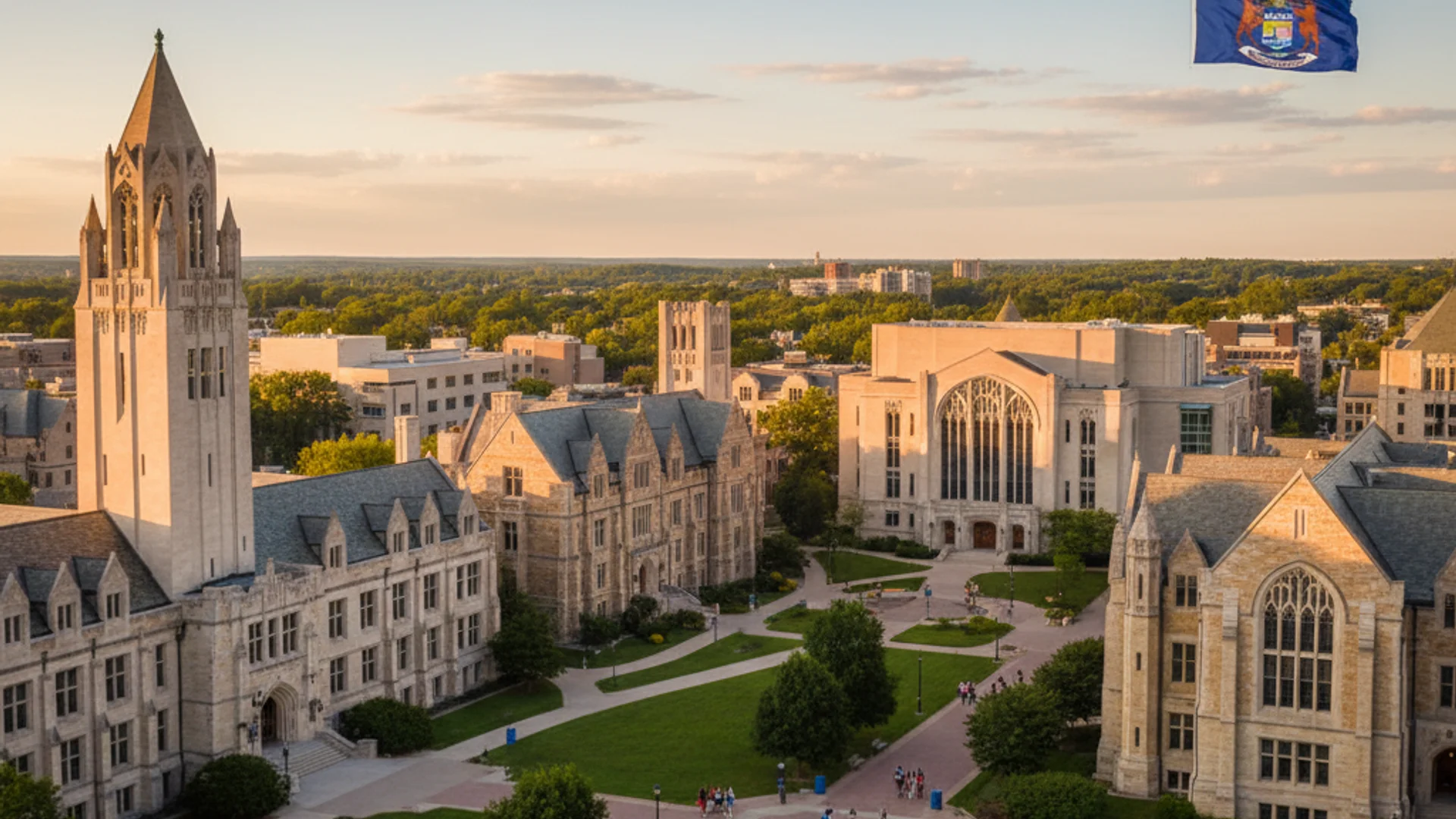
Compare the top artificial intelligence colleges in Michigan. 26 accredited artificial intelligence schools ranked by graduation rate, career outcomes, and value, from Monroe County Community College to Michigan Technological University.
Best artificial intelligence degree programs: Michigan Technological, Eastern Michigan, U of Michigan-Ann Arbor
Ranked by graduation rates, program outcomes, and institutional quality
Tuition ranges from $4,656 to $55,226/year
Monroe County Community C... offers the most affordable option at $6,638/yr
Artificial Intelligence degree programs available: 4 associate's, 8 master's, 2 doctoral in Michigan
From community college pathways to advanced research degrees
8 online artificial intelligence degree programs in Michigan
Flexible scheduling for working professionals
Michigan community college transfer can save 40-60% on total degree costs
4 associate's programs provide transfer pathways to bachelor's degrees
Education Commission of the States
Major employers: Ford, GM, Quicken Loans, Duo Security
Tech hubs in Detroit and Ann Arbor
Hakia Research 2026
Artificial Intelligence degree programs near 85+ cities across Michigan
Search by city to find programs within 200 miles of your location
Updated October 19, 2026
We rank 36 accredited artificial intelligence programs in Michigan using IPEDS 2024 institutional data, BLS OEWS 2024 state salary data, and College Scorecard outcomes. A 4-factor weighted composite is normalized to a 0–100 score. Schools cannot pay for placement; rankings are produced algorithmically.
Are Artificial Intelligence Degree Programs in Michigan Worth It?
Source: BLS OEWS May 2024
Compare the top-ranked Artificial Intelligence programs in Michigan by degree level. Tuition, graduation rate, and Hakia Score for every accredited program.
Michigan offers 8 master's degree programs in artificial intelligence, designed for professionals seeking to advance into senior engineering, technical leadership, and specialized roles. The top programs, Central Michigan, U of Michigan-Dearborn, Michigan Technological, combine advanced technical training with research opportunities and leadership development.
Master's graduates in Michigan earn a median salary of $99,830, approximately 20-30% higher than bachelor's degree holders. The concentration of technology companies in Detroit, Ann Arbor, Grand Rapids creates strong demand for graduate-level talent, with Ford, GM, Quicken Loans actively recruiting from these programs.
Program formats include traditional full-time study (typically 2 years), part-time options for working professionals (2-3 years), and accelerated tracks. Tuition averages $23,320/yr, with many employers offering tuition reimbursement for graduate education. Some programs offer thesis and non-thesis tracks, allowing students to focus on research or professional development based on their career goals.
Curriculum covers advanced topics including machine learning, distributed systems, software architecture, and technical management. Many programs include practicum experiences, industry capstone projects, or consulting engagements that provide real-world application of advanced concepts. Among Michigan's artificial intelligence schools at the graduate level, these programs stand out for both academic quality and career outcomes.
| Metric | Value |
|---|---|
| Average in-state tuition | $24,730/year |
| Average out-of-state tuition | $61,825/year |
| Community college tuition | $6,183/year |
| 4-year savings for residents | $148,380 |
| 2+2 transfer pathway savings | $37,094 |
Source: IPEDS 2024
Michigan offers substantial financial aid opportunities for students pursuing artificial intelligence education, including state grants, federal aid, and specialized technology funding. Michigan State University reports that 79 percent of undergraduate students received aid that didn't have to be repaid, with 22.8 percent of first-year students paying zero tuition after aid and 55 percent graduating with zero loan debt (MSU Aid).
These statistics demonstrate significant opportunities to reduce educational costs. Ferris State University's AI and cybersecurity programs benefit from research funding by the National Science Foundation, National Security Agency, and Department of Defense (Ferris Funding).
Students can pursue federal CyberCorps Scholarship for Service opportunities providing full tuition plus stipends for government employment commitments. Western Michigan University provides 99 percent of full-time undergraduate students with financial need receiving aid in 2024-25 (WMU Aid).
Graduate students should explore research assistantships, teaching assistantships, and industry-sponsored fellowships available through AI research centers. Technology companies increasingly offer tuition assistance and internship stipends for AI students.
Use our interactive ROI calculator to estimate your return on investment for a artificial intelligence degree in Michigan. Enter your expected tuition costs, financial aid, and career goals to see projected payback periods and lifetime earnings. The calculator uses current salary data from BLS and tuition data from IPEDS to provide accurate estimates.
Estimate your return on investment for a artificial intelligence degree
Leave blank to use average cost for selected program type
+697%
Net gain divided by total investment. ROI above 200% is considered excellent for education investments.
$1,289,731
Your additional lifetime earnings with this degree vs. working without one, minus the total investment.
6 years
Years until your cumulative earnings exceed total investment. Shorter programs often break even faster due to lower opportunity cost.
$141,176
Your starting salary adjusted for local cost of living. This shows real purchasing power compared to a $100K national baseline.
Why does break-even change with program type? Your "total investment" includes both tuition AND opportunity cost (foregone earnings while in school). A 4-year full-time public university (in-state) means 4 years of not earning a salary ($140,000 in opportunity cost). Shorter full-time programs may have higher tuition but lower total investment because you return to the workforce sooner.
How we calculate your degree ROI using real salary data
Tuition plus opportunity cost (earnings you miss while in school)
Direct cost of the degree program
4 years × $35K/year foregone salary while studying full-time
Projected career earnings starting after graduation, with salary growth
What you'd earn working at $35K/year with 2% annual growth
Median salary for this role in your selected location (BLS 2024)
Your investment's compound annual growth rate (similar to stock market returns)
Data sources: BLS OEWS May 2024, IPEDS 2024. Calculations use median salaries, 3% discount rate, and assume salary growth declines from 6% to 2% over career. Individual results will vary. | Powered by Hakia.com
Median annual salary in Michigan metro areas
| Category | Value |
|---|---|
| Detroit | $110K |
| Ann Arbor | $105K |
| Grand Rapids | $100K |
Source: BLS OEWS May 2024
Hakia.com
Find artificial intelligence jobs in Michigan. These major employers across Michigan metro areas are actively hiring artificial intelligence degree holders. Click employer names to view current job openings.
Detroit is the center of automotive innovation, leading in EV development and autonomous vehicle technology.
Nearby cities: Dearborn, Troy, Warren, Auburn Hills, Southfield
Ann Arbor is anchored by University of Michigan, with strong tech research and startup ecosystem.
Nearby cities: Ypsilanti, Canton, Plymouth, Novi
Michigan's Transfer Agreement provides clear pathways for students pursuing artificial intelligence education at four-year universities. The Michigan Transfer Agreement (MTA) allows students to complete at least 30 semester hours of college-level credit at community colleges that fulfill lower-division general education requirements at participating institutions (MiTransfer).
Students must complete courses with at least a 2.0 grade in each course including English composition, mathematics, social sciences, humanities, and natural sciences. AI programs have specific prerequisite requirements beyond the standard agreement, particularly in mathematics and programming. Students should complete calculus sequences, linear algebra, discrete mathematics, and introductory programming before transferring.
Community colleges participating in the MTA include Oakland Community College, Washtenaw Community College, Grand Rapids Community College, and Lansing Community College, all of which offer foundational STEM coursework (Macomb MTA). All 15 Michigan public universities accept the MTA, including the University of Michigan, Michigan State University, and Michigan Tech.
Students should work closely with advisors to ensure completion of calculus, statistics, and programming prerequisites that align with target AI program requirements.
Michigan has positioned itself at the forefront of artificial intelligence education, leveraging its strong automotive and manufacturing heritage to pioneer AI applications in industrial settings. Ferris State University offers the first AI program in the United States accredited by the National Security Agency as a Center of Academic Excellence in Secure Artificial Intelligence, the only program of its kind in Michigan (Ferris AI).
This groundbreaking designation addresses the critical security implications of AI development, preparing students to create trustworthy AI systems. The University of Michigan's computer science programs integrate AI and machine learning throughout the curriculum, connecting students with research opportunities in autonomous vehicles, natural language processing, and robotics.
Michigan Tech's engineering programs combine AI with traditional manufacturing expertise, creating graduates who understand both theoretical foundations and practical industrial applications. With Detroit's automotive industry investing billions in autonomous vehicle development and AI-powered manufacturing systems, Michigan students have unprecedented access to real-world AI deployment opportunities.
The state's combination of universities, major technology employers, and industrial innovation makes it an exceptional choice for AI education.
Artificial Intelligence Job Growth in Michigan
Source: BLS Occupational Outlook
Michigan's artificial intelligence job market offers exceptional growth opportunities driven by automotive industry transformation and manufacturing modernization. According to the Bureau of Labor Statistics, employment of software developers is projected to grow 15 percent from 2024 to 2034, with median annual wages of $133,080, while AI-focused data scientist positions offer median wages of $112,590 (BLS Software).
The Detroit metropolitan area leads AI adoption for autonomous vehicles, with major employers including Ford, General Motors, and numerous technology startups. Michigan State University reports a 93 percent placement rate for recent graduates, with top employers conducting more than 15,000 interviews annually including technology and automotive companies (MSU Careers).
AI specializations command salary premiums across industries, with machine learning engineers and AI researchers earning above median technology salaries. Career paths include AI researcher, machine learning engineer, data scientist, autonomous systems developer, natural language processing specialist, computer vision engineer, and robotics programmer.
Michigan's unique position connecting traditional manufacturing with advanced AI development creates opportunities for graduates to lead industrial transformation initiatives across the Great Lakes region.
New graduates and career changers
Technical leads and architects
8 available in Michigan
Traditional classroom experience
Institutional characteristics, completions, graduation rates
Michigan salary and employment data
Program details and admissions information
Last Updated: June 26, 2026. Rankings based on IPEDS 2024 data. Salary data from BLS OEWS May 2024.

Co-founder & Editor (B.S. Computer Science, Oregon State • B.A. Psychology, University of Washington)
Taylor combines technical expertise in computer science with a deep understanding of human behavior and learning. His dual background drives Hakia's mission: leveraging technology to build authoritative educational resources that help people make better decisions about their academic and career paths.
Hand-researched detail on the top-ranked programs: degree pathways, research labs, industry partners, career outcomes, and admissions. Tap any school to expand.
Why it stands out. An engineering-grounded AI program uniquely positioned in automotive innovation, where machine learning addresses real autonomous systems and manufacturing challenges.
Hakia insight. UM-Dearborn's Autonomous Vehicles Research Lab gives students direct entry into Ford's self-driving pipeline; unlike programs that teach autonomous systems theory, this one teaches the engineering constraints that actually ship in production vehicles.
At the master's level, UM-Dearborn's artificial intelligence and machine learning offerings are tightly integrated with the university's engineering and computer science programs, which have deep historical connections to Ford Motor Company and the broader automotive-industrial innovation ecosystem in Southeast Michigan. The curriculum emphasizes applications of AI to complex engineering problems—autonomous vehicle perception, predictive maintenance, manufacturing optimization, supply chain forecasting—giving students concrete, high-stakes contexts in which to develop machine learning and AI skills. Faculty expertise spans computer vision, reinforcement learning, robotics, and AI-enabled control systems, with many researchers holding active collaborations with automotive and industrial partners. Students work on capstone projects and research initiatives often sponsored by or aligned with industry needs, creating pathways to employment and internships. The program's strength lies in its ability to teach AI not as abstract theory but as a practical discipline for solving engineering and operational challenges—a distinction that appeals to students who want to see immediate impact. Graduate programs in computer science and engineering support thesis-based and coursework-based options, accommodating both research-focused and professional career tracks. UM-Dearborn's location and reputation create a direct pipeline to automotive, aerospace, and defense contractors, where AI and machine learning skills command premium salaries. The smaller scale compared to Ann Arbor means more accessible faculty and tighter cohorts, fostering collaboration and mentorship.
Programs offered
Research labs & institutes
Industry partners
Career outcomes
Top employers: Ford Motor Company, General Motors
Accreditation & certifications
Location advantage: Direct proximity to Ford Motor Company and major automotive suppliers Access to Southeast Michigan automotive and industrial R&D centers
Why it stands out. Lawrence Tech uniquely anchors AI education within applied engineering and automotive/manufacturing industry partnerships, producing graduates ready for immediate deployment in industrial AI roles.
Hakia insight. Lawrence Tech's master's students work alongside the same GM and Ford engineers who hire them, collapsing the typical gap between academic credentialing and industry credibility.
At the master's level, lawrence Tech's artificial intelligence focus emphasizes the intersection of AI with real-world engineering challenges, reflecting the university's strong tradition in applied technology. The program integrates machine learning, computer vision, and autonomous systems into a curriculum designed around hands-on project work and industry collaboration. Students engage directly with faculty who maintain active research partnerships with automotive and manufacturing firms—sectors where Michigan's economy has driven significant AI innovation. The program's strength lies in its practical orientation: rather than purely theoretical foundations, coursework balances algorithmic rigor with implementation across embedded systems, robotics, and industrial automation. Lawrence Tech's location in Southfield positions students within the Detroit metro AI ecosystem, creating direct pipeline opportunities with companies actively deploying machine learning in production environments. Internship placements are woven into the academic pathway, and many graduates move into roles where they're immediately applying neural networks and optimization techniques to tangible product challenges.
Programs offered
Research labs & institutes
Industry partners
Career outcomes
Top employers: General Motors, Ford Motor Company, Bosch, Siemens
Location advantage: Proximity to Detroit automotive and manufacturing ecosystem Access to major OEM AI development centers