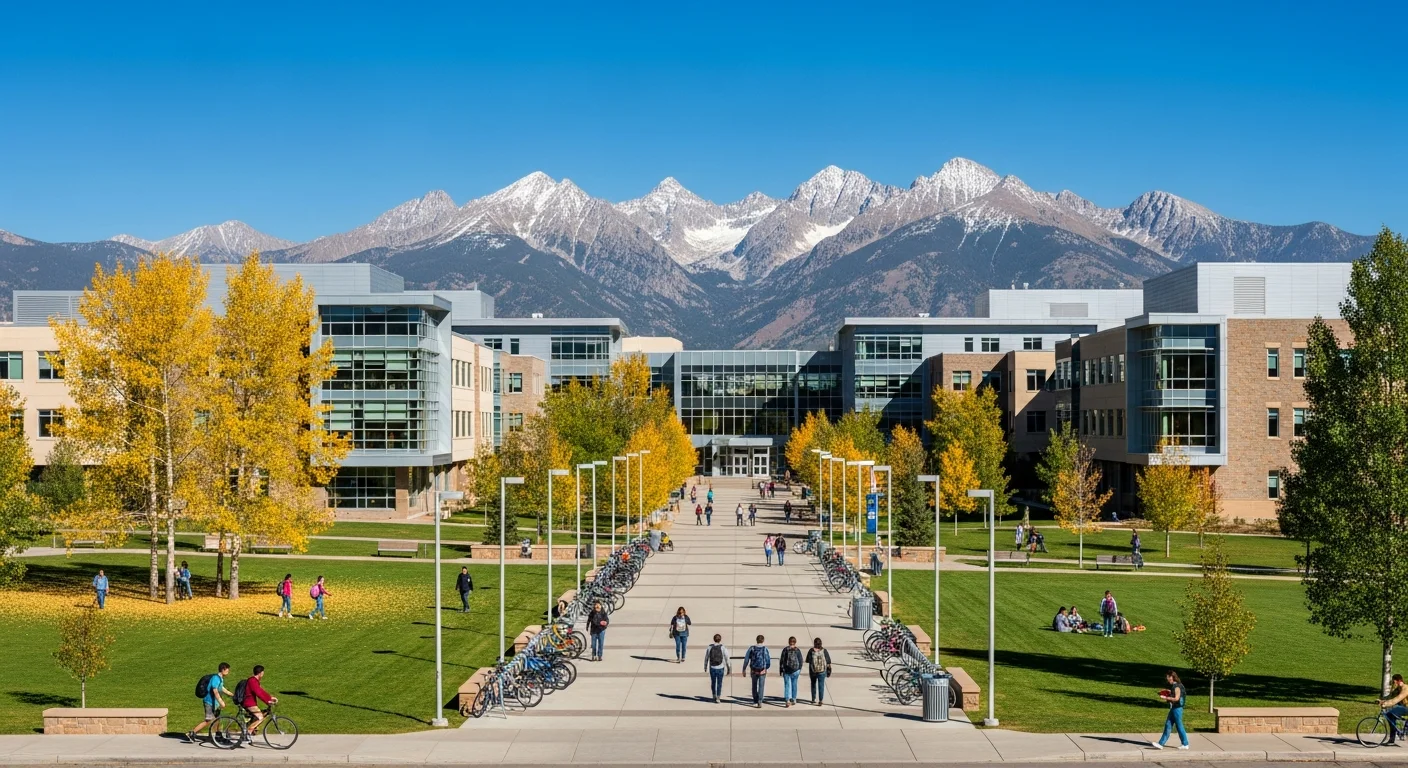
University campus in Colorado
Updated June 28, 2026

Best Software Engineering Degree Programs in Colorado, 2026 Rankings

Compare the top software engineering colleges in Colorado. 13 accredited software engineering schools ranked by graduation rate, career outcomes, and value, from Red Rocks Community College to University of Colorado Boulder.

#1 ProgramU of Colorado Boulder
Avg Salary$121,440
Tuition From$3,936/yr
Job Growth+22%
On this page
Reviewed by Taylor Rupe, Founder & EditorSee methodology

22

Programs ranked

IPEDS 2024

$121,440

Colorado median software engineering salary

BLS OEWS 2024

88/100

Top program score

Hakia methodology

17%

U.S. job growth (2023–33)

BLS projections

Key Takeaways

Best software engineering degree programs: U of Colorado Boulder, Colorado Technical Univer..., Colorado School of Mines

Ranked by graduation rates, program outcomes, and institutional quality

IPEDS 2024

Tuition ranges from $3,754 to $58,032/year

Red Rocks Community College offers the most affordable option at $3,936/yr

IPEDS 2024

Software Engineering degree programs available: 2 associate's, 6 master's, 3 doctoral in Colorado

From community college pathways to advanced research degrees

IPEDS 2024

5 online software engineering degree programs in Colorado

Flexible scheduling for working professionals

IPEDS 2024

Colorado community college transfer can save 40-60% on total degree costs

2 associate's programs provide transfer pathways to bachelor's degrees

Education Commission of the States

Major employers: Arrow Electronics, IHS Markit, Lockheed Martin, Ping Identity

Tech hubs in Denver and Boulder

Hakia Research 2026

Software Engineering degree programs near 31+ cities across Colorado

Search by city to find programs within 200 miles of your location

IPEDS 2024

Updated June 28, 2026

How we ranked Colorado Software Engineering programs

We rank 22 accredited software engineering programs in Colorado using IPEDS 2024 institutional data, BLS OEWS 2024 state salary data, and College Scorecard outcomes. A 4-factor weighted composite is normalized to a 0–100 score. Schools cannot pay for placement; rankings are produced algorithmically.

Program completions (35%)Graduation rate (25%)Selectivity (20%)Career outcomes (20%)
See full methodology

Are Software Engineering Degree Programs in Colorado Worth It?

Answer
$121,440
Yes. The best software engineering degree programs in Colorado deliver strong ROI, graduates earn $121,440 median salary with +22% job growth through 2032. In-state tuition averages $16,363/year.

Source: BLS OEWS May 2024

Software Engineering Degree Rankings in Colorado

Compare the top-ranked Software Engineering programs in Colorado by degree level. Tuition, graduation rate, and Hakia Score for every accredited program.

Best Associate's Software Engineering Programs in Colorado

2
Programs ranked
$3,845
Avg tuition/yr
0%
Avg grad rate

Program Landscape

Colorado offers 2 accredited associate's degree programs in software engineering, providing an affordable entry point into the technology field. The top-ranked programs include Red Rocks Community College, Community College of Aurora, which combine rigorous technical curriculum with practical skills training.

Costs & Value

Community colleges in Colorado offer these two-year programs at an average cost of $3,845/yr, significantly less than four-year university tuition. Students completing associate's degrees can pursue entry-level technical positions and transfer opportunities, with entry-level salaries averaging $66,792 in Colorado.

Career Pathways

Many programs feature guaranteed transfer agreements with Colorado's public universities, allowing students to complete their first two years at reduced cost before transferring to complete a bachelor's degree. The Denver, Boulder, Colorado Springs areas offer particularly strong job markets for associate's degree holders, with employers like Arrow Electronics, IHS Markit, Lockheed Martin hiring for technical support, junior development, and IT specialist positions.

Curriculum & Specializations

Programs typically include coursework in programming fundamentals, database management, networking basics, and software development. Among software engineering schools in Colorado, these associate's programs offer the best value for students beginning their software engineering degrees in Colorado.

Best Bachelor's Software Engineering Programs in Colorado

11
Programs ranked
$18,867
Avg tuition/yr
87%
Avg grad rate

Program Landscape

Colorado ranks among the nation's top destinations for software engineering education, with 11 accredited bachelor's degree programs across 8 public and 2 private institutions. The highest-ranked programs are U of Colorado Boulder, Colorado Technical Univer..., Colorado School of Mines, recognized for academic excellence, research opportunities, and strong industry connections.

Career Outcomes

Graduates from Colorado software engineering programs earn a median salary of $103,224, 5% above the national average. The state's robust technology sector, anchored by the Denver, Boulder, Colorado Springs metropolitan areas, provides abundant internship and employment opportunities with companies including Arrow Electronics, IHS Markit, Lockheed Martin.

Costs & Value

Tuition ranges from $7,560 to $58,032 annually, with an average of $18,867/yr. Top programs maintain graduation rates above 87%, with the highest reaching 93%. Many programs hold ABET accreditation, the gold standard for computing education, ensuring curriculum meets rigorous industry standards.

Curriculum & Specializations

Students can choose from specializations including software engineering, cybersecurity, artificial intelligence, data science, and systems architecture. Strong industry partnerships provide access to co-op programs, capstone projects with real companies, and direct recruiting pipelines to Colorado's leading technology employers. For students seeking software engineering degrees in Colorado, these top-ranked software engineering schools offer the strongest combination of academic rigor and career preparation.

Show all 11 ranked programs
RankSchoolLocationTypeTuitionGrad RateHakia Score
#6University of DenverDenver, COPrivate$58,03263.4
#7University of Colorado Colorado SpringsColorado Springs, COPublic$8,73865.8
#8Metropolitan State University of DenverDenver, COPublic$8,86862.9
#9Fort Lewis CollegeDurango, COPublic$7,56087%47.0
#10Regis UniversityDenver, COPrivate$41,99050.6
#11University of Northern ColoradoGreeley, COPublic$8,78442.3

Best Master's Software Engineering Programs in Colorado

6
Programs ranked
$20,245
Avg tuition/yr
87%
Avg grad rate

Program Landscape

Colorado offers 6 master's degree programs in software engineering, designed for professionals seeking to advance into senior engineering, technical leadership, and specialized roles. The top programs, Colorado Technical Univer..., U of Colorado Boulder, Colorado School of Mines, combine advanced technical training with research opportunities and leadership development.

Career Outcomes

Master's graduates in Colorado earn a median salary of $121,440, approximately 20-30% higher than bachelor's degree holders. The concentration of technology companies in Denver, Boulder, Colorado Springs creates strong demand for graduate-level talent, with Arrow Electronics, IHS Markit, Lockheed Martin actively recruiting from these programs.

Costs & Value

Program formats include traditional full-time study (typically 2 years), part-time options for working professionals (2-3 years), and accelerated tracks. Tuition averages $20,245/yr, with many employers offering tuition reimbursement for graduate education. Some programs offer thesis and non-thesis tracks, allowing students to focus on research or professional development based on their career goals.

Curriculum & Specializations

Curriculum covers advanced topics including machine learning, distributed systems, software architecture, and technical management. Many programs include practicum experiences, industry capstone projects, or consulting engagements that provide real-world application of advanced concepts. Among Colorado's software engineering schools at the graduate level, these programs stand out for both academic quality and career outcomes.

Show all 6 ranked programs
RankSchoolLocationTypeTuitionGrad RateHakia Score
#6University of Colorado Colorado SpringsColorado Springs, COPublic$8,73844.2

Best Doctoral Software Engineering Programs in Colorado

3
Programs ranked
$30,111
Avg tuition/yr
83%
Avg grad rate

Program Landscape

Colorado is home to 3 doctoral programs in software engineering, preparing students for research positions, faculty appointments, and executive technical roles. Leading programs at U of Colorado Boulder, Colorado School of Mines, U of Denver are recognized for cutting-edge research, strong faculty publications, and competitive funding packages.

Career Outcomes

Doctoral graduates command premium salaries, with Colorado PhD holders earning a median of $151,800, reflecting the advanced expertise required for research and executive positions. The Denver, Boulder, Colorado Springs region's research universities and corporate R&D centers provide extensive collaboration opportunities with industry leaders like Arrow Electronics, IHS Markit, Lockheed Martin.

Costs & Value

PhD programs typically require 4-6 years of full-time study, including coursework, qualifying examinations, and original dissertation research. Many programs offer full funding through teaching or research assistantships, covering tuition and providing stipends of $25,000–$40,000 annually.

Curriculum & Specializations

Research strengths across Colorado programs include artificial intelligence, cybersecurity, human-computer interaction, systems, and theoretical computer science. For aspiring researchers pursuing software engineering degrees in Colorado, graduates go on to careers as university faculty, industry research scientists, or technical executives, contributing to advances in technology that impact millions of users worldwide.

Software Engineering Degree Costs & Tuition in Colorado

MetricValue
Average in-state tuition$16,363/year
Average out-of-state tuition$40,908/year
Community college tuition$4,091/year
4-year savings for residents$98,180
2+2 transfer pathway savings$24,544

Source: IPEDS 2024

Financial Aid & Scholarships for Software Engineering Students in Colorado

State Aid Programs

Standard Colorado financial aid applies to software engineering programs. The College Opportunity Fund (COF) provides $116 per credit hour for eligible Colorado residents (CDHE COF). For full-time students, COF contributes $1,740/semester or $3,480/year. Combined with need-based Colorado Student Grant and federal Pell Grant (up to $7,395 for 2025-26), in-state students can significantly reduce costs.

Key Programs & Amounts

Tech industry scholarships: Major employers fund computing scholarships at partner universities. Google, Microsoft, and Amazon offer scholarships for underrepresented groups in tech. Professional organizations (ACM, IEEE) provide computing-specific awards. Colorado Promise programs at various institutions cover tuition for students with family income below $60,000-$70,000. CU Boulder's Engineering Excellence Fund supports high-achieving engineering students.

Institutional Scholarships

Graduate funding: Research and teaching assistantships at CU Boulder cover tuition plus $25,000-$35,000 annual stipend for PhD students. MS students may receive partial funding. Industry-sponsored research from tech companies provides additional opportunities. Many tech employers offer tuition reimbursement for employees pursuing degrees - check with current employer. NSF Graduate Research Fellowships ($37,000/year) support computing research. Defense contractors often provide education benefits for employees pursuing relevant degrees.

Software Engineering Degree ROI Calculator, Colorado

Use our interactive ROI calculator to estimate your return on investment for a software engineering degree in Colorado. Enter your expected tuition costs, financial aid, and career goals to see projected payback periods and lifetime earnings. The calculator uses current salary data from BLS and tuition data from IPEDS to provide accurate estimates.

Software Engineering Degree ROI Calculator

Estimate your return on investment for a software engineering degree

Leave blank to use average cost for selected program type

20 years
10 years20 years30 years
20-Year ROI

+854%

Net gain divided by total investment. ROI above 200% is considered excellent for education investments.

Net Gain

$1,580,373

Your additional lifetime earnings with this degree vs. working without one, minus the total investment.

Break-Even

5 years

Years until your cumulative earnings exceed total investment. Shorter programs often break even faster due to lower opportunity cost.

COL-Adjusted Salary

$122,727

Your starting salary adjusted for local cost of living. This shows real purchasing power compared to a $100K national baseline.

Why does break-even change with program type? Your "total investment" includes both tuition AND opportunity cost (foregone earnings while in school). A 4-year full-time public university (in-state) means 4 years of not earning a salary ($140,000 in opportunity cost). Shorter full-time programs may have higher tuition but lower total investment because you return to the workforce sooner.

Detailed Breakdown

How we calculate your degree ROI using real salary data

Total Investment$185,000

Tuition plus opportunity cost (earnings you miss while in school)

Program Cost (Tuition)$45,000

Direct cost of the degree program

Opportunity Cost$140,000

4 years × $35K/year foregone salary while studying full-time

20-Year Earnings (with degree)$2,615,781

Projected career earnings starting after graduation, with salary growth

20-Year Earnings (without degree)$850,408

What you'd earn working at $35K/year with 2% annual growth

Starting Salary (Denver, CO)$135,000

Median salary for this role in your selected location (BLS 2024)

Annualized Return4.7%

Your investment's compound annual growth rate (similar to stock market returns)

Data sources: BLS OEWS May 2024, IPEDS 2024. Calculations use median salaries, 3% discount rate, and assume salary growth declines from 6% to 2% over career. Individual results will vary. | Powered by Hakia.com

Software Engineering Salaries by Metro Area

Median annual salary in Colorado metro areas

Denver$134K
Boulder$128K
Colorado Springs$121K
View data table
CategoryValue
Denver$134K
Boulder$128K
Colorado Springs$121K

Source: BLS OEWS May 2024

Hakia.com

Top Employers Hiring Software Engineering Graduates in Colorado

Find software engineering jobs in Colorado. These major employers across Colorado metro areas are actively hiring software engineering degree holders. Click employer names to view current job openings.

Software Engineering Jobs in Denver/Boulder

CO

Denver/Boulder is a growing tech hub with aerospace heritage, outdoor lifestyle appeal, and a thriving startup ecosystem.

Nearby cities: Boulder, Westminster, Broomfield, Englewood, Littleton

Google
Search/Cloud/AI
Amazon
E-commerce/Cloud
Microsoft
Enterprise Software
Meta
Social/VR/AI
Apple
Consumer Electronics
Oracle
Enterprise Software
Lockheed Martin
Defense/Aerospace
Arrow Electronics
Electronics Distribution
DISH Network
Telecommunications
Palantir
Data Analytics
Ibotta
Fintech/Rewards
SendGrid (Twilio)
Communications API

Transfer Pathways for Software Engineering Degrees in Colorado

State Transfer System

Colorado's transfer system includes gtPathways for general education and specific Computer Science articulation agreements (CDHE Transfer). The Computer Science Statewide Transfer Articulation Agreement (effective Fall 2020) provides structured pathways from community colleges to four-year programs. Students completing AS in Computer Science at Colorado community colleges can transfer with junior standing to participating universities.

How Transfers Work

Strategic transfer planning:

  1. 1Complete CS1 and CS2 (data structures) - verify specific course requirements with target university
  2. 2Take calculus through differential equations (MATH 1401, 1402, 2301)
  3. 3Complete discrete mathematics - essential foundation
  4. 4Take physics with calculus (for engineering programs)
  5. 5Build programming portfolio with GitHub projects
  6. 6Maintain 3.5+ GPA for competitive admission to CU Boulder Engineering; 3.3+ for other programs

Transfer Planning Tips

Community college options: Front Range Community College, Arapahoe Community College, and Community College of Denver offer AS in Computer Science designed for transfer. Complete in two years for approximately $5,000-$7,000 total (after COF stipend). This pathway saves $20,000-$30,000 compared to starting at a four-year university. Students can gain work experience as interns or junior developers while completing community college, building both resume and savings.

Why Pursue a Software Engineering Degree in Colorado?

Industry & Workforce

Colorado's software engineering landscape is exceptional, with the Denver-Boulder corridor ranking among the nation's premier tech hubs (Colorado Technology Association 2024 Report). The state's 129,040 tech workers operate across Big Tech offices, startups, and enterprise software companies. Denver moved to #8 among top North American tech markets in CBRE's 2025 ranking. The BLS projects 15% growth for software developers from 2024-2034, significantly exceeding the national average. Colorado's combination of major employer presence, startup ecosystem, and quality of life attracts software engineers nationally.

Salary Outlook

Software engineering salaries in Colorado are highly competitive.

Software developers earn a national median of $144,570 (BLS OEWS May 2024). In Denver-Boulder, salaries range from $99,067 (25th percentile) to $176,189 (90th percentile). Boulder software engineers earn $131,150-$135,000 median. Entry-level positions start around $85,000-$95,000. Senior engineers at major tech companies can earn $200,000+ with stock compensation. Colorado's no-state-income-tax neighbor states (Wyoming, Texas) sometimes lure remote workers, but Colorado's lifestyle keeps many engineers local.

Regional Tech Hubs

Diverse industry applications span Colorado's economy.

Beyond pure tech companies, software powers Colorado's aerospace sector (satellite software, mission systems), healthcare industry (medical software, health IT), energy sector (grid management, renewable systems), and outdoor industry (fitness apps, adventure tech). Lockheed Martin's 14,000+ Colorado employees include substantial software teams. The defense sector provides unique embedded systems and real-time computing opportunities. Boulder's startup culture creates opportunities to join early-stage ventures with equity upside. Compare programs in California, Texas, or explore our national rankings.

Software Engineering Job Growth in Colorado

15%
The Bureau of Labor Statistics projects 15% growth for software engineering occupations in Colorado through 2024-2034. The median salary stands at $121,440 with 13 accredited programs statewide.

Source: BLS Occupational Outlook

Software Engineering Job Market & Salary Data in Colorado

Employment Outlook

Colorado's software engineering job market shows sustained growth.

The tech industry added 47,440 net new jobs over five years, the most of any Colorado industry sector. Software development roles comprise a significant portion of this growth. The BLS projects 15% growth for software developers nationally, with Colorado expected to match or exceed this rate. Major employers including Google, Amazon, Microsoft, and Oracle maintain substantial Colorado operations. Defense contractors (Lockheed Martin, Northrop Grumman, Raytheon) hire software engineers for mission-critical systems.

Salaries by Metro

Metro-specific opportunities:

  • Denver: Corporate software development hub. Arrow Electronics, Ibotta, Guild Education, and enterprise software companies hire across experience levels. Median salary approximately $120,000-$130,000. Financial services and healthcare drive demand for enterprise developers.
  • Boulder: Startup and tech company concentration. Google, Twitter/X, Qualcomm offices plus 100+ startups. Median salary $131,150-$135,000 with equity potential. Strong demand for full-stack, frontend, and ML engineering.
  • Colorado Springs: Defense software dominates. Lockheed Martin, Northrop Grumman seek embedded systems and secure software engineers. Clearance-required positions pay premiums. Median approximately $105,000-$115,000.

High-Growth Sectors

In-demand software engineering skills: cloud-native development (AWS, GCP, Azure), modern frontend frameworks (React, Vue, Angular), backend systems (Python, Go, Java, Node.js), DevOps/SRE practices (Kubernetes, CI/CD, infrastructure as code), and mobile development (iOS, Android, React Native). Colorado's aerospace sector values embedded systems, real-time computing, and security-focused development. The AI wave creates demand for ML integration and AI-powered application development. For related paths, explore computer science programs, web development, or mobile development.

Entry-Level (0-2 yrs)

New graduates and career changers

Senior (8+ yrs)

Technical leads and architects

Median Salary in Colorado$78,936$176,088
Typical RolesJunior Developer, AnalystStaff Engineer, Architect
Remote Work AccessLimitedCommon
Degree ExpectationBachelor's sufficientMaster's preferred

Online vs On-Campus Software Engineering Programs in Colorado

Online Programs

5 available in Colorado

On-Campus Programs

Traditional classroom experience

Typical Tuition$14,727/yr$16,363/yr
Schedule FlexibilitySelf-paced or asyncFixed schedule
NetworkingVirtual cohortsIn-person, career fairs
Best ForWorking professionalsTraditional students
Completion Time2-4 years (flexible)4 years (standard)

Compare Software Engineering Programs in Other States

Software Engineering Degree Programs in Colorado: FAQ

What are the best software engineering degree programs in Colorado?
The best software engineering degree programs in Colorado based on our methodology are: 1) University of Colorado Boulder (87% graduation rate), 2) Colorado Technical University-Colorado Springs, and 3) Colorado School of Mines. Our rankings weight graduation rates (25%), program completions (35%), selectivity (20%), and career outcomes (20%). Colorado offers 13 total accredited programs across 10 public and 2 private institutions. See our complete rankings for all 11 bachelor's programs.
How much do software engineering degree programs cost in Colorado?
Software Engineering degree program costs in Colorado vary significantly by institution type. In-state public tuition averages $16,363/year, while private institutions average $35,999/year. Community colleges offer the most affordable path at approximately $4,091/year for associate's degrees. The total 4-year cost ranges from $65,452 at public schools to $143,994 at private institutions before financial aid. Most students don't pay full sticker price, federal grants, state aid, and institutional scholarships can reduce costs by 30-60%.
What salary can software engineering degree graduates earn in Colorado?
Software Engineering professionals in Colorado earn a median salary of $121,440, which is 5% above the national average of $115,500. Entry-level positions typically start around $78,936, while senior roles exceed $176,088. Salaries vary by metro area: Denver ($133,584), Boulder ($127,512) offer the highest compensation. Specialized roles like AI/ML engineers and cloud architects command premiums of 15-30% above median.
Are there online software engineering degree programs in Colorado?
Yes, Colorado offers 5 accredited online Software Engineering programs from state institutions. These programs award the same degree as on-campus options and include synchronous and asynchronous formats. Top-ranked online programs include offerings from Red Rocks Community College and Community College of Aurora. Online programs typically cost the same as on-campus tuition for in-state students. Many programs offer flexible scheduling for working professionals, with some offering accelerated completion in 2-3 years. Ensure any online program holds regional accreditation and ideally ABET accreditation for engineering programs.
What companies hire software engineering degree graduates in Colorado?
Major Software Engineering employers in Colorado include Arrow Electronics, IHS Markit, Lockheed Martin, Ping Identity, Guild Education. The Denver and Boulder metro areas serve as primary tech hubs with thousands of open positions. Top employers maintain recruiting pipelines directly from Colorado universities, with many offering internship-to-hire programs. Beyond tech giants, opportunities exist in healthcare IT, financial services, defense contractors, and growing startups. Colorado's tech sector shows +22% projected job growth through 2033, outpacing most other industries.
Is a software engineering degree program worth it in Colorado?
A software engineering degree program in Colorado offers strong ROI with a $121,440 median salary and +22% projected job growth. At average in-state tuition of $16,363/year, graduates typically recoup their educational investment within 3-5 years. The degree opens doors to high-paying careers in software development ($137,227), data science, cybersecurity, and AI/ML. Beyond salary, benefits include job security, remote work flexibility, and clear advancement paths. Alternative paths like bootcamps exist for career changers, but bachelor's degrees provide broader career options and higher lifetime earnings.
How long do software engineering degree programs take in Colorado?
Standard completion times for software engineering degree programs in Colorado are: Associate's (2 years, 60 credits), Bachelor's (4 years, 120 credits), and Master's (1-2 years, 30-36 credits). However, actual timelines vary based on course load, transfer credits, and program format. Accelerated programs can compress a bachelor's to 3 years or a master's to 12 months. Part-time students typically need 5-6 years for a bachelor's degree. Colorado community colleges offer a cost-effective "2+2" path: complete your associate's in 2 years, then transfer to a Colorado university for the final 2 years of a bachelor's program.
What financial aid is available for software engineering degree students in Colorado?
Colorado software engineering degree students can access multiple financial aid sources. Federal aid includes Pell Grants (up to $7,395/year for qualifying students) and federal student loans. Colorado state grants provide additional support for residents attending in-state schools. Institutional scholarships from universities can significantly reduce costs, many schools offer merit-based awards for STEM students. Work-study programs and teaching/research assistantships (especially for graduate students) provide income while building experience. Complete the FAFSA by Colorado's priority deadline to maximize aid eligibility. Some employers also offer tuition reimbursement for employees pursuing CS degrees.

Data Sources

Institutional characteristics, completions, graduation rates

Colorado salary and employment data

Official University Websites

Program details and admissions information

Last Updated: June 26, 2026. Rankings based on IPEDS 2024 data. Salary data from BLS OEWS May 2024.

Was this ranking helpful for your college search?
Taylor Rupe

Taylor Rupe

Co-founder & Editor (B.S. Computer Science, Oregon State • B.A. Psychology, University of Washington)

Taylor combines technical expertise in computer science with a deep understanding of human behavior and learning. His dual background drives Hakia's mission: leveraging technology to build authoritative educational resources that help people make better decisions about their academic and career paths.

The research behind the rankings

In-depth Software Engineering program profiles in Colorado

Hand-researched detail on the top-ranked programs: degree pathways, research labs, industry partners, career outcomes, and admissions. Tap any school to expand.

Best Associate's Software Engineering programs

#1Red Rocks Community CollegeLakewood, CO

Why it stands out. Red Rocks Community College is #1 in transfers to Colorado School of Mines and features the innovative IDEA Lab makerspace that serves as the center of STEM innovation with advanced prototyping tools and resources.

Hakia insight. Red Rocks' #1 transfer rate to Colorado School of Mines + IDEA Lab makerspace creates a hidden pathway: students who start in the associate's program often arrive at Mines with hands-on prototyping experience most four-year undergrads never touch.

At the associate's level, red Rocks Community College's Computer Technology department offers comprehensive programs designed to prepare students for careers in Software Engineering and Computer Science. The program emphasizes hands-on learning through practical, project-based coursework including coding, networking, and cybersecurity simulations. Students benefit from industry partnerships that provide real-world expertise, site visits to local tech companies, and insights from industry leaders on program Advisory Boards. The department utilizes cutting-edge technology including cloud computing and AI-driven tools to ensure workforce readiness. Flexible learning formats are available in classroom, hybrid, or online modalities. The program features the IDEA Lab makerspace with 3D printers, microcontrollers, and prototyping resources. Strong transfer pathways exist with four-year universities, particularly Colorado School of Mines where RRCC is #1 in transfers. Students can pursue various tracks including Programming, Computer Science, Cybersecurity, and Networking, with opportunities for research experiences and internships.

Programs offered

  • Associate of Science in Software Engineering · 2 years · on-campus
  • Associate of Applied Science in Software Engineering · 2 years · online

Research labs & institutes

  • IDEA Lab — Innovation, prototyping, and STEM project development

Industry partners

Colorado School of Mines

Location advantage: Access to Colorado tech industry Proximity to Colorado School of Mines Industry partnerships with local tech companies

#2Community College of AuroraAurora, CO

Why it stands out. CCA provides flexible, stackable credentials with evening/weekend and online options designed for working professionals, offering guaranteed transfer agreements to Colorado public universities and practical hands-on training in multiple programming languages and development environments.

Hakia insight. CCA's stackable credentials with guaranteed transfers to Colorado public universities solve the part-time professional's dilemma—you earn micro-credentials immediately while working, then port them to a bachelor's without restarting, a model most community colleges advertise but rarely operationalize.

At the associate's level, community College of Aurora offers several technology-related programs that provide pathways to software engineering careers, though no dedicated Software Engineering program exists. The Programming AAS degree (61 credits) focuses on software development skills including application development, database user interface, object-oriented programming, project management, and systems analysis. Students learn to design, develop, build, troubleshoot and test computer software programs in different programming languages, ranging from simple business programs to complex web applications. The Computer Science Transfer AS prepares students with foundational coursework to pursue bachelor's degrees in computer science at four-year institutions, covering basic mathematics, science, and computer science requirements. The Computer Information System AAS (60 credits) offers flexible concentrations in Business and Computer Support, preparing students for careers as system managers, system analysts, information security analysts, and software developers. All programs emphasize job market growth, with the U.S. Bureau of Labor Statistics predicting faster-than-average growth in computer and information technology occupations through 2032.

Programs offered

  • Associate of Science in Software Engineering · 2 years · on-campus
  • Associate of Applied Science in Software Engineering · 2 years · online

Industry partners

Colorado School of Mines

Location advantage: Multiple campus locations in Aurora, Centennial, and Denver Convenient evening and weekend class schedules Guaranteed transfer agreements with Colorado public universities

Best Bachelor's Software Engineering programs

#1University of Colorado BoulderBoulder, CO

Why it stands out. CU Boulder uniquely combines rigorous CS theory with cloud systems focus and direct industry partnerships, creating a pipeline to senior engineering roles at scale-focused tech companies.

Hakia insight. CU Boulder's faculty (Chang, Coady) bridge program verification and empirical software engineering—a pairing that explains why Google and Lockheed Martin recruit heavily from the program: graduates understand both the math that prevents failures and the organizational practices that actually prevent them.

At the bachelor's level, CU Boulder's software engineering program is built on a foundation of rigorous computer science theory paired with hands-on systems design. The curriculum emphasizes software architecture, cloud computing, and distributed systems—areas where Boulder graduates consistently land roles at scale-focused tech companies. Students engage with real industrial problems through capstone projects, many sponsored by companies like Google, IBM, and local startups in the Denver tech corridor. The program benefits from Boulder's proximity to a thriving ecosystem of aerospace, robotics, and enterprise software firms, creating internship pipelines that often convert to full-time offers. Faculty actively research software verification, programming languages, and systems optimization, and students can participate in labs like the Programming Language and Verification Lab. Graduates report strong placement in backend engineering, DevOps, and cloud infrastructure roles, with median starting salaries in the $85k–$95k range. The program's emphasis on both breadth (algorithms, databases, networks) and depth (students choose specializations) prepares engineers who can grow into senior and leadership positions.

Programs offered

  • Bachelor of Science in Software Engineering · 4 years · on-campus
  • Bachelor of Arts in Software Engineering · 4 years · online

Research labs & institutes

  • Programming Language and Verification Lab — Programming languages, formal verification, software correctness
  • Formal Methods Lab — Automated reasoning, software verification, cybersecurity

Industry partners

GoogleIBMLockheed MartinBall Aerospace

Career outcomes

$8,700,095,000 median salary

Notable faculty

  • Bor-Yuh Evan Chang (Programming languages, program synthesis, software verification)
  • Yvonne Coady (Software engineering practices, systems design, empirical software engineering)

Accreditation & certifications

ABET accredited (Computer Science)

Location advantage: Denver metro tech corridor with major employers (Google, Lockheed Martin, Ball Aerospace) Proximity to aerospace and robotics industries Strong startup ecosystem in Boulder and surrounding areas

#2Colorado Technical University-Colorado SpringsColorado Springs, CO

Why it stands out. CTU delivers software engineering education optimized for working professionals, with accelerated delivery, industry-aligned curriculum, and direct connections to Colorado Springs defense and tech employers.

Hakia insight. CTU's location in the NORAD/Lockheed/Northrop Grumman corridor + accelerated evening delivery means working engineers can upskill into software roles without leaving their defense contractor jobs, a pipeline advantage no traditional university matches.

At the bachelor's level, colorado Technical University's software engineering program is built for working adults and career-changers, featuring accelerated coursework, evening and online delivery, and curriculum explicitly aligned with industry hiring needs. The program prioritizes practical skills—version control, agile methodologies, cloud deployment, full-stack development—over extended theory, enabling students to apply concepts immediately in their current jobs or internships. CTU's location in Colorado Springs, home to significant defense, aerospace, and managed IT services sectors, creates a direct pipeline to employers seeking software engineers with specific technical certifications and hands-on experience. The school's partnerships with companies like Lockheed Martin, Northrop Grumman, and regional software firms ensure curriculum stays current with hiring demand and often result in job placement assistance. Many students complete degrees while employed part-time, meaning classmates bring real-world context to group projects and discussions. Graduation outcomes reflect strong employment rates among graduates pursuing roles in software development, systems administration, and IT operations—success driven by the program's relentless focus on market-ready competency.

Programs offered

  • Bachelor of Science in Software Engineering · 4 years · on-campus
  • Bachelor of Arts in Software Engineering · 4 years · online

Industry partners

Lockheed MartinNorthrop GrummanU.S. Air Force AcademyNORAD

Notable faculty

  • null

Location advantage: Colorado Springs defense, aerospace, and government technology hub Direct access to Lockheed Martin, Northrop Grumman, NORAD, and military contracting employers

#3Colorado School of MinesGolden, CO

Why it stands out. Mines uniquely combines rigorous software engineering with deep domain expertise in high-performance computing for energy, geoscience, and resource industries—creating differentiated career opportunities.

Hakia insight. Mines' engineering-first curriculum isn't just theory—Shell and ExxonMobil recruit directly from campus because the program embeds high-performance computing for geoscience and resource extraction into every project, giving graduates domain expertise that commands premiums in energy sector roles.

At the bachelor's level, mines' computer science program distinguishes itself through its engineering-first approach and deep integration with the school's mining, petroleum, and energy sector focus. While many students pursue traditional software engineering careers, the program uniquely prepares graduates for roles in geospatial computing, scientific simulation, high-performance computing, and data systems—domains critical to resource extraction, climate modeling, and energy technology. The curriculum balances computer science foundations with applied computing in domains like computational geology, reservoir simulation, and sensor networks. Faculty conduct research spanning cybersecurity, machine learning for earth science, and systems optimization. Students benefit from industry partnerships with major energy companies, mining firms, and engineering contractors, many of which have recruiting partnerships and internship programs. The capstone experience often involves solving real problems for sponsors in the energy and resource sectors. Graduates command strong salaries and secure positions at tech companies, energy firms, and government labs—many in specialized technical roles that reflect their domain-specific computing knowledge. The program's location near Denver also connects students to the region's growing aerospace and defense sectors.

Programs offered

  • Bachelor of Science in Software Engineering · 4 years · on-campus
  • Bachelor of Arts in Software Engineering · 4 years · online

Research labs & institutes

  • Department of Computer Science Research Centers — Cybersecurity, machine learning, computational science

Industry partners

ShellExxonMobilColorado Geological SurveyNational Renewable Energy Laboratory (NREL)

Career outcomes

$90,000,105,000 median salary

Notable faculty

  • Chris Weisz (Cybersecurity, cryptography, secure systems)

Accreditation & certifications

ABET accredited (Computer Science)

Location advantage: Golden, CO proximity to energy industry headquarters and labs Strong partnerships with National Renewable Energy Laboratory (NREL) Access to mining, petroleum, and geoscience industry employers

#4United States Air Force AcademyUSAF Academy, CO

Why it stands out. The Academy's software engineering program uniquely integrates military systems engineering, cybersecurity, and operational context, preparing officers for leadership roles in defense and aerospace computing.

Hakia insight. Unlike civilian CS programs, the Air Force Academy's software engineering students write code for systems that defend airspace, not just pass interviews—direct access to Peterson Space Force Base means capstones often become operational tools rather than portfolio pieces.

At the bachelor's level, the Air Force Academy's computer science curriculum is uniquely shaped by the institution's military mission and the priority placed on systems critical to national defense. Students pursue software engineering within a rigorous, discipline-focused environment where courses in cybersecurity, network defense, command-and-control systems, and embedded systems take precedence based on Air Force operational needs. All students complete a core engineering curriculum alongside specialized computer science tracks, ensuring they understand hardware, systems integration, and real-time computing—skills essential for military aerospace and defense applications. Faculty include active-duty and retired Air Force officers with direct experience fielding software systems in operational settings. Capstones often involve working with actual Air Force systems and problems, providing context and impact that exceed typical academic projects. Graduates commission as Second Lieutenants and serve 5 years on active duty, typically in software development, cybersecurity, or systems engineering roles supporting Air Force and Space Force operations. The program's strength lies in producing officers who understand both rigorous software engineering principles and the military's operational and security imperatives.

Programs offered

  • Bachelor of Science in Software Engineering · 4 years · on-campus
  • Bachelor of Arts in Software Engineering · 4 years · online

Industry partners

United States Air ForceUnited States Space Force

Accreditation & certifications

ABET accredited (Computer Science)Security clearance path (DoD)

Location advantage: Colorado Springs proximity to Peterson Space Force Base and other defense installations Direct access to government and defense sector technology challenges

#5Colorado State University-Fort CollinsFort Collins, CO

Why it stands out. Hands-on work with industry-standard software engineering tools integrated throughout curriculum. Project management and systems analysis courses (CIS 320, CIS 360) providing practical application experience

Hakia insight. CSU's integration of project management courses (CIS 320, CIS 360) throughout the curriculum rather than as electives means graduates arrive on the job already fluent in the Gantt charts and scope documents that junior engineers usually spend six months learning on the clock.

Colorado State University's Bachelor of Science in Computer Science with a Software Engineering concentration equips students with rigorous computer science fundamentals combined with specialized software engineering skills. The 120-credit program emphasizes hands-on work with industry-standard software engineering tools, covering software design, testing, project management, and system analysis. Students progress through a structured curriculum beginning with foundational CS and mathematics courses, advancing to core software engineering courses like CS 314 (Software Engineering), CS 414 (Object-Oriented Design), and CS 415 (Software Testing). The program requires CIS 320 (Project Management for Information Systems) and CIS 360 (Systems Analysis and Design), ensuring practical project management experience. Seniors select depth courses from specialized areas including Database Systems, Big Data, Artificial Intelligence, Distributed Systems, and Human-Computer Interaction. Graduates pursue careers as software developers, architects, full-stack developers, software project managers, cloud engineers, and UX designers. The concentration prepares graduates for immediate professional employment or graduate studies in software engineering and computer science.

Programs offered

  • Bachelor of Science in Computer Science, Software Engineering Concentration · 4 years · on-campus

Research labs & institutes

  • Cybersecurity Center — Modern cybersecurity practices and procedures
  • Center for Exascale Spatial Data Analytics and Computing — AI, machine learning, and deep learning methods at scale over high-dimensional spatial datasets

Notable faculty

  • Charles Anderson (Artificial Intelligence, Machine Learning)
  • Bruce Draper (Computer Vision, Artificial Intelligence)
  • Indrajit Ray (Data Security and Privacy)
#6University of DenverDenver, CO

Why it stands out. DU's software engineering programs stand out through their NSA-accredited cybersecurity education, tool-agnostic teaching approach, and integration of cutting-edge research in areas like smart grids, biomedical engineering, and AI with practical industry preparation.

Hakia insight. DU's NSA-accredited cybersecurity program, paired with a median starting salary of $155,200, reflects a deliberate specialization in a market where Colorado has 19,603 open security roles—students graduating into acute regional demand rather than national oversupply.

At the bachelor's level, the University of Denver's Software Engineering-related programs are offered through the Ritchie School of Engineering and Computer Science, featuring strong emphases on practical application, industry preparation, and cutting-edge research. The school offers multiple pathways including undergraduate Computer Science, graduate Electrical and Computer Engineering with software focus, Cybersecurity, and Data Science and AI programs. Key strengths include NSA-accredited cybersecurity education, tool-agnostic approaches focusing on foundational knowledge, state-of-the-art research laboratories covering areas like smart grids, biomedical engineering, robotics, and AI. The programs emphasize hands-on learning, small cohort sizes for personalized attention, and preparation for industry certifications. Faculty have extensive industry experience and are actively engaged in research across diverse domains including power systems, biomedical devices, unmanned systems, and intelligent control.

Programs offered

  • Bachelor of Science in Software Engineering · 4 years · on-campus
  • Bachelor of Arts in Software Engineering · 4 years · online

Research labs & institutes

  • BioSun Lab — Biosensing, bioinstrumentation, cancer detection and treatment
  • KLab — Smart grids, quantum computing, blockchain, and AI

Career outcomes

$155,200 median salary

Notable faculty

  • Amin Khodaei (Smart grids, quantum computing, blockchain, and AI)
  • Dali Sun (Biosensing, bioinstrumentation, cancer detection, cancer treatment)
  • Kimon Valavanis (Robotics and automation, unmanned systems, intelligent control, and autonomy)
  • Mohammad Mahoor (Robotics for autism spectrum disorders)

Admissions

GPA 2.5. Deadline May 15, 2025 (priority), July 31, 2025 (final).

Accreditation & certifications

NSA CAE-CD (National Center of Academic Excellence-Cyber Defense)ABET Accredited

Location advantage: 19,603 cybersecurity job openings in Colorado Denver tech market with high cybersecurity engineer salaries

#7University of Colorado Colorado SpringsColorado Springs, CO

Why it stands out. ABET accreditation. Multiple specialty track options allowing specialization in areas like cybersecurity, AI/machine learning, and software engineering

Hakia insight. UCCS' QAS Lab under Armin Moin offers undergraduates rare access to quantum computing research while maintaining ABET accreditation and hybrid delivery—students can graduate with both a software engineering degree and publications in an emerging field most peers won't touch until graduate school.

The Bachelor of Science in Computer Science at UCCS is a 120-credit, ABET-accredited program available in on-campus, online, and hybrid formats. The curriculum integrates theoretical foundations with practical experience in hardware and software, preparing graduates for immediate professional employment. Students complete 43 credit hours of core computer science competencies covering programming, architecture, operating systems, networking, software engineering, algorithms, ethics, and security. The program requires selection of one specialty track (12 credits) from Advanced Software Engineering, Artificial Intelligence and Machine Learning, Computer Systems and Networking, Cybersecurity, or General Computer Sciences. Additional requirements include 17 credit hours of mathematics, 9-10 credit hours of natural science, 6 credit hours of writing skills, and general electives. The curriculum emphasizes problem-solving, team collaboration, professional communication, and ethical decision-making. Graduates are prepared to pursue careers in technical development, project management, and technical sales across all branches of computer science.

Programs offered

  • Bachelor of Science in Computer Science · 4 years · on-campus

Research labs & institutes

  • Dr. Moin's QAS Lab — Software Engineering, Software Testing, and Quantum Computing

Notable faculty

  • Armin Moin (Software Engineering, Software Testing, Quantum Computing)
  • Kristen Walcott-Justice (Software Engineering, Software Testing, Computer Science Education)
  • Yanyan Zhuang (Software Engineering, Computer Networks, Systems)

Location advantage: Located in Colorado Springs with access to local technology companies Evening and late afternoon course scheduling for working professionals

#8Metropolitan State University of DenverDenver, CO

Why it stands out. MSU Denver's Computer Sciences department stands out with its newly launched Computer Security (CSEC) and Data Science and Machine Learning programs, positioning students at the forefront of emerging technology fields.

Hakia insight. MSU Denver's newly launched Computer Security and Data Science programs position students at the frontier of recruiting cycles rather than in established pipelines—employers actively court graduates from emerging degree concentrations before competition saturates the talent pool.

At the bachelor's level, metropolitan State's computer science program serves a diverse, working-adult student population and emphasizes accessibility to a software engineering education without the premium tuition of research universities. The curriculum covers full-stack development, data systems, and web technologies—skills directly relevant to the Denver job market where startups, financial services firms, and tech companies actively recruit. The program's strength lies in its flexibility: students can attend part-time while working, and many faculty bring industry experience and connections. Capstone projects often partner with local employers, creating networking opportunities and potential job leads. While the program lacks the research prestige and specialized depth of larger universities, it succeeds at converting working professionals and career-changers into productive software engineers within a reasonable timeframe and cost. Graduates predominantly enter the Denver tech ecosystem in mid-level developer roles at startups, consulting firms, and regional tech companies. The location in downtown Denver provides direct access to employers and a thriving startup scene, making the program particularly valuable for those already embedded in or relocating to the Colorado Front Range.

Programs offered

  • Bachelor of Science in Software Engineering · 4 years · on-campus
  • Bachelor of Arts in Software Engineering · 4 years · online

Location advantage: Downtown Denver location with direct access to tech startups and employers Strong local tech job market and networking opportunities Proximity to tech-forward companies in the Front Range

#9Fort Lewis CollegeDurango, CO

Why it stands out. Fort Lewis delivers software engineering education at a human scale, combining rigorous technical training with hands-on project experience and deep faculty mentorship in a tight-knit cohort.

Hakia insight. Fort Lewis College's tight cohort model with faculty mentorship generates outsized placement at regional powerhouses like Trimble and Ball Aerospace—small class sizes create the relationship-based hiring pipelines that large state schools chase through career fairs.

At the bachelor's level, fort Lewis College's software engineering program operates within a small, undergraduate-focused institution that prioritizes mentorship and project-based learning over lecture-heavy coursework. Students engage hands-on with full software development lifecycle projects—from requirements gathering through deployment—often working on real problems for local government, nonprofits, and small businesses in the Four Corners region. The program emphasizes software design, system architecture, and collaborative development skills, with particular strength in embedded systems and geospatial software relevant to the Southwest's natural resource and energy sectors. Faculty maintain close relationships with students and actively involve undergraduates in research; the low student-to-faculty ratio means direct feedback and personalized guidance throughout the degree. Internship placements tend toward regional and mid-market companies rather than Silicon Valley pipelines, but graduates report strong technical preparation and exceptional professional communication skills. The Durango location and proximity to outdoor industries, energy research, and environmental conservation organizations create unique internship and networking opportunities that differentiate Fort Lewis graduates in their career searches.

Programs offered

  • Bachelor of Science in Software Engineering · 4 years · on-campus
  • Bachelor of Arts in Software Engineering · 4 years · online

Industry partners

Trimble NavigationSan Juan Basin Operators

Career outcomes

Top employers: Trimble, Ball Aerospace, Local Colorado government agencies

Notable faculty

  • null

Accreditation & certifications

ABET accredited

Location advantage: Four Corners region proximity to energy, environmental, and geospatial industries Internship access to regional tech and government organizations

#10Regis UniversityDenver, CO

Why it stands out. The program utilizes a proprietary Regis Cloud network environment for hands-on learning and emphasizes collaborative skills development alongside technical expertise. All courses are offered 100% online with flexible 8-week terms taught by faculty with decades of industry experience.

Hakia insight. Regis' proprietary Regis Cloud environment for hands-on learning in a fully online 8-week format means working professionals actually build systems in real infrastructure, not simulations, while maintaining their current jobs—eliminating the forced gap year many career-switchers face.

At the bachelor's level, the Regis University Software Engineering program offers a Master of Science degree and graduate certificate designed to meet growing industry demand for software engineers. The program provides foundational skills and specialized knowledge in programming languages including Java, C#, Swift, JavaScript, HTML, and CSS, with focus on specification, architecture, design, implementation, testing and security of desktop and mobile applications. Classes are taught by seasoned faculty with decades of software engineering experience and offered 100% online with 8-week terms for maximum flexibility. Students gain hands-on experience through the proprietary Regis Cloud network environment. The program emphasizes team-building and collaborative skills to create well-rounded graduates. Merit scholarships up to $10,200 are available, and certificate courses can be applied toward the full master's degree.

Programs offered

  • Bachelor of Science in Software Engineering · 4 years · on-campus
  • Bachelor of Arts in Software Engineering · 4 years · online

Research labs & institutes

  • Regis Cloud — Networked environment for software engineering experimentation and learning

Career outcomes

$110,140 median salary

Notable faculty

  • Richard Blumenthal (Computer Science and Information Systems)

Location advantage: Denver, Colorado location

Best Master's Software Engineering programs

#1Colorado Technical University-Colorado SpringsColorado Springs, CO

Why it stands out. CTU delivers software engineering education optimized for working professionals, with accelerated delivery, industry-aligned curriculum, and direct connections to Colorado Springs defense and tech employers.

Hakia insight. CTU's location in Colorado Springs surrounded by Lockheed Martin, Northrop Grumman, and NORAD makes the defense sector not a recruiting pipeline but the literal classroom context—accelerated evening cohorts often include current government employees upgrading credentials for internal promotions.

At the master's level, colorado Technical University's software engineering program is built for working adults and career-changers, featuring accelerated coursework, evening and online delivery, and curriculum explicitly aligned with industry hiring needs. The program prioritizes practical skills—version control, agile methodologies, cloud deployment, full-stack development—over extended theory, enabling students to apply concepts immediately in their current jobs or internships. CTU's location in Colorado Springs, home to significant defense, aerospace, and managed IT services sectors, creates a direct pipeline to employers seeking software engineers with specific technical certifications and hands-on experience. The school's partnerships with companies like Lockheed Martin, Northrop Grumman, and regional software firms ensure curriculum stays current with hiring demand and often result in job placement assistance. Many students complete degrees while employed part-time, meaning classmates bring real-world context to group projects and discussions. Graduation outcomes reflect strong employment rates among graduates pursuing roles in software development, systems administration, and IT operations—success driven by the program's relentless focus on market-ready competency.

Programs offered

  • Master of Science in Software Engineering · 1-2 years · on-campus
  • Master of Arts in Software Engineering · 1-2 years · online

Industry partners

Lockheed MartinNorthrop GrummanU.S. Air Force AcademyNORAD

Notable faculty

  • null

Location advantage: Colorado Springs defense, aerospace, and government technology hub Direct access to Lockheed Martin, Northrop Grumman, NORAD, and military contracting employers

#2University of Colorado BoulderBoulder, CO

Why it stands out. Performance-based admission—no GRE, transcripts, or letters of recommendation required. Coursework-only track (no thesis option)

Hakia insight. CU Boulder's performance-based Coursera admission (no GRE, transcripts, or recommendations) coupled with faculty in program synthesis and formal methods means career-changers can enroll based purely on demonstrated coding ability, bypassing the pedigree gatekeeping that blocks talented self-taught engineers.

The Master of Science in Electrical and Computer Engineering (MS-ECE) on Coursera is designed specifically for working professionals seeking flexible, part-time study. The fully online, asynchronous program offers 30 credit hours completed through stackable specializations in Embedded Systems, Power Electronics, Photonics and Optics, and Systems and Controls. Students follow a coursework-only track (no thesis option) with six 8-week sessions per year, enabling self-paced learning within strict session deadlines. Admission is performance-based—no GRE, transcripts, or recommendations required; instead, students demonstrate mastery by completing a pathway specialization with a 3.0+ cumulative GPA. Tuition is $667 per credit hour ($20,010 total), with flexible payment options including employer partnerships via Flywire. The degree is fully accredited through CU Boulder's Higher Learning Commission accreditation, and graduates earn identical credentials as on-campus students with no online designation on transcripts. This program positions mid-career professionals for advancement in engineering roles while maintaining full-time employment.

Programs offered

  • Master of Science in Electrical and Computer Engineering · 1-2 years · on-campus

Research labs & institutes

  • Programming Language and Verification Lab — Programming languages, formal verification, software correctness
  • Formal Methods Lab — Automated reasoning, software verification, cybersecurity

Industry partners

GoogleIBMLockheed MartinBall Aerospace

Career outcomes

$8,700,095,000 median salary

Notable faculty

  • Bor-Yuh Evan Chang (Programming languages, program synthesis, software verification)
  • Yvonne Coady (Software engineering practices, systems design, empirical software engineering)

Accreditation & certifications

ABET accredited (Computer Science)

Location advantage: Denver metro tech corridor with major employers (Google, Lockheed Martin, Ball Aerospace) Proximity to aerospace and robotics industries Strong startup ecosystem in Boulder and surrounding areas

#3Colorado School of MinesGolden, CO

Why it stands out. Thesis vs non-thesis tracks available. Non-thesis options include Project Track (24 credits + 6 credits project) and Coursework-Only Track (30 credits)

Hakia insight. Mines' non-thesis Project Track (24 credits + 6 credits applied project) lets working engineers solve real problems for NREL or oil majors as their capstone—the degree becomes a credential for work they're already doing, compressing time-to-completion for industry professionals.

Colorado School of Mines' Master of Science in Computer Science is designed for working professionals seeking career advancement in industry or government. The program offers flexible thesis and non-thesis tracks: a thesis option (21 credits coursework + 9 credits thesis), a project track (24 credits + 6 credits project), and a coursework-only track (30 credits). All students complete two required core courses with flexibility to choose electives within CS or up to 6 credits outside the department. The program emphasizes research depth across algorithms, machine learning, data science, robotics, and security. With a 3.0 minimum GPA requirement and prerequisite coursework in foundational programming, data structures, software engineering, computer organization, and discrete mathematics, graduates are prepared for advanced technical roles. The department maintains strong industry and government partnerships. Graduate students benefit from faculty mentorship and research opportunities, with thesis options providing deeper specialization. Transfer credit up to 9 credits is accepted, and the program must be completed within 5 years. This rigorous program positions graduates for senior engineering roles and salary advancement in competitive tech markets.

Programs offered

  • Master of Science in Computer Science · 1-2 years · on-campus

Research labs & institutes

  • Department of Computer Science Research Centers — Cybersecurity, machine learning, computational science

Industry partners

ShellExxonMobilColorado Geological SurveyNational Renewable Energy Laboratory (NREL)

Career outcomes

$90,000,105,000 median salary

Notable faculty

  • Chris Weisz (Cybersecurity, cryptography, secure systems)

Accreditation & certifications

ABET accredited (Computer Science)

Location advantage: Golden, CO proximity to energy industry headquarters and labs Strong partnerships with National Renewable Energy Laboratory (NREL) Access to mining, petroleum, and geoscience industry employers

#4Colorado State University-Fort CollinsFort Collins, CO

Why it stands out. Thesis and coursework track options available. Graduate assistantships available (GTA, GRA, GSA) with tuition support and stipends

Hakia insight. CSU's graduate assistantships with tuition support and stipends in the Cybersecurity Center and Exascale Analytics Lab transform a master's degree from a personal expense into a funded apprenticeship—students graduate debt-free while contributing to research that drives hiring.

Colorado State University's Master of Science in Computer Science offers both on-campus and online formats designed for working professionals. The program provides flexible scheduling with options for thesis and coursework tracks. Graduate assistantships (GTA, GRA, GSA) are available with opportunities for tuition support and stipends through departmental funding. Students can specialize in software engineering alongside nine other areas including artificial intelligence, networks and security, distributed systems, and high performance computing. The program emphasizes practical, cutting-edge research with an award-winning faculty. An accelerated master's pathway enables completion in less time at reduced cost. Western Regional Graduate Program participants from WICHE member states can access on-campus instruction at resident tuition rates. Mid-career salary advancement and employer partnerships support career progression in software engineering and related technical roles.

Programs offered

  • Master of Science in Computer Science · 1-2 years · on-campus

Research labs & institutes

  • Cybersecurity Center — Modern cybersecurity practices and procedures
  • Center for Exascale Spatial Data Analytics and Computing — AI, machine learning, and deep learning methods at scale over high-dimensional spatial datasets

Notable faculty

  • Charles Anderson (Artificial Intelligence, Machine Learning)
  • Bruce Draper (Computer Vision, Artificial Intelligence)
  • Indrajit Ray (Data Security and Privacy)
#5University of DenverDenver, CO

Why it stands out. Thesis vs. non-thesis track options for customized learning path. Graduate teaching and research assistantships available (competitive funding)

Hakia insight. DU's thesis and non-thesis flexibility combined with competitive research assistantships in smart grids and biomedical engineering creates dual paths: engineers can pursue deep specialization with funding or accelerate into roles like Khodaei's quantum-blockchain research, which sits at the intersection of three emerging verticals.

The Master of Science in Mechanical Engineering at University of Denver is a 45-credit, 2-year program designed for working professionals seeking career advancement in engineering. Students choose between thesis and non-thesis tracks—the thesis option develops research skills alongside faculty, while the non-thesis track emphasizes additional coursework. The program features flexible technical electives in solid mechanics, fluid mechanics, heat transfer, biomechanics, and robotics, preparing graduates for roles across aerospace, energy, biotechnology, and manufacturing sectors. Graduate teaching and research assistantships provide competitive funding opportunities. With a median annual salary of $99,000 and 11% projected employment growth through 2033, graduates advance into leadership and specialized technical roles. The curriculum balances theoretical and applied engineering, including hands-on work with engineering software and interdisciplinary projects. Offered in quarter terms with flexible start dates (Fall, Winter, Spring, Summer), the program accommodates working professionals.

Programs offered

  • Master of Science in Mechanical Engineering · 1-2 years · on-campus

Research labs & institutes

  • BioSun Lab — Biosensing, bioinstrumentation, cancer detection and treatment
  • KLab — Smart grids, quantum computing, blockchain, and AI

Career outcomes

$99,000 median salary

Notable faculty

  • Amin Khodaei (Smart grids, quantum computing, blockchain, and AI)
  • Dali Sun (Biosensing, bioinstrumentation, cancer detection, cancer treatment)
  • Kimon Valavanis (Robotics and automation, unmanned systems, intelligent control, and autonomy)
  • Mohammad Mahoor (Robotics for autism spectrum disorders)

Admissions

GPA 2.5. Deadline May 15, 2025 (priority), July 31, 2025 (final).

Accreditation & certifications

NSA CAE-CD (National Center of Academic Excellence-Cyber Defense)ABET Accredited

Location advantage: 19,603 cybersecurity job openings in Colorado Denver tech market with high cybersecurity engineer salaries

#6University of Colorado Colorado SpringsColorado Springs, CO

Why it stands out. UCCS offers a unique software engineering education environment with faculty bringing extensive industry experience, creating a practical learning approach that bridges academic theory with real-world application. The program's flexible scheduling and multiple delivery formats specifically accommodate working professionals in the local technology sector.

Hakia insight. UCCS' faculty in software testing and quantum computing combined with evening/late-afternoon scheduling for working professionals means the local defense tech sector doesn't have to choose between hiring experienced engineers or waiting for part-time graduates—it gets both simultaneously.

At the master's level, the University of Colorado Colorado Springs offers comprehensive Software Engineering graduate programs through the College of Engineering and Applied Science, designed to meet industry demand for well-educated software engineers. The programs feature faculty with extensive industry experience, creating a diverse environment of ideas, technologies, and practical applications. Students can pursue a Master of Engineering in Software Engineering (30 credits, on-campus), a Master of Science in Computer Science with software engineering focus, or a Graduate Certificate in Software Engineering (15 credits, available on-campus, online, or hybrid). The certificate program serves both local industry employees seeking career advancement and current graduate students wanting specialized software engineering knowledge. Courses are strategically offered in late afternoons and evenings to accommodate working professionals, emphasizing both theoretical foundations and practical applications of software engineering principles.

Programs offered

  • Master of Science in Software Engineering · 1-2 years · on-campus
  • Master of Arts in Software Engineering · 1-2 years · online

Research labs & institutes

  • Dr. Moin's QAS Lab — Software Engineering, Software Testing, and Quantum Computing

Notable faculty

  • Armin Moin (Software Engineering, Software Testing, Quantum Computing)
  • Kristen Walcott-Justice (Software Engineering, Software Testing, Computer Science Education)
  • Yanyan Zhuang (Software Engineering, Computer Networks, Systems)

Location advantage: Located in Colorado Springs with access to local technology companies Evening and late afternoon course scheduling for working professionals

Best Doctoral Software Engineering programs

#1University of Colorado BoulderBoulder, CO

Why it stands out. CU Boulder uniquely combines rigorous CS theory with cloud systems focus and direct industry partnerships, creating a pipeline to senior engineering roles at scale-focused tech companies.

Hakia insight. CU Boulder's Programming Language and Formal Methods labs under Chang and Coady produce researchers who shape how Google and cloud infrastructure companies think about verification and synthesis—doctoral students co-author the tools their own future employers license, embedding themselves in the discipline before graduation.

At the doctoral level, CU Boulder's software engineering program is built on a foundation of rigorous computer science theory paired with hands-on systems design. The curriculum emphasizes software architecture, cloud computing, and distributed systems—areas where Boulder graduates consistently land roles at scale-focused tech companies. Students engage with real industrial problems through capstone projects, many sponsored by companies like Google, IBM, and local startups in the Denver tech corridor. The program benefits from Boulder's proximity to a thriving ecosystem of aerospace, robotics, and enterprise software firms, creating internship pipelines that often convert to full-time offers. Faculty actively research software verification, programming languages, and systems optimization, and students can participate in labs like the Programming Language and Verification Lab. Graduates report strong placement in backend engineering, DevOps, and cloud infrastructure roles, with median starting salaries in the $85k–$95k range. The program's emphasis on both breadth (algorithms, databases, networks) and depth (students choose specializations) prepares engineers who can grow into senior and leadership positions.

Programs offered

  • Doctor of Philosophy in Software Engineering · 4-6 years · on-campus
  • Doctor of Science in Software Engineering · 4-6 years · online

Research labs & institutes

  • Programming Language and Verification Lab — Programming languages, formal verification, software correctness
  • Formal Methods Lab — Automated reasoning, software verification, cybersecurity

Industry partners

GoogleIBMLockheed MartinBall Aerospace

Career outcomes

$8,700,095,000 median salary

Notable faculty

  • Bor-Yuh Evan Chang (Programming languages, program synthesis, software verification)
  • Yvonne Coady (Software engineering practices, systems design, empirical software engineering)

Accreditation & certifications

ABET accredited (Computer Science)

Location advantage: Denver metro tech corridor with major employers (Google, Lockheed Martin, Ball Aerospace) Proximity to aerospace and robotics industries Strong startup ecosystem in Boulder and surrounding areas

#2Colorado School of MinesGolden, CO

Why it stands out. Mines uniquely combines rigorous software engineering with deep domain expertise in high-performance computing for energy, geoscience, and resource industries—creating differentiated career opportunities.

Hakia insight. Mines' doctoral program sits at the intersection of software engineering rigor and energy-sector domain expertise—its partnerships with Shell, ExxonMobil, and NREL mean students aren't just learning HPC theory, they're solving real optimization problems for Fortune 500 operators and national labs that can't find this skill combination elsewhere.

At the doctoral level, mines' computer science program distinguishes itself through its engineering-first approach and deep integration with the school's mining, petroleum, and energy sector focus. While many students pursue traditional software engineering careers, the program uniquely prepares graduates for roles in geospatial computing, scientific simulation, high-performance computing, and data systems—domains critical to resource extraction, climate modeling, and energy technology. The curriculum balances computer science foundations with applied computing in domains like computational geology, reservoir simulation, and sensor networks. Faculty conduct research spanning cybersecurity, machine learning for earth science, and systems optimization. Students benefit from industry partnerships with major energy companies, mining firms, and engineering contractors, many of which have recruiting partnerships and internship programs. The capstone experience often involves solving real problems for sponsors in the energy and resource sectors. Graduates command strong salaries and secure positions at tech companies, energy firms, and government labs—many in specialized technical roles that reflect their domain-specific computing knowledge. The program's location near Denver also connects students to the region's growing aerospace and defense sectors.

Programs offered

  • Doctor of Philosophy in Software Engineering · 4-6 years · on-campus
  • Doctor of Science in Software Engineering · 4-6 years · online

Research labs & institutes

  • Department of Computer Science Research Centers — Cybersecurity, machine learning, computational science

Industry partners

ShellExxonMobilColorado Geological SurveyNational Renewable Energy Laboratory (NREL)

Career outcomes

$90,000,105,000 median salary

Notable faculty

  • Chris Weisz (Cybersecurity, cryptography, secure systems)

Accreditation & certifications

ABET accredited (Computer Science)

Location advantage: Golden, CO proximity to energy industry headquarters and labs Strong partnerships with National Renewable Energy Laboratory (NREL) Access to mining, petroleum, and geoscience industry employers

#3University of DenverDenver, CO

Why it stands out. DU's software engineering programs stand out through their NSA-accredited cybersecurity education, tool-agnostic teaching approach, and integration of cutting-edge research in areas like smart grids, biomedical engineering, and AI with practical industry preparation.

Hakia insight. With $155,200 median salary and NSA cybersecurity accreditation, DU's doctoral program leverages Colorado's 19,603 open cybersecurity roles to create a rare advantage: students can conduct research in emerging areas like quantum computing and smart grids while their security credentials immediately unlock six-figure defense contractor and financial services positions.

At the doctoral level, the University of Denver's Software Engineering-related programs are offered through the Ritchie School of Engineering and Computer Science, featuring strong emphases on practical application, industry preparation, and cutting-edge research. The school offers multiple pathways including undergraduate Computer Science, graduate Electrical and Computer Engineering with software focus, Cybersecurity, and Data Science and AI programs. Key strengths include NSA-accredited cybersecurity education, tool-agnostic approaches focusing on foundational knowledge, state-of-the-art research laboratories covering areas like smart grids, biomedical engineering, robotics, and AI. The programs emphasize hands-on learning, small cohort sizes for personalized attention, and preparation for industry certifications. Faculty have extensive industry experience and are actively engaged in research across diverse domains including power systems, biomedical devices, unmanned systems, and intelligent control.

Programs offered

  • Doctor of Philosophy in Software Engineering · 4-6 years · on-campus
  • Doctor of Science in Software Engineering · 4-6 years · online

Research labs & institutes

  • BioSun Lab — Biosensing, bioinstrumentation, cancer detection and treatment
  • KLab — Smart grids, quantum computing, blockchain, and AI

Career outcomes

$155,200 median salary

Notable faculty

  • Amin Khodaei (Smart grids, quantum computing, blockchain, and AI)
  • Dali Sun (Biosensing, bioinstrumentation, cancer detection, cancer treatment)
  • Kimon Valavanis (Robotics and automation, unmanned systems, intelligent control, and autonomy)
  • Mohammad Mahoor (Robotics for autism spectrum disorders)

Admissions

GPA 2.5. Deadline May 15, 2025 (priority), July 31, 2025 (final).

Accreditation & certifications

NSA CAE-CD (National Center of Academic Excellence-Cyber Defense)ABET Accredited

Location advantage: 19,603 cybersecurity job openings in Colorado Denver tech market with high cybersecurity engineer salaries