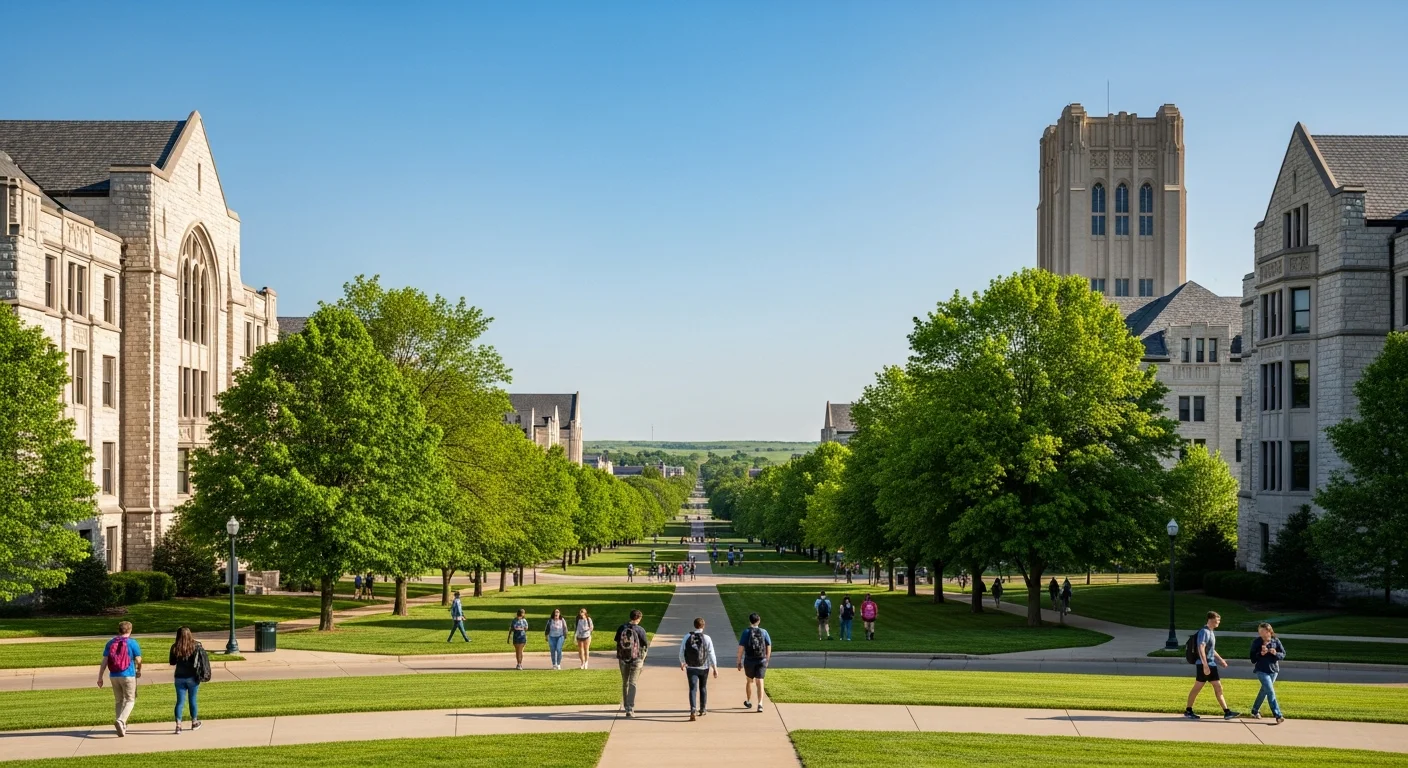
University campus in Kansas
Updated June 28, 2026

Best Game Development Degree Programs in Kansas, 2026 Rankings

Compare the top game development colleges in Kansas. 12 accredited game development schools ranked by graduation rate, career outcomes, and value, from Johnson County Community College to Wichita State University.

#1 ProgramWichita State
Avg Salary$92,340
Tuition From$2,400/yr
Job Growth+22%
On this page
Reviewed by Taylor Rupe, Founder & EditorSee methodology

13

Programs ranked

IPEDS 2024

$92,340

Kansas median game development salary

BLS OEWS 2024

74/100

Top program score

Hakia methodology

16%

U.S. job growth (2023–33)

BLS projections

Key Takeaways

Best game development degree programs: Wichita State, Southwestern College, Fort Hays State

Ranked by graduation rates, program outcomes, and institutional quality

IPEDS 2024

Tuition ranges from $2,100 to $38,330/year

Johnson County Community ... offers the most affordable option at $2,400/yr

IPEDS 2024

Game Development degree programs available: 5 associate's, 2 master's in Kansas

From community college pathways to advanced research degrees

IPEDS 2024

2 online game development degree programs in Kansas

Flexible scheduling for working professionals

IPEDS 2024

Kansas community college transfer can save 40-60% on total degree costs

5 associate's programs provide transfer pathways to bachelor's degrees

Education Commission of the States

Major employers: Garmin, Sprint, Cerner, Koch Industries

Tech hubs in Kansas City and Wichita

Hakia Research 2026

Game Development degree programs near 44+ cities across Kansas

Search by city to find programs within 200 miles of your location

IPEDS 2024

Updated June 28, 2026

How we ranked Kansas Game Development programs

We rank 13 accredited game development programs in Kansas using IPEDS 2024 institutional data, BLS OEWS 2024 state salary data, and College Scorecard outcomes. A 4-factor weighted composite is normalized to a 0–100 score. Schools cannot pay for placement; rankings are produced algorithmically.

Program completions (35%)Graduation rate (25%)Selectivity (20%)Career outcomes (20%)
See full methodology

Are Game Development Degree Programs in Kansas Worth It?

Answer
$92,340
Yes. The best game development degree programs in Kansas deliver strong ROI, graduates earn $92,340 median salary with +22% job growth through 2032. In-state tuition averages $14,330/year.

Source: BLS OEWS May 2024

Game Development Degree Rankings in Kansas

Compare the top-ranked Game Development programs in Kansas by degree level. Tuition, graduation rate, and Hakia Score for every accredited program.

Best Associate's Game Development Programs in Kansas

5
Programs ranked
$2,996
Avg tuition/yr
0%
Avg grad rate

Program Landscape

Kansas offers 5 accredited associate's degree programs in game development, providing an affordable entry point into the technology field. The top-ranked programs include Johnson County Community ..., Butler Community College, Barton County Community C..., which combine rigorous technical curriculum with practical skills training.

Costs & Value

Community colleges in Kansas offer these two-year programs at an average cost of $2,996/yr, significantly less than four-year university tuition. Students completing associate's degrees can pursue entry-level technical positions and transfer opportunities, with entry-level salaries averaging $50,787 in Kansas.

Career Pathways

Many programs feature guaranteed transfer agreements with Kansas's public universities, allowing students to complete their first two years at reduced cost before transferring to complete a bachelor's degree. The Kansas City, Wichita, Overland Park areas offer particularly strong job markets for associate's degree holders, with employers like Garmin, Sprint, Cerner hiring for technical support, junior development, and IT specialist positions.

Curriculum & Specializations

Programs typically include coursework in programming fundamentals, database management, networking basics, and software development. Among game development schools in Kansas, these associate's programs offer the best value for students beginning their game development degrees in Kansas.

Best Bachelor's Game Development Programs in Kansas

6
Programs ranked
$24,502
Avg tuition/yr
85%
Avg grad rate

Program Landscape

Kansas ranks among the nation's top destinations for game development education, with 6 accredited bachelor's degree programs across 2 public and 4 private institutions. The highest-ranked programs are Wichita State, Southwestern College, Fort Hays State, recognized for academic excellence, research opportunities, and strong industry connections.

Career Outcomes

Graduates from Kansas game development programs earn a median salary of $78,489, 20% below the national average. The state's robust technology sector, anchored by the Kansas City, Wichita, Overland Park metropolitan areas, provides abundant internship and employment opportunities with companies including Garmin, Sprint, Cerner.

Costs & Value

Tuition ranges from $4,437 to $38,330 annually, with an average of $24,502/yr. Top programs maintain graduation rates above 85%, with the highest reaching 96%. Many programs hold ABET accreditation, the gold standard for computing education, ensuring curriculum meets rigorous industry standards.

Curriculum & Specializations

Students can choose from specializations including software engineering, cybersecurity, artificial intelligence, data science, and systems architecture. Strong industry partnerships provide access to co-op programs, capstone projects with real companies, and direct recruiting pipelines to Kansas's leading technology employers. For students seeking game development degrees in Kansas, these top-ranked game development schools offer the strongest combination of academic rigor and career preparation.

Show all 6 ranked programs
RankSchoolLocationTypeTuitionGrad RateHakia Score
#6Baker UniversityBaldwin City, KSPrivate$33,20029.8

Best Master's Game Development Programs in Kansas

2
Programs ranked
$8,606
Avg tuition/yr
87%
Avg grad rate

Program Landscape

Kansas offers 2 master's degree programs in game development, designed for professionals seeking to advance into senior engineering, technical leadership, and specialized roles. The top programs, Wichita State, Kansas State, combine advanced technical training with research opportunities and leadership development.

Career Outcomes

Master's graduates in Kansas earn a median salary of $92,340, approximately 20-30% higher than bachelor's degree holders. The concentration of technology companies in Kansas City, Wichita, Overland Park creates strong demand for graduate-level talent, with Garmin, Sprint, Cerner actively recruiting from these programs.

Costs & Value

Program formats include traditional full-time study (typically 2 years), part-time options for working professionals (2-3 years), and accelerated tracks. Tuition averages $8,606/yr, with many employers offering tuition reimbursement for graduate education. Some programs offer thesis and non-thesis tracks, allowing students to focus on research or professional development based on their career goals.

Curriculum & Specializations

Curriculum covers advanced topics including machine learning, distributed systems, software architecture, and technical management. Many programs include practicum experiences, industry capstone projects, or consulting engagements that provide real-world application of advanced concepts. Among Kansas's game development schools at the graduate level, these programs stand out for both academic quality and career outcomes.

Game Development Degree Costs & Tuition in Kansas

MetricValue
Average in-state tuition$14,330/year
Average out-of-state tuition$35,825/year
Community college tuition$3,583/year
4-year savings for residents$85,980
2+2 transfer pathway savings$21,494

Source: IPEDS 2024

Financial Aid & Scholarships for Game Development Students in Kansas

State Aid Programs

Kansas students pursuing game development degrees have access to multiple financial aid pathways, starting with the Free Application for Federal Student Aid (FAFSA). Through Federal Student Aid, undergraduate and graduate students can explore federal grants, loans, and work-study opportunities regardless of institution type. The federal government provides need-based and merit-based support that can significantly reduce out-of-pocket costs across Kansas's 20 institutions offering game development programs.

Key Programs & Amounts

Kansas-specific aid comes through the Kansas Comprehensive Grant, a need-based grant program administered by the Kansas Board of Regents that supports students attending independent institutions throughout the state. Students at public universities like Wichita State University and University of Kansas should also investigate institutional scholarships and departmental funding opportunities specific to computer science and game development disciplines. Many Kansas schools offer merit scholarships based on academic performance, portfolio quality, and demonstrated creative talent, particularly valuable for game development majors whose work can showcase exceptional skill.

Institutional Scholarships

For students exploring related fields, examining Computer Science in Kansas and Software Engineering in Kansas programs may reveal additional funding opportunities, as many scholarships span STEM disciplines. The Kansas Transfer Equivalency System also enables community college students to transfer credits efficiently, reducing overall time-to-degree and associated costs. Students should complete the FAFSA by priority deadlines and contact financial aid offices at their chosen institutions for information about game development-specific scholarships and assistantships.

Game Development Degree ROI Calculator, Kansas

Use our interactive ROI calculator to estimate your return on investment for a game development degree in Kansas. Enter your expected tuition costs, financial aid, and career goals to see projected payback periods and lifetime earnings. The calculator uses current salary data from BLS and tuition data from IPEDS to provide accurate estimates.

Game Development Degree ROI Calculator

Estimate your return on investment for a game development degree

Leave blank to use average cost for selected program type

20 years
10 years20 years30 years
20-Year ROI

+907%

Net gain divided by total investment. ROI above 200% is considered excellent for education investments.

Net Gain

$1,677,254

Your additional lifetime earnings with this degree vs. working without one, minus the total investment.

Break-Even

5 years

Years until your cumulative earnings exceed total investment. Shorter programs often break even faster due to lower opportunity cost.

COL-Adjusted Salary

$133,333

Your starting salary adjusted for local cost of living. This shows real purchasing power compared to a $100K national baseline.

Why does break-even change with program type? Your "total investment" includes both tuition AND opportunity cost (foregone earnings while in school). A 4-year full-time public university (in-state) means 4 years of not earning a salary ($140,000 in opportunity cost). Shorter full-time programs may have higher tuition but lower total investment because you return to the workforce sooner.

Detailed Breakdown

How we calculate your degree ROI using real salary data

Total Investment$185,000

Tuition plus opportunity cost (earnings you miss while in school)

Program Cost (Tuition)$45,000

Direct cost of the degree program

Opportunity Cost$140,000

4 years × $35K/year foregone salary while studying full-time

20-Year Earnings (with degree)$2,712,662

Projected career earnings starting after graduation, with salary growth

20-Year Earnings (without degree)$850,408

What you'd earn working at $35K/year with 2% annual growth

Starting Salary (Austin, TX)$140,000

Median salary for this role in your selected location (BLS 2024)

Annualized Return4.9%

Your investment's compound annual growth rate (similar to stock market returns)

Data sources: BLS OEWS May 2024, IPEDS 2024. Calculations use median salaries, 3% discount rate, and assume salary growth declines from 6% to 2% over career. Individual results will vary. | Powered by Hakia.com

Game Development Salaries by Metro Area

Median annual salary in Kansas metro areas

Kansas City$102K
Wichita$97K
Overland Park$92K
View data table
CategoryValue
Kansas City$102K
Wichita$97K
Overland Park$92K

Source: BLS OEWS May 2024

Hakia.com

Top Employers Hiring Game Development Graduates in Kansas

Find game development jobs in Kansas. These major employers across Kansas metro areas are actively hiring game development degree holders. Click employer names to view current job openings.

Game Development Jobs in Overland Park

KS
Sprint/T-Mobile
telecom
Garmin
tech
Netsmart
healthtech
Black & Veatch
engineering

Game Development Jobs in Wichita

KS
Spirit AeroSystems
aerospace
Textron Aviation
aerospace
NetApp
tech

Transfer Pathways for Game Development Degrees in Kansas

State Transfer System

Kansas provides streamlined transfer pathways for game development students through the Kansas Transfer Equivalency System, which establishes systemwide course transfer agreements among public institutions. This framework enables students to complete associate's degrees at 8 community colleges before transferring to one of 10 bachelor's degree-granting institutions without losing credits. Institutions like Johnson County Community College (39 completions in 2023) and Butler Community College (30 completions) serve as primary entry points for students seeking affordable initial coursework. Community college tuition averages significantly below four-year institutions, making this pathway economically attractive: Johnson County Community College charges $2,400 annually while Butler Community College costs $3,090.

How Transfers Work

The Kansas Transfer Equivalency System guarantees that courses completed at community colleges align with lower-level requirements at universities like Wichita State University, University of Kansas, and Kansas State University. This structured approach allows students to complete general education and foundational game development coursework at reduced cost, then transition to specialized upper-level courses at four-year institutions. The Kansas Board of Regents publishes official articulation agreements detailing specific course equivalencies. Students can explore related technical pathways through Computer Programming in Kansas community college programs, which strengthen foundational skills. For financial planning during transfer, the Kansas Comprehensive Grant supports eligible students at participating institutions. To compare affordability across all transfer options, consult Most Affordable Programs featuring Kansas's most cost-effective pathways.

Why Pursue a Game Development Degree in Kansas?

Industry & Workforce

Kansas offers a strong landscape for game development education, with 20 institutions across the state providing programs at multiple degree levels (IPEDS). Bachelor's degree programs are available at 10 institutions, while 8 associate's programs serve students seeking accelerated entry into the field. The state's commitment to game development is evident in completion data: 249 bachelor's degrees, 79 associate's degrees, and 276 master's degrees were awarded in 2023 alone (IPEDS). This comprehensive educational infrastructure positions Kansas as a competitive destination for aspiring game developers.

Salary Outlook

The state's affordability stands out in a competitive national landscape. Average public in-state tuition at four-year institutions is just $7,625, significantly lower than the national average (College Scorecard). Top-ranked programs like Wichita State University offer tuition as low as $7,247 while maintaining exceptional graduation outcomes. Kansas's major employment hubs, including Wichita, Kansas City, and Topeka metro areas, host technology employers that actively recruit game development graduates. Students can explore related fields through neighboring programs in Computer Science in Kansas, Software Engineering in Kansas, and UX Design in Kansas to build interdisciplinary expertise. The combination of affordable education, quality institutions, and regional employment opportunities makes Kansas an economical choice for game development careers.

Game Development Program Availability in Kansas

12 Programs
Kansas offers 12 accredited game development programs across public universities, private colleges, and community colleges. Top tech hubs include Kansas City, Wichita, Overland Park.

Source: IPEDS 2024

Game Development Job Market & Salary Data in Kansas

Employment Outlook

Kansas has established itself as a growing hub for game development talent, with 20 institutions offering game development programs across the state (IPEDS). The state's educational pipeline is particularly strong at the bachelor's level, where 10 institutions produce graduates annually, with 249 completions reported in the most recent data cycle. Beyond traditional four-year programs, Kansas supports 8 associate's programs generating 79 completions, providing alternative pathways into the industry. This diverse educational landscape creates a steady stream of qualified professionals entering the Kansas job market.

Salaries by Metro

Job opportunities for game developers in Kansas are concentrated in major metropolitan areas including Wichita, the Kansas City Metro, Topeka, and Lawrence. For current salary data and detailed occupational information for computer and video game developers in Kansas, the Bureau of Labor Statistics (BLS) provides comprehensive labor market analysis. Students and professionals can explore additional career pathways through related fields such as Computer Science in Kansas, Software Engineering in Kansas, and Computer Programming in Kansas, which often overlap with game development career opportunities and employer requirements.

Entry-Level (0-2 yrs)

New graduates and career changers

Senior (8+ yrs)

Technical leads and architects

Median Salary in Kansas$60,021$133,893
Typical RolesJunior Developer, AnalystStaff Engineer, Architect
Remote Work AccessLimitedCommon
Degree ExpectationBachelor's sufficientMaster's preferred

Online vs On-Campus Game Development Programs in Kansas

Online Programs

2 available in Kansas

On-Campus Programs

Traditional classroom experience

Typical Tuition$12,897/yr$14,330/yr
Schedule FlexibilitySelf-paced or asyncFixed schedule
NetworkingVirtual cohortsIn-person, career fairs
Best ForWorking professionalsTraditional students
Completion Time2-4 years (flexible)4 years (standard)

Compare Game Development Programs in Other States

Game Development Degree Programs in Kansas: FAQ

What are the best game development degree programs in Kansas?
The best game development degree programs in Kansas based on our methodology are: 1) Wichita State University (87% graduation rate), 2) Southwestern College, and 3) Fort Hays State University. Our rankings weight graduation rates (25%), program completions (35%), selectivity (20%), and career outcomes (20%). Kansas offers 12 total accredited programs across 8 public and 4 private institutions. See our complete rankings for all 6 bachelor's programs.
How much do game development degree programs cost in Kansas?
Game Development degree program costs in Kansas vary significantly by institution type. In-state public tuition averages $14,330/year, while private institutions average $31,526/year. Community colleges offer the most affordable path at approximately $3,583/year for associate's degrees. The total 4-year cost ranges from $57,320 at public schools to $126,104 at private institutions before financial aid. Most students don't pay full sticker price, federal grants, state aid, and institutional scholarships can reduce costs by 30-60%.
What salary can game development degree graduates earn in Kansas?
Game Development professionals in Kansas earn a median salary of $92,340, which is competitive with the national average of $115,500. Entry-level positions typically start around $60,021, while senior roles exceed $133,893. Salaries vary by metro area: Kansas City ($101,574), Wichita ($96,957) offer the highest compensation. Specialized roles like AI/ML engineers and cloud architects command premiums of 15-30% above median.
Are there online game development degree programs in Kansas?
Yes, Kansas offers 2 accredited online Game Development programs from state institutions. These programs award the same degree as on-campus options and include synchronous and asynchronous formats. Top-ranked online programs include offerings from Flint Hills Technical College and Independence Community College. Online programs typically cost the same as on-campus tuition for in-state students. Many programs offer flexible scheduling for working professionals, with some offering accelerated completion in 2-3 years. Ensure any online program holds regional accreditation and ideally ABET accreditation for engineering programs.
What companies hire game development degree graduates in Kansas?
Major Game Development employers in Kansas include Garmin, Sprint, Cerner, Koch Industries, Spirit AeroSystems. The Kansas City and Wichita metro areas serve as primary tech hubs with thousands of open positions. Top employers maintain recruiting pipelines directly from Kansas universities, with many offering internship-to-hire programs. Beyond tech giants, opportunities exist in healthcare IT, financial services, defense contractors, and growing startups. Kansas's tech sector shows +22% projected job growth through 2033, outpacing most other industries.
Is a game development degree program worth it in Kansas?
A game development degree program in Kansas offers strong ROI with a $92,340 median salary and +22% projected job growth. At average in-state tuition of $14,330/year, graduates typically recoup their educational investment within 3-5 years. The degree opens doors to high-paying careers in software development ($104,344), data science, cybersecurity, and AI/ML. Beyond salary, benefits include job security, remote work flexibility, and clear advancement paths. Alternative paths like bootcamps exist for career changers, but bachelor's degrees provide broader career options and higher lifetime earnings.
How long do game development degree programs take in Kansas?
Standard completion times for game development degree programs in Kansas are: Associate's (2 years, 60 credits), Bachelor's (4 years, 120 credits), and Master's (1-2 years, 30-36 credits). However, actual timelines vary based on course load, transfer credits, and program format. Accelerated programs can compress a bachelor's to 3 years or a master's to 12 months. Part-time students typically need 5-6 years for a bachelor's degree. Kansas community colleges offer a cost-effective "2+2" path: complete your associate's in 2 years, then transfer to a Kansas university for the final 2 years of a bachelor's program.
What financial aid is available for game development degree students in Kansas?
Kansas game development degree students can access multiple financial aid sources. Federal aid includes Pell Grants (up to $7,395/year for qualifying students) and federal student loans. Kansas state grants provide additional support for residents attending in-state schools. Institutional scholarships from universities can significantly reduce costs, many schools offer merit-based awards for STEM students. Work-study programs and teaching/research assistantships (especially for graduate students) provide income while building experience. Complete the FAFSA by Kansas's priority deadline to maximize aid eligibility. Some employers also offer tuition reimbursement for employees pursuing CS degrees.

Data Sources

Institutional characteristics, completions, graduation rates

Kansas salary and employment data

Official University Websites

Program details and admissions information

Last Updated: June 26, 2026. Rankings based on IPEDS 2024 data. Salary data from BLS OEWS May 2024.

Was this ranking helpful for your college search?
Taylor Rupe

Taylor Rupe

Co-founder & Editor (B.S. Computer Science, Oregon State • B.A. Psychology, University of Washington)

Taylor combines technical expertise in computer science with a deep understanding of human behavior and learning. His dual background drives Hakia's mission: leveraging technology to build authoritative educational resources that help people make better decisions about their academic and career paths.

The research behind the rankings

In-depth Game Development program profiles in Kansas

Hand-researched detail on the top-ranked programs: degree pathways, research labs, industry partners, career outcomes, and admissions. Tap any school to expand.

Best Associate's Game Development programs

#1Johnson County Community CollegeOverland Park, KS

Hakia insight. JCCC's Kansas City location gives associate's students proximity to a regional gaming hub—students can intern at local studios while completing their degree, then transfer to four-year programs without losing credits or momentum.

At the associate's level, if you're looking to jump into game development without relocating, JCCC's program gives you hands-on experience with industry-standard engines and tools while staying connected to the Kansas City metro tech ecosystem. You'll work with Unreal and Unity in dedicated labs, learning both programming fundamentals and game design principles that employers actually care about. Most graduates either transfer to four-year programs at Kansas universities or land junior developer roles at local studios and tech companies in the greater Kansas City area—a region with growing game and interactive media opportunities. The program's strength lies in its proximity to active development communities and its focus on portfolio-building: you leave with shipped game projects, not just certificates.

Programs offered

  • Associate of Science in Game Development · 2 years · on-campus
  • Associate of Applied Science in Game Development · 2 years · online

Career outcomes

Top employers: Local game development studios in Kansas City metro, Regional tech companies, Independent game studios

#2Butler Community CollegeEl Dorado, KS

Hakia insight. Butler's emphasis on programming logic before game-specific tools means graduates arrive at four-year programs or entry-level roles with transferable problem-solving skills, not just engine tutorials.

At the associate's level, butler's game development track sits within a broader technology program that emphasizes real-world problem-solving, giving you a solid foundation in programming logic before specializing in game engines. You'll build competency in C# and game design while benefiting from Butler's strong transfer agreements with Kansas universities—many students complete their associate and smoothly transition into four-year computer science or game design majors. The program also connects you with local employers in central Kansas who need skilled technical staff, making it a smart choice if you want both transferability and immediate workforce options. Expect project-based learning where you create working games that become portfolio pieces employers ask to see.

Programs offered

  • Associate of Science in Game Development · 2 years · on-campus
  • Associate of Applied Science in Game Development · 2 years · online

Career outcomes

Top employers: Regional technology companies, Game development studios, Software firms in central Kansas

#3Barton County Community CollegeGreat Bend, KS

Hakia insight. Barton's smaller cohorts create an unusual advantage at the associate's level: professors can catch weak fundamentals early and customize projects to individual strengths, reducing the remediation delays many transfer students face.

At the associate's level, with smaller cohorts and direct instructor access, Barton's game development students get mentored attention that larger programs can't match—your professors know your code and your career goals by name. The curriculum covers essential game engines and scripting languages while emphasizing the entrepreneurial side of indie game development, perfect if you're interested in launching your own projects. You'll transfer readily to Kansas universities or move into junior roles at regional tech firms and studios. The program's rural Kansas location offers an underrated advantage: lower costs, tight-knit networks with local employers, and the freedom to focus deeply on your craft without the distraction of a massive campus.

Programs offered

  • Associate of Science in Game Development · 2 years · on-campus
  • Associate of Applied Science in Game Development · 2 years · online

Career outcomes

Top employers: Regional tech companies, Game development studios, Local software firms

#4Flint Hills Technical CollegeEmporia, KS

Why it stands out. Flint Hills Technical College offers comprehensive Game Development programs preparing students for careers in technology.

Hakia insight. Flint Hills' location in Emporia positions it as a pipeline for regional tech employment—students graduate into a tight labor market where they're known entities rather than competing with graduates from larger metropolitan programs.

Flint Hills Technical College offers Game Development programs in Emporia, KS. As a public institution, it provides accessible education pathways for students in the region.

#5Independence Community CollegeIndependence, KS

Why it stands out. Independence Community College provides affordable Game Development education with flexible scheduling and transfer pathways to four-year universities.

Hakia insight. Independence's flexible scheduling and explicit transfer pathways mean working students or those with competing obligations can complete a marketable credential in two years without sacrificing the option to upgrade to a bachelor's later.

Independence Community College offers Game Development programs in Independence, KS. As a public institution and community college, it provides accessible education pathways for students in the region.

Best Bachelor's Game Development programs

#1Wichita State UniversityWichita, KS

Why it stands out. Required applied learning experience through three sequential practicum courses in game design. Mid-program review checkpoint at 59 credit hours to ensure student progress and readiness

Hakia insight. Located in Wichita, Wichita State University students have direct access to internship pipelines at Garmin and Sprint.

The Bachelor of Applied Arts in Media Arts with a concentration in Game Design is a 120-credit hour program designed to prepare students for careers in game development. The curriculum combines foundational media arts courses with specialized game design instruction, covering computer modeling, digital animation, game technology and coding, level design, and 3D asset pipeline development. Students progress through three sequential game design courses (Game Design I, II, and III) alongside technical training in game engines and programming. The program requires a mid-program review upon completion of 59 credit hours to ensure student readiness. Applied learning is integrated through three required practicum courses (Media Arts Practicum I, II, and III - Game Design), providing hands-on experience in game development. The curriculum emphasizes both artistic and technical skills, including foundation courses in 2D design, drawing, digital animation, and character design, complemented by coding and game technology courses. Graduates are prepared for roles in game studios, interactive media companies, and related creative industries.

Programs offered

  • Bachelor of Applied Arts in Media Arts - Concentration in Game Design · 4 years · on-campus

Career outcomes

Top employers: Microsoft Games Studios

Location advantage: Growing game development cluster in the Midwest Access to emerging regional studios and mid-market publishers

#2Southwestern CollegeWinfield, KS

Why it stands out. Three specialized emphasis tracks within game development. Hands-on coursework in 3D modeling and animation

Hakia insight. Southwestern's three specialized emphasis tracks within a single degree let students double down on art, systems, or design without committing to a separate major—a flexibility that larger programs often gate behind double-majors or minors.

Southwestern College's Bachelor of Science in Computer Science & Digital Arts with an emphasis in Computer Game Development combines core computer science principles with specialized game development coursework. Students complete foundational courses in computer systems and game concepts, followed by specialized training in game/level design, image and sound design, or software design. The program requires completion of CPTR200 Computer Game Concepts and CPTR205 Computer Game Planning and Production, alongside cognate requirements in communication and professional writing. Students select one of three specialization tracks: Game/Level Design (covering management, marketing, and storytelling), Image and Sound Design (focusing on graphics, 3D modeling, animation, and digital sound), or Software Design (emphasizing programming, data structures, and algorithms). The curriculum integrates hands-on technical skills with creative and production elements, preparing graduates for roles in game studios, interactive media, and software development.

Programs offered

  • Bachelor of Science in Computer Science & Digital Arts - Computer Game Development Emphasis · 4 years · on-campus
#3Fort Hays State UniversityHays, KS

Hakia insight. Fort Hays State offers both BS and BA paths in game development, letting students weight technical depth or breadth depending on career trajectory without forcing a late pivot between degree types.

Programs offered

  • Bachelor of Science in Game Development · 4 years · on-campus
  • Bachelor of Arts in Game Development · 4 years · online
#4Benedictine CollegeAtchison, KS

Hakia insight. Benedictine's dual-degree option (BS and BA) gives students flexibility to emphasize either technical systems or creative practice—a choice many larger programs don't offer until after enrollment.

Programs offered

  • Bachelor of Science in Game Development · 4 years · on-campus
  • Bachelor of Arts in Game Development · 4 years · online
#5Bethany CollegeLindsborg, KS

Why it stands out. Bethany's strength lies in graduating well-rounded generalists with shipped projects and mentorship-driven iteration cycles, rather than specializing in a single discipline.

Hakia insight. Bethany's focus on shipping playable projects across multiple genres from day one means graduates have 4+ portfolio pieces to show studios, rather than a single capstone—a multiplier effect on employment competitiveness.

At the bachelor's level, bethany College's game development program emphasizes hands-on creation from day one, with students shipping playable projects across multiple genres and platforms starting in their first year. The curriculum balances technical depth—covering engine architecture, graphics programming, and systems design—with creative storytelling and game design theory, ensuring graduates can contribute meaningfully across development disciplines. What sets this program apart is its integration of small-cohort mentorship; faculty work closely with students on iterative projects, providing the kind of personalized feedback typically found only at boutique studios. The program has built meaningful connections with indie developers and smaller publishing houses in the region, creating pathways for student work to reach actual players and for graduates to land positions at studios hungry for generalists who can wear multiple hats. Career outcomes skew toward independent game developers and mid-tier studios, with many graduates either launching their own projects or joining teams where they're expected to contribute across gameplay programming, art direction, or narrative design. The school's location in rural Kansas might seem remote, but it's actually a strategic advantage for students seeking focused, distraction-free development environments and close faculty relationships—exactly what aspiring game creators need to build a strong portfolio.

Programs offered

  • Bachelor of Science in Game Development · 4 years · on-campus
  • Bachelor of Arts in Game Development · 4 years · online
#6Baker UniversityBaldwin City, KS

Why it stands out. Leverages a liberal arts environment to foster interdisciplinary game projects with art and design students rather than operating as an isolated engineering specialization.

Hakia insight. Baker's liberal arts integration forces game dev students into actual collaboration with art and design majors, mimicking AAA studio structure years before graduation rather than learning team dynamics on the job.

At the bachelor's level, at Baker University, game development emerges as a creative outlet within computer science studies, appealing to students who want to build systems-level skills while maintaining artistic and design interests. The program weaves game projects into core coursework on data structures, algorithms, and software design—ensuring that students learn fundamental computer science through concrete, engaging applications. Baker's strength is its liberal arts ethos: computer science students interact regularly with peers in digital media, art, and communications, creating organic opportunities for interdisciplinary game projects and portfolio pieces. While formalized game development tracks are limited, the curriculum's flexibility allows motivated students to specialize by choosing electives, independent studies, and capstone projects focused on game systems. Faculty maintain awareness of industry standards and encourage students to engage with game jams, online competitions, and open-source engine communities. The Baldwin City campus provides a supportive environment where students can prototype ideas collaboratively and receive feedback from both technical and creative peers.

Programs offered

  • Bachelor of Science in Game Development · 4 years · on-campus
  • Bachelor of Arts in Game Development · 4 years · online

Best Master's Game Development programs

#1Wichita State UniversityWichita, KS

Why it stands out. Wichita State differentiates through rigorous technical depth in game systems and AI, embedded within a larger engineering research environment, rather than focusing primarily on art or narrative.

Hakia insight. Wichita State's master's program embeds game AI and systems research within a broader engineering ecosystem—students can co-author papers on game architecture or AI while completing their capstone, making them competitive for research or senior technical roles.

At the master's level, wichita State University's game development track sits within a larger computer science and engineering ecosystem that treats games as a serious computational and design discipline. The program attracts students interested in the technical foundations of real-time systems—graphics rendering, networked multiplayer architecture, AI behavior trees, and engine optimization—while still maintaining a studio-style project component where theory translates into playable demos. Faculty research touches on game AI, procedural generation, and interactive storytelling, giving students exposure to current academic work in the space and the chance to contribute to publications alongside industry-ready portfolio pieces. A distinctive feature is the program's emphasis on cross-disciplinary collaboration: computer science students work alongside peers in engineering, art, and design, mirroring how real game teams operate at scale. Wichita's location in the American heartland has become an unexpected advantage as the region develops a growing indie and mid-market game development cluster; several studios have partnered with the university for internships and recruiting, creating a direct pipeline from coursework to employment. Graduates often move into technical roles—engine programmer, gameplay programmer, tools engineer—at studios and tech companies, with some going on to graphics or AI-focused careers in adjacent fields. The university's investment in modern lab facilities and industry-standard software licenses means students train on the same tools they'll encounter professionally.

Programs offered

  • Master of Science in Game Development · 1-2 years · on-campus
  • Master of Arts in Game Development · 1-2 years · online

Career outcomes

Top employers: Microsoft Games Studios

Location advantage: Growing game development cluster in the Midwest Access to emerging regional studios and mid-market publishers

#2Kansas State UniversityManhattan, KS

Why it stands out. Three program options: thesis track (6 credit hours CIS 899 original research), report/project track (3 credit hours applied capstone work), or non-thesis/non-report track with exit interview. Available via distance learning for working professionals

Hakia insight. Kansas State's three exit pathways (thesis, project, or coursework-only) plus distance delivery mean working professionals can pursue a credential aligned to their actual constraints—a thesis student advances research, while a non-thesis student gets a degree and interview.

Kansas State University's Master of Science in Computer Science offers flexible pathways for working professionals seeking career advancement. Students can choose between three options: a thesis track (30 credits, including 6 hours of original research), a report/project track (30 credits with applied capstone work), or a coursework-only track (30 credits with exit interview). The program is available via distance learning, accommodating part-time study. All students must complete coursework across Implementation Languages, Systems, Applied Computer Science, and Foundations areas, with a grade of B or better required. Faculty advisers guide course selection from the start, and students submit a formal program of study. While specific salary data, assistantship stipends, and embedded certifications are not detailed in available materials, the flexible format supports mid-career professionals balancing work and education.

Programs offered

  • Master of Science in Computer Science · 1-2 years · on-campus