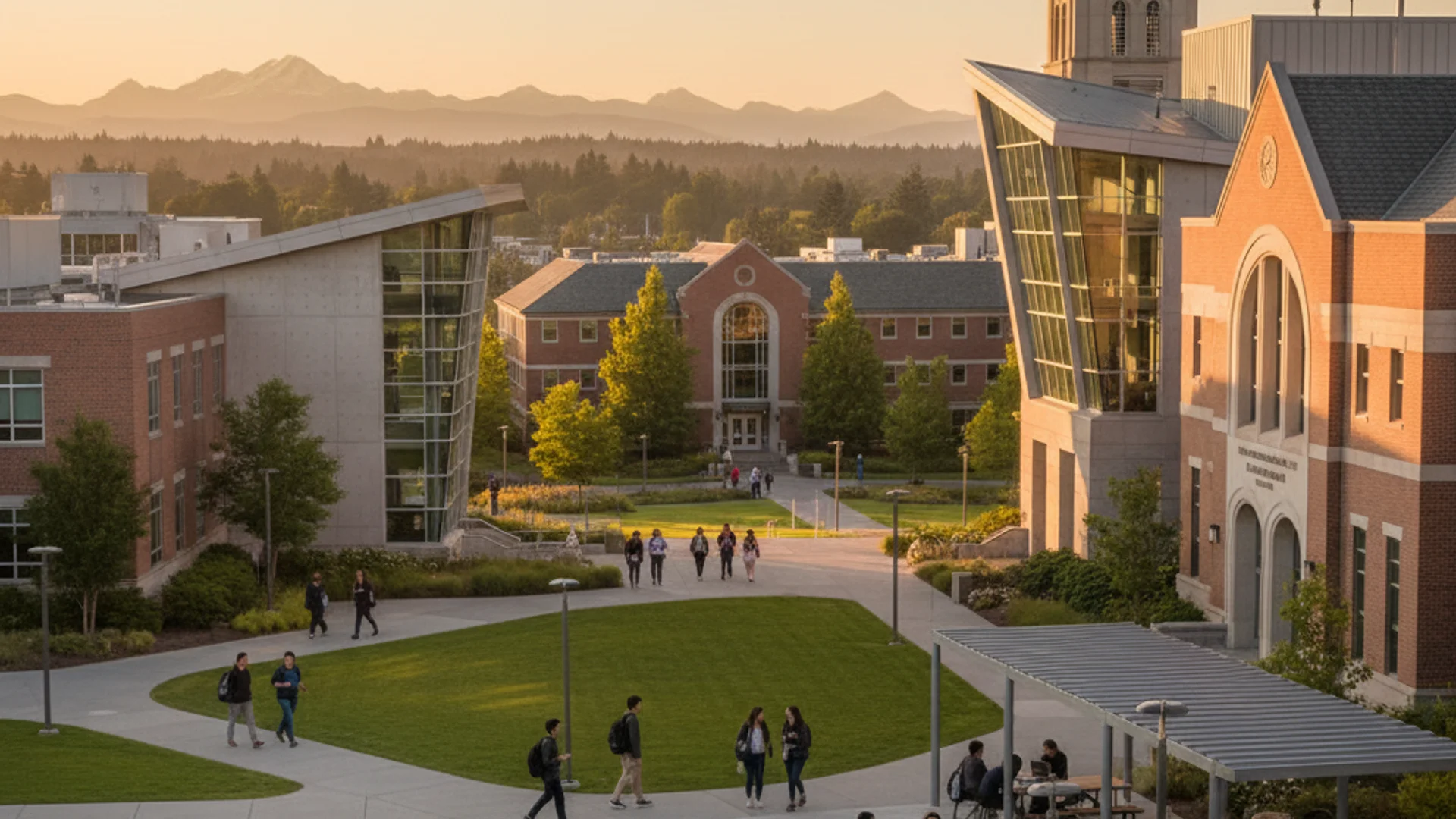
University campus in Washington
Updated June 28, 2026

Best Game Development Degree Programs in Washington, 2026 Rankings

Compare the top game development colleges in Washington. 41 accredited game development schools ranked by graduation rate, career outcomes, and value, from Green River College to University of Washington-Seattle Campus.

#1 ProgramU of Washington-Seattle
Avg Salary$145,230
Tuition From$4,074/yr
Job Growth+22%
On this page
Reviewed by Taylor Rupe, Founder & EditorSee methodology

53

Programs ranked

IPEDS 2024

$145,230

Washington median game development salary

BLS OEWS 2024

95/100

Top program score

Hakia methodology

16%

U.S. job growth (2023–33)

BLS projections

Key Takeaways

Best game development degree programs: U of Washington-Seattle, Seattle, U of Washington-Bothell

Ranked by graduation rates, program outcomes, and institutional quality

IPEDS 2024

Tuition ranges from $3,195 to $59,340/year

Green River College offers the most affordable option at $4,074/yr

IPEDS 2024

Game Development degree programs available: 24 associate's, 9 master's, 1 doctoral in Washington

From community college pathways to advanced research degrees

IPEDS 2024

4 online game development degree programs in Washington

Flexible scheduling for working professionals

IPEDS 2024

Washington community college transfer can save 40-60% on total degree costs

24 associate's programs provide transfer pathways to bachelor's degrees

Education Commission of the States

Major employers: Microsoft, Amazon, Boeing, Expedia

Tech hubs in Seattle and Bellevue

Hakia Research 2026

Game Development degree programs near 43+ cities across Washington

Search by city to find programs within 200 miles of your location

IPEDS 2024

Updated June 28, 2026

How we ranked Washington Game Development programs

We rank 53 accredited game development programs in Washington using IPEDS 2024 institutional data, BLS OEWS 2024 state salary data, and College Scorecard outcomes. A 4-factor weighted composite is normalized to a 0–100 score. Schools cannot pay for placement; rankings are produced algorithmically.

Program completions (35%)Graduation rate (25%)Selectivity (20%)Career outcomes (20%)
See full methodology

Are Game Development Degree Programs in Washington Worth It?

Answer
$145,230
Yes. The best game development degree programs in Washington deliver strong ROI, graduates earn $145,230 median salary with +22% job growth through 2032. In-state tuition averages $15,684/year.

Source: BLS OEWS May 2024

Game Development Degree Rankings in Washington

Compare the top-ranked Game Development programs in Washington by degree level. Tuition, graduation rate, and Hakia Score for every accredited program.

Best Associate's Game Development Programs in Washington

24
Programs ranked
$4,310
Avg tuition/yr
75%
Avg grad rate

Program Landscape

Washington offers 24 accredited associate's degree programs in game development, providing an affordable entry point into the technology field. The top-ranked programs include Green River College, Lake Washington Institute..., Tacoma Community College, which combine rigorous technical curriculum with practical skills training.

Costs & Value

Community colleges in Washington offer these two-year programs at an average cost of $4,310/yr, significantly less than four-year university tuition. Students completing associate's degrees can pursue entry-level technical positions and transfer opportunities, with entry-level salaries averaging $79,877 in Washington.

Career Pathways

Many programs feature guaranteed transfer agreements with Washington's public universities, allowing students to complete their first two years at reduced cost before transferring to complete a bachelor's degree. The Seattle, Bellevue, Redmond areas offer particularly strong job markets for associate's degree holders, with employers like Microsoft, Amazon, Boeing hiring for technical support, junior development, and IT specialist positions.

Curriculum & Specializations

Programs typically include coursework in programming fundamentals, database management, networking basics, and software development. Among game development schools in Washington, these associate's programs offer the best value for students beginning their game development degrees in Washington.

Show all 24 ranked programs
RankSchoolLocationTypeTuitionGrad RateHakia Score
#6Shoreline Community CollegeShoreline, WAPublic$3,64849.2
#7Bellevue CollegeBellevue, WAPublic$4,07496%68.3
#8Edmonds CollegeLynnwood, WAPublic$4,07393%67.5
#9Clover Park Technical CollegeLakewood, WAPublic$5,74062%58.9
#10North Seattle CollegeSeattle, WAPublic$4,45849%55.1
#11Columbia Basin CollegePasco, WAPublic$5,51497%66.3
#12South Seattle CollegeSeattle, WAPublic$4,45853%54.7
#13Seattle Central CollegeSeattle, WAPublic$4,45839%51.4
#14Bates Technical CollegeTacoma, WAPublic$4,13151.9
#15Spokane Falls Community CollegeSpokane, WAPublic$3,19543.4
#16Centralia CollegeCentralia, WAPublic$4,62390%61.1
#17Skagit Valley CollegeMount Vernon, WAPublic$4,62391%61.4
#18Yakima Valley CollegeYakima, WAPublic$4,62355%52.4
#19Olympic CollegeBremerton, WAPublic$4,19785%58.9
#20Highline CollegeDes Moines, WAPublic$3,63349.1
#21Whatcom Community CollegeBellingham, WAPublic$3,63378%47.8
#22Big Bend Community CollegeMoses Lake, WAPublic$4,62396%50.6
#23Cascadia CollegeBothell, WAPublic$4,62347.9
#24Peninsula CollegePort Angeles, WAPublic$4,07446.3

Best Bachelor's Game Development Programs in Washington

19
Programs ranked
$27,900
Avg tuition/yr
86%
Avg grad rate

Program Landscape

Washington ranks among the nation's top destinations for game development education, with 19 accredited bachelor's degree programs across 8 public and 10 private institutions. The highest-ranked programs are U of Washington-Seattle, Seattle, U of Washington-Bothell, recognized for academic excellence, research opportunities, and strong industry connections.

Career Outcomes

Graduates from Washington game development programs earn a median salary of $123,446, 26% above the national average. The state's robust technology sector, anchored by the Seattle, Bellevue, Redmond metropolitan areas, provides abundant internship and employment opportunities with companies including Microsoft, Amazon, Boeing.

Costs & Value

Tuition ranges from $3,195 to $59,340 annually, with an average of $27,900/yr. Top programs maintain graduation rates above 86%, with the highest reaching 100%. Many programs hold ABET accreditation, the gold standard for computing education, ensuring curriculum meets rigorous industry standards.

Curriculum & Specializations

Students can choose from specializations including software engineering, cybersecurity, artificial intelligence, data science, and systems architecture. Strong industry partnerships provide access to co-op programs, capstone projects with real companies, and direct recruiting pipelines to Washington's leading technology employers. For students seeking game development degrees in Washington, these top-ranked game development schools offer the strongest combination of academic rigor and career preparation.

#5
Bellevue College
Bellevue, WAPublic
$4,074
Tuition/yr
96%
Grad rate
63.4
Hakia Score
Show all 19 ranked programs
RankSchoolLocationTypeTuitionGrad RateHakia Score
#6Washington State UniversityPullman, WAPublic$10,97660.1
#7DigiPen Institute of TechnologyRedmond, WAFor-Profit$37,20056.5
#8Pacific Lutheran UniversityTacoma, WAPrivate$49,472100%65.0
#9Whitworth UniversitySpokane, WAPrivate$49,60092%67.7
#10Heritage UniversityToppenish, WAPrivate$19,92084%54.9
#11Central Washington UniversityEllensburg, WAPublic$7,02171.8
#12Walla Walla UniversityCollege Place, WAPrivate$31,89956.9
#13Gonzaga UniversitySpokane, WAPrivate$52,54063.2
#14Lake Washington Institute of TechnologyKirkland, WAPublic$3,19543%46.6
#15Cascadia CollegeBothell, WAPublic$4,62346.3
#16University of Puget SoundTacoma, WAPrivate$59,34054.1
#17Seattle Pacific UniversitySeattle, WAPrivate$37,96553.6
#18Saint Martin's UniversityLacey, WAPrivate$43,60041.4
#19Cornish College of the ArtsSeattle, WAPrivate$38,31642.3

Best Master's Game Development Programs in Washington

9
Programs ranked
$22,285
Avg tuition/yr
87%
Avg grad rate

Program Landscape

Washington offers 9 master's degree programs in game development, designed for professionals seeking to advance into senior engineering, technical leadership, and specialized roles. The top programs, U of Washington-Seattle, Seattle, U of Washington-Bothell, combine advanced technical training with research opportunities and leadership development.

Career Outcomes

Master's graduates in Washington earn a median salary of $145,230, approximately 20-30% higher than bachelor's degree holders. The concentration of technology companies in Seattle, Bellevue, Redmond creates strong demand for graduate-level talent, with Microsoft, Amazon, Boeing actively recruiting from these programs.

Costs & Value

Program formats include traditional full-time study (typically 2 years), part-time options for working professionals (2-3 years), and accelerated tracks. Tuition averages $22,285/yr, with many employers offering tuition reimbursement for graduate education. Some programs offer thesis and non-thesis tracks, allowing students to focus on research or professional development based on their career goals.

Curriculum & Specializations

Curriculum covers advanced topics including machine learning, distributed systems, software architecture, and technical management. Many programs include practicum experiences, industry capstone projects, or consulting engagements that provide real-world application of advanced concepts. Among Washington's game development schools at the graduate level, these programs stand out for both academic quality and career outcomes.

Show all 9 ranked programs
RankSchoolLocationTypeTuitionGrad RateHakia Score
#6DigiPen Institute of TechnologyRedmond, WAFor-Profit$37,20052.2
#7University of Washington-Tacoma CampusTacoma, WAPublic$11,52492%50.1
#8Saint Martin's UniversityLacey, WAPrivate$43,60050.0
#9Central Washington UniversityEllensburg, WAPublic$7,02147.2

Best Doctoral Game Development Programs in Washington

1
Programs ranked
$10,976
Avg tuition/yr
0%
Avg grad rate

Program Landscape

Washington is home to 1 doctoral programs in game development, preparing students for research positions, faculty appointments, and executive technical roles. Leading programs at Washington State are recognized for cutting-edge research, strong faculty publications, and competitive funding packages.

Career Outcomes

Doctoral graduates command premium salaries, with Washington PhD holders earning a median of $181,538, reflecting the advanced expertise required for research and executive positions. The Seattle, Bellevue, Redmond region's research universities and corporate R&D centers provide extensive collaboration opportunities with industry leaders like Microsoft, Amazon, Boeing.

Costs & Value

PhD programs typically require 4-6 years of full-time study, including coursework, qualifying examinations, and original dissertation research. Many programs offer full funding through teaching or research assistantships, covering tuition and providing stipends of $25,000–$40,000 annually.

Curriculum & Specializations

Research strengths across Washington programs include artificial intelligence, cybersecurity, human-computer interaction, systems, and theoretical computer science. For aspiring researchers pursuing game development degrees in Washington, graduates go on to careers as university faculty, industry research scientists, or technical executives, contributing to advances in technology that impact millions of users worldwide.

Game Development Degree Costs & Tuition in Washington

MetricValue
Average in-state tuition$15,684/year
Average out-of-state tuition$39,210/year
Community college tuition$3,921/year
4-year savings for residents$94,104
2+2 transfer pathway savings$23,526

Source: IPEDS 2024

Financial Aid & Scholarships for Game Development Students in Washington

State Aid Programs

The Washington College Grant (WA Grant) provides substantial support for game development students.

For 2024-25, qualifying students can receive up to $11,887 per year at four-year public institutions, with awards based on family income and school attended (WSAC WCG). A family of four earning $78,500 or less may qualify for free tuition at public colleges. Families earning up to $131,000 can receive partial awards. Students are automatically considered when filing FAFSA or WASFA. Lifetime eligibility extends to 18 quarters (6 years), providing coverage for extended programs like game development.

Key Programs & Amounts

DigiPen and private institution students access federal and institutional aid.

DigiPen participates in federal student aid programs including Pell Grants (up to $7,395/year for 2024-25), federal loans, and work-study. Washington state aid including the WA Grant can be used at DigiPen for qualifying students (DigiPen Financial Aid). Merit scholarships and industry-sponsored awards supplement need-based aid. DigiPen's specialized focus attracts students nationally, so out-of-state students should explore home state portability agreements.

Institutional Scholarships

Additional funding sources support game development education.

The College Bound Scholarship provides tuition coverage for low-income students who signed up in 7th/8th grade. ESA Foundation scholarships specifically support women and minority students pursuing game-related degrees. Gaming companies including Microsoft, Amazon, and EA offer technology scholarships available to Washington students. Work-study positions at game studios and campus game labs provide income while building industry connections. Graduate assistantships at UW cover tuition plus stipends for master's and PhD students in graphics and game-related research.

Game Development Degree ROI Calculator, Washington

Use our interactive ROI calculator to estimate your return on investment for a game development degree in Washington. Enter your expected tuition costs, financial aid, and career goals to see projected payback periods and lifetime earnings. The calculator uses current salary data from BLS and tuition data from IPEDS to provide accurate estimates.

Game Development Degree ROI Calculator

Estimate your return on investment for a game development degree

Leave blank to use average cost for selected program type

20 years
10 years20 years30 years
20-Year ROI

+1168%

Net gain divided by total investment. ROI above 200% is considered excellent for education investments.

Net Gain

$2,161,658

Your additional lifetime earnings with this degree vs. working without one, minus the total investment.

Break-Even

5 years

Years until your cumulative earnings exceed total investment. Shorter programs often break even faster due to lower opportunity cost.

COL-Adjusted Salary

$110,000

Your starting salary adjusted for local cost of living. This shows real purchasing power compared to a $100K national baseline.

Why does break-even change with program type? Your "total investment" includes both tuition AND opportunity cost (foregone earnings while in school). A 4-year full-time public university (in-state) means 4 years of not earning a salary ($140,000 in opportunity cost). Shorter full-time programs may have higher tuition but lower total investment because you return to the workforce sooner.

Detailed Breakdown

How we calculate your degree ROI using real salary data

Total Investment$185,000

Tuition plus opportunity cost (earnings you miss while in school)

Program Cost (Tuition)$45,000

Direct cost of the degree program

Opportunity Cost$140,000

4 years × $35K/year foregone salary while studying full-time

20-Year Earnings (with degree)$3,197,066

Projected career earnings starting after graduation, with salary growth

20-Year Earnings (without degree)$850,408

What you'd earn working at $35K/year with 2% annual growth

Starting Salary (Seattle, WA)$165,000

Median salary for this role in your selected location (BLS 2024)

Annualized Return5.8%

Your investment's compound annual growth rate (similar to stock market returns)

Data sources: BLS OEWS May 2024, IPEDS 2024. Calculations use median salaries, 3% discount rate, and assume salary growth declines from 6% to 2% over career. Individual results will vary. | Powered by Hakia.com

Game Development Salaries by Metro Area

Median annual salary in Washington metro areas

Seattle$160K
Bellevue$152K
Redmond$145K
View data table
CategoryValue
Seattle$160K
Bellevue$152K
Redmond$145K

Source: BLS OEWS May 2024

Hakia.com

Top Employers Hiring Game Development Graduates in Washington

Find game development jobs in Washington. These major employers across Washington metro areas are actively hiring game development degree holders. Click employer names to view current job openings.

Game Development Jobs in Seattle

WA

Seattle is home to Amazon and Microsoft headquarters, plus major engineering offices for Google, Meta, and other tech giants.

Nearby cities: Bellevue, Redmond, Kirkland, Tacoma, Renton

Microsoft
Enterprise Software/Cloud
Amazon
E-commerce/Cloud (AWS)
Google
Search/Cloud/AI
Meta
Social/VR/AI
Tableau (Salesforce)
Data Visualization
Zillow
Real Estate Tech
Expedia Group
Travel Tech
Redfin
Real Estate Tech
DocuSign
Digital Agreements
F5 Networks
Networking/Security

Game Development Jobs in Bellevue/Eastside

WA

The Eastside corridor houses Microsoft's main campus in Redmond, Nintendo of America, and T-Mobile's headquarters.

Nearby cities: Redmond, Kirkland, Issaquah, Sammamish

Microsoft
Enterprise Software/Cloud
T-Mobile
Telecommunications
Valve Corporation
Gaming/Steam Platform

Washington Tech Industry & Infrastructure

Washington's tech economy is essentially defined by Microsoft and Amazon. The Seattle metro hosts the headquarters of both, plus major engineering offices for Google, Meta, Apple, and a dense second-tier of cloud, AI, and enterprise tech employers. With no state income tax and University of Washington's CS program at the top of the western US, Washington consistently posts the highest tech-job concentration per capita of any US state.

Seattle / Bellevue / Redmond

Seattle metropolitan area

Headquarters of Microsoft (Redmond) and Amazon (Seattle); major engineering offices for Google, Meta, Apple, Tableau, Tableau, Expedia, Zillow, Costco IT. UW is the dominant CS feeder; total-comp at named employers regularly clears $200K for new bachelor's grads.

Spokane / Eastern Washington

Spokane metro

Smaller tech market focused on healthcare-IT (Providence), defense (Fairchild AFB-adjacent), and growing remote-work tech employment. Whitworth and WSU-Spokane feed the local market.

No state income tax. Washington levies a Business and Occupation tax on gross receipts that tech employers factor into compensation structures.

Washington Regulation Affecting Game Development Graduates

Washington has emerged as one of the more active state legislatures on AI, biometric privacy, and consumer health data. The 2024 My Health My Data Act in particular is among the strictest US consumer health-data laws and shapes engineering practice at any company touching health-adjacent data.

Washington My Health My Data Act (MHMD)

Effective March 2024. Imposes strict requirements on collection, use, and sharing of consumer health data — broadly defined to include data inferring health status. Provides a private right of action.

Engineers at any company processing wellness, fitness, mental-health, or biometric data of WA users must implement consent, geofencing, and data-sharing restrictions. The law's broad scope of 'health data' makes it relevant for surprising amounts of consumer-tech work.

Read more

Washington Biometric Identifiers Act

Requires notice and consent before enrolling biometric identifiers in a database for commercial purposes.

Similar in shape to Illinois BIPA though narrower; engineers building biometric features for WA users must implement consent flows.

Read more

Washington AI legislation (HB 1394 et al.)

Washington has passed and continues to develop AI-specific legislation around government use, deepfake elections content, and consumer disclosure.

AI/ML engineers building products serving WA users should monitor evolving disclosure and bias-audit requirements.

Read more

Professional Engineer Licensure in Washington

Washington does not currently administer a separate Software Engineering PE license. Standard engineering disciplines require ABET-EAC accreditation for PE eligibility; software engineering is not a Washington-recognized PE discipline.

Washington licensing board

Washington Financial Aid Programs

Up to $11,840/yr at public 4-year, up to $4,180/yr at community college

WA residents with family income up to ~70% of state median income (~$70,000)

College Bound Scholarship

State scholarship (early commitment)

Covers tuition and fees at participating WA institutions

WA students who sign up in 7th-8th grade with family income at or below 65% state median income; must maintain 2.0+ GPA and stay crime-free

N/A — application channel

WA students ineligible for federal FAFSA (e.g., undocumented) — opens access to state aid programs

Opportunity Scholarship (STEM-specific)

STEM merit-need scholarship

Up to $22,500 total (across 5 years)

WA students pursuing STEM or healthcare bachelor's at participating WA institutions with family income at or below 125% state median

Transfer Pathways for Game Development Degrees in Washington

State Transfer System

Washington's Direct Transfer Agreement (DTA) streamlines community college to university transitions.

Students completing a DTA associate degree (90 quarter credits) fulfill general education requirements at receiving four-year institutions and receive guaranteed junior standing (WSAC Transfers). While no specific Game Development DTA/MRP exists, the Computer Science Major Related Program (MRP) prepares students for CS programs where they can specialize in graphics and game development. The Washington 45 ensures up to 45 credits in general education transfer to any public institution statewide.

How Transfers Work

Lake Washington Tech's AAS-T in Digital Gaming provides a designed transfer pathway.

The AAS-T (Associate of Applied Science-Transfer) degree prepares students specifically for transition to the BAS program or transfer to related four-year programs. Students complete 90+ credits covering game development fundamentals, then can continue to LWTech's BAS or transfer to university programs in computer science, digital media, or related fields. This pathway can reduce total bachelor's degree costs by $20,000-$40,000 compared to four-year institution attendance throughout (LWTech).

Transfer Planning Tips

Strategic course selection maximizes transferability.

Community college students targeting game development should complete: calculus sequence (required for most CS programs), physics (for game physics understanding), introductory programming (C++, Java, or Python), and art/design electives if pursuing visual development. Verify course equivalencies with target institutions before enrolling. UW, WSU, and DigiPen each have specific prerequisite requirements. Running Start allows high school juniors and seniors to earn college credit tuition-free at community colleges, potentially completing foundational coursework before full-time college enrollment.

Washington Take-Home Pay Advantage

$0 State Income Tax
Washington has no state income tax. At the median game development salary of $145,230, that keeps roughly $7,262 more in your pocket annually compared to states with a 5% income tax rate.

Source: Washington Department of Revenue

Game Development Job Market & Salary Data in Washington

Employment Outlook

Washington's game development job market is driven by legendary studios with decades-long legacies.

The state employs 10,870 direct video game industry workers with an additional 17,554 indirect jobs, ranking among the top three states nationally for gaming employment (ESA 2024). Washington hosts 254 software game companies, including AAA powerhouses and thriving indie studios. Xbox Game Studios in Redmond oversees 23 first-party development teams including 343 Industries (Halo), The Coalition (Gears of War), and Turn 10 Studios (Forza). Employment at major studios remains stable despite industry-wide layoffs, with Washington's diverse studio ecosystem providing resilience.

Salaries by Metro

Major employers and their specializations define the regional market:

  • Bungie (Bellevue): 1,200+ employees developing Destiny franchise. Hiring for engineering, design, and live service roles
  • Valve Corporation (Bellevue): Privately-held creator of Half-Life, Portal, Counter-Strike, Dota 2, and Steam platform
  • Nintendo of America (Redmond): North American headquarters since 1982. Software localization, testing, and development support
  • Xbox Game Studios (Redmond): First-party publisher including Bethesda, Mojang, and Obsidian acquisitions
  • ArenaNet (Bellevue): 270+ employees developing Guild Wars franchise under NCsoft
  • PopCap Games (Seattle): EA studio behind Plants vs. Zombies and Bejeweled Game programmer salaries reach $128,571 median in Seattle, with game designers earning $112,677 (Glassdoor 2025).

High-Growth Sectors

The indie and mobile gaming scenes complement AAA development.

Washington's 400+ game companies include emerging studios in VR/AR development, mobile gaming, and experimental gameplay. PAX West in Seattle provides annual showcasing opportunities for student and indie developers. Lake Washington Tech students regularly demo games at the convention. Game testing and QA roles offer entry points for those building industry experience, with conversion paths to design and production. Remote work opportunities have expanded post-pandemic, allowing developers outside Seattle to access major studio positions. For related careers, explore software engineering programs, computer science degrees, or AI/ML programs.

Entry-Level (0-2 yrs)

New graduates and career changers

Senior (8+ yrs)

Technical leads and architects

Median Salary in Washington$94,400$210,584
Typical RolesJunior Developer, AnalystStaff Engineer, Architect
Remote Work AccessLimitedCommon
Degree ExpectationBachelor's sufficientMaster's preferred

Online vs On-Campus Game Development Programs in Washington

Online Programs

4 available in Washington

On-Campus Programs

Traditional classroom experience

Typical Tuition$14,116/yr$15,684/yr
Schedule FlexibilitySelf-paced or asyncFixed schedule
NetworkingVirtual cohortsIn-person, career fairs
Best ForWorking professionalsTraditional students
Completion Time2-4 years (flexible)4 years (standard)

Compare Game Development Programs in Other States

Game Development Degree Programs in Washington: FAQ

What are the best game development degree programs in Washington?
The best game development degree programs in Washington based on our methodology are: 1) University of Washington-Seattle Campus (97% graduation rate), 2) Seattle University, and 3) University of Washington-Bothell Campus. Our rankings weight graduation rates (25%), program completions (35%), selectivity (20%), and career outcomes (20%). Washington offers 41 total accredited programs across 29 public and 11 private institutions. See our complete rankings for all 19 bachelor's programs.
How much do game development degree programs cost in Washington?
Game Development degree program costs in Washington vary significantly by institution type. In-state public tuition averages $15,684/year, while private institutions average $34,505/year. Community colleges offer the most affordable path at approximately $3,921/year for associate's degrees. The total 4-year cost ranges from $62,736 at public schools to $138,019 at private institutions before financial aid. Most students don't pay full sticker price, federal grants, state aid, and institutional scholarships can reduce costs by 30-60%.
What salary can game development degree graduates earn in Washington?
Game Development professionals in Washington earn a median salary of $145,230, which is 26% above the national average of $115,500. Entry-level positions typically start around $94,400, while senior roles exceed $210,584. Salaries vary by metro area: Seattle ($159,753), Bellevue ($152,492) offer the highest compensation. Specialized roles like AI/ML engineers and cloud architects command premiums of 15-30% above median.
Are there online game development degree programs in Washington?
Yes, Washington offers 4 accredited online Game Development programs from state institutions. These programs award the same degree as on-campus options and include synchronous and asynchronous formats. Top-ranked online programs include offerings from City University of Seattle and Bates Technical College. Online programs typically cost the same as on-campus tuition for in-state students. Many programs offer flexible scheduling for working professionals, with some offering accelerated completion in 2-3 years. Ensure any online program holds regional accreditation and ideally ABET accreditation for engineering programs.
What companies hire game development degree graduates in Washington?
Major Game Development employers in Washington include Microsoft, Amazon, Boeing, Expedia, Zillow. The Seattle and Bellevue metro areas serve as primary tech hubs with thousands of open positions. Top employers maintain recruiting pipelines directly from Washington universities, with many offering internship-to-hire programs. Beyond tech giants, opportunities exist in healthcare IT, financial services, defense contractors, and growing startups. Washington's tech sector shows +22% projected job growth through 2033, outpacing most other industries.
Is a game development degree program worth it in Washington?
A game development degree program in Washington offers strong ROI with a $145,230 median salary and +22% projected job growth. At average in-state tuition of $15,684/year, graduates typically recoup their educational investment within 3-5 years. The degree opens doors to high-paying careers in software development ($164,110), data science, cybersecurity, and AI/ML. Beyond salary, benefits include job security, remote work flexibility, and clear advancement paths. Alternative paths like bootcamps exist for career changers, but bachelor's degrees provide broader career options and higher lifetime earnings.
How long do game development degree programs take in Washington?
Standard completion times for game development degree programs in Washington are: Associate's (2 years, 60 credits), Bachelor's (4 years, 120 credits), and Master's (1-2 years, 30-36 credits). However, actual timelines vary based on course load, transfer credits, and program format. Accelerated programs can compress a bachelor's to 3 years or a master's to 12 months. Part-time students typically need 5-6 years for a bachelor's degree. Washington community colleges offer a cost-effective "2+2" path: complete your associate's in 2 years, then transfer to a Washington university for the final 2 years of a bachelor's program.
What financial aid is available for game development degree students in Washington?
Washington game development degree students can access multiple financial aid sources. Federal aid includes Pell Grants (up to $7,395/year for qualifying students) and federal student loans. Washington state grants provide additional support for residents attending in-state schools. Institutional scholarships from universities can significantly reduce costs, many schools offer merit-based awards for STEM students. Work-study programs and teaching/research assistantships (especially for graduate students) provide income while building experience. Complete the FAFSA by Washington's priority deadline to maximize aid eligibility. Some employers also offer tuition reimbursement for employees pursuing CS degrees.

Data Sources

Institutional characteristics, completions, graduation rates

Washington salary and employment data

Official University Websites

Program details and admissions information

Last Updated: June 26, 2026. Rankings based on IPEDS 2024 data. Salary data from BLS OEWS May 2024.

Was this ranking helpful for your college search?
Taylor Rupe

Taylor Rupe

Co-founder & Editor (B.S. Computer Science, Oregon State • B.A. Psychology, University of Washington)

Taylor combines technical expertise in computer science with a deep understanding of human behavior and learning. His dual background drives Hakia's mission: leveraging technology to build authoritative educational resources that help people make better decisions about their academic and career paths.

The research behind the rankings

In-depth Game Development program profiles in Washington

Hand-researched detail on the top-ranked programs: degree pathways, research labs, industry partners, career outcomes, and admissions. Tap any school to expand.

Best Associate's Game Development programs

#1Green River CollegeAuburn, WA

Hakia insight. Green River's associate program explicitly mirrors professional studio team structures and workflows, so graduates aren't learning game development in isolation—they're learning how to ship as part of a production pipeline from day one.

At the associate's level, green River's game development program stands out for its emphasis on team-based development and industry-standard workflows, mirroring how professional studios actually work. Students engage in iterative design cycles, playtesting, and feedback integration throughout their coursework, building both technical chops and soft skills that employers value. The program's location near the Seattle metro area opens doors to internships and entry-level positions at established studios and tech companies. Graduates are prepared for QA, junior development, and technical support roles, while those pursuing further education transfer smoothly to UW or WSU with junior standing and course credit recognition.

Programs offered

  • Associate of Science in Game Development · 2 years · on-campus
  • Associate of Applied Science in Game Development · 2 years · online

Career outcomes

Top employers: Seattle-area studios, Puget Sound tech companies, Microsoft

#2Lake Washington Institute of TechnologyKirkland, WA

Why it stands out. The program's unique seamless integration with Design, Computing, and Software Development programs provides comprehensive education across art, design, coding, and immersive media production. Students benefit from small class settings with industry professionals and hands-on experience developing both indie games and professional studio projects.

Hakia insight. Lake Washington's program integrates Design, Computing, and Software Development into one coherent pathway rather than treating art and code as separate tracks, with named faculty leaders (Ty Underwood, Todd Bagaason) giving students rare consistency and mentorship across disciplines.

At the associate's level, lake Washington Institute of Technology's Game Design and Development program (formerly Digital Gaming and Interactive Media) is a comprehensive program that prepares students for careers in video game development, interactive media, marketing, and education. The program uniquely integrates with Design, Computing, and Software Development programs, offering comprehensive education in art, design, coding, and immersive media production. Students learn traditional art, 3D modeling in Maya and Z-Brush, programming, game mechanics, animation, character design and rigging, scripting for game engines, mobile and VR/AR development, UI/UX design, and project architecture. The program emphasizes hands-on training in small class settings with seasoned industry professionals as instructors. Students work on indie game development and professional studio projects, with graduates finding careers at renowned companies like Bungie, Nintendo, Microsoft, Amazon, and EA PopCap.

Programs offered

  • Associate of Science in Game Development · 2 years · on-campus
  • Associate of Applied Science in Game Development · 2 years · online

Industry partners

BungieNintendoMicrosoftAmazonEA PopCap

Career outcomes

0

Top employers: Bungie, Nintendo, Microsoft, Amazon, EA PopCap

Notable faculty

  • Ty Underwood (Digital Gaming)
  • Todd Bagaason (Digital Gaming)

Admissions

GPA 2.0. Deadline Priority Deadline: May 11, 2026; Rolling Admission: August 21, 2026.

Location advantage: Located in rich digital gaming environment surrounding LWTech Access to Pacific Northwest gaming industry

#3Tacoma Community CollegeTacoma, WA

Hakia insight. Tacoma Community College's dual-campus model (Tacoma and Gig Harbor) plus emphasis on regional Pacific Northwest studios creates unusually localized job placement—graduates can launch careers without relocating to Seattle or California.

At the associate's level, tacoma Community College offers over 80 degree and certificate programs designed to challenge and inspire students in a supportive academic environment. The college provides associate degrees, bachelor's degrees, and professional certificates that prepare students for workforce entry or continued education. With excellent faculty and staff, TCC serves over 12,000 students across two campuses in Tacoma and Gig Harbor. The college emphasizes accessibility with tuition costs that are one-third the price of state universities, making higher education affordable for diverse populations. TCC has been serving the community since 1965, building a strong foundation of academic excellence and community engagement. The college offers flexible pathways including transfer programs, professional-technical degrees, continuing education, and dual credit opportunities for high school students.

Programs offered

  • Associate of Science in Game Development · 2 years · on-campus
  • Associate of Applied Science in Game Development · 2 years · online

Career outcomes

Top employers: Regional game studios, Pacific Northwest indie developers

Location advantage: Two campus locations in Tacoma and Gig Harbor for convenient access Located in the greater Tacoma area with strong community connections Affordable tuition at one-third the cost of state universities

#4Renton Technical CollegeRenton, WA

Hakia insight. Renton Technical College's location in Renton, Washington positions it as a workforce feeder directly into the tech companies and game studios anchoring the greater Seattle metro—geographic proximity that converts recruitment into enrollment advantage.

At the associate's level, renton Technical College offers career-focused technical education programs designed to prepare students for immediate entry into the workforce. Located in Renton, Washington, the college provides hands-on training across multiple disciplines including Advanced Manufacturing, Business Management, Information Technology, Culinary Arts, Health and Human Services, Transportation Technology, and College and Career Pathways. The institution emphasizes practical skills development through industry-relevant curriculum and maintains strong community connections. RTC serves diverse student populations including traditional students, working adults seeking career advancement, transfer students, high school students through dual enrollment programs, and English language learners. The college is committed to inclusivity, equity, and student success, offering comprehensive support services including financial aid, veteran services, and the Renton Promise program. With Boeing's $250,000 grant supporting the Renton Promise expansion, the college demonstrates strong industry partnerships that enhance educational opportunities and career prospects for students.

Programs offered

  • Associate of Science in Game Development · 2 years · on-campus
  • Associate of Applied Science in Game Development · 2 years · online

Career outcomes

Top employers: Regional game development studios, Tech companies with game divisions

Location advantage: Located in Renton, Washington with strong regional industry connections Access to major employers and manufacturing companies in the Pacific Northwest

#5South Puget Sound Community CollegeOlympia, WA

Why it stands out. SPSCC's Information Technology pathway uniquely combines game development training with comprehensive IT education, offering direct workforce entry or seamless university transfer options in one of the most in-demand technology fields.

Hakia insight. SPSCC's embedded game development track within Information Technology means students can pivot between pure game dev and broader tech careers without credential loss, a rare curricular flexibility that hedges career risk for students uncertain about long-term studio work.

At the associate's level, south Puget Sound Community College offers a comprehensive Information Technology pathway that includes game development within its broader technology programs. The college provides pathways to become a game developer, cybersecurity expert, IT network engineer, BIM technician, or civil engineer. Students can pursue various degree options including Computer Science (with Software Development Track), Software Development (AAS), Information Technology Computer Support (AAS), and Cybersecurity and Network Administration (AAS). The college emphasizes hands-on learning and industry relevance, preparing students for high-paying employment opportunities in a wide range of industries. Students have the flexibility to enter the workforce directly after earning a degree or certificate, or continue their education at a four-year university. The IT pathway is designed to be highly relevant to current industry demands.

Programs offered

  • Associate of Science in Game Development · 2 years · on-campus
  • Associate of Applied Science in Game Development · 2 years · online

Industry partners

FC Olympia

Notable faculty

  • Andy Leiren (Cybersecurity)
  • Joy Platter (Cybersecurity)

Location advantage: Located in Olympia and Lacey, Washington Partnership opportunities with local organizations Transfer agreement with The Evergreen State College

#6Shoreline Community CollegeShoreline, WA

Hakia insight. Shoreline's Game Art and Design program emphasizes perceptual and technical skill development in a deliberately beautiful campus setting ten miles from Seattle—environmental design that directly supports artistic practice in ways most technical programs ignore.

At the associate's level, shoreline Community College's Game Art and Design program offers a comprehensive Associate of Applied Arts and Sciences degree focused on developing perceptual, technical, and production skills needed to create professional 2D and 3D game levels. Students learn visual design concepts while training on industry-standard software used in game development. The 115-121 credit program is designed to prepare graduates for immediate employment in the expanding multimedia and gaming industry. The curriculum emphasizes both artistic creativity and technical proficiency, covering areas from character modeling and animation to lighting and texture artistry. Students develop skills in game level design, storyboarding, and project management, preparing them for diverse roles in game studios, video production companies, advertising agencies, and multimedia firms.

Programs offered

  • Associate of Science in Game Development · 2 years · on-campus
  • Associate of Applied Science in Game Development · 2 years · online

Career outcomes

Top employers: Seattle-area game studios, Independent game developers

Location advantage: Ten miles north of downtown Seattle Strikingly beautiful campus setting

#7Bellevue CollegeBellevue, WA

Why it stands out. Bellevue College delivers a practical, accelerated game development pathway that combines affordable 2-year training with direct access to the Puget Sound tech market.

Hakia insight. Bellevue College's location in the Bellevue-Redmond corridor gives students direct proximity to Microsoft, Amazon, and Nintendo recruitment pipelines during a 2-year program, compressing the usual time-to-industry-connection by years.

At the associate's level, bellevue College's game development pathway stands out for its practical, industry-aligned curriculum that prioritizes rapid skill acquisition and portfolio building over theory-heavy coursework. The program emphasizes real-world game engines—primarily Unity and Unreal Engine—with students shipping playable prototypes across their studies. What distinguishes this approach is the integrated pipeline: students move through structured tracks in programming, art/animation, and design, with each track culminating in capstone projects that directly mirror professional workflows. The college's proximity to the Pacific Northwest's thriving gaming sector (home to studios like ArenaNet and Bungie) means faculty maintain active industry connections, frequently bringing in guest developers and consulting on student projects. Bellevue's two-year pathway makes it an attractive entry point for students seeking to enter the workforce quickly or transfer to four-year programs with a competitive portfolio already in hand. The program benefits from partnerships with local studios and tech companies that occasionally hire top student talent or sponsor projects. Class sizes remain small, enabling hands-on mentorship and individualized feedback that larger universities often cannot sustain. Students consistently report that the emphasis on finishing games—not just learning engine features—prepares them differently than academic-heavy competitors, with many landing junior roles at regional studios or joining AAA pipelines immediately after graduation.

Programs offered

  • Associate of Science in Game Development · 2 years · on-campus
  • Associate of Applied Science in Game Development · 2 years · online

Location advantage: Bellevue-Redmond tech corridor proximity Access to major tech company recruitment pipelines

#8Edmonds CollegeLynnwood, WA

Hakia insight. Edmonds College's Creative Technology initiative situates game development inside an Advanced Manufacturing Skills Center, giving students access to industrial 3D printing, CNC, and physical prototyping tools that blur the line between digital and physical game production.

At the associate's level, edmonds College's game development program operates through its Creative Technology (C-Tech) initiative at the Advanced Manufacturing Skills Center, providing students with practical high-tech skills needed for current and future digital environments. The program integrates 3D design, electronics, automation, and material science with comprehensive courses in industry-leading software. Students gain hands-on experience with Unreal Engine for virtual reality and metaverse development, Blender for industrial design and game asset creation, CATIA for advanced 3D modeling, and Fusion 360 for parametric design. The curriculum emphasizes practical application through projects that develop skills in 3D modeling, animation, simulation, and immersive experience creation. The program caters to individuals at all experience levels looking to develop digital realm skills applicable to game development, visual effects, product design, aerospace, and automotive industries.

Programs offered

  • Associate of Science in Game Development · 2 years · on-campus
  • Associate of Applied Science in Game Development · 2 years · online

Career outcomes

Top employers: Local Seattle-area indie studios, Pacific Northwest game development startups

Location advantage: Located in Washington State's tech corridor Access to Advanced Manufacturing Skills Center facilities

#9Clover Park Technical CollegeLakewood, WA

Why it stands out. The program uniquely combines storytelling with technical skills across both film and game industries, fostering a collaborative community where being a 'movie nerd and game geek' is celebrated and channeled into professional development.

Hakia insight. Clover Park's dual-track associate structure (AS and AAS) lets students choose between transferring to a four-year program or entering the workforce immediately—a flexibility that transforms the decision point from 'trade school vs. university' into 'when do I want to start earning?'

At the associate's level, clover Park Technical College's Game Development program falls under their Digital Entertainment Design and Production (DEDP) program, which combines art, computer science, and communications to provide fundamental skills for careers in film, game design, and digital illustration industries. The program focuses on storytelling through digital mediums, with a 6-quarter AAT & AAS-T degree pathway. Students explore production, design, and storytelling in the digital entertainment world, with emphasis on creating movies, games, and digital content. The program cultivates a community of 'movie nerds and game geeks' who shape the next generation of entertainment experiences. Faculty welcome direct contact for program questions, and the college offers regular information sessions, campus tours, and hands-on studio experiences for prospective students.

Programs offered

  • Associate of Science in Game Development · 2 years · on-campus
  • Associate of Applied Science in Game Development · 2 years · online

Industry partners

Amazon Career ChoiceWorkForce CentralCity of Tacoma

Location advantage: Multiple campus locations including Lakewood, South Hill, and Eastside Training Center Access to specialized facilities and studios for hands-on learning Located in Washington state's technology corridor

#10North Seattle CollegeSeattle, WA

Why it stands out. North Seattle College integrates practical client-based project work through four practicum courses where students develop real applications for external organizations, providing authentic professional experience.

Hakia insight. North Seattle's four embedded practicum courses mean students graduate with a portfolio of client-delivered work rather than classroom projects, effectively compressing the typical 1-2 year 'junior developer' phase into their degree timeline.

At the associate's level, north Seattle College's Game Development program appears to be part of the broader Communication, Business & Media division and Computer Science offerings. The college provides comprehensive technology education with programs in Application Development (including a Bachelor of Applied Science degree), Computer Science (Associate degrees with transfer pathways), and related technical fields. The Application Development BAS program features four practicum courses where students work with client organizations to develop web applications, mobile applications, cloud computing services, and data science projects in collaborative group settings. The college emphasizes hands-on learning through real-world projects and client partnerships. North Seattle College serves as a transfer-focused institution with strong pathways to four-year universities, particularly through their Associate in Computer Science DTA/MRP program. The college's location in Seattle provides access to the Pacific Northwest's thriving technology sector, offering students proximity to major tech companies and startup ecosystems.

Programs offered

  • Associate of Science in Game Development · 2 years · on-campus
  • Associate of Applied Science in Game Development · 2 years · online

Notable faculty

  • Scott Ku (Communication, Business & Media Program Coordination)

Location advantage: Located in Seattle's thriving technology ecosystem Access to Pacific Northwest tech industry opportunities

Best Bachelor's Game Development programs

#1University of Washington-Seattle CampusSeattle, WA

Why it stands out. The University of Washington's game development education uniquely combines interdisciplinary design thinking through the Interactive Media Design program with world-class computer science research, offering both creative studio-based learning and cutting-edge technical foundations in AI and human-computer interaction.

Hakia insight. UW's Social RL Lab gives undergrads direct access to Professor Natasha Jaques' cutting-edge AI research—rare for non-specialized institutions, and it reframes game AI from a gameplay feature into a legitimate academic research frontier.

At the bachelor's level, the University of Washington offers comprehensive game development education through multiple interdisciplinary programs. The Interactive Media Design (IMD) program at UW Bothell provides a two-year intensive Bachelor of Arts degree focusing on creating technology-mediated experiences including video games, web-based apps, and immersive artworks. Students work in cohort-based learning environments blending academic theory, human-centered design, artistic technique, and process management. The Computing & Software Systems program offers foundational courses including CSS 101 Digital Thinking which covers creating digital artifacts like video games, and CSS 107 Introduction to Programming through Animated Storytelling focusing on character creation and game development in virtual worlds. The Paul G. Allen School of Computer Science & Engineering provides advanced technical foundations with research in Human-Centered Computing, Artificial Intelligence, and Software & Hardware Systems that support game development applications.

Programs offered

  • Bachelor of Science in Game Development · 4 years · on-campus
  • Bachelor of Arts in Game Development · 4 years · online

Research labs & institutes

  • Social RL Lab — AI models for safe user interaction

Notable faculty

  • Professor Natasha Jaques (Artificial Intelligence and Social Reinforcement Learning)
  • Professor Ira Kemelmacher-Shlizerman (Face, body, and clothing modeling from large image collections)

Admissions

GPA 2.0. Deadline January 15.

Location advantage: Located in Seattle with access to prominent Pacific Northwest technology corporations Beautiful campus environment Proximity to major tech industry hub

#2Seattle UniversitySeattle, WA

Why it stands out. Seattle University's game development program uniquely prioritizes collaborative, shipped games as the core learning vehicle, embedding industry mentorship throughout the curriculum.

Hakia insight. Seattle University embeds Amazon, Boeing, and Microsoft as active curriculum partners rather than post-graduation employers, meaning industry mentorship arrives during project cycles, not after graduation.

At the bachelor's level, seattle University's game development program emphasizes the intersection of creative design and technical implementation through a curriculum that treats games as a medium for interactive storytelling. The program leverages the school's location in a thriving tech corridor to connect students with industry mentors and guest speakers from nearby studios. Rather than compartmentalizing art, design, and programming, the curriculum integrates these disciplines from the start, requiring students to collaborate across specializations on iterative projects that ship to real audiences. The program maintains strong connections with independent developers and mid-sized studios in the Pacific Northwest, creating internship pathways and post-graduation employment networks. Faculty bring practical experience from commercial game development, ensuring coursework reflects current industry practices in engine selection, agile workflows, and cross-functional team dynamics. Students graduate with portfolio pieces developed under real-world constraints—tight timelines, budget limitations, and stakeholder feedback—that resonate with hiring managers.

Programs offered

  • Bachelor of Science in Game Development · 4 years · on-campus
  • Bachelor of Arts in Game Development · 4 years · online

Industry partners

AmazonBoeingMicrosoftPACCARNordstromCostco

Career outcomes

Top employers: Amazon, Boeing, Microsoft, PACCAR, Nordstrom, Costco

Notable faculty

  • Dr. Burkhard Englert (Computer Science)
  • Dr. Eric Larson (Computer Science)
  • Dr. Wan Bae (Computer Science and Engineering)
  • Dr. Yingwu Zhu (Computer Science)

Location advantage: Seattle metropolitan area with major game studios and tech companies Proximity to independent game development community in Pacific Northwest

#3University of Washington-Bothell CampusBothell, WA

Why it stands out. UW Bothell's game development program uniquely combines interactive media design with interdisciplinary arts approaches, offering students both technical computing skills and creative media production capabilities through their Arts & Media meta-major pathway.

Hakia insight. UW Bothell's Arts & Media meta-major deliberately decentralizes game development from a siloed program, forcing intentional collaboration with students in animation, sound design, and interactive art—the studio structure most indie developers eventually adopt anyway.

At the bachelor's level, the University of Washington-Bothell Campus offers game development education through multiple interdisciplinary pathways within their Arts & Media meta-major program. Students can pursue Interactive Media Design (IMD), which focuses on digital interactive experiences and game development. The program emphasizes visual, literary, and media practices as ways to transmit information and ideas across professional, technical, organizational, academic, and public settings. Coursework enhances students' abilities for ideation and increases their skills in oral, written, and visual communications. The program is supported by faculty expertise in computer graphics, interactive systems, and media technologies, with strong connections to the School of Science, Technology, Engineering & Mathematics for technical foundations.

Programs offered

  • Bachelor of Science in Game Development · 4 years · on-campus
  • Bachelor of Arts in Game Development · 4 years · online

Notable faculty

  • Kelvin Sung (Computer graphics and interactive systems)
  • William Erdly (Computing and software systems)

Location advantage: Access to Seattle tech industry Partnership with UW main campus resources

#4Green River CollegeAuburn, WA

Hakia insight. Green River's emphasis on team-based, industry-standard workflows compressed into a bachelor's timeline means graduates enter studios already fluent in the exact production pipelines they'll use day-one, unlike peers from art-centric or pure CS programs.

At the bachelor's level, green River's game development program stands out for its emphasis on team-based development and industry-standard workflows, mirroring how professional studios actually work. Students engage in iterative design cycles, playtesting, and feedback integration throughout their coursework, building both technical chops and soft skills that employers value. The program's location near the Seattle metro area opens doors to internships and entry-level positions at established studios and tech companies. Graduates are prepared for QA, junior development, and technical support roles, while those pursuing further education transfer smoothly to UW or WSU with junior standing and course credit recognition.

Programs offered

  • Bachelor of Science in Game Development · 4 years · on-campus
  • Bachelor of Arts in Game Development · 4 years · online

Career outcomes

Top employers: Seattle-area studios, Puget Sound tech companies, Microsoft

#5Bellevue CollegeBellevue, WA

Why it stands out. Bellevue College delivers a practical, accelerated game development pathway that combines affordable 2-year training with direct access to the Puget Sound tech market.

Hakia insight. Bellevue College's accelerated 2+2 pathway and Bellevue-Redmond corridor location create a direct pipeline: complete your core skills at half the cost of a traditional four-year program, then pivot into the highest-concentration tech talent market in the region.

At the bachelor's level, bellevue College's game development pathway stands out for its practical, industry-aligned curriculum that prioritizes rapid skill acquisition and portfolio building over theory-heavy coursework. The program emphasizes real-world game engines—primarily Unity and Unreal Engine—with students shipping playable prototypes across their studies. What distinguishes this approach is the integrated pipeline: students move through structured tracks in programming, art/animation, and design, with each track culminating in capstone projects that directly mirror professional workflows. The college's proximity to the Pacific Northwest's thriving gaming sector (home to studios like ArenaNet and Bungie) means faculty maintain active industry connections, frequently bringing in guest developers and consulting on student projects. Bellevue's two-year pathway makes it an attractive entry point for students seeking to enter the workforce quickly or transfer to four-year programs with a competitive portfolio already in hand. The program benefits from partnerships with local studios and tech companies that occasionally hire top student talent or sponsor projects. Class sizes remain small, enabling hands-on mentorship and individualized feedback that larger universities often cannot sustain. Students consistently report that the emphasis on finishing games—not just learning engine features—prepares them differently than academic-heavy competitors, with many landing junior roles at regional studios or joining AAA pipelines immediately after graduation.

Programs offered

  • Bachelor of Science in Game Development · 4 years · on-campus
  • Bachelor of Arts in Game Development · 4 years · online

Location advantage: Bellevue-Redmond tech corridor proximity Access to major tech company recruitment pipelines

#6Washington State UniversityPullman, WA

Why it stands out. WSU's game development program stands out for treating games as computational systems, emphasizing architecture, optimization, and emerging technologies alongside creative design.

Hakia insight. WSU's framing of games as computational systems—prioritizing architecture and optimization—produces graduates equipped for engine work and technical direction roles that most design-forward programs struggle to fill.

At the bachelor's level, washington State University's game development initiative integrates with a broader computer science and interactive media ecosystem that emphasizes both artistic vision and computational rigor. The program benefits from the university's research infrastructure and faculty with backgrounds spanning human-computer interaction, graphics, and software engineering—perspectives that inform how games are analyzed as interactive systems, not just entertainment products. Students engage with game development through the lens of systems design, learning to architect complex gameplay mechanics, optimize engine performance, and prototype novel interaction models. The curriculum encourages experimentation with emerging technologies, from VR/AR experiences to procedural generation systems, preparing graduates for roles in established studios as well as technology research. WSU's location in Pullman connects the program to a supportive computer science community while maintaining bridges to the Seattle tech scene through alumni networks and collaborative projects. Graduates pursue roles across the industry spectrum—from AAA studios to independent ventures—with a foundation in both the craft and the science of game development.

Programs offered

  • Bachelor of Science in Game Development · 4 years · on-campus
  • Bachelor of Arts in Game Development · 4 years · online

Research labs & institutes

  • IMPACT Lab — Adolescent prevention research, substance abuse prevention, rural health issues

Notable faculty

  • Dr. Elizabeth Weybright (Adolescent prevention research, rural health, substance abuse prevention)
  • Dr. Brittany Cooper (Prevention science, implementation research)
  • Martin King (Music composition, Southeast Asian wind quintet repertoire)

Location advantage: Connections to Seattle-area tech and game development industry

#7DigiPen Institute of TechnologyRedmond, WA

Why it stands out. DigiPen is the only institution on this list built exclusively around game development, offering specialized degree tracks, active industry faculty, and a culture entirely oriented toward shipped titles and professional outcomes.

Hakia insight. DigiPen's shipped-game requirement isn't just a capstone; every student leaves with a published title on their resume before day-one employment, eliminating the 'unpaid apprenticeship' phase most developers endure.

At the bachelor's level, digiPen Institute of Technology is purpose-built for game development and digital arts education, with every aspect of curriculum and campus culture centered on shipping games and building industry-ready portfolios. The institute offers multiple specialized degree pathways—BS in Game Design, BS in Computer Science in Game Programming, BS in Real-Time Interactive Simulation, and others—each with a distinct focus but all embedded in a cohesive game development ecosystem. Faculty are active or recently-active game industry veterans, and curriculum is continuously updated to reflect current engine standards, pipeline practices, and market demand. DigiPen's proximity to Seattle connects students directly to a global game industry hub, and the institute maintains formal relationships with major studios. Graduates emerge with shipped games, deep technical or design specialization, and strong industry networks; the program's intensity and focus attract students seeking a no-compromise path to professional game development roles.

Programs offered

  • Bachelor of Science in Game Development · 4 years · on-campus
  • Bachelor of Arts in Game Development · 4 years · online

Research labs & institutes

  • Project Spaces / Game Development Studios — Student game production and portfolio development

Industry partners

NintendoMicrosoft / XboxElectronic ArtsBungieAmazon Games

Career outcomes

Top employers: Nintendo, Microsoft / Xbox, Electronic Arts, Bungie, Sumo Digital, Daybreak Games

Location advantage: Seattle metropolitan area: proximity to Nintendo of America, Bungie, Amazon Games, Sumo Digital, Daybreak Games, and other major studios Access to Pacific Northwest game development ecosystem and networking events Global game industry hub location

#8Pacific Lutheran UniversityTacoma, WA

Why it stands out. PLU integrates game development as a CS concentration within a broader liberal arts computer science degree, offering depth without total specialization.

Hakia insight. PLU positions game development as a CS concentration rather than a separate degree, allowing students to minor in art, psychology, or business without penalty—a structure that actually mirrors how modern indie studios hire.

At the bachelor's level, pacific Lutheran University's game development program centers on experiential learning and student-led creative teams, where undergraduates lead game projects from conception through launch. The curriculum combines computer science fundamentals with art and design coursework, but the distinguishing feature is the emphasis on project leadership and entrepreneurship—students aren't just contributors to games; they pitch ideas, manage schedules, and navigate the creative and technical decisions that come with shipping a title. This approach means graduates develop not just technical or artistic skills but also the communication and project management abilities that studios value in junior leads and producers. The program is housed within PLU's computer science department but draws faculty from art and design, creating a genuinely cross-disciplinary environment. Located in Tacoma, just south of Seattle, PLU students benefit from proximity to the region's thriving game development community while maintaining the advantages of a smaller, more intimate campus where faculty mentorship is personal and accessible. Many graduates move directly into junior development roles at regional studios or launch their own indie projects with confidence in both technical execution and team dynamics.

Programs offered

  • Bachelor of Science in Game Development · 4 years · on-campus
  • Bachelor of Arts in Game Development · 4 years · online

Location advantage: Proximity to Seattle game development studios and companies

#9Whitworth UniversitySpokane, WA

Why it stands out. Whitworth's computer science programs uniquely integrate faith, ethics, and interdisciplinary collaboration, allowing students to combine technical skills with other disciplines while working on real-world projects with actual clients.

Hakia insight. Whitworth's integration of ethics and faith into technical curriculum, combined with NASA-funded research access and client-facing projects, produces graduates comfortable working on high-stakes systems (defense, aerospace, finance) where game studios are increasingly moving.

At the bachelor's level, whitworth University offers several technology-related programs that intersect with game development through computer science and interdisciplinary studies. The Computer Science department provides multiple pathways including Computer Science UI/UX B.A., Interdisciplinary Computer Science B.A., and Front-End Design Development B.A. These programs emphasize hands-on learning with real client projects, service-learning opportunities, and senior capstone experiences. Students benefit from small class sizes with supportive faculty who maintain open office hours and build individual relationships with students. The programs integrate ethical considerations and faith perspectives into technology education. The vibrant Lied Arts Center provides state-of-the-art facilities including computer labs with Apple iMacs, six studios, and two gallery spaces. Students gain practical experience through internships, NASA-funded research projects, and participation in the active ACM club that performs well in programming competitions. The interdisciplinary approach allows students to combine computer science with other disciplines like art, communication, or business, preparing graduates for diverse technology careers including game development, software engineering, and user experience design.

Programs offered

  • Bachelor of Science in Game Development · 4 years · on-campus
  • Bachelor of Arts in Game Development · 4 years · online

Research labs & institutes

  • NASA-funded Summer Research Program — Spaceflight mission trajectory modeling and genetics algorithms
  • CubeSat Satellite Building Club — Satellite design and construction

Industry partners

NASAGoldman SachsJPMorgan Chase

Career outcomes

0

Top employers: Wahoo Fitness, Utah Jazz, Nike, Bungie, F5, SpaceX

Notable faculty

  • Pete Tucker (Computer science education and software development)
  • Scott Griffith (Electrical and computer engineering)
  • Kent Jones (Bioinformatics and computer engineering)
  • Qian Mao (Deep learning, cybersecurity and wireless networks)
  • Matthew Bell (Computer science with theology, ethics and philosophy)
  • Kamesh Sankaran (Physics and engineering)

Location advantage: Vibrant Lied Arts Center with state-of-the-art computer labs Access to Apple iMac computer labs Studios available 6 a.m. to 1 a.m. Small liberal arts university environment

#10Heritage UniversityToppenish, WA

Why it stands out. Heritage University offers comprehensive Game Development programs preparing students for careers in technology.

Hakia insight. Heritage University's regional location in Toppenish offers underrepresented students a pathway into game development without relocating to Seattle or Puget Sound, a rare advantage for rural Washington residents.

Heritage University offers Game Development programs in Toppenish, WA. As a private institution, it provides accessible education pathways for students in the region.

Best Master's Game Development programs

#1University of Washington-Seattle CampusSeattle, WA

Why it stands out. The University of Washington's game development education uniquely combines interdisciplinary design thinking through the Interactive Media Design program with world-class computer science research, offering both creative studio-based learning and cutting-edge technical foundations in AI and human-computer interaction.

Hakia insight. UW's master's program pairs world-class AI research (Jaques, Kemelmacher-Shlizerman) with studio-based design, positioning graduates for technical leadership or research roles in emerging areas like procedural generation and facial animation—roles typically requiring both credentials.

At the master's level, the University of Washington offers comprehensive game development education through multiple interdisciplinary programs. The Interactive Media Design (IMD) program at UW Bothell provides a two-year intensive Bachelor of Arts degree focusing on creating technology-mediated experiences including video games, web-based apps, and immersive artworks. Students work in cohort-based learning environments blending academic theory, human-centered design, artistic technique, and process management. The Computing & Software Systems program offers foundational courses including CSS 101 Digital Thinking which covers creating digital artifacts like video games, and CSS 107 Introduction to Programming through Animated Storytelling focusing on character creation and game development in virtual worlds. The Paul G. Allen School of Computer Science & Engineering provides advanced technical foundations with research in Human-Centered Computing, Artificial Intelligence, and Software & Hardware Systems that support game development applications.

Programs offered

  • Master of Science in Game Development · 1-2 years · on-campus
  • Master of Arts in Game Development · 1-2 years · online

Research labs & institutes

  • Social RL Lab — AI models for safe user interaction

Notable faculty

  • Professor Natasha Jaques (Artificial Intelligence and Social Reinforcement Learning)
  • Professor Ira Kemelmacher-Shlizerman (Face, body, and clothing modeling from large image collections)

Admissions

GPA 2.0. Deadline January 15.

Location advantage: Located in Seattle with access to prominent Pacific Northwest technology corporations Beautiful campus environment Proximity to major tech industry hub

#2Seattle UniversitySeattle, WA

Why it stands out. Seattle University's game development program uniquely prioritizes collaborative, shipped games as the core learning vehicle, embedding industry mentorship throughout the curriculum.

Hakia insight. Seattle University's master's curriculum centers on shipped titles with embedded industry mentorship, compressing what typically takes 3-5 years of junior roles into a two-year degree where every project has professional accountability.

At the master's level, seattle University's game development program emphasizes the intersection of creative design and technical implementation through a curriculum that treats games as a medium for interactive storytelling. The program leverages the school's location in a thriving tech corridor to connect students with industry mentors and guest speakers from nearby studios. Rather than compartmentalizing art, design, and programming, the curriculum integrates these disciplines from the start, requiring students to collaborate across specializations on iterative projects that ship to real audiences. The program maintains strong connections with independent developers and mid-sized studios in the Pacific Northwest, creating internship pathways and post-graduation employment networks. Faculty bring practical experience from commercial game development, ensuring coursework reflects current industry practices in engine selection, agile workflows, and cross-functional team dynamics. Students graduate with portfolio pieces developed under real-world constraints—tight timelines, budget limitations, and stakeholder feedback—that resonate with hiring managers.

Programs offered

  • Master of Science in Game Development · 1-2 years · on-campus
  • Master of Arts in Game Development · 1-2 years · online

Industry partners

AmazonBoeingMicrosoftPACCARNordstromCostco

Career outcomes

Top employers: Amazon, Boeing, Microsoft, PACCAR, Nordstrom, Costco

Notable faculty

  • Dr. Burkhard Englert (Computer Science)
  • Dr. Eric Larson (Computer Science)
  • Dr. Wan Bae (Computer Science and Engineering)
  • Dr. Yingwu Zhu (Computer Science)

Location advantage: Seattle metropolitan area with major game studios and tech companies Proximity to independent game development community in Pacific Northwest

#3University of Washington-Bothell CampusBothell, WA

Why it stands out. UW Bothell's game development program uniquely combines interactive media design with interdisciplinary arts approaches, offering students both technical computing skills and creative media production capabilities through their Arts & Media meta-major pathway.

Hakia insight. UW Bothell's master's-level Arts & Media meta-major enables thesis work that bridges disciplines—a student could research narrative design, implement it in-engine with graphics research, and publish across game and HCI venues simultaneously.

At the master's level, the University of Washington-Bothell Campus offers game development education through multiple interdisciplinary pathways within their Arts & Media meta-major program. Students can pursue Interactive Media Design (IMD), which focuses on digital interactive experiences and game development. The program emphasizes visual, literary, and media practices as ways to transmit information and ideas across professional, technical, organizational, academic, and public settings. Coursework enhances students' abilities for ideation and increases their skills in oral, written, and visual communications. The program is supported by faculty expertise in computer graphics, interactive systems, and media technologies, with strong connections to the School of Science, Technology, Engineering & Mathematics for technical foundations.

Programs offered

  • Master of Science in Game Development · 1-2 years · on-campus
  • Master of Arts in Game Development · 1-2 years · online

Notable faculty

  • Kelvin Sung (Computer graphics and interactive systems)
  • William Erdly (Computing and software systems)

Location advantage: Access to Seattle tech industry Partnership with UW main campus resources

#4Washington State UniversityPullman, WA

Why it stands out. WSU's game development program stands out for treating games as computational systems, emphasizing architecture, optimization, and emerging technologies alongside creative design.

Hakia insight. WSU treats games as computational systems rather than creative projects—the IMPACT Lab research focus on architecture and optimization means master's students contribute to peer-reviewed work on engine performance and scalability, a research credential most game dev programs don't offer.

At the master's level, washington State University's game development initiative integrates with a broader computer science and interactive media ecosystem that emphasizes both artistic vision and computational rigor. The program benefits from the university's research infrastructure and faculty with backgrounds spanning human-computer interaction, graphics, and software engineering—perspectives that inform how games are analyzed as interactive systems, not just entertainment products. Students engage with game development through the lens of systems design, learning to architect complex gameplay mechanics, optimize engine performance, and prototype novel interaction models. The curriculum encourages experimentation with emerging technologies, from VR/AR experiences to procedural generation systems, preparing graduates for roles in established studios as well as technology research. WSU's location in Pullman connects the program to a supportive computer science community while maintaining bridges to the Seattle tech scene through alumni networks and collaborative projects. Graduates pursue roles across the industry spectrum—from AAA studios to independent ventures—with a foundation in both the craft and the science of game development.

Programs offered

  • Master of Science in Game Development · 1-2 years · on-campus
  • Master of Arts in Game Development · 1-2 years · online

Research labs & institutes

  • IMPACT Lab — Adolescent prevention research, substance abuse prevention, rural health issues

Notable faculty

  • Dr. Elizabeth Weybright (Adolescent prevention research, rural health, substance abuse prevention)
  • Dr. Brittany Cooper (Prevention science, implementation research)
  • Martin King (Music composition, Southeast Asian wind quintet repertoire)

Location advantage: Connections to Seattle-area tech and game development industry

#5City University of SeattleSeattle, WA

Why it stands out. City University of Seattle does not currently offer a specific Game Development program, though it provides related technology and computing degrees that could support game development interests.

Hakia insight. City University of Seattle's partnerships with Blue Origin and UW Applied Physics Lab position it as a rare pipeline for defense-contractor game tech roles, though prospective students should verify whether the listed Game Development degrees actually exist, as current catalogs suggest these programs may be in transition.

At the master's level, city University of Seattle does not offer a dedicated Game Development program based on the available source pages. The university focuses on technology and computing programs including Computer Science, Artificial Intelligence, Cybersecurity, and Data Science, but no specific game development curriculum was found. However, the university shows interest in gaming theory through library resources and educational discussions, with staff reviewing books like 'Reality is Broken: Why Games Make Us Better and How They Can Change the World' and exploring game-based learning concepts. Students interested in game development might find relevant coursework in the BS in Applied Computer Science or MS in Artificial Intelligence programs, which could provide foundational programming and technical skills applicable to game development.

Programs offered

  • Master of Science in Game Development · 1-2 years · on-campus
  • Master of Arts in Game Development · 1-2 years · online

Research labs & institutes

  • Center for Cybersecurity Innovation — Cybersecurity research and education

Industry partners

Blue OriginUniversity of Washington Applied Physics LaboratoryMonolithAccenture

Notable faculty

  • Morgan Zantua (Cybersecurity Innovation)

Location advantage: Seattle technology hub access Industry partnerships in Pacific Northwest

#6DigiPen Institute of TechnologyRedmond, WA

Why it stands out. DigiPen is the only institution on this list built exclusively around game development, offering specialized degree tracks, active industry faculty, and a culture entirely oriented toward shipped titles and professional outcomes.

Hakia insight. DigiPen's entire faculty model—instructors pulled directly from Nintendo, EA, and Bungie—means you're learning current-generation console and live-service architecture from people shipping AAA titles this quarter, not from academics.

At the master's level, digiPen Institute of Technology is purpose-built for game development and digital arts education, with every aspect of curriculum and campus culture centered on shipping games and building industry-ready portfolios. The institute offers multiple specialized degree pathways—BS in Game Design, BS in Computer Science in Game Programming, BS in Real-Time Interactive Simulation, and others—each with a distinct focus but all embedded in a cohesive game development ecosystem. Faculty are active or recently-active game industry veterans, and curriculum is continuously updated to reflect current engine standards, pipeline practices, and market demand. DigiPen's proximity to Seattle connects students directly to a global game industry hub, and the institute maintains formal relationships with major studios. Graduates emerge with shipped games, deep technical or design specialization, and strong industry networks; the program's intensity and focus attract students seeking a no-compromise path to professional game development roles.

Programs offered

  • Master of Science in Game Development · 1-2 years · on-campus
  • Master of Arts in Game Development · 1-2 years · online

Research labs & institutes

  • Project Spaces / Game Development Studios — Student game production and portfolio development

Industry partners

NintendoMicrosoft / XboxElectronic ArtsBungieAmazon Games

Career outcomes

Top employers: Nintendo, Microsoft / Xbox, Electronic Arts, Bungie, Sumo Digital, Daybreak Games

Location advantage: Seattle metropolitan area: proximity to Nintendo of America, Bungie, Amazon Games, Sumo Digital, Daybreak Games, and other major studios Access to Pacific Northwest game development ecosystem and networking events Global game industry hub location

#7University of Washington-Tacoma CampusTacoma, WA

Why it stands out. The CSS program uniquely balances computer science theory with software application design methods specifically tailored to local and regional industry needs, offering both B.S. and B.A. pathways to accommodate diverse academic interests.

Hakia insight. UW-Tacoma's CSS program feeds directly into Boeing and Intel pipelines; a student specializing in real-time systems or graphics optimization can graduate with both a game dev credential and clearance-track experience at Fortune 500 companies.

At the master's level, the University of Washington-Tacoma's Computer Science & Systems program provides a comprehensive approach to computer science and software design, combining theoretical foundations with practical application methods relevant to local and regional industry needs. Students acquire essential knowledge in object-oriented programming, algorithms, data structures, discrete structures, architecture, operating systems, and software design while addressing complex ethical and societal computing issues. The program offers both Bachelor of Science and Bachelor of Arts pathways, with the B.A. option allowing students to blend computer science with a minor in another discipline. Notable career paths include video game design, with graduates pursuing opportunities at major companies like Boeing, Intel, Blue Origin, and T-Mobile. The curriculum includes specialized elective courses in areas such as artificial intelligence, network security, compiler construction, and distributed systems, providing students with diverse technical expertise for modern computing challenges.

Programs offered

  • Master of Science in Game Development · 1-2 years · on-campus
  • Master of Arts in Game Development · 1-2 years · online

Research labs & institutes

  • Center for Data Science — Data Science Research

Industry partners

BoeingIntelBlue OriginT-MobileTacoma PowerNaval Undersea Warfare Center

Career outcomes

0

Top employers: Boeing, Intel, Blue Origin, T-Mobile, Tacoma Power, Naval Undersea Warfare Center

Admissions

GPA 2.0. Deadline August 31, 2026.

Location advantage: Access to major technology companies in the Pacific Northwest Proximity to Boeing, Intel, and other major employers

#8Saint Martin's UniversityLacey, WA

Why it stands out. Saint Martin's University uniquely positions game development within a liberal arts framework that emphasizes critical analysis and meaningful design alongside technical implementation.

Hakia insight. Saint Martin's embeds game development in a Jesuit liberal arts tradition that makes ethics and systems thinking core—unusually, this means coursework examining algorithmic bias and player psychology sits alongside engine architecture, differentiating graduates in studios prioritizing player wellness.

At the master's level, saint Martin's University integrates game development within a computer science framework that emphasizes systems thinking, ethical design, and the mathematical foundations underpinning interactive media. Rather than treating games as purely artistic projects, the program positions them as complex computational systems, attracting students who want to understand *why* games work beneath the surface. This philosophy shapes the curriculum: core coursework in algorithms, data structures, and software architecture precedes specialized game courses, ensuring graduates grasp performance optimization, scalable code architecture, and technical problem-solving at depths that many competitors don't require. The university's Jesuit liberal arts context also introduces a distinctive ethical dimension—coursework touches on player psychology, inclusive design, and the societal impact of interactive media, preparing students for leadership roles in studios increasingly focused on responsible game development. Faculty research interests span real-time graphics, AI systems for games, and networking architecture, providing depth rarely found at smaller institutions. Saint Martin's location in Lacey, Washington positions students within reach of regional studios while maintaining a tight-knit residential community that fosters collaborative learning. Capstone projects often partner with nonprofit or education-focused organizations, creating opportunities to develop games for social impact—a portfolio differentiator that appeals to studios with social responsibility mandates.

Programs offered

  • Master of Science in Game Development · 1-2 years · on-campus
  • Master of Arts in Game Development · 1-2 years · online

Industry partners

Pacific Rim Collegiate Cyber Defense Competition

Location advantage: Pacific Northwest independent game development community

#9Central Washington UniversityEllensburg, WA

Why it stands out. Central Washington University's game development program prioritizes studio-based, collaborative project work that prepares students for immediate professional team dynamics.

Hakia insight. Central Washington University's Clinical Physiology Laboratory creates a direct research-to-career pipeline with Microsoft, one of Washington's top game development employers.

At the master's level, central Washington University's game development program channels the strengths of a comprehensive regional university into a balanced technical and creative curriculum that avoids overspecialization. Rather than narrowing students into single discipline tracks early, CWU encourages breadth—students gain competency across programming, 3D art, audio design, and narrative, creating adaptable developers comfortable wearing multiple hats. This generalist approach proves invaluable in small-to-medium studios where hiring needs shift and individuals must solve problems across domains. The program leverages the university's existing strengths in computer science and fine arts, with game courses taught by faculty who actively develop or consult, ensuring currency with industry practice. Central Washington's location in Ellensburg provides an advantageous remove from Seattle's competitive talent market while remaining within commuting distance of major studios, meaning students gain real-world project experience without the cost-of-living pressures of urban tech hubs. Hands-on learning anchors the experience: studios built by students exist for other coursework to use and iterate on, creating a living game development ecosystem on campus. Partnerships with regional independent studios and game jams hosted by the program provide organic networking and talent spotting opportunities. Graduates report particular strength in finding roles at indie studios and startups valuing the self-directed, creative problem-solving mindset that CWU's flexible curriculum cultivates.

Programs offered

  • Master of Science in Game Development · 1-2 years · on-campus
  • Master of Arts in Game Development · 1-2 years · online

Research labs & institutes

  • Clinical Physiology Laboratory — Human performance and health sciences research
  • Clinical Therapy Laboratory — Rehabilitation sciences and therapeutic applications

Location advantage: Proximity to Seattle game studios without urban cost-of-living pressures Access to Pacific Northwest independent game development community

Best Doctoral Game Development programs

#1Washington State UniversityPullman, WA

Why it stands out. WSU's game development program stands out for treating games as computational systems, emphasizing architecture, optimization, and emerging technologies alongside creative design.

Hakia insight. WSU's doctoral program uniquely positions game technology as a research discipline; the IMPACT Lab provides doctoral candidates a path to publish game systems research that influences both academic venues and industry standards, rather than treating the PhD as a teaching credential.

At the doctoral level, washington State University's game development initiative integrates with a broader computer science and interactive media ecosystem that emphasizes both artistic vision and computational rigor. The program benefits from the university's research infrastructure and faculty with backgrounds spanning human-computer interaction, graphics, and software engineering—perspectives that inform how games are analyzed as interactive systems, not just entertainment products. Students engage with game development through the lens of systems design, learning to architect complex gameplay mechanics, optimize engine performance, and prototype novel interaction models. The curriculum encourages experimentation with emerging technologies, from VR/AR experiences to procedural generation systems, preparing graduates for roles in established studios as well as technology research. WSU's location in Pullman connects the program to a supportive computer science community while maintaining bridges to the Seattle tech scene through alumni networks and collaborative projects. Graduates pursue roles across the industry spectrum—from AAA studios to independent ventures—with a foundation in both the craft and the science of game development.

Programs offered

  • Doctor of Philosophy in Game Development · 4-6 years · on-campus
  • Doctor of Science in Game Development · 4-6 years · online

Research labs & institutes

  • IMPACT Lab — Adolescent prevention research, substance abuse prevention, rural health issues

Notable faculty

  • Dr. Elizabeth Weybright (Adolescent prevention research, rural health, substance abuse prevention)
  • Dr. Brittany Cooper (Prevention science, implementation research)
  • Martin King (Music composition, Southeast Asian wind quintet repertoire)

Location advantage: Connections to Seattle-area tech and game development industry