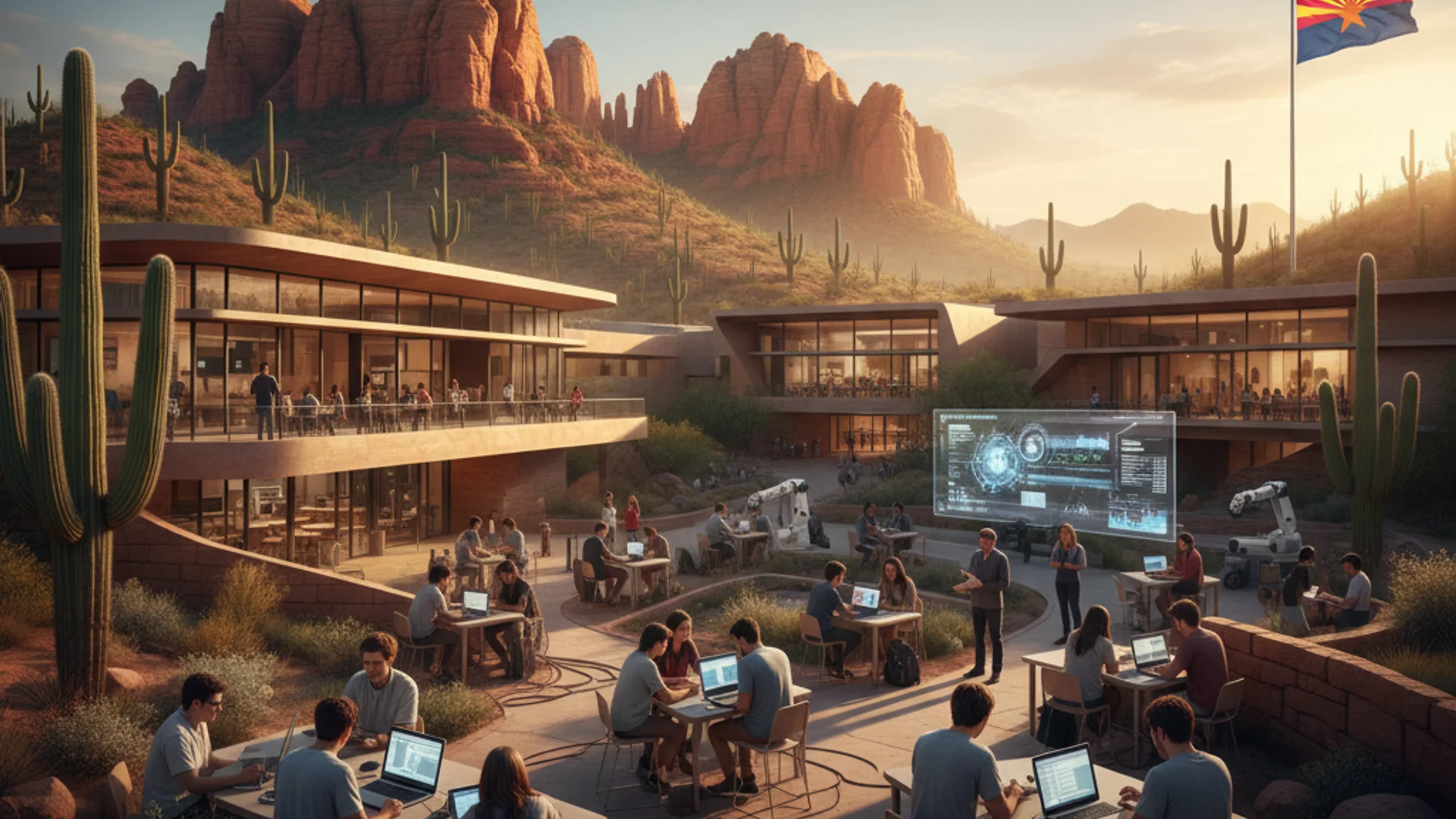
University campus in Arizona
Updated June 28, 2026

Best Game Development Degree Programs in Arizona, 2026 Rankings

Compare the top game development colleges in Arizona. 25 accredited game development schools ranked by graduation rate, career outcomes, and value, from Mesa Community College to Arizona State University Campus Immersion.

#1 ProgramArizona State University ...
Avg Salary$105,930
Tuition From$2,328/yr
Job Growth+22%
On this page
Reviewed by Taylor Rupe, Founder & EditorSee methodology

7

Programs ranked

IPEDS 2024

$105,930

Arizona median game development salary

BLS OEWS 2024

82.1/100

Top program score

Hakia methodology

16%

U.S. job growth (2023–33)

BLS projections

Key Takeaways

Best game development degree programs: Arizona State University ..., U of Arizona, Northern Arizona

Ranked by graduation rates, program outcomes, and institutional quality

IPEDS 2024

Tuition ranges from $1,944 to $40,680/year

Mesa Community College offers the most affordable option at $2,328/yr

IPEDS 2024

Game Development degree programs available: 17 associate's, 6 master's, 3 doctoral in Arizona

From community college pathways to advanced research degrees

IPEDS 2024

4 online game development degree programs in Arizona

Flexible scheduling for working professionals

IPEDS 2024

Arizona community college transfer can save 40-60% on total degree costs

17 associate's programs provide transfer pathways to bachelor's degrees

Education Commission of the States

Major employers: Intel, GoDaddy, Axon, Carvana

Tech hubs in Phoenix and Scottsdale

Hakia Research 2026

Game Development degree programs near 25+ cities across Arizona

Search by city to find programs within 200 miles of your location

IPEDS 2024

Updated June 28, 2026

How we ranked Arizona Game Development programs

We rank 34 accredited game development programs in Arizona using IPEDS 2024 institutional data, BLS OEWS 2024 state salary data, and College Scorecard outcomes. A 4-factor weighted composite is normalized to a 0–100 score. Schools cannot pay for placement; rankings are produced algorithmically.

Program completions (35%)Graduation rate (25%)Selectivity (20%)Career outcomes (20%)
See full methodology

Are Game Development Degree Programs in Arizona Worth It?

Answer
$105,930
Yes. The best game development degree programs in Arizona deliver strong ROI, graduates earn $105,930 median salary with +22% job growth through 2032. In-state tuition averages $7,687/year.

Source: BLS OEWS May 2024

Game Development Degree Rankings in Arizona

Compare the top-ranked Game Development programs in Arizona by degree level. Tuition, graduation rate, and Hakia Score for every accredited program.

Best Associate's Game Development Programs in Arizona

5
Programs ranked
$5,459
Avg tuition/yr
23%
Avg grad rate

Program Landscape

Arizona offers 17 accredited associate's degree programs in game development, providing an affordable entry point into the technology field. The top-ranked programs include Mesa Community College, Chandler-Gilbert Communit..., Glendale Community College, which combine rigorous technical curriculum with practical skills training.

Costs & Value

Community colleges in Arizona offer these two-year programs at an average cost of $4,239/yr, significantly less than four-year university tuition. Students completing associate's degrees can pursue entry-level technical positions and transfer opportunities, with entry-level salaries averaging $58,262 in Arizona.

Career Pathways

Many programs feature guaranteed transfer agreements with Arizona's public universities, allowing students to complete their first two years at reduced cost before transferring to complete a bachelor's degree. The Phoenix, Scottsdale, Tempe areas offer particularly strong job markets for associate's degree holders, with employers like Intel, GoDaddy, Axon hiring for technical support, junior development, and IT specialist positions.

Curriculum & Specializations

Programs typically include coursework in programming fundamentals, database management, networking basics, and software development. Among game development schools in Arizona, these associate's programs offer the best value for students beginning their game development degrees in Arizona.

Best Bachelor's Game Development Programs in Arizona

2
Programs ranked
$14,868
Avg tuition/yr
52%
Avg grad rate

Program Landscape

Arizona ranks among the nation's top destinations for game development education, with 8 accredited bachelor's degree programs across 3 public and 1 private institutions. The highest-ranked programs are Arizona State University ..., U of Arizona, Northern Arizona, recognized for academic excellence, research opportunities, and strong industry connections.

Career Outcomes

Graduates from Arizona game development programs earn a median salary of $90,041, 8% below the national average. The state's robust technology sector, anchored by the Phoenix, Scottsdale, Tempe metropolitan areas, provides abundant internship and employment opportunities with companies including Intel, GoDaddy, Axon.

Costs & Value

Tuition ranges from $9,552 to $40,680 annually, with an average of $16,325/yr. Top programs maintain graduation rates above 73%, with the highest reaching 98%. Many programs hold ABET accreditation, the gold standard for computing education, ensuring curriculum meets rigorous industry standards.

Curriculum & Specializations

Students can choose from specializations including software engineering, cybersecurity, artificial intelligence, data science, and systems architecture. Strong industry partnerships provide access to co-op programs, capstone projects with real companies, and direct recruiting pipelines to Arizona's leading technology employers. For students seeking game development degrees in Arizona, these top-ranked game development schools offer the strongest combination of academic rigor and career preparation.

Game Development Degree Costs & Tuition in Arizona

MetricValue
Average in-state tuition$7,687/year
Average out-of-state tuition$19,218/year
Community college tuition$1,922/year
4-year savings for residents$46,124
2+2 transfer pathway savings$11,530

Source: IPEDS 2024

Financial Aid & Scholarships for Game Development Students in Arizona

State Aid Programs

Arizona game development students access comprehensive financial aid supporting technology education. The Arizona Leveraging Educational Assistance Partnership (AzLEAP) provides need-based grants up to $2,500 annually (Arizona Commission for Postsecondary Education). Federal Pell Grants, Stafford Loans, and work-study positions supplement state assistance for students demonstrating financial need.

Key Programs & Amounts

Merit scholarships support high-achieving game development students. ASU's Ira A. Fulton Schools of Engineering offers scholarships for computer science students, while the Herberger Institute provides design and arts scholarships for students in creative technology programs (Fulton Scholarships). Industry sponsors occasionally fund scholarships for students pursuing game development careers.

Institutional Scholarships

Work-study positions in university game labs and IT departments provide income while developing relevant experience. Students working in campus technology operations, multimedia labs, or research projects gain professional skills while earning money for educational expenses. These positions sometimes lead to internship referrals or employment recommendations.

Game Development Degree ROI Calculator, Arizona

Use our interactive ROI calculator to estimate your return on investment for a game development degree in Arizona. Enter your expected tuition costs, financial aid, and career goals to see projected payback periods and lifetime earnings. The calculator uses current salary data from BLS and tuition data from IPEDS to provide accurate estimates.

Game Development Degree ROI Calculator

Estimate your return on investment for a game development degree

Leave blank to use average cost for selected program type

20 years
10 years20 years30 years
20-Year ROI

+697%

Net gain divided by total investment. ROI above 200% is considered excellent for education investments.

Net Gain

$1,289,731

Your additional lifetime earnings with this degree vs. working without one, minus the total investment.

Break-Even

6 years

Years until your cumulative earnings exceed total investment. Shorter programs often break even faster due to lower opportunity cost.

COL-Adjusted Salary

$126,316

Your starting salary adjusted for local cost of living. This shows real purchasing power compared to a $100K national baseline.

Why does break-even change with program type? Your "total investment" includes both tuition AND opportunity cost (foregone earnings while in school). A 4-year full-time public university (in-state) means 4 years of not earning a salary ($140,000 in opportunity cost). Shorter full-time programs may have higher tuition but lower total investment because you return to the workforce sooner.

Detailed Breakdown

How we calculate your degree ROI using real salary data

Total Investment$185,000

Tuition plus opportunity cost (earnings you miss while in school)

Program Cost (Tuition)$45,000

Direct cost of the degree program

Opportunity Cost$140,000

4 years × $35K/year foregone salary while studying full-time

20-Year Earnings (with degree)$2,325,139

Projected career earnings starting after graduation, with salary growth

20-Year Earnings (without degree)$850,408

What you'd earn working at $35K/year with 2% annual growth

Starting Salary (Phoenix, AZ)$120,000

Median salary for this role in your selected location (BLS 2024)

Annualized Return4.1%

Your investment's compound annual growth rate (similar to stock market returns)

Data sources: BLS OEWS May 2024, IPEDS 2024. Calculations use median salaries, 3% discount rate, and assume salary growth declines from 6% to 2% over career. Individual results will vary. | Powered by Hakia.com

Game Development Salaries by Metro Area

Median annual salary in Arizona metro areas

Phoenix$117K
Scottsdale$111K
Tempe$106K
Tucson$101K
View data table
CategoryValue
Phoenix$117K
Scottsdale$111K
Tempe$106K
Tucson$101K

Source: BLS OEWS May 2024

Hakia.com

Top Employers Hiring Game Development Graduates in Arizona

Find game development jobs in Arizona. These major employers across Arizona metro areas are actively hiring game development degree holders. Click employer names to view current job openings.

Game Development Jobs in Phoenix

AZ

The Phoenix metro is the 5th largest in the US with a growing tech sector. Intel, Amazon, and major defense contractors have significant operations here.

Nearby cities: Tempe, Scottsdale, Mesa, Chandler, Gilbert, Glendale, Peoria, Surprise

Intel
Semiconductor/AI
Amazon
E-commerce/Cloud
Honeywell
Aerospace/Industrial
American Express
Financial Services
Banner Health
Healthcare IT
State Farm
Insurance/Tech

Game Development Jobs in Tucson

AZ

Tucson is home to the University of Arizona and major defense contractors like Raytheon. The metro offers lower cost of living than Phoenix.

Nearby cities: Oro Valley, Marana, Sahuarita, Green Valley, Sierra Vista

Raytheon
Defense/Aerospace
University of Arizona
Higher Education/Research
Caterpillar
Manufacturing/Mining Tech

Game Development Jobs in Scottsdale

AZ

The Scottsdale-Tempe corridor is a major tech hub with GoDaddy, Axon, and numerous startups. ASU drives talent pipeline.

Nearby cities: Paradise Valley, Fountain Hills, Cave Creek, Carefree

GoDaddy
Web Services/Tech
Axon
Public Safety Tech

Transfer Pathways for Game Development Degrees in Arizona

State Transfer System

Arizona's transfer system supports students beginning game development education at community colleges. The Arizona Transfer System (AZTransfer) coordinates articulation ensuring programming and digital media credits transfer between community colleges and universities (AZTransfer). Students completing computer science-focused associate degrees receive guaranteed admission to university programs with credit recognition for approved courses.

How Transfers Work

Maricopa County Community College District offers relevant coursework in programming, digital media, and 3D graphics that transfers to university game development programs (MCCCD). The Maricopa to ASU Pathways Program (MAPP) provides structured transfer agreements ensuring students taking designated courses receive full credit at ASU. Pathway advisors help students select optimal course combinations.

Transfer Planning Tips

Community colleges provide cost-effective foundations in programming and mathematics before university specialization. Students completing general education requirements and foundational computer science courses for under $5,500 at Maricopa colleges reduce total degree costs substantially while building skills necessary for advanced game development coursework.

Why Pursue a Game Development Degree in Arizona?

Industry & Workforce

Arizona is an increasingly attractive destination for game development education and careers, benefiting from its strategic position between major entertainment hubs in California and Texas. The Phoenix metropolitan area hosts a growing ecosystem of game studios, simulation companies, and interactive entertainment businesses that provide employment opportunities for graduates (Greater Phoenix Economic Council). The state's lower cost of living compared to Los Angeles or San Francisco makes it an appealing alternative for both studios and professionals seeking quality of life alongside career opportunities.

Salary Outlook

Arizona State University has invested substantially in game development education, offering specialized programs that combine computer science fundamentals with game design, 3D graphics programming, and interactive media development (ASU Digital Culture). The university's proximity to industry professionals and its partnerships with technology companies provide students access to current tools, techniques, and career pathways in gaming and simulation.

Regional Tech Hubs

The state's aerospace and defense industry creates unique opportunities for game developers in serious games and simulation. Companies like Raytheon and Honeywell Aerospace employ developers creating training simulations, virtual reality applications, and interactive visualization systems that apply game development skills to defense and aerospace contexts. These positions often offer competitive compensation and security clearance opportunities unavailable in entertainment gaming.

Game Development Job Growth in Arizona

15%
The Bureau of Labor Statistics projects 15% growth for game development occupations in Arizona through 2024-2034. The median salary stands at $105,930 with 25 accredited programs statewide.

Source: BLS Occupational Outlook

Game Development Job Market & Salary Data in Arizona

Employment Outlook

Arizona's game development job market spans entertainment gaming, simulation, and interactive media sectors. The Bureau of Labor Statistics categorizes game developers within broader software developer classifications, with Arizona employing 35,890 software developers at median annual wages of $110,450 (BLS). Specialized game development positions command varying compensation based on studio size, project scope, and individual expertise in graphics programming, game engine development, or technical art.

Salaries by Metro

Simulation and training companies provide substantial game development employment in Arizona. L3Harris Technologies operates significant Arizona facilities developing military simulation and training systems requiring game engine expertise, 3D graphics programming, and real-time systems development. Bohemia Interactive Simulations, creators of military training software, maintains offices in the Phoenix area employing developers with game development backgrounds for defense simulation projects.

High-Growth Sectors

Independent and mobile game studios create opportunities for entrepreneurial game developers. The Phoenix area hosts indie studios developing games for mobile platforms, PC, and consoles. While smaller than major entertainment markets, Arizona's lower operational costs enable studios to remain competitive, and the concentration of ASU graduates creates a local talent pool supporting industry growth.

Entry-Level (0-2 yrs)

New graduates and career changers

Senior (8+ yrs)

Technical leads and architects

Median Salary in Arizona$68,855$153,599
Typical RolesJunior Developer, AnalystStaff Engineer, Architect
Remote Work AccessLimitedCommon
Degree ExpectationBachelor's sufficientMaster's preferred

Online vs On-Campus Game Development Programs in Arizona

Online Programs

4 available in Arizona

On-Campus Programs

Traditional classroom experience

Typical Tuition$6,918/yr$7,687/yr
Schedule FlexibilitySelf-paced or asyncFixed schedule
NetworkingVirtual cohortsIn-person, career fairs
Best ForWorking professionalsTraditional students
Completion Time2-4 years (flexible)4 years (standard)

Compare Game Development Programs in Other States

Game Development Degree Programs in Arizona: FAQ

What are the best game development degree programs in Arizona?
The best game development degree programs in Arizona based on our methodology are: 1) Arizona State University Campus Immersion (81% graduation rate), 2) University of Arizona, and 3) Northern Arizona University. Our rankings weight graduation rates (25%), program completions (35%), selectivity (20%), and career outcomes (20%). Arizona offers 25 total accredited programs across 18 public and 1 private institutions. See our complete rankings for all 8 bachelor's programs.
How much do game development degree programs cost in Arizona?
Game Development degree program costs in Arizona vary significantly by institution type. In-state public tuition averages $7,687/year, while private institutions average $16,911/year. Community colleges offer the most affordable path at approximately $1,922/year for associate's degrees. The total 4-year cost ranges from $30,748 at public schools to $67,646 at private institutions before financial aid. Most students don't pay full sticker price, federal grants, state aid, and institutional scholarships can reduce costs by 30-60%.
What salary can game development degree graduates earn in Arizona?
Game Development professionals in Arizona earn a median salary of $105,930, which is competitive with the national average of $115,500. Entry-level positions typically start around $68,855, while senior roles exceed $153,599. Salaries vary by metro area: Phoenix ($116,523), Scottsdale ($111,227) offer the highest compensation. Specialized roles like AI/ML engineers and cloud architects command premiums of 15-30% above median.
Are there online game development degree programs in Arizona?
Yes, Arizona offers 4 accredited online Game Development programs from state institutions. These programs award the same degree as on-campus options and include synchronous and asynchronous formats. Top-ranked online programs include offerings from Estrella Mountain Community College and Aspen University. Online programs typically cost the same as on-campus tuition for in-state students. Many programs offer flexible scheduling for working professionals, with some offering accelerated completion in 2-3 years. Ensure any online program holds regional accreditation and ideally ABET accreditation for engineering programs.
What companies hire game development degree graduates in Arizona?
Major Game Development employers in Arizona include Intel, GoDaddy, Axon, Carvana, Microchip Technology. The Phoenix and Scottsdale metro areas serve as primary tech hubs with thousands of open positions. Top employers maintain recruiting pipelines directly from Arizona universities, with many offering internship-to-hire programs. Beyond tech giants, opportunities exist in healthcare IT, financial services, defense contractors, and growing startups. Arizona's tech sector shows +22% projected job growth through 2033, outpacing most other industries.
Is a game development degree program worth it in Arizona?
A game development degree program in Arizona offers strong ROI with a $105,930 median salary and +22% projected job growth. At average in-state tuition of $7,687/year, graduates typically recoup their educational investment within 3-5 years. The degree opens doors to high-paying careers in software development ($119,701), data science, cybersecurity, and AI/ML. Beyond salary, benefits include job security, remote work flexibility, and clear advancement paths. Alternative paths like bootcamps exist for career changers, but bachelor's degrees provide broader career options and higher lifetime earnings.
How long do game development degree programs take in Arizona?
Standard completion times for game development degree programs in Arizona are: Associate's (2 years, 60 credits), Bachelor's (4 years, 120 credits), and Master's (1-2 years, 30-36 credits). However, actual timelines vary based on course load, transfer credits, and program format. Accelerated programs can compress a bachelor's to 3 years or a master's to 12 months. Part-time students typically need 5-6 years for a bachelor's degree. Arizona community colleges offer a cost-effective "2+2" path: complete your associate's in 2 years, then transfer to a Arizona university for the final 2 years of a bachelor's program.
What financial aid is available for game development degree students in Arizona?
Arizona game development degree students can access multiple financial aid sources. Federal aid includes Pell Grants (up to $7,395/year for qualifying students) and federal student loans. Arizona state grants provide additional support for residents attending in-state schools. Institutional scholarships from universities can significantly reduce costs, many schools offer merit-based awards for STEM students. Work-study programs and teaching/research assistantships (especially for graduate students) provide income while building experience. Complete the FAFSA by Arizona's priority deadline to maximize aid eligibility. Some employers also offer tuition reimbursement for employees pursuing CS degrees.

Data Sources

Institutional characteristics, completions, graduation rates

Arizona salary and employment data

Official University Websites

Program details and admissions information

Last Updated: June 26, 2026. Rankings based on IPEDS 2024 data. Salary data from BLS OEWS May 2024.

Was this ranking helpful for your college search?
Taylor Rupe

Taylor Rupe

Co-founder & Editor (B.S. Computer Science, Oregon State • B.A. Psychology, University of Washington)

Taylor combines technical expertise in computer science with a deep understanding of human behavior and learning. His dual background drives Hakia's mission: leveraging technology to build authoritative educational resources that help people make better decisions about their academic and career paths.

The research behind the rankings

In-depth Game Development program profiles in Arizona

Hand-researched detail on the top-ranked programs: degree pathways, research labs, industry partners, career outcomes, and admissions. Tap any school to expand.

Best Associate's Game Development programs

#1Pima Community CollegeTucson, AZ

Why it stands out. The program uniquely combines comprehensive game design theory with practical animation and production skills, offering both creative and technical pathways in game development education.

Hakia insight. Pima's Digital Animation and Production concentration creates an unusual hybrid path: students graduate with both animation production skills and game design theory, positioning them for roles that typically require either a specialized art degree or a separate design credential.

At the associate's level, pima Community College's Digital Game and Simulation program with Digital Animation and Production Concentration offers a comprehensive Associate of Applied Science (AAS) degree that prepares students for careers in the rapidly growing gaming industry. The program combines foundational game design theory with hands-on technical skills, covering everything from game mechanics and player psychology to digital art and programming. Students progress through a structured curriculum featuring core courses like Game Design I-III, Introduction to Game Programming, and a Portfolio Capstone project. The program emphasizes both the creative and technical aspects of game development, with courses covering game history, formal elements, cultural impact, and industry practices. Students learn through textual analysis of gameplay, playtesting methodologies, and practical development skills including introductory scripting and tabletop game emulation. The Digital Animation and Production concentration adds artistic depth with life drawing and digital arts coursework, preparing graduates for diverse roles as game designers, programmers, artists, character builders, modelers, and gameplay testers.

Programs offered

  • Associate of Science in Game Development · 2 years · on-campus
  • Associate of Applied Science in Game Development · 2 years · online
#2Mesa Community CollegeMesa, AZ

Why it stands out. This program uniquely offers four specialized certificate pathways embedded within the degree, allowing students to focus on specific areas like game art, audio production, narrative writing, or coding while maintaining a comprehensive interdisciplinary foundation.

Hakia insight. Mesa's four embedded certificates mean a student can complete the full associate degree while also earning a standalone credential in (say) game audio—stackable credentials that survive if they need to leave early or pivot into adjacent fields.

At the associate's level, mesa Community College's Video Game Production program provides students with comprehensive skills needed to plan, design, and produce video games through interdisciplinary coursework bridging art and science. The program uniquely combines business concepts, game technology, narrative development, music, sound design, and animation. Students can pursue an Associate in Applied Science degree (62-79 credits) or specialized certificates in Game Art, Audio and Sound, Coding and Scripting, or Game Narrative. The curriculum prepares graduates for entry-level careers including Level Designer, Environment Artist, Character Modeler, Game Developer, Mobile Game Developer, and Game Writer. The program features hands-on learning with planning materials, prototypes, narrative scripts, and interactive components, managed by experienced faculty in the Computer Information Systems Department.

Programs offered

  • Associate of Science in Game Development · 2 years · on-campus
  • Associate of Applied Science in Game Development · 2 years · online

Notable faculty

  • Miriam Lierley (Video Game Design, Web Design and Development, Computer Information Systems)
#3University of Advancing TechnologyTempe, AZ

Why it stands out. UAT is one of the only fully accredited game design programs that boasts connections to a full continuum of game studies degrees and was the first in the world to introduce fully accredited game design and game programming degrees.

Hakia insight. UAT's 120-student game incubator lab—the largest in Arizona—functions as a live studio rather than a classroom, meaning your associate's degree includes actual shipped game contributions on your portfolio before you transfer or graduate.

At the associate's level, the University of Advancing Technology offers a comprehensive Game Development program featuring multiple specialized degree pathways including Game Programming (BS), Game Design (BA), Game Art & Animation, and Game Production Management (MS). The program emphasizes hands-on experience with industry-standard tools, C++ and C# programming, scripting, artificial intelligence, networking, and multiple platform development for PC, console, mobile, and virtual reality. Students benefit from UAT Game Studios, an independent game studio and production pipeline that allows students to ship completed works. The program is fully accredited and features multidisciplinary collaboration across all game studies degrees, providing students with real-world experience through Game Jams, technology sandboxes, and team-based projects that prepare graduates for careers in entertainment, business, research, and training industries.

Programs offered

  • Associate of Science in Game Development · 2 years · on-campus
  • Associate of Applied Science in Game Development · 2 years · online

Research labs & institutes

  • UAT Game Studios — Independent game studio and production pipeline supporting game development
  • New Technology Lab — Video game development, Apple development, mobile development, virtual reality, mind control (Emotiv), motion control

Notable faculty

  • Matt Prater (Hardware and electronics)
  • Sarah Bunce (Network Technology)
  • Dapzury Valenzuela (Student success and mentorship)
  • Aaron Rodriguez (Computer Forensics)

Admissions

Acceptance rate not specified%. GPA not specified. Deadline not specified.

Accreditation & certifications

Fully Accredited

Location advantage: Home to the largest game incubator lab in Arizona with more than 120 students contributing to game creation

#5Glendale Community CollegeGlendale, AZ

Why it stands out. This program uniquely combines artistic and technical game development skills with business and project management training, offering multiple embedded specialization certificates within a single comprehensive degree pathway.

Hakia insight. Glendale's unusual addition of business and project management training to a game dev AAS prepares students for studio producer or technical lead roles by 22, a career acceleration most associates programs don't offer until year 3 of a bachelor's.

At the associate's level, glendale Community College's Video Game Production program offers a comprehensive Associate in Applied Science (AAS) degree that bridges the art and science of game development through interdisciplinary coursework. The 62-79 credit program combines business concepts, game technology, narrative design, music, sound design, and animation to prepare students for entry-level careers as Level Designers, Environment Artists, Character Modelers, Game Developers, and more. Students gain hands-on experience with game development project management, scripting and programming, 3D modeling, and portfolio creation. The program features four embedded Certificate of Completion options in Game Art (39 credits), Audio and Sound, Narrative (27 credits), and Scripting and Coding, allowing students to specialize in specific areas of game production while maintaining a holistic understanding of the industry.

Programs offered

  • Associate of Science in Game Development · 2 years · on-campus
  • Associate of Applied Science in Game Development · 2 years · online

Career outcomes

$52,310 median salary

Best Bachelor's Game Development programs

#1University of ArizonaTucson, AZ

Why it stands out. STEM-designated program. Hands-on experience in game conceptualization, market analysis, technical design, and usability testing

Hakia insight. University of Arizona's STEM designation on its fully online degree means graduates qualify for OPT visa extensions and federal STEM employment pathways—a concrete advantage for international students that most online game programs lack.

The University of Arizona's STEM-designated Bachelor of Science in Game Design and Development is offered fully online and prepares students to lead in the game design industry with both creative and technical expertise. The 115-credit curriculum emphasizes hands-on experience in game conceptualization, market analysis, technical design, and usability testing using industry-standard tools and platforms. Students master critical skills in research, ethical decision-making, and cross-functional team collaboration through courses like Game Design, Game Development, 3D Modeling for Games, Virtual Reality, and Algorithms for Games. The program requires a minor and prerequisite mathematics coursework (Math 113, 116, or 122B or higher). Graduates develop skills in programming, creativity, problem-solving, game engine knowledge, 3D/2D graphics, animation, and digital storytelling, positioning them for diverse careers in the game industry and beyond across entertainment, education, healthcare, and training sectors.

Programs offered

  • Bachelor of Science in Game Design and Development · 4 years · on-campus

Research labs & institutes

  • Game Development Lab — Game production, engine development, gameplay programming

Location advantage: Proximity to Arizona's tech and digital media industry growth Access to growing software development ecosystem in Tucson

#2University of Advancing TechnologyTempe, AZ

Why it stands out. UAT is one of the only fully accredited game design programs that boasts connections to a full continuum of game studies degrees and was the first in the world to introduce fully accredited game design and game programming degrees.

Hakia insight. As the world's first fully accredited game design and programming degree provider, UAT's curricular lineage means the program has 20+ years of industry feedback baked into course design—a maturity advantage that newer programs simply cannot replicate.

At the bachelor's level, the University of Advancing Technology offers a comprehensive Game Development program featuring multiple specialized degree pathways including Game Programming (BS), Game Design (BA), Game Art & Animation, and Game Production Management (MS). The program emphasizes hands-on experience with industry-standard tools, C++ and C# programming, scripting, artificial intelligence, networking, and multiple platform development for PC, console, mobile, and virtual reality. Students benefit from UAT Game Studios, an independent game studio and production pipeline that allows students to ship completed works. The program is fully accredited and features multidisciplinary collaboration across all game studies degrees, providing students with real-world experience through Game Jams, technology sandboxes, and team-based projects that prepare graduates for careers in entertainment, business, research, and training industries.

Programs offered

  • Bachelor of Science in Game Development · 4 years · on-campus
  • Bachelor of Arts in Game Development · 4 years · online

Research labs & institutes

  • UAT Game Studios — Independent game studio and production pipeline supporting game development
  • New Technology Lab — Video game development, Apple development, mobile development, virtual reality, mind control (Emotiv), motion control

Notable faculty

  • Matt Prater (Hardware and electronics)
  • Sarah Bunce (Network Technology)
  • Dapzury Valenzuela (Student success and mentorship)
  • Aaron Rodriguez (Computer Forensics)

Admissions

Acceptance rate not specified%. GPA not specified. Deadline not specified.

Accreditation & certifications

Fully Accredited

Location advantage: Home to the largest game incubator lab in Arizona with more than 120 students contributing to game creation