🥇
$54,760
Tuition/yr
80%
Grad rate
82.0
Hakia Score
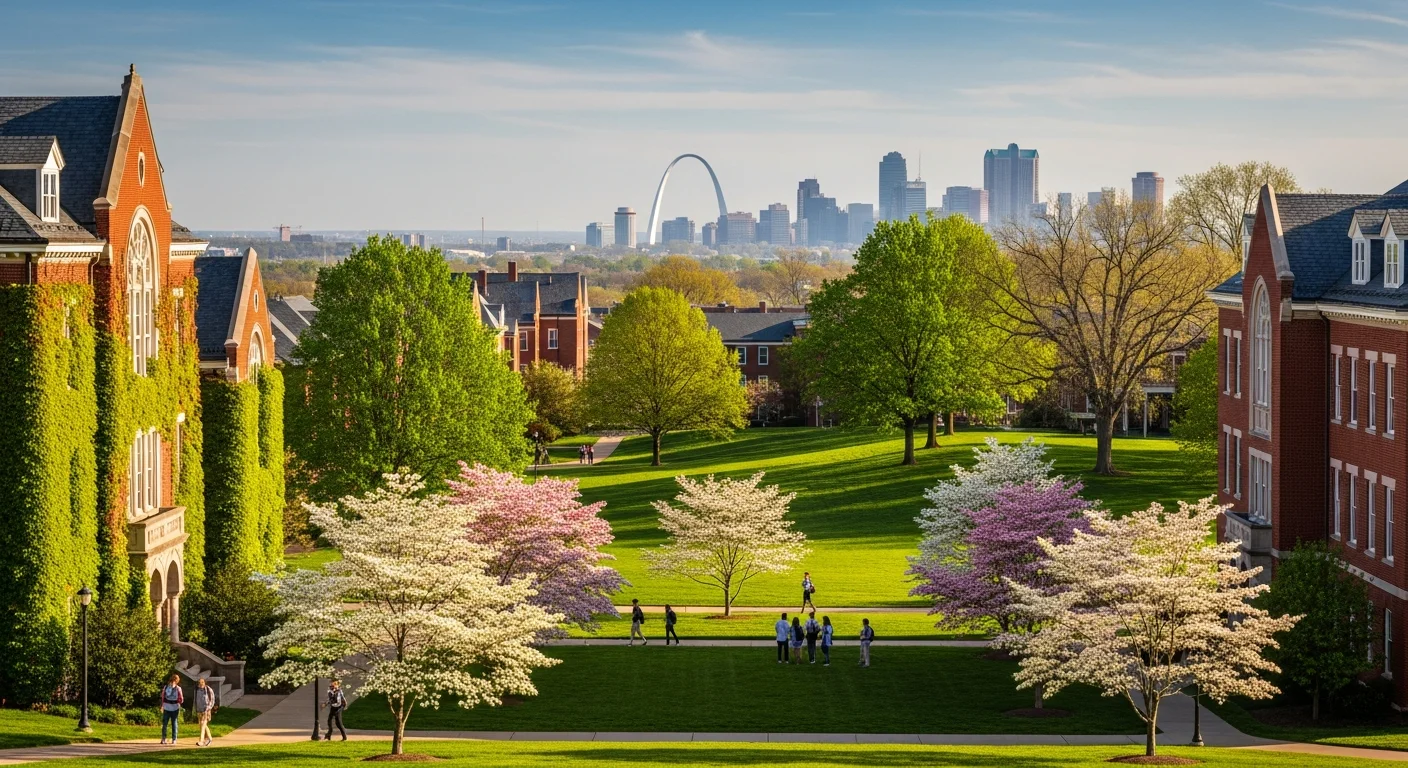
Compare the top data science colleges in Missouri. 21 accredited data science schools ranked by graduation rate, career outcomes, and value, from University of Central Missouri to Washington University in St Louis.
Best data science degree programs: Washington University in ..., U of Missouri-Kansas City, U of Missouri-St Louis
Ranked by graduation rates, program outcomes, and institutional quality
Tuition ranges from $6,442 to $61,750/year
U of Central Missouri offers the most affordable option at $8,325/yr
Data Science degree programs available: 10 master's, 2 doctoral in Missouri
From community college pathways to advanced research degrees
4 online data science degree programs in Missouri
Flexible scheduling for working professionals
Major employers: Cerner, World Wide Technology, Bayer, Mastercard
Tech hubs in Kansas City and St. Louis
Hakia Research 2026
Data Science degree programs near 62+ cities across Missouri
Search by city to find programs within 200 miles of your location
Updated October 19, 2026
We rank 33 accredited data science programs in Missouri using IPEDS 2024 institutional data, BLS OEWS 2024 state salary data, and College Scorecard outcomes. A 4-factor weighted composite is normalized to a 0–100 score. Schools cannot pay for placement; rankings are produced algorithmically.
Are Data Science Degree Programs in Missouri Worth It?
Source: BLS OEWS May 2024
Compare the top-ranked Data Science programs in Missouri by degree level. Tuition, graduation rate, and Hakia Score for every accredited program.
Missouri ranks among the nation's top destinations for data science education, with 21 accredited bachelor's degree programs across 8 public and 13 private institutions. The highest-ranked programs are Washington University in ..., U of Missouri-Kansas City, U of Missouri-St Louis, recognized for academic excellence, research opportunities, and strong industry connections.
Graduates from Missouri data science programs earn a median salary of $88,400, 10% below the national average. The state's robust technology sector, anchored by the Kansas City, St. Louis metropolitan areas, provides abundant internship and employment opportunities with companies including Cerner, World Wide Technology, Bayer.
Tuition ranges from $6,442 to $61,750 annually, with an average of $21,596/yr. Top programs maintain graduation rates above 80%, with the highest reaching 98%. Many programs hold ABET accreditation, the gold standard for computing education, ensuring curriculum meets rigorous industry standards.
Students can choose from specializations including software engineering, cybersecurity, artificial intelligence, data science, and systems architecture. Strong industry partnerships provide access to co-op programs, capstone projects with real companies, and direct recruiting pipelines to Missouri's leading technology employers. For students seeking data science degrees in Missouri, these top-ranked data science schools offer the strongest combination of academic rigor and career preparation.
Missouri offers 10 master's degree programs in data science, designed for professionals seeking to advance into senior engineering, technical leadership, and specialized roles. The top programs, U of Missouri-Kansas City, Washington University in ..., U of Central Missouri, combine advanced technical training with research opportunities and leadership development.
Master's graduates in Missouri earn a median salary of $104,000, approximately 20-30% higher than bachelor's degree holders. The concentration of technology companies in Kansas City, St. Louis creates strong demand for graduate-level talent, with Cerner, World Wide Technology, Bayer actively recruiting from these programs.
Program formats include traditional full-time study (typically 2 years), part-time options for working professionals (2-3 years), and accelerated tracks. Tuition averages $20,909/yr, with many employers offering tuition reimbursement for graduate education. Some programs offer thesis and non-thesis tracks, allowing students to focus on research or professional development based on their career goals.
Curriculum covers advanced topics including machine learning, distributed systems, software architecture, and technical management. Many programs include practicum experiences, industry capstone projects, or consulting engagements that provide real-world application of advanced concepts. Among Missouri's data science schools at the graduate level, these programs stand out for both academic quality and career outcomes.
| Metric | Value |
|---|---|
| Average in-state tuition | $21,596/year |
| Average out-of-state tuition | $53,990/year |
| Community college tuition | $5,399/year |
| 4-year savings for residents | $129,576 |
| 2+2 transfer pathway savings | $32,394 |
Source: IPEDS 2024
Missouri students pursuing data science degrees have access to multiple federal and state financial aid programs designed to reduce college costs. The foundation of federal aid begins with the Free Application for Federal Student Aid (FAFSA), available through Federal Student Aid, which determines eligibility for grants, loans, and work-study opportunities. Once FAFSA is completed, Missouri residents attending public four-year institutions can apply for the Access Missouri Grant, a need-based program that awards up to $2,850 per year to eligible students (Missouri Department of Higher Education). This state-specific support significantly reduces out-of-pocket expenses and makes quality data science education more accessible across Missouri's diverse student population.
Beyond grants, many of Missouri's top data science programs offer institutional scholarships and assistantships to qualified applicants. Students should contact their institution's financial aid office to inquire about program-specific scholarships, graduate assistantships, and merit-based awards. Public institutions in Missouri report average in-state tuition of $8,649, making state universities an affordable option when combined with Access Missouri Grants (Missouri Department of Higher Education). Additionally, students transferring from Missouri's community colleges can leverage the Missouri Core Transfer Curriculum (CORE 42), which guarantees transfer of 42 credit hours statewide, reducing overall time-to-degree and associated costs (Missouri Department of Higher Education). Comparing financial aid packages across schools like University of Missouri-Columbia and Missouri State University-Springfield can help students identify the most cost-effective pathway to their degree.
Use our interactive ROI calculator to estimate your return on investment for a data science degree in Missouri. Enter your expected tuition costs, financial aid, and career goals to see projected payback periods and lifetime earnings. The calculator uses current salary data from BLS and tuition data from IPEDS to provide accurate estimates.
Estimate your return on investment for a data science degree
Leave blank to use average cost for selected program type
+697%
Net gain divided by total investment. ROI above 200% is considered excellent for education investments.
$1,289,731
Your additional lifetime earnings with this degree vs. working without one, minus the total investment.
6 years
Years until your cumulative earnings exceed total investment. Shorter programs often break even faster due to lower opportunity cost.
$114,286
Your starting salary adjusted for local cost of living. This shows real purchasing power compared to a $100K national baseline.
Why does break-even change with program type? Your "total investment" includes both tuition AND opportunity cost (foregone earnings while in school). A 4-year full-time public university (in-state) means 4 years of not earning a salary ($140,000 in opportunity cost). Shorter full-time programs may have higher tuition but lower total investment because you return to the workforce sooner.
How we calculate your degree ROI using real salary data
Tuition plus opportunity cost (earnings you miss while in school)
Direct cost of the degree program
4 years × $35K/year foregone salary while studying full-time
Projected career earnings starting after graduation, with salary growth
What you'd earn working at $35K/year with 2% annual growth
Median salary for this role in your selected location (BLS 2024)
Your investment's compound annual growth rate (similar to stock market returns)
Data sources: BLS OEWS May 2024, IPEDS 2024. Calculations use median salaries, 3% discount rate, and assume salary growth declines from 6% to 2% over career. Individual results will vary. | Powered by Hakia.com
Median annual salary in Missouri metro areas
| Category | Value |
|---|---|
| Kansas City | $114K |
| St. Louis | $109K |
Source: BLS OEWS May 2024
Hakia.com
Find data science jobs in Missouri. These major employers across Missouri metro areas are actively hiring data science degree holders. Click employer names to view current job openings.
Missouri's streamlined transfer system makes it seamless for community college students to pursue data science degrees at four-year institutions. The Missouri Core Transfer Curriculum (CORE 42) guarantees that 42 credit hours of general education coursework transfers automatically between all Missouri public institutions and many private colleges. This statewide articulation agreement eliminates credit loss and reduces time-to-degree for transfer students. The state's 21 two-year institutions, including Saint Louis Community College, Metropolitan Community College-Kansas City, and Ozarks Technical Community College, serve as vital entry points for students seeking affordable pathways into data science. Associate's degree programs in data science and related STEM fields build foundational knowledge in mathematics, programming, and introductory data analysis before students transfer to bachelor's programs.
Community college students completing CORE requirements and associate's-level prerequisite coursework in mathematics and computer science are well-positioned to transfer directly into junior-year status at bachelor's programs. This pathway reduces overall tuition costs. With average public in-state tuition at $8,649 annually, two-year programs at community colleges offer significant savings compared to four-year programs. Successful transfer students can then complete bachelor's degrees at top-ranked programs such as University of Missouri-Columbia or University of Missouri-Kansas City, leveraging the credit they earned while attending more affordable institutions. The Missouri Department of Higher Education maintains a comprehensive transfer guide and articulation agreements to help this process.
Many bachelor's programs also articulate with regional employer partnerships, creating bridge pathways into graduate education and careers. Students completing bachelor's degrees in data science can pursue master's programs at the same or different institutions. Several Missouri universities support part-time and online master's enrollment for working professionals, enabling continued education without interrupting careers. Transfer-friendly institutions credit prior coursework appropriately, and the Access Missouri Grant continues to support eligible transfer students. For detailed transfer agreements and course equivalencies, consult your community college's transfer specialist or explore related fields through computer science and data analytics transfer pathways.
Missouri offers a strong and growing landscape for data science education, with 39 institutions across the state offering data science programs at multiple degree levels (IPEDS). The state's higher education system produced 2,549 master's degree completions and 691 bachelor's degree completions in data science, reflecting strong industry demand and academic investment. From prestigious research universities to affordable community colleges, Missouri provides pathways for students at every educational level to enter this high-demand field.
Missouri's major metropolitan areas. St. Louis and Kansas City, serve as thriving tech hubs with significant employer presence. Leading companies including BJC HealthCare, SSM Health, Cerner, Walmart, and Express Scripts actively recruit data science talent, creating abundant career opportunities for graduates. Top-ranked institutions like Washington University in St. Louis, University of Missouri-Columbia, and University of Missouri-Kansas City are anchoring innovation ecosystems that connect students directly to industry. Public in-state tuition averages $8,649 at four-year institutions, making Missouri an economically attractive choice compared to national alternatives (College Scorecard).
Students choosing data science in Missouri benefit from the state's commitment to educational access and mobility. The Missouri Core Transfer Curriculum (CORE 42) guarantees transfer of 42 credit hours statewide, enabling community college students to seamlessly transition to four-year programs. Additionally, the Access Missouri Grant provides need-based funding up to $2,850 annually at public institutions. For career advancement, explore related fields through our guides on data analytics, machine learning, and artificial intelligence programs throughout the state.
Data Science Program Availability in Missouri
Source: IPEDS 2024
Missouri's data science job market is strong and expanding, with opportunities concentrated in major metropolitan areas including St. Louis, Kansas City, and Springfield. The state's diverse economy has created consistent demand for data science professionals across healthcare, technology, retail, and financial services sectors. According to the Bureau of Labor Statistics, Missouri continues to see growth in occupations requiring data analysis and computational skills. With 39 institutions offering data science programs across the state, Missouri produces a steady pipeline of qualified professionals to meet employer demand.
The strongest job markets for data science graduates are located in the St. Louis and Kansas City metropolitan regions, where Fortune 500 companies and healthcare systems maintain significant operations. Entry-level positions start for candidates with bachelor's degrees, while advanced roles increasingly require master's-level credentials. Missouri's public four-year institutions charge an average in-state tuition of $8,649, making education more accessible than many neighboring states. Graduate programs are particularly strong, with 11 institutions offering master's degrees and 2,549 total completions recorded, significantly outpacing bachelor's degree production of 691 completions. Students should consult the College Scorecard for detailed employment outcomes by institution.
New graduates and career changers
Technical leads and architects
4 available in Missouri
Traditional classroom experience
Institutional characteristics, completions, graduation rates
Missouri salary and employment data
Program details and admissions information
Last Updated: June 26, 2026. Rankings based on IPEDS 2024 data. Salary data from BLS OEWS May 2024.

Co-founder & Editor (B.S. Computer Science, Oregon State • B.A. Psychology, University of Washington)
Taylor combines technical expertise in computer science with a deep understanding of human behavior and learning. His dual background drives Hakia's mission: leveraging technology to build authoritative educational resources that help people make better decisions about their academic and career paths.
Hand-researched detail on the top-ranked programs: degree pathways, research labs, industry partners, career outcomes, and admissions. Tap any school to expand.
Why it stands out. Four semesters of practica and capstone experiences integrated into curriculum. Two-semester capstone project (DATA 4961 and DATA 4962) providing hands-on application
Hakia insight. Saint Louis University's four-semester practica + two-semester capstone structure means students graduate with 18+ months of documented project work, not a single capstone—a portfolio depth that rivals programs requiring internships, yet embedded within required curriculum rather than competing for limited positions.
Saint Louis University's Bachelor of Science in Data Science is an interdisciplinary program jointly supported by the Department of Computer Science and the Department of Mathematics and Statistics, modeled on guidelines endorsed by the American Statistical Association's Board of Directors. The curriculum combines computer science, statistics, and mathematics fundamentals with four semesters of practica and capstone experiences, providing hands-on training in data cleaning, visualization, analysis, and reporting. Students complete 120 credits including two capstone courses (DATA 4961 and DATA 4962) and choose electives to specialize in either computer science or statistical aspects of data science. The program offers extensive research and internship opportunities through faculty research in machine learning, natural language processing, time series analysis, and topological data analysis. Past students have collaborated with ArchCity Defenders, MIT's Lincoln Lab, and SLU's Medical School. The Data Science Club enables students to practice predictive modeling in competitions. Graduates are positioned for careers in technology, government, research, and consulting, with strong demand projected by McKinsey (140,000–190,000 person shortfall) and recognition as a top-ranked job by Glassdoor.
Programs offered
Industry partners
Admissions
Deadline December 1 for priority scholarship consideration.
Location advantage: St. Louis healthcare sector (BJC, SSM Health) recruiting heavily Financial services hub (Edward Jones headquarters) Strong supply chain and manufacturing economy
Hakia insight. William Jewell's dual BA/BS track suggests flexibility between quantitative rigor and liberal arts breadth—rare among regional data science programs—making it unusually accessible to students uncertain whether they want pure mathematics or applied decision-making.
At the bachelor's level, william Jewell College's Data Science program aims to prepare students to collect, interpret and make decisions based on data and quantitative information in a world that increasingly needs data scientists.
Programs offered
Why it stands out. Maryville's data science program differentiates itself through mandatory industry project partnerships beginning in the first semester, ensuring every student graduates with real-world case studies in their portfolio.
Hakia insight. Maryville's requirement that every student complete real industry projects starting freshman year means graduates enter job markets with client-ready case studies rather than textbook exercises—a portfolio depth most peers don't achieve until internships.
At the bachelor's level, maryville's data science program emphasizes applied problem-solving through industry-embedded projects that start in the first semester. Students work directly with local and regional businesses—healthcare systems, financial services firms, and manufacturing companies—to solve real analytics challenges, turning classroom theory into portfolio-ready work before graduation. The curriculum balances statistical rigor with modern machine learning and big data technologies, drawing expertise from faculty with backgrounds in predictive modeling, business analytics, and software engineering. What sets this program apart is its deliberate focus on translating technical skills into business impact; students learn not just how to build models, but how to communicate findings to non-technical stakeholders and navigate the organizational side of data initiatives. The program benefits from Maryville's location in the St. Louis metro area, which hosts a growing tech sector and established corporate headquarters that serve as both recruiting grounds and internship pipelines. Graduates consistently move into analytics roles at companies like Centene, Schnucks, and regional financial institutions, with many reporting that their project portfolio—built during coursework—was the deciding factor in landing their first role.
Programs offered
Industry partners
Career outcomes
Top employers: Centene Corporation, Schnucks Markets, Ameren
Location advantage: Proximity to Centene headquarters (health insurance analytics) Access to St. Louis financial services sector Growing regional tech community
Why it stands out. Coursework-based track with required capstone (no thesis option mentioned). Flexible elective options enabling specialization in cloud computing, computer vision, information security, business analytics, or advanced analytics
Hakia insight. UMKC's partnerships with Oak Ridge National Lab and X (formerly Twitter), combined with five specialized research labs including dSAIC, position working professionals to contribute to federal-scale data infrastructure projects while earning their degree—uncommon outside major research universities.
The Master of Science in Data Science Analytics at UMKC is a 30-credit program designed for working professionals seeking advanced expertise in data science. The program offers a coursework-based track with a required capstone project, providing hands-on experience with state-of-the-art tools and techniques. Students complete 15 credits of required core coursework covering data science principles, big data management, machine learning, and deep learning, followed by 15 credits of electives allowing specialization in areas such as cloud computing, advanced analytics, computer vision, and information security. The program is structured to accommodate professional schedules and emphasizes team-based problem solving and industry-relevant skills. While specific salary advancement data, assistantship opportunities, and embedded certifications are not detailed in the catalog, the capstone requirement ensures direct application to real-world challenges. Students with non-CS/IT backgrounds may require additional prerequisites before beginning the main coursework.
Programs offered
Research labs & institutes
Industry partners
Career outcomes
Notable faculty
Location advantage: Access to $145 million Healthcare Delivery and Innovation Building in UMKC Health Sciences District Part of University of Missouri system-wide data science initiative
Why it stands out. Truman State emphasizes undergraduate research integration and academic rigor, making it distinctive for students pursuing graduate education or research-focused data science careers.
Hakia insight. Truman State's master's program uniquely leverages its undergraduate research culture to compress what many schools stretch across two years—graduate students hit the ground running in active labs rather than spending the first semester on foundational coursework.
At the master's level, truman State's data science initiative builds on the institution's reputation for undergraduate research and academic rigor, with a program structure that integrates research experiences and capstone projects alongside core technical coursework. The curriculum combines data engineering fundamentals, statistical analysis, machine learning, and domain applications, with particular strength in quantitative reasoning and problem-solving methodology. Faculty maintain involvement in research—spanning topics like computational statistics, optimization, and applied mathematics—and actively involve undergraduate students in their work, offering a rare advantage for a regional comprehensive university. The program benefits from Kirksville's location in north-central Missouri and proximity to larger Midwest metros, though it functions more as a feeder to graduate programs and larger tech companies than as a hub with deep local industry partnerships. What distinguishes Truman is its emphasis on academic excellence and research mentorship; students who graduate tend to pursue advanced degrees (MS/PhD in data science, statistics, or related fields) or secure analyst roles at companies recruiting heavily from Midwestern universities. The honors and research focus makes it particularly attractive to students aiming for research-oriented or doctoral pathways rather than immediate industry analytics roles.
Programs offered
Location advantage: Pipeline to Midwest graduate programs Access to larger Midwest tech companies
Why it stands out. Maryville's data science program differentiates itself through mandatory industry project partnerships beginning in the first semester, ensuring every student graduates with real-world case studies in their portfolio.
Hakia insight. Maryville's mandatory industry projects from semester one mean master's graduates accumulate 4–6 client case studies by degree completion, a portfolio depth that immediately differentiates them from coursework-only competitors in regional hiring markets.
At the master's level, maryville's data science program emphasizes applied problem-solving through industry-embedded projects that start in the first semester. Students work directly with local and regional businesses—healthcare systems, financial services firms, and manufacturing companies—to solve real analytics challenges, turning classroom theory into portfolio-ready work before graduation. The curriculum balances statistical rigor with modern machine learning and big data technologies, drawing expertise from faculty with backgrounds in predictive modeling, business analytics, and software engineering. What sets this program apart is its deliberate focus on translating technical skills into business impact; students learn not just how to build models, but how to communicate findings to non-technical stakeholders and navigate the organizational side of data initiatives. The program benefits from Maryville's location in the St. Louis metro area, which hosts a growing tech sector and established corporate headquarters that serve as both recruiting grounds and internship pipelines. Graduates consistently move into analytics roles at companies like Centene, Schnucks, and regional financial institutions, with many reporting that their project portfolio—built during coursework—was the deciding factor in landing their first role.
Programs offered
Industry partners
Career outcomes
Top employers: Centene Corporation, Schnucks Markets, Ameren
Location advantage: Proximity to Centene headquarters (health insurance analytics) Access to St. Louis financial services sector Growing regional tech community