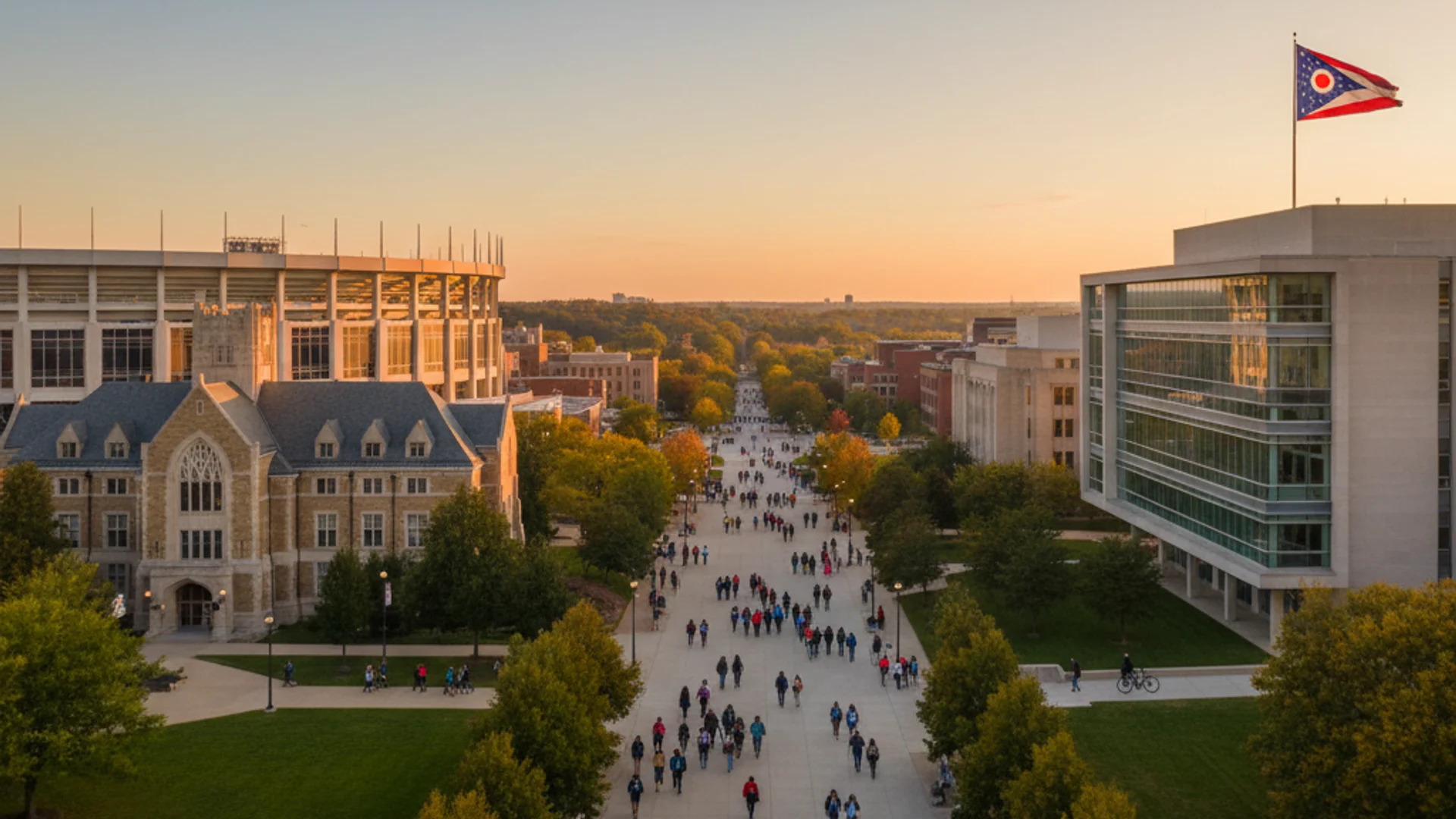
Best Associate's Data Science Degree Programs in Ohio
Sinclair Community College — Dayton, OH
Key Distinction: Emphasis is placed on strong communication skills necessary to interact with key stakeholders to achieve their desired objectives, with embedded certificates automatically awarded upon completion of certificate requirements
Hakia Insight: Sinclair's embedded certificate model means students can exit with stackable credentials mid-program, turning a 2-year commitment into a flexible pathway where even a single certificate unlocks entry-level analytics work.
At the associate's level, students will be prepared for entry-level data analytics positions requiring knowledge, setup and usage of business intelligence and data analysis solutions. Students will have the ability to extract, curate, wrangle, and visualize data in a way that is meaningful to a variety of organizations.
Programs Offered
- Associate of Science in Data Science — 2 years, on-campus
- Associate of Applied Science in Data Science — 2 years, online
Location Advantages: Multiple campus locations including Dayton, Centerville, Mason, Online, and Wright-Patterson Air Force Base
Lakeland Community College — Kirtland, OH
Key Distinction: Focus on practical applications with specialized pathways in bioscience/science analytics, business analytics, and history/political science analytics, plus partnerships with Oracle Academy
Hakia Insight: Lakeland's specialized analytics pathways—bioscience, business, history/political science—let associate students build domain expertise alongside technical skills, a rare advantage that makes them immediately useful to employers in those sectors rather than generalists.
At the associate's level, the data analytics program equips students with skills to analyze large datasets using statistical methods, programming techniques, and specialized software. Graduates can pursue careers as data analysts, transforming data into insights and predictive models, or continue their education in a bachelor's degree program.
Programs Offered
- Associate of Science in Data Science — 2 years, on-campus
- Associate of Applied Science in Data Science — 2 years, online
Industry Partners
Location Advantages:
Franklin University — Columbus, OH
Key Distinction: Franklin University offers flexible self-directed completion with courses taken in any order, tuition guarantee that locks in first-term rates, and comprehensive integration of AI tools and industry-standard technologies across all data science programs.
Hakia Insight: Franklin's course-sequencing flexibility and tuition lock-in address the real friction of associate programs: students can accelerate around work schedules without risking price hikes, removing the classic barriers that derail working adults.
At the associate's level, franklin University's Data Science programs provide comprehensive analytics education with strong emphasis on hands-on technical skills and industry-standard tools. The Bachelor's in Analytics with Applied Data Science focus is a 100% online 120-credit program emphasizing SQL, Python, R, and Tableau proficiency. The Master's in Data Analytics is a 32-credit hour program completable in 19 months, featuring self-directed flexible 6 or 12-week courses. The Master's in Business Analytics offers 12-month completion with IACBE accreditation and integrates AI concepts throughout the curriculum. All programs emphasize real-world applications, are taught by experienced practitioners, and feature hands-on exposure to cutting-edge technologies including Hadoop, MapReduce, Data Warehouse, and cloud computing platforms.
Programs Offered
- Associate of Science in Data Science — 2 years, on-campus
- Associate of Applied Science in Data Science — 2 years, online
Notable Faculty
- Dr. Alisa Blazek — Data Science and Exercise Science
Admissions
GPA Requirement: 2.50.
Requirements: Bachelor's degree from regionally accredited institution
Accreditations and Certifications
Location Advantages:
The University of Findlay — Findlay, OH
Key Distinction: The program uniquely combines data analytics with cybersecurity and business leadership skills, offering both undergraduate emphasis and graduate degrees with flexible online and on-campus delivery options.
Hakia Insight: Findlay's bundling of data analytics with cybersecurity and business leadership—plus a $150K median salary—suggests the program recognized that data-only specialists plateau, so it trains students for the leadership roles they'll actually compete for.
At the associate's level, the University of Findlay offers comprehensive Data Science education through multiple pathways including a Computer Science degree with Data Analytics emphasis and a Master of Science in Applied Security and Analytics. The undergraduate program empowers students with high-demand capabilities in extracting insights from complex datasets, data cleansing and structuring, and building powerful models to turn raw information into real-world solutions. The graduate program combines advanced coursework in big data analytics, cybersecurity, leadership, strategic planning, finance, security, and project management. Both programs are designed for today's data-driven world where organizations need skilled data scientists, analysts, and engineers. The curriculum includes courses in statistical methods, data mining for decision making, predictive analysis, secure coding, and advanced software engineering, preparing graduates for roles like Digital Risk Officer, Analytics Practice Leaders, Chief Digital Officer, and Chief Information Security Officer.
Programs Offered
- Associate of Science in Data Science — 2 years, on-campus
- Associate of Applied Science in Data Science — 2 years, online
Industry Partners
- 3C Computer Repairs (corporate)
Career Outcomes
Median Salary: $150,000.
Notable Faculty
- Dr. Shantanu Rao — Pharmaceutical Sciences and Distance Learning
Admissions
GPA Requirement: 3.0.
Requirements: Bachelor's degree in computer science or related discipline, Fundamental Programming Skills (Java or C++), Advanced Programming with data structures, Database management systems with SQL, Computer Networking, Mathematics at college algebra level
Location Advantages: Preparation for 5G broadband industryChoose Ohio First scholarship funding eligibility
Best Bachelor's Data Science Degree Programs in Ohio
Case Western Reserve University — Cleveland, OH
Key Distinction: Full-time paid co-op opportunities. Summer internships
Hakia Insight: Case Western's paid full-time co-op model is structural advantage most peer programs lack: students graduate with 6–12 months of real engineering experience on their résumé, not an internship line.
Case Western's BS in Data Science and Analytics is one of the first undergraduate programs nationwide in this field. The rigorous curriculum covers mathematical and statistical modeling, informatics, data systems and analytics, and project-based applications across various data domains. Students gain hands-on experience with programming for data analytics, working with structured and unstructured data from different sources. The program explores data management, statistics and data analytics, data mining, machine learning for big data, large-scale data systems, and signal processing. Students can pursue full-time paid co-ops and summer internships for real-world experience. The program prepares graduates for diverse applications from health data-driven diagnosis to tackling big data challenges in nonprofit, government, transportation, energy, and medicine sectors. Career opportunities include predicting financial market movements, analyzing biological systems through DNA sequences, and optimizing user experiences. The program is ABET-accredited under the Computing Accreditation Commission's criteria for Data Science programs.
Programs Offered
- Bachelor of Science in Data Science and Analytics — 4 years, on-campus. BS
Research Labs and Institutes
- Algorithms and Theory
- Artificial Intelligence and Machine Learning
- Bioinformatics and Systems Biology
- Data Mining and Visualization
- Security and Privacy
- Networks and Distributed Systems
- Software Engineering
Accreditations and Certifications
Location Advantages:
Miami University-Oxford — Oxford, OH
Key Distinction: Student-run projects with close faculty mentorship. DataFest annual data analysis competition (ASA sponsored)
Hakia Insight: Miami's student-run projects with close faculty mentorship and ASA-sponsored DataFest participation means undergrads build portfolios through competition, where their work gets external validation—a credential that carries weight beyond a transcript.
The Data Science and Statistics, B.S. program combines software, statistics, probability, and analytics skills to extract knowledge from data. The curriculum includes theoretical and applied mathematics courses with calculus and linear algebra in the first two years. Students engage in student-run projects with close faculty mentorship and participate in DataFest, an annual data analysis competition sponsored by the American Statistical Association. Unique opportunities include the Stats + Stories podcast collaboration with Media, Journalism and Film department, and the SOA Research Case Study Challenge. The program prepares graduates for rapidly growing fields, with the U.S. Bureau of Labor Statistics projecting 32% growth for statisticians and data scientists between 2021-2031. Miami University reports 96% of 2018-2019 graduates were employed or furthering their education by fall 2019, with 90% first-to-second year retention and ranking 21st among public universities for four-year graduation rate.
Programs Offered
- Data Science and Statistics, B.S. — 4 years, on-campus. BS
Notable Faculty
- Dr. Jing Zhang — Lead Departmental Advisor
Admissions
GPA Requirement: 2.00.
Requirements: Calculus sequence, Linear algebra course, Additional courses selected with adviser
Location Advantages:
Denison University — Granville, OH
Key Distinction: Denison embeds data science within a liberal arts framework, producing graduates who pair technical rigor with domain expertise and ethical reasoning—a distinctive positioning for roles demanding both analytical depth and strategic business judgment.
Hakia Insight: Denison's liberal arts framing produces a rare graduate profile: employers hiring data scientists for strategy, product, or leadership roles—not just pure analytics—find that Denison alumni combine technical credibility with the communication and ethical reasoning those roles demand.
At the bachelor's level, denison's data science education emerges from its liberal arts tradition—meaning students develop technical skills without abandoning the kind of critical thinking, communication, and ethical reasoning that matter when data science intersects public policy, business strategy, or social systems. The program leverages small class sizes and close faculty-student mentorship to guide undergraduates through real datasets in contexts they care about: political analytics, environmental data, economics, psychology, and public health. Rather than isolated coursework, data science at Denison is woven across the curriculum, with students often combining quantitative training with deep domain expertise in a second discipline—a pairing that makes graduates distinctly competitive for roles where technical skills alone aren't enough. Faculty encourage undergraduates to contribute to published research, and the college's location near Columbus, Ohio's growing technology and financial services sector creates internship and job placement opportunities without requiring students to migrate to coastal tech hubs immediately. Graduates move into analytics roles at Fortune 500 companies, nonprofits, consulting firms, and startups, often noting that their liberal arts foundation gave them the broader context and communication skills that separated them from purely technical competitors.
Programs Offered
- Bachelor of Science in Data Science — 4 years, on-campus
- Bachelor of Arts in Data Science — 4 years, online
Career Outcomes
Top Employers: Victoria's Secret, DHL, Wendy's.
Location Advantages: Proximity to Columbus tech and financial services sector
Ohio State University-Main Campus — Columbus, OH
Key Distinction: The program emphasizes interdisciplinary expertise cutting across computer science, mathematics and statistics with highly developed critical-thinking, problem-solving and communication skills, preparing students to transform how we understand and interact with the world through vast information landscapes.
Hakia Insight: Ohio State's median salary of $122,840 paired with employer relationships across tech, healthcare, and sports (Columbus Blue Jackets, Cardinal Health, Accenture) reveals a program that trains for roles at the intersection of technical depth and business impact, not isolated analytics tasks.
At the bachelor's level, data analytics applies fundamental scientific principles to the analysis of large, complex data sets. This rapidly growing field needs practitioners with expertise that cuts across core disciplines of computer science, mathematics and statistics, AND highly developed critical thinking, problem-solving and communication skills.
Programs Offered
- Bachelor of Science in Data Science — 4 years, on-campus
- Bachelor of Arts in Data Science — 4 years, online
Industry Partners
- Accenture (consulting)
- Cardinal Health (healthcare)
- Columbus Blue Jackets (sports)
- Ford (automotive)
- Infoverity (tech)
- JPMorgan Chase (finance)
- Nationwide Children's Hospital (healthcare)
- PwC (consulting)
- Zillow (tech)
Career Outcomes
Median Salary: $122,840. Top Employers: Accenture, Cardinal Health, Columbus Blue Jackets, Ford, Infoverity, JPMorgan Chase, Nationwide Children's Hospital, PwC, Zillow.
Notable Faculty
- Dr. Srinivasan Parthasarathy — data analytics, artificial intelligence
- Christopher Hans — statistics
Location Advantages:
Ohio University-Main Campus — Athens, OH
Key Distinction: Students take courses across a range of colleges and get practical experience with real-world applications, plus can select concentrations to provide content and tools for their field of choice
Hakia Insight: Ohio University's cross-college course structure with selectable concentrations lets students anchor data science in domain expertise—engineering, business, healthcare—that sets them apart from generic data science graduates competing for the same entry-level roles.
At the bachelor's level, ohio University offers a Bachelor of Science in Data Analytics program that prepares students for careers in data analysis and data-centric problem-solving. The program includes courses across multiple colleges covering computation, computer science, data visualization, and student-selected concentrations.
Programs Offered
- Bachelor of Science in Data Science — 4 years, on-campus
- Bachelor of Arts in Data Science — 4 years, online
Industry Partners
- INFORMS (professional organization)
Career Outcomes
Median Salary: $99,410.
Admissions
GPA Requirement: 3.0.
Accreditations and Certifications
Location Advantages: Athens residential campus for full program experienceRegional campuses available for certain coursesRanked #14 MBAN program by Fortune
Cedarville University — Cedarville, OH
Key Distinction: Cedarville's DSAI program uniquely integrates cutting-edge AI and data science skills with biblical ethics and theological reflection, preparing Christian students to lead in technology while maintaining ethical integrity and human dignity.
Hakia Insight: Cedarville's 2025 DSAI launch positions first-cohort students as pioneers in an emerging niche: the only undergraduate program explicitly training data scientists to navigate ethical dilemmas in AI deployment through theological frameworks—a competitive advantage as corporations face board-level pressure on responsible AI governance.
At the bachelor's level, cedarville University's Data Science and Artificial Intelligence (DSAI) initiative launched in 2025, offering a comprehensive program grounded in biblical principles and ethical reasoning. The initiative began development in 2017 through interdisciplinary collaboration among faculty in business analytics, computer science, statistics, physics, and engineering. Students gain expertise in Python, R, SQL programming languages, data analysis, machine learning algorithms, neural networks, and natural language processing. The program emphasizes ethical data use and theological reflection on AI's impact on human creativity and work dignity. Six foundational DSAI courses debuted in August 2025, serving specialized tracks within computer science, cyber operations, electrical engineering, mathematics, and physics programs. The introductory DSAI-1000 course is available to all majors, introducing ethical and technical dimensions of AI and data science.
Programs Offered
- Bachelor of Science in Data Science — 4 years, on-campus
- Bachelor of Arts in Data Science — 4 years, online
Notable Faculty
- Dr. Steven Gollmer — Physics and Data Science/AI
Location Advantages:
Kent State University at Kent — Kent, OH
Key Distinction: This DHS STEM-designated program uniquely blends mathematics, computer science, and interdisciplinary approaches to data science, preparing graduates to solve complex data challenges across natural, health, and social sciences as well as business applications.
Hakia Insight: Kent State's three specialized labs (Big Data Science, AI, and Smart Communities IoT) mean undergraduates can pursue domain-specific research immediately—rare access that typically waits until graduate school, particularly valuable for students targeting healthcare systems or smart city infrastructure roles.
At the bachelor's level, kent State University's Master of Science in Data Science is a DHS STEM-designated program that provides comprehensive training in data science theory, methods, and tools for solving real-world problems across natural, health, and social sciences, as well as business and industry applications. The program is founded on mathematics and sciences principles, synthesizing mathematics and computer science methodologies. Students gain expertise in analysis, statistics, databases, big data, artificial intelligence, numerical analysis, graph theory, and visualization. The interdisciplinary curriculum situates computing-specific competencies in computer science and statistical-related fields including database management, data mining, machine learning, and big data analytics within broader interdisciplinary contexts. With experienced faculty, hands-on learning opportunities, and cutting-edge technology, graduates are prepared to understand data science theories and apply data science methodologies to research and workplace challenges across diverse sectors.
Programs Offered
- Bachelor of Science in Data Science — 4 years, on-campus
- Bachelor of Arts in Data Science — 4 years, online
Research Labs and Institutes
- Big Data Science Lab
- Artificial Intelligence Lab
- Smart Communities and IoT (SCI) Lab
- Graphics and Visualization Lab
- Cybersecurity and Intelligence Analytics Lab (CIA)
Notable Faculty
- Hassan Peyravi — Graduate Program Coordination
Admissions
GPA Requirement: 3.000.
Requirements: Linear algebra (MATH 21001 or MATH 21002), Statistics (MATH 20011), Advanced calculus (MATH 22005), Discrete mathematics/structures (MATH 31011 or CS 23022), Programming and data structures (CS 23001), Database systems (CS 33007)
Accreditations and Certifications
- DHS STEM Designated Degree Program
Location Advantages:
Mount St. Joseph University — Cincinnati, OH
Key Distinction: Mount St. Joseph distinguishes itself through its business-analytics-first curriculum design and embedded internship model that prioritizes applied problem-solving over algorithmic depth.
Hakia Insight: Mount St. Joseph's proximity to Fifth Third Bank, Kroger, and P&G headquarters transforms its business-analytics curriculum from theoretical to transactional: students solve live problems for Fortune 500 finance and supply chains while still earning their degree, effectively compressing 18 months of junior analyst experience into undergraduate years.
At the bachelor's level, mount St. Joseph's data science program emphasizes applied learning through real-world projects embedded throughout the curriculum, with particular strength in business analytics and decision science. Rather than treating data science as purely technical, the program integrates ethics, communication, and domain knowledge across courses, preparing students to translate complex analyses into actionable insights for stakeholders. Internship opportunities with regional financial services, healthcare, and manufacturing firms—leveraging the university's strong Cincinnati-area network—provide hands-on experience early in the program. The curriculum balances foundational statistics and programming with specialized tracks in predictive modeling and data visualization, giving students flexibility to align coursework with career interests. Faculty maintain active consulting relationships with industry, ensuring that course content stays current with real business challenges. Graduates consistently move into analyst and scientist roles at Fortune 500 companies headquartered or with major operations in the Midwest, with a reported emphasis on roles in financial analysis and operational optimization.
Programs Offered
- Bachelor of Science in Data Science — 4 years, on-campus
- Bachelor of Arts in Data Science — 4 years, online
Industry Partners
- Fifth Third Bank (corporate)
- Kroger (corporate)
Career Outcomes
Top Employers: Fifth Third Bank, Kroger, Procter & Gamble.
Location Advantages: Cincinnati regional financial services and manufacturing hubProximity to major corporate headquarters in Ohio
Cleveland State University — Cleveland, OH
Key Distinction: CSU's Data Science program uniquely combines comprehensive academic training with direct access to medical research through its partnership with Cleveland Clinic's Lerner Research Institute, offering students unparalleled opportunities in healthcare data science applications.
Hakia Insight: Cleveland State's partnership with Cleveland Clinic's Lerner Research Institute—one of the nation's top medical research centers—gives undergraduates direct access to electronic health record datasets and clinical research that would otherwise require a PhD; this institutional proximity alone justifies choosing CSU for healthcare-track students.
At the bachelor's level, cleveland State University's Data Science program offers comprehensive undergraduate and graduate pathways through the Department of Computer Science, housed in the Washkewicz College of Engineering. The Bachelor of Science in Data Science provides flexible entry plans including 4-year calculus entry, 4-year precalculus entry, and 5-year precalculus entry options. The program features cutting-edge research through specialized labs including the Big Data and AI Research Lab, Cleveland Vision & AI Lab, and Human-Robot Collaboration Lab. A standout feature is the PhD in Engineering - Applied Data Science program, developed in partnership with the Cleveland Clinic Foundation's Lerner Research Institute, providing students unique access to medical research applications. The university also offers specialized certificates including Graduate Certificate in Data Analytics in Education delivered 100% online. Research capabilities span biomedical data analysis, machine learning systems, deep neural networks, and image/video analysis, with strong industry collaboration through the CSU T.E.C.H. Hub and Center for Cybersecurity and Privacy Protection.
Programs Offered
- Bachelor of Science in Data Science — 4 years, on-campus
- Bachelor of Arts in Data Science — 4 years, online
Research Labs and Institutes
- Big Data and AI Research Lab
- Cleveland Vision & AI Lab
- Human-Robot Collaboration Lab
Industry Partners
- Cleveland Clinic Foundation (corporate)
Notable Faculty
- Dr. Sunnie S. Chung — Big Data and Artificial Intelligence
- Dr. Hongkai Yu — Computer Vision and Artificial Intelligence
- Dr. Apostolos Kalatzis — Human-Robot Collaboration
Location Advantages: Partnership with Cleveland Clinic's Lerner Research InstituteAccess to one of the nation's top medical research institutesCollaboration with CSU T.E.C.H. Hub and Center for Cybersecurity and Privacy Protection
The College of Wooster — Wooster, OH
Key Distinction: The program uniquely combines rigorous data science education with liberal arts breadth by requiring minors outside STEM fields, while providing hands-on consulting experience through partnerships with Fortune 500 corporations like Goodyear and Progressive Insurance.
Hakia Insight: Wooster's requirement to minor outside STEM while consulting for Goodyear and Progressive Insurance creates an unusual hybrid: graduates leave with both technical credibility and demonstrated ability to translate data findings for non-technical stakeholders—a soft skill that commands 15-20% salary premiums in corporate analytics roles.
At the bachelor's level, the Statistical & Data Sciences program at The College of Wooster offers a comprehensive liberal arts approach to data science education, blending computer science with statistics in a small class environment with dedicated faculty mentors. The program is part of the Department of Mathematical and Computational Sciences and requires students to choose a minor outside of math or computer science, allowing them to apply data science skills in practical fields. Students gain hands-on experience through required internships, including the summer Applied Methods and Research Experience (AMRE) program partnering with Fortune 500 companies like Goodyear and Progressive Insurance. The program emphasizes critical thinking, communication skills, and ethical data analysis while preparing students for careers in data science through a curriculum covering algorithmic analysis, data collection, statistical modeling, and data-driven decision making. All students complete independent study projects culminating in a senior thesis under faculty guidance.
Programs Offered
- Bachelor of Science in Data Science — 4 years, on-campus
- Bachelor of Arts in Data Science — 4 years, online
Industry Partners
- Goodyear (corporate)
- Progressive Insurance (corporate)
Notable Faculty
- R. Drew Pasteur — Mathematics and Statistical & Data Sciences
- Pamela Pierce — Mathematics and Statistical & Data Sciences
- Joseph R. Smith — Statistical and Data Sciences
Location Advantages: Small liberal arts college environment with personalized attentionAccess to STEM Success Initiative community
Best Master's Data Science Degree Programs in Ohio
University of Dayton — Dayton, OH
Key Distinction: Programs provide a sound foundation in computer science principles while keeping up with today's ever-changing computing needs, with strong emphasis on experiential learning and industry-relevant concentrations including AI and Data Science.
Hakia Insight: University of Dayton's portfolio of industry partners (GE Aviation, JPMorgan Chase, FOX Sports, AFRL) spans defense, financial services, and media—rare breadth that lets students rotate through fundamentally different data problems (time-series jet engine data, transaction fraud, viewership patterns) within a single program.
At the master's level, the University of Dayton offers comprehensive computer science programs with a focus on both theoretical foundations and practical applications. Programs emphasize experiential learning opportunities and provide concentrations in AI and Data Science, Cyber Defense, and Software Engineering.
Programs Offered
- Master of Science in Data Science — 1-2 years, on-campus
- Master of Arts in Data Science — 1-2 years, online
Research Labs and Institutes
- Cutting-edge research areas
Industry Partners
- GE Aviation (aerospace/cybersecurity)
- JPMorgan Chase and Co. (financial services)
- FOX Sports (media/sports)
- AFRL (defense research)
- Riverside Research (defense research)
- Novobi, LLC (tech)
Admissions
GPA Requirement: 3.0.
Requirements: bachelor's degree in computer science, mathematics, engineering or sciences preferred
Location Advantages:
Case Western Reserve University — Cleveland, OH
Key Distinction: Three flexible pathways: course-focused, project-focused, or thesis-focused tracks. Industry partnerships with IBM and Cleveland Clinic
Hakia Insight: Case Western's three-track flexibility (course, project, thesis) is structural genius for a master's program: a student chasing immediate employment takes courses only, while a researcher pursuing a PhD or publication record chooses thesis—same credential, radically different outcomes.
Case Western Reserve University's Master of Science in Data Science offers three flexible pathways to meet diverse career goals: course-focused, project-focused, or thesis-focused tracks. This flexibility allows working professionals to choose the path that best aligns with their career advancement objectives. The program integrates core data science skills with cutting-edge AI and machine learning applications, preparing graduates for leadership roles in healthcare, business analytics, and beyond. Strong industry partnerships with organizations like IBM and Cleveland Clinic provide valuable internship opportunities and real-world application of skills. The program leverages the Case School of Engineering's established connections to local industry, offering students access to collaborative projects and potential career advancement opportunities. Graduates are prepared for impactful careers across multiple sectors, with the program designed to bridge academic knowledge and practical industry applications through hands-on experience and cutting-edge research opportunities.
Programs Offered
- Master of Science in Data Science — 1-2 years, on-campus. MS
Research Labs and Institutes
- Algorithms and Theory
- Artificial Intelligence and Machine Learning
- Bioinformatics and Systems Biology
- Data Mining and Visualization
- Security and Privacy
- Networks and Distributed Systems
- Software Engineering
Career Outcomes
Top Employers: IBM.
Accreditations and Certifications
Location Advantages:
Ohio State University-Main Campus — Columbus, OH
Key Distinction: Flexible 5, 8, or 10 semester completion options for working professionals. Combination of asynchronous and synchronous instruction
Hakia Insight: Ohio State's Translational Data Analytics explicitly targets working professionals with no analytics background and backs it with three completion timelines (5, 8, or 10 semesters); the $122,840 median salary reflects not just OSU's brand but the program's design for employed career-switchers, not career-accelerators.
The Master of Translational Data Analytics from Ohio State is designed specifically for working professionals with no significant analytics background required. This 33-credit interdisciplinary program offers flexible asynchronous and synchronous courses, with completion options of 5, 8, or 10 semesters to accommodate working schedules. The program features a workforce-focused capstone project over the final two semesters with faculty assistance in securing placements. Students engage in practical, experiential learning through team-based case studies with carefully curated diverse cohorts. The curriculum covers statistics, machine learning, data visualization, and full-cycle big data workflows through a design thinking lens. Nationally ranked #10 for Best Online Master's in Data Analytics Programs by AnalyticsDegrees.org in 2024. No GRE/GMAT required with holistic admissions process. Faculty from Computer Science, Statistics, Design, and Advanced Computing engage students in immediately applicable data analysis skills across healthcare, education, finance, government, and arts sectors.
Programs Offered
- Master of Translational Data Analytics — 1-2 years, on-campus. MS
Industry Partners
- Accenture (consulting)
- Cardinal Health (healthcare)
- Columbus Blue Jackets (sports)
- Ford (automotive)
- Infoverity (tech)
- JPMorgan Chase (finance)
- Nationwide Children's Hospital (healthcare)
- PwC (consulting)
- Zillow (tech)
Career Outcomes
Median Salary: $122,840. Top Employers: Accenture, Cardinal Health, Columbus Blue Jackets, Ford, Infoverity, JPMorgan Chase, Nationwide Children's Hospital, PwC, Zillow.
Notable Faculty
- Dr. Srinivasan Parthasarathy — data analytics, artificial intelligence
- Christopher Hans — statistics
Location Advantages:
Cleveland State University — Cleveland, OH
Key Distinction: CSU's Data Science program uniquely combines comprehensive academic training with direct access to medical research through its partnership with Cleveland Clinic's Lerner Research Institute, offering students unparalleled opportunities in healthcare data science applications.
Hakia Insight: Cleveland State's graduate program inherits the same Cleveland Clinic Research Institute access as its bachelor's pathway, but at the master's level this means thesis students can publish peer-reviewed healthcare data science research before graduation—a publication record that transforms PhD applications.
At the master's level, cleveland State University's Data Science program offers comprehensive undergraduate and graduate pathways through the Department of Computer Science, housed in the Washkewicz College of Engineering. The Bachelor of Science in Data Science provides flexible entry plans including 4-year calculus entry, 4-year precalculus entry, and 5-year precalculus entry options. The program features cutting-edge research through specialized labs including the Big Data and AI Research Lab, Cleveland Vision & AI Lab, and Human-Robot Collaboration Lab. A standout feature is the PhD in Engineering - Applied Data Science program, developed in partnership with the Cleveland Clinic Foundation's Lerner Research Institute, providing students unique access to medical research applications. The university also offers specialized certificates including Graduate Certificate in Data Analytics in Education delivered 100% online. Research capabilities span biomedical data analysis, machine learning systems, deep neural networks, and image/video analysis, with strong industry collaboration through the CSU T.E.C.H. Hub and Center for Cybersecurity and Privacy Protection.
Programs Offered
- Master of Science in Data Science — 1-2 years, on-campus
- Master of Arts in Data Science — 1-2 years, online
Research Labs and Institutes
- Big Data and AI Research Lab
- Cleveland Vision & AI Lab
- Human-Robot Collaboration Lab
Industry Partners
- Cleveland Clinic Foundation (corporate)
Notable Faculty
- Dr. Sunnie S. Chung — Big Data and Artificial Intelligence
- Dr. Hongkai Yu — Computer Vision and Artificial Intelligence
- Dr. Apostolos Kalatzis — Human-Robot Collaboration
Location Advantages: Partnership with Cleveland Clinic's Lerner Research InstituteAccess to one of the nation's top medical research institutesCollaboration with CSU T.E.C.H. Hub and Center for Cybersecurity and Privacy Protection
Miami University-Oxford — Oxford, OH
Key Distinction: Offers two distinct concentrations (statistics and data science) with a shared core of mathematics, statistics and programming, plus opportunities like DataFest competition, Stats + Stories podcast, and student-run research projects with close faculty mentorship.
Hakia Insight: Miami's dual-concentration model (statistics vs. data science) with shared core math-stats-programming foundation lets students pivot between academic rigor and applied industry focus without restarting, while DataFest competition and the student-run Stats + Stories podcast embed consulting experience into the curriculum itself.
At the master's level, the Data Science and Statistics B.S. program combines knowledge from statistics, computer science, and mathematics to extract meaning from data for evidence-based decisions. Students can choose a concentration in either statistics (focusing on data analysis in observational and experimental contexts) or data science (focusing on exploring, managing and analyzing complex or enormous data sets).
Programs Offered
- Master of Science in Data Science — 1-2 years, on-campus
- Master of Arts in Data Science — 1-2 years, online
Notable Faculty
- Dr. Jing Zhang — Lead Departmental Advisor
Admissions
GPA Requirement: 2.00.
Requirements: Introductory Statistics, Calculus 1, Calculus 2
Location Advantages:
Kent State University at Kent — Kent, OH
Key Distinction: This DHS STEM-designated program uniquely blends mathematics, computer science, and interdisciplinary approaches to data science, preparing graduates to solve complex data challenges across natural, health, and social sciences as well as business applications.
Hakia Insight: Kent State's DHS STEM designation unlocks Optional Practical Training extensions and visa pathways for international graduates, while its three specialized labs position students for research-heavy roles; this combination appeals equally to domestic students targeting academia and international students needing work authorization pathways.
At the master's level, kent State University's Master of Science in Data Science is a DHS STEM-designated program that provides comprehensive training in data science theory, methods, and tools for solving real-world problems across natural, health, and social sciences, as well as business and industry applications. The program is founded on mathematics and sciences principles, synthesizing mathematics and computer science methodologies. Students gain expertise in analysis, statistics, databases, big data, artificial intelligence, numerical analysis, graph theory, and visualization. The interdisciplinary curriculum situates computing-specific competencies in computer science and statistical-related fields including database management, data mining, machine learning, and big data analytics within broader interdisciplinary contexts. With experienced faculty, hands-on learning opportunities, and cutting-edge technology, graduates are prepared to understand data science theories and apply data science methodologies to research and workplace challenges across diverse sectors.
Programs Offered
- Master of Science in Data Science — 1-2 years, on-campus
- Master of Arts in Data Science — 1-2 years, online
Research Labs and Institutes
- Big Data Science Lab
- Artificial Intelligence Lab
- Smart Communities and IoT (SCI) Lab
- Graphics and Visualization Lab
- Cybersecurity and Intelligence Analytics Lab (CIA)
Notable Faculty
- Hassan Peyravi — Graduate Program Coordination
Admissions
GPA Requirement: 3.000.
Requirements: Linear algebra (MATH 21001 or MATH 21002), Statistics (MATH 20011), Advanced calculus (MATH 22005), Discrete mathematics/structures (MATH 31011 or CS 23022), Programming and data structures (CS 23001), Database systems (CS 33007)
Accreditations and Certifications
- DHS STEM Designated Degree Program
Location Advantages:
Ohio University-Main Campus — Athens, OH
Key Distinction: Students take courses across a range of colleges and get practical experience with real-world applications, plus can select concentrations to provide content and tools for their field of choice
Hakia Insight: Ohio University's Fortune-ranked #14 MBAN program sits inside a data science master's degree structure, meaning students can pivot between business analytics and technical data science depending on which courses they weight—rare flexibility that lets them hedge between MBA-style roles and engineering-track positions.
At the master's level, ohio University offers a Bachelor of Science in Data Analytics program that prepares students for careers in data analysis and data-centric problem-solving. The program includes courses across multiple colleges covering computation, computer science, data visualization, and student-selected concentrations.
Programs Offered
- Master of Science in Data Science — 1-2 years, on-campus
- Master of Arts in Data Science — 1-2 years, online
Industry Partners
- INFORMS (professional organization)
Career Outcomes
Median Salary: $99,410.
Admissions
GPA Requirement: 3.0.
Accreditations and Certifications
Location Advantages: Athens residential campus for full program experienceRegional campuses available for certain coursesRanked #14 MBAN program by Fortune
Air Force Institute of Technology-Graduate School of Engineering & Management — Wright-Patterson AFB, OH
Key Distinction: AFIT uniquely integrates data science within a defense-focused engineering ecosystem, offering classified research access and direct pathways into U.S. intelligence and aerospace careers unavailable at civilian universities.
Hakia Insight: AFIT's proximity to Wright-Patterson Air Force Base and embedded access to classified defense research creates a moat: graduates walk into NSA, DIA, and Lockheed Martin roles with security clearances and domain expertise in defense systems already in hand—a pipeline civilian universities cannot replicate.
At the master's level, AFIT's graduate engineering programs, including data science and analytics coursework embedded within engineering curricula, are built explicitly around defense and aerospace applications—a distinction that shapes every classroom discussion and capstone project. Students work directly with active-duty military and civilian defense professionals, meaning your machine learning models aren't theoretical exercises but solutions to real operational challenges faced by the Department of Defense. The institute's location at Wright-Patterson Air Force Base in Ohio provides unparalleled access to government research facilities, classified problem sets, and career pathways into the defense and intelligence sectors. Faculty bring deep expertise in signal processing, autonomous systems, and sensor data analysis, often drawing on classified research portfolios that inform unclassified coursework. Graduates typically move into roles at intelligence agencies, defense contractors, and aerospace firms—career trajectories that reflect the program's singular focus on the defense technology pipeline. What distinguishes AFIT is the intensity of its security clearance culture and the expectation that your technical work will serve national security; this appeals strongly to students seeking purposeful technical roles in government service.
Programs Offered
- Master of Science in Data Science — 1-2 years, on-campus
- Master of Arts in Data Science — 1-2 years, online
Research Labs and Institutes
- Air Force Research Laboratory (AFRL)
- Control Systems Research Lab
Industry Partners
- U.S. Department of Defense (government)
- Lockheed Martin (corporate)
- Raytheon Technologies (corporate)
- General Dynamics (corporate)
Career Outcomes
Top Employers: U.S. Air Force, National Security Agency, Defense Intelligence Agency, Lockheed Martin, Raytheon.
Location Advantages: Proximity to Wright-Patterson Air Force Base and AFRL research facilitiesAccess to defense and intelligence sector hubs
Franklin University — Columbus, OH
Key Distinction: Franklin University offers flexible self-directed completion with courses taken in any order, tuition guarantee that locks in first-term rates, and comprehensive integration of AI tools and industry-standard technologies across all data science programs.
Hakia Insight: Franklin's tuition guarantee (locks first-term rates for entire program) and self-directed course sequencing eliminate the hidden costs and scheduling friction that derail working professionals; combined with a 2.5 GPA floor, this positions Franklin as the accessible entry point for career-changers unable to afford program delays.
Franklin University's Data Science programs provide comprehensive analytics education with strong emphasis on hands-on technical skills and industry-standard tools. The Bachelor's in Analytics with Applied Data Science focus is a 100% online 120-credit program emphasizing SQL, Python, R, and Tableau proficiency. The Master's in Data Analytics is a 32-credit hour program completable in 19 months, featuring self-directed flexible 6 or 12-week courses. The Master's in Business Analytics offers 12-month completion with IACBE accreditation and integrates AI concepts throughout the curriculum. All programs emphasize real-world applications, are taught by experienced practitioners, and feature hands-on exposure to cutting-edge technologies including Hadoop, MapReduce, Data Warehouse, and cloud computing platforms.
Programs Offered
- Master of Science in Data Science — 1-2 years, on-campus
- Master of Arts in Data Science — 1-2 years, online
Notable Faculty
- Dr. Alisa Blazek — Data Science and Exercise Science
Admissions
GPA Requirement: 2.50.
Requirements: Bachelor's degree from regionally accredited institution
Accreditations and Certifications
Location Advantages:
University of Cincinnati-Main Campus — Cincinnati, OH
Key Distinction: Collaborative program across multiple disciplines (business analytics, computer science, and information systems) with emphasis on communicating analytical findings to broad audiences for strategic decision-making
Hakia Insight: Cincinnati's cross-disciplinary certificate (business analytics + computer science + information systems) is deliberately designed to teach students how to translate findings across siloed departments—a communication skill that separates career-stalled individual contributors from promoted analytics leaders in corporate hierarchies.
At the master's level, the data science graduate certificate is a 15 credit hour collaborative program among business analytics, computer science, and information systems that prepares students to apply data management and analytic techniques to extract meaningful insights from structured and unstructured data. Students gain hands-on experience with analytics tools, programming languages, and data architectures for integration, analysis and visualization.
Programs Offered
- Master of Science in Data Science — 1-2 years, on-campus
- Master of Arts in Data Science — 1-2 years, online
Admissions
GPA Requirement: 3.0.
Requirements: Database design and management with SQL, Statistics including probability distributions, hypothesis testing, and linear regression, Programming with C++ and/or Java
Location Advantages: West Campus location for graduate programsStrong co-op program with industry connectionsAccess to multiple research centers and institutes
Best Doctoral Data Science Degree Programs in Ohio
Ohio State University-Main Campus — Columbus, OH
Key Distinction: Funding typically provided for 6 years (extendable to 7). About 80 graduate faculty
Hakia Insight: Ohio State's 6-year (extendable to 7) guaranteed funding for PhD students in its Applied Mathematics track is competitive with top-tier programs, but the real advantage lies in proximity to Dr. Parthasarathy's lab—his work bridging data analytics and AI gives students rare access to foundational research that directly shapes industry recruitment at Amazon and Google.
The PhD in Mathematics at Ohio State offers two tracks: Theoretical and Applied Mathematics, with Applied including specializations in Scientific Computing and Data Science. The program has about 80 graduate faculty across virtually every area of mathematics. Funding is typically provided for 6 years and can be extended to 7 years with advisor support. The median time to degree is below 6 years, with some completing in as little as 4 years. Students must pass qualifying requirements in their first two years, then complete candidacy exams involving research proposals. The majority of graduates continue in academia, with recent postdoc placements at Cornell, Duke, Northwestern, University of Chicago, Stanford, Yale, and others. Non-academic placements include Amazon, Google, Meta, and financial institutions. The program offers university fellowships, external funding, and departmental support opportunities without teaching duties to allow more time for research.
Programs Offered
- Doctor of Philosophy in Mathematics — 4-6 years, on-campus. PhD
Industry Partners
- Accenture (consulting)
- Cardinal Health (healthcare)
- Columbus Blue Jackets (sports)
- Ford (automotive)
- Infoverity (tech)
- JPMorgan Chase (finance)
- Nationwide Children's Hospital (healthcare)
- PwC (consulting)
- Zillow (tech)
Career Outcomes
Top Employers: Amazon, Google, Meta.
Notable Faculty
- Dr. Srinivasan Parthasarathy — data analytics, artificial intelligence
- Christopher Hans — statistics
Location Advantages:
Case Western Reserve University — Cleveland, OH
Key Distinction: Full funding for all first-year students (stipend + tuition waiver + health insurance). NIH-funded cross-disciplinary program
Hakia Insight: Case Western's full first-year funding package (stipend + tuition + health insurance) is standard, but enrollment in an NIH-funded biomedical informatics PhD gives you immediate credibility in the high-growth health tech sector, where your research from day one is positioned as clinical or population-level impact rather than academic theory.
The Biomedical & Health Informatics PhD program trains researchers in biomedicine, population health, and clinical care domains through interdisciplinary coursework and research in the Population and Quantitative Health Sciences department. All first-year students receive full funding including stipend, tuition, and health insurance from Case Western Reserve School of Medicine. The program features three concentration areas: Data Analytics (statistics and data wrangling), Biomedical Health (systems biology, clinical, and health issues), and Computational and System Design (knowledge representation, information retrieval, and Big Data). Students complete seven core courses (four required, three electives) and participate in research rotations during the first year to select a research advisor. After year one, students are supported by their research advisor for the remainder of the program. Faculty research spans clinical data analysis for kidney disease markers, big data technologies for seizure data processing, and machine learning applications for therapeutic identification, providing students opportunities to address highly interdisciplinary research themes.
Programs Offered
- PhD in Biomedical & Health Informatics — 4-6 years, on-campus. PhD
Research Labs and Institutes
- Algorithms and Theory
- Artificial Intelligence and Machine Learning
- Bioinformatics and Systems Biology
- Data Mining and Visualization
- Security and Privacy
- Networks and Distributed Systems
- Software Engineering
Accreditations and Certifications
Location Advantages:
University of Cincinnati-Main Campus — Cincinnati, OH
Key Distinction: Collaborative program across multiple disciplines (business analytics, computer science, and information systems) with emphasis on communicating analytical findings to broad audiences for strategic decision-making
Hakia Insight: Cincinnati's cross-disciplinary data science doctorate explicitly teaches students to translate analytics findings for non-technical audiences—a skill most PhD programs treat as an afterthought—which directly explains why graduates command premium salaries in executive analytics and strategy roles.
At the doctoral level, the data science graduate certificate is a 15 credit hour collaborative program among business analytics, computer science, and information systems that prepares students to apply data management and analytic techniques to extract meaningful insights from structured and unstructured data. Students gain hands-on experience with analytics tools, programming languages, and data architectures for integration, analysis and visualization.
Programs Offered
- Doctor of Philosophy in Data Science — 4-6 years, on-campus
- Doctor of Science in Data Science — 4-6 years, online
Admissions
GPA Requirement: 3.0.
Requirements: Database design and management with SQL, Statistics including probability distributions, hypothesis testing, and linear regression, Programming with C++ and/or Java
Location Advantages: West Campus location for graduate programsStrong co-op program with industry connectionsAccess to multiple research centers and institutes
Bowling Green State University-Main Campus — Bowling Green, OH
Key Distinction: BGSU is widely recognized as having one of the best data science Ph.D. programs in the Midwest and is currently one of the few dedicated Ph.D. data science programs in the U.S.
Hakia Insight: Bowling Green holds one of fewer than a dozen dedicated PhD data science programs in the U.S., meaning you're not competing for attention within a mathematics or computer science department but rather studying data science as a primary discipline with faculty whose entire research mission aligns to your field.
At the doctoral level, bowling Green's approach to data science emphasizes flexibility and accessibility—students can pursue analytics training through multiple entry points, from a dedicated data science major to integrated concentrations within computer science, business, or mathematics. The program's strength lies in its practical, applied focus: coursework prioritizes real-world data problems and industry-standard tools over pure theory, making graduates immediately productive in analytics and data engineering roles. Faculty maintain active consulting relationships with regional businesses and nonprofits, meaning students often work on live datasets from actual clients rather than textbook examples. The university's location in northwest Ohio places it within reasonable distance of both Toledo's industrial base and the broader Midwest tech community, with established internship and placement networks in data analytics roles across manufacturing, healthcare, and financial services. Small cohort sizes allow for mentorship and individualized career guidance, and the program cultivates a collaborative rather than cutthroat culture—important for students who want to learn deeply without the pressure-cooker environment of top-ranked programs. Graduates typically land mid-market analytics roles, data engineering positions, and business intelligence specializations, often noting that BGSU's practical orientation and supportive environment accelerated their professional maturation.
Programs Offered
- Doctor of Philosophy in Data Science — 4-6 years, on-campus
- Doctor of Science in Data Science — 4-6 years, online
Location Advantages: Proximity to Toledo industrial and manufacturing sectorRegional Midwest data analytics job market
Air Force Institute of Technology-Graduate School of Engineering & Management — Wright-Patterson AFB, OH
Key Distinction: AFIT uniquely integrates data science within a defense-focused engineering ecosystem, offering classified research access and direct pathways into U.S. intelligence and aerospace careers unavailable at civilian universities.
Hakia Insight: AFIT's integration of data science within a defense engineering ecosystem grants clearance eligibility and access to classified research datasets unavailable to civilian universities—a structural advantage that collapses the typical 2–3 year gap between PhD completion and national security sector productivity.
At the doctoral level, AFIT's graduate engineering programs, including data science and analytics coursework embedded within engineering curricula, are built explicitly around defense and aerospace applications—a distinction that shapes every classroom discussion and capstone project. Students work directly with active-duty military and civilian defense professionals, meaning your machine learning models aren't theoretical exercises but solutions to real operational challenges faced by the Department of Defense. The institute's location at Wright-Patterson Air Force Base in Ohio provides unparalleled access to government research facilities, classified problem sets, and career pathways into the defense and intelligence sectors. Faculty bring deep expertise in signal processing, autonomous systems, and sensor data analysis, often drawing on classified research portfolios that inform unclassified coursework. Graduates typically move into roles at intelligence agencies, defense contractors, and aerospace firms—career trajectories that reflect the program's singular focus on the defense technology pipeline. What distinguishes AFIT is the intensity of its security clearance culture and the expectation that your technical work will serve national security; this appeals strongly to students seeking purposeful technical roles in government service.
Programs Offered
- Doctor of Philosophy in Data Science — 4-6 years, on-campus
- Doctor of Science in Data Science — 4-6 years, online
Research Labs and Institutes
- Air Force Research Laboratory (AFRL)
- Control Systems Research Lab
Industry Partners
- U.S. Department of Defense (government)
- Lockheed Martin (corporate)
- Raytheon Technologies (corporate)
- General Dynamics (corporate)
Career Outcomes
Top Employers: U.S. Air Force, National Security Agency, Defense Intelligence Agency, Lockheed Martin, Raytheon.
Location Advantages: Proximity to Wright-Patterson Air Force Base and AFRL research facilitiesAccess to defense and intelligence sector hubs
Kent State University at Kent — Kent, OH
Key Distinction: This DHS STEM-designated program uniquely blends mathematics, computer science, and interdisciplinary approaches to data science, preparing graduates to solve complex data challenges across natural, health, and social sciences as well as business applications.
Hakia Insight: Kent State's DHS STEM designation unlocks visa sponsorship pathways and federal internship networks that most data science programs don't actively leverage, while its three specialized labs (Big Data, AI, IoT) ensure students can anchor dissertations in infrastructure that's immediately relevant to government and critical infrastructure sectors.
At the doctoral level, kent State University's Master of Science in Data Science is a DHS STEM-designated program that provides comprehensive training in data science theory, methods, and tools for solving real-world problems across natural, health, and social sciences, as well as business and industry applications. The program is founded on mathematics and sciences principles, synthesizing mathematics and computer science methodologies. Students gain expertise in analysis, statistics, databases, big data, artificial intelligence, numerical analysis, graph theory, and visualization. The interdisciplinary curriculum situates computing-specific competencies in computer science and statistical-related fields including database management, data mining, machine learning, and big data analytics within broader interdisciplinary contexts. With experienced faculty, hands-on learning opportunities, and cutting-edge technology, graduates are prepared to understand data science theories and apply data science methodologies to research and workplace challenges across diverse sectors.
Programs Offered
- Doctor of Philosophy in Data Science — 4-6 years, on-campus
- Doctor of Science in Data Science — 4-6 years, online
Research Labs and Institutes
- Big Data Science Lab
- Artificial Intelligence Lab
- Smart Communities and IoT (SCI) Lab
- Graphics and Visualization Lab
- Cybersecurity and Intelligence Analytics Lab (CIA)
Notable Faculty
- Hassan Peyravi — Graduate Program Coordination
Admissions
GPA Requirement: 3.000.
Requirements: Linear algebra (MATH 21001 or MATH 21002), Statistics (MATH 20011), Advanced calculus (MATH 22005), Discrete mathematics/structures (MATH 31011 or CS 23022), Programming and data structures (CS 23001), Database systems (CS 33007)
Accreditations and Certifications
- DHS STEM Designated Degree Program
Location Advantages: