🥇
$10,596
Tuition/yr
79%
Grad rate
73.3
Hakia Score
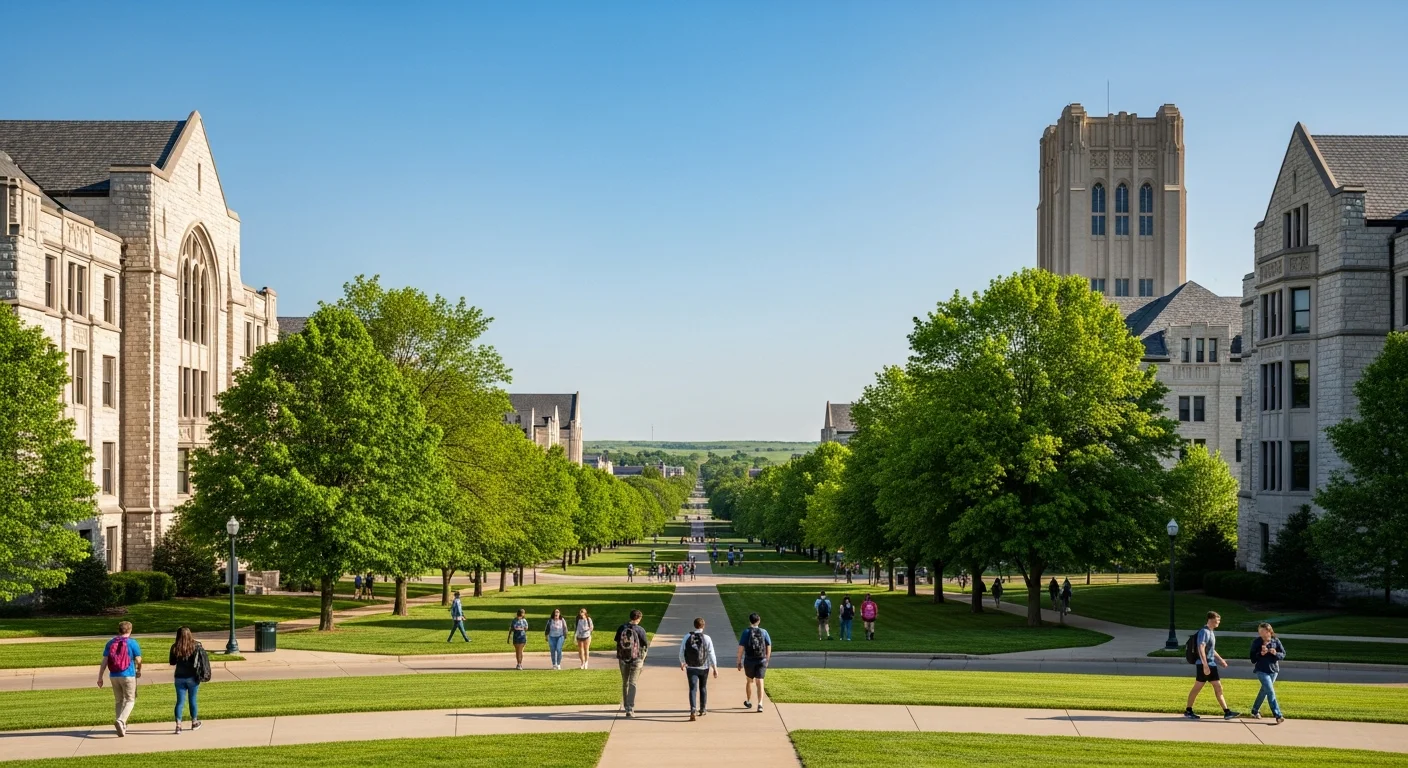
Compare the top data analytics colleges in Kansas. 5 accredited data analytics schools ranked by graduation rate, career outcomes, and value, from Wichita State University to University of Kansas.
Best data analytics degree programs: U of Kansas, Washburn, Sterling College
Ranked by graduation rates, program outcomes, and institutional quality
Tuition ranges from $7,247 to $30,000/year
Wichita State offers the most affordable option at $7,247/yr
Data Analytics degree programs available: 3 master's, 1 doctoral in Kansas
From community college pathways to advanced research degrees
Major employers: Garmin, Sprint, Cerner, Koch Industries
Tech hubs in Kansas City and Wichita
Hakia Research 2026
Data Analytics degree programs near 44+ cities across Kansas
Search by city to find programs within 200 miles of your location
Updated October 12, 2026
We rank 9 accredited data analytics programs in Kansas using IPEDS 2024 institutional data, BLS OEWS 2024 state salary data, and College Scorecard outcomes. A 4-factor weighted composite is normalized to a 0–100 score. Schools cannot pay for placement; rankings are produced algorithmically.
Are Data Analytics Degree Programs in Kansas Worth It?
Source: BLS OEWS May 2024
Compare the top-ranked Data Analytics programs in Kansas by degree level. Tuition, graduation rate, and Hakia Score for every accredited program.
Kansas ranks among the nation's top destinations for data analytics education, with 5 accredited bachelor's degree programs across 4 public and 1 private institutions. The highest-ranked programs are U of Kansas, Washburn, Sterling College, recognized for academic excellence, research opportunities, and strong industry connections.
Graduates from Kansas data analytics programs earn a median salary of $78,489, 20% below the national average. The state's robust technology sector, anchored by the Kansas City, Wichita, Overland Park metropolitan areas, provides abundant internship and employment opportunities with companies including Garmin, Sprint, Cerner.
Tuition ranges from $7,247 to $30,000 annually, with an average of $13,454/yr. Top programs maintain graduation rates above 86%, with the highest reaching 93%. Many programs hold ABET accreditation, the gold standard for computing education, ensuring curriculum meets rigorous industry standards.
Students can choose from specializations including software engineering, cybersecurity, artificial intelligence, data science, and systems architecture. Strong industry partnerships provide access to co-op programs, capstone projects with real companies, and direct recruiting pipelines to Kansas's leading technology employers. For students seeking data analytics degrees in Kansas, these top-ranked data analytics schools offer the strongest combination of academic rigor and career preparation.
Kansas offers 3 master's degree programs in data analytics, designed for professionals seeking to advance into senior engineering, technical leadership, and specialized roles. The top programs, Kansas State, U of Kansas, Wichita State, combine advanced technical training with research opportunities and leadership development.
Master's graduates in Kansas earn a median salary of $92,340, approximately 20-30% higher than bachelor's degree holders. The concentration of technology companies in Kansas City, Wichita, Overland Park creates strong demand for graduate-level talent, with Garmin, Sprint, Cerner actively recruiting from these programs.
Program formats include traditional full-time study (typically 2 years), part-time options for working professionals (2-3 years), and accelerated tracks. Tuition averages $9,269/yr, with many employers offering tuition reimbursement for graduate education. Some programs offer thesis and non-thesis tracks, allowing students to focus on research or professional development based on their career goals.
Curriculum covers advanced topics including machine learning, distributed systems, software architecture, and technical management. Many programs include practicum experiences, industry capstone projects, or consulting engagements that provide real-world application of advanced concepts. Among Kansas's data analytics schools at the graduate level, these programs stand out for both academic quality and career outcomes.
Kansas is home to 1 doctoral programs in data analytics, preparing students for research positions, faculty appointments, and executive technical roles. Leading programs at Kansas State are recognized for cutting-edge research, strong faculty publications, and competitive funding packages.
Doctoral graduates command premium salaries, with Kansas PhD holders earning a median of $115,425, reflecting the advanced expertise required for research and executive positions. The Kansas City, Wichita, Overland Park region's research universities and corporate R&D centers provide extensive collaboration opportunities with industry leaders like Garmin, Sprint, Cerner.
PhD programs typically require 4-6 years of full-time study, including coursework, qualifying examinations, and original dissertation research. Many programs offer full funding through teaching or research assistantships, covering tuition and providing stipends of $25,000–$40,000 annually.
Research strengths across Kansas programs include artificial intelligence, cybersecurity, human-computer interaction, systems, and theoretical computer science. For aspiring researchers pursuing data analytics degrees in Kansas, graduates go on to careers as university faculty, industry research scientists, or technical executives, contributing to advances in technology that impact millions of users worldwide.
| Metric | Value |
|---|---|
| Average in-state tuition | $13,454/year |
| Average out-of-state tuition | $33,635/year |
| Community college tuition | $3,364/year |
| 4-year savings for residents | $80,724 |
| 2+2 transfer pathway savings | $20,180 |
Source: IPEDS 2024
Kansas students pursuing data analytics degrees have access to multiple financial aid pathways. The primary source of federal aid begins with the Free Application for Federal Student Aid (FAFSA), available through Federal Student Aid. This application unlocks federal grants, loans, and work-study opportunities regardless of enrollment at public or private institutions. Additionally, Kansas offers the Kansas Comprehensive Grant, a need-based grant program specifically designed for students attending Kansas independent institutions. Information about state-specific grants and application procedures is available through the Kansas Board of Regents.
Beyond federal and state aid, students should investigate institutional scholarships offered directly by their chosen programs. The University of Kansas, Kansas State University, and Wichita State University, the three institutions with the highest data analytics completions, offer merit-based scholarships for high-performing students in STEM fields. The College Scorecard provides transparent data on average aid packages and loan outcomes by institution, helping students compare true out-of-pocket costs. Students transferring from Kansas community colleges benefit from the Kansas Transfer Equivalency System, which streamlines credit transfer and reduces overall time-to-degree, lowering total borrowing costs. Prospective students should also explore related degree pathways such as Data Science in Kansas and Information Systems in Kansas to identify alternative funding opportunities.
Use our interactive ROI calculator to estimate your return on investment for a data analytics degree in Kansas. Enter your expected tuition costs, financial aid, and career goals to see projected payback periods and lifetime earnings. The calculator uses current salary data from BLS and tuition data from IPEDS to provide accurate estimates.
Estimate your return on investment for a data analytics degree
Leave blank to use average cost for selected program type
+907%
Net gain divided by total investment. ROI above 200% is considered excellent for education investments.
$1,677,254
Your additional lifetime earnings with this degree vs. working without one, minus the total investment.
5 years
Years until your cumulative earnings exceed total investment. Shorter programs often break even faster due to lower opportunity cost.
$133,333
Your starting salary adjusted for local cost of living. This shows real purchasing power compared to a $100K national baseline.
Why does break-even change with program type? Your "total investment" includes both tuition AND opportunity cost (foregone earnings while in school). A 4-year full-time public university (in-state) means 4 years of not earning a salary ($140,000 in opportunity cost). Shorter full-time programs may have higher tuition but lower total investment because you return to the workforce sooner.
How we calculate your degree ROI using real salary data
Tuition plus opportunity cost (earnings you miss while in school)
Direct cost of the degree program
4 years × $35K/year foregone salary while studying full-time
Projected career earnings starting after graduation, with salary growth
What you'd earn working at $35K/year with 2% annual growth
Median salary for this role in your selected location (BLS 2024)
Your investment's compound annual growth rate (similar to stock market returns)
Data sources: BLS OEWS May 2024, IPEDS 2024. Calculations use median salaries, 3% discount rate, and assume salary growth declines from 6% to 2% over career. Individual results will vary. | Powered by Hakia.com
Median annual salary in Kansas metro areas
| Category | Value |
|---|---|
| Kansas City | $102K |
| Wichita | $97K |
| Overland Park | $92K |
Source: BLS OEWS May 2024
Hakia.com
Find data analytics jobs in Kansas. These major employers across Kansas metro areas are actively hiring data analytics degree holders. Click employer names to view current job openings.
Kansas offers streamlined pathways for students beginning their data analytics journey at community colleges and transferring to four-year universities. The Kansas Transfer Equivalency System (https://www.kansasregents.org/academic_affairs/transfer-articulation) provides systemwide course transfer agreements, ensuring credits earned at one of Kansas's 28 two-year institutions transfer seamlessly to four-year programs. This system protects student investment and reduces time to degree completion. With 1 associate's degree program in data analytics currently available, students can begin foundational coursework in statistics, programming, and database concepts at the community college level before advancing to bachelor's programs at schools like University of Kansas (126 completions) or Kansas State University (56 completions).
Transfer students benefit from established articulation agreements between Kansas's community and four-year systems, making transitions predictable and cost-effective. Average public in-state tuition at four-year institutions ($7,625) is affordable, and students may qualify for the Kansas Comprehensive Grant, a need-based aid program for students attending Kansas independent institutions (https://www.kansasregents.org/students/student_financial_aid). For detailed information on specific transfer pathways, consult the Kansas Board of Regents website and your target university's transfer admission office. To explore complementary programs, check Data Science in Kansas and Information Systems in Kansas for additional transfer-friendly options aligned with regional employers.
Kansas offers strong opportunities for students pursuing data analytics education, with 12 institutions across the state offering programs at multiple degree levels (IPEDS). From associate's through doctoral degrees, Kansas institutions produced 235 completions in 2023, demonstrating strong enrollment and graduation trends. The University of Kansas leads the state with 126 completions, followed by Kansas State University with 56 completions, establishing these schools as regional powerhouses in the field. Whether you're seeking a bachelor's degree, master's credential, or doctorate, Kansas provides diverse pathways to enter one of the fastest-growing technical fields.
Beyond academic options, Kansas offers significant economic advantages for data analytics professionals. The state's major employers, including Spirit AeroSystems, Textron Aviation, University of Kansas, and Koch Industries, actively recruit data-driven talent across industries ranging from aerospace to manufacturing. Key metros like Wichita, Kansas City Metro, and Topeka serve as technology hubs with growing data science sectors. Combined with Kansas's average public in-state tuition of $7,625 for four-year institutions, students gain quality education at an affordable cost. Explore Data Science in Kansas and Information Systems in Kansas to discover complementary career paths, or compare your options with national best programs.
Data Analytics Program Availability in Kansas
Source: IPEDS 2024
Kansas has a growing demand for data analytics professionals across multiple sectors and metropolitan regions. The state's job market is concentrated in major urban centers including Wichita, Kansas City, Topeka, and Lawrence, where businesses increasingly rely on data-driven decision-making. According to the Bureau of Labor Statistics, data analytics and related occupations represent significant employment opportunities in Kansas. The Kansas City Metro, South Central Kansas region (anchored by Wichita), and Northeast Kansas (home to Lawrence and Manhattan) serve as primary hubs for analytics professionals seeking employment. Educational institutions across the state have responded to this demand, with 12 institutions offering data analytics programs at various degree levels, from associate's degrees through doctoral programs (IPEDS).
The pipeline of data analytics talent in Kansas remains strong, with 118 bachelor's degree completions and 89 master's degree completions reported in 2023, demonstrating sustained interest in the field (IPEDS). University of Kansas leads the state in program completions with 126 total completions across all degree levels, followed by Kansas State University with 56 completions. This talent production supports the state's growing employer base and provides graduates with abundant career pathways. For detailed salary information and occupation-specific employment trends, the BLS State Data tool offers comprehensive labor market insights. Students exploring data analytics education in Kansas should also examine related fields. Consider reviewing Data Science in Kansas and Database Management in Kansas for complementary career options.
New graduates and career changers
Technical leads and architects
0 available in Kansas
Traditional classroom experience
Institutional characteristics, completions, graduation rates
Kansas salary and employment data
Program details and admissions information
Last Updated: June 26, 2026. Rankings based on IPEDS 2024 data. Salary data from BLS OEWS May 2024.

Co-founder & Editor (B.S. Computer Science, Oregon State • B.A. Psychology, University of Washington)
Taylor combines technical expertise in computer science with a deep understanding of human behavior and learning. His dual background drives Hakia's mission: leveraging technology to build authoritative educational resources that help people make better decisions about their academic and career paths.
Hand-researched detail on the top-ranked programs: degree pathways, research labs, industry partners, career outcomes, and admissions. Tap any school to expand.
Why it stands out. Business Professional Development Program with professionalism coursework integrated throughout curriculum. Capstone course MGMT 498 requiring co-curricular and extra-curricular enrichment engagement
Hakia insight. Kansas's integration of a Business Professional Development Program throughout its curriculum—not as a capstone afterthought—means graduates enter the workforce with demonstrated professionalism credentials, translating technical skills into faster management-track consideration than peers from programs treating soft skills as optional.
The Bachelor of Science in Business in Business Analytics at the University of Kansas prepares students to transform raw data into actionable intelligence for organizational decision-making. The program covers data warehousing, dimensional modeling, big-data analytics methods, visualization tools, data mining, and predictive analytics. Students complete 120 credit hours including core business curriculum, foundation courses in accounting, economics, and statistics, and advanced analytics coursework. The program requires a minimum 2.5 GPA overall and in major courses. Graduates develop analytical skills to guide strategic business decisions across industries relying on data-driven insights. The curriculum integrates professionalism development through required BUS courses and co-curricular enrichment activities leading to the capstone course MGMT 498.
Programs offered
Research labs & institutes
Industry partners
Accreditation & certifications
Location advantage: Access to Kansas City tech hub and startup ecosystem Proximity to Garmin headquarters Strong ties to Midwest financial and healthcare sectors
Why it stands out. Mandatory internships with area companies providing real-world data analytics experience. Capstone course (Data Analytics in Practice) with real-world data projects
Hakia insight. Washburn's mandatory internships with State of Kansas and Blue Cross Blue Shield aren't just resume-builders—they funnel students directly into the government and healthcare sectors where entry-level analyst roles actually exist, making the transition from classroom to paycheck nearly frictionless.
Washburn University's Bachelor of Business Administration in Data Analytics prepares students to transform big data into actionable business intelligence. The program combines classroom instruction with hands-on experience through area company internships that provide real-world data analytics projects. The capstone course, Data Analytics in Practice, requires students to apply their skills to complete real-world data projects. Students learn to gather, assess, and process data using industry-standard analytic tools and techniques. The curriculum covers data discovery and management, data methods and warehousing, data mining and modeling, and advanced analytics. With a 15:1 student-to-faculty ratio and faculty holding doctoral degrees, students benefit from strong mentorship. The program emphasizes career readiness, with alumni providing local opportunities and area companies actively recruiting graduates for internships and full-time positions across accounting, finance, marketing, human resources, information systems, and other business disciplines.
Programs offered
Industry partners
Career outcomes
Location advantage: Proximity to Kansas state government and administrative offices Access to healthcare employer base in Topeka region Strong nonprofit and public sector analytics demand
Why it stands out. Sterling College's liberal arts approach integrates data analytics across the curriculum, producing analytically-skilled graduates with deep disciplinary expertise and social awareness.
Hakia insight. Sterling College's liberal arts analytics degree produces graduates with a rare combination: technical rigor in data methods paired with domain fluency in humanities or sciences, a profile that nonprofit organizations and NGOs actively seek but struggle to find.
At the bachelor's level, sterling College's analytics offerings are embedded within its liberal arts computing curriculum, meaning students combining data skills with breadth across sciences, humanities, and social sciences in ways that larger technical programs rarely facilitate. The small college environment allows faculty to design analytics coursework that connects to students' other majors—a biology student might analyze ecological datasets while an economics student builds forecasting models tied to their discipline. Rather than a standalone analytics major, Sterling integrates data literacy and analytical thinking across multiple programs, creating graduates who understand both the technical and contextual dimensions of data work. The college's emphasis on undergraduate research means students engage in real analytical projects alongside faculty, building portfolios with genuine research contributions rather than purely pedagogical exercises. Sterling's location in central Kansas and its values-driven mission attract students interested in analytics roles with nonprofits, educational institutions, and regional public sector organizations where technical skills are increasingly essential but where cultural fit with mission-driven organizations matters as much as credentials. Graduates of Sterling's programs often pursue analytics roles in education, healthcare nonprofits, government agencies, and social science research organizations where their combination of technical competency and liberal arts perspective is distinctly valued.
Programs offered
Location advantage: Access to nonprofit and regional education sectors for internships and employment
Why it stands out. Distinctive strength in precision agriculture and industrial analytics with embedded partnerships in agribusiness, farming technology, and equipment manufacturing.
Hakia insight. Kansas State's partnership with John Deere and Cargill means students solve real precision agriculture problems—not case studies—while still undergraduates, building a portfolio that carries disproportionate weight when competing for roles at agribusiness firms that dominate the Great Plains job market.
At the bachelor's level, kansas State's data science and analytics programs leverage the university's engineering heritage and agricultural research mission, creating distinctive depth in domains like precision agriculture, environmental data, and industrial systems optimization. The curriculum balances theoretical foundations with applied projects—students don't just learn regression; they implement predictive models for crop yield, equipment failure prediction, or energy consumption in real agricultural and industrial settings. Faculty research in agricultural analytics, bioinformatics, and IoT systems directly informs course content and capstone opportunities. The MS in Data Science attracts both tech-focused students and those from agriculture, engineering, and life sciences backgrounds, creating cross-disciplinary teams in project courses. What sets K-State apart is its unique position at the intersection of Big Data and Big Agriculture—the program partners with John Deere, regional grain cooperatives, and food processing companies, offering internships and research collaborations that few other universities can match. The graduate school's emphasis on hands-on research labs means students typically conduct meaningful analytics projects rather than purely coursework-based studies. Placement outcomes are strong in both traditional tech companies and the substantial agribusiness sector across the Midwest and Great Plains.
Programs offered
Research labs & institutes
Industry partners
Career outcomes
Top employers: KOCH Industries, Textron Aviation, Cerner, Kansas State University, Shamrock Trading, CivicPlus, Southwest Airlines, U.S. government, CSCS, HWE, Sims
Accreditation & certifications
Location advantage: Center of agribusiness analytics demand in North America Proximity to John Deere and agricultural equipment manufacturers Access to Midwest food processing and grain handling sectors Partnerships with USDA research stations and agricultural cooperatives
Why it stands out. Strong emphasis on aerospace and manufacturing analytics with hands-on projects embedded in regional industry partnerships from the first semester.
Hakia insight. Wichita State embeds aerospace and manufacturing projects into the first semester, not the fourth, compressing the typical timeline from academic theory to industry-relevant problem-solving and creating a natural pipeline to Boeing and Spirit AeroSystems hires.
At the bachelor's level, wichita State's data analytics programs capitalize on the region's aerospace and manufacturing sectors, embedding students in real-world problem-solving from day one. The curriculum emphasizes applied analytics across engineering, business, and healthcare domains—students work with actual industry datasets rather than textbook examples. Faculty research clusters around predictive modeling for aerospace systems and supply chain optimization, creating natural bridges to internships and projects with Boeing, Spirit AeroSystems, and regional manufacturers. The MS in Data Science integrates machine learning fundamentals with domain-specific applications, and students regularly present findings at regional conferences. What distinguishes this approach is the emphasis on translating analytics into actionable decisions within resource-constrained industries—a skill set that resonates deeply with employers in Kansas and the broader Midwest. Placement outcomes reflect strong regional ties: graduates land roles at Textron, Collins Aerospace, and local healthcare systems within months. The program also maintains partnerships with the Kansas Technology Enterprise Corporation, opening doors to startup analytics roles. Class sizes remain intimate enough that faculty mentorship includes portfolio development and job placement guidance.
Programs offered
Research labs & institutes
Industry partners
Location advantage: Proximity to aerospace manufacturing hub (Boeing, Spirit AeroSystems) Access to Midwest manufacturing sector analytics roles Regional tech workforce demand in Wichita innovation corridor
Why it stands out. 100% online delivery with flexible scheduling ideal for working professionals. Two specialized tracks: Data Science (machine learning, AI) and Applied Analytics (business-focused capstone)
Hakia insight. Kansas State's two-track structure (Data Science vs. Applied Analytics) lets working professionals choose their specialization after the first semester based on actual coursework interest, not blind program selection—a flexibility that reduces the risk of investing 18 months in the wrong focus.
Kansas State University's Master's in Data Analytics is a 30-credit, 100% online program designed for working professionals seeking to master data collection, analysis, and application. The program offers two specialized tracks: Data Science (emphasizing machine learning and AI) and Applied Analytics (featuring a business capstone). Students complete 21 credits of core coursework in programming, econometrics, big data analytics, and business intelligence, then select 9 credits from their chosen track. While the program does not explicitly offer a thesis option, the Applied Analytics track includes a Data Analytics Capstone providing real-world application. Part-time completion is available with flexible online scheduling ideal for mid-career professionals. No graduate assistantships or embedded professional certifications are mentioned. Tuition is $707.43 per credit hour (2025-2026 rates). Graduates pursue roles as data analysts, data scientists, business intelligence analysts, and analytics consultants, with the U.S. Bureau of Labor Statistics reporting strong job growth in data analytics roles.
Programs offered
Research labs & institutes
Industry partners
Career outcomes
Top employers: Intel
Accreditation & certifications
Location advantage: Center of agribusiness analytics demand in North America Proximity to John Deere and agricultural equipment manufacturers Access to Midwest food processing and grain handling sectors Partnerships with USDA research stations and agricultural cooperatives
Why it stands out. Coursework-based track with optional summer internship capstone (BSAN 780). Accelerated two-semester full-time format
Hakia insight. University of Kansas's two-semester format paired with proximity to Garmin and the Kansas City tech ecosystem means students can compress a master's degree into a single calendar year while maintaining genuine access to internship and job opportunities, rare for accelerated programs.
The Master of Science in Business Analytics at the University of Kansas is a 31-credit, accelerated program designed for working professionals seeking to advance their careers in data-driven decision-making. The program offers a coursework-based track with an optional summer internship capstone, combining core business foundations with advanced analytics training in machine learning, data warehousing, and big-data analytics. Students typically complete the program full-time over two consecutive semesters, positioning graduates for leadership roles in data science across business and government sectors. The program emphasizes practical skills in statistical modeling, predictive analytics, and AI applications. While specific salary advancement data and graduate assistantship opportunities are not detailed in the catalog, the program's focus on high-demand analytics competencies aligns with industry growth in data science roles.
Programs offered
Research labs & institutes
Industry partners
Accreditation & certifications
Location advantage: Access to Kansas City tech hub and startup ecosystem Proximity to Garmin headquarters Strong ties to Midwest financial and healthcare sectors
Why it stands out. Thesis vs. coursework track options available. STEM-classified degree with 24-month F1 OPT extension eligibility
Hakia insight. Wichita State's STEM designation grants international students 24 months of OPT—versus the standard 12—while the thesis-or-coursework flexibility lets visa-bound students optimize for either advanced research credentials or immediate job-market readiness.
The Master of Arts in Economics and Quantitative Analysis with Data Analytics specialization from Wichita State's AACSB-accredited Barton School of Business prepares working professionals to advance their careers through data-driven economic analysis. The program offers flexibility with two completion tracks: a thesis option (30 credit hours) or a coursework-based independent research project track (33 credit hours), typically completed in four semesters. All students benefit from guaranteed applied learning and research experiences integrated throughout the curriculum, ensuring workforce readiness before graduation. The STEM-classified program qualifies graduates for a 24-month F1 OPT extension. The data analytics concentration combines quantitative skills with economic analysis, positioning graduates for career advancement in roles requiring analytical expertise. While specific salary data and assistantship details are not provided in available materials, the program is designed to equip professionals with skills to advance careers or pursue doctoral study in economics.
Programs offered
Research labs & institutes
Industry partners
Location advantage: Proximity to aerospace manufacturing hub (Boeing, Spirit AeroSystems) Access to Midwest manufacturing sector analytics roles Regional tech workforce demand in Wichita innovation corridor
Why it stands out. Distinctive strength in precision agriculture and industrial analytics with embedded partnerships in agribusiness, farming technology, and equipment manufacturing.
Hakia insight. Kansas State's doctoral programs sit at the intersection of agricultural engineering and data science, a niche where PhD holders face virtually no competition for positions at USDA, John Deere, and Cargill—the employers actually funding this research.
At the doctoral level, kansas State's data science and analytics programs leverage the university's engineering heritage and agricultural research mission, creating distinctive depth in domains like precision agriculture, environmental data, and industrial systems optimization. The curriculum balances theoretical foundations with applied projects—students don't just learn regression; they implement predictive models for crop yield, equipment failure prediction, or energy consumption in real agricultural and industrial settings. Faculty research in agricultural analytics, bioinformatics, and IoT systems directly informs course content and capstone opportunities. The MS in Data Science attracts both tech-focused students and those from agriculture, engineering, and life sciences backgrounds, creating cross-disciplinary teams in project courses. What sets K-State apart is its unique position at the intersection of Big Data and Big Agriculture—the program partners with John Deere, regional grain cooperatives, and food processing companies, offering internships and research collaborations that few other universities can match. The graduate school's emphasis on hands-on research labs means students typically conduct meaningful analytics projects rather than purely coursework-based studies. Placement outcomes are strong in both traditional tech companies and the substantial agribusiness sector across the Midwest and Great Plains.
Programs offered
Research labs & institutes
Industry partners
Career outcomes
Top employers: KOCH Industries, Textron Aviation, Cerner, Kansas State University, Shamrock Trading, CivicPlus, Southwest Airlines, U.S. government, CSCS, HWE, Sims
Accreditation & certifications
Location advantage: Center of agribusiness analytics demand in North America Proximity to John Deere and agricultural equipment manufacturers Access to Midwest food processing and grain handling sectors Partnerships with USDA research stations and agricultural cooperatives