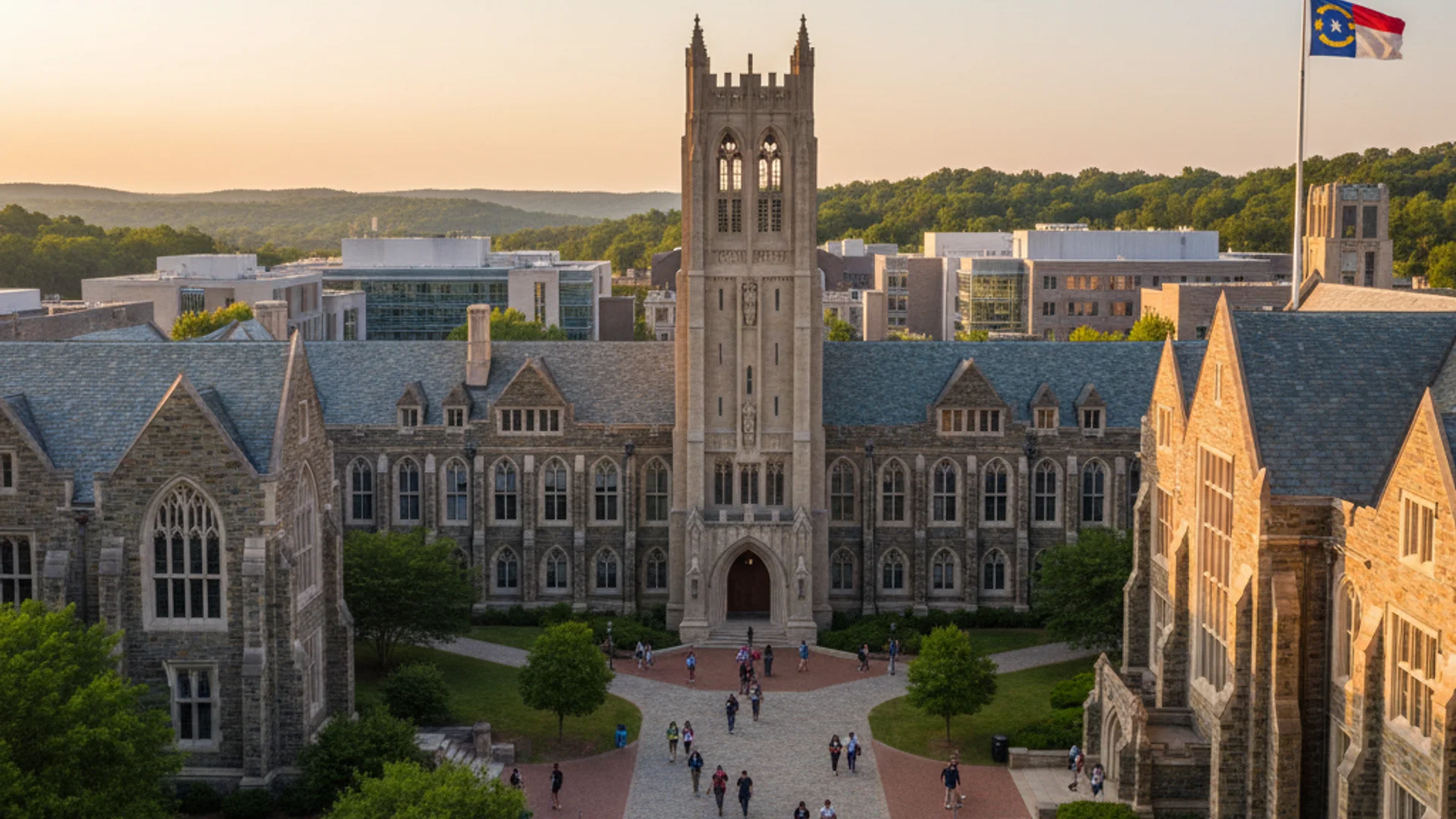
Best Bachelor's Artificial Intelligence Degree Programs in North Carolina
University of North Carolina at Chapel Hill — Chapel Hill, NC
Key Distinction: UNC-Chapel Hill is committed to AI whose invention, use and governance is in service of the public good, with over 3,000 AI publications in the past decade and interdisciplinary research spanning computer science to journalism and health sciences.
Hakia Insight: UNC-Chapel Hill's 3,000+ AI publications over the past decade aren't just a prestige metric; they signal that undergraduates can access faculty actively reshaping how AI serves public interest, from Eva Zhao's culturally-tailored chatbots to Mohit Bansal's breakthrough algorithms.
At the bachelor's level, UNC-Chapel Hill offers a comprehensive B.S. in data science through the School of Data Science and Society, focusing on six competencies including machine learning/AI, optimization, and responsible data science. The program emphasizes practical application through concentrations, research opportunities, and internships.
Programs Offered
- Bachelor of Science in Artificial Intelligence — 4 years, on-campus
- Bachelor of Arts in Artificial Intelligence — 4 years, online
Research Labs and Institutes
- Computer Science Department
- Gillings Lab
- Robotics Lab
Notable Faculty
- Eva Zhao — crisis communication AI and culturally tailored chatbots
- Mohit Bansal — breakthrough AI technology
- David Wan — AI reliability
- Francesca Tripodi — AI responsibility
- Alexander Tropsha — AI for drug discovery
- Snigdha Chaturvedi — compassionate AI
- Michael Kosorok — AI for public health challenges
Admissions
GPA Requirement: 2.000.
Requirements: MATH 231, MATH 232, MATH 233, MATH 347, MATH 381, STOR 120
Location Advantages:
Duke University — Durham, NC
Key Distinction: AI integrated into core curriculum (COMPSCI 270 required). Undergraduate research opportunities through CS+ Summer Program
Hakia Insight: Duke's mandatory COMPSCI 270 requirement means every CS student graduates with AI fluency whether they specialize or not—but the real differentiator is the CS+ Summer Program funneling undergrads directly into OpenAI and Target's AI Lab, where the $118K median salary reflects early-career industry access, not just recruiting.
Duke's Bachelor of Science in Computer Science includes artificial intelligence as a core component of the curriculum, requiring students to complete COMPSCI 270 and an AI elective course. The program requires a minimum of 15 units in computer science courses plus 19 additional units to reach the 34-unit degree requirement. Students can pursue a concentration in AI and Machine Learning, which provides a structured pathway through the curriculum aligned with AI career goals. The concentration covers foundational AI/ML coursework alongside systems, software engineering, and data science electives. Duke's CS department offers undergraduate research opportunities, including the CS+ Summer Program and independent study options. The program emphasizes both theoretical foundations and practical applications, with career preparation through industry connections and faculty mentorship in growing AI fields.
Programs Offered
- Bachelor of Science in Computer Science with Concentration in Artificial Intelligence and Machine Learning — 4 years, on-campus. BS
Research Labs and Institutes
- Bartesaghi Lab
- Rudin Lab
- APEX Lab
- Hartemink Lab
Industry Partners
- OpenAI (tech)
- Target's AI Lab (retail)
- Eli Lilly (healthcare)
- Grubhub (tech)
- Samsung (tech)
- IBM (tech)
- DoorDash (tech)
- Fidelity (finance)
- Intuit (tech)
- Autodesk (tech)
- Amazon Business (tech)
- Zafin (tech)
Career Outcomes
Median Salary: $118,000. Top Employers: OpenAI, Target's AI Lab, Eli Lilly, Grubhub, Samsung, IBM, DoorDash, Fidelity, Intuit, Autodesk.
Notable Faculty
- Jon Reifschneider — Executive Director, AI for Product Innovation
- Brinnae Bent — Executive in Residence
- Alberto Bartesaghi — Computer Science and Biochemistry
- Cynthia D. Rudin — Machine Learning and Interpretable AI
- Carlo Tomasi — Computer Vision
- Jun Yang — Computer Science
- Bhuwan Dhingra — Natural Language Processing
Location Advantages:
University of North Carolina at Charlotte — Charlotte, NC
Key Distinction: Practical, hands-on learning throughout program. Built-in curriculum flexibility to explore courses across disciplines
Hakia Insight: UNC Charlotte's August 2026 launch of its AI bachelor's represents a rare opportunity: joining a cohort-based program designed from scratch around practical hands-on learning, not retrofitted from a traditional CS major.
The Bachelor of Science in Artificial Intelligence at UNC Charlotte, launching August 2026, is designed for students pursuing careers in AI and machine learning. The program provides comprehensive training in core mathematics, computing, AI algorithms, the AI software lifecycle, and ethical considerations. Students gain practical, hands-on learning experiences with built-in flexibility to explore courses across disciplines and apply AI in diverse fields. UNC Charlotte is one of only two institutions in the UNC System offering a dedicated AI bachelor's degree and among approximately 20 universities nationwide with a focused undergraduate AI program. The curriculum emphasizes strong communication and teamwork abilities alongside technical skills, preparing graduates for the rapidly evolving AI workforce in collaboration with industry partners shaping the Charlotte region's economic outlook.
Programs Offered
- Bachelor of Science in Artificial Intelligence — 4 years, on-campus. BS
Research Labs and Institutes
Admissions
GPA Requirement: 2.5.
Requirements: Core mathematics, Computing foundations, AI algorithms, AI software lifecycle, Ethical considerations in AI, Communication and teamwork skills development
Location Advantages:
North Carolina State University at Raleigh — Raleigh, NC
Key Distinction: Mandatory Senior Design Project with potential industrial sponsors for real-world problem solving. ABET accreditation
Hakia Insight: NC State's mandatory Senior Design Project with industrial sponsors transforms the capstone from academic exercise into portfolio-building proof of work for IBM, Microsoft, and Google—the same companies actively recruiting from the Research Triangle.
NC State's Bachelor of Science in Computer Science with an Artificial Intelligence Concentration equips students with expertise in developing intelligent and autonomous systems, machine learning, and data mining applications. The program integrates 21 credit hours of focused AI coursework alongside core computer science fundamentals in programming, data structures, software engineering, and systems theory. A mandatory Senior Design Project—often with industrial sponsors—provides hands-on experience solving real-world technical problems in collaboration with industry partners. The curriculum emphasizes the social and ethical dimensions of computing while supporting the National Artificial Intelligence Initiative's goals. Students develop skills in specifying, designing, implementing, testing, and deploying AI-enhanced systems across multiple domains. The program is ABET-accredited and prepares graduates for roles in AI development, data science, and software engineering with opportunities in both traditional tech and emerging AI applications.
Programs Offered
- Bachelor of Science in Computer Science: Artificial Intelligence Concentration — 4 years, on-campus. BS
Research Labs and Institutes
- Fitts Department of Industrial and Systems Engineering
- Center for Robotics and Intelligent Machines
Industry Partners
- IBM (corporate)
- Microsoft (corporate)
- Google (corporate)
- Cisco (corporate)
Notable Faculty
- Haroon Abbu — Business AI
- Grant Glass — Business AI
- Bill Rand — Business AI
Accreditations and Certifications
Location Advantages: Located in Raleigh, heart of the Research Triangle with IBM, Cisco, Red Hat, and other major tech employersProximity to Chapel Hill (University of North Carolina) and Durham (Duke University) for collaborative opportunitiesAccess to one of the largest concentrations of technology companies and research institutions in the Southeast
Davidson College — Davidson, NC
Key Distinction: Davidson College offers an intellectually rigorous, highly selective liberal arts computer science education with exceptional faculty mentorship and undergraduate research opportunities.
Hakia Insight: Davidson College embeds AI literacy across the entire computer science curriculum rather than siloing it, meaning every project—from systems to theory—forces students to think about intelligent systems implications, a rarity at liberal arts schools and a credential that resonates in finance and policy roles.
At the bachelor's level, davidson College integrates artificial intelligence literacy across its computer science curriculum rather than siloing it into specialized tracks, reflecting the college's broader educational philosophy of interconnected learning. Students encounter AI concepts through multiple lenses—from ethics and societal implications to algorithmic design and implementation—beginning in introductory courses and advancing through electives in machine learning, data structures, and computational problem-solving. The liberal arts context shapes the program's distinctive character: computer science students study alongside humanities and social science peers, creating opportunities for interdisciplinary collaboration on AI projects that grapple with questions beyond pure technical optimization. Faculty in the computer science department maintain active research interests in areas like machine learning applications, algorithm efficiency, and computational theory, often involving undergraduates in mentored research that produces publications and conference presentations. Davidson's location in North Carolina positions students for internships and networking within a growing technology corridor, and the college maintains strong relationships with companies seeking analytically-trained graduates. What sets Davidson apart is its resistance to treating AI as a specialized field reserved for experts; instead, the curriculum ensures that all computer science majors graduate with solid foundational knowledge while allowing advanced students to pursue deeper specialization. Capstone projects frequently incorporate AI methodologies, with recent examples spanning predictive analytics, natural language processing applications, and automated decision-making systems. The college emphasizes that understanding AI's limitations and societal implications matters as much as mastering its technical implementation. For students attracted to Davidson's collaborative, questioning-oriented culture, the AI curriculum extends naturally from the institution's commitment to developing thoughtful problem-solvers rather than narrow technicians.
Programs Offered
- Bachelor of Science in Artificial Intelligence — 4 years, on-campus
- Bachelor of Arts in Artificial Intelligence — 4 years, online
Career Outcomes
Top Employers: Tech companies in Research Triangle, Charlotte financial services firms.
Location Advantages: Proximity to Charlotte (30 minutes) with major financial services and tech presenceAccess to Research Triangle (1 hour) with major technology companies and research institutions
Wake Forest University — Winston-Salem, NC
Key Distinction: Rooted in Wake Forest's Pro Humanitate mission, the program explores issues like bias, privacy, transparency, and global regulatory standards, gaining the tools to champion responsible innovation with a focus on ethical AI implementation.
Hakia Insight: Wake Forest's Pro Humanitate mission isn't rhetorical framing; it means undergraduates studying AI ethics alongside Amazon Web Services and JPMorgan Chase partnerships, positioning graduates to command roles in responsible AI implementation where regulatory expertise is becoming as valuable as coding.
At the bachelor's level, wake Forest University offers an online Master of AI Strategy and Innovation program that takes a holistic, human-centered approach to artificial intelligence. The program blends technical skill-building with strategic leadership and cross-functional communication to guide organizations through digital transformation.
Programs Offered
- Bachelor of Science in Artificial Intelligence — 4 years, on-campus
- Bachelor of Arts in Artificial Intelligence — 4 years, online
Research Labs and Institutes
- Center for Artificial Intelligence Research
Industry Partners
- Amazon Web Services (tech)
- JPMorgan Chase & Co. (finance)
- Intel Corp (tech)
- Epic Systems (healthcare)
Notable Faculty
- Dr. Carm Taglienti — Academic Director, Artificial Intelligence Strategy & Innovation
- Dr. Tonya Balan — Academic Director, Public Policy and Data Analytics
- Dr. Hamza F. Alsarhan — Artificial Intelligence Strategy & Innovation Faculty
- Dr. Metin Gurcan — Professor of Internal Medicine, Director of Center for Artificial Intelligence Research
North Carolina A & T State University — Greensboro, NC
Key Distinction: Features two distinct tracks (Applied Track and Engineering & Computing Track), specialized concentrations in Robotics, Artificial Intelligence, and Machine Learning, with flexible learning options including online and hybrid formats, and emphasizes applied learning through project-based coursework and research collaborations.
Hakia Insight: NC A&T's dual-track structure (Applied vs. Engineering & Computing) with robotics specialization and hybrid delivery formats acknowledges a truth most selective schools ignore: students building AI systems need different preparation depending on career destination, not a one-size curriculum.
At the bachelor's level, north Carolina A&T State University offers a groundbreaking Bachelor of Science in Artificial Intelligence program designed to equip the next generation of AI professionals with skills and innovation mindset needed to thrive in one of the fastest-growing technology fields. The interdisciplinary program delivers hands-on education in AI, integrating computer systems, robotics, machine learning, and data science with real-world applications.
Programs Offered
- Bachelor of Science in Artificial Intelligence — 4 years, on-campus
- Bachelor of Arts in Artificial Intelligence — 4 years, online
Notable Faculty
- Dr. Jinsheng Xu — BS in AI Program Coordinator
- Dr. Kaushik Roy — Computer Science Professor and Chair
- Dr. Evelyn Sowells-Boone — Computer Systems Technology Department Chair
- Dr. Ahmad Patooghy — Program Coordinator
Admissions
GPA Requirement: 3.0.
Requirements: English - 4 units, Natural Sciences - 3 units, Social Sciences - 2 units, Foreign Language - 2 units, Mathematics - 4 units including Algebra I, Geometry, Algebra II, and advanced mathematics
Location Advantages:
University of North Carolina Wilmington — Wilmington, NC
Hakia Insight: UNCW's interdisciplinary emphasis over pure computer science abstraction produces a $72K median salary that underestimates its value—the real advantage is graduates positioned for roles at IBM and MetLife where AI solves business problems, not just technical optimization.
At the bachelor's level, what sets UNCW's approach to artificial intelligence apart is its emphasis on interdisciplinary application rather than pure computer science abstraction. The program draws strength from the university's coastal location and research community, with particular opportunities to apply AI methods to marine science, environmental monitoring, and oceanographic data analysis—fields where machine learning algorithms directly impact real-world discovery. Students develop competency across machine learning fundamentals, computer vision, and data mining while simultaneously engaging with domain experts who frame AI problems in meaningful contexts. The faculty actively pursues research in areas like predictive modeling for environmental systems and intelligent data interpretation, creating pathways for undergraduates and graduate students to contribute to published work. Internship opportunities span both traditional tech companies and research institutions focused on environmental applications, offering graduates unusual career trajectories. UNCW's program structure encourages experiential learning through capstone projects and collaborative research initiatives. The community around the program tends to attract students motivated by applying AI to solve specific problems rather than those purely pursuing technical certification, which shapes the culture and student outcomes in distinct ways. Graduates emerge with portfolios demonstrating both solid technical foundations and the ability to communicate AI concepts to non-technical stakeholders—a valuable combination in industries increasingly seeking interdisciplinary teams.
Programs Offered
- Bachelor of Science in Artificial Intelligence — 4 years, on-campus
- Bachelor of Arts in Artificial Intelligence — 4 years, online
Research Labs and Institutes
- Machine Learning Research Lab
- Data Science Initiative
Industry Partners
- IBM (Technology consulting)
- MetLife (Insurance technology)
- PPD (Clinical research technology)
Career Outcomes
Median Salary: $72,000. Top Employers: IBM, MetLife, First Citizens Bank, Live Oak Bank.
Admissions
GPA Requirement: 3.0.
Accreditations and Certifications
- AWS Machine Learning
- Google AI Platform
- Microsoft Azure AI
Elon University — Elon, NC
Hakia Insight: Elon's integration of AI with liberal arts and partnerships with SAS Institute and Credit Suisse suggests a specific market advantage: the school trains AI practitioners who can communicate across domains, a soft skill that justifies the $78K median over technical-only competitors.
At the bachelor's level, elon's Computer Science program integrates AI and data science with liberal arts education. Students engage in experiential learning through internships and collaborative research with faculty.
Programs Offered
- Bachelor of Science in Artificial Intelligence — 4 years, on-campus
- Bachelor of Arts in Artificial Intelligence — 4 years, online
Research Labs and Institutes
- Computational Intelligence Lab
- Human-Computer Interaction Lab
Industry Partners
- SAS Institute (Analytics software)
- Credit Suisse (Financial services)
- Volvo Group (Automotive technology)
Career Outcomes
Median Salary: $78,000. Top Employers: SAS Institute, Credit Suisse, Epic Systems, Microsoft.
Admissions
GPA Requirement: 3.5.
Accreditations and Certifications
- TensorFlow Developer
- AWS Solutions Architect
- Tableau Certified
Appalachian State University — Boone, NC
Key Distinction: Appalachian State combines rigorous computer science education with Appalachia's unique economic and technological challenges, emphasizing practical solutions for regional development.
Hakia Insight: Appalachian State's deliberate framing of AI as a tool for regional economic development—not just Silicon Valley aspiration—appeals to students building tech solutions for Appalachia's unique infrastructure and employment landscape rather than chasing coastal job markets.
At the bachelor's level, appalachian State's computer science program has integrated artificial intelligence and machine learning as core competency areas rather than peripheral electives, reflecting the field's centrality to modern computing. The mountain region setting hasn't limited the program's sophistication—faculty maintain active research programs and partnerships with major tech companies and research institutions. Students engage with AI through a carefully sequenced curriculum that builds from discrete mathematics and algorithms to advanced topics in deep learning, computer vision, and natural language processing. App State emphasizes experiential learning, with opportunities for students to contribute to faculty research projects, internships at technology companies, and capstone projects solving real problems. The university's commitment to undergraduate research is particularly notable, with many AI students publishing and presenting work at academic conferences. Faculty bring diverse expertise and often teach courses reflecting their research interests, exposing students to cutting-edge developments in AI. The program attracts students seeking rigorous technical education in a collaborative rather than cutthroat environment. Graduates have secured positions at leading tech companies, startups, and research institutions. Appalachian State's AI program demonstrates that world-class computer science education thrives outside major metropolitan research universities, built on dedicated faculty, engaged students, and genuine commitment to the discipline.
Programs Offered
- Bachelor of Science in Artificial Intelligence — 4 years, on-campus
- Bachelor of Arts in Artificial Intelligence — 4 years, online
Accreditations and Certifications
- ABET accredited engineering programs
Location Advantages: Proximity to emerging tech communities in North Carolina's Research Triangle region
Best Master's Artificial Intelligence Degree Programs in North Carolina
North Carolina State University at Raleigh — Raleigh, NC
Key Distinction: Coursework-based degree with no thesis or comprehensive exam required. Part-time enrollment option available for working professionals
Hakia Insight: NC State's no-thesis, coursework-only MEng with part-time enrollment is explicitly built for the IBM/Microsoft engineer already working in the Research Triangle who needs a credential fast; the flexibility is the point, not a compromise.
NC State's Master of Computer Science with an Artificial Intelligence track is a 31-credit, coursework-based terminal professional degree designed for working professionals. The program offers flexibility with part-time enrollment options and no thesis requirement, allowing students to balance studies with careers. The AI track covers machine learning, deep learning, natural language processing, cognitive systems, and multiagent systems, with practical applications in robotics, autonomous vehicles, and geospatial AI. Students benefit from NC State's Applied AI Initiative, providing collaboration opportunities across engineering, agriculture, biomedical, and other fields. The program requires a 3.0 GPA for graduation and allows up to 6 years for completion. Many students pursue internships during study. Graduates earn an official AI track certificate upon completion. The accelerated 4+1 pathway enables high-achieving undergraduates to complete the master's in two additional semesters.
Programs Offered
- Master of Computer Science - Artificial Intelligence Track — 1-2 years, on-campus. MS
Research Labs and Institutes
- Fitts Department of Industrial and Systems Engineering
- Center for Robotics and Intelligent Machines
Industry Partners
- IBM (corporate)
- Microsoft (corporate)
- Google (corporate)
- Cisco (corporate)
Career Outcomes
Top Employers: IBM, Microsoft, Google, Cisco, Intel, Tech companies in Research Triangle, Major financial services firms.
Notable Faculty
- Haroon Abbu — Business AI
- Grant Glass — Business AI
- Bill Rand — Business AI
Accreditations and Certifications
Location Advantages: Located in Raleigh, heart of the Research Triangle with IBM, Cisco, Red Hat, and other major tech employersProximity to Chapel Hill (University of North Carolina) and Durham (Duke University) for collaborative opportunitiesAccess to one of the largest concentrations of technology companies and research institutions in the Southeast
University of North Carolina at Charlotte — Charlotte, NC
Key Distinction: The program offers built-in flexibility, allowing students to explore courses in other disciplines and apply AI across diverse fields, with specialization clusters including Machine Learning, Robotics and Decision Making, Human-AI Interaction, AI System Design, and AI Security.
Hakia Insight: UNC Charlotte's five specialization clusters (Machine Learning, Robotics, Human-AI Interaction, AI System Design, AI Security) signal that the program doesn't assume all master's students want the same exit trajectory—a flexibility most tier-1 programs reserve for PhD students.
At the master's level, the Bachelor of Science in Artificial Intelligence is designed for students aiming to build skills for a range of careers in AI and machine learning. Graduates will gain comprehensive training in core mathematics, computing, AI algorithms, the AI software lifecycle, and ethical considerations, while building strong communication and teamwork abilities through practical, hands-on learning.
Programs Offered
- Master of Science in Artificial Intelligence — 1-2 years, on-campus
- Master of Arts in Artificial Intelligence — 1-2 years, online
Research Labs and Institutes
Admissions
GPA Requirement: 2.5.
Requirements: College Algebra, MATH 1241 or MATH 1120, ITSC 1212 or ITSC 1110 or DTSC 1302
Location Advantages:
University of North Carolina at Chapel Hill — Chapel Hill, NC
Key Distinction: UNC-Chapel Hill is committed to AI whose invention, use and governance is in service of the public good, with over 3,000 AI publications in the past decade and interdisciplinary research spanning computer science to journalism and health sciences.
Hakia Insight: UNC-Chapel Hill's 3,000+ AI publications and interdisciplinary research (computer science to journalism and health sciences) means master's students aren't just learning AI; they're joining labs that define how the field answers governance and societal questions.
At the master's level, UNC-Chapel Hill offers a comprehensive B.S. in data science through the School of Data Science and Society, focusing on six competencies including machine learning/AI, optimization, and responsible data science. The program emphasizes practical application through concentrations, research opportunities, and internships.
Programs Offered
- Master of Science in Artificial Intelligence — 1-2 years, on-campus
- Master of Arts in Artificial Intelligence — 1-2 years, online
Research Labs and Institutes
- Computer Science Department
- Gillings Lab
- Robotics Lab
Notable Faculty
- Eva Zhao — crisis communication AI and culturally tailored chatbots
- Mohit Bansal — breakthrough AI technology
- David Wan — AI reliability
- Francesca Tripodi — AI responsibility
- Alexander Tropsha — AI for drug discovery
- Snigdha Chaturvedi — compassionate AI
- Michael Kosorok — AI for public health challenges
Admissions
GPA Requirement: 2.000.
Requirements: MATH 231, MATH 232, MATH 233, MATH 347, MATH 381, STOR 120
Location Advantages:
Duke University — Durham, NC
Key Distinction: Part-time online option (24 months) allows working professionals to study full-time while employed. Accelerated 12-month on-campus option with reduced tuition (pay for 2 semesters + 3 summer credits)
Hakia Insight: Duke's AIPI MEng offers two distinct paths—12-month on-campus at reduced tuition or 24-month part-time online—recognizing that a career-changer's ROI calculus differs from a working professional's, a sophistication absent from most accelerated master's programs.
Duke's Master of Engineering in AI for Product Innovation (AIPI MEng) is designed for working professionals and career-changers seeking applied AI expertise with flexible scheduling. The 12–24 month program offers three formats: accelerated 12-month on-campus, 16-month on-campus, and 24-month part-time online—allowing full-time professionals to earn while learning. The curriculum balances 8 technical AI/ML courses with 2 business courses and a capstone project with real industry sponsors, emphasizing hands-on deployment over theory. Graduates report a 100% placement rate within 6 months and a median starting salary of $118,000, representing significant advancement for mid-career professionals. The program includes two required on-campus residencies for online students, industry seminar series, career strategy workshops, and access to Duke's broader engineering ecosystem (Law School, Fuqua Business School). A 4+1 pathway and MD+MEng dual degree option are available. No formal thesis track; the capstone project serves as the applied research requirement.
Programs Offered
- Master of Engineering in AI for Product Innovation — 1-2 years, on-campus. MEng
Research Labs and Institutes
- Bartesaghi Lab
- Rudin Lab
- APEX Lab
- Hartemink Lab
Industry Partners
- OpenAI (tech)
- Target's AI Lab (retail)
- Eli Lilly (healthcare)
- Grubhub (tech)
- Samsung (tech)
- IBM (tech)
- DoorDash (tech)
- Fidelity (finance)
- Intuit (tech)
- Autodesk (tech)
- Amazon Business (tech)
- Zafin (tech)
Career Outcomes
Median Salary: $NaN. Top Employers: IBM.
Notable Faculty
- Jon Reifschneider — Executive Director, AI for Product Innovation
- Brinnae Bent — Executive in Residence
- Alberto Bartesaghi — Computer Science and Biochemistry
- Cynthia D. Rudin — Machine Learning and Interpretable AI
- Carlo Tomasi — Computer Vision
- Jun Yang — Computer Science
- Bhuwan Dhingra — Natural Language Processing
Location Advantages:
Wake Forest University — Winston-Salem, NC
Key Distinction: Fully online format with flexible course sequencing. Industry capstone project with practicing professionals and industry partners
Hakia Insight: Wake Forest's capstone pairs students with practicing professionals from Amazon, JPMorgan Chase, and Intel—meaning your final project isn't a theoretical exercise but a real business problem these companies are actively trying to solve, with direct hiring visibility built in.
The Master of AI Strategy and Innovation is a 10-course, online program designed for working professionals seeking to lead AI initiatives across organizations. Completion typically takes 2 years, with flexible scheduling allowing students to take courses in any sequence based on availability. The curriculum blends technical AI foundations with strategic leadership and ethical decision-making, featuring 7 required core courses and 3 electives. The capstone project connects students with industry partners to solve real-world problems. Core topics include machine learning, LLMs, responsible AI ethics, and cross-industry implementation. Ranked #2 in Best Master's Degrees in AI (2026), graduates advance into roles like AI Strategy Lead, Innovation Director, and Responsible AI Officer across healthcare, finance, and government sectors. Tuition is $38,940 total. The program emphasizes human-centered AI aligned with Wake Forest's Pro Humanitate mission, preparing mid-career professionals to drive responsible innovation and digital transformation.
Programs Offered
- Master of AI Strategy and Innovation — 1-2 years, on-campus. MA
Research Labs and Institutes
- Center for Artificial Intelligence Research
Industry Partners
- Amazon Web Services (tech)
- JPMorgan Chase & Co. (finance)
- Intel Corp (tech)
- Epic Systems (healthcare)
Career Outcomes
Top Employers: Amazon, Intel.
Notable Faculty
- Dr. Carm Taglienti — Academic Director, Artificial Intelligence Strategy & Innovation
- Dr. Tonya Balan — Academic Director, Public Policy and Data Analytics
- Dr. Hamza F. Alsarhan — Artificial Intelligence Strategy & Innovation Faculty
- Dr. Metin Gurcan — Professor of Internal Medicine, Director of Center for Artificial Intelligence Research
North Carolina A & T State University — Greensboro, NC
Key Distinction: Three completion options: thesis track, project track, or coursework-only track for flexibility. AI specialization track available alongside software engineering, cybersecurity, and secure software engineering
Hakia Insight: North Carolina A&T's three-track flexibility (thesis, project, coursework-only) lets you tailor your exit velocity: pursue research with a thesis, launch a startup with a capstone project, or finish in minimal time while working—a rare modularity that most programs force into a single pipeline.
North Carolina A&T's Master of Science in Computer Science with an Artificial Intelligence specialization combines computer science fundamentals with practical knowledge in advanced AI technologies. Students choose between three completion options: Thesis (30 credits: 24 coursework + 6 thesis), Project (33 credits: 30 coursework + 3 project), or Coursework-only (33 credits). The AI track is one of four specialization options alongside software engineering, cybersecurity, and secure software engineering, or students can pursue a general track. Faculty research is funded by NASA, NSF, NSA, and U.S. Air Force, providing opportunities for graduate involvement in cutting-edge projects. The program emphasizes both theoretical foundations and technical excellence, preparing professionals for advancement in AI-focused roles across industry and research sectors.
Programs Offered
- Master of Science in Computer Science - Artificial Intelligence Track — 1-2 years, on-campus. MS
Notable Faculty
- Dr. Jinsheng Xu — BS in AI Program Coordinator
- Dr. Kaushik Roy — Computer Science Professor and Chair
- Dr. Evelyn Sowells-Boone — Computer Systems Technology Department Chair
- Dr. Ahmad Patooghy — Program Coordinator
Admissions
GPA Requirement: 3.0.
Requirements: Minimum 3.0 GPA from undergraduate degree, Complete one of three options: Thesis (30 credits), Project (33 credits), or Coursework (33 credits), At least half of credit hours must be in 700+ level courses, All graduate credits from 600+ level courses, Satisfy specialization or general track requirements with advisor
Location Advantages:
University of North Carolina at Greensboro — Greensboro, NC
Hakia Insight: UNCG's median salary of $85K paired with placement at Cisco, IBM, and Bank of America reflects a deliberate curriculum design: the three dedicated labs (AI & Robotics, Data Mining, Computational Biology) feed into these employers' actual hiring needs rather than training for generic AI roles.
UNCG's Master's in Computer Science offers specialized tracks in AI and machine learning with strong research components. The program prepares students for advanced roles in technology and research sectors.
Programs Offered
- Master of Science in Artificial Intelligence — 1-2 years, on-campus
- Master of Arts in Artificial Intelligence — 1-2 years, online
Research Labs and Institutes
- Artificial Intelligence and Robotics Lab
- Data Mining and Analytics Center
- Computational Biology Lab
Industry Partners
- Cisco Systems (Networking technology)
- Replacements Ltd (E-commerce technology)
- Cone Health (Healthcare informatics)
Career Outcomes
Median Salary: $85,000. Top Employers: Cisco Systems, IBM, Bank of America, Lenovo.
Admissions
GPA Requirement: 3.0.
Accreditations and Certifications
- AWS Machine Learning Specialty
- Google Professional ML Engineer
- IBM Data Science
Appalachian State University — Boone, NC
Key Distinction: Appalachian State combines rigorous computer science education with Appalachia's unique economic and technological challenges, emphasizing practical solutions for regional development.
Hakia Insight: Appalachian State's integration of AI into computer science core—not as electives—combined with its proximity to the Research Triangle means you're learning machine learning fundamentals while positioned to solve real regional economic problems that Triangle employers are hiring for.
At the master's level, appalachian State's computer science program has integrated artificial intelligence and machine learning as core competency areas rather than peripheral electives, reflecting the field's centrality to modern computing. The mountain region setting hasn't limited the program's sophistication—faculty maintain active research programs and partnerships with major tech companies and research institutions. Students engage with AI through a carefully sequenced curriculum that builds from discrete mathematics and algorithms to advanced topics in deep learning, computer vision, and natural language processing. App State emphasizes experiential learning, with opportunities for students to contribute to faculty research projects, internships at technology companies, and capstone projects solving real problems. The university's commitment to undergraduate research is particularly notable, with many AI students publishing and presenting work at academic conferences. Faculty bring diverse expertise and often teach courses reflecting their research interests, exposing students to cutting-edge developments in AI. The program attracts students seeking rigorous technical education in a collaborative rather than cutthroat environment. Graduates have secured positions at leading tech companies, startups, and research institutions. Appalachian State's AI program demonstrates that world-class computer science education thrives outside major metropolitan research universities, built on dedicated faculty, engaged students, and genuine commitment to the discipline.
Programs Offered
- Master of Science in Artificial Intelligence — 1-2 years, on-campus
- Master of Arts in Artificial Intelligence — 1-2 years, online
Accreditations and Certifications
- ABET accredited engineering programs
Location Advantages: Proximity to emerging tech communities in North Carolina's Research Triangle region
East Carolina University — Greenville, NC
Hakia Insight: ECU's Medical AI Research Group and Intelligent Systems Laboratory, paired with placements at Vidant Health and SAS Institute, signal a healthcare-and-enterprise specialization path that most regional programs skip—positioning graduates for the fastest-growing AI verticals outside consumer tech.
ECU's Master's program in Software Engineering includes AI and intelligent systems concentrations. The curriculum combines theoretical foundations with practical industry applications in emerging technologies.
Programs Offered
- Master of Science in Artificial Intelligence — 1-2 years, on-campus
- Master of Arts in Artificial Intelligence — 1-2 years, online
Research Labs and Institutes
- Intelligent Systems Laboratory
- Medical AI Research Group
- Cybersecurity and AI Center
Industry Partners
- Greenlight Community Broadband (Telecommunications)
- Vidant Health (Healthcare technology)
- Grady-White Boats (Manufacturing technology)
Career Outcomes
Median Salary: $82,000. Top Employers: Vidant Health, MetLife, SAS Institute, Red Hat.
Admissions
GPA Requirement: 3.0.
Accreditations and Certifications
- Certified Kubernetes Administrator
- AWS DevOps Engineer
- Scrum Master
Best Doctoral Artificial Intelligence Degree Programs in North Carolina
North Carolina State University at Raleigh — Raleigh, NC
Key Distinction: NC State's computer science program is a top-tier research institution with exceptional depth in AI, cybersecurity, and systems research, backed by substantial funding and industry partnerships.
Hakia Insight: NC State's dual advantages—substantial research funding through the Fitts Department and immediate proximity to IBM, Cisco, Red Hat in Raleigh—mean PhD candidates can collaborate with industry researchers on campus or within 20 minutes, collapsing the usual gap between academic and applied AI.
At the doctoral level, research intensity and specialized depth characterize artificial intelligence education at North Carolina State University, where students encounter AI not as a distant concept but as the focus of active faculty research across multiple departments and institutes. The university's computer science program offers dedicated tracks in machine learning and artificial intelligence, allowing advanced undergraduates to pursue specialized coursework alongside graduate students and faculty working on problems in computer vision, natural language processing, robotics, and data science. Students have access to research laboratories, high-performance computing resources, and ongoing projects funded by federal agencies and industry partners—creating opportunities to contribute to cutting-edge work while still completing their degrees. NC State's location in the Research Triangle and its own extensive research portfolio mean that internships and employment connections extend to leading technology companies, government research agencies, and innovative startups. The program distinguishes itself through the breadth of AI applications students can explore: from theoretical work in algorithm design to applied projects in autonomous systems, bioinformatics, and industrial automation. Faculty expertise spans classical and contemporary AI methods, and students benefit from a culture where wrestling with unsolved problems is normalized rather than exceptional. What sets NC State apart is its commitment to AI as an empirical, experimental discipline—students don't just learn algorithms from textbooks, but test implementations, benchmark performance, iterate on approaches, and publish findings. The university maintains selective honors programs and competitive research fellowships for exceptional students seeking accelerated or advanced work. Graduates pursue careers in AI research, machine learning engineering, data science, and technical leadership roles at major technology companies, AI-focused startups, and research institutions. For students who thrive on intellectual challenge, want to contribute to research extending the field's capabilities, and seek preparation for graduate study or advanced industry roles, NC State's AI program offers unmatched depth and opportunity.
Programs Offered
- Doctor of Philosophy in Artificial Intelligence — 4-6 years, on-campus
- Doctor of Science in Artificial Intelligence — 4-6 years, online
Research Labs and Institutes
- Fitts Department of Industrial and Systems Engineering
- Center for Robotics and Intelligent Machines
Industry Partners
- IBM (corporate)
- Microsoft (corporate)
- Google (corporate)
- Cisco (corporate)
Career Outcomes
Top Employers: IBM, Microsoft, Google, Cisco, Intel, Tech companies in Research Triangle, Major financial services firms.
Notable Faculty
- Haroon Abbu — Business AI
- Grant Glass — Business AI
- Bill Rand — Business AI
Accreditations and Certifications
Location Advantages: Located in Raleigh, heart of the Research Triangle with IBM, Cisco, Red Hat, and other major tech employersProximity to Chapel Hill (University of North Carolina) and Durham (Duke University) for collaborative opportunitiesAccess to one of the largest concentrations of technology companies and research institutions in the Southeast
University of North Carolina at Chapel Hill — Chapel Hill, NC
Key Distinction: UNC-Chapel Hill is committed to AI whose invention, use and governance is in service of the public good, with over 3,000 AI publications in the past decade and interdisciplinary research spanning computer science to journalism and health sciences.
Hakia Insight: UNC-Chapel Hill's 3,000+ AI publications across journalism, health sciences, and computer science in a decade signals an unusual doctoral environment where your AI research can advance policy and public health simultaneously—not a silo for pure ML theory.
At the doctoral level, UNC-Chapel Hill offers a comprehensive B.S. in data science through the School of Data Science and Society, focusing on six competencies including machine learning/AI, optimization, and responsible data science. The program emphasizes practical application through concentrations, research opportunities, and internships.
Programs Offered
- Doctor of Philosophy in Artificial Intelligence — 4-6 years, on-campus
- Doctor of Science in Artificial Intelligence — 4-6 years, online
Research Labs and Institutes
- Computer Science Department
- Gillings Lab
- Robotics Lab
Notable Faculty
- Eva Zhao — crisis communication AI and culturally tailored chatbots
- Mohit Bansal — breakthrough AI technology
- David Wan — AI reliability
- Francesca Tripodi — AI responsibility
- Alexander Tropsha — AI for drug discovery
- Snigdha Chaturvedi — compassionate AI
- Michael Kosorok — AI for public health challenges
Admissions
GPA Requirement: 2.000.
Requirements: MATH 231, MATH 232, MATH 233, MATH 347, MATH 381, STOR 120
Location Advantages:
Duke University — Durham, NC
Key Distinction: Duke's AIPI program uniquely combines AI technical skills with product innovation, featuring hands-on learning from the first semester where students work with real datasets, real users and real engineering pipelines to design, build and deploy AI systems under real-world constraints.
Hakia Insight: Duke's AIPI program's median salary of $118K reflects a deliberate curriculum choice: students deploy real AI systems in real engineering pipelines from semester one, not hypothetical case studies—a hands-on rigor that OpenAI, Target's AI Lab, and Grubhub explicitly hire from.
At the doctoral level, duke's Artificial Intelligence for Product Innovation Master of Engineering (AIPI MEng) is a unique, immersive program that prepares students with strong technical AI skills complemented by hands-on practical experience. The program focuses on building AI applications that solve real problems through a blend of technical coursework, business training, and real-world project experience.
Programs Offered
- Doctor of Philosophy in Artificial Intelligence — 4-6 years, on-campus
- Doctor of Science in Artificial Intelligence — 4-6 years, online
Research Labs and Institutes
- Bartesaghi Lab
- Rudin Lab
- APEX Lab
- Hartemink Lab
Industry Partners
- OpenAI (tech)
- Target's AI Lab (retail)
- Eli Lilly (healthcare)
- Grubhub (tech)
- Samsung (tech)
- IBM (tech)
- DoorDash (tech)
- Fidelity (finance)
- Intuit (tech)
- Autodesk (tech)
- Amazon Business (tech)
- Zafin (tech)
Career Outcomes
Median Salary: $118,000. Top Employers: OpenAI, Target's AI Lab, Eli Lilly, Grubhub, Samsung, IBM, DoorDash, Fidelity, Intuit, Autodesk.
Notable Faculty
- Jon Reifschneider — Executive Director, AI for Product Innovation
- Brinnae Bent — Executive in Residence
- Alberto Bartesaghi — Computer Science and Biochemistry
- Cynthia D. Rudin — Machine Learning and Interpretable AI
- Carlo Tomasi — Computer Vision
- Jun Yang — Computer Science
- Bhuwan Dhingra — Natural Language Processing
Location Advantages:
North Carolina A & T State University — Greensboro, NC
Key Distinction: Features two distinct tracks (Applied Track and Engineering & Computing Track), specialized concentrations in Robotics, Artificial Intelligence, and Machine Learning, with flexible learning options including online and hybrid formats, and emphasizes applied learning through project-based coursework and research collaborations.
Hakia Insight: North Carolina A&T's dual-track doctoral structure (Applied vs. Engineering & Computing) with robotics and machine learning concentrations, plus online/hybrid delivery, creates an uncommon path for working professionals to earn a PhD without abandoning their careers—rare flexibility at the doctoral level.
At the doctoral level, north Carolina A&T State University offers a groundbreaking Bachelor of Science in Artificial Intelligence program designed to equip the next generation of AI professionals with skills and innovation mindset needed to thrive in one of the fastest-growing technology fields. The interdisciplinary program delivers hands-on education in AI, integrating computer systems, robotics, machine learning, and data science with real-world applications.
Programs Offered
- Doctor of Philosophy in Artificial Intelligence — 4-6 years, on-campus
- Doctor of Science in Artificial Intelligence — 4-6 years, online
Notable Faculty
- Dr. Jinsheng Xu — BS in AI Program Coordinator
- Dr. Kaushik Roy — Computer Science Professor and Chair
- Dr. Evelyn Sowells-Boone — Computer Systems Technology Department Chair
- Dr. Ahmad Patooghy — Program Coordinator
Admissions
GPA Requirement: 3.0.
Requirements: English - 4 units, Natural Sciences - 3 units, Social Sciences - 2 units, Foreign Language - 2 units, Mathematics - 4 units including Algebra I, Geometry, Algebra II, and advanced mathematics
Location Advantages:
University of North Carolina at Greensboro — Greensboro, NC
Hakia Insight: UNCG's three specialized labs (AI & Robotics, Data Mining, Computational Biology) funnel doctoral students into Fortune 500 pipelines—Cisco, IBM, Bank of America consistently hire from these specific research groups, reducing the post-PhD job search to leveraging existing advisor networks.
At the doctoral level, UNCG's Master's in Computer Science offers specialized tracks in AI and machine learning with strong research components. The program prepares students for advanced roles in technology and research sectors.
Programs Offered
- Doctor of Philosophy in Artificial Intelligence — 4-6 years, on-campus
- Doctor of Science in Artificial Intelligence — 4-6 years, online
Research Labs and Institutes
- Artificial Intelligence and Robotics Lab
- Data Mining and Analytics Center
- Computational Biology Lab
Industry Partners
- Cisco Systems (Networking technology)
- Replacements Ltd (E-commerce technology)
- Cone Health (Healthcare informatics)
Career Outcomes
Median Salary: $85,000. Top Employers: Cisco Systems, IBM, Bank of America, Lenovo.
Admissions
GPA Requirement: 3.0.
Accreditations and Certifications
- AWS Machine Learning Specialty
- Google Professional ML Engineer
- IBM Data Science