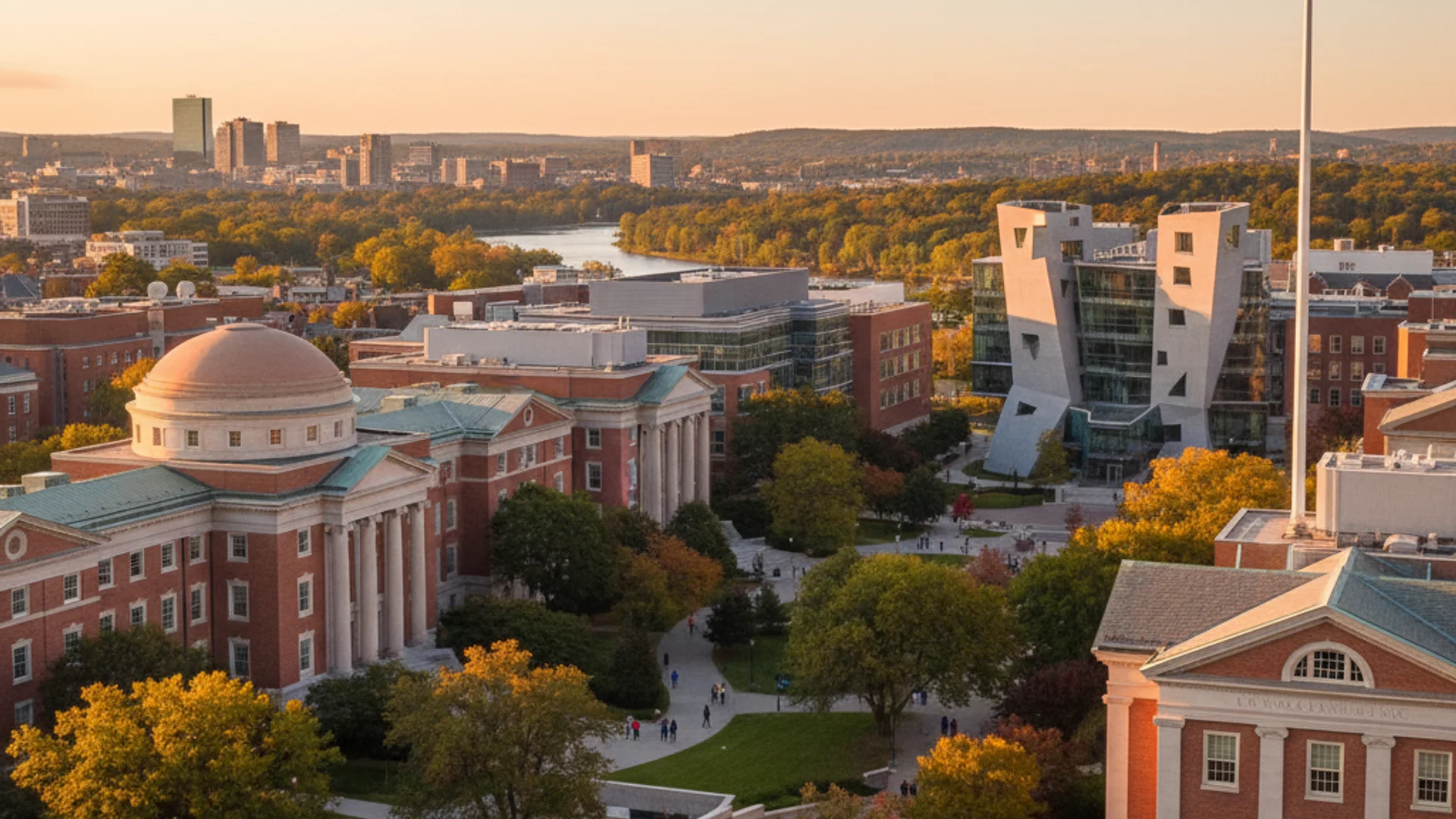
University campus in Massachusetts
Updated June 26, 2026

Best Information Technology Degree Programs in Massachusetts, 2026 Rankings

Compare the top information technology colleges in Massachusetts. 43 accredited information technology schools ranked by graduation rate, career outcomes, and value, from Bunker Hill Community College to Northeastern University.

#1 ProgramNortheastern
Avg Salary$128,640
Tuition From$576/yr
Job Growth+22%
On this page
Reviewed by Taylor Rupe, Founder & EditorSee methodology

16

Programs ranked

IPEDS 2024

$128,640

Massachusetts median information technology salary

BLS OEWS 2024

87.9/100

Top program score

Hakia methodology

13%

U.S. job growth (2023–33)

BLS projections

Key Takeaways

Best information technology degree programs: Northeastern, U of Massachusetts-Lowell, Wellesley College

Ranked by graduation rates, program outcomes, and institutional quality

IPEDS 2024

Tuition ranges from $576 to $66,410/year

Bunker Hill Community Col... offers the most affordable option at $576/yr

IPEDS 2024

Information Technology degree programs available: 16 associate's, 13 master's, 2 doctoral in Massachusetts

From community college pathways to advanced research degrees

IPEDS 2024

11 online information technology degree programs in Massachusetts

Flexible scheduling for working professionals

IPEDS 2024

Massachusetts community college transfer can save 40-60% on total degree costs

16 associate's programs provide transfer pathways to bachelor's degrees

Education Commission of the States

Major employers: Amazon, Google, HubSpot, Wayfair

Tech hubs in Boston and Cambridge

Hakia Research 2026

Information Technology degree programs near 75+ cities across Massachusetts

Search by city to find programs within 200 miles of your location

IPEDS 2024

Updated June 26, 2026

How we ranked Massachusetts Information Technology programs

We rank 55 accredited information technology programs in Massachusetts using IPEDS 2024 institutional data, BLS OEWS 2024 state salary data, and College Scorecard outcomes. A 4-factor weighted composite is normalized to a 0–100 score. Schools cannot pay for placement; rankings are produced algorithmically.

Program completions (35%)Graduation rate (25%)Selectivity (20%)Career outcomes (20%)
See full methodology
$128,640
Are Information Technology Degree Programs in Massachusetts Worth It?
Yes. The best information technology degree programs in Massachusetts deliver strong ROI, graduates earn $128,640 median salary with +22% job growth through 2032. In-state tuition averages $25,108/year.

Source: BLS OEWS May 2024

Information Technology Degree Rankings in Massachusetts

Compare the top-ranked Information Technology programs in Massachusetts by degree level. Tuition, graduation rate, and Hakia Score for every accredited program.

Best Associate's Information Technology Programs in Massachusetts

4
Programs ranked
$8,911
Avg tuition/yr
27%
Avg grad rate

Program Landscape

Massachusetts offers 16 accredited associate's degree programs in information technology, providing an affordable entry point into the technology field. The top-ranked programs include Bunker Hill Community Col..., Bristol Community College, Northern Essex Community ..., which combine rigorous technical curriculum with practical skills training.

Costs & Value

Community colleges in Massachusetts offer these two-year programs at an average cost of $5,623/yr, significantly less than four-year university tuition. Students completing associate's degrees can pursue entry-level technical positions and transfer opportunities, with entry-level salaries averaging $70,752 in Massachusetts.

Career Pathways

Many programs feature guaranteed transfer agreements with Massachusetts's public universities, allowing students to complete their first two years at reduced cost before transferring to complete a bachelor's degree. The Boston, Cambridge, Worcester areas offer particularly strong job markets for associate's degree holders, with employers like Amazon, Google, HubSpot hiring for technical support, junior development, and IT specialist positions.

Curriculum & Specializations

Programs typically include coursework in programming fundamentals, database management, networking basics, and software development. Among information technology schools in Massachusetts, these associate's programs offer the best value for students beginning their information technology degrees in Massachusetts.

Best Bachelor's Information Technology Programs in Massachusetts

5
Programs ranked
$27,801
Avg tuition/yr
58%
Avg grad rate

Program Landscape

Massachusetts ranks among the nation's top destinations for information technology education, with 24 accredited bachelor's degree programs across 9 public and 15 private institutions. The highest-ranked programs are Northeastern, U of Massachusetts-Lowell, Wellesley College, recognized for academic excellence, research opportunities, and strong industry connections.

Career Outcomes

Graduates from Massachusetts information technology programs earn a median salary of $109,344, 11% above the national average. The state's robust technology sector, anchored by the Boston, Cambridge, Worcester metropolitan areas, provides abundant internship and employment opportunities with companies including Amazon, Google, HubSpot.

Costs & Value

Tuition ranges from $910 to $66,410 annually, with an average of $32,261/yr. Top programs maintain graduation rates above 91%, with the highest reaching 100%. Many programs hold ABET accreditation, the gold standard for computing education, ensuring curriculum meets rigorous industry standards.

Curriculum & Specializations

Students can choose from specializations including software engineering, cybersecurity, artificial intelligence, data science, and systems architecture. Strong industry partnerships provide access to co-op programs, capstone projects with real companies, and direct recruiting pipelines to Massachusetts's leading technology employers. For students seeking information technology degrees in Massachusetts, these top-ranked information technology schools offer the strongest combination of academic rigor and career preparation.

🥇
Simmons University
Boston, MAPrivate nonprofit
$45,534
Tuition/yr
72%
Grad rate
82.0
Hakia Score
#4
Lasell University
Newton, MAPrivate nonprofit
$27,040
Tuition/yr
59%
Grad rate
70.0
Hakia Score

Best Master's Information Technology Programs in Massachusetts

7
Programs ranked
$42,808
Avg tuition/yr
74%
Avg grad rate

Program Landscape

Massachusetts offers 13 master's degree programs in information technology, designed for professionals seeking to advance into senior engineering, technical leadership, and specialized roles. The top programs, Northeastern, Clark, Boston, combine advanced technical training with research opportunities and leadership development.

Career Outcomes

Master's graduates in Massachusetts earn a median salary of $128,640, approximately 20-30% higher than bachelor's degree holders. The concentration of technology companies in Boston, Cambridge, Worcester creates strong demand for graduate-level talent, with Amazon, Google, HubSpot actively recruiting from these programs.

Costs & Value

Program formats include traditional full-time study (typically 2 years), part-time options for working professionals (2-3 years), and accelerated tracks. Tuition averages $45,414/yr, with many employers offering tuition reimbursement for graduate education. Some programs offer thesis and non-thesis tracks, allowing students to focus on research or professional development based on their career goals.

Curriculum & Specializations

Curriculum covers advanced topics including machine learning, distributed systems, software architecture, and technical management. Many programs include practicum experiences, industry capstone projects, or consulting engagements that provide real-world application of advanced concepts. Among Massachusetts's information technology schools at the graduate level, these programs stand out for both academic quality and career outcomes.

🥇
Clark University
Worcester, MAPrivate nonprofit
$57,440
Tuition/yr
77%
Grad rate
87.9
Hakia Score
🥈
Bentley University
Waltham, MAPrivate nonprofit
$61,000
Tuition/yr
87%
Grad rate
85.4
Hakia Score
#4
Endicott College
Beverly, MAPrivate nonprofit
$39,750
Tuition/yr
76%
Grad rate
78.9
Hakia Score
Show all 7 ranked programs
RankSchoolLocationTypeTuitionGrad RateHakia Score
#6University of Massachusetts-BostonBoston, MAPublic$15,27849%69.2
#7Northeastern University Professional ProgramsBoston, MAPrivate nonprofit$50,24360.4

Information Technology Degree Costs & Tuition in Massachusetts

MetricValue
Average in-state tuition$25,108/year
Average out-of-state tuition$62,770/year
Community college tuition$6,277/year
4-year savings for residents$150,648
2+2 transfer pathway savings$37,662

Source: IPEDS 2024

Financial Aid & Scholarships for Information Technology Students in Massachusetts

State Aid Programs

Massachusetts offers the MASSGrant Plus program providing need-based aid up to $17,500 annually for students attending state universities and community colleges. The John and Abigail Adams Scholarship covers full tuition for high-achieving Massachusetts residents attending state universities. Federal aid including Pell Grants, subsidized loans, and work-study programs supplement state funding, with IT students often qualifying for additional STEM-focused scholarships.

Key Programs & Amounts

Private foundations and tech companies provide targeted scholarships for Massachusetts IT students, including programs specifically for underrepresented groups in technology. The MassTech Intern Partnership offers indirect financial support through paid internships, with companies receiving up to $3,200 in reimbursement per intern (MassTech Intern Partnership). Community college students can access additional support through the Massachusetts Community College Transfer Scholarship program.

Institutional Scholarships

Students should complete the FAFSA early to maximize aid eligibility, with Massachusetts institutions offering substantial institutional grants and merit scholarships. Work-study opportunities in campus IT departments provide both financial support and relevant experience. Detailed information about aid application processes and deadlines is available through our financial aid guide which covers federal, state, and institutional funding sources.

Information Technology Degree ROI Calculator, Massachusetts

Use our interactive ROI calculator to estimate your return on investment for a information technology degree in Massachusetts. Enter your expected tuition costs, financial aid, and career goals to see projected payback periods and lifetime earnings. The calculator uses current salary data from BLS and tuition data from IPEDS to provide accurate estimates.

Information Technology Degree ROI Calculator

Estimate your return on investment for a information technology degree

Leave blank to use average cost for selected program type

20 years
10 years20 years30 years
20-Year ROI

+848%

Net gain divided by total investment. ROI above 200% is considered excellent for education investments.

Net Gain

$1,568,849

Your additional lifetime earnings with this degree vs. working without one, minus the total investment.

Break-Even

5 years

Years until your cumulative earnings exceed total investment. Shorter programs often break even faster due to lower opportunity cost.

COL-Adjusted Salary

$87,097

Your starting salary adjusted for local cost of living. This shows real purchasing power compared to a $100K national baseline.

Why does break-even change with program type? Your "total investment" includes both tuition AND opportunity cost (foregone earnings while in school). A 4-year full-time public university (in-state) means 4 years of not earning a salary ($140,000 in opportunity cost). Shorter full-time programs may have higher tuition but lower total investment because you return to the workforce sooner.

Detailed Breakdown

How we calculate your degree ROI using real salary data

Total Investment$185,000

Tuition plus opportunity cost (earnings you miss while in school)

Program Cost (Tuition)$45,000

Direct cost of the degree program

Opportunity Cost$140,000

4 years × $35K/year foregone salary while studying full-time

20-Year Earnings (with degree)$2,604,257

Projected career earnings starting after graduation, with salary growth

20-Year Earnings (without degree)$850,408

What you'd earn working at $35K/year with 2% annual growth

Starting Salary (Boston, MA)$135,000

Median salary for this role in your selected location (BLS 2024)

Annualized Return4.7%

Your investment's compound annual growth rate (similar to stock market returns)

Data sources: BLS OEWS May 2024, IPEDS 2024. Calculations use median salaries, 3% discount rate, and assume salary growth declines from 6% to 2% over career. Individual results will vary. | Powered by Hakia.com

Information Technology Salaries by Metro Area

Median annual salary in Massachusetts metro areas

Boston$142K
Cambridge$135K
Worcester$129K
View data table
CategoryValue
Boston$142K
Cambridge$135K
Worcester$129K

Source: BLS OEWS May 2024

Hakia.com

Top Employers Hiring Information Technology Graduates in Massachusetts

Find information technology jobs in Massachusetts. These major employers across Massachusetts metro areas are actively hiring information technology degree holders. Click employer names to view current job openings.

Information Technology Jobs in Boston/Cambridge

MA

Boston/Cambridge is a biotech and AI research hub, anchored by MIT, Harvard, and major tech company R&D centers.

Nearby cities: Cambridge, Somerville, Waltham, Burlington, Quincy

Google
Search/Cloud/AI
Amazon
E-commerce/Cloud/Robotics
Microsoft
Enterprise Software
Meta
Social/VR/AI
HubSpot
Marketing Software
Wayfair
E-commerce
Toast
Restaurant Tech
DraftKings
Sports Tech
Akamai
CDN/Cloud Security

Transfer Pathways for Information Technology Degrees in Massachusetts

State Transfer System

Massachusetts community colleges maintain formal transfer agreements with state universities through the Commonwealth Transfer Compact, guaranteeing junior-level admission for students completing associate degrees with satisfactory grades. The MassTransfer program ensures seamless credit transfer for general education requirements, while individual institutions negotiate specific articulation agreements for IT and computer science coursework. Students can complete foundational programming, mathematics, and science requirements at community colleges before transferring to four-year programs.

How Transfers Work

Private universities including Northeastern University and Boston University actively recruit community college graduates through bridge programs and transfer scholarships. The state's proximity enables students to research multiple institutions efficiently, comparing programs and costs before making transfer decisions. Students can explore most affordable programs information technology to identify cost-effective pathways that combine community college preparation with university specialization.

Why Pursue an Information Technology Degree in Massachusetts?

Industry & Workforce

Massachusetts leads the nation in artificial intelligence development and tech innovation, with the Bay Area being the only region that surpasses Boston's concentration of AI-related job postings (Brookings AI Economy Mapping). The state's tech sector shows remarkable growth in software development, quality assurance, and testing roles, with employment projections indicating sustained expansion through 2032 (U.S. Bureau of Labor Statistics Software Developers). Boston-area tech professionals earn significantly above the national average, making Massachusetts one of the highest-paying states for IT professionals.

Salary Outlook

The state's proximity to universities like MIT and Harvard creates a unique ecosystem where academic research directly feeds into commercial innovation. Cambridge alone hosts 25 major employers spanning biotechnology, artificial intelligence, and software development, providing students with unprecedented access to internships and full-time opportunities. Massachusetts companies receive state support through programs like the MassTech Intern Partnership, which reimburses employers up to $3,200 per intern annually, creating more opportunities for students.

Regional Tech Hubs

Your career prospects expand significantly with Massachusetts's focus on emerging technologies including quantum computing, robotics, and cybersecurity. Students can explore specialized paths through cybersecurity in massachusetts programs or broader information technology studies. The state's tech talent pipeline extends beyond traditional software development, offering opportunities in cloud computing in massachusetts and network infrastructure management.

15%
Information Technology Job Growth in Massachusetts
The Bureau of Labor Statistics projects 15% growth for information technology occupations in Massachusetts through 2024-2034. The median salary stands at $128,640 with 43 accredited programs statewide.

Source: BLS Occupational Outlook

Information Technology Job Market & Salary Data in Massachusetts

Employment Outlook

Software developers, quality assurance analysts, and testers represent the fastest-growing IT occupations in Massachusetts, with employment growth projected to exceed the national average through 2032 (U.S. Bureau of Labor Statistics Software Developers). The Boston metropolitan area posts thousands of AI-related job openings annually, with the region ranking among the top five nationally for artificial intelligence employment concentration. Massachusetts companies actively seek talent in cybersecurity, digital health, fintech, and microelectronics sectors.

Salaries by Metro

Cambridge's tech corridor features companies ranging from established enterprises to funded startups, with the city's Top 25 employers list including multiple technology firms spanning various IT specializations (Cambridge Top 25 Employers). Boston-area salaries for software developers and IT specialists consistently rank in the top 10 nationally, with senior-level positions commanding premium compensation packages. Entry-level IT professionals in Massachusetts earn starting salaries 15-25% above the national average.

High-Growth Sectors

Remote work opportunities have expanded significantly, with Massachusetts companies offering hybrid arrangements that combine Boston-area collaboration with flexible work options. The state's focus on quantum technology, robotics, and semiconductors creates specialized career paths for IT graduates. Students can prepare for these emerging opportunities through data scientist training or traditional software developer programs that emphasize advanced technologies.

Entry-Level (0-2 yrs)

New graduates and career changers

Senior (8+ yrs)

Technical leads and architects

Median Salary in Massachusetts$83,616$186,528
Typical RolesJunior Developer, AnalystStaff Engineer, Architect
Remote Work AccessLimitedCommon
Degree ExpectationBachelor's sufficientMaster's preferred

Online vs On-Campus Information Technology Programs in Massachusetts

Online Programs

11 available in Massachusetts

On-Campus Programs

Traditional classroom experience

Typical Tuition$22,597/yr$25,108/yr
Schedule FlexibilitySelf-paced or asyncFixed schedule
NetworkingVirtual cohortsIn-person, career fairs
Best ForWorking professionalsTraditional students
Completion Time2-4 years (flexible)4 years (standard)

Compare Information Technology Programs in Other States

Information Technology Degree Programs in Massachusetts: FAQ

What are the best information technology degree programs in Massachusetts?
The best information technology degree programs in Massachusetts based on our methodology are: 1) Northeastern University (highly ranked), 2) University of Massachusetts-Lowell, and 3) Wellesley College. Our rankings weight graduation rates (25%), program completions (35%), selectivity (20%), and career outcomes (20%). Massachusetts offers 43 total accredited programs across 22 public and 21 private institutions. See our complete rankings for all 24 bachelor's programs.
How much do information technology degree programs cost in Massachusetts?
Information Technology degree program costs in Massachusetts vary significantly by institution type. In-state public tuition averages $25,108/year, while private institutions average $55,238/year. Community colleges offer the most affordable path at approximately $6,277/year for associate's degrees. The total 4-year cost ranges from $100,432 at public schools to $220,950 at private institutions before financial aid. Most students don't pay full sticker price, federal grants, state aid, and institutional scholarships can reduce costs by 30-60%.
What salary can information technology degree graduates earn in Massachusetts?
Information Technology professionals in Massachusetts earn a median salary of $128,640, which is 11% above the national average of $115,500. Entry-level positions typically start around $83,616, while senior roles exceed $186,528. Salaries vary by metro area: Boston ($141,504), Cambridge ($135,072) offer the highest compensation. Specialized roles like AI/ML engineers and cloud architects command premiums of 15-30% above median.
Are there online information technology degree programs in Massachusetts?
Yes, Massachusetts offers 11 accredited online Information Technology programs from state institutions. These programs award the same degree as on-campus options and include synchronous and asynchronous formats. Top-ranked online programs include offerings from Bristol Community College and University of Massachusetts-Dartmouth. Online programs typically cost the same as on-campus tuition for in-state students. Many programs offer flexible scheduling for working professionals, with some offering accelerated completion in 2-3 years. Ensure any online program holds regional accreditation and ideally ABET accreditation for engineering programs.
What companies hire information technology degree graduates in Massachusetts?
Major Information Technology employers in Massachusetts include Amazon, Google, HubSpot, Wayfair, Toast. The Boston and Cambridge metro areas serve as primary tech hubs with thousands of open positions. Top employers maintain recruiting pipelines directly from Massachusetts universities, with many offering internship-to-hire programs. Beyond tech giants, opportunities exist in healthcare IT, financial services, defense contractors, and growing startups. Massachusetts's tech sector shows +22% projected job growth through 2033, outpacing most other industries.
Is an information technology degree program worth it in Massachusetts?
An information technology degree program in Massachusetts offers strong ROI with a $128,640 median salary and +22% projected job growth. At average in-state tuition of $25,108/year, graduates typically recoup their educational investment within 3-5 years. The degree opens doors to high-paying careers in software development ($145,363), data science, cybersecurity, and AI/ML. Beyond salary, benefits include job security, remote work flexibility, and clear advancement paths. Alternative paths like bootcamps exist for career changers, but bachelor's degrees provide broader career options and higher lifetime earnings.
How long do information technology degree programs take in Massachusetts?
Standard completion times for information technology degree programs in Massachusetts are: Associate's (2 years, 60 credits), Bachelor's (4 years, 120 credits), and Master's (1-2 years, 30-36 credits). However, actual timelines vary based on course load, transfer credits, and program format. Accelerated programs can compress a bachelor's to 3 years or a master's to 12 months. Part-time students typically need 5-6 years for a bachelor's degree. Massachusetts community colleges offer a cost-effective "2+2" path: complete your associate's in 2 years, then transfer to a Massachusetts university for the final 2 years of a bachelor's program.
What financial aid is available for information technology degree students in Massachusetts?
Massachusetts information technology degree students can access multiple financial aid sources. Federal aid includes Pell Grants (up to $7,395/year for qualifying students) and federal student loans. Massachusetts state grants provide additional support for residents attending in-state schools. Institutional scholarships from universities can significantly reduce costs, many schools offer merit-based awards for STEM students. Work-study programs and teaching/research assistantships (especially for graduate students) provide income while building experience. Complete the FAFSA by Massachusetts's priority deadline to maximize aid eligibility. Some employers also offer tuition reimbursement for employees pursuing CS degrees.

Data Sources

Institutional characteristics, completions, graduation rates

Massachusetts salary and employment data

Official University Websites

Program details and admissions information

Last Updated: June 26, 2026. Rankings based on IPEDS 2024 data. Salary data from BLS OEWS May 2024.

Was this ranking helpful for your college search?
Taylor Rupe

Taylor Rupe

Co-founder & Editor (B.S. Computer Science, Oregon State • B.A. Psychology, University of Washington)

Taylor combines technical expertise in computer science with a deep understanding of human behavior and learning. His dual background drives Hakia's mission: leveraging technology to build authoritative educational resources that help people make better decisions about their academic and career paths.

Information Technology Degree Programs in Massachusetts, Detailed School Profiles

Best Associate's Information Technology Degree Programs in Massachusetts

Bunker Hill Community College, Boston, MA

Hakia Insight: Bunker Hill's IT labs run current enterprise equipment and software maintained through Boston-area healthcare and financial services partnerships, meaning students practice on the exact same infrastructure they'll manage post-graduation rather than outdated textbook systems.

At the associate's level, you'll get hands-on experience in Bunker Hill's IT labs with current equipment and software that employers actually use—the college maintains strong partnerships with Boston-area tech companies that actively recruit graduates. The program balances foundational computer science with practical networking and systems administration skills, positioning you well for immediate employment or transfer to UMass Boston and Northeastern University's bridge programs. Many students complete their associate degree, land help desk or junior sysadmin roles, and then leverage tuition assistance from employers to finish a bachelor's degree. The Boston location means internship opportunities and networking with professionals in a major tech hub.

Programs Offered
  • Associate of Science in Information Technology, 2 years, on-campus
  • Associate of Applied Science in Information Technology, 2 years, online
Career Outcomes

Top Employers: New England medical institutions, Boston-area financial services, Healthcare IT vendors, Local government IT departments.

Top Transfer Destinations
  • UMass Boston
  • Northeastern University
  • University of Massachusetts Amherst
  • Worcester Polytechnic Institute
Entry-Level Career Paths
  • Help Desk Technician
  • IT Support Specialist
  • Junior Systems Administrator
  • Technical Support Associate
  • Field Service Technician
Included Certifications
  • CompTIA A+
  • CompTIA Network+
  • Microsoft Azure Fundamentals

Location Advantages:

Roxbury Community College, Roxbury Crossing, MA

Key Distinction: RCC's IST program combines comprehensive technical training with guaranteed transferability to four-year institutions, featuring specific articulation agreements with Northeastern University and Wentworth Institute of Technology.

Hakia Insight: RCC's articulation agreements with Northeastern and Wentworth aren't just transfer pathways; they're pre-negotiated curriculum alignments that let associate degree holders complete bachelor's degrees in three semesters rather than the typical two years.

At the associate's level, roxbury Community College's Information Systems Technology program offers an Associate of Science degree designed to develop essential IT skills for today's professional environment. The comprehensive curriculum covers programming languages including Visual Basic and Java, database management, network fundamentals, Linux operating systems, web design, and microcomputer applications. Students gain hands-on experience through internships and work with department advisors to create personalized semester-by-semester schedules. The program prepares graduates for diverse career opportunities including computer operator, help desk support specialist, programmer, analyst, PC support technician, and network support technician. All credits are fully transferable to UMass Boston and other universities, with specific transfer agreements established with Northeastern University and Wentworth Institute of Technology for seamless bachelor's degree completion.

Programs Offered
  • Associate of Science in Information Technology, 2 years, on-campus
  • Associate of Applied Science in Information Technology, 2 years, online
Notable Faculty
  • Nomose Agho, Desktop Technology and Systems
  • Pierre Edmond, Information Systems Technology
  • Ntohm Izuchi, Information Systems Technology

Location Advantages: Located in Boston with access to major tech employersTransfer agreements with prestigious local institutions like Northeastern University

Holyoke Community College, Holyoke, MA

Key Distinction: HCC's IT program combines technical expertise with management fundamentals, uniquely positioning graduates for leadership roles in technology organizations while maintaining the accessibility and affordability of community college education.

Hakia Insight: While most community college IT programs focus purely on technical certifications, Holyoke's integration of management fundamentals into the curriculum creates an unusual pipeline—graduates can move directly into junior IT management roles rather than competing for entry-level tech positions.

At the associate's level, if you're considering a two-year plan that keeps costs low while building real IT skills, Holyoke's program delivers solid CompTIA preparation and networking fundamentals in a supportive environment—many instructors are working professionals who understand what employers expect on day one. The college works closely with Western Massachusetts tech employers and has articulation agreements with major state universities, so your credits transfer cleanly and employers recognize the degree. You'll graduate job-ready for help desk or junior technical support roles, with a clear pathway to advance into systems administration or network management after gaining experience. The Pioneer Valley location offers growing tech job markets in healthcare, education, and manufacturing.

Programs Offered
  • Associate of Science in Information Technology, 2 years, on-campus
  • Associate of Applied Science in Information Technology, 2 years, online
Top Transfer Destinations
  • University of Massachusetts Amherst
  • Fitchburg State University
  • Springfield College
  • UMass Boston
Entry-Level Career Paths
  • Help Desk Technician
  • IT Support Specialist
  • Desktop Support Technician
  • Computer Support Associate
  • Technical Support Specialist
Included Certifications
  • CompTIA A+
  • CompTIA Network+
  • Microsoft Azure Fundamentals

Location Advantages: Part of Hispanic Serving InstitutionAccess to comprehensive student support services including tutoring and academic support

Best Bachelor's Information Technology Degree Programs in Massachusetts

University of Massachusetts-Boston, Boston, MA

Key Distinction: The program uniquely combines technical expertise with business acumen through a joint offering between the College of Management and Computer Science Department, featuring four industry-ready specialization tracks and extensive real-world project collaboration with industry partners.

Hakia Insight: UMass Boston's joint College of Management and Computer Science degree structure embeds business context into technical coursework from day one, creating graduates who understand how IT spending connects to organizational strategy—a perspective most pure CS programs delay until senior electives or grad school.

At the bachelor's level, UMass Boston's Information Technology program offers both BS and MS degrees through a unique collaboration between the College of Management and Computer Science Department. The BS program features four specialized tracks (system administration, information architecture, business intelligence, computer forensics) with nearly 100 electives for customization. Students engage in hands-on, experiential learning with real-world IT projects and industry partnerships. The program emphasizes building adaptable thinkers with strong technical and business foundations, preparing graduates for emerging technologies. With a 96% employment placement rate and starting salaries averaging competitive levels across Massachusetts, graduates pursue diverse roles from system administrators to CIOs. The MS program combines advanced technical knowledge in software development, data analytics, and cybersecurity with business management principles, preparing students for IT leadership roles.

Programs Offered
  • Bachelor of Science in Information Technology, 4 years, on-campus
  • Bachelor of Arts in Information Technology, 4 years, online
Research Labs and Institutes
  • Adaptive Computer Lab
  • Graduate Research Center
Industry Partners
  • Ahead LLC (corporate)
Admissions

GPA Requirement: 2.50. Application Deadline: June 15 for fall, December 1 for spring (MS program).

Requirements: At least 24 college credits with 12 earned at UMass Boston, No incomplete grades for College of Management entry

Location Advantages: Access to Massachusetts IT job marketBoston technology ecosystem

Northeastern University Professional Programs, Boston, MA

Key Distinction: Northeastern's professional programs deliver graduate-level IT training in formats (evening, online, hybrid) built for employed professionals, with cohort-based learning and real industry capstones.

Hakia Insight: Northeastern's professional programs compress graduate-level IT rigor into evening and online formats specifically architected for working adults—meaning career changers gain credentials equivalent to full-time peers without sacrificing income, a model most universities reserve for extension programs.

At the bachelor's level, northeastern's professional IT programs are specifically designed for working adults and career changers, delivered through evening, weekend, and online formats that respect the reality of full-time employment. The graduate-level curriculum—including an MS in Information Systems, MS in Project Management, and specialized certificates in cybersecurity, data analytics, and software engineering—attracts professionals pivoting from other fields or seeking to deepen expertise in emerging domains. Unlike traditional computer science programs, these pathways emphasize applied problem-solving: students work on real capstone projects with industry partners, analyze actual datasets, and design solutions for genuine organizational challenges. Faculty bring current industry roles alongside academic appointments, ensuring curriculum stays synchronized with what hiring managers are looking for today. Northeastern's global co-op network extends to professional programs, meaning graduate students can negotiate experiential components with employers. The programs excel at producing IT leaders and specialists mid-career: project managers transitioning into technical leadership, data professionals entering cybersecurity, engineers moving into architecture roles. Cohort-based learning is standard, building peer networks that often become long-term professional communities. Enrollment flexibility and the school's brand recognition in the Northeast make these programs particularly attractive to professionals seeking credentials without career interruption.

Programs Offered
  • Bachelor of Science in Information Technology, 4 years, on-campus
  • Bachelor of Arts in Information Technology, 4 years, online

Location Advantages: Strong employment pipeline with Boston-area corporationsAlumni network in Northeast technology sector

Best Master's Information Technology Degree Programs in Massachusetts

Clark University, Worcester, MA

Key Distinction: Clark's IT program distinguishes itself through interdisciplinary flexibility and close faculty-student collaboration, enabling students to apply computing skills across business, science, and social impact domains rather than following rigid career tracks.

Hakia Insight: Clark's strength isn't breadth for its own sake; employers like J.P. Morgan and UMass Chan Medical School hire from here because small cohorts and close faculty collaboration mean students can architect capstones around specific industries (finance, healthcare, social impact) rather than generic applications.

At the master's level, clark University's information technology initiatives blend computer science theory with interdisciplinary applications, reflecting the institution's strength in connecting technical depth to real-world problem-solving across business, science, and social domains. Students engage with modern software development practices, data systems, and computational thinking through a curriculum that encourages exploration of IT's role in fields ranging from environmental science to business analytics. The program benefits from Clark's collaborative research culture and relatively small class sizes, enabling close faculty mentorship and opportunities to participate in applied projects that often involve external partners or community-engaged learning. Rather than narrowly tracking students into pre-defined specializations, the program allows flexibility to combine core IT competencies with electives in areas like data analysis, web development, or systems design depending on individual interests. Faculty members actively involve students in research and practical projects, fostering an environment where undergraduates can develop both technical and critical-thinking skills. For students who want rigorous computer science foundations but also value the ability to apply technology across multiple disciplines and work closely with faculty, Clark's approach offers a distinctive balance between academic depth and practical versatility.

Programs Offered
  • Master of Science in Information Technology, 1-2 years, on-campus
  • Master of Arts in Information Technology, 1-2 years, online
Career Outcomes

Top Employers: J.P. Morgan Wealth Management, Brandeis University Endowment, BlueHub Capital, UMass Chan Medical School, Max (formerly HBO Max).

Location Advantages: Located in Worcester, Massachusetts, part of the New England technology corridorAccess to Boston-area tech companies and startup ecosystem

Bentley University, Waltham, MA

Key Distinction: Bentley's IT programs uniquely combine deep technical knowledge with business expertise, regularly adapting curriculum based on direct employer feedback to ensure graduates meet current industry demands.

Hakia Insight: Bentley's median salary of $72,000 appears modest until you account for the program's obsession with employer feedback loops; curriculum evolves based on direct partnership signals from Google, Amazon, and Deloitte, meaning each cohort learns technologies those companies will actually pay for in 18 months, not two years ago.

At the master's level, bentley University offers comprehensive Information Technology programs that blend business acumen with technical expertise. The Master of Science in Information Technology (MSIT) program is designed to meet current employer needs while remaining flexible for individual interests. The curriculum emphasizes deep understanding of IT beyond single platforms, excellent communication skills, and agile development. The program includes courses like Data Management Architectures, Web-Based Application Development, Mobile Application Development, and Business Intelligence Methods & Technologies. Bentley also offers an Information Technology in Accounting undergraduate major with a 99% job placement rate and $72K median starting salary. The STEM MBA includes technology-focused concentrations in Accounting Analytics, Artificial Intelligence, Business Analytics, and Financial Analytics. Programs feature industry partnerships, hands-on learning experiences, and faculty who regularly engage with employers to ensure curriculum relevance.

Programs Offered
  • Master of Science in Information Technology, 1-2 years, on-campus
  • Master of Arts in Information Technology, 1-2 years, online
Research Labs and Institutes
  • CIS Sandbox
  • User Experience Center
Industry Partners
  • Meta (corporate)
  • KPMG (corporate)
  • Alteryx (corporate)
  • SAP (corporate)
Career Outcomes

Median Salary: $72,000. Top Employers: Google, Amazon.com, Deloitte, Tesla, Facebook, Liberty Mutual Insurance, Fidelity.

Notable Faculty
  • Wendy Lucas, Information Technology
  • Kerri-Ann Sanderson, Accounting
Admissions

Acceptance Rate: not specified%. GPA Requirement: not specified. Application Deadline: not specified.

Requirements:

Accreditations and Certifications
  • AACSB International separate accountancy accreditation
  • STEM-designated

Location Advantages: Access to tech sector job opportunities across all industriesStrong alumni network from Silicon Valley to Boston

Worcester Polytechnic Institute, Worcester, MA

Key Distinction: WPI's IT program uniquely combines world-class technology expertise from a premier STEM university with comprehensive business and analytics training, featuring a new AI specialty concentration and reduced tuition making it more affordable than ever.

Hakia Insight: WPI's new AI specialty concentration and reduced tuition arrive at a moment when most programs are hiking prices to fund AI labs—here, students gain cutting-edge focus without premium costs, while Elke Rundensteiner's data science research provides lab pathways that turn classroom theory into publishable work.

Worcester Polytechnic Institute's Information Technology program combines technology expertise with business acumen through The WPI Business School. The Master's in Information Technology (MS IT) is a comprehensive 33-credit program that prepares students to become IT leaders who can leverage existing and emerging technology tools for business applications. The program features a cutting-edge AI specialty concentration where students learn to develop and deploy AI-based IT solutions. Core courses include Policy and Strategy for IT and Analytics, Business Intelligence, and Data Management for Analytics. The program emphasizes hands-on, project-based learning and is offered both on-campus and online for full-time and part-time students. WPI has reduced tuition for graduate business programs making this premier STEM business degree more affordable. Students also have access to an undergraduate Information Systems and Technologies degree and graduate certificate options.

Programs Offered
  • Master of Science in Information Technology, 1-2 years, on-campus
  • Master of Arts in Information Technology, 1-2 years, online
Research Labs and Institutes
  • Efficient Learning for Planning and Intelligent Systems (ELPIS) Lab
Notable Faculty
  • Elke Rundensteiner, Data Science, Computer Science
  • Berk Calli, Robotics Engineering, robotic manipulation
  • Constantinos Chamzas, Robotics Engineering, autonomous systems
Accreditations and Certifications
  • STEM Certified

Location Advantages:

University of Massachusetts-Lowell, Lowell, MA

Key Distinction: UMass Lowell's mandatory cooperative education model embeds 6+ months of paid industry experience into every degree pathway, creating graduates with portfolio-ready systems engineering expertise before they leave campus.

Hakia Insight: UMass Lowell's mandatory co-op model produces systems engineers with portfolio-ready work before graduation, and the Cybersecurity Research Lab means those 6+ months aren't routine deployments—they're embedded in firms like Raytheon where students touch infrastructure that requires publication-level rigor.

At the master's level, UMass Lowell's computer science and information technology programs are built on a cooperative education model that distinguishes them in New England—students alternate semesters between classroom work and paid industry placements, giving them 6+ months of real-world experience before graduation. This isn't an internship add-on; it's core to the curriculum. The program emphasizes practical systems design, cybersecurity, and software engineering through a blend of theory and applied projects. Faculty maintain active research programs in areas like mobile computing, cloud systems, and data science, and they regularly bring industry challenges into the classroom. Graduates enter positions at companies like Google, Microsoft, and Raytheon with a resume that already lists substantial professional accomplishments. The UMass Lowell location in the Merrimack Valley positions students near Boston's tech ecosystem while maintaining closer ties to regional manufacturing and defense contractors who value the program's applied orientation.

Programs Offered
  • Master of Science in Information Technology, 1-2 years, on-campus
  • Master of Arts in Information Technology, 1-2 years, online
Research Labs and Institutes
  • Cybersecurity Research Lab
  • UMass Lowell Innovation Hub
Industry Partners
  • Raytheon Technologies (corporate)
  • Google (corporate)
  • Microsoft (corporate)
  • Eaton Corporation (corporate)
Notable Faculty
  • Rajmohan Rajagopal, Cybersecurity and network protocols
  • Peiyi Ren, Cloud computing and distributed systems
Accreditations and Certifications
  • ABET accredited

Location Advantages: Proximity to Boston tech corridorNear Merrimack Valley manufacturing and defense contractorsAccess to regional tech talent networks

University of Massachusetts-Boston, Boston, MA

Key Distinction: The program uniquely combines technical expertise with business acumen through a joint offering between the College of Management and Computer Science Department, featuring four industry-ready specialization tracks and extensive real-world project collaboration with industry partners.

Hakia Insight: UMass Boston's joint College of Management and Computer Science structure isn't administrative convenience—it means every IT student builds business acumen alongside technical depth, and the four specialization tracks let career changers target finance, healthcare, or operations without switching programs.

At the master's level, UMass Boston's Information Technology program offers both BS and MS degrees through a unique collaboration between the College of Management and Computer Science Department. The BS program features four specialized tracks (system administration, information architecture, business intelligence, computer forensics) with nearly 100 electives for customization. Students engage in hands-on, experiential learning with real-world IT projects and industry partnerships. The program emphasizes building adaptable thinkers with strong technical and business foundations, preparing graduates for emerging technologies. With a 96% employment placement rate and starting salaries averaging competitive levels across Massachusetts, graduates pursue diverse roles from system administrators to CIOs. The MS program combines advanced technical knowledge in software development, data analytics, and cybersecurity with business management principles, preparing students for IT leadership roles.

Programs Offered
  • Master of Science in Information Technology, 1-2 years, on-campus
  • Master of Arts in Information Technology, 1-2 years, online
Research Labs and Institutes
  • Adaptive Computer Lab
  • Graduate Research Center
Industry Partners
  • Ahead LLC (corporate)
Admissions

GPA Requirement: 2.50. Application Deadline: June 15 for fall, December 1 for spring (MS program).

Requirements: At least 24 college credits with 12 earned at UMass Boston, No incomplete grades for College of Management entry

Location Advantages: Access to Massachusetts IT job marketBoston technology ecosystem