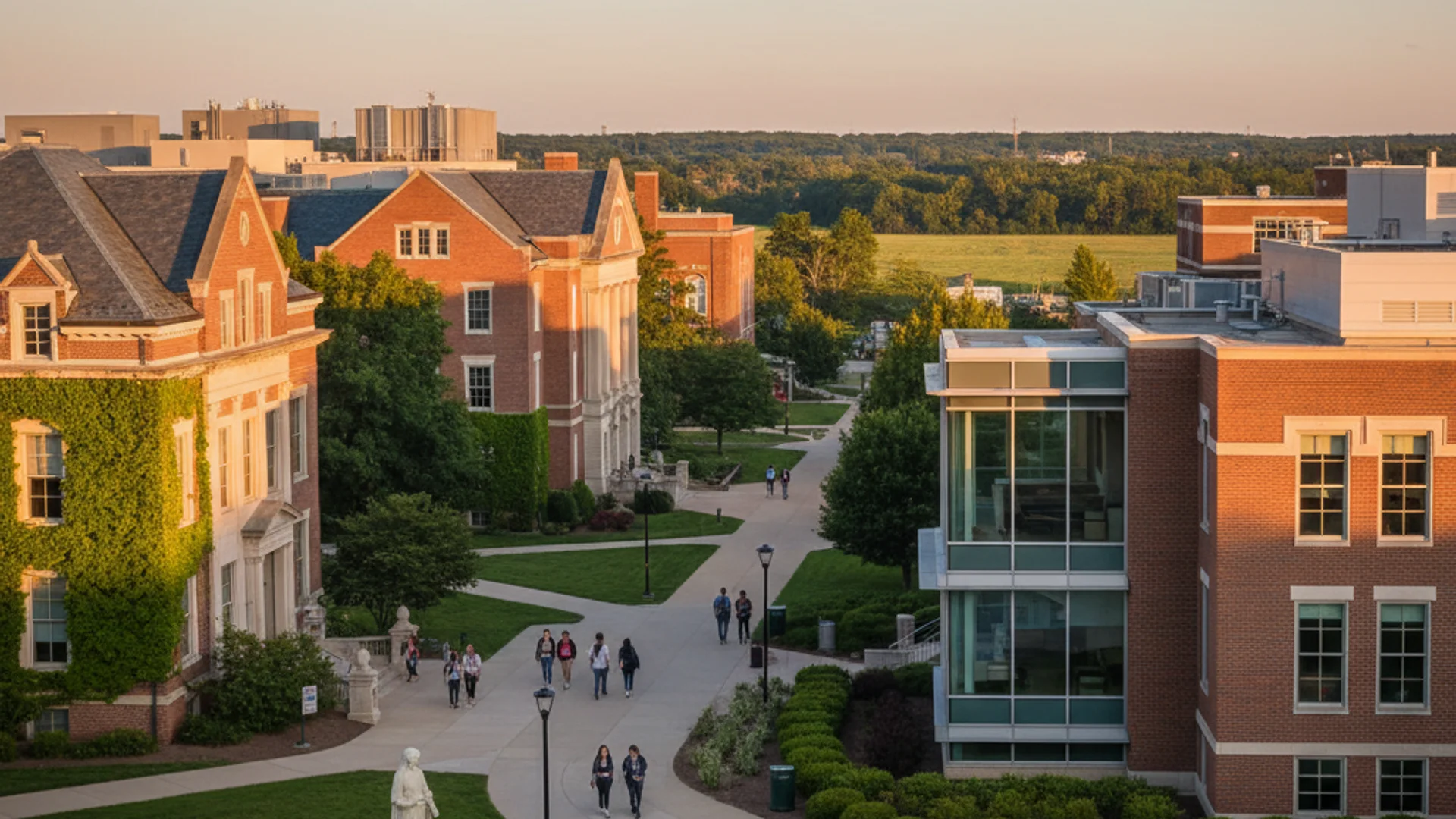
University campus in Illinois
Updated July 13, 2026

Best Information Technology Degree Programs in Illinois, 2026 Rankings

Compare the top information technology colleges in Illinois. 51 accredited information technology schools ranked by graduation rate, career outcomes, and value, from Southwestern Illinois College to Northwestern University.

#1 ProgramNorthwestern
Avg Salary$113,200
Tuition From$6,120/yr
Job Growth+22%
On this page
Reviewed by Taylor Rupe, Founder & EditorSee methodology

28

Programs ranked

IPEDS 2024

$113,200

Illinois median information technology salary

BLS OEWS 2024

88/100

Top program score

Hakia methodology

13%

U.S. job growth (2023–33)

BLS projections

Key Takeaways

Best information technology degree programs: Northwestern, U of Illinois Urbana-Cham..., DeVry University-Illinois

Ranked by graduation rates, program outcomes, and institutional quality

IPEDS 2024

Tuition ranges from $5,640 to $64,887/year

Southwestern Illinois Col... offers the most affordable option at $6,120/yr

IPEDS 2024

Information Technology degree programs available: 21 associate's, 15 master's, 2 doctoral in Illinois

From community college pathways to advanced research degrees

IPEDS 2024

27 online information technology degree programs in Illinois

Flexible scheduling for working professionals

IPEDS 2024

Illinois community college transfer can save 40-60% on total degree costs

21 associate's programs provide transfer pathways to bachelor's degrees

Education Commission of the States

Major employers: Salesforce, Google, Groupon, Grubhub

Tech hubs in Chicago and Naperville

Hakia Research 2026

Information Technology degree programs near 113+ cities across Illinois

Search by city to find programs within 200 miles of your location

IPEDS 2024

Updated July 13, 2026

How we ranked Illinois Information Technology programs

We rank 68 accredited information technology programs in Illinois using IPEDS 2024 institutional data, BLS OEWS 2024 state salary data, and College Scorecard outcomes. A 4-factor weighted composite is normalized to a 0–100 score. Schools cannot pay for placement; rankings are produced algorithmically.

Program completions (35%)Graduation rate (25%)Selectivity (20%)Career outcomes (20%)
See full methodology

Are Information Technology Degree Programs in Illinois Worth It?

Answer
$113,200
Yes. The best information technology degree programs in Illinois deliver strong ROI, graduates earn $113,200 median salary with +22% job growth through 2032. In-state tuition averages $20,563/year.

Source: BLS OEWS May 2024

Information Technology Degree Rankings in Illinois

Compare the top-ranked Information Technology programs in Illinois by degree level. Tuition, graduation rate, and Hakia Score for every accredited program.

Best Associate's Information Technology Programs in Illinois

13
Programs ranked
$9,146
Avg tuition/yr
41%
Avg grad rate

Program Landscape

Illinois offers 21 accredited associate's degree programs in information technology, providing an affordable entry point into the technology field. The top-ranked programs include DeVry University-Illinois, Southwestern Illinois Col..., Lake Land College, which combine rigorous technical curriculum with practical skills training.

Costs & Value

Community colleges in Illinois offer these two-year programs at an average cost of $9,544/yr, significantly less than four-year university tuition. Students completing associate's degrees can pursue entry-level technical positions and transfer opportunities, with entry-level salaries averaging $62,260 in Illinois.

Career Pathways

Many programs feature guaranteed transfer agreements with Illinois's public universities, allowing students to complete their first two years at reduced cost before transferring to complete a bachelor's degree. The Chicago, Naperville, Champaign areas offer particularly strong job markets for associate's degree holders, with employers like Salesforce, Google, Groupon hiring for technical support, junior development, and IT specialist positions.

Curriculum & Specializations

Programs typically include coursework in programming fundamentals, database management, networking basics, and software development. Among information technology schools in Illinois, these associate's programs offer the best value for students beginning their information technology degrees in Illinois.

#5
Oakton College
Des Plaines, ILPublic
$10,276
Tuition/yr
37%
Grad rate
74.8
Hakia Score
Show all 13 ranked programs
RankSchoolLocationTypeTuitionGrad RateHakia Score
#6Rock Valley CollegeRockford, ILPublic$6,79537%74.7
#7Spoon River CollegeCanton, ILPublic$11,29542%73.7
#8Black Hawk CollegeMoline, ILPublic$7,95040%73.5
#9McHenry County CollegeCrystal Lake, ILPublic$9,87537%72.1
#10Southwestern Illinois CollegeBelleville, ILPublic$7,47036%71.0
#11DeVry University-IllinoisLisle, ILPrivate for-profit$16,44837%68.9
#12Morton CollegeCicero, ILPublic$8,25631%62.1
#13Prairie State CollegeChicago Heights, ILPublic$8,61021%61.1

Best Bachelor's Information Technology Programs in Illinois

11
Programs ranked
$29,279
Avg tuition/yr
59%
Avg grad rate

Program Landscape

Illinois ranks among the nation's top destinations for information technology education, with 30 accredited bachelor's degree programs across 8 public and 21 private institutions. The highest-ranked programs are Northwestern, U of Illinois Urbana-Cham..., DeVry University-Illinois, recognized for academic excellence, research opportunities, and strong industry connections.

Career Outcomes

Graduates from Illinois information technology programs earn a median salary of $96,220, 2% below the national average. The state's robust technology sector, anchored by the Chicago, Naperville, Champaign metropolitan areas, provides abundant internship and employment opportunities with companies including Salesforce, Google, Groupon.

Costs & Value

Tuition ranges from $7,872 to $64,887 annually, with an average of $26,732/yr. Top programs maintain graduation rates above 81%, with the highest reaching 99%. Many programs hold ABET accreditation, the gold standard for computing education, ensuring curriculum meets rigorous industry standards.

Curriculum & Specializations

Students can choose from specializations including software engineering, cybersecurity, artificial intelligence, data science, and systems architecture. Strong industry partnerships provide access to co-op programs, capstone projects with real companies, and direct recruiting pipelines to Illinois's leading technology employers. For students seeking information technology degrees in Illinois, these top-ranked information technology schools offer the strongest combination of academic rigor and career preparation.

#5
Elmhurst University
Elmhurst, ILPrivate nonprofit
$42,495
Tuition/yr
70%
Grad rate
76.6
Hakia Score
Show all 11 ranked programs
RankSchoolLocationTypeTuitionGrad RateHakia Score
#6Lewis UniversityRomeoville, ILPrivate nonprofit$38,80067%76.6
#7Illinois State UniversityNormal, ILPublic$11,21565%76.1
#8Western Illinois UniversityMacomb, ILPublic$9,66245%74.4
#9Governors State UniversityUniversity Park, ILPublic$8,23222%74.3
#10Southern Illinois University-CarbondaleCarbondale, ILPublic$9,63862%74.0
#11DeVry University-IllinoisLisle, ILPrivate for-profit$16,44837%62.5

Best Master's Information Technology Programs in Illinois

4
Programs ranked
$31,078
Avg tuition/yr
66%
Avg grad rate

Program Landscape

Illinois offers 15 master's degree programs in information technology, designed for professionals seeking to advance into senior engineering, technical leadership, and specialized roles. The top programs, U of Illinois Urbana-Cham..., Northwestern, Illinois Institute of Tec..., combine advanced technical training with research opportunities and leadership development.

Career Outcomes

Master's graduates in Illinois earn a median salary of $113,200, approximately 20-30% higher than bachelor's degree holders. The concentration of technology companies in Chicago, Naperville, Champaign creates strong demand for graduate-level talent, with Salesforce, Google, Groupon actively recruiting from these programs.

Costs & Value

Program formats include traditional full-time study (typically 2 years), part-time options for working professionals (2-3 years), and accelerated tracks. Tuition averages $30,557/yr, with many employers offering tuition reimbursement for graduate education. Some programs offer thesis and non-thesis tracks, allowing students to focus on research or professional development based on their career goals.

Curriculum & Specializations

Curriculum covers advanced topics including machine learning, distributed systems, software architecture, and technical management. Many programs include practicum experiences, industry capstone projects, or consulting engagements that provide real-world application of advanced concepts. Among Illinois's information technology schools at the graduate level, these programs stand out for both academic quality and career outcomes.

Information Technology Degree Costs & Tuition in Illinois

MetricValue
Average in-state tuition$20,563/year
Average out-of-state tuition$51,408/year
Community college tuition$5,141/year
4-year savings for residents$123,380
2+2 transfer pathway savings$30,844

Source: IPEDS 2024

Financial Aid for Illinois Information Technology Students

Verdict: Illinois IT students benefit from substantial state aid (Illinois MAP Grant, Illinois Commitment at UIUC) combined with one of the largest US Chicago enterprise IT operations markets: Chicago-area Wall Street IT operations (JPMorgan Chase Chicago IT, Bank of America Chicago IT, Citi Chicago IT, Northern Trust Chicago IT, Chicago is substantially the largest US bank IT operations market outside NYC), plus substantial Chicago HFT IT operations (DRW IT, Jump Trading IT, Citadel Securities Chicago IT, Optiver Chicago IT, Belvedere Trading IT, HRT Chicago IT), plus Boeing Defense IT (Chicago HQ), Caterpillar IT, Walgreens IT, plus substantial State of Illinois IT operations.

Illinois Monetary Award Program (MAP) Grant provides need-based aid for Illinois residents at participating Illinois institutions (up to ~$8,400/year for highest-need students). The Illinois Commitment at UIUC covers full tuition for Illinois resident families earning under $75,000. Northern Illinois University, Illinois State University, Southern Illinois University Carbondale and Edwardsville, Eastern Illinois University, and Western Illinois University all offer affordable in-state tuition for substantial IT programs.

Illinois's IT-specific institutional aid is concentrated at: University of Illinois at Urbana-Champaign School of Information Sciences (iSchool) with substantial IT programs. DePaul University Jarvis College of Computing and Digital Media has substantial IT programs with strong Chicago industry placement. Illinois Institute of Technology (IIT) has IT programs with substantial Chicago tech industry placement. Loyola University Chicago has IT programs. The Chicago-area community college IT certification + AAS-IT degree programs at City Colleges of Chicago (Wright College specifically), College of DuPage, Harper College, Joliet Junior College, and College of Lake County provide substantial IT credentialing pathways.

Industry-track scholarships and tuition reimbursement from Illinois-based IT employers, Chicago-area Wall Street IT operations (JPMorgan Chase Chicago IT, Bank of America Chicago IT, Citi Chicago IT, Northern Trust Chicago IT, BMO Harris Chicago IT, Chicago is substantially the largest US bank IT operations market outside NYC), Chicago HFT IT operations (DRW IT, Jump Trading IT, Citadel Securities Chicago IT, Optiver Chicago IT), Boeing Defense IT (Chicago HQ), Caterpillar IT (Peoria + Deerfield HQ), Walgreens IT (Deerfield HQ), Allstate IT (Northbrook HQ), Discover Financial IT (Riverwoods HQ), United Airlines IT (Chicago HQ, substantial airline operations IT), Abbott IT (Abbott Park HQ), AbbVie IT (North Chicago HQ), plus the substantial Chicago MSP and IT consulting industry (Accenture Chicago, Deloitte Chicago, EY Chicago, IBM Chicago, McKinsey Digital Chicago), provide additional funding most students don't pursue.

Information Technology Degree ROI Calculator, Illinois

Use our interactive ROI calculator to estimate your return on investment for a information technology degree in Illinois. Enter your expected tuition costs, financial aid, and career goals to see projected payback periods and lifetime earnings. The calculator uses current salary data from BLS and tuition data from IPEDS to provide accurate estimates.

Information Technology Degree ROI Calculator

Estimate your return on investment for a information technology degree

Leave blank to use average cost for selected program type

20 years
10 years20 years30 years
20-Year ROI

+639%

Net gain divided by total investment. ROI above 200% is considered excellent for education investments.

Net Gain

$1,183,033

Your additional lifetime earnings with this degree vs. working without one, minus the total investment.

Break-Even

6 years

Years until your cumulative earnings exceed total investment. Shorter programs often break even faster due to lower opportunity cost.

COL-Adjusted Salary

$109,524

Your starting salary adjusted for local cost of living. This shows real purchasing power compared to a $100K national baseline.

Why does break-even change with program type? Your "total investment" includes both tuition AND opportunity cost (foregone earnings while in school). A 4-year full-time public university (in-state) means 4 years of not earning a salary ($140,000 in opportunity cost). Shorter full-time programs may have higher tuition but lower total investment because you return to the workforce sooner.

Detailed Breakdown

How we calculate your degree ROI using real salary data

Total Investment$185,000

Tuition plus opportunity cost (earnings you miss while in school)

Program Cost (Tuition)$45,000

Direct cost of the degree program

Opportunity Cost$140,000

4 years × $35K/year foregone salary while studying full-time

20-Year Earnings (with degree)$2,218,441

Projected career earnings starting after graduation, with salary growth

20-Year Earnings (without degree)$850,408

What you'd earn working at $35K/year with 2% annual growth

Starting Salary (Chicago, IL)$115,000

Median salary for this role in your selected location (BLS 2024)

Annualized Return3.9%

Your investment's compound annual growth rate (similar to stock market returns)

Data sources: BLS OEWS May 2024, IPEDS 2024. Calculations use median salaries, 3% discount rate, and assume salary growth declines from 6% to 2% over career. Individual results will vary. | Powered by Hakia.com

Information Technology Salaries by Metro Area

Median annual salary in Illinois metro areas

Chicago$125K
Naperville$119K
Champaign$113K
View data table
CategoryValue
Chicago$125K
Naperville$119K
Champaign$113K

Source: BLS OEWS May 2024

Hakia.com

Top Employers Hiring Information Technology Graduates in Illinois

Find information technology jobs in Illinois. These major employers across Illinois metro areas are actively hiring information technology degree holders. Click employer names to view current job openings.

Information Technology Jobs in Chicago

IL
~484 Open Positions

Chicago is a fintech and trading technology hub. CME Group and numerous trading firms drive demand for tech talent.

Nearby cities: Evanston, Oak Brook, Schaumburg, Naperville, Aurora, Downers Grove, Skokie

Google
Big Tech
Salesforce
Enterprise CRM
Microsoft
Big Tech
Groupon
E-commerce
Grubhub
Food Delivery
Sprout Social
Social Media SaaS
CME Group
Financial Services/Fintech
Morningstar
Financial Data/Fintech
Motorola Solutions
Communications Technology
Allstate
Insurance Technology
Relativity
Legal Tech
Avant
Fintech

Illinois Tech Industry & Infrastructure

Illinois — and specifically the Chicago metro — is the largest US Midwest tech hub and uniquely combines financial-services tech (CBOE, CME Group, Citadel before its move, Morningstar) with a deep enterprise/IT employer base (Caterpillar, Boeing, Walgreens, McDonald's IT). The University of Illinois Urbana-Champaign CS program is one of the largest CS-graduate producers in the country.

Chicago

Chicago-Naperville-Elgin

Trading and financial-services tech hub (CBOE, CME Group, Citadel Securities, Jump Trading), plus major Chicago offices for Google, Meta, Salesforce. Northwestern, UChicago, and UIUC alumni concentrate here.

Urbana-Champaign

Champaign metro

UIUC research and startup spinout hub. UIUC's CS program produces one of the largest US bachelor's CS graduate cohorts; Research Park hosts engineering offices for John Deere, Yahoo, ADM, and others.

Illinois has a flat-rate state income tax. The state offers EDGE tax credits for qualifying tech-employer investments.

Illinois Regulation Affecting Information Technology Graduates

Illinois has the most stringent biometric-privacy law in the United States. For ML, AI, and identity-verification engineers, Illinois BIPA is a foundational compliance constraint that has reshaped product design at major US tech employers.

Illinois Biometric Information Privacy Act (BIPA)

Strictest US biometric privacy law. Requires written consent before collecting, storing, or using biometric identifiers (fingerprints, facial geometry, voiceprints). Provides a private right of action — including statutory damages of $1,000-$5,000 per violation.

Critical for any engineer building face-recognition, fingerprint, voice-print, or similar biometric features. BIPA litigation has produced settlements in the hundreds of millions (Facebook: $650M, TikTok: $92M). Most major US tech companies have modified product behavior specifically to avoid BIPA exposure.

Read more

Illinois Personal Information Protection Act (PIPA)

Requires reasonable security measures for personal information and sets data-breach notification requirements.

Standard data-protection compliance for any IL-resident-serving business.

Read more

Illinois Artificial Intelligence Video Interview Act

Employers using AI to analyze video interviews must notify candidates, obtain consent, explain how the AI works, and limit data sharing.

AI/ML engineers building hiring-tech serving Illinois employers must implement consent flows and AI-explanation interfaces.

Read more

Professional Engineer Licensure in Illinois

Illinois does not currently administer a separate Software Engineering PE license. Standard engineering PE disciplines (mechanical, electrical) require ABET-EAC accreditation; software engineering specifically is not a Illinois-recognized PE discipline.

Illinois licensing board

Illinois Financial Aid Programs

Up to ~$8,400/yr

Illinois residents with financial need at IL institutions

Up to in-state tuition coverage

Illinois residents with academic merit and financial need at IL public universities

MAP Plus

Supplemental state grant

Varies

MAP recipients with additional financial need

Up to $7,500/yr

Minority IL residents pursuing teaching credentials; CS/tech education tracks eligible

Transfer Pathways for Illinois Information Technology Students

Verdict: Illinois's Illinois Articulation Initiative (IAI) provides robust IT-track transfer pathways at the foundational level. The IT-specific consideration is that IT-track transfer admission is substantially more accessible than CS-track admission at most Illinois 4-year institutions, often 40-70% for qualified transfer applicants.

Best Illinois community college IT-track-feeder schools: City Colleges of Chicago (Wright College specifically, strong UIC and DePaul IT transfer record), College of DuPage (suburban Chicago, strong UIUC iSchool and IIT pathways, refined IT certification + AAS-IT programs), Harper College (NW suburbs, strong UIUC and IIT IT pathways), Joliet Junior College (SW suburbs, strong UIC and Lewis University IT pathways), College of Lake County (N suburbs, strong North Central College and Lake Forest College IT pathways), Parkland College (Champaign, geographically adjacent to UIUC). Each has refined IT certification + intro-CS sequences via IAI articulation.

The College of DuPage → UIUC iSchool or IIT IT pathway is one of the most reliable Illinois community college IT progressions, refined IT certification + AAS-IT programs aligned to UIUC iSchool and IIT IT admissions. The Wright College → UIC IT pathway is the most accessible Chicago-area public IT optimization with substantial Chicago enterprise IT industry placement. The Harper College → DePaul Jarvis College IT pathway is the substantially-accessible private alternative with strong Chicago industry placement.

Beyond UIUC iSchool: DePaul University Jarvis College of Computing and Digital Media has substantial IT programs with strong Chicago industry placement. Illinois Institute of Technology (IIT) has IT programs with substantial Chicago tech industry placement. University of Illinois at Chicago (UIC) has substantially accessible IT-track admission with substantial Chicago industry placement. Northern Illinois University, Illinois State University, Southern Illinois University Carbondale offer affordable IT programs. For Illinois IT-track students, the UIUC iSchool pathway is the strong public flagship optimization; UIC is the accessible Chicago-area public optimization; DePaul is the accessible private Chicago optimization; IIT is the private Chicago tech optimization; Northern Illinois and Illinois State are the affordable comprehensive alternatives.

Illinois's Tech Ecosystem

6,000+ Tech Companies
Illinois is home to 6,000+ technology companies. Information Technology graduates compete in a deep job market across Chicago, Naperville, Champaign.

Source: BLS OEWS May 2024, CompTIA State of Tech Workforce 2025, Glassdoor

Illinois Information Technology Job Market & Salary

Verdict: Illinois has one of the largest US Information Technology job markets, with industry composition substantially driven by Chicago-area Wall Street IT operations (Chicago is substantially the largest US bank IT operations market outside NYC, JPMorgan Chase Chicago IT, Bank of America Chicago IT, Citi Chicago IT, Northern Trust Chicago IT, BMO Harris Chicago IT, plus the substantial Wintrust, BMO, and broader Chicago banking IT operations), plus Chicago HFT IT operations, plus Boeing Defense IT (Chicago HQ), Caterpillar IT, Walgreens IT, Allstate IT, Discover Financial IT, United Airlines IT, Abbott IT, AbbVie IT, plus substantial State of Illinois IT operations. Chicago IT compensation is meaningfully lower than NYC or Bay Area nominally but Chicago cost-of-living is substantially lower.

By metro: Chicago metro averages ~$85,000-$140,000 for IT support and systems administration roles with senior IT roles regularly $125,000-$190,000+ and IT leadership roles substantially higher. Chicago-area Wall Street IT operations are the dominant employer, JPMorgan Chase Chicago IT (one of JPMorgan's larger non-NYC IT operations supporting trading, capital markets, and wealth management), Bank of America Chicago IT, Citi Chicago IT, Northern Trust Chicago IT (one of the larger US trust company IT operations), BMO Harris Chicago IT, plus the substantial Chicago bank IT operations industry collectively employing tens of thousands of IT professionals. Chicago HFT IT operations at DRW IT, Jump Trading IT, Citadel Securities Chicago IT, Optiver Chicago IT, substantial low-latency trading IT operations with substantial compensation premium for HFT IT specialists.

Boeing Defense IT (Chicago HQ) is the substantial Illinois defense IT employer, Boeing Defense is headquartered in Arlington VA but maintains substantial Chicago HQ IT operations + the substantial Boeing Commercial Airplanes IT operations supporting commercial aerospace IT. Caterpillar IT (Peoria + Deerfield HQ, substantial industrial-IT operations supporting Caterpillar's substantial global heavy-equipment operations). Walgreens IT (Deerfield HQ, one of the larger US pharmacy/retail IT operations supporting Walgreens' substantial 9,000+ store retail operations). Allstate IT (Northbrook HQ, substantial insurance IT). Discover Financial IT (Riverwoods HQ, substantial credit-card-issuer IT). United Airlines IT (Chicago HQ, substantial airline operations IT). Abbott IT (Abbott Park HQ, substantial healthcare/diagnostics IT). AbbVie IT (North Chicago HQ, substantial pharma IT). State of Illinois IT at Department of Innovation and Technology (DoIT).

Three Illinois IT-specific dynamics: (1) Chicago is substantially the largest US bank IT operations market outside NYC, providing substantial enterprise IT employment scale comparable to NYC Wall Street IT with substantially lower Chicago cost-of-living. (2) Chicago HFT IT operations provide substantial compensation premium for low-latency trading IT specialists, DRW IT, Jump Trading IT, Citadel Securities Chicago IT often pay $30,000-$80,000+ HFT IT salary premium for senior IT operations supporting trading infrastructure. (3) Illinois enterprise IT hiring stability through 2022-2024 broader tech downturns, Illinois enterprise IT (Wall Street IT operations Chicago + Boeing Defense IT + Caterpillar IT + Walgreens IT + Allstate IT + Discover IT) provided substantial IT employment stability during periods when commercial-tech IT hiring contracted. See IT Support Specialist Career Guide and Systems Administrator Career Guide.

Entry-Level (0-2 yrs)

New graduates and career changers

Senior (8+ yrs)

Technical leads and architects

Median Salary in Illinois$73,580$164,140
Typical RolesJunior Developer, AnalystStaff Engineer, Architect
Remote Work AccessLimitedCommon
Degree ExpectationBachelor's sufficientMaster's preferred

Online vs On-Campus Information Technology Programs in Illinois

Online Programs

27 available in Illinois

On-Campus Programs

Traditional classroom experience

Typical Tuition$18,507/yr$20,563/yr
Schedule FlexibilitySelf-paced or asyncFixed schedule
NetworkingVirtual cohortsIn-person, career fairs
Best ForWorking professionalsTraditional students
Completion Time2-4 years (flexible)4 years (standard)

Compare Information Technology Programs in Other States

Information Technology Degree Programs in Illinois: FAQ

What are the best information technology degree programs in Illinois?
The best information technology degree programs in Illinois based on our methodology are: 1) Northwestern University (90% graduation rate), 2) University of Illinois Urbana-Champaign, and 3) DeVry University-Illinois. Our rankings weight graduation rates (25%), program completions (35%), selectivity (20%), and career outcomes (20%). Illinois offers 51 total accredited programs across 27 public and 22 private institutions. See our complete rankings for all 30 bachelor's programs.
How much do information technology degree programs cost in Illinois?
Information Technology degree program costs in Illinois vary significantly by institution type. In-state public tuition averages $20,563/year, while private institutions average $45,239/year. Community colleges offer the most affordable path at approximately $5,141/year for associate's degrees. The total 4-year cost ranges from $82,252 at public schools to $180,954 at private institutions before financial aid. Most students don't pay full sticker price, federal grants, state aid, and institutional scholarships can reduce costs by 30-60%.
What salary can information technology degree graduates earn in Illinois?
Information Technology professionals in Illinois earn a median salary of $113,200, which is competitive with the national average of $115,500. Entry-level positions typically start around $73,580, while senior roles exceed $164,140. Salaries vary by metro area: Chicago ($124,520), Naperville ($118,860) offer the highest compensation. Specialized roles like AI/ML engineers and cloud architects command premiums of 15-30% above median.
Are there online information technology degree programs in Illinois?
Yes, Illinois offers 27 accredited online Information Technology programs from state institutions. These programs award the same degree as on-campus options and include synchronous and asynchronous formats. Top-ranked online programs include offerings from Northwestern University and Illinois Institute of Technology. Online programs typically cost the same as on-campus tuition for in-state students. Many programs offer flexible scheduling for working professionals, with some offering accelerated completion in 2-3 years. Ensure any online program holds regional accreditation and ideally ABET accreditation for engineering programs.
What companies hire information technology degree graduates in Illinois?
Major Information Technology employers in Illinois include Salesforce, Google, Groupon, Grubhub, Motorola. The Chicago and Naperville metro areas serve as primary tech hubs with thousands of open positions. Top employers maintain recruiting pipelines directly from Illinois universities, with many offering internship-to-hire programs. Beyond tech giants, opportunities exist in healthcare IT, financial services, defense contractors, and growing startups. Illinois's tech sector shows +22% projected job growth through 2033, outpacing most other industries.
Is an information technology degree program worth it in Illinois?
An information technology degree program in Illinois offers strong ROI with a $113,200 median salary and +22% projected job growth. At average in-state tuition of $20,563/year, graduates typically recoup their educational investment within 3-5 years. The degree opens doors to high-paying careers in software development ($127,916), data science, cybersecurity, and AI/ML. Beyond salary, benefits include job security, remote work flexibility, and clear advancement paths. Alternative paths like bootcamps exist for career changers, but bachelor's degrees provide broader career options and higher lifetime earnings.
How long do information technology degree programs take in Illinois?
Standard completion times for information technology degree programs in Illinois are: Associate's (2 years, 60 credits), Bachelor's (4 years, 120 credits), and Master's (1-2 years, 30-36 credits). However, actual timelines vary based on course load, transfer credits, and program format. Accelerated programs can compress a bachelor's to 3 years or a master's to 12 months. Part-time students typically need 5-6 years for a bachelor's degree. Illinois community colleges offer a cost-effective "2+2" path: complete your associate's in 2 years, then transfer to a Illinois university for the final 2 years of a bachelor's program.
What financial aid is available for information technology degree students in Illinois?
Illinois information technology degree students can access multiple financial aid sources. Federal aid includes Pell Grants (up to $7,395/year for qualifying students) and federal student loans. Illinois state grants provide additional support for residents attending in-state schools. Institutional scholarships from universities can significantly reduce costs, many schools offer merit-based awards for STEM students. Work-study programs and teaching/research assistantships (especially for graduate students) provide income while building experience. Complete the FAFSA by Illinois's priority deadline to maximize aid eligibility. Some employers also offer tuition reimbursement for employees pursuing CS degrees.

Data Sources

Institutional characteristics, completions, graduation rates

Illinois salary and employment data

Official University Websites

Program details and admissions information

Last Updated: June 26, 2026. Rankings based on IPEDS 2024 data. Salary data from BLS OEWS May 2024.

Was this ranking helpful for your college search?
Taylor Rupe

Taylor Rupe

Co-founder & Editor (B.S. Computer Science, Oregon State • B.A. Psychology, University of Washington)

Taylor combines technical expertise in computer science with a deep understanding of human behavior and learning. His dual background drives Hakia's mission: leveraging technology to build authoritative educational resources that help people make better decisions about their academic and career paths.

The research behind the rankings

In-depth Information Technology program profiles in Illinois

Hand-researched detail on the top-ranked programs: degree pathways, research labs, industry partners, career outcomes, and admissions. Tap any school to expand.

Best Associate's Information Technology programs

#3John A Logan CollegeCarterville, IL

Why it stands out. John A Logan College offers comprehensive Information Technology programs preparing students for careers in technology.

Hakia insight. John A Logan College's open-door admission philosophy means students can enter IT without prerequisites, enabling career-switchers and under-resourced students to build technical foundations without gatekeeping that screens out motivated but underprepared applicants.

John A Logan College offers Information Technology programs in Carterville, IL. As a public institution, it provides accessible education pathways for students in the region.

#8Black Hawk CollegeMoline, IL

Why it stands out. The program offers flexible pathways allowing students to complete certificate programs first before transitioning to the full Associate's degree, with specialized tracks in both network security and secure software development.

Hakia insight. Black Hawk's stackable certificate-to-degree model is deceptively valuable; students can earn a network security or secure software development credential in 12 months, enter the job market immediately, then complete the full Associate degree part-time while already employed.

At the associate's level, black Hawk College's Computer Information Technology program offers comprehensive Associate in Applied Science degrees with specialized tracks in Network Administration and Security and Secure Software Development. The 64-credit program provides hands-on training in HTML, networking, Windows and Linux operating systems, security, hardware, programming logic, and Microsoft Project. Students gain valuable experience through state-of-the-art labs, computer labs, networking and hardware workstations. The program is designed to prepare students for industry certifications including CompTIA A+, Network+, and Security+ as well as Microsoft MCITP and Cisco CCNA certifications. The curriculum culminates in an internship providing real-world experience, and students can complete related certificates before pursuing the full degree.

Programs offered

  • Associate of Science in Information Technology · 2 years · on-campus
  • Associate of Applied Science in Information Technology · 2 years · online

Accreditation & certifications

CompTIA A+CompTIA Network+CompTIA Security+Microsoft MCITPMicrosoft MTSCisco CCNACisco CCENT

Location advantage: State-of-the-art labs and equipment Computer labs with networking and hardware workstations Quad-Cities Campus location

#10Southwestern Illinois CollegeBelleville, IL

Hakia insight. Southwestern Illinois College's multi-campus footprint including Scott Air Force Base creates unusual access: students can structure internships and eventually employment within the DoD contractor ecosystem, where security clearances and stable work cultures attract IT professionals differently than commercial tech.

At the associate's level, southwestern Illinois College delivers information technology programs through its Belleville and neighboring campuses with focus on regional workforce needs. The curriculum covers networking, systems administration, cybersecurity fundamentals, and database management. Strong partnerships with healthcare, manufacturing, and utility companies in the Metro East region provide internship and employment opportunities. Students benefit from transfer pathways to major universities and can earn industry certifications while completing their degree.

Programs offered

  • Associate of Science in Information Technology · 2 years · on-campus
  • Associate of Applied Science in Information Technology · 2 years · online

Career outcomes

Top employers: Ameren Corporation, BJC HealthCare, Laclede Gas, Local manufacturing firms

Location advantage: Multiple campus locations including Belleville, Sam Wolf Granite City, Red Bud, East St Louis, and Scott Air Force Base

#11DeVry University-IllinoisLisle, IL

Why it stands out. DeVry University-Illinois provides career-focused technology education with flexible delivery formats targeting working professionals and career-changers.

Hakia insight. DeVry-Illinois's hybrid delivery model specifically targets working professionals and career-changers rather than traditional students—this population overlap means cohorts include people with existing IT experience, transforming classroom dynamics into informal peer mentorship that textbook curricula can't replicate.

At the associate's level, deVry University-Illinois operates as part of the DeVry University system, a for-profit institution that emphasizes career-focused technology and business education. DeVry's academic philosophy centers on workforce development and practical skills training aligned with industry demands. The institution offers programs in information technology, networking, cybersecurity, and business administration with flexible delivery formats including online and hybrid options. DeVry programs are designed for working adults and career-changers seeking credentials in high-demand technology fields. The institution maintains relationships with technology employers and emphasizes certifications and hands-on project-based learning.

Programs offered

  • Associate of Science in Information Technology · 2 years · on-campus
  • Associate of Applied Science in Information Technology · 2 years · online

Industry partners

CompTIACisco

Accreditation & certifications

CompTIA A+Cisco CCNA preparation

Location advantage: Online and hybrid formats provide access regardless of Illinois location

#12Morton CollegeCicero, IL

Hakia insight. Morton College's curriculum shaped by direct employer input from Chicago-area corporations creates an unusual advantage: students learn systems and tools actually deployed at hiring companies in real time, rather than the 18-24 month lag between technology adoption and textbook updates.

At the associate's level, career readiness drives the information technology program at Morton College, where curriculum development reflects direct input from local and regional employers seeking skilled IT professionals. The associate degree program equips students with technical expertise in networking, help desk support, systems administration, and IT fundamentals needed for immediate entry into the workforce. Hands-on laboratory work is central to the learning experience—students work with actual networking equipment, server infrastructure, and industry-standard software rather than simulations alone. The college's suburban Illinois location places students near major metropolitan employers while maintaining the affordability and accessibility of community college education. Many students enter Morton's IT program with no prior technical background; the curriculum is designed to build skills progressively, from fundamentals to specialized areas. Faculty members often maintain connections to industry, bringing real-world scenarios and current best practices into the classroom. The program's structure supports both students aiming to enter the job market after two years and those planning to transfer to bachelor's degree programs at universities. Industry certifications—such as CompTIA A+, Network+, and others—are incorporated into coursework, allowing graduates to earn credentials valued by employers. Advisory boards composed of IT professionals help ensure that program offerings remain aligned with workforce needs. For students seeking practical IT training in a supportive community college environment, Morton College provides a direct pathway to employment-ready qualifications.

Programs offered

  • Associate of Science in Information Technology · 2 years · on-campus
  • Associate of Applied Science in Information Technology · 2 years · online

Career outcomes

Top employers: Chicago-area corporations, Financial services, Healthcare systems, Technology firms

#13Prairie State CollegeChicago Heights, IL

Hakia insight. Prairie State's dual Associate tracks (Science vs. Applied Science) and direct pipeline to Chicago's healthcare and financial sectors means graduates can start entry-level roles immediately while their peers are still completing gen eds, compressing the time-to-salary gap by up to two years.

At the associate's level, if you're looking to jump straight into IT work without spending four years on gen eds, Prairie State's information technology program is built for speed. The curriculum emphasizes practical skills in networking, systems administration, and cybersecurity—areas where employers are actively hiring right now. Many graduates land positions at major corporations in the Chicago area within months of completing their degree, and the college maintains strong partnerships with regional tech employers who regularly recruit from the program. The hands-on labs give you real experience with industry-standard equipment, not just theory. If a two-year pathway to a tech job appeals to you more than a traditional four-year university track, this program delivers that.

Programs offered

  • Associate of Science in Information Technology · 2 years · on-campus
  • Associate of Applied Science in Information Technology · 2 years · online

Career outcomes

Top employers: Chicago-area healthcare systems, Financial institutions, Manufacturing companies, Regional government agencies

Accreditation & certifications

CompTIA A+CompTIA Network+CompTIA Security+CompTIA Linux+Cisco Certified Entry Level Technician (CCENT)Cisco Certified Network Associate (CCNA)

Location advantage: Located in Chicago Heights, IL with additional Matteson Area Center Access to Chicago metropolitan area technology sector

Best Bachelor's Information Technology programs

#1Illinois Institute of TechnologyChicago, IL

Why it stands out. Coursera partnership enabling flexible delivery. Designed for transfer students and working professionals

Hakia insight. Illinois Tech's Coursera partnership creates a hybrid advantage for transfer students—the degree remains accredited and employer-recognized while the delivery model compresses two years of prerequisites into self-paced online modules, targeting community college transfers specifically.

The Bachelor of Information Technology is a professional bachelor's degree offered through Illinois Institute of Technology's partnership with Coursera, designed for transfer students and working professionals. The program requires 127 total credit hours (66 at Illinois Tech, 61 transferred), with 48 credit hours in information technology coursework across 16 courses. The curriculum emphasizes cloud computing technologies, including courses in cloud infrastructure (IaaS), platform (PaaS), and software (SaaS) services, operating systems virtualization, and cybersecurity. Students complete hands-on projects through required IPRO (Interprofessional Projects) courses and develop expertise in open source development, data modeling, web development, and system integration. The program is structured as a 2-year full-time commitment and includes project management and cybersecurity specializations. Graduates are prepared for IT roles in cloud infrastructure, systems administration, and information security across enterprise organizations.

Programs offered

  • Bachelor of Information Technology · 4 years · on-campus

Industry partners

CourseraNorthrop Grumman

Career outcomes

Top employers: Northrop Grumman, Foreign Service

#2DePaul UniversityChicago, IL

Why it stands out. Capstone project developing software for nonprofit companies. Three community-based service learning courses with real employers

Hakia insight. DePaul's capstone requirement to build software *specifically for nonprofits* creates an unusual alumni network effect: graduates already have social impact credentials and connections to mission-driven employers that actively recruit from their cohort.

The BS in Information Technology at DePaul's Jarvis College of Computing and Digital Media prepares graduates to configure and manage software solutions for organizations. The curriculum emphasizes hands-on development in networking, databases, applied programming, user experience design, and security. A distinctive feature is the capstone course where students develop software for nonprofit companies, providing real-world experience. Students complete three community-based service learning courses solving technology problems for actual employers. The program partners with industry leaders including Abbott, Allstate, Bosch, CareerBuilder, CDW, and Digital Mint through the iD-Lab innovation partnership. Faculty bring extensive experience from companies like Accenture, Microsoft, and United Airlines. Graduates reported a median starting salary of $79,000 with a 94% employment/continued education rate within six months of graduation.

Programs offered

  • Bachelor of Science in Information Technology · 4 years · on-campus

Research labs & institutes

  • Innovation Development Lab (iD-Lab) — technology innovation projects with member companies, education through training and workshops, and research on technology innovation

Industry partners

AbbottAllstateBoschCareerBuilderCDWDigital MintAccentureMicrosoftUnited Airlines

Career outcomes

$79,000 median salary

Top employers: Microsoft

Notable faculty

  • Steve Jost (Associate Professor)
  • Craig Miller (Professor)
  • Sean Bush (Sr. Professional Lecturer)

Location advantage: Centrally located in Chicago's Loop business district Proximity to major companies in tech, insurance, banking, and finance Access to internship opportunities near campus

#3Loyola University ChicagoChicago, IL

Why it stands out. Loyola's IT program stands out with its four specialized master's tracks, STEM designation, and dual BA/MS pathway option, all designed specifically for working adults with fully online delivery and accelerated 8-week sessions.

Hakia insight. Loyola's dual BA/MS pathway with 8-week accelerated sessions and four specialized graduate tracks (Information Systems, Cybersecurity, Software Engineering, Data Science) lets undergraduates start graduate coursework in year three and earn both degrees by age 22—a compression most programs don't enable until after a gap.

At the bachelor's level, loyola University Chicago's Information Technology program offers both undergraduate and graduate pathways designed for working professionals and career-changers. The BA in Information Technology is a 39-credit fully online program through the School of Continuing and Professional Studies, covering network administration, Java programming, software development, project management, web development, and IT management. The MS in Information Technology is a 30-credit STEM-designated program offering four specialized tracks: Enterprise Networking, IT Security, Data Management, and Technology Management. Both programs emphasize current industry standards, hands-on application-based learning, and flexible scheduling with 8-week sessions. Students gain access to state-of-the-art computer labs and learn from industry leaders. The master's program can be completed in-person at Lake Shore Campus or fully online, with small class sizes of 20-30 students ensuring personalized attention.

Programs offered

  • Bachelor of Science in Information Technology · 4 years · on-campus
  • Bachelor of Arts in Information Technology · 4 years · online

Research labs & institutes

  • UX & Biometrics Lab — User experience and biometrics research

Notable faculty

  • Peter Dordal (Information Technology)

Accreditation & certifications

STEM-designated degree

Location advantage: Lake Shore Campus on Chicago's North Side Train ride from downtown Access to Water Tower Campus

#5Elmhurst UniversityElmhurst, IL

Hakia insight. Elmhurst's three dedicated research labs (Software Engineering, Cybersecurity, Data Science) for a small private university means undergraduates have lab access typically reserved for grad students—unusual density of hands-on research opportunities outside R1 institutions.

At the bachelor's level, elmhurst University's Computer Science and Information Technology program combines theoretical knowledge with practical application in software development, cybersecurity, and data analytics. The program emphasizes critical thinking and problem-solving skills essential for technology leadership roles.

Programs offered

  • Bachelor of Science in Information Technology · 4 years · on-campus
  • Bachelor of Arts in Information Technology · 4 years · online

Research labs & institutes

  • Software Engineering Lab — application development and testing
  • Cybersecurity Research Center — digital forensics and ethical hacking
  • Data Science Lab — machine learning and analytics

Industry partners

IBMCaterpillarBoeingAccenture

Career outcomes

$75,000 median salary

Top employers: IBM, Accenture, Boeing, Abbott Laboratories

Admissions

GPA 3.0.

Accreditation & certifications

AWS Cloud PractitionerCompTIA Security+Microsoft Azure Developer
#9Governors State UniversityUniversity Park, IL

Why it stands out. GSU is one of only 3 public universities in the Chicago area offering a graduate IT degree, providing exceptional and accessible education with the most affordable graduate tuition in Chicagoland.

Hakia insight. GSU's median graduate salary of $150K combined with the fact it's one of only 3 public universities in Chicagoland offering an IT master's degree means undergraduates can plan a vertical climb to higher earner roles within the same affordable public system, rather than switching institutions.

At the bachelor's level, governors State University's Information Technology program offers comprehensive preparation with advanced coursework and real-world projects, collaborating closely with Computer Science, Criminal Justice, and Management Information Systems programs. The program provides a balance of theory and application, teaching students to use broad ranges of software and hardware to design and deploy computer and network systems. Located near Chicago, it benefits from the region's booming tech job market with 30,050 tech jobs added in 2023 alone. Students gain hands-on experience in virtual and physical labs with 24/7 access, learning advanced skills for industry certifications including CISSP, SSCP, CompTIA CASP, and GIAC certifications. The program prepares graduates for high-demand careers with projected 9% growth in computer systems analysts from 2022 to 2032 according to the U.S. Bureau of Labor Statistics.

Programs offered

  • Bachelor of Science in Information Technology · 4 years · on-campus
  • Bachelor of Arts in Information Technology · 4 years · online

Industry partners

CompTIACisco

Career outcomes

$150,000 median salary

Notable faculty

  • Rich Manprisio (Infrastructure administration and cybersecurity)

Accreditation & certifications

ISC2 Certified Information Systems Security Professional (CISSP)Systems Security Certified Practitioner (SSCP)CompTIA Certified Advanced Security Practitioner (CASP)Certified IT Operations Specialist (CIOS)GIAC Certifications Security Essentials (GSEC)Certified Windows Security Administrator (GCWN)Continuous Monitoring Certification (GMON)Certified Forensics Examiner (GCFE)

Location advantage: Chicago area tech job growth with 30,050 jobs added in 2023 73% increase in emerging fields like 5G and artificial intelligence Most affordable graduate tuition in Chicagoland Unique location where urban and rural areas meet

#10Southern Illinois University-CarbondaleCarbondale, IL

Why it stands out. Southern Illinois University-Carbondale combines comprehensive research opportunities with strong undergraduate engineering programs at a public research institution.

Hakia insight. SIU-Carbondale's Materials Technology, Polymer, and Biomedical Device research centers—funded by the Department of Energy and IDOT—offer IT undergraduates rare cross-disciplinary research roles in engineering-adjacent federal projects at a regional public university with a 2.7 GPA floor.

At the bachelor's level, the information technology program at Southern Illinois University-Carbondale leverages the resources of a research-focused institution to deliver education that spans theoretical foundations and applied practice. Students benefit from faculty engaged in cutting-edge research across areas such as cybersecurity, data science, software engineering, and network systems. The university's commitment to experiential learning means IT students often participate in capstone projects, internships with major organizations, and research initiatives that extend beyond textbook learning. Carbondale's IT curriculum is structured to accommodate diverse career paths—whether students aim toward software development, infrastructure management, security analysis, or systems architecture. The program benefits from the university's broader academic ecosystem, where computer science and IT students can cross-register for advanced courses in mathematics, engineering, and business. Industry partnerships have been established to ensure curriculum relevance and create pathways for graduate employment. Graduate-level opportunities also exist for students interested in specialized IT fields, providing a natural progression from undergraduate study. The university's location offers access to regional employers while maintaining connection to national and international technology companies. Student organizations focused on IT and computing provide networking and professional development opportunities beyond the classroom. For students seeking a four-year IT education within a university research environment, SIU-Carbondale offers the combination of institutional resources, faculty expertise, and career support that characterizes larger public universities.

Programs offered

  • Bachelor of Science in Information Technology · 4 years · on-campus
  • Bachelor of Arts in Information Technology · 4 years · online

Research labs & institutes

  • Materials Technology Center — Materials science and engineering research
  • Polymer Technology Center — Polymer materials research and development
  • Biomedical Device Research Center — Medical device development and biomedical engineering

Industry partners

BoeingIllinois Department of TransportationU.S. Department of Energy

Career outcomes

Top employers: Boeing, State of Illinois, Regional engineering firms

Admissions

GPA 2.7.

Accreditation & certifications

ABET accredited engineering programs

Location advantage: Public research university with access to federal research funding Located in southern Illinois with regional engineering and manufacturing opportunities

#11DeVry University-IllinoisLisle, IL

Why it stands out. DeVry University-Illinois provides career-focused technology education with flexible delivery formats targeting working professionals and career-changers.

Hakia insight. Northwestern's CS+X program embedding computer science into economics, law, and art creates rare interdisciplinary research paths for undergrads—a student studying CS+Law can co-author security or policy research before graduation, an advantage most pure CS programs don't offer until law school.

At the bachelor's level, deVry University-Illinois operates as part of the DeVry University system, a for-profit institution that emphasizes career-focused technology and business education. DeVry's academic philosophy centers on workforce development and practical skills training aligned with industry demands. The institution offers programs in information technology, networking, cybersecurity, and business administration with flexible delivery formats including online and hybrid options. DeVry programs are designed for working adults and career-changers seeking credentials in high-demand technology fields. The institution maintains relationships with technology employers and emphasizes certifications and hands-on project-based learning.

Programs offered

  • Bachelor of Science in Information Technology · 4 years · on-campus
  • Bachelor of Arts in Information Technology · 4 years · online

Industry partners

CompTIACisco

Accreditation & certifications

CompTIA A+Cisco CCNA preparation

Location advantage: Online and hybrid formats provide access regardless of Illinois location

Best Master's Information Technology programs

#1Illinois Institute of TechnologyChicago, IL

Why it stands out. Flexible specialization options (7 specializations available). Coursework-based curriculum with no thesis requirement

Hakia insight. Illinois Tech's seven specialization tracks within a 30-credit structure mean you can pivot mid-program if cloud infrastructure feels wrong but data governance clicks—flexibility most coursework-based programs don't actually offer despite claiming it.

The Master of Information Technology and Management (MITM) is a 30-credit graduate program designed for working professionals seeking career advancement in IT leadership and specialized technical domains. The program offers two pathways: completion without specialization (selecting from seven core subject areas) or with one of seven specializations including Applied Data Science and AI, Computer and Information Security, Data Modeling and Management, IT Infrastructure, IT Management and Entrepreneurship, Management Information Systems, and Smart Technology and Innovation. All students complete a minimum of three core courses ensuring competency in contemporary programming, system deployment, and business development. The coursework-based format allows professionals to develop technical expertise while gaining management capabilities for enterprise environments. Graduates are prepared to deliver optimal technology solutions, lead cross-functional teams, and manage information resources across industries including business, government, and non-profit sectors. The program emphasizes practical application through specialization-focused electives, enabling mid-career professionals to advance into senior technical and management roles.

Programs offered

  • Master of Information Technology and Management · 1-2 years · on-campus

Industry partners

CourseraNorthrop Grumman

Career outcomes

Top employers: Northrop Grumman, Foreign Service

#2Loyola University ChicagoChicago, IL

Why it stands out. Loyola's IT program stands out with its four specialized master's tracks, STEM designation, and dual BA/MS pathway option, all designed specifically for working adults with fully online delivery and accelerated 8-week sessions.

Hakia insight. Loyola's fully online 8-week sessions let you compress a semester into six weeks, but the real edge is the dual BA/MS pathway—you can earn both degrees in roughly four years as a working adult, cutting the typical five-to-six-year timeline for career switchers.

Loyola University Chicago's Information Technology program offers both undergraduate and graduate pathways designed for working professionals and career-changers. The BA in Information Technology is a 39-credit fully online program through the School of Continuing and Professional Studies, covering network administration, Java programming, software development, project management, web development, and IT management. The MS in Information Technology is a 30-credit STEM-designated program offering four specialized tracks: Enterprise Networking, IT Security, Data Management, and Technology Management. Both programs emphasize current industry standards, hands-on application-based learning, and flexible scheduling with 8-week sessions. Students gain access to state-of-the-art computer labs and learn from industry leaders. The master's program can be completed in-person at Lake Shore Campus or fully online, with small class sizes of 20-30 students ensuring personalized attention.

Programs offered

  • Master of Science in Information Technology · 1-2 years · on-campus
  • Master of Arts in Information Technology · 1-2 years · online

Research labs & institutes

  • UX & Biometrics Lab — User experience and biometrics research

Notable faculty

  • Peter Dordal (Information Technology)

Accreditation & certifications

STEM-designated degree

Location advantage: Lake Shore Campus on Chicago's North Side Train ride from downtown Access to Water Tower Campus

#3Northern Illinois UniversityDekalb, IL

Why it stands out. Part-time and full-time options with flexible scheduling. Graduate assistantships available covering part of tuition plus stipend (competitive; application submitted post-admission to OM&IS department)

Hakia insight. Northern Illinois' graduate assistantships bundling tuition coverage plus stipend create a rare pathway where regional employers like Abbott fund your degree while you're already solving their technology problems—essentially paid training with hiring already built in.

The Master of Science in Management Information Systems at Northern Illinois University is a 30-credit hour program designed for working professionals seeking to advance careers in business technology and analytics. Offered in full-time or part-time formats with flexible start dates (fall or spring), the program integrates computer technology with business operations using industry-standard tools like SAP and SAS. Students can specialize in either Business Analytics or Business Analysis and IT Management. Graduate assistantships are available, covering part of tuition and providing stipends (competitive awards based on test scores, experience, and academic achievement). The curriculum emphasizes practical skills through internship opportunities, departmental networking events (Meet the Firm Night), and real-world projects. The program holds STEM-designation, benefiting international students with extended OPT opportunities. Part-time students can complete the degree in their own timeframe (maximum six years), while full-time students with completed prerequisites finish in approximately three semesters. Graduates advance into roles as business analysts, IT managers, database specialists, and project managers at major employers including JP Morgan Chase, Accenture, and State Farm.

Programs offered

  • Master of Science in Management Information Systems · 1-2 years · on-campus

Industry partners

AbbottAbbvieAccentureAllstateCaterpillarJP Morgan ChaseMcDonald's CorporationSAP Inc.State FarmTarget

Career outcomes

Top employers: intel

Admissions

GPA 3.00. Deadline Fall: Aug 1, Spring: Dec 10, Summer: June 1.

#4Illinois State UniversityNormal, IL

Why it stands out. Illinois State is the only university in Illinois with both information systems and computer science programs accredited by ABET's Computing Accreditation Commission. The programs uniquely balance practical skills with theoretical knowledge through mandatory professional practice experiences.

Hakia insight. Illinois State holds the only dual ABET accreditation in Illinois for both information systems and computer science at the same institution, meaning your degree signals rigor to employers who specifically value that computational + business systems foundation over either alone.

At the master's level, illinois State University's School of Information Technology offers comprehensive undergraduate and graduate programs in Computer Science, Cybersecurity, Information Systems, and Computer Networking. The school is distinguished as the only university in Illinois with both information systems and computer science programs accredited by ABET's Computing Accreditation Commission. All programs emphasize practical application of computing solutions to real-world problems while maintaining strong theoretical foundations. Students develop substantial interpersonal communication skills alongside technical computing expertise. The curriculum includes mandatory practical experience through internships or directed projects, with IT 191 preparing students for professional practice requirements. Graduate programs include M.S. in Computer Science and M.S. in Information Systems with specialized sequences, plus multiple graduate certificates. Faculty conduct cutting-edge research in AI, cybersecurity, and responsible computing, with notable researchers like Dr. Dmitry Zhdanov serving on the Illinois Governor's AI Task Force.

Programs offered

  • Master of Science in Information Technology · 1-2 years · on-campus
  • Master of Arts in Information Technology · 1-2 years · online

Research labs & institutes

  • Responsible Artificial Intelligence for Precision Public and Clinical Health — AI and computational methods for healthcare with emphasis on privacy-preserving, explainable, and unbiased approaches

Industry partners

Oak Ridge National Lab's Center for Biomedical InformaticsOchsner Xavier Institute for Health Equity and ResearchState Farm

Notable faculty

  • Dr. Nariman Ammar (Responsible AI for healthcare and precision medicine)
  • Dr. Dmitry Zhdanov (Cybersecurity and responsible computing)
  • Dr. Greg Corness (Human-computer interaction and AI in creative contexts)
  • Dr. Yongning Tang (Computer Science graduate program coordination)

Admissions

GPA 3.25. Deadline May 1 for Fall (graduate).

Accreditation & certifications

ABET Accredited