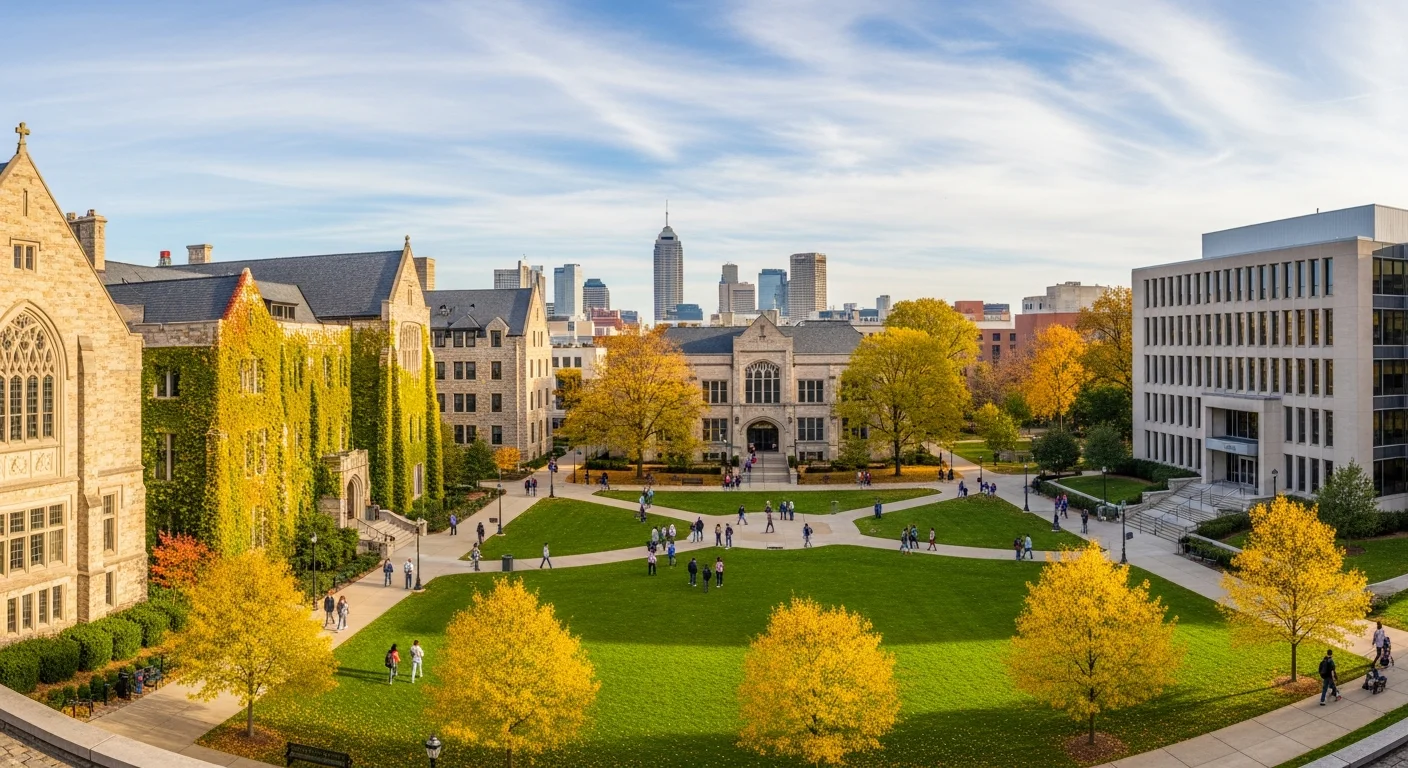
University campus in Indiana
Updated June 26, 2026

Best Information Systems Degree Programs in Indiana, 2026 Rankings

Compare the top information systems colleges in Indiana. 19 accredited information systems schools ranked by graduation rate, career outcomes, and value, from Ivy Tech Community College to University of Notre Dame.

#1 ProgramU of Notre Dame
Avg Salary$103,570
Tuition From$4,912/yr
Job Growth+22%
On this page
Reviewed by Taylor Rupe, Founder & EditorSee methodology

15

Programs ranked

IPEDS 2024

$103,570

Indiana median information systems salary

BLS OEWS 2024

92.3/100

Top program score

Hakia methodology

16%

U.S. job growth (2023–33)

BLS projections

Key Takeaways

Best information systems degree programs: U of Notre Dame, Purdue University Global, Purdue

Ranked by graduation rates, program outcomes, and institutional quality

IPEDS 2024

Tuition ranges from $4,912 to $62,186/year

Ivy Tech Community College offers the most affordable option at $4,912/yr

IPEDS 2024

Information Systems degree programs available: 5 associate's, 7 master's in Indiana

From community college pathways to advanced research degrees

IPEDS 2024

5 online information systems degree programs in Indiana

Flexible scheduling for working professionals

IPEDS 2024

Indiana community college transfer can save 40-60% on total degree costs

5 associate's programs provide transfer pathways to bachelor's degrees

Education Commission of the States

Major employers: Salesforce, Angie, Cummins, Eli Lilly

Tech hubs in Indianapolis and Carmel

Hakia Research 2026

Information Systems degree programs near 49+ cities across Indiana

Search by city to find programs within 200 miles of your location

IPEDS 2024

Updated June 26, 2026

How we ranked Indiana Information Systems programs

We rank 28 accredited information systems programs in Indiana using IPEDS 2024 institutional data, BLS OEWS 2024 state salary data, and College Scorecard outcomes. A 4-factor weighted composite is normalized to a 0–100 score. Schools cannot pay for placement; rankings are produced algorithmically.

Program completions (35%)Graduation rate (25%)Selectivity (20%)Career outcomes (20%)
See full methodology
$103,570
Are Information Systems Degree Programs in Indiana Worth It?
Yes. The best information systems degree programs in Indiana deliver strong ROI, graduates earn $103,570 median salary with +22% job growth through 2032. In-state tuition averages $21,925/year.

Source: BLS OEWS May 2024

Information Systems Degree Rankings in Indiana

Compare the top-ranked Information Systems programs in Indiana by degree level. Tuition, graduation rate, and Hakia Score for every accredited program.

Best Associate's Information Systems Programs in Indiana

1
Programs ranked
$5,154
Avg tuition/yr
40%
Avg grad rate

Program Landscape

Indiana offers 5 accredited associate's degree programs in information systems, providing an affordable entry point into the technology field. The top-ranked programs include Ivy Tech Community College, Vincennes, Indiana Institute of Tech..., which combine rigorous technical curriculum with practical skills training.

Costs & Value

Community colleges in Indiana offer these two-year programs at an average cost of $13,027/yr, significantly less than four-year university tuition. Students completing associate's degrees can pursue entry-level technical positions and transfer opportunities, with entry-level salaries averaging $56,964 in Indiana.

Career Pathways

Many programs feature guaranteed transfer agreements with Indiana's public universities, allowing students to complete their first two years at reduced cost before transferring to complete a bachelor's degree. The Indianapolis, Carmel, Fort Wayne areas offer particularly strong job markets for associate's degree holders, with employers like Salesforce, Angie, Cummins hiring for technical support, junior development, and IT specialist positions.

Curriculum & Specializations

Programs typically include coursework in programming fundamentals, database management, networking basics, and software development. Among information systems schools in Indiana, these associate's programs offer the best value for students beginning their information systems degrees in Indiana.

Best Bachelor's Information Systems Programs in Indiana

11
Programs ranked
$24,429
Avg tuition/yr
61%
Avg grad rate

Program Landscape

Indiana ranks among the nation's top destinations for information systems education, with 16 accredited bachelor's degree programs across 6 public and 10 private institutions. The highest-ranked programs are U of Notre Dame, Purdue University Global, Purdue, recognized for academic excellence, research opportunities, and strong industry connections.

Career Outcomes

Graduates from Indiana information systems programs earn a median salary of $88,035, 10% below the national average. The state's robust technology sector, anchored by the Indianapolis, Carmel, Fort Wayne metropolitan areas, provides abundant internship and employment opportunities with companies including Salesforce, Angie, Cummins.

Costs & Value

Tuition ranges from $7,259 to $62,186 annually, with an average of $24,714/yr. Top programs maintain graduation rates above 79%, with the highest reaching 99%. Many programs hold ABET accreditation, the gold standard for computing education, ensuring curriculum meets rigorous industry standards.

Curriculum & Specializations

Students can choose from specializations including software engineering, cybersecurity, artificial intelligence, data science, and systems architecture. Strong industry partnerships provide access to co-op programs, capstone projects with real companies, and direct recruiting pipelines to Indiana's leading technology employers. For students seeking information systems degrees in Indiana, these top-ranked information systems schools offer the strongest combination of academic rigor and career preparation.

🥉
Butler University
Indianapolis, INPrivate nonprofit
$46,570
Tuition/yr
80%
Grad rate
81.4
Hakia Score
Show all 11 ranked programs
RankSchoolLocationTypeTuitionGrad RateHakia Score
#6University of IndianapolisIndianapolis, INPrivate nonprofit$35,44856%78.1
#7Indiana University-IndianapolisIndianapolis, INPublic$9,51854%76.1
#8Grace College and Theological SeminaryWinona Lake, INPrivate nonprofit$28,74569%74.8
#9Indiana State UniversityTerre Haute, INPublic$9,97843%70.0
#10Goshen CollegeGoshen, INPrivate nonprofit$38,89065%67.5
#11Indiana Wesleyan University-National & GlobalMarion, INPrivate nonprofit$8,84835%65.0

Best Master's Information Systems Programs in Indiana

3
Programs ranked
$15,653
Avg tuition/yr
55%
Avg grad rate

Program Landscape

Indiana offers 7 master's degree programs in information systems, designed for professionals seeking to advance into senior engineering, technical leadership, and specialized roles. The top programs, Trine University-Regional..., U of Notre Dame, Purdue, combine advanced technical training with research opportunities and leadership development.

Career Outcomes

Master's graduates in Indiana earn a median salary of $103,570, approximately 20-30% higher than bachelor's degree holders. The concentration of technology companies in Indianapolis, Carmel, Fort Wayne creates strong demand for graduate-level talent, with Salesforce, Angie, Cummins actively recruiting from these programs.

Costs & Value

Program formats include traditional full-time study (typically 2 years), part-time options for working professionals (2-3 years), and accelerated tracks. Tuition averages $30,673/yr, with many employers offering tuition reimbursement for graduate education. Some programs offer thesis and non-thesis tracks, allowing students to focus on research or professional development based on their career goals.

Curriculum & Specializations

Curriculum covers advanced topics including machine learning, distributed systems, software architecture, and technical management. Many programs include practicum experiences, industry capstone projects, or consulting engagements that provide real-world application of advanced concepts. Among Indiana's information systems schools at the graduate level, these programs stand out for both academic quality and career outcomes.

Information Systems Degree Costs & Tuition in Indiana

MetricValue
Average in-state tuition$21,925/year
Average out-of-state tuition$54,813/year
Community college tuition$5,481/year
4-year savings for residents$131,552
2+2 transfer pathway savings$32,888

Source: IPEDS 2024

Financial Aid & Scholarships for Information Systems Students in Indiana

State Aid Programs

Indiana offers strong financial aid opportunities for students pursuing Information Systems degrees. The state's flagship program, 21st Century Scholars, covers up to 100% of tuition at Indiana public institutions for eligible low-income students. This program significantly reduces the financial burden for qualifying applicants and represents one of the most generous state-level aid initiatives in the nation. Additionally, all students should complete the Free Application for Federal Student Aid (FAFSA) at StudentAid.gov to access federal grants, loans, and work-study opportunities. The U.S. Department of Education's College Scorecard provides detailed aid data for Indiana institutions, helping students compare net cost across programs.

Key Programs & Amounts

Beyond state and federal aid, Indiana's public universities and community colleges offer institutional scholarships specifically for Information Systems majors. The Indiana Commission for Higher Education administers multiple grant programs and can guide students through state-specific opportunities. Many of Indiana's top-ranked programs, including Purdue University-Main Campus, Ball State University, and Indiana University-Indianapolis, offer merit-based scholarships that reduce out-of-pocket costs. Students should contact financial aid offices directly to explore program-specific awards. For transfer students, the Indiana Core Transfer Library (CTL) ensures guaranteed transfer of core courses statewide, which can reduce overall time-to-degree and associated costs. Explore related programs like Information Technology in Indiana and Data Analytics in Indiana for additional scholarship opportunities across the technology sector.

Information Systems Degree ROI Calculator, Indiana

Use our interactive ROI calculator to estimate your return on investment for a information systems degree in Indiana. Enter your expected tuition costs, financial aid, and career goals to see projected payback periods and lifetime earnings. The calculator uses current salary data from BLS and tuition data from IPEDS to provide accurate estimates.

Information Systems Degree ROI Calculator

Estimate your return on investment for a information systems degree

Leave blank to use average cost for selected program type

20 years
10 years20 years30 years
20-Year ROI

+907%

Net gain divided by total investment. ROI above 200% is considered excellent for education investments.

Net Gain

$1,677,254

Your additional lifetime earnings with this degree vs. working without one, minus the total investment.

Break-Even

5 years

Years until your cumulative earnings exceed total investment. Shorter programs often break even faster due to lower opportunity cost.

COL-Adjusted Salary

$133,333

Your starting salary adjusted for local cost of living. This shows real purchasing power compared to a $100K national baseline.

Why does break-even change with program type? Your "total investment" includes both tuition AND opportunity cost (foregone earnings while in school). A 4-year full-time public university (in-state) means 4 years of not earning a salary ($140,000 in opportunity cost). Shorter full-time programs may have higher tuition but lower total investment because you return to the workforce sooner.

Detailed Breakdown

How we calculate your degree ROI using real salary data

Total Investment$185,000

Tuition plus opportunity cost (earnings you miss while in school)

Program Cost (Tuition)$45,000

Direct cost of the degree program

Opportunity Cost$140,000

4 years × $35K/year foregone salary while studying full-time

20-Year Earnings (with degree)$2,712,662

Projected career earnings starting after graduation, with salary growth

20-Year Earnings (without degree)$850,408

What you'd earn working at $35K/year with 2% annual growth

Starting Salary (Austin, TX)$140,000

Median salary for this role in your selected location (BLS 2024)

Annualized Return4.9%

Your investment's compound annual growth rate (similar to stock market returns)

Data sources: BLS OEWS May 2024, IPEDS 2024. Calculations use median salaries, 3% discount rate, and assume salary growth declines from 6% to 2% over career. Individual results will vary. | Powered by Hakia.com

Information Systems Salaries by Metro Area

Median annual salary in Indiana metro areas

Indianapolis$114K
Carmel$109K
Fort Wayne$104K
View data table
CategoryValue
Indianapolis$114K
Carmel$109K
Fort Wayne$104K

Source: BLS OEWS May 2024

Hakia.com

Top Employers Hiring Information Systems Graduates in Indiana

Find information systems jobs in Indiana. These major employers across Indiana metro areas are actively hiring information systems degree holders. Click employer names to view current job openings.

Information Systems Jobs in Indianapolis

IN
Salesforce
tech
Eli Lilly
pharma
Infosys
consulting
Rolls-Royce
aerospace
Cummins
manufacturing

Information Systems Jobs in Carmel

IN
Genesys
tech
KAR Global
automotive-tech

Information Systems Jobs in Fort Wayne

IN
Sweetwater Sound
ecommerce
Raytheon
defense

Transfer Pathways for Information Systems Degrees in Indiana

State Transfer System

Indiana's streamlined transfer system makes it efficient for students to progress from associate's to bachelor's degree programs. The Indiana Core Transfer Library (CTL) provides guaranteed transfer of core courses across the state's public institutions, ensuring credits earned at community colleges seamlessly apply toward bachelor's degrees. Indiana currently supports 12 two-year institutions, including Ivy Tech Community College, which produced 200 completions in Information Systems in 2023, and Vincennes University, making accessible entry points for students pursuing associate's degrees before transferring to four-year programs.

How Transfers Work

Students beginning at Ivy Tech Community College can complete general education and core Information Systems courses, then transfer to Purdue University-Main Campus, Indiana University-Indianapolis, or other 18 bachelor's-degree-granting institutions across Indiana with guaranteed credit recognition. This pathway significantly reduces overall education costs while maintaining academic quality. The Indiana Commission for Higher Education enforces articulation agreements ensuring smooth transitions between institutions. Additionally, students should explore complementary fields like Information Technology in Indiana and Database Management in Indiana when planning their transfer sequences. For comprehensive information about transfer agreements and program articulations, consult the CTL website and individual institution transfer offices to confirm your specific program's transfer requirements and course mappings.

Why Pursue an Information Systems Degree in Indiana?

Industry & Workforce

Indiana has established itself as a strong hub for Information Systems education and technology careers. With 35 institutions offering Information Systems programs across all degree levels, Indiana provides diverse educational pathways for students pursuing this in-demand field (IPEDS). The state's offerings include 6 associate's programs, 18 bachelor's programs, and 10 master's programs, producing 1,893 completions annually according to 2023 data. This comprehensive array of options ensures students can find programs aligned with their career goals, learning pace, and financial circumstances.

Salary Outlook

Indiana's major metropolitan areas. Indianapolis, Fort Wayne, South Bend, and the surrounding regions, host significant technology employers including Indiana University Health, Eli Lilly, Walmart, and Amazon, creating abundant career opportunities for graduates. Top-ranked institutions like the University of Notre Dame and Purdue University-Main Campus consistently produce highly-qualified graduates. For budget-conscious students, Indiana public universities offer competitive tuition, with average in-state four-year costs at $8,373, and the state's 21st Century Scholars program covers up to 100% of tuition at Indiana public institutions for qualifying low-income students. Additionally, students should explore related fields like Information Technology in Indiana, Data Analytics in Indiana, and Cloud Computing in Indiana to broaden their career options.

19 Programs
Information Systems Program Availability in Indiana
Indiana offers 19 accredited information systems programs across public universities, private colleges, and community colleges. Top tech hubs include Indianapolis, Carmel, Fort Wayne.

Source: IPEDS 2024

Information Systems Job Market & Salary Data in Indiana

Employment Outlook

Indiana's information systems job market is strong and growing, with significant opportunities across multiple metro areas and industry sectors. According to the Bureau of Labor Statistics, the state supports a diverse technology workforce with strong demand in major metropolitan regions. The Indianapolis-Carmel-Anderson metro area leads the state's technology job market, followed by Fort Wayne and South Bend-Mishawaka. These regions serve as regional hubs for technology employment and innovation, attracting graduates from Indiana's 35 institutions offering information systems programs at various degree levels. Indiana's average public in-state tuition for four-year institutions is $8,373, making education in the state significantly more affordable than the national average, allowing students to enter the job market with less debt.

Salaries by Metro

The state's information systems workforce is supported by comprehensive educational pathways. In 2023, Indiana institutions awarded 731 bachelor's degrees, 936 master's degrees, and 226 associate's degrees in information systems (IPEDS). These completion numbers reflect strong enrollment demand and indicate a pipeline of qualified professionals entering Indiana's technology sector. Schools like Purdue University-Main Campus and Indiana University-Indianapolis offer both traditional and online bachelor's programs, while Purdue's master's programs rank among the best in the region. The state's transfer infrastructure, including the Indiana Core Transfer Library, facilitates workforce development by allowing students to build credentials efficiently across institutions. This educational foundation supports the state's ability to attract and retain technology employers seeking skilled talent.

Entry-Level (0-2 yrs)

New graduates and career changers

Senior (8+ yrs)

Technical leads and architects

Median Salary in Indiana$67,321$150,177
Typical RolesJunior Developer, AnalystStaff Engineer, Architect
Remote Work AccessLimitedCommon
Degree ExpectationBachelor's sufficientMaster's preferred

Online vs On-Campus Information Systems Programs in Indiana

Online Programs

5 available in Indiana

On-Campus Programs

Traditional classroom experience

Typical Tuition$19,733/yr$21,925/yr
Schedule FlexibilitySelf-paced or asyncFixed schedule
NetworkingVirtual cohortsIn-person, career fairs
Best ForWorking professionalsTraditional students
Completion Time2-4 years (flexible)4 years (standard)

Compare Information Systems Programs in Other States

Information Systems Degree Programs in Indiana: FAQ

What are the best information systems degree programs in Indiana?
The best information systems degree programs in Indiana based on our methodology are: 1) University of Notre Dame (99% graduation rate), 2) Purdue University Global, and 3) Purdue University-Main Campus. Our rankings weight graduation rates (25%), program completions (35%), selectivity (20%), and career outcomes (20%). Indiana offers 19 total accredited programs across 8 public and 11 private institutions. See our complete rankings for all 16 bachelor's programs.
How much do information systems degree programs cost in Indiana?
Information Systems degree program costs in Indiana vary significantly by institution type. In-state public tuition averages $21,925/year, while private institutions average $48,235/year. Community colleges offer the most affordable path at approximately $5,481/year for associate's degrees. The total 4-year cost ranges from $87,700 at public schools to $192,940 at private institutions before financial aid. Most students don't pay full sticker price, federal grants, state aid, and institutional scholarships can reduce costs by 30-60%.
What salary can information systems degree graduates earn in Indiana?
Information Systems professionals in Indiana earn a median salary of $103,570, which is competitive with the national average of $115,500. Entry-level positions typically start around $67,321, while senior roles exceed $150,177. Salaries vary by metro area: Indianapolis ($113,927), Carmel ($108,749) offer the highest compensation. Specialized roles like AI/ML engineers and cloud architects command premiums of 15-30% above median.
Are there online information systems degree programs in Indiana?
Yes, Indiana offers 5 accredited online Information Systems programs from state institutions. These programs award the same degree as on-campus options and include synchronous and asynchronous formats. Top-ranked online programs include offerings from University of Indianapolis and University of Saint Francis-Fort Wayne. Online programs typically cost the same as on-campus tuition for in-state students. Many programs offer flexible scheduling for working professionals, with some offering accelerated completion in 2-3 years. Ensure any online program holds regional accreditation and ideally ABET accreditation for engineering programs.
What companies hire information systems degree graduates in Indiana?
Major Information Systems employers in Indiana include Salesforce, Angie, Cummins, Eli Lilly, Infosys. The Indianapolis and Carmel metro areas serve as primary tech hubs with thousands of open positions. Top employers maintain recruiting pipelines directly from Indiana universities, with many offering internship-to-hire programs. Beyond tech giants, opportunities exist in healthcare IT, financial services, defense contractors, and growing startups. Indiana's tech sector shows +22% projected job growth through 2033, outpacing most other industries.
Is an information systems degree program worth it in Indiana?
An information systems degree program in Indiana offers strong ROI with a $103,570 median salary and +22% projected job growth. At average in-state tuition of $21,925/year, graduates typically recoup their educational investment within 3-5 years. The degree opens doors to high-paying careers in software development ($117,034), data science, cybersecurity, and AI/ML. Beyond salary, benefits include job security, remote work flexibility, and clear advancement paths. Alternative paths like bootcamps exist for career changers, but bachelor's degrees provide broader career options and higher lifetime earnings.
How long do information systems degree programs take in Indiana?
Standard completion times for information systems degree programs in Indiana are: Associate's (2 years, 60 credits), Bachelor's (4 years, 120 credits), and Master's (1-2 years, 30-36 credits). However, actual timelines vary based on course load, transfer credits, and program format. Accelerated programs can compress a bachelor's to 3 years or a master's to 12 months. Part-time students typically need 5-6 years for a bachelor's degree. Indiana community colleges offer a cost-effective "2+2" path: complete your associate's in 2 years, then transfer to a Indiana university for the final 2 years of a bachelor's program.
What financial aid is available for information systems degree students in Indiana?
Indiana information systems degree students can access multiple financial aid sources. Federal aid includes Pell Grants (up to $7,395/year for qualifying students) and federal student loans. Indiana state grants provide additional support for residents attending in-state schools. Institutional scholarships from universities can significantly reduce costs, many schools offer merit-based awards for STEM students. Work-study programs and teaching/research assistantships (especially for graduate students) provide income while building experience. Complete the FAFSA by Indiana's priority deadline to maximize aid eligibility. Some employers also offer tuition reimbursement for employees pursuing CS degrees.

Data Sources

Institutional characteristics, completions, graduation rates

Indiana salary and employment data

Official University Websites

Program details and admissions information

Last Updated: June 26, 2026. Rankings based on IPEDS 2024 data. Salary data from BLS OEWS May 2024.

Was this ranking helpful for your college search?
Taylor Rupe

Taylor Rupe

Co-founder & Editor (B.S. Computer Science, Oregon State • B.A. Psychology, University of Washington)

Taylor combines technical expertise in computer science with a deep understanding of human behavior and learning. His dual background drives Hakia's mission: leveraging technology to build authoritative educational resources that help people make better decisions about their academic and career paths.

Information Systems Degree Programs in Indiana, Detailed School Profiles

Best Associate's Information Systems Degree Programs in Indiana

Ivy Tech Community College, Indianapolis, IN

Hakia Insight: Ivy Tech's multi-campus footprint across Indiana combined with direct employer pipelines to regional manufacturers and healthcare networks means associate's graduates often stay regionally employed at higher salaries than their out-of-state peer institutions report.

At the associate's level, with multiple campuses across Indiana, Ivy Tech's information systems program emphasizes hands-on experience in networking, cybersecurity fundamentals, and cloud computing—skills employers are actively hiring for right now. You'll work in dedicated IT labs where you can configure networks, troubleshoot systems, and earn industry certifications while still in school. Graduates typically land help desk and junior network administrator roles at healthcare systems, manufacturing plants, and financial institutions throughout Indiana. The program's real strength is its flexibility: choose full-time, part-time, evening, or online formats depending on your schedule, and leverage Ivy Tech's partnerships with companies like Salesforce and Microsoft for internship opportunities. Many students complete their associate degree and immediately enter the workforce earning competitive entry-level salaries, while others use their credentials to transfer to four-year programs at Purdue or Indiana University.

Programs Offered
  • Associate of Science in Information Systems, 2 years, on-campus
  • Associate of Applied Science in Information Systems, 2 years, online
Career Outcomes

Top Employers: Salesforce, Microsoft, Indiana hospitals and healthcare networks, Manufacturing firms across Indiana, Financial institutions, State and local government agencies.

Top Transfer Destinations
  • Purdue University
  • Indiana University
  • Indiana State University
  • IPFW (Purdue Fort Wayne)
Entry-Level Career Paths
  • Help Desk Technician
  • Desktop Support Specialist
  • Junior Network Administrator
  • IT Support Specialist
  • Technical Support Analyst
Included Certifications
  • CompTIA A+
  • CompTIA Network+
  • Microsoft Azure Fundamentals
  • Cisco CCNA Fundamentals

Location Advantages:

Best Bachelor's Information Systems Degree Programs in Indiana

University of Notre Dame, Notre Dame, IN

Key Distinction: An academically rigorous information systems program combining computer science fundamentals with enterprise IT strategy, bolstered by a top-tier alumni network and Midwest corporate connections.

Hakia Insight: Notre Dame's IS program sits adjacent to its computer science ecosystem while maintaining ties to Accenture and Deloitte, positioning graduates to move directly into enterprise IT strategy consulting roles rather than commodity software development—a distinction that justifies the tuition premium.

At the bachelor's level, notre Dame's information systems program sits within a broader computing ecosystem that prioritizes student outcomes and ethical technology leadership. The curriculum blends foundational computer science theory with applied IS topics like enterprise architecture, IT governance, and digital transformation, ensuring graduates understand both the technical and business dimensions of information systems work. The program benefits from Notre Dame's extensive industry partnerships and consulting connections, giving students access to real-world client projects through coursework and internship placements. Faculty are actively engaged in research around enterprise systems, IT strategy, and organizational technology adoption—areas where Notre Dame maintains strong visibility in academic publishing. The proximity to major corporate headquarters in the Midwest and Notre Dame's alumni network in technology leadership create a natural pipeline into roles at Fortune 500 companies and innovative tech firms. Career outcomes reflect this positioning, with graduates moving into systems analyst, enterprise architect, IT manager, and technology consultant roles at organizations ranging from healthcare systems to financial services firms.

Programs Offered
  • Bachelor of Science in Information Systems, 4 years, on-campus
  • Bachelor of Arts in Information Systems, 4 years, online
Industry Partners
  • Accenture (corporate)
  • Deloitte (corporate)

Location Advantages: Proximity to major Midwest corporate headquartersStrong regional and national alumni network in technology leadership

Trine University-Regional/Non-Traditional Campuses, Angola, IN

Key Distinction: A fully flexible, working-professional-focused information systems program with evening/weekend classes and multiple delivery formats across regional campuses.

Hakia Insight: Trine's evening/weekend regional-campus model for undergraduates uniquely solves the "working student with childcare" constraint by building cohort-based learning into non-traditional schedules, rather than treating flexibility as asynchronous isolation.

At the bachelor's level, trine's information systems program is built explicitly for working professionals and non-traditional students, with evening and weekend classes designed to fit busy schedules while maintaining academic rigor. The curriculum emphasizes practical application over theory, integrating real-world business scenarios into coursework so students can immediately apply what they learn to their current roles. Specialization tracks in enterprise systems management, cybersecurity, and data analytics allow students to tailor their education to their career trajectory. Faculty bring direct industry experience, mentoring students through capstone projects that often address actual business challenges from their employers. The program's strength lies in its flexibility—online, hybrid, and in-person options across multiple regional campuses mean you're not locked into a single location or learning modality. Graduates typically advance within their current organizations or transition into higher-level IS roles, with many employers sponsoring employee tuition as a professional development investment.

Programs Offered
  • Bachelor of Science in Information Systems, 4 years, on-campus
  • Bachelor of Arts in Information Systems, 4 years, online

Location Advantages:

Butler University, Indianapolis, IN

Key Distinction: Butler distinguishes itself through a liberal arts-informed approach to information systems that prioritizes business acumen and communication skills alongside technical depth.

Hakia Insight: Butler's liberal arts frame means IS students take business communication and ethics courses alongside systems design—a curricular investment that pays dividends when Indianapolis corporate hiring managers (especially in fintech) filter for candidates who can articulate technical decisions to non-technical boards.

At the bachelor's level, butler's information systems program reflects its rigorous liberal arts foundation, emphasizing critical thinking and business communication alongside technical competency. Rather than overwhelming students with disconnected technical courses, Butler integrates information systems education within a broader business school context, ensuring graduates develop the judgment and communication skills that separate effective IT professionals from technically proficient technicians. The curriculum balances systems analysis, database management, and enterprise architecture with coursework in organizational behavior, business strategy, and technology ethics. Small class sizes and close faculty-student interaction enable mentorship and customized learning paths. Indianapolis location provides internship opportunities with regional employers while maintaining the relationship-focused community that characterizes the Butler experience.

Programs Offered
  • Bachelor of Science in Information Systems, 4 years, on-campus
  • Bachelor of Arts in Information Systems, 4 years, online

Location Advantages: Indianapolis metro access to corporate headquarters and regional business centers

Purdue University Global, West Lafayette, IN

Key Distinction: IT Integrative Project (IT299) requirement. Bachelor's Capstone in Information Technology (IT499)

Hakia Insight: Purdue Global's fully online delivery doesn't sacrifice capstone rigor: the IT499 Capstone requirement mirrors the on-campus experience, yet the employer roster (ExxonMobil, JPMorgan Chase, Microsoft) suggests the degree carries equal weight despite zero geographic constraints.

The Bachelor of Science in Information Technology at Purdue University Global is a 180 quarter-credit hour program designed to prepare students for career advancement in IT through technical knowledge and professional skills. The curriculum emphasizes hands-on learning in IT concepts, tools, and leading-edge technologies for designing information systems, with courses teaching students how to apply technical competencies to solve business problems. Key features include an IT Integrative Project (IT299) and a Bachelor's Capstone in Information Technology (IT499) that requires students to synthesize their learning. The program integrates general education literacies and professional competencies throughout, focusing on developing discipline-specific outcomes in technology skills, system specifications, professional communication, and team management. The program is available in ExcelTrack format and designed for students seeking immediate employment or pursuing advanced degrees in information technology.

Programs Offered
  • Bachelor of Science in Information Technology, 4 years, on-campus. BS
Career Outcomes

Top Employers: ExxonMobil, Microsoft, JPMorgan Chase, Freddie Mac.

Location Advantages: No geographic constraint; fully online access to Purdue's curriculum and resources

Ball State University, Muncie, IN

Key Distinction: Ball State differentiates through its structured certification-preparation curriculum that embeds industry credential pathways directly into degree requirements.

Hakia Insight: Ball State embeds professional certification pathways directly into degree requirements, so students graduate with CompTIA or Cisco credentials already earned rather than scrambling to self-fund exam fees after graduation—a structural advantage worth thousands to mid-market employers who use certifications as hiring filters.

At the bachelor's level, ball State's information systems program stands out for its strong applied computing foundation combined with explicit preparation for multiple professional certifications and industry credentials. The curriculum emphasizes hands-on technical skills—networking, database management, systems security—alongside the business and management competencies that employers consistently demand. The program maintains active partnerships with regional tech employers and integrates real-world case studies throughout the course sequence. What distinguishes Ball State is its deliberate pathway toward industry-recognized certifications; students graduate positioned to immediately pursue CompTIA, Cisco, and Microsoft credentials. The Muncie location, while not a major tech hub, has enabled the program to build tight relationships with Indiana's distributed business community, resulting in strong internship and entry-level placement networks across the state.

Programs Offered
  • Bachelor of Science in Information Systems, 4 years, on-campus
  • Bachelor of Arts in Information Systems, 4 years, online
Accreditations and Certifications
  • CompTIA A+
  • CompTIA Network+
  • Cisco CCNA preparation

Location Advantages: Access to Indiana's mid-market business community

Indiana University-Indianapolis, Indianapolis, IN

Key Distinction: Mandatory experiential learning requirement with multiple options: Capstone Internship, Senior Project, Project in Professional Practice, or Software Engineering project. Capstone Internship option (INFO-I 491) connecting students with industry partners

Hakia Insight: IUPUI's mandatory experiential learning with four distinct pathways (capstone internship, senior project, professional practice, or software engineering) is rarer than it sounds—most programs default to a single track, but IUPUI's menu lets students match their learning to Eli Lilly's internship cycles or Salesforce's project needs.

The Bachelor of Science in Information Systems is a 120-credit hour program designed to provide students with foundational and advanced knowledge in computer science and informatics. The curriculum emphasizes hands-on learning through required experiential learning courses, including options for capstone internships, senior projects, and professional practice projects. Students must maintain a cumulative GPA of 2.0 or higher and earn a C or better in all courses. The program includes core computer science courses in programming, data structures, operating systems, and computer theory, complemented by general education requirements in mathematics, communication, and sciences. Students can pursue specializations through certificates in Applied Data Science, Applied Information Science, Artificial Intelligence, Human-Computer Interaction, Legal Informatics, Multi-Device Development, Software Bots for Cognitive Automation, or a Game Design and Development minor. The program integrates career readiness preparation and offers multiple pathways for experiential learning, including the Capstone Internship option that connects students directly with industry partners.

Programs Offered
  • Bachelor of Science in Information Systems, 4 years, on-campus. BS
Industry Partners
  • Eli Lilly and Company (corporate)
  • Salesforce (corporate)
Career Outcomes

Top Employers: Eli Lilly and Company, Salesforce, Major Indianapolis healthcare systems.

Location Advantages: Proximity to Eli Lilly headquartersAccess to Indianapolis's healthcare IT ecosystemGrowing fintech and business services sector

Grace College and Theological Seminary, Winona Lake, IN

Key Distinction: Grace College and Theological Seminary offers comprehensive Information Systems programs preparing students for careers in technology.

Hakia Insight: Grace College's rural Indiana location paradoxically offers proximity to distributed manufacturing IT infrastructure (automotive, industrial controls) that major tech hubs overlook—students develop expertise in systems that run supply chains, not just consumer apps.

Grace College and Theological Seminary offers Information Systems programs in Winona Lake, IN. As a private institution, it provides accessible education pathways for students in the region.

Best Master's Information Systems Degree Programs in Indiana

Trine University-Regional/Non-Traditional Campuses, Angola, IN

Key Distinction: Fully online format — complete from home. Flexible pacing — new 8-week cohorts starting regularly, completion in as little as 1 year or part-time

Hakia Insight: Trine's 1-year completion option for the MS-IS works because cohorts move through together on a compressed 8-week-module schedule, eliminating the drift that plagues part-time programs where peer groups scatter—critical for working professionals who value completion velocity alongside credential quality.

Trine University's Master of Science in Information Systems is designed for working professionals with bachelor's degrees in technology fields seeking career advancement into leadership roles. The fully online program, offered through TrineOnline, allows flexible completion in as little as one year with new cohorts starting every eight weeks, accommodating part-time study. Students develop technological leadership, managerial skills, and project management expertise to analyze, design, and maintain information systems that solve business problems. The curriculum emphasizes advanced information systems management, business competitiveness optimization, and professional communication. Graduates advance into leadership and executive positions with enhanced project management capabilities and strategic decision-making skills.

Programs Offered
  • Master of Science in Information Systems, 1-2 years, on-campus. MS

Location Advantages:

Ball State University, Muncie, IN

Key Distinction: Ball State differentiates through its structured certification-preparation curriculum that embeds industry credential pathways directly into degree requirements.

Hakia Insight: Ball State embeds certification pathways directly into degree requirements rather than offering them as add-ons; this means graduates exit with credentials already earned, not a to-do list, cutting time-to-promotion in mid-market IT roles by months.

At the master's level, ball State's information systems program stands out for its strong applied computing foundation combined with explicit preparation for multiple professional certifications and industry credentials. The curriculum emphasizes hands-on technical skills—networking, database management, systems security—alongside the business and management competencies that employers consistently demand. The program maintains active partnerships with regional tech employers and integrates real-world case studies throughout the course sequence. What distinguishes Ball State is its deliberate pathway toward industry-recognized certifications; students graduate positioned to immediately pursue CompTIA, Cisco, and Microsoft credentials. The Muncie location, while not a major tech hub, has enabled the program to build tight relationships with Indiana's distributed business community, resulting in strong internship and entry-level placement networks across the state.

Programs Offered
  • Master of Science in Information Systems, 1-2 years, on-campus
  • Master of Arts in Information Systems, 1-2 years, online
Accreditations and Certifications
  • CompTIA A+
  • CompTIA Network+
  • Cisco CCNA preparation

Location Advantages: Access to Indiana's mid-market business community