On this page
Key Takeaways
Best cybersecurity degree programs: Green River College, Columbia Basin College, Western Washington
Ranked by graduation rates, program outcomes, and institutional quality
Tuition ranges from $3,195 to $13,965/year
Green River College offers the most affordable option at $4,074/yr
Cybersecurity degree programs available: 18 associate's, 3 master's in Washington
From community college pathways to advanced research degrees
11 online cybersecurity degree programs in Washington
Flexible scheduling for working professionals
Washington community college transfer can save 40-60% on total degree costs
18 associate's programs provide transfer pathways to bachelor's degrees
Education Commission of the States
Major employers: Microsoft, Amazon, Boeing, Expedia
Tech hubs in Seattle and Bellevue
Hakia Research 2026
Cybersecurity degree programs near 43+ cities across Washington
Search by city to find programs within 200 miles of your location
Updated October 19, 2026
How we ranked Washington Cybersecurity programs
We rank 32 accredited cybersecurity programs in Washington using IPEDS 2024 institutional data, BLS OEWS 2024 state salary data, and College Scorecard outcomes. A 4-factor weighted composite is normalized to a 0–100 score. Schools cannot pay for placement; rankings are produced algorithmically.
Are Cybersecurity Degree Programs in Washington Worth It?
Source: BLS OEWS May 2024
Cybersecurity Degree Rankings in Washington
Compare the top-ranked Cybersecurity programs in Washington by degree level. Tuition, graduation rate, and Hakia Score for every accredited program.
Best Associate's Cybersecurity Programs in Washington
Program Landscape
Washington offers 18 accredited associate's degree programs in cybersecurity, providing an affordable entry point into the technology field. The top-ranked programs include Green River College, Whatcom Community College, Clover Park Technical Col..., which combine rigorous technical curriculum with practical skills training.
Costs & Value
Community colleges in Washington offer these two-year programs at an average cost of $4,142/yr, significantly less than four-year university tuition. Students completing associate's degrees can pursue entry-level technical positions and transfer opportunities, with entry-level salaries averaging $79,877 in Washington.
Career Pathways
Many programs feature guaranteed transfer agreements with Washington's public universities, allowing students to complete their first two years at reduced cost before transferring to complete a bachelor's degree. The Seattle, Bellevue, Redmond areas offer particularly strong job markets for associate's degree holders, with employers like Microsoft, Amazon, Boeing hiring for technical support, junior development, and IT specialist positions.
Curriculum & Specializations
Programs typically include coursework in programming fundamentals, database management, networking basics, and software development. Among cybersecurity schools in Washington, these associate's programs offer the best value for students beginning their cybersecurity degrees in Washington.
Show all 10 ranked programs
| Rank | School | Location | Type | Tuition | Grad Rate | Hakia Score |
|---|---|---|---|---|---|---|
| #6 | Peninsula College | Port Angeles, WA | Public | $4,205 | 37% | 70.2 |
| #7 | Olympic College | Bremerton, WA | Public | $4,197 | 31% | 69.4 |
| #8 | Edmonds College | Lynnwood, WA | Public | $4,206 | 29% | 69.2 |
| #9 | Spokane Falls Community College | Spokane, WA | Public | $4,772 | 32% | 66.6 |
| #10 | Lower Columbia College | Longview, WA | Public | $4,206 | 23% | 60.6 |
Best Bachelor's Cybersecurity Programs in Washington
Program Landscape
Washington ranks among the nation's top destinations for cybersecurity education, with 11 accredited bachelor's degree programs across 11 public and 0 private institutions. The highest-ranked programs are Green River College, Columbia Basin College, Western Washington, recognized for academic excellence, research opportunities, and strong industry connections.
Career Outcomes
Graduates from Washington cybersecurity programs earn a median salary of $123,446, 26% above the national average. The state's robust technology sector, anchored by the Seattle, Bellevue, Redmond metropolitan areas, provides abundant internship and employment opportunities with companies including Microsoft, Amazon, Boeing.
Costs & Value
Tuition ranges from $3,633 to $7,997 annually, with an average of $4,795/yr. Top programs maintain graduation rates above 82%, with the highest reaching 99%. Many programs hold ABET accreditation, the gold standard for computing education, ensuring curriculum meets rigorous industry standards.
Curriculum & Specializations
Students can choose from specializations including software engineering, cybersecurity, artificial intelligence, data science, and systems architecture. Strong industry partnerships provide access to co-op programs, capstone projects with real companies, and direct recruiting pipelines to Washington's leading technology employers. For students seeking cybersecurity degrees in Washington, these top-ranked cybersecurity schools offer the strongest combination of academic rigor and career preparation.
Show all 7 ranked programs
| Rank | School | Location | Type | Tuition | Grad Rate | Hakia Score |
|---|---|---|---|---|---|---|
| #6 | Columbia Basin College | Pasco, WA | Public | $5,875 | 33% | 67.8 |
| #7 | Clover Park Technical College | Lakewood, WA | Public | $5,740 | 43% | 67.0 |
Best Master's Cybersecurity Programs in Washington
Program Landscape
Washington offers 3 master's degree programs in cybersecurity, designed for professionals seeking to advance into senior engineering, technical leadership, and specialized roles. The top programs, U of Washington-Tacoma, U of Washington-Bothell, City University of Seattle, combine advanced technical training with research opportunities and leadership development.
Career Outcomes
Master's graduates in Washington earn a median salary of $145,230, approximately 20-30% higher than bachelor's degree holders. The concentration of technology companies in Seattle, Bellevue, Redmond creates strong demand for graduate-level talent, with Microsoft, Amazon, Boeing actively recruiting from these programs.
Costs & Value
Program formats include traditional full-time study (typically 2 years), part-time options for working professionals (2-3 years), and accelerated tracks. Tuition averages $12,338/yr, with many employers offering tuition reimbursement for graduate education. Some programs offer thesis and non-thesis tracks, allowing students to focus on research or professional development based on their career goals.
Curriculum & Specializations
Curriculum covers advanced topics including machine learning, distributed systems, software architecture, and technical management. Many programs include practicum experiences, industry capstone projects, or consulting engagements that provide real-world application of advanced concepts. Among Washington's cybersecurity schools at the graduate level, these programs stand out for both academic quality and career outcomes.
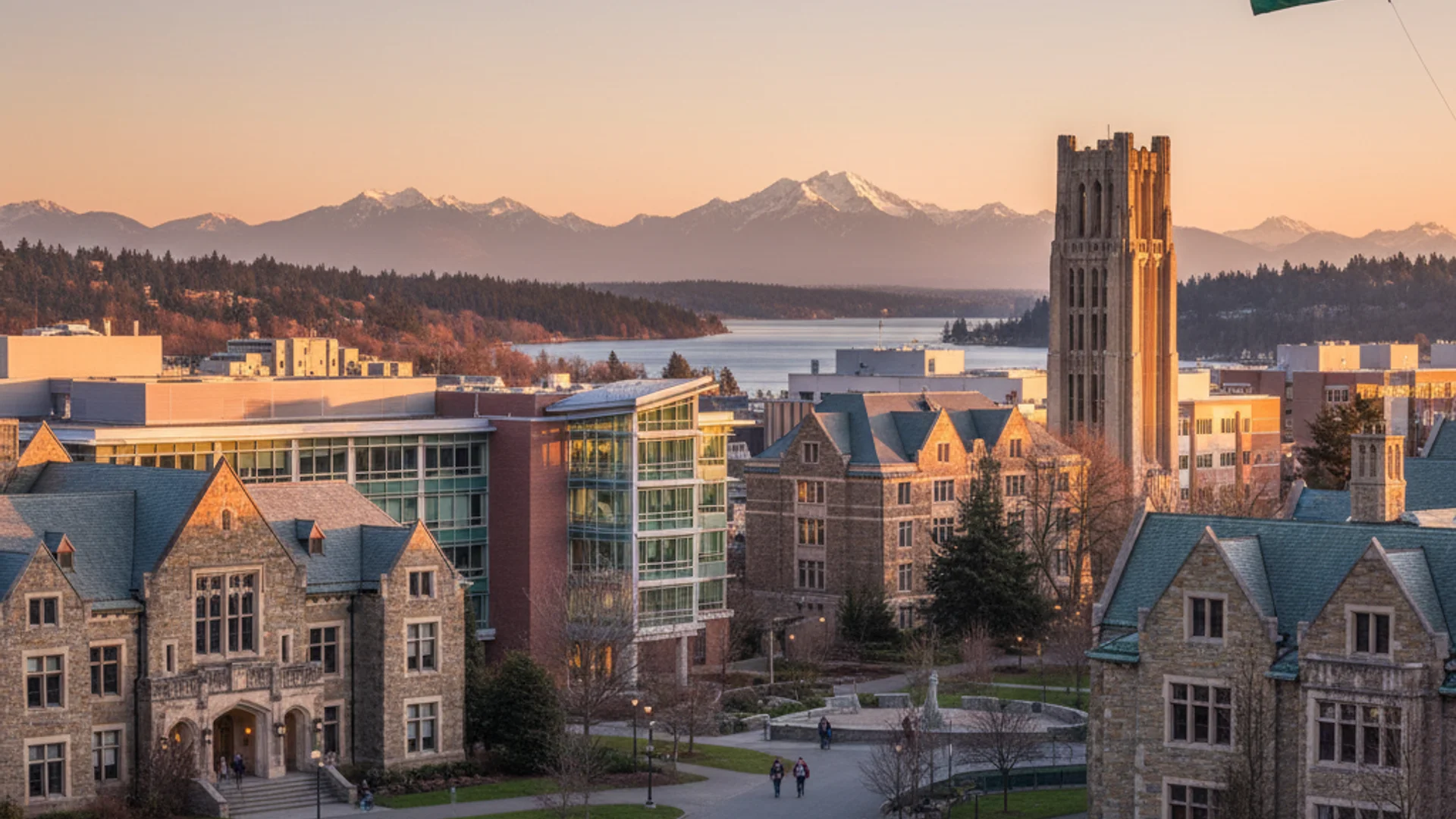
University of Washington-Bothell Campus
Cybersecurity Degree Costs & Tuition in Washington
| Metric | Value |
|---|---|
| Average in-state tuition | $5,312/year |
| Average out-of-state tuition | $13,280/year |
| Community college tuition | $1,328/year |
| 4-year savings for residents | $31,872 |
| 2+2 transfer pathway savings | $7,968 |
Source: IPEDS 2024
Financial Aid for Washington Cybersecurity Students
Verdict: Washington's Washington College Grant (WA Grant) covers full UW tuition for in-state families up to ~$70,000 income, plus the STEM-specific Opportunity Scholarship (up to $22,500 over 5 years for STEM students up to 125% state median income). For cybersecurity-bound Washington residents, the combined state aid + federal Pell + CyberCorps SFS at UW often produces zero-loan undergraduate cybersecurity bachelor's degrees. Combined with no state income tax, this puts Washington among the most cost-effective US states for cybersecurity education.
WA Grant covers full tuition and fees at UW Seattle for in-state families at or below 65% of state median income (~$70,000), with coverage scaling down to ~$108,000 family income. The College Bound Scholarship extends commitment-based aid for low-income 7th-8th graders who pledge academic and behavioral standards.
CyberCorps Scholarship for Service (SFS) is funded at multiple Washington CAE-CD designated institutions: University of Washington (Seattle), Eastern Washington University, Washington State University, City University of Seattle, and others. UW's cybersecurity programs are distributed across the Information School (iSchool) (information security and policy) and the Allen School of Computer Science & Engineering (technical security research), both with substantial federal funding.
Washington's particular cyber funding strength is the combined cost equation: WA Grant + Opportunity Scholarship + CyberCorps SFS + federal Pell, layered with no state income tax on post-graduation salaries. For Washington-resident cyber-track students with appropriate eligibility, the path from low-income family to debt-free cybersecurity bachelor's at UW to high-paying Microsoft or Amazon security engineering role is one of the most financially-efficient career trajectories in US tech. Cyber-employer scholarships from Microsoft, Amazon Web Services, and Washington-based security vendors (ExtraHop, Auth0 legacy operations now Okta) provide additional funding most students don't pursue.
Cybersecurity Degree ROI Calculator
Estimate your return on investment for a cybersecurity degree
Leave blank to use average cost for selected program type
+1011%
Net gain divided by total investment. ROI above 200% is considered excellent for education investments.
$1,869,485
Your additional lifetime earnings with this degree vs. working without one, minus the total investment.
5 years
Years until your cumulative earnings exceed total investment. Shorter programs often break even faster due to lower opportunity cost.
$100,000
Your starting salary adjusted for local cost of living. This shows real purchasing power compared to a $100K national baseline.
Why does break-even change with program type? Your "total investment" includes both tuition AND opportunity cost (foregone earnings while in school). A 4-year full-time public university (in-state) means 4 years of not earning a salary ($140,000 in opportunity cost). Shorter full-time programs may have higher tuition but lower total investment because you return to the workforce sooner.
Detailed Breakdown
How we calculate your degree ROI using real salary data
Tuition plus opportunity cost (earnings you miss while in school)
Direct cost of the degree program
4 years × $35K/year foregone salary while studying full-time
Projected career earnings starting after graduation, with salary growth
What you'd earn working at $35K/year with 2% annual growth
Median salary for this role in your selected location (BLS 2024)
Your investment's compound annual growth rate (similar to stock market returns)
Data sources: BLS OEWS May 2024, IPEDS 2024. Calculations use median salaries, 3% discount rate, and assume salary growth declines from 6% to 2% over career. Individual results will vary. | Powered by Hakia.com
Cybersecurity Salaries by Metro Area
Median annual salary in Washington metro areas
View data table
| Category | Value |
|---|---|
| Seattle | $160K |
| Bellevue | $152K |
| Redmond | $145K |
Source: BLS OEWS May 2024
Hakia.com
Top Employers Hiring Cybersecurity Graduates in Washington
Find cybersecurity jobs in Washington. These major employers across Washington metro areas are actively hiring cybersecurity degree holders. Click employer names to view current job openings.
Cybersecurity Jobs in Seattle
WASeattle is home to Amazon and Microsoft headquarters, plus major engineering offices for Google, Meta, and other tech giants.
Nearby cities: Bellevue, Redmond, Kirkland, Tacoma, Renton
Cybersecurity Jobs in Bellevue/Eastside
WAThe Eastside corridor houses Microsoft's main campus in Redmond, Nintendo of America, and T-Mobile's headquarters.
Nearby cities: Redmond, Kirkland, Issaquah, Sammamish
Washington Tech Industry & Infrastructure
Washington's tech economy is essentially defined by Microsoft and Amazon. The Seattle metro hosts the headquarters of both, plus major engineering offices for Google, Meta, Apple, and a dense second-tier of cloud, AI, and enterprise tech employers. With no state income tax and University of Washington's CS program at the top of the western US, Washington consistently posts the highest tech-job concentration per capita of any US state.
Seattle / Bellevue / Redmond
Seattle metropolitan area
Headquarters of Microsoft (Redmond) and Amazon (Seattle); major engineering offices for Google, Meta, Apple, Tableau, Tableau, Expedia, Zillow, Costco IT. UW is the dominant CS feeder; total-comp at named employers regularly clears $200K for new bachelor's grads.
Spokane / Eastern Washington
Spokane metro
Smaller tech market focused on healthcare-IT (Providence), defense (Fairchild AFB-adjacent), and growing remote-work tech employment. Whitworth and WSU-Spokane feed the local market.
No state income tax. Washington levies a Business and Occupation tax on gross receipts that tech employers factor into compensation structures.
Washington Regulation Affecting Cybersecurity Graduates
Washington has emerged as one of the more active state legislatures on AI, biometric privacy, and consumer health data. The 2024 My Health My Data Act in particular is among the strictest US consumer health-data laws and shapes engineering practice at any company touching health-adjacent data.
Washington My Health My Data Act (MHMD)
Effective March 2024. Imposes strict requirements on collection, use, and sharing of consumer health data — broadly defined to include data inferring health status. Provides a private right of action.
Engineers at any company processing wellness, fitness, mental-health, or biometric data of WA users must implement consent, geofencing, and data-sharing restrictions. The law's broad scope of 'health data' makes it relevant for surprising amounts of consumer-tech work.
Read moreWashington Biometric Identifiers Act
Requires notice and consent before enrolling biometric identifiers in a database for commercial purposes.
Similar in shape to Illinois BIPA though narrower; engineers building biometric features for WA users must implement consent flows.
Read moreWashington AI legislation (HB 1394 et al.)
Washington has passed and continues to develop AI-specific legislation around government use, deepfake elections content, and consumer disclosure.
AI/ML engineers building products serving WA users should monitor evolving disclosure and bias-audit requirements.
Read moreProfessional Engineer Licensure in Washington
Washington does not currently administer a separate Software Engineering PE license. Standard engineering disciplines require ABET-EAC accreditation for PE eligibility; software engineering is not a Washington-recognized PE discipline.
Washington licensing boardWashington Financial Aid Programs
Washington College Grant (WA Grant)
State grantUp to $11,840/yr at public 4-year, up to $4,180/yr at community college
WA residents with family income up to ~70% of state median income (~$70,000)
College Bound Scholarship
State scholarship (early commitment)Covers tuition and fees at participating WA institutions
WA students who sign up in 7th-8th grade with family income at or below 65% state median income; must maintain 2.0+ GPA and stay crime-free
Washington Application for State Financial Aid (WASFA)
Application portalN/A — application channel
WA students ineligible for federal FAFSA (e.g., undocumented) — opens access to state aid programs
Opportunity Scholarship (STEM-specific)
STEM merit-need scholarshipUp to $22,500 total (across 5 years)
WA students pursuing STEM or healthcare bachelor's at participating WA institutions with family income at or below 125% state median
Transfer Pathways for Washington Cybersecurity Students
Verdict: Washington's Direct Transfer Agreement (DTA) provides guaranteed junior-standing admission at Washington public 4-year institutions for community-college AA graduates. The cybersecurity-specific consideration is that Bellevue College has the strongest UW cybersecurity transfer record in Washington, and several Washington community colleges hold CAE-2Y designation supporting accessible cyber-track 2-year-to-4-year progression.
CAE-2Y designated Washington community colleges include Bellevue College, Edmonds College, Highline College, Pierce College, and Tacoma Community College. Each has refined cybersecurity AAS sequences aligned to DTA articulation. Bellevue College specifically has the strongest established CS/cyber transfer record to UW Seattle among Washington community colleges.
The Bellevue College → UW Information School cybersecurity pathway is well-supported, UW's iSchool has accessible transfer admission for cybersecurity-track students with strong Bellevue College preparation. UW's Allen School of Computer Science & Engineering cybersecurity track is more competitive (substantially harder to transfer into than the iSchool) but available for technically-strong applicants.
Beyond UW: Eastern Washington University (EWU) has one of the strongest US public-university undergraduate cybersecurity programs with CAE-CD designation and CyberCorps SFS, particularly notable for students who can't make UW's competitive transfer bar. Washington State University (WSU) Tri-Cities specifically focuses on cybersecurity and has substantial Pacific Northwest National Laboratory (PNNL) cybersecurity research partnerships. City University of Seattle (CityU) is a non-profit private option with CAE-CD designation and substantial military-student support. For Washington cyber-track students, the EWU and CityU paths are often underused, both offer CAE-CD designation with substantially more open transfer admission than UW, and both produce well-employed graduates into Microsoft, Amazon, Boeing, and PNNL cyber roles.
Washington Take-Home Pay Advantage
Source: Washington Department of Revenue
Washington Cybersecurity Job Market & Salary
Verdict: Washington has one of the largest US private-sector cybersecurity job markets anchored by Microsoft's massive security organization (Microsoft Defender, Microsoft Sentinel, Azure security, Microsoft Threat Intelligence Center, GitHub security, M365 security) and Amazon's substantial security operation (AWS security, AWS GuardDuty, Amazon Security, AWS shield, retail cyber). Nominal Seattle-area cyber compensation rivals the Bay Area, and adjusted for no state income tax, Seattle cyber take-home compensation often exceeds equivalent Bay Area Big Tech security roles. For cyber graduates targeting cloud security at meaningful scale, Seattle is the strongest US destination.
By metro: Seattle / Bellevue / Redmond averages ~$170,000-$220,000 for security engineer roles per Levels.fyi and Levels.fyi compensation data, with senior cyber roles regularly exceeding $300,000 and principal/distinguished cyber roles at Microsoft and Amazon exceeding $500,000 total compensation. Microsoft's security organization is the dominant employer, across Defender, Sentinel, Azure Security, M365 security, GitHub security, and Microsoft Threat Intelligence Center, Microsoft employs an estimated 8,000+ security professionals worldwide with substantial Redmond/Seattle concentration. Amazon's security operation is similarly substantial, AWS security alone employs thousands of cyber engineers across detection, response, identity, and application-security teams.
Smaller Washington cyber employers include: Boeing (defense cyber, particularly aerospace cyber and avionics security), Costco's substantial Seattle IT operation, T-Mobile cybersecurity, Expedia security, Tableau (Salesforce) security, Zillow cyber, F5 Networks (security-product engineering), ExtraHop Networks (network detection vendor), and a growing PNW security-startup ecosystem. Spokane is materially smaller but worth knowing about, anchored by Providence healthcare cybersecurity and Pacific Northwest National Laboratory (PNNL) cybersecurity research.
Two distinctive Washington cyber dynamics: (1) Cloud security at scale is the defining Washington cyber specialty, Microsoft and Amazon's combined cloud-security operations dwarf any other US metro's cloud-security workforce. For cyber graduates interested in cloud security as a career, Seattle is the obvious destination. (2) The Washington My Health My Data Act (MHMD) creates ongoing privacy-engineering compliance work at any Washington-resident-serving consumer-tech business, broader privacy scope than CCPA, so engineers building wellness, fitness, mental-health, or biometric products face significant Washington-specific compliance overhead. See Cybersecurity Career Guide and Cybersecurity Certifications Guide.
Entry-Level (0-2 yrs)
New graduates and career changers
Senior (8+ yrs)
Technical leads and architects
Online vs On-Campus Cybersecurity Programs in Washington
Online Programs
11 available in Washington
On-Campus Programs
Traditional classroom experience
Compare Cybersecurity Programs in Other States
- Total Programs
- 11
- Median Tuition
- $5,000
- Total Programs
- 9
- Median Tuition
- $4,700
- Total Programs
- 27
- Median Tuition
- $5,700
- Total Programs
- 50
- Median Tuition
- $6,200
- Total Programs
- 65
- Median Tuition
- $18,600
- Total Programs
- 22
- Median Tuition
- $44,500
- Total Programs
- 25
- Median Tuition
- $15,000
- Total Programs
- 11
- Median Tuition
- $8,900
Cybersecurity Degree Programs in Washington: FAQ
What are the best cybersecurity degree programs in Washington?
How much do cybersecurity degree programs cost in Washington?
What salary can cybersecurity degree graduates earn in Washington?
Are there online cybersecurity degree programs in Washington?
What companies hire cybersecurity degree graduates in Washington?
Is a cybersecurity degree program worth it in Washington?
How long do cybersecurity degree programs take in Washington?
What financial aid is available for cybersecurity degree students in Washington?
Data Sources
Institutional characteristics, completions, graduation rates
Washington salary and employment data
Program details and admissions information
Last Updated: June 26, 2026. Rankings based on IPEDS 2024 data. Salary data from BLS OEWS May 2024.

Taylor Rupe
Co-founder & Editor (B.S. Computer Science, Oregon State • B.A. Psychology, University of Washington)
Taylor combines technical expertise in computer science with a deep understanding of human behavior and learning. His dual background drives Hakia's mission: leveraging technology to build authoritative educational resources that help people make better decisions about their academic and career paths.