🥇
Valley Forge Military College
Wayne, PAPrivate nonprofit
$30,976
Tuition/yr
96%
Grad rate
83.2
Hakia Score
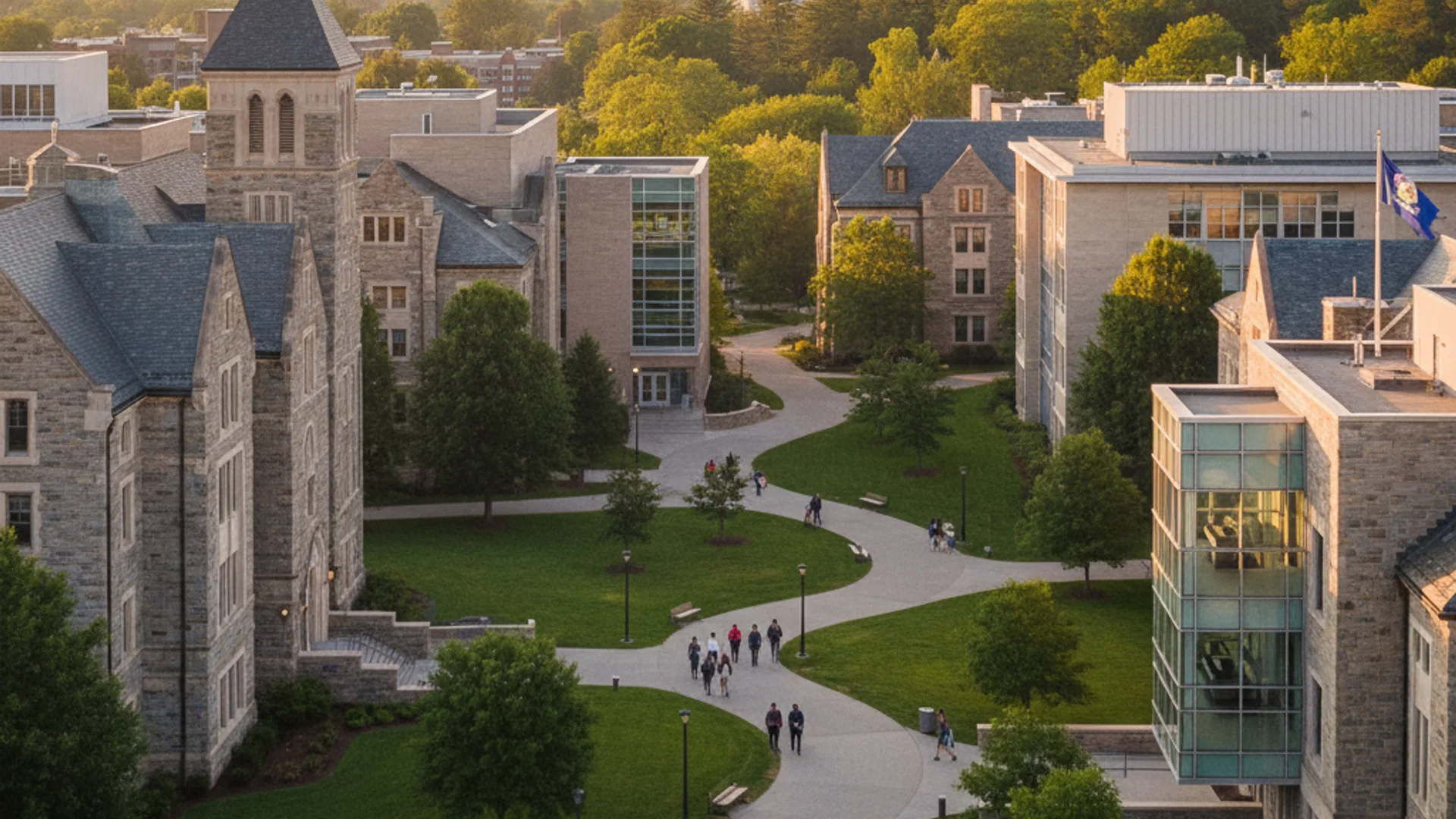
7 accredited cybersecurity programs near Pittsburgh ranked by IPEDS data. 3 NSA-designated schools. Median cybersecurity salary: $112,000. An estimated 950 open positions in the metro area.
7 cybersecurity programs from 5 public and 2 private institutions
4 schools physically in Pittsburgh, plus 3 within 50 miles. Tuition ranges from $6,990 (Butler County Community College) to $62,260 (Carnegie Mellon University).
Median cybersecurity salary: $112,000, 10% below the national median
Security engineers earn up to $120,960, while cybersecurity managers command $162,400 in the Pittsburgh. Source: BLS OEWS Pittsburgh MSA, May 2024.
An estimated 950 open cybersecurity positions in the Pittsburgh
Pennsylvania has 14,200 total cybersecurity openings, 7% concentrated in the Pittsburgh metro. Nationally, 26% of cybersecurity roles remain unfilled.
3 NSA Center of Academic Excellence designated schools
University of Pittsburgh-Pittsburgh Campus, Carnegie Mellon University, Indiana University of Pennsylvania-Main Campus hold NSA/DHS CAE designation, the federal benchmark for cybersecurity education. CAE students may qualify for CyberCorps: Scholarship for Service (full tuition + stipend).
Updated October 12, 2026
We rank 11 accredited cybersecurity programs in Pittsburgh, Pennsylvania using IPEDS 2024 institutional data, BLS OEWS 2024 state salary data, and College Scorecard outcomes. A 4-factor weighted composite is normalized to a 0–100 score. Schools cannot pay for placement; rankings are produced algorithmically.
Compare the top-ranked Cybersecurity programs in Pittsburgh, Pennsylvania by degree level. Tuition, graduation rate, and Hakia Score for every accredited program.
Hakia ranks 3 accredited associate's cybersecurity programs within 50 miles of Pittsburgh, 3 public institutions. 1 is physically located in Pittsburgh, with the rest accessible via short commutes. The top-ranked programs include Community College of Allegheny County, Westmoreland County Community College, Butler County Community College. Tuition for associate's programs ranges from $6,990 to $8,400 per year. Community colleges offer the most affordable entry into cybersecurity, and many have articulation agreements with nearby four-year universities for seamless credit transfer. Students can complete foundational coursework in networking, operating systems, and security fundamentals while earning industry certifications like CompTIA Security+ or CySA+. Graduates with a associate's degree in cybersecurity from Pittsburgh-area schools can expect starting salaries in the range of $72,800 to $87,360 in the local market, with roles such as SOC analyst, IT security technician, or network security associate. The Pittsburgh metro area has an estimated 950 open cybersecurity positions, and the BLS projects +33% job growth through 2033.
| Rank | School | Location | Type | Tuition | Grad Rate | Hakia Score |
|---|---|---|---|---|---|---|
| #6 | Northampton County Area Community College | Bethlehem, PA | Public | $7,800 | 24% | 67.4 |
| #7 | Harrisburg Area Community College | Harrisburg, PA | Public | $7,995 | 21% | 67.2 |
| #8 | Lehigh Carbon Community College | Schnecksville, PA | Public | $7,500 | 30% | 65.3 |
| #9 | Westmoreland County Community College | Youngwood, PA | Public | $8,400 | 31% | 65.3 |
| #10 | Community College of Allegheny County | Pittsburgh, PA | Public | $7,560 | 24% | 63.3 |
| #11 | Community College of Beaver County | Monaca, PA | Public | $11,220 | 12% | 55.0 |
Hakia ranks 3 accredited bachelor's cybersecurity programs within 50 miles of Pittsburgh, 2 public and 1 private institutions. 2 are physically located in Pittsburgh, with the rest accessible via short commutes. The top-ranked programs include University of Pittsburgh-Pittsburgh C., Carnegie Mellon University, Indiana University of Pennsylvania-Ma.. Annual tuition ranges from $7,716 to $62,260 (average: $30,043). A four-year cybersecurity degree covers core topics including network defense, ethical hacking, digital forensics, and security policy, preparing graduates for roles as security analyst, penetration tester, or incident response specialist. The average graduation rate across these programs is 93%. Graduates with a bachelor's degree in cybersecurity from Pittsburgh-area schools can expect starting salaries in the range of $98,560 to $106,400 in the local market, with roles such as security analyst, penetration tester, or incident response specialist. The Pittsburgh metro area has an estimated 950 open cybersecurity positions, and the BLS projects +33% job growth through 2033. University of Pittsburgh-Pittsburgh Campus and Carnegie Mellon University and Indiana University of Pennsylvania-Main Campus hold NSA Center of Academic Excellence (CAE) designation at this level, the federal benchmark for cybersecurity education. CAE students may qualify for the CyberCorps: Scholarship for Service program, covering full tuition plus a stipend.
| Rank | School | Location | Type | Tuition | Grad Rate | Hakia Score |
|---|---|---|---|---|---|---|
| #6 | Saint Vincent College | Latrobe, PA | Private nonprofit | $41,180 | 69% | 79.9 |
| #7 | Saint Francis University | Loretto, PA | Private nonprofit | $25,288 | 74% | 79.1 |
| #8 | York College of Pennsylvania | York, PA | Private nonprofit | $23,000 | 64% | 78.8 |
| #9 | Gannon University | Erie, PA | Private nonprofit | $39,270 | 66% | 78.4 |
| #10 | Immaculata University | Immaculata, PA | Private nonprofit | $28,130 | 71% | 77.8 |
| #11 | Seton Hill University | Greensburg, PA | Private nonprofit | $42,294 | 67% | 75.4 |
| #12 | Mercyhurst University | Erie, PA | Private nonprofit | $42,840 | 60% | 74.2 |
| #13 | Pennsylvania College of Technology | Williamsport, PA | Public | $15,450 | 53% | 72.3 |
| #14 | Geneva College | Beaver Falls, PA | Private nonprofit | $32,080 | 61% | 72.1 |
| #15 | Neumann University | Aston, PA | Private nonprofit | $37,020 | 54% | 70.3 |
| #16 | Pennsylvania State University-World Campus | University Park, PA | Public | $15,356 | 34% | 69.5 |
| #17 | East Stroudsburg University of Pennsylvania | East Stroudsburg, PA | Public | $7,716 | 43% | 64.6 |
| #18 | Pennsylvania State University-Penn State Harrisburg | Middletown, PA | Public | $15,388 | 26% | 62.9 |
| #19 | Harrisburg University of Science and Technology | Harrisburg, PA | Private nonprofit | $23,900 | 34% | 61.6 |
| #20 | Pennsylvania State University-Penn State Berks | Reading, PA | Public | $15,388 | 32% | 59.6 |
| #21 | Pennsylvania State University-Penn State Altoona | Altoona, PA | Public | $15,388 | 17% | 59.3 |
| #22 | Pennsylvania State University-Penn State Brandywine | Media, PA | Public | $14,624 | 26% | 58.9 |
Hakia ranks 3 accredited master's cybersecurity programs within 50 miles of Pittsburgh, 1 public and 2 private institutions. 3 are physically located in Pittsburgh, with the rest accessible via short commutes. The top-ranked programs include University of Pittsburgh-Pittsburgh C., Carnegie Mellon University, Duquesne University. Graduate tuition ranges from $20,154 to $62,260 per year. Master's programs take 18-24 months and focus on advanced topics like threat intelligence, security architecture, risk management, and leadership, designed for professionals looking to move into senior technical or management roles. Average completion rate: 93%. Graduates with a master's degree in cybersecurity from Pittsburgh-area schools can expect starting salaries in the range of $120,960 to $136,640 in the local market, with roles such as security engineer, security architect, or cybersecurity consultant. The Pittsburgh metro area has an estimated 950 open cybersecurity positions, and the BLS projects +33% job growth through 2033. University of Pittsburgh-Pittsburgh Campus and Carnegie Mellon University hold NSA Center of Academic Excellence (CAE) designation at this level, the federal benchmark for cybersecurity education. CAE students may qualify for the CyberCorps: Scholarship for Service program, covering full tuition plus a stipend.
| Rank | School | Location | Type | Tuition | Grad Rate | Hakia Score |
|---|---|---|---|---|---|---|
| #6 | Saint Joseph's University - Philadelphia | Philadelphia, PA | Private nonprofit | $53,060 | 79% | 73.7 |
| #7 | Mercyhurst University | Erie, PA | Private nonprofit | $42,840 | 60% | 70.9 |
| #8 | Geneva College | Beaver Falls, PA | Private nonprofit | $32,080 | 61% | 69.3 |
| #9 | Robert Morris University | Moon Township, PA | Private nonprofit | $34,360 | 66% | 69.2 |
| #10 | Pennsylvania State University-World Campus | University Park, PA | Public | $15,356 | 34% | 65.5 |
| #11 | Pennsylvania Western University | California, PA | Public | $7,716 | 52% | 63.9 |
| #12 | La Salle University | Philadelphia, PA | Private nonprofit | $36,000 | 57% | 61.5 |
Pittsburgh is home to a growing cybersecurity education ecosystem with 7 accredited programs across 3 associate's, 3 bachelor's, 3 master's, 2 doctoral degree levels within 50 miles. 4 of these institutions are physically located in Pittsburgh, with the remaining schools accessible via short commutes from surrounding communities in the Pittsburgh.
3 schools near Pittsburgh hold NSA Center of Academic Excellence (CAE) designation: University of Pittsburgh-Pittsburgh Campus, Carnegie Mellon University, Indiana University of Pennsylvania-Main Campus. The CAE program, jointly sponsored by the NSA and DHS, certifies schools whose cybersecurity curricula meet rigorous federal standards aligned with the NICE Cybersecurity Workforce Framework. Students at CAE-designated schools may qualify for the CyberCorps: Scholarship for Service program, which covers full tuition plus a $25,000-$34,000 annual stipend in exchange for government service after graduation.
The Pittsburgh cybersecurity job market is substantial, with an estimated 950 open positions and a median salary of $112,000 for information security analysts (BLS OEWS May 2024). The Bureau of Labor Statistics projects +33% job growth for cybersecurity roles through 2033, making it one of the fastest-growing occupations in the U.S. economy. For students in Pittsburgh, this translates to strong local hiring prospects upon graduation.
Among the top-ranked programs, University of Pittsburgh-Pittsburgh Campus (88.2% graduation rate) leads the bachelor's rankings. See our complete rankings below for detailed program comparisons across all degree levels.
Median Cybersecurity Salary in Pittsburgh
| Role | Pittsburgh Metro | National Median | Difference |
|---|---|---|---|
| Security Analyst | $98,560 | $109,921 | -10% |
| Penetration Tester | $106,400 | $118,665 | -10% |
| Security Engineer | $120,960 | $134,903 | -10% |
| Security Architect | $136,640 | $152,390 | -10% |
| Cybersecurity Manager / CISO | $162,400 | $181,120 | -10% |
Source: BLS OEWS Pittsburgh MSA, May 2024. Role estimates derived from BLS SOC 15-1212 median.
Cybersecurity professionals in the Pittsburgh earn a median salary of $112,000, which is 10% below the national median of $124,910 (BLS OEWS May 2024, SOC 15-1212: Information Security Analysts). This positions Pittsburgh as a market where cybersecurity salaries are offset by Pittsburgh's lower cost of living compared to coastal tech hubs.
Entry-level security analysts in Pittsburgh can expect starting salaries around $98,560, making cybersecurity one of the highest-paying entry points in the tech sector. With 2-5 years of experience, penetration testers, who simulate cyberattacks to identify vulnerabilities, earn approximately $106,400. Senior technical roles like security engineers command $120,960, while security architects who design enterprise defense systems earn up to $136,640.
At the management level, cybersecurity managers and CISOs in the Pittsburgh can earn $162,400 or more, a 65% premium over entry-level positions. This career trajectory from analyst to manager spans 8-12 years, with certifications like CISSP (82,494 openings nationally), CompTIA Security+ (70,019 openings), and CISA (52,337 openings) significantly accelerating advancement and salary growth.
Security clearances provide an additional salary boost of approximately $25,000 per year. Professionals with Top Secret/SCI clearances can earn between $104,000 and $185,000 nationally, making this a particularly lucrative path for graduates near Pittsburgh. For a deeper dive into cybersecurity compensation trends, see our Cybersecurity Analyst Salary Guide. You can also explore related fields like Information Security and Network Administration for adjacent career paths.
The Pittsburgh cybersecurity job market spans 4 major sectors, with employers actively recruiting for roles ranging from entry-level SOC analysts to senior security architects. Here are the key employers driving cybersecurity hiring locally:
UPMC. Pittsburgh-based major healthcare system with enterprise cybersecurity operations and multiple data centers.
Bayer. Pharmaceutical operations with research system and supply chain security.
University of Pittsburgh. Research institution with significant cybersecurity research and campus infrastructure security.
BNY Mellon. Major financial services company with significant cybersecurity and trading system protection.
Google. Major data center operations and engineering hub with cloud infrastructure security responsibilities.
Alcoa Corporation. Industrial manufacturer with OT security and manufacturing system protection.
These employers represent a cross-section of the Pittsburgh area's cybersecurity hiring market. Many maintain partnerships with local universities for internships, co-ops, and direct hiring pipelines, making a degree from a Pittsburgh-area school particularly valuable for breaking into the field.
Notable Cyber Incidents Affecting Pittsburgh Organizations
Cyber threats aren't abstract risks for Pittsburgh, they have directly impacted local organizations, showing the urgent need for trained cybersecurity professionals in the Pittsburgh:
UPMC (2020), ransomware. Ransomware attack disrupted clinical operations across Pittsburgh-area hospitals forcing operational pivots.
Alcoa (2022), ransomware. Manufacturing operations affected by ransomware targeting industrial control systems.
These incidents represent just a fraction of the cyber threats facing Pittsburgh-area organizations. According to CyberSeek data, the Pittsburgh metro area has an estimated 950 open cybersecurity positions, and the nationwide supply-to-demand ratio stands at just 74%, meaning roughly one in four cybersecurity roles goes unfilled. For students considering a cybersecurity degree, these real-world incidents demonstrate that the skills learned in programs near Pittsburgh directly translate to preventing and responding to threats that affect their own community.
The cybersecurity job market in the Pittsburgh reflects a broader national talent crisis. Pennsylvania has approximately 14,200 open cybersecurity positions (CyberSeek, January 2026), with an estimated 950 concentrated in the Pittsburgh metro area. Nationally, there are 514,359 unfilled cybersecurity roles across the United States, and the workforce gap continues to widen, the global shortfall reached 4.8 million positions in 2024, a 41% increase since 2022.
The supply-to-demand ratio for cybersecurity talent nationally is approximately 74%, meaning for every 100 cybersecurity jobs posted, only about 74 qualified candidates are available. This ratio has been declining steadily (from 116% in 2020 to 74% in 2025), which means cybersecurity graduates face increasingly favorable job prospects. For Pittsburgh students specifically, this translates to strong local hiring demand and competitive starting salaries.
The Bureau of Labor Statistics projects +33% growth in information security analyst employment through 2033, compared to just 4% for all occupations. This makes cybersecurity the 6th fastest-growing occupation in the United States. Within Pennsylvania, the combination of growing digital transformation across industries is driving sustained demand for cybersecurity talent.
Most in-demand certifications that complement a cybersecurity degree from Pittsburgh schools include CISSP (82,494 job postings nationally), CompTIA Security+ (70,019 postings), and CISA (52,337 postings). Many of the top-ranked programs near Pittsburgh integrate certification preparation into their curricula, giving graduates a competitive edge in this seller's market. For statewide job market trends and additional programs, see our Pennsylvania Cybersecurity Rankings.
Cybersecurity degree programs near Pittsburgh range from $6,990/year at Butler County Community College to $62,260/year at Carnegie Mellon University. Public institutions average $10,164/year (in-state), while private schools average $54,703/year.
Return on investment is compelling: with a median cybersecurity salary of $112,000 in the Pittsburgh area versus a high school diploma median of $42,000 (BLS 2024), a four-year bachelor's degree at a typical tuition rate (approximately $137,960 total) can be recouped in roughly 2.0 years of the annual salary premium. Community college cybersecurity programs offer an even faster path, a two-year associate's degree for as little as $13,980 provides foundational credentials for entry-level SOC analyst or IT security roles paying $84,000+.
Ways to reduce costs: Federal financial aid (FAFSA), Pennsylvania state grants, institutional scholarships, and cybersecurity-specific funding like the CyberCorps: Scholarship for Service program (full tuition + $25,000-$34,000 annual stipend). Many employers in the Pittsburgh area also offer tuition reimbursement for employees pursuing cybersecurity degrees, check with local employers listed in our employer section above.
U.S. Department of Education institutional data: enrollment, completions, graduation rates, tuition, and institutional characteristics for all Title IV schools
Occupational Employment and Wage Statistics for Information Security Analysts (SOC 15-1212). National median: $124,910.
Cybersecurity workforce supply and demand data powered by CompTIA and NICE. Pennsylvania: 14,200 openings. National: 514,359 openings, 26% vacancy rate.
National Centers of Academic Excellence in Cybersecurity program designations. 3 designated schools near Pittsburgh.
Last Updated: June 26, 2026. Rankings based on IPEDS 2024 institutional data. Salary data from BLS OEWS May 2024 release. Job market data from CyberSeek (January 2026). NSA CAE designations verified as of February 2026.

Co-founder & Editor (B.S. Computer Science, Oregon State • B.A. Psychology, University of Washington)
Taylor combines technical expertise in computer science with a deep understanding of human behavior and learning. His dual background drives Hakia's mission: leveraging technology to build authoritative educational resources that help people make better decisions about their academic and career paths.
Hand-researched detail on the top-ranked programs: degree pathways, research labs, industry partners, career outcomes, and admissions. Tap any school to expand.
You'll work hands-on in dedicated cybersecurity labs where you build real defensive skills—not just theory. Westmoreland's program emphasizes practical threat analysis, network security, and incident response through live exercises that mirror what you'll see on the job. Graduates move into help desk and junior security analyst roles quickly, often within the Pittsburgh region's growing tech sector. The college maintains strong transfer pathways to Penn State and Duquesne, so if you want a bachelor's, you won't lose credits or momentum. Local employers in manufacturing and healthcare actively recruit from this program because they need security-minded technicians who can hit the ground running.
Programs offered
Career outcomes
Top employers: Local healthcare systems (Excela Health, Highmark), Manufacturing firms in Westmoreland County, Regional school districts, State and local government agencies
Why it stands out. Designated as a National Center of Academic Excellence in Cyber Defense Education (NCAE-CDE) by the U.S. National Security Agency (NSA) and Department of Homeland Security (DHS), making it a recognized hub for cybersecurity education and research excellence.
CCAC's cybersecurity program prepares students for entry-level careers in cybersecurity through Associate of Science degrees and certificates. The program is based on guidelines from the National Initiative for Cybersecurity Careers and Studies (NICCS) and focuses on identifying vulnerabilities, implementing security measures, and responding to cyber threats.
Programs offered
Industry partners
Notable faculty
Accreditation & certifications
Location advantage: Multiple campus locations in Allegheny County Strong regional industry connections Transfer partnerships with major universities
Why it stands out. Carnegie Mellon holds Center of Academic Excellence designations in Cyber Defense, Cyber Operations, and Cyber Research from the NSA, and houses the renowned CyLab Security and Privacy Institute. The university's Plaid Parliament of Pwning team has won nine DEF CON Capture-the-Flag titles.
Carnegie Mellon University offers multiple cybersecurity programs including a Master of Science in Information Security (MSIS) that provides technical focus in security and computer systems with research opportunities. The MSIS program is a two-year program that immerses students in campus life and Pittsburgh's emerging tech environment.
Programs offered
Research labs & institutes
Industry partners
Accreditation & certifications