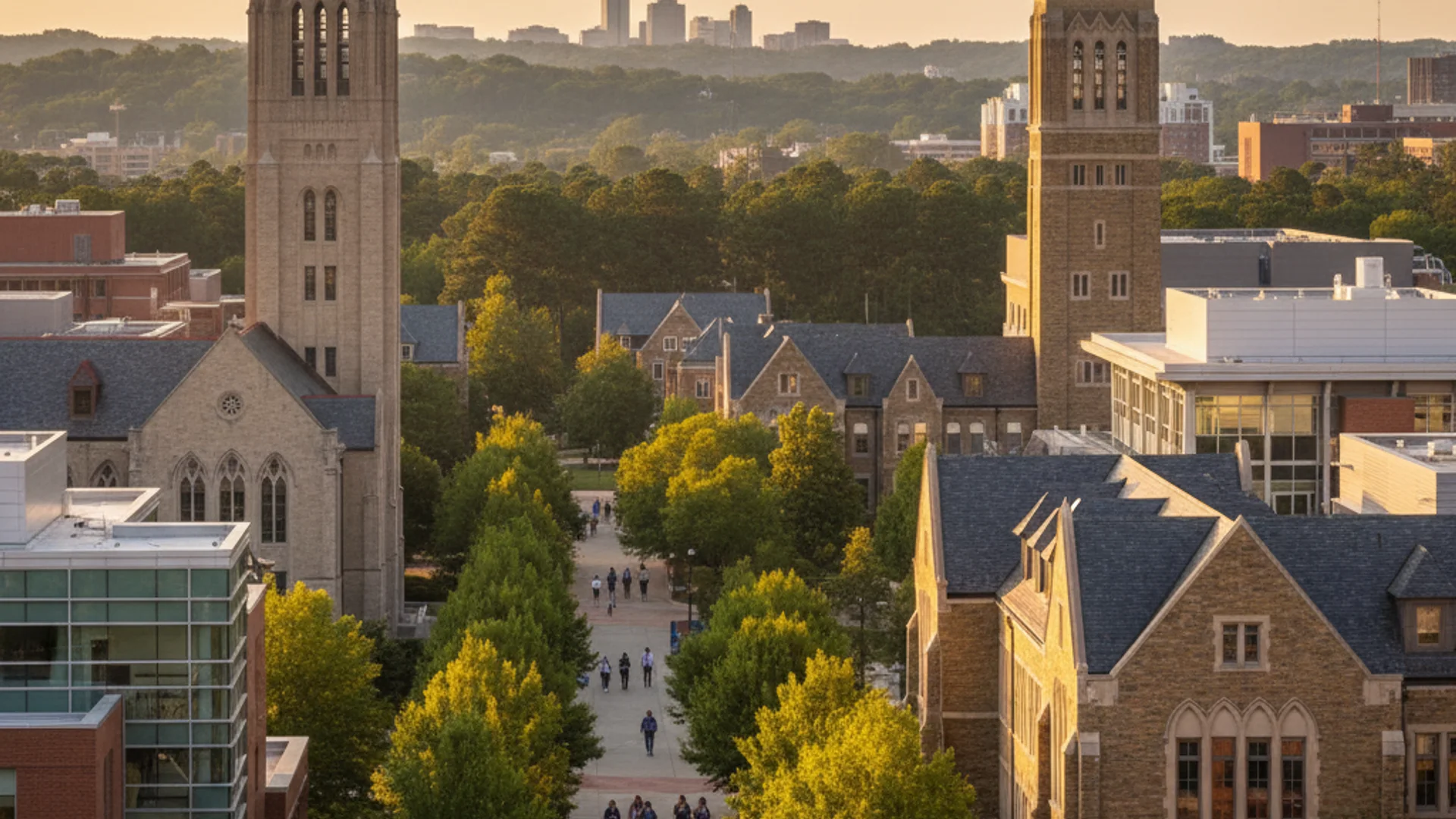
University campus in Georgia
Updated January 2026

Best Artificial Intelligence Degree Programs in Georgia — 2026 Rankings

Explore 15 accredited artificial intelligence (AI) degree programs in Georgia. Compare schools by graduation rate, salary outcomes, and tuition—from Georgia State University to Georgia State University.

#1 ProgramGeorgia State
Avg Salary$107,450
Tuition From$7,158/yr
Job Growth+22%

Key Takeaways

Top 3 ranked: Georgia State, U of Georgia, Emory

Based on graduation rates, program outcomes, and institutional quality

IPEDS 2023

Tuition ranges from $4,064 to $59,920/year

Georgia State offers the most affordable option at $7,158/yr

IPEDS 2023

Degree levels: 9 master's, 4 doctoral programs available in Georgia

From community college pathways to advanced research degrees

IPEDS 2023

7 Georgia programs offer online or hybrid formats

Flexible scheduling for working professionals

IPEDS 2023

Major employers: NCR, Mailchimp, SalesLoft, Calendly

Tech hubs in Atlanta and Savannah

Hakia Research 2026

Artificial Intelligence programs available near 64+ cities across Georgia

Search by city to find programs within 200 miles of your location

IPEDS 2023

Updated February 2026

On This Page
$107,450
Is Artificial Intelligence in Georgia Worth It?
Yes. Artificial Intelligence degrees in Georgia deliver strong ROI—graduates earn $107,450 median salary with +22% job growth through 2032. In-state tuition averages $16,502/year.

Source: BLS OEWS May 2024

Best Artificial Intelligence Degree Programs in Georgia

Bachelor's Artificial Intelligence Degree Programs in Georgia

13 programs$107,450 median salary86% avg grad rate
13
Programs
$107,450
Median Salary
$18,369/yr
Avg Tuition
86%
Avg Grad Rate

Program Landscape

Georgia ranks among the nation's top destinations for artificial intelligence education, with 13 accredited bachelor's degree programs across 8 public and 5 private institutions. The highest-ranked programs are Georgia State, U of Georgia, Emory, recognized for academic excellence, research opportunities, and strong industry connections.

Career Outcomes

Graduates from Georgia artificial intelligence programs earn a median salary of $91,333—7% below the national average. The state's robust technology sector, anchored by the Atlanta, Savannah, Augusta metropolitan areas, provides abundant internship and employment opportunities with companies including NCR, Mailchimp, SalesLoft.

Costs & Value

Tuition ranges from $4,064 to $59,920 annually, with an average of $18,369/yr. Top programs maintain graduation rates above 86%, with the highest reaching 97%. Many programs hold ABET accreditation, the gold standard for computing education, ensuring curriculum meets rigorous industry standards.

Curriculum & Specializations

Students can choose from specializations including software engineering, cybersecurity, artificial intelligence, data science, and systems architecture. Strong industry partnerships provide access to co-op programs, capstone projects with real companies, and direct recruiting pipelines to Georgia's leading technology employers. For students seeking artificial intelligence degrees in Georgia, these top-ranked artificial intelligence schools offer the strongest combination of academic rigor and career preparation.

Show:

Earn your bachelor's in Artificial Intelligence

(Sponsored)

Loading programs...

🥇

Georgia State University

Public
Atlanta, GA
$7,158
Tuition/yr
94%
Grad Rate
84.9
Score
Website
🥈

University of Georgia

Public
Athens, GA
$9,790
Tuition/yr
95%
Grad Rate
84.2
Score
Website
🥉

Emory University

Private
Atlanta, GA
$59,920
Tuition/yr
97%
Grad Rate
78.1
Score
Website
#4

Kennesaw State University

Public
Kennesaw, GA
$4,450
Tuition/yr
66%
Grad Rate
71.5
Score
Website
#5

Georgia Institute of Technology-Main Campus

Public
Atlanta, GA
$10,258
Tuition/yr
76%
Grad Rate
63.5
Score
Website
#6

Morehouse College

Private
Atlanta, GA
$27,984
Tuition/yr
91%
Grad Rate
57.4
Score
Website
#7

Mercer University

Private
Macon, GA
$33,080
Tuition/yr
88%
Grad Rate
53.3
Score
Website
#8

Clark Atlanta University

Private
Atlanta, GA
$23,484
Tuition/yr
85%
Grad Rate
48.7
Score
Website
#9

Berry College

Private
Mount Berry, GA
$40,140
Tuition/yr
96%
Grad Rate
48.8
Score
Website
#10

Georgia College & State University

Public
Milledgeville, GA
$7,508
Tuition/yr
79%
Grad Rate
48.9
Score
Website

Complete Artificial Intelligence Degree Program Rankings in Georgia

Best Bachelor's Artificial Intelligence Degree Programs in Georgia

### Program Landscape Georgia ranks among the nation's top destinations for artificial intelligence education, with **13 accredited** bachelor's degree programs across **8 public** and **5 private** institutions. The highest-ranked programs are **Georgia State**, **U of Georgia**, **Emory**, recognized for academic excellence, research opportunities, and strong industry connections. ### Career Outcomes Graduates from Georgia artificial intelligence programs earn a median salary of **$91,333**—7% below the national average. The state's robust technology sector, anchored by the Atlanta, Savannah, Augusta metropolitan areas, provides abundant internship and employment opportunities with companies including NCR, Mailchimp, SalesLoft. ### Costs & Value Tuition ranges from **$4,064** to **$59,920** annually, with an average of **$18,369/yr**. Top programs maintain graduation rates above **86%**, with the highest reaching **97%**. Many programs hold ABET accreditation, the gold standard for computing education, ensuring curriculum meets rigorous industry standards. ### Curriculum & Specializations Students can choose from specializations including software engineering, cybersecurity, artificial intelligence, data science, and systems architecture. Strong industry partnerships provide access to co-op programs, capstone projects with real companies, and direct recruiting pipelines to Georgia's leading technology employers. For students seeking artificial intelligence degrees in Georgia, these top-ranked artificial intelligence schools offer the strongest combination of academic rigor and career preparation.

  1. #1. Georgia State University

    Hakia ranks Georgia State University as the #1 bachelor's in artificial intelligence degree program in Georgia. This public institution in Atlanta, GA has annual tuition of $7,158 and a 94% graduation rate. Ranking score: 84.9.

  2. #2. University of Georgia

    Hakia ranks University of Georgia as the #2 bachelor's in artificial intelligence degree program in Georgia. This public institution in Athens, GA has annual tuition of $9,790 and a 95% graduation rate. Ranking score: 84.2.

  3. #3. Emory University

    Hakia ranks Emory University as the #3 bachelor's in artificial intelligence degree program in Georgia. This private institution in Atlanta, GA has annual tuition of $59,920 and a 97% graduation rate. Ranking score: 78.1.

  4. #4. Kennesaw State University

    Hakia ranks Kennesaw State University as the #4 bachelor's in artificial intelligence degree program in Georgia. This public institution in Kennesaw, GA has annual tuition of $4,450 and a 66% graduation rate. Ranking score: 71.5.

  5. #5. Georgia Institute of Technology-Main Campus

    Hakia ranks Georgia Institute of Technology-Main Campus as the #5 bachelor's in artificial intelligence degree program in Georgia. This public institution in Atlanta, GA has annual tuition of $10,258 and a 76% graduation rate. Ranking score: 63.5.

  6. #6. Morehouse College

    Hakia ranks Morehouse College as the #6 bachelor's in artificial intelligence degree program in Georgia. This private institution in Atlanta, GA has annual tuition of $27,984 and a 91% graduation rate. Ranking score: 57.4.

  7. #7. Mercer University

    Hakia ranks Mercer University as the #7 bachelor's in artificial intelligence degree program in Georgia. This private institution in Macon, GA has annual tuition of $33,080 and a 88% graduation rate. Ranking score: 53.3.

  8. #8. Clark Atlanta University

    Hakia ranks Clark Atlanta University as the #8 bachelor's in artificial intelligence degree program in Georgia. This private institution in Atlanta, GA has annual tuition of $23,484 and a 85% graduation rate. Ranking score: 48.7.

  9. #9. Berry College

    Hakia ranks Berry College as the #9 bachelor's in artificial intelligence degree program in Georgia. This private institution in Mount Berry, GA has annual tuition of $40,140 and a 96% graduation rate. Ranking score: 48.8.

  10. #10. Georgia College & State University

    Hakia ranks Georgia College & State University as the #10 bachelor's in artificial intelligence degree program in Georgia. This public institution in Milledgeville, GA has annual tuition of $7,508 and a 79% graduation rate. Ranking score: 48.9.

  11. #11. Georgia Southwestern State University

    Hakia ranks Georgia Southwestern State University as the #11 bachelor's in artificial intelligence degree program in Georgia. This public institution in Americus, GA has annual tuition of $4,064 and a 86% graduation rate. Ranking score: 44.6.

  12. #12. Clayton State University

    Hakia ranks Clayton State University as the #12 bachelor's in artificial intelligence degree program in Georgia. This public institution in Morrow, GA has annual tuition of $4,064. Ranking score: 44.9.

  13. #13. Augusta University

    Hakia ranks Augusta University as the #13 bachelor's in artificial intelligence degree program in Georgia. This public institution in Augusta, GA has annual tuition of $6,892 and a 73% graduation rate. Ranking score: 40.2.

Online Bachelor's Artificial Intelligence Degree Programs in Georgia

### Online Program Options 5 Georgia institutions offer bachelor's artificial intelligence degrees with online or hybrid options, enabling students to earn accredited degrees while maintaining professional or personal commitments. Top-ranked online programs include **Georgia State**, **Emory**, **Kennesaw State**, all regionally accredited and recognized by Georgia employers. ### Costs & Employer Recognition Online bachelor's programs average **$17,859/yr**—often comparable to or less than on-campus tuition. Georgia-based employers including NCR, Mailchimp, SalesLoft value online credentials from accredited institutions, recognizing that program quality matters more than delivery format. The Atlanta, Savannah, Augusta job market actively recruits graduates from online programs. ### Program Format These programs feature asynchronous coursework for maximum flexibility, with some offering synchronous sessions for collaborative learning. Students can typically complete **120 credit hours** in 4 years while working full-time. ### Technology & Flexibility Technology requirements include reliable internet access and a modern computer. Programs provide virtual labs, online tutoring, career services, and networking opportunities. Many offer start dates throughout the year and accelerated course formats for motivated students. Graduates earn the same degree as on-campus students, with no distinction on transcripts or diplomas. For students pursuing online artificial intelligence degrees in Georgia, these accredited artificial intelligence schools offer the flexibility and quality that today's learners demand.

  • Georgia State University - Atlanta, GA - Tuition: $7,158/year
  • Emory University - Atlanta, GA - Tuition: $59,920/year
  • Kennesaw State University - Kennesaw, GA - Tuition: $4,450/year
  • Georgia Institute of Technology-Main Campus - Atlanta, GA - Tuition: $10,258/year
  • Georgia College & State University - Milledgeville, GA - Tuition: $7,508/year

Best Master's Artificial Intelligence Degree Programs in Georgia

### Program Landscape Georgia offers **9** master's degree programs in artificial intelligence, designed for professionals seeking to advance into senior engineering, technical leadership, and specialized roles. The top programs—**Georgia Institute of Tech...**, **Georgia State**, **Kennesaw State**—combine advanced technical training with research opportunities and leadership development. ### Career Outcomes Master's graduates in Georgia earn a median salary of **$107,450**, approximately **20-30% higher** than bachelor's degree holders. The concentration of technology companies in Atlanta, Savannah, Augusta creates strong demand for graduate-level talent, with NCR, Mailchimp, SalesLoft actively recruiting from these programs. ### Costs & Value Program formats include traditional full-time study (typically 2 years), part-time options for working professionals (2-3 years), and accelerated tracks. Tuition averages **$14,207/yr**, with many employers offering tuition reimbursement for graduate education. Some programs offer thesis and non-thesis tracks, allowing students to focus on research or professional development based on their career goals. ### Curriculum & Specializations Curriculum covers advanced topics including machine learning, distributed systems, software architecture, and technical management. Many programs include practicum experiences, industry capstone projects, or consulting engagements that provide real-world application of advanced concepts. Among Georgia's artificial intelligence schools at the graduate level, these programs stand out for both academic quality and career outcomes.

  1. #1. Georgia Institute of Technology-Main Campus

    Hakia ranks Georgia Institute of Technology-Main Campus as the #1 master's in artificial intelligence degree program in Georgia. This public institution in Atlanta, GA has annual tuition of $10,258 and a 76% graduation rate. Ranking score: 89.8.

  2. #2. Georgia State University

    Hakia ranks Georgia State University as the #2 master's in artificial intelligence degree program in Georgia. This public institution in Atlanta, GA has annual tuition of $7,158 and a 94% graduation rate. Ranking score: 78.2.

  3. #3. Kennesaw State University

    Hakia ranks Kennesaw State University as the #3 master's in artificial intelligence degree program in Georgia. This public institution in Kennesaw, GA has annual tuition of $4,450 and a 66% graduation rate. Ranking score: 75.0.

  4. #4. Emory University

    Hakia ranks Emory University as the #4 master's in artificial intelligence degree program in Georgia. This private institution in Atlanta, GA has annual tuition of $59,920 and a 97% graduation rate. Ranking score: 77.4.

  5. #5. University of Georgia

    Hakia ranks University of Georgia as the #5 master's in artificial intelligence degree program in Georgia. This public institution in Athens, GA has annual tuition of $9,790 and a 95% graduation rate. Ranking score: 77.2.

  6. #6. Georgia Southern University

    Hakia ranks Georgia Southern University as the #6 master's in artificial intelligence degree program in Georgia. This public institution in Statesboro, GA has annual tuition of $4,371 and a 94% graduation rate. Ranking score: 51.1.

  7. #7. Georgia Southwestern State University

    Hakia ranks Georgia Southwestern State University as the #7 master's in artificial intelligence degree program in Georgia. This public institution in Americus, GA has annual tuition of $4,064 and a 86% graduation rate. Ranking score: 51.6.

  8. #8. Clark Atlanta University

    Hakia ranks Clark Atlanta University as the #8 master's in artificial intelligence degree program in Georgia. This private institution in Atlanta, GA has annual tuition of $23,484 and a 85% graduation rate. Ranking score: 49.2.

  9. #9. University of West Georgia

    Hakia ranks University of West Georgia as the #9 master's in artificial intelligence degree program in Georgia. This public institution in Carrollton, GA has annual tuition of $4,371. Ranking score: 47.0.

Online Master's Artificial Intelligence Degree Programs in Georgia

### Online Program Options Working professionals can advance their careers through 6 online master's artificial intelligence programs from Georgia universities, designed for flexibility without sacrificing academic rigor. Top-ranked online programs include **Georgia Institute of Tech...**, **Georgia State**, **Kennesaw State**, all regionally accredited and recognized by Georgia employers. ### Costs & Employer Recognition Online master's programs average **$15,088/yr**—often comparable to or less than on-campus tuition. Georgia-based employers including NCR, Mailchimp, SalesLoft value online credentials from accredited institutions, recognizing that program quality matters more than delivery format. The Atlanta, Savannah, Augusta job market actively recruits graduates from online programs. ### Program Format These programs feature asynchronous coursework for maximum flexibility, with some offering synchronous sessions for collaborative learning. Students can typically complete **30-36 credit hours** in 18-24 months while working full-time. ### Technology & Flexibility Technology requirements include reliable internet access and a modern computer. Programs provide virtual labs, online tutoring, career services, and networking opportunities. Many offer start dates throughout the year and accelerated course formats for motivated students. Graduates earn the same degree as on-campus students, with no distinction on transcripts or diplomas. For students pursuing online artificial intelligence degrees in Georgia, these accredited artificial intelligence schools offer the flexibility and quality that today's learners demand.

  • Georgia Institute of Technology-Main Campus - Atlanta, GA - Tuition: $10,258/year
  • Georgia State University - Atlanta, GA - Tuition: $7,158/year
  • Kennesaw State University - Kennesaw, GA - Tuition: $4,450/year
  • Emory University - Atlanta, GA - Tuition: $59,920/year
  • Georgia Southern University - Statesboro, GA - Tuition: $4,371/year
  • University of West Georgia - Carrollton, GA - Tuition: $4,371/year

Best Doctoral Artificial Intelligence Degree Programs in Georgia

### Program Landscape Georgia is home to **4** doctoral programs in artificial intelligence, preparing students for research positions, faculty appointments, and executive technical roles. Leading programs at **Emory**, **U of Georgia**, **Georgia State** are recognized for cutting-edge research, strong faculty publications, and competitive funding packages. ### Career Outcomes Doctoral graduates command premium salaries, with Georgia PhD holders earning a median of **$134,313**—reflecting the advanced expertise required for research and executive positions. The Atlanta, Savannah, Augusta region's research universities and corporate R&D centers provide extensive collaboration opportunities with industry leaders like NCR, Mailchimp, SalesLoft. ### Costs & Value PhD programs typically require 4-6 years of full-time study, including coursework, qualifying examinations, and original dissertation research. Many programs offer full funding through teaching or research assistantships, covering tuition and providing stipends of **$25,000–$40,000** annually. ### Curriculum & Specializations Research strengths across Georgia programs include artificial intelligence, cybersecurity, human-computer interaction, systems, and theoretical computer science. For aspiring researchers pursuing artificial intelligence degrees in Georgia, graduates go on to careers as university faculty, industry research scientists, or technical executives, contributing to advances in technology that impact millions of users worldwide.

  1. #1. Emory University

    Hakia ranks Emory University as the #1 doctoral in artificial intelligence degree program in Georgia. This private institution in Atlanta, GA has annual tuition of $59,920 and a 97% graduation rate. Ranking score: 66.2.

  2. #2. University of Georgia

    Hakia ranks University of Georgia as the #2 doctoral in artificial intelligence degree program in Georgia. This public institution in Athens, GA has annual tuition of $9,790 and a 95% graduation rate. Ranking score: 60.0.

  3. #3. Georgia State University

    Hakia ranks Georgia State University as the #3 doctoral in artificial intelligence degree program in Georgia. This public institution in Atlanta, GA has annual tuition of $7,158 and a 94% graduation rate. Ranking score: 55.1.

  4. #4. Georgia Institute of Technology-Main Campus

    Hakia ranks Georgia Institute of Technology-Main Campus as the #4 doctoral in artificial intelligence degree program in Georgia. This public institution in Atlanta, GA has annual tuition of $10,258 and a 76% graduation rate. Ranking score: 74.2.

Online Doctoral Artificial Intelligence Degree Programs in Georgia

### Online Program Options 3 Georgia universities offer doctoral artificial intelligence programs with online or hybrid components, accommodating established professionals pursuing terminal degrees. Top-ranked online programs include **Emory**, **Georgia State**, **Georgia Institute of Tech...**, all regionally accredited and recognized by Georgia employers. ### Costs & Employer Recognition Online doctoral programs average **$25,779/yr**—often comparable to or less than on-campus tuition. Georgia-based employers including NCR, Mailchimp, SalesLoft value online credentials from accredited institutions, recognizing that program quality matters more than delivery format. The Atlanta, Savannah, Augusta job market actively recruits graduates from online programs. ### Program Format These programs feature asynchronous coursework for maximum flexibility, with some offering synchronous sessions for collaborative learning. Students can typically complete doctoral requirements in 3-5 years while working full-time. ### Technology & Flexibility Technology requirements include reliable internet access and a modern computer. Programs provide virtual labs, online tutoring, career services, and networking opportunities. Many offer start dates throughout the year and accelerated course formats for motivated students. Graduates earn the same degree as on-campus students, with no distinction on transcripts or diplomas. For students pursuing online artificial intelligence degrees in Georgia, these accredited artificial intelligence schools offer the flexibility and quality that today's learners demand.

  • Emory University - Atlanta, GA - Tuition: $59,920/year
  • Georgia State University - Atlanta, GA - Tuition: $7,158/year
  • Georgia Institute of Technology-Main Campus - Atlanta, GA - Tuition: $10,258/year

Artificial Intelligence Tuition in Georgia

MetricValue
Average in-state tuition$16,502/year
Average out-of-state tuition$41,255/year
Community college tuition$4,126/year
4-year savings for residents$99,012
2+2 transfer pathway savings$24,752

Source: IPEDS 2023

Artificial Intelligence Financial Aid & Scholarships in Georgia

State Aid Programs

Georgia's HOPE Scholarship significantly reduces AI education costs.

Funded by the Georgia Lottery, HOPE provides tuition assistance for Georgia residents maintaining a 3.0 GPA at eligible Georgia institutions (GAFutures). Recipients can receive aid through 127 attempted hours with a seven-year time limit. HOPE covers substantial tuition at public universities, making Georgia Tech's world-class AI education accessible. Students must complete the FAFSA or Georgia Student Financial Aid Application (GSFAPPS) annually to maintain eligibility.

Key Programs & Amounts

The Zell Miller Scholarship provides full tuition coverage for top performers.

Requirements include graduating high school with a 3.7 GPA AND either 1200 SAT or 25 ACT (Zell Miller). For 2025-2026, Zell Miller pays 100% of in-state tuition—up to $10,512 for full-time enrollment at Georgia Tech. Maintaining eligibility requires a 3.30 GPA at 30, 60, and 90 attempted hour checkpoints. Students who lose Zell Miller may still qualify for HOPE, providing a safety net for challenging AI coursework.

Institutional Scholarships

Additional funding sources complement state scholarships.

The maximum Pell Grant reached $7,395 for 2024-25 (StudentAid.gov). Combined with HOPE or Zell Miller, federal aid can cover most costs at Georgia public universities. AI-focused students should pursue departmental scholarships—Georgia Tech's College of Computing offers merit awards for outstanding students, women in computing, and underrepresented groups. Tech companies including Google, Microsoft, and NVIDIA fund AI-specific scholarships. Graduate students can access research assistantships and teaching assistantships that cover tuition plus stipends. For affordable options, explore most affordable AI programs.

Calculate Your Artificial Intelligence Degree ROI in Georgia

Use our interactive ROI calculator to estimate your return on investment for a artificial intelligence degree in Georgia. Enter your expected tuition costs, financial aid, and career goals to see projected payback periods and lifetime earnings. The calculator uses current salary data from BLS and tuition data from IPEDS to provide accurate estimates.

Artificial Intelligence Degree ROI Calculator
Estimate your return on investment for a artificial intelligence degree
$

Leave blank to use average cost for selected program type

20 years
10 years20 years30 years
20-Year ROI

+854%

Net gain divided by total investment. ROI above 200% is considered excellent for education investments.

Net Gain

$1,580,373

Your additional lifetime earnings with this degree vs. working without one, minus the total investment.

Break-Even

5 years

Years until your cumulative earnings exceed total investment. Shorter programs often break even faster due to lower opportunity cost.

COL-Adjusted Salary

$135,000

Your starting salary adjusted for local cost of living. This shows real purchasing power compared to a $100K national baseline.

Why does break-even change with program type? Your "total investment" includes both tuition AND opportunity cost (foregone earnings while in school). A 4-year full-time public university (in-state) means 4 years of not earning a salary ($140,000 in opportunity cost). Shorter full-time programs may have higher tuition but lower total investment because you return to the workforce sooner.

Detailed Breakdown
How we calculate your degree ROI using real salary data
Total Investment$185,000

Tuition plus opportunity cost (earnings you miss while in school)

Program Cost (Tuition)$45,000

Direct cost of the degree program

Opportunity Cost$140,000

4 years × $35K/year foregone salary while studying full-time

20-Year Earnings (with degree)$2,615,781

Projected career earnings starting after graduation, with salary growth

20-Year Earnings (without degree)$850,408

What you'd earn working at $35K/year with 2% annual growth

Starting Salary (Atlanta, GA)$135,000

Median salary for this role in your selected location (BLS 2024)

Annualized Return4.7%

Your investment's compound annual growth rate (similar to stock market returns)

Data sources: BLS OEWS May 2024, IPEDS 2023. Calculations use median salaries, 3% discount rate, and assume salary growth declines from 6% to 2% over career. Individual results will vary. | Powered by Hakia.com

Career Paths

Design and develop software applications and systems

Median Salary:$121,418

Analyze complex datasets and build predictive models

Median Salary:$101,003

Protect computer networks from cyber threats

Median Salary:$112,823

Manage cloud infrastructure and deployment pipelines

Median Salary:$119,270

Design and maintain cloud computing infrastructure

Median Salary:$116,046

Build and deploy machine learning models

Median Salary:$135,387
Artificial Intelligence Salaries by Metro Area

Median annual salary in Georgia metro areas

Hakia.com
View data table
Categoryvalue
Atlanta$118K
Savannah$113K
Augusta$107K

Source: BLS OEWS May 2024

Hakia.com

Artificial Intelligence Jobs in Georgia: Top Employers Hiring

Find artificial intelligence jobs in Georgia. These major employers across Georgia metro areas are actively hiring artificial intelligence graduates. Click employer names to view current job openings.

Artificial Intelligence Jobs in Atlanta

GA

Atlanta is a major tech hub anchored by Georgia Tech, with strong fintech, retail tech, and enterprise software sectors.

Nearby cities: Alpharetta, Sandy Springs, Marietta, Buckhead, Midtown

Microsoft
Enterprise Software/Cloud
Google
Search/Cloud/AI
Salesforce
Enterprise CRM
NCR Corporation
Financial Tech/POS
The Home Depot
Retail Tech
Delta Air Lines
Aviation Tech
Mailchimp (Intuit)
Marketing Tech
Cox Enterprises
Media/Telecom
Equifax
Data/Financial Services
Cardlytics
Fintech

How to Apply to Artificial Intelligence Programs in Georgia

1

Research Program Requirements

Review admission requirements for artificial intelligence programs at your target schools. Requirements vary by institution and degree level.

2

Prepare Application Materials

Gather transcripts, test scores (SAT/ACT for undergrad, GRE for graduate), letters of recommendation, and personal statement.

3

Apply for Financial Aid

Complete the FAFSA by priority deadlines.

4

Submit Applications Before Deadlines

Apply early for priority consideration. Early action/decision deadlines are typically October-November; regular deadlines December-January.

5

Complete Enrollment Steps

Accept your offer, submit enrollment deposit, complete orientation requirements, and register for classes.

Artificial Intelligence Transfer Pathways in Georgia

State Transfer System

Georgia's University System provides streamlined transfer pathways through the Core IMPACTS curriculum. All 26 USG institutions accept the 42-hour general education core plus an 18-hour Field of Study (USG Academic Handbook). Students completing core courses at any USG institution—including technical colleges—receive full credit upon transfer to another USG school within the same major. This eliminates the common transfer problem where students lose credits; Georgia transfer students retain significantly more coursework than the national average of 43% credit loss.

How Transfers Work

Critical consideration: Computer Science is excluded from Georgia Tech pathway programs.

Unlike other majors, CS is not eligible for Georgia Tech's First-Generation, Family, Conditional, or Talent Initiative pathways due to extreme demand (Georgia Tech Transfer). Students targeting Georgia Tech's AI-focused CS program should pursue regular transfer admission with exceptional grades (3.5+ GPA, admitted average 3.8) in foundational coursework including calculus, programming, and discrete mathematics. Alternative targets include Georgia State University, Kennesaw State, and UGA, which offer strong computing programs with higher transfer acceptance rates.

Transfer Planning Tips

Strategic course planning maximizes transfer success.

Complete the calculus sequence through differential equations, linear algebra (essential for AI/ML), introductory programming in Python or Java, data structures, and discrete mathematics. The USG-TCSG articulation agreement allows 28 general education courses to transfer seamlessly between Technical College System of Georgia and USG institutions. Students should use the Georgia Transfer credit tool to verify exact course equivalencies before enrolling. Community college completion can reduce total bachelor's degree costs by 40% or more while maintaining clear pathways to AI-focused programs.

Why Study Artificial Intelligence in Georgia?

Industry & Workforce

Georgia has emerged as a major hub for artificial intelligence education and employment, anchored by Georgia Institute of Technology's world-renowned AI research programs. According to Brookings Institution research, the Atlanta metropolitan area ranks among the top regions nationally for AI readiness, with strong concentrations of AI-related employment and research infrastructure (Brookings AI Economy). Georgia Tech's College of Computing houses over 140 faculty members conducting cutting-edge research across machine learning, natural language processing, computer vision, and robotics, providing students exceptional opportunities to learn from leading AI researchers.

Salary Outlook

The salary outlook for AI professionals in Georgia is exceptionally strong.

Data scientists and machine learning engineers in the Atlanta metro earn median salaries of $125,000-$145,000 annually, with senior AI engineers commanding $160,000-$200,000+ at major tech companies (BLS OEWS May 2024). The Bureau of Labor Statistics projects 35% growth for data scientists through 2033, significantly outpacing average occupations. Georgia's lower cost of living compared to Silicon Valley or New York means AI professionals enjoy greater purchasing power, particularly in housing costs where median home prices remain well below coastal tech hub levels.

Regional Tech Hubs

Atlanta's tech ecosystem actively recruits AI talent across diverse industries.

Major employers including The Home Depot, Cox Automotive, Delta Air Lines, NCR Voyix, and numerous fintech companies deploy AI for personalization, predictive analytics, and automation. Georgia Tech's proximity to Fortune 500 headquarters creates robust internship and full-time hiring pipelines. The state's AI workforce development is further supported by research partnerships between Georgia Tech, Emory University, and industry leaders. Students considering AI education should also compare programs in California, Massachusetts, or explore our national AI rankings.

Artificial Intelligence Job Market in Georgia

Employment Outlook

Georgia's AI job market is experiencing rapid expansion.

According to CompTIA's State of the Tech Workforce 2025, Georgia's tech sector contributes $58.6 billion to the state economy, with AI and machine learning roles representing one of the fastest-growing segments (CompTIA 2025). The Atlanta metro alone employs over 156,000 tech professionals, with AI specialists increasingly in demand across financial services, healthcare, logistics, and retail sectors. The Bureau of Labor Statistics projects 35% growth for data scientists nationally through 2033, with Georgia capturing a significant share of this expansion.

Salaries by Metro

Salary ranges vary by role and experience level:

  • Entry-level ML Engineers: $95,000-$115,000 annually
  • Mid-career Data Scientists: $120,000-$145,000
  • Senior AI Engineers: $150,000-$185,000
  • AI Research Scientists: $140,000-$200,000+
  • AI/ML Managers: $170,000-$220,000+ Top-paying employers include major tech companies with Atlanta operations (Google, Microsoft, Salesforce), fintech firms (Fiserv, Intercontinental Exchange), and Fortune 500 technology divisions (Home Depot, Delta, UPS). Georgia Tech graduates particularly benefit from strong alumni networks and on-campus recruiting by AI-focused employers (Georgia Tech Career Center).

High-Growth Sectors

High-growth AI application areas in Georgia include: predictive analytics for financial services and insurance, supply chain optimization for logistics companies centered around Atlanta's transportation hub, healthcare AI at Emory Healthcare and numerous health tech startups, retail personalization at Home Depot and Mailchimp, and autonomous systems research at Georgia Tech Research Institute. The Augusta Cyber Center at Fort Eisenhower also drives demand for AI specialists with security clearances working on defense applications. For related career paths, explore machine learning degrees or data science programs.

Artificial Intelligence Curriculum & Specializations in Georgia

Core Requirements

Georgia Tech's Intelligence thread provides comprehensive AI preparation.

The curriculum combines foundational computer science with specialized AI coursework including: CS 3600 (Introduction to Artificial Intelligence) covering search, planning, and machine learning basics; CS 4641 (Machine Learning) with supervised, unsupervised, and reinforcement learning; CS 4649 (Robot Intelligence: Planning) for robotics applications; and CS 4650 (Natural Language Processing) for language AI (Georgia Tech Catalog). Students combine Intelligence with a second thread—such as Information Internetworks, Media, or Systems—creating customized AI-focused degrees.

Degree Pathways

Core mathematical foundations essential for AI study include: calculus through differential equations, linear algebra (critical for understanding neural networks), probability and statistics, and discrete mathematics. Georgia Tech requires CS 2050 (Discrete Mathematics) and MATH 3012 (Applied Combinatorics) or equivalents. Strong programming skills in Python are essential, as Python dominates AI/ML tooling including TensorFlow, PyTorch, scikit-learn, and Pandas. Students should also develop familiarity with cloud computing platforms (AWS, Google Cloud, Azure) where AI models are typically deployed (Georgia Tech CS Requirements).

Specialization Tracks

Hands-on experience distinguishes top programs.

Georgia Tech emphasizes project-based learning with capstone courses requiring original AI implementations. The VIP (Vertically Integrated Projects) program allows undergraduates to join ongoing faculty research in AI areas including robotics, computer vision, healthcare AI, and autonomous systems. Graduate students can access cutting-edge research facilities including the Institute for Robotics and Intelligent Machines (IRIM) and the Machine Learning Center (ML@GT). Students should build portfolios through class projects, Kaggle competitions, and personal AI projects. For related specializations, explore data science programs or machine learning degrees.

Online vs On-Campus Artificial Intelligence Programs in Georgia

Online Program Growth

Georgia Tech's Online Master of Science in Computer Science (OMSCS) offers world-class AI education at exceptional value. The Machine Learning specialization provides graduate-level AI training for approximately $7,000 total—a fraction of comparable on-campus programs (OMSCS). OMSCS maintains the same rigorous curriculum and ABET accreditation as the on-campus program, with courses taught by the same faculty. The program enrolls over 10,000 students globally and can be completed in 2-3 years while working full-time. This represents one of the most cost-effective paths to AI credentials nationally.

Accredited Online Options

The Online Master of Science in Analytics (OMS Analytics) provides another pathway to AI careers. This interdisciplinary program combines computer science, statistics, and business analytics, with specializations in Analytical Tools, Business Analytics, and Computational Data Analytics. Total cost approximates $10,000 for Georgia residents. Georgia Tech Professional Education also offers graduate certificates in Machine Learning for professionals seeking focused AI credentials without full master's programs. These certificates can later apply toward full degree completion (Georgia Tech Professional Education).

Choosing Your Format

Undergraduate online options are more limited but growing.

Georgia Southern University and Middle Georgia State University offer online computing degrees with AI-related coursework. For students seeking flexibility while maintaining in-person access, most Georgia universities offer hybrid arrangements. Critical considerations for online AI learners: verify SACSCOC regional accreditation, ensure programs include hands-on projects with real datasets, and actively build portfolios through personal projects. Online students should participate in virtual AI communities, contribute to open-source projects, and pursue remote internships. Compare with our best online AI programs.

Artificial Intelligence by City in Georgia

Atlanta

Atlanta dominates Georgia's AI employment landscape with median AI/ML salaries of $130,000-$150,000 for experienced professionals. The tech sector contributes $58.6 billion to the metro economy, with AI roles concentrated in Midtown (Georgia Tech/Tech Square), Buckhead (corporate headquarters), and along the BeltLine corridor (CompTIA 2025). Cost of living has risen significantly—median home prices exceed $400,000—but remains well below Bay Area, Seattle, or NYC levels. The concentration of Fortune 500 headquarters and tech company offices creates exceptional networking and job opportunities for AI professionals.

Augusta

Augusta offers unique AI opportunities in defense and cybersecurity. The Army Cyber Center at Fort Eisenhower hosts one of the nation's largest concentrations of cleared technical professionals, with AI applications in threat detection, autonomous systems, and cybersecurity. Companies like ManTech, Leidos, and defense contractors maintain significant presences. AI salaries in Augusta average $100,000-$130,000 with security clearance premiums. The lower cost of living—median home prices around $250,000—makes Augusta attractive for AI professionals willing to work in defense applications.

Athens

Athens ($90,000-$110,000 median) benefits from University of Georgia's growing AI research ecosystem and startup scene. The college town offers affordable living with median home prices around $300,000. Savannah is emerging with logistics AI applications driven by the Port of Savannah's technology needs. Columbus and Macon represent smaller markets with modest but growing AI presences, primarily serving regional healthcare and manufacturing organizations. Remote work has expanded AI job access—an estimated 22% of Atlanta tech workers work remotely, normalizing distributed AI teams. Compare opportunities in neighboring North Carolina or Florida.

Compare Online Artificial Intelligence Programs in Georgia

View tuition costs, program formats & enrollment info

Find Artificial Intelligence Programs Near You in Georgia

Search by city to find accredited artificial intelligence programs ranked by our state methodology.

Artificial Intelligence Degree Programs by City in Georgia

Artificial Intelligence Degree Programs Near Atlanta, Georgia

As Georgia's AI and tech hub, Atlanta hosts major corporate R&D centers for Delta Air Lines (autonomous logistics optimization), Home Depot (computer vision for supply chain), and UPS (autonomous delivery systems), alongside Georgia Tech's world-renowned College of Computing with cutting-edge AI, robotics, and machine learning labs. The city's thriving startup ecosystem in Midtown and Tech Square offers accelerators and venture funding specifically targeting AI applications, making it the primary destination for AI engineers seeking both established corporate roles and entrepreneurial opportunities.

Atlanta is located in Fulton County, Georgia.

Associate's Artificial Intelligence Degree Programs Near Atlanta, Georgia
  1. Gordon State College (Public) — State #1, 52.8 mi from Atlanta. Tuition: $2,563/year.
  2. Georgia Military College (Public) — State #3, 82.6 mi from Atlanta. Tuition: $7,605/year.
  3. Interactive College of Technology-Chamblee (For-Profit) — State #4, 8.2 mi from Atlanta. Tuition: $11,280/year.
Bachelor's Artificial Intelligence Degree Programs Near Atlanta, Georgia
  1. Georgia Institute of Technology-Main Campus (Public) — State #1, in Atlanta. Tuition: $10,258/year. Graduation rate: 76%.
  2. University of Georgia (Public) — State #2, 58.9 mi from Atlanta. Tuition: $9,790/year. Graduation rate: 95%.
  3. Emory University (Private) — State #3, in Atlanta. Tuition: $59,920/year. Graduation rate: 97%.
Master's Artificial Intelligence Degree Programs Near Atlanta, Georgia
  1. Georgia Institute of Technology-Main Campus (Public) — State #1, in Atlanta. Tuition: $10,258/year. Graduation rate: 76%.
  2. Emory University (Private) — State #2, in Atlanta. Tuition: $59,920/year. Graduation rate: 97%.
  3. University of Georgia (Public) — State #3, 58.9 mi from Atlanta. Tuition: $9,790/year. Graduation rate: 95%.
Doctoral Artificial Intelligence Degree Programs Near Atlanta, Georgia
  1. Emory University (Private) — State #1, in Atlanta. Tuition: $59,920/year. Graduation rate: 97%.
  2. Georgia Institute of Technology-Main Campus (Public) — State #2, in Atlanta. Tuition: $10,258/year. Graduation rate: 76%.
  3. University of Georgia (Public) — State #3, 58.9 mi from Atlanta. Tuition: $9,790/year. Graduation rate: 95%.

Artificial Intelligence Degree Programs Near Augusta, Georgia

Augusta's growing healthcare and biotech sector, anchored by the Georgia Cyber Innovation and Training Consortium and Fort Gordon's federal AI initiatives, creates niche opportunities in medical AI and defense-related autonomous systems research. Though smaller than Atlanta, Augusta offers lower cost-of-living advantages while accessing regional partnerships with Georgia Tech and proximity to emerging AI applications in healthcare diagnostics and cybersecurity.

Augusta is located in Richmond County, Georgia.

Associate's Artificial Intelligence Degree Programs Near Augusta, Georgia
  1. Gordon State College (Public) — State #1, 125.9 mi from Augusta. Tuition: $2,563/year.
  2. Savannah Technical College (Public) — State #2, 113.3 mi from Augusta. Tuition: $2,400/year.
  3. Georgia Military College (Public) — State #3, 73.8 mi from Augusta. Tuition: $7,605/year.
Bachelor's Artificial Intelligence Degree Programs Near Augusta, Georgia
  1. Georgia Institute of Technology-Main Campus (Public) — State #1, 137.4 mi from Augusta. Tuition: $10,258/year. Graduation rate: 76%.
  2. University of Georgia (Public) — State #2, 84 mi from Augusta. Tuition: $9,790/year. Graduation rate: 95%.
  3. Emory University (Private) — State #3, 133.6 mi from Augusta. Tuition: $59,920/year. Graduation rate: 97%.
Master's Artificial Intelligence Degree Programs Near Augusta, Georgia
  1. Georgia Institute of Technology-Main Campus (Public) — State #1, 137.4 mi from Augusta. Tuition: $10,258/year. Graduation rate: 76%.
  2. Emory University (Private) — State #2, 133.6 mi from Augusta. Tuition: $59,920/year. Graduation rate: 97%.
  3. University of Georgia (Public) — State #3, 84 mi from Augusta. Tuition: $9,790/year. Graduation rate: 95%.
Doctoral Artificial Intelligence Degree Programs Near Augusta, Georgia
  1. Emory University (Private) — State #1, 133.6 mi from Augusta. Tuition: $59,920/year. Graduation rate: 97%.
  2. Georgia Institute of Technology-Main Campus (Public) — State #2, 137.4 mi from Augusta. Tuition: $10,258/year. Graduation rate: 76%.
  3. University of Georgia (Public) — State #3, 84 mi from Augusta. Tuition: $9,790/year. Graduation rate: 95%.

Artificial Intelligence Degree Programs Near Savannah, Georgia

Savannah's port authority and logistics infrastructure position it as an emerging hub for autonomous shipping and supply chain optimization research, with local employers like Gulfstream Aerospace exploring AI-enhanced manufacturing and robotics. Savannah College of Art and Design (SCAD) increasingly intersects AI with digital media and computer vision applications, creating specialized opportunities for researchers focused on visual AI and industrial automation rather than general computer science.

Savannah is located in Chatham County, Georgia.

Associate's Artificial Intelligence Degree Programs Near Savannah, Georgia
  1. Gordon State College (Public) — State #1, 191.5 mi from Savannah. Tuition: $2,563/year.
  2. Savannah Technical College (Public) — State #2, in Savannah. Tuition: $2,400/year.
  3. Georgia Military College (Public) — State #3, 143.8 mi from Savannah. Tuition: $7,605/year.
Bachelor's Artificial Intelligence Degree Programs Near Savannah, Georgia
  1. University of Georgia (Public) — State #2, 187.8 mi from Savannah. Tuition: $9,790/year. Graduation rate: 95%.
  2. Georgia Southern University (Public) — State #5, 48.8 mi from Savannah. Tuition: $4,371/year. Graduation rate: 94%.
  3. Mercer University (Private) — State #8, 158.9 mi from Savannah. Tuition: $33,080/year. Graduation rate: 88%.
Master's Artificial Intelligence Degree Programs Near Savannah, Georgia
  1. University of Georgia (Public) — State #3, 187.8 mi from Savannah. Tuition: $9,790/year. Graduation rate: 95%.
  2. Mercer University (Private) — State #6, 158.9 mi from Savannah. Tuition: $33,080/year. Graduation rate: 88%.
  3. Georgia Southern University (Public) — State #9, 48.8 mi from Savannah. Tuition: $4,371/year. Graduation rate: 94%.
Doctoral Artificial Intelligence Degree Programs Near Savannah, Georgia
  1. University of Georgia (Public) — State #3, 187.8 mi from Savannah. Tuition: $9,790/year. Graduation rate: 95%.

Artificial Intelligence Degree Programs Near Macon, Georgia

Macon is a smaller regional center with limited direct AI employment but serves as an affordable satellite location for remote AI workers and graduate students attending Mercer University's engineering programs. The city's proximity to Atlanta (90 minutes) makes it viable for those seeking lower living costs while commuting to or freelancing for major AI research institutions and companies in the metro area.

Macon is located in Bibb County, Georgia.

Associate's Artificial Intelligence Degree Programs Near Macon, Georgia
  1. Gordon State College (Public) — State #1, 29.8 mi from Macon. Tuition: $2,563/year.
  2. Savannah Technical College (Public) — State #2, 161.1 mi from Macon. Tuition: $2,400/year.
  3. Georgia Military College (Public) — State #3, 31.9 mi from Macon. Tuition: $7,605/year.
Bachelor's Artificial Intelligence Degree Programs Near Macon, Georgia
  1. Georgia Institute of Technology-Main Campus (Public) — State #1, 75.5 mi from Macon. Tuition: $10,258/year. Graduation rate: 76%.
  2. University of Georgia (Public) — State #2, 78.9 mi from Macon. Tuition: $9,790/year. Graduation rate: 95%.
  3. Emory University (Private) — State #3, 74.5 mi from Macon. Tuition: $59,920/year. Graduation rate: 97%.
Master's Artificial Intelligence Degree Programs Near Macon, Georgia
  1. Georgia Institute of Technology-Main Campus (Public) — State #1, 75.5 mi from Macon. Tuition: $10,258/year. Graduation rate: 76%.
  2. Emory University (Private) — State #2, 74.5 mi from Macon. Tuition: $59,920/year. Graduation rate: 97%.
  3. University of Georgia (Public) — State #3, 78.9 mi from Macon. Tuition: $9,790/year. Graduation rate: 95%.
Doctoral Artificial Intelligence Degree Programs Near Macon, Georgia
  1. Emory University (Private) — State #1, 74.5 mi from Macon. Tuition: $59,920/year. Graduation rate: 97%.
  2. Georgia Institute of Technology-Main Campus (Public) — State #2, 75.5 mi from Macon. Tuition: $10,258/year. Graduation rate: 76%.
  3. University of Georgia (Public) — State #3, 78.9 mi from Macon. Tuition: $9,790/year. Graduation rate: 95%.

Artificial Intelligence Degree Programs Near Decatur, Georgia

Decatur's strong connection to Georgia Tech through proximity and partnership programs, combined with its affluent suburb status near Atlanta, attracts AI researchers seeking collaborative academic-industry roles without downtown congestion. The city serves as a residential hub for Georgia Tech faculty and PhD students working on AI projects, with easy access to the university's robotics labs, AI ethics research centers, and tech company partnerships.

Decatur is located in DeKalb County, Georgia.

Associate's Artificial Intelligence Degree Programs Near Decatur, Georgia
  1. Gordon State College (Public) — State #1, 49.1 mi from Decatur. Tuition: $2,563/year.
  2. Georgia Military College (Public) — State #3, 76 mi from Decatur. Tuition: $7,605/year.
  3. Interactive College of Technology-Chamblee (For-Profit) — State #4, 9.7 mi from Decatur. Tuition: $11,280/year.
Bachelor's Artificial Intelligence Degree Programs Near Decatur, Georgia
  1. Georgia Institute of Technology-Main Campus (Public) — State #1, 7.5 mi from Decatur. Tuition: $10,258/year. Graduation rate: 76%.
  2. University of Georgia (Public) — State #2, 53.2 mi from Decatur. Tuition: $9,790/year. Graduation rate: 95%.
  3. Emory University (Private) — State #3, 4.3 mi from Decatur. Tuition: $59,920/year. Graduation rate: 97%.
Master's Artificial Intelligence Degree Programs Near Decatur, Georgia
  1. Georgia Institute of Technology-Main Campus (Public) — State #1, 7.5 mi from Decatur. Tuition: $10,258/year. Graduation rate: 76%.
  2. Emory University (Private) — State #2, 4.3 mi from Decatur. Tuition: $59,920/year. Graduation rate: 97%.
  3. University of Georgia (Public) — State #3, 53.2 mi from Decatur. Tuition: $9,790/year. Graduation rate: 95%.
Doctoral Artificial Intelligence Degree Programs Near Decatur, Georgia
  1. Emory University (Private) — State #1, 4.3 mi from Decatur. Tuition: $59,920/year. Graduation rate: 97%.
  2. Georgia Institute of Technology-Main Campus (Public) — State #2, 7.5 mi from Decatur. Tuition: $10,258/year. Graduation rate: 76%.
  3. University of Georgia (Public) — State #3, 53.2 mi from Decatur. Tuition: $9,790/year. Graduation rate: 95%.

Artificial Intelligence Degree Programs Near Lawrenceville, Georgia

Gwinnett County's rapidly diversifying tech corridor hosts major manufacturing and logistics operations where AI applications in robotics and predictive maintenance are expanding, particularly through UPS regional operations and automotive suppliers. Proximity to Georgia Tech and Kennesaw State University's engineering programs provides local talent pipelines, while the area's lower costs than Atlanta make it attractive for established AI researchers seeking suburban quality-of-life with corporate research opportunities.

Lawrenceville is located in Gwinnett County, Georgia.

Associate's Artificial Intelligence Degree Programs Near Lawrenceville, Georgia
  1. Gordon State College (Public) — State #1, 63.7 mi from Lawrenceville. Tuition: $2,563/year.
  2. Georgia Military College (Public) — State #3, 77.7 mi from Lawrenceville. Tuition: $7,605/year.
  3. Interactive College of Technology-Chamblee (For-Profit) — State #4, 15.1 mi from Lawrenceville. Tuition: $11,280/year.
Bachelor's Artificial Intelligence Degree Programs Near Lawrenceville, Georgia
  1. Georgia Institute of Technology-Main Campus (Public) — State #1, 23.4 mi from Lawrenceville. Tuition: $10,258/year. Graduation rate: 76%.
  2. University of Georgia (Public) — State #2, 39.2 mi from Lawrenceville. Tuition: $9,790/year. Graduation rate: 95%.
  3. Emory University (Private) — State #3, 19.4 mi from Lawrenceville. Tuition: $59,920/year. Graduation rate: 97%.
Master's Artificial Intelligence Degree Programs Near Lawrenceville, Georgia
  1. Georgia Institute of Technology-Main Campus (Public) — State #1, 23.4 mi from Lawrenceville. Tuition: $10,258/year. Graduation rate: 76%.
  2. Emory University (Private) — State #2, 19.4 mi from Lawrenceville. Tuition: $59,920/year. Graduation rate: 97%.
  3. University of Georgia (Public) — State #3, 39.2 mi from Lawrenceville. Tuition: $9,790/year. Graduation rate: 95%.
Doctoral Artificial Intelligence Degree Programs Near Lawrenceville, Georgia
  1. Emory University (Private) — State #1, 19.4 mi from Lawrenceville. Tuition: $59,920/year. Graduation rate: 97%.
  2. Georgia Institute of Technology-Main Campus (Public) — State #2, 23.4 mi from Lawrenceville. Tuition: $10,258/year. Graduation rate: 76%.
  3. University of Georgia (Public) — State #3, 39.2 mi from Lawrenceville. Tuition: $9,790/year. Graduation rate: 95%.

Artificial Intelligence Degree Programs Near Columbus, Georgia

Columbus's military and defense sector presence, centered on Fort Moore (formerly Fort Benning), creates specialized opportunities in autonomous systems, robotic process automation, and defense AI applications for engineers with security clearances. The city's smaller scale means limited pure AI research infrastructure compared to Atlanta, but those in defense contracting or seeking military-affiliated AI roles will find concentrated opportunities unavailable elsewhere in Georgia.

Columbus is located in Muscogee County, Georgia.

Associate's Artificial Intelligence Degree Programs Near Columbus, Georgia
  1. Gordon State College (Public) — State #1, 59.5 mi from Columbus. Tuition: $2,563/year.
  2. Georgia Military College (Public) — State #3, 107.8 mi from Columbus. Tuition: $7,605/year.
  3. Interactive College of Technology-Chamblee (For-Profit) — State #4, 102.8 mi from Columbus. Tuition: $11,280/year.
Bachelor's Artificial Intelligence Degree Programs Near Columbus, Georgia
  1. Georgia Institute of Technology-Main Campus (Public) — State #1, 93.5 mi from Columbus. Tuition: $10,258/year. Graduation rate: 76%.
  2. University of Georgia (Public) — State #2, 135.6 mi from Columbus. Tuition: $9,790/year. Graduation rate: 95%.
  3. Emory University (Private) — State #3, 96.1 mi from Columbus. Tuition: $59,920/year. Graduation rate: 97%.
Master's Artificial Intelligence Degree Programs Near Columbus, Georgia
  1. Georgia Institute of Technology-Main Campus (Public) — State #1, 93.5 mi from Columbus. Tuition: $10,258/year. Graduation rate: 76%.
  2. Emory University (Private) — State #2, 96.1 mi from Columbus. Tuition: $59,920/year. Graduation rate: 97%.
  3. University of Georgia (Public) — State #3, 135.6 mi from Columbus. Tuition: $9,790/year. Graduation rate: 95%.
Doctoral Artificial Intelligence Degree Programs Near Columbus, Georgia
  1. Emory University (Private) — State #1, 96.1 mi from Columbus. Tuition: $59,920/year. Graduation rate: 97%.
  2. Georgia Institute of Technology-Main Campus (Public) — State #2, 93.5 mi from Columbus. Tuition: $10,258/year. Graduation rate: 76%.
  3. University of Georgia (Public) — State #3, 135.6 mi from Columbus. Tuition: $9,790/year. Graduation rate: 95%.

Artificial Intelligence Degree Programs Near Morrow, Georgia

Morrow is a small residential suburb directly south of Atlanta in Clayton County, primarily serving as an affordable bedroom community for AI professionals working at Atlanta-based employers like Delta, UPS, and tech companies rather than a standalone AI hub. Remote work capability and proximity to Atlanta's AI ecosystem (15-20 minutes) make it practical for cost-conscious engineers, though the city itself lacks major research institutions or AI employers.

Morrow is located in Clayton County, Georgia.

Associate's Artificial Intelligence Degree Programs Near Morrow, Georgia
  1. Gordon State College (Public) — State #1, 38.1 mi from Morrow. Tuition: $2,563/year.
  2. Georgia Military College (Public) — State #3, 72.6 mi from Morrow. Tuition: $7,605/year.
  3. Interactive College of Technology-Chamblee (For-Profit) — State #4, 21.5 mi from Morrow. Tuition: $11,280/year.
Bachelor's Artificial Intelligence Degree Programs Near Morrow, Georgia
  1. Georgia Institute of Technology-Main Campus (Public) — State #1, 14 mi from Morrow. Tuition: $10,258/year. Graduation rate: 76%.
  2. University of Georgia (Public) — State #2, 60.9 mi from Morrow. Tuition: $9,790/year. Graduation rate: 95%.
  3. Emory University (Private) — State #3, 14.8 mi from Morrow. Tuition: $59,920/year. Graduation rate: 97%.
Master's Artificial Intelligence Degree Programs Near Morrow, Georgia
  1. Georgia Institute of Technology-Main Campus (Public) — State #1, 14 mi from Morrow. Tuition: $10,258/year. Graduation rate: 76%.
  2. Emory University (Private) — State #2, 14.8 mi from Morrow. Tuition: $59,920/year. Graduation rate: 97%.
  3. University of Georgia (Public) — State #3, 60.9 mi from Morrow. Tuition: $9,790/year. Graduation rate: 95%.
Doctoral Artificial Intelligence Degree Programs Near Morrow, Georgia
  1. Emory University (Private) — State #1, 14.8 mi from Morrow. Tuition: $59,920/year. Graduation rate: 97%.
  2. Georgia Institute of Technology-Main Campus (Public) — State #2, 14 mi from Morrow. Tuition: $10,258/year. Graduation rate: 76%.
  3. University of Georgia (Public) — State #3, 60.9 mi from Morrow. Tuition: $9,790/year. Graduation rate: 95%.

Artificial Intelligence Degree Programs Near Gainesville, Georgia

Gainesville in Hall County sits 50 miles north of Atlanta, offering small-city living costs while remaining within commutable range of Georgia Tech and Atlanta's AI employers, particularly for UPS logistics and supply chain optimization roles. The area is better suited for remote AI work or workers in distributed teams rather than those seeking local research labs, though its growing tech sector and proximity to the metro creates emerging opportunities in agribusiness AI applications.

Gainesville is located in Hall County, Georgia.

Associate's Artificial Intelligence Degree Programs Near Gainesville, Georgia
  1. Gordon State College (Public) — State #1, 89 mi from Gainesville. Tuition: $2,563/year.
  2. Georgia Military College (Public) — State #3, 91.2 mi from Gainesville. Tuition: $7,605/year.
  3. Interactive College of Technology-Chamblee (For-Profit) — State #4, 39.9 mi from Gainesville. Tuition: $11,280/year.
Bachelor's Artificial Intelligence Degree Programs Near Gainesville, Georgia
  1. Georgia Institute of Technology-Main Campus (Public) — State #1, 49.2 mi from Gainesville. Tuition: $10,258/year. Graduation rate: 76%.
  2. University of Georgia (Public) — State #2, 35 mi from Gainesville. Tuition: $9,790/year. Graduation rate: 95%.
  3. Emory University (Private) — State #3, 45.7 mi from Gainesville. Tuition: $59,920/year. Graduation rate: 97%.
Master's Artificial Intelligence Degree Programs Near Gainesville, Georgia
  1. Georgia Institute of Technology-Main Campus (Public) — State #1, 49.2 mi from Gainesville. Tuition: $10,258/year. Graduation rate: 76%.
  2. Emory University (Private) — State #2, 45.7 mi from Gainesville. Tuition: $59,920/year. Graduation rate: 97%.
  3. University of Georgia (Public) — State #3, 35 mi from Gainesville. Tuition: $9,790/year. Graduation rate: 95%.
Doctoral Artificial Intelligence Degree Programs Near Gainesville, Georgia
  1. Emory University (Private) — State #1, 45.7 mi from Gainesville. Tuition: $59,920/year. Graduation rate: 97%.
  2. Georgia Institute of Technology-Main Campus (Public) — State #2, 49.2 mi from Gainesville. Tuition: $10,258/year. Graduation rate: 76%.
  3. University of Georgia (Public) — State #3, 35 mi from Gainesville. Tuition: $9,790/year. Graduation rate: 95%.

Artificial Intelligence Degree Programs Near Marietta, Georgia

Marietta in Cobb County hosts significant aerospace and defense contractors like Lockheed Martin and Gulfstream with substantial AI and autonomous systems divisions, creating specialized employment in robotics, computer vision for manufacturing, and autonomous vehicle research. As a major corporate hub just northwest of Atlanta, Marietta combines access to Georgia Tech's resources with established defense industry AI R&D, making it particularly valuable for engineers focused on aerospace, autonomy, and robotics applications.

Marietta is located in Cobb County, Georgia.

Associate's Artificial Intelligence Degree Programs Near Marietta, Georgia
  1. Gordon State College (Public) — State #1, 64 mi from Marietta. Tuition: $2,563/year.
  2. Georgia Military College (Public) — State #3, 94.2 mi from Marietta. Tuition: $7,605/year.
  3. Interactive College of Technology-Chamblee (For-Profit) — State #4, 11.9 mi from Marietta. Tuition: $11,280/year.
Bachelor's Artificial Intelligence Degree Programs Near Marietta, Georgia
  1. Georgia Institute of Technology-Main Campus (Public) — State #1, 12.3 mi from Marietta. Tuition: $10,258/year. Graduation rate: 76%.
  2. University of Georgia (Public) — State #2, 65 mi from Marietta. Tuition: $9,790/year. Graduation rate: 95%.
  3. Emory University (Private) — State #3, 14 mi from Marietta. Tuition: $59,920/year. Graduation rate: 97%.
Master's Artificial Intelligence Degree Programs Near Marietta, Georgia
  1. Georgia Institute of Technology-Main Campus (Public) — State #1, 12.3 mi from Marietta. Tuition: $10,258/year. Graduation rate: 76%.
  2. Emory University (Private) — State #2, 14 mi from Marietta. Tuition: $59,920/year. Graduation rate: 97%.
  3. University of Georgia (Public) — State #3, 65 mi from Marietta. Tuition: $9,790/year. Graduation rate: 95%.
Doctoral Artificial Intelligence Degree Programs Near Marietta, Georgia
  1. Emory University (Private) — State #1, 14 mi from Marietta. Tuition: $59,920/year. Graduation rate: 97%.
  2. Georgia Institute of Technology-Main Campus (Public) — State #2, 12.3 mi from Marietta. Tuition: $10,258/year. Graduation rate: 76%.
  3. University of Georgia (Public) — State #3, 65 mi from Marietta. Tuition: $9,790/year. Graduation rate: 95%.

Coding Bootcamps: An Alternative Pathway

Coding bootcamps offer an accelerated pathway into tech careers. For those in Georgia considering alternatives to traditional degrees, here's what you need to know about this intensive learning format.

What is a Coding Bootcamp?

A coding bootcamp is an intensive, short-term training program (typically 12-24 weeks) that teaches practical programming skills through hands-on projects. Unlike traditional degrees, bootcamps focus exclusively on job-ready skills and often include career services to help graduates land their first tech role.

Who Bootcamps Are Best For

  • Career changers looking to enter tech quickly
  • Professionals wanting to upskill or transition roles
  • Self-taught developers seeking structured training
  • Those unable to commit to a 4-year degree timeline

What People Love

Based on discussions from r/codingbootcamp, r/cscareerquestions, and r/learnprogramming

  • AI literacy is increasingly valuable across all tech roles
  • Learn to work with LLMs, RAG, and modern AI tools
  • AI bootcamps are newer, often more current than university courses
  • Companies need people who can apply AI, not just research it
  • Good stepping stone to AI product or AI engineering roles

Common Concerns

Honest feedback from bootcamp graduates and industry professionals

  • True AI research roles still require advanced degrees
  • Field moving so fast, curriculum may lag behind state-of-art
  • 'AI Engineer' title is poorly defined—roles vary wildly
  • Many AI roles are actually software engineering + API calls
  • Hype cycle makes it hard to separate real value from marketing
EXCLUSIVE OFFER

Save $1000 on Springboard Bootcamps

Springboard offers career-focused bootcamps with 1-on-1 mentorship from industry professionals. Their programs include a job guarantee—complete all requirements, and if you don't land a qualifying role, you may be eligible for a full tuition refund. Use our exclusive link to save $1000 on enrollment.

Programs for Artificial Intelligence careers:

  • Machine Learning Engineering & AI
  • Generative AI for Business
1-on-1 MentorshipJob GuaranteeFlexible Payment

We may earn a commission when you use our affiliate link and coupon.

Top Ranked Artificial Intelligence Degree Programs in Other States

StateTotal ProgramsMedian TuitionTop Program
Best Artificial Intelligence Degree Programs in California54$11,834University of California-Berkeley
Best Artificial Intelligence Degree Programs in Texas30$32,900Texas A & M University-College Station
Best Artificial Intelligence Degree Programs in New York42$21,236Cornell University
Best Artificial Intelligence Degree Programs in Florida20$32,800Full Sail University
Best Artificial Intelligence Degree Programs in Washington15$37,200University of Washington-Seattle Campus
Best Artificial Intelligence Degree Programs in Massachusetts35$47,636University of Massachusetts-Amherst
Best Artificial Intelligence Degree Programs in Illinois38$35,740University of Illinois Urbana-Champaign
Best Artificial Intelligence Degree Programs in Pennsylvania46$40,520Carnegie Mellon University

Artificial Intelligence in Georgia: FAQ

How We Rank Artificial Intelligence Degree Programs

Based on 50 programs from IPEDS 2023

We analyzed 50 artificial intelligence degree programs in Georgia using IPEDS 2023 data and BLS labor statistics. Our rankings are produced algorithmically without editorial intervention, ensuring objectivity and reproducibility.

Ranking Factors

Program Completions35%

Number of graduates per year in this specific field (CIP code). Larger programs indicate established departments with more resources, course offerings, and career services. Measured from IPEDS Completions data.

Graduation Rate25%

Percentage of students completing their degree within 150% of expected time (6 years for bachelor's, 3 years for associate's). Higher rates indicate better student support and program quality. Source: IPEDS Graduation Rates survey.

Selectivity20%

Admission rate (lower = more selective). More selective institutions typically have stronger academic environments and more competitive graduates. For open-admission institutions, we use graduation rates as a proxy for quality.

Career Outcomes20%

Regional salary data for artificial intelligence graduates. Georgia median salary of $107,450 is factored into institutional scores based on local job market strength.

Ranking Categories

Best Programs

Overall quality using all four factors weighted as shown above. Ideal for students seeking the strongest academic experience.

Online Programs

Same methodology, filtered to schools with fully online or hybrid options (IPEDS Distance Education data). Some schools may have lower graduation rates due to different student demographics.

Most Affordable

Ranked primarily by net cost (tuition minus average institutional aid), with quality factors as tiebreakers. Best for cost-conscious students.

Data Sources

  • IPEDS 2023Institutional characteristics, completions, graduation rates
  • BLS OEWS 2024State and metro salary data by occupation
  • CIP Code MappingPrograms identified using Classification of Instructional Programs codes

Data Sources

Institutional characteristics, completions, graduation rates

Georgia salary and employment data

Official University Websites

Program details and admissions information

Last Updated: February 15, 2026. Rankings based on IPEDS 2023 data. Salary data from BLS OEWS May 2024.

Was this ranking helpful for your college search?
Taylor Rupe

Taylor Rupe

Co-founder & Editor (B.S. Computer Science, Oregon State • B.A. Psychology, University of Washington)

Taylor combines technical expertise in computer science with a deep understanding of human behavior and learning. His dual background drives Hakia's mission: leveraging technology to build authoritative educational resources that help people make better decisions about their academic and career paths.

Artificial Intelligence Degree Programs in Georgia — Detailed School Profiles

Best Bachelor's Artificial Intelligence Degree Programs in Georgia

Georgia State University — Atlanta, GA

Key Distinction: GSU's R1 research status and downtown Atlanta location position it as a bridge between academic research and the city's growing fintech and cybersecurity industries.

Hakia Insight: Georgia State's R1 research designation combined with downtown Atlanta positioning gives undergrads unusual access to fintech and cybersecurity research labs while staying embedded in a city with active Fortune 500 tech hiring—bridging the research-to-employment gap most programs leave to chance.

At the bachelor's level, as a major urban research institution, Georgia State has developed an artificial intelligence program designed for working professionals and full-time students seeking practical skill development alongside theoretical grounding. The program's accessibility through various delivery formats—including evening and online options—reflects GSU's commitment to serving Atlanta's diverse student population while building the regional AI workforce. Faculty expertise spans machine learning systems, natural language processing, and AI applications in business intelligence, with strong connections to Atlanta-based employers actively hiring AI talent. Students work on real datasets and industry-relevant problems, moving quickly from foundational concepts to applied projects that mirror workplace challenges. The program particularly emphasizes scalability and production-level AI systems rather than purely research-oriented work, making it attractive to students seeking careers in tech companies, financial institutions, and enterprise organizations. Internship placements frequently lead to full-time offers, as employers use the program as a pipeline for junior AI engineers and data scientists. GSU's location and institutional focus on serving the local economy mean the program maintains direct relationships with hiring managers and project opportunities within the Atlanta metropolitan region.

Programs Offered
  • Bachelor of Science in Artificial Intelligence — 4 years, on-campus
  • Bachelor of Arts in Artificial Intelligence — 4 years, online
Research Labs and Institutes
  • Center for Digital Innovation
  • Center for Research in Information Systems
  • Center for Research in Information Security and Privacy
Industry Partners
  • Georgia Tech (corporate)
  • The Coca-Cola Company (corporate)
  • CDC (government)
Career Outcomes

Top Employers: The Coca-Cola Company, Delta Air Lines, State of Georgia, IBM, Microsoft.

Location Advantages: Downtown Atlanta locationAccess to fintech and cybersecurity sectorsProximity to Fortune 500 corporate headquartersRegional technology job market

University of Georgia — Athens, GA

Key Distinction: ABET accreditation. Optional Area of Emphasis in Artificial Intelligence (available Fall 2026)

Hakia Insight: UGA's optional AI Emphasis (launching Fall 2026) arriving *after* ABET-accredited CS foundations means students build bulletproof fundamentals before specializing, avoiding the common pitfall of AI-first programs that under-develop core systems knowledge.

The Bachelor of Science in Computer Science at the University of Georgia provides a strong foundation in computer science theory and practice within a liberal arts education framework. The program comprises 121 credit hours and includes core coursework in software development, data structures, algorithms, computer architecture, and systems design. Beginning Fall 2026, students may pursue an Area of Emphasis in Artificial Intelligence with slightly modified degree requirements. The curriculum emphasizes practical application through courses in software engineering, database management, operating systems, and computer networks. Students must maintain a grade of C or higher in all major coursework. The program is ABET-accredited and prepares graduates for careers in software development, systems administration, consulting, project management, and increasingly in AI and cybersecurity fields. Academic advising support is provided throughout the degree to ensure timely graduation.

Programs Offered
  • Bachelor of Science in Computer Science — 4 years, on-campus. BS
Notable Faculty
  • Dr. Ramviyas Parasuraman — Director of Graduate Studies
  • Dr. Kimberly Van Orman — Undergraduate Coordinator
  • Fei Dou — Machine Learning & Health Informatics
Admissions

GPA Requirement: 3.0.

Requirements: UGA General Education Core Curriculum, School of Computing Major Requirements, Franklin College of Arts and Sciences requirements, University System of Georgia requirements, Grade of C (2.0) or higher in all major coursework and prerequisites, Computing & Society course (CSCI 3030), Computer Architecture course (CSCI 4720), Algorithms course (CSCI 4470), Application Design course (CSCI 4050 or CSCI 4370), Systems Design course (CSCI 4570, CSCI 4730, or CSCI 4760), 12 hours of CSCI 4000-level electives, 11 hours of math/statistics electives, Teamwork requirement (CSCI 4050, CSCI 4300, CSCI 4530, or CSCI 4800)

Location Advantages:

Emory University — Atlanta, GA

Key Distinction: Emory combines rigorous computer science research with unique strengths in health informatics and biomedical computing, leveraging its position as a leading research university with major medical and healthcare connections.

Hakia Insight: Emory's health informatics and biomedical computing focus—leveraging its own healthcare system—creates a rare undergraduate pipeline into AI roles within medicine and life sciences, sectors where AI talent commands significant premiums but remains scarce.

At the bachelor's level, emory's artificial intelligence program benefits from the university's strong research infrastructure and partnerships with leading tech companies in the Southeast. The program emphasizes practical machine learning applications across healthcare, business analytics, and computational science, with particular strength in AI ethics and responsible AI development—areas increasingly critical to industry employers. Students engage with faculty who maintain active research agendas, providing opportunities to contribute to publications and real-world projects rather than purely classroom-based learning. The curriculum balances theoretical foundations in algorithms, neural networks, and statistical methods with hands-on experience in contemporary tools and frameworks. Emory's location in Atlanta, a growing tech hub, facilitates internships and career connections with companies expanding their AI capabilities. Graduate outcomes reflect strong placement in both tech companies and domain-specific roles where AI expertise is applied—finance, healthcare analytics, and consulting firms actively recruit from the program. The interdisciplinary nature of Emory's approach means students can integrate AI study with domain knowledge in business, medicine, or other fields, creating graduates positioned for specialized roles rather than generic data science positions.

Programs Offered
  • Bachelor of Science in Artificial Intelligence — 4 years, on-campus
  • Bachelor of Arts in Artificial Intelligence — 4 years, online
Research Labs and Institutes
  • Department of Computer Science Research Groups
Industry Partners
  • Emory Healthcare (nonprofit)
Career Outcomes

Top Employers: Tech companies, Healthcare organizations, Financial services firms.

Location Advantages: Location in Atlanta, major technology hubProximity to major tech companies headquarters and officesStrong connections to healthcare and biomedical sectorsAccess to leading research institutions and medical centers

Kennesaw State University — Kennesaw, GA

Key Distinction: KSU's proximity to Atlanta's corporate technology sector and emphasis on cooperative education create direct pathways between classroom learning and industry employment.

Hakia Insight: Kennesaw State's cooperative education requirement doesn't just add internship experience—it embeds paid work rotations into degree completion, meaning graduates often enter full-time roles at co-op employers with both credential and institutional knowledge already established.

At the bachelor's level, kennesaw State University's computer science and engineering programs have grown significantly since the university's founding in 1966. Located in the Atlanta metropolitan area, KSU serves over 37,000 students and has expanded its technical offerings to meet regional demand from Georgia's growing tech sector. The university's engineering programs received ABET accreditation, reflecting commitment to quality in computer science and related disciplines. KSU emphasizes practical, industry-focused education with strong connections to Atlanta's corporate community, including technology companies in the Cobb County corridor. The university has developed partnerships with regional employers and participates in cooperative education programs that integrate classroom learning with professional experience. Research activities focus on software engineering, cybersecurity, and systems development, with faculty engaged in projects relevant to enterprise and government applications. The institution prioritizes accessibility and workforce development, serving a diverse student population and supporting degree completion in engineering and computer science fields.

Programs Offered
  • Bachelor of Science in Artificial Intelligence — 4 years, on-campus
  • Bachelor of Arts in Artificial Intelligence — 4 years, online
Industry Partners
  • Lockheed Martin (corporate)
  • The Home Depot (corporate)
  • Delta Air Lines (corporate)
Career Outcomes

Top Employers: Lockheed Martin, The Home Depot, Delta Air Lines, IBM, Microsoft.

Accreditations and Certifications
  • ABET accredited

Location Advantages: Cobb County technology corridorGreater Atlanta metropolitan area tech hubProximity to major corporate headquarters

Georgia Institute of Technology-Main Campus — Atlanta, GA

Key Distinction: Georgia Tech's AI programs are distinguished by their interdisciplinary approach across top-ranked colleges, access to two NSF-funded National AI centers (AI-ALOE and AI-CARING), and integration with the Institute for Robotics and Intelligent Machines (IRIM).

Hakia Insight: Georgia Tech's dual NSF AI centers (AI-ALOE and AI-CARING) plus IRIM access mean undergrads can contribute to national-scale research infrastructure within their first two years, a rarity at schools where undergrad research is peripheral rather than core to the program design.

The Bachelor of Science in Mathematics and Computing at Georgia Tech offers rigorous, integrated training combining mathematical depth with computational fluency. The program prepares students for cutting-edge interdisciplinary fields including artificial intelligence, computational science, data-driven modeling, algorithm design, and mathematical foundations of machine learning. Students develop both theoretical understanding and practical computational skills, learning not just how computational systems work, but why they work and how to prove their properties. Graduates are well-positioned for industry roles as data scientists, numerical programmers, quantitative finance engineers, cryptographers, graphics engineers, and computer vision engineers across multiple sectors of the digital economy. The program emphasizes the intersection of mathematics and computing, preparing students to build new applications and solve complex problems from first principles.

Programs Offered
  • Bachelor of Science in Mathematics and Computing — 4 years, on-campus. BS
Research Labs and Institutes
  • Machine Learning at Georgia Tech
  • Computer Vision Lab
  • Natural Language Processing Lab
  • Computational Behavior Analysis Lab
  • CORE Robotics Lab
  • Design & Intelligence Lab
  • Entertainment & Intelligence Lab
  • Machine Learning and Perception Lab
  • RAIL Lab
  • STAR Lab
Notable Faculty
  • Dr. Sonia Chernova — AI, Robotics
  • Dr. Irfan Essa — AI, ML, CV, Robotics
  • Dr. Animesh Garg — ML, CV, Robotics
  • Dr. Ashok Goel — AI, CogSci
  • Dr. James Hays — ML, CV, Robotics
  • Dr. Larry Heck — AI, ML, NLP
  • Dr. Judy Hoffman — ML, CV
  • Dr. Mark Riedl — AI, ML, NLP
  • Dr. Thad Starner — AI, ML, CV, NLP
Admissions

GPA Requirement: 3.0.

Requirements: Probability/statistics, Computer programming in Python, Calculus and basic linear algebra

Location Advantages:

Morehouse College — Atlanta, GA

Key Distinction: Morehouse's AI program uniquely centers ethical AI development and social impact, preparing students to build technology that addresses real-world inequities rather than treating AI as a purely technical domain.

Hakia Insight: Morehouse's centering of ethical AI and social impact isn't decorative—it's baked into admissions, hiring, and partnerships, producing graduates who can articulate *why* their AI work matters, a differentiator as companies increasingly scrutinize algorithmic bias and fairness in hiring.

At the bachelor's level, morehouse College's approach to artificial intelligence education prioritizes ethical AI development and social impact, embedding responsible computing principles throughout its curriculum. Rather than treating AI as a purely technical discipline, the program challenges students to consider algorithmic bias, fairness in machine learning systems, and AI's role in addressing societal challenges—particularly those affecting underrepresented communities. This ethical lens distinguishes Morehouse's AI education from competitors and reflects the institution's historical mission. Students engage with core computer science fundamentals, neural networks, and machine learning while simultaneously studying the policy, ethics, and sociological implications of AI systems. The curriculum creates space for students to work on projects that bridge technology and social good, from healthcare applications to criminal justice reform. Faculty mentorship is intensive, with professors actively guiding students toward research opportunities and internships at major tech companies and AI-focused organizations. Graduates have pursued roles in AI research, data science, and software engineering at firms like Microsoft, Google, and IBM, as well as in nonprofits and government agencies focused on responsible AI development. The program's small cohort size ensures personalized advising and collaborative learning environments where students can develop both technical depth and critical thinking about AI's broader implications.

Programs Offered
  • Bachelor of Science in Artificial Intelligence — 4 years, on-campus
  • Bachelor of Arts in Artificial Intelligence — 4 years, online

Location Advantages: Atlanta tech ecosystem and proximity to major technology companies

Mercer University — Macon, GA

Hakia Insight: Mercer's $72,000 median salary tied to placements at Georgia Power and Southern Company reveals a hidden strength: the program feeds a regional energy sector increasingly deploying AI for grid optimization and predictive maintenance, a specialized market most schools ignore.

At the bachelor's level, mercer's artificial intelligence program emphasizes practical problem-solving through a blend of theoretical computer science and applied machine learning. The curriculum is structured around core competencies in neural networks, natural language processing, and data analytics, with particular strength in how AI intersects with business applications and decision-making systems. Students engage in hands-on projects that often involve real-world datasets and industry partnerships, preparing graduates for roles that demand both technical depth and strategic thinking. The program benefits from Mercer's location in Georgia's growing tech corridor, creating internship and employment pipelines with companies actively building AI solutions. Faculty members bring research experience across robotics, predictive analytics, and intelligent systems, and they maintain active connections with industry that inform curriculum development. A distinguishing feature is the program's integration of ethical AI considerations throughout coursework, reflecting growing demand for practitioners who understand both the capabilities and responsible implementation of these technologies. Graduates have pursued careers in machine learning engineering, AI research, data science, and technical leadership roles at both established tech companies and startups. The relatively intimate class sizes typical of Mercer allow for personalized mentorship and collaborative research opportunities that larger programs cannot always provide.

Programs Offered
  • Bachelor of Science in Artificial Intelligence — 4 years, on-campus
  • Bachelor of Arts in Artificial Intelligence — 4 years, online
Research Labs and Institutes
  • Computational Intelligence Lab
  • Data Science Research Center
Industry Partners
  • Georgia Power (Utility Company)
  • Cox Enterprises (Technology Conglomerate)
  • NCR Corporation (Technology Solutions)
Career Outcomes

Median Salary: $72,000. Top Employers: Georgia Power, Cox Enterprises, Aflac, Southern Company.

Admissions

GPA Requirement: 3.0.

Accreditations and Certifications
  • AWS Cloud Practitioner
  • Microsoft Azure Fundamentals
  • CompTIA Security+

Clark Atlanta University — Atlanta, GA

Key Distinction: First HBCU to establish a comprehensive AI Hub focused on increasing minority participation in AI research and education, with specific emphasis on empowering future generations of Black AI researchers

Hakia Insight: Clark Atlanta's $2.79M NSF AI Hub—uniquely designed to increase Black representation in AI research—isn't diversity window-dressing; it funds dedicated mentorship, research positions, and partnerships with Georgia Tech's AI4OPT, creating structural advantages competitors don't match.

At the bachelor's level, clark Atlanta University is developing an AI Hub through a $2.79 million NSF grant in collaboration with AI4OPT at Georgia Tech, aimed at advancing AI education and research at HBCUs. The university is establishing undergraduate and graduate AI programs to address underrepresentation of African Americans in AI research and education.

Programs Offered
  • Bachelor of Science in Artificial Intelligence — 4 years, on-campus
  • Bachelor of Arts in Artificial Intelligence — 4 years, online
Research Labs and Institutes
  • AIHUB@CAU
Industry Partners
  • IBM (tech)
  • Intel (tech)
  • Georgia Tech AI4OPT (academic)
Notable Faculty
  • Dr. Charles B. Pierre — analytics and AI optimization, leads Educational and Diversity Initiatives at AI4OPT

Location Advantages: Atlanta tech hub accessPartnership with Georgia TechHBCU network connections

Berry College — Mount Berry, GA

Key Distinction: Berry's AI program uniquely combines technical depth with liberal arts breadth, producing graduates who understand both how to build AI systems and their broader cultural, ethical, and societal implications.

Hakia Insight: Berry's liberal arts framework forces AI students to articulate *why* they build systems, not just *how*—graduates emerge bilingual in both code and consequence, a competitive edge in leadership and policy roles where technical expertise alone stalls careers.

At the bachelor's level, berry College integrates artificial intelligence education within a liberal arts framework, allowing students to develop AI expertise while maintaining breadth across humanities, social sciences, and natural sciences—a rare combination that produces graduates who can communicate technical concepts to non-technical stakeholders and understand AI's cultural context. The program doesn't isolate computer science students in a silo; instead, it encourages cross-disciplinary collaboration, from AI applications in environmental science to computational linguistics and digital humanities. This approach reflects Berry's distinctive educational philosophy emphasizing engaged learning and real-world application. Students work on capstone projects that often involve local and regional partners, solving concrete problems in healthcare, agriculture, or business operations. The emphasis on both technical competence and liberal arts literacy prepares graduates for diverse roles: some pursue machine learning engineering at tech firms, while others move into AI product management, policy, or research roles where understanding both the technology and human dimensions is critical. Faculty across disciplines integrate AI into their teaching, giving students exposure to how artificial intelligence intersects with philosophy, ethics, economics, and environmental studies. The residential campus fosters mentorship and hands-on learning, with opportunities to work in maker spaces and computer labs. Graduates consistently report that their broad educational background—unusual among AI program graduates—gave them an edge in job interviews and enabled them to transition fluidly between technical and strategic roles.

Programs Offered
  • Bachelor of Science in Artificial Intelligence — 4 years, on-campus
  • Bachelor of Arts in Artificial Intelligence — 4 years, online

Location Advantages: Georgia location with growing regional tech presence and proximity to Atlanta

Georgia College & State University — Milledgeville, GA

Key Distinction: Georgia College & State University offers comprehensive Artificial Intelligence programs preparing students for careers in technology.

Hakia Insight: Georgia College & State University offers regional accessibility without sacrificing outcomes—serving students who can't afford relocation while staying rooted in a state with significant AI hiring outside Atlanta's saturated market.

Georgia College & State University offers Artificial Intelligence programs in Milledgeville, GA. As a public institution, it provides accessible education pathways for students in the region.

Best Master's Artificial Intelligence Degree Programs in Georgia

Georgia Institute of Technology-Main Campus — Atlanta, GA

Key Distinction: Coursework-based degree with no thesis requirement. Flexible specialization options allowing focus on AI methods, perception/robotics, cognition, or interaction domains

Hakia Insight: Georgia Tech's threads model lets M.S. students customize their AI focus—methods, robotics, cognition, or interaction—without a thesis requirement, compressing what typically demands a PhD elsewhere into a coursework-based degree designed for working professionals.

Georgia Tech's M.S. Computer Science with Artificial Intelligence specialization is designed for working professionals seeking advanced expertise in AI systems. The program offers flexible coursework-based tracks with no thesis requirement, allowing students to complete their degree while maintaining employment. The AI specialization requires 9 core hours covering algorithms and foundational AI courses (CS 6601 Artificial Intelligence, CS 7637 Knowledge-Based AI, CS 7641 Machine Learning), plus 6 elective hours from interaction, AI methods, cognition, and computational perception domains. Students gain hands-on experience in emerging AI areas including deep learning, natural language processing, computer vision, and human-robot interaction. Georgia Tech graduates in computer science typically see salary increases of $20,000-$35,000 over bachelor's degree holders, with mid-career salaries reaching $140,000+. The program emphasizes practical AI applications across healthcare informatics, autonomous systems, and industry-standard machine learning frameworks.

Programs Offered
  • M.S. Computer Science with Artificial Intelligence Specialization — 1-2 years, on-campus. MS
Research Labs and Institutes
  • Machine Learning at Georgia Tech
  • Computer Vision Lab
  • Natural Language Processing Lab
  • Computational Behavior Analysis Lab
  • CORE Robotics Lab
  • Design & Intelligence Lab
  • Entertainment & Intelligence Lab
  • Machine Learning and Perception Lab
  • RAIL Lab
  • STAR Lab
Notable Faculty
  • Dr. Sonia Chernova — AI, Robotics
  • Dr. Irfan Essa — AI, ML, CV, Robotics
  • Dr. Animesh Garg — ML, CV, Robotics
  • Dr. Ashok Goel — AI, CogSci
  • Dr. James Hays — ML, CV, Robotics
  • Dr. Larry Heck — AI, ML, NLP
  • Dr. Judy Hoffman — ML, CV
  • Dr. Mark Riedl — AI, ML, NLP
  • Dr. Thad Starner — AI, ML, CV, NLP
Admissions

GPA Requirement: 3.0.

Requirements: 9 core hours: one algorithms course and two AI/machine learning courses, 6 elective hours from approved AI specialization electives, Coursework-based track (no thesis required)

Location Advantages:

Georgia State University — Atlanta, GA

Key Distinction: GSU's R1 research status and downtown Atlanta location position it as a bridge between academic research and the city's growing fintech and cybersecurity industries.

Hakia Insight: GSU's R1 research status combined with its downtown Atlanta headquarters location creates an unusual advantage: students can access Coca-Cola, IBM, and Microsoft labs for real applied work while their research centers (Digital Innovation, Information Systems Security) directly feed into the city's expanding fintech sector.

At the master's level, as a major urban research institution, Georgia State has developed an artificial intelligence program designed for working professionals and full-time students seeking practical skill development alongside theoretical grounding. The program's accessibility through various delivery formats—including evening and online options—reflects GSU's commitment to serving Atlanta's diverse student population while building the regional AI workforce. Faculty expertise spans machine learning systems, natural language processing, and AI applications in business intelligence, with strong connections to Atlanta-based employers actively hiring AI talent. Students work on real datasets and industry-relevant problems, moving quickly from foundational concepts to applied projects that mirror workplace challenges. The program particularly emphasizes scalability and production-level AI systems rather than purely research-oriented work, making it attractive to students seeking careers in tech companies, financial institutions, and enterprise organizations. Internship placements frequently lead to full-time offers, as employers use the program as a pipeline for junior AI engineers and data scientists. GSU's location and institutional focus on serving the local economy mean the program maintains direct relationships with hiring managers and project opportunities within the Atlanta metropolitan region.

Programs Offered
  • Master of Science in Artificial Intelligence — 1-2 years, on-campus
  • Master of Arts in Artificial Intelligence — 1-2 years, online
Research Labs and Institutes
  • Center for Digital Innovation
  • Center for Research in Information Systems
  • Center for Research in Information Security and Privacy
Industry Partners
  • Georgia Tech (corporate)
  • The Coca-Cola Company (corporate)
  • CDC (government)
Career Outcomes

Top Employers: The Coca-Cola Company, Delta Air Lines, State of Georgia, IBM, Microsoft.

Location Advantages: Downtown Atlanta locationAccess to fintech and cybersecurity sectorsProximity to Fortune 500 corporate headquartersRegional technology job market

Kennesaw State University — Kennesaw, GA

Key Distinction: KSU's proximity to Atlanta's corporate technology sector and emphasis on cooperative education create direct pathways between classroom learning and industry employment.

Hakia Insight: Kennesaw's cooperative education model means students don't just learn about Lockheed Martin and The Home Depot's AI challenges—they solve them during structured industry rotations, turning the Cobb County technology corridor into an extended classroom with guaranteed job placement pathways.

At the master's level, kennesaw State University's computer science and engineering programs have grown significantly since the university's founding in 1966. Located in the Atlanta metropolitan area, KSU serves over 37,000 students and has expanded its technical offerings to meet regional demand from Georgia's growing tech sector. The university's engineering programs received ABET accreditation, reflecting commitment to quality in computer science and related disciplines. KSU emphasizes practical, industry-focused education with strong connections to Atlanta's corporate community, including technology companies in the Cobb County corridor. The university has developed partnerships with regional employers and participates in cooperative education programs that integrate classroom learning with professional experience. Research activities focus on software engineering, cybersecurity, and systems development, with faculty engaged in projects relevant to enterprise and government applications. The institution prioritizes accessibility and workforce development, serving a diverse student population and supporting degree completion in engineering and computer science fields.

Programs Offered
  • Master of Science in Artificial Intelligence — 1-2 years, on-campus
  • Master of Arts in Artificial Intelligence — 1-2 years, online
Industry Partners
  • Lockheed Martin (corporate)
  • The Home Depot (corporate)
  • Delta Air Lines (corporate)
Career Outcomes

Top Employers: Lockheed Martin, The Home Depot, Delta Air Lines, IBM, Microsoft.

Accreditations and Certifications
  • ABET accredited

Location Advantages: Cobb County technology corridorGreater Atlanta metropolitan area tech hubProximity to major corporate headquarters

Emory University — Atlanta, GA

Key Distinction: STEM-designated degree enabling up to 36 months OPT for F-1 international students. Project-based learning with real industry partners and executive-level client presentations

Hakia Insight: Emory's STEM-designated Business Analytics degree unlocks 36 months of OPT for international graduates while embedding them in real Emory Healthcare projects presented to executives, creating a rare combination: advanced work authorization plus immediate portfolio pieces for healthcare AI roles.

Emory's MS in Business Analytics is a STEM-designated, full-time program designed for early-career professionals to develop technical and analytical capabilities in a data-driven, AI-enabled business environment. The program emphasizes hands-on, project-based learning with real-world industry partners, covering machine learning, artificial intelligence, cloud analytics, and data visualization using Python, R, AWS, SQL, NoSQL, Hadoop, and Spark. Students choose from four specialized tracks: AI in Business, Business Analytics, Marketing Analytics, or Supply Chain Analytics. The capstone project involves collaboration with industry partners, culminating in presentations to executive-level client sponsors. Graduates gain STEM degree designation, enabling up to 36 months of Optional Practical Training (OPT) for F-1 international students. While specific salary advancement data is not provided, the program is ranked among top U.S. programs for value for money (QS, 2026). Scholarships are available, including 30% for current Emory undergraduates and 50% for recent Emory graduates.

Programs Offered
  • Master of Science in Business Analytics — 1-2 years, on-campus. MS
Research Labs and Institutes
  • Department of Computer Science Research Groups
Industry Partners
  • Emory Healthcare (nonprofit)

Location Advantages: Location in Atlanta, major technology hubProximity to major tech companies headquarters and officesStrong connections to healthcare and biomedical sectorsAccess to leading research institutions and medical centers

University of Georgia — Athens, GA

Key Distinction: Research-based thesis track required. Interdisciplinary program blending computer science, linguistics, philosophy, and psychology

Hakia Insight: UGA's thesis-required MS represents one of the nation's oldest continuously-run AI programs (since 1987), but its true edge lies in the philosophy and psychology faculty embedded in the curriculum—graduates emerge with cognitive science foundations that most CS-heavy programs never touch.

The MS in Artificial Intelligence prepares working professionals for careers as AI developers or PhD study through a research-based thesis program. Students blend coursework across computer science, linguistics, philosophy, and psychology, completing specialized seminars in knowledge-based systems, natural language understanding, and logic programming. The program typically requires 2 years to complete, including undergraduate prerequisites, required graduate courses (symbolic programming, AI, symbolic logic, logic programming, and electives in knowledge-based systems, computational intelligence, natural language processing, or computer vision), and a research-based thesis. The interdisciplinary approach welcomes diverse backgrounds including business, education, linguistics, and psychology professionals seeking career advancement in AI development.

Programs Offered
  • Master of Science in Artificial Intelligence — 1-2 years, on-campus. MS
Notable Faculty
  • Dr. Ramviyas Parasuraman — Director of Graduate Studies
  • Dr. Kimberly Van Orman — Undergraduate Coordinator
  • Fei Dou — Machine Learning & Health Informatics
Admissions

GPA Requirement: 3.0.

Requirements: Completion of undergraduate prerequisites, Required graduate courses in symbolic programming, artificial intelligence, symbolic logic, logic programming, Two electives from knowledge-based systems, computational intelligence, natural language processing, or computer vision/pattern recognition, Research-based thesis

Location Advantages:

Georgia Southern University — Statesboro, GA

Key Distinction: One of the most affordable computer science programs in Georgia with personalized learning through small class sizes and hands-on experience for job-ready skills

Hakia Insight: Georgia Southern's 2.5 GPA floor and sub-market tuition create access, but the real differentiator is Dr. Atef Shalan's software reliability research combined with partnerships to aerospace giants (Gulfstream, Northrop Grumman), positioning graduates for safety-critical AI roles competitors aren't preparing for.

At the master's level, the Master of Science (MS) in Computer Science program at Georgia Southern University teaches students to master the principles of computation and their applications in a variety of areas, from algorithms to databases. The program offers 30 credit hours to completion with smaller classes, expert faculty access, and abundant lab and research activities to build real-world experience.

Programs Offered
  • Master of Science in Artificial Intelligence — 1-2 years, on-campus
  • Master of Arts in Artificial Intelligence — 1-2 years, online
Industry Partners
  • Microsoft (tech)
  • Samsung Electronics America (tech)
  • General Motors (automotive)
  • Gulfstream Aerospace (aerospace)
  • Northrop Grumman (defense)
  • United States Air Force (government)
  • U.S. Food and Drug Administration (government)
  • Deloitte (consulting)
Career Outcomes

Top Employers: Microsoft, Samsung Electronics America, General Motors, Gulfstream Aerospace, Northrop Grumman, United States Air Force.

Notable Faculty
  • Dr. Andrew A. Allen — Computer Science Department Chair and Graduate Program Coordinator
  • Dr. Atef Shalan — Software reliability and security, artificial intelligence, machine learning, software architectural design
Admissions

GPA Requirement: 2.5.

Requirements: Bachelor's degree in Computer Science or related field OR at least two years of relevant professional experience in computing

Georgia Southwestern State University — Americus, GA

Key Distinction: Georgia Southwestern combines personalized liberal arts education with practical computer science training and strong regional employer connections.

Hakia Insight: Georgia Southwestern's regional focus in rural southwest Georgia—where AI talent scarcity is acute—means graduates face minimal competition for positions with regional employers, an inverse advantage to coastal saturation that translates directly into negotiating power.

At the master's level, georgia Southwestern's approach to artificial intelligence education prioritizes accessibility and practical relevance within a supportive institutional environment. The program introduces students to AI fundamentals through intuitive progression: foundational programming concepts, mathematical reasoning including linear algebra and statistics, and then machine learning and neural network implementation. Coursework emphasizes understanding AI applications across business, science, and social contexts—exploring both transformative potential and important limitations of current technologies. The relatively intimate scale of Georgia Southwestern creates advantages for AI students, including direct access to faculty, individualized project mentorship, and collaborative learning with peers pursuing related interests. Students engage with open-source tools, publicly available datasets, and cloud-based platforms for experimentation and learning, ensuring they graduate with hands-on experience using industry-relevant technologies. The program incorporates ethical considerations and responsible AI development practices throughout its structure, recognizing that effective AI professionals must understand societal implications of their work. Faculty bring diverse backgrounds and expertise, encouraging students to view AI challenges from multiple perspectives—technical, business, and human-centered. Internship coordination and career development support help students translate academic achievements into professional opportunities. Alumni work in roles spanning data analysis, machine learning development, business intelligence, and software engineering positions where AI capabilities matter. The distinctive strength lies in combining rigorous technical preparation with an educational culture emphasizing student growth, accessible mentorship, and awareness of AI's broader impacts.

Programs Offered
  • Master of Science in Artificial Intelligence — 1-2 years, on-campus
  • Master of Arts in Artificial Intelligence — 1-2 years, online

Location Advantages: Located in Americus, Georgia serving southwest Georgia region

Clark Atlanta University — Atlanta, GA

Key Distinction: First HBCU to establish a comprehensive AI Hub focused on increasing minority participation in AI research and education, with specific emphasis on empowering future generations of Black AI researchers

Hakia Insight: Clark Atlanta's $2.79M NSF AI Hub partnership with Georgia Tech's AI4OPT is not symbolic diversity spending—it's structural: students gain access to Georgia Tech's research infrastructure and IBM/Intel mentorship specifically designed to increase minority representation in AI research, a credential advantage in an industry measuring DEI impact.

At the master's level, clark Atlanta University is developing an AI Hub through a $2.79 million NSF grant in collaboration with AI4OPT at Georgia Tech, aimed at advancing AI education and research at HBCUs. The university is establishing undergraduate and graduate AI programs to address underrepresentation of African Americans in AI research and education.

Programs Offered
  • Master of Science in Artificial Intelligence — 1-2 years, on-campus
  • Master of Arts in Artificial Intelligence — 1-2 years, online
Research Labs and Institutes
  • AIHUB@CAU
Industry Partners
  • IBM (tech)
  • Intel (tech)
  • Georgia Tech AI4OPT (academic)
Notable Faculty
  • Dr. Charles B. Pierre — analytics and AI optimization, leads Educational and Diversity Initiatives at AI4OPT

Location Advantages: Atlanta tech hub accessPartnership with Georgia TechHBCU network connections

University of West Georgia — Carrollton, GA

Hakia Insight: West Georgia's $68K median salary paired with partnerships to Delta and Home Depot suggests a practical pipeline into operations AI roles, a less glamorous but more stable career path than the startup-focused positioning of research-intensive competitors.

At the master's level, the University of West Georgia's Computer Science program provides students with foundational knowledge in AI and machine learning through theoretical coursework and practical applications. The program focuses on preparing students for careers in technology with emphasis on problem-solving and critical thinking skills.

Programs Offered
  • Master of Science in Artificial Intelligence — 1-2 years, on-campus
  • Master of Arts in Artificial Intelligence — 1-2 years, online
Research Labs and Institutes
  • Applied Computing Research Lab
  • Cybersecurity and AI Lab
Industry Partners
  • Delta Air Lines (Aviation)
  • Home Depot (Retail Technology)
  • Chick-fil-A (Restaurant Technology)
Career Outcomes

Median Salary: $68,000. Top Employers: Delta Air Lines, Home Depot, State Farm, Coca-Cola.

Admissions

GPA Requirement: 2.5.

Accreditations and Certifications
  • Google Cloud Associate
  • Oracle Database
  • Cisco Networking

Best Doctoral Artificial Intelligence Degree Programs in Georgia

Emory University — Atlanta, GA

Key Distinction: Emory combines rigorous computer science research with unique strengths in health informatics and biomedical computing, leveraging its position as a leading research university with major medical and healthcare connections.

Hakia Insight: Emory's doctoral program weaponizes healthcare proximity in ways traditional AI doctorates cannot—Emory Healthcare's patient data and clinical workflows create dissertation opportunities in interpretability and fairness that directly shape hospital deployment, making graduates simultaneously researchers and industry-ready practitioners.

At the doctoral level, emory's artificial intelligence program benefits from the university's strong research infrastructure and partnerships with leading tech companies in the Southeast. The program emphasizes practical machine learning applications across healthcare, business analytics, and computational science, with particular strength in AI ethics and responsible AI development—areas increasingly critical to industry employers. Students engage with faculty who maintain active research agendas, providing opportunities to contribute to publications and real-world projects rather than purely classroom-based learning. The curriculum balances theoretical foundations in algorithms, neural networks, and statistical methods with hands-on experience in contemporary tools and frameworks. Emory's location in Atlanta, a growing tech hub, facilitates internships and career connections with companies expanding their AI capabilities. Graduate outcomes reflect strong placement in both tech companies and domain-specific roles where AI expertise is applied—finance, healthcare analytics, and consulting firms actively recruit from the program. The interdisciplinary nature of Emory's approach means students can integrate AI study with domain knowledge in business, medicine, or other fields, creating graduates positioned for specialized roles rather than generic data science positions.

Programs Offered
  • Doctor of Philosophy in Artificial Intelligence — 4-6 years, on-campus
  • Doctor of Science in Artificial Intelligence — 4-6 years, online
Research Labs and Institutes
  • Department of Computer Science Research Groups
Industry Partners
  • Emory Healthcare (nonprofit)
Career Outcomes

Top Employers: Tech companies, Healthcare organizations, Financial services firms.

Location Advantages: Location in Atlanta, major technology hubProximity to major tech companies headquarters and officesStrong connections to healthcare and biomedical sectorsAccess to leading research institutions and medical centers

University of Georgia — Athens, GA

Key Distinction: One of the nation's oldest continuously-offered graduate degree programs in AI (since 1987) with an interdisciplinary approach combining computing with philosophy, cognition and psychology, linguistics, and engineering

Hakia Insight: UGA's 37-year track record in interdisciplinary AI means its philosophy and psychology faculty aren't add-ons—they're peer reviewers on dissertations, creating a rare environment where cognitive science rigor shapes machine learning research from inception, producing PhDs with unusual depth in AI alignment and human-computer interaction.

At the doctoral level, UGA's Institute for Artificial Intelligence offers an interdisciplinary MS program that has been running since 1987, making it one of the nation's oldest continuously-offered graduate degree programs in AI. The program blends computer science, linguistics, philosophy and psychology, preparing students for careers as AI developers or for PhD study.

Programs Offered
  • Doctor of Philosophy in Artificial Intelligence — 4-6 years, on-campus
  • Doctor of Science in Artificial Intelligence — 4-6 years, online
Notable Faculty
  • Dr. Ramviyas Parasuraman — Director of Graduate Studies
  • Dr. Kimberly Van Orman — Undergraduate Coordinator
  • Fei Dou — Machine Learning & Health Informatics
Admissions

GPA Requirement: 3.0.

Requirements: varies by background - some undergraduate courses may be required

Location Advantages:

Georgia State University — Atlanta, GA

Key Distinction: GSU's R1 research status and downtown Atlanta location position it as a bridge between academic research and the city's growing fintech and cybersecurity industries.

Hakia Insight: GSU's downtown Atlanta R1 status positions its doctoral students at the nexus of fintech regulation and cybersecurity policy—the three research centers (Digital Innovation, Information Systems, Information Security) feed directly into CDC and state government advisory roles, making dissertations immediately relevant to public health and finance infrastructure.

At the doctoral level, as a major urban research institution, Georgia State has developed an artificial intelligence program designed for working professionals and full-time students seeking practical skill development alongside theoretical grounding. The program's accessibility through various delivery formats—including evening and online options—reflects GSU's commitment to serving Atlanta's diverse student population while building the regional AI workforce. Faculty expertise spans machine learning systems, natural language processing, and AI applications in business intelligence, with strong connections to Atlanta-based employers actively hiring AI talent. Students work on real datasets and industry-relevant problems, moving quickly from foundational concepts to applied projects that mirror workplace challenges. The program particularly emphasizes scalability and production-level AI systems rather than purely research-oriented work, making it attractive to students seeking careers in tech companies, financial institutions, and enterprise organizations. Internship placements frequently lead to full-time offers, as employers use the program as a pipeline for junior AI engineers and data scientists. GSU's location and institutional focus on serving the local economy mean the program maintains direct relationships with hiring managers and project opportunities within the Atlanta metropolitan region.

Programs Offered
  • Doctor of Philosophy in Artificial Intelligence — 4-6 years, on-campus
  • Doctor of Science in Artificial Intelligence — 4-6 years, online
Research Labs and Institutes
  • Center for Digital Innovation
  • Center for Research in Information Systems
  • Center for Research in Information Security and Privacy
Industry Partners
  • Georgia Tech (corporate)
  • The Coca-Cola Company (corporate)
  • CDC (government)
Career Outcomes

Top Employers: The Coca-Cola Company, Delta Air Lines, State of Georgia, IBM, Microsoft.

Location Advantages: Downtown Atlanta locationAccess to fintech and cybersecurity sectorsProximity to Fortune 500 corporate headquartersRegional technology job market

Georgia Institute of Technology-Main Campus — Atlanta, GA

Key Distinction: First truly multidisciplinary robotics doctorate in the world. Joint program across College of Computing and College of Engineering

Hakia Insight: Georgia Tech's robotics PhD uniquely spans five schools rather than isolating in computing, meaning doctoral students work with mechanical engineers on hardware and industrial designers on embodiment—a structural advantage that produces roboticists who understand systems beyond algorithms, directly preferred by Lockheed and Boston Dynamics.

The Ph.D. Program in Robotics at Georgia Tech is the first truly multidisciplinary robotics doctorate in the world, offered jointly by the College of Computing and Engineering across five schools. Students complete 33 semester hours including Introduction to Robotics Research, three foundation courses from core areas (Mechanics, Controls, Perception, AI, HRI), three electives, two Multidisciplinary Robotics Research courses, and a minor. The program requires passing comprehensive qualifying exams with written and oral components, plus defending original research in a doctoral thesis. Students are subject to home unit teaching apprenticeship requirements (typically two semesters as TA). The Institute for Robotics & Intelligent Machines serves as the flagship, with many IRIM faculty serving as research advisors. The program prepares researchers for impact in the high-tech workforce upon graduation.

Programs Offered
  • Ph.D. Program in Robotics — 4-6 years, on-campus. PhD
Research Labs and Institutes
  • Machine Learning at Georgia Tech
  • Computer Vision Lab
  • Natural Language Processing Lab
  • Computational Behavior Analysis Lab
  • CORE Robotics Lab
  • Design & Intelligence Lab
  • Entertainment & Intelligence Lab
  • Machine Learning and Perception Lab
  • RAIL Lab
  • STAR Lab
Notable Faculty
  • Dr. Sonia Chernova — AI, Robotics
  • Dr. Irfan Essa — AI, ML, CV, Robotics
  • Dr. Animesh Garg — ML, CV, Robotics
  • Dr. Ashok Goel — AI, CogSci
  • Dr. James Hays — ML, CV, Robotics
  • Dr. Larry Heck — AI, ML, NLP
  • Dr. Judy Hoffman — ML, CV
  • Dr. Mark Riedl — AI, ML, NLP
  • Dr. Thad Starner — AI, ML, CV, NLP
Admissions

GPA Requirement: 3.0.

Requirements: Completion of 33 semester hours of courses with letter grade, Pass comprehensive qualifying exam with written and oral components, Successfully conduct, document, and defend original research culminating in doctoral thesis

Location Advantages: