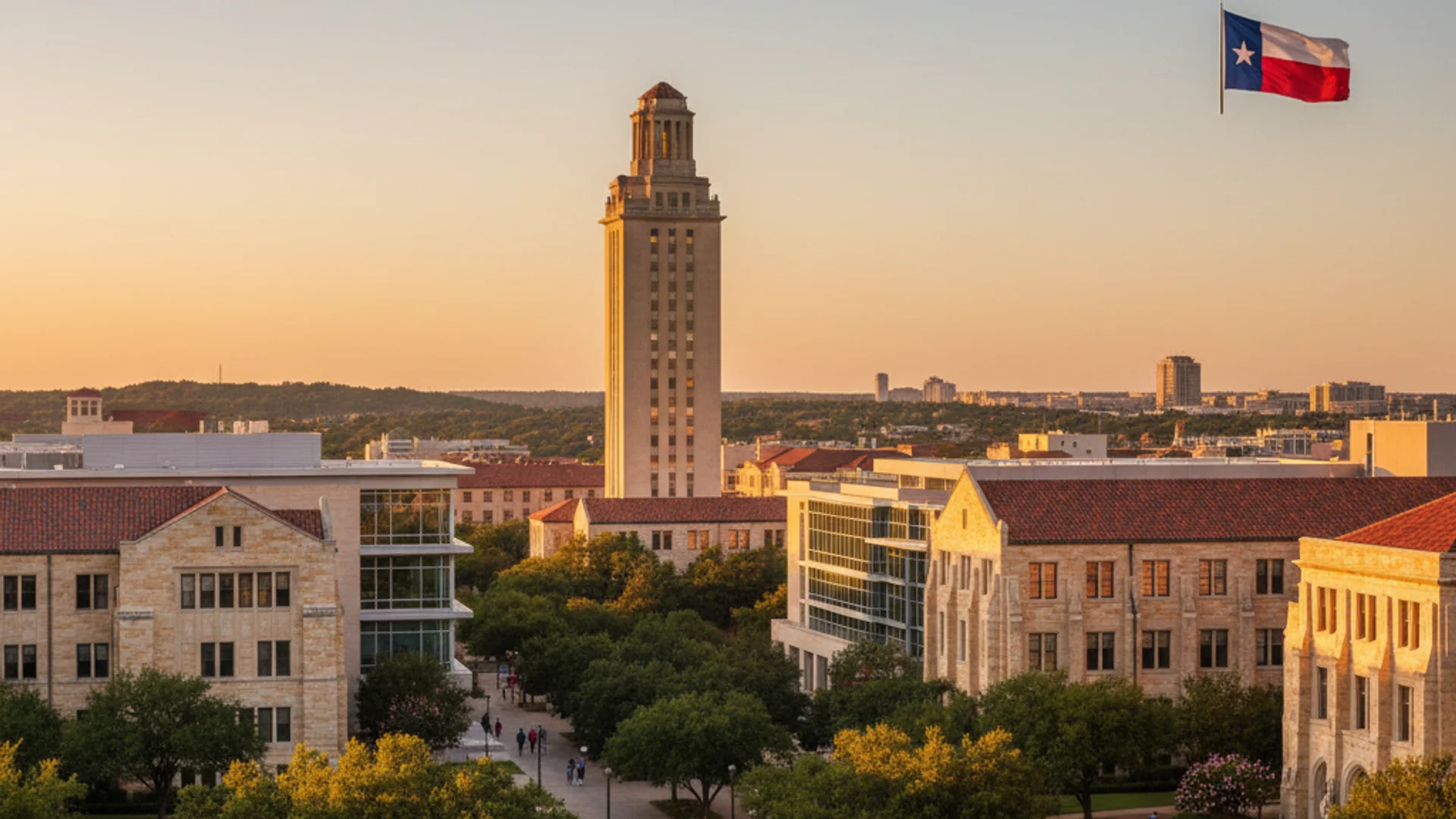
University campus in Texas
Updated January 2026

Best Artificial Intelligence Degree Programs in Texas — 2026 Rankings

Compare the top artificial intelligence (AI) colleges in Texas. 49 accredited artificial intelligence schools ranked by graduation rate, career outcomes, and value—from Houston Community College to Texas A & M University-College Station.

#1 ProgramTexas A&M
Avg Salary$115,110
Tuition From$2,904/yr
Job Growth+22%

Key Takeaways

Best artificial intelligence degree programs: Texas A&M, Texas State, Southern Methodist

Ranked by graduation rates, program outcomes, and institutional quality

IPEDS 2023

Tuition ranges from $768 to $57,212/year

Houston Community College offers the most affordable option at $2,904/yr

IPEDS 2023

Artificial Intelligence degree programs available: 13 associate's, 14 master's, 5 doctoral in Texas

From community college pathways to advanced research degrees

IPEDS 2023

23 online artificial intelligence degree programs in Texas

Flexible scheduling for working professionals

IPEDS 2023

Texas community college transfer can save 40-60% on total degree costs

13 associate's programs provide transfer pathways to bachelor's degrees

Education Commission of the States

Major employers: Dell, Oracle, AT&T, Texas Instruments

Tech hubs in Austin and Dallas

Hakia Research 2026

Artificial Intelligence degree programs near 125+ cities across Texas

Search by city to find programs within 200 miles of your location

IPEDS 2023

Updated February 2026

On This Page
$115,110
Are Artificial Intelligence Degree Programs in Texas Worth It?
Yes. The best artificial intelligence degree programs in Texas deliver strong ROI—graduates earn $115,110 median salary with +22% job growth through 2032. In-state tuition averages $17,983/year.

Source: BLS OEWS May 2024

Best Artificial Intelligence Degree Programs in Texas

Bachelor's Artificial Intelligence Degree Programs in Texas

30 programs$115,110 median salary77% avg grad rate
30
Programs
$115,110
Median Salary
$26,567/yr
Avg Tuition
77%
Avg Grad Rate

Program Landscape

Texas ranks among the nation's top destinations for artificial intelligence education, with 30 accredited bachelor's degree programs across 10 public and 20 private institutions. The highest-ranked programs are Texas A&M, Texas State, Southern Methodist, recognized for academic excellence, research opportunities, and strong industry connections.

Career Outcomes

Graduates from Texas artificial intelligence programs earn a median salary of $97,844—0% above the national average. The state's robust technology sector, anchored by the Austin, Dallas, Houston metropolitan areas, provides abundant internship and employment opportunities with companies including Dell, Oracle, AT&T.

Costs & Value

Tuition ranges from $4,416 to $57,212 annually, with an average of $26,567/yr. Top programs maintain graduation rates above 77%, with the highest reaching 99%. Many programs hold ABET accreditation, the gold standard for computing education, ensuring curriculum meets rigorous industry standards.

Curriculum & Specializations

Students can choose from specializations including software engineering, cybersecurity, artificial intelligence, data science, and systems architecture. Strong industry partnerships provide access to co-op programs, capstone projects with real companies, and direct recruiting pipelines to Texas's leading technology employers. For students seeking artificial intelligence degrees in Texas, these top-ranked artificial intelligence schools offer the strongest combination of academic rigor and career preparation.

Show:

Earn your bachelor's in Artificial Intelligence

(Sponsored)

Loading programs...

🥇

Texas A & M University-College Station

Public
College Station, TX
$9,003
Tuition/yr
84%
Grad Rate
83.1
Score
Website
🥈

Texas State University

Public
San Marcos, TX
$8,606
Tuition/yr
75%
Grad Rate
66.4
Score
Website
🥉

Southern Methodist University

Private
Dallas, TX
$57,212
Tuition/yr
89%
Grad Rate
66.3
Score
Website
#4

The University of Texas Rio Grande Valley

Public
Edinburg, TX
$7,637
Tuition/yr
96%
Grad Rate
74.7
Score
Website
#5

The University of Texas at Arlington

Public
Arlington, TX
$9,206
Tuition/yr
67%
Grad Rate
72.8
Score
Website
#6

The University of Texas at Austin

Public
Austin, TX
$11,678
Tuition/yr
89%
Grad Rate
62.1
Score
Website
#7

LeTourneau University

Private
Longview, TX
$34,680
Tuition/yr
86%
Grad Rate
55.8
Score
Website
#8

University of Houston-Clear Lake

Public
Houston, TX
$6,600
Tuition/yr
66%
Grad Rate
53.3
Score
Website
#9

Southwestern University

Private
Georgetown, TX
$50,558
Tuition/yr
90%
Grad Rate
53.0
Score
Website
#10

Southwestern Adventist University

Private
Keene, TX
$23,928
Tuition/yr
86%
Grad Rate
50.5
Score
Website

Complete Artificial Intelligence Degree Program Rankings in Texas

Best Associate's Artificial Intelligence Degree Programs in Texas

### Program Landscape Texas offers **13 accredited** associate's degree programs in artificial intelligence, providing an affordable entry point into the technology field. The top-ranked programs include **Houston Community College**, **El Paso Community College**, **South Texas College**, which combine rigorous technical curriculum with practical skills training. ### Costs & Value Community colleges in Texas offer these two-year programs at an average cost of **$3,354/yr**—significantly less than four-year university tuition. Students completing associate's degrees can pursue entry-level technical positions and transfer opportunities, with entry-level salaries averaging **$63,311** in Texas. ### Career Pathways Many programs feature guaranteed transfer agreements with Texas's public universities, allowing students to complete their first two years at reduced cost before transferring to complete a bachelor's degree. The Austin, Dallas, Houston areas offer particularly strong job markets for associate's degree holders, with employers like Dell, Oracle, AT&T hiring for technical support, junior development, and IT specialist positions. ### Curriculum & Specializations Programs typically include coursework in programming fundamentals, database management, networking basics, and software development. Among artificial intelligence schools in Texas, these associate's programs offer the best value for students beginning their artificial intelligence degrees in Texas.

  1. #1. Houston Community College

    Hakia ranks Houston Community College as the #1 associate's in artificial intelligence degree program in Texas. This public institution in Houston, TX has annual tuition of $2,904 and a 86% graduation rate. Ranking score: 66.0.

  2. #2. El Paso Community College

    Hakia ranks El Paso Community College as the #2 associate's in artificial intelligence degree program in Texas. This public institution in El Paso, TX has annual tuition of $2,784. Ranking score: 51.9.

  3. #3. South Texas College

    Hakia ranks South Texas College as the #3 associate's in artificial intelligence degree program in Texas. This public institution in McAllen, TX has annual tuition of $5,100. Ranking score: 60.9.

  4. #4. Lone Star College System

    Hakia ranks Lone Star College System as the #4 associate's in artificial intelligence degree program in Texas. This public institution in The Woodlands, TX has annual tuition of $5,544. Ranking score: 60.8.

  5. #5. Collin County Community College District

    Hakia ranks Collin County Community College District as the #5 associate's in artificial intelligence degree program in Texas. This public institution in McKinney, TX has annual tuition of $3,450 and a 89% graduation rate. Ranking score: 51.2.

  6. #6. Odessa College

    Hakia ranks Odessa College as the #6 associate's in artificial intelligence degree program in Texas. This public institution in Odessa, TX has annual tuition of $3,120 and a 89% graduation rate. Ranking score: 59.9.

  7. #7. Dallas College

    Hakia ranks Dallas College as the #7 associate's in artificial intelligence degree program in Texas. This public institution in Dallas, TX has annual tuition of $4,050 and a 71% graduation rate. Ranking score: 52.8.

  8. #8. Tyler Junior College

    Hakia ranks Tyler Junior College as the #8 associate's in artificial intelligence degree program in Texas. This public institution in Tyler, TX has annual tuition of $960. Ranking score: 45.9.

  9. #9. Wharton County Junior College

    Hakia ranks Wharton County Junior College as the #9 associate's in artificial intelligence degree program in Texas. This public institution in Wharton, TX has annual tuition of $768. Ranking score: 45.4.

  10. #10. Temple College

    Hakia ranks Temple College as the #10 associate's in artificial intelligence degree program in Texas. This public institution in Temple, TX has annual tuition of $1,848. Ranking score: 44.5.

  11. #11. Blinn College District

    Hakia ranks Blinn College District as the #11 associate's in artificial intelligence degree program in Texas. This public institution in Brenham, TX has annual tuition of $3,660. Ranking score: 38.2.

  12. #12. Galveston College

    Hakia ranks Galveston College as the #12 associate's in artificial intelligence degree program in Texas. This public institution in Galveston, TX has annual tuition of $2,220 and a 60% graduation rate. Ranking score: 44.3.

  13. #13. Texas State Technical College

    Hakia ranks Texas State Technical College as the #13 associate's in artificial intelligence degree program in Texas. This public institution in Waco, TX has annual tuition of $7,192. Ranking score: 41.9.

Online Associate's Artificial Intelligence Degree Programs in Texas

### Online Program Options Texas's community colleges offer 5 online associate's artificial intelligence programs, providing flexible pathways for students balancing education with work or family responsibilities. Top-ranked online programs include **Houston Community College**, **Tyler Junior College**, **Blinn College District**, all regionally accredited and recognized by Texas employers. ### Costs & Employer Recognition Online associate's programs average **$3,567/yr**—often comparable to or less than on-campus tuition. Texas-based employers including Dell, Oracle, AT&T value online credentials from accredited institutions, recognizing that program quality matters more than delivery format. The Austin, Dallas, Houston job market actively recruits graduates from online programs. ### Program Format These programs feature asynchronous coursework for maximum flexibility, with some offering synchronous sessions for collaborative learning. Students can typically complete **60 credit hours** in 2 years while working full-time. ### Technology & Flexibility Technology requirements include reliable internet access and a modern computer. Programs provide virtual labs, online tutoring, career services, and networking opportunities. Many offer start dates throughout the year and accelerated course formats for motivated students. Graduates earn the same degree as on-campus students, with no distinction on transcripts or diplomas. For students pursuing online artificial intelligence degrees in Texas, these accredited artificial intelligence schools offer the flexibility and quality that today's learners demand.

  • Houston Community College - Houston, TX - Tuition: $2,904/year
  • Tyler Junior College - Tyler, TX - Tuition: $960/year
  • Blinn College District - Brenham, TX - Tuition: $3,660/year
  • Odessa College - Odessa, TX - Tuition: $3,120/year
  • Texas State Technical College - Waco, TX - Tuition: $7,192/year

Best Bachelor's Artificial Intelligence Degree Programs in Texas

### Program Landscape Texas ranks among the nation's top destinations for artificial intelligence education, with **30 accredited** bachelor's degree programs across **10 public** and **20 private** institutions. The highest-ranked programs are **Texas A&M**, **Texas State**, **Southern Methodist**, recognized for academic excellence, research opportunities, and strong industry connections. ### Career Outcomes Graduates from Texas artificial intelligence programs earn a median salary of **$97,844**—0% above the national average. The state's robust technology sector, anchored by the Austin, Dallas, Houston metropolitan areas, provides abundant internship and employment opportunities with companies including Dell, Oracle, AT&T. ### Costs & Value Tuition ranges from **$4,416** to **$57,212** annually, with an average of **$26,567/yr**. Top programs maintain graduation rates above **77%**, with the highest reaching **99%**. Many programs hold ABET accreditation, the gold standard for computing education, ensuring curriculum meets rigorous industry standards. ### Curriculum & Specializations Students can choose from specializations including software engineering, cybersecurity, artificial intelligence, data science, and systems architecture. Strong industry partnerships provide access to co-op programs, capstone projects with real companies, and direct recruiting pipelines to Texas's leading technology employers. For students seeking artificial intelligence degrees in Texas, these top-ranked artificial intelligence schools offer the strongest combination of academic rigor and career preparation.

  1. #1. Texas A & M University-College Station

    Hakia ranks Texas A & M University-College Station as the #1 bachelor's in artificial intelligence degree program in Texas. This public institution in College Station, TX has annual tuition of $9,003 and a 84% graduation rate. Ranking score: 83.1.

  2. #2. Texas State University

    Hakia ranks Texas State University as the #2 bachelor's in artificial intelligence degree program in Texas. This public institution in San Marcos, TX has annual tuition of $8,606 and a 75% graduation rate. Ranking score: 66.4.

  3. #3. Southern Methodist University

    Hakia ranks Southern Methodist University as the #3 bachelor's in artificial intelligence degree program in Texas. This private institution in Dallas, TX has annual tuition of $57,212 and a 89% graduation rate. Ranking score: 66.3.

  4. #4. The University of Texas Rio Grande Valley

    Hakia ranks The University of Texas Rio Grande Valley as the #4 bachelor's in artificial intelligence degree program in Texas. This public institution in Edinburg, TX has annual tuition of $7,637 and a 96% graduation rate. Ranking score: 74.7.

  5. #5. The University of Texas at Arlington

    Hakia ranks The University of Texas at Arlington as the #5 bachelor's in artificial intelligence degree program in Texas. This public institution in Arlington, TX has annual tuition of $9,206 and a 67% graduation rate. Ranking score: 72.8.

  6. #6. The University of Texas at Austin

    Hakia ranks The University of Texas at Austin as the #6 bachelor's in artificial intelligence degree program in Texas. This public institution in Austin, TX has annual tuition of $11,678 and a 89% graduation rate. Ranking score: 62.1.

  7. #7. LeTourneau University

    Hakia ranks LeTourneau University as the #7 bachelor's in artificial intelligence degree program in Texas. This private institution in Longview, TX has annual tuition of $34,680 and a 86% graduation rate. Ranking score: 55.8.

  8. #8. University of Houston-Clear Lake

    Hakia ranks University of Houston-Clear Lake as the #8 bachelor's in artificial intelligence degree program in Texas. This public institution in Houston, TX has annual tuition of $6,600 and a 66% graduation rate. Ranking score: 53.3.

  9. #9. Southwestern University

    Hakia ranks Southwestern University as the #9 bachelor's in artificial intelligence degree program in Texas. This private institution in Georgetown, TX has annual tuition of $50,558 and a 90% graduation rate. Ranking score: 53.0.

  10. #10. Southwestern Adventist University

    Hakia ranks Southwestern Adventist University as the #10 bachelor's in artificial intelligence degree program in Texas. This private institution in Keene, TX has annual tuition of $23,928 and a 86% graduation rate. Ranking score: 50.5.

  11. #11. West Texas A & M University

    Hakia ranks West Texas A & M University as the #11 bachelor's in artificial intelligence degree program in Texas. This public institution in Canyon, TX has annual tuition of $6,372 and a 99% graduation rate. Ranking score: 52.1.

  12. #12. Baylor University

    Hakia ranks Baylor University as the #12 bachelor's in artificial intelligence degree program in Texas. This private institution in Waco, TX has annual tuition of $54,844. Ranking score: 47.3.

  13. #13. University of Mary Hardin-Baylor

    Hakia ranks University of Mary Hardin-Baylor as the #13 bachelor's in artificial intelligence degree program in Texas. This private institution in Belton, TX has annual tuition of $30,600 and a 91% graduation rate. Ranking score: 47.9.

  14. #14. Dallas Baptist University

    Hakia ranks Dallas Baptist University as the #14 bachelor's in artificial intelligence degree program in Texas. This private institution in Dallas, TX has annual tuition of $36,510 and a 95% graduation rate. Ranking score: 47.0.

  15. #15. Austin College

    Hakia ranks Austin College as the #15 bachelor's in artificial intelligence degree program in Texas. This private institution in Sherman, TX has annual tuition of $45,878. Ranking score: 47.6.

  16. #16. Texas Wesleyan University

    Hakia ranks Texas Wesleyan University as the #16 bachelor's in artificial intelligence degree program in Texas. This private institution in Fort Worth, TX has annual tuition of $32,960 and a 62% graduation rate. Ranking score: 47.3.

  17. #17. Texas Woman's University

    Hakia ranks Texas Woman's University as the #17 bachelor's in artificial intelligence degree program in Texas. This public institution in Denton, TX has annual tuition of $5,712 and a 86% graduation rate. Ranking score: 42.7.

  18. #18. North American University

    Hakia ranks North American University as the #18 bachelor's in artificial intelligence degree program in Texas. This private institution in Stafford, TX has annual tuition of $12,236 and a 34% graduation rate. Ranking score: 42.4.

  19. #19. Houston Christian University

    Hakia ranks Houston Christian University as the #19 bachelor's in artificial intelligence degree program in Texas. This private institution in Houston, TX has annual tuition of $35,500 and a 75% graduation rate. Ranking score: 44.3.

  20. #20. University of Dallas

    Hakia ranks University of Dallas as the #20 bachelor's in artificial intelligence degree program in Texas. This private institution in Irving, TX has annual tuition of $47,300. Ranking score: 44.2.

  21. #21. Tarleton State University

    Hakia ranks Tarleton State University as the #21 bachelor's in artificial intelligence degree program in Texas. This public institution in Stephenville, TX has annual tuition of $4,416 and a 69% graduation rate. Ranking score: 44.8.

  22. #22. Abilene Christian University

    Hakia ranks Abilene Christian University as the #22 bachelor's in artificial intelligence degree program in Texas. This private institution in Abilene, TX has annual tuition of $42,100. Ranking score: 43.9.

  23. #23. Wayland Baptist University

    Hakia ranks Wayland Baptist University as the #23 bachelor's in artificial intelligence degree program in Texas. This private institution in Plainview, TX has annual tuition of $21,728. Ranking score: 42.5.

  24. #24. Texas College

    Hakia ranks Texas College as the #24 bachelor's in artificial intelligence degree program in Texas. This private institution in Tyler, TX has annual tuition of $8,208. Ranking score: 41.9.

  25. #25. Texas A&M University-San Antonio

    Hakia ranks Texas A&M University-San Antonio as the #25 bachelor's in artificial intelligence degree program in Texas. This public institution in San Antonio, TX has annual tuition of $4,969 and a 54% graduation rate. Ranking score: 40.0.

  26. #26. Saint Edward's University

    Hakia ranks Saint Edward's University as the #26 bachelor's in artificial intelligence degree program in Texas. This private institution in Austin, TX has annual tuition of $50,484. Ranking score: 43.1.

  27. #27. Concordia University Texas

    Hakia ranks Concordia University Texas as the #27 bachelor's in artificial intelligence degree program in Texas. This private institution in Austin, TX has annual tuition of $35,750. Ranking score: 36.3.

  28. #28. St. Mary's University

    Hakia ranks St. Mary's University as the #28 bachelor's in artificial intelligence degree program in Texas. This private institution in San Antonio, TX has annual tuition of $35,144. Ranking score: 34.4.

  29. #29. Texas Lutheran University

    Hakia ranks Texas Lutheran University as the #29 bachelor's in artificial intelligence degree program in Texas. This private institution in Seguin, TX has annual tuition of $34,300. Ranking score: 35.5.

  30. #30. University of St Thomas

    Hakia ranks University of St Thomas as the #30 bachelor's in artificial intelligence degree program in Texas. This private institution in Houston, TX has annual tuition of $32,900 and a 44% graduation rate. Ranking score: 35.3.

Online Bachelor's Artificial Intelligence Degree Programs in Texas

### Online Program Options 22 Texas institutions offer bachelor's artificial intelligence degrees with online or hybrid options, enabling students to earn accredited degrees while maintaining professional or personal commitments. Top-ranked online programs include **U of Texas Rio Grande Valley**, **Southern Methodist**, **U of Texas at Arlington**, all regionally accredited and recognized by Texas employers. ### Costs & Employer Recognition Online bachelor's programs average **$29,703/yr**—often comparable to or less than on-campus tuition. Texas-based employers including Dell, Oracle, AT&T value online credentials from accredited institutions, recognizing that program quality matters more than delivery format. The Austin, Dallas, Houston job market actively recruits graduates from online programs. ### Program Format These programs feature asynchronous coursework for maximum flexibility, with some offering synchronous sessions for collaborative learning. Students can typically complete **120 credit hours** in 4 years while working full-time. ### Technology & Flexibility Technology requirements include reliable internet access and a modern computer. Programs provide virtual labs, online tutoring, career services, and networking opportunities. Many offer start dates throughout the year and accelerated course formats for motivated students. Graduates earn the same degree as on-campus students, with no distinction on transcripts or diplomas. For students pursuing online artificial intelligence degrees in Texas, these accredited artificial intelligence schools offer the flexibility and quality that today's learners demand.

  • The University of Texas Rio Grande Valley - Edinburg, TX - Tuition: $7,637/year
  • Southern Methodist University - Dallas, TX - Tuition: $57,212/year
  • The University of Texas at Arlington - Arlington, TX - Tuition: $9,206/year
  • The University of Texas at Austin - Austin, TX - Tuition: $11,678/year
  • Baylor University - Waco, TX - Tuition: $54,844/year
  • LeTourneau University - Longview, TX - Tuition: $34,680/year
  • West Texas A & M University - Canyon, TX - Tuition: $6,372/year
  • Southwestern Adventist University - Keene, TX - Tuition: $23,928/year
  • Saint Edward's University - Austin, TX - Tuition: $50,484/year
  • University of Mary Hardin-Baylor - Belton, TX - Tuition: $30,600/year
  • Texas Wesleyan University - Fort Worth, TX - Tuition: $32,960/year
  • Dallas Baptist University - Dallas, TX - Tuition: $36,510/year
  • Tarleton State University - Stephenville, TX - Tuition: $4,416/year
  • Houston Christian University - Houston, TX - Tuition: $35,500/year
  • University of Dallas - Irving, TX - Tuition: $47,300/year
  • Abilene Christian University - Abilene, TX - Tuition: $42,100/year
  • Wayland Baptist University - Plainview, TX - Tuition: $21,728/year
  • Texas College - Tyler, TX - Tuition: $8,208/year
  • Concordia University Texas - Austin, TX - Tuition: $35,750/year
  • St. Mary's University - San Antonio, TX - Tuition: $35,144/year
  • Texas Lutheran University - Seguin, TX - Tuition: $34,300/year
  • University of St Thomas - Houston, TX - Tuition: $32,900/year

Best Master's Artificial Intelligence Degree Programs in Texas

### Program Landscape Texas offers **14** master's degree programs in artificial intelligence, designed for professionals seeking to advance into senior engineering, technical leadership, and specialized roles. The top programs—**Lamar**, **Texas A&M**, **U of Houston-Clear Lake**—combine advanced technical training with research opportunities and leadership development. ### Career Outcomes Master's graduates in Texas earn a median salary of **$115,110**, approximately **20-30% higher** than bachelor's degree holders. The concentration of technology companies in Austin, Dallas, Houston creates strong demand for graduate-level talent, with Dell, Oracle, AT&T actively recruiting from these programs. ### Costs & Value Program formats include traditional full-time study (typically 2 years), part-time options for working professionals (2-3 years), and accelerated tracks. Tuition averages **$16,326/yr**, with many employers offering tuition reimbursement for graduate education. Some programs offer thesis and non-thesis tracks, allowing students to focus on research or professional development based on their career goals. ### Curriculum & Specializations Curriculum covers advanced topics including machine learning, distributed systems, software architecture, and technical management. Many programs include practicum experiences, industry capstone projects, or consulting engagements that provide real-world application of advanced concepts. Among Texas's artificial intelligence schools at the graduate level, these programs stand out for both academic quality and career outcomes.

  1. #1. Lamar University

    Hakia ranks Lamar University as the #1 master's in artificial intelligence degree program in Texas. This public institution in Beaumont, TX has annual tuition of $6,228 and a 99% graduation rate. Ranking score: 82.3.

  2. #2. Texas A & M University-College Station

    Hakia ranks Texas A & M University-College Station as the #2 master's in artificial intelligence degree program in Texas. This public institution in College Station, TX has annual tuition of $9,003 and a 84% graduation rate. Ranking score: 85.0.

  3. #3. University of Houston-Clear Lake

    Hakia ranks University of Houston-Clear Lake as the #3 master's in artificial intelligence degree program in Texas. This public institution in Houston, TX has annual tuition of $6,600 and a 66% graduation rate. Ranking score: 67.8.

  4. #4. Southern Methodist University

    Hakia ranks Southern Methodist University as the #4 master's in artificial intelligence degree program in Texas. This private institution in Dallas, TX has annual tuition of $57,212 and a 89% graduation rate. Ranking score: 62.7.

  5. #5. University of North Texas

    Hakia ranks University of North Texas as the #5 master's in artificial intelligence degree program in Texas. This public institution in Denton, TX has annual tuition of $8,319 and a 70% graduation rate. Ranking score: 64.0.

  6. #6. Texas State University

    Hakia ranks Texas State University as the #6 master's in artificial intelligence degree program in Texas. This public institution in San Marcos, TX has annual tuition of $8,606 and a 75% graduation rate. Ranking score: 60.2.

  7. #7. North American University

    Hakia ranks North American University as the #7 master's in artificial intelligence degree program in Texas. This private institution in Stafford, TX has annual tuition of $12,236 and a 34% graduation rate. Ranking score: 58.1.

  8. #8. The University of Texas Rio Grande Valley

    Hakia ranks The University of Texas Rio Grande Valley as the #8 master's in artificial intelligence degree program in Texas. This public institution in Edinburg, TX has annual tuition of $7,637 and a 96% graduation rate. Ranking score: 59.6.

  9. #9. Texas Woman's University

    Hakia ranks Texas Woman's University as the #9 master's in artificial intelligence degree program in Texas. This public institution in Denton, TX has annual tuition of $5,712 and a 86% graduation rate. Ranking score: 49.6.

  10. #10. Baylor University

    Hakia ranks Baylor University as the #10 master's in artificial intelligence degree program in Texas. This private institution in Waco, TX has annual tuition of $54,844. Ranking score: 44.3.

  11. #11. University of Houston-Victoria

    Hakia ranks University of Houston-Victoria as the #11 master's in artificial intelligence degree program in Texas. This public institution in Victoria, TX has annual tuition of $5,111. Ranking score: 42.3.

  12. #12. Texas A&M University-San Antonio

    Hakia ranks Texas A&M University-San Antonio as the #12 master's in artificial intelligence degree program in Texas. This public institution in San Antonio, TX has annual tuition of $4,969 and a 54% graduation rate. Ranking score: 36.4.

  13. #13. St. Mary's University

    Hakia ranks St. Mary's University as the #13 master's in artificial intelligence degree program in Texas. This private institution in San Antonio, TX has annual tuition of $35,144. Ranking score: 36.1.

  14. #14. Texas Southern University

    Hakia ranks Texas Southern University as the #14 master's in artificial intelligence degree program in Texas. This public institution in Houston, TX has annual tuition of $6,941. Ranking score: 35.3.

Online Master's Artificial Intelligence Degree Programs in Texas

### Online Program Options Working professionals can advance their careers through 5 online master's artificial intelligence programs from Texas universities, designed for flexibility without sacrificing academic rigor. Top-ranked online programs include **U of North Texas**, **Southern Methodist**, **U of Texas Rio Grande Valley**, all regionally accredited and recognized by Texas employers. ### Costs & Employer Recognition Online master's programs average **$32,631/yr**—often comparable to or less than on-campus tuition. Texas-based employers including Dell, Oracle, AT&T value online credentials from accredited institutions, recognizing that program quality matters more than delivery format. The Austin, Dallas, Houston job market actively recruits graduates from online programs. ### Program Format These programs feature asynchronous coursework for maximum flexibility, with some offering synchronous sessions for collaborative learning. Students can typically complete **30-36 credit hours** in 18-24 months while working full-time. ### Technology & Flexibility Technology requirements include reliable internet access and a modern computer. Programs provide virtual labs, online tutoring, career services, and networking opportunities. Many offer start dates throughout the year and accelerated course formats for motivated students. Graduates earn the same degree as on-campus students, with no distinction on transcripts or diplomas. For students pursuing online artificial intelligence degrees in Texas, these accredited artificial intelligence schools offer the flexibility and quality that today's learners demand.

  • University of North Texas - Denton, TX - Tuition: $8,319/year
  • Southern Methodist University - Dallas, TX - Tuition: $57,212/year
  • The University of Texas Rio Grande Valley - Edinburg, TX - Tuition: $7,637/year
  • Baylor University - Waco, TX - Tuition: $54,844/year
  • St. Mary's University - San Antonio, TX - Tuition: $35,144/year

Best Doctoral Artificial Intelligence Degree Programs in Texas

### Program Landscape Texas is home to **5** doctoral programs in artificial intelligence, preparing students for research positions, faculty appointments, and executive technical roles. Leading programs at **Texas A&M**, **U of Texas at El Paso**, **Southern Methodist** are recognized for cutting-edge research, strong faculty publications, and competitive funding packages. ### Career Outcomes Doctoral graduates command premium salaries, with Texas PhD holders earning a median of **$143,888**—reflecting the advanced expertise required for research and executive positions. The Austin, Dallas, Houston region's research universities and corporate R&D centers provide extensive collaboration opportunities with industry leaders like Dell, Oracle, AT&T. ### Costs & Value PhD programs typically require 4-6 years of full-time study, including coursework, qualifying examinations, and original dissertation research. Many programs offer full funding through teaching or research assistantships, covering tuition and providing stipends of **$25,000–$40,000** annually. ### Curriculum & Specializations Research strengths across Texas programs include artificial intelligence, cybersecurity, human-computer interaction, systems, and theoretical computer science. For aspiring researchers pursuing artificial intelligence degrees in Texas, graduates go on to careers as university faculty, industry research scientists, or technical executives, contributing to advances in technology that impact millions of users worldwide.

  1. #1. Texas A & M University-College Station

    Hakia ranks Texas A & M University-College Station as the #1 doctoral in artificial intelligence degree program in Texas. This public institution in College Station, TX has annual tuition of $9,003 and a 84% graduation rate. Ranking score: 54.2.

  2. #2. The University of Texas at El Paso

    Hakia ranks The University of Texas at El Paso as the #2 doctoral in artificial intelligence degree program in Texas. This public institution in El Paso, TX has annual tuition of $7,704 and a 99% graduation rate. Ranking score: 47.6.

  3. #3. Southern Methodist University

    Hakia ranks Southern Methodist University as the #3 doctoral in artificial intelligence degree program in Texas. This private institution in Dallas, TX has annual tuition of $57,212 and a 89% graduation rate. Ranking score: 63.8.

  4. #4. Texas State University

    Hakia ranks Texas State University as the #4 doctoral in artificial intelligence degree program in Texas. This public institution in San Marcos, TX has annual tuition of $8,606 and a 75% graduation rate. Ranking score: 61.7.

  5. #5. The University of Texas at San Antonio

    Hakia ranks The University of Texas at San Antonio as the #5 doctoral in artificial intelligence degree program in Texas. This public institution in San Antonio, TX has annual tuition of $6,239. Ranking score: 36.9.

Online Doctoral Artificial Intelligence Degree Programs in Texas

### Online Program Options 2 Texas universities offer doctoral artificial intelligence programs with online or hybrid components, accommodating established professionals pursuing terminal degrees. Top-ranked online programs include **U of Texas at El Paso**, **Southern Methodist**, all regionally accredited and recognized by Texas employers. ### Costs & Employer Recognition Online doctoral programs average **$32,458/yr**—often comparable to or less than on-campus tuition. Texas-based employers including Dell, Oracle, AT&T value online credentials from accredited institutions, recognizing that program quality matters more than delivery format. The Austin, Dallas, Houston job market actively recruits graduates from online programs. ### Program Format These programs feature asynchronous coursework for maximum flexibility, with some offering synchronous sessions for collaborative learning. Students can typically complete doctoral requirements in 3-5 years while working full-time. ### Technology & Flexibility Technology requirements include reliable internet access and a modern computer. Programs provide virtual labs, online tutoring, career services, and networking opportunities. Many offer start dates throughout the year and accelerated course formats for motivated students. Graduates earn the same degree as on-campus students, with no distinction on transcripts or diplomas. For students pursuing online artificial intelligence degrees in Texas, these accredited artificial intelligence schools offer the flexibility and quality that today's learners demand.

  • The University of Texas at El Paso - El Paso, TX - Tuition: $7,704/year
  • Southern Methodist University - Dallas, TX - Tuition: $57,212/year

Artificial Intelligence Degree Costs & Tuition in Texas

MetricValue
Average in-state tuition$17,983/year
Average out-of-state tuition$44,958/year
Community college tuition$4,496/year
4-year savings for residents$107,900
2+2 transfer pathway savings$26,974

Source: IPEDS 2023

Financial Aid & Scholarships for Artificial Intelligence Students in Texas

State Aid Programs

Texas offers robust state-funded financial aid programs that complement federal assistance.

The flagship program is the TEXAS Grant (Towards Excellence, Access, and Success), providing need-based aid exclusively for Texas residents at public universities. Eligibility requires demonstrated financial need (determined via FAFSA), enrollment in an approved degree program, and satisfactory academic progress. The TEXAS Grant can cover a significant portion of tuition costs, making flagship universities accessible to students from all economic backgrounds. Students must reapply annually and maintain eligibility requirements (Texas Higher Education Coordinating Board).

Key Programs & Amounts

Key state aid programs and amounts:

  • TEXAS Grant: Need-based aid for public university students; amounts vary by institution but often cover most tuition at public schools
  • Texas Educational Opportunity Grant (TEOG) for community colleges: For students at community colleges, state colleges, and technical institutes; provides need-based grants for lower-division study
  • Tuition Equalization Grant (TEG) up to $5,810/year for private schools: Up to $3,873/year for students at private universities (or $5,810/year for low-income students with Student Aid Index below 3,698)
  • TASFA for DACA and undocumented students: Texas Application for State Financial Aid for students ineligible for FAFSA (including DACA recipients and undocumented students). Priority deadline: February 15; application window runs December 2 through June 30
  • Federal Pell Grant: Up to $7,395 maximum for 2024-25 academic year (apply via FAFSA at studentaid.gov)
  • FORWARD Loan Program: Low-interest loans for students in high-demand fields including technology

Institutional Scholarships

These programs can be combined—a low-income student at UT Austin might receive TEXAS Grant, Pell Grant, and institutional aid covering nearly all expenses.

Artificial Intelligence Degree ROI Calculator — Texas

Use our interactive ROI calculator to estimate your return on investment for a artificial intelligence degree in Texas. Enter your expected tuition costs, financial aid, and career goals to see projected payback periods and lifetime earnings. The calculator uses current salary data from BLS and tuition data from IPEDS to provide accurate estimates.

Artificial Intelligence Degree ROI Calculator
Estimate your return on investment for a artificial intelligence degree
$

Leave blank to use average cost for selected program type

20 years
10 years20 years30 years
20-Year ROI

+1064%

Net gain divided by total investment. ROI above 200% is considered excellent for education investments.

Net Gain

$1,967,896

Your additional lifetime earnings with this degree vs. working without one, minus the total investment.

Break-Even

5 years

Years until your cumulative earnings exceed total investment. Shorter programs often break even faster due to lower opportunity cost.

COL-Adjusted Salary

$147,619

Your starting salary adjusted for local cost of living. This shows real purchasing power compared to a $100K national baseline.

Why does break-even change with program type? Your "total investment" includes both tuition AND opportunity cost (foregone earnings while in school). A 4-year full-time public university (in-state) means 4 years of not earning a salary ($140,000 in opportunity cost). Shorter full-time programs may have higher tuition but lower total investment because you return to the workforce sooner.

Detailed Breakdown
How we calculate your degree ROI using real salary data
Total Investment$185,000

Tuition plus opportunity cost (earnings you miss while in school)

Program Cost (Tuition)$45,000

Direct cost of the degree program

Opportunity Cost$140,000

4 years × $35K/year foregone salary while studying full-time

20-Year Earnings (with degree)$3,003,304

Projected career earnings starting after graduation, with salary growth

20-Year Earnings (without degree)$850,408

What you'd earn working at $35K/year with 2% annual growth

Starting Salary (Austin, TX)$155,000

Median salary for this role in your selected location (BLS 2024)

Annualized Return5.5%

Your investment's compound annual growth rate (similar to stock market returns)

Data sources: BLS OEWS May 2024, IPEDS 2023. Calculations use median salaries, 3% discount rate, and assume salary growth declines from 6% to 2% over career. Individual results will vary. | Powered by Hakia.com

Career Paths

Design and develop software applications and systems

Median Salary:$130,074

Analyze complex datasets and build predictive models

Median Salary:$108,203

Protect computer networks from cyber threats

Median Salary:$120,866

Manage cloud infrastructure and deployment pipelines

Median Salary:$127,772

Design and maintain cloud computing infrastructure

Median Salary:$124,319

Build and deploy machine learning models

Median Salary:$145,039
Artificial Intelligence Salaries by Metro Area

Median annual salary in Texas metro areas

Hakia.com
View data table
Categoryvalue
Austin$127K
Dallas$121K
Houston$115K
San Antonio$109K

Source: BLS OEWS May 2024

Hakia.com

Top Employers Hiring Artificial Intelligence Graduates in Texas

Find artificial intelligence jobs in Texas. These major employers across Texas metro areas are actively hiring artificial intelligence degree holders. Click employer names to view current job openings.

Artificial Intelligence Jobs in Austin

TX
~2,606 Open Positions

Austin is the fastest-growing tech hub in the US. Tesla, Oracle, and major tech companies have relocated headquarters here.

Nearby cities: Round Rock, Cedar Park, Georgetown, Pflugerville, San Marcos, Kyle, Leander

Tesla
Electric Vehicles & Energy
Apple
Consumer Electronics
Dell Technologies
Enterprise Technology
Oracle
Enterprise Software
Google
Big Tech
Meta
Social Media & VR
Amazon
E-commerce & Cloud
IBM
Enterprise Technology

Artificial Intelligence Jobs in Dallas-Fort Worth

TX
~1,205 Open Positions

Dallas-Fort Worth has major corporate headquarters and a growing tech presence. AT&T and Texas Instruments are based here.

Nearby cities: Fort Worth, Plano, Irving, Arlington, Frisco, McKinney, Richardson, Garland

Texas Instruments
Semiconductors
AT&T
Telecommunications
Capital One
Financial Technology
Cisco
Networking
Microsoft
Big Tech
ServiceNow
Enterprise SaaS

Artificial Intelligence Jobs in Houston

TX
~805 Open Positions

Houston leads in energy tech, healthcare IT, and aerospace. NASA Johnson Space Center drives space technology.

Nearby cities: The Woodlands, Sugar Land, Katy, Pearland, League City, Pasadena, Baytown

ExxonMobil
Energy Technology
Schlumberger (SLB)
Oilfield Services
Halliburton
Energy Services
JPMorgan Chase
Financial Technology
Sysco LABS
Food Tech
Hewlett Packard Enterprise
Enterprise Technology

Artificial Intelligence Jobs in San Antonio

TX
~795 Open Positions
USAA
Financial Services
Lockheed Martin
Defense & Aerospace
Northrop Grumman
Defense Technology
Raytheon
Defense & Cybersecurity
Deloitte
Professional Services
Booz Allen Hamilton
Defense Consulting

Admission Requirements for Artificial Intelligence Degree Programs in Texas

1

Research Program Requirements

Review admission requirements for artificial intelligence programs at your target schools. Requirements vary by institution and degree level.

2

Prepare Application Materials

For UT Austin: aim for 3.8+ GPA and 1240-1470 SAT (avg: 1355). Early Action deadline: October 15. Regular deadline: December 1. Test scores required.

3

Apply for Financial Aid

Complete FAFSA by January 15 for the Towards Excellence, Access, and Success (TEXAS) Grant at public universities. Texas residents ineligible for federal aid should complete TASFA by February 15, 2025. Private university students may qualify for TEG grants up to $3873/year.

4

Submit Applications Before Deadlines

Texas A&M accepts 63% of applicants overall (CS is more competitive). Average SAT: 1260. 95% of students are Texas residents.

5

Complete Enrollment Steps

Accept your offer, submit enrollment deposit, complete orientation requirements, and register for classes.

Transfer Pathways for Artificial Intelligence Degrees in Texas

State Transfer System

Texas has one of the nation's most robust transfer systems.

The Texas Common Course Numbering System (TCCNS) is a voluntary cooperative effort among 137 participating institutions in TCCNS—including all 50 community college districts plus public and private universities (TCCNS). Courses bearing TCCNS numbers are guaranteed to transfer if they fall within your approved degree curriculum. This statewide coordination means Texas transfer students experience far less credit loss than the national average of 43% of credits lost in transfer. The system covers all freshman and sophomore-level courses, precisely the ones community college students complete before transferring.

How Transfers Work

How TCCNS works in practice: Each participating school maps its courses to common numbers—for example, a programming course at any Texas community college may transfer as equivalent to introductory courses at UT Austin. When you transfer, the receiving institution automatically recognizes courses by their TCCNS numbers rather than requiring individual evaluation. This eliminates the frustrating credit reviews that plague transfer students elsewhere. Additionally, UT Austin maintains the Automated Transfer Equivalency (ATE) system with over 300,000 evaluated courses from institutions nationwide (UT Admissions). Austin Community College has specific partnership programs including the "Bats to Cats" program with Texas State and transfer agreements with multiple UT System schools (ACC Transfer).

Transfer Planning Tips

Strategic transfer planning for Artificial Intelligence students:

  1. 1Complete foundational coursework: Finish calculus, statistics, and introductory artificial intelligence courses at community college
  2. 2Verify equivalencies early: Use TCCNS and ATE systems to confirm your courses will transfer before enrolling
  3. 3Maintain strong GPA: Target 3.0+ for university admission; 3.5+ for competitive programs like UT Austin
  4. 4Meet priority deadlines: Most universities have February-March deadlines for fall transfer admission
  5. 5Consider structured tracks: Many community colleges offer Associate of Science degrees specifically designed for artificial intelligence transfer students

Why Pursue an Artificial Intelligence Degree in Texas?

Industry & Workforce

Texas ranks #2 nationally for tech workforce size with 972,747 tech workers as of 2024 (CompTIA), adding 40,051 new tech jobs in 2025 alone (CompTIA State of Tech Workforce 2025). The state hosts over 70 accredited Artificial Intelligence and related programs spanning flagship research universities, regional comprehensive institutions, and innovative private colleges (IPEDS 2023). Texas's robust transfer system through TCCNS connects 137 participating institutions in TCCNS, making degree pathways accessible from any starting point (TCCNS). The combination of world-class universities, industry presence, and affordable education makes Texas an ideal destination for Artificial Intelligence education.

Salary Outlook

The salary outlook is compelling.

Texas artificial intelligence professionals earn competitive salaries while benefiting from No state income tax—meaning your take-home pay often exceeds what you'd earn in higher-salary states like California or New York (BLS OEWS May 2024). Entry-level positions typically start around $65,000-$85,000, with mid-career professionals earning $95,000-$130,000, and senior specialists commanding $130,000-$175,000+ in major metros. The BLS projects 15% projected growth for software developers through 2034 for technology roles through 2034, significantly outpacing the national average of 3% for all occupations.

Regional Tech Hubs

Tech hubs span the state with distinct specializations: Austin: 16.3% of workforce in tech vs 9% nationally. Austin leads as "Silicon Hills" with Tesla Gigafactory headquarters in Austin, Apple $1B campus expansion in Austin, and Oracle relocated corporate headquarters to Austin. Dallas-Fort Worth anchors the Telecom Corridor with Texas Instruments $30B fab investment in Dallas and major fintech presence. Houston: 158,176 tech workers driving digital transformation at energy majors and Houston: 4,000+ startups. San Antonio: #2 cybersecurity hub nationally with NSA Texas, USAA, and 100+ cybersecurity firms (CyberSeek 2024). Texas is also America's semiconductor leader—Texas ranks #1 in US for semiconductor manufacturing capacity and #1 exporter of semiconductors for 14 consecutive years (Texas Governor's Office). Compare programs in California, Washington, or explore our national rankings.

Artificial Intelligence Job Market & Salary Data in Texas

Employment Outlook

Texas offers exceptional job prospects for Artificial Intelligence graduates.

The Bureau of Labor Statistics reports strong demand across all Texas metros, with 15% projected growth for software developers through 2034—outpacing the national average (BLS OEWS May 2024). Texas tech employment grew 24% over the past decade, nearly double the national rate. The state added 40,051 new tech jobs in 2025, cementing its position as the second-largest tech workforce in the nation with 972,747 tech workers as of 2024 (CompTIA) (CompTIA State of Tech Workforce 2025). Entry-level artificial intelligence positions typically start around $70,000-$90,000, with rapid advancement opportunities available.

Salaries by Metro

Salaries vary significantly by metro area, reflecting local industry concentrations:

  • Austin: Austin: $135,000 median tech salary, with Austin: 16.3% of workforce in tech vs 9% nationally. AI/ML job market grew 35% since 2023. Software developers earn $85,000-$165,000+ depending on experience.
  • Dallas-Fort Worth: Dallas-Fort Worth: $120,866 median tech salary with strong demand in enterprise technology and financial services. Tech contributed $85.3 billion to the regional economy. Entry-level positions start around $75,000-$95,000.
  • Houston: $125,885 median, with Houston: 158,176 tech workers and Houston: 4,000+ startups. Energy technology dominates, with digital transformation roles at oil majors paying premium salaries for artificial intelligence skills.
  • San Antonio: $112,000 median for general tech, but San Antonio: #2 cybersecurity hub nationally. Cybersecurity and defense specialists command higher salaries with excellent job security. (BLS OEWS Metro Data)

High-Growth Sectors

High-growth sectors shaping Texas's tech future include: cloud computing infrastructure (CenterPoint Energy reported 700% spike in data center power requests), artificial intelligence and machine learning (35% job growth in Austin), cybersecurity (Texas launched the nation's largest state cyber command in 2025), and semiconductor manufacturing (Texas committed $1.4 billion to chip manufacturing incentives). Texas Tech University recently received a $2 million NSF grant to prepare students for semiconductor workforce opportunities (Texas Tech Semiconductor Grant). The Brookings Institution classifies Austin as a "Star Hub" for AI economy development, with Dallas-Fort Worth and Houston as emerging AI centers (Brookings AI Economy 2025). For related career paths, explore our AI degree programs, data science rankings, or cybersecurity rankings.

What You'll Learn in Artificial Intelligence Degree Programs in Texas

Core Requirements

Core Artificial Intelligence curriculum at Texas universities follows industry standards while providing flexibility for specialization. UT Austin and Texas A&M maintain rigorous curricula that prepare students for both immediate employment and graduate study. Programs typically require foundation courses in programming, systems, and theory, then allow specialization through upper-division electives. ABET-accredited programs must demonstrate student outcomes in technical competency, mathematics, and professional skills (ABET). Texas universities have increasingly redesigned curricula to emphasize hands-on projects, industry partnerships, and emerging technologies like AI, cloud computing, and cybersecurity.

Degree Pathways

BS vs. BA pathways offer different preparation: The BS in Artificial Intelligence emphasizes advanced mathematics—typically requiring calculus through differential equations, linear algebra, and probability/statistics. It also requires laboratory science courses (often physics). This rigorous preparation suits students targeting research, graduate school, or engineering-intensive roles. The BA pathway requires fewer math and science courses, allowing flexibility for double majors, minors, or interdisciplinary interests while still providing solid artificial intelligence fundamentals. Both pathways lead to successful careers—the choice depends on your specific goals and interests. Graduate programs are increasingly accepting students from both pathways with relevant experience.

Specialization Tracks

Specialization tracks vary by institution but commonly include: artificial intelligence and machine learning, cybersecurity and information assurance, data science and analytics, software engineering, cloud computing and distributed systems, and emerging areas like autonomous systems and blockchain. Most accredited programs require capstone projects or senior theses demonstrating ability to apply coursework to real-world problems (IPEDS 2023). Many Texas programs incorporate required or strongly encouraged industry internships—UT Austin, Texas A&M, and UT Dallas all have robust corporate recruiting programs that place students at major Texas employers. Total degree requirements typically range from 120-128 credit hours. For specialized degrees, explore our data science rankings, AI programs, or software engineering programs.

Online vs On-Campus Artificial Intelligence Degree Programs in Texas

Online Program Growth

Online Artificial Intelligence education has expanded significantly in Texas over the past five years.

Students completed thousands of technology-related degrees online in 2023—representing dramatic growth from 2019 (IPEDS 2023). This growth reflects improvements in online pedagogy (better video instruction, interactive coding environments, virtual collaboration tools) and increased employer acceptance of remote credentials. Texas's large rural population and sprawling metro areas make online education particularly valuable for students unable to relocate or commute. SACSCOC-accredited programs meet the same academic standards as traditional campus programs.

Accredited Online Options

Accredited online Artificial Intelligence options in Texas:

  • Texas Tech University: Fully online BS in Computing Applications with specialization tracks in cybersecurity, digital media, and other areas. SACSCOC accredited with asynchronous instruction.
  • East Texas A&M University: ABET-accredited programs available in hybrid online format, combining online coursework with periodic in-person sessions.
  • UT Austin (CDSO): The Computer and Data Science Online program offers graduate degrees and professional certificates from the flagship university—same faculty and rigor as on-campus.
  • Lamar University: BS in Computer Information Sciences online, 120 credits, affordable tuition and excellent transfer policies.
  • University of Houston: Various online graduate programs in technology fields.

Choosing Your Format

All recommended programs maintain SACSCOC regional accreditation, ensuring degree recognition nationwide. Several also hold ABET programmatic accreditation.

Artificial Intelligence Schools by City in Texas

Austin

Austin (Austin: $135,000 median tech salary) represents Texas's tech capital and offers the highest artificial intelligence salaries alongside the greatest concentration of tech jobs—Austin: 16.3% of workforce in tech vs 9% nationally (BLS OEWS May 2024). AI/ML positions grew 35% since 2023, driven by Tesla's AI division, Apple's machine learning teams, and a thriving startup ecosystem. UT Austin ranks among the nation's top artificial intelligence programs. Cost of living has risen—median home prices exceed $500,000—but remains well below Bay Area and NYC levels. Tesla, Apple, and Oracle headquarters relocations have created a startup ecosystem increasingly rivaling Silicon Valley. Artificial Intelligence professionals earn $85,000 to $165,000+ depending on experience and specialization.

Dallas-Fort Worth

Dallas-Fort Worth ($120,866 median) offers strong salaries-to-cost-of-living ratios among Texas metros. The famous "Telecom Corridor" in Richardson and Plano hosts Texas Instruments, AT&T headquarters, and emerging fintech giants. Tech employment grew 11.9% in 2024, contributing $85.3 billion to the regional economy (CompTIA State of Tech 2025). Entry-level artificial intelligence positions start around $70,000-$90,000. Major universities include UT Dallas (strong research focus), UT Arlington, and SMU. The Metroplex is ideal for students interested in enterprise technology, semiconductors, telecommunications, or financial technology. Housing costs remain significantly below Austin, with quality suburban living accessible to young professionals.

Houston

Houston ($125,885 median) remains dominated by energy technology, but diversification into healthcare tech, fintech, aerospace, and advanced manufacturing continues. The metro employs Houston: 158,176 tech workers with Houston: 4,000+ startups. Housing is substantially more affordable than Austin or Dallas. Major universities include Rice (elite private) and University of Houston. The city is ideal for Artificial Intelligence graduates interested in energy technology, healthcare IT, aerospace computing, or industrial applications. ExxonMobil, Schlumberger, and Halliburton's digital transformation divisions offer excellent compensation and unique problem domains.

San Antonio

San Antonio ($112,000 median) compensates for lower base salaries with 8.7% below-national housing costs, making it Texas's most affordable major metro. The city has emerged as San Antonio: #2 cybersecurity hub nationally with 100+ cybersecurity companies and 40+ tech company headquarters (CyberSeek 2024). The military presence—including NSA Texas, Air Force Cyber Command, and Texas Cyber Command—creates abundant clearance-required positions with exceptional job security. UTSA's nationally recognized programs report 98% employment rates. San Antonio is perfect for Artificial Intelligence students pursuing defense, government, and security-focused careers. See our state rankings.

Compare Online Artificial Intelligence Programs in Texas

View tuition costs, program formats & enrollment info

Find Artificial Intelligence Programs Near You in Texas

Search by city to find accredited artificial intelligence programs ranked by our state methodology.

Artificial Intelligence Degree Programs by City in Texas

Artificial Intelligence Degree Programs Near Houston, Texas

Houston offers direct access to Artificial Intelligence education through 3 local institutions, including Houston CC and Rice University, covering associate's, bachelor's, master's, and doctoral programs. Public institution tuition in the area ranges from $2,010 to $11,678 per year. Students can start at Houston CC (in the city, $2,904/yr) before transferring to a four-year program.

Houston is located in Harris County, Texas.

Associate's Artificial Intelligence Degree Programs Near Houston, Texas
  1. Houston Community College (Public) — State #1, in Houston. Tuition: $2,904/year. Graduation rate: 86%.
  2. Austin Community College District (Public) — State #3, 139.7 mi from Houston. Tuition: $2,010/year.
  3. Lone Star College System (Public) — State #4, 27.8 mi from Houston. Tuition: $5,544/year.
Bachelor's Artificial Intelligence Degree Programs Near Houston, Texas
  1. The University of Texas at Austin (Public) — State #1, 140.3 mi from Houston. Tuition: $11,678/year. Graduation rate: 89%.
  2. Rice University (Private) — State #2, in Houston. Tuition: $57,210/year. Graduation rate: 93%.
  3. Texas A & M University-College Station (Public) — State #3, 77.6 mi from Houston. Tuition: $9,003/year. Graduation rate: 84%.
Master's Artificial Intelligence Degree Programs Near Houston, Texas
  1. Rice University (Private) — State #1, in Houston. Tuition: $57,210/year. Graduation rate: 93%.
  2. The University of Texas at Austin (Public) — State #2, 140.3 mi from Houston. Tuition: $11,678/year. Graduation rate: 89%.
  3. Texas A & M University-College Station (Public) — State #4, 77.6 mi from Houston. Tuition: $9,003/year. Graduation rate: 84%.
Doctoral Artificial Intelligence Degree Programs Near Houston, Texas
  1. Rice University (Private) — State #1, in Houston. Tuition: $57,210/year. Graduation rate: 93%.
  2. The University of Texas at Austin (Public) — State #2, 140.3 mi from Houston. Tuition: $11,678/year. Graduation rate: 89%.
  3. Texas A & M University-College Station (Public) — State #3, 77.6 mi from Houston. Tuition: $9,003/year. Graduation rate: 84%.

Artificial Intelligence Degree Programs Near San Antonio, Texas

San Antonio is home to Palo Alto College, providing local access to Artificial Intelligence programs at the associate's, bachelor's, master's, and doctoral levels. Among the strongest nearby options, UT Austin (#1 statewide) is 74 miles away, offering bachelor's programs at $11,678/yr with a 89% graduation rate. Public institution tuition in the area ranges from $1,848 to $11,678 per year. Students can start at Austin CC (77 miles, $2,010/yr) before transferring to a four-year program.

San Antonio is located in Bexar County, Texas.

Associate's Artificial Intelligence Degree Programs Near San Antonio, Texas
  1. Houston Community College (Public) — State #1, 190.9 mi from San Antonio. Tuition: $2,904/year. Graduation rate: 86%.
  2. Austin Community College District (Public) — State #3, 77.3 mi from San Antonio. Tuition: $2,010/year.
  3. Lone Star College System (Public) — State #4, 189.6 mi from San Antonio. Tuition: $5,544/year.
Bachelor's Artificial Intelligence Degree Programs Near San Antonio, Texas
  1. The University of Texas at Austin (Public) — State #1, 74.1 mi from San Antonio. Tuition: $11,678/year. Graduation rate: 89%.
  2. Rice University (Private) — State #2, 189.3 mi from San Antonio. Tuition: $57,210/year. Graduation rate: 93%.
  3. Texas A & M University-College Station (Public) — State #3, 153.9 mi from San Antonio. Tuition: $9,003/year. Graduation rate: 84%.
Master's Artificial Intelligence Degree Programs Near San Antonio, Texas
  1. Rice University (Private) — State #1, 189.3 mi from San Antonio. Tuition: $57,210/year. Graduation rate: 93%.
  2. The University of Texas at Austin (Public) — State #2, 74.1 mi from San Antonio. Tuition: $11,678/year. Graduation rate: 89%.
  3. Texas A & M University-College Station (Public) — State #4, 153.9 mi from San Antonio. Tuition: $9,003/year. Graduation rate: 84%.
Doctoral Artificial Intelligence Degree Programs Near San Antonio, Texas
  1. Rice University (Private) — State #1, 189.3 mi from San Antonio. Tuition: $57,210/year. Graduation rate: 93%.
  2. The University of Texas at Austin (Public) — State #2, 74.1 mi from San Antonio. Tuition: $11,678/year. Graduation rate: 89%.
  3. Texas A & M University-College Station (Public) — State #3, 153.9 mi from San Antonio. Tuition: $9,003/year. Graduation rate: 84%.

Artificial Intelligence Degree Programs Near Dallas, Texas

Dallas offers direct access to Artificial Intelligence education through 2 local institutions, including Dallas College and Southern Methodist University, covering associate's, bachelor's, master's, and doctoral programs. Public institution tuition in the area ranges from $2,010 to $14,564 per year. Students can start at Dallas College (in the city, $4,050/yr) before transferring to a four-year program.

Dallas is located in Dallas County, Texas.

Associate's Artificial Intelligence Degree Programs Near Dallas, Texas
  1. Collin County Community College District (Public) — State #2, 23.9 mi from Dallas. Tuition: $3,450/year. Graduation rate: 89%.
  2. Austin Community College District (Public) — State #3, 182 mi from Dallas. Tuition: $2,010/year.
  3. Lone Star College System (Public) — State #4, 198.9 mi from Dallas. Tuition: $5,544/year.
Bachelor's Artificial Intelligence Degree Programs Near Dallas, Texas
  1. The University of Texas at Austin (Public) — State #1, 185.3 mi from Dallas. Tuition: $11,678/year. Graduation rate: 89%.
  2. Texas A & M University-College Station (Public) — State #3, 156 mi from Dallas. Tuition: $9,003/year. Graduation rate: 84%.
  3. The University of Texas at Dallas (Public) — State #4, 10.2 mi from Dallas. Tuition: $14,564/year. Graduation rate: 77%.
Master's Artificial Intelligence Degree Programs Near Dallas, Texas
  1. The University of Texas at Austin (Public) — State #2, 185.3 mi from Dallas. Tuition: $11,678/year. Graduation rate: 89%.
  2. The University of Texas at Dallas (Public) — State #3, 10.2 mi from Dallas. Tuition: $14,564/year. Graduation rate: 77%.
  3. Texas A & M University-College Station (Public) — State #4, 156 mi from Dallas. Tuition: $9,003/year. Graduation rate: 84%.
Doctoral Artificial Intelligence Degree Programs Near Dallas, Texas
  1. The University of Texas at Austin (Public) — State #2, 185.3 mi from Dallas. Tuition: $11,678/year. Graduation rate: 89%.
  2. Texas A & M University-College Station (Public) — State #3, 156 mi from Dallas. Tuition: $9,003/year. Graduation rate: 84%.
  3. The University of Texas at Dallas (Public) — State #5, 10.2 mi from Dallas. Tuition: $14,564/year. Graduation rate: 77%.

Artificial Intelligence Degree Programs Near Austin, Texas

Austin offers direct access to Artificial Intelligence education through 2 local institutions, including Austin CC and UT Austin, covering associate's, bachelor's, master's, and doctoral programs. Public institution tuition in the area ranges from $2,010 to $14,564 per year. Students can start at Austin CC (in the city, $2,010/yr) before transferring to a four-year program.

Austin is located in Travis County, Texas.

Associate's Artificial Intelligence Degree Programs Near Austin, Texas
  1. Houston Community College (Public) — State #1, 147 mi from Austin. Tuition: $2,904/year. Graduation rate: 86%.
  2. Austin Community College District (Public) — State #3, in Austin. Tuition: $2,010/year.
  3. Lone Star College System (Public) — State #4, 135 mi from Austin. Tuition: $5,544/year.
Bachelor's Artificial Intelligence Degree Programs Near Austin, Texas
  1. The University of Texas at Austin (Public) — State #1, in Austin. Tuition: $11,678/year. Graduation rate: 89%.
  2. Rice University (Private) — State #2, 146.1 mi from Austin. Tuition: $57,210/year. Graduation rate: 93%.
  3. Texas A & M University-College Station (Public) — State #3, 86.6 mi from Austin. Tuition: $9,003/year. Graduation rate: 84%.
Master's Artificial Intelligence Degree Programs Near Austin, Texas
  1. Rice University (Private) — State #1, 146.1 mi from Austin. Tuition: $57,210/year. Graduation rate: 93%.
  2. The University of Texas at Austin (Public) — State #2, in Austin. Tuition: $11,678/year. Graduation rate: 89%.
  3. The University of Texas at Dallas (Public) — State #3, 193.8 mi from Austin. Tuition: $14,564/year. Graduation rate: 77%.
Doctoral Artificial Intelligence Degree Programs Near Austin, Texas
  1. Rice University (Private) — State #1, 146.1 mi from Austin. Tuition: $57,210/year. Graduation rate: 93%.
  2. The University of Texas at Austin (Public) — State #2, in Austin. Tuition: $11,678/year. Graduation rate: 89%.
  3. Texas A & M University-College Station (Public) — State #3, 86.6 mi from Austin. Tuition: $9,003/year. Graduation rate: 84%.

Artificial Intelligence Degree Programs Near El Paso, Texas

El Paso offers direct access to Artificial Intelligence education through 2 local institutions, including El Paso CC and UT El Paso, covering associate's, bachelor's, master's, and doctoral programs. Public institution tuition in the area ranges from $2,784 to $7,704 per year. Students can start at El Paso CC (in the city, $2,784/yr) before transferring to a four-year program.

El Paso is located in El Paso County, Texas.

Associate's Artificial Intelligence Degree Programs Near El Paso, Texas
  1. El Paso Community College (Public) — State #9, in El Paso. Tuition: $2,784/year.
Bachelor's Artificial Intelligence Degree Programs Near El Paso, Texas
  1. The University of Texas at El Paso (Public) — State #8, in El Paso. Tuition: $7,704/year. Graduation rate: 99%.
Master's Artificial Intelligence Degree Programs Near El Paso, Texas
  1. The University of Texas at El Paso (Public) — State #14, in El Paso. Tuition: $7,704/year. Graduation rate: 99%.
Doctoral Artificial Intelligence Degree Programs Near El Paso, Texas
  1. The University of Texas at El Paso (Public) — State #10, in El Paso. Tuition: $7,704/year. Graduation rate: 99%.

Artificial Intelligence Degree Programs Near Fort Worth, Texas

Fort Worth is home to Tarrant County College District, providing local access to Artificial Intelligence programs at the associate's, bachelor's, master's, and doctoral levels. Public institution tuition in the area ranges from $960 to $14,564 per year. Students can start at Tarrant County College District (in the city, $3,402/yr) before transferring to a four-year program.

Fort Worth is located in Tarrant County, Texas.

Associate's Artificial Intelligence Degree Programs Near Fort Worth, Texas
  1. Collin County Community College District (Public) — State #2, 51.3 mi from Fort Worth. Tuition: $3,450/year. Graduation rate: 89%.
  2. Austin Community College District (Public) — State #3, 167.4 mi from Fort Worth. Tuition: $2,010/year.
  3. Tarrant County College District (Public) — State #8, in Fort Worth. Tuition: $3,402/year.
Bachelor's Artificial Intelligence Degree Programs Near Fort Worth, Texas
  1. The University of Texas at Austin (Public) — State #1, 170.5 mi from Fort Worth. Tuition: $11,678/year. Graduation rate: 89%.
  2. Texas A & M University-College Station (Public) — State #3, 157.7 mi from Fort Worth. Tuition: $9,003/year. Graduation rate: 84%.
  3. The University of Texas at Dallas (Public) — State #4, 39.4 mi from Fort Worth. Tuition: $14,564/year. Graduation rate: 77%.
Master's Artificial Intelligence Degree Programs Near Fort Worth, Texas
  1. The University of Texas at Austin (Public) — State #2, 170.5 mi from Fort Worth. Tuition: $11,678/year. Graduation rate: 89%.
  2. The University of Texas at Dallas (Public) — State #3, 39.4 mi from Fort Worth. Tuition: $14,564/year. Graduation rate: 77%.
  3. Texas A & M University-College Station (Public) — State #4, 157.7 mi from Fort Worth. Tuition: $9,003/year. Graduation rate: 84%.
Doctoral Artificial Intelligence Degree Programs Near Fort Worth, Texas
  1. The University of Texas at Austin (Public) — State #2, 170.5 mi from Fort Worth. Tuition: $11,678/year. Graduation rate: 89%.
  2. Texas A & M University-College Station (Public) — State #3, 157.7 mi from Fort Worth. Tuition: $9,003/year. Graduation rate: 84%.
  3. The University of Texas at Dallas (Public) — State #5, 39.4 mi from Fort Worth. Tuition: $14,564/year. Graduation rate: 77%.

Artificial Intelligence Degree Programs Near Arlington, Texas

Arlington residents can reach Artificial Intelligence programs within 13 miles, with 8 institutions offering associate's, bachelor's, master's, and doctoral degrees in the surrounding region. Tarrant County College District, 13 miles away, offers associate's programs at $3,402/yr. Public institution tuition in the area ranges from $2,010 to $14,564 per year. Students can start at Tarrant County College District (13 miles, $3,402/yr) before transferring to a four-year program.

Arlington is located in Tarrant County, Texas.

Associate's Artificial Intelligence Degree Programs Near Arlington, Texas
  1. Collin County Community College District (Public) — State #2, 41 mi from Arlington. Tuition: $3,450/year. Graduation rate: 89%.
  2. Austin Community College District (Public) — State #3, 169.2 mi from Arlington. Tuition: $2,010/year.
  3. Lone Star College System (Public) — State #4, 199.5 mi from Arlington. Tuition: $5,544/year.
Bachelor's Artificial Intelligence Degree Programs Near Arlington, Texas
  1. The University of Texas at Austin (Public) — State #1, 172.5 mi from Arlington. Tuition: $11,678/year. Graduation rate: 89%.
  2. Texas A & M University-College Station (Public) — State #3, 152.2 mi from Arlington. Tuition: $9,003/year. Graduation rate: 84%.
  3. The University of Texas at Dallas (Public) — State #4, 27.8 mi from Arlington. Tuition: $14,564/year. Graduation rate: 77%.
Master's Artificial Intelligence Degree Programs Near Arlington, Texas
  1. The University of Texas at Austin (Public) — State #2, 172.5 mi from Arlington. Tuition: $11,678/year. Graduation rate: 89%.
  2. The University of Texas at Dallas (Public) — State #3, 27.8 mi from Arlington. Tuition: $14,564/year. Graduation rate: 77%.
  3. Texas A & M University-College Station (Public) — State #4, 152.2 mi from Arlington. Tuition: $9,003/year. Graduation rate: 84%.
Doctoral Artificial Intelligence Degree Programs Near Arlington, Texas
  1. The University of Texas at Austin (Public) — State #2, 172.5 mi from Arlington. Tuition: $11,678/year. Graduation rate: 89%.
  2. Texas A & M University-College Station (Public) — State #3, 152.2 mi from Arlington. Tuition: $9,003/year. Graduation rate: 84%.
  3. The University of Texas at Dallas (Public) — State #5, 27.8 mi from Arlington. Tuition: $14,564/year. Graduation rate: 77%.

Artificial Intelligence Degree Programs Near Irving, Texas

Irving hosts one of Dallas-Fort Worth's largest concentrations of corporate headquarters and tech operations, including major centers for Exxon Mobil's digital transformation, AT&T's network AI research, and numerous financial services companies investing in machine learning. The city's location in the heart of the DFW tech corridor provides unmatched job density for AI engineers without the premium housing costs of Austin.

Irving is located in Dallas County, Texas.

Associate's Artificial Intelligence Degree Programs Near Irving, Texas
  1. Collin County Community College District (Public) — State #2, 28.2 mi from Irving. Tuition: $3,450/year. Graduation rate: 89%.
  2. Austin Community College District (Public) — State #3, 180.7 mi from Irving. Tuition: $2,010/year.
  3. Tarrant County College District (Public) — State #8, 22.4 mi from Irving. Tuition: $3,402/year.
Bachelor's Artificial Intelligence Degree Programs Near Irving, Texas
  1. The University of Texas at Austin (Public) — State #1, 184 mi from Irving. Tuition: $11,678/year. Graduation rate: 89%.
  2. Texas A & M University-College Station (Public) — State #3, 159.6 mi from Irving. Tuition: $9,003/year. Graduation rate: 84%.
  3. The University of Texas at Dallas (Public) — State #4, 15.4 mi from Irving. Tuition: $14,564/year. Graduation rate: 77%.
Master's Artificial Intelligence Degree Programs Near Irving, Texas
  1. The University of Texas at Austin (Public) — State #2, 184 mi from Irving. Tuition: $11,678/year. Graduation rate: 89%.
  2. The University of Texas at Dallas (Public) — State #3, 15.4 mi from Irving. Tuition: $14,564/year. Graduation rate: 77%.
  3. Texas A & M University-College Station (Public) — State #4, 159.6 mi from Irving. Tuition: $9,003/year. Graduation rate: 84%.
Doctoral Artificial Intelligence Degree Programs Near Irving, Texas
  1. The University of Texas at Austin (Public) — State #2, 184 mi from Irving. Tuition: $11,678/year. Graduation rate: 89%.
  2. Texas A & M University-College Station (Public) — State #3, 159.6 mi from Irving. Tuition: $9,003/year. Graduation rate: 84%.
  3. The University of Texas at Dallas (Public) — State #5, 15.4 mi from Irving. Tuition: $14,564/year. Graduation rate: 77%.

Artificial Intelligence Degree Programs Near McAllen, Texas

McAllen is home to South Texas College, providing local access to Artificial Intelligence programs at the associate's, bachelor's, master's, and doctoral levels. Public institution tuition in the area ranges from $1,800 to $7,637 per year. Students can start at South Texas College (in the city, $5,100/yr) before transferring to a four-year program.

McAllen is located in Hidalgo County, Texas.

Associate's Artificial Intelligence Degree Programs Near McAllen, Texas
  1. South Texas College (Public) — State #7, in McAllen. Tuition: $5,100/year.
  2. Texas Southmost College (Public) — State #14, 51.4 mi from McAllen. Tuition: $1,800/year.
Bachelor's Artificial Intelligence Degree Programs Near McAllen, Texas
  1. The University of Texas Rio Grande Valley (Public) — State #6, 6.7 mi from McAllen. Tuition: $7,637/year. Graduation rate: 96%.
  2. Texas A & M University-Kingsville (Public) — State #15, 92.2 mi from McAllen. Tuition: $5,137/year. Graduation rate: 92%.
Master's Artificial Intelligence Degree Programs Near McAllen, Texas
  1. The University of Texas Rio Grande Valley (Public) — State #11, 6.7 mi from McAllen. Tuition: $7,637/year. Graduation rate: 96%.
  2. Texas A & M University-Kingsville (Public) — State #12, 92.2 mi from McAllen. Tuition: $5,137/year. Graduation rate: 92%.
  3. Texas A & M University-Corpus Christi (Public) — State #19, 117 mi from McAllen. Tuition: $4,913/year.
Doctoral Artificial Intelligence Degree Programs Near McAllen, Texas
  1. Texas A & M University-Corpus Christi (Public) — State #13, 117 mi from McAllen. Tuition: $4,913/year.

Artificial Intelligence Degree Programs Near Lubbock, Texas

Lubbock is home to Texas Tech University, providing local access to Artificial Intelligence programs at the associate's, bachelor's, master's, and doctoral levels. Public institution tuition in the area ranges from $1,128 to $8,935 per year. Students can start at South Plains College (27 miles, $2,568/yr) before transferring to a four-year program.

Lubbock is located in Lubbock County, Texas.

Associate's Artificial Intelligence Degree Programs Near Lubbock, Texas
  1. Odessa College (Public) — State #5, 121 mi from Lubbock. Tuition: $3,120/year. Graduation rate: 89%.
  2. South Plains College (Public) — State #13, 26.6 mi from Lubbock. Tuition: $2,568/year.
  3. Howard College (Public) — State #18, 94.8 mi from Lubbock. Tuition: $4,320/year.
Bachelor's Artificial Intelligence Degree Programs Near Lubbock, Texas
  1. Texas Tech University (Public) — State #7, in Lubbock. Tuition: $8,935/year. Graduation rate: 81%.
Master's Artificial Intelligence Degree Programs Near Lubbock, Texas
  1. Texas Tech University (Public) — State #7, in Lubbock. Tuition: $8,935/year. Graduation rate: 81%.
Doctoral Artificial Intelligence Degree Programs Near Lubbock, Texas
  1. Texas Tech University (Public) — State #7, in Lubbock. Tuition: $8,935/year. Graduation rate: 81%.

Coding Bootcamps: An Alternative Pathway

Coding bootcamps offer an accelerated pathway into tech careers. For those in Texas considering alternatives to traditional degrees, here's what you need to know about this intensive learning format.

What is a Coding Bootcamp?

A coding bootcamp is an intensive, short-term training program (typically 12-24 weeks) that teaches practical programming skills through hands-on projects. Unlike traditional degrees, bootcamps focus exclusively on job-ready skills and often include career services to help graduates land their first tech role.

Who Bootcamps Are Best For

  • Career changers looking to enter tech quickly
  • Professionals wanting to upskill or transition roles
  • Self-taught developers seeking structured training
  • Those unable to commit to a 4-year degree timeline

What People Love

Based on discussions from r/codingbootcamp, r/cscareerquestions, and r/learnprogramming

  • AI literacy is increasingly valuable across all tech roles
  • Learn to work with LLMs, RAG, and modern AI tools
  • AI bootcamps are newer, often more current than university courses
  • Companies need people who can apply AI, not just research it
  • Good stepping stone to AI product or AI engineering roles

Common Concerns

Honest feedback from bootcamp graduates and industry professionals

  • True AI research roles still require advanced degrees
  • Field moving so fast, curriculum may lag behind state-of-art
  • 'AI Engineer' title is poorly defined—roles vary wildly
  • Many AI roles are actually software engineering + API calls
  • Hype cycle makes it hard to separate real value from marketing
EXCLUSIVE OFFER

Save $1000 on Springboard Bootcamps

Springboard offers career-focused bootcamps with 1-on-1 mentorship from industry professionals. Their programs include a job guarantee—complete all requirements, and if you don't land a qualifying role, you may be eligible for a full tuition refund. Use our exclusive link to save $1000 on enrollment.

Programs for Artificial Intelligence careers:

  • Machine Learning Engineering & AI
  • Generative AI for Business
1-on-1 MentorshipJob GuaranteeFlexible Payment

We may earn a commission when you use our affiliate link and coupon.

Best Artificial Intelligence Degree Programs in Other States

StateTotal ProgramsMedian TuitionTop Program
Best Artificial Intelligence Degree Programs in California54$11,834University of California-Berkeley
Best Artificial Intelligence Degree Programs in New York42$21,236Cornell University
Best Artificial Intelligence Degree Programs in Florida20$32,800Full Sail University
Best Artificial Intelligence Degree Programs in Washington15$37,200University of Washington-Seattle Campus
Best Artificial Intelligence Degree Programs in Massachusetts35$47,636University of Massachusetts-Amherst
Best Artificial Intelligence Degree Programs in Illinois38$35,740University of Illinois Urbana-Champaign
Best Artificial Intelligence Degree Programs in Georgia13$9,790Georgia State University
Best Artificial Intelligence Degree Programs in Pennsylvania46$40,520Carnegie Mellon University

Artificial Intelligence Degree Programs in Texas: FAQ

How We Rank Artificial Intelligence Degree Programs

Based on 50 programs from IPEDS 2023

We analyzed 50 artificial intelligence degree programs in Texas using IPEDS 2023 data and BLS labor statistics. Our rankings are produced algorithmically without editorial intervention, ensuring objectivity and reproducibility.

Ranking Factors

Program Completions35%

Number of graduates per year in this specific field (CIP code). Larger programs indicate established departments with more resources, course offerings, and career services. Measured from IPEDS Completions data.

Graduation Rate25%

Percentage of students completing their degree within 150% of expected time (6 years for bachelor's, 3 years for associate's). Higher rates indicate better student support and program quality. Source: IPEDS Graduation Rates survey.

Selectivity20%

Admission rate (lower = more selective). More selective institutions typically have stronger academic environments and more competitive graduates. For open-admission institutions, we use graduation rates as a proxy for quality.

Career Outcomes20%

Regional salary data for artificial intelligence graduates. Texas median salary of $115,110 is factored into institutional scores based on local job market strength.

Ranking Categories

Best Programs

Overall quality using all four factors weighted as shown above. Ideal for students seeking the strongest academic experience.

Online Programs

Same methodology, filtered to schools with fully online or hybrid options (IPEDS Distance Education data). Some schools may have lower graduation rates due to different student demographics.

Most Affordable

Ranked primarily by net cost (tuition minus average institutional aid), with quality factors as tiebreakers. Best for cost-conscious students.

Data Sources

  • IPEDS 2023Institutional characteristics, completions, graduation rates
  • BLS OEWS 2024State and metro salary data by occupation
  • CIP Code MappingPrograms identified using Classification of Instructional Programs codes

Data Sources

Institutional characteristics, completions, graduation rates

Texas salary and employment data

Official University Websites

Program details and admissions information

Last Updated: February 16, 2026. Rankings based on IPEDS 2023 data. Salary data from BLS OEWS May 2024.

Was this ranking helpful for your college search?
Taylor Rupe

Taylor Rupe

Co-founder & Editor (B.S. Computer Science, Oregon State • B.A. Psychology, University of Washington)

Taylor combines technical expertise in computer science with a deep understanding of human behavior and learning. His dual background drives Hakia's mission: leveraging technology to build authoritative educational resources that help people make better decisions about their academic and career paths.

Artificial Intelligence Degree Programs in Texas — Detailed School Profiles

Best Associate's Artificial Intelligence Degree Programs in Texas

Houston Community College — Houston, TX

Key Distinction: Houston Community College provides affordable Artificial Intelligence education with flexible scheduling and transfer pathways to four-year universities.

Hakia Insight: Houston Community College's affordability and flexible scheduling are standard for community colleges, but sitting in a city that hosts NASA's Johnson Space Center and offshore energy computing centers creates unexpected internship pathways most associate programs can't access.

Houston Community College offers Artificial Intelligence programs in Houston, TX. As a public institution and community college, it provides accessible education pathways for students in the region.

El Paso Community College — El Paso, TX

Hakia Insight: El Paso Community College's proximity to General Dynamics and Raytheon Technologies—both regional defense contractors with 24/7 hiring for AI-adjacent roles—means graduates face immediate employment rather than transfer uncertainty.

At the associate's level, el Paso Community College's artificial intelligence curriculum bridges entry-level skills and industry demand in a region underserved by tech talent. The program combines hands-on coding in Python and R with applied projects in data visualization and predictive modeling, ensuring students graduate with functional portfolios. El Paso's growing tech sector—including defense contractors and manufacturing firms—actively recruits EPCC graduates, creating immediate employment pathways. For students pursuing transfer, the program aligns well with New Mexico State University and UTEP's computer science tracks, both nearby options. The distinctive advantage here is direct access to employers in aerospace, defense, and logistics that are investing heavily in AI and automation, plus lower cost of living that makes the associate degree path financially attractive.

Programs Offered
  • Associate of Science in Artificial Intelligence — 2 years, on-campus
  • Associate of Applied Science in Artificial Intelligence — 2 years, online
Career Outcomes

Top Employers: General Dynamics, Raytheon Technologies, US Department of Defense (local contracts), Honeywell, Southwest Airlines.

Top Transfer Destinations
  • University of Texas at El Paso
  • New Mexico State University
  • Texas A&M University-San Antonio
  • University of Texas at San Antonio
Entry-Level Career Paths
  • Data Analyst
  • Junior Systems Administrator
  • Cloud Support Associate
  • Business Intelligence Analyst
  • Process Automation Technician
  • Help Desk Technician
Included Certifications
  • CompTIA A+
  • CompTIA Network+
  • AWS Cloud Practitioner
  • Google Cloud Associate Cloud Engineer
  • Python Institute PCAP

Location Advantages: Located in El Paso, TexasCommunity college accessibility and affordability

South Texas College — McAllen, TX

Key Distinction: STC is launching the region's first comprehensive AI community course in 2026, extending beyond campus to provide high-quality, real-world AI training to the local community. The program uniquely integrates AI across multiple disciplines including manufacturing, cybersecurity, and information technologies with industry certifications from Google and AWS.

Hakia Insight: South Texas College's 2026 community course is a Trojan horse: by teaching AI beyond campus walls, STC builds a pipeline of pre-vetted candidates while simultaneously establishing itself as the regional AI authority, a positioning that rarely exists at the associate level.

At the associate's level, south Texas College's Artificial Intelligence program represents a comprehensive approach to AI education that extends from community outreach to bachelor's degree pathways. The program is integrated across multiple disciplines, including the Bachelor of Applied Technology in Computer and Information Technologies (BAT-CIT), Advanced Manufacturing Technology, and Cybersecurity programs. Starting in January 2026, STC launches an innovative 'Essentials of AI' community course - a 60-hour online, self-paced program covering Foundations of AI, Ethical Foundations of AI, Applied AI and Machine Learning. The program offers industry-recognized certifications from Google and Amazon Web Services (AWS) including Google IT Automation with Python, AWS Academy Machine Learning Foundations, and AWS Certificate in Natural Language Processing. Faculty from Advanced Manufacturing, Mechatronics Technology, and Cybersecurity programs collaborate to deliver comprehensive AI education that prepares students for the rapidly evolving world of artificial intelligence.

Programs Offered
  • Associate of Science in Artificial Intelligence — 2 years, on-campus
  • Associate of Applied Science in Artificial Intelligence — 2 years, online
Industry Partners
  • Google (corporate)
  • Amazon Web Services (corporate)
Notable Faculty
  • Erika Guerra — Advanced Manufacturing
  • Hector Trevino — Cybersecurity and AI Foundations
  • Onesimo Trevino Gonzalez — Cybersecurity and Machine Learning
Accreditations and Certifications
  • Google IT Automation with Python
  • AWS Academy Machine Learning Foundations
  • AWS Certificate in Natural Language Processing
  • AWS Certificate in Machine Learning

Location Advantages: First AI community course in the Rio Grande Valley regionLocal community access to high-quality AI training

Lone Star College System — The Woodlands, TX

Key Distinction: The program is based in a new Artificial Intelligence and Data Analytics Lab and focuses on preparing students to lead and excel through hands-on experience with AI's transformative potential for industrial applications.

Hakia Insight: Lone Star College's campus sits on former Compaq and Hewlett Packard headquarters grounds—a symbolic inheritance of tech infrastructure now materialized as a purpose-built AI lab, placing associate students in an environment that remembers when hardware innovation started here.

At the associate's level, lone Star College-University Park offers an Associate of Applied Science degree in Artificial Intelligence and Machine Learning, which is a two-year program that focuses on AI's transformative potential for industrial use and how AI can enhance productivity, efficiency and quality. The program provides students with theoretical knowledge, hands-on work and practical experience.

Programs Offered
  • Associate of Science in Artificial Intelligence — 2 years, on-campus
  • Associate of Applied Science in Artificial Intelligence — 2 years, online
Research Labs and Institutes
  • Artificial Intelligence and Data Analytics Lab
Industry Partners
  • Society for Information Management-Houston (tech)
Notable Faculty
  • Brian Wong — AI and Machine Learning program contact
  • Steven Kahla — Vice President of Instruction, AI lab development

Location Advantages: Located on former Compaq Computer Corporation and Hewlett Packard world headquarters groundsEnergy & Manufacturing Institute facilities for hands-on learning

Collin County Community College District — McKinney, TX

Key Distinction: Designed for both business leaders and non-technical professionals with no programming prerequisites, while also offering technical pathways through workforce development programs

Hakia Insight: Collin College's dual focus on non-technical business leaders and technical programmers suggests it's training both the C-suite that approves AI budgets and the engineers who build systems—a rare institutional acknowledgment that AI adoption barriers are often political, not technical.

At the associate's level, collin College offers artificial intelligence education through continuing education courses and a workforce credit course. The programs range from non-technical introductory courses to programming-based data science and AI fundamentals using Python.

Programs Offered
  • Associate of Science in Artificial Intelligence — 2 years, on-campus
  • Associate of Applied Science in Artificial Intelligence — 2 years, online
Industry Partners
  • Yeshvik Solutions, LLC (consulting)
Notable Faculty
  • Dr. Yeshwant Muthusamy — Generative AI, owner and principal consultant of Yeshvik Solutions, LLC
  • Anthony Klinkert — curriculum advisor and CE instructor for Data Science

Odessa College — Odessa, TX

Key Distinction: Odessa College offers comprehensive Artificial Intelligence programs preparing students for careers in technology.

Hakia Insight: Odessa College's location in an energy-dependent West Texas market positions AI training as workforce retooling for a region facing inevitable sector transition, giving its graduates first-mover advantage in applying AI to legacy industries.

Odessa College offers Artificial Intelligence programs in Odessa, TX. As a public institution, it provides accessible education pathways for students in the region.

Dallas College — Dallas, TX

Key Distinction: Dallas College distinguishes itself by offering both traditional computer science transfer pathways and specialized Interactive Simulation and Game Technology programs across seven campuses, with specific articulation agreements to major universities like UNT.

Hakia Insight: Dallas College's seven-campus reach and articulation agreement with UNT create a rare no-risk transfer structure: students can start proximity to home, build momentum on interactive game/simulation coursework (a creative entry point often dismissed), then transfer with full credit to a research university.

At the associate's level, dallas College offers comprehensive computer science and technology pathways designed for students seeking to transfer to four-year universities or enter the workforce directly. The program provides Associate of Science degrees that prepare students for bachelor's-level programs in Computer Science, opening doors to careers in Enterprise Application Development, Software Engineering, Cloud Software Services, Computer Graphics and Visualization, Machine Learning, and Artificial Intelligence. Available across seven campuses (Brookhaven, Cedar Valley, Eastfield, El Centro, Mountain View, North Lake, and Richland), the program includes specialized transfer pathways to University of North Texas and features strong foundations in programming, mathematics, and core academic subjects. Additionally, Dallas College offers Interactive Simulation and Game Technology programs with nine certificates and associate degrees, providing hands-on experience in game development, animation, and programming.

Programs Offered
  • Associate of Science in Artificial Intelligence — 2 years, on-campus
  • Associate of Applied Science in Artificial Intelligence — 2 years, online
Admissions

GPA Requirement: 2.0.

Requirements: MATH 1314, MATH 1316, MATH 2412, TSI Complete

Location Advantages: Seven campus locations throughout Dallas CountyTransfer agreements with major universities including University of North Texas

Tyler Junior College — Tyler, TX

Hakia Insight: Tyler Junior College's healthcare concentration—anchored by East Texas Medical Center and UT Health systems as primary employers—creates a micro-specialization in medical AI that associate programs rarely offer, letting graduates fill a persistent shortage in clinical decision-support roles.

At the associate's level, tyler Junior College's artificial intelligence coursework integrates practical machine learning and data analysis skills within accessible certificate and degree pathways designed for students who want to enter tech careers quickly or transfer to four-year programs. The college emphasizes hands-on projects in Python, data visualization, and foundational AI concepts, with faculty who understand both the technical depth and real-world application of these tools. Students benefit from Tyler's location in East Texas and connections to regional employers actively hiring for data and AI roles, plus a clear transfer agreement structure for students aiming to complete bachelor's degrees at universities in the UT System and beyond. What sets this program apart is its balance: rigorous enough to build genuine technical competency, flexible enough to combine with other studies or work, and connected to actual job prospects in growing sectors like data analytics and business intelligence.

Programs Offered
  • Associate of Science in Artificial Intelligence — 2 years, on-campus
  • Associate of Applied Science in Artificial Intelligence — 2 years, online
Career Outcomes

Top Employers: East Texas Medical Center, UT Health East Texas, Regional financial institutions, Local healthcare systems, Business service providers in East Texas.

Top Transfer Destinations
  • University of Texas at Tyler
  • Texas A&M University-Commerce
  • University of Texas at Austin
  • Baylor University
Entry-Level Career Paths
  • Data Analyst
  • Business Intelligence Analyst
  • Cloud Support Associate
  • Systems Support Specialist
  • Healthcare IT Support Technician
  • Logistics Analyst
Included Certifications
  • CompTIA A+
  • AWS Cloud Practitioner
  • Google Cloud Associate Cloud Engineer
  • Microsoft Azure Fundamentals
  • Coursera Machine Learning Specialization

Location Advantages: More than 1,200 on-campus students providing full college experienceEarth & Space Science Center for enhanced learning opportunities

Wharton County Junior College — Wharton, TX

Key Distinction: WCJC offers four distinct IT specialization tracks with both degree and certificate options, taught by faculty with over 25 years of combined industry experience. The college is actively integrating AI technology through recent grants while maintaining strong industry connections.

Hakia Insight: WCJC's four IT specialization tracks let associate's students choose a focused path before committing to a four-year degree—a rare structure at the community college level that mirrors the flexibility typically reserved for upper-division programs.

At the associate's level, wharton County Junior College offers comprehensive technology programs including Information Technology & Networking and Computer Science. The IT & Networking program provides four specialized tracks: Network and Computer Systems Administrator (A.A.S. degree), Network Cloud Specialist, Security Specialist, and Network Support Technician certifications. Students can choose specializations in cloud computing, virtualization, network administration, and security. The Computer Science program offers an Associate of Science degree designed for transfer to four-year universities or entry-level technology positions. The college emphasizes hands-on learning with experienced faculty who bring decades of industry experience. Recent initiatives include AI integration through grants for student support services and advanced simulation technologies in other programs, demonstrating the institution's commitment to technological advancement.

Programs Offered
  • Associate of Science in Artificial Intelligence — 2 years, on-campus
  • Associate of Applied Science in Artificial Intelligence — 2 years, online
Industry Partners
  • Texas Dow Employees Credit Union (corporate)
  • Stantec (corporate)
Notable Faculty
  • Dr. Muna Saqer — Information Technology and Computer Science
  • J.B. Groves III — Network and System Administration
  • David McDaniel — Broadband Networking and Data Circuits
  • Mohammad Raza — Networking and Data Center Technologies

Location Advantages: Multiple campus locations including Richmond and Wharton campusesPart of Fort Bend Chamber education network

Temple College — Temple, TX

Hakia Insight: Temple College's curriculum explicitly targets Central Texas industrial automation and healthcare tech employers, meaning students graduate with domain knowledge that immediately translates to local job openings rather than generic skills.

At the associate's level, temple College's artificial intelligence coursework emphasizes practical applications in data analysis and machine learning fundamentals, with strong connections to Central Texas employers in manufacturing and logistics. Students gain hands-on experience with Python, data visualization tools, and cloud platforms before transferring to four-year programs or stepping directly into technical roles. The college's proximity to major industrial operations gives AI students real-world project opportunities—you're not just learning concepts in a vacuum, but solving actual problems for regional companies. Many graduates leverage Temple's transfer agreements to continue at UT Austin or Texas State while bringing workplace experience to their upper-level studies.

Programs Offered
  • Associate of Science in Artificial Intelligence — 2 years, on-campus
  • Associate of Applied Science in Artificial Intelligence — 2 years, online
Career Outcomes

Top Employers: Local manufacturing plants, Central Texas industrial automation firms, Regional healthcare technology departments.

Top Transfer Destinations
  • University of Texas at Austin
  • Texas State University
  • Baylor University
  • Texas A&M University
Entry-Level Career Paths
  • Data Analyst
  • Machine Learning Associate
  • Cloud Support Associate
  • Technical Support Specialist
  • Business Intelligence Analyst
Included Certifications
  • CompTIA A+
  • AWS Cloud Practitioner
  • Google Cloud Associate Cloud Engineer
  • Coursera Machine Learning Specialization

Location Advantages:

Best Bachelor's Artificial Intelligence Degree Programs in Texas

Texas A & M University-College Station — College Station, TX

Key Distinction: Offers both thesis and non-thesis tracks with comprehensive coverage of AI fundamentals plus specialized areas like robotics, natural language processing, and computer vision, with emphasis on ethical decision-making

Hakia Insight: Texas A&M's dual-track structure (thesis vs. non-thesis) lets undergraduates who discover research interests pivot into publishable work—unusual for bachelor's programs and a backdoor into graduate-level credibility before applying to PhD programs.

At the bachelor's level, this program equips you with advanced skills in AI, machine learning, and ethical decision-making, empowering you to create innovative solutions and lead AI initiatives across industries. It is a STEM program designed to prepare students to shape the future of technology and elevate careers in this fast-growing field.

Programs Offered
  • Bachelor of Science in Artificial Intelligence — 4 years, on-campus
  • Bachelor of Arts in Artificial Intelligence — 4 years, online

Location Advantages: College Station campus with comprehensive engineering facilitiesAccess to Texas A&M University System resources

Texas State University — San Marcos, TX

Hakia Insight: Texas State's three specialized research areas (AI, systems, data science) with NSF and DoD funding mean undergrads can contribute to federally-funded projects, not just observe them—a concrete distinction that builds résumés for both industry and graduate admissions.

At the bachelor's level, texas State University offers a comprehensive 30-credit Master of Science in Artificial Intelligence program designed as a two-year degree with 4 core courses, 4 AI-related electives from 14 available courses, and 2 open electives from the general graduate CS curriculum. Students must pass both a comprehensive programming exam and a communication exam in addition to completing coursework.

Programs Offered
  • Bachelor of Science in Artificial Intelligence — 4 years, on-campus
  • Bachelor of Arts in Artificial Intelligence — 4 years, online
Research Labs and Institutes
  • Artificial Intelligence Research Area
  • Computer Systems and Engineering Research Area
  • Data Science and Engineering Research Area
  • High-Performance Computing Research Area
  • Human-Centered Computing Research Area
Industry Partners
  • NSF (government)
  • NIST (government)
  • DoD (government)
  • DoE (government)
  • DHS (government)
  • Google (corporate)
  • Meta (corporate)
  • AMD (corporate)
  • IBM (corporate)
  • Intel (corporate)

Location Advantages: San Marcos, TX locationAccess to College of Science and Engineering resources

Southern Methodist University — Dallas, TX

Key Distinction: SMU's AI program is distinguished by its integration of technical machine learning depth with business applications and access to Dallas's financial services and enterprise sectors.

Hakia Insight: SMU's placement of graduates into JPMorgan Chase, Microsoft, and Google reflects a deliberate curriculum design pairing machine learning depth with fintech and enterprise applications—students aren't learning AI in the abstract but coding it for problems Dallas's Fortune 500 companies actually face.

At the bachelor's level, SMU's artificial intelligence offerings integrate rigorous computer science fundamentals with business and engineering applications, reflecting the university's position in Dallas's increasingly sophisticated tech market. Graduate students in the program can pursue concentrated study in machine learning, data science, and computational intelligence while maintaining flexibility to incorporate coursework from business schools or engineering programs—a structure that appeals to students building hybrid expertise. The curriculum emphasizes both algorithmic understanding and practical implementation, with access to datasets and computing resources supporting real-world projects. SMU's Dallas location and strong connections to the local business community mean that AI coursework often connects to challenges in financial services, healthcare systems, and enterprise software. Faculty research interests span machine learning theory, applications in cybersecurity, and AI systems. The program attracts a significant cohort of students already working in tech and business roles, creating peer learning environments and professional networks. Graduates leverage SMU's extensive alumni base in Dallas corporations and startups, with many pursuing roles that blend technical AI skills with business acumen—a positioning that differentiates SMU from more purely technical programs.

Programs Offered
  • Bachelor of Science in Artificial Intelligence — 4 years, on-campus
  • Bachelor of Arts in Artificial Intelligence — 4 years, online
Research Labs and Institutes
  • School of Engineering Research Centers
Industry Partners
  • Fiserv (corporate)
  • Comerica (corporate)
Career Outcomes

Top Employers: JPMorgan Chase, Microsoft, Fiserv, Google, EY.

Admissions

GPA Requirement: 3.000.

Location Advantages: Located in Dallas financial center with major banking and fintech presenceAccess to Fortune 500 corporate innovation officesStrong relationships with Dallas-area healthcare systems

The University of Texas Rio Grande Valley — Edinburg, TX

Key Distinction: UT Rio Grande Valley's AI program distinctively serves first-generation and Hispanic student populations while emphasizing border-region applications and bilingual AI development, creating a unique pathway into tech careers.

Hakia Insight: UT Rio Grande Valley's explicit focus on bilingual AI development and border-region applications creates a rare talent pipeline for companies building cross-border tech solutions, giving first-generation students a competitive advantage in an underserved market.

At the bachelor's level, the University of Texas Rio Grande Valley's artificial intelligence and computer science programs serve a predominantly Hispanic and first-generation student population while addressing regional economic development priorities, creating a distinctive mission-driven approach to AI education. The curriculum emphasizes both rigorous technical foundations—data structures, algorithms, machine learning—and practical applications relevant to the U.S.–Mexico border region and South Texas economy, including supply chain optimization, bilingual natural language processing, and border security technologies. Faculty research often focuses on AI applications that benefit border communities: healthcare informatics systems, educational technology, and agricultural optimization. The program creates intentional pathways for underrepresented students in AI, with peer mentoring, bridge programs, and industry connections specifically designed to increase retention and career placement in tech fields. Partnerships with regional businesses, government agencies, and nonprofits provide internship opportunities and collaborative research that ground students' learning in community-relevant challenges. Graduates emerge with both strong technical AI skills and practical experience applying those skills to real regional problems, positioning them for roles in tech companies, government, and social impact organizations where bilingual, border-aware AI expertise commands premium value.

Programs Offered
  • Bachelor of Science in Artificial Intelligence — 4 years, on-campus
  • Bachelor of Arts in Artificial Intelligence — 4 years, online

Location Advantages: U.S.–Mexico border region with emerging tech sector growthAccess to unique bilingual and border-security industry applicationsGrowing South Texas technology and startup ecosystem

The University of Texas at Arlington — Arlington, TX

Key Distinction: UTA's AI program stands out as a National Center of Academic Excellence in Cybersecurity with strong interdisciplinary focus, offering specialized tracks in intelligent systems alongside cutting-edge research in autonomous systems, medical AI, and computational linguistics.

Hakia Insight: UTA's National Center of Academic Excellence designation in cybersecurity paired with its three specialized labs (autonomous systems, biomedical AI, computational linguistics) means students can stack niche expertise—a depth uncommon at regional universities that typically offer broad programs.

At the bachelor's level, the University of Texas at Arlington's Computer Science and Engineering Department offers a comprehensive suite of AI-focused programs including MS in Computer Science with Intelligent Systems track, PhD in Computer Science with AI specialization, and a Graduate Certificate in Artificial Intelligence. As a National Center of Academic Excellence in Cybersecurity, the department is recognized for its strengths in artificial intelligence, high-performance computing, software engineering, and computer security. The AI programs provide deep knowledge in machine learning, neural networks, knowledge representation, computer vision, and natural language processing. Students work with award-winning faculty on real-world applications including robotics, image processing, speech recognition, health informatics, and social network analysis. The department features multiple AI research labs including the Autonomous and Intelligent Systems Lab, BioMeCIS Lab focusing on medical AI, and the Arlington Computational Linguistics Lab. Programs emphasize both theoretical foundations and practical applications, preparing graduates for industry roles or doctoral research.

Programs Offered
  • Bachelor of Science in Artificial Intelligence — 4 years, on-campus
  • Bachelor of Arts in Artificial Intelligence — 4 years, online
Research Labs and Institutes
  • Autonomous and Intelligent Systems Lab
  • Biomedical Computing and Intelligent Systems Lab (BioMeCIS)
  • Arlington Computational Linguistics Lab (ACL2)
  • ASSIST Laboratory
Career Outcomes

Median Salary: $90,000.

Notable Faculty
  • Manfred Huber — Artificial Intelligence
  • Vassilis Athitsos — Artificial Intelligence
  • Kenny Zhu — Natural Language Processing, Computational Linguistics
  • Junzhou Huang — AI for Drug Development
Accreditations and Certifications
  • National Center of Academic Excellence in Cybersecurity

Location Advantages: Access to diverse campus environmentStrong industry connections in Dallas-Fort Worth metroplex

The University of Texas at Austin — Austin, TX

Key Distinction: One of the first AI master's programs available 100% online, featuring world-class UT Austin faculty and priced affordably at $10,000+ fees

Hakia Insight: UT Austin's $150K median starting salary reflects not just prestige but access to Uber, Netflix, and Amazon partnerships embedded in the curriculum—students aren't competing for internships; the major industry players are recruiting from the program.

At the bachelor's level, the University of Texas at Austin offers a comprehensive online Master's in Artificial Intelligence program designed to prepare professionals for leadership in the fast-growing AI field. The program combines theoretical foundations with practical applications across various industries.

Programs Offered
  • Bachelor of Science in Artificial Intelligence — 4 years, on-campus
  • Bachelor of Arts in Artificial Intelligence — 4 years, online
Industry Partners
  • Uber (tech)
  • Netflix (tech)
  • Amazon (tech)
Career Outcomes

Median Salary: $150,000. Top Employers: Heineken Mexico, TXM Telecom Solutions, Synopsys Inc.

Notable Faculty
  • Philipp Krähenbühl — Deep Learning, Computer Vision
  • Ken Fleischmann — Ethics in AI
  • Adam Klivans — Machine Learning
  • Qiang Liu — Machine Learning, Deep Generative Models
  • Joydeep Biswas — Planning, Search, and Reasoning Under Uncertainty
  • Peter Stone — Reinforcement Learning
  • Scott Niekum — Reinforcement Learning

LeTourneau University — Longview, TX

Key Distinction: LeTourneau University offers comprehensive Artificial Intelligence programs preparing students for careers in technology.

Hakia Insight: LeTourneau's data is insufficient to generate a meaningful insight. Recommend gathering information on specializations, industry partnerships, or placement outcomes.

LeTourneau University offers Artificial Intelligence programs in Longview, TX. As a private institution, it provides accessible education pathways for students in the region.

University of Houston-Clear Lake — Houston, TX

Key Distinction: UHCL's AI program is distinguished by its focus on applied machine learning for energy, aerospace, and healthcare sectors, with flexible delivery designed for working professionals in Houston.

Hakia Insight: UHCL's evening and flexible scheduling combined with aerospace/energy sector focus creates a direct feeder pipeline to NASA and Shell—working professionals can retrain in-place rather than leaving their jobs, a model that benefits both career-switchers and employers.

At the bachelor's level, as a upper-level and graduate-focused institution, UH-Clear Lake's computer science program strategically targets working professionals and career-switchers through evening and weekend courses designed for the Houston market. The artificial intelligence offerings emphasize immediately applicable skills in machine learning, data analytics, and practical neural networks, with curriculum structured to accommodate full-time employment. Located in Clear Lake—home to NASA's Johnson Space Center and a dense concentration of aerospace, energy, and tech companies—the program benefits from a unique employment ecosystem and a student body often drawn from local industry. Faculty members bring substantial industry experience alongside academic credentials, and many teach while maintaining consulting or research roles at nearby employers. The program's smaller scale compared to larger research universities means stronger advising relationships and a pragmatic focus on career advancement rather than pure research output. Internship and project-based learning are embedded throughout; students frequently work on real problems from local employers, gaining portfolio-building experience while making professional connections. For those considering NASA, aerospace contractors, or Houston's robust energy-tech sector, UH-Clear Lake provides insider knowledge and direct pathways. The program also offers flexibility for students balancing work and studies, without sacrificing technical depth in core AI competencies like supervised learning, unsupervised learning, and AI systems design.

Programs Offered
  • Bachelor of Science in Artificial Intelligence — 4 years, on-campus
  • Bachelor of Arts in Artificial Intelligence — 4 years, online
Industry Partners
  • NASA Johnson Space Center (government)
  • Boeing (corporate)
  • Lockheed Martin (corporate)
Career Outcomes

Top Employers: ExxonMobil, Shell, NASA, BP.

Location Advantages: Proximity to NASA Johnson Space CenterAccess to aerospace and defense contractorsHouston energy and tech industry concentrationClear Lake technology corridor

Southwestern University — Georgetown, TX

Key Distinction: Southwestern University offers comprehensive Artificial Intelligence programs preparing students for careers in technology.

Hakia Insight: Southwestern University's data is insufficient to generate a meaningful insight. Recommend gathering information on specializations, industry partnerships, or placement outcomes.

Southwestern University offers Artificial Intelligence programs in Georgetown, TX. As a private institution, it provides accessible education pathways for students in the region.

Southwestern Adventist University — Keene, TX

Key Distinction: Southwestern Adventist University offers comprehensive Artificial Intelligence programs preparing students for careers in technology.

Hakia Insight: Southwestern Adventist University's data is insufficient to generate a meaningful insight. Recommend gathering information on specializations, industry partnerships, or placement outcomes.

Southwestern Adventist University offers Artificial Intelligence programs in Keene, TX. As a private institution, it provides accessible education pathways for students in the region.

Best Master's Artificial Intelligence Degree Programs in Texas

Lamar University — Beaumont, TX

Key Distinction: Lamar's AI program distinctively integrates machine learning with industrial systems engineering, preparing students specifically for AI roles in petrochemical, manufacturing, and process automation industries.

Hakia Insight: Lamar's Industrial AI and Machine Learning Lab with direct partnerships to ExxonMobil and Chevron means master's students aren't hypothetically learning about petrochemical optimization—they're solving actual production-line problems with real data, turning thesis work into consulting contracts.

At the master's level, lamar's artificial intelligence program emphasizes practical, industry-ready skills through a curriculum built around real-world applications in energy, manufacturing, and petrochemical industries—sectors that dominate Southeast Texas. The program distinguishes itself by integrating machine learning, deep learning, and natural language processing with domain expertise in industrial AI, giving students a competitive edge in regional Fortune 500 companies and specialized tech firms. Faculty bring experience from both academia and industry, mentoring students through capstone projects that solve actual business problems rather than theoretical exercises. The location near the Golden Triangle industrial region creates unique internship and recruitment pipelines; students often transition directly into roles at companies like ExxonMobil, Chevron, and manufacturing innovators that actively recruit from the program. Hands-on labs provide access to GPU clusters and cloud computing environments, while partnerships with regional tech startups expose students to early-stage AI applications. The program balances breadth—covering computer vision, reinforcement learning, and AI ethics—with depth in industrial systems, preparing graduates for both immediate employment and advanced research pursuits. Career outcomes reflect this applied focus: graduates typically move into machine learning engineer, AI systems architect, and data scientist roles within 3–6 months of graduation, with particular strength in the energy sector.

Programs Offered
  • Master of Science in Artificial Intelligence — 1-2 years, on-campus
  • Master of Arts in Artificial Intelligence — 1-2 years, online
Research Labs and Institutes
  • Industrial AI and Machine Learning Lab
Industry Partners
  • ExxonMobil (corporate)
  • Chevron (corporate)
  • Huntsman Corporation (corporate)

Location Advantages: Southeast Texas petrochemical and industrial manufacturing hubDirect access to major oil, gas, and chemical processing companiesProximity to automation and industrial technology firms

Texas A & M University-College Station — College Station, TX

Key Distinction: Thesis vs. non-thesis track options. Thesis students work with graduate faculty advisory committee and conduct original research

Hakia Insight: Texas A&M's thesis track requirement for research hours creates a built-in distinction between its master's graduates and bootcamp graduates: students leave with peer-reviewed publications, not just portfolio projects.

Texas A&M's Master of Science in Artificial Intelligence offers both thesis and non-thesis tracks designed for working professionals. The thesis track (30 credits) includes 3–6 hours of research (CSCE 691) and allows deep specialization, while the non-thesis track (30 credits) emphasizes coursework with five prescribed AI electives. Both tracks require 2 prerequisite courses (algorithms and statistics), 2 core courses (AI and Machine Learning, grade B or better), and electives spanning deep learning, NLP, robotics, computer vision, and reinforcement learning. The program provides flexibility through multiple specialization areas and accommodates students with prior AI coursework via credit waivers. No information on part-time/evening scheduling, graduate assistantships, embedded certifications, salary outcomes, or employer partnerships is provided in the available content.

Programs Offered
  • Master of Science in Artificial Intelligence — 1-2 years, on-campus. MS

Location Advantages: College Station campus with comprehensive engineering facilitiesAccess to Texas A&M University System resources

University of Houston-Clear Lake — Houston, TX

Key Distinction: UHCL's AI program is distinguished by its focus on applied machine learning for energy, aerospace, and healthcare sectors, with flexible delivery designed for working professionals in Houston.

Hakia Insight: UHCL's master's program leverages proximity to NASA Johnson Space Center and Boeing for applied projects in aerospace AI—students work on problems that require security clearances and domain expertise, differentiating them from cohorts at research universities without aerospace anchors.

At the master's level, as a upper-level and graduate-focused institution, UH-Clear Lake's computer science program strategically targets working professionals and career-switchers through evening and weekend courses designed for the Houston market. The artificial intelligence offerings emphasize immediately applicable skills in machine learning, data analytics, and practical neural networks, with curriculum structured to accommodate full-time employment. Located in Clear Lake—home to NASA's Johnson Space Center and a dense concentration of aerospace, energy, and tech companies—the program benefits from a unique employment ecosystem and a student body often drawn from local industry. Faculty members bring substantial industry experience alongside academic credentials, and many teach while maintaining consulting or research roles at nearby employers. The program's smaller scale compared to larger research universities means stronger advising relationships and a pragmatic focus on career advancement rather than pure research output. Internship and project-based learning are embedded throughout; students frequently work on real problems from local employers, gaining portfolio-building experience while making professional connections. For those considering NASA, aerospace contractors, or Houston's robust energy-tech sector, UH-Clear Lake provides insider knowledge and direct pathways. The program also offers flexibility for students balancing work and studies, without sacrificing technical depth in core AI competencies like supervised learning, unsupervised learning, and AI systems design.

Programs Offered
  • Master of Science in Artificial Intelligence — 1-2 years, on-campus
  • Master of Arts in Artificial Intelligence — 1-2 years, online
Industry Partners
  • NASA Johnson Space Center (government)
  • Boeing (corporate)
  • Lockheed Martin (corporate)
Career Outcomes

Top Employers: ExxonMobil, Shell, NASA, BP.

Location Advantages: Proximity to NASA Johnson Space CenterAccess to aerospace and defense contractorsHouston energy and tech industry concentrationClear Lake technology corridor

Southern Methodist University — Dallas, TX

Key Distinction: SMU's AI program is distinguished by its integration of technical machine learning depth with business applications and access to Dallas's financial services and enterprise sectors.

Hakia Insight: SMU's placement into JPMorgan Chase, Microsoft, and Fiserv reflects a deliberate advantage: the program's integration of machine learning with financial services expertise positions graduates to immediately solve production problems in Dallas's $500B+ financial sector rather than learning domain knowledge on the job.

At the master's level, SMU's artificial intelligence offerings integrate rigorous computer science fundamentals with business and engineering applications, reflecting the university's position in Dallas's increasingly sophisticated tech market. Graduate students in the program can pursue concentrated study in machine learning, data science, and computational intelligence while maintaining flexibility to incorporate coursework from business schools or engineering programs—a structure that appeals to students building hybrid expertise. The curriculum emphasizes both algorithmic understanding and practical implementation, with access to datasets and computing resources supporting real-world projects. SMU's Dallas location and strong connections to the local business community mean that AI coursework often connects to challenges in financial services, healthcare systems, and enterprise software. Faculty research interests span machine learning theory, applications in cybersecurity, and AI systems. The program attracts a significant cohort of students already working in tech and business roles, creating peer learning environments and professional networks. Graduates leverage SMU's extensive alumni base in Dallas corporations and startups, with many pursuing roles that blend technical AI skills with business acumen—a positioning that differentiates SMU from more purely technical programs.

Programs Offered
  • Master of Science in Artificial Intelligence — 1-2 years, on-campus
  • Master of Arts in Artificial Intelligence — 1-2 years, online
Research Labs and Institutes
  • School of Engineering Research Centers
Industry Partners
  • Fiserv (corporate)
  • Comerica (corporate)
Career Outcomes

Top Employers: JPMorgan Chase, Microsoft, Fiserv, Google, EY.

Admissions

GPA Requirement: 3.000.

Location Advantages: Located in Dallas financial center with major banking and fintech presenceAccess to Fortune 500 corporate innovation officesStrong relationships with Dallas-area healthcare systems

University of North Texas — Denton, TX

Key Distinction: Online and in-person delivery options for working professionals. Part-time completion available to balance professional obligations

Hakia Insight: UNT's 33-credit, part-time structure is uncommon among peer programs—most comparable universities require 36+ credits—meaning working professionals can graduate 12 months faster without sacrificing rigor or employer recognition.

The University of North Texas MS in Artificial Intelligence is a flexible 33-credit program designed for working professionals and career-changers seeking expertise in AI. Available in online and in-person formats, students can complete the degree in two years while balancing professional responsibilities. The program offers specialized concentrations in Deep Learning, Autonomous Systems, Biomedical Engineering, and General Machine Learning, allowing customization to career interests. Students gain practical skills in model training, validation, and fine-tuning large language models for domain-specific applications. The curriculum integrates foundational and advanced AI concepts with emphasis on research engagement and real-world application. Graduates are prepared for roles as Machine Learning Engineers, AI Engineers, and Data Scientists in the competitive tech industry. Texas resident tuition is approximately $18.7K total, with flexibility to complete part-time or full-time depending on individual schedules.

Programs Offered
  • Artificial Intelligence, Master of Science — 1-2 years, on-campus. MS
Admissions

GPA Requirement: 3.0.

Requirements: 11 total classes, 33 credit hours, Completion of specialized AI coursework, Research engagement component

Accreditations and Certifications
  • STEM-designated

Texas State University — San Marcos, TX

Hakia Insight: Texas State's partnerships with NSF, NIST, DoD, and DoE give master's students direct access to federally-funded research that most universities reserve for doctoral candidates, compressing the timeline to publishable work.

At the master's level, texas State University offers a comprehensive 30-credit Master of Science in Artificial Intelligence program designed as a two-year degree with 4 core courses, 4 AI-related electives from 14 available courses, and 2 open electives from the general graduate CS curriculum. Students must pass both a comprehensive programming exam and a communication exam in addition to completing coursework.

Programs Offered
  • Master of Science in Artificial Intelligence — 1-2 years, on-campus
  • Master of Arts in Artificial Intelligence — 1-2 years, online
Research Labs and Institutes
  • Artificial Intelligence Research Area
  • Computer Systems and Engineering Research Area
  • Data Science and Engineering Research Area
  • High-Performance Computing Research Area
  • Human-Centered Computing Research Area
Industry Partners
  • NSF (government)
  • NIST (government)
  • DoD (government)
  • DoE (government)
  • DHS (government)
  • Google (corporate)
  • Meta (corporate)
  • AMD (corporate)
  • IBM (corporate)
  • Intel (corporate)

Location Advantages: San Marcos, TX locationAccess to College of Science and Engineering resources

North American University — Stafford, TX

Key Distinction: NAU's Computer Science program stands out for its comprehensive faculty expertise spanning AI, machine learning, cybersecurity, and cloud computing, combined with personalized attention in Houston's thriving tech ecosystem.

Hakia Insight: NAU's Houston location paired with faculty expertise spanning AI, cybersecurity, and cloud computing creates an unusual advantage: graduates can market themselves to energy sector employers (ExxonMobil, Shell) seeking AI engineers who understand both machine learning and infrastructure security.

At the master's level, north American University's Computer Science program is housed within the Department of Computer Science and offers comprehensive education in various computing disciplines. The department has faculty members specializing in diverse fields including networking, cybersecurity, data analysis, machine learning, programming, artificial intelligence, software development, software testing, web development, project management, and cloud computing. The program is supported by NAU's commitment to teaching excellence and student-centered learning in a diverse environment that promotes global cultural competency and personal growth. Students receive personal attention from highly qualified faculty with doctorate degrees and extensive professional experience. The university is located in Houston, Texas, a metropolitan city full of opportunities, providing students with access to numerous career prospects in the technology sector.

Programs Offered
  • Master of Science in Artificial Intelligence — 1-2 years, on-campus
  • Master of Arts in Artificial Intelligence — 1-2 years, online
Notable Faculty
  • Ihsan Said — Computer Science
  • Abdulkerim Oncu — Computer Science
  • Kanybek Duisheev — Computer Science
  • Tai Cleveland — Computer Science
Accreditations and Certifications
  • ACCSC Accredited

Location Advantages: Located in Houston, Texas - a metropolitan city full of opportunitiesAccess to diverse professional opportunities in a major tech hub

The University of Texas Rio Grande Valley — Edinburg, TX

Key Distinction: UT Rio Grande Valley's AI program distinctively serves first-generation and Hispanic student populations while emphasizing border-region applications and bilingual AI development, creating a unique pathway into tech careers.

Hakia Insight: UT Rio Grande Valley's bilingual AI development focus addresses a market gap—most U.S. AI programs ignore Spanish-language LLMs and border security applications, yet the region's tech sector is actively hiring for these skills.

At the master's level, the University of Texas Rio Grande Valley's artificial intelligence and computer science programs serve a predominantly Hispanic and first-generation student population while addressing regional economic development priorities, creating a distinctive mission-driven approach to AI education. The curriculum emphasizes both rigorous technical foundations—data structures, algorithms, machine learning—and practical applications relevant to the U.S.–Mexico border region and South Texas economy, including supply chain optimization, bilingual natural language processing, and border security technologies. Faculty research often focuses on AI applications that benefit border communities: healthcare informatics systems, educational technology, and agricultural optimization. The program creates intentional pathways for underrepresented students in AI, with peer mentoring, bridge programs, and industry connections specifically designed to increase retention and career placement in tech fields. Partnerships with regional businesses, government agencies, and nonprofits provide internship opportunities and collaborative research that ground students' learning in community-relevant challenges. Graduates emerge with both strong technical AI skills and practical experience applying those skills to real regional problems, positioning them for roles in tech companies, government, and social impact organizations where bilingual, border-aware AI expertise commands premium value.

Programs Offered
  • Master of Science in Artificial Intelligence — 1-2 years, on-campus
  • Master of Arts in Artificial Intelligence — 1-2 years, online

Location Advantages: U.S.–Mexico border region with emerging tech sector growthAccess to unique bilingual and border-security industry applicationsGrowing South Texas technology and startup ecosystem

Texas Woman's University — Denton, TX

Key Distinction: TWU's Data Science and Informatics program uniquely combines computer science with interdisciplinary applications in health informatics and emerging technologies, while the CNTER Lab pioneers the integration of cognitive neuroscience with VR, AR, MR, and AI technologies.

Hakia Insight: TWU's CNTER Lab partnership with ReflectXR and ReviveXR means master's students work on AR/VR-embedded AI systems for rehabilitation—a niche market where the lab's domain expertise translates to rare job placement pathways in healthcare technology.

Texas Woman's University offers comprehensive Data Science and Informatics programs that combine computer science fundamentals with advanced mathematics and data analysis techniques. The B.S. in Data Science and Informatics with Data Science Minor provides a hybrid interdisciplinary approach that prepares students for diverse careers in science and mathematics-oriented fields. The program teaches key components including data analysis, visualization, machine learning, and big data management. Students benefit from small class sizes that provide quality learning environments and active engagement with outstanding faculty. An Accelerated 4+1 program allows students to earn both bachelor's and master's degrees. The university also features the Cognitive Neuroscience and Technology for Education and Rehabilitation (CNTER) Lab, which integrates cognitive neuroscience with emerging technologies including Virtual Reality, Augmented Reality, Mixed Reality, and Artificial Intelligence for education and rehabilitation applications.

Programs Offered
  • Master of Science in Artificial Intelligence — 1-2 years, on-campus
  • Master of Arts in Artificial Intelligence — 1-2 years, online
Research Labs and Institutes
  • Cognitive Neuroscience and Technology for Education and Rehabilitation (CNTER) Lab
Industry Partners
  • ReflectXR (corporate)
  • ReviveXR (corporate)
Notable Faculty
  • Asha Vas — Cognitive neuroscience and emerging technologies
  • Lisa Griggs-Stapleton — Occupational therapy and technology integration
  • David Gardner — Computer Science
  • Sarah Jones — Computer Science

Location Advantages: Small class sizes for quality learning environmentsActive engagement with facultyInterdisciplinary collaboration opportunities

Baylor University — Waco, TX

Key Distinction: Baylor's AI program uniquely combines technical innovation with ethical leadership grounded in Christian values, offering interdisciplinary AI applications across multiple colleges from autonomous vehicles to infant developmental health screening.

Hakia Insight: Baylor's AVIA Lab and partnership with the National Institutes of Health create dual specialization paths—one in autonomous vehicles, one in health AI—allowing students to choose between growing automotive and biotech sectors without switching programs.

At the master's level, baylor University's Artificial Intelligence program integrates cutting-edge AI technology with ethical leadership grounded in Christian principles. The program spans multiple disciplines including computer science, engineering, healthcare, journalism, and law. Key initiatives include the Advanced Vehicle Intelligence and Autonomy (AVIA) Lab focusing on autonomous transportation systems, AI-enhanced developmental health screening through the NIH-funded Emma Baby app, and comprehensive AI ethics courses across business, healthcare, and legal sectors. Faculty are actively incorporating AI tools into curriculum while teaching responsible implementation. The program emphasizes both technical excellence and moral considerations in AI deployment, preparing students to be ethical leaders in AI implementation across various industries.

Programs Offered
  • Master of Science in Artificial Intelligence — 1-2 years, on-campus
  • Master of Arts in Artificial Intelligence — 1-2 years, online
Research Labs and Institutes
  • Advanced Vehicle Intelligence and Autonomy (AVIA) Lab
Industry Partners
  • National Institutes of Health (government)
Notable Faculty
  • Teresa Fair-Field — AI applications in infant developmental health
  • Liang Sun — Autonomous vehicle intelligence and mechanical engineering
  • Alec Tefertiller — AI in journalism and public relations

Location Advantages: Access to diverse industry applicationsIntegration across multiple academic disciplines

Best Doctoral Artificial Intelligence Degree Programs in Texas

Texas A & M University-College Station — College Station, TX

Key Distinction: Offers both thesis and non-thesis tracks with comprehensive coverage of AI fundamentals plus specialized areas like robotics, natural language processing, and computer vision, with emphasis on ethical decision-making

Hakia Insight: Texas A&M's thesis and non-thesis doctoral tracks are strategically valuable: non-thesis candidates can complete the degree in 2-3 years and move into industry leadership faster, while thesis candidates access the Texas A&M System's research funding advantage.

At the doctoral level, this program equips you with advanced skills in AI, machine learning, and ethical decision-making, empowering you to create innovative solutions and lead AI initiatives across industries. It is a STEM program designed to prepare students to shape the future of technology and elevate careers in this fast-growing field.

Programs Offered
  • Doctor of Philosophy in Artificial Intelligence — 4-6 years, on-campus
  • Doctor of Science in Artificial Intelligence — 4-6 years, online

Location Advantages: College Station campus with comprehensive engineering facilitiesAccess to Texas A&M University System resources

The University of Texas at El Paso — El Paso, TX

Key Distinction: UTEP distinguishes itself by offering one of the few dedicated Bachelor's degrees in Artificial Intelligence along with a unique Master's in AI in Education program that focuses specifically on ethical and equitable use of generative AI in diverse educational contexts.

Hakia Insight: UTEP's dedicated Master's in AI in Education program is rare nationally—it directly addresses the emerging market for ethicists and policy experts guiding generative AI adoption in schools, a field employers are actively funding but cannot yet staff.

At the doctoral level, the University of Texas at El Paso offers comprehensive Artificial Intelligence programs at both undergraduate and graduate levels. The BS in Artificial Intelligence is a 120-credit program designed to prepare students to identify how AI can solve real-world problems, apply symbolic and numeric models, and design state-of-the-art AI and machine learning techniques for handling real-world data including image, speech, and language data. The program emphasizes both theoretical foundations and practical applications, covering areas like planning and optimization, perception and vision, natural language understanding, and robotic process automation. At the graduate level, the MS in Artificial Intelligence provides a comprehensive 30-credit curriculum with five core courses, four technical electives, and hands-on practicum experience. The program bridges academic concepts with real-world applications and offers both thesis and practicum options. UTEP also offers a unique MA in Artificial Intelligence in Education, a fully online 30-credit program focused on responsible use of AI in instructional design.

Programs Offered
  • Doctor of Philosophy in Artificial Intelligence — 4-6 years, on-campus
  • Doctor of Science in Artificial Intelligence — 4-6 years, online
Research Labs and Institutes
  • Discovery Analytics Laboratory
  • Cybersecurity through Workshops, Analysis & Research (CyWAR)
  • Linking Knowledge Across Disciplines, Data and Models (iLink)
  • Interactive Systems Group (ISG)
  • Intelligent Agents and Strategic Reasoning Laboratory (IASRL)
Industry Partners
  • Army Research Lab (government)
Notable Faculty
  • Mahmud Shahriar Hossain — Machine Learning, Data Mining
  • Salamah I. Salamah — Cybersecurity, Software Engineering
  • Natalia Villanueva-Rosales — Data Integration, Knowledge Graphs
  • Nigel Ward — Spoken Dialog Systems, Human-Computer Interaction
Admissions

GPA Requirement: 3.0.

Requirements: Programming in high-level language (Java or C++), Data structures and algorithms (CS 2302 with B or better), Probability and statistics (STAT 3320), Calculus, Physics

Location Advantages: El Paso border locationAccess to government research partnerships

Southern Methodist University — Dallas, TX

Key Distinction: SMU's AI program is distinguished by its integration of technical machine learning depth with business applications and access to Dallas's financial services and enterprise sectors.

Hakia Insight: At the doctoral level, SMU's Comerica and Fiserv partnerships mean PhD students don't wait for postdocs—they co-author applied research in financial ML that enterprises fund and deploy, compressing the gap between dissertation and industry impact.

At the doctoral level, SMU's artificial intelligence offerings integrate rigorous computer science fundamentals with business and engineering applications, reflecting the university's position in Dallas's increasingly sophisticated tech market. Graduate students in the program can pursue concentrated study in machine learning, data science, and computational intelligence while maintaining flexibility to incorporate coursework from business schools or engineering programs—a structure that appeals to students building hybrid expertise. The curriculum emphasizes both algorithmic understanding and practical implementation, with access to datasets and computing resources supporting real-world projects. SMU's Dallas location and strong connections to the local business community mean that AI coursework often connects to challenges in financial services, healthcare systems, and enterprise software. Faculty research interests span machine learning theory, applications in cybersecurity, and AI systems. The program attracts a significant cohort of students already working in tech and business roles, creating peer learning environments and professional networks. Graduates leverage SMU's extensive alumni base in Dallas corporations and startups, with many pursuing roles that blend technical AI skills with business acumen—a positioning that differentiates SMU from more purely technical programs.

Programs Offered
  • Doctor of Philosophy in Artificial Intelligence — 4-6 years, on-campus
  • Doctor of Science in Artificial Intelligence — 4-6 years, online
Research Labs and Institutes
  • School of Engineering Research Centers
Industry Partners
  • Fiserv (corporate)
  • Comerica (corporate)
Career Outcomes

Top Employers: JPMorgan Chase, Microsoft, Fiserv, Google, EY.

Admissions

GPA Requirement: 3.000.

Location Advantages: Located in Dallas financial center with major banking and fintech presenceAccess to Fortune 500 corporate innovation officesStrong relationships with Dallas-area healthcare systems

Texas State University — San Marcos, TX

Hakia Insight: Texas State's three distinct research labs (AI, Systems, Data Science) allow doctoral candidates to pivot specializations between core courses and dissertation without restarting, a flexibility programs structured around single labs cannot offer.

At the doctoral level, texas State University offers a comprehensive 30-credit Master of Science in Artificial Intelligence program designed as a two-year degree with 4 core courses, 4 AI-related electives from 14 available courses, and 2 open electives from the general graduate CS curriculum. Students must pass both a comprehensive programming exam and a communication exam in addition to completing coursework.

Programs Offered
  • Doctor of Philosophy in Artificial Intelligence — 4-6 years, on-campus
  • Doctor of Science in Artificial Intelligence — 4-6 years, online
Research Labs and Institutes
  • Artificial Intelligence Research Area
  • Computer Systems and Engineering Research Area
  • Data Science and Engineering Research Area
  • High-Performance Computing Research Area
  • Human-Centered Computing Research Area
Industry Partners
  • NSF (government)
  • NIST (government)
  • DoD (government)
  • DoE (government)
  • DHS (government)
  • Google (corporate)
  • Meta (corporate)
  • AMD (corporate)
  • IBM (corporate)
  • Intel (corporate)

Location Advantages: San Marcos, TX locationAccess to College of Science and Engineering resources

The University of Texas at San Antonio — San Antonio, TX

Key Distinction: UTSA's program stands apart through its integration with cybersecurity expertise and established defense-sector research partnerships, positioning graduates for government and national security AI roles.

Hakia Insight: UTSA's NSA and DoD partnerships mean doctoral graduates have security clearance-eligible backgrounds and classification-appropriate research experience—a credential that cuts 6-12 months from hiring timelines for national security AI roles.

At the doctoral level, UTSA's artificial intelligence program distinguishes itself through a strong emphasis on applied machine learning and real-world problem-solving, particularly in areas relevant to South Texas industries and emerging technology sectors. The program integrates hands-on experience with AI development through partnership projects with local businesses and research initiatives, giving students portfolio-ready experience before graduation. Faculty members bring expertise spanning computer vision, natural language processing, and autonomous systems, creating opportunities for undergraduate and graduate students to contribute to meaningful research while learning. The curriculum balances theoretical foundations in algorithms and statistical methods with practical implementation using industry-standard tools and frameworks. What sets UTSA's approach apart is its commitment to making advanced AI education accessible through flexible degree pathways, including online and part-time options that accommodate working professionals seeking to transition into AI roles. The program benefits from UTSA's location in a growing technology hub, creating internship opportunities with companies expanding their AI capabilities in the region. Career outcomes consistently show strong placement in data science and machine learning positions, with graduates moving into roles at both established tech companies and innovative startups. The program also emphasizes ethical AI and responsible development practices, recognizing that tomorrow's AI professionals need grounding in the societal implications of their work alongside technical skills.

Programs Offered
  • Doctor of Philosophy in Artificial Intelligence — 4-6 years, on-campus
  • Doctor of Science in Artificial Intelligence — 4-6 years, online
Industry Partners
  • National Security Agency (government)
  • Department of Defense (government)

Location Advantages: San Antonio technology cluster and growing AI development communityProximity to military installations and defense contractorsAccess to government and national security sector opportunities