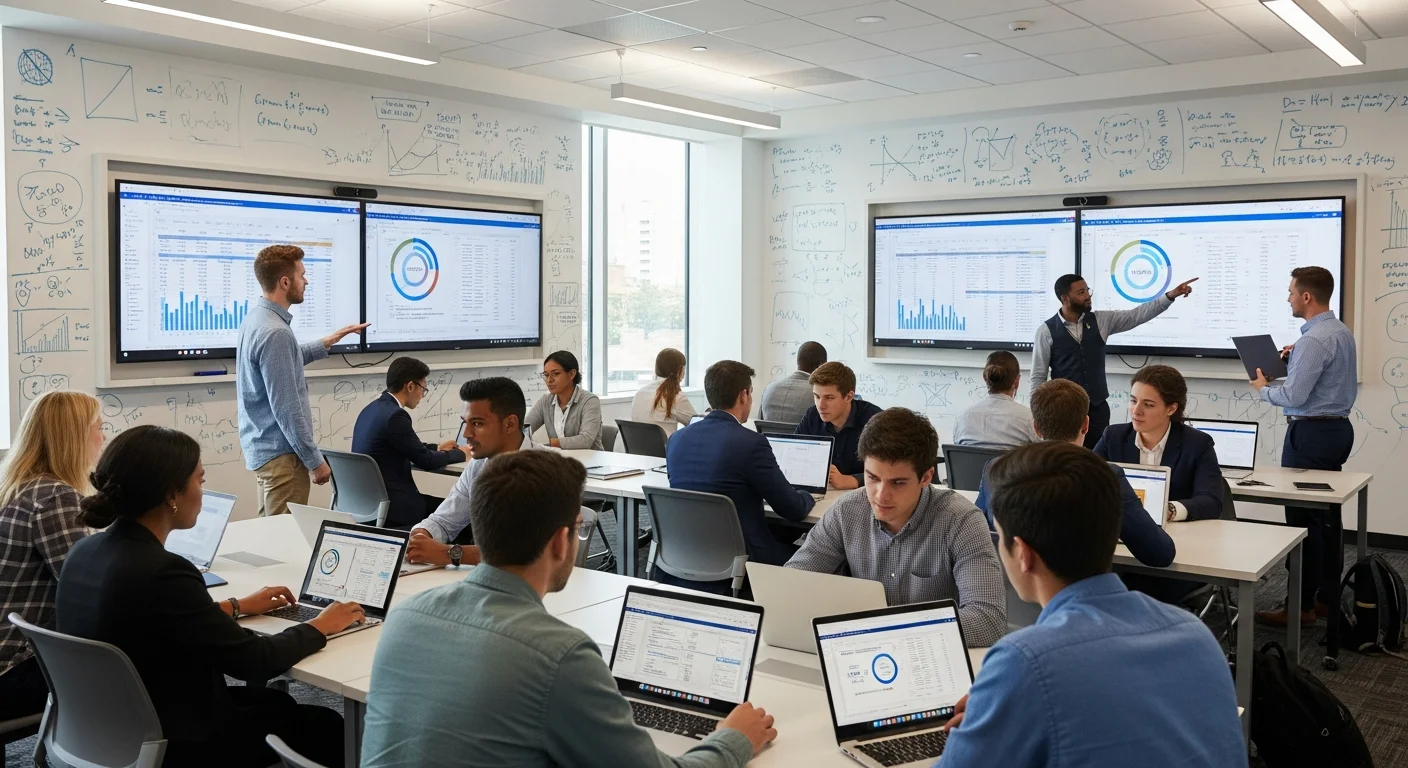
- 1.Hakia ranks the best data analytics degree programs in 2026, data analytics professionals earn a median salary of $103,500/year, with 23% job growth projected through 2032, much faster than average.
- 2.Our top-ranked data analytics programs are University of California-Berkeley, Carnegie Mellon University, and Massachusetts Institute of Technology, selected based on graduation rates, program size, and career outcomes.
- 3.Best value: University of Florida offers data analytics degrees at just $4,477/year with a 95% graduation rate.
- 4.404 accredited data analytics programs available nationwide, with options at every degree level from associate's to doctoral.
- 5.Entry-level positions require a bachelor's degree. Master's degrees unlock senior roles with 20-40% higher salaries and leadership opportunities.
Source: BLS OEWS 2024, IPEDS 2023
Best Data Analytics Programs - Top 10
These are the best data analytics programs in the United States based on our comprehensive methodology that considers graduation rates, program size, institutional reputation, and career outcomes. Rankings are updated annually using data from IPEDS and BLS.
Best Data Analytics Programs - Top 10
University of California-Berkeley
Doctoral: Very High Research (R1)
Berkeley pioneered human-centered data science education, with MIDS being the first major online data science program to integrate ethics and policy throughout the curriculum, while MAnalytics achieves 100% internship placement and operates in the heart of Silicon Valley with constant industry engagement.
University of California-Berkeley Data Analytics Program Overview
Hakia ranks University of California-Berkeley as the #1 in data analytics degree program.
University of California-Berkeley's Data Analytics program graduates 637 students annually with a 96% graduation rate. Research opportunities include the Berkeley Institute for Data Science (BIDS) and Berkeley Artificial Intelligence Research (BAIR). Located in Silicon Valley innovation hub Graduates find positions at Amazon, Apple, Google.
Hakia Insight: University of California-Berkeley leverages partnerships with Amazon and Apple to offer students real-world project experience valued by employers.
Degree Programs
Research Labs & Institutes
Promotes scientific breakthroughs by advancing interdisciplinary, data-driven discovery
Computer vision, machine learning, natural language processing, planning, and robotics
Brings together world's leading researchers to explore nature and limits of computation
Catalyzing innovation in cloud computing and distributed systems
Location Advantages
- •Located in Silicon Valley innovation hub
- •Direct access to top tech companies for recruitment and internships
- •Proximity to San Francisco Bay Area ensures top recruiters regularly attend career fairs
Industry Partners
Career Outcomes
Amazon, Apple, Google, Microsoft, Tesla
Certifications & Designations
Admissions
Carnegie Mellon University
Doctoral: Very High Research (R1)
CMU pioneered data-informed business decision-making at the Tepper School and houses the Pittsburgh Supercomputing Center, a world leader in high-performance computing, giving students unprecedented access to advanced computational resources and real scientific datasets.
Carnegie Mellon University Data Analytics Program Overview
Hakia ranks Carnegie Mellon University as the #2 in data analytics degree program.
Carnegie Mellon University's Data Analytics program graduates 337 students annually with a 98% graduation rate. Research opportunities include the AI Measurement Science & Engineering Cooperative Research Center (AIMSEC) and Pittsburgh Supercomputing Center. Access to Pittsburgh Supercomputing Center's computational resources Graduates find positions at Consulting firms, Financial services, Healthcare.
Hakia Insight: Carnegie Mellon University leverages partnerships with NIST and PwC to offer students real-world project experience valued by employers.
Degree Programs
Research Labs & Institutes
AI system evaluation, testing, and monitoring in partnership with NIST
World leader in high-performance computing and data analytics, hosts large scientific datasets
Public policy and managerial questions in digital distribution of entertainment content
Decision sciences research building on psychology, economics, neuroscience, and public policy
Location Advantages
- •Access to Pittsburgh Supercomputing Center's computational resources
- •Strong industry partnerships in Pittsburgh tech corridor
- •Proximity to government research facilities and contractors
Industry Partners
Career Outcomes
Consulting firms, Financial services, Healthcare, Technology, Government agencies
Certifications & Designations
Admissions
Massachusetts Institute of Technology
Doctoral: Very High Research (R1)
MIT created one of the first rigorous online MicroMasters programs that delivers authentic MIT-level education remotely, while IDSS represents a unique interdisciplinary approach combining data science with systems thinking and societal impact.
Massachusetts Institute of Technology Data Analytics Program Overview
Hakia ranks Massachusetts Institute of Technology as the #3 in data analytics degree program.
Massachusetts Institute of Technology offers comprehensive Data Analytics programs at multiple degree levels, combining rigorous academics with practical experience. Research opportunities include the Laboratory for Infrastructure Science and Sustainability (LISS) and Braatz Group. Cambridge innovation ecosystem
Hakia Insight: Massachusetts Institute of Technology's industry network, including Shell and Chromatan, provides students with internship and hiring pathways.
Degree Programs
Research Labs & Institutes
Infrastructure sensing and vision-based monitoring through data analytics and AI in engineering mechanics
Applied mathematics and control theory with data analytics applications in manufacturing systems
RFID, Internet of Things (IoT), and predictive data analytics
Artificial intelligence and computer science research
Location Advantages
- •Cambridge innovation ecosystem
- •Proximity to Boston's thriving tech and biotech sectors
- •Access to venture capital and startup community
Industry Partners
Career Outcomes
Certifications & Designations
Admissions
University of Southern California
Doctoral: Very High Research (R1)
USC uniquely offers data analytics training across three schools - Viterbi Engineering, Marshall Business, and through extensive research at the Information Sciences Institute - creating the only comprehensive ecosystem where students can pursue analytics from pure engineering, business strategy, or applied research perspectives.
University of Southern California Data Analytics Program Overview
Hakia ranks University of Southern California as the #4 in data analytics degree program.
University of Southern California's Data Analytics program graduates 1,221 students annually with a 92% graduation rate. Research opportunities include the Information Sciences Institute (ISI) and Data Science Lab. Los Angeles entertainment and media industry access Graduates find positions at Amazon, Google, Salesforce.
Hakia Insight: Students at University of Southern California benefit from active collaborations with Amazon and Google, connecting classroom learning to the workforce.
Degree Programs
Research Labs & Institutes
World leader in AI, machine learning, and computational systems research
Machine learning and data mining research
AI applications for social good
Location Advantages
- •Los Angeles entertainment and media industry access
- •Silicon Beach tech ecosystem proximity
- •Strong alumni network across global industries
Industry Partners
Career Outcomes
Amazon, Google, Salesforce, Boston Consulting Group, Goldman Sachs
Certifications & Designations
Admissions
Stanford University
Doctoral: Very High Research (R1)
Stanford's Statistics and Data Science program sits at the epicenter of Silicon Valley, offering unmatched access to tech giants and startups while being backed by one of the world's most prestigious statistics departments with deep ties to industry innovation.
Stanford University Data Analytics Program Overview
Hakia ranks Stanford University as the #5 in data analytics degree program.
Stanford University offers comprehensive Data Analytics programs at multiple degree levels, combining rigorous academics with practical experience. Research opportunities include the Golub Capital Social Impact Lab and Data, Analytics, and Research Computing (DARC). Silicon Valley location with direct access to tech industry Graduates find positions at Technology sector companies, Finance industry, Government services.
Hakia Insight: Stanford University's Golub Capital Social Impact Lab creates a direct research-to-career pipeline with DeepLearning.AI, bridging academic research and industry practice.
Degree Programs
Research Labs & Institutes
Machine Learning and Causal Inference for social impact
Analytics support, machine learning, text processing, and cloud services
Artificial intelligence research and applications
AI research, education, policy, and practice to improve human condition
Neural data science research and applications
Data science and AI applications in cosmic discovery
Data science for mobile health applications
Mobile sensing in rehabilitation research
Sequence analysis, molecular modeling, mathematical and statistical analysis
Location Advantages
- •Silicon Valley location with direct access to tech industry
- •Bay Area concentration of data science opportunities
- •Stanford's prestigious reputation opening doors globally
Industry Partners
Career Outcomes
Technology sector companies, Finance industry, Government services, Healthcare organizations
Admissions
Cornell University
Doctoral: Very High Research (R1)
Cornell is the only Ivy League university offering a Master of Professional Studies in Data Science and Applied Statistics, and its MSBA program uniquely integrates the 'ABCs' framework - Advanced Analytics & AI Tools, Business Fundamentals, and Communication & Leadership - across three flexible delivery formats.
Cornell University Data Analytics Program Overview
Hakia ranks Cornell University as the #6 in data analytics degree program.
Cornell University's Data Analytics program graduates 305 students annually with a 95% graduation rate. Research opportunities include the Cornell Center for Data Science for Enterprise and Society and Cornell Statistical Consulting Unit. Ithaca campus with strong academic research environment Graduates find positions at Amazon, Bloomberg, Google.
Hakia Insight: Students at Cornell University benefit from active collaborations with Various Fortune 500 Companies and NYC Tech Ecosystem, connecting classroom learning to the workforce.
Degree Programs
Research Labs & Institutes
Unifying Cornell data science programs with emphasis on human-generated data
Statistical research and consultation services
Location Advantages
- •Ithaca campus with strong academic research environment
- •Cornell Tech NYC campus in Roosevelt Island tech hub
- •Access to New York City analytics talent market
Industry Partners
Career Outcomes
Amazon, Bloomberg, Google, Microsoft, Banking
Certifications & Designations
Admissions
University of California-Los Angeles
Doctoral: Very High Research (R1)
UCLA Anderson's MSBA is the only program ranked #1 globally that specifically trains data scientists to communicate compelling 'data stories' to non-technical business leaders, bridging the critical gap between analytics and C-suite decision making.
University of California-Los Angeles Data Analytics Program Overview
Hakia ranks University of California-Los Angeles as the #7 in data analytics degree program.
University of California-Los Angeles's Data Analytics program graduates 909 students annually with a 92% graduation rate. Research opportunities include the Morrison Center for Marketing and Data Analytics and Information Systems Research Program. Los Angeles tech hub with entertainment industry analytics opportunities Graduates find positions at Boston Consulting Group, Nextdoor, Big Tech companies.
Hakia Insight: University of California-Los Angeles's direct partnerships with Intuit and Nextdoor give students a competitive edge through industry-embedded projects and recruiting pipelines.
Degree Programs
Research Labs & Institutes
marketing analytics and data science
information systems and data analytics
Location Advantages
- •Los Angeles tech hub with entertainment industry analytics opportunities
- •Proximity to major tech companies and startups
- •Access to diverse industry sectors including media, entertainment, and aerospace
Industry Partners
Career Outcomes
Boston Consulting Group, Nextdoor, Big Tech companies, Entertainment industry, E-commerce/Retail
Certifications & Designations
Admissions
University of Washington-Seattle Campus
Doctoral: Very High Research (R1)
UW offers one of the fastest business analytics tracks nationally at just 12 months through Build, while simultaneously providing deep technical data science education through MSDS - creating dual pathways that serve both business-focused and technically-oriented career trajectories in Seattle's booming tech market.
University of Washington-Seattle Campus Data Analytics Program Overview
Hakia ranks University of Washington-Seattle Campus as the #8 in data analytics degree program.
University of Washington-Seattle Campus's Data Analytics program graduates 106 students annually with a 97% graduation rate. Research opportunities include the Build Customer Analytics Center and eScience Institute. Seattle tech ecosystem proximity with connections to major employers Graduates find positions at JP Morgan Chase & Co., IBM, Costco IT.
Hakia Insight: Students at University of Washington-Seattle Campus benefit from active collaborations with Amazon and Microsoft, connecting classroom learning to the workforce.
Degree Programs
Research Labs & Institutes
Database marketing, e-commerce, and big data social influence models
Data-intensive discovery across disciplines, serving as campus hub for data science innovation
Location Advantages
- •Seattle tech ecosystem proximity with connections to major employers
- •Beautiful campus with Mount Rainier and Lake Washington views
- •Four miles from downtown Seattle
- •Strong ties to Pacific Northwest tech industry
Industry Partners
Career Outcomes
JP Morgan Chase & Co., IBM, Costco IT, Toyota, Northrop Grumman
Certifications & Designations
Admissions
Northwestern University
Doctoral: Very High Research (R1)
Northwestern pioneered the integration of Go programming language into data science education and operates the Program for Data Analytics at Kellogg (PDAK), the first business school program specifically designed to teach analytics leadership to business executives rather than technical implementation.
Northwestern University Data Analytics Program Overview
Hakia ranks Northwestern University as the #9 in data analytics degree program.
Northwestern University's Data Analytics program graduates 2,013 students annually with a 90% graduation rate. Research opportunities include the Northwestern Institute on Complex Systems (NICO) and NSF-Simons AI Institute for the Sky (SkAI). Access to Chicago's major corporate headquarters and financial sector Graduates find positions at Amazon, Google, Microsoft.
Hakia Insight: Students at Northwestern University benefit from active collaborations with Amazon and Google, connecting classroom learning to the workforce.
Degree Programs
Research Labs & Institutes
Computational social science, science of science, bio informatics, and data visualization
AI tools for astronomical data analysis with over 100 team members from 25 partner organizations
Quantum computing, communications, and sensing applications
Location Advantages
- •Access to Chicago's major corporate headquarters and financial sector
- •Strong Northwestern alumni network across technology and consulting firms
- •Partnership with Argonne National Laboratory through NAISE Institute
Industry Partners
Career Outcomes
Amazon, Google, Microsoft, Meta, JP Morgan
Admissions
University of North Carolina at Chapel Hill
Doctoral: Very High Research (R1)
UNC created the School of Data Science and Society as an interdisciplinary hub that uniquely positions data science within societal impact, emphasizing ethical governance and collaborative partnerships with industry, government, and community organizations through every stage of learning.
University of North Carolina at Chapel Hill Data Analytics Program Overview
Hakia ranks University of North Carolina at Chapel Hill as the #10 in data analytics degree program.
University of North Carolina at Chapel Hill's Data Analytics program graduates 824 students annually with a 93% graduation rate. Research opportunities include the Renaissance Computing Institute (RENCI) and Carolina Health Informatics Program (CHIP). Access to Renaissance Computing Institute (RENCI) Graduates find positions at Google, Amazon, Apple.
Hakia Insight: University of North Carolina at Chapel Hill leverages partnerships with Industry Partners and Government Agencies to offer students real-world project experience valued by employers.
Degree Programs
Research Labs & Institutes
Data analytics, high-end computing for modeling and simulation, advanced computational tools
Health informatics, information visualization, clinical data science
Society-centered AI, machine learning, human-AI interaction, AI fairness and ethics
Health services research, healthcare data analytics, population health
Population research methods, demographic analysis
Location Advantages
- •Access to Renaissance Computing Institute (RENCI)
- •Proximity to major healthcare databases through Sheps Center
- •Integration with UNC Health System for clinical applications
Industry Partners
Career Outcomes
Google, Amazon, Apple, PayPal, Akamai
Admissions
Best Data Analytics Programs - Top 10 — Complete Program Data
#1. University of California-Berkeley Data Analytics Program
Hakia ranks University of California-Berkeley as the #1 in data analytics degree program. Location: Berkeley, CA | Type: Public | Tuition: $11,834/year | Graduation Rate: 96% | Score: 100.0
What makes University of California-Berkeley stand out: Berkeley pioneered human-centered data science education, with MIDS being the first major online data science program to integrate ethics and policy throughout the curriculum, while MAnalytics achieves 100% internship placement and operates in the heart of Silicon Valley with constant industry engagement.
Hakia Insight: University of California-Berkeley leverages partnerships with Amazon and Apple to offer students real-world project experience valued by employers.
Program Overview: UC Berkeley offers two premier data analytics programs that represent different approaches to the field. The Master of Information and Data Science (MIDS) is a 27-unit online program delivered by the School of Information, designed specifically for working professionals with flexible completion paths ranging from 12 months (accelerated) to 32 months (decelerated). Fortune magazine has nationally recognized this as the No. 1-ranked online data science program. The curriculum uniquely integrates computer science, AI, machine learning, social sciences, statistics, management, and law, with a strong emphasis on human-centered values and ethical implications of data science. The Master of Analytics (MAnalytics) is a 12-month, on-campus STEM-designated program housed in the Industrial Engineering & Operations Research department, ranked No. 3 nationally. This intensive program follows a structured timeline: Python intensive (months 0-1), core analytical methods (months 2-6), electives and analytics lab (months 7-10), and a 200-hour summer internship (months 11-12). Both programs benefit from Berkeley's location in the innovation hub of the San Francisco Bay Area, with direct access to Silicon Valley companies and a strong research ecosystem including the Berkeley Institute for Data Science (BIDS), Berkeley Artificial Intelligence Research (BAIR) Lab, and the Simons Institute for the Theory of Computing.
Degree Programs: Master of Information and Data Science (MIDS) (20 months standard); Master of Analytics (MAnalytics) (12 months)
Research Labs: Berkeley Institute for Data Science (BIDS) - Promotes scientific breakthroughs by advancing interdisciplinary, data-driven discovery; Berkeley Artificial Intelligence Research (BAIR) - Computer vision, machine learning, natural language processing, planning, and robotics; Simons Institute for the Theory of Computing - Brings together world's leading researchers to explore nature and limits of computation; Sky Computing Lab - Catalyzing innovation in cloud computing and distributed systems
Industry Partners: Amazon, Apple, Google, Microsoft, Tesla, Uber, 2U
Career Outcomes: Placement Rate: 100% secured internships for MAnalytics program | Top Employers: Amazon, Apple, Google, Microsoft, Tesla, Uber | Common Roles: Business Data Analyst, Data Scientist, Data Engineer, Data Architect, Solutions Architect, Systems Engineer
Notable Faculty: Alper Atamturk (Program Director for MAnalytics, Industrial Engineering and Operations Research); Ilan Adler (Industrial Engineering and Operations Research); Paul Grigas (Associate Professor, Industrial Engineering and Operations Research); Ying Cui (Assistant Professor, Industrial Engineering and Operations Research)
Admissions:
Accreditations: WASC-accredited (MIDS), STEM-designated (MAnalytics)
#2. Carnegie Mellon University Data Analytics Program
Hakia ranks Carnegie Mellon University as the #2 in data analytics degree program. Location: Pittsburgh, PA | Type: Private | Tuition: $62,260/year | Graduation Rate: 98% | Score: 97.2
What makes Carnegie Mellon University stand out: CMU pioneered data-informed business decision-making at the Tepper School and houses the Pittsburgh Supercomputing Center, a world leader in high-performance computing, giving students unprecedented access to advanced computational resources and real scientific datasets.
Hakia Insight: Carnegie Mellon University leverages partnerships with NIST and PwC to offer students real-world project experience valued by employers.
Program Overview: Carnegie Mellon University offers a comprehensive ecosystem of data analytics programs spread across multiple prestigious schools, each tailored to specific career trajectories. The flagship Master of Science in Data Analytics for Science (MS-DAS) is housed in the Mellon College of Science as an intensive one-year program that combines rigorous coursework in applied linear algebra, machine learning, and statistical methods with hands-on experience using datasets from biology, chemistry, mathematics, and physics hosted by the Pittsburgh Supercomputing Center. Students complete a semester-long industry capstone project and a required communications and professional development component, totaling 99 units. The Tepper School of Business offers both full-time (9-month) and part-time online (20-month) Master of Science in Business Analytics (MSBA) programs, ranked #1 by U.S. News & World Report for Business Analytics. These STEM-designated programs emphasize strategic business applications of analytics, featuring experiential learning courses where students manage real company datasets and present findings to executives. The Heinz College contributes through its strong research infrastructure, including the AI Measurement Science & Engineering Cooperative Research Center (AIMSEC) in partnership with NIST, and multiple specialized research centers focusing on behavioral decision research, digital entertainment analytics, and teaching & education analytics.
Degree Programs: MS in Data Analytics for Science (MS-DAS) (1 year); MS in Business Analytics (MSBA) - Full-Time (9 months); MS in Business Analytics (MSBA) - Part-Time Online (20 months)
Research Labs: AI Measurement Science & Engineering Cooperative Research Center (AIMSEC) - AI system evaluation, testing, and monitoring in partnership with NIST; Pittsburgh Supercomputing Center - World leader in high-performance computing and data analytics, hosts large scientific datasets; Initiative for Digital Entertainment Analytics (IDEA) - Public policy and managerial questions in digital distribution of entertainment content; Center for Behavioral Decision Research (CBDR) - Decision sciences research building on psychology, economics, neuroscience, and public policy
Industry Partners: NIST, PwC, Singapore Management University
Career Outcomes: | Top Employers: Consulting firms, Financial services, Healthcare, Technology, Government agencies, Energy sector | Common Roles: Director of Business Development, Global Development Analyst, Data Analyst, Senior Consultant, Strategic Pricing Leadership Development Associate, Policy Analyst, Research Analyst
Notable Faculty: Professor Rayid Ghani (data analytics for public policy)
Admissions:
Accreditations: STEM-designated programs (MSBA), ABET accredited engineering programs available
#3. Massachusetts Institute of Technology Data Analytics Program
Hakia ranks Massachusetts Institute of Technology as the #3 in data analytics degree program. Location: Cambridge, MA | Type: Private | Tuition: $59,750/year | Score: 92.7
What makes Massachusetts Institute of Technology stand out: MIT created one of the first rigorous online MicroMasters programs that delivers authentic MIT-level education remotely, while IDSS represents a unique interdisciplinary approach combining data science with systems thinking and societal impact.
Hakia Insight: Massachusetts Institute of Technology's industry network, including Shell and Chromatan, provides students with internship and hiring pathways.
Program Overview: MIT offers several data analytics pathways, with the flagship being the MicroMasters® program in Statistics and Data Science (SDS) developed by MITx and the MIT Institute for Data, Systems, and Society (IDSS). This rigorous online program provides four specialized tracks: General, Methods, Time Series and Social Sciences, and Social Sciences, each comprising four courses plus a capstone exam. The program delivers MIT-level rigor without requiring students to leave their jobs, covering everything from probability and statistics to machine learning and domain-specific applications. For those seeking residential programs, MIT Sloan offers a Master of Business Analytics (MBAn) - a 12-month intensive program focused on applying modern data science, optimization, and machine learning tools to real-world business problems. The Institute also houses the Institute for Data, Systems, and Society (IDSS), which serves as MIT's hub for interdisciplinary data science research, bringing together faculty from across engineering, management, and social sciences.
Degree Programs: MicroMasters in Statistics and Data Science (1-2 years); Master of Business Analytics (12 months)
Research Labs: Laboratory for Infrastructure Science and Sustainability (LISS) - Infrastructure sensing and vision-based monitoring through data analytics and AI in engineering mechanics; Braatz Group - Applied mathematics and control theory with data analytics applications in manufacturing systems; MIT Auto-ID Laboratory - RFID, Internet of Things (IoT), and predictive data analytics; Computer Science and Artificial Intelligence Laboratory (CSAIL) - Artificial intelligence and computer science research
Industry Partners: Shell, Chromatan, Takeda, Novartis Basel, McKinsey & Company, IBM Innovation Center, Biogen, Toyota Research Institute (TRI), Gates Foundation, FDA
Career Outcomes: | Common Roles: Data Scientist, Business Analyst, Machine Learning Engineer, Policy Analyst
Notable Faculty: Dr. Oral Buyukozturk (Infrastructure sensing and vision-based monitoring through data analytics and AI); Dr. Richard D. Braatz (Applied mathematics and control theory for manufacturing data analytics); Dr. Shoumen Palit Austin Datta (RFID, IoT, and predictive data analytics)
Admissions:
Accreditations: MITx MicroMasters Certificate, Pathways to graduate programs available
#4. University of Southern California Data Analytics Program
Hakia ranks University of Southern California as the #4 in data analytics degree program. Location: Los Angeles, CA | Type: Private | Tuition: $66,640/year | Graduation Rate: 92% | Score: 92.5
What makes University of Southern California stand out: USC uniquely offers data analytics training across three schools - Viterbi Engineering, Marshall Business, and through extensive research at the Information Sciences Institute - creating the only comprehensive ecosystem where students can pursue analytics from pure engineering, business strategy, or applied research perspectives.
Hakia Insight: Students at University of Southern California benefit from active collaborations with Amazon and Google, connecting classroom learning to the workforce.
Program Overview: USC offers three distinct data analytics pathways that showcase the university's comprehensive approach to data education. The MS in Analytics, housed in the Daniel J. Epstein Department of Industrial and Systems Engineering (recently ranked top 10 by U.S. News), is a 28-unit program that blends engineering rigor with advanced analytics. Students master tools like Python, R, SQL, Snowflake, and Google Cloud Platform while choosing from four specialization tracks: Data Engineering/ML Engineering, Data Science, Data Analysis, and AI Engineering. The MS in Business Analytics (MSBA) at Marshall School of Business is a 2-year, full-time STEM program ranked #8 in the U.S. by QS, combining technical training with business strategy in the heart of Los Angeles. Meanwhile, the MS in Applied Data Science from Viterbi is a 32-unit program designed for students from diverse backgrounds, emphasizing hands-on experience with the goal of having students 'live in the data' through extensive practical projects and a unique professional practicum.
Degree Programs: MS in Analytics (1.5-2 years); MS in Business Analytics (MSBA) (2 years); MS in Applied Data Science (1.5-2 years)
Research Labs: Information Sciences Institute (ISI) - World leader in AI, machine learning, and computational systems research; Data Science Lab - Machine learning and data mining research; Center for Artificial Intelligence in Society - AI applications for social good
Industry Partners: Amazon, Google, Salesforce, Boston Consulting Group, Goldman Sachs
Career Outcomes: Placement Rate: Strong placement across multiple industries | Top Employers: Amazon, Google, Salesforce, Boston Consulting Group, Goldman Sachs, Deloitte, Tencent, Meta | Common Roles: Data Scientist, ML Engineer, Business Intelligence Analyst, Analytics Consultant, Product Analyst
Notable Faculty: Dr. Dawn Porter (Statistics, Academic Director of MS Business Analytics); Dr. Mohammed Alyakoob (Digital marketplaces and economic impact); Dr. Arif Ansari (Data mining, business intelligence, data warehousing); Dr. Cosimo Arnesano (AI/ML applications to business processes)
Admissions:
Accreditations: STEM OPT extension eligible, DEN@Viterbi online delivery available
#5. Stanford University Data Analytics Program
Hakia ranks Stanford University as the #5 in data analytics degree program. Location: Stanford, CA | Type: Private | Tuition: $61,731/year | Score: 89.4
What makes Stanford University stand out: Stanford's Statistics and Data Science program sits at the epicenter of Silicon Valley, offering unmatched access to tech giants and startups while being backed by one of the world's most prestigious statistics departments with deep ties to industry innovation.
Hakia Insight: Stanford University's Golub Capital Social Impact Lab creates a direct research-to-career pipeline with DeepLearning.AI, bridging academic research and industry practice.
Program Overview: Stanford University offers a rigorous M.S. in Statistics and Data Science, a terminal master's program designed for immediate career placement in the rapidly expanding data science field. The program takes 5-6 quarters to complete (excluding summer), requiring 45 units of coursework that blends theoretical statistical foundations with practical machine learning applications. Students begin with core courses like Probability Theory for Statistical Inference (STATS 118) and Statistical Learning and Data Science (STATS 202), progressing through advanced topics including causal inference, matrix theory, and specialized electives. The curriculum emphasizes both R and Python programming skills, with hands-on experience analyzing real datasets of moderate size. What sets Stanford's program apart is its location in the heart of Silicon Valley and deep integration with the broader Stanford ecosystem. Students benefit from mandatory orientations, close faculty mentoring through assigned advisors, and access to Stanford's renowned research infrastructure. The program attracts a diverse cohort from around the world, with students expected to live within commuting distance to ensure significant engagement with the department and faculty. Career prospects are exceptionally strong, with graduates finding positions across technology, finance, healthcare, and government sectors, particularly in the Bay Area where Stanford's Silicon Valley location provides industry access.
Degree Programs: Bachelors in Data Analytics; Data Science Scholars Program; Data Science Postdoctoral Fellows; MBA with Analytics Focus (2 years)
Research Labs: Golub Capital Social Impact Lab - Machine Learning and Causal Inference for social impact; Data, Analytics, and Research Computing (DARC) - Analytics support, machine learning, text processing, and cloud services; Stanford Artificial Intelligence Laboratory - Artificial intelligence research and applications; Stanford Institute for Human-Centered Artificial Intelligence (HAI) - AI research, education, policy, and practice to improve human condition; Center for Neural Data Science - Neural data science research and applications; Center for Decoding the Universe - Data science and AI applications in cosmic discovery; Mobilize Center - Data science for mobile health applications; RESTORE Center - Mobile sensing in rehabilitation research; Computational Services and Bioinformatics Facility (CSBF) - Sequence analysis, molecular modeling, mathematical and statistical analysis
Industry Partners: DeepLearning.AI, Coursera
Career Outcomes: | Top Employers: Technology sector companies, Finance industry, Government services, Healthcare organizations | Common Roles: Data Scientist, Research Analyst, Software Engineer, Program Manager, Business Analyst
Notable Faculty: Wah Chiu (Cryo-electron microscopy and tomography); Paul Yock (Medical technology innovation); Stephen Quake (Microfluidics and bioengineering)
Admissions:
#6. Cornell University Data Analytics Program
Hakia ranks Cornell University as the #6 in data analytics degree program. Location: Ithaca, NY | Type: Private | Tuition: $65,204/year | Graduation Rate: 95% | Score: 88.6
What makes Cornell University stand out: Cornell is the only Ivy League university offering a Master of Professional Studies in Data Science and Applied Statistics, and its MSBA program uniquely integrates the 'ABCs' framework - Advanced Analytics & AI Tools, Business Fundamentals, and Communication & Leadership - across three flexible delivery formats.
Hakia Insight: Students at Cornell University benefit from active collaborations with Various Fortune 500 Companies and NYC Tech Ecosystem, connecting classroom learning to the workforce.
Program Overview: Cornell University offers a comprehensive portfolio of data analytics programs spanning multiple schools and formats. The flagship Master of Science in Business Analytics (MSBA) through the Johnson Graduate School of Management bridges advanced analytics with Ivy League business education in three distinct formats: a 16-month Online+ program with two immersive residencies, a 10-month accelerated full-time program in NYC, and a part-time evening program for working professionals. Students can specialize in Business Analytics, Finance, Marketing, or Operations & Supply Chains. Additionally, Cornell's Ann S. Bowers College of Computing and Information Science offers a Master of Professional Studies (MPS) in Data Science and Applied Statistics, which can be completed in just two semesters with options for either applied statistics or data science concentration. Cornell Tech in New York City provides a Master of Engineering in Data Science and Decision Analytics, combining technical depth with the innovative Studio curriculum where students build real solutions for industry partners.
Degree Programs: MS in Business Analytics (MSBA) (10-16 months); Master of Professional Studies in Data Science and Applied Statistics (2 semesters); Master of Engineering in Data Science and Decision Analytics (1 year)
Research Labs: Cornell Center for Data Science for Enterprise and Society - Unifying Cornell data science programs with emphasis on human-generated data; Cornell Statistical Consulting Unit - Statistical research and consultation services
Industry Partners: Various Fortune 500 Companies, NYC Tech Ecosystem
Career Outcomes: Placement Rate: 72% of MPS graduates employed | Top Employers: Amazon, Bloomberg, Google, Microsoft, Banking, Consulting, Technology, E-commerce | Common Roles: Senior Analyst, Data Scientist, Data Engineer, Business Analyst, Financial Analyst, Insights Manager, Operations Analyst, Analytics Consultant, Director of Analytics
Notable Faculty: undefined (Professors work at the forefront of data and business innovation)
Admissions:
Accreditations: STEM-designated degrees for OPT eligibility
#7. University of California-Los Angeles Data Analytics Program
Hakia ranks University of California-Los Angeles as the #7 in data analytics degree program. Location: Los Angeles, CA | Type: Public | Tuition: $11,834/year | Graduation Rate: 92% | Score: 87.4
What makes University of California-Los Angeles stand out: UCLA Anderson's MSBA is the only program ranked #1 globally that specifically trains data scientists to communicate compelling 'data stories' to non-technical business leaders, bridging the critical gap between analytics and C-suite decision making.
Hakia Insight: University of California-Los Angeles's direct partnerships with Intuit and Nextdoor give students a competitive edge through industry-embedded projects and recruiting pipelines.
Program Overview: UCLA offers a standout Master of Science in Business Analytics (MSBA) program through the prestigious Anderson School of Management, ranked #1 globally by QS World University Rankings in 2026. This 15-month, STEM-certified on-campus program is designed to bridge the critical gap between technical data skills and business strategy, training students to translate massive datasets into actionable business insights. The program features an exceptional 3:1 student-to-faculty ratio and is led by renowned faculty like Professor Felipe Caro, who helped Zara revolutionize its supply chain into a fast-fashion empire. Students gain hands-on experience through Applied Analytics Projects with top companies, industry seminars, and specialized workshops in data storytelling and business communication. The curriculum combines rigorous quantitative training with business acumen, preparing graduates to become invaluable assets who can speak both the language of data science and executive strategy.
Degree Programs: MSBA (15 months); Data Science Certificate (10 weeks intensive or self-paced)
Research Labs: Morrison Center for Marketing and Data Analytics - marketing analytics and data science; Information Systems Research Program - information systems and data analytics
Industry Partners: Intuit, Nextdoor, Uber, Zara
Career Outcomes: Placement Rate: 98% full-time placement within 6 months | Top Employers: Boston Consulting Group, Nextdoor, Big Tech companies, Entertainment industry, E-commerce/Retail, Finance/Fintech | Common Roles: Data Scientist, Data Analyst, Business Analyst, Product Analyst, Business Intelligence Analyst, Product Manager, Data Engineer, Analytics Consultant
Notable Faculty: Felipe Caro (Supply chain optimization and operations research); Francisco Castro (Market operations and spatial analytics); Paola Giuliano (Cultural economics and political economy); Auyon Siddiq (Urban mobility and healthcare analytics)
Admissions:
Accreditations: STEM-certified program
#8. University of Washington-Seattle Campus Data Analytics Program
Hakia ranks University of Washington-Seattle Campus as the #8 in data analytics degree program. Location: Seattle, WA | Type: Public | Tuition: $11,524/year | Graduation Rate: 97% | Score: 84.0
What makes University of Washington-Seattle Campus stand out: UW offers one of the fastest business analytics tracks nationally at just 12 months through Build, while simultaneously providing deep technical data science education through MSDS - creating dual pathways that serve both business-focused and technically-oriented career trajectories in Seattle's booming tech market.
Hakia Insight: Students at University of Washington-Seattle Campus benefit from active collaborations with Amazon and Microsoft, connecting classroom learning to the workforce.
Program Overview: The University of Washington-Seattle Campus offers multiple pathways into data analytics through two distinct programs housed in different schools. The Master of Science in Business Analytics (MSBA) is a 12-month, STEM-designated professional program through the Build School of Business, designed specifically for career acceleration with a focus on extracting business value from data. Simultaneously, the Master of Science in Data Science (MSDS) provides a more comprehensive 1.5-year full-time or 2.5-year part-time program that covers statistical modeling, machine learning, data visualization, and software engineering with evening classes accommodating working professionals. Both programs leverage UW's position in Seattle's thriving tech ecosystem, with the MSBA program featuring direct industry engagement through faculty like Professor Oliver Rutz (O'Dell Award winner from the American Marketing Association) and Professor Hema Yoganarasimhan (Director of Build Customer Analytics Center). The MSDS program emphasizes practical application through capstone projects with external organizations, connecting students directly with companies like JP Morgan Chase, IBM, Costco IT, Toyota, and local healthcare organizations like Seattle Children's Hospital.
Degree Programs: MS in Business Analytics (MSBA) (12 months); MS in Data Science (MSDS) (1.5 years full-time)
Research Labs: Build Customer Analytics Center - Database marketing, e-commerce, and big data social influence models; eScience Institute - Data-intensive discovery across disciplines, serving as campus hub for data science innovation
Industry Partners: Amazon, Microsoft, Google
Career Outcomes: Placement Rate: Strong outcomes with dedicated career services including annual Data Science Career Fair | Top Employers: JP Morgan Chase & Co., IBM, Costco IT, Toyota, Northrop Grumman, Zillow, T-Mobile | Common Roles: Business Analysis Manager, Data Scientist, Operations Research Analyst
Notable Faculty: Professor Oliver Rutz (Customer Analytics, database marketing and e-commerce); Professor Hema Yoganarasimhan (Big data and social influence models); Professor Lalit Jain (Experimental design and artificial intelligence in marketing)
Admissions:
Accreditations: ABET accredited
#9. Northwestern University Data Analytics Program
Hakia ranks Northwestern University as the #9 in data analytics degree program. Location: Evanston, IL | Type: Private | Tuition: $64,887/year | Graduation Rate: 90% | Score: 84.0
What makes Northwestern University stand out: Northwestern pioneered the integration of Go programming language into data science education and operates the Program for Data Analytics at Kellogg (PDAK), the first business school program specifically designed to teach analytics leadership to business executives rather than technical implementation.
Hakia Insight: Students at Northwestern University benefit from active collaborations with Amazon and Google, connecting classroom learning to the workforce.
Program Overview: Northwestern University's Data Analytics ecosystem spans multiple schools, offering diverse pathways into the data science field. The School of Professional Studies houses the fully online Master of Science in Data Science (MSDS), a part-time program designed for working professionals that can be completed in as little as two years. This comprehensive program features five specializations including Analytics and Modeling, Analytics Management, Artificial Intelligence, Data Engineering, and Technology Entrepreneurship. The curriculum uniquely incorporates three programming languages. Python, R, and Go, with Go being particularly notable as a systems programming language for high-performance data science applications. Meanwhile, McCormick Engineering offers the Master of Science in Machine Learning and Data Science (MLDS), a more traditional on-campus program.
Degree Programs: BS Data Science (4 years); Combined BA/BS/MS; MS in Machine Learning and Data Science (15 months); MS in Statistics and Data Science; MSDS; PhD
Research Labs: Northwestern Institute on Complex Systems (NICO) - Computational social science, science of science, bio informatics, and data visualization; NSF-Simons AI Institute for the Sky (SkAI) - AI tools for astronomical data analysis with over 100 team members from 25 partner organizations; Institute for Quantum Information Research and Engineering (INQUIRE) - Quantum computing, communications, and sensing applications
Industry Partners: Amazon, Google, Microsoft, Meta, JP Morgan
Career Outcomes: Placement Rate: 98% of MLDS students receive offers within 3 months of graduation | Top Employers: Amazon, Google, Microsoft, Meta, JP Morgan, Boeing, Capital One, Disney | Common Roles: Data Scientist, Machine Learning Engineer, Analytics Manager, AI Engineer
Notable Faculty: Florian Zettelmeyer (Faculty Director of PDAK, Nancy L. Ertle Professor of Marketing); Luis Amaral (Complex systems and data science); Brian Uzzi (Science of science and data analytics)
Admissions:
#10. University of North Carolina at Chapel Hill Data Analytics Program
Hakia ranks University of North Carolina at Chapel Hill as the #10 in data analytics degree program. Location: Chapel Hill, NC | Type: Public | Tuition: $7,019/year | Graduation Rate: 93% | Score: 82.7
What makes University of North Carolina at Chapel Hill stand out: UNC created the School of Data Science and Society as an interdisciplinary hub that uniquely positions data science within societal impact, emphasizing ethical governance and collaborative partnerships with industry, government, and community organizations through every stage of learning.
Hakia Insight: University of North Carolina at Chapel Hill leverages partnerships with Industry Partners and Government Agencies to offer students real-world project experience valued by employers.
Program Overview: The University of North Carolina at Chapel Hill's data analytics ecosystem spans multiple programs across the newly established School of Data Science and Society. The flagship offering is the online Master of Applied Data Science (MADS), a 16-month intensive program that Fortune Education ranked as one of the best online master's in data science for 2024. This practice-oriented program emphasizes real-world application through industry partnerships and collaborative capstone projects. For undergraduates, the Statistics and Analytics major provides a comprehensive foundation in statistical data science, operations research, and actuarial science, while the Kenan-Flagler Business School offers an MBA concentration in Data Analytics and Decision Making for those seeking strategic leadership roles. The programs benefit from UNC's deep interdisciplinary collaboration, drawing faculty from the School of Information and Library Science, Department of Biostatistics, Computer Science, Mathematics, and Statistics and Operations Research. Notable faculty include Dr. David Gotz, who leads the Visual Analysis and Communications Lab (VACLab) and directs the Carolina Health Informatics Program. The curriculum emphasizes ethical data governance throughout the data lifecycle, from collection and curation to visualization and communication, preparing graduates to translate complex insights into actionable business strategies.
Degree Programs: Master of Applied Data Science (MADS) (16 months); Statistics and Analytics Major (4 years); MBA - Data Analytics and Decision Making Concentration (2 years)
Research Labs: Renaissance Computing Institute (RENCI) - Data analytics, high-end computing for modeling and simulation, advanced computational tools; Carolina Health Informatics Program (CHIP) - Health informatics, information visualization, clinical data science; Society-Centered AI Lab (SAIL) - Society-centered AI, machine learning, human-AI interaction, AI fairness and ethics; Cecil G. Sheps Center for Health Services Research - Health services research, healthcare data analytics, population health; Carolina Population Center - Population research methods, demographic analysis
Industry Partners: Industry Partners, Government Agencies, Nonprofit Organizations
Career Outcomes: Placement Rate: 95% employment or further education within 6 months (university-wide) | Top Employers: Google, Amazon, Apple, PayPal, Akamai, Coca-Cola | Common Roles: Data Scientist, Business Analyst, Operations Research Analyst, Management Analyst
Notable Faculty: Dr. Stan Ahalt (Signal, image, and video processing, high-performance scientific computing); Dr. Steve Marron (Statistics, data science and machine learning, genomics and imaging data analysis); Dr. Melissa Haendel (Semantic engineering, ontologies, knowledge graphs, real-world data analytics); Dr. David Gotz (Data science, health informatics, information visualization); Dr. Ashok Krishnamurthy (Data analytics with applications in healthcare and social science, high-end computing); Dr. Iain Carmichael (Computational pathology, deep learning for medical imaging, multimodal data analysis)
Admissions: GPA: Bachelor's degree required
Our rankings methodology weighs program strength (25%), graduation rate (20%), career outcomes (15%), institutional quality (12%), industry recognition (10%), selectivity (10%), and data transparency (8%). Learn more about our methodology →
What's Data Analytics?
Data analytics is the science of examining raw data to extract meaningful insights, patterns, and trends that inform business decisions. Unlike data science (which emphasizes machine learning and advanced modeling) or computer science (which focuses on software development), data analytics centers on transforming data into actionable business intelligence.
A data analytics degree covers statistical analysis, data visualization, SQL and database management, business intelligence tools (Tableau, Power BI), programming (Python, R), and domain-specific applications across marketing, finance, healthcare, and operations.
Data analytics professionals work across virtually every industry: tech companies, consulting firms, retail, healthcare, finance, government, and nonprofits. The degree provides both technical analytical skills and business acumen valued by employers seeking data-driven decision makers.
Who Should Study Data Analytics?
Data analytics is ideal for students who enjoy working with numbers, finding patterns in data, and translating insights into business recommendations. You don't need advanced programming skills, most programs teach necessary technical tools, but you should be comfortable with mathematics and logical thinking.
- Problem solvers who enjoy investigating questions and finding evidence-based answers
- Detail-oriented students comfortable with statistics, mathematics, and logical reasoning
- Curious analysts who want to understand what data reveals about trends and behaviors
- Business-minded students seeking roles that bridge technology and strategy
- Communication-focused individuals who can translate complex findings into clear recommendations
Data Analytics Degree Levels Compared
Data analytics degrees are available at multiple levels, each designed for different career goals and experience levels.
Data Analytics Programs by Degree Level
Top-ranked undergraduate programs nationwide
Top graduate programs for specialization and advancement
Flexible online programs for working professionals
Best Data Analytics Programs - Bachelor's
A bachelor's degree in data analytics is the standard credential for entry-level positions. These 4-year programs provide comprehensive training and hands-on experience.
Best Data Analytics Programs - Top 3 Bachelor's
University of Southern California
1221 graduates, 92% grad rate, Score: 92.5
University of Washington-Seattle Campus
81 graduates, 97% grad rate, Score: 82.6
Virginia Polytechnic Institute and State University
659 graduates, 95% grad rate, Score: 81.3
4. University of Michigan-Ann Arbor (Ann Arbor, MI) - Score: 77.7, Tuition: $17,977
5. University of Pennsylvania (Philadelphia, PA) - Score: 73.6, Tuition: $58,620
6. University of California-San Diego (La Jolla, CA) - Score: 73.4, Tuition: $11,834
7. University of Wisconsin-Madison (Madison, WI) - Score: 73.1, Tuition: $9,644
8. University of Maryland-College Park (College Park, MD) - Score: 72.2, Tuition: $9,889
9. Massachusetts Institute of Technology (Cambridge, MA) - Score: 72.2, Tuition: $59,750
10. Rutgers University-New Brunswick (New Brunswick, NJ) - Score: 71.9, Tuition: $13,674
Best Data Analytics Programs - Master's
A master's degree in data analytics prepares students for senior and specialized roles. These 1-2 year programs offer advanced expertise and leadership training.
Best Data Analytics Programs - Top 3 Master's
University of California-Berkeley
637 graduates, 96% grad rate, Score: 100.0
Carnegie Mellon University
337 graduates, 98% grad rate, Score: 97.2
Massachusetts Institute of Technology
716 graduates, N/A% grad rate, Score: 92.7
4. University of Southern California (Los Angeles, CA) - Score: 92.5, Tuition: $66,640
5. Stanford University (Stanford, CA) - Score: 89.4, Tuition: $61,731
6. Cornell University (Ithaca, NY) - Score: 88.6, Tuition: $65,204
7. University of California-Los Angeles (Los Angeles, CA) - Score: 87.4, Tuition: $11,834
8. Northwestern University (Evanston, IL) - Score: 84.0, Tuition: $64,887
9. University of Washington-Seattle Campus (Seattle, WA) - Score: 84.0, Tuition: $11,524
10. University of North Carolina at Chapel Hill (Chapel Hill, NC) - Score: 82.7, Tuition: $7,019
Best Data Analytics Programs - Online
Online data analytics programs offer flexibility for working professionals. Top accredited programs provide the same curriculum quality as on-campus alternatives.
Best Data Analytics Programs - Top 3 Online
University of California-Berkeley
637 graduates, 96% grad rate, Score: 100.0
Carnegie Mellon University
337 graduates, 98% grad rate, Score: 97.2
University of Southern California
1221 graduates, 92% grad rate, Score: 92.5
4. Stanford University (Stanford, CA) - Score: 89.4, Tuition: $61,731
5. Cornell University (Ithaca, NY) - Score: 88.6, Tuition: $65,204
6. University of California-Los Angeles (Los Angeles, CA) - Score: 87.4, Tuition: $11,834
7. University of North Carolina at Chapel Hill (Chapel Hill, NC) - Score: 82.7, Tuition: $7,019
8. University of Washington-Seattle Campus (Seattle, WA) - Score: 82.6, Tuition: $11,524
9. Virginia Polytechnic Institute and State University (Blacksburg, VA) - Score: 81.3, Tuition: $12,698
10. University of California-Davis (Davis, CA) - Score: 80.1, Tuition: $11,834
Best Data Analytics Programs - Associate's
An associate's degree in data analytics provides a 2-year pathway into the field. These programs are ideal for career starters or those planning to transfer to a 4-year program.
Best Data Analytics Programs - Top 3 Associate's
Pierce College District
7 graduates, 93% grad rate, Score: 52.3
Santa Monica College
1 graduates, 95% grad rate, Score: 48.7
Florida State College at Jacksonville
4 graduates, 89% grad rate, Score: 47.5
4. College of Southern Nevada (Las Vegas, NV) - Score: 41.8, Tuition: $3,465
5. Miami Dade College (Miami, FL) - Score: 41.0, Tuition: $1,987
6. Remington College-Online Dallas (Dallas, TX) - Score: 39.3, Tuition: $15,764
7. St Petersburg College (St. Petersburg, FL) - Score: 39.3, Tuition: $1,943
8. De Anza College (Cupertino, CA) - Score: 38.8, Tuition: $1,395
9. Gateway Technical College (Kenosha, WI) - Score: 38.4, Tuition: $4,386
10. Cleary University (Howell, MI) - Score: 37.8, Tuition: $23,292
Best Data Analytics Programs - Graduate
Graduate programs in data analytics (PhD and doctoral degrees) prepare students for research, academic, and senior leadership positions.
Best Data Analytics Programs - Top 3 Graduate
University of Washington-Seattle Campus
17 graduates, 97% grad rate, Score: 82.8
University of Southern California
14 graduates, 92% grad rate, Score: 76.8
Massachusetts Institute of Technology
13 graduates, N/A% grad rate, Score: 76.8
4. Stanford University (Stanford, CA) - Score: 75.8, Tuition: $61,731
5. University of Michigan-Ann Arbor (Ann Arbor, MI) - Score: 70.5, Tuition: $17,977
6. Washington University in St Louis (Saint Louis, MO) - Score: 68.6, Tuition: $61,750
7. University of California-Irvine (Irvine, CA) - Score: 68.3, Tuition: $11,834
8. University of Pennsylvania (Philadelphia, PA) - Score: 67.2, Tuition: $58,620
9. University of California-Santa Barbara (Santa Barbara, CA) - Score: 62.7, Tuition: $11,834
10. The University of Texas at Austin (Austin, TX) - Score: 62.4, Tuition: $11,678
Most Affordable Data Analytics Programs
Looking for quality data analytics education without the hefty price tag? These programs offer the best value, balancing tuition costs with strong academic outcomes and career prospects. Our Value Score factors in graduation rates, program strength, and institutional quality relative to cost.
Top 5 Most Affordable Data Analytics Programs
| Rank | Institution | Location | Tuition | Value Score | Grad Rate |
|---|---|---|---|---|---|
| 1 | University of Florida | Gainesville, FL | $4,477 | 140.0 | 95% |
| 2 | Bridgewater State University | Bridgewater, MA | $910 | 123.0 | 97% |
| 3 | Florida State University | Tallahassee, FL | $4,640 | 123.0 | — |
| 4 | University of Central Florida | Orlando, FL | $4,478 | 121.4 | 93% |
| 5 | University of North Carolina at Charlotte | Charlotte, NC | $3,812 | 120.4 | 76% |
Data Analytics Career Outcomes
Data analytics graduates enter one of the fastest-growing fields in technology. The Bureau of Labor Statistics projects 35% job growth for data analysts through 2032, much faster than average for all occupations. This growth is driven by increasing data volumes and the need for data-driven decision making across all industries.
Career Paths
Data Analyst
Collect, process, and analyze data to identify trends and insights that inform business decisions.
Business Intelligence Analyst
Design and maintain business intelligence systems to support organizational decision-making.
Operations Research Analyst
Use analytical methods to help organizations solve complex business problems and make better decisions.
Market Research Analyst
Study market conditions to examine potential sales of products and services.
Financial Analyst
Assess the performance of investments and provide guidance to businesses and individuals making investment decisions.
Data Analytics Curriculum Overview
Data analytics programs combine technical skills, statistical knowledge, and business acumen. Core courses include statistics, database management, programming, visualization, and applied analytics projects.
- Statistics and Probability: Descriptive and inferential statistics, hypothesis testing, regression analysis
- Programming: Python and R for data analysis, SQL for database querying
- Data Management: Database design, data warehousing, ETL processes
- Visualization: Tableau, Power BI, and programming-based visualization tools
- Business Intelligence: Dashboard design, reporting, KPI development
- Applied Analytics: Real-world projects in marketing, finance, operations, or healthcare analytics
Many programs also include capstone projects, internships, or industry partnerships. Advanced courses may cover predictive analytics, machine learning fundamentals, and specialized domain applications.
Data Analytics Programs by State
Data Analytics vs Related Fields
Data analytics focuses on business intelligence and decision support rather than building predictive models. Analytics professionals create dashboards, reports, and visualizations that help organizations understand their data and make informed decisions.
The emphasis on communication and business context distinguishes analytics from data science. While data scientists build models, analysts explain what the data means to business stakeholders who make decisions based on those insights.
Analytics tools like SQL, Excel, Tableau, and Power BI are more accessible than ML frameworks, making analytics a viable entry point for people transitioning into data careers without extensive programming backgrounds. Many analysts later specialize in data science or data engineering.
Data Analytics Career Track
+$17K avg salary increase·6 months
- Microsoft partnership with industry-recognized tools
- 1-on-1 mentorship from industry professionals
- Money-back job guarantee
Affiliate link · We may earn a commission at no extra cost to you.
- You want to focus on business intelligence and reporting
- You prefer working with existing data rather than building models
- You're interested in translating data into business recommendations
- You want faster entry into the job market with practical skills
- You're interested in machine learning and predictive modeling
- You enjoy advanced mathematics and statistical theory
- You want to build algorithms and automated systems
- You're comfortable with more complex programming and math
- You want broad programming and systems knowledge
- You're interested in software development beyond data
- You want maximum career flexibility across tech roles
- You enjoy algorithms and theoretical computer science
- You're interested in business processes and technology management
- You prefer less technical depth with more business focus
- You want to work on enterprise software implementations
- You're drawn to project management and business analysis
Is a Data Analytics Degree Worth It?
For most students, yes. The combination of strong starting salaries ($52,000+ for new grads), exceptional job growth (35% through 2032), and increasing demand across all industries makes data analytics one of the most promising career paths in technology.
When it's worth it: You're interested in working with data, comfortable with statistics and basic programming, and want a career that bridges technology and business. The degree provides structured learning, networking opportunities, and credibility with employers that bootcamps and self-study often can't match.
When to consider alternatives: You already have strong technical skills and just need analytics tools (data analytics bootcamps or certifications might be faster), you have significant financial constraints (consider starting at community college), or you're certain you want to focus only on machine learning (data science degrees might be better).
The field offers excellent job security because every organization needs people who can make sense of their data. Unlike some tech roles that may be automated, data analytics requires human judgment and business understanding.
Alternative Paths to Data Analytics Careers
While a degree is the most comprehensive path, alternatives exist for those with different timelines, budgets, or goals
- Best Data Analytics Bootcamps, 12-24 week intensive programs for career switchers
- Data Analytics Certification Guide. Industry credentials for skill validation
- Best Data Science Bootcamps. If you want more machine learning focus
- Self-Taught vs Degree: An Honest Comparison. Pros and cons of each path
- Bootcamp vs Masters: ROI Analysis. Cost-benefit comparison for working professionals
Many successful analysts combine approaches, starting with online courses or bootcamps, then adding formal education for advancement. The key is matching your path to your timeline, budget, and career goals.
Coding Bootcamps: An Alternative Pathway
Coding bootcamps offer an accelerated pathway into data analytics careers. For those considering alternatives to traditional degrees, here's what you need to know about this intensive learning format.
What is a Coding Bootcamp?
A coding bootcamp is an intensive, short-term training program (typically 12-24 weeks) that teaches practical programming skills through hands-on projects. Unlike traditional degrees, bootcamps focus exclusively on job-ready skills and often include career services to help graduates land their first tech role.
Who Bootcamps Are Best For
- Career changers looking to enter tech quickly
- Professionals wanting to upskill or transition roles
- Self-taught developers seeking structured training
- Those unable to commit to a 4-year degree timeline
What People Love
Based on discussions from r/codingbootcamp, r/cscareerquestions, and r/learnprogramming
- SQL and visualization skills transfer directly to the job
- More entry-level analytics roles available than data science
- Excel, Tableau, and Power BI are in high demand
- Shorter bootcamps (3-6 months) get you working faster
- Business intelligence skills qualify you for roles across industries
Common Concerns
Honest feedback from bootcamp graduates and industry professionals
- Analytics roles may have lower salary ceiling than engineering
- Some programs over-promise on 'data science' when teaching analytics
- Advanced analytics still requires solid statistics foundation
- Tool-focused learning may not prepare for strategy discussions
- Competition from self-taught analysts with domain expertise
Save $1000 on Springboard Bootcamps
Springboard offers career-focused bootcamps with 1-on-1 mentorship from industry professionals. Their programs include a job guarantee, complete all requirements, and if you don't land a qualifying role, you may be eligible for a full tuition refund. Use our exclusive link to save $1000 on enrollment.
Programs for Data Analytics careers:
- Data Analytics Career Track
We may earn a commission when you use our affiliate link and coupon.
More Bootcamp Resources
Data Analytics Degree FAQ
Based on 742 programs from IPEDS 2023
Our rankings are based on analysis of data analytics degree programs nationwide using IPEDS 2023 data and BLS labor statistics. Rankings are produced algorithmically without editorial intervention, ensuring objectivity and reproducibility.
Ranking Factors
Number of graduates per year in this specific field (CIP code). Larger programs indicate established departments with more resources, course offerings, and career services. Measured from IPEDS Completions data.
Percentage of students completing their degree within 150% of expected time (6 years for bachelor's, 3 years for associate's). Higher rates indicate better student support and program quality. Source: IPEDS Graduation Rates survey.
Admission rate (lower = more selective). More selective institutions have stronger academic environments and more competitive graduates. For open-admission institutions, we use graduation rates as a proxy for quality.
National salary data for data analytics graduates, factored into institutional scores based on job market strength.
Ranking Categories
Overall quality using all four factors weighted as shown above. Ideal for students seeking the strongest academic experience.
Same methodology, filtered to schools with fully online or hybrid options (IPEDS Distance Education data). Some schools may have lower graduation rates due to different student demographics.
Ranked primarily by net cost (tuition minus average institutional aid), with quality factors as tiebreakers. Best for cost-conscious students.
Data Sources
- IPEDS 2023 — Institutional characteristics, completions, graduation rates
- BLS OEWS 2024 — National and metro salary data by occupation
- CIP Code Mapping — Programs identified using Classification of Instructional Programs codes
Related Resources

Taylor Rupe
Co-founder & Editor (B.S. Computer Science, Oregon State • B.A. Psychology, University of Washington)
Taylor combines technical expertise in computer science with a deep understanding of human behavior and learning. His dual background drives Hakia's mission: leveraging technology to build authoritative educational resources that help people make better decisions about their academic and career paths.