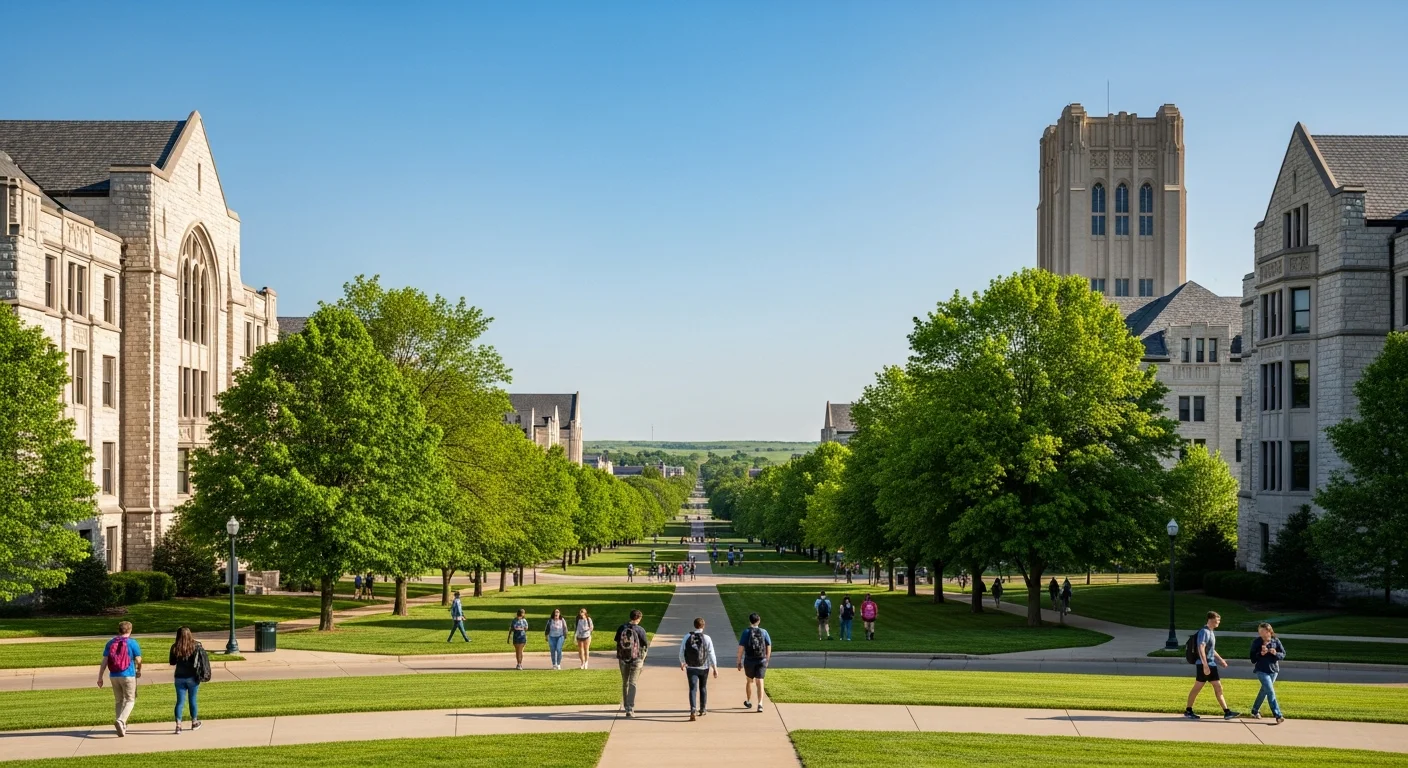
University campus in Kansas
Updated January 2026

Best Information Technology Degree Programs in Kansas — 2026 Rankings

Compare the top information technology colleges in Kansas. 18 accredited information technology schools ranked by graduation rate, career outcomes, and value—from Manhattan Area Technical College to University of Kansas.

#1 ProgramU of Kansas
Avg Salary$92,340
Tuition From$5,976/yr
Job Growth+22%

Key Takeaways

Best information technology degree programs: U of Kansas, Kansas State, Washburn

Ranked by graduation rates, program outcomes, and institutional quality

IPEDS 2023

Tuition ranges from $2,432 to $35,120/year

Manhattan Area Technical ... offers the most affordable option at $5,976/yr

IPEDS 2023

Information Technology degree programs available: 3 associate's, 7 master's, 2 doctoral in Kansas

From community college pathways to advanced research degrees

IPEDS 2023

5 online information technology degree programs in Kansas

Flexible scheduling for working professionals

IPEDS 2023

Kansas community college transfer can save 40-60% on total degree costs

3 associate's programs provide transfer pathways to bachelor's degrees

Education Commission of the States

Major employers: Garmin, Sprint, Cerner, Koch Industries

Tech hubs in Kansas City and Wichita

Hakia Research 2026

Information Technology degree programs near 44+ cities across Kansas

Search by city to find programs within 200 miles of your location

IPEDS 2023

Updated February 2026

On This Page
$92,340
Are Information Technology Degree Programs in Kansas Worth It?
Yes. The best information technology degree programs in Kansas deliver strong ROI—graduates earn $92,340 median salary with +22% job growth through 2032. In-state tuition averages $15,295/year.

Source: BLS OEWS May 2024

Best Information Technology Degree Programs in Kansas

Bachelor's Information Technology Degree Programs in Kansas

12 programs$92,340 median salary77% avg grad rate
12
Programs
$92,340
Median Salary
$16,493/yr
Avg Tuition
77%
Avg Grad Rate

Program Landscape

Kansas ranks among the nation's top destinations for information technology education, with 12 accredited bachelor's degree programs across 7 public and 5 private institutions. The highest-ranked programs are U of Kansas, Kansas State, Washburn, recognized for academic excellence, research opportunities, and strong industry connections.

Career Outcomes

Graduates from Kansas information technology programs earn a median salary of $78,489—20% below the national average. The state's robust technology sector, anchored by the Kansas City, Wichita, Overland Park metropolitan areas, provides abundant internship and employment opportunities with companies including Garmin, Sprint, Cerner.

Costs & Value

Tuition ranges from $4,437 to $35,120 annually, with an average of $16,493/yr. Top programs maintain graduation rates above 77%, with the highest reaching 93%. Many programs hold ABET accreditation, the gold standard for computing education, ensuring curriculum meets rigorous industry standards.

Curriculum & Specializations

Students can choose from specializations including software engineering, cybersecurity, artificial intelligence, data science, and systems architecture. Strong industry partnerships provide access to co-op programs, capstone projects with real companies, and direct recruiting pipelines to Kansas's leading technology employers. For students seeking information technology degrees in Kansas, these top-ranked information technology schools offer the strongest combination of academic rigor and career preparation.

Show:

Earn your bachelor's in Information Technology

(Sponsored)

Loading programs...

🥇

University of Kansas

PublicNSA CAE
Lawrence, KS
$10,596
Tuition/yr
$353
Per Credit
79%
Grad Rate
73.3
Score
Website
🥈

Kansas State University

PublicNSA CAE
Manhattan, KS
$9,964
Tuition/yr
$332
Per Credit
63.0
Score
Website
🥉

Washburn University

Public
Topeka, KS
$9,464
Tuition/yr
$338
Per Credit
93%
Grad Rate
60.8
Score
Website
#4

Wichita State University

Public
Wichita, KS
$7,247
Tuition/yr
$242
Per Credit
87%
Grad Rate
52.1
Score
Website
#5

Fort Hays State University

PublicNSA CAE
Hays, KS
$4,437
Tuition/yr
$147
Per Credit
50.2
Score
Website
#6

Friends University

Private
Wichita, KS
$32,108
Tuition/yr
$1,070
Per Credit
70%
Grad Rate
44.2
Score
Website
#7

Donnelly College

Private
Kansas City, KS
$11,813
Tuition/yr
$394
Per Credit
41.1
Score
Website
#8

Kansas Wesleyan University

Private
Salina, KS
$32,750
Tuition/yr
$300
Per Credit
69%
Grad Rate
40.9
Score
Website
#9

Pittsburg State University

Public
Pittsburg, KS
$6,128
Tuition/yr
$204
Per Credit
39.1
Score
Website
#10

University of Saint Mary

Private
Leavenworth, KS
$32,750
Tuition/yr
$755
Per Credit
65%
Grad Rate
38.2
Score
Website

Complete Information Technology Degree Program Rankings in Kansas

Best Associate's Information Technology Degree Programs in Kansas

### Program Landscape Kansas offers **3 accredited** associate's degree programs in information technology, providing an affordable entry point into the technology field. The top-ranked programs include **Manhattan Area Technical ...**, **Barton County Community C...**, **Rasmussen University-Kansas**, which combine rigorous technical curriculum with practical skills training. ### Costs & Value Community colleges in Kansas offer these two-year programs at an average cost of **$7,182/yr**—significantly less than four-year university tuition. Students completing associate's degrees can pursue entry-level technical positions and transfer opportunities, with entry-level salaries averaging **$50,787** in Kansas. ### Career Pathways Many programs feature guaranteed transfer agreements with Kansas's public universities, allowing students to complete their first two years at reduced cost before transferring to complete a bachelor's degree. The Kansas City, Wichita, Overland Park areas offer particularly strong job markets for associate's degree holders, with employers like Garmin, Sprint, Cerner hiring for technical support, junior development, and IT specialist positions. ### Curriculum & Specializations Programs typically include coursework in programming fundamentals, database management, networking basics, and software development. Among information technology schools in Kansas, these associate's programs offer the best value for students beginning their information technology degrees in Kansas.

  1. #1. Manhattan Area Technical College

    Hakia ranks Manhattan Area Technical College as the #1 associate's in information technology degree program in Kansas. This public institution in Manhattan, KS has annual tuition of $5,976 ($199/credit). Ranking score: 45.1.

  2. #2. Barton County Community College

    Hakia ranks Barton County Community College as the #2 associate's in information technology degree program in Kansas. This public institution in Great Bend, KS has annual tuition of $2,432 ($76/credit). Ranking score: 32.4.

  3. #3. Rasmussen University-Kansas

    Hakia ranks Rasmussen University-Kansas as the #3 associate's in information technology degree program in Kansas. This for-profit institution in Topeka, KS has annual tuition of $13,137 ($378/credit). Ranking score: 38.1.

Online Associate's Information Technology Degree Programs in Kansas

### Online Program Options Kansas's community colleges offer 1 online associate's information technology programs, providing flexible pathways for students balancing education with work or family responsibilities. Top-ranked online programs include **Rasmussen University-Kansas**, all regionally accredited and recognized by Kansas employers. ### Costs & Employer Recognition Online associate's programs average **$13,137/yr**—often comparable to or less than on-campus tuition. Kansas-based employers including Garmin, Sprint, Cerner value online credentials from accredited institutions, recognizing that program quality matters more than delivery format. The Kansas City, Wichita, Overland Park job market actively recruits graduates from online programs. ### Program Format These programs feature asynchronous coursework for maximum flexibility, with some offering synchronous sessions for collaborative learning. Students can typically complete **60 credit hours** in 2 years while working full-time. ### Technology & Flexibility Technology requirements include reliable internet access and a modern computer. Programs provide virtual labs, online tutoring, career services, and networking opportunities. Many offer start dates throughout the year and accelerated course formats for motivated students. Graduates earn the same degree as on-campus students, with no distinction on transcripts or diplomas. For students pursuing online information technology degrees in Kansas, these accredited information technology schools offer the flexibility and quality that today's learners demand.

  • Rasmussen University-Kansas - Topeka, KS - Tuition: $13,137/year

Best Bachelor's Information Technology Degree Programs in Kansas

### Program Landscape Kansas ranks among the nation's top destinations for information technology education, with **12 accredited** bachelor's degree programs across **7 public** and **5 private** institutions. The highest-ranked programs are **U of Kansas**, **Kansas State**, **Washburn**, recognized for academic excellence, research opportunities, and strong industry connections. ### Career Outcomes Graduates from Kansas information technology programs earn a median salary of **$78,489**—20% below the national average. The state's robust technology sector, anchored by the Kansas City, Wichita, Overland Park metropolitan areas, provides abundant internship and employment opportunities with companies including Garmin, Sprint, Cerner. ### Costs & Value Tuition ranges from **$4,437** to **$35,120** annually, with an average of **$16,493/yr**. Top programs maintain graduation rates above **77%**, with the highest reaching **93%**. Many programs hold ABET accreditation, the gold standard for computing education, ensuring curriculum meets rigorous industry standards. ### Curriculum & Specializations Students can choose from specializations including software engineering, cybersecurity, artificial intelligence, data science, and systems architecture. Strong industry partnerships provide access to co-op programs, capstone projects with real companies, and direct recruiting pipelines to Kansas's leading technology employers. For students seeking information technology degrees in Kansas, these top-ranked information technology schools offer the strongest combination of academic rigor and career preparation.

  1. #1. University of Kansas

    Hakia ranks University of Kansas as the #1 bachelor's in information technology degree program in Kansas. This public institution in Lawrence, KS has annual tuition of $10,596 ($353/credit) and a 79% graduation rate. Ranking score: 73.3. NSA/DHS Center of Academic Excellence designation: CAE-CDE.

  2. #2. Kansas State University

    Hakia ranks Kansas State University as the #2 bachelor's in information technology degree program in Kansas. This public institution in Manhattan, KS has annual tuition of $9,964 ($332/credit). Ranking score: 63.0. NSA/DHS Center of Academic Excellence designation: CAE-R.

  3. #3. Washburn University

    Hakia ranks Washburn University as the #3 bachelor's in information technology degree program in Kansas. This public institution in Topeka, KS has annual tuition of $9,464 ($338/credit) and a 93% graduation rate. Ranking score: 60.8.

  4. #4. Wichita State University

    Hakia ranks Wichita State University as the #4 bachelor's in information technology degree program in Kansas. This public institution in Wichita, KS has annual tuition of $7,247 ($242/credit) and a 87% graduation rate. Ranking score: 52.1.

  5. #5. Fort Hays State University

    Hakia ranks Fort Hays State University as the #5 bachelor's in information technology degree program in Kansas. This public institution in Hays, KS has annual tuition of $4,437 ($147/credit). Ranking score: 50.2. NSA/DHS Center of Academic Excellence designation: CAE-CDE.

  6. #6. Friends University

    Hakia ranks Friends University as the #6 bachelor's in information technology degree program in Kansas. This private institution in Wichita, KS has annual tuition of $32,108 ($1070/credit) and a 70% graduation rate. Ranking score: 44.2.

  7. #7. Donnelly College

    Hakia ranks Donnelly College as the #7 bachelor's in information technology degree program in Kansas. This private institution in Kansas City, KS has annual tuition of $11,813 ($394/credit). Ranking score: 41.1.

  8. #8. Kansas Wesleyan University

    Hakia ranks Kansas Wesleyan University as the #8 bachelor's in information technology degree program in Kansas. This private institution in Salina, KS has annual tuition of $32,750 ($300/credit) and a 69% graduation rate. Ranking score: 40.9.

  9. #9. Pittsburg State University

    Hakia ranks Pittsburg State University as the #9 bachelor's in information technology degree program in Kansas. This public institution in Pittsburg, KS has annual tuition of $6,128 ($204/credit). Ranking score: 39.1.

  10. #10. University of Saint Mary

    Hakia ranks University of Saint Mary as the #10 bachelor's in information technology degree program in Kansas. This private institution in Leavenworth, KS has annual tuition of $32,750 ($755/credit) and a 65% graduation rate. Ranking score: 38.2.

  11. #11. Emporia State University

    Hakia ranks Emporia State University as the #11 bachelor's in information technology degree program in Kansas. This public institution in Emporia, KS has annual tuition of $5,542 ($185/credit). Ranking score: 35.9.

  12. #12. MidAmerica Nazarene University

    Hakia ranks MidAmerica Nazarene University as the #12 bachelor's in information technology degree program in Kansas. This private institution in Olathe, KS has annual tuition of $35,120 ($1220/credit). Ranking score: 35.7.

Online Bachelor's Information Technology Degree Programs in Kansas

### Online Program Options 2 Kansas institutions offer bachelor's information technology degrees with online or hybrid options, enabling students to earn accredited degrees while maintaining professional or personal commitments. Top-ranked online programs include **Friends**, **MidAmerica Nazarene**, all regionally accredited and recognized by Kansas employers. ### Costs & Employer Recognition Online bachelor's programs average **$33,614/yr**—often comparable to or less than on-campus tuition. Kansas-based employers including Garmin, Sprint, Cerner value online credentials from accredited institutions, recognizing that program quality matters more than delivery format. The Kansas City, Wichita, Overland Park job market actively recruits graduates from online programs. ### Program Format These programs feature asynchronous coursework for maximum flexibility, with some offering synchronous sessions for collaborative learning. Students can typically complete **120 credit hours** in 4 years while working full-time. ### Technology & Flexibility Technology requirements include reliable internet access and a modern computer. Programs provide virtual labs, online tutoring, career services, and networking opportunities. Many offer start dates throughout the year and accelerated course formats for motivated students. Graduates earn the same degree as on-campus students, with no distinction on transcripts or diplomas. For students pursuing online information technology degrees in Kansas, these accredited information technology schools offer the flexibility and quality that today's learners demand.

  • Friends University - Wichita, KS - Tuition: $32,108/year
  • MidAmerica Nazarene University - Olathe, KS - Tuition: $35,120/year

Best Master's Information Technology Degree Programs in Kansas

### Program Landscape Kansas offers **7** master's degree programs in information technology, designed for professionals seeking to advance into senior engineering, technical leadership, and specialized roles. The top programs—**Wichita State**, **U of Kansas**, **Ottawa University-Kansas ...**—combine advanced technical training with research opportunities and leadership development. ### Career Outcomes Master's graduates in Kansas earn a median salary of **$92,340**, approximately **20-30% higher** than bachelor's degree holders. The concentration of technology companies in Kansas City, Wichita, Overland Park creates strong demand for graduate-level talent, with Garmin, Sprint, Cerner actively recruiting from these programs. ### Costs & Value Program formats include traditional full-time study (typically 2 years), part-time options for working professionals (2-3 years), and accelerated tracks. Tuition averages **$12,743/yr**, with many employers offering tuition reimbursement for graduate education. Some programs offer thesis and non-thesis tracks, allowing students to focus on research or professional development based on their career goals. ### Curriculum & Specializations Curriculum covers advanced topics including machine learning, distributed systems, software architecture, and technical management. Many programs include practicum experiences, industry capstone projects, or consulting engagements that provide real-world application of advanced concepts. Among Kansas's information technology schools at the graduate level, these programs stand out for both academic quality and career outcomes.

  1. #1. Wichita State University

    Hakia ranks Wichita State University as the #1 master's in information technology degree program in Kansas. This public institution in Wichita, KS has annual tuition of $7,247 ($242/credit) and a 87% graduation rate. Ranking score: 62.7.

  2. #2. University of Kansas

    Hakia ranks University of Kansas as the #2 master's in information technology degree program in Kansas. This public institution in Lawrence, KS has annual tuition of $10,596 ($353/credit) and a 79% graduation rate. Ranking score: 66.4. NSA/DHS Center of Academic Excellence designation: CAE-CDE.

  3. #3. Ottawa University-Kansas City

    Hakia ranks Ottawa University-Kansas City as the #3 master's in information technology degree program in Kansas. This private institution in Overland Park, KS has annual tuition of $11,976 ($499/credit). Ranking score: 49.8.

  4. #4. Emporia State University

    Hakia ranks Emporia State University as the #4 master's in information technology degree program in Kansas. This public institution in Emporia, KS has annual tuition of $5,542 ($185/credit). Ranking score: 38.2.

  5. #5. Ottawa University-Online

    Hakia ranks Ottawa University-Online as the #5 master's in information technology degree program in Kansas. This private institution in Overland Park, KS has annual tuition of $11,976 ($499/credit). Ranking score: 39.4.

  6. #6. Ottawa University-Ottawa

    Hakia ranks Ottawa University-Ottawa as the #6 master's in information technology degree program in Kansas. This private institution in Ottawa, KS has annual tuition of $31,900 ($1350/credit) and a 69% graduation rate. Ranking score: 36.9.

  7. #7. Kansas State University

    Hakia ranks Kansas State University as the #7 master's in information technology degree program in Kansas. This public institution in Manhattan, KS has annual tuition of $9,964 ($332/credit). Ranking score: 39.9. NSA/DHS Center of Academic Excellence designation: CAE-R.

Online Master's Information Technology Degree Programs in Kansas

### Online Program Options Working professionals can advance their careers through 2 online master's information technology programs from Kansas universities, designed for flexibility without sacrificing academic rigor. Top-ranked online programs include **Ottawa University-Online**, **Ottawa University-Ottawa**, all regionally accredited and recognized by Kansas employers. ### Costs & Employer Recognition Online master's programs average **$21,938/yr**—often comparable to or less than on-campus tuition. Kansas-based employers including Garmin, Sprint, Cerner value online credentials from accredited institutions, recognizing that program quality matters more than delivery format. The Kansas City, Wichita, Overland Park job market actively recruits graduates from online programs. ### Program Format These programs feature asynchronous coursework for maximum flexibility, with some offering synchronous sessions for collaborative learning. Students can typically complete **30-36 credit hours** in 18-24 months while working full-time. ### Technology & Flexibility Technology requirements include reliable internet access and a modern computer. Programs provide virtual labs, online tutoring, career services, and networking opportunities. Many offer start dates throughout the year and accelerated course formats for motivated students. Graduates earn the same degree as on-campus students, with no distinction on transcripts or diplomas. For students pursuing online information technology degrees in Kansas, these accredited information technology schools offer the flexibility and quality that today's learners demand.

  • Ottawa University-Online - Overland Park, KS - Tuition: $11,976/year
  • Ottawa University-Ottawa - Ottawa, KS - Tuition: $31,900/year

Best Doctoral Information Technology Degree Programs in Kansas

### Program Landscape Kansas is home to **2** doctoral programs in information technology, preparing students for research positions, faculty appointments, and executive technical roles. Leading programs at **Kansas State**, **U of Kansas** are recognized for cutting-edge research, strong faculty publications, and competitive funding packages. ### Career Outcomes Doctoral graduates command premium salaries, with Kansas PhD holders earning a median of **$115,425**—reflecting the advanced expertise required for research and executive positions. The Kansas City, Wichita, Overland Park region's research universities and corporate R&D centers provide extensive collaboration opportunities with industry leaders like Garmin, Sprint, Cerner. ### Costs & Value PhD programs typically require 4-6 years of full-time study, including coursework, qualifying examinations, and original dissertation research. Many programs offer full funding through teaching or research assistantships, covering tuition and providing stipends of **$25,000–$40,000** annually. ### Curriculum & Specializations Research strengths across Kansas programs include artificial intelligence, cybersecurity, human-computer interaction, systems, and theoretical computer science. For aspiring researchers pursuing information technology degrees in Kansas, graduates go on to careers as university faculty, industry research scientists, or technical executives, contributing to advances in technology that impact millions of users worldwide.

  1. #1. Kansas State University

    Hakia ranks Kansas State University as the #1 doctoral in information technology degree program in Kansas. This public institution in Manhattan, KS has annual tuition of $9,964 ($332/credit). Ranking score: 37.8. NSA/DHS Center of Academic Excellence designation: CAE-R.

  2. #2. University of Kansas

    Hakia ranks University of Kansas as the #2 doctoral in information technology degree program in Kansas. This public institution in Lawrence, KS has annual tuition of $10,596 ($353/credit) and a 79% graduation rate. Ranking score: 62.9. NSA/DHS Center of Academic Excellence designation: CAE-CDE.

Information Technology Degree Costs & Tuition in Kansas

MetricValue
Average in-state tuition$15,295/year
Average out-of-state tuition$38,238/year
Community college tuition$3,824/year
4-year savings for residents$91,772
2+2 transfer pathway savings$22,942

Source: IPEDS 2023

Financial Aid & Scholarships for Information Technology Students in Kansas

State Aid Programs

Kansas students pursuing Information Technology degrees have access to multiple layers of financial support, beginning with federal aid available through the Free Application for Federal Student Aid (FAFSA). All students should complete the FAFSA at Federal Student Aid to qualify for federal grants, loans, and work-study opportunities. Beyond federal programs, Kansas offers the Kansas Comprehensive Grant, a need-based grant program specifically designed for students attending Kansas independent institutions. This state-level aid significantly reduces out-of-pocket costs for qualifying students and complements federal assistance.

Key Programs & Amounts

Students attending public institutions in Kansas benefit from affordable tuition rates supported by state appropriations. The average public in-state tuition for four-year institutions stands at $7,625 annually, making Kansas one of the more accessible states for IT education (IPEDS). Many institutions, including top-ranked programs at University of Kansas, Kansas State University, and Wichita State University, offer institutional scholarships and merit-based aid packages that can further reduce costs. Students should also explore the Kansas Transfer Equivalency System if starting at community college, as transfer credits simplify pathways to bachelor's degrees while keeping costs down. For comprehensive financial planning, the College Scorecard provides transparent data on net price, aid packages, and graduation rates by institution.

Information Technology Degree ROI Calculator — Kansas

Use our interactive ROI calculator to estimate your return on investment for a information technology degree in Kansas. Enter your expected tuition costs, financial aid, and career goals to see projected payback periods and lifetime earnings. The calculator uses current salary data from BLS and tuition data from IPEDS to provide accurate estimates.

Information Technology Degree ROI Calculator
Estimate your return on investment for a information technology degree
$

Leave blank to use average cost for selected program type

20 years
10 years20 years30 years
20-Year ROI

+692%

Net gain divided by total investment. ROI above 200% is considered excellent for education investments.

Net Gain

$1,279,487

Your additional lifetime earnings with this degree vs. working without one, minus the total investment.

Break-Even

6 years

Years until your cumulative earnings exceed total investment. Shorter programs often break even faster due to lower opportunity cost.

COL-Adjusted Salary

$114,286

Your starting salary adjusted for local cost of living. This shows real purchasing power compared to a $100K national baseline.

Why does break-even change with program type? Your "total investment" includes both tuition AND opportunity cost (foregone earnings while in school). A 4-year full-time public university (in-state) means 4 years of not earning a salary ($140,000 in opportunity cost). Shorter full-time programs may have higher tuition but lower total investment because you return to the workforce sooner.

Detailed Breakdown
How we calculate your degree ROI using real salary data
Total Investment$185,000

Tuition plus opportunity cost (earnings you miss while in school)

Program Cost (Tuition)$45,000

Direct cost of the degree program

Opportunity Cost$140,000

4 years × $35K/year foregone salary while studying full-time

20-Year Earnings (with degree)$2,314,895

Projected career earnings starting after graduation, with salary growth

20-Year Earnings (without degree)$850,408

What you'd earn working at $35K/year with 2% annual growth

Starting Salary (Austin, TX)$120,000

Median salary for this role in your selected location (BLS 2024)

Annualized Return4.1%

Your investment's compound annual growth rate (similar to stock market returns)

Data sources: BLS OEWS May 2024, IPEDS 2023. Calculations use median salaries, 3% discount rate, and assume salary growth declines from 6% to 2% over career. Individual results will vary. | Powered by Hakia.com

Information Technology Salaries by Metro Area

Median annual salary in Kansas metro areas

Hakia.com
View data table
Categoryvalue
Kansas City$102K
Wichita$97K
Overland Park$92K

Source: BLS OEWS May 2024

Hakia.com

Top Employers Hiring Information Technology Graduates in Kansas

Find information technology jobs in Kansas. These major employers across Kansas metro areas are actively hiring information technology degree holders. Click employer names to view current job openings.

Information Technology Jobs in Overland Park

KS
Sprint/T-Mobile
telecom
Garmin
tech
Netsmart
healthtech
Black & Veatch
engineering

Information Technology Jobs in Wichita

KS
Spirit AeroSystems
aerospace
Textron Aviation
aerospace
NetApp
tech

Admission Requirements for Information Technology Degree Programs in Kansas

1

Research Program Requirements

Review admission requirements for information technology programs at your target schools. Requirements vary by institution and degree level.

2

Prepare Application Materials

Gather transcripts, test scores (SAT/ACT for undergrad, GRE for graduate), letters of recommendation, and personal statement.

3

Apply for Financial Aid

Complete the FAFSA by priority deadlines.

4

Submit Applications Before Deadlines

Apply early for priority consideration. Early action/decision deadlines are typically October-November; regular deadlines December-January.

5

Complete Enrollment Steps

Accept your offer, submit enrollment deposit, complete orientation requirements, and register for classes.

Transfer Pathways for Information Technology Degrees in Kansas

State Transfer System

Kansas provides seamless transfer pathways through the Kansas Transfer Equivalency System (https://www.kansasregents.org/academic_affairs/transfer-articulation), which establishes systemwide course transfer agreements enabling students to progress from community colleges to four-year universities without losing credits. The state's 28 two-year institutions offer Information Technology associate's degrees that articulate directly into bachelor's programs at the state's 34 four-year institutions. Students completing programs at affordable community colleges like Johnson County Community College ($2,400 tuition), Allen County Community College ($2,380 tuition), or Hutchinson Community College ($2,910 tuition) can transition smoothly into bachelor's programs at institutions like Wichita State University, Kansas State University, and the University of Kansas, minimizing time to degree completion and reducing overall education costs.

How Transfers Work

The Kansas Board of Regents (https://www.kansasregents.org/) coordinates transfer agreements ensuring that general education and IT-specific coursework completed at two-year institutions apply directly toward bachelor's degree requirements. Students pursuing associate's degrees at technical colleges like Flint Hills Technical College ($4,960 tuition) can transition into applied bachelor's programs emphasizing hands-on technical skills. Many four-year universities designate specific IT associate's degree programs as automatic admission pathways, streamlining the transfer process. The Kansas Comprehensive Grant (https://www.kansasregents.org/students/student_financial_aid) provides financial aid support throughout the transfer journey. For students exploring information systems, network administration, or related IT specializations, starting at community college offers cost-effective preparation and guaranteed transfer credits, allowing progression to top-ranked bachelor's programs with minimal credit loss.

Why Pursue an Information Technology Degree in Kansas?

Industry & Workforce

Kansas offers a strong Information Technology education landscape with 37 institutions delivering IT programs at all degree levels, from associate's through doctoral degrees (IPEDS). The state produced 391 bachelor's degree completions in 2023, demonstrating strong demand and institutional investment in IT education. Leading institutions like the University of Kansas, Kansas State University, and Wichita State University consistently rank among the nation's top IT programs, providing students access to faculty and resources without requiring out-of-state relocation.

Salary Outlook

Kansas's affordability advantage sets it apart nationally. Average public in-state tuition at four-year institutions reaches just $7,625, significantly below the national average, making IT education accessible to a broader student population. Top-ranked programs like Wichita State University charge $7,247 in tuition, while Fort Hays State University offers the most affordable option at $4,437. The state's major tech hubs in Wichita, Kansas City, and Topeka host employers like Spirit AeroSystems and Textron Aviation, creating abundant internship and career opportunities for graduates. Whether pursuing bachelor's degrees, online programs, or exploring related specializations like cybersecurity, Kansas students benefit from quality education at exceptional value.

18 Programs
Information Technology Program Availability in Kansas
Kansas offers 18 accredited information technology programs across public universities, private colleges, and community colleges. Top tech hubs include Kansas City, Wichita, Overland Park.

Source: IPEDS 2023

Information Technology Job Market & Salary Data in Kansas

Employment Outlook

Kansas maintains a strong Information Technology job market supported by diverse employer networks across the state's major metro areas. According to the BLS occupational data for Kansas, the state offers competitive opportunities for IT professionals in Wichita, Overland Park, Kansas City, Olathe, Topeka, Lawrence, and Manhattan. The Kansas Board of Regents reports that 37 institutions across the state offer IT programs at various degree levels, from associate's through doctoral credentials, producing 391 bachelor's completions annually. This substantial pipeline of graduates directly supports Kansas's regional technology sectors and ensures a steady supply of qualified professionals entering the workforce.

Salaries by Metro

The state's IT employment landscape is anchored by major industry players including Spirit AeroSystems, Textron Aviation, University of Kansas, and Koch Industries, which collectively drive demand across multiple sectors including aerospace, manufacturing, higher education, and energy. Kansas public four-year institutions charge an average in-state tuition of $7,625, making the state an affordable destination for IT education. Entry into the field is facilitated through multiple pathways: 10 institutions offer associate's degrees with an average cost of approximately $3,900, while 18 institutions provide bachelor's programs, and 7 institutions offer master's degrees for advanced specialization. Data from IPEDS reveals that top-performing schools like the University of Kansas, Kansas State University, and Wichita State University consistently produce the largest graduate cohorts, creating strong alumni networks within Kansas's technology sector.

Entry-Level (0-2 yrs)

New graduates and career changers

Senior (8+ yrs)

Technical leads and architects

Median Salary in Kansas$60,021$133,893
Typical RolesJunior Developer, AnalystStaff Engineer, Architect
Remote Work AccessLimitedCommon
Degree ExpectationBachelor's sufficientMaster's preferred

What You'll Learn in Information Technology Degree Programs in Kansas

Core Requirements

Information Technology curricula in Kansas follow industry standards and prepare students for diverse career paths. Bachelor's programs include core coursework in computer systems, networking, database management, systems administration, and IT security. Students study programming languages, cloud infrastructure, and IT project management, with many programs incorporating hands-on laboratory experiences and real-world case studies. The University of Kansas, Kansas State University, and Wichita State University structure programs around capstone projects that require students to solve actual industry problems, often in partnership with Kansas employers like Koch Industries and major aerospace contractors. Upper-level coursework increasingly emphasizes emerging technologies including cloud computing, cybersecurity, and data management.

Degree Pathways

Specialization tracks allow students to focus on areas aligned with Kansas's economic priorities. Many programs offer concentrations in network administration, IT infrastructure, help desk support, and business technology integration. Associate's degree programs at institutions like Flint Hills Technical College ($4,960 tuition) and Manhattan Area Technical College ($5,976 tuition) emphasize practical technical skills through lab-intensive coursework and industry certifications (CompTIA, Cisco, Microsoft). Master's programs add advanced topics like IT governance, enterprise architecture, and strategic technology management. Programs at Wichita State and the University of Kansas maintain strong connections with regional employers, ensuring curricula reflect current industry needs. Explore complementary specializations like cloud computing or cybersecurity to deepen expertise in high-demand areas.

Information Technology Specialization Tracks

Information Systems

Specialize in information systems through electives and capstone projects within your information technology degree.

Network Administration

Specialize in network administration through electives and capstone projects within your information technology degree.

Cloud Computing

Specialize in cloud computing through electives and capstone projects within your information technology degree.

Cybersecurity

Specialize in cybersecurity through electives and capstone projects within your information technology degree.

Online vs On-Campus Information Technology Programs in Kansas

Online Programs

5 available in Kansas

On-Campus Programs

Traditional classroom experience

Typical Tuition$13,766/yr$15,295/yr
Schedule FlexibilitySelf-paced or asyncFixed schedule
NetworkingVirtual cohortsIn-person, career fairs
Best ForWorking professionalsTraditional students
Completion Time2-4 years (flexible)4 years (standard)

Information Technology Schools by City in Kansas

Kansas's major metropolitan areas each offer distinct advantages for IT professionals seeking employment and education. Wichita, located in South Central Kansas, serves as the state's largest technology hub, home to Spirit AeroSystems and Textron Aviation, attracting IT talent in aerospace engineering and advanced manufacturing. Wichita State University's IT program, ranked in the top tier for both bachelor's and master's degrees, provides direct pipeline access to these major employers, with tuition at just $7,247 annually and a strong 87.2% graduation rate. The Kansas City Metro region, spanning the border with Missouri, offers the broadest employment diversity and includes Overland Park and Olathe as technology employment centers. Lawrence and Manhattan serve as secondary tech hubs anchored by the University of Kansas and Kansas State University respectively, providing educated workforces and regional IT infrastructure development opportunities. Topeka, the state capital, maintains steady IT demand through government agencies and regional corporations.

Cost of living considerations make Kansas cities particularly attractive compared to national averages. Fort Hays State University, located in the Flint Hills region, offers IT education at the most affordable rate statewide, $4,437 annually, while Emporia State University charges $5,542, making these options ideal for budget-conscious students. The Kansas Transfer Equivalency System (Kansas Board of Regents) facilitates geographic mobility, allowing students to begin at community colleges in smaller cities before transferring to four-year programs in metro areas. For prospective students weighing relocation options, reviewing National best Information Technology programs and Most affordable programs resources provides comprehensive comparison data. Kansas's moderate housing costs, combined with affordable in-state tuition averaging $7,625, create compelling value for students prioritizing both education quality and economic efficiency across the state's diverse geographic regions.

Compare Online Information Technology Programs in Kansas

View tuition costs, program formats & enrollment info

Find Information Technology Programs Near You in Kansas

Search by city to find accredited information technology programs ranked by our state methodology.

Information Technology Degree Programs by City in Kansas

Information Technology Degree Programs Near Wichita, Kansas

As Kansas's largest tech hub, Wichita hosts major IT operations for Spirit AeroSystems and Textron Aviation, creating demand for systems administrators and cloud architects managing aerospace manufacturing data systems. The city's IT service provider ecosystem is substantial, with companies like Cerner Corporation (nearby in North Kansas City influence) and local managed service providers supporting the region's aerospace and healthcare sectors.

Wichita is located in Sedgwick County, Kansas.

Associate's Information Technology Degree Programs Near Wichita, Kansas
  1. Johnson County Community College (Public) — State #1, 165.1 mi from Wichita. Tuition: $2,400/year.
  2. Allen County Community College (Public) — State #2, 107.4 mi from Wichita. Tuition: $2,380/year.
  3. Flint Hills Technical College (Public) — State #3, 78.7 mi from Wichita. Tuition: $4,960/year.
Bachelor's Information Technology Degree Programs Near Wichita, Kansas
  1. University of Kansas (Public) — State #1, 143.1 mi from Wichita. Tuition: $10,596/year. Graduation rate: 79%.
  2. Kansas State University (Public) — State #2, 111.1 mi from Wichita. Tuition: $9,964/year.
  3. Wichita State University (Public) — State #3, in Wichita. Tuition: $7,247/year. Graduation rate: 87%.
Master's Information Technology Degree Programs Near Wichita, Kansas
  1. Wichita State University (Public) — State #1, in Wichita. Tuition: $7,247/year. Graduation rate: 87%.
  2. University of Kansas (Public) — State #2, 143.1 mi from Wichita. Tuition: $10,596/year. Graduation rate: 79%.
  3. Ottawa University-Kansas City (Private) — State #3, 169.7 mi from Wichita. Tuition: $11,976/year.
Doctoral Information Technology Degree Programs Near Wichita, Kansas
  1. Kansas State University (Public) — State #1, 111.1 mi from Wichita. Tuition: $9,964/year.

Information Technology Degree Programs Near Overland Park, Kansas

Located in the Kansas City metro area, Overland Park offers IT professionals proximity to major corporate headquarters and data centers while maintaining lower costs than Kansas City proper, making it attractive for remote workers and those commuting to regional tech jobs. Johnson County Community College provides IT certification programs, and the city's corporate parks host multiple Fortune 500 subsidiary IT departments.

Overland Park is located in Johnson County, Kansas.

Associate's Information Technology Degree Programs Near Overland Park, Kansas
  1. Johnson County Community College (Public) — State #1, in Overland Park. Tuition: $2,400/year.
  2. Allen County Community College (Public) — State #2, 79.5 mi from Overland Park. Tuition: $2,380/year.
  3. Flint Hills Technical College (Public) — State #3, 91.1 mi from Overland Park. Tuition: $4,960/year.
Bachelor's Information Technology Degree Programs Near Overland Park, Kansas
  1. University of Kansas (Public) — State #1, 31 mi from Overland Park. Tuition: $10,596/year. Graduation rate: 79%.
  2. Kansas State University (Public) — State #2, 103.9 mi from Overland Park. Tuition: $9,964/year.
  3. Wichita State University (Public) — State #3, 165.2 mi from Overland Park. Tuition: $7,247/year. Graduation rate: 87%.
Master's Information Technology Degree Programs Near Overland Park, Kansas
  1. Wichita State University (Public) — State #1, 165.2 mi from Overland Park. Tuition: $7,247/year. Graduation rate: 87%.
  2. University of Kansas (Public) — State #2, 31 mi from Overland Park. Tuition: $10,596/year. Graduation rate: 79%.
  3. Ottawa University-Kansas City (Private) — State #3, in Overland Park. Tuition: $11,976/year.
Doctoral Information Technology Degree Programs Near Overland Park, Kansas
  1. Kansas State University (Public) — State #1, 103.9 mi from Overland Park. Tuition: $9,964/year.

Information Technology Degree Programs Near Manhattan, Kansas

Home to Kansas State University's strong engineering and computer science programs, Manhattan provides a talent pipeline and research opportunities in enterprise systems and agricultural technology innovation. The university's IT infrastructure needs and local tech startups focused on agribusiness create entry-level and mid-career opportunities for systems administrators and software developers in a college-town environment.

Manhattan is located in Riley County, Kansas.

Associate's Information Technology Degree Programs Near Manhattan, Kansas
  1. Johnson County Community College (Public) — State #1, 101.9 mi from Manhattan. Tuition: $2,400/year.
  2. Allen County Community College (Public) — State #2, 108.1 mi from Manhattan. Tuition: $2,380/year.
  3. Flint Hills Technical College (Public) — State #3, 57 mi from Manhattan. Tuition: $4,960/year.
Bachelor's Information Technology Degree Programs Near Manhattan, Kansas
  1. University of Kansas (Public) — State #1, 74.1 mi from Manhattan. Tuition: $10,596/year. Graduation rate: 79%.
  2. Kansas State University (Public) — State #2, in Manhattan. Tuition: $9,964/year.
  3. Wichita State University (Public) — State #3, 108.4 mi from Manhattan. Tuition: $7,247/year. Graduation rate: 87%.
Master's Information Technology Degree Programs Near Manhattan, Kansas
  1. Wichita State University (Public) — State #1, 108.4 mi from Manhattan. Tuition: $7,247/year. Graduation rate: 87%.
  2. University of Kansas (Public) — State #2, 74.1 mi from Manhattan. Tuition: $10,596/year. Graduation rate: 79%.
  3. Ottawa University-Kansas City (Private) — State #3, 106.7 mi from Manhattan. Tuition: $11,976/year.
Doctoral Information Technology Degree Programs Near Manhattan, Kansas
  1. Kansas State University (Public) — State #1, in Manhattan. Tuition: $9,964/year.

Information Technology Degree Programs Near Topeka, Kansas

As Kansas's capital, Topeka hosts state government IT operations and federal contractor offices requiring database administrators and enterprise systems specialists for mission-critical infrastructure. The city serves as a regional hub for healthcare IT, with hospital networks and insurance companies maintaining substantial IT departments.

Topeka is located in Shawnee County, Kansas.

Associate's Information Technology Degree Programs Near Topeka, Kansas
  1. Johnson County Community College (Public) — State #1, 53.3 mi from Topeka. Tuition: $2,400/year.
  2. Allen County Community College (Public) — State #2, 76.6 mi from Topeka. Tuition: $2,380/year.
  3. Flint Hills Technical College (Public) — State #3, 49.8 mi from Topeka. Tuition: $4,960/year.
Bachelor's Information Technology Degree Programs Near Topeka, Kansas
  1. University of Kansas (Public) — State #1, 25.3 mi from Topeka. Tuition: $10,596/year. Graduation rate: 79%.
  2. Kansas State University (Public) — State #2, 48.1 mi from Topeka. Tuition: $9,964/year.
  3. Wichita State University (Public) — State #3, 124.1 mi from Topeka. Tuition: $7,247/year. Graduation rate: 87%.
Master's Information Technology Degree Programs Near Topeka, Kansas
  1. Wichita State University (Public) — State #1, 124.1 mi from Topeka. Tuition: $7,247/year. Graduation rate: 87%.
  2. University of Kansas (Public) — State #2, 25.3 mi from Topeka. Tuition: $10,596/year. Graduation rate: 79%.
  3. Ottawa University-Kansas City (Private) — State #3, 58.1 mi from Topeka. Tuition: $11,976/year.
Doctoral Information Technology Degree Programs Near Topeka, Kansas
  1. Kansas State University (Public) — State #1, 48.1 mi from Topeka. Tuition: $9,964/year.

Information Technology Degree Programs Near Salina, Kansas

This mid-sized city is home to Kansas State University's Salina campus and serves as a regional IT services hub for central Kansas, offering IT management roles with smaller organizations and managed service provider positions for those seeking non-metro work environments. Proximity to aviation and manufacturing industries in surrounding areas creates niche opportunities in industrial IT systems.

Salina is located in Saline County, Kansas.

Associate's Information Technology Degree Programs Near Salina, Kansas
  1. Johnson County Community College (Public) — State #1, 155.6 mi from Salina. Tuition: $2,400/year.
  2. Allen County Community College (Public) — State #2, 134.7 mi from Salina. Tuition: $2,380/year.
  3. Flint Hills Technical College (Public) — State #3, 80.1 mi from Salina. Tuition: $4,960/year.
Bachelor's Information Technology Degree Programs Near Salina, Kansas
  1. University of Kansas (Public) — State #1, 127.8 mi from Salina. Tuition: $10,596/year. Graduation rate: 79%.
  2. Kansas State University (Public) — State #2, 61.3 mi from Salina. Tuition: $9,964/year.
  3. Wichita State University (Public) — State #3, 77.8 mi from Salina. Tuition: $7,247/year. Graduation rate: 87%.
Master's Information Technology Degree Programs Near Salina, Kansas
  1. Wichita State University (Public) — State #1, 77.8 mi from Salina. Tuition: $7,247/year. Graduation rate: 87%.
  2. University of Kansas (Public) — State #2, 127.8 mi from Salina. Tuition: $10,596/year. Graduation rate: 79%.
  3. Ottawa University-Kansas City (Private) — State #3, 160.6 mi from Salina. Tuition: $11,976/year.
Doctoral Information Technology Degree Programs Near Salina, Kansas
  1. Kansas State University (Public) — State #1, 61.3 mi from Salina. Tuition: $9,964/year.

Information Technology Degree Programs Near Lawrence, Kansas

University of Kansas anchors Lawrence's tech ecosystem with strong computer science and engineering programs, research computing centers, and a growing local startup scene focused on software development and data analytics. The university's IT department and campus tech infrastructure provide substantial employment for systems engineers and network administrators.

Lawrence is located in Douglas County, Kansas.

Associate's Information Technology Degree Programs Near Lawrence, Kansas
  1. Johnson County Community College (Public) — State #1, 27.5 mi from Lawrence. Tuition: $2,400/year.
  2. Allen County Community College (Public) — State #2, 70.7 mi from Lawrence. Tuition: $2,380/year.
  3. Flint Hills Technical College (Public) — State #3, 64.8 mi from Lawrence. Tuition: $4,960/year.
Bachelor's Information Technology Degree Programs Near Lawrence, Kansas
  1. University of Kansas (Public) — State #1, in Lawrence. Tuition: $10,596/year. Graduation rate: 79%.
  2. Kansas State University (Public) — State #2, 73.8 mi from Lawrence. Tuition: $9,964/year.
  3. Wichita State University (Public) — State #3, 140.3 mi from Lawrence. Tuition: $7,247/year. Graduation rate: 87%.
Master's Information Technology Degree Programs Near Lawrence, Kansas
  1. Wichita State University (Public) — State #1, 140.3 mi from Lawrence. Tuition: $7,247/year. Graduation rate: 87%.
  2. University of Kansas (Public) — State #2, in Lawrence. Tuition: $10,596/year. Graduation rate: 79%.
  3. Ottawa University-Kansas City (Private) — State #3, 32.4 mi from Lawrence. Tuition: $11,976/year.
Doctoral Information Technology Degree Programs Near Lawrence, Kansas
  1. Kansas State University (Public) — State #1, 73.8 mi from Lawrence. Tuition: $9,964/year.

Information Technology Degree Programs Near Emporia, Kansas

Emporia State University's information technology programs create a small but established tech education hub, though employment opportunities are limited to the university and local government IT needs. Remote work flexibility is essential for IT professionals in this smaller city, with most career advancement requiring relocation to larger Kansas metros.

Emporia is located in Lyon County, Kansas.

Associate's Information Technology Degree Programs Near Emporia, Kansas
  1. Johnson County Community College (Public) — State #1, 86.9 mi from Emporia. Tuition: $2,400/year.
  2. Allen County Community College (Public) — State #2, 54.8 mi from Emporia. Tuition: $2,380/year.
  3. Flint Hills Technical College (Public) — State #3, in Emporia. Tuition: $4,960/year.
Bachelor's Information Technology Degree Programs Near Emporia, Kansas
  1. University of Kansas (Public) — State #1, 63.6 mi from Emporia. Tuition: $10,596/year. Graduation rate: 79%.
  2. Kansas State University (Public) — State #2, 57.1 mi from Emporia. Tuition: $9,964/year.
  3. Wichita State University (Public) — State #3, 76.5 mi from Emporia. Tuition: $7,247/year. Graduation rate: 87%.
Master's Information Technology Degree Programs Near Emporia, Kansas
  1. Wichita State University (Public) — State #1, 76.5 mi from Emporia. Tuition: $7,247/year. Graduation rate: 87%.
  2. University of Kansas (Public) — State #2, 63.6 mi from Emporia. Tuition: $10,596/year. Graduation rate: 79%.
  3. Ottawa University-Kansas City (Private) — State #3, 91.7 mi from Emporia. Tuition: $11,976/year.
Doctoral Information Technology Degree Programs Near Emporia, Kansas
  1. Kansas State University (Public) — State #1, 57.1 mi from Emporia. Tuition: $9,964/year.

Information Technology Degree Programs Near Hays, Kansas

Fort Hays State University and the nearby Fort Hays military installation create localized IT employment in education and defense contracting, particularly for help desk and systems support roles. The city's distance from major metros makes it viable primarily for military IT contractors or those committed to regional institution employment.

Hays is located in Ellis County, Kansas.

Associate's Information Technology Degree Programs Near Hays, Kansas
  1. Flint Hills Technical College (Public) — State #3, 170.4 mi from Hays. Tuition: $4,960/year.
  2. Manhattan Area Technical College (Public) — State #4, 147.1 mi from Hays. Tuition: $5,976/year.
  3. Hutchinson Community College (Public) — State #5, 94.4 mi from Hays. Tuition: $2,910/year.
Bachelor's Information Technology Degree Programs Near Hays, Kansas
  1. Kansas State University (Public) — State #2, 148.9 mi from Hays. Tuition: $9,964/year.
  2. Wichita State University (Public) — State #3, 136.3 mi from Hays. Tuition: $7,247/year. Graduation rate: 87%.
  3. Washburn University (Public) — State #4, 195 mi from Hays. Tuition: $9,464/year. Graduation rate: 93%.
Master's Information Technology Degree Programs Near Hays, Kansas
  1. Wichita State University (Public) — State #1, 136.3 mi from Hays. Tuition: $7,247/year. Graduation rate: 87%.
  2. Emporia State University (Public) — State #4, 172.8 mi from Hays. Tuition: $5,542/year.
Doctoral Information Technology Degree Programs Near Hays, Kansas
  1. Kansas State University (Public) — State #1, 148.9 mi from Hays. Tuition: $9,964/year.

Information Technology Degree Programs Near Andover, Kansas

As a small suburb south of Wichita, Andover offers lower cost-of-living than Wichita proper while remaining within commuting distance of aerospace and manufacturing IT operations. Remote work is the primary realistic path for IT career growth from this location, though it serves as an affordable base for Wichita-area employment.

Andover is located in Butler County, Kansas.

Associate's Information Technology Degree Programs Near Andover, Kansas
  1. Johnson County Community College (Public) — State #1, 155.4 mi from Andover. Tuition: $2,400/year.
  2. Allen County Community College (Public) — State #2, 96.2 mi from Andover. Tuition: $2,380/year.
  3. Flint Hills Technical College (Public) — State #3, 70.1 mi from Andover. Tuition: $4,960/year.
Bachelor's Information Technology Degree Programs Near Andover, Kansas
  1. University of Kansas (Public) — State #1, 134.2 mi from Andover. Tuition: $10,596/year. Graduation rate: 79%.
  2. Kansas State University (Public) — State #2, 107.1 mi from Andover. Tuition: $9,964/year.
  3. Wichita State University (Public) — State #3, 8.7 mi from Andover. Tuition: $7,247/year. Graduation rate: 87%.
Master's Information Technology Degree Programs Near Andover, Kansas
  1. Wichita State University (Public) — State #1, 8.7 mi from Andover. Tuition: $7,247/year. Graduation rate: 87%.
  2. University of Kansas (Public) — State #2, 134.2 mi from Andover. Tuition: $10,596/year. Graduation rate: 79%.
  3. Ottawa University-Kansas City (Private) — State #3, 159.9 mi from Andover. Tuition: $11,976/year.
Doctoral Information Technology Degree Programs Near Andover, Kansas
  1. Kansas State University (Public) — State #1, 107.1 mi from Andover. Tuition: $9,964/year.

Information Technology Degree Programs Near McPherson, Kansas

This rural central Kansas city offers minimal local IT employment beyond small business support and school district IT roles, making it best suited for remote IT workers or those in the early career stages willing to relocate. The nearest significant IT job markets are Wichita (50 miles south) and Manhattan (70 miles north).

McPherson is located in McPherson County, Kansas.

Associate's Information Technology Degree Programs Near McPherson, Kansas
  1. Johnson County Community College (Public) — State #1, 162.7 mi from McPherson. Tuition: $2,400/year.
  2. Allen County Community College (Public) — State #2, 126.3 mi from McPherson. Tuition: $2,380/year.
  3. Flint Hills Technical College (Public) — State #3, 77.6 mi from McPherson. Tuition: $4,960/year.
Bachelor's Information Technology Degree Programs Near McPherson, Kansas
  1. University of Kansas (Public) — State #1, 136.2 mi from McPherson. Tuition: $10,596/year. Graduation rate: 79%.
  2. Kansas State University (Public) — State #2, 81.2 mi from McPherson. Tuition: $9,964/year.
  3. Wichita State University (Public) — State #3, 48.8 mi from McPherson. Tuition: $7,247/year. Graduation rate: 87%.
Master's Information Technology Degree Programs Near McPherson, Kansas
  1. Wichita State University (Public) — State #1, 48.8 mi from McPherson. Tuition: $7,247/year. Graduation rate: 87%.
  2. University of Kansas (Public) — State #2, 136.2 mi from McPherson. Tuition: $10,596/year. Graduation rate: 79%.
  3. Ottawa University-Kansas City (Private) — State #3, 167.6 mi from McPherson. Tuition: $11,976/year.
Doctoral Information Technology Degree Programs Near McPherson, Kansas
  1. Kansas State University (Public) — State #1, 81.2 mi from McPherson. Tuition: $9,964/year.

Coding Bootcamps: An Alternative Pathway

Coding bootcamps offer an accelerated pathway into tech careers. For those in Kansas considering alternatives to traditional degrees, here's what you need to know about this intensive learning format.

What is a Coding Bootcamp?

A coding bootcamp is an intensive, short-term training program (typically 12-24 weeks) that teaches practical programming skills through hands-on projects. Unlike traditional degrees, bootcamps focus exclusively on job-ready skills and often include career services to help graduates land their first tech role.

Who Bootcamps Are Best For

  • Career changers looking to enter tech quickly
  • Professionals wanting to upskill or transition roles
  • Self-taught developers seeking structured training
  • Those unable to commit to a 4-year degree timeline

What People Love

Based on discussions from r/codingbootcamp, r/cscareerquestions, and r/learnprogramming

  • Fast-track to employment—many graduates land jobs within 3-6 months
  • Hands-on, project-based learning builds real portfolio pieces
  • Career services and interview prep included in most programs
  • Strong alumni networks for job referrals and mentorship
  • Structured curriculum keeps you accountable and on track

Common Concerns

Honest feedback from bootcamp graduates and industry professionals

  • Intense pace can be overwhelming—expect 60-80 hour weeks
  • Some employers still prefer traditional CS degrees for certain roles
  • Quality varies widely between programs—research carefully
  • Job placement stats can be misleading—ask for CIRR audited reports
  • May lack depth in computer science fundamentals like algorithms
EXCLUSIVE OFFER

Save $1000 on Springboard Bootcamps

Springboard offers career-focused bootcamps with 1-on-1 mentorship from industry professionals. Their programs include a job guarantee—complete all requirements, and if you don't land a qualifying role, you may be eligible for a full tuition refund. Use our exclusive link to save $1000 on enrollment.

Programs for Information Technology careers:

  • Software Engineering for Beginners
  • Cybersecurity Career Track
1-on-1 MentorshipJob GuaranteeFlexible Payment

We may earn a commission when you use our affiliate link and coupon.

Best Information Technology Degree Programs in Other States

StateTotal ProgramsMedian TuitionTop Program
Best Information Technology Degree Programs in California29$14,392University of the People
Best Information Technology Degree Programs in Texas52$8,606The University of Texas at Dallas
Best Information Technology Degree Programs in New York66$36,122New York University
Best Information Technology Degree Programs in Florida38$12,240University of Central Florida
Best Information Technology Degree Programs in Washington16$7,997University of Washington-Seattle Campus
Best Information Technology Degree Programs in Massachusetts24$40,410Northeastern University
Best Information Technology Degree Programs in Illinois30$29,850DeVry University-Illinois
Best Information Technology Degree Programs in Georgia31$7,158Georgia Institute of Technology-Main Campus

Information Technology Degree Programs in Kansas: FAQ

How We Rank Information Technology Degree Programs

Based on 18 programs from IPEDS 2023

We analyzed 18 information technology degree programs in Kansas using IPEDS 2023 data and BLS labor statistics. Our rankings are produced algorithmically without editorial intervention, ensuring objectivity and reproducibility.

Ranking Factors

Program Completions35%

Number of graduates per year in this specific field (CIP code). Larger programs indicate established departments with more resources, course offerings, and career services. Measured from IPEDS Completions data.

Graduation Rate25%

Percentage of students completing their degree within 150% of expected time (6 years for bachelor's, 3 years for associate's). Higher rates indicate better student support and program quality. Source: IPEDS Graduation Rates survey.

Selectivity20%

Admission rate (lower = more selective). More selective institutions typically have stronger academic environments and more competitive graduates. For open-admission institutions, we use graduation rates as a proxy for quality.

Career Outcomes20%

Regional salary data for information technology graduates. Kansas median salary of $92,340 is factored into institutional scores based on local job market strength.

Ranking Categories

Best Programs

Overall quality using all four factors weighted as shown above. Ideal for students seeking the strongest academic experience.

Online Programs

Same methodology, filtered to schools with fully online or hybrid options (IPEDS Distance Education data). Some schools may have lower graduation rates due to different student demographics.

Most Affordable

Ranked primarily by net cost (tuition minus average institutional aid), with quality factors as tiebreakers. Best for cost-conscious students.

Data Sources

  • IPEDS 2023Institutional characteristics, completions, graduation rates
  • BLS OEWS 2024State and metro salary data by occupation
  • CIP Code MappingPrograms identified using Classification of Instructional Programs codes

Data Sources

Institutional characteristics, completions, graduation rates

Kansas salary and employment data

Official University Websites

Program details and admissions information

Last Updated: February 22, 2026. Rankings based on IPEDS 2023 data. Salary data from BLS OEWS May 2024.

Was this ranking helpful for your college search?
Taylor Rupe

Taylor Rupe

Co-founder & Editor (B.S. Computer Science, Oregon State • B.A. Psychology, University of Washington)

Taylor combines technical expertise in computer science with a deep understanding of human behavior and learning. His dual background drives Hakia's mission: leveraging technology to build authoritative educational resources that help people make better decisions about their academic and career paths.

Information Technology Degree Programs in Kansas — Detailed School Profiles

Best Associate's Information Technology Degree Programs in Kansas

Manhattan Area Technical College — Manhattan, KS

Hakia Insight: Manhattan Area Technical College's proximity to Kansas State University doesn't just mean job placement nearby—K-State directly hires MATC graduates into IT roles, creating a built-in employment pipeline most associate's programs can only promise.

At the associate's level, the proximity to Kansas State University and the Manhattan tech ecosystem means your IT degree from MATC opens doors at one of the region's largest employers and their supply chain of tech companies. The curriculum integrates networking, systems administration, and cybersecurity awareness—skills that tech companies in the area are actively recruiting for. You'll complete your associate degree in two years and either transfer seamlessly to K-State or enter the workforce with credentials that employers trust. Being in Manhattan gives you access to a concentrated tech job market and networking opportunities that smaller Kansas towns simply can't match.

Programs Offered
  • Associate of Science in Information Technology — 2 years, on-campus
  • Associate of Applied Science in Information Technology — 2 years, online
Career Outcomes

Top Employers: Kansas State University, Regional tech companies, Healthcare IT departments, School districts, Government agencies.

Top Transfer Destinations
  • Kansas State University
  • University of Kansas
  • Wichita State University
Entry-Level Career Paths
  • Help Desk Technician
  • Junior Systems Administrator
  • Desktop Support Specialist
  • IT Support Technician
  • Network Support Technician
Included Certifications
  • CompTIA A+
  • CompTIA Network+
  • Microsoft Office Specialist
  • AWS Cloud Practitioner

Location Advantages:

Barton County Community College — Great Bend, KS

Hakia Insight: Barton's explicit cloud computing and cybersecurity modules in an associate's curriculum mean you graduate job-ready for infrastructure roles that typically require on-the-job training elsewhere, compressing entry-level experience into your degree.

At the associate's level, barton's IT program combines foundational certifications with exposure to emerging technologies like cloud computing and basic cybersecurity—preparing you to compete for entry-level roles in a changing tech landscape. The Great Bend location serves a growing region with increasing IT hiring needs, and the college maintains connections to employers looking for technical support and systems administration talent. Whether you're transferring to a four-year program or entering the workforce directly, you're building a credential that's recognized both locally and statewide.

Programs Offered
  • Associate of Science in Information Technology — 2 years, on-campus
  • Associate of Applied Science in Information Technology — 2 years, online
Career Outcomes

Top Employers: Regional healthcare systems, School districts, Local government agencies, Manufacturing facilities, Financial institutions.

Top Transfer Destinations
  • Kansas State University
  • Wichita State University
  • University of Kansas
Entry-Level Career Paths
  • Help Desk Technician
  • IT Support Technician
  • Desktop Support Specialist
  • Junior Systems Administrator
  • Computer Support Specialist
Included Certifications
  • CompTIA A+
  • CompTIA Network+
  • Microsoft Azure Fundamentals
  • Microsoft Office Specialist

Location Advantages:

Rasmussen University-Kansas — Topeka, KS

Key Distinction: Rasmussen University-Kansas offers comprehensive Information Technology programs preparing students for careers in technology.

Hakia Insight: Rasmussen's Topeka location positions you directly in the state capital's government IT hiring market, where public sector IT budgets fund consistent entry-level openings that regional employers depend on to fill pipeline roles.

Rasmussen University-Kansas offers Information Technology programs in Topeka, KS. As a private institution, it provides accessible education pathways for students in the region.

Best Bachelor's Information Technology Degree Programs in Kansas

University of Kansas — Lawrence, KS

Key Distinction: 100% remote and asynchronous format. Designed for working professionals

Hakia Insight: University of Kansas's asynchronous online degree is fully remote, but its partnerships with Google and Microsoft mean capstone projects often involve real infrastructure challenges from working tech companies—you're solving actual problems, not hypotheticals.

The University of Kansas Online Bachelor of Science in Information Technology is a fully remote, asynchronous degree program designed for working professionals. The curriculum covers system administration, network security, database management, programming, cybersecurity, IT management, and cloud computing. Courses are 16 weeks long (8 weeks in summer) and taught by KU's experienced faculty with the same rigor as on-campus programs. The program emphasizes hands-on experience through projects and case studies in real-world problem-solving. Graduates are well-prepared for roles such as IT Support Specialist, Network Administrator, Database Administrator, Cybersecurity Analyst, and Cloud Solutions Architect. Top employers include FBI, U.S. Department of Homeland Security, Elevance Health, Deloitte, Citigroup, and Amazon. The median annual income for IT professionals is $104,200, with network architects earning around $120,000 and cybersecurity analysts earning $90,000+. The program features rolling admissions with five start dates per year and is offered through KU's School of Professional Studies.

Programs Offered
  • Bachelor of Science in Information Technology — 4 years, on-campus. BS
Research Labs and Institutes
  • Security and Software Systems Laboratory
  • Machine Learning and Intelligent Systems Lab
Industry Partners
  • Google (corporate)
  • Microsoft (corporate)
  • Black & Veatch (corporate)
Career Outcomes

Median Salary: $NaN. Top Employers: Amazon.

Notable Faculty
  • null — Software security and systems
  • null — Machine learning and data science
Accreditations and Certifications
  • ABET accredited

Location Advantages: Lawrence tech community growthKansas City and Midwest corporate tech hiring reach

Kansas State University — Manhattan, KS

Key Distinction: Coordinated class projects with real-world problems for actual companies. Corporate site visits and networking with IT managers

Hakia Insight: K-State's MIS program coordinates live projects with real companies, but the NSA partnership specifically signals that cybersecurity coursework meets federal hiring standards—a credential that matters for security clearance-track careers.

K-State's Bachelor of Science in Management Information Systems prepares students to develop technological and managerial skills essential for IT leadership in modern organizations. The curriculum balances breadth and depth, covering introductory programming, database management, data analytics, systems analysis and design, cybersecurity, enterprise systems, and project management. Students gain hands-on experience through coordinated class projects involving real-world problems for actual companies, corporate site visits, and networking with IT managers. The MIS Club provides active student engagement and access to potential employers. K-State offers undergraduate research opportunities through 90+ research centers and study abroad programs across 85+ countries. Over 90% of graduates find relevant jobs or continue education within three months of graduation.

Programs Offered
  • Bachelor of Science in Management Information Systems — 4 years, on-campus. BS
Research Labs and Institutes
  • Laboratory for Systems Security and Assurance
Industry Partners
  • Cerner Corporation (corporate)
  • Burns & McDonnell (corporate)
  • National Security Agency (NSA) (government)
Notable Faculty
  • null — Cybersecurity and formal verification
Accreditations and Certifications
  • ABET accredited

Location Advantages: Strong connections to agricultural technology and energy sector ITKansas City proximity for tech hiring markets

Washburn University — Topeka, KS

Key Distinction: Washburn delivers an IT degree explicitly designed for working adults and career-changers, with integrated industry certifications and evening/hybrid scheduling that doesn't compromise employment marketability.

Hakia Insight: Washburn's evening and hybrid IT degree explicitly targets working adults, yet partnerships with the State of Kansas IT Department and Stormont Vail Health System mean your cohort often includes your future employers and networking contacts.

At the bachelor's level, washburn's information technology program serves a distinct student population: working professionals, career-changers, and adult learners seeking flexibility without sacrificing academic quality. The curriculum prioritizes applied technical competencies over theoretical depth, with tracks in network administration, cybersecurity, and business IT. Evening and hybrid course schedules make degree completion feasible for students balancing employment and education. Located in Topeka, the program benefits from partnerships with state government agencies and local healthcare systems that actively hire Washburn IT graduates. Faculty bring substantial real-world experience, often maintaining consulting or industry roles alongside teaching, which keeps curriculum current with practitioner needs. The program includes industry certification pathways (CompTIA, Cisco, Microsoft) integrated into coursework, allowing students to accumulate credentials while earning their degree. This focus on accessibility and applied outcomes has created a strong reputation within Topeka's public sector and healthcare IT communities, where many graduates work in technical support, infrastructure, and IT management roles.

Programs Offered
  • Bachelor of Science in Information Technology — 4 years, on-campus
  • Bachelor of Arts in Information Technology — 4 years, online
Industry Partners
  • State of Kansas IT Department (government)
  • Stormont Vail Health System (nonprofit)
Accreditations and Certifications
  • CompTIA pathway
  • Cisco certifications available

Location Advantages: Topeka state government IT hiring marketHealthcare systems IT infrastructure in central Kansas

Wichita State University — Wichita, KS

Key Distinction: Applied learning requirement embedded in MIS 325 with real-world network troubleshooting problems provided by Fortune 500 company NetApp. Industry partnership with NetApp for practical case studies

Hakia Insight: Wichita State embeds Fortune 500 reality into MIS 325 through NetApp case studies on actual network troubleshooting problems—you're not simulating work, you're learning solutions Boeing and Spirit AeroSystems already use.

The Bachelor of Business Administration (BBA) in Information Technology and Management Information Systems at Wichita State University prepares students for careers in IT management and business systems. The 120-credit program combines business fundamentals with technical expertise in application development, data communications, database management, and systems analysis. A distinctive applied learning requirement is embedded in MIS 325 Data Communications and Computer Networks, where students troubleshoot real-world network problems sourced by Fortune 500 company NetApp for its clients, providing hands-on experience with industry-standard challenges. Students select 9 credits from specialized electives including cloud computing, web programming, data visualization, and business analytics. The curriculum emphasizes the intersection of IT strategy and business operations, preparing graduates for IT management, systems analyst, and business technology roles in corporate environments.

Programs Offered
  • Bachelor of Business Administration in Information Technology and Management Information Systems — 4 years, on-campus. BBA
Industry Partners
  • Boeing (corporate)
  • Spirit AeroSystems (corporate)
  • Textron (corporate)
Accreditations and Certifications
  • ABET accredited

Location Advantages: Wichita's aerospace and defense technology clusterDirect access to Fortune 500 corporate R&D centers

Fort Hays State University — Hays, KS

Key Distinction: Hands-on lab exercises and real-world simulations. Group projects and interdisciplinary collaboration

Hakia Insight: Fort Hays State's IT program feeds directly into Salina Regional Health Center and Kansas Department of Commerce partnerships, meaning your capstone isn't hypothetical: regional healthcare and government IT teams actively recruit from your class.

Fort Hays State University's Bachelor of Arts and Bachelor of Science in Information Networking and Telecommunications (Information Systems) equip students with strong technical and strategic foundations in designing, developing, and managing complex information systems. The 120-credit curriculum emphasizes hands-on learning through lab exercises, group projects, and real-world simulations that mirror professional environments. Students gain practical experience in programming, network configuration, system analysis, and data analytics while developing leadership skills for technology-driven roles. The programs integrate emerging technologies including big data analytics, cloud computing, and artificial intelligence. Core coursework covers programming (Python), management information systems, data analytics, and business intelligence. Graduates are prepared for leadership positions as systems analysts, database administrators, IT project managers, information systems managers, and data analysts. The curriculum is continuously refined with input from industry partners to ensure alignment with workforce needs and current technological advancements.

Programs Offered
  • Bachelor of Arts or Bachelor of Science in Information Networking and Telecommunications (Information Systems) — 4 years, on-campus. BA, BS
Industry Partners
  • Kansas Department of Commerce (government)
  • Salina Regional Health Center (nonprofit)

Location Advantages: Access to regional healthcare IT infrastructureGovernment agency partnerships in central Kansas

Friends University — Wichita, KS

Key Distinction: Friends University offers comprehensive Information Technology programs preparing students for careers in technology.

Hakia Insight: Friends University's location in Wichita—home to aerospace giants Boeing and Spirit AeroSystems—creates implicit recruitment pathways most small private colleges can't match, particularly for defense contractor IT infrastructure roles.

Friends University offers Information Technology programs in Wichita, KS. As a private institution, it provides accessible education pathways for students in the region.

Donnelly College — Kansas City, KS

Key Distinction: Donnelly College offers comprehensive Information Technology programs preparing students for careers in technology.

Hakia Insight: Donnelly College's Kansas City location places you at the intersection of Midwest tech hiring and one of the nation's growing fintech hubs, offering entry-level pathways to regional and national companies many rural Kansas programs cannot access.

Donnelly College offers Information Technology programs in Kansas City, KS. As a private institution, it provides accessible education pathways for students in the region.

Kansas Wesleyan University — Salina, KS

Key Distinction: Kansas Wesleyan combines individualized faculty mentorship with embedded business and ethics coursework, preparing IT graduates for leadership-track careers.

Hakia Insight: Kansas Wesleyan's small cohorts mean faculty-led mentorship isn't a marketing claim—you work directly with instructors on IT ethics and business integration, preparing you for management-track careers faster than large programs where advising is transactional.

At the bachelor's level, kansas Wesleyan's information technology program takes a distinctly personalized approach, leveraging its small enrollment to offer mentorship-driven education where faculty work closely with each student to tailor technical coursework around individual career goals. Unlike larger institutions, the program can offer flexibility in elective sequencing and research opportunities—a professor might invite you into independent study work on cybersecurity, cloud infrastructure, or software development based on your trajectory. The curriculum integrates business and organizational context throughout, recognizing that most IT careers involve communicating technical solutions to non-technical stakeholders; this emphasis on IT literacy for leadership positions graduates well for advancement into management and strategic roles. The program benefits from Kansas Wesleyan's Methodist heritage of ethical leadership, which translates into curriculum that addresses responsible technology use, data privacy implications, and security ethics alongside technical skills. With a tight-knit student cohort, you'll graduate with a strong peer network and direct relationships with faculty who can speak authentically about your capabilities to employers and graduate schools.

Programs Offered
  • Bachelor of Science in Information Technology — 4 years, on-campus
  • Bachelor of Arts in Information Technology — 4 years, online

Location Advantages: Access to Salina regional business community

Pittsburg State University — Pittsburg, KS

Key Distinction: Pittsburg State integrates client-based capstone projects throughout its IT curriculum, giving students real-world portfolio pieces before graduation.

Hakia Insight: Pittsburg State embeds client-based capstones throughout its curriculum rather than isolating them to senior year, meaning you graduate with multiple production-quality portfolio pieces rather than a single theoretical final project.

At the bachelor's level, pittsburg State's information technology program emphasizes practical, hands-on learning through its applied computer science curriculum, where students build real systems rather than focusing primarily on theory. The program structures its coursework around concrete specialization tracks—including cybersecurity, software engineering, and database administration—allowing you to develop depth in areas that directly align with industry demand. Faculty maintain active connections with regional employers in Kansas City and beyond, creating internship pipelines and guest lecture opportunities that keep coursework grounded in current workplace challenges. The capstone project sequence is particularly distinctive: students work in teams on client-driven projects, often for local businesses and government agencies, which means your degree portfolio includes genuine professional work. Career placement rates for graduates have remained strong, with most IT majors moving into roles at Fortune 500 companies, government IT departments, and mid-market tech firms within the region. The program's strength lies in its balance—rigorous technical foundations paired with the professional communication and project management skills that employers actually prioritize when hiring.

Programs Offered
  • Bachelor of Science in Information Technology — 4 years, on-campus
  • Bachelor of Arts in Information Technology — 4 years, online

Location Advantages: Proximity to Kansas City tech corridor and Fortune 500 regional offices

University of Saint Mary — Leavenworth, KS

Key Distinction: University of Saint Mary integrates technology ethics and social responsibility throughout its IT curriculum while maintaining rigorous technical and certification-prep coursework.

Hakia Insight: University of Saint Mary's integration of technology ethics alongside Fort Leavenworth military IT partnerships creates a rare credential for candidates pursuing federal cybersecurity roles, where values-based decision-making increasingly matters in clearance reviews.

At the bachelor's level, the University of Saint Mary's information technology program prioritizes applied learning within a values-centered Catholic liberal arts context, meaning technical depth is paired with attention to ethical implications and social responsibility in technology design and deployment. Rather than treating IT as a purely technical discipline, the program integrates coursework in data ethics, cybersecurity policy, and technology's role in social justice, which differentiates graduates when employers increasingly seek technologists who understand broader impact. The curriculum emphasizes hands-on skills in database management, network administration, software development, and cloud platforms, with a particular strength in preparing students for industry certifications (CompTIA, Microsoft, Cisco). Small class sizes allow faculty to provide individualized guidance on certification pathways and internship placement, and many students complete 1–2 professional certifications before graduation, entering the workforce with both a degree and credentialed expertise. The Leavenworth, Kansas location, while modest, provides access to military IT operations and healthcare IT—two sectors with strong local presence and ongoing hiring. Graduates frequently describe the program as intellectually rigorous but supportive; the faculty genuinely invest in student success and career planning.

Programs Offered
  • Bachelor of Science in Information Technology — 4 years, on-campus
  • Bachelor of Arts in Information Technology — 4 years, online
Industry Partners
  • Fort Leavenworth (US Army) (government)
Accreditations and Certifications
  • CompTIA Security+ (pathway)
  • Microsoft certification pathway
  • Cisco CCNA pathway

Location Advantages: Proximity to Fort Leavenworth military IT operationsAccess to regional healthcare IT sector

Best Master's Information Technology Degree Programs in Kansas

Wichita State University — Wichita, KS

Key Distinction: Three flexible completion tracks: thesis, project, and coursework options for working professionals. GRE not required

Hakia Insight: Wichita State's no-GRE admission policy paired with its thesis/project/coursework flexibility creates a rare advantage for aerospace professionals: you can earn your MSCS while embedded in Boeing and Spirit AeroSystems' R&D operations without pausing your career trajectory.

The Master of Science in Computer Science (MSCS) at Wichita State University prepares working professionals for career advancement through flexible degree completion options. Students choose between three tracks: thesis, project, or coursework-based completion, allowing professionals to balance studies with employment. The program is taught by active researchers with national and international recognition and includes an applied learning or research experience requirement for all graduates. Cooperative Education opportunities provide invaluable job experience, financial assistance, and networking with local companies actively recruiting graduate students. GRE is not required for admission. Graduates advance into senior technical roles and leadership positions across technology sectors. The program's STEM designation (CIP 11.0701) supports career progression and employer tuition partnerships.

Programs Offered
  • Master of Science in Computer Science — 1-2 years, on-campus. MS
Industry Partners
  • Boeing (corporate)
  • Spirit AeroSystems (corporate)
  • Textron (corporate)
Accreditations and Certifications
  • ABET accredited

Location Advantages: Wichita's aerospace and defense technology clusterDirect access to Fortune 500 corporate R&D centers

University of Kansas — Lawrence, KS

Key Distinction: Hybrid format: primarily in-person at Edwards Campus (Overland Park, KS) with some online courses; cannot be completed entirely online. Embedded Project Management certification option through Foundations of Project Management Graduate Certificate

Hakia Insight: Unlike fully online competitors, Kansas's hybrid Edwards Campus model forces students into the Kansas City tech hiring market during their degree—a friction point that doubles as a networking advantage, with Google and Microsoft recruiters already monitoring the program.

The Master of Science in Information Technology at the University of Kansas prepares working professionals for managerial and executive IT roles through applied, real-world problem-solving. The 30-credit program combines required courses in security, networks, software engineering, and project management with five electives, culminating in a capstone. Delivered primarily at the Edwards Campus in Overland Park with some online options (hybrid format), the program emphasizes peer leadership and collective work. Students can pursue embedded project management certifications through the Foundations of Project Management Graduate Certificate. The curriculum addresses career advancement into strategic IT leadership positions, with coursework designed for professionals seeking to transition into management roles. No specific salary data or assistantship information is provided in the catalog.

Programs Offered
  • Master of Science in Information Technology — 1-2 years, on-campus. MS
Research Labs and Institutes
  • Security and Software Systems Laboratory
  • Machine Learning and Intelligent Systems Lab
Industry Partners
  • Google (corporate)
  • Microsoft (corporate)
  • Black & Veatch (corporate)
Notable Faculty
  • null — Software security and systems
  • null — Machine learning and data science
Accreditations and Certifications
  • ABET accredited

Location Advantages: Lawrence tech community growthKansas City and Midwest corporate tech hiring reach

Ottawa University-Kansas City — Overland Park, KS

Key Distinction: Ottawa University-Kansas City delivers IT education in flexible formats (online/hybrid/evening) tailored for working professionals, embedded in the Kansas City tech job market.

Hakia Insight: Ottawa University-Kansas City's embedded Project Management certification transforms a flexible IT degree into a dual credential; working professionals graduate job-ready for both technical and leadership roles in fintech and IT services—sectors where the Kansas City metro explicitly invests.

At the master's level, ottawa University's Kansas City campus offers information technology and computer science programs specifically designed for working professionals and non-traditional students, with flexible scheduling (evening, weekend, and online options) that don't compromise academic rigor. The program recognizes that many students are already in the workforce, so coursework emphasizes immediately applicable skills—cloud platforms, cybersecurity fundamentals, systems administration, and software development—rather than extended theory phases. The Kansas City location is a genuine asset: you're studying in a metropolitan tech hub with active tech communities, recruiting firms, and companies (from startups to established software and financial services firms) that hire Ottawa graduates. The curriculum integrates real-world case studies and project-based learning; instructors often draw on their own industry experience to illustrate how theoretical concepts apply in actual IT environments. Cohort-based learning means you build peer networks with fellow working professionals, which frequently translates into job referrals and collaborative opportunities after graduation. Many students complete the degree while employed part-time or full-time, graduating without significant debt and moving directly into IT roles or advancing within their current organizations.

Programs Offered
  • Master of Science in Information Technology — 1-2 years, on-campus
  • Master of Arts in Information Technology — 1-2 years, online

Location Advantages: Kansas City metro tech hub with strong hiring in software, fintech, and IT servicesEvening and weekend class options for working professionals

Emporia State University — Emporia, KS

Key Distinction: Coursework-based format with no thesis option. Six start dates per year with flexible enrollment

Hakia Insight: Six annual start dates and no-thesis structure let cybersecurity professionals ramp up through Emporia's program in under two years while maintaining Intel-level credentials, making it the only Kansas option optimized for rapid re-credentialing in the fastest-hiring security niche.

The online Master of Science in Information Technology – Cybersecurity Concentration from Emporia State University is designed for working professionals seeking to advance their careers in cybersecurity. This 33-credit, coursework-based program can be completed in as few as 12 months through 7-week online courses with six start dates annually, ideal for part-time study. The curriculum covers hands-on cybersecurity skills including network security, incident response, digital forensics, and threat intelligence using industry tools like Splunk and Wireshark. Students prepare for recognized industry certifications including CompTIA Security+, Cisco CyberOps Associate, and Certified Cybersecurity Technician. The program is AACSB-accredited and leverages Emporia State's Cybersecurity Research and Outreach Center (CyROC) for industry partnerships. With affordable tuition of $11,979 total ($363/credit hour) for all students regardless of residency, graduates are positioned for high-demand cybersecurity roles including Cybersecurity Analyst, SOC Analyst, Incident Response Analyst, and Digital Forensics Analyst.

Programs Offered
  • Master of Science in Information Technology – Cybersecurity Concentration — 1-2 years, on-campus. MS
Industry Partners
  • Kansas Department of Education (government)
Career Outcomes

Top Employers: Intel.

Location Advantages: Partnership network across Kansas K-12 and municipal IT departments

Ottawa University-Online — Overland Park, KS

Key Distinction: Ottawa University-Online offers comprehensive Information Technology programs preparing students for careers in technology.

Hakia Insight: Ottawa University-Online delivers IT master's degrees entirely remotely from a Kansas-based institution, eliminating geographic constraints while preserving regional employer recognition in the Midwest's distributed tech workforce.

Ottawa University-Online offers Information Technology programs in Overland Park, KS. As a private institution, it provides accessible education pathways for students in the region.

Ottawa University-Ottawa — Ottawa, KS

Key Distinction: Ottawa University-Ottawa offers comprehensive Information Technology programs preparing students for careers in technology.

Hakia Insight: Ottawa University-Ottawa's small-town Kansas location offers lower friction entry into IT master's work for rural professionals, with evening formats that don't require relocation to compete for credentials.

Ottawa University-Ottawa offers Information Technology programs in Ottawa, KS. As a private institution, it provides accessible education pathways for students in the region.

Kansas State University — Manhattan, KS

Key Distinction: Kansas State distinguishes itself through specialized cybersecurity education pipelines and research opportunities that rival larger institutions, supported by strong industry partnerships across energy, agriculture, and defense sectors.

Hakia Insight: Kansas State's NSA partnership and Laboratory for Systems Security and Assurance give master's students direct pipeline access to federal cybersecurity hiring—a credential advantage most comparable state schools can't match without doctoral-level clearance work.

At the master's level, kansas State's computer science curriculum combines core algorithmic thinking with practical specializations in cybersecurity, data analytics, and embedded systems—each pathway designed to address specific high-demand IT career trajectories. The program has invested heavily in cybersecurity infrastructure and education, including dedicated labs and competitions that prepare students for roles in critical infrastructure protection and enterprise security. Research opportunities abound across multiple centers, particularly in systems security and distributed computing, allowing undergraduates and graduate students to contribute to published work while still in school. The university's location in Manhattan, Kansas provides an interesting dynamic: while rural, the program compensates with robust online components, partnerships with Kansas industries, and strong alumni networks in both regional tech hubs and nationwide tech centers. Graduate programs in computer science and cybersecurity attract research-focused students, particularly those interested in formal methods, cryptography, and network security. The faculty balance academic rigor with industry awareness, regularly teaching and researching topics directly applicable to cybersecurity roles at major corporations and government agencies.

Programs Offered
  • Master of Science in Information Technology — 1-2 years, on-campus
  • Master of Arts in Information Technology — 1-2 years, online
Research Labs and Institutes
  • Laboratory for Systems Security and Assurance
Industry Partners
  • Cerner Corporation (corporate)
  • Burns & McDonnell (corporate)
  • National Security Agency (NSA) (government)
Notable Faculty
  • null — Cybersecurity and formal verification
Accreditations and Certifications
  • ABET accredited

Location Advantages: Strong connections to agricultural technology and energy sector ITKansas City proximity for tech hiring markets

Best Doctoral Information Technology Degree Programs in Kansas

Kansas State University — Manhattan, KS

Key Distinction: Kansas State distinguishes itself through specialized cybersecurity education pipelines and research opportunities that rival larger institutions, supported by strong industry partnerships across energy, agriculture, and defense sectors.

Hakia Insight: Kansas State's doctoral program uniquely bridges agricultural IT and energy sector research through its Laboratory for Systems Security and Assurance; PhD holders graduate into a labor market where grid security and crop modeling expertise commands premium compensation outside traditional tech hubs.

At the doctoral level, kansas State's computer science curriculum combines core algorithmic thinking with practical specializations in cybersecurity, data analytics, and embedded systems—each pathway designed to address specific high-demand IT career trajectories. The program has invested heavily in cybersecurity infrastructure and education, including dedicated labs and competitions that prepare students for roles in critical infrastructure protection and enterprise security. Research opportunities abound across multiple centers, particularly in systems security and distributed computing, allowing undergraduates and graduate students to contribute to published work while still in school. The university's location in Manhattan, Kansas provides an interesting dynamic: while rural, the program compensates with robust online components, partnerships with Kansas industries, and strong alumni networks in both regional tech hubs and nationwide tech centers. Graduate programs in computer science and cybersecurity attract research-focused students, particularly those interested in formal methods, cryptography, and network security. The faculty balance academic rigor with industry awareness, regularly teaching and researching topics directly applicable to cybersecurity roles at major corporations and government agencies.

Programs Offered
  • Doctor of Philosophy in Information Technology — 4-6 years, on-campus
  • Doctor of Science in Information Technology — 4-6 years, online
Research Labs and Institutes
  • Laboratory for Systems Security and Assurance
Industry Partners
  • Cerner Corporation (corporate)
  • Burns & McDonnell (corporate)
  • National Security Agency (NSA) (government)
Notable Faculty
  • null — Cybersecurity and formal verification
Accreditations and Certifications
  • ABET accredited

Location Advantages: Strong connections to agricultural technology and energy sector ITKansas City proximity for tech hiring markets

University of Kansas — Lawrence, KS

Key Distinction: KU's computer science program uniquely integrates active faculty research into undergraduate education, creating pathways to both cutting-edge tech careers and industry-leading companies while maintaining rigorous theoretical foundations.

Hakia Insight: KU's integration of faculty research into doctoral training—particularly through its Security and Software Systems Laboratory—means PhD candidates publish alongside Google and Microsoft-affiliated researchers before graduation, compressing the typical 5-year post-PhD publication lag into Year 2.

At the doctoral level, the University of Kansas computer science program combines strong theoretical foundations in algorithms, programming languages, and computational theory with applied tracks in software engineering, data science, and cybersecurity. The program sits within a research-intensive environment where undergraduate students can engage with faculty-led projects in machine learning, systems security, and human-computer interaction—unusual for many programs where research remains reserved for graduate students. Faculty members are active in publishing and bring grant-funded research into the classroom, meaning coursework reflects current frontiers in computer science. The Lawrence, Kansas location benefits from a vibrant college town and growing tech community, with corporate recruiting from across the Midwest. Graduate programs (MS and PhD in Computer Science) attract serious researchers, particularly those focused on systems, security, programming languages, and computational science. Career outcomes reflect both the program's rigor and its location: graduates pursue roles at major tech companies, cybersecurity firms, and research-oriented positions. The program's emphasis on both breadth and depth—requiring coursework across core areas while allowing specialization—prepares students for diverse IT career paths, from startup software development to enterprise infrastructure roles.

Programs Offered
  • Doctor of Philosophy in Information Technology — 4-6 years, on-campus
  • Doctor of Science in Information Technology — 4-6 years, online
Research Labs and Institutes
  • Security and Software Systems Laboratory
  • Machine Learning and Intelligent Systems Lab
Industry Partners
  • Google (corporate)
  • Microsoft (corporate)
  • Black & Veatch (corporate)
Career Outcomes

Top Employers: FBI, U.S. Department.

Notable Faculty
  • null — Software security and systems
  • null — Machine learning and data science
Accreditations and Certifications
  • ABET accredited

Location Advantages: Lawrence tech community growthKansas City and Midwest corporate tech hiring reach