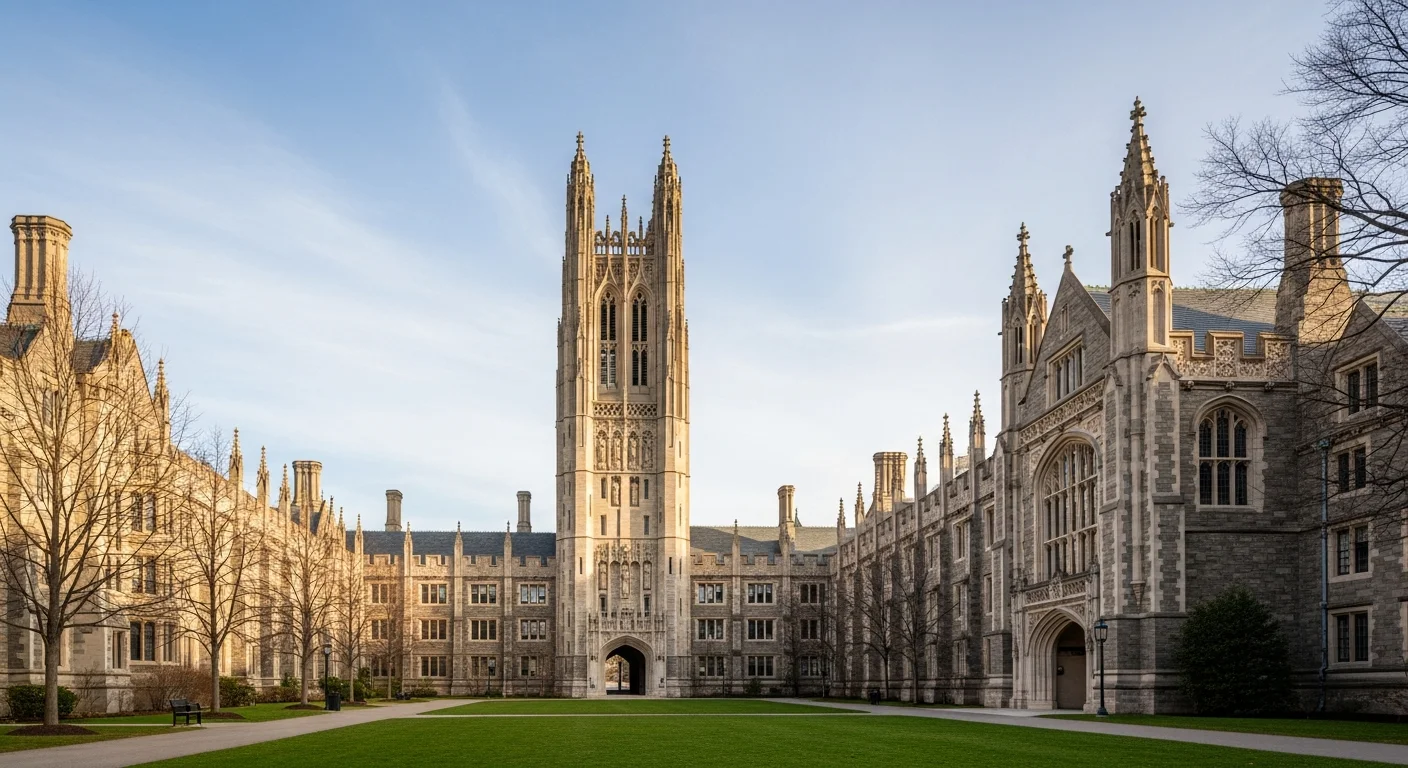
Best Bachelor's Data Analytics Degree Programs in Connecticut
Yale University — New Haven, CT
Key Distinction: Mandatory senior research project with faculty advisement. Combined B.S./M.A. option for exceptional students (8 terms total)
Hakia Insight: Yale's mandatory senior research project requirement, combined with access to the Yale Institute for Foundations of Data Science, creates a pipeline where exceptional undergraduates can co-author publishable work before graduation—a credential that distinguishes Yale graduates at Two Sigma and Citadel.
Yale's Bachelor's program in Statistics and Data Science prepares undergraduates in both mathematical foundations and practical applications of modern data analysis. The B.A. requires 11 courses covering core probability and statistics, computational skills, and methods of data science, while the B.S. requires 14 courses with additional depth in mathematical theory and research applications. All students complete a senior research project (S&DS 4910 or S&DS 4920) under faculty advisement. The curriculum emphasizes the full data lifecycle—from specification and gathering through cleaning, management, analysis, and decision-making. Students may combine the major with disciplines in social sciences, natural sciences, engineering, computer science, or mathematics. Exceptional students may pursue a combined B.S./M.A. in Statistics, completing both degrees in eight terms. The program integrates machine learning, data mining, and high-performance computing with domain expertise across multiple fields.
Programs Offered
- Bachelor's in Statistics and Data Science — 4 years, on-campus. BA, BS
Research Labs and Institutes
- Yale Institute for Foundations of Data Science
- Yale Center for Biomedical Data Science
Industry Partners
- Renaissance Technologies (corporate)
Career Outcomes
Top Employers: Two Sigma, Citadel, Goldman Sachs, Google, Microsoft, McKinsey.
Notable Faculty
- Dirk Eddelbuettel — Statistical computing and computational finance
- John Lafferty — Machine learning and statistical theory
Location Advantages: Proximity to Yale School of Medicine and Yale School of Public HealthAccess to healthcare and biomedical research partnershipsAffiliation with Yale-affiliated hospitals and research centers
University of Connecticut — Storrs, CT
Key Distinction: Optional Financial Technology concentration with cryptocurrency and blockchain specialization. Available at regional campuses (Hartford, Stamford, Waterbury)
Hakia Insight: UConn's optional blockchain and fintech concentration at regional campuses (Hartford, Stamford) gives students proximity to Connecticut's active insurance and digital asset sectors without relocating, a rare combination of technical depth and local career leverage.
The Bachelor of Science in Business Data Analytics (BDA) is offered at University of Connecticut's Hartford, Stamford, and Waterbury regional campuses. The program combines business fundamentals with specialized training in data analytics and information technology applications. Students complete core courses in Business Database Management, Business Data Analytics I and II, along with three additional 3000-4000 level business electives. The curriculum emphasizes practical application of analytics to business problems. An optional Financial Technology concentration is available, allowing students to specialize in FinTech, cryptocurrency, and blockchain technologies. Students must maintain a cumulative 2.0 GPA in all Operations and Information Management (OPIM) courses. The program meets University Common Curriculum Requirements and School of Business degree requirements, preparing graduates for careers in data-driven business roles.
Programs Offered
- Bachelor of Science in Business Data Analytics — 4 years, on-campus. BS
Research Labs and Institutes
- Computational Science Initiative
- UConn Machine Learning Lab
Career Outcomes
Top Employers: IBM, Microsoft, Google, Amazon.
Notable Faculty
- Jun Yan — Statistical learning and machine learning
Location Advantages: Proximity to Hartford financial servicesAccess to Boston tech corridor (90 minutes)
Connecticut College — New London, CT
Key Distinction: Connecticut College's data analytics program, embedded in liberal arts education, uniquely emphasizes ethical analytics and societal impact alongside technical skill development, attracting students pursuing mission-driven data work.
Hakia Insight: Connecticut College's integration of ethics and societal impact into core analytics coursework appeals to students targeting nonprofit and public health roles, where most peer institutions treat ethical analysis as an afterthought rather than curriculum anchor.
At the bachelor's level, connecticut College integrates data analytics into its liberal arts framework, offering students the rare opportunity to combine technical depth with humanistic inquiry—a distinctive approach for analytics education. Rather than treating data science as purely technical, the program encourages students to consider ethical dimensions, stakeholder perspectives, and societal impact of analytical work. The curriculum emphasizes smaller class sizes and close faculty mentorship, allowing for individualized guidance as students build analytics capabilities. Students can major or concentrate in computer science with data analytics focus, completing coursework in statistics, programming, and machine learning while maintaining connections to humanities and social science perspectives. This approach attracts students interested in analytics for social good—nonprofits, public health, environmental research—as well as traditional corporate roles. The college's location in New London provides a tight-knit community where faculty are genuinely accessible, and students typically engage in capstone projects addressing real community or organizational challenges. For students prioritizing education quality and ethical reasoning over rapid salary maximization, Connecticut College offers a distinctly different flavor of technical training—one grounded in liberal arts values.
Programs Offered
- Bachelor of Science in Data Analytics — 4 years, on-campus
- Bachelor of Arts in Data Analytics — 4 years, online
Location Advantages: New London coastal locationAccess to nonprofit and public health organizations in Connecticut
Post University — Waterbury, CT
Key Distinction: Post University's online and hybrid formats with industry-experienced faculty serve working professionals seeking rapid, accessible entry into analytics roles.
Hakia Insight: Post University's online and hybrid bachelor's, taught by industry-experienced faculty, compresses time-to-degree for working professionals without the hidden cost of extended part-time enrollment that makes traditional programs de facto longer.
At the bachelor's level, post University's data analytics program is specifically engineered for working professionals and non-traditional students, with flexible delivery formats—online, hybrid, and evening classes—that accommodate full-time employment while earning a credential. The curriculum prioritizes immediately applicable analytics skills: Excel-to-Python progression, hands-on statistical analysis, and practical business intelligence tools used in real organizations on day one. Faculty bring substantial industry experience; many taught part-time while maintaining careers in analytics, consulting, or finance, ensuring coursework stays grounded in current workplace practices. The online format attracts geographically dispersed students, creating cohorts with diverse professional backgrounds—healthcare administrators, retail managers, financial analysts—which enriches case discussions and networking. Post's reputation in adult education and career-focused instruction means the program maintains strong relationships with employers seeking mid-career professionals with analytics skills. For career-changers, working parents, and others seeking to upskill without disrupting income or relocation, Post's accessibility model removes traditional barriers while delivering substantive technical training. Graduates typically report modest salary increases within their current organizations or successful transitions into dedicated analytics roles, often within 6-12 months of degree completion.
Programs Offered
- Bachelor of Science in Data Analytics — 4 years, on-campus
- Bachelor of Arts in Data Analytics — 4 years, online
Location Advantages: Online accessibility removes geographic constraintsServing non-traditional student populations across multiple time zones
Quinnipiac University — Hamden, CT
Key Distinction: Quinnipiac's program uniquely emphasizes data storytelling and business communication alongside technical analytics, preparing graduates for stakeholder-facing roles from day one.
Hakia Insight: Quinnipiac's explicit curriculum emphasis on data storytelling and business communication, paired with proximity to healthcare analytics hubs and the insurance sector, prepares graduates for the communication-heavy roles that actually drive decisions at hospitals and actuarial firms.
At the bachelor's level, quinnipiac has built a data analytics program around interactive learning and real-world application, with an embedded emphasis on communication and storytelling alongside technical skills. The curriculum progresses from foundational statistics and database design through advanced machine learning, but distinguishes itself by requiring students to present findings to non-technical stakeholders—a competency gap many employers report. Hands-on labs use industry-standard platforms like Tableau, Power BI, and cloud analytics services, exposing students to tools they'll encounter immediately on the job. The program sits within a business-focused institution that maintains strong connections to healthcare organizations, financial firms, and technology companies throughout the Northeast, translating into internship placements and recruiting pipelines. Faculty advisors emphasize portfolio development: students graduate with 4-5 completed analytics projects spanning different datasets and methodologies, which become tangible evidence of capability beyond test scores. Capstone courses involve live client engagement—recent cohorts have partnered with nonprofits, local government, and mid-market companies to solve authentic analytical challenges.
Programs Offered
- Bachelor of Science in Data Analytics — 4 years, on-campus
- Bachelor of Arts in Data Analytics — 4 years, online
Location Advantages: Proximity to healthcare analytics hubsNortheast financial services corridorConnecticut insurance and actuarial sector
Southern Connecticut State University — New Haven, CT
Key Distinction: Southern Connecticut integrates ethics, social impact, and public sector analytics into its core curriculum, differentiating it from technology-centric competitors.
Hakia Insight: Southern Connecticut's partnerships with the Connecticut Department of Education and United Way embed public sector analytics into coursework, creating direct pipelines for students genuinely interested in policy and social impact rather than Wall Street—a rare institutional commitment that influences hiring.
At the bachelor's level, southern Connecticut's data analytics offerings emerge from a strong quantitative social sciences foundation, positioning the program as particularly valuable for students interested in applying analytics to public policy, social research, and institutional effectiveness. The curriculum integrates survey methodology, statistical inference, and data visualization with an emphasis on ethical data use and understanding bias in algorithmic decision-making—topics often underemphasized in purely technical programs. Faculty research spans education analytics, labor market analysis, and social equity applications, creating opportunities for students to contribute to meaningful research while developing technical skills. Partnerships with Connecticut school districts, workforce development agencies, and nonprofits provide internship placements where students tackle genuine institutional challenges: improving student retention predictions, optimizing resource allocation, or evaluating program effectiveness. The program appeals to career-switchers and those from humanities backgrounds who want to acquire analytics expertise without assuming prior calculus or programming experience. For prospective students motivated by impact and who value understanding *why* data matters as much as *how* to analyze it, Southern's approach offers a refreshingly human-centered complement to the computational intensity typical of larger engineering-focused programs.
Programs Offered
- Bachelor of Science in Data Analytics — 4 years, on-campus
- Bachelor of Arts in Data Analytics — 4 years, online
Industry Partners
- Connecticut Department of Education (government)
- United Way of Connecticut (nonprofit)
Career Outcomes
Top Employers: Connecticut Department of Education, Yale School of Management, Community nonprofits.
Location Advantages: Access to New Haven and Yale ecosystemProximity to Connecticut education and nonprofit sectors
Best Master's Data Analytics Degree Programs in Connecticut
University of Connecticut — Storrs, CT
Key Distinction: Two program formats: online part-time (self-paced flexibility for working professionals) and on-campus full-time 11-month cohort. Applied industry-based capstone project (3 credits) required for all students
Hakia Insight: UConn's dual-track MS (online self-paced versus 11-month cohort) lets students choose not just format but peer environment: working professionals stay isolated and flexible, while cohort students build networks in Hartford's financial services ecosystem.
UConn's MS in Data Science is a 30-credit, career-focused program offering both online (part-time, self-paced) and on-campus (11-month, full-time cohort) formats. The curriculum emphasizes foundational data science, machine learning, and data ethics across five schools and colleges. All students complete a 3-credit applied industry-based capstone project. The program is STEM OPT-approved and visa-sponsorable. Data scientists earn an average of $103K annually, with 31% expected job growth (3rd fastest-growing U.S. job). While graduate assistantships are not currently offered, the online format enables working professionals to advance careers flexibly. The multidisciplinary curriculum integrates domain-specific knowledge and includes specialized electives in time series, biostatistics, cybersecurity, and deep learning, positioning graduates for roles in analytics, machine learning, and data-driven decision-making across industries.
Programs Offered
- Master of Science in Data Science — 1-2 years, on-campus. MS
Research Labs and Institutes
- Computational Science Initiative
- UConn Machine Learning Lab
Career Outcomes
Median Salary: $NaN.
Notable Faculty
- Jun Yan — Statistical learning and machine learning
Location Advantages: Proximity to Hartford financial servicesAccess to Boston tech corridor (90 minutes)
Yale University — New Haven, CT
Key Distinction: Yale's graduate data science program, centered in a newly prominent Department of Statistics and Data Science, emphasizes foundational research and intellectual rigor, preparing students for leadership and innovation roles rather than practitioner-track analytics.
Hakia Insight: Yale's graduate program in a newly prominent Department of Statistics and Data Science prioritizes foundational research rigor over practitioner training, positioning graduates for leadership trajectories at quant firms (Two Sigma, Citadel) rather than standard analytics roles.
Yale's approach to data science education reflects the university's research intensity and institutional resources—graduate programs train students for leadership roles in academic research, industry innovation, and policy work, not entry-level analytics positions. The Department of Statistics and Data Science, recently elevated in institutional prominence, offers graduate programs featuring seminars taught by faculty with significant research recognition. Students engage with cutting-edge research in causal inference, Bayesian methods, and applications ranging from genomics to economics. Yale's ecosystem includes affiliated research centers—the Yale Institute for Foundations of Data Science facilitates collaboration across departments, creating opportunities for students to apply analytics to problems in medicine, public health, environmental science, and social science. The undergraduate program in statistics and data science provides strong foundational training; graduate students often pursue PhD tracks or terminal master's degrees with explicit preparation for research positions. Yale's location in New Haven connects students to Yale School of Medicine, Yale School of Public Health, and affiliated hospitals—creating unique internship and collaboration opportunities in healthcare analytics and biostatistics. Recruitment by top-tier tech firms and finance companies is vigorous, but the program's culture emphasizes research contribution and intellectual depth. This is a program for students who want to understand the theory behind the methods, not just apply frameworks.
Programs Offered
- Master of Science in Data Analytics — 1-2 years, on-campus
- Master of Arts in Data Analytics — 1-2 years, online
Research Labs and Institutes
- Yale Institute for Foundations of Data Science
- Yale Center for Biomedical Data Science
Industry Partners
- Renaissance Technologies (corporate)
Career Outcomes
Top Employers: Two Sigma, Citadel, Goldman Sachs, Google, Microsoft, McKinsey.
Notable Faculty
- Dirk Eddelbuettel — Statistical computing and computational finance
- John Lafferty — Machine learning and statistical theory
Location Advantages: Proximity to Yale School of Medicine and Yale School of Public HealthAccess to healthcare and biomedical research partnershipsAffiliation with Yale-affiliated hospitals and research centers
University of Bridgeport — Bridgeport, CT
Key Distinction: 100% online option available. On-campus option available
Hakia Insight: University of Bridgeport's 100% online option with named employers like Intel and local partners (Webster Bank, Sikorsky) serves the Fairfield County aerospace and defense cluster—a geographic specialization most competitors overlook.
University of Bridgeport's Master of Science in Data Analytics and Systems prepares working professionals for careers in data-driven decision-making. The program offers flexibility with both online and on-campus options, completable in as few as 18 months for full-time students. Students develop technical and soft skills under experienced faculty at the Ernest C. Trefz School of Business. The curriculum emphasizes practical application, enabling graduates to navigate and interpret critical data for organizations of all sizes. A dual master's degree option combining Data Analytics and Systems with an MBA is available, expanding career opportunities and lifetime earning potential. The program welcomes professionals from various backgrounds and learning styles, fostering collaboration among cohorts preparing for fast-paced careers in this essential field.
Programs Offered
- Master of Science in Data Analytics and Systems — 1-2 years, on-campus. MS
Industry Partners
- Webster Bank (corporate)
- Sikorsky Aircraft (corporate)
Career Outcomes
Top Employers: Intel.
Location Advantages: Proximity to Fairfield County financial services hubAccess to insurance and manufacturing sectors in ConnecticutBridgeport area career networking opportunities
Fairfield University — Fairfield, CT
Key Distinction: Fairfield's data analytics program uniquely combines technical depth with ethical responsibility and hands-on industry collaboration, positioning graduates as thoughtful practitioners rather than pure technicians.
Hakia Insight: Fairfield's emphasis on ethical responsibility alongside technical skill, grounded in proximity to NYC and Connecticut employers, produces graduates trained to ask 'should we' not just 'can we'—a positioning particularly valued by insurance and healthcare firms facing regulatory scrutiny.
At the master's level, fairfield's data analytics program emphasizes applied learning through real-world projects and close collaboration with industry partners in the New York metropolitan region. Rather than treating analytics as a purely technical discipline, the curriculum integrates business acumen with statistical rigor, preparing graduates to translate data insights into strategic organizational decisions. Students work with actual datasets from corporate clients, developing portfolios that demonstrate immediate professional relevance. The program leverages Fairfield's location and Jesuit educational philosophy to foster ethical data practices—a differentiator in an industry often criticized for algorithmic bias and privacy concerns. Faculty bring substantial industry experience alongside academic credentials, creating a bridge between classroom theory and practitioner challenges. Specialization tracks allow students to concentrate in areas like business intelligence, predictive modeling, or data engineering, depending on career goals. The cohort-based model encourages peer learning and professional networking that extends well into alumni careers. Graduates consistently report strong placement outcomes in financial services, healthcare, and technology sectors, with many leveraging internship connections into full-time roles. The program's smaller size compared to larger state schools means more direct faculty mentorship and fewer anonymous lectures—a meaningful advantage for students who thrive with personalized guidance.
Programs Offered
- Master of Science in Data Analytics — 1-2 years, on-campus
- Master of Arts in Data Analytics — 1-2 years, online
Location Advantages: Proximity to New York City financial services, insurance, and technology companiesAccess to Connecticut-based healthcare and manufacturing firms with advanced data needs
Central Connecticut State University — New Britain, CT
Key Distinction: CCSU makes analytics education accessible and affordable while maintaining strong connections to regional employers, serving first-generation and non-traditional students effectively.
Hakia Insight: CCSU's affordability, first-generation focus, and direct ties to Connecticut state agencies and regional healthcare employers create an underutilized pathway into analyst roles at employers actively hiring locally, without the prestige markup of peer institutions.
At the master's level, central Connecticut State's data analytics offerings emerge from a computer science foundation with particular strength in statistical modeling and machine learning applications. The program architecture allows students to build depth in either predictive analytics or data engineering, creating specialization tracks that reflect divergent career trajectories in the field. Faculty research areas span machine learning, data mining, and optimization—expertise that directly influences curriculum design and ensures students learn methods grounded in current academic research rather than industry trends alone. Students gain hands-on experience through a combination of classroom labs, independent projects, and collaborative work with faculty on active research initiatives. The university's location within Connecticut's central hub positions it as a bridge between Hartford's insurance and financial services clusters, creating natural internship pathways and recruiting relationships with major employers in those sectors. Computer science students interested in pivoting toward data-intensive roles benefit from the program's integration with broader CS coursework, enabling double specializations in software engineering plus analytics or cybersecurity plus data science. The teaching approach emphasizes both theoretical foundations and applied implementation, with particular attention to the engineering practices that distinguish production analytics work from academic exercises.
Programs Offered
- Master of Science in Data Analytics — 1-2 years, on-campus
- Master of Arts in Data Analytics — 1-2 years, online
Location Advantages: Access to Connecticut state agenciesRegional healthcare and insurance employersHartford metro tech growth
Best Doctoral Data Analytics Degree Programs in Connecticut
University of Connecticut — Storrs, CT
Key Distinction: Full funding available including tuition waiver and generous stipend. EPSY Scholars Program provides 20-hour assistantship for 4 years
Hakia Insight: UConn's Ph.D. places students within striking distance of Hartford's $200B+ financial services sector and Boston's venture ecosystem—yet the EPSY Scholars' guaranteed 4-year assistantship means students build research credentials without the debt that typically forces east coast doctoral candidates into consulting rather than tenure-track paths.
UConn's Special Education Ph.D. program offers comprehensive funding for full-time students including tuition waiver, generous stipend, and health/dental insurance through multiple fellowship programs. Students engage in highly individualized study across four research areas: Literacy Supports, Positive Behavior Supports, Postsecondary Transition, and Early Childhood Intervention. The program is ranked consistently in the top 20 by U.S. News & World Report. EPSY Scholars receive 20-hour assistantships (10 from department + 10 from advisor) for up to four years. Project NeXus II provides four years of full funding plus travel and research funds. Students work closely with nationally recognized faculty conducting hands-on research. The program emphasizes research publication, university teaching, and professional development. Graduates pursue careers at major research universities, policy positions, and faculty roles training future special educators.
Programs Offered
- Doctor of Philosophy in Special Education — 4-6 years, on-campus. PhD
Research Labs and Institutes
- Computational Science Initiative
- UConn Machine Learning Lab
Notable Faculty
- Jun Yan — Statistical learning and machine learning
Location Advantages: Proximity to Hartford financial servicesAccess to Boston tech corridor (90 minutes)
Yale University — New Haven, CT
Key Distinction: Yale's graduate data science program, centered in a newly prominent Department of Statistics and Data Science, emphasizes foundational research and intellectual rigor, preparing students for leadership and innovation roles rather than practitioner-track analytics.
Hakia Insight: Yale's partnership with Renaissance Technologies (the secretive quantitative fund that returns 39% annually) signals doctoral students access to the rare intersection of academic rigor and applied quant finance—the kind of dual credibility most universities can't offer without compromising one or the other.
At the doctoral level, yale's approach to data science education reflects the university's research intensity and institutional resources—graduate programs train students for leadership roles in academic research, industry innovation, and policy work, not entry-level analytics positions. The Department of Statistics and Data Science, recently elevated in institutional prominence, offers graduate programs featuring seminars taught by faculty with significant research recognition. Students engage with cutting-edge research in causal inference, Bayesian methods, and applications ranging from genomics to economics. Yale's ecosystem includes affiliated research centers—the Yale Institute for Foundations of Data Science facilitates collaboration across departments, creating opportunities for students to apply analytics to problems in medicine, public health, environmental science, and social science. The undergraduate program in statistics and data science provides strong foundational training; graduate students often pursue PhD tracks or terminal master's degrees with explicit preparation for research positions. Yale's location in New Haven connects students to Yale School of Medicine, Yale School of Public Health, and affiliated hospitals—creating unique internship and collaboration opportunities in healthcare analytics and biostatistics. Recruitment by top-tier tech firms and finance companies is vigorous, but the program's culture emphasizes research contribution and intellectual depth. This is a program for students who want to understand the theory behind the methods, not just apply frameworks.
Programs Offered
- Doctor of Philosophy in Data Analytics — 4-6 years, on-campus
- Doctor of Science in Data Analytics — 4-6 years, online
Research Labs and Institutes
- Yale Institute for Foundations of Data Science
- Yale Center for Biomedical Data Science
Industry Partners
- Renaissance Technologies (corporate)
Career Outcomes
Top Employers: Two Sigma, Citadel, Goldman Sachs, Google, Microsoft, McKinsey.
Notable Faculty
- Dirk Eddelbuettel — Statistical computing and computational finance
- John Lafferty — Machine learning and statistical theory
Location Advantages: Proximity to Yale School of Medicine and Yale School of Public HealthAccess to healthcare and biomedical research partnershipsAffiliation with Yale-affiliated hospitals and research centers