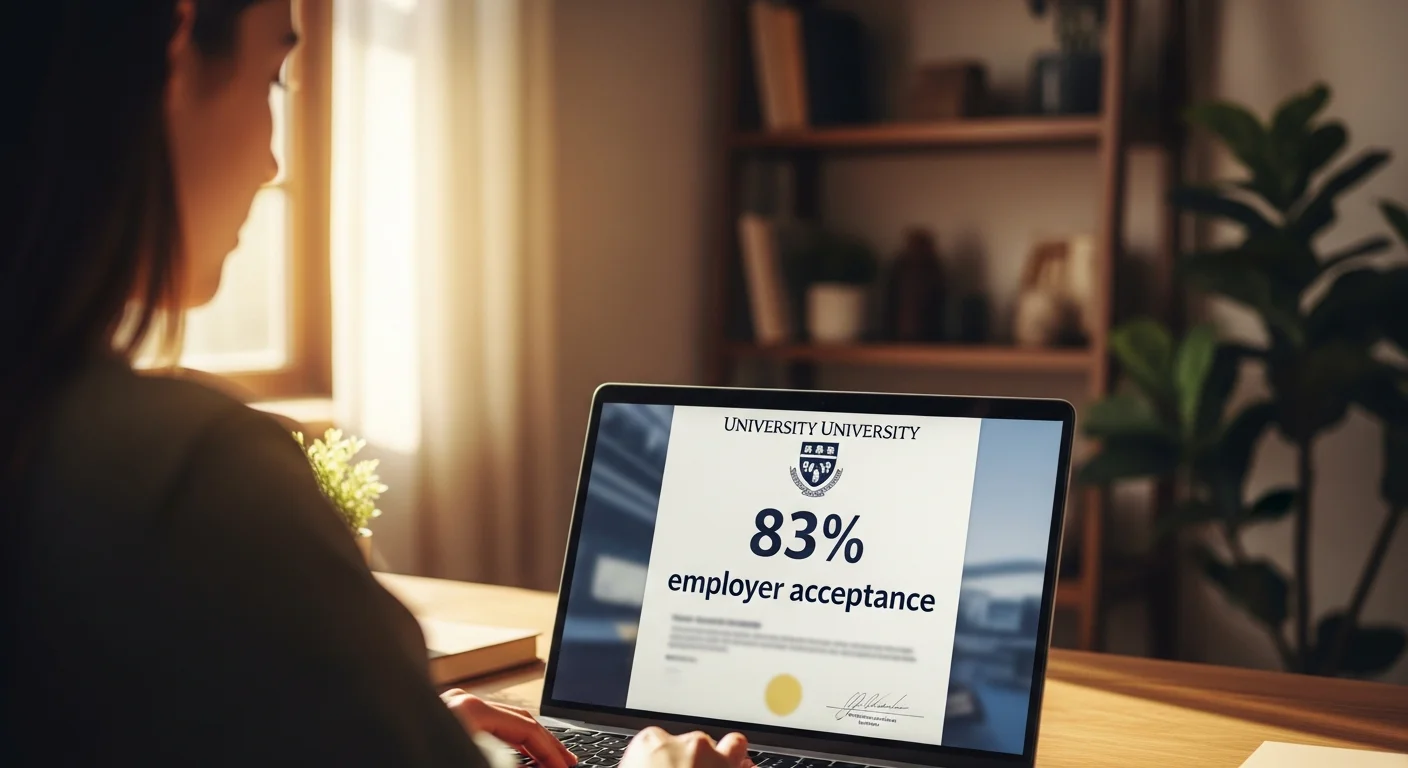
- 1.83% of employers now consider online degrees as credible as traditional on-campus programs (OLC, 2023)
- 2.Over 70% of organizations hired job applicants with online degrees in the past 12 months (Research.com, 2026)
- 3.54% of global employers view online and in-person degrees as equally valuable (GMAC, 2025)
- 4.Accreditation and institution prestige matter more than delivery format for employer perception
83%
Employer Acceptance
70%+
Hired Online Grads
54%
Equal Value (Global)
28%
US Equal Value
The Acceptance Transformation
In 2026, online degrees are respected and taken seriously, particularly from accredited institutions. According to Research.com, employers increasingly recognize the legitimacy and rigor of online programs, valuing skills and knowledge over the mode of education.
Recent data shows that 83% of employers now consider online degrees to be as credible as those earned through traditional on-campus programs, according to a 2023 survey by the Online Learning Consortium. Over 70% of organizations have acknowledged hiring job applicants with online degrees within the past 12 months.
The COVID-19 pandemic accelerated this shift. When every university moved online in 2020, the artificial distinction between 'online' and 'campus' degrees blurred. Employers who once saw online learning as inferior discovered that remote education could be rigorous and effective.
Source: Online Learning Consortium, 2023
What Matters for Credibility
Not all online degrees are perceived equally. According to Research.com, several factors significantly impact how employers view online credentials:
- Accreditation. Regional accreditation from bodies like AACSB, ABET, or HLC is essential. Unaccredited programs aren't taken seriously regardless of format.
- Institution Prestige. An online degree from Georgia Tech, MIT, or Stanford carries the same weight as on-campus. The school's reputation matters more than delivery method.
- Program Relevance. Degrees in technology, business, and education are well-accepted online. Healthcare and lab-science fields face more skepticism.
- Demonstrated Skills. AI-driven learning validation is emerging, providing concrete evidence of student competency through real-time tracking.
- Same Curriculum. Programs where online and on-campus students take identical courses from the same faculty are most respected.
| Credential Factor | Impact on Credibility | Employer Concern |
|---|---|---|
| Regional Accreditation | Critical | Is the school legitimate? |
| Institution Reputation | High | Do I recognize this school? |
| Program Accreditation (ABET, AACSB) | High | Does the program meet standards? |
| Same Faculty/Curriculum | Moderate | Is it the same education? |
| Delivery Format | Low (now) | Less important than above |
Source: Research.com, Industry Analysis
Regional Differences in Acceptance
Employer perceptions of online degrees vary significantly by region. According to the 2025 GMAC Corporate Recruiters Survey, 54% of global employers view online and in-person degrees as equally valuable.
However, U.S. employers remain somewhat more cautious, with only 28% agreeing that both formats are equally credible. This gap reflects lingering bias in American hiring culture, though the trend is moving toward acceptance.
- Global employers: 54% view online and campus degrees as equally valuable
- U.S. employers: 28% view them as equal (but 83% consider online 'credible')
- European employers: More accepting, especially for professional degrees
- Tech industry: Most accepting, skills and portfolio matter more than degree format
- Traditional industries: Finance, law, and healthcare show more preference for campus programs
Where Skepticism Remains
Despite progress, some biases persist. The GMAC survey found that among U.S. recruiters, 44% agreed in-person programs impart stronger technical skills than online programs, and about two-thirds believed graduates of in-person programs have stronger leadership and communication skills.
Skepticism is highest in fields requiring hands-on training:
- Healthcare. Clinical skills require in-person training. Online-only medical degrees face legitimate concerns
- Laboratory Sciences. Chemistry, biology, and engineering fields where lab work is essential
- Performing Arts. Music, theater, and dance programs where physical presence matters
- Leadership Roles. Some executives prefer candidates who demonstrated in-person collaboration
- Elite Consulting/Finance. Traditional firms like McKinsey or Goldman still prefer campus recruiting
Maximizing Your Online Degree's Value
Research.com notes that online programs build critical skills such as self-discipline and time management, which are highly valued by employers. Here's how to maximize your online degree's career impact:
- Choose accredited, recognized institutions. State universities, established private schools, or respected online-first institutions (SNHU, WGU, Purdue Global)
- Verify program-specific accreditation. ABET for engineering, AACSB for business, NCATE for education
- Build portfolio alongside degree. Projects, internships, and real work experience matter more than degree format
- Network actively. Join professional associations, attend (virtual) conferences, build LinkedIn presence
- Don't hide it. If asked, explain how online learning developed self-discipline and time management
- Choose programs with same curriculum. Where online students take identical courses to campus students
Source: Industry Analysis
Related Articles
Related Degrees
Consider a Coding Bootcamp
While online degrees gain credibility, bootcamps offer an even faster path for those focused purely on job-ready skills.
What is a Coding Bootcamp?
A coding bootcamp is an intensive, short-term training program (typically 12-24 weeks) that teaches practical programming skills through hands-on projects. Unlike traditional degrees, bootcamps focus exclusively on job-ready skills and often include career services to help graduates land their first tech role.
Who Bootcamps Are Best For
- Career changers looking to enter tech quickly
- Professionals wanting to upskill or transition roles
- Self-taught developers seeking structured training
- Those unable to commit to a 4-year degree timeline
What People Love
Based on discussions from r/codingbootcamp, r/cscareerquestions, and r/learnprogramming
- Designed specifically for career changers with no tech background
- Structured curriculum vs trying to self-teach with scattered resources
- Networking with cohort peers who become professional contacts
- Mentorship from industry professionals who've made the switch
- Job guarantee programs reduce financial risk of career change
Common Concerns
Honest feedback from bootcamp graduates and industry professionals
- Won't replace years of experience for senior roles
- Initial salaries may be lower than experienced hires
- Competition is fierce, bootcamp grads compete with CS grads
- Some bootcamps oversell outcomes, check verified employment data
- Learning doesn't stop after bootcamp, continuous upskilling required
Save $1000 on Springboard Bootcamps
Springboard offers career-focused bootcamps with 1-on-1 mentorship from industry professionals. Their programs include a job guarantee, complete all requirements, and if you don't land a qualifying role, you may be eligible for a full tuition refund. Use our exclusive link to save $1000 on enrollment.
Programs for Tech Careers careers:
- Software Engineering Career Track
- Data Science Career Track
We may earn a commission when you use our affiliate link and coupon.
Frequently Asked Questions
Sources
83% employer acceptance statistic
70%+ recent hiring of online graduates
Global vs. U.S. employer perception data
Employer perspective analysis

Taylor Rupe
Co-founder & Editor (B.S. Computer Science, Oregon State • B.A. Psychology, University of Washington)
Taylor combines technical expertise in computer science with a deep understanding of human behavior and learning. His dual background drives Hakia's mission: leveraging technology to build authoritative educational resources that help people make better decisions about their academic and career paths.