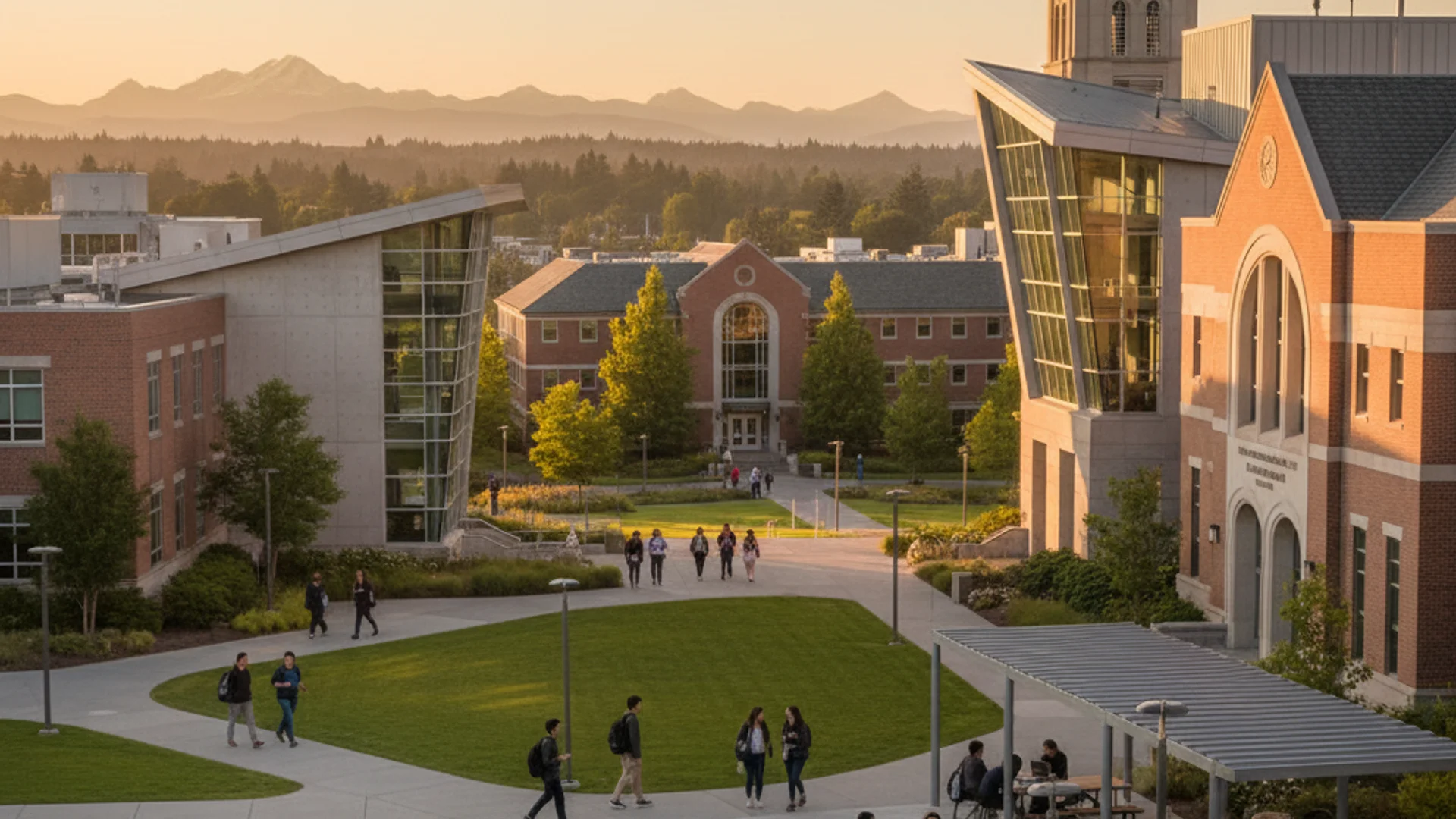
Best Associate's Game Development Degree Programs in Washington
Green River College — Auburn, WA
Hakia Insight: Green River's associate program explicitly mirrors professional studio team structures and workflows, so graduates aren't learning game development in isolation—they're learning how to ship as part of a production pipeline from day one.
At the associate's level, green River's game development program stands out for its emphasis on team-based development and industry-standard workflows, mirroring how professional studios actually work. Students engage in iterative design cycles, playtesting, and feedback integration throughout their coursework, building both technical chops and soft skills that employers value. The program's location near the Seattle metro area opens doors to internships and entry-level positions at established studios and tech companies. Graduates are prepared for QA, junior development, and technical support roles, while those pursuing further education transfer smoothly to UW or WSU with junior standing and course credit recognition.
Programs Offered
- Associate of Science in Game Development — 2 years, on-campus
- Associate of Applied Science in Game Development — 2 years, online
Career Outcomes
Top Employers: Seattle-area studios, Puget Sound tech companies, Microsoft.
Top Transfer Destinations
- University of Washington
- Washington State University
- University of Washington Bothell
Entry-Level Career Paths
- QA Test Engineer
- Junior Game Programmer
- Level Design Associate
- Game Support Technician
Location Advantages:
Lake Washington Institute of Technology — Kirkland, WA
Key Distinction: The program's unique seamless integration with Design, Computing, and Software Development programs provides comprehensive education across art, design, coding, and immersive media production. Students benefit from small class settings with industry professionals and hands-on experience developing both indie games and professional studio projects.
Hakia Insight: Lake Washington's program integrates Design, Computing, and Software Development into one coherent pathway rather than treating art and code as separate tracks, with named faculty leaders (Ty Underwood, Todd Bagaason) giving students rare consistency and mentorship across disciplines.
At the associate's level, lake Washington Institute of Technology's Game Design and Development program (formerly Digital Gaming and Interactive Media) is a comprehensive program that prepares students for careers in video game development, interactive media, marketing, and education. The program uniquely integrates with Design, Computing, and Software Development programs, offering comprehensive education in art, design, coding, and immersive media production. Students learn traditional art, 3D modeling in Maya and Z-Brush, programming, game mechanics, animation, character design and rigging, scripting for game engines, mobile and VR/AR development, UI/UX design, and project architecture. The program emphasizes hands-on training in small class settings with seasoned industry professionals as instructors. Students work on indie game development and professional studio projects, with graduates finding careers at renowned companies like Bungie, Nintendo, Microsoft, Amazon, and EA PopCap.
Programs Offered
- Associate of Science in Game Development — 2 years, on-campus
- Associate of Applied Science in Game Development — 2 years, online
Industry Partners
- Bungie (corporate)
- Nintendo (corporate)
- Microsoft (corporate)
- Amazon (corporate)
- EA PopCap (corporate)
Career Outcomes
Top Employers: Bungie, Nintendo, Microsoft, Amazon, EA PopCap.
Notable Faculty
- Ty Underwood — Digital Gaming
- Todd Bagaason — Digital Gaming
Admissions
GPA Requirement: 2.0. Application Deadline: Priority Deadline: May 11, 2026; Rolling Admission: August 21, 2026.
Requirements: Associate degree or 90+ college credits, ENGL&101 English Composition 1, MATH&107 or college-level math with intermediate algebra prerequisite, College-Level Social Science, ART 121 Introduction to Drawing, ART 102 Design 1, 60 quarter credits of relevant coursework in Design, Gaming, Art, or Information Technology, Portfolio containing 5-7 pieces of game-related work
Location Advantages: Located in rich digital gaming environment surrounding LWTechAccess to Pacific Northwest gaming industry
Tacoma Community College — Tacoma, WA
Hakia Insight: Tacoma Community College's dual-campus model (Tacoma and Gig Harbor) plus emphasis on regional Pacific Northwest studios creates unusually localized job placement—graduates can launch careers without relocating to Seattle or California.
At the associate's level, tacoma Community College offers over 80 degree and certificate programs designed to challenge and inspire students in a supportive academic environment. The college provides associate degrees, bachelor's degrees, and professional certificates that prepare students for workforce entry or continued education. With excellent faculty and staff, TCC serves over 12,000 students across two campuses in Tacoma and Gig Harbor. The college emphasizes accessibility with tuition costs that are one-third the price of state universities, making higher education affordable for diverse populations. TCC has been serving the community since 1965, building a strong foundation of academic excellence and community engagement. The college offers flexible pathways including transfer programs, professional-technical degrees, continuing education, and dual credit opportunities for high school students.
Programs Offered
- Associate of Science in Game Development — 2 years, on-campus
- Associate of Applied Science in Game Development — 2 years, online
Career Outcomes
Top Employers: Regional game studios, Pacific Northwest indie developers.
Top Transfer Destinations
- University of Washington Tacoma
- Washington State University
- Pacific Lutheran University
Entry-Level Career Paths
- QA Test Technician
- Junior Game Designer
- Quality Assurance Analyst
- Level Design Assistant
Included Certifications
- Unreal Engine Certification
- CompTIA A+
Location Advantages: Two campus locations in Tacoma and Gig Harbor for convenient accessLocated in the greater Tacoma area with strong community connectionsAffordable tuition at one-third the cost of state universities
Renton Technical College — Renton, WA
Hakia Insight: Renton Technical College's location in Renton, Washington positions it as a workforce feeder directly into the tech companies and game studios anchoring the greater Seattle metro—geographic proximity that converts recruitment into enrollment advantage.
At the associate's level, renton Technical College offers career-focused technical education programs designed to prepare students for immediate entry into the workforce. Located in Renton, Washington, the college provides hands-on training across multiple disciplines including Advanced Manufacturing, Business Management, Information Technology, Culinary Arts, Health and Human Services, Transportation Technology, and College and Career Pathways. The institution emphasizes practical skills development through industry-relevant curriculum and maintains strong community connections. RTC serves diverse student populations including traditional students, working adults seeking career advancement, transfer students, high school students through dual enrollment programs, and English language learners. The college is committed to inclusivity, equity, and student success, offering comprehensive support services including financial aid, veteran services, and the Renton Promise program. With Boeing's $250,000 grant supporting the Renton Promise expansion, the college demonstrates strong industry partnerships that enhance educational opportunities and career prospects for students.
Programs Offered
- Associate of Science in Game Development — 2 years, on-campus
- Associate of Applied Science in Game Development — 2 years, online
Career Outcomes
Top Employers: Regional game development studios, Tech companies with game divisions.
Top Transfer Destinations
- University of Washington (UW)
- Washington State University (WSU)
- University of Washington Bothell
Entry-Level Career Paths
- QA Test Specialist
- Technical Support Technician
- Game Tester
- Junior Technical Artist
Location Advantages: Located in Renton, Washington with strong regional industry connectionsAccess to major employers and manufacturing companies in the Pacific Northwest
South Puget Sound Community College — Olympia, WA
Key Distinction: SPSCC's Information Technology pathway uniquely combines game development training with comprehensive IT education, offering direct workforce entry or seamless university transfer options in one of the most in-demand technology fields.
Hakia Insight: SPSCC's embedded game development track within Information Technology means students can pivot between pure game dev and broader tech careers without credential loss, a rare curricular flexibility that hedges career risk for students uncertain about long-term studio work.
At the associate's level, south Puget Sound Community College offers a comprehensive Information Technology pathway that includes game development within its broader technology programs. The college provides pathways to become a game developer, cybersecurity expert, IT network engineer, BIM technician, or civil engineer. Students can pursue various degree options including Computer Science (with Software Development Track), Software Development (AAS), Information Technology Computer Support (AAS), and Cybersecurity and Network Administration (AAS). The college emphasizes hands-on learning and industry relevance, preparing students for high-paying employment opportunities in a wide range of industries. Students have the flexibility to enter the workforce directly after earning a degree or certificate, or continue their education at a four-year university. The IT pathway is designed to be highly relevant to current industry demands.
Programs Offered
- Associate of Science in Game Development — 2 years, on-campus
- Associate of Applied Science in Game Development — 2 years, online
Industry Partners
Notable Faculty
- Andy Leiren — Cybersecurity
- Joy Platter — Cybersecurity
Location Advantages: Located in Olympia and Lacey, WashingtonPartnership opportunities with local organizationsTransfer agreement with The Evergreen State College
Shoreline Community College — Shoreline, WA
Hakia Insight: Shoreline's Game Art and Design program emphasizes perceptual and technical skill development in a deliberately beautiful campus setting ten miles from Seattle—environmental design that directly supports artistic practice in ways most technical programs ignore.
At the associate's level, shoreline Community College's Game Art and Design program offers a comprehensive Associate of Applied Arts and Sciences degree focused on developing perceptual, technical, and production skills needed to create professional 2D and 3D game levels. Students learn visual design concepts while training on industry-standard software used in game development. The 115-121 credit program is designed to prepare graduates for immediate employment in the expanding multimedia and gaming industry. The curriculum emphasizes both artistic creativity and technical proficiency, covering areas from character modeling and animation to lighting and texture artistry. Students develop skills in game level design, storyboarding, and project management, preparing them for diverse roles in game studios, video production companies, advertising agencies, and multimedia firms.
Programs Offered
- Associate of Science in Game Development — 2 years, on-campus
- Associate of Applied Science in Game Development — 2 years, online
Career Outcomes
Top Employers: Seattle-area game studios, Independent game developers.
Top Transfer Destinations
- University of Washington
- Washington State University
- University of Washington Bothell
Entry-Level Career Paths
- Junior Game Developer
- QA Tester
- Game Design Technician
- 3D Modeler
Location Advantages: Ten miles north of downtown SeattleStrikingly beautiful campus setting
Bellevue College — Bellevue, WA
Key Distinction: Bellevue College delivers a practical, accelerated game development pathway that combines affordable 2-year training with direct access to the Puget Sound tech market.
Hakia Insight: Bellevue College's location in the Bellevue-Redmond corridor gives students direct proximity to Microsoft, Amazon, and Nintendo recruitment pipelines during a 2-year program, compressing the usual time-to-industry-connection by years.
At the associate's level, bellevue College's game development pathway stands out for its practical, industry-aligned curriculum that prioritizes rapid skill acquisition and portfolio building over theory-heavy coursework. The program emphasizes real-world game engines—primarily Unity and Unreal Engine—with students shipping playable prototypes across their studies. What distinguishes this approach is the integrated pipeline: students move through structured tracks in programming, art/animation, and design, with each track culminating in capstone projects that directly mirror professional workflows. The college's proximity to the Pacific Northwest's thriving gaming sector (home to studios like ArenaNet and Bungie) means faculty maintain active industry connections, frequently bringing in guest developers and consulting on student projects. Bellevue's two-year pathway makes it an attractive entry point for students seeking to enter the workforce quickly or transfer to four-year programs with a competitive portfolio already in hand. The program benefits from partnerships with local studios and tech companies that occasionally hire top student talent or sponsor projects. Class sizes remain small, enabling hands-on mentorship and individualized feedback that larger universities often cannot sustain. Students consistently report that the emphasis on finishing games—not just learning engine features—prepares them differently than academic-heavy competitors, with many landing junior roles at regional studios or joining AAA pipelines immediately after graduation.
Programs Offered
- Associate of Science in Game Development — 2 years, on-campus
- Associate of Applied Science in Game Development — 2 years, online
Location Advantages: Bellevue-Redmond tech corridor proximityAccess to major tech company recruitment pipelines
Edmonds College — Lynnwood, WA
Hakia Insight: Edmonds College's Creative Technology initiative situates game development inside an Advanced Manufacturing Skills Center, giving students access to industrial 3D printing, CNC, and physical prototyping tools that blur the line between digital and physical game production.
At the associate's level, edmonds College's game development program operates through its Creative Technology (C-Tech) initiative at the Advanced Manufacturing Skills Center, providing students with practical high-tech skills needed for current and future digital environments. The program integrates 3D design, electronics, automation, and material science with comprehensive courses in industry-leading software. Students gain hands-on experience with Unreal Engine for virtual reality and metaverse development, Blender for industrial design and game asset creation, CATIA for advanced 3D modeling, and Fusion 360 for parametric design. The curriculum emphasizes practical application through projects that develop skills in 3D modeling, animation, simulation, and immersive experience creation. The program caters to individuals at all experience levels looking to develop digital realm skills applicable to game development, visual effects, product design, aerospace, and automotive industries.
Programs Offered
- Associate of Science in Game Development — 2 years, on-campus
- Associate of Applied Science in Game Development — 2 years, online
Career Outcomes
Top Employers: Local Seattle-area indie studios, Pacific Northwest game development startups.
Top Transfer Destinations
- Washington State University
- University of Washington
- University of Washington Bothell
Entry-Level Career Paths
- QA Tester
- Junior Gameplay Programmer
- 3D Asset Artist
- Game Design Assistant
Location Advantages: Located in Washington State's tech corridorAccess to Advanced Manufacturing Skills Center facilities
Clover Park Technical College — Lakewood, WA
Key Distinction: The program uniquely combines storytelling with technical skills across both film and game industries, fostering a collaborative community where being a 'movie nerd and game geek' is celebrated and channeled into professional development.
Hakia Insight: Clover Park's dual-track associate structure (AS and AAS) lets students choose between transferring to a four-year program or entering the workforce immediately—a flexibility that transforms the decision point from 'trade school vs. university' into 'when do I want to start earning?'
At the associate's level, clover Park Technical College's Game Development program falls under their Digital Entertainment Design and Production (DEDP) program, which combines art, computer science, and communications to provide fundamental skills for careers in film, game design, and digital illustration industries. The program focuses on storytelling through digital mediums, with a 6-quarter AAT & AAS-T degree pathway. Students explore production, design, and storytelling in the digital entertainment world, with emphasis on creating movies, games, and digital content. The program cultivates a community of 'movie nerds and game geeks' who shape the next generation of entertainment experiences. Faculty welcome direct contact for program questions, and the college offers regular information sessions, campus tours, and hands-on studio experiences for prospective students.
Programs Offered
- Associate of Science in Game Development — 2 years, on-campus
- Associate of Applied Science in Game Development — 2 years, online
Industry Partners
- Amazon Career Choice (corporate)
- WorkForce Central (government)
- City of Tacoma (government)
Location Advantages: Multiple campus locations including Lakewood, South Hill, and Eastside Training CenterAccess to specialized facilities and studios for hands-on learningLocated in Washington state's technology corridor
North Seattle College — Seattle, WA
Key Distinction: North Seattle College integrates practical client-based project work through four practicum courses where students develop real applications for external organizations, providing authentic professional experience.
Hakia Insight: North Seattle's four embedded practicum courses mean students graduate with a portfolio of client-delivered work rather than classroom projects, effectively compressing the typical 1-2 year 'junior developer' phase into their degree timeline.
At the associate's level, north Seattle College's Game Development program appears to be part of the broader Communication, Business & Media division and Computer Science offerings. The college provides comprehensive technology education with programs in Application Development (including a Bachelor of Applied Science degree), Computer Science (Associate degrees with transfer pathways), and related technical fields. The Application Development BAS program features four practicum courses where students work with client organizations to develop web applications, mobile applications, cloud computing services, and data science projects in collaborative group settings. The college emphasizes hands-on learning through real-world projects and client partnerships. North Seattle College serves as a transfer-focused institution with strong pathways to four-year universities, particularly through their Associate in Computer Science DTA/MRP program. The college's location in Seattle provides access to the Pacific Northwest's thriving technology sector, offering students proximity to major tech companies and startup ecosystems.
Programs Offered
- Associate of Science in Game Development — 2 years, on-campus
- Associate of Applied Science in Game Development — 2 years, online
Notable Faculty
- Scott Ku — Communication, Business & Media Program Coordination
Location Advantages: Located in Seattle's thriving technology ecosystemAccess to Pacific Northwest tech industry opportunities
Best Bachelor's Game Development Degree Programs in Washington
University of Washington-Seattle Campus — Seattle, WA
Key Distinction: The University of Washington's game development education uniquely combines interdisciplinary design thinking through the Interactive Media Design program with world-class computer science research, offering both creative studio-based learning and cutting-edge technical foundations in AI and human-computer interaction.
Hakia Insight: UW's Social RL Lab gives undergrads direct access to Professor Natasha Jaques' cutting-edge AI research—rare for non-specialized institutions, and it reframes game AI from a gameplay feature into a legitimate academic research frontier.
At the bachelor's level, the University of Washington offers comprehensive game development education through multiple interdisciplinary programs. The Interactive Media Design (IMD) program at UW Bothell provides a two-year intensive Bachelor of Arts degree focusing on creating technology-mediated experiences including video games, web-based apps, and immersive artworks. Students work in cohort-based learning environments blending academic theory, human-centered design, artistic technique, and process management. The Computing & Software Systems program offers foundational courses including CSS 101 Digital Thinking which covers creating digital artifacts like video games, and CSS 107 Introduction to Programming through Animated Storytelling focusing on character creation and game development in virtual worlds. The Paul G. Allen School of Computer Science & Engineering provides advanced technical foundations with research in Human-Centered Computing, Artificial Intelligence, and Software & Hardware Systems that support game development applications.
Programs Offered
- Bachelor of Science in Game Development — 4 years, on-campus
- Bachelor of Arts in Game Development — 4 years, online
Research Labs and Institutes
Notable Faculty
- Professor Natasha Jaques — Artificial Intelligence and Social Reinforcement Learning
- Professor Ira Kemelmacher-Shlizerman — Face, body, and clothing modeling from large image collections
Admissions
GPA Requirement: 2.0. Application Deadline: January 15.
Requirements: English Composition (B WRIT 134 or ENGL 131), Interactive Media/Design Thinking/Visual Arts course, Web Development and Programming course, Statistics/Quantitative Methods/Data Visualization course
Location Advantages: Located in Seattle with access to prominent Pacific Northwest technology corporationsBeautiful campus environmentProximity to major tech industry hub
Seattle University — Seattle, WA
Key Distinction: Seattle University's game development program uniquely prioritizes collaborative, shipped games as the core learning vehicle, embedding industry mentorship throughout the curriculum.
Hakia Insight: Seattle University embeds Amazon, Boeing, and Microsoft as active curriculum partners rather than post-graduation employers, meaning industry mentorship arrives during project cycles, not after graduation.
At the bachelor's level, seattle University's game development program emphasizes the intersection of creative design and technical implementation through a curriculum that treats games as a medium for interactive storytelling. The program leverages the school's location in a thriving tech corridor to connect students with industry mentors and guest speakers from nearby studios. Rather than compartmentalizing art, design, and programming, the curriculum integrates these disciplines from the start, requiring students to collaborate across specializations on iterative projects that ship to real audiences. The program maintains strong connections with independent developers and mid-sized studios in the Pacific Northwest, creating internship pathways and post-graduation employment networks. Faculty bring practical experience from commercial game development, ensuring coursework reflects current industry practices in engine selection, agile workflows, and cross-functional team dynamics. Students graduate with portfolio pieces developed under real-world constraints—tight timelines, budget limitations, and stakeholder feedback—that resonate with hiring managers.
Programs Offered
- Bachelor of Science in Game Development — 4 years, on-campus
- Bachelor of Arts in Game Development — 4 years, online
Industry Partners
- Amazon (partner)
- Boeing (partner)
- Microsoft (partner)
- PACCAR (partner)
- Nordstrom (partner)
- Costco (partner)
Career Outcomes
Top Employers: Amazon, Boeing, Microsoft, PACCAR, Nordstrom, Costco.
Notable Faculty
- Dr. Burkhard Englert — Computer Science
- Dr. Eric Larson — Computer Science
- Dr. Wan Bae — Computer Science and Engineering
- Dr. Yingwu Zhu — Computer Science
Location Advantages: Seattle metropolitan area with major game studios and tech companiesProximity to independent game development community in Pacific Northwest
University of Washington-Bothell Campus — Bothell, WA
Key Distinction: UW Bothell's game development program uniquely combines interactive media design with interdisciplinary arts approaches, offering students both technical computing skills and creative media production capabilities through their Arts & Media meta-major pathway.
Hakia Insight: UW Bothell's Arts & Media meta-major deliberately decentralizes game development from a siloed program, forcing intentional collaboration with students in animation, sound design, and interactive art—the studio structure most indie developers eventually adopt anyway.
At the bachelor's level, the University of Washington-Bothell Campus offers game development education through multiple interdisciplinary pathways within their Arts & Media meta-major program. Students can pursue Interactive Media Design (IMD), which focuses on digital interactive experiences and game development. The program emphasizes visual, literary, and media practices as ways to transmit information and ideas across professional, technical, organizational, academic, and public settings. Coursework enhances students' abilities for ideation and increases their skills in oral, written, and visual communications. The program is supported by faculty expertise in computer graphics, interactive systems, and media technologies, with strong connections to the School of Science, Technology, Engineering & Mathematics for technical foundations.
Programs Offered
- Bachelor of Science in Game Development — 4 years, on-campus
- Bachelor of Arts in Game Development — 4 years, online
Notable Faculty
- Kelvin Sung — Computer graphics and interactive systems
- William Erdly — Computing and software systems
Location Advantages: Access to Seattle tech industryPartnership with UW main campus resources
Green River College — Auburn, WA
Hakia Insight: Green River's emphasis on team-based, industry-standard workflows compressed into a bachelor's timeline means graduates enter studios already fluent in the exact production pipelines they'll use day-one, unlike peers from art-centric or pure CS programs.
At the bachelor's level, green River's game development program stands out for its emphasis on team-based development and industry-standard workflows, mirroring how professional studios actually work. Students engage in iterative design cycles, playtesting, and feedback integration throughout their coursework, building both technical chops and soft skills that employers value. The program's location near the Seattle metro area opens doors to internships and entry-level positions at established studios and tech companies. Graduates are prepared for QA, junior development, and technical support roles, while those pursuing further education transfer smoothly to UW or WSU with junior standing and course credit recognition.
Programs Offered
- Bachelor of Science in Game Development — 4 years, on-campus
- Bachelor of Arts in Game Development — 4 years, online
Career Outcomes
Top Employers: Seattle-area studios, Puget Sound tech companies, Microsoft.
Top Transfer Destinations
- University of Washington
- Washington State University
- University of Washington Bothell
Entry-Level Career Paths
- QA Test Engineer
- Junior Game Programmer
- Level Design Associate
- Game Support Technician
Location Advantages:
Bellevue College — Bellevue, WA
Key Distinction: Bellevue College delivers a practical, accelerated game development pathway that combines affordable 2-year training with direct access to the Puget Sound tech market.
Hakia Insight: Bellevue College's accelerated 2+2 pathway and Bellevue-Redmond corridor location create a direct pipeline: complete your core skills at half the cost of a traditional four-year program, then pivot into the highest-concentration tech talent market in the region.
At the bachelor's level, bellevue College's game development pathway stands out for its practical, industry-aligned curriculum that prioritizes rapid skill acquisition and portfolio building over theory-heavy coursework. The program emphasizes real-world game engines—primarily Unity and Unreal Engine—with students shipping playable prototypes across their studies. What distinguishes this approach is the integrated pipeline: students move through structured tracks in programming, art/animation, and design, with each track culminating in capstone projects that directly mirror professional workflows. The college's proximity to the Pacific Northwest's thriving gaming sector (home to studios like ArenaNet and Bungie) means faculty maintain active industry connections, frequently bringing in guest developers and consulting on student projects. Bellevue's two-year pathway makes it an attractive entry point for students seeking to enter the workforce quickly or transfer to four-year programs with a competitive portfolio already in hand. The program benefits from partnerships with local studios and tech companies that occasionally hire top student talent or sponsor projects. Class sizes remain small, enabling hands-on mentorship and individualized feedback that larger universities often cannot sustain. Students consistently report that the emphasis on finishing games—not just learning engine features—prepares them differently than academic-heavy competitors, with many landing junior roles at regional studios or joining AAA pipelines immediately after graduation.
Programs Offered
- Bachelor of Science in Game Development — 4 years, on-campus
- Bachelor of Arts in Game Development — 4 years, online
Location Advantages: Bellevue-Redmond tech corridor proximityAccess to major tech company recruitment pipelines
Washington State University — Pullman, WA
Key Distinction: WSU's game development program stands out for treating games as computational systems, emphasizing architecture, optimization, and emerging technologies alongside creative design.
Hakia Insight: WSU's framing of games as computational systems—prioritizing architecture and optimization—produces graduates equipped for engine work and technical direction roles that most design-forward programs struggle to fill.
At the bachelor's level, washington State University's game development initiative integrates with a broader computer science and interactive media ecosystem that emphasizes both artistic vision and computational rigor. The program benefits from the university's research infrastructure and faculty with backgrounds spanning human-computer interaction, graphics, and software engineering—perspectives that inform how games are analyzed as interactive systems, not just entertainment products. Students engage with game development through the lens of systems design, learning to architect complex gameplay mechanics, optimize engine performance, and prototype novel interaction models. The curriculum encourages experimentation with emerging technologies, from VR/AR experiences to procedural generation systems, preparing graduates for roles in established studios as well as technology research. WSU's location in Pullman connects the program to a supportive computer science community while maintaining bridges to the Seattle tech scene through alumni networks and collaborative projects. Graduates pursue roles across the industry spectrum—from AAA studios to independent ventures—with a foundation in both the craft and the science of game development.
Programs Offered
- Bachelor of Science in Game Development — 4 years, on-campus
- Bachelor of Arts in Game Development — 4 years, online
Research Labs and Institutes
Notable Faculty
- Dr. Elizabeth Weybright — Adolescent prevention research, rural health, substance abuse prevention
- Dr. Brittany Cooper — Prevention science, implementation research
- Martin King — Music composition, Southeast Asian wind quintet repertoire
Location Advantages: Connections to Seattle-area tech and game development industry
DigiPen Institute of Technology — Redmond, WA
Key Distinction: DigiPen is the only institution on this list built exclusively around game development, offering specialized degree tracks, active industry faculty, and a culture entirely oriented toward shipped titles and professional outcomes.
Hakia Insight: DigiPen's shipped-game requirement isn't just a capstone; every student leaves with a published title on their resume before day-one employment, eliminating the 'unpaid apprenticeship' phase most developers endure.
At the bachelor's level, digiPen Institute of Technology is purpose-built for game development and digital arts education, with every aspect of curriculum and campus culture centered on shipping games and building industry-ready portfolios. The institute offers multiple specialized degree pathways—BS in Game Design, BS in Computer Science in Game Programming, BS in Real-Time Interactive Simulation, and others—each with a distinct focus but all embedded in a cohesive game development ecosystem. Faculty are active or recently-active game industry veterans, and curriculum is continuously updated to reflect current engine standards, pipeline practices, and market demand. DigiPen's proximity to Seattle connects students directly to a global game industry hub, and the institute maintains formal relationships with major studios. Graduates emerge with shipped games, deep technical or design specialization, and strong industry networks; the program's intensity and focus attract students seeking a no-compromise path to professional game development roles.
Programs Offered
- Bachelor of Science in Game Development — 4 years, on-campus
- Bachelor of Arts in Game Development — 4 years, online
Research Labs and Institutes
- Project Spaces / Game Development Studios
Industry Partners
- Nintendo (corporate)
- Microsoft / Xbox (corporate)
- Electronic Arts (corporate)
- Bungie (corporate)
- Amazon Games (corporate)
Career Outcomes
Top Employers: Nintendo, Microsoft / Xbox, Electronic Arts, Bungie, Sumo Digital, Daybreak Games.
Location Advantages: Seattle metropolitan area: proximity to Nintendo of America, Bungie, Amazon Games, Sumo Digital, Daybreak Games, and other major studiosAccess to Pacific Northwest game development ecosystem and networking eventsGlobal game industry hub location
Pacific Lutheran University — Tacoma, WA
Key Distinction: PLU integrates game development as a CS concentration within a broader liberal arts computer science degree, offering depth without total specialization.
Hakia Insight: PLU positions game development as a CS concentration rather than a separate degree, allowing students to minor in art, psychology, or business without penalty—a structure that actually mirrors how modern indie studios hire.
At the bachelor's level, pacific Lutheran University's game development program centers on experiential learning and student-led creative teams, where undergraduates lead game projects from conception through launch. The curriculum combines computer science fundamentals with art and design coursework, but the distinguishing feature is the emphasis on project leadership and entrepreneurship—students aren't just contributors to games; they pitch ideas, manage schedules, and navigate the creative and technical decisions that come with shipping a title. This approach means graduates develop not just technical or artistic skills but also the communication and project management abilities that studios value in junior leads and producers. The program is housed within PLU's computer science department but draws faculty from art and design, creating a genuinely cross-disciplinary environment. Located in Tacoma, just south of Seattle, PLU students benefit from proximity to the region's thriving game development community while maintaining the advantages of a smaller, more intimate campus where faculty mentorship is personal and accessible. Many graduates move directly into junior development roles at regional studios or launch their own indie projects with confidence in both technical execution and team dynamics.
Programs Offered
- Bachelor of Science in Game Development — 4 years, on-campus
- Bachelor of Arts in Game Development — 4 years, online
Location Advantages: Proximity to Seattle game development studios and companies
Whitworth University — Spokane, WA
Key Distinction: Whitworth's computer science programs uniquely integrate faith, ethics, and interdisciplinary collaboration, allowing students to combine technical skills with other disciplines while working on real-world projects with actual clients.
Hakia Insight: Whitworth's integration of ethics and faith into technical curriculum, combined with NASA-funded research access and client-facing projects, produces graduates comfortable working on high-stakes systems (defense, aerospace, finance) where game studios are increasingly moving.
At the bachelor's level, whitworth University offers several technology-related programs that intersect with game development through computer science and interdisciplinary studies. The Computer Science department provides multiple pathways including Computer Science UI/UX B.A., Interdisciplinary Computer Science B.A., and Front-End Design Development B.A. These programs emphasize hands-on learning with real client projects, service-learning opportunities, and senior capstone experiences. Students benefit from small class sizes with supportive faculty who maintain open office hours and build individual relationships with students. The programs integrate ethical considerations and faith perspectives into technology education. The vibrant Lied Arts Center provides state-of-the-art facilities including computer labs with Apple iMacs, six studios, and two gallery spaces. Students gain practical experience through internships, NASA-funded research projects, and participation in the active ACM club that performs well in programming competitions. The interdisciplinary approach allows students to combine computer science with other disciplines like art, communication, or business, preparing graduates for diverse technology careers including game development, software engineering, and user experience design.
Programs Offered
- Bachelor of Science in Game Development — 4 years, on-campus
- Bachelor of Arts in Game Development — 4 years, online
Research Labs and Institutes
- NASA-funded Summer Research Program
- CubeSat Satellite Building Club
Industry Partners
- NASA (government)
- Goldman Sachs (corporate)
- JPMorgan Chase (corporate)
Career Outcomes
Top Employers: Wahoo Fitness, Utah Jazz, Nike, Bungie, F5, SpaceX.
Notable Faculty
- Pete Tucker — Computer science education and software development
- Scott Griffith — Electrical and computer engineering
- Kent Jones — Bioinformatics and computer engineering
- Qian Mao — Deep learning, cybersecurity and wireless networks
- Matthew Bell — Computer science with theology, ethics and philosophy
- Kamesh Sankaran — Physics and engineering
Location Advantages: Vibrant Lied Arts Center with state-of-the-art computer labsAccess to Apple iMac computer labsStudios available 6 a.m. to 1 a.m.Small liberal arts university environment
Heritage University — Toppenish, WA
Key Distinction: Heritage University offers comprehensive Game Development programs preparing students for careers in technology.
Hakia Insight: Heritage University's regional location in Toppenish offers underrepresented students a pathway into game development without relocating to Seattle or Puget Sound, a rare advantage for rural Washington residents.
Heritage University offers Game Development programs in Toppenish, WA. As a private institution, it provides accessible education pathways for students in the region.
Best Master's Game Development Degree Programs in Washington
University of Washington-Seattle Campus — Seattle, WA
Key Distinction: The University of Washington's game development education uniquely combines interdisciplinary design thinking through the Interactive Media Design program with world-class computer science research, offering both creative studio-based learning and cutting-edge technical foundations in AI and human-computer interaction.
Hakia Insight: UW's master's program pairs world-class AI research (Jaques, Kemelmacher-Shlizerman) with studio-based design, positioning graduates for technical leadership or research roles in emerging areas like procedural generation and facial animation—roles typically requiring both credentials.
At the master's level, the University of Washington offers comprehensive game development education through multiple interdisciplinary programs. The Interactive Media Design (IMD) program at UW Bothell provides a two-year intensive Bachelor of Arts degree focusing on creating technology-mediated experiences including video games, web-based apps, and immersive artworks. Students work in cohort-based learning environments blending academic theory, human-centered design, artistic technique, and process management. The Computing & Software Systems program offers foundational courses including CSS 101 Digital Thinking which covers creating digital artifacts like video games, and CSS 107 Introduction to Programming through Animated Storytelling focusing on character creation and game development in virtual worlds. The Paul G. Allen School of Computer Science & Engineering provides advanced technical foundations with research in Human-Centered Computing, Artificial Intelligence, and Software & Hardware Systems that support game development applications.
Programs Offered
- Master of Science in Game Development — 1-2 years, on-campus
- Master of Arts in Game Development — 1-2 years, online
Research Labs and Institutes
Notable Faculty
- Professor Natasha Jaques — Artificial Intelligence and Social Reinforcement Learning
- Professor Ira Kemelmacher-Shlizerman — Face, body, and clothing modeling from large image collections
Admissions
GPA Requirement: 2.0. Application Deadline: January 15.
Requirements: English Composition (B WRIT 134 or ENGL 131), Interactive Media/Design Thinking/Visual Arts course, Web Development and Programming course, Statistics/Quantitative Methods/Data Visualization course
Location Advantages: Located in Seattle with access to prominent Pacific Northwest technology corporationsBeautiful campus environmentProximity to major tech industry hub
Seattle University — Seattle, WA
Key Distinction: Seattle University's game development program uniquely prioritizes collaborative, shipped games as the core learning vehicle, embedding industry mentorship throughout the curriculum.
Hakia Insight: Seattle University's master's curriculum centers on shipped titles with embedded industry mentorship, compressing what typically takes 3-5 years of junior roles into a two-year degree where every project has professional accountability.
At the master's level, seattle University's game development program emphasizes the intersection of creative design and technical implementation through a curriculum that treats games as a medium for interactive storytelling. The program leverages the school's location in a thriving tech corridor to connect students with industry mentors and guest speakers from nearby studios. Rather than compartmentalizing art, design, and programming, the curriculum integrates these disciplines from the start, requiring students to collaborate across specializations on iterative projects that ship to real audiences. The program maintains strong connections with independent developers and mid-sized studios in the Pacific Northwest, creating internship pathways and post-graduation employment networks. Faculty bring practical experience from commercial game development, ensuring coursework reflects current industry practices in engine selection, agile workflows, and cross-functional team dynamics. Students graduate with portfolio pieces developed under real-world constraints—tight timelines, budget limitations, and stakeholder feedback—that resonate with hiring managers.
Programs Offered
- Master of Science in Game Development — 1-2 years, on-campus
- Master of Arts in Game Development — 1-2 years, online
Industry Partners
- Amazon (partner)
- Boeing (partner)
- Microsoft (partner)
- PACCAR (partner)
- Nordstrom (partner)
- Costco (partner)
Career Outcomes
Top Employers: Amazon, Boeing, Microsoft, PACCAR, Nordstrom, Costco.
Notable Faculty
- Dr. Burkhard Englert — Computer Science
- Dr. Eric Larson — Computer Science
- Dr. Wan Bae — Computer Science and Engineering
- Dr. Yingwu Zhu — Computer Science
Location Advantages: Seattle metropolitan area with major game studios and tech companiesProximity to independent game development community in Pacific Northwest
University of Washington-Bothell Campus — Bothell, WA
Key Distinction: UW Bothell's game development program uniquely combines interactive media design with interdisciplinary arts approaches, offering students both technical computing skills and creative media production capabilities through their Arts & Media meta-major pathway.
Hakia Insight: UW Bothell's master's-level Arts & Media meta-major enables thesis work that bridges disciplines—a student could research narrative design, implement it in-engine with graphics research, and publish across game and HCI venues simultaneously.
At the master's level, the University of Washington-Bothell Campus offers game development education through multiple interdisciplinary pathways within their Arts & Media meta-major program. Students can pursue Interactive Media Design (IMD), which focuses on digital interactive experiences and game development. The program emphasizes visual, literary, and media practices as ways to transmit information and ideas across professional, technical, organizational, academic, and public settings. Coursework enhances students' abilities for ideation and increases their skills in oral, written, and visual communications. The program is supported by faculty expertise in computer graphics, interactive systems, and media technologies, with strong connections to the School of Science, Technology, Engineering & Mathematics for technical foundations.
Programs Offered
- Master of Science in Game Development — 1-2 years, on-campus
- Master of Arts in Game Development — 1-2 years, online
Notable Faculty
- Kelvin Sung — Computer graphics and interactive systems
- William Erdly — Computing and software systems
Location Advantages: Access to Seattle tech industryPartnership with UW main campus resources
Washington State University — Pullman, WA
Key Distinction: WSU's game development program stands out for treating games as computational systems, emphasizing architecture, optimization, and emerging technologies alongside creative design.
Hakia Insight: WSU treats games as computational systems rather than creative projects—the IMPACT Lab research focus on architecture and optimization means master's students contribute to peer-reviewed work on engine performance and scalability, a research credential most game dev programs don't offer.
At the master's level, washington State University's game development initiative integrates with a broader computer science and interactive media ecosystem that emphasizes both artistic vision and computational rigor. The program benefits from the university's research infrastructure and faculty with backgrounds spanning human-computer interaction, graphics, and software engineering—perspectives that inform how games are analyzed as interactive systems, not just entertainment products. Students engage with game development through the lens of systems design, learning to architect complex gameplay mechanics, optimize engine performance, and prototype novel interaction models. The curriculum encourages experimentation with emerging technologies, from VR/AR experiences to procedural generation systems, preparing graduates for roles in established studios as well as technology research. WSU's location in Pullman connects the program to a supportive computer science community while maintaining bridges to the Seattle tech scene through alumni networks and collaborative projects. Graduates pursue roles across the industry spectrum—from AAA studios to independent ventures—with a foundation in both the craft and the science of game development.
Programs Offered
- Master of Science in Game Development — 1-2 years, on-campus
- Master of Arts in Game Development — 1-2 years, online
Research Labs and Institutes
Notable Faculty
- Dr. Elizabeth Weybright — Adolescent prevention research, rural health, substance abuse prevention
- Dr. Brittany Cooper — Prevention science, implementation research
- Martin King — Music composition, Southeast Asian wind quintet repertoire
Location Advantages: Connections to Seattle-area tech and game development industry
City University of Seattle — Seattle, WA
Key Distinction: City University of Seattle does not currently offer a specific Game Development program, though it provides related technology and computing degrees that could support game development interests.
Hakia Insight: City University of Seattle's partnerships with Blue Origin and UW Applied Physics Lab position it as a rare pipeline for defense-contractor game tech roles, though prospective students should verify whether the listed Game Development degrees actually exist, as current catalogs suggest these programs may be in transition.
At the master's level, city University of Seattle does not offer a dedicated Game Development program based on the available source pages. The university focuses on technology and computing programs including Computer Science, Artificial Intelligence, Cybersecurity, and Data Science, but no specific game development curriculum was found. However, the university shows interest in gaming theory through library resources and educational discussions, with staff reviewing books like 'Reality is Broken: Why Games Make Us Better and How They Can Change the World' and exploring game-based learning concepts. Students interested in game development might find relevant coursework in the BS in Applied Computer Science or MS in Artificial Intelligence programs, which could provide foundational programming and technical skills applicable to game development.
Programs Offered
- Master of Science in Game Development — 1-2 years, on-campus
- Master of Arts in Game Development — 1-2 years, online
Research Labs and Institutes
- Center for Cybersecurity Innovation
Industry Partners
- Blue Origin (corporate)
- University of Washington Applied Physics Laboratory (government)
- Monolith (corporate)
- Accenture (corporate)
Notable Faculty
- Morgan Zantua — Cybersecurity Innovation
Location Advantages: Seattle technology hub accessIndustry partnerships in Pacific Northwest
DigiPen Institute of Technology — Redmond, WA
Key Distinction: DigiPen is the only institution on this list built exclusively around game development, offering specialized degree tracks, active industry faculty, and a culture entirely oriented toward shipped titles and professional outcomes.
Hakia Insight: DigiPen's entire faculty model—instructors pulled directly from Nintendo, EA, and Bungie—means you're learning current-generation console and live-service architecture from people shipping AAA titles this quarter, not from academics.
At the master's level, digiPen Institute of Technology is purpose-built for game development and digital arts education, with every aspect of curriculum and campus culture centered on shipping games and building industry-ready portfolios. The institute offers multiple specialized degree pathways—BS in Game Design, BS in Computer Science in Game Programming, BS in Real-Time Interactive Simulation, and others—each with a distinct focus but all embedded in a cohesive game development ecosystem. Faculty are active or recently-active game industry veterans, and curriculum is continuously updated to reflect current engine standards, pipeline practices, and market demand. DigiPen's proximity to Seattle connects students directly to a global game industry hub, and the institute maintains formal relationships with major studios. Graduates emerge with shipped games, deep technical or design specialization, and strong industry networks; the program's intensity and focus attract students seeking a no-compromise path to professional game development roles.
Programs Offered
- Master of Science in Game Development — 1-2 years, on-campus
- Master of Arts in Game Development — 1-2 years, online
Research Labs and Institutes
- Project Spaces / Game Development Studios
Industry Partners
- Nintendo (corporate)
- Microsoft / Xbox (corporate)
- Electronic Arts (corporate)
- Bungie (corporate)
- Amazon Games (corporate)
Career Outcomes
Top Employers: Nintendo, Microsoft / Xbox, Electronic Arts, Bungie, Sumo Digital, Daybreak Games.
Location Advantages: Seattle metropolitan area: proximity to Nintendo of America, Bungie, Amazon Games, Sumo Digital, Daybreak Games, and other major studiosAccess to Pacific Northwest game development ecosystem and networking eventsGlobal game industry hub location
University of Washington-Tacoma Campus — Tacoma, WA
Key Distinction: The CSS program uniquely balances computer science theory with software application design methods specifically tailored to local and regional industry needs, offering both B.S. and B.A. pathways to accommodate diverse academic interests.
Hakia Insight: UW-Tacoma's CSS program feeds directly into Boeing and Intel pipelines; a student specializing in real-time systems or graphics optimization can graduate with both a game dev credential and clearance-track experience at Fortune 500 companies.
At the master's level, the University of Washington-Tacoma's Computer Science & Systems program provides a comprehensive approach to computer science and software design, combining theoretical foundations with practical application methods relevant to local and regional industry needs. Students acquire essential knowledge in object-oriented programming, algorithms, data structures, discrete structures, architecture, operating systems, and software design while addressing complex ethical and societal computing issues. The program offers both Bachelor of Science and Bachelor of Arts pathways, with the B.A. option allowing students to blend computer science with a minor in another discipline. Notable career paths include video game design, with graduates pursuing opportunities at major companies like Boeing, Intel, Blue Origin, and T-Mobile. The curriculum includes specialized elective courses in areas such as artificial intelligence, network security, compiler construction, and distributed systems, providing students with diverse technical expertise for modern computing challenges.
Programs Offered
- Master of Science in Game Development — 1-2 years, on-campus
- Master of Arts in Game Development — 1-2 years, online
Research Labs and Institutes
Industry Partners
- Boeing (corporate)
- Intel (corporate)
- Blue Origin (corporate)
- T-Mobile (corporate)
- Tacoma Power (government)
- Naval Undersea Warfare Center (government)
Career Outcomes
Top Employers: Boeing, Intel, Blue Origin, T-Mobile, Tacoma Power, Naval Undersea Warfare Center.
Admissions
GPA Requirement: 2.0. Application Deadline: August 31, 2026.
Requirements: TCSS 342, TCSS 371
Location Advantages: Access to major technology companies in the Pacific NorthwestProximity to Boeing, Intel, and other major employers
Saint Martin's University — Lacey, WA
Key Distinction: Saint Martin's University uniquely positions game development within a liberal arts framework that emphasizes critical analysis and meaningful design alongside technical implementation.
Hakia Insight: Saint Martin's embeds game development in a Jesuit liberal arts tradition that makes ethics and systems thinking core—unusually, this means coursework examining algorithmic bias and player psychology sits alongside engine architecture, differentiating graduates in studios prioritizing player wellness.
At the master's level, saint Martin's University integrates game development within a computer science framework that emphasizes systems thinking, ethical design, and the mathematical foundations underpinning interactive media. Rather than treating games as purely artistic projects, the program positions them as complex computational systems, attracting students who want to understand *why* games work beneath the surface. This philosophy shapes the curriculum: core coursework in algorithms, data structures, and software architecture precedes specialized game courses, ensuring graduates grasp performance optimization, scalable code architecture, and technical problem-solving at depths that many competitors don't require. The university's Jesuit liberal arts context also introduces a distinctive ethical dimension—coursework touches on player psychology, inclusive design, and the societal impact of interactive media, preparing students for leadership roles in studios increasingly focused on responsible game development. Faculty research interests span real-time graphics, AI systems for games, and networking architecture, providing depth rarely found at smaller institutions. Saint Martin's location in Lacey, Washington positions students within reach of regional studios while maintaining a tight-knit residential community that fosters collaborative learning. Capstone projects often partner with nonprofit or education-focused organizations, creating opportunities to develop games for social impact—a portfolio differentiator that appeals to studios with social responsibility mandates.
Programs Offered
- Master of Science in Game Development — 1-2 years, on-campus
- Master of Arts in Game Development — 1-2 years, online
Industry Partners
- Pacific Rim Collegiate Cyber Defense Competition (corporate)
Location Advantages: Pacific Northwest independent game development community
Central Washington University — Ellensburg, WA
Key Distinction: Central Washington University's game development program prioritizes studio-based, collaborative project work that prepares students for immediate professional team dynamics.
Hakia Insight: Central Washington University's Clinical Physiology Laboratory creates a direct research-to-career pipeline with Microsoft, one of Washington's top game development employers.
At the master's level, central Washington University's game development program channels the strengths of a comprehensive regional university into a balanced technical and creative curriculum that avoids overspecialization. Rather than narrowing students into single discipline tracks early, CWU encourages breadth—students gain competency across programming, 3D art, audio design, and narrative, creating adaptable developers comfortable wearing multiple hats. This generalist approach proves invaluable in small-to-medium studios where hiring needs shift and individuals must solve problems across domains. The program leverages the university's existing strengths in computer science and fine arts, with game courses taught by faculty who actively develop or consult, ensuring currency with industry practice. Central Washington's location in Ellensburg provides an advantageous remove from Seattle's competitive talent market while remaining within commuting distance of major studios, meaning students gain real-world project experience without the cost-of-living pressures of urban tech hubs. Hands-on learning anchors the experience: studios built by students exist for other coursework to use and iterate on, creating a living game development ecosystem on campus. Partnerships with regional independent studios and game jams hosted by the program provide organic networking and talent spotting opportunities. Graduates report particular strength in finding roles at indie studios and startups valuing the self-directed, creative problem-solving mindset that CWU's flexible curriculum cultivates.
Programs Offered
- Master of Science in Game Development — 1-2 years, on-campus
- Master of Arts in Game Development — 1-2 years, online
Research Labs and Institutes
- Clinical Physiology Laboratory
- Clinical Therapy Laboratory
Location Advantages: Proximity to Seattle game studios without urban cost-of-living pressuresAccess to Pacific Northwest independent game development community