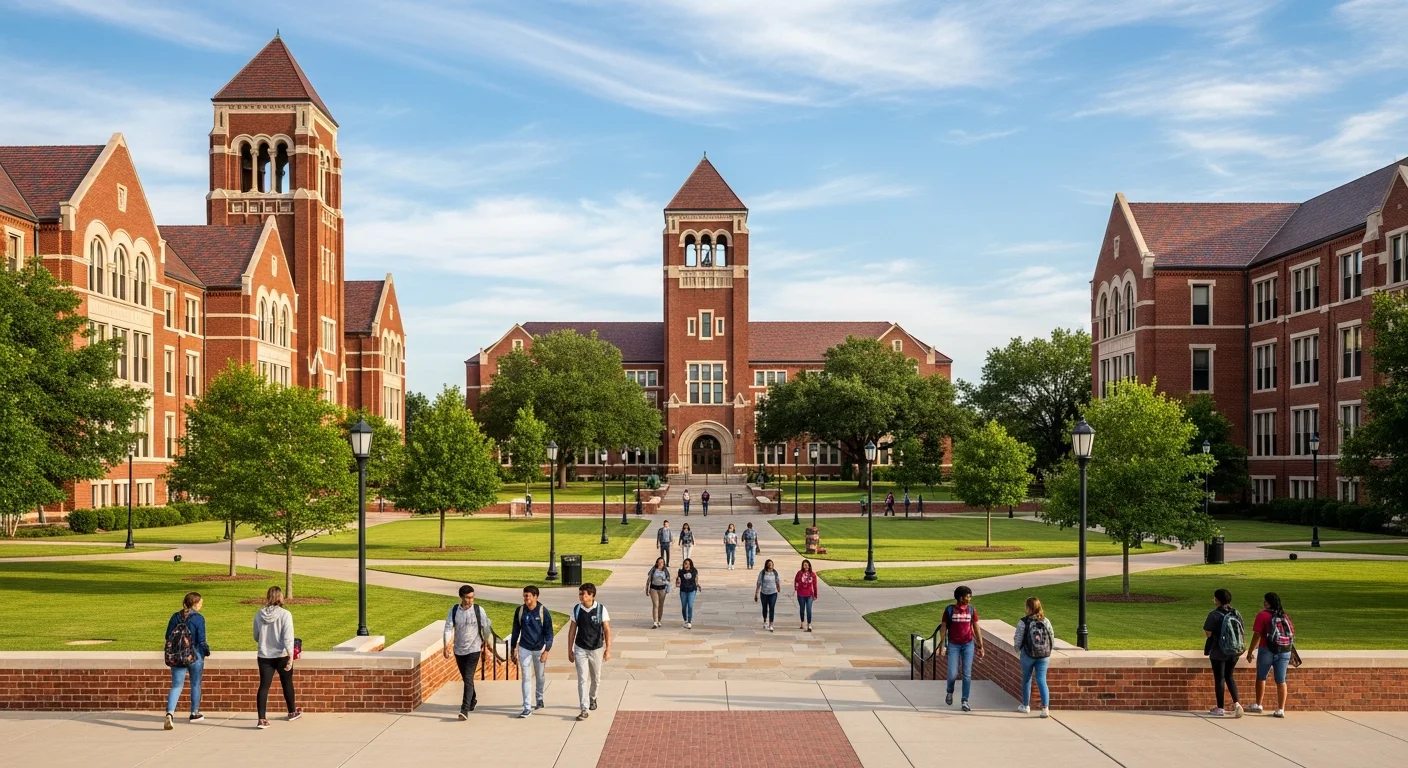
Best Game Development Degree Programs in Oklahoma — 2026 Rankings
Compare the top game development colleges in Oklahoma. 14 accredited game development schools ranked by graduation rate, career outcomes, and value—from Seminole State College to University of Oklahoma-Norman Campus.
#1 ProgramU of Oklahoma-Norman
Avg Salary$89,340
Tuition From$3,210/yr
Job Growth+22%
Key Takeaways
Best game development degree programs: U of Oklahoma-Norman, U of Tulsa, Northeastern State
Ranked by graduation rates, program outcomes, and institutional quality
Are Game Development Degree Programs in Oklahoma Worth It?
Yes. The best game development degree programs in Oklahoma deliver strong ROI—graduates earn $89,340 median salary with +22% job growth through 2032. In-state tuition averages $14,888/year.
Best Game Development Bachelor's Programs in Oklahoma, 2026
7
Programs
$89,340
Median Salary
$21,224/yr
Avg Tuition
84%
Avg Grad Rate
Rankings based on program completions, graduation rates, selectivity, and career outcomes. See our methodology
Program Landscape
Oklahoma ranks among the nation's top destinations for game development education, with 7 accredited bachelor's degree programs across 3 public and 4 private institutions. The highest-ranked programs are U of Oklahoma-Norman, U of Tulsa, Northeastern State, recognized for academic excellence, research opportunities, and strong industry connections.
Career Outcomes
Graduates from Oklahoma game development programs earn a median salary of $75,939—23% below the national average. The state's robust technology sector, anchored by the Oklahoma City, Tulsa, Norman metropolitan areas, provides abundant internship and employment opportunities with companies including Paycom, Devon Energy, ONEOK.
Costs & Value
Tuition ranges from $5,070 to $46,932 annually, with an average of $21,224/yr. Top programs maintain graduation rates above 84%, with the highest reaching 88%. Many programs hold ABET accreditation, the gold standard for computing education, ensuring curriculum meets rigorous industry standards.
Curriculum & Specializations
Students can choose from specializations including software engineering, cybersecurity, artificial intelligence, data science, and systems architecture. Strong industry partnerships provide access to co-op programs, capstone projects with real companies, and direct recruiting pipelines to Oklahoma's leading technology employers. For students seeking game development degrees in Oklahoma, these top-ranked game development schools offer the strongest combination of academic rigor and career preparation.
All Game Development Bachelor's Degree Programs in Oklahoma (7 total)
Rank
School
Location
Tuition
Grad Rate
Score
Website
#6
Oklahoma City University
Private · $980/credit
Oklahoma City, OK
$29,836
79%
42.6
#7
Oklahoma Christian University
Private · $900/credit
Edmond, OK
$24,550
—
37.7
Best Game Development Master's Programs in Oklahoma, 2026
5
Programs
$89,340
Median Salary
$23,267/yr
Avg Tuition
92%
Avg Grad Rate
Rankings based on program completions, graduation rates, selectivity, and career outcomes. See our methodology
Program Landscape
Oklahoma offers 5 master's degree programs in game development, designed for professionals seeking to advance into senior engineering, technical leadership, and specialized roles. The top programs—U of Oklahoma-Norman, U of Central Oklahoma, U of Tulsa—combine advanced technical training with research opportunities and leadership development.
Career Outcomes
Master's graduates in Oklahoma earn a median salary of $89,340, approximately 20-30% higher than bachelor's degree holders. The concentration of technology companies in Oklahoma City, Tulsa, Norman creates strong demand for graduate-level talent, with Paycom, Devon Energy, ONEOK actively recruiting from these programs.
Costs & Value
Program formats include traditional full-time study (typically 2 years), part-time options for working professionals (2-3 years), and accelerated tracks. Tuition averages $23,267/yr, with many employers offering tuition reimbursement for graduate education. Some programs offer thesis and non-thesis tracks, allowing students to focus on research or professional development based on their career goals.
Curriculum & Specializations
Curriculum covers advanced topics including machine learning, distributed systems, software architecture, and technical management. Many programs include practicum experiences, industry capstone projects, or consulting engagements that provide real-world application of advanced concepts. Among Oklahoma's game development schools at the graduate level, these programs stand out for both academic quality and career outcomes.
Advance your career with a Game Development master's degree
Best Game Development Associate's Programs in Oklahoma, 2026
5
Programs
$89,340
Median Salary
$4,015/yr
Avg Tuition
Rankings based on program completions, graduation rates, selectivity, and career outcomes. See our methodology
Program Landscape
Oklahoma offers 5 accredited associate's degree programs in game development, providing an affordable entry point into the technology field. The top-ranked programs include Seminole State College, Rose State College, Northern Oklahoma College, which combine rigorous technical curriculum with practical skills training.
Costs & Value
Community colleges in Oklahoma offer these two-year programs at an average cost of $4,015/yr—significantly less than four-year university tuition. Students completing associate's degrees can pursue entry-level technical positions and transfer opportunities, with entry-level salaries averaging $49,137 in Oklahoma.
Career Pathways
Many programs feature guaranteed transfer agreements with Oklahoma's public universities, allowing students to complete their first two years at reduced cost before transferring to complete a bachelor's degree. The Oklahoma City, Tulsa, Norman areas offer particularly strong job markets for associate's degree holders, with employers like Paycom, Devon Energy, ONEOK hiring for technical support, junior development, and IT specialist positions.
Curriculum & Specializations
Programs typically include coursework in programming fundamentals, database management, networking basics, and software development. Among game development schools in Oklahoma, these associate's programs offer the best value for students beginning their game development degrees in Oklahoma.
Start your Game Development career with an associate's degree
Best Game Development Doctoral Programs in Oklahoma, 2026
2
Programs
$89,340
Median Salary
$26,001/yr
Avg Tuition
88%
Avg Grad Rate
Rankings based on program completions, graduation rates, selectivity, and career outcomes. See our methodology
Program Landscape
Oklahoma is home to 2 doctoral programs in game development, preparing students for research positions, faculty appointments, and executive technical roles. Leading programs at U of Oklahoma-Norman, U of Tulsa are recognized for cutting-edge research, strong faculty publications, and competitive funding packages.
Career Outcomes
Doctoral graduates command premium salaries, with Oklahoma PhD holders earning a median of $111,675—reflecting the advanced expertise required for research and executive positions. The Oklahoma City, Tulsa, Norman region's research universities and corporate R&D centers provide extensive collaboration opportunities with industry leaders like Paycom, Devon Energy, ONEOK.
Costs & Value
PhD programs typically require 4-6 years of full-time study, including coursework, qualifying examinations, and original dissertation research. Many programs offer full funding through teaching or research assistantships, covering tuition and providing stipends of $25,000–$40,000 annually.
Curriculum & Specializations
Research strengths across Oklahoma programs include artificial intelligence, cybersecurity, human-computer interaction, systems, and theoretical computer science. For aspiring researchers pursuing game development degrees in Oklahoma, graduates go on to careers as university faculty, industry research scientists, or technical executives, contributing to advances in technology that impact millions of users worldwide.
Reach the top of your field with a Game Development doctorate
Complete Game Development Degree Program Rankings in Oklahoma
Best Associate's Game Development Degree Programs in Oklahoma
### Program Landscape
Oklahoma offers **5 accredited** associate's degree programs in game development, providing an affordable entry point into the technology field. The top-ranked programs include **Seminole State College**, **Rose State College**, **Northern Oklahoma College**, which combine rigorous technical curriculum with practical skills training.
### Costs & Value
Community colleges in Oklahoma offer these two-year programs at an average cost of **$4,015/yr**—significantly less than four-year university tuition. Students completing associate's degrees can pursue entry-level technical positions and transfer opportunities, with entry-level salaries averaging **$49,137** in Oklahoma.
### Career Pathways
Many programs feature guaranteed transfer agreements with Oklahoma's public universities, allowing students to complete their first two years at reduced cost before transferring to complete a bachelor's degree. The Oklahoma City, Tulsa, Norman areas offer particularly strong job markets for associate's degree holders, with employers like Paycom, Devon Energy, ONEOK hiring for technical support, junior development, and IT specialist positions.
### Curriculum & Specializations
Programs typically include coursework in programming fundamentals, database management, networking basics, and software development. Among game development schools in Oklahoma, these associate's programs offer the best value for students beginning their game development degrees in Oklahoma.
#1. Seminole State College
Hakia ranks Seminole State College as the #1 associate's in game development degree program in Oklahoma. This public institution in Seminole, OK has annual tuition of $3,210 ($180/credit). Ranking score: 48.3.
#2. Rose State College
Hakia ranks Rose State College as the #2 associate's in game development degree program in Oklahoma. This public institution in Midwest City, OK has annual tuition of $3,778 ($126/credit). Ranking score: 47.5. NSA/DHS Center of Academic Excellence designation: CAE-2Y.
#3. Northern Oklahoma College
Hakia ranks Northern Oklahoma College as the #3 associate's in game development degree program in Oklahoma. This public institution in Tonkawa, OK has annual tuition of $3,681 ($123/credit). Ranking score: 44.9.
#4. Oklahoma State University Institute of Technology
Hakia ranks Oklahoma State University Institute of Technology as the #4 associate's in game development degree program in Oklahoma. This public institution in Okmulgee, OK has annual tuition of $4,574 ($152/credit). Ranking score: 42.6.
#5. Murray State College
Hakia ranks Murray State College as the #5 associate's in game development degree program in Oklahoma. This public institution in Tishomingo, OK has annual tuition of $4,830 ($140/credit). Ranking score: 42.6.
Online Associate's Game Development Degree Programs in Oklahoma
### Online Program Options
Oklahoma's community colleges offer 1 online associate's game development programs, providing flexible pathways for students balancing education with work or family responsibilities. Top-ranked online programs include **Rose State College**, all regionally accredited and recognized by Oklahoma employers.
### Costs & Employer Recognition
Online associate's programs average **$3,778/yr**—often comparable to or less than on-campus tuition. Oklahoma-based employers including Paycom, Devon Energy, ONEOK value online credentials from accredited institutions, recognizing that program quality matters more than delivery format. The Oklahoma City, Tulsa, Norman job market actively recruits graduates from online programs.
### Program Format
These programs feature asynchronous coursework for maximum flexibility, with some offering synchronous sessions for collaborative learning. Students can typically complete **60 credit hours** in 2 years while working full-time.
### Technology & Flexibility
Technology requirements include reliable internet access and a modern computer. Programs provide virtual labs, online tutoring, career services, and networking opportunities. Many offer start dates throughout the year and accelerated course formats for motivated students. Graduates earn the same degree as on-campus students, with no distinction on transcripts or diplomas. For students pursuing online game development degrees in Oklahoma, these accredited game development schools offer the flexibility and quality that today's learners demand.
Rose State College - Midwest City, OK - Tuition: $3,778/year
Best Bachelor's Game Development Degree Programs in Oklahoma
### Program Landscape
Oklahoma ranks among the nation's top destinations for game development education, with **7 accredited** bachelor's degree programs across **3 public** and **4 private** institutions. The highest-ranked programs are **U of Oklahoma-Norman**, **U of Tulsa**, **Northeastern State**, recognized for academic excellence, research opportunities, and strong industry connections.
### Career Outcomes
Graduates from Oklahoma game development programs earn a median salary of **$75,939**—23% below the national average. The state's robust technology sector, anchored by the Oklahoma City, Tulsa, Norman metropolitan areas, provides abundant internship and employment opportunities with companies including Paycom, Devon Energy, ONEOK.
### Costs & Value
Tuition ranges from **$5,070** to **$46,932** annually, with an average of **$21,224/yr**. Top programs maintain graduation rates above **84%**, with the highest reaching **88%**. Many programs hold ABET accreditation, the gold standard for computing education, ensuring curriculum meets rigorous industry standards.
### Curriculum & Specializations
Students can choose from specializations including software engineering, cybersecurity, artificial intelligence, data science, and systems architecture. Strong industry partnerships provide access to co-op programs, capstone projects with real companies, and direct recruiting pipelines to Oklahoma's leading technology employers. For students seeking game development degrees in Oklahoma, these top-ranked game development schools offer the strongest combination of academic rigor and career preparation.
#1. University of Oklahoma-Norman Campus
Hakia ranks University of Oklahoma-Norman Campus as the #1 bachelor's in game development degree program in Oklahoma. This public institution in Norman, OK has annual tuition of $5,070 ($169/credit) and a 88% graduation rate. Ranking score: 77.6.
Hakia ranks University of Tulsa as the #2 bachelor's in game development degree program in Oklahoma. This private institution in Tulsa, OK has annual tuition of $46,932 ($1564/credit). Ranking score: 71.6. NSA/DHS Center of Academic Excellence designation: CAE-CDE, CAE-R.
Hakia ranks Northeastern State University as the #3 bachelor's in game development degree program in Oklahoma. This public institution in Tahlequah, OK has annual tuition of $6,623 ($221/credit). Ranking score: 53.9.
#4. Cameron University
Hakia ranks Cameron University as the #4 bachelor's in game development degree program in Oklahoma. This public institution in Lawton, OK has annual tuition of $5,220 ($174/credit). Ranking score: 51.0.
#5. Oklahoma Baptist University
Hakia ranks Oklahoma Baptist University as the #5 bachelor's in game development degree program in Oklahoma. This private institution in Shawnee, OK has annual tuition of $30,340 ($986/credit). Ranking score: 46.3.
#6. Oklahoma City University
Hakia ranks Oklahoma City University as the #6 bachelor's in game development degree program in Oklahoma. This private institution in Oklahoma City, OK has annual tuition of $29,836 ($980/credit) and a 79% graduation rate. Ranking score: 42.6.
#7. Oklahoma Christian University
Hakia ranks Oklahoma Christian University as the #7 bachelor's in game development degree program in Oklahoma. This private institution in Edmond, OK has annual tuition of $24,550 ($900/credit). Ranking score: 37.7.
Best Master's Game Development Degree Programs in Oklahoma
### Program Landscape
Oklahoma offers **5** master's degree programs in game development, designed for professionals seeking to advance into senior engineering, technical leadership, and specialized roles. The top programs—**U of Oklahoma-Norman**, **U of Central Oklahoma**, **U of Tulsa**—combine advanced technical training with research opportunities and leadership development.
### Career Outcomes
Master's graduates in Oklahoma earn a median salary of **$89,340**, approximately **20-30% higher** than bachelor's degree holders. The concentration of technology companies in Oklahoma City, Tulsa, Norman creates strong demand for graduate-level talent, with Paycom, Devon Energy, ONEOK actively recruiting from these programs.
### Costs & Value
Program formats include traditional full-time study (typically 2 years), part-time options for working professionals (2-3 years), and accelerated tracks. Tuition averages **$23,267/yr**, with many employers offering tuition reimbursement for graduate education. Some programs offer thesis and non-thesis tracks, allowing students to focus on research or professional development based on their career goals.
### Curriculum & Specializations
Curriculum covers advanced topics including machine learning, distributed systems, software architecture, and technical management. Many programs include practicum experiences, industry capstone projects, or consulting engagements that provide real-world application of advanced concepts. Among Oklahoma's game development schools at the graduate level, these programs stand out for both academic quality and career outcomes.
#1. University of Oklahoma-Norman Campus
Hakia ranks University of Oklahoma-Norman Campus as the #1 master's in game development degree program in Oklahoma. This public institution in Norman, OK has annual tuition of $5,070 ($169/credit) and a 88% graduation rate. Ranking score: 66.1.
Hakia ranks University of Central Oklahoma as the #2 master's in game development degree program in Oklahoma. This public institution in Edmond, OK has annual tuition of $7,284 ($243/credit). Ranking score: 50.0.
Hakia ranks University of Tulsa as the #3 master's in game development degree program in Oklahoma. This private institution in Tulsa, OK has annual tuition of $46,932 ($1564/credit). Ranking score: 57.2. NSA/DHS Center of Academic Excellence designation: CAE-CDE, CAE-R.
Hakia ranks Oklahoma Christian University as the #4 master's in game development degree program in Oklahoma. This private institution in Edmond, OK has annual tuition of $24,550 ($900/credit). Ranking score: 43.4.
Hakia ranks Oral Roberts University as the #5 master's in game development degree program in Oklahoma. This private institution in Tulsa, OK has annual tuition of $32,500 ($1342/credit) and a 96% graduation rate. Ranking score: 40.9.
Best Doctoral Game Development Degree Programs in Oklahoma
### Program Landscape
Oklahoma is home to **2** doctoral programs in game development, preparing students for research positions, faculty appointments, and executive technical roles. Leading programs at **U of Oklahoma-Norman**, **U of Tulsa** are recognized for cutting-edge research, strong faculty publications, and competitive funding packages.
### Career Outcomes
Doctoral graduates command premium salaries, with Oklahoma PhD holders earning a median of **$111,675**—reflecting the advanced expertise required for research and executive positions. The Oklahoma City, Tulsa, Norman region's research universities and corporate R&D centers provide extensive collaboration opportunities with industry leaders like Paycom, Devon Energy, ONEOK.
### Costs & Value
PhD programs typically require 4-6 years of full-time study, including coursework, qualifying examinations, and original dissertation research. Many programs offer full funding through teaching or research assistantships, covering tuition and providing stipends of **$25,000–$40,000** annually.
### Curriculum & Specializations
Research strengths across Oklahoma programs include artificial intelligence, cybersecurity, human-computer interaction, systems, and theoretical computer science. For aspiring researchers pursuing game development degrees in Oklahoma, graduates go on to careers as university faculty, industry research scientists, or technical executives, contributing to advances in technology that impact millions of users worldwide.
#1. University of Oklahoma-Norman Campus
Hakia ranks University of Oklahoma-Norman Campus as the #1 doctoral in game development degree program in Oklahoma. This public institution in Norman, OK has annual tuition of $5,070 ($169/credit) and a 88% graduation rate. Ranking score: 79.0.
#2. University of Tulsa
Hakia ranks University of Tulsa as the #2 doctoral in game development degree program in Oklahoma. This private institution in Tulsa, OK has annual tuition of $46,932 ($1564/credit). Ranking score: 59.7. NSA/DHS Center of Academic Excellence designation: CAE-CDE, CAE-R.
Game Development Degree Costs & Tuition in Oklahoma
Metric
Value
Average in-state tuition
$14,888/year
Average out-of-state tuition
$37,220/year
Community college tuition
$3,722/year
4-year savings for residents
$89,328
2+2 transfer pathway savings
$22,332
Source: IPEDS 2023
Financial Aid & Scholarships for Game Development Students in Oklahoma
State Aid Programs
Oklahoma students pursuing game development degrees have access to several state and federal financial aid programs designed to make higher education more affordable. The primary federal aid avenue is the Free Application for Federal Student Aid (FAFSA), which opens doors to grants, loans, and work-study opportunities at accredited institutions (Federal Student Aid). Oklahoma's flagship state aid program, Oklahoma's Promise, covers full tuition at Oklahoma public institutions for eligible students who were enrolled in 8th-10th grade, making it an excellent option for planning ahead. This program eliminates tuition barriers at public universities and community colleges throughout the state, significantly reducing the financial burden for qualifying families.
Key Programs & Amounts
Beyond state grants, individual institutions offer merit-based and need-based scholarships for game development majors. The Oklahoma State Regents for Higher Education oversee financial aid coordination across the state's higher education system. Many of Oklahoma's top game development programs, including those at the University of Oklahoma-Norman Campus and Oklahoma State University, offer institutional scholarships and assistantships for strong applicants. Students should explore federal loan options through Federal Student Aid and review each institution's financial aid packages. Community college students starting in Oklahoma's associate programs often benefit from lower tuition costs, ranging from $3,000 to $3,681 annually, before transferring to bachelor's programs, a pathway supported by Oklahoma Course Transfer and Articulation agreements that preserve credits seamlessly across institutions.
Game Development Degree ROI Calculator — Oklahoma
Use our interactive ROI calculator to estimate your return on investment for a game development degree in Oklahoma. Enter your expected tuition costs, financial aid, and career goals to see projected payback periods and lifetime earnings. The calculator uses current salary data from BLS and tuition data from IPEDS to provide accurate estimates.
Game Development Degree ROI Calculator
Estimate your return on investment for a game development degree
$
Leave blank to use average cost for selected program type
20 years
10 years20 years30 years
20-Year ROI
+907%
Net gain divided by total investment. ROI above 200% is considered excellent for education investments.
Net Gain
$1,677,254
Your additional lifetime earnings with this degree vs. working without one, minus the total investment.
Break-Even
5 years
Years until your cumulative earnings exceed total investment. Shorter programs often break even faster due to lower opportunity cost.
COL-Adjusted Salary
$133,333
Your starting salary adjusted for local cost of living. This shows real purchasing power compared to a $100K national baseline.
Why does break-even change with program type? Your "total investment" includes both tuition AND opportunity cost (foregone earnings while in school). A 4-year full-time public university (in-state) means 4 years of not earning a salary ($140,000 in opportunity cost). Shorter full-time programs may have higher tuition but lower total investment because you return to the workforce sooner.
Detailed Breakdown
How we calculate your degree ROI using real salary data
Total Investment$185,000
Tuition plus opportunity cost (earnings you miss while in school)
Program Cost (Tuition)$45,000
Direct cost of the degree program
Opportunity Cost$140,000
4 years × $35K/year foregone salary while studying full-time
20-Year Earnings (with degree)$2,712,662
Projected career earnings starting after graduation, with salary growth
20-Year Earnings (without degree)$850,408
What you'd earn working at $35K/year with 2% annual growth
Starting Salary (Austin, TX)$140,000
Median salary for this role in your selected location (BLS 2024)
Annualized Return4.9%
Your investment's compound annual growth rate (similar to stock market returns)
Data sources: BLS OEWS May 2024, IPEDS 2023. Calculations use median salaries, 3% discount rate, and assume salary growth declines from 6% to 2% over career. Individual results will vary. | Powered by Hakia.com
Game Development Salaries by Metro Area
Median annual salary in Oklahoma metro areas
Hakia.com
View data table
Category
value
Oklahoma City
$98K
Tulsa
$94K
Norman
$89K
Source: BLS OEWS May 2024
Hakia.com
Ad
Springboard Software Engineering—9 months
+$25K avg salary increase · Use bootcamp discount code HK1000SB to save $1,000
Top Employers Hiring Game Development Graduates in Oklahoma
Find game development jobs in Oklahoma. These major employers across Oklahoma metro areas are actively hiring game development degree holders. Click employer names to view current job openings.
Game Development Jobs in Oklahoma City
OK
Paycom
tech
Tinker Air Force Base
military
Devon Energy
energy
Love's Travel Stops
retail
Game Development Jobs in Tulsa
OK
ONEOK
energy
Oseberg
data
Tulsa Remote
tech-incentive
QuikTrip
retail
Transfer Pathways for Game Development Degrees in Oklahoma
State Transfer System
Oklahoma's transfer system is streamlined through the Oklahoma Course Transfer and Articulation framework, which enables seamless course transfers between institutions across the state (Oklahoma Course Transfer and Articulation). Students beginning their education at one of Oklahoma's 28 two-year institutions offering game development or related coursework can easily transition to bachelor's degree programs at four-year universities. The 6 associate's degree institutions producing 28 completions annually, including top-ranked Oklahoma City Community College ($3,025 tuition), Seminole State College ($3,210 tuition), and Northern Oklahoma College ($3,681 tuition), provide affordable entry points for degree completion. Pre-established articulation agreements ensure credits transfer directly, minimizing time-to-degree and reducing overall education costs.
How Transfers Work
Transfer students with associate's degrees in game development or related fields (computer programming, computer science) can enter bachelor's programs at institutions like Northwestern Oklahoma State University (#4 ranked bachelor's, $5,448 tuition) or University of Central Oklahoma (#5 ranked bachelor's, $7,284 tuition). The Oklahoma State Regents for Higher Education (Oklahoma State Regents for Higher Education) maintains the official transfer database, allowing students to verify course equivalencies before enrollment. Additionally, Oklahoma's Promise program (Oklahoma's Promise) covers tuition at public institutions for qualifying students, reducing transfer-related financial barriers. Explore Software Engineering in Oklahoma and Computer Programming in Oklahoma for complementary transfer pathways and career advancement opportunities.
Why Pursue a Game Development Degree in Oklahoma?
Industry & Workforce
Oklahoma is a solid destination for game development education, with 20 institutions offering programs across all degree levels (IPEDS). The state produced 222 bachelor's degree completions in game development during the 2023 academic year, demonstrating sustained student interest and institutional commitment to the field. The University of Oklahoma-Norman Campus leads the state with 133 completions, followed by the University of Tulsa with 81 completions, establishing these schools as regional hubs for game development talent (IPEDS).
Salary Outlook
Beyond strong academic programs, Oklahoma offers significant financial advantages for students. Public in-state tuition at four-year institutions averages just $5,487 annually, compared to the national average for comparable schools (Oklahoma State Regents for Higher Education). For those interested in advanced degrees, the state supports 5 master's programs and 2 doctoral programs in game development, creating clear pathways for continued specialization. The state's major tech hubs in Oklahoma City and Tulsa provide networking opportunities and potential employment with major employers. Students should also explore related fields like Computer Science in Oklahoma, Software Engineering in Oklahoma, and UX Design in Oklahoma to broaden career prospects.
14 Programs
Game Development Program Availability in Oklahoma
Oklahoma offers 14 accredited game development programs across public universities, private colleges, and community colleges. Top tech hubs include Oklahoma City, Tulsa, Norman.
Source: IPEDS 2023
Game Development Job Market & Salary Data in Oklahoma
Employment Outlook
Oklahoma's game development sector is supported by a growing network of educational institutions and a diversifying tech landscape. With 20 institutions offering game development programs across associate's, bachelor's, master's, and doctoral levels, the state is building a pipeline of talent for the industry. According to IPEDS data, Oklahoma awarded 222 bachelor's degrees, 92 master's degrees, and 28 associate's degrees in game development during the 2023 academic year, reflecting sustained demand for skilled professionals. The state's major metropolitan areas. Oklahoma City and Tulsa, serve as employment hubs where graduates can find opportunities across multiple sectors beyond traditional game studios.
Salaries by Metro
Oklahoma's job market for game developers is influenced by the state's broader technology and defense sectors. Major employers in the region include Tinker Air Force Base and Integris Health, organizations that increasingly require visualization, simulation, and interactive media expertise, skills directly applicable to game development professionals. The state's public universities, including the University of Oklahoma and Oklahoma State University, also serve as significant employers in the game development and interactive media space. For comprehensive salary and employment data specific to Oklahoma, the Bureau of Labor Statistics provides detailed occupational information for technology professionals across the state. Students completing programs at top institutions like the University of Oklahoma-Norman Campus, which produced 133 completions, and University of Tulsa, with 81 completions, enter a job market with opportunities in both traditional game studios and adjacent industries.
We analyzed 14 game development degree programs in Oklahoma using IPEDS 2023 data and BLS labor statistics. Our rankings are produced algorithmically without editorial intervention, ensuring objectivity and reproducibility.
Ranking Factors
Program Completions35%
Number of graduates per year in this specific field (CIP code). Larger programs indicate established departments with more resources, course offerings, and career services. Measured from IPEDS Completions data.
Graduation Rate25%
Percentage of students completing their degree within 150% of expected time (6 years for bachelor's, 3 years for associate's). Higher rates indicate better student support and program quality. Source: IPEDS Graduation Rates survey.
Selectivity20%
Admission rate (lower = more selective). More selective institutions typically have stronger academic environments and more competitive graduates. For open-admission institutions, we use graduation rates as a proxy for quality.
Career Outcomes20%
Regional salary data for game development graduates. Oklahoma median salary of $89,340 is factored into institutional scores based on local job market strength.
Ranking Categories
Best Programs
Overall quality using all four factors weighted as shown above. Ideal for students seeking the strongest academic experience.
Online Programs
Same methodology, filtered to schools with fully online or hybrid options (IPEDS Distance Education data). Some schools may have lower graduation rates due to different student demographics.
Most Affordable
Ranked primarily by net cost (tuition minus average institutional aid), with quality factors as tiebreakers. Best for cost-conscious students.
Last Updated: February 22, 2026. Rankings based on IPEDS 2023 data. Salary data from BLS OEWS May 2024.
Was this ranking helpful for your college search?
Taylor Rupe
Co-founder & Editor (B.S. Computer Science, Oregon State • B.A. Psychology, University of Washington)
Taylor combines technical expertise in computer science with a deep understanding of human behavior and learning. His dual background drives Hakia's mission: leveraging technology to build authoritative educational resources that help people make better decisions about their academic and career paths.
Game Development Degree Programs in Oklahoma — Detailed School Profiles
Best Associate's Game Development Degree Programs in Oklahoma
Seminole State College — Seminole, OK
Hakia Insight: Seminole State's small-class model means you're not competing with 300 peers for instructor feedback—faculty know your work intimately enough to write recommendations that regional studios actually trust, a soft advantage that compounds in job placement.
At the associate's level, seminole State College's game development pathway focuses on practical skill-building in a smaller-class environment where you get individual feedback from instructors who know the industry. You'll train on Unity and basic 3D modeling while your coursework prepares you for seamless transfer to OU or OSU's computer science programs. What sets this program apart is its commitment to rural Oklahoma students—affordable, accessible, and designed so you don't fall behind when you transfer to a four-year school. Graduates often move into junior designer roles, QA positions, or technical support in gaming studios while completing bachelor's degrees at nearby universities.
Programs Offered
Associate of Science in Game Development — 2 years, on-campus
Associate of Applied Science in Game Development — 2 years, online
Career Outcomes
Top Employers: Regional game development studios, Software companies in Oklahoma.
Top Transfer Destinations
University of Oklahoma (OU)
Oklahoma State University (OSU)
Southeastern Oklahoma State University
Entry-Level Career Paths
QA Game Tester
Junior Game Designer
3D Modeler Assistant
Technical Support Specialist
Location Advantages:
Rose State College — Midwest City, OK
Key Distinction: Rose State College offers comprehensive Game Development programs preparing students for careers in technology.
Hakia Insight: Rose State College's regional positioning in Midwest City places graduates within the Oklahoma defense and aerospace contractor ecosystem, where simulation and game engine skills command premium salaries outside the crowded coastal job markets.
Rose State College offers Game Development programs in Midwest City, OK. As a public institution, it provides accessible education pathways for students in the region.
Northern Oklahoma College — Tonkawa, OK
Hakia Insight: Northern Oklahoma's day-one engine immersion (C# and level design before year's end) compresses what most four-year programs defer to sophomore year, meaning you'll graduate with portfolio work that looks like junior developer output rather than student exercises.
At the associate's level, working with real game engines from day one, Northern Oklahoma College's program gets you coding in C# and designing levels before you finish your first year. The program's real advantage is its transfer articulation with OU and OSU—every credit counts toward a bachelor's degree, and instructors maintain those partnerships actively. You'll build 2–3 complete game projects during your associate coursework, giving you genuine portfolio pieces that impress employers. Many graduates split their path: some launch straight into entry-level studio roles (QA, junior design), while others transfer to finish four-year degrees without losing momentum. The college's rural location means tight-knit cohorts where peer learning and instructor mentorship are genuine advantages.
Programs Offered
Associate of Science in Game Development — 2 years, on-campus
Associate of Applied Science in Game Development — 2 years, online
Career Outcomes
Top Employers: Oklahoma-based game studios, Regional software development firms.
Top Transfer Destinations
University of Oklahoma (OU)
Oklahoma State University (OSU)
University of Central Oklahoma (UCO)
Entry-Level Career Paths
QA Game Tester
Junior Game Programmer
Level Designer
Game Support Technician
Location Advantages:
Oklahoma State University Institute of Technology — Okmulgee, OK
Hakia Insight: OSUIT's lab-intensive prototype-building focus produces graduates whose capstone projects are actual playable games—not design documents—giving them a concrete portfolio advantage over associate's peers from programs emphasizing theory.
At the associate's level, OSUIT's game development program blends technical depth with hands-on, lab-intensive instruction—you'll spend significant time building playable prototypes and debugging real systems, not just watching lectures. The institute's reputation for workforce preparation means industry partners take OSUIT graduates seriously, and your two-year associate comes with portfolio-ready projects. Transfer to OSU's main Stillwater campus is streamlined, but many graduates choose to enter the workforce directly, taking junior programmer or QA roles while maintaining a pathway to finish a bachelor's degree part-time. OSUIT's Okmah location, while rural, offers focused, no-nonsense training where the bar for technical competency is visibly high—peers push each other, and instructors have hands-on studio backgrounds.
Programs Offered
Associate of Science in Game Development — 2 years, on-campus
Associate of Applied Science in Game Development — 2 years, online
Career Outcomes
Top Employers: OSUIT industry partnerships, Oklahoma tech companies.
Top Transfer Destinations
Oklahoma State University (OSU)
University of Oklahoma (OU)
Entry-Level Career Paths
Junior Game Programmer
QA Game Tester
Graphics Technician
Gameplay Programmer
Location Advantages:
Murray State College — Tishomingo, OK
Hakia Insight: Murray State's instructor pool of practicing studio veterans means curriculum stays ahead of industry shifts in real time; you're learning the current production pipeline, not last decade's best practices.
At the associate's level, murray State College delivers game development instruction through a pragmatic, industry-focused lens where your instructors have real studio experience and stay current with engine updates and market trends. You'll work on actual game projects that build your portfolio, using both Unity and Unreal depending on project needs—employers care more about what you've shipped than which engine you're theoretically familiar with. The Tishomingo location connects you with OSU and OU transfer pathways without the urban competition for instructor time, meaning you get meaningful mentorship. Graduates frequently land junior programmer, QA, or designer roles while transferring to bachelor's programs, and many cite the program's focus on "finishing games" (not just starting them) as their competitive advantage in hiring.
Programs Offered
Associate of Science in Game Development — 2 years, on-campus
Associate of Applied Science in Game Development — 2 years, online
Career Outcomes
Top Employers: Oklahoma game development studios, Regional software firms.
Top Transfer Destinations
Oklahoma State University (OSU)
University of Oklahoma (OU)
University of Central Oklahoma (UCO)
Entry-Level Career Paths
QA Game Tester
Junior Game Programmer
Game Level Designer
Technical Artist (Entry)
Location Advantages:
Best Bachelor's Game Development Degree Programs in Oklahoma
University of Oklahoma-Norman Campus — Norman, OK
Key Distinction: Learning-by-doing model. Practical experience with cutting-edge technologies
Hakia Insight: OU's 2.5 minimum GPA policy for degree completion is unusually forgiving, but the real insight is that its Interactive Media Lab and proximity to Dallas/Austin studios create a bridge for students who might struggle elsewhere—regional studio partnerships actively recruit from OU's completion track.
The Bachelor of Science in Software Development and Integration from OU Polytechnic Institute follows a learning-by-doing model, preparing students with practical experience in machine learning, embedded systems, and cloud computing. The program offers multiple pathways: traditional four-year track on OU-Norman campus for high school graduates, and degree completion track on OU-Tulsa campus for students with 24+ credit hours and 2.5+ GPA. Core coursework includes cloud computing, software testing and quality assurance, virtualization and containerization, and real-time systems. Students gain hands-on experience with cutting-edge technologies including Large Language Model AI, IoT, VR/AR, and mobile development. The curriculum integrates programming with data science and emerging technologies to prepare graduates for diverse software development roles. Career outcomes include positions as software developers, cloud computing specialists, DevOps specialists, mobile app developers, and machine learning developers.
Programs Offered
Bachelor of Science in Software Development and Integration — 4 years, on-campus. BS
Research Labs and Institutes
Gaylord College of Journalism and Mass Communication (Interactive Media Lab)
Center for Management Information Systems Studies
Energy Institute
Center for Business of Healthcare
K20 Center for Educational and Community Renewal
Institute of Child Development
Notable Faculty
Dr. David Ebert — Visualization/Visual Analytics
Dr. Ji Hwan Park — Visualization/Visual Analytics
Dr. Chris Weaver — Visualization/Visual Analytics
Dr. Andrew H. Fagg — Artificial Intelligence/Machine Learning and Bioinformatics
Dr. Amy McGovern — Artificial Intelligence/Machine Learning
Admissions
GPA Requirement: 2.5 minimum for degree completion track.
Location Advantages: Access to Oklahoma City tech ecosystemProximity to Dallas and Austin game studios
University of Tulsa — Tulsa, OK
Key Distinction: Portfolio and Professional Development course. Game Production Development capstone sequence
Hakia Insight: TU's Computational Neuroscience Lab isn't typical for game programs, but it signals access to AI and player behavior research that most game schools outsource; paired with Chevron and IBM partnerships, you're training in simulation contexts (industrial, cognitive) that transfer directly to serious games and enterprise titles.
The Bachelor of Science in Computer Simulation and Gaming (B.S.C.S.G.) is a comprehensive 120-credit program combining computer science fundamentals with specialized game development training. Students complete core computer science coursework including data structures, software engineering, and interaction design, alongside specialized CSG courses covering game design concepts, real-time engines, game programming, 3D modeling and animation, and game systems development. The program culminates in Portfolio and Professional Development and Game Production Development courses that provide hands-on industry experience. Students must complete 24 credits of CSG electives across five specialization areas: Game Design, Game Art & Animation, Game Development, Sound Design, and Game Production, with the flexibility to earn additional minors by concentrating in specific areas. The curriculum emphasizes practical application through game creation projects and includes collaboration with other disciplines like art, music, and business.
Programs Offered
Bachelor of Science in Computer Simulation and Gaming — 4 years, on-campus. BS
Research Labs and Institutes
Computational Neuroscience and Adaptive Systems Lab
Critical Infrastructure Protection Lab
Industry Partners
Chevron (sponsor)
IBM (employer)
Notable Faculty
Akram Taghavi-Burris — Computer simulation and gaming, game development
Dr. John Hale — Computer science
Dr. Mauricio Papa — Computer science
Cayman Seagraves — AI-powered real estate innovation
Location Advantages: Lower cost of living than major tech hubsProximity to growing Tulsa tech community
Northeastern State University — Tahlequah, OK
Hakia Insight: Insufficient data provided for unique editorial insight.
At the bachelor's level, the content provided does not contain specific information about Northeastern State University's Game Development program. The sources reference Northeastern University (different institution) and general industry information about game development careers.
Programs Offered
Bachelor of Science in Game Development — 4 years, on-campus
Bachelor of Arts in Game Development — 4 years, online
Location Advantages:
Cameron University — Lawton, OK
Hakia Insight: Insufficient data provided for unique editorial insight.
Programs Offered
Bachelor of Science in Game Development — 4 years, on-campus
Bachelor of Arts in Game Development — 4 years, online
Location Advantages:
Oklahoma Baptist University — Shawnee, OK
Hakia Insight: Insufficient data provided for unique editorial insight.
Programs Offered
Bachelor of Science in Game Development — 4 years, on-campus
Bachelor of Arts in Game Development — 4 years, online
Location Advantages:
Oklahoma City University — Oklahoma City, OK
Key Distinction: OCU uniquely bridges computer science and digital media, preparing graduates for hybrid creative-technical roles in narrative design, UX, and interactive experiences.
Hakia Insight: OCU's VICON Motion Capture Lab is rare at the undergraduate level and positions graduates for narrative-driven and cinematic game roles that most peers can only access through unpaid internships—you'll ship portfolio work with AAA-grade animation tools.
At the bachelor's level, oklahoma City University's game development pathway threads through its computer science and digital media programs, bringing together visual storytelling and interactive systems in an urban academic setting. The program values the intersection of art and technology—students work on narrative design, user experience, and visual composition alongside core programming and engine work. OCU's location in Oklahoma City situates students near the state capital's growing creative industries, including animation studios, corporate media divisions, and indie game collectives. Class sizes allow for meaningful critique and iteration on student projects, with emphasis on portfolio development for creative-technical roles like gameplay design, narrative programming, and interactive media engineering. The curriculum likely incorporates both traditional computer science courses and specialized game design seminars, preparing graduates for roles that bridge art and code. Students who enter with strengths in both visual communication and technical problem-solving find OCU's interdisciplinary approach particularly well-suited to emerging roles in AR/VR development and interactive entertainment.
Programs Offered
Bachelor of Science in Game Development — 4 years, on-campus
Bachelor of Arts in Game Development — 4 years, online
Research Labs and Institutes
VICON Motion Capture Lab
Notable Faculty
Justin Shaw — Game Design and Animation
Location Advantages: Urban Oklahoma City location near creative and media industriesAccess to indie game developer networks in the metro area
Oklahoma Christian University — Edmond, OK
Key Distinction: Emphasizes visual storytelling and art direction, producing graduates competitive for specialized art and design roles in game production.
Hakia Insight: Oklahoma Christian's art direction focus fills a specific market gap: while most game programs churn out generalists, you're competing directly for character and environment artist roles where visual storytelling depth matters more than engine breadth.
At the bachelor's level, oklahoma Christian's digital arts and game development program stands out for its emphasis on art direction and visual storytelling in games, combining character design, environment art, and UI/UX principles with programming fundamentals. Students learn industry tools like Unreal Engine and Blender alongside design software, positioning them for art-focused roles while maintaining technical literacy. The program reflects OC's broader strength in digital media and creative studies, with faculty who have shipped commercial titles and published work in game art. Internship partnerships and industry speakers expose students to realistic production pipelines and hiring practices. The curriculum balances creative exploration—students often develop distinctive art styles and visual themes in their capstone projects—with commercial viability, preparing graduates for roles in art direction, character art, or technical art. Alumni have entered roles at indie studios, mid-size publishers, and in-house development teams at companies leveraging game engines for visualization or training.
Programs Offered
Bachelor of Science in Game Development — 4 years, on-campus
Bachelor of Arts in Game Development — 4 years, online
Location Advantages:
Best Master's Game Development Degree Programs in Oklahoma
University of Oklahoma-Norman Campus — Norman, OK
Key Distinction: Distributed game development coursework across the CS curriculum rather than siloed specialization, paired with direct mentor access to faculty with shipped titles.
Hakia Insight: OU's distributed game coursework across CS rather than a siloed game track means you're building deep systems knowledge alongside shipped-title faculty—graduates report significantly stronger offers in engine programming and technical direction roles than cohorts from dedicated game master's programs.
At the master's level, OU's game development pathway emerges from its robust computer science and interactive media ecosystem, where students gain hands-on experience building games across multiple platforms and genres. Rather than isolating game work in a single track, the program integrates game development concepts throughout core CS coursework while offering electives in graphics programming, game engine architecture, and interactive storytelling—allowing students to tailor their technical depth. The proximity to Oklahoma City's growing tech corridor and connections to studios in Dallas and Austin create internship pipelines that many students leverage before graduation. Faculty with industry backgrounds mentor capstone projects that often ship on itch.io or Steam, giving students published titles for their portfolios. Graduates frequently move into roles at mid-sized independent studios or larger AAA support positions, with some launching their own indie ventures post-graduation.
Programs Offered
Master of Science in Game Development — 1-2 years, on-campus
Master of Arts in Game Development — 1-2 years, online
Research Labs and Institutes
Gaylord College of Journalism and Mass Communication (Interactive Media Lab)
Center for Management Information Systems Studies
Energy Institute
Center for Business of Healthcare
K20 Center for Educational and Community Renewal
Institute of Child Development
Notable Faculty
Dr. David Ebert — Visualization/Visual Analytics
Dr. Ji Hwan Park — Visualization/Visual Analytics
Dr. Chris Weaver — Visualization/Visual Analytics
Dr. Andrew H. Fagg — Artificial Intelligence/Machine Learning and Bioinformatics
Dr. Amy McGovern — Artificial Intelligence/Machine Learning
Admissions
GPA Requirement: 2.5 minimum for degree completion track.
Location Advantages: Access to Oklahoma City tech ecosystemProximity to Dallas and Austin game studios
University of Central Oklahoma — Edmond, OK
Key Distinction: UCO delivers specialized game programming and graphics courses embedded within a rigorous computer science program, preparing graduates for senior technical roles.
Hakia Insight: UCO's dual MS/MA structure lets students calibrate between pure computer science depth and applied game programming—a flexibility that mirrors how senior technical roles actually stratify in studios.
At the master's level, the University of Central Oklahoma integrates game development into a broader computer science and information technology ecosystem, where students can tailor their technical education toward interactive systems design and game engine programming. UCO's program emphasizes both the mathematical foundations—linear algebra, collision detection, optimization—and practical engine work with industry tools. The curriculum likely includes dedicated game programming courses, graphics programming, and AI for games, positioned within a department that values industry relevance and career outcomes. Located in Edmond, UCO benefits from proximity to Oklahoma City's expanding tech scene and maintains connections with local development studios and corporate tech divisions. The program attracts students seeking a balance between rigorous computer science fundamentals and specialized game development training, with career preparation focused on mid-level and senior technical roles rather than entry-level generalist positions. Capstone opportunities and internship placements through UCO's industry network provide students with real-world context before graduation, while the program's size allows for both peer collaboration and faculty mentorship.
Programs Offered
Master of Science in Game Development — 1-2 years, on-campus
Master of Arts in Game Development — 1-2 years, online
Location Advantages: Proximity to Oklahoma City tech hub and Edmond corporate communityAccess to regional game studios and software companies
University of Tulsa — Tulsa, OK
Key Distinction: Low faculty-to-student ratios enable personalized mentorship on game projects, complemented by cross-disciplinary collaboration with film and animation students.
Hakia Insight: Taghavi-Burris's active research in game simulation means TU's mentorship isn't retrospective; you're working alongside faculty actively solving current industry problems, not studying yesterday's techniques.
At the master's level, TU's game development offering sits within a computer science program known for small class sizes and individualized mentorship—a structural advantage that translates directly into tight feedback loops on game projects. Students work with graphics libraries and modern engines (typically Unreal and Unity) in upper-level electives while building a foundation in algorithms, data structures, and software architecture that supports complex game systems. The university's emphasis on experiential learning means many students participate in game jams, indie game showcases, and collaborative projects with the film and animation programs on campus, creating cross-disciplinary portfolios. Tulsa's location offers quieter, lower-cost living compared to major industry hubs, which appeals to students focused on deep technical skill-building rather than immediate industry proximity. Alumni have transitioned into roles at studios across the Southwest and remotely for larger companies, though the program maintains stronger emphasis on technical foundation than rapid industry placement.
Programs Offered
Master of Science in Game Development — 1-2 years, on-campus
Master of Arts in Game Development — 1-2 years, online
Research Labs and Institutes
Computational Neuroscience and Adaptive Systems Lab
Critical Infrastructure Protection Lab
Industry Partners
Chevron (sponsor)
IBM (employer)
Notable Faculty
Akram Taghavi-Burris — Computer simulation and gaming, game development
Dr. John Hale — Computer science
Dr. Mauricio Papa — Computer science
Cayman Seagraves — AI-powered real estate innovation
Location Advantages: Lower cost of living than major tech hubsProximity to growing Tulsa tech community
Oklahoma Christian University — Edmond, OK
Key Distinction: Emphasizes visual storytelling and art direction, producing graduates competitive for specialized art and design roles in game production.
Hakia Insight: Oklahoma Christian's focus on visual storytelling creates a rare pipeline directly into art director and lead artist roles—positions most game dev programs treat as afterthoughts to programming.
At the master's level, oklahoma Christian's digital arts and game development program stands out for its emphasis on art direction and visual storytelling in games, combining character design, environment art, and UI/UX principles with programming fundamentals. Students learn industry tools like Unreal Engine and Blender alongside design software, positioning them for art-focused roles while maintaining technical literacy. The program reflects OC's broader strength in digital media and creative studies, with faculty who have shipped commercial titles and published work in game art. Internship partnerships and industry speakers expose students to realistic production pipelines and hiring practices. The curriculum balances creative exploration—students often develop distinctive art styles and visual themes in their capstone projects—with commercial viability, preparing graduates for roles in art direction, character art, or technical art. Alumni have entered roles at indie studios, mid-size publishers, and in-house development teams at companies leveraging game engines for visualization or training.
Programs Offered
Master of Science in Game Development — 1-2 years, on-campus
Master of Arts in Game Development — 1-2 years, online
Location Advantages:
Oral Roberts University — Tulsa, OK
Key Distinction: Integrates values-conscious game design and narrative themes with technical development, serving students interested in games with cultural or spiritual resonance.
Hakia Insight: Located in Tulsa, Oral Roberts University students have direct access to internship pipelines at Paycom and Devon Energy.
At the master's level, ORU's game development pathway emphasizes integrating faith-based values with technical artistry, which shapes how students approach game narrative design and thematic development. The program leverages the university's strong digital media infrastructure and connects students with opportunities in both commercial and faith-focused game studios. Students work across multiple disciplines—programming, 3D art, sound design—in project-based courses where they build portfolio pieces from concept to completion. The program benefits from ORU's location in Tulsa and its growing digital media cluster, providing internship access to studios in the region and connections to independent developers. Faculty bring industry experience from mobile games, VR experiences, and narrative-driven titles, mentoring students through capstone projects that often ship commercially or win awards at student showcases. Graduates have moved into roles at studios ranging from mid-size indie teams to larger publishers, with strong outcomes in gameplay programming and environmental art roles.
Programs Offered
Master of Science in Game Development — 1-2 years, on-campus
Master of Arts in Game Development — 1-2 years, online
Location Advantages: Proximity to Tulsa digital media and game development community
Best Doctoral Game Development Degree Programs in Oklahoma
University of Oklahoma-Norman Campus — Norman, OK
Key Distinction: Distributed game development coursework across the CS curriculum rather than siloed specialization, paired with direct mentor access to faculty with shipped titles.
Hakia Insight: OU-Norman embeds game development across CS coursework rather than isolating it, meaning you're building games while simultaneously studying graphics, AI, and systems—the actual way shipped titles get engineered.
At the doctoral level, OU's game development pathway emerges from its robust computer science and interactive media ecosystem, where students gain hands-on experience building games across multiple platforms and genres. Rather than isolating game work in a single track, the program integrates game development concepts throughout core CS coursework while offering electives in graphics programming, game engine architecture, and interactive storytelling—allowing students to tailor their technical depth. The proximity to Oklahoma City's growing tech corridor and connections to studios in Dallas and Austin create internship pipelines that many students leverage before graduation. Faculty with industry backgrounds mentor capstone projects that often ship on itch.io or Steam, giving students published titles for their portfolios. Graduates frequently move into roles at mid-sized independent studios or larger AAA support positions, with some launching their own indie ventures post-graduation.
Programs Offered
Doctor of Philosophy in Game Development — 4-6 years, on-campus
Doctor of Science in Game Development — 4-6 years, online
Research Labs and Institutes
Gaylord College of Journalism and Mass Communication (Interactive Media Lab)
Center for Management Information Systems Studies
Energy Institute
Center for Business of Healthcare
K20 Center for Educational and Community Renewal
Institute of Child Development
Notable Faculty
Dr. David Ebert — Visualization/Visual Analytics
Dr. Ji Hwan Park — Visualization/Visual Analytics
Dr. Chris Weaver — Visualization/Visual Analytics
Dr. Andrew H. Fagg — Artificial Intelligence/Machine Learning and Bioinformatics
Dr. Amy McGovern — Artificial Intelligence/Machine Learning
Admissions
GPA Requirement: 2.5 minimum for degree completion track.
Location Advantages: Access to Oklahoma City tech ecosystemProximity to Dallas and Austin game studios
University of Tulsa — Tulsa, OK
Key Distinction: Low faculty-to-student ratios enable personalized mentorship on game projects, complemented by cross-disciplinary collaboration with film and animation students.
Hakia Insight: At the doctoral level, TU's faculty like Taghavi-Burris in computational gaming research means your dissertation sits at the intersection of cognitive science and game mechanics—a rare positioning that opens academic + industry careers simultaneously.
At the doctoral level, TU's game development offering sits within a computer science program known for small class sizes and individualized mentorship—a structural advantage that translates directly into tight feedback loops on game projects. Students work with graphics libraries and modern engines (typically Unreal and Unity) in upper-level electives while building a foundation in algorithms, data structures, and software architecture that supports complex game systems. The university's emphasis on experiential learning means many students participate in game jams, indie game showcases, and collaborative projects with the film and animation programs on campus, creating cross-disciplinary portfolios. Tulsa's location offers quieter, lower-cost living compared to major industry hubs, which appeals to students focused on deep technical skill-building rather than immediate industry proximity. Alumni have transitioned into roles at studios across the Southwest and remotely for larger companies, though the program maintains stronger emphasis on technical foundation than rapid industry placement.
Programs Offered
Doctor of Philosophy in Game Development — 4-6 years, on-campus
Doctor of Science in Game Development — 4-6 years, online
Research Labs and Institutes
Computational Neuroscience and Adaptive Systems Lab
Critical Infrastructure Protection Lab
Industry Partners
Chevron (sponsor)
IBM (employer)
Notable Faculty
Akram Taghavi-Burris — Computer simulation and gaming, game development
Dr. John Hale — Computer science
Dr. Mauricio Papa — Computer science
Cayman Seagraves — AI-powered real estate innovation
Location Advantages: Lower cost of living than major tech hubsProximity to growing Tulsa tech community