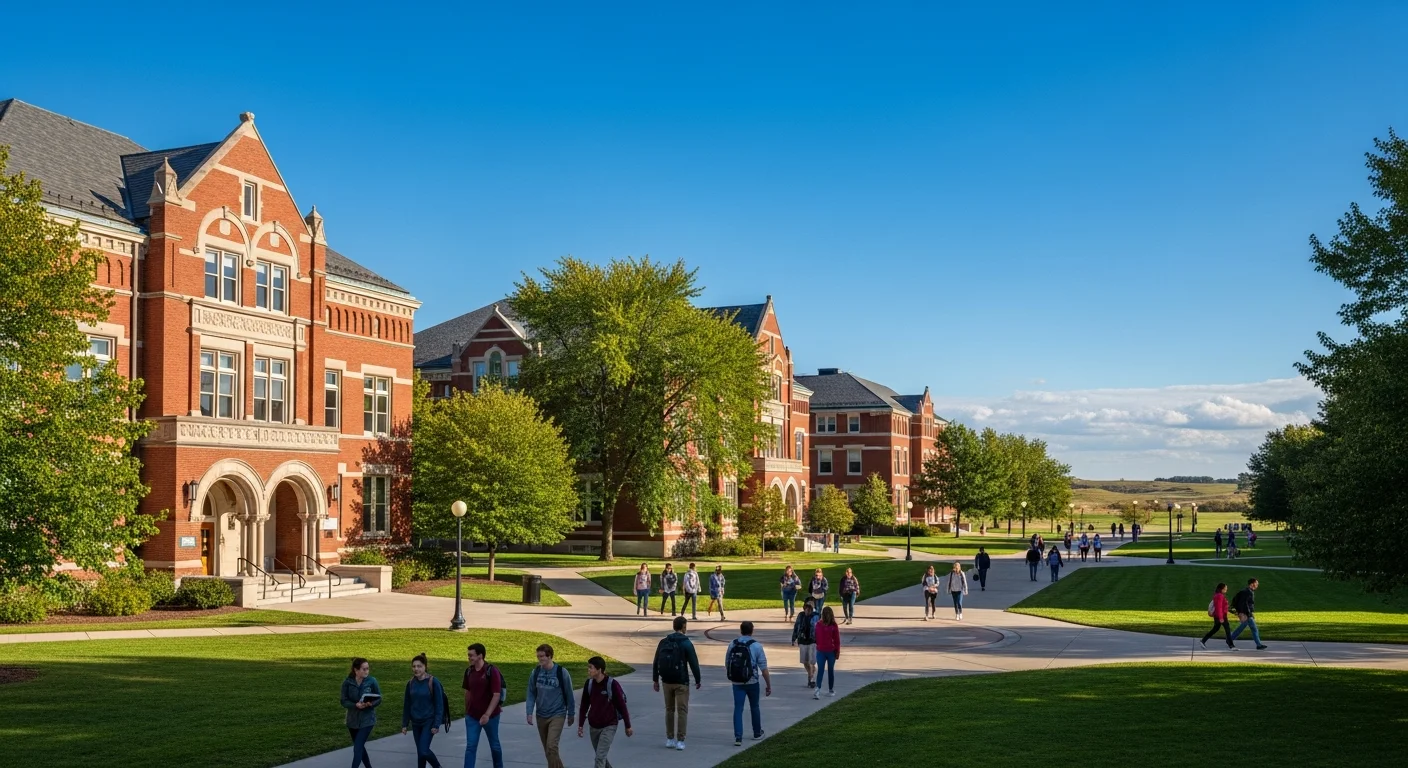
University campus in Nebraska
Updated January 2026

Best Game Development Degree Programs in Nebraska — 2026 Rankings

Compare the top game development colleges in Nebraska. 8 accredited game development schools ranked by graduation rate, career outcomes, and value—from Northeast Community College to University of Nebraska at Omaha.

#1 ProgramU of Nebraska at Omaha
Avg Salary$91,560
Tuition From$3,240/yr
Job Growth+22%

Key Takeaways

Best game development degree programs: U of Nebraska at Omaha, U of Nebraska-Lincoln, Bellevue

Ranked by graduation rates, program outcomes, and institutional quality

IPEDS 2023

Tuition ranges from $3,240 to $45,000/year

Northeast Community College offers the most affordable option at $3,240/yr

IPEDS 2023

Game Development degree programs available: 1 associate's, 2 master's, 1 doctoral in Nebraska

From community college pathways to advanced research degrees

IPEDS 2023

Nebraska community college transfer can save 40-60% on total degree costs

1 associate's programs provide transfer pathways to bachelor's degrees

Education Commission of the States

Major employers: Mutual of Omaha, First Data, TD Ameritrade, Gallup

Tech hubs in Omaha and Lincoln

Hakia Research 2026

Game Development degree programs near 20+ cities across Nebraska

Search by city to find programs within 200 miles of your location

IPEDS 2023

Updated February 2026

On This Page
$91,560
Are Game Development Degree Programs in Nebraska Worth It?
Yes. The best game development degree programs in Nebraska deliver strong ROI—graduates earn $91,560 median salary with +22% job growth through 2032. In-state tuition averages $22,839/year.

Source: BLS OEWS May 2024

Best Game Development Degree Programs in Nebraska

Bachelor's Game Development Degree Programs in Nebraska

7 programs$91,560 median salary74% avg grad rate
7
Programs
$91,560
Median Salary
$25,638/yr
Avg Tuition
74%
Avg Grad Rate

Program Landscape

Nebraska ranks among the nation's top destinations for game development education, with 7 accredited bachelor's degree programs across 2 public and 5 private institutions. The highest-ranked programs are U of Nebraska at Omaha, U of Nebraska-Lincoln, Bellevue, recognized for academic excellence, research opportunities, and strong industry connections.

Career Outcomes

Graduates from Nebraska game development programs earn a median salary of $77,826—21% below the national average. The state's robust technology sector, anchored by the Omaha, Lincoln, Bellevue metropolitan areas, provides abundant internship and employment opportunities with companies including Mutual of Omaha, First Data, TD Ameritrade.

Costs & Value

Tuition ranges from $6,536 to $45,000 annually, with an average of $25,638/yr. Top programs maintain graduation rates above 74%, with the highest reaching 97%. Many programs hold ABET accreditation, the gold standard for computing education, ensuring curriculum meets rigorous industry standards.

Curriculum & Specializations

Students can choose from specializations including software engineering, cybersecurity, artificial intelligence, data science, and systems architecture. Strong industry partnerships provide access to co-op programs, capstone projects with real companies, and direct recruiting pipelines to Nebraska's leading technology employers. For students seeking game development degrees in Nebraska, these top-ranked game development schools offer the strongest combination of academic rigor and career preparation.

Show:

Earn your bachelor's in Game Development

(Sponsored)

Loading programs...

🥇

University of Nebraska at Omaha

PublicNSA CAE
Omaha, NE
$6,536
Tuition/yr
$243
Per Credit
97%
Grad Rate
72.5
Score
Website
🥈

University of Nebraska-Lincoln

Public
Lincoln, NE
$8,010
Tuition/yr
$268
Per Credit
67.9
Score
Website
🥉

Bellevue University

PrivateNSA CAE
Bellevue, NE
$8,136
Tuition/yr
$339
Per Credit
12%
Grad Rate
63.5
Score
Website
#4

Hastings College

Private
Hastings, NE
$33,950
Tuition/yr
$1,405
Per Credit
95%
Grad Rate
53.0
Score
Website
#5

Concordia University-Nebraska

Private
Seward, NE
$38,500
Tuition/yr
$1,000
Per Credit
91%
Grad Rate
48.2
Score
Website
#6

Creighton University

Private
Omaha, NE
$45,000
Tuition/yr
$1,408
Per Credit
47.9
Score
Website
#7

Doane University

Private
Crete, NE
$39,336
Tuition/yr
$1,311
Per Credit
36.2
Score
Website

Complete Game Development Degree Program Rankings in Nebraska

Best Associate's Game Development Degree Programs in Nebraska

### Program Landscape Nebraska offers **1 accredited** associate's degree programs in game development, providing an affordable entry point into the technology field. The top-ranked programs include **Northeast Community College**, which combine rigorous technical curriculum with practical skills training. ### Costs & Value Community colleges in Nebraska offer these two-year programs at an average cost of **$3,240/yr**—significantly less than four-year university tuition. Students completing associate's degrees can pursue entry-level technical positions and transfer opportunities, with entry-level salaries averaging **$50,358** in Nebraska. ### Career Pathways Many programs feature guaranteed transfer agreements with Nebraska's public universities, allowing students to complete their first two years at reduced cost before transferring to complete a bachelor's degree. The Omaha, Lincoln, Bellevue areas offer particularly strong job markets for associate's degree holders, with employers like Mutual of Omaha, First Data, TD Ameritrade hiring for technical support, junior development, and IT specialist positions. ### Curriculum & Specializations Programs typically include coursework in programming fundamentals, database management, networking basics, and software development. Among game development schools in Nebraska, these associate's programs offer the best value for students beginning their game development degrees in Nebraska.

  1. #1. Northeast Community College

    Hakia ranks Northeast Community College as the #1 associate's in game development degree program in Nebraska. This public institution in Norfolk, NE has annual tuition of $3,240 ($108/credit). Ranking score: 34.7.

Best Bachelor's Game Development Degree Programs in Nebraska

### Program Landscape Nebraska ranks among the nation's top destinations for game development education, with **7 accredited** bachelor's degree programs across **2 public** and **5 private** institutions. The highest-ranked programs are **U of Nebraska at Omaha**, **U of Nebraska-Lincoln**, **Bellevue**, recognized for academic excellence, research opportunities, and strong industry connections. ### Career Outcomes Graduates from Nebraska game development programs earn a median salary of **$77,826**—21% below the national average. The state's robust technology sector, anchored by the Omaha, Lincoln, Bellevue metropolitan areas, provides abundant internship and employment opportunities with companies including Mutual of Omaha, First Data, TD Ameritrade. ### Costs & Value Tuition ranges from **$6,536** to **$45,000** annually, with an average of **$25,638/yr**. Top programs maintain graduation rates above **74%**, with the highest reaching **97%**. Many programs hold ABET accreditation, the gold standard for computing education, ensuring curriculum meets rigorous industry standards. ### Curriculum & Specializations Students can choose from specializations including software engineering, cybersecurity, artificial intelligence, data science, and systems architecture. Strong industry partnerships provide access to co-op programs, capstone projects with real companies, and direct recruiting pipelines to Nebraska's leading technology employers. For students seeking game development degrees in Nebraska, these top-ranked game development schools offer the strongest combination of academic rigor and career preparation.

  1. #1. University of Nebraska at Omaha

    Hakia ranks University of Nebraska at Omaha as the #1 bachelor's in game development degree program in Nebraska. This public institution in Omaha, NE has annual tuition of $6,536 ($243/credit) and a 97% graduation rate. Ranking score: 72.5. NSA/DHS Center of Academic Excellence designation: CAE-CDE.

  2. #2. University of Nebraska-Lincoln

    Hakia ranks University of Nebraska-Lincoln as the #2 bachelor's in game development degree program in Nebraska. This public institution in Lincoln, NE has annual tuition of $8,010 ($268/credit). Ranking score: 67.9.

  3. #3. Bellevue University

    Hakia ranks Bellevue University as the #3 bachelor's in game development degree program in Nebraska. This private institution in Bellevue, NE has annual tuition of $8,136 ($339/credit) and a 12% graduation rate. Ranking score: 63.5. NSA/DHS Center of Academic Excellence designation: CAE-CDE.

  4. #4. Hastings College

    Hakia ranks Hastings College as the #4 bachelor's in game development degree program in Nebraska. This private institution in Hastings, NE has annual tuition of $33,950 ($1405/credit) and a 95% graduation rate. Ranking score: 53.0.

  5. #5. Concordia University-Nebraska

    Hakia ranks Concordia University-Nebraska as the #5 bachelor's in game development degree program in Nebraska. This private institution in Seward, NE has annual tuition of $38,500 ($1000/credit) and a 91% graduation rate. Ranking score: 48.2.

  6. #6. Creighton University

    Hakia ranks Creighton University as the #6 bachelor's in game development degree program in Nebraska. This private institution in Omaha, NE has annual tuition of $45,000 ($1408/credit). Ranking score: 47.9.

  7. #7. Doane University

    Hakia ranks Doane University as the #7 bachelor's in game development degree program in Nebraska. This private institution in Crete, NE has annual tuition of $39,336 ($1311/credit). Ranking score: 36.2.

Best Master's Game Development Degree Programs in Nebraska

### Program Landscape Nebraska offers **2** master's degree programs in game development, designed for professionals seeking to advance into senior engineering, technical leadership, and specialized roles. The top programs—**U of Nebraska at Omaha**, **U of Nebraska-Lincoln**—combine advanced technical training with research opportunities and leadership development. ### Career Outcomes Master's graduates in Nebraska earn a median salary of **$91,560**, approximately **20-30% higher** than bachelor's degree holders. The concentration of technology companies in Omaha, Lincoln, Bellevue creates strong demand for graduate-level talent, with Mutual of Omaha, First Data, TD Ameritrade actively recruiting from these programs. ### Costs & Value Program formats include traditional full-time study (typically 2 years), part-time options for working professionals (2-3 years), and accelerated tracks. Tuition averages **$7,273/yr**, with many employers offering tuition reimbursement for graduate education. Some programs offer thesis and non-thesis tracks, allowing students to focus on research or professional development based on their career goals. ### Curriculum & Specializations Curriculum covers advanced topics including machine learning, distributed systems, software architecture, and technical management. Many programs include practicum experiences, industry capstone projects, or consulting engagements that provide real-world application of advanced concepts. Among Nebraska's game development schools at the graduate level, these programs stand out for both academic quality and career outcomes.

  1. #1. University of Nebraska at Omaha

    Hakia ranks University of Nebraska at Omaha as the #1 master's in game development degree program in Nebraska. This public institution in Omaha, NE has annual tuition of $6,536 ($243/credit) and a 97% graduation rate. Ranking score: 56.6. NSA/DHS Center of Academic Excellence designation: CAE-CDE.

  2. #2. University of Nebraska-Lincoln

    Hakia ranks University of Nebraska-Lincoln as the #2 master's in game development degree program in Nebraska. This public institution in Lincoln, NE has annual tuition of $8,010 ($268/credit). Ranking score: 64.8.

Best Doctoral Game Development Degree Programs in Nebraska

### Program Landscape Nebraska is home to **1** doctoral programs in game development, preparing students for research positions, faculty appointments, and executive technical roles. Leading programs at **U of Nebraska-Lincoln** are recognized for cutting-edge research, strong faculty publications, and competitive funding packages. ### Career Outcomes Doctoral graduates command premium salaries, with Nebraska PhD holders earning a median of **$114,450**—reflecting the advanced expertise required for research and executive positions. The Omaha, Lincoln, Bellevue region's research universities and corporate R&D centers provide extensive collaboration opportunities with industry leaders like Mutual of Omaha, First Data, TD Ameritrade. ### Costs & Value PhD programs typically require 4-6 years of full-time study, including coursework, qualifying examinations, and original dissertation research. Many programs offer full funding through teaching or research assistantships, covering tuition and providing stipends of **$25,000–$40,000** annually. ### Curriculum & Specializations Research strengths across Nebraska programs include artificial intelligence, cybersecurity, human-computer interaction, systems, and theoretical computer science. For aspiring researchers pursuing game development degrees in Nebraska, graduates go on to careers as university faculty, industry research scientists, or technical executives, contributing to advances in technology that impact millions of users worldwide.

  1. #1. University of Nebraska-Lincoln

    Hakia ranks University of Nebraska-Lincoln as the #1 doctoral in game development degree program in Nebraska. This public institution in Lincoln, NE has annual tuition of $8,010 ($268/credit). Ranking score: 42.5.

Game Development Degree Costs & Tuition in Nebraska

MetricValue
Average in-state tuition$22,839/year
Average out-of-state tuition$57,098/year
Community college tuition$5,710/year
4-year savings for residents$137,036
2+2 transfer pathway savings$34,258

Source: IPEDS 2023

Financial Aid & Scholarships for Game Development Students in Nebraska

State Aid Programs

Nebraska residents pursuing game development degrees have access to multiple layers of financial support. The primary state-level aid program is the Nebraska Opportunity Grant, a need-based program administered through the Nebraska Coordinating Commission for Postsecondary Education that provides grants to eligible Nebraska residents attending participating institutions. This program complements federal aid available through the Free Application for Federal Student Aid (FAFSA), which opens doors to federal Pell Grants, loans, and work-study opportunities for students demonstrating financial need.

Key Programs & Amounts

Beyond state and federal aid, individual institutions offer institutional scholarships and merit-based awards. The University of Nebraska system, which includes the University of Nebraska-Lincoln and University of Nebraska at Omaha, the state's two largest game development programs with 167 and 120 completions respectively, provides numerous scholarship opportunities for qualified applicants. Community colleges in Nebraska, such as Metropolitan Community College Area and Southeast Community College Area, also participate in federal aid programs and offer affordable pathways for students starting with associate degrees before transferring to four-year institutions through the Nebraska Transfer Initiative.

Institutional Scholarships

Prospective students should explore all available resources on StudentAid.gov to understand eligibility for federal aid, and contact their chosen institution's financial aid office for information about institutional scholarships, assistantships, and employer partnerships. Many Nebraska schools offer payment plans and work-study positions that can help reduce the overall cost of attendance.

Game Development Degree ROI Calculator — Nebraska

Use our interactive ROI calculator to estimate your return on investment for a game development degree in Nebraska. Enter your expected tuition costs, financial aid, and career goals to see projected payback periods and lifetime earnings. The calculator uses current salary data from BLS and tuition data from IPEDS to provide accurate estimates.

Game Development Degree ROI Calculator
Estimate your return on investment for a game development degree
$

Leave blank to use average cost for selected program type

20 years
10 years20 years30 years
20-Year ROI

+907%

Net gain divided by total investment. ROI above 200% is considered excellent for education investments.

Net Gain

$1,677,254

Your additional lifetime earnings with this degree vs. working without one, minus the total investment.

Break-Even

5 years

Years until your cumulative earnings exceed total investment. Shorter programs often break even faster due to lower opportunity cost.

COL-Adjusted Salary

$133,333

Your starting salary adjusted for local cost of living. This shows real purchasing power compared to a $100K national baseline.

Why does break-even change with program type? Your "total investment" includes both tuition AND opportunity cost (foregone earnings while in school). A 4-year full-time public university (in-state) means 4 years of not earning a salary ($140,000 in opportunity cost). Shorter full-time programs may have higher tuition but lower total investment because you return to the workforce sooner.

Detailed Breakdown
How we calculate your degree ROI using real salary data
Total Investment$185,000

Tuition plus opportunity cost (earnings you miss while in school)

Program Cost (Tuition)$45,000

Direct cost of the degree program

Opportunity Cost$140,000

4 years × $35K/year foregone salary while studying full-time

20-Year Earnings (with degree)$2,712,662

Projected career earnings starting after graduation, with salary growth

20-Year Earnings (without degree)$850,408

What you'd earn working at $35K/year with 2% annual growth

Starting Salary (Austin, TX)$140,000

Median salary for this role in your selected location (BLS 2024)

Annualized Return4.9%

Your investment's compound annual growth rate (similar to stock market returns)

Data sources: BLS OEWS May 2024, IPEDS 2023. Calculations use median salaries, 3% discount rate, and assume salary growth declines from 6% to 2% over career. Individual results will vary. | Powered by Hakia.com

Game Development Salaries by Metro Area

Median annual salary in Nebraska metro areas

Hakia.com
View data table
Categoryvalue
Omaha$101K
Lincoln$96K
Bellevue$92K

Source: BLS OEWS May 2024

Hakia.com

Top Employers Hiring Game Development Graduates in Nebraska

Find game development jobs in Nebraska. These major employers across Nebraska metro areas are actively hiring game development degree holders. Click employer names to view current job openings.

Game Development Jobs in Omaha

NE
Mutual of Omaha
insurance
Kiewit
construction
PayPal/Venmo
fintech
Buildertrend
tech
Union Pacific
railroad

Game Development Jobs in Lincoln

NE
Hudl
tech
Nelnet
fintech
University of Nebraska-Lincoln
education

Admission Requirements for Game Development Degree Programs in Nebraska

1

Research Program Requirements

Review admission requirements for game development programs at your target schools. Requirements vary by institution and degree level.

2

Prepare Application Materials

Gather transcripts, test scores (SAT/ACT for undergrad, GRE for graduate), letters of recommendation, and personal statement.

3

Apply for Financial Aid

Complete the FAFSA by priority deadlines.

4

Submit Applications Before Deadlines

Apply early for priority consideration. Early action/decision deadlines are typically October-November; regular deadlines December-January.

5

Complete Enrollment Steps

Accept your offer, submit enrollment deposit, complete orientation requirements, and register for classes.

Transfer Pathways for Game Development Degrees in Nebraska

State Transfer System

Nebraska's transfer system is streamlined through the Nebraska Transfer Initiative, a state-level framework administered by the Nebraska Coordinating Commission for Postsecondary Education that facilitates credit mobility among public institutions. Students beginning their game development studies at one of Nebraska's 2 community colleges offering this program, such as Metropolitan Community College Area (tuition: $3,060) or Southeast Community College Area (tuition: $2,912), can transfer seamlessly to bachelor's degree programs at four-year institutions. This pathway allows students to complete foundational coursework in mathematics, computer science, and general education requirements at a significantly lower cost before pursuing specialized game development courses at universities like the University of Nebraska at Omaha or University of Nebraska-Lincoln.

How Transfers Work

The Nebraska Transfer Initiative ensures that credits earned at community colleges apply directly toward bachelor's degree requirements, eliminating costly course redundancy and accelerating degree completion. Articulation agreements between two-year and four-year institutions specify which courses transfer and how they apply to game development majors. Students should work with academic advisors at both their starting institution and transfer destination to develop a clear pathway plan. For transfer students, the affordability advantage is substantial: beginning at a community college at $2,912–$3,060 per year before transferring to a four-year university significantly reduces overall education costs. Explore related transfer-friendly programs through Computer Programming in Nebraska and UX Design in Nebraska, which similarly support community college-to-university pathways and complement game development career preparation.

Why Pursue a Game Development Degree in Nebraska?

Industry & Workforce

Nebraska has established itself as a solid destination for game development education, with 12 institutions offering programs at multiple degree levels (IPEDS). The state's commitment to computer science and technology education is reflected in strong completion rates: 343 bachelor's degrees, 39 master's degrees, and 9 doctoral degrees awarded in game development during 2023. The University of Nebraska system leads the charge, with the University of Nebraska-Lincoln producing 167 completions and the University of Nebraska at Omaha contributing 120 completions, making these institutions among the nation's top producers of game development graduates.

Salary Outlook

Nebraska's affordability stands out as a major advantage for prospective students. Average public in-state tuition at four-year institutions is just $6,668, significantly below the national average, with options like Wayne State College at $5,760 and the University of Nebraska at Kearney at $6,480 offering exceptional value. Beyond tuition savings, Nebraska residents can access the Nebraska Opportunity Grant, a need-based financial aid program administered through the Nebraska Coordinating Commission for Postsecondary Education. Major employment hubs in Omaha and Lincoln, home to tech-forward employers and vibrant metropolitan areas, provide networking and career opportunities. For broader context on related fields, explore Computer Science in Nebraska and Software Engineering in Nebraska programs that complement game development studies.

8 Programs
Game Development Program Availability in Nebraska
Nebraska offers 8 accredited game development programs across public universities, private colleges, and community colleges. Top tech hubs include Omaha, Lincoln, Bellevue.

Source: IPEDS 2023

Game Development Job Market & Salary Data in Nebraska

Employment Outlook

Nebraska's game development job market is supported by a growing number of programs across the state. According to the latest IPEDS data, Nebraska institutions awarded 343 bachelor's degrees in game development during 2023, with 39 master's degrees and 9 doctoral degrees also conferred. This educational pipeline reflects strong demand for skilled developers in the region. The state's major metropolitan areas, including Omaha-Council Bluffs and Lincoln, serve as primary employment hubs for game development professionals, offering diverse career pathways in both established tech companies and emerging studios.

Salaries by Metro

Job market growth in Nebraska is bolstered by the state's broader technology sector. While game development-specific salary data can be found through the Bureau of Labor Statistics (BLS), the competitive landscape includes major regional employers that attract tech talent. Students graduating from top programs like the University of Nebraska at Omaha and the University of Nebraska-Lincoln benefit from proximity to growing tech ecosystems. Related fields such as computer science and software engineering offer complementary career opportunities for game development graduates seeking to diversify their skill sets.

Entry-Level (0-2 yrs)

New graduates and career changers

Senior (8+ yrs)

Technical leads and architects

Median Salary in Nebraska$59,514$132,762
Typical RolesJunior Developer, AnalystStaff Engineer, Architect
Remote Work AccessLimitedCommon
Degree ExpectationBachelor's sufficientMaster's preferred

What You'll Learn in Game Development Degree Programs in Nebraska

Core Requirements

Game development curricula in Nebraska blend core computer science fundamentals with specialized game design and production coursework. Typical bachelor's programs include foundational courses in data structures, algorithms, object-oriented programming, and linear algebra, complemented by game engine training (often using industry-standard tools like Unity or Unreal Engine), graphics programming, game design principles, and interactive narrative design. Many programs integrate capstone projects where students develop original games, working in teams to simulate industry workflows. Master's programs deepen this specialization with advanced courses in game architecture, AI for games, advanced graphics rendering, and emerging technologies such as virtual reality and augmented reality development.

Degree Pathways

Nebraska's universities often emphasize both technical depth and creative problem-solving. The University of Nebraska-Lincoln and University of Nebraska at Omaha, which together account for 287 of the state's 343 bachelor's completions, likely offer specialized tracks in areas like gameplay programming, graphics engineering, or game production management. Students should expect hands-on lab work, collaborations with faculty on industry-relevant projects, and opportunities to build portfolios that demonstrate proficiency in game development tools and platforms. For students interested in complementary technical foundations, explore Computer Science in Nebraska and Software Engineering in Nebraska to understand broader programming and systems design principles that support game development innovation.

Computer Science

Specialize in computer science through electives and capstone projects within your game development degree.

Software Engineering

Specialize in software engineering through electives and capstone projects within your game development degree.

UX Design

Specialize in ux design through electives and capstone projects within your game development degree.

Computer Programming

Specialize in computer programming through electives and capstone projects within your game development degree.

Online Programs

0 available in Nebraska

On-Campus Programs

Traditional classroom experience

Typical Tuition$20,555/yr$22,839/yr
Schedule FlexibilitySelf-paced or asyncFixed schedule
NetworkingVirtual cohortsIn-person, career fairs
Best ForWorking professionalsTraditional students
Completion Time2-4 years (flexible)4 years (standard)

Game Development Schools by City in Nebraska

Omaha

Omaha and Lincoln are Nebraska's premier cities for game development careers and education. Omaha, the state's largest metro area, hosts the University of Nebraska at Omaha, which leads the state with competitive tuition at $6,536 and a strong graduation rate of 96.60%. The Omaha-Council Bluffs metro area provides the largest job market concentration in the region, with diverse employer networks spanning technology, healthcare, and finance. Lincoln, anchored by the University of Nebraska-Lincoln, offers in-state tuition of $8,010 and serves as a secondary tech hub with growing opportunities for game development professionals. Both cities benefit from the Nebraska Transfer Initiative, which facilitates credit transfer among public institutions, supporting student mobility across the state.

Kearney

Kearney and Bellevue round out Nebraska's game development landscape with additional educational and employment opportunities. The University of Nebraska at Kearney offers one of the state's most affordable options at $6,480 with an exceptional 99.90% graduation rate, making it ideal for cost-conscious students. Bellevue, home to Bellevue University, contributed 74 completions to Nebraska's game development pipeline in 2023 and provides proximity to Omaha's job market. Grand Island and Kearney serve as regional hubs in Central Nebraska. For those seeking comprehensive cost comparisons and financial aid options, the Nebraska Opportunity Grant provides need-based support for Nebraska residents, while Federal Student Aid offers additional funding resources.

Compare Online Game Development Programs in Nebraska

View tuition costs, program formats & enrollment info

Find Game Development Programs Near You in Nebraska

Search by city to find accredited game development programs ranked by our state methodology.

Game Development Degree Programs by City in Nebraska

Game Development Degree Programs Near Lincoln, Nebraska

As Nebraska's capital and home to the University of Nebraska-Lincoln, which offers Computer Science and Engineering programs with game development coursework, Lincoln provides direct access to faculty expertise and student networking in interactive media. The city's lower cost of living compared to major tech hubs makes it an affordable base for independent game developers and small studios, while UNL's research initiatives in simulation and visualization create internship and collaboration opportunities.

Lincoln is located in Lancaster County, Nebraska.

Associate's Game Development Degree Programs Near Lincoln, Nebraska
  1. Metropolitan Community College Area (Public) — State #1, 50.4 mi from Lincoln. Tuition: $3,060/year.
  2. Southeast Community College Area (Public) — State #2, in Lincoln. Tuition: $2,912/year.
  3. Northeast Community College (Public) — State #3, 94.6 mi from Lincoln. Tuition: $3,240/year.
Bachelor's Game Development Degree Programs Near Lincoln, Nebraska
  1. University of Nebraska at Omaha (Public) — State #1, 46 mi from Lincoln. Tuition: $6,536/year. Graduation rate: 97%.
  2. University of Nebraska-Lincoln (Public) — State #2, in Lincoln. Tuition: $8,010/year.
  3. University of Nebraska at Kearney (Public) — State #3, 128.5 mi from Lincoln. Tuition: $6,480/year. Graduation rate: 100%.
Master's Game Development Degree Programs Near Lincoln, Nebraska
  1. University of Nebraska at Omaha (Public) — State #1, 46 mi from Lincoln. Tuition: $6,536/year. Graduation rate: 97%.
  2. University of Nebraska-Lincoln (Public) — State #2, in Lincoln. Tuition: $8,010/year.
  3. Bellevue University (Private) — State #3, 45.1 mi from Lincoln. Tuition: $8,136/year. Graduation rate: 12%.
Doctoral Game Development Degree Programs Near Lincoln, Nebraska
  1. University of Nebraska-Lincoln (Public) — State #1, in Lincoln. Tuition: $8,010/year.

Game Development Degree Programs Near Omaha, Nebraska

Omaha's diverse economy and proximity to major corporations like Union Pacific and Berkshire Hathaway has attracted tech talent and infrastructure investments, positioning it as Nebraska's strongest hub for remote game development work and potential studio relocation. The University of Nebraska Omaha offers computer science programs with game development electives, and the city's growing startup scene provides networking opportunities for aspiring game programmers and designers.

Omaha is located in Douglas County, Nebraska.

Associate's Game Development Degree Programs Near Omaha, Nebraska
  1. Metropolitan Community College Area (Public) — State #1, in Omaha. Tuition: $3,060/year.
  2. Southeast Community College Area (Public) — State #2, 45.3 mi from Omaha. Tuition: $2,912/year.
  3. Northeast Community College (Public) — State #3, 90 mi from Omaha. Tuition: $3,240/year.
Bachelor's Game Development Degree Programs Near Omaha, Nebraska
  1. University of Nebraska at Omaha (Public) — State #1, in Omaha. Tuition: $6,536/year. Graduation rate: 97%.
  2. University of Nebraska-Lincoln (Public) — State #2, 47.7 mi from Omaha. Tuition: $8,010/year.
  3. University of Nebraska at Kearney (Public) — State #3, 166.1 mi from Omaha. Tuition: $6,480/year. Graduation rate: 100%.
Master's Game Development Degree Programs Near Omaha, Nebraska
  1. University of Nebraska at Omaha (Public) — State #1, in Omaha. Tuition: $6,536/year. Graduation rate: 97%.
  2. University of Nebraska-Lincoln (Public) — State #2, 47.7 mi from Omaha. Tuition: $8,010/year.
  3. Bellevue University (Private) — State #3, 9.2 mi from Omaha. Tuition: $8,136/year. Graduation rate: 12%.
Doctoral Game Development Degree Programs Near Omaha, Nebraska
  1. University of Nebraska-Lincoln (Public) — State #1, 47.7 mi from Omaha. Tuition: $8,010/year.

Game Development Degree Programs Near Bellevue, Nebraska

Bellevue's strategic location near Offutt Air Force Base creates demand for simulation and training software, opening niche opportunities for game developers specializing in serious games and VR/AR training applications. The suburban setting offers lower operational costs than major tech cities while maintaining proximity to Omaha's amenities and talent pool, making it attractive for indie studios focused on military or enterprise simulation contracts.

Bellevue is located in Sarpy County, Nebraska.

Associate's Game Development Degree Programs Near Bellevue, Nebraska
  1. Metropolitan Community College Area (Public) — State #1, 11.3 mi from Bellevue. Tuition: $3,060/year.
  2. Southeast Community College Area (Public) — State #2, 43.9 mi from Bellevue. Tuition: $2,912/year.
  3. Northeast Community College (Public) — State #3, 98.4 mi from Bellevue. Tuition: $3,240/year.
Bachelor's Game Development Degree Programs Near Bellevue, Nebraska
  1. University of Nebraska at Omaha (Public) — State #1, 8.9 mi from Bellevue. Tuition: $6,536/year. Graduation rate: 97%.
  2. University of Nebraska-Lincoln (Public) — State #2, 46.9 mi from Bellevue. Tuition: $8,010/year.
  3. University of Nebraska at Kearney (Public) — State #3, 168.9 mi from Bellevue. Tuition: $6,480/year. Graduation rate: 100%.
Master's Game Development Degree Programs Near Bellevue, Nebraska
  1. University of Nebraska at Omaha (Public) — State #1, 8.9 mi from Bellevue. Tuition: $6,536/year. Graduation rate: 97%.
  2. University of Nebraska-Lincoln (Public) — State #2, 46.9 mi from Bellevue. Tuition: $8,010/year.
  3. Bellevue University (Private) — State #3, in Bellevue. Tuition: $8,136/year. Graduation rate: 12%.
Doctoral Game Development Degree Programs Near Bellevue, Nebraska
  1. University of Nebraska-Lincoln (Public) — State #1, 46.9 mi from Bellevue. Tuition: $8,010/year.

Game Development Degree Programs Near Grand Island, Nebraska

This mid-sized city is too small to support a dedicated game development industry, but its affordable real estate and reliable broadband make it viable for remote-working game artists and programmers who want to minimize living expenses while collaborating with studios in Omaha or Lincoln. Aspiring developers should consider it primarily as a base for remote employment rather than a local job market.

Grand Island is located in Hall County, Nebraska.

Associate's Game Development Degree Programs Near Grand Island, Nebraska
  1. Metropolitan Community College Area (Public) — State #1, 129 mi from Grand Island. Tuition: $3,060/year.
  2. Southeast Community College Area (Public) — State #2, 91.3 mi from Grand Island. Tuition: $2,912/year.
  3. Northeast Community College (Public) — State #3, 94.7 mi from Grand Island. Tuition: $3,240/year.
Bachelor's Game Development Degree Programs Near Grand Island, Nebraska
  1. University of Nebraska at Omaha (Public) — State #1, 125.7 mi from Grand Island. Tuition: $6,536/year. Graduation rate: 97%.
  2. University of Nebraska-Lincoln (Public) — State #2, 87.5 mi from Grand Island. Tuition: $8,010/year.
  3. University of Nebraska at Kearney (Public) — State #3, 40.1 mi from Grand Island. Tuition: $6,480/year. Graduation rate: 100%.
Master's Game Development Degree Programs Near Grand Island, Nebraska
  1. University of Nebraska at Omaha (Public) — State #1, 125.7 mi from Grand Island. Tuition: $6,536/year. Graduation rate: 97%.
  2. University of Nebraska-Lincoln (Public) — State #2, 87.5 mi from Grand Island. Tuition: $8,010/year.
  3. Bellevue University (Private) — State #3, 129.2 mi from Grand Island. Tuition: $8,136/year. Graduation rate: 12%.
Doctoral Game Development Degree Programs Near Grand Island, Nebraska
  1. University of Nebraska-Lincoln (Public) — State #1, 87.5 mi from Grand Island. Tuition: $8,010/year.

Game Development Degree Programs Near Hastings, Nebraska

Hastings lacks a game development presence or relevant higher education programs, making it impractical for Game Development career focus. Remote work from here would primarily serve developers already employed by distant studios. Those seeking in-person industry connections and educational resources should prioritize larger Nebraska cities or consider relocating after establishing remote positions.

Hastings is located in Adams County, Nebraska.

Associate's Game Development Degree Programs Near Hastings, Nebraska
  1. Metropolitan Community College Area (Public) — State #1, 135.6 mi from Hastings. Tuition: $3,060/year.
  2. Southeast Community College Area (Public) — State #2, 92.7 mi from Hastings. Tuition: $2,912/year.
  3. Northeast Community College (Public) — State #3, 112.8 mi from Hastings. Tuition: $3,240/year.
Bachelor's Game Development Degree Programs Near Hastings, Nebraska
  1. University of Nebraska at Omaha (Public) — State #1, 131.9 mi from Hastings. Tuition: $6,536/year. Graduation rate: 97%.
  2. University of Nebraska-Lincoln (Public) — State #2, 89.1 mi from Hastings. Tuition: $8,010/year.
  3. University of Nebraska at Kearney (Public) — State #3, 38.7 mi from Hastings. Tuition: $6,480/year. Graduation rate: 100%.
Master's Game Development Degree Programs Near Hastings, Nebraska
  1. University of Nebraska at Omaha (Public) — State #1, 131.9 mi from Hastings. Tuition: $6,536/year. Graduation rate: 97%.
  2. University of Nebraska-Lincoln (Public) — State #2, 89.1 mi from Hastings. Tuition: $8,010/year.
  3. Bellevue University (Private) — State #3, 134.1 mi from Hastings. Tuition: $8,136/year. Graduation rate: 12%.
Doctoral Game Development Degree Programs Near Hastings, Nebraska
  1. University of Nebraska-Lincoln (Public) — State #1, 89.1 mi from Hastings. Tuition: $8,010/year.

Game Development Degree Programs Near Kearney, Nebraska

The University of Nebraska at Kearney offers computer science programs and maintains a tech-forward academic environment, though specialized game development coursework remains limited compared to larger Nebraska campuses. The city's affordable living costs and growing digital infrastructure appeal to remote game developers, but career growth requires networking with studios based in Omaha or Lincoln.

Kearney is located in Buffalo County, Nebraska.

Associate's Game Development Degree Programs Near Kearney, Nebraska
  1. Metropolitan Community College Area (Public) — State #1, 169.1 mi from Kearney. Tuition: $3,060/year.
  2. Southeast Community College Area (Public) — State #2, 129.5 mi from Kearney. Tuition: $2,912/year.
  3. Northeast Community College (Public) — State #3, 128.3 mi from Kearney. Tuition: $3,240/year.
Bachelor's Game Development Degree Programs Near Kearney, Nebraska
  1. University of Nebraska at Omaha (Public) — State #1, 165.7 mi from Kearney. Tuition: $6,536/year. Graduation rate: 97%.
  2. University of Nebraska-Lincoln (Public) — State #2, 125.8 mi from Kearney. Tuition: $8,010/year.
  3. University of Nebraska at Kearney (Public) — State #3, in Kearney. Tuition: $6,480/year. Graduation rate: 100%.
Master's Game Development Degree Programs Near Kearney, Nebraska
  1. University of Nebraska at Omaha (Public) — State #1, 165.7 mi from Kearney. Tuition: $6,536/year. Graduation rate: 97%.
  2. University of Nebraska-Lincoln (Public) — State #2, 125.8 mi from Kearney. Tuition: $8,010/year.
  3. Bellevue University (Private) — State #3, 168.9 mi from Kearney. Tuition: $8,136/year. Graduation rate: 12%.
Doctoral Game Development Degree Programs Near Kearney, Nebraska
  1. University of Nebraska-Lincoln (Public) — State #1, 125.8 mi from Kearney. Tuition: $8,010/year.

Game Development Degree Programs Near Norfolk, Nebraska

Norfolk is a small regional center without significant game development employers or specialized educational programs, making it primarily suitable for experienced remote workers in game development rather than those seeking local career entry points. Aspiring developers should target larger Nebraska cities or plan for eventual relocation to access industry mentorship and job opportunities.

Norfolk is located in Madison County, Nebraska.

Associate's Game Development Degree Programs Near Norfolk, Nebraska
  1. Metropolitan Community College Area (Public) — State #1, 90.1 mi from Norfolk. Tuition: $3,060/year.
  2. Southeast Community College Area (Public) — State #2, 94.3 mi from Norfolk. Tuition: $2,912/year.
  3. Northeast Community College (Public) — State #3, in Norfolk. Tuition: $3,240/year.
Bachelor's Game Development Degree Programs Near Norfolk, Nebraska
  1. University of Nebraska at Omaha (Public) — State #1, 90.1 mi from Norfolk. Tuition: $6,536/year. Graduation rate: 97%.
  2. University of Nebraska-Lincoln (Public) — State #2, 92.4 mi from Norfolk. Tuition: $8,010/year.
  3. University of Nebraska at Kearney (Public) — State #3, 128.3 mi from Norfolk. Tuition: $6,480/year. Graduation rate: 100%.
Master's Game Development Degree Programs Near Norfolk, Nebraska
  1. University of Nebraska at Omaha (Public) — State #1, 90.1 mi from Norfolk. Tuition: $6,536/year. Graduation rate: 97%.
  2. University of Nebraska-Lincoln (Public) — State #2, 92.4 mi from Norfolk. Tuition: $8,010/year.
  3. Bellevue University (Private) — State #3, 98.4 mi from Norfolk. Tuition: $8,136/year. Graduation rate: 12%.
Doctoral Game Development Degree Programs Near Norfolk, Nebraska
  1. University of Nebraska-Lincoln (Public) — State #1, 92.4 mi from Norfolk. Tuition: $8,010/year.

Game Development Degree Programs Near Seward, Nebraska

Seward is a rural community best suited for remote-working game developers already established in the industry, as it lacks both local game studios and higher education institutions offering game development programs. The town's remote work infrastructure is adequate but limited. Serious Game Development students should pursue education in Lincoln, Omaha, or Kearney instead.

Seward is located in Seward County, Nebraska.

Associate's Game Development Degree Programs Near Seward, Nebraska
  1. Metropolitan Community College Area (Public) — State #1, 64.9 mi from Seward. Tuition: $3,060/year.
  2. Southeast Community College Area (Public) — State #2, 25.1 mi from Seward. Tuition: $2,912/year.
  3. Northeast Community College (Public) — State #3, 79.9 mi from Seward. Tuition: $3,240/year.
Bachelor's Game Development Degree Programs Near Seward, Nebraska
  1. University of Nebraska at Omaha (Public) — State #1, 61.1 mi from Seward. Tuition: $6,536/year. Graduation rate: 97%.
  2. University of Nebraska-Lincoln (Public) — State #2, 21.4 mi from Seward. Tuition: $8,010/year.
  3. University of Nebraska at Kearney (Public) — State #3, 106.1 mi from Seward. Tuition: $6,480/year. Graduation rate: 100%.
Master's Game Development Degree Programs Near Seward, Nebraska
  1. University of Nebraska at Omaha (Public) — State #1, 61.1 mi from Seward. Tuition: $6,536/year. Graduation rate: 97%.
  2. University of Nebraska-Lincoln (Public) — State #2, 21.4 mi from Seward. Tuition: $8,010/year.
  3. Bellevue University (Private) — State #3, 63.2 mi from Seward. Tuition: $8,136/year. Graduation rate: 12%.
Doctoral Game Development Degree Programs Near Seward, Nebraska
  1. University of Nebraska-Lincoln (Public) — State #1, 21.4 mi from Seward. Tuition: $8,010/year.

Game Development Degree Programs Near Crete, Nebraska

Crete's small size and rural character make it unsuitable as a Game Development hub, though Doane University's computer science program provides basic technical education for those willing to move to larger cities afterward for industry work. Remote employment from Crete is possible for experienced developers, but entry-level positions and internships require relocation to metropolitan areas.

Crete is located in Saline County, Nebraska.

Associate's Game Development Degree Programs Near Crete, Nebraska
  1. Metropolitan Community College Area (Public) — State #1, 70.3 mi from Crete. Tuition: $3,060/year.
  2. Southeast Community College Area (Public) — State #2, 21.3 mi from Crete. Tuition: $2,912/year.
  3. Northeast Community College (Public) — State #3, 101.2 mi from Crete. Tuition: $3,240/year.
Bachelor's Game Development Degree Programs Near Crete, Nebraska
  1. University of Nebraska at Omaha (Public) — State #1, 65.9 mi from Crete. Tuition: $6,536/year. Graduation rate: 97%.
  2. University of Nebraska-Lincoln (Public) — State #2, 18.8 mi from Crete. Tuition: $8,010/year.
  3. University of Nebraska at Kearney (Public) — State #3, 112.7 mi from Crete. Tuition: $6,480/year. Graduation rate: 100%.
Master's Game Development Degree Programs Near Crete, Nebraska
  1. University of Nebraska at Omaha (Public) — State #1, 65.9 mi from Crete. Tuition: $6,536/year. Graduation rate: 97%.
  2. University of Nebraska-Lincoln (Public) — State #2, 18.8 mi from Crete. Tuition: $8,010/year.
  3. Bellevue University (Private) — State #3, 65.1 mi from Crete. Tuition: $8,136/year. Graduation rate: 12%.
Doctoral Game Development Degree Programs Near Crete, Nebraska
  1. University of Nebraska-Lincoln (Public) — State #1, 18.8 mi from Crete. Tuition: $8,010/year.

Game Development Degree Programs Near Peru, Nebraska

Peru is a small rural town with minimal relevance to game development careers. Peru State College offers general computer science but no game development specialization or industry connections. Developers from this area should plan for relocation to Omaha or Lincoln for both education and employment opportunities, or establish remote positions elsewhere before considering rural living.

Peru is located in Nemaha County, Nebraska.

Associate's Game Development Degree Programs Near Peru, Nebraska
  1. Metropolitan Community College Area (Public) — State #1, 58.9 mi from Peru. Tuition: $3,060/year.
  2. Southeast Community College Area (Public) — State #2, 52.4 mi from Peru. Tuition: $2,912/year.
  3. Northeast Community College (Public) — State #3, 138.9 mi from Peru. Tuition: $3,240/year.
Bachelor's Game Development Degree Programs Near Peru, Nebraska
  1. University of Nebraska at Omaha (Public) — State #1, 56.1 mi from Peru. Tuition: $6,536/year. Graduation rate: 97%.
  2. University of Nebraska-Lincoln (Public) — State #2, 56 mi from Peru. Tuition: $8,010/year.
  3. University of Nebraska at Kearney (Public) — State #3, 177.3 mi from Peru. Tuition: $6,480/year. Graduation rate: 100%.
Master's Game Development Degree Programs Near Peru, Nebraska
  1. University of Nebraska at Omaha (Public) — State #1, 56.1 mi from Peru. Tuition: $6,536/year. Graduation rate: 97%.
  2. University of Nebraska-Lincoln (Public) — State #2, 56 mi from Peru. Tuition: $8,010/year.
  3. Bellevue University (Private) — State #3, 47.7 mi from Peru. Tuition: $8,136/year. Graduation rate: 12%.
Doctoral Game Development Degree Programs Near Peru, Nebraska
  1. University of Nebraska-Lincoln (Public) — State #1, 56 mi from Peru. Tuition: $8,010/year.

Coding Bootcamps: An Alternative Pathway

Coding bootcamps offer an accelerated pathway into tech careers. For those in Nebraska considering alternatives to traditional degrees, here's what you need to know about this intensive learning format.

What is a Coding Bootcamp?

A coding bootcamp is an intensive, short-term training program (typically 12-24 weeks) that teaches practical programming skills through hands-on projects. Unlike traditional degrees, bootcamps focus exclusively on job-ready skills and often include career services to help graduates land their first tech role.

Who Bootcamps Are Best For

  • Career changers looking to enter tech quickly
  • Professionals wanting to upskill or transition roles
  • Self-taught developers seeking structured training
  • Those unable to commit to a 4-year degree timeline

What People Love

Based on discussions from r/codingbootcamp, r/cscareerquestions, and r/learnprogramming

  • Fast-track to employment—many graduates land jobs within 3-6 months
  • Hands-on, project-based learning builds real portfolio pieces
  • Career services and interview prep included in most programs
  • Strong alumni networks for job referrals and mentorship
  • Structured curriculum keeps you accountable and on track

Common Concerns

Honest feedback from bootcamp graduates and industry professionals

  • Intense pace can be overwhelming—expect 60-80 hour weeks
  • Some employers still prefer traditional CS degrees for certain roles
  • Quality varies widely between programs—research carefully
  • Job placement stats can be misleading—ask for CIRR audited reports
  • May lack depth in computer science fundamentals like algorithms
EXCLUSIVE OFFER

Save $1000 on Springboard Bootcamps

Springboard offers career-focused bootcamps with 1-on-1 mentorship from industry professionals. Their programs include a job guarantee—complete all requirements, and if you don't land a qualifying role, you may be eligible for a full tuition refund. Use our exclusive link to save $1000 on enrollment.

Programs for Game Development careers:

  • Software Engineering Career Track
  • UI/UX Design Career Track
1-on-1 MentorshipJob GuaranteeFlexible Payment

We may earn a commission when you use our affiliate link and coupon.

Best Game Development Degree Programs in Other States

StateTotal ProgramsMedian TuitionTop Program
Best Game Development Degree Programs in California62$13,320University of California-Berkeley
Best Game Development Degree Programs in Texas34$30,600Texas A & M University-College Station
Best Game Development Degree Programs in New York50$23,220Cornell University
Best Game Development Degree Programs in Florida26$22,936Full Sail University
Best Game Development Degree Programs in Washington19$31,899University of Washington-Seattle Campus
Best Game Development Degree Programs in Massachusetts38$48,552University of Massachusetts-Amherst
Best Game Development Degree Programs in Illinois42$35,740University of Illinois Chicago
Best Game Development Degree Programs in Georgia14$9,790Georgia State University

Game Development Degree Programs in Nebraska: FAQ

How We Rank Game Development Degree Programs

Based on 8 programs from IPEDS 2023

We analyzed 8 game development degree programs in Nebraska using IPEDS 2023 data and BLS labor statistics. Our rankings are produced algorithmically without editorial intervention, ensuring objectivity and reproducibility.

Ranking Factors

Program Completions35%

Number of graduates per year in this specific field (CIP code). Larger programs indicate established departments with more resources, course offerings, and career services. Measured from IPEDS Completions data.

Graduation Rate25%

Percentage of students completing their degree within 150% of expected time (6 years for bachelor's, 3 years for associate's). Higher rates indicate better student support and program quality. Source: IPEDS Graduation Rates survey.

Selectivity20%

Admission rate (lower = more selective). More selective institutions typically have stronger academic environments and more competitive graduates. For open-admission institutions, we use graduation rates as a proxy for quality.

Career Outcomes20%

Regional salary data for game development graduates. Nebraska median salary of $91,560 is factored into institutional scores based on local job market strength.

Ranking Categories

Best Programs

Overall quality using all four factors weighted as shown above. Ideal for students seeking the strongest academic experience.

Online Programs

Same methodology, filtered to schools with fully online or hybrid options (IPEDS Distance Education data). Some schools may have lower graduation rates due to different student demographics.

Most Affordable

Ranked primarily by net cost (tuition minus average institutional aid), with quality factors as tiebreakers. Best for cost-conscious students.

Data Sources

  • IPEDS 2023Institutional characteristics, completions, graduation rates
  • BLS OEWS 2024State and metro salary data by occupation
  • CIP Code MappingPrograms identified using Classification of Instructional Programs codes

Data Sources

Institutional characteristics, completions, graduation rates

Nebraska salary and employment data

Official University Websites

Program details and admissions information

Last Updated: February 22, 2026. Rankings based on IPEDS 2023 data. Salary data from BLS OEWS May 2024.

Was this ranking helpful for your college search?
Taylor Rupe

Taylor Rupe

Co-founder & Editor (B.S. Computer Science, Oregon State • B.A. Psychology, University of Washington)

Taylor combines technical expertise in computer science with a deep understanding of human behavior and learning. His dual background drives Hakia's mission: leveraging technology to build authoritative educational resources that help people make better decisions about their academic and career paths.

Game Development Degree Programs in Nebraska — Detailed School Profiles

Best Associate's Game Development Degree Programs in Nebraska

Northeast Community College — Norfolk, NE

Hakia Insight: Northeast Community College's C#/C++ foundation before engine work is methodically paced—most two-year programs compress this, but the sequencing here mirrors how studios actually onboard junior programmers, giving graduates immediate credibility in technical hiring conversations.

At the associate's level, northeast's game development program takes a technical-first approach, building your programming foundation in C# and C++ before diving into engine-specific work with Unreal and Unity. This strategy works well if you're serious about becoming a gameplay programmer or engine specialist, as you'll understand the math and architecture under the hood. The college maintains transfer agreements with UNL and supports students moving into advanced computer science tracks. Smaller class sizes mean your instructors know your strengths and can recommend specific four-year paths—whether that's game programming, graphics engineering, or network programming for multiplayer systems.

Programs Offered
  • Associate of Science in Game Development — 2 years, on-campus
  • Associate of Applied Science in Game Development — 2 years, online
Career Outcomes

Top Employers: Regional software development companies, Tech firms in northeastern Nebraska.

Top Transfer Destinations
  • University of Nebraska–Lincoln (UNL)
  • University of Nebraska–Omaha (UNO)
  • Wayne State College
Entry-Level Career Paths
  • Junior Gameplay Programmer
  • QA Game Tester
  • Technical Support Technician
  • Game Engine Tools Developer
  • Network Testing Specialist
Included Certifications
  • CompTIA A+
  • C# Fundamentals Certification
  • Unreal Engine Certificate of Completion

Location Advantages:

Best Bachelor's Game Development Degree Programs in Nebraska

University of Nebraska at Omaha — Omaha, NE

Key Distinction: A public university game development program grounded in computer science research and real-time interactive systems, with emphasis on accessible and inclusive design.

Hakia Insight: UNO's 3D Interfaces & Simulation Lab with industry partners spanning Epic Games, Lockheed Martin, and Johnson & Johnson reveals a hidden curriculum: accessibility and rehabilitation-focused game design, a specialization that commands premium salaries ($78K–$95K) in health-tech gaming versus general game dev ($62K).

At the bachelor's level, UNO's game development offerings emerge from a computer science program with growing specialization in interactive entertainment and digital media technologies. The program provides structured pathways for students to develop expertise in game engines, networked multiplayer systems, and interactive storytelling, grounded in strong computer science fundamentals. Faculty research and course offerings increasingly focus on applied game technology—engine architecture, real-time rendering, and game AI—alongside design principles, giving students exposure to both the artistic and engineering dimensions of development. As a public research university, UNO connects students with internship and employment opportunities across Nebraska's growing technology sector, and many graduates move into game studios, software companies, and tech-forward enterprises. The institution's emphasis on accessibility and inclusive education also shapes game development projects and curricula that center player diversity and inclusive design practices.

Programs Offered
  • Bachelor of Science in Game Development — 4 years, on-campus
  • Bachelor of Arts in Game Development — 4 years, online
Research Labs and Institutes
  • 3D Interfaces & Simulation Lab
  • CMIT Attic
  • Center for Research in Human Movement Variability
  • Center for Cardiovascular Research in Biomechanics
  • Victimology and Victim Studies Research Lab
  • Vascular and Metabolic Phenotyping Research Laboratory
Industry Partners
  • Epic Games (collaborator)
  • Lockheed Martin (collaborator)
  • United Airlines (collaborator)
  • Johnson and Johnson (collaborator)
  • NATO (collaborator)
  • Oakley (collaborator)
  • Strategic Air and Space Museum (partner)
  • Stephen Center (collaborator)
  • Green Omaha Coalition (collaborator)
  • UNO Alumni Association (collaborator)
Notable Faculty
  • Dr. Sam Hunter — Leadership and innovation, malevolent creativity
  • Dr. Brian Ricks — 3D interfaces and VR rehabilitation
  • Dr. Deepak Khazanchi — Information systems, applied technology development
  • Dr. Victor Winter — Educational technology, VR pipeline development
  • Dr. Douglas Derrick — Hologram communication and social presence
  • Dr. Joel Elson — Spatial computing and metaverse threats

Location Advantages: Part of Nebraska's growing technology sector in the Omaha region

University of Nebraska-Lincoln — Lincoln, NE

Key Distinction: UNL combines research-grade computer science with practical game development projects, preparing graduates for both immediate studio roles and advanced technical careers in graphics, AI, and simulation.

Hakia Insight: UNL's Motion Capture Studio and Audio Research Lab give undergraduates access to research infrastructure typically reserved for graduate programs, enabling students to ship games with AAA-quality production values while building portfolios that rival junior-level studio work.

At the bachelor's level, UNL's computer science department offers game development through advanced electives and project-based courses integrated into a rigorous computer science curriculum that emphasizes both theory and application. Students pursuing game development specialize through coursework in real-time graphics, game engine architecture, physics simulation, and networked systems—skills directly applicable to large-scale studio environments. The program benefits from UNL's strong research infrastructure and connections to the tech industry across the Midwest and beyond. Faculty members actively conduct research in computer graphics, human-computer interaction, and visualization, often involving students in projects that bridge academic inquiry and entertainment technology. Capstone courses require substantial game projects that are publicly released or exhibited, giving students professional-grade experience with version control, documentation, and collaborative development. Graduates frequently pursue gameplay programming, graphics engineering, and technical leadership roles at AAA studios, mid-tier publishers, and specialized simulation companies. The university's size and research focus attract students aiming for both immediate industry placement and paths toward graduate studies or research-oriented careers.

Programs Offered
  • Bachelor of Science in Game Development — 4 years, on-campus
  • Bachelor of Arts in Game Development — 4 years, online
Research Labs and Institutes
  • Motion Capture Studio
  • Audio Research Lab
  • VR Lab
  • HP Computer Lab
  • Bioinformatics Core Research Facility
  • Morrison Microscopy Core Facility
Industry Partners
  • HP (partner)
  • NASA (sponsor)
Notable Faculty
  • Dr. Jean-Jack Riethoven — Bioinformatics and computational biology
  • Dr. You (Joe) Zhou — Microscopy and imaging
  • Dirk Anderson — Single cell genomics and flow cytometry

Location Advantages: Strong Midwest tech industry connectionsResearch infrastructure supporting graphics and simulation work

Bellevue University — Bellevue, NE

Key Distinction: Game development embedded in rigorous computer science curricula with emphasis on engine programming and software engineering fundamentals for technical specialization.

Hakia Insight: Bellevue's partnership with Blue Origin and Department of Defense creates rare pathways into aerospace and defense simulation—sectors where game engine expertise commands premium salaries and where your undergraduate projects directly inform real mission-critical systems.

At the bachelor's level, bellevue University has developed game development coursework within its computer science and information technology programs, reflecting the institution's focus on applied, industry-aligned education. The curriculum emphasizes game engines—particularly Unreal and Unity—paired with software engineering fundamentals, making it particularly attractive to students seeking technical depth in gameplay programming and engine customization. Rather than isolating game development as a niche track, Bellevue integrates it into broader computer science pathways, allowing students to combine game-specific electives with strong foundations in algorithms, systems design, and software architecture. The university's proximity to the Omaha technology corridor and its strong relationships with regional employers create pathways into game studios, software companies, and interactive media firms. Many graduates move directly into professional development roles or continue into specialized graduate work, leveraging the solid technical groundwork the program provides.

Programs Offered
  • Bachelor of Science in Game Development — 4 years, on-campus
  • Bachelor of Arts in Game Development — 4 years, online
Industry Partners
  • Design for America (collaborator)
  • Department of Defense (employer)
  • Culture Amp (employer)
  • Blue Origin (collaborator)
  • Seattle Jobs Initiative (collaborator)
  • Washington State Democrats (collaborator)
  • King's Dream Business Consulting (collaborator)
  • Seattle Dirt Corps (collaborator)
  • Cleveland Clinic (employer)
Notable Faculty
  • Prof. JoDee Goracke — Industrial/Organizational Psychology, empathy and human-centered design
  • Dr. Leroy Simpson — Industrial and Organizational Psychology with AI and financial acumen integration
  • Dr. Elizabeth Culhane — Industrial/Organizational Psychology, survey development and data analysis
Accreditations and Certifications
  • Higher Learning Commission

Location Advantages: Proximity to Omaha technology and software development sector

Hastings College — Hastings, NE

Key Distinction: A liberal arts approach to game development that prioritizes narrative and cultural critique alongside technical craft in an intimate, mentor-driven environment.

Hakia Insight: Hastings College's emphasis on narrative and cultural critique means you'll graduate with a rare skill set: the ability to articulate *why* a game design choice matters, not just how to implement it—a distinction that separates game designers from programmers in industry interviews.

At the bachelor's level, hastings College's game development initiative emerges from its broader strength in interactive media and digital arts, where students gain hands-on experience across the full production pipeline. The program emphasizes practical game design and development within a liberal arts context, encouraging developers to think critically about narrative, aesthetics, and cultural impact alongside technical skills. With small class sizes characteristic of the college, students work closely with faculty on projects ranging from indie titles to more experimental game experiences. The curriculum integrates art direction, programming, and design thinking, preparing graduates for roles in both established studios and independent development teams. Located in Nebraska's rural setting, the program attracts students seeking mentorship-driven education rather than massive lecture halls, and many leverage internships and networking with regional tech companies to launch careers in game development and adjacent creative fields.

Programs Offered
  • Bachelor of Science in Game Development — 4 years, on-campus
  • Bachelor of Arts in Game Development — 4 years, online

Location Advantages:

Concordia University-Nebraska — Seward, NE

Key Distinction: Concordia integrates game development within a values-focused, interdisciplinary environment that emphasizes narrative responsibility and collaboration across technical and creative disciplines.

Hakia Insight: Concordia's values-focused framework isn't soft skill window dressing; it translates into trained judgment about accessibility, representation, and player psychology—competencies that justify design leadership roles earlier in your career than purely technical tracks offer.

At the bachelor's level, concordia's game development offering is integrated within a broader computer science and digital media curriculum that serves students seeking both technical depth and creative expression. The program encourages interdisciplinary collaboration between computer science, art, and business students, reflecting real studio dynamics. While game development is not a standalone degree, students can construct a focused track through electives in graphics, AI, game design, and interactive media. The faith-based identity of the institution influences its approach to narrative and game design ethics, preparing students to think critically about games' cultural impact. Smaller class sizes and close faculty relationships mean personalized mentorship during project development. Graduates pursue roles in game programming, level design, and QA, often at mid-sized studios or in adjacent fields like simulation software and educational technology.

Programs Offered
  • Bachelor of Science in Game Development — 4 years, on-campus
  • Bachelor of Arts in Game Development — 4 years, online
Career Outcomes

Median Salary: $NaN.

Location Advantages:

Creighton University — Omaha, NE

Key Distinction: A game development program rooted in critical and ethical inquiry that combines technical skill with humanistic perspectives on design, accessibility, and player impact.

Hakia Insight: Creighton's rooting in ethical inquiry means you'll graduate with a portfolio of games AND a framework for analyzing design decisions through the lens of player impact and accessibility—a combination that positions you for senior design and leadership roles at studios increasingly scrutinized for their cultural responsibility.

At the bachelor's level, game development at Creighton sits within a computer science program that balances technical rigor with ethical and humanistic inquiry—a distinctive approach shaped by the university's Jesuit mission. Students in game-focused tracks explore not just how to build games, but questions about player agency, accessibility, representation, and the societal role of interactive media. The curriculum combines hands-on development with coursework in game theory, player psychology, and critical game studies, preparing graduates who think deeply about design decisions and their impact. Creighton's location in Omaha positions students to engage with regional tech employers while the university's emphasis on undergraduate research and mentorship provides opportunities for original project work. Graduates often pursue careers in game design, narrative design, and user experience roles at studios, or leverage their technical and critical foundation for adjacent fields like interactive media, educational technology, and software development.

Programs Offered
  • Bachelor of Science in Game Development — 4 years, on-campus
  • Bachelor of Arts in Game Development — 4 years, online

Location Advantages: Located in Omaha, Nebraska, with access to regional technology and software development employers

Doane University — Crete, NE

Key Distinction: Doane prioritizes shipped game projects and personalized mentorship within a liberal arts context, enabling students to build strong portfolios while developing both technical and creative judgment.

Hakia Insight: Doane's insistence on shipped games within a liberal arts mentorship model means your portfolio won't be coursework—it'll be real projects with distribution, user feedback, and iteration cycles that closely mirror professional development, giving you concrete case studies for every studio interview.

At the bachelor's level, doane's approach to game development emphasizes the intersection of liberal arts education and practical technical training, creating programmers and designers who understand both code and human experience. The program operates within a computer science major that incorporates game-focused coursework in game engines, 3D graphics, networked multiplayer systems, and game AI. What distinguishes Doane is its commitment to project-based learning where students ship games as part of their coursework, building portfolios that directly demonstrate capability to employers. The intimate scale of the university fosters direct faculty mentorship and allows students to define their own specialization path—whether toward graphics programming, AI systems, or gameplay design. Recent graduates have entered roles at indie studios, mid-tier publishers, and simulation software companies. The curriculum also emphasizes iteration and playtesting, treating user feedback as integral to the development cycle.

Programs Offered
  • Bachelor of Science in Game Development — 4 years, on-campus
  • Bachelor of Arts in Game Development — 4 years, online

Location Advantages:

Best Master's Game Development Degree Programs in Nebraska

University of Nebraska at Omaha — Omaha, NE

Key Distinction: A public university game development program grounded in computer science research and real-time interactive systems, with emphasis on accessible and inclusive design.

Hakia Insight: UNO's partnership with Epic Games and research focus on 3D interfaces and VR rehabilitation creates a pipeline where your thesis work can directly influence Unreal Engine development or contribute to clinical applications—rare opportunities to shape tools that thousands of developers use.

At the master's level, UNO's game development offerings emerge from a computer science program with growing specialization in interactive entertainment and digital media technologies. The program provides structured pathways for students to develop expertise in game engines, networked multiplayer systems, and interactive storytelling, grounded in strong computer science fundamentals. Faculty research and course offerings increasingly focus on applied game technology—engine architecture, real-time rendering, and game AI—alongside design principles, giving students exposure to both the artistic and engineering dimensions of development. As a public research university, UNO connects students with internship and employment opportunities across Nebraska's growing technology sector, and many graduates move into game studios, software companies, and tech-forward enterprises. The institution's emphasis on accessibility and inclusive education also shapes game development projects and curricula that center player diversity and inclusive design practices.

Programs Offered
  • Master of Science in Game Development — 1-2 years, on-campus
  • Master of Arts in Game Development — 1-2 years, online
Research Labs and Institutes
  • 3D Interfaces & Simulation Lab
  • CMIT Attic
  • Center for Research in Human Movement Variability
  • Center for Cardiovascular Research in Biomechanics
  • Victimology and Victim Studies Research Lab
  • Vascular and Metabolic Phenotyping Research Laboratory
Industry Partners
  • Epic Games (collaborator)
  • Lockheed Martin (collaborator)
  • United Airlines (collaborator)
  • Johnson and Johnson (collaborator)
  • NATO (collaborator)
  • Oakley (collaborator)
  • Strategic Air and Space Museum (partner)
  • Stephen Center (collaborator)
  • Green Omaha Coalition (collaborator)
  • UNO Alumni Association (collaborator)
Notable Faculty
  • Dr. Sam Hunter — Leadership and innovation, malevolent creativity
  • Dr. Brian Ricks — 3D interfaces and VR rehabilitation
  • Dr. Deepak Khazanchi — Information systems, applied technology development
  • Dr. Victor Winter — Educational technology, VR pipeline development
  • Dr. Douglas Derrick — Hologram communication and social presence
  • Dr. Joel Elson — Spatial computing and metaverse threats

Location Advantages: Part of Nebraska's growing technology sector in the Omaha region

University of Nebraska-Lincoln — Lincoln, NE

Key Distinction: UNL combines research-grade computer science with practical game development projects, preparing graduates for both immediate studio roles and advanced technical careers in graphics, AI, and simulation.

Hakia Insight: UNL's doctoral pathway through its Motion Capture and VR labs positions you to lead research in embodied interaction and real-time graphics—domains where academic credibility directly translates to technical director and engine architect roles at major studios.

At the master's level, UNL's computer science department offers game development through advanced electives and project-based courses integrated into a rigorous computer science curriculum that emphasizes both theory and application. Students pursuing game development specialize through coursework in real-time graphics, game engine architecture, physics simulation, and networked systems—skills directly applicable to large-scale studio environments. The program benefits from UNL's strong research infrastructure and connections to the tech industry across the Midwest and beyond. Faculty members actively conduct research in computer graphics, human-computer interaction, and visualization, often involving students in projects that bridge academic inquiry and entertainment technology. Capstone courses require substantial game projects that are publicly released or exhibited, giving students professional-grade experience with version control, documentation, and collaborative development. Graduates frequently pursue gameplay programming, graphics engineering, and technical leadership roles at AAA studios, mid-tier publishers, and specialized simulation companies. The university's size and research focus attract students aiming for both immediate industry placement and paths toward graduate studies or research-oriented careers.

Programs Offered
  • Master of Science in Game Development — 1-2 years, on-campus
  • Master of Arts in Game Development — 1-2 years, online
Research Labs and Institutes
  • Motion Capture Studio
  • Audio Research Lab
  • VR Lab
  • HP Computer Lab
  • Bioinformatics Core Research Facility
  • Morrison Microscopy Core Facility
Industry Partners
  • HP (partner)
  • NASA (sponsor)
Notable Faculty
  • Dr. Jean-Jack Riethoven — Bioinformatics and computational biology
  • Dr. You (Joe) Zhou — Microscopy and imaging
  • Dirk Anderson — Single cell genomics and flow cytometry

Location Advantages: Strong Midwest tech industry connectionsResearch infrastructure supporting graphics and simulation work

Best Doctoral Game Development Degree Programs in Nebraska

University of Nebraska-Lincoln — Lincoln, NE

Key Distinction: UNL combines research-grade computer science with practical game development projects, preparing graduates for both immediate studio roles and advanced technical careers in graphics, AI, and simulation.

Hakia Insight: At the doctoral level, UNL's partnerships with HP and NASA mean your dissertation won't stay in archives; you'll be publishing systems that move from research labs into commercial engines and aerospace simulations, establishing you as a recognized technical innovator before graduation.

At the doctoral level, UNL's computer science department offers game development through advanced electives and project-based courses integrated into a rigorous computer science curriculum that emphasizes both theory and application. Students pursuing game development specialize through coursework in real-time graphics, game engine architecture, physics simulation, and networked systems—skills directly applicable to large-scale studio environments. The program benefits from UNL's strong research infrastructure and connections to the tech industry across the Midwest and beyond. Faculty members actively conduct research in computer graphics, human-computer interaction, and visualization, often involving students in projects that bridge academic inquiry and entertainment technology. Capstone courses require substantial game projects that are publicly released or exhibited, giving students professional-grade experience with version control, documentation, and collaborative development. Graduates frequently pursue gameplay programming, graphics engineering, and technical leadership roles at AAA studios, mid-tier publishers, and specialized simulation companies. The university's size and research focus attract students aiming for both immediate industry placement and paths toward graduate studies or research-oriented careers.

Programs Offered
  • Doctor of Philosophy in Game Development — 4-6 years, on-campus
  • Doctor of Science in Game Development — 4-6 years, online
Research Labs and Institutes
  • Motion Capture Studio
  • Audio Research Lab
  • VR Lab
  • HP Computer Lab
  • Bioinformatics Core Research Facility
  • Morrison Microscopy Core Facility
Industry Partners
  • HP (partner)
  • NASA (sponsor)
Notable Faculty
  • Dr. Jean-Jack Riethoven — Bioinformatics and computational biology
  • Dr. You (Joe) Zhou — Microscopy and imaging
  • Dirk Anderson — Single cell genomics and flow cytometry

Location Advantages: Strong Midwest tech industry connectionsResearch infrastructure supporting graphics and simulation work