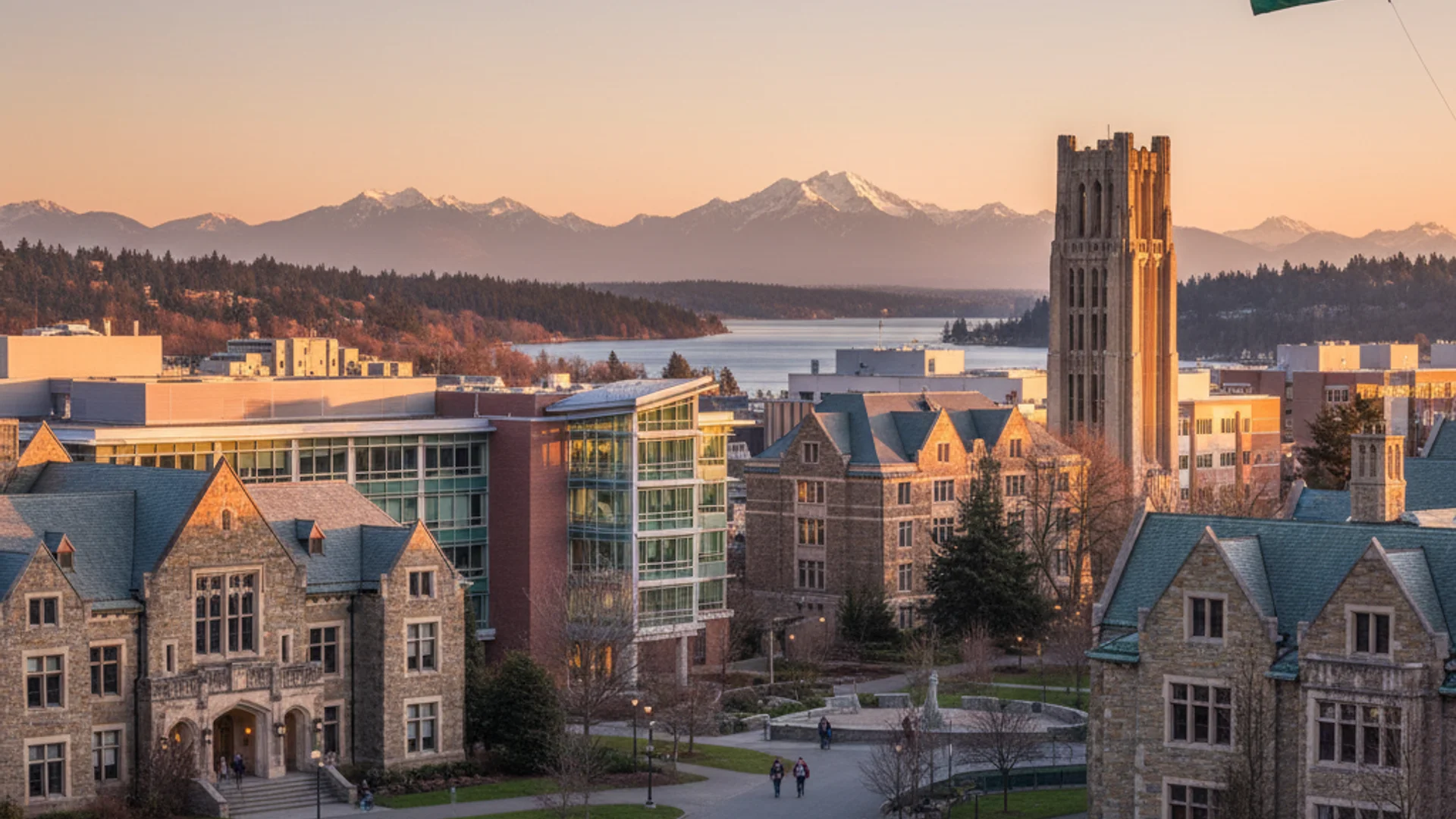
University campus in Washington
Updated January 2026

Best Cybersecurity Degree Programs in Washington — 2026 Rankings

Explore 25 accredited cybersecurity degree programs in Washington. Compare schools by graduation rate, salary outcomes, and tuition—from Green River College to Green River College.

#1 ProgramGreen River College
Avg Salary$145,230
Tuition From$4,074/yr
Job Growth+22%

Key Takeaways

Top 3 ranked: Green River College, Columbia Basin College, Western Washington

Based on graduation rates, program outcomes, and institutional quality

IPEDS 2023

Tuition ranges from $3,195 to $13,965/year

Green River College offers the most affordable option at $4,074/yr

IPEDS 2023

Degree levels: 18 associate's, 3 master's programs available in Washington

From community college pathways to advanced research degrees

IPEDS 2023

11 Washington programs offer online or hybrid formats

Flexible scheduling for working professionals

IPEDS 2023

Washington community college transfer can save 40-60% on total degree costs

18 associate's programs provide transfer pathways to bachelor's degrees

Education Commission of the States

Major employers: Microsoft, Amazon, Boeing, Expedia

Tech hubs in Seattle and Bellevue

Hakia Research 2026

Cybersecurity programs available near 43+ cities across Washington

Search by city to find programs within 200 miles of your location

IPEDS 2023

Updated February 2026

On This Page
$145,230
Is Cybersecurity in Washington Worth It?
Yes. Cybersecurity degrees in Washington deliver strong ROI—graduates earn $145,230 median salary with +22% job growth through 2032. In-state tuition averages $5,312/year.

Source: BLS OEWS May 2024

Best Cybersecurity Degree Programs in Washington

Bachelor's Cybersecurity Degree Programs in Washington

11 programs$145,230 median salary82% avg grad rate
11
Programs
$145,230
Median Salary
$4,795/yr
Avg Tuition
82%
Avg Grad Rate

Program Landscape

Washington ranks among the nation's top destinations for cybersecurity education, with 11 accredited bachelor's degree programs across 11 public and 0 private institutions. The highest-ranked programs are Green River College, Columbia Basin College, Western Washington, recognized for academic excellence, research opportunities, and strong industry connections.

Career Outcomes

Graduates from Washington cybersecurity programs earn a median salary of $123,446—26% above the national average. The state's robust technology sector, anchored by the Seattle, Bellevue, Redmond metropolitan areas, provides abundant internship and employment opportunities with companies including Microsoft, Amazon, Boeing.

Costs & Value

Tuition ranges from $3,633 to $7,997 annually, with an average of $4,795/yr. Top programs maintain graduation rates above 82%, with the highest reaching 99%. Many programs hold ABET accreditation, the gold standard for computing education, ensuring curriculum meets rigorous industry standards.

Curriculum & Specializations

Students can choose from specializations including software engineering, cybersecurity, artificial intelligence, data science, and systems architecture. Strong industry partnerships provide access to co-op programs, capstone projects with real companies, and direct recruiting pipelines to Washington's leading technology employers. For students seeking cybersecurity degrees in Washington, these top-ranked cybersecurity schools offer the strongest combination of academic rigor and career preparation.

Show:

Earn your bachelor's in Cybersecurity

(Sponsored)

Loading programs...

🥇

Green River College

Public
Auburn, WA
$4,074
Tuition/yr
99%
Grad Rate
94.1
Score
Website
🥈

Columbia Basin College

Public
Pasco, WA
$5,514
Tuition/yr
97%
Grad Rate
81.0
Score
Website
🥉

Western Washington University

Public
Bellingham, WA
$7,997
Tuition/yr
99%
Grad Rate
70.7
Score
Website
#4

Highline College

Public
Des Moines, WA
$3,633
Tuition/yr
68.1
Score
Website
#5

Clark College

Public
Vancouver, WA
$4,306
Tuition/yr
63.2
Score
Website
#6

Renton Technical College

Public
Renton, WA
$4,673
Tuition/yr
65%
Grad Rate
60.5
Score
Website
#7

Yakima Valley College

Public
Yakima, WA
$4,623
Tuition/yr
55%
Grad Rate
59.6
Score
Website
#8

Bellevue College

Public
Bellevue, WA
$4,074
Tuition/yr
96%
Grad Rate
58.6
Score
Website
#9

Whatcom Community College

Public
Bellingham, WA
$3,633
Tuition/yr
78%
Grad Rate
56.7
Score
Website
#10

Tacoma Community College

Public
Tacoma, WA
$4,477
Tuition/yr
87%
Grad Rate
56.6
Score
Website

Complete Cybersecurity Degree Program Rankings in Washington

Best Associate's Cybersecurity Degree Programs in Washington

### Program Landscape Washington offers **18 accredited** associate's degree programs in cybersecurity, providing an affordable entry point into the technology field. The top-ranked programs include **Green River College**, **Whatcom Community College**, **Clover Park Technical Col...**, which combine rigorous technical curriculum with practical skills training. ### Costs & Value Community colleges in Washington offer these two-year programs at an average cost of **$4,142/yr**—significantly less than four-year university tuition. Students completing associate's degrees can pursue entry-level technical positions and transfer opportunities, with entry-level salaries averaging **$79,877** in Washington. ### Career Pathways Many programs feature guaranteed transfer agreements with Washington's public universities, allowing students to complete their first two years at reduced cost before transferring to complete a bachelor's degree. The Seattle, Bellevue, Redmond areas offer particularly strong job markets for associate's degree holders, with employers like Microsoft, Amazon, Boeing hiring for technical support, junior development, and IT specialist positions. ### Curriculum & Specializations Programs typically include coursework in programming fundamentals, database management, networking basics, and software development. Among cybersecurity schools in Washington, these associate's programs offer the best value for students beginning their cybersecurity degrees in Washington.

  1. #1. Green River College

    Hakia ranks Green River College as the #1 associate's in cybersecurity degree program in Washington. This public institution in Auburn, WA has annual tuition of $4,074 and a 99% graduation rate. Ranking score: 90.4.

  2. #2. Whatcom Community College

    Hakia ranks Whatcom Community College as the #2 associate's in cybersecurity degree program in Washington. This public institution in Bellingham, WA has annual tuition of $3,633 and a 78% graduation rate. Ranking score: 74.3.

  3. #3. Clover Park Technical College

    Hakia ranks Clover Park Technical College as the #3 associate's in cybersecurity degree program in Washington. This public institution in Lakewood, WA has annual tuition of $5,740 and a 62% graduation rate. Ranking score: 72.9.

  4. #4. Columbia Basin College

    Hakia ranks Columbia Basin College as the #4 associate's in cybersecurity degree program in Washington. This public institution in Pasco, WA has annual tuition of $5,514 and a 97% graduation rate. Ranking score: 79.3.

  5. #5. Edmonds College

    Hakia ranks Edmonds College as the #5 associate's in cybersecurity degree program in Washington. This public institution in Lynnwood, WA has annual tuition of $4,073 and a 93% graduation rate. Ranking score: 75.9.

  6. #6. Spokane Falls Community College

    Hakia ranks Spokane Falls Community College as the #6 associate's in cybersecurity degree program in Washington. This public institution in Spokane, WA has annual tuition of $3,195. Ranking score: 51.7.

  7. #7. Olympic College

    Hakia ranks Olympic College as the #7 associate's in cybersecurity degree program in Washington. This public institution in Bremerton, WA has annual tuition of $4,197 and a 85% graduation rate. Ranking score: 69.6.

  8. #8. Clark College

    Hakia ranks Clark College as the #8 associate's in cybersecurity degree program in Washington. This public institution in Vancouver, WA has annual tuition of $4,306. Ranking score: 58.9.

  9. #9. Pierce College District

    Hakia ranks Pierce College District as the #9 associate's in cybersecurity degree program in Washington. This public institution in Lakewood, WA has annual tuition of $4,074 and a 93% graduation rate. Ranking score: 58.5.

  10. #10. Spokane Community College

    Hakia ranks Spokane Community College as the #10 associate's in cybersecurity degree program in Washington. This public institution in Spokane, WA has annual tuition of $3,195 and a 92% graduation rate. Ranking score: 57.8.

  11. #11. North Seattle College

    Hakia ranks North Seattle College as the #11 associate's in cybersecurity degree program in Washington. This public institution in Seattle, WA has annual tuition of $4,458 and a 49% graduation rate. Ranking score: 56.6.

  12. #12. Seattle Central College

    Hakia ranks Seattle Central College as the #12 associate's in cybersecurity degree program in Washington. This public institution in Seattle, WA has annual tuition of $4,458 and a 39% graduation rate. Ranking score: 54.1.

  13. #13. Highline College

    Hakia ranks Highline College as the #13 associate's in cybersecurity degree program in Washington. This public institution in Des Moines, WA has annual tuition of $3,633. Ranking score: 53.1.

  14. #14. Lower Columbia College

    Hakia ranks Lower Columbia College as the #14 associate's in cybersecurity degree program in Washington. This public institution in Longview, WA has annual tuition of $3,988 and a 84% graduation rate. Ranking score: 61.5.

  15. #15. Peninsula College

    Hakia ranks Peninsula College as the #15 associate's in cybersecurity degree program in Washington. This public institution in Port Angeles, WA has annual tuition of $4,074. Ranking score: 53.1.

  16. #16. Bellingham Technical College

    Hakia ranks Bellingham Technical College as the #16 associate's in cybersecurity degree program in Washington. This public institution in Bellingham, WA has annual tuition of $3,195 and a 13% graduation rate. Ranking score: 41.4.

  17. #17. Bates Technical College

    Hakia ranks Bates Technical College as the #17 associate's in cybersecurity degree program in Washington. This public institution in Tacoma, WA has annual tuition of $4,131. Ranking score: 49.2.

  18. #18. Yakima Valley College

    Hakia ranks Yakima Valley College as the #18 associate's in cybersecurity degree program in Washington. This public institution in Yakima, WA has annual tuition of $4,623 and a 55% graduation rate. Ranking score: 48.5.

Online Associate's Cybersecurity Degree Programs in Washington

### Online Program Options Washington's community colleges offer 9 online associate's cybersecurity programs, providing flexible pathways for students balancing education with work or family responsibilities. Top-ranked online programs include **Green River College**, **Clover Park Technical Col...**, **Spokane Falls Community C...**, all regionally accredited and recognized by Washington employers. ### Costs & Employer Recognition Online associate's programs average **$4,103/yr**—often comparable to or less than on-campus tuition. Washington-based employers including Microsoft, Amazon, Boeing value online credentials from accredited institutions, recognizing that program quality matters more than delivery format. The Seattle, Bellevue, Redmond job market actively recruits graduates from online programs. ### Program Format These programs feature asynchronous coursework for maximum flexibility, with some offering synchronous sessions for collaborative learning. Students can typically complete **60 credit hours** in 2 years while working full-time. ### Technology & Flexibility Technology requirements include reliable internet access and a modern computer. Programs provide virtual labs, online tutoring, career services, and networking opportunities. Many offer start dates throughout the year and accelerated course formats for motivated students. Graduates earn the same degree as on-campus students, with no distinction on transcripts or diplomas. For students pursuing online cybersecurity degrees in Washington, these accredited cybersecurity schools offer the flexibility and quality that today's learners demand.

  • Green River College - Auburn, WA - Tuition: $4,074/year
  • Clover Park Technical College - Lakewood, WA - Tuition: $5,740/year
  • Spokane Falls Community College - Spokane, WA - Tuition: $3,195/year
  • Pierce College District - Lakewood, WA - Tuition: $4,074/year
  • Seattle Central College - Seattle, WA - Tuition: $4,458/year
  • Lower Columbia College - Longview, WA - Tuition: $3,988/year
  • Peninsula College - Port Angeles, WA - Tuition: $4,074/year
  • Bellingham Technical College - Bellingham, WA - Tuition: $3,195/year
  • Bates Technical College - Tacoma, WA - Tuition: $4,131/year

Best Bachelor's Cybersecurity Degree Programs in Washington

### Program Landscape Washington ranks among the nation's top destinations for cybersecurity education, with **11 accredited** bachelor's degree programs across **11 public** and **0 private** institutions. The highest-ranked programs are **Green River College**, **Columbia Basin College**, **Western Washington**, recognized for academic excellence, research opportunities, and strong industry connections. ### Career Outcomes Graduates from Washington cybersecurity programs earn a median salary of **$123,446**—26% above the national average. The state's robust technology sector, anchored by the Seattle, Bellevue, Redmond metropolitan areas, provides abundant internship and employment opportunities with companies including Microsoft, Amazon, Boeing. ### Costs & Value Tuition ranges from **$3,633** to **$7,997** annually, with an average of **$4,795/yr**. Top programs maintain graduation rates above **82%**, with the highest reaching **99%**. Many programs hold ABET accreditation, the gold standard for computing education, ensuring curriculum meets rigorous industry standards. ### Curriculum & Specializations Students can choose from specializations including software engineering, cybersecurity, artificial intelligence, data science, and systems architecture. Strong industry partnerships provide access to co-op programs, capstone projects with real companies, and direct recruiting pipelines to Washington's leading technology employers. For students seeking cybersecurity degrees in Washington, these top-ranked cybersecurity schools offer the strongest combination of academic rigor and career preparation.

  1. #1. Green River College

    Hakia ranks Green River College as the #1 bachelor's in cybersecurity degree program in Washington. This public institution in Auburn, WA has annual tuition of $4,074 and a 99% graduation rate. Ranking score: 94.1.

  2. #2. Columbia Basin College

    Hakia ranks Columbia Basin College as the #2 bachelor's in cybersecurity degree program in Washington. This public institution in Pasco, WA has annual tuition of $5,514 and a 97% graduation rate. Ranking score: 81.0.

  3. #3. Western Washington University

    Hakia ranks Western Washington University as the #3 bachelor's in cybersecurity degree program in Washington. This public institution in Bellingham, WA has annual tuition of $7,997 and a 99% graduation rate. Ranking score: 70.7.

  4. #4. Highline College

    Hakia ranks Highline College as the #4 bachelor's in cybersecurity degree program in Washington. This public institution in Des Moines, WA has annual tuition of $3,633. Ranking score: 68.1.

  5. #5. Clark College

    Hakia ranks Clark College as the #5 bachelor's in cybersecurity degree program in Washington. This public institution in Vancouver, WA has annual tuition of $4,306. Ranking score: 63.2.

  6. #6. Renton Technical College

    Hakia ranks Renton Technical College as the #6 bachelor's in cybersecurity degree program in Washington. This public institution in Renton, WA has annual tuition of $4,673 and a 65% graduation rate. Ranking score: 60.5.

  7. #7. Yakima Valley College

    Hakia ranks Yakima Valley College as the #7 bachelor's in cybersecurity degree program in Washington. This public institution in Yakima, WA has annual tuition of $4,623 and a 55% graduation rate. Ranking score: 59.6.

  8. #8. Bellevue College

    Hakia ranks Bellevue College as the #8 bachelor's in cybersecurity degree program in Washington. This public institution in Bellevue, WA has annual tuition of $4,074 and a 96% graduation rate. Ranking score: 58.6.

  9. #9. Whatcom Community College

    Hakia ranks Whatcom Community College as the #9 bachelor's in cybersecurity degree program in Washington. This public institution in Bellingham, WA has annual tuition of $3,633 and a 78% graduation rate. Ranking score: 56.7.

  10. #10. Tacoma Community College

    Hakia ranks Tacoma Community College as the #10 bachelor's in cybersecurity degree program in Washington. This public institution in Tacoma, WA has annual tuition of $4,477 and a 87% graduation rate. Ranking score: 56.6.

  11. #11. Clover Park Technical College

    Hakia ranks Clover Park Technical College as the #11 bachelor's in cybersecurity degree program in Washington. This public institution in Lakewood, WA has annual tuition of $5,740 and a 62% graduation rate. Ranking score: 55.0.

Online Bachelor's Cybersecurity Degree Programs in Washington

### Online Program Options 3 Washington institutions offer bachelor's cybersecurity degrees with online or hybrid options, enabling students to earn accredited degrees while maintaining professional or personal commitments. Top-ranked online programs include **Green River College**, **Bellevue College**, **Clover Park Technical Col...**, all regionally accredited and recognized by Washington employers. ### Costs & Employer Recognition Online bachelor's programs average **$4,629/yr**—often comparable to or less than on-campus tuition. Washington-based employers including Microsoft, Amazon, Boeing value online credentials from accredited institutions, recognizing that program quality matters more than delivery format. The Seattle, Bellevue, Redmond job market actively recruits graduates from online programs. ### Program Format These programs feature asynchronous coursework for maximum flexibility, with some offering synchronous sessions for collaborative learning. Students can typically complete **120 credit hours** in 4 years while working full-time. ### Technology & Flexibility Technology requirements include reliable internet access and a modern computer. Programs provide virtual labs, online tutoring, career services, and networking opportunities. Many offer start dates throughout the year and accelerated course formats for motivated students. Graduates earn the same degree as on-campus students, with no distinction on transcripts or diplomas. For students pursuing online cybersecurity degrees in Washington, these accredited cybersecurity schools offer the flexibility and quality that today's learners demand.

  • Green River College - Auburn, WA - Tuition: $4,074/year
  • Bellevue College - Bellevue, WA - Tuition: $4,074/year
  • Clover Park Technical College - Lakewood, WA - Tuition: $5,740/year

Best Master's Cybersecurity Degree Programs in Washington

### Program Landscape Washington offers **3** master's degree programs in cybersecurity, designed for professionals seeking to advance into senior engineering, technical leadership, and specialized roles. The top programs—**U of Washington-Tacoma**, **U of Washington-Bothell**, **City University of Seattle**—combine advanced technical training with research opportunities and leadership development. ### Career Outcomes Master's graduates in Washington earn a median salary of **$145,230**, approximately **20-30% higher** than bachelor's degree holders. The concentration of technology companies in Seattle, Bellevue, Redmond creates strong demand for graduate-level talent, with Microsoft, Amazon, Boeing actively recruiting from these programs. ### Costs & Value Program formats include traditional full-time study (typically 2 years), part-time options for working professionals (2-3 years), and accelerated tracks. Tuition averages **$12,338/yr**, with many employers offering tuition reimbursement for graduate education. Some programs offer thesis and non-thesis tracks, allowing students to focus on research or professional development based on their career goals. ### Curriculum & Specializations Curriculum covers advanced topics including machine learning, distributed systems, software architecture, and technical management. Many programs include practicum experiences, industry capstone projects, or consulting engagements that provide real-world application of advanced concepts. Among Washington's cybersecurity schools at the graduate level, these programs stand out for both academic quality and career outcomes.

  1. #1. University of Washington-Tacoma Campus

    Hakia ranks University of Washington-Tacoma Campus as the #1 master's in cybersecurity degree program in Washington. This public institution in Tacoma, WA has annual tuition of $11,524 and a 92% graduation rate. Ranking score: 73.2.

  2. #2. University of Washington-Bothell Campus

    Hakia ranks University of Washington-Bothell Campus as the #2 master's in cybersecurity degree program in Washington. This public institution in Bothell, WA has annual tuition of $11,524 and a 69% graduation rate. Ranking score: 55.9.

  3. #3. City University of Seattle

    Hakia ranks City University of Seattle as the #3 master's in cybersecurity degree program in Washington. This private institution in Seattle, WA has annual tuition of $13,965. Ranking score: 49.2.

Online Master's Cybersecurity Degree Programs in Washington

### Online Program Options Working professionals can advance their careers through 1 online master's cybersecurity programs from Washington universities, designed for flexibility without sacrificing academic rigor. Top-ranked online programs include **City University of Seattle**, all regionally accredited and recognized by Washington employers. ### Costs & Employer Recognition Online master's programs average **$13,965/yr**—often comparable to or less than on-campus tuition. Washington-based employers including Microsoft, Amazon, Boeing value online credentials from accredited institutions, recognizing that program quality matters more than delivery format. The Seattle, Bellevue, Redmond job market actively recruits graduates from online programs. ### Program Format These programs feature asynchronous coursework for maximum flexibility, with some offering synchronous sessions for collaborative learning. Students can typically complete **30-36 credit hours** in 18-24 months while working full-time. ### Technology & Flexibility Technology requirements include reliable internet access and a modern computer. Programs provide virtual labs, online tutoring, career services, and networking opportunities. Many offer start dates throughout the year and accelerated course formats for motivated students. Graduates earn the same degree as on-campus students, with no distinction on transcripts or diplomas. For students pursuing online cybersecurity degrees in Washington, these accredited cybersecurity schools offer the flexibility and quality that today's learners demand.

  • City University of Seattle - Seattle, WA - Tuition: $13,965/year

Cybersecurity Tuition in Washington

MetricValue
Average in-state tuition$5,312/year
Average out-of-state tuition$13,280/year
Community college tuition$1,328/year
4-year savings for residents$31,872
2+2 transfer pathway savings$7,968

Source: IPEDS 2023

Cybersecurity Financial Aid & Scholarships in Washington

State Aid Programs

Washington offers substantial financial aid opportunities for students pursuing cybersecurity education, including one of the most generous state grant programs in the nation. The Washington College Grant (WA Grant) provides free money for education that students do not need to repay, with eligibility extending to families earning up to $131,000 annually for a family of four in 2025-26 (WA Grant). Families of four earning $78,500 or less may qualify for fully funded college or career training through this program.

Key Programs & Amounts

The Washington Application for State Financial Aid (WASFA) enables undocumented students and others who choose not to file federal FAFSA applications to access state financial aid programs, with information protected under Washington state privacy laws (WASFA). The Washington Student Achievement Council administers multiple state aid programs including the College Bound Scholarship for low-income students, State Work Study providing employment opportunities, and the Passport to Careers program supporting former foster youth.

Institutional Scholarships

Federal financial aid through FAFSA covers Pell Grants, federal student loans, and work-study opportunities for qualifying students. The CyberCorps Scholarship for Service program provides full scholarships plus stipends for cybersecurity students who commit to federal government service after graduation. Washington institutions offer institutional scholarships and aid packages, with many technology companies providing tuition assistance for employees pursuing cybersecurity credentials. Industry certifications including CompTIA Security+, CISSP, and CEH can be funded through professional development programs at many Washington employers.

Calculate Your Cybersecurity Degree ROI in Washington

Use our interactive ROI calculator to estimate your return on investment for a cybersecurity degree in Washington. Enter your expected tuition costs, financial aid, and career goals to see projected payback periods and lifetime earnings. The calculator uses current salary data from BLS and tuition data from IPEDS to provide accurate estimates.

Cybersecurity Degree ROI Calculator
Estimate your return on investment for a cybersecurity degree
$

Leave blank to use average cost for selected program type

20 years
10 years20 years30 years
20-Year ROI

+1011%

Net gain divided by total investment. ROI above 200% is considered excellent for education investments.

Net Gain

$1,869,485

Your additional lifetime earnings with this degree vs. working without one, minus the total investment.

Break-Even

5 years

Years until your cumulative earnings exceed total investment. Shorter programs often break even faster due to lower opportunity cost.

COL-Adjusted Salary

$100,000

Your starting salary adjusted for local cost of living. This shows real purchasing power compared to a $100K national baseline.

Why does break-even change with program type? Your "total investment" includes both tuition AND opportunity cost (foregone earnings while in school). A 4-year full-time public university (in-state) means 4 years of not earning a salary ($140,000 in opportunity cost). Shorter full-time programs may have higher tuition but lower total investment because you return to the workforce sooner.

Detailed Breakdown
How we calculate your degree ROI using real salary data
Total Investment$185,000

Tuition plus opportunity cost (earnings you miss while in school)

Program Cost (Tuition)$45,000

Direct cost of the degree program

Opportunity Cost$140,000

4 years × $35K/year foregone salary while studying full-time

20-Year Earnings (with degree)$2,904,893

Projected career earnings starting after graduation, with salary growth

20-Year Earnings (without degree)$850,408

What you'd earn working at $35K/year with 2% annual growth

Starting Salary (Seattle, WA)$150,000

Median salary for this role in your selected location (BLS 2024)

Annualized Return5.3%

Your investment's compound annual growth rate (similar to stock market returns)

Data sources: BLS OEWS May 2024, IPEDS 2023. Calculations use median salaries, 3% discount rate, and assume salary growth declines from 6% to 2% over career. Individual results will vary. | Powered by Hakia.com

Career Paths

Design and develop software applications and systems

Median Salary:$164,110

Analyze complex datasets and build predictive models

Median Salary:$136,516

Protect computer networks from cyber threats

Median Salary:$152,492

Manage cloud infrastructure and deployment pipelines

Median Salary:$161,205

Design and maintain cloud computing infrastructure

Median Salary:$156,848

Build and deploy machine learning models

Median Salary:$182,990
Cybersecurity Salaries by Metro Area

Median annual salary in Washington metro areas

Hakia.com
View data table
Categoryvalue
Seattle$160K
Bellevue$152K
Redmond$145K

Source: BLS OEWS May 2024

Hakia.com

Cybersecurity Jobs in Washington: Top Employers Hiring

Find cybersecurity jobs in Washington. These major employers across Washington metro areas are actively hiring cybersecurity graduates. Click employer names to view current job openings.

Cybersecurity Jobs in Seattle

WA

Seattle is home to Amazon and Microsoft headquarters, plus major engineering offices for Google, Meta, and other tech giants.

Nearby cities: Bellevue, Redmond, Kirkland, Tacoma, Renton

Microsoft
Enterprise Software/Cloud
Amazon
E-commerce/Cloud (AWS)
Google
Search/Cloud/AI
Meta
Social/VR/AI
Tableau (Salesforce)
Data Visualization
Zillow
Real Estate Tech
Expedia Group
Travel Tech
Redfin
Real Estate Tech
DocuSign
Digital Agreements
F5 Networks
Networking/Security

Cybersecurity Jobs in Bellevue/Eastside

WA

The Eastside corridor houses Microsoft's main campus in Redmond, Nintendo of America, and T-Mobile's headquarters.

Nearby cities: Redmond, Kirkland, Issaquah, Sammamish

Microsoft
Enterprise Software/Cloud
T-Mobile
Telecommunications
Valve Corporation
Gaming/Steam Platform

How to Apply to Cybersecurity Programs in Washington

1

Research Program Requirements

Review admission requirements for cybersecurity programs at your target schools. Requirements vary by institution and degree level.

2

Prepare Application Materials

Gather transcripts, test scores (SAT/ACT for undergrad, GRE for graduate), letters of recommendation, and personal statement.

3

Apply for Financial Aid

Complete the FAFSA by priority deadlines.

4

Submit Applications Before Deadlines

Apply early for priority consideration. Early action/decision deadlines are typically October-November; regular deadlines December-January.

5

Complete Enrollment Steps

Accept your offer, submit enrollment deposit, complete orientation requirements, and register for classes.

Cybersecurity Transfer Pathways in Washington

State Transfer System

Washington's comprehensive community college system provides clear transfer pathways for students pursuing cybersecurity education at four-year universities. The state's 34 community and technical colleges offer associate degrees and certificates in cybersecurity, information technology, and related fields that transfer to Washington's public universities through statewide articulation agreements. Students completing transfer degrees receive priority consideration for admission to participating four-year institutions.

How Transfers Work

The Direct Transfer Agreement (DTA) enables students who complete an associate degree at a Washington community college to transfer as juniors to participating four-year institutions. Students should work closely with academic advisors at both sending and receiving institutions to ensure courses transfer appropriately within cybersecurity programs. Washington State University accepts transfer students into its cybersecurity programs at Pullman, Tri-Cities, and Vancouver campuses, with specific course equivalencies established through articulation agreements (WSU Transfer Info).

Transfer Planning Tips

The Washington State Board for Community and Technical Colleges coordinates transfer policies ensuring smooth transitions between two-year and four-year institutions. Running Start allows high school students to earn college credits tuition-free at community colleges, potentially reducing time and cost to complete a cybersecurity degree. Students pursuing cybersecurity careers should complete prerequisite courses in programming, mathematics, and networking at community colleges before transferring to university programs. The Washington Student Achievement Council maintains transfer resources helping students navigate pathways between institutions throughout the state's higher education system.

Why Study Cybersecurity in Washington?

Industry & Workforce

Washington State stands as a premier destination for cybersecurity education, combining world-class technology companies with innovative academic programs. The Seattle metropolitan area serves as headquarters for Microsoft, Amazon, and numerous cybersecurity-focused firms that drive demand for qualified security professionals. The Bureau of Labor Statistics projects employment of information security analysts to grow 29 percent from 2024 to 2034, much faster than the average for all occupations, with a median annual wage of $124,910 nationally (BLS Information Security Analysts). Washington's technology ecosystem offers students direct access to industry leaders, internship opportunities, and career pathways in cloud security, application security, and enterprise protection.

Salary Outlook

The University of Washington, ranked among the top public universities nationally, provides comprehensive cybersecurity education through its Paul G. Allen School of Computer Science & Engineering. Washington State University offers cybersecurity programs at multiple campuses including Pullman, Tri-Cities, and Vancouver, though the undergraduate cybersecurity program is not currently ABET-accredited (WSU ABET Status). Western Washington University's Department of Computer Science in Bellingham offers cybersecurity certificates and minors, with the university situated on the ancestral homelands of the Coast Salish Peoples near the Canadian border (WWU CS Department). The Washington College Grant provides significant financial support for cybersecurity students, with families earning up to $131,000 annually qualifying for aid toward college or career training (Washington College Grant).

Cybersecurity Job Market in Washington

Employment Outlook

Washington's cybersecurity job market ranks among the strongest in the nation, driven by the concentration of technology giants and government agencies throughout the Puget Sound region. According to the Bureau of Labor Statistics, information security analysts earn a median annual wage of $124,910 nationally, with the highest 10 percent earning more than $186,420 (BLS Pay Data). Washington employers typically pay above national averages due to competition among major technology companies and the high cost of living in the Seattle metropolitan area.

Salaries by Metro

The Washington Employment Security Department provides detailed labor market projections through its Labor Market Information and Research Division. In the Seattle-Tacoma-Bellevue metropolitan statistical area, professional and business services represent a major employment sector, with computer systems design and related services comprising 22 percent of information security analyst employment nationally (ESD Projections). Major employers including Microsoft, Amazon Web Services, Boeing, Costco, T-Mobile, and Nordstrom maintain significant cybersecurity operations in Washington, creating robust demand for security professionals at all experience levels.

High-Growth Sectors

King County hosts the greatest concentration of technology employment, while Spokane County in Eastern Washington serves as a secondary technology hub with approximately 266,900 total jobs and strong professional and business services employment (ESD Spokane Profile). Cybersecurity career paths in Washington include security analyst, penetration tester, security architect, incident response specialist, cloud security engineer, and chief information security officer positions across diverse industry sectors.

Cybersecurity Curriculum & Specializations in Washington

Core Requirements

Washington cybersecurity curricula combine theoretical foundations in computer science with practical hands-on experience protecting digital infrastructure. Programs emphasize core competencies including network security, cryptography, digital forensics, penetration testing, and secure software development. Students develop abilities to design, implement, and evaluate computing-based solutions meeting security requirements while considering ethical, legal, and social implications of technology.

Degree Pathways

Washington State University's cybersecurity program, offered at Pullman and Tri-Cities campuses, covers security fundamentals, network defense, vulnerability assessment, and incident response methodologies. While the cybersecurity undergraduate program is not currently ABET-accredited, students benefit from the college's ABET-accredited Computer Science and Software Engineering programs that emphasize continuous improvement and student outcome assessment (WSU Programs). WSU's research institutes and laboratories provide opportunities for undergraduate research in security-related projects.

Specialization Tracks

The University of Washington's Paul G. Allen School offers advanced coursework in computer security, cryptographic protocols, and system security through its graduate programs. Students gain exposure to current industry tools and methodologies while developing competencies in security analysis, risk assessment, and defensive strategies. Western Washington University's cybersecurity certificate covers applied security concepts appropriate for students seeking professional credentials without completing a full degree program. Program curricula across Washington institutions emphasize practical skills including security tool proficiency, threat modeling, security architecture, and compliance frameworks. Graduate programs typically include advanced coursework in malware analysis, cryptographic systems, and security research methodologies.

Online vs On-Campus Cybersecurity Programs in Washington

Online Program Growth

Washington universities offer flexible delivery options for cybersecurity education, accommodating both traditional students and working professionals seeking career advancement. Washington State University's Global Campus provides 100% online degree options including the Bachelor of Science in Data Analytics, which shares foundational coursework with cybersecurity programs (WSU Global Campus). WSU is one of a handful of universities in the nation offering an online undergraduate degree specifically designed to prepare students for leadership in data analytics and related technical fields.

Accredited Online Options

The University of Washington's Master of Science in Data Science offers a professional master's program with evening classes on the Seattle campus, available full-time (two courses per quarter, 1.5 years) or part-time (one course per quarter, 2.5 years) (UW MSDS). Approximately 80 percent of MSDS students attend full-time while 20 percent enroll part-time, allowing flexibility for working professionals. Classes meet in evenings, accommodating students who maintain employment while pursuing advanced education.

Choosing Your Format

Campus-based study provides advantages including hands-on access to specialized cybersecurity laboratories, participation in capture-the-flag competitions, direct networking with faculty and industry professionals, and immersive learning experiences. Online delivery offers flexibility for students who cannot relocate or need to maintain employment while studying. Many Washington programs offer hybrid approaches combining online coursework with periodic on-campus laboratory sessions. Students should consider their career goals, learning preferences, and personal circumstances when choosing delivery format.

Cybersecurity by City in Washington

Explore cybersecurity programs by city: Bellingham · Seattle · Spokane · Tacoma · Walla Walla

Washington's major metropolitan areas each offer distinct advantages for cybersecurity professionals, with the Seattle-Tacoma-Bellevue corridor serving as the epicenter of technology employment. King County hosts Microsoft, Amazon, and hundreds of technology companies ranging from startups to established enterprises, creating the highest concentration of technology jobs in the Pacific Northwest. Seattle's South Lake Union neighborhood houses Amazon's headquarters campus, while the Eastside communities of Bellevue, Redmond, and Kirkland host Microsoft, T-Mobile, and numerous technology firms.

Spokane serves as Eastern Washington's largest city and the business, transportation, medical, industrial, and cultural hub of the Inland Northwest, with an estimated population of 555,947 in Spokane County (ESD Spokane). The City of Spokane is the second-largest city in Washington and offers lower cost of living than the Seattle area while maintaining professional and business services employment. Eastern Washington University's campus in nearby Cheney provides educational resources for the region.

Bellingham in Whatcom County hosts Western Washington University and offers a smaller technology community near the Canadian border. The Tri-Cities region (Kennewick, Pasco, Richland) provides technology opportunities connected to Pacific Northwest National Laboratory. Olympia, the state capital, offers government cybersecurity positions. Vancouver, Washington in Clark County provides proximity to Portland, Oregon's technology sector while maintaining Washington residency. These diverse metropolitan areas enable cybersecurity professionals to find employment matching their lifestyle and career preferences throughout Washington State.

Compare Online Cybersecurity Programs in Washington

View tuition costs, program formats & enrollment info

Find Cybersecurity Programs Near You in Washington

Search by city to find accredited cybersecurity programs ranked by our state methodology.

Cybersecurity Degree Programs by City in Washington

Cybersecurity Degree Programs Near Seattle, Washington

Home to Microsoft's Puget Sound operations and Amazon Web Services headquarters, Seattle is a primary hub for cloud security, threat intelligence, and enterprise cybersecurity roles, with salaries among the highest in the nation for security professionals. The University of Washington offers a dedicated cybersecurity degree program and regularly partners with local tech giants for internships and research, creating a pipeline of talent directly into established security teams.

Seattle is located in King County, Washington.

Associate's Cybersecurity Degree Programs Near Seattle, Washington
  1. Green River College (Public) — State #1, 22.9 mi from Seattle. Tuition: $4,074/year. Graduation rate: 99%.
  2. Edmonds College (Public) — State #2, 13.2 mi from Seattle. Tuition: $4,073/year. Graduation rate: 93%.
  3. Columbia Basin College (Public) — State #3, 179 mi from Seattle. Tuition: $5,514/year. Graduation rate: 97%.
Bachelor's Cybersecurity Degree Programs Near Seattle, Washington
  1. University of Washington-Seattle Campus (Public) — State #1, in Seattle. Tuition: $11,524/year. Graduation rate: 97%.
  2. Green River College (Public) — State #2, 22.9 mi from Seattle. Tuition: $4,074/year. Graduation rate: 99%.
  3. Seattle University (Private) — State #3, in Seattle. Tuition: $53,235/year. Graduation rate: 92%.
Master's Cybersecurity Degree Programs Near Seattle, Washington
  1. University of Washington-Seattle Campus (Public) — State #1, in Seattle. Tuition: $11,524/year. Graduation rate: 97%.
  2. Seattle University (Private) — State #2, in Seattle. Tuition: $53,235/year. Graduation rate: 92%.
  3. University of Washington-Tacoma Campus (Public) — State #4, 26.8 mi from Seattle. Tuition: $11,524/year. Graduation rate: 92%.
Doctoral Cybersecurity Degree Programs Near Seattle, Washington
  1. University of Washington-Seattle Campus (Public) — State #1, in Seattle. Tuition: $11,524/year. Graduation rate: 97%.

Cybersecurity Degree Programs Near Tacoma, Washington

Tacoma's economy centers on Joint Base Lewis-McChord and defense contracting firms that require extensive compliance with DoD cybersecurity standards, making it ideal for professionals seeking government-adjacent security work in system hardening and classified network protection. The proximity to Fort Lewis provides networking opportunities with federal contractors and government agencies actively hiring cleared cybersecurity personnel.

Tacoma is located in Pierce County, Washington.

Associate's Cybersecurity Degree Programs Near Tacoma, Washington
  1. Green River College (Public) — State #1, 14.7 mi from Tacoma. Tuition: $4,074/year. Graduation rate: 99%.
  2. Edmonds College (Public) — State #2, 41 mi from Tacoma. Tuition: $4,073/year. Graduation rate: 93%.
  3. Columbia Basin College (Public) — State #3, 172.1 mi from Tacoma. Tuition: $5,514/year. Graduation rate: 97%.
Bachelor's Cybersecurity Degree Programs Near Tacoma, Washington
  1. University of Washington-Seattle Campus (Public) — State #1, 30.3 mi from Tacoma. Tuition: $11,524/year. Graduation rate: 97%.
  2. Green River College (Public) — State #2, 14.7 mi from Tacoma. Tuition: $4,074/year. Graduation rate: 99%.
  3. Seattle University (Private) — State #3, 27 mi from Tacoma. Tuition: $53,235/year. Graduation rate: 92%.
Master's Cybersecurity Degree Programs Near Tacoma, Washington
  1. University of Washington-Seattle Campus (Public) — State #1, 30.3 mi from Tacoma. Tuition: $11,524/year. Graduation rate: 97%.
  2. Seattle University (Private) — State #2, 27 mi from Tacoma. Tuition: $53,235/year. Graduation rate: 92%.
  3. University of Washington-Tacoma Campus (Public) — State #4, in Tacoma. Tuition: $11,524/year. Graduation rate: 92%.
Doctoral Cybersecurity Degree Programs Near Tacoma, Washington
  1. University of Washington-Seattle Campus (Public) — State #1, 30.3 mi from Tacoma. Tuition: $11,524/year. Graduation rate: 97%.

Cybersecurity Degree Programs Near Spokane, Washington

Eastern Washington's largest city, Spokane lacks the major tech headquarters of the Puget Sound but offers lower cost-of-living advantages and growing demand from healthcare systems and small-to-mid-sized financial institutions for compliance and incident response roles. Gonzaga University and Washington State University both offer cybersecurity coursework, making it viable for those seeking remote work with Seattle-area firms while maintaining local roots.

Spokane is located in Spokane County, Washington.

Associate's Cybersecurity Degree Programs Near Spokane, Washington
  1. Columbia Basin College (Public) — State #3, 128.4 mi from Spokane. Tuition: $5,514/year. Graduation rate: 97%.
  2. Big Bend Community College (Public) — State #9, 96.8 mi from Spokane. Tuition: $4,623/year. Graduation rate: 97%.
  3. Spokane Community College (Public) — State #12, in Spokane. Tuition: $3,195/year. Graduation rate: 92%.
Bachelor's Cybersecurity Degree Programs Near Spokane, Washington
  1. Columbia Basin College (Public) — State #5, 128.4 mi from Spokane. Tuition: $5,514/year. Graduation rate: 97%.
  2. Washington State University (Public) — State #6, 67.2 mi from Spokane. Tuition: $10,976/year.
  3. Whitman College (Private) — State #12, 120.3 mi from Spokane. Tuition: $61,070/year. Graduation rate: 88%.
Master's Cybersecurity Degree Programs Near Spokane, Washington
  1. Washington State University (Public) — State #3, 67.2 mi from Spokane. Tuition: $10,976/year.
  2. Eastern Washington University (Public) — State #9, 16.3 mi from Spokane. Tuition: $7,294/year.
Doctoral Cybersecurity Degree Programs Near Spokane, Washington
  1. Washington State University (Public) — State #2, 67.2 mi from Spokane. Tuition: $10,976/year.

Cybersecurity Degree Programs Near Bellingham, Washington

This smaller city (population ~90,000) functions primarily as a remote work hub for Seattle-based security positions rather than a local job center, though Western Washington University's proximity and the region's outdoor quality of life attract distributed cybersecurity professionals. Bellingham is best suited for candidates already employed remotely or seeking relocation near tech talent but willing to commute or work hybrid roles in the Seattle metro.

Bellingham is located in Whatcom County, Washington.

Associate's Cybersecurity Degree Programs Near Bellingham, Washington
  1. Green River College (Public) — State #1, 102.3 mi from Bellingham. Tuition: $4,074/year. Graduation rate: 99%.
  2. Edmonds College (Public) — State #2, 66.9 mi from Bellingham. Tuition: $4,073/year. Graduation rate: 93%.
  3. Tacoma Community College (Public) — State #4, 105.9 mi from Bellingham. Tuition: $4,477/year. Graduation rate: 87%.
Bachelor's Cybersecurity Degree Programs Near Bellingham, Washington
  1. University of Washington-Seattle Campus (Public) — State #1, 78.1 mi from Bellingham. Tuition: $11,524/year. Graduation rate: 97%.
  2. Green River College (Public) — State #2, 102.3 mi from Bellingham. Tuition: $4,074/year. Graduation rate: 99%.
  3. Seattle University (Private) — State #3, 81.2 mi from Bellingham. Tuition: $53,235/year. Graduation rate: 92%.
Master's Cybersecurity Degree Programs Near Bellingham, Washington
  1. University of Washington-Seattle Campus (Public) — State #1, 78.1 mi from Bellingham. Tuition: $11,524/year. Graduation rate: 97%.
  2. Seattle University (Private) — State #2, 81.2 mi from Bellingham. Tuition: $53,235/year. Graduation rate: 92%.
  3. University of Washington-Tacoma Campus (Public) — State #4, 105.9 mi from Bellingham. Tuition: $11,524/year. Graduation rate: 92%.
Doctoral Cybersecurity Degree Programs Near Bellingham, Washington
  1. University of Washington-Seattle Campus (Public) — State #1, 78.1 mi from Bellingham. Tuition: $11,524/year. Graduation rate: 97%.

Cybersecurity Degree Programs Near Yakima, Washington

Yakima is a rural agricultural hub with minimal local cybersecurity infrastructure, making it unsuitable for most entry-level or mid-career security professionals unless pursuing remote work opportunities. Candidates interested in the Yakima area should plan to work remotely for Puget Sound employers or target compliance roles at regional healthcare providers and agricultural enterprises.

Yakima is located in Yakima County, Washington.

Associate's Cybersecurity Degree Programs Near Yakima, Washington
  1. Green River College (Public) — State #1, 93 mi from Yakima. Tuition: $4,074/year. Graduation rate: 99%.
  2. Edmonds College (Public) — State #2, 120.2 mi from Yakima. Tuition: $4,073/year. Graduation rate: 93%.
  3. Columbia Basin College (Public) — State #3, 70.4 mi from Yakima. Tuition: $5,514/year. Graduation rate: 97%.
Bachelor's Cybersecurity Degree Programs Near Yakima, Washington
  1. University of Washington-Seattle Campus (Public) — State #1, 111.9 mi from Yakima. Tuition: $11,524/year. Graduation rate: 97%.
  2. Green River College (Public) — State #2, 93 mi from Yakima. Tuition: $4,074/year. Graduation rate: 99%.
  3. Seattle University (Private) — State #3, 110.4 mi from Yakima. Tuition: $53,235/year. Graduation rate: 92%.
Master's Cybersecurity Degree Programs Near Yakima, Washington
  1. University of Washington-Seattle Campus (Public) — State #1, 111.9 mi from Yakima. Tuition: $11,524/year. Graduation rate: 97%.
  2. Seattle University (Private) — State #2, 110.4 mi from Yakima. Tuition: $53,235/year. Graduation rate: 92%.
  3. Washington State University (Public) — State #3, 159.6 mi from Yakima. Tuition: $10,976/year.
Doctoral Cybersecurity Degree Programs Near Yakima, Washington
  1. University of Washington-Seattle Campus (Public) — State #1, 111.9 mi from Yakima. Tuition: $11,524/year. Graduation rate: 97%.
  2. Washington State University (Public) — State #2, 159.6 mi from Yakima. Tuition: $10,976/year.

Cybersecurity Degree Programs Near Kirkland, Washington

Kirkland hosts significant Microsoft operations and attracts major security vendors and consulting firms serving the Puget Sound tech ecosystem, offering mid-to-senior level positions in enterprise security, cloud compliance, and managed security services. The city's proximity to both Microsoft's Puget Sound region and proximity to Seattle's broader tech scene makes it competitive for CISO-level roles and specialized penetration testing contracts.

Kirkland is located in King County, Washington.

Associate's Cybersecurity Degree Programs Near Kirkland, Washington
  1. Green River College (Public) — State #1, 24.9 mi from Kirkland. Tuition: $4,074/year. Graduation rate: 99%.
  2. Edmonds College (Public) — State #2, 11.9 mi from Kirkland. Tuition: $4,073/year. Graduation rate: 93%.
  3. Columbia Basin College (Public) — State #3, 174.7 mi from Kirkland. Tuition: $5,514/year. Graduation rate: 97%.
Bachelor's Cybersecurity Degree Programs Near Kirkland, Washington
  1. University of Washington-Seattle Campus (Public) — State #1, 5.7 mi from Kirkland. Tuition: $11,524/year. Graduation rate: 97%.
  2. Green River College (Public) — State #2, 24.9 mi from Kirkland. Tuition: $4,074/year. Graduation rate: 99%.
  3. Seattle University (Private) — State #3, 7.7 mi from Kirkland. Tuition: $53,235/year. Graduation rate: 92%.
Master's Cybersecurity Degree Programs Near Kirkland, Washington
  1. University of Washington-Seattle Campus (Public) — State #1, 5.7 mi from Kirkland. Tuition: $11,524/year. Graduation rate: 97%.
  2. Seattle University (Private) — State #2, 7.7 mi from Kirkland. Tuition: $53,235/year. Graduation rate: 92%.
  3. University of Washington-Tacoma Campus (Public) — State #4, 31.9 mi from Kirkland. Tuition: $11,524/year. Graduation rate: 92%.
Doctoral Cybersecurity Degree Programs Near Kirkland, Washington
  1. University of Washington-Seattle Campus (Public) — State #1, 5.7 mi from Kirkland. Tuition: $11,524/year. Graduation rate: 97%.

Cybersecurity Degree Programs Near Olympia, Washington

Washington's capital is the primary hub for state government cybersecurity roles, with the Department of Information Services and legislative IT infrastructure requiring compliance specialists and security analysts focused on public-sector security standards. This focus on government IT makes Olympia ideal for candidates interested in public sector security careers, regulatory compliance, and infrastructure protection rather than private enterprise roles.

Olympia is located in Thurston County, Washington.

Associate's Cybersecurity Degree Programs Near Olympia, Washington
  1. Green River College (Public) — State #1, 40.7 mi from Olympia. Tuition: $4,074/year. Graduation rate: 99%.
  2. Edmonds College (Public) — State #2, 60.6 mi from Olympia. Tuition: $4,073/year. Graduation rate: 93%.
  3. Columbia Basin College (Public) — State #3, 189.6 mi from Olympia. Tuition: $5,514/year. Graduation rate: 97%.
Bachelor's Cybersecurity Degree Programs Near Olympia, Washington
  1. University of Washington-Seattle Campus (Public) — State #1, 51.8 mi from Olympia. Tuition: $11,524/year. Graduation rate: 97%.
  2. Green River College (Public) — State #2, 40.7 mi from Olympia. Tuition: $4,074/year. Graduation rate: 99%.
  3. Seattle University (Private) — State #3, 48.8 mi from Olympia. Tuition: $53,235/year. Graduation rate: 92%.
Master's Cybersecurity Degree Programs Near Olympia, Washington
  1. University of Washington-Seattle Campus (Public) — State #1, 51.8 mi from Olympia. Tuition: $11,524/year. Graduation rate: 97%.
  2. Seattle University (Private) — State #2, 48.8 mi from Olympia. Tuition: $53,235/year. Graduation rate: 92%.
  3. University of Washington-Tacoma Campus (Public) — State #4, 27.6 mi from Olympia. Tuition: $11,524/year. Graduation rate: 92%.
Doctoral Cybersecurity Degree Programs Near Olympia, Washington
  1. University of Washington-Seattle Campus (Public) — State #1, 51.8 mi from Olympia. Tuition: $11,524/year. Graduation rate: 97%.

Cybersecurity Degree Programs Near Vancouver, Washington

Just across the Columbia River from Portland, Oregon, Vancouver benefits from proximity to both Seattle's tech market and Portland's growing fintech and security firm cluster, with lower taxes attracting remote workers from both regions. The city's strategic location makes it valuable for security professionals seeking Pacific Northwest opportunity without full Seattle-area cost-of-living burdens.

Vancouver is located in Clark County, Washington.

Associate's Cybersecurity Degree Programs Near Vancouver, Washington
  1. Green River College (Public) — State #1, 117.9 mi from Vancouver. Tuition: $4,074/year. Graduation rate: 99%.
  2. Edmonds College (Public) — State #2, 151.3 mi from Vancouver. Tuition: $4,073/year. Graduation rate: 93%.
  3. Columbia Basin College (Public) — State #3, 173.9 mi from Vancouver. Tuition: $5,514/year. Graduation rate: 97%.
Bachelor's Cybersecurity Degree Programs Near Vancouver, Washington
  1. University of Washington-Seattle Campus (Public) — State #1, 140.4 mi from Vancouver. Tuition: $11,524/year. Graduation rate: 97%.
  2. Green River College (Public) — State #2, 117.9 mi from Vancouver. Tuition: $4,074/year. Graduation rate: 99%.
  3. Seattle University (Private) — State #3, 137.1 mi from Vancouver. Tuition: $53,235/year. Graduation rate: 92%.
Master's Cybersecurity Degree Programs Near Vancouver, Washington
  1. University of Washington-Seattle Campus (Public) — State #1, 140.4 mi from Vancouver. Tuition: $11,524/year. Graduation rate: 97%.
  2. Seattle University (Private) — State #2, 137.1 mi from Vancouver. Tuition: $53,235/year. Graduation rate: 92%.
  3. University of Washington-Tacoma Campus (Public) — State #4, 111.5 mi from Vancouver. Tuition: $11,524/year. Graduation rate: 92%.
Doctoral Cybersecurity Degree Programs Near Vancouver, Washington
  1. University of Washington-Seattle Campus (Public) — State #1, 140.4 mi from Vancouver. Tuition: $11,524/year. Graduation rate: 97%.

Cybersecurity Degree Programs Near Bothell, Washington

Bothell hosts significant Microsoft research and engineering operations, making it a specialized hub for security researchers, cryptography specialists, and advanced threat analysis roles within one of the world's largest software security organizations. Professionals at Microsoft's Bothell campus typically pursue PhD-level research or senior security architecture positions rather than entry-level cybersecurity roles.

Bothell is located in King County, Washington.

Associate's Cybersecurity Degree Programs Near Bothell, Washington
  1. Green River College (Public) — State #1, 30.9 mi from Bothell. Tuition: $4,074/year. Graduation rate: 99%.
  2. Edmonds College (Public) — State #2, 7.4 mi from Bothell. Tuition: $4,073/year. Graduation rate: 93%.
  3. Columbia Basin College (Public) — State #3, 178.3 mi from Bothell. Tuition: $5,514/year. Graduation rate: 97%.
Bachelor's Cybersecurity Degree Programs Near Bothell, Washington
  1. University of Washington-Seattle Campus (Public) — State #1, 9 mi from Bothell. Tuition: $11,524/year. Graduation rate: 97%.
  2. Green River College (Public) — State #2, 30.9 mi from Bothell. Tuition: $4,074/year. Graduation rate: 99%.
  3. Seattle University (Private) — State #3, 12 mi from Bothell. Tuition: $53,235/year. Graduation rate: 92%.
Master's Cybersecurity Degree Programs Near Bothell, Washington
  1. University of Washington-Seattle Campus (Public) — State #1, 9 mi from Bothell. Tuition: $11,524/year. Graduation rate: 97%.
  2. Seattle University (Private) — State #2, 12 mi from Bothell. Tuition: $53,235/year. Graduation rate: 92%.
  3. University of Washington-Tacoma Campus (Public) — State #4, 37.5 mi from Bothell. Tuition: $11,524/year. Graduation rate: 92%.
Doctoral Cybersecurity Degree Programs Near Bothell, Washington
  1. University of Washington-Seattle Campus (Public) — State #1, 9 mi from Bothell. Tuition: $11,524/year. Graduation rate: 97%.

Cybersecurity Degree Programs Near Everett, Washington

Everett's economy is dominated by Boeing's massive aerospace and defense manufacturing presence, which drives sustained demand for cybersecurity professionals specializing in industrial control systems, supply chain security, and defense contractor compliance. The concentration of DoD-cleared security positions and aerospace embedded systems security roles makes Everett uniquely valuable for candidates interested in critical infrastructure and defense-grade security work.

Everett is located in Snohomish County, Washington.

Associate's Cybersecurity Degree Programs Near Everett, Washington
  1. Green River College (Public) — State #1, 44.5 mi from Everett. Tuition: $4,074/year. Graduation rate: 99%.
  2. Edmonds College (Public) — State #2, 11.1 mi from Everett. Tuition: $4,073/year. Graduation rate: 93%.
  3. Columbia Basin College (Public) — State #3, 187.2 mi from Everett. Tuition: $5,514/year. Graduation rate: 97%.
Bachelor's Cybersecurity Degree Programs Near Everett, Washington
  1. University of Washington-Seattle Campus (Public) — State #1, 21.3 mi from Everett. Tuition: $11,524/year. Graduation rate: 97%.
  2. Green River College (Public) — State #2, 44.5 mi from Everett. Tuition: $4,074/year. Graduation rate: 99%.
  3. Seattle University (Private) — State #3, 24.6 mi from Everett. Tuition: $53,235/year. Graduation rate: 92%.
Master's Cybersecurity Degree Programs Near Everett, Washington
  1. University of Washington-Seattle Campus (Public) — State #1, 21.3 mi from Everett. Tuition: $11,524/year. Graduation rate: 97%.
  2. Seattle University (Private) — State #2, 24.6 mi from Everett. Tuition: $53,235/year. Graduation rate: 92%.
  3. University of Washington-Tacoma Campus (Public) — State #4, 50.4 mi from Everett. Tuition: $11,524/year. Graduation rate: 92%.
Doctoral Cybersecurity Degree Programs Near Everett, Washington
  1. University of Washington-Seattle Campus (Public) — State #1, 21.3 mi from Everett. Tuition: $11,524/year. Graduation rate: 97%.

Coding Bootcamps: An Alternative Pathway

Coding bootcamps offer an accelerated pathway into tech careers. For those in Washington considering alternatives to traditional degrees, here's what you need to know about this intensive learning format.

What is a Coding Bootcamp?

A coding bootcamp is an intensive, short-term training program (typically 12-24 weeks) that teaches practical programming skills through hands-on projects. Unlike traditional degrees, bootcamps focus exclusively on job-ready skills and often include career services to help graduates land their first tech role.

Who Bootcamps Are Best For

  • Career changers looking to enter tech quickly
  • Professionals wanting to upskill or transition roles
  • Self-taught developers seeking structured training
  • Those unable to commit to a 4-year degree timeline

What People Love

Based on discussions from r/codingbootcamp, r/cscareerquestions, and r/learnprogramming

  • Cybersecurity demand is massive—skills shortage works in your favor
  • Certifications (Security+, CEH) often included in programs
  • Hands-on labs with real security tools and simulations
  • Many entry paths: SOC analyst, pentesting, GRC compliance
  • High-paying field once you get your foot in the door

Common Concerns

Honest feedback from bootcamp graduates and industry professionals

  • Entry-level security often requires IT/networking experience first
  • Certifications matter more than bootcamp credentials in security
  • SOC analyst burnout is real—long hours monitoring alerts
  • Many roles require security clearances, limiting options
  • Bootcamp may not teach offensive security depth for pentesting
EXCLUSIVE OFFER

Save $1000 on Springboard Bootcamps

Springboard offers career-focused bootcamps with 1-on-1 mentorship from industry professionals. Their programs include a job guarantee—complete all requirements, and if you don't land a qualifying role, you may be eligible for a full tuition refund. Use our exclusive link to save $1000 on enrollment.

Programs for Cybersecurity careers:

  • Cybersecurity Career Track
1-on-1 MentorshipJob GuaranteeFlexible Payment

We may earn a commission when you use our affiliate link and coupon.

Top Ranked Cybersecurity Degree Programs in Other States

StateTotal ProgramsMedian TuitionTop Program
Best Cybersecurity Degree Programs in California4$13,320Ashford University
Best Cybersecurity Degree Programs in Texas11$7,637The University of Texas at San Antonio
Best Cybersecurity Degree Programs in New York24$21,236CUNY John Jay College of Criminal Justice
Best Cybersecurity Degree Programs in Florida15$13,452St Petersburg College
Best Cybersecurity Degree Programs in Massachusetts5$48,552Northeastern University
Best Cybersecurity Degree Programs in Illinois15$36,950Illinois State University
Best Cybersecurity Degree Programs in Georgia9$6,892University of North Georgia
Best Cybersecurity Degree Programs in Pennsylvania21$23,900Pennsylvania State University-Main Campus

Cybersecurity in Washington: FAQ

How We Rank Cybersecurity Degree Programs

Based on 50 programs from IPEDS 2023

We analyzed 50 cybersecurity degree programs in Washington using IPEDS 2023 data and BLS labor statistics. Our rankings are produced algorithmically without editorial intervention, ensuring objectivity and reproducibility.

Ranking Factors

Program Completions35%

Number of graduates per year in this specific field (CIP code). Larger programs indicate established departments with more resources, course offerings, and career services. Measured from IPEDS Completions data.

Graduation Rate25%

Percentage of students completing their degree within 150% of expected time (6 years for bachelor's, 3 years for associate's). Higher rates indicate better student support and program quality. Source: IPEDS Graduation Rates survey.

Selectivity20%

Admission rate (lower = more selective). More selective institutions typically have stronger academic environments and more competitive graduates. For open-admission institutions, we use graduation rates as a proxy for quality.

Career Outcomes20%

Regional salary data for cybersecurity graduates. Washington median salary of $145,230 is factored into institutional scores based on local job market strength.

Ranking Categories

Best Programs

Overall quality using all four factors weighted as shown above. Ideal for students seeking the strongest academic experience.

Online Programs

Same methodology, filtered to schools with fully online or hybrid options (IPEDS Distance Education data). Some schools may have lower graduation rates due to different student demographics.

Most Affordable

Ranked primarily by net cost (tuition minus average institutional aid), with quality factors as tiebreakers. Best for cost-conscious students.

Data Sources

  • IPEDS 2023Institutional characteristics, completions, graduation rates
  • BLS OEWS 2024State and metro salary data by occupation
  • CIP Code MappingPrograms identified using Classification of Instructional Programs codes

Data Sources

Institutional characteristics, completions, graduation rates

Washington salary and employment data

Official University Websites

Program details and admissions information

Last Updated: February 15, 2026. Rankings based on IPEDS 2023 data. Salary data from BLS OEWS May 2024.

Was this ranking helpful for your college search?
Taylor Rupe

Taylor Rupe

Co-founder & Editor (B.S. Computer Science, Oregon State • B.A. Psychology, University of Washington)

Taylor combines technical expertise in computer science with a deep understanding of human behavior and learning. His dual background drives Hakia's mission: leveraging technology to build authoritative educational resources that help people make better decisions about their academic and career paths.

Cybersecurity Degree Programs in Washington — Detailed School Profiles

Best Associate's Cybersecurity Degree Programs in Washington

Green River College — Auburn, WA

Key Distinction: Program provides balanced, well-rounded knowledge combining technical cybersecurity skills with key interpersonal communication skills sought by employers, plus preparation for multiple industry certifications including CompTIA Security+, Cisco, and CompTIA Cloud+.

Hakia Insight: Green River's $136,442 median salary for an associate's degree outpaces many four-year program outcomes, powered by deliberate instruction in communication skills employers cite as the differentiator between technically competent and promotable hires.

At the associate's level, green River College's Cybersecurity and Networking program teaches students how to protect computers, stop hackers, and set up strong networks with hands-on skills in high demand by businesses, schools, and government. Students receive foundational training in networking, systems administration, and scripting, resulting in balanced knowledge of information technology and cybersecurity.

Programs Offered
  • Associate of Science in Cybersecurity — 2 years, on-campus
  • Associate of Applied Science in Cybersecurity — 2 years, online
Career Outcomes

Median Salary: $136,442.

Notable Faculty
  • Katie Markham — BAS Program Manager
  • Niki Nelson — AAS-T Program Manager
  • Alan Carter — IT Faculty

Location Advantages:

Whatcom Community College — Bellingham, WA

Key Distinction: WCC is home to the National Science Foundation-designated Advanced Technological Education (ATE) Center for Cybersecurity Education (NCyTE), receiving $7.5 million in NSF funding to help colleges train cybersecurity faculty and adopt leading-edge curriculum for fast-tracking students into cybersecurity careers.

Hakia Insight: Whatcom's $7.5 million NSF-ATE designation means the college doesn't just teach cybersecurity—it shapes the curriculum standards other community colleges adopt, giving students access to bleeding-edge material before it reaches competitors.

At the associate's level, whatcom Community College offers an Associate in Applied Science Transfer (AAS-T) in Cybersecurity that serves as a pathway to Western Washington University's BS in Cybersecurity program. The college is home to the National Center for Cybersecurity Training and Education (NCyTE), a nationally recognized program funded by the National Science Foundation.

Programs Offered
  • Associate of Science in Cybersecurity — 2 years, on-campus
  • Associate of Applied Science in Cybersecurity — 2 years, online
Research Labs and Institutes
  • Cybersecurity lab
Industry Partners
  • Anvil Corporation (tech)
  • SPIE (tech)
  • ESO (tech)
Notable Faculty
  • Corrinne Sande — Director/PI for the NCyTE Center, Computer Science and CIS
Admissions

GPA Requirement: 2.5.

Location Advantages:

Clover Park Technical College — Lakewood, WA

Hakia Insight: Clover Park's adjacency to Joint Base Lewis-McChord and Washington State government creates employer relationships where hiring managers actively recruit from campus, collapsing the typical job search timeline.

At the associate's level, clover Park's cybersecurity program is built on a strong reputation for workforce training and maintains direct relationships with Tacoma and Olympia employers who actively recruit graduates. The curriculum prioritizes hands-on certifications and real-world scenarios, giving students immediate credibility for entry-level security and IT operations roles. With evening and weekend options, the program serves both traditional students and working adults pivoting to tech careers. Many Clover Park graduates stay in the South Puget Sound region, filling critical security roles at government agencies and regional Fortune 500 companies.

Programs Offered
  • Associate of Science in Cybersecurity — 2 years, on-campus
  • Associate of Applied Science in Cybersecurity — 2 years, online
Career Outcomes

Top Employers: Washington State government agencies, Tacoma-Pierce County government, Joint Base Lewis-McChord, Regional healthcare systems, Fortune 500 companies in the region.

Admissions

Acceptance Rate: N/A%. GPA Requirement: N/A.

Accreditations and Certifications
  • Northwest Commission on Colleges and Universities (NWCCU)
Top Transfer Destinations
  • University of Washington Tacoma
  • Washington State University
  • University of Puget Sound
Entry-Level Career Paths
  • Help Desk Technician
  • IT Support Specialist
  • Junior Security Administrator
  • Network Support Technician
  • Security Operations Center (SOC) Analyst
Included Certifications
  • CompTIA A+
  • CompTIA Network+
  • CompTIA Security+
  • Certified Ethical Hacker (CEH) foundation coursework

Location Advantages: Multiple campus locations in Washington stateAdjacent to Thun Field for aviation programs

Columbia Basin College — Pasco, WA

Key Distinction: CBC's Computer Science program is certified as a National Center of Academic Excellence (CAE-CD) in the field of Information Assurance and Cyber Defense Education, with connections extending beyond the classroom to facilitate internships, contests, and community volunteer work through the student-run Cyberhawks club.

Hakia Insight: Columbia Basin's CAE-CD certification and student-run Cyberhawks club create a rare two-channel model: formal curriculum pathways plus peer-led competition and volunteer work that drives demonstrable portfolio depth before graduation.

At the associate's level, the Cyber Security program at Columbia Basin College provides students with limitless opportunities in the Information Security workforce through current technologies integrated into the curriculum, connections with area employers, and skills gained from cyber competitions. The program prepares students for success in solving complex cybersecurity problems and designing solutions against hackers and cyber vulnerabilities.

Programs Offered
  • Associate of Science in Cybersecurity — 2 years, on-campus
  • Associate of Applied Science in Cybersecurity — 2 years, online
Admissions

GPA Requirement: 2.0.

Requirements: At least one 100+ level math course with minimum grade of 2.0, ENGL& 101 or equivalent with minimum grade of 2.0, Associate degree or 90 college-level credits for BAS program

Accreditations and Certifications
  • CAE-CD (National Center of Academic Excellence in Information Assurance and Cyber Defense Education)

Location Advantages:

Edmonds College — Lynnwood, WA

Key Distinction: The program deeply integrates digital forensics tools and techniques with instructor-led consulting projects providing real-world experience, taught by internationally recognized professionals who are cyberterrorism subject matter experts for Department of Homeland Security programs.

Hakia Insight: Edmonds' instructors aren't just educators—they're DHS subject matter experts on cyberterrorism who embed consulting projects into coursework, meaning students solve real forensic cases for actual clients as their labs.

At the associate's level, edmonds College has been at the forefront of cyber defense and digital forensics education since 1999. Students develop next-generation cyber skills to anticipate and avoid cyber threats, protect valuable data assets, and gather, analyze, and present evidence of security breaches and incidents.

Programs Offered
  • Associate of Science in Cybersecurity — 2 years, on-campus
  • Associate of Applied Science in Cybersecurity — 2 years, online
Industry Partners
  • Microsoft (tech)
  • City of Seattle (government)
  • major telecommunications provider (telecommunications)
Career Outcomes

Top Employers: Microsoft, City of Seattle, major telecommunications provider.

Notable Faculty
  • Steve Hailey — digital forensics and cyberterrorism
  • Mike Andrew — digital forensics and cyberterrorism
Accreditations and Certifications
  • National Center of Academic Excellence in Cyber Defense (CAE-CD)
  • Network+
  • Security+
  • Certified Ethical Hacker (CEH)
  • PenTest+

Spokane Falls Community College — Spokane, WA

Hakia Insight: Spokane Falls' integration with the Public Infrastructure Security Cyber Education Systems (PISCES) program positions students to specialize in critical infrastructure defense, a shortage area that commands premium placement and clearance eligibility.

At the associate's level, the Cybersecurity program focuses on systems security analysis, countermeasures, cloud-based computing systems, and network security technologies. Students participate in cyber competitions, engage with PISCES, and complete internships with regional partners through this Center of Academic Excellence program.

Programs Offered
  • Associate of Science in Cybersecurity — 2 years, on-campus
  • Associate of Applied Science in Cybersecurity — 2 years, online
Research Labs and Institutes
  • Cyber Center
Industry Partners
  • Regional Industry Partners (corporate)
  • Public Infrastructure Security Cyber Education Systems (PISCES) (government)
Career Outcomes

Top Employers: Regional industry partners.

Admissions

Acceptance Rate: Not specified%. GPA Requirement: Not specified.

Accreditations and Certifications
  • Center of Academic Excellence in Cybersecurity
  • Center of Academic Excellence in Cybersecurity

Location Advantages: Local cyber competitionsRegional industry internshipsPublic Infrastructure Security Cyber Education Systems (PISCES) engagement

Olympic College — Bremerton, WA

Key Distinction: Olympic College offers comprehensive Cybersecurity programs preparing students for careers in technology.

Hakia Insight: At $4,197/year with a 85% graduation rate, Olympic College delivers one of the strongest ROI profiles among Washington public universities for cybersecurity.

Olympic College offers Cybersecurity programs in Bremerton, WA. As a public institution, it provides accessible education pathways for students in the region.

Clark College — Vancouver, WA

Key Distinction: As a community college, Clark offers an affordable, accelerated pathway to cybersecurity employment and industry certifications without excessive prerequisite requirements.

Hakia Insight: Clark College's proximity to Pacific Northwest government contractors transforms its hands-on labs from classroom exercises into pipelines for security clearance-eligible positions, a credential advantage most community colleges can't replicate.

At the associate's level, clark College's cybersecurity offerings emphasize hands-on lab work and real-world incident response training, making it particularly valuable for students seeking practical skills before entering the workforce. The program integrates penetration testing, network defense, and security operations center (SOC) fundamentals into its core curriculum, with faculty who bring active industry experience. What distinguishes this approach is the focus on entry-level certifications—students work toward CompTIA Security+, CEH prerequisites, and other industry-recognized credentials while completing coursework, creating a direct bridge to employment. The college's location in the Portland metropolitan area provides internship opportunities with regional tech companies and government agencies, and the program deliberately keeps class sizes manageable to ensure students get adequate hands-on time in labs. Graduates report strong placement in junior security analyst and IT security roles, often within 3–6 months of completion. The program avoids purely theoretical instruction; capstone projects involve simulated breach scenarios and defensive challenges that mirror what SOC teams actually encounter.

Programs Offered
  • Associate of Science in Cybersecurity — 2 years, on-campus
  • Associate of Applied Science in Cybersecurity — 2 years, online
Accreditations and Certifications
  • CompTIA Security+ preparation

Location Advantages: Proximity to Vancouver tech sectorAccess to Pacific Northwest government contractors

Pierce College District — Lakewood, WA

Hakia Insight: Pierce College's Cyber Range Lab and Digital Forensics Center aren't just teaching tools—they're connected directly to JBLM and state agencies that hire graduates, meaning students build portfolios on infrastructure they'll defend professionally.

At the associate's level, pierce College offers an Associate in Applied Science in Cybersecurity that prepares students for careers in information security. The program combines theoretical knowledge with practical application through lab exercises and real-world scenarios.

Programs Offered
  • Associate of Science in Cybersecurity — 2 years, on-campus
  • Associate of Applied Science in Cybersecurity — 2 years, online
Research Labs and Institutes
  • Cyber Range Lab
  • Digital Forensics Center
Industry Partners
  • Joint Base Lewis-McChord (military)
  • MultiCare Health System (healthcare)
  • Tacoma Public Utilities (utilities)
Career Outcomes

Median Salary: $58,000. Top Employers: JBLM, MultiCare, State of Washington, Pierce County.

Admissions

GPA Requirement: 2.0.

Accreditations and Certifications
  • CompTIA Security+
  • CompTIA CySA+
  • EC-Council CEH

Spokane Community College — Spokane, WA

Hakia Insight: Spokane's employer pipeline spans both higher education (Gonzaga, WSU) and healthcare (Empire Health Services), positioning graduates for dual career tracks—government contractors or private sector—without geographic relocation.

At the associate's level, spokane Community College's cybersecurity pathway benefits from robust partnerships with regional tech employers and the broader Spokane tech ecosystem. You'll study network security, system administration, and incident response through a mix of classroom and hands-on lab work, with real-world scenarios built into coursework. Graduates often stay in the Spokane market—a growing tech hub with employers hungry for cybersecurity talent—or transfer to nearby Washington State University or Gonzaga. The program emphasizes both technical depth and job readiness; alumni frequently enter help desk or junior security analyst roles within months of graduation.

Programs Offered
  • Associate of Science in Cybersecurity — 2 years, on-campus
  • Associate of Applied Science in Cybersecurity — 2 years, online
Career Outcomes

Top Employers: Gonzaga University, Washington State University, Empire Health Services, Local government agencies.

Top Transfer Destinations
  • Washington State University
  • University of Washington
  • Eastern Washington University
Entry-Level Career Paths
  • Help Desk Technician
  • IT Support Specialist
  • Network Support Technician
  • Junior Systems Administrator
  • Security Operations Center (SOC) Analyst
Included Certifications
  • CompTIA A+
  • CompTIA Network+
  • CompTIA Security+
  • Cisco CCNA

Location Advantages:

Best Bachelor's Cybersecurity Degree Programs in Washington

Green River College — Auburn, WA

Key Distinction: Project-based curriculum simulating real-world problems. CAE (Center for Academic Excellence) in Cyber Defense designation

Hakia Insight: Green River's CAE designation combined with its project-based curriculum means every capstone is NSA-vetted, giving employers pre-filtered confidence in hiring graduates without additional certifications.

Green River College's Bachelor of Applied Science (BAS) in Cybersecurity and Networking is a project-based program designed for rapid entry into the cybersecurity workforce. The curriculum emphasizes hands-on, applied learning with the latest technologies, including courses certified by Cisco, Microsoft, PaloAlto, and CompTIA. Students engage in class projects simulating real-world problems and have opportunities to participate in clubs and competitions. The program is designated as a CAE (Center for Academic Excellence) in Cyber Defense, ensuring alignment with industry standards. Accelerated completion is available—students with an associate degree can earn the BAS in as little as 18 months. The program offers flexible scheduling with day and online classes available full-time or part-time. Career support includes individualized advising, job fairs, and networking opportunities. Graduates pursue roles in security policy, architecture, forensics, ethical hacking, and IT auditing across all industries, with strong job market demand and competitive salaries.

Programs Offered
  • Bachelor of Applied Science in Cybersecurity and Networking — 4 years, on-campus. BAS
Career Outcomes

Median Salary: $NaN.

Notable Faculty
  • Katie Markham — BAS Program Manager
  • Niki Nelson — AAS-T Program Manager
  • Alan Carter — IT Faculty

Location Advantages:

Columbia Basin College — Pasco, WA

Key Distinction: National Center of Academic Excellence Certified (CAE2Y) by NSA-DHS. Internship opportunities facilitated by area employer connections

Hakia Insight: Columbia Basin College's NSA-DHS CAE2Y certification carries outsized weight in the government contracting sector, and the fully online format lets students in rural Eastern Washington pursue defense industry careers without leaving home.

Columbia Basin College offers a Bachelor of Applied Science (BAS) in Cyber Security, available fully online. The program is National Center of Academic Excellence Certified (CAE2Y) by the NSA-DHS, demonstrating commitment to excellence in Information Assurance and Cyber Defense education. Students benefit from connections with area employers facilitating internships, cyber competitions with award recognition, and volunteer community work. The curriculum integrates current technologies and prepares graduates for cybersecurity roles in an evolving IT workforce. Graduates are eligible for DoD-NSA full-ride scholarships ($14,000 stipend for undergraduates) and receive NSA-DHS sanctioned certificates recognizing them as information security professionals. The program has established articulation agreements with Western Governors University Washington for seamless transition to master's degree programs.

Programs Offered
  • Bachelor of Applied Science in Cyber Security — 4 years, on-campus. BAS
Admissions

GPA Requirement: 2.0.

Requirements: Completed associate degree or 90+ college-level credits, Math prerequisite (100+ level with minimum 2.0 grade), English prerequisite (ENGL& 101 or equivalent with minimum 2.0 grade), Submit completed CBC Application for Admission (new students only), Submit BAS application with official transcripts, Submit resume (max 3 pages)

Accreditations and Certifications
  • CAE-CD (National Center of Academic Excellence in Information Assurance and Cyber Defense Education)

Location Advantages:

Western Washington University — Bellingham, WA

Key Distinction: Western's Cybersecurity program is a leader in cybersecurity education and training with eight community college partner pathways and multiple industry connections, representing one of the nation's few community college-to-university cybersecurity program collaborations.

Hakia Insight: Western Washington's eight community college partnership pathways create a rare two-year-to-four-year ladder where Palo Alto Networks and AWS collaborate on curriculum, meaning students transition with industry-aligned credentials already in hand.

At the bachelor's level, western's BS in Cybersecurity is a unique joint academic program between Western Washington University and Washington State community colleges, culminating in a baccalaureate degree in cybersecurity. It is a '2+2' program where students complete the first two years at a partner community college earning a Transfer Degree in Cybersecurity, then complete the final two years at Western.

Programs Offered
  • Bachelor of Science in Cybersecurity — 4 years, on-campus
  • Bachelor of Arts in Cybersecurity — 4 years, online
Industry Partners
  • Palo Alto Networks (tech)
  • Premera Blue Cross (healthcare)
  • IBM (tech)
  • Amazon Web Services (tech)

Location Advantages:

Highline College — Des Moines, WA

Key Distinction: Highline College combines community college affordability with Seattle-area tech industry proximity and strong four-year university transfer pathways.

Hakia Insight: Highline College's partnerships with Amazon and Microsoft translate research into real-world experience — a key differentiator for hiring managers in Washington.

Highline College's cybersecurity program leverages its location in the Seattle metropolitan area to create a distinctive bridge between community college accessibility and proximity to major tech companies and government agencies. The curriculum is deliberately structured around CompTIA certifications and vendor-neutral foundations while incorporating exposure to enterprise environments through guest speakers and field experience. Students gain practical experience with network monitoring, intrusion detection, and access control systems in dedicated lab environments equipped with current security tools. The college's strong transfer agreements with four-year institutions including University of Washington and Washington State University provide a clear academic pathway for students who begin with an associate degree before pursuing a bachelor's. Highline's faculty bring recent industry experience—many hold active security certifications and work in or have recently worked in Pacific Northwest tech and aerospace sectors. The college actively cultivates connections with major employers in the region, including Amazon, Microsoft, and Boeing satellite operations, creating internship and job placement opportunities that elevate graduate outcomes beyond typical community college programs.

Programs Offered
  • Bachelor of Science in Cybersecurity — 4 years, on-campus
  • Bachelor of Arts in Cybersecurity — 4 years, online
Industry Partners
  • Amazon (corporate)
  • Microsoft (corporate)
  • Boeing (corporate)
Career Outcomes

Top Employers: Amazon, Microsoft, T-Mobile, F5 Networks.

Accreditations and Certifications
  • CompTIA Security+ pathway

Location Advantages: Seattle metropolitan tech hub proximityAccess to Amazon, Microsoft, T-Mobile, F5, Boeing, and aerospace sector employersStrong transfer relationships with UW and WSU

Clark College — Vancouver, WA

Key Distinction: As a community college, Clark offers an affordable, accelerated pathway to cybersecurity employment and industry certifications without excessive prerequisite requirements.

Hakia Insight: Clark College's bachelor's program serves the Pacific Northwest government contractor ecosystem without the credential inflation of four-year universities, compressing time-to-employment while maintaining NSA-adjacent employer relationships.

At the bachelor's level, clark College's cybersecurity offerings emphasize hands-on lab work and real-world incident response training, making it particularly valuable for students seeking practical skills before entering the workforce. The program integrates penetration testing, network defense, and security operations center (SOC) fundamentals into its core curriculum, with faculty who bring active industry experience. What distinguishes this approach is the focus on entry-level certifications—students work toward CompTIA Security+, CEH prerequisites, and other industry-recognized credentials while completing coursework, creating a direct bridge to employment. The college's location in the Portland metropolitan area provides internship opportunities with regional tech companies and government agencies, and the program deliberately keeps class sizes manageable to ensure students get adequate hands-on time in labs. Graduates report strong placement in junior security analyst and IT security roles, often within 3–6 months of completion. The program avoids purely theoretical instruction; capstone projects involve simulated breach scenarios and defensive challenges that mirror what SOC teams actually encounter.

Programs Offered
  • Bachelor of Science in Cybersecurity — 4 years, on-campus
  • Bachelor of Arts in Cybersecurity — 4 years, online
Accreditations and Certifications
  • CompTIA Security+ preparation

Location Advantages: Proximity to Vancouver tech sectorAccess to Pacific Northwest government contractors

Renton Technical College — Renton, WA

Hakia Insight: Renton Technical's open enrollment policy with 2.0 GPA requirement removes gatekeeping that blocks career-changers, yet its Microsoft and Amazon connections ensure students aren't trading selectivity for opportunity.

At the bachelor's level, renton Technical College delivers a workforce-focused cybersecurity program grounded in immediate job placement and certification achievement. You'll move quickly through CompTIA A+, Network+, and Security+ certifications while building practical skills in network defense and system administration—exactly what Seattle-area employers want. Many graduates land technical support or junior IT roles within weeks of finishing the program; others leverage the credential to advance their careers. Renton Tech's advantage is its intense, employer-aligned curriculum and location in one of Washington's hottest job markets for IT professionals.

Programs Offered
  • Bachelor of Science in Cybersecurity — 4 years, on-campus
  • Bachelor of Arts in Cybersecurity — 4 years, online
Career Outcomes

Top Employers: Microsoft, Amazon, T-Mobile, Managed Service Providers, Seattle-area enterprises.

Admissions

Acceptance Rate: Open enrollment%. GPA Requirement: 2.0.

Accreditations and Certifications
  • Microsoft Modern Desktop Administrator Associate
  • CompTIA Security+
  • CCNA
Top Transfer Destinations
  • University of Washington
  • Washington State University
  • University of Washington Tacoma
Entry-Level Career Paths
  • Help Desk Technician
  • IT Support Specialist
  • Junior Systems Administrator
  • Network Support Technician
  • Desktop Support Specialist
Included Certifications
  • CompTIA A+
  • CompTIA Network+
  • CompTIA Security+
  • Cisco CCNA

Location Advantages: Located in Washington state's tech corridorAccess to Seattle-area technology companiesStrong local IT job market

Yakima Valley College — Yakima, WA

Key Distinction: Yakima Valley College delivers cybersecurity training tailored to rural and agricultural technology sectors with direct local employer connections.

Hakia Insight: Yakima Valley College's rural positioning is strategic, not limiting—agricultural operations and regional healthcare systems face severe cybersecurity talent gaps, creating job markets where graduates face zero post-graduation competition.

At the bachelor's level, yakima Valley College's cybersecurity program serves a primarily working-adult and community-focused student population, with curriculum designed for flexibility and rapid career entry. The program emphasizes foundational security principles—threat modeling, risk assessment, secure systems administration, and basic cryptography—delivered in evening and hybrid formats that accommodate students balancing work and education. Faculty integrate local workforce development priorities, connecting students to Eastern Washington's growing need for IT security professionals in agriculture, logistics, and regional government. The curriculum pathway is intentionally streamlined to help students achieve industry certifications quickly, with partnerships that sometimes include tuition support or course bundling with exam vouchers. Graduates typically move into junior security analyst, IT support, or systems administration roles with a security focus. While research and specialized tracks are limited, the program's strength lies in accessibility and relevance to the regional labor market—it's calibrated for someone working in IT who needs security credentials without relocating or leaving their job.

Programs Offered
  • Bachelor of Science in Cybersecurity — 4 years, on-campus
  • Bachelor of Arts in Cybersecurity — 4 years, online

Location Advantages: Serves Yakima Valley agricultural and healthcare technology sectorsAccess to regional small business IT needs

Bellevue College — Bellevue, WA

Key Distinction: Applied learning opportunities with local employers. Curriculum updated annually to meet industry and business demands

Hakia Insight: Bellevue College's annual curriculum updates with CISA and Amazon mean students aren't learning last year's threat landscape; the program refreshes faster than most four-year universities can committee-approve changes.

The Bachelor of Applied Science in Cybersecurity at Bellevue College prepares students to protect internet-connected systems from cyber threats through theoretical and technical knowledge. The program requires 90-92 credits in addition to 90 credits of general education and program prerequisites. Students develop expertise in digital forensics, network security, firewalls, network vulnerabilities, and automation/configuration management. Graduates are equipped to monitor and maintain system security solutions while understanding legal, regulatory, and internal compliance requirements. The curriculum is updated annually to meet industry demands, and the program emphasizes real-world experience through applied learning opportunities with local employers. Cybersecurity is identified as one of the fastest-growing occupations in the United States, positioning graduates for strong career prospects in a high-demand field.

Programs Offered
  • Cybersecurity, BAS — 4 years, on-campus. BAS
Industry Partners
  • Amazon (tech)
  • CISA (government)
Accreditations and Certifications
  • Northwest Commission on Colleges and Universities (NWCCU)

Whatcom Community College — Bellingham, WA

Key Distinction: WCC is home to the National Science Foundation-designated Advanced Technological Education (ATE) Center for Cybersecurity Education (NCyTE), receiving $7.5 million in NSF funding to help colleges train cybersecurity faculty and adopt leading-edge curriculum for fast-tracking students into cybersecurity careers.

Hakia Insight: Whatcom's $7.5 million NSF-funded NCyTE Center makes it a de facto national training hub for faculty development, meaning Corrinne Sande's team doesn't just teach cybersecurity—they architect how the field is taught nationwide, giving students access to curriculum innovation before it reaches peer institutions.

At the bachelor's level, whatcom Community College offers an Associate in Applied Science Transfer (AAS-T) in Cybersecurity that serves as a pathway to Western Washington University's BS in Cybersecurity program. The college is home to the National Center for Cybersecurity Training and Education (NCyTE), a nationally recognized program funded by the National Science Foundation.

Programs Offered
  • Bachelor of Science in Cybersecurity — 4 years, on-campus
  • Bachelor of Arts in Cybersecurity — 4 years, online
Research Labs and Institutes
  • Cybersecurity lab
Industry Partners
  • Anvil Corporation (tech)
  • SPIE (tech)
  • ESO (tech)
Notable Faculty
  • Corrinne Sande — Director/PI for the NCyTE Center, Computer Science and CIS
Admissions

GPA Requirement: 2.5.

Location Advantages:

Tacoma Community College — Tacoma, WA

Key Distinction: This degree was created as a pathway for students to become well-rounded, soft-skilled enabled IT professionals with ethics as its cornerstone, developing not only technical expertise but also ability to work as a team and communicate effectively and professionally.

Hakia Insight: Tacoma Community College's ethics-first design with soft-skills training addresses the real hiring gap most cybersecurity programs ignore: employers need both technical depth and employees who won't become liabilities in high-stakes environments.

At the bachelor's level, TCC's Information Systems program provides technical skills and knowledge for students who plan to enter the field of information security. The program serves a fast-growing industry that focuses on technical skills, database administration, and networking and cybersecurity.

Programs Offered
  • Bachelor of Science in Cybersecurity — 4 years, on-campus
  • Bachelor of Arts in Cybersecurity — 4 years, online
Industry Partners
  • Microsoft (tech)
  • CompTIA (tech)
  • Cisco (tech)
  • Dell/EMC (tech)
Accreditations and Certifications
  • CompTIA Security+
  • CompTIA Cloud+
  • CompTIA CySA+
  • Cisco CCNA
  • CompTIA A+
  • CompTIA Linux+

Location Advantages:

Best Master's Cybersecurity Degree Programs in Washington

University of Washington-Tacoma Campus — Tacoma, WA

Key Distinction: Saturday-only schedule (AM and PM classes) designed for working professionals. 12-month full-time completion timeline

Hakia Insight: UW Tacoma's Saturday-only schedule isn't a convenience—it's an economic strategy that lets active military and federal contractors complete a 12-month degree without choosing between income and credentials, a model no competing program offers.

The Master of Cybersecurity and Leadership (MCL) at University of Washington Tacoma is a 40-credit, 12-month full-time program designed for working professionals and military personnel with technical backgrounds. Delivered on Saturdays only (AM and PM), the program integrates engineering and business coursework to advance leadership and cybersecurity skills. Students can substitute one course with independent study (TCSL 600) for deeper research exploration. The program is STEM-designated, offering F-1 visa students 1 year OPT plus 2-year OPT-STEM extension. MCL Entrance Scholarship ($1,200) supports early-committed students. Professional development includes financial aid for embedded certificate programs to expand cybersecurity credentials. The curriculum positions graduates for career advancement in Washington's cybersecurity landscape and entrepreneurial opportunities. Graduates develop expertise in information assurance, web service protection, and data systems security.

Programs Offered
  • Master of Cybersecurity and Leadership — 1-2 years, on-campus. MCL
Notable Faculty
  • Dr. Yan Bai — MCL Program Director
Admissions

GPA Requirement: 3.0.

Requirements: Completion of 40 quarter credits, 8 required non-capstone courses (or substitute 1 with independent study TCSL 600), Capstone requirement (details not specified in provided content), Successful completion of baccalaureate degree with 3.0+ GPA, Demonstration of networking and programming proficiency

Location Advantages:

University of Washington-Bothell Campus — Bothell, WA

Hakia Insight: UW Bothell's $115K median salary combined with its Applied Cryptography Lab and partnerships across Meta, Google, and Amazon reflects a rare match: research-tier security education feeding into companies that actually pioneer the field rather than merely deploy it.

At the master's level, UW Bothell offers a Master of Science in Cybersecurity Engineering that combines technical depth with practical application. The program focuses on secure system design, threat analysis, and cybersecurity leadership in enterprise environments.

Programs Offered
  • Master of Science in Cybersecurity — 1-2 years, on-campus
  • Master of Arts in Cybersecurity — 1-2 years, online
Research Labs and Institutes
  • Cybersecurity and Privacy Research Lab
  • Applied Cryptography Lab
  • Mobile Security Research Group
Industry Partners
  • Microsoft (technology)
  • Amazon (e-commerce/cloud)
  • T-Mobile (telecommunications)
  • Expedia Group (travel technology)
Career Outcomes

Median Salary: $115,000. Top Employers: Microsoft, Amazon, Google, Meta, Apple.

Admissions

GPA Requirement: 3.0.

Accreditations and Certifications
  • CISSP
  • CISM
  • CISSP-ISSAP
  • SABSA

City University of Seattle — Seattle, WA

Key Distinction: CityU is designated as a National Center of Academic Excellence in Cyber Defense Education by the NSA and Department of Homeland Security, with curriculum designed by industry experts and updated annually to reflect the changing technological landscape.

Hakia Insight: CityU's NSA/DHS Center of Academic Excellence designation carries real weight—the annual curriculum refresh means you're learning defenses against threats identified in the past 12 months, not textbook vulnerabilities from three years ago.

At the master's level, city University of Seattle's Cybersecurity program offers comprehensive undergraduate and graduate degrees designed to address the growing cybersecurity workforce shortage. The BS in Cybersecurity is a 180-credit program that can be completed in as little as two years with transfer credits, combining governance, risk, and compliance (GRC) skills with technical expertise. The MS in Cybersecurity is a 39-credit technical management degree providing a balanced socio-technical approach based on the NIST Cybersecurity Framework and DoD CIO Workforce Framework. Both programs are offered fully online with flexible scheduling. CityU is designated as a National Center of Academic Excellence in Cyber Defense Education by the NSA and Department of Homeland Security, ensuring curriculum meets industry standards. The programs integrate hands-on technical skills, experiential learning, and are designed by industry subject matter experts and taught by practitioner faculty.

Programs Offered
  • Master of Science in Cybersecurity — 1-2 years, on-campus
  • Master of Arts in Cybersecurity — 1-2 years, online
Research Labs and Institutes
  • Center for Cybersecurity Innovation
Industry Partners
  • National Security Agency (government)
  • Department of Homeland Security (government)
Career Outcomes

Median Salary: $124,910.

Notable Faculty
  • Greg Surber — Cybersecurity with 25+ years experience in public and private sectors
Accreditations and Certifications
  • NSA National Center of Academic Excellence in Cyber Defense Education

Location Advantages: Online program accessible globallySeattle technology hub location