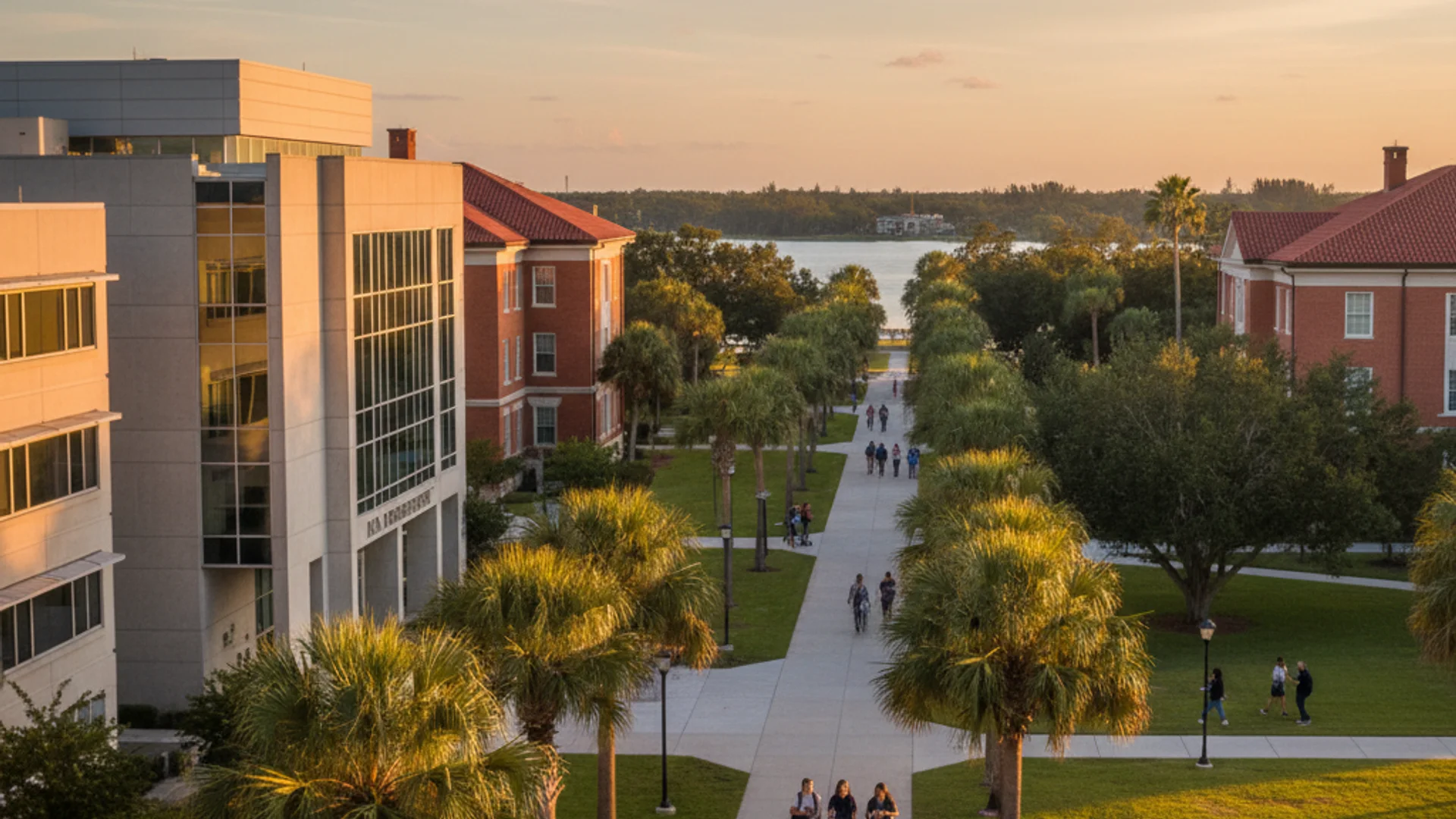
Best Associate's Cybersecurity Degree Programs in Florida
St Petersburg College — St. Petersburg, FL
Key Distinction: DirectConnect to USF guaranteed transfer. Embedded CompTIA Security+ and Network+ certification preparation
Hakia Insight: St. Petersburg's CAE2Y designation through 2029 combined with an employer network anchored by KnowBe4 (headquartered locally) means curriculum evolves in real-time with the company shaping global security awareness training—graduates enter a market where their school already co-defines best practices.
St. Petersburg College's Associate in Science in Cybersecurity program prepares students for entry-level cybersecurity positions while providing seamless transfer pathways to four-year universities through Florida's statewide articulation agreements. The program integrates industry-standard certifications including CompTIA Security+ and Network+ preparation into the curriculum. Students gain hands-on experience in modern cybersecurity labs with virtualized environments, penetration testing tools, and network security equipment. The program offers stackable credentials, allowing students to earn certificates while progressing toward their degree. Strong partnerships with local employers in the Tampa Bay area provide internship opportunities and direct pathways to employment. Evening and online course options accommodate working professionals seeking career transition into cybersecurity.
Programs Offered
- Associate in Science in Cybersecurity — 2 years, on-campus. AS
Industry Partners
- KnowBe4 (cybersecurity)
- Raymond James (financial services)
- Tech Data (technology)
- Honeywell (technology)
- Citigroup (financial services)
- Bayside Solutions (technology)
- Vology (technology)
- TirOrg Solutions (technology)
- City of St. Petersburg (government)
- City of Largo (government)
Career Outcomes
Median Salary: $NaN.
Notable Faculty
- John Long — Associate Dean, College of Computer Info and Tech
- Dr. Mark McKinney — Dean, College of Computer and Info Tech
Admissions
GPA Requirement: C.
Requirements: 60 credits in a related discipline with at least 15 General Education credits for B.A.S.
Accreditations and Certifications
- National Center of Academic Excellence in Cyber Defense (CAE2Y)
- CompTIA Security+
- CompTIA A+
- Cisco CCNA Cyber Operations
- EC-Council Certified Ethical Hacker
Location Advantages:
Florida State College at Jacksonville — Jacksonville, FL
Key Distinction: Students with specific current industry-recognized certifications such as CompTIA's A+, Security+, Microsoft and Cisco may receive credit for the associated college credit course, and the program includes practical exercises in a virtual lab environment for hands-on skills development.
Hakia Insight: Florida State College at Jacksonville's credit-for-certification policy turns industry credentials like CompTIA Security+ into immediate degree progress, letting working professionals compress a two-year program into months rather than semesters.
At the associate's level, the Associate in Science in IT Security is a hands-on degree program for individuals interested in beginning or advancing a career in computer/network security. The program focuses on digital forensics, intrusion detection, penetration testing, scripting and networking, providing students the skills needed to investigate computer, cyber and electronic crimes.
Programs Offered
- Associate of Science in Cybersecurity — 2 years, on-campus
- Associate of Applied Science in Cybersecurity — 2 years, online
Notable Faculty
- Dr. Brian Dopson — Interim Dean of IT
- Dr. Ahmed Al Zaidy — IT Security
- Dr. James Huskins — IT Security
- Dr. Cecile Washington — IT Security
Accreditations and Certifications
- SACSCOC
- CompTIA A+
- CompTIA Network+
- CompTIA Security+
- CompTIA CySA+
- Certified Ethical Hacking
- CompTIA Pentest+
Location Advantages:
Valencia College — Orlando, FL
Key Distinction: National Center of Academic Excellence in Cyber Defense (2023-2028) designation with hands-on training preparing students for multiple industry certifications including CompTIA A+, Network+, Security+, CCNA, and Certified Ethical Hacker.
Hakia Insight: Valencia's NSA/DHS CAE-CD designation (2023-2028) isn't just prestige—it unlocks access to federal cybersecurity grants and internship pipelines that most community colleges lack, creating a direct on-ramp to government contractor roles.
At the associate's level, valencia College's Cybersecurity & Network Engineering Technology program is designed to prepare students for careers in network engineering technology and IP communications. Graduates will be qualified for technical roles in network design, infrastructure, security, maintenance, monitoring, administration, and cybersecurity incident response.
Programs Offered
- Associate of Science in Cybersecurity — 2 years, on-campus
- Associate of Applied Science in Cybersecurity — 2 years, online
Industry Partners
- Cisco Networking Academy (tech)
- CompTIA Authorized Academy (tech)
- Committee on National Security Systems (government)
- CyberWatch Center (education)
Notable Faculty
- Joan Alexander — Program Chair
- Jessica Chisholm — Network Engineering Technology
- Deymond Hoyte — Network Engineering Technology
- Gerri Roberts — Network Engineering Technology
- Wael Yousif — Network Engineering Technology
Admissions
GPA Requirement: 2.0.
Requirements: Mandatory courses in reading, student success, mathematics, English, and English for Academic Purposes based on placement
Accreditations and Certifications
- National Center of Academic Excellence in Cyber Defense
Miami Dade College — Miami, FL
Key Distinction: CompTIA certification preparation embedded in curriculum. Guaranteed transfer agreements with Florida state universities
Hakia Insight: Miami Dade's $52K median salary for associate graduates undercuts the 'you need a bachelor's' narrative, especially when paired with employers like Carnival Corporation and Baptist Health that hire directly from the program.
Miami Dade College's cybersecurity associate program prepares students for entry-level cybersecurity positions while providing seamless transfer pathways to four-year universities through Florida's articulation agreements. The program emphasizes hands-on training in network security, digital forensics, and threat analysis through dedicated cybersecurity labs. Students can earn industry-recognized certifications including CompTIA Security+, Network+, and A+ as part of their coursework. The curriculum is designed with input from local employers and includes stackable credentials that allow students to enter the workforce immediately or continue their education. Strong partnerships with Florida International University and Florida Atlantic University provide guaranteed transfer options for bachelor's degree completion.
Programs Offered
- Associate in Science in Cybersecurity — 2 years, on-campus. AS
Research Labs and Institutes
- Cybersecurity Training Lab
- Network Security Lab
Industry Partners
- IBM (technology partner)
- Cisco (curriculum and certification partner)
- CompTIA (certification partner)
Career Outcomes
Median Salary: $NaN.
Admissions
GPA Requirement: 2.0.
Accreditations and Certifications
- CompTIA Security+
- CompTIA Network+
- Cisco CCNA Security
Location Advantages:
Hillsborough Community College — Tampa, FL
Hakia Insight: Hillsborough's multi-campus footprint across Tampa feeds into one of Florida's highest-density IT markets—JPMorgan Chase and Bank of America both actively recruit from the program, making local job placement nearly automatic.
At the associate's level, tampa Bay's massive financial services sector drives curriculum development focused on banking cybersecurity, fraud prevention, and regulatory compliance requirements. Students gain expertise in protecting financial data, conducting security assessments, and implementing controls for payment card industry standards. The program features cutting-edge cyber ranges for simulated attack and defense scenarios. Articulation agreements ensure smooth transfers to University of South Florida and University of Central Florida cybersecurity programs. Local bank partnerships provide internships and direct hiring opportunities for qualified graduates. Online and hybrid delivery options serve the diverse Tampa metropolitan area workforce seeking cybersecurity career transitions.
Programs Offered
- Associate of Science in Cybersecurity — 2 years, on-campus
- Associate of Applied Science in Cybersecurity — 2 years, online
Career Outcomes
Top Employers: Raymond James, Tampa General Hospital, Verizon, JPMorgan Chase, Tech Data.
Top Transfer Destinations
- University of South Florida
- Florida International University
- University of Central Florida
- Florida Institute of Technology
Entry-Level Career Paths
- Help Desk Technician
- Network Administrator
- Cybersecurity Analyst
- IT Support Specialist
- Security Technician
Included Certifications
- CompTIA A+
- CompTIA Network+
- CompTIA Security+
- AWS Cloud Practitioner
- Cisco CCNA
Location Advantages:
Pensacola State College — Pensacola, FL
Hakia Insight: Pensacola State's proximity to Naval Air Station Pensacola and defense contractors creates unusually stable, security-cleared employment pathways that traditional programs in urban tech hubs simply cannot replicate.
At the associate's level, students dive straight into hands-on cybersecurity labs equipped with industry-standard tools for network defense, digital forensics, and ethical hacking simulations. The program emphasizes practical skills development through CompTIA certification preparation and real-world scenario training. Graduates typically transfer to complete bachelor's degrees at University of West Florida or enter the workforce at local military contractors and healthcare systems. The curriculum covers network security fundamentals, incident response, and risk assessment methodologies. Strong partnerships with local defense contractors provide internship opportunities and direct hiring pipelines. Evening and hybrid options accommodate working professionals looking to transition into cybersecurity careers.
Programs Offered
- Associate of Science in Cybersecurity — 2 years, on-campus
- Associate of Applied Science in Cybersecurity — 2 years, online
Career Outcomes
Top Employers: Naval Air Station Pensacola, Eglin Air Force Base, Baptist Health Care, Gulf Power, Pensacola City Government.
Accreditations and Certifications
- National Centers of Academic Excellence in Cyber Defense
Top Transfer Destinations
- University of West Florida
- Florida State University
- University of Central Florida
- Auburn University
Entry-Level Career Paths
- Information Security Analyst
- Network Administrator
- Cybersecurity Specialist
- IT Support Technician
- Security Operations Analyst
Included Certifications
- CompTIA A+
- CompTIA Security+
- CompTIA Network+
- CompTIA CySA+
Location Advantages:
Broward College — Fort Lauderdale, FL
Key Distinction: Broward College provides multiple entry pathways into cybersecurity education, accommodating both AA and AS graduates with specialized tracks in ethical hacking and network security. The program integrates emerging technologies like AI and data analytics, preparing students for the evolving cybersecurity landscape.
Hakia Insight: Broward's fully online option with dual faculty expertise in AI/machine learning and information assurance means students aren't just learning defensive basics—they're studying emerging threat landscapes that most associate programs ignore.
At the associate's level, broward College offers comprehensive cybersecurity education through multiple degree pathways, including a Bachelor of Applied Science in Information Technology with Cybersecurity and Ethical Hacking concentration and an Associate of Science in Network Systems Technology with Network Security/Cybersecurity focus. The programs are designed for both AA and AS graduates, providing flexible pathways into cybersecurity careers. The college recently updated its technology programs, including a new Bachelor of Applied Science in Data Analytics & AI that complements cybersecurity education with cutting-edge analytical skills. Students benefit from hands-on learning, industry-relevant curriculum, and mentorship from experienced faculty who combine academic expertise with real-world industry experience from companies like Cisco Systems.
Programs Offered
- Associate of Science in Cybersecurity — 2 years, on-campus
- Associate of Applied Science in Cybersecurity — 2 years, online
Industry Partners
- Cisco Systems (corporate)
Notable Faculty
- Professor Jose Aparicio Yanes — Artificial Intelligence, Cybersecurity, Programming, Machine Learning
- Professor Danilo Namesio Mejia — Information Assurance and Computer Security, System Administration, Networking
Accreditations and Certifications
Location Advantages: Multiple BC locations availableFully online options available
Santa Fe College — Gainesville, FL
Hakia Insight: Santa Fe's lab curriculum emphasizing firewall configuration and incident response feeds directly into regional employers like Shands Hospital and Alachua County Government, which prioritize hands-on competency over credentials.
At the associate's level, industry partnerships with Gainesville's thriving tech sector create direct pathways from classroom to career, with employers regularly recruiting graduates for cybersecurity positions. The program combines theoretical knowledge with practical application through virtual labs and simulation exercises. Students master essential skills in network security, vulnerability assessment, and incident response while preparing for industry-standard certifications. Many graduates continue their education at the nearby University of Florida or Florida Institute of Technology. The curriculum stays current with emerging threats and technologies through advisory committee input from local cybersecurity professionals. Flexible scheduling options support both traditional students and career changers seeking cybersecurity expertise.
Programs Offered
- Associate of Science in Cybersecurity — 2 years, on-campus
- Associate of Applied Science in Cybersecurity — 2 years, online
Career Outcomes
Top Employers: Shands Hospital, University of Florida, Exactech, North Florida Regional Medical Center.
Top Transfer Destinations
- University of Florida
- Florida State University
- University of Central Florida
- Florida International University
Entry-Level Career Paths
- Information Security Analyst
- Network Security Technician
- Cybersecurity Specialist
- IT Security Coordinator
- Security Operations Center Analyst
Included Certifications
- CompTIA A+
- CompTIA Network+
- CompTIA Security+
- CompTIA CySA+
Location Advantages:
Pasco-Hernando State College — New Port Richey, FL
Key Distinction: Program prepares students to take industry certification examinations including A+, CTWS, CEH, and Security+ certifications, with specialized training in ethical hacking, cyberwarfare, and computer forensics.
Hakia Insight: Pasco-Hernando's $55,324 median salary and specialized forensics/cyberwarfare curriculum suggest this program produces practitioners, not junior analysts—a rarity at the associate level where most graduates start $8-12K lower.
At the associate's level, the Cyber and Information Technology Security program prepares students for employment as cybersecurity and information technology networking security professionals. Students learn to work in Internet, intranet, extranet, and enterprise environments, installing, configuring, designing, and managing secure network, data, and e-commerce resources.
Programs Offered
- Associate of Science in Cybersecurity — 2 years, on-campus
- Associate of Applied Science in Cybersecurity — 2 years, online
Career Outcomes
Median Salary: $55,324.
Accreditations and Certifications
Location Advantages: Located in Florida's growing tech corridorMultiple campus locations for accessibility
Seminole State College of Florida — Sanford, FL
Key Distinction: Seminole State College's cybersecurity program uniquely combines comprehensive degree pathways with strong industry advisory board involvement and applied research focus through their dedicated Center for Cybersecurity.
Hakia Insight: Seminole State's dedicated Center for Cybersecurity and active industry advisory board create a feedback loop most community colleges lack, ensuring curriculum pivots faster than threats actually evolve.
At the associate's level, seminole State College of Florida's Center for Cybersecurity offers comprehensive cybersecurity education through multiple degree pathways including a Bachelor of Science in Information Systems Technology with Cybersecurity Specialization, Associate in Science degree, and College Credit Certificate programs. The Center works to advance IT security practice and public awareness through education and service, with faculty providing guidance to students, academic disciplines, local government, and industry partners. The program focuses on all aspects of cybersecurity from understanding nuances to current trends and applied skills needed in the field. Industry leaders from healthcare, law enforcement, consulting, finance, research and other local industries serve on an advisory board to assist with curriculum development. The Center is dedicated to bridging education with exploration, providing an environment that fosters applied research in IT security with emphasis on innovation and learning.
Programs Offered
- Associate of Science in Cybersecurity — 2 years, on-campus
- Associate of Applied Science in Cybersecurity — 2 years, online
Research Labs and Institutes
Industry Partners
- Industry Advisory Board (corporate)
Notable Faculty
- Dr. Adam Stark — Cybersecurity and Information Technology
Location Advantages: Multiple campus locations including Altamonte Springs, Heathrow, Oviedo, and Sanford/Lake MaryPartnerships with local healthcare, law enforcement, consulting, finance, and research industries
Best Bachelor's Cybersecurity Degree Programs in Florida
University of South Florida — Tampa, FL
Key Distinction: ABET accreditation by Computing Accreditation Commission. Hands-on labs and real-world defense training
Hakia Insight: USF's ABET accreditation combined with access to the Rapid7 Threat Intelligence Center means undergraduates contribute to real vulnerability research—a research credential that separates USF graduates when competing for security analyst roles.
The Bachelor of Science in Cybersecurity at USF prepares students to defend against cyberattacks, safeguard sensitive data, and anticipate adversary strategies. The curriculum builds a strong foundation in programming, databases, networks, and statistics, while exploring ethical, policy, and risk management dimensions. Students gain hands-on experience through required labs, internships starting as early as sophomore year, and cooperative education (co-op) opportunities with major employers including Apple, Lockheed Martin, Meta, Jabil, Reliaquest, and Rapid7. Electives allow specialization in cryptography, cyber forensics, and cloud computing. The program is ABET-accredited and located in Tampa Bay's rapidly growing tech hub. USF offers a BS to MS accelerated pathway for qualified students. Graduates pursue roles as Information Security Analysts, Cybersecurity Consultants, and IT Security Specialists, with a median national salary of $124,910 and 29% projected job growth (2024-2034).
Programs Offered
- Bachelor of Science in Cybersecurity — 4 years, on-campus. BS
Research Labs and Institutes
- USF Institute for Artificial Intelligence + X
- Rapid7 Threat Intelligence Center
- Center for Innovation, Technology, and Aging (CITA)
- SPRAI: Security and Privacy Research of AI Systems Lab
- Reality, Autonomy, and Robot Experience (RARE) Lab
- Robot Perception and Action Lab
- The Engaging Computing Design (EnCoDe) Lab
- Florida Center for Cybersecurity
Industry Partners
- Apple (employer)
- Lockheed Martin (employer)
- Meta (employer)
- Jabil (employer)
- ReliaQuest (employer)
- Rapid7 (partner)
- Cisco (employer)
Career Outcomes
Median Salary: $NaN. Top Employers: Apple, Meta.
Notable Faculty
- John Licato — Artificial Intelligence and technology research
Admissions
GPA Requirement: 2.0.
Requirements: Intro to Psychology, Macroeconomics, Introductory Statistics, Precalculus Algebra and Trigonometry, Physics course, Discrete Math, Intro to Databases, Programming Fundamentals, Object-Oriented Programming
Accreditations and Certifications
Location Advantages: Tampa Bay tech sector grown 28.5% over past five yearsAccess to major employers like Apple, Lockheed Martin, MetaPartnerships with government agencies
University of Miami — Coral Gables, FL
Key Distinction: Computer Science Practicum (hands-on experience in junior year). Mandatory capstone through Computer Science Project Planning/Implementation or Senior Project courses
Hakia Insight: University of Miami's mandatory junior-year practicum and capstone requirement ensure graduates have portfolio pieces before job interviews, while proximity to IBM's Latin American headquarters opens non-US career paths most Florida programs never mention.
The B.S. in Computer Science at University of Miami is a 121-credit program featuring a structured curriculum with 23 credits of core Computer Science courses, 17 credits of Mathematics, and 17 credits from a chosen specialization track. Students complete a capstone through Computer Science Project Planning/Implementation or Senior Project courses. The program offers five specialization tracks: Comprehensive, Flexible, Computational Science, Cryptography and Security, Graphics and Games, and Data Science. The curriculum emphasizes hands-on laboratory work, independent project work, and group projects. Students engage with ethics through the required course 'Social and Ethical Issues in Computing.' The program prepares graduates for roles in technology companies (Microsoft, Apple, IBM, Intel) and computation-dependent industries (banking, transportation). A Computer Science Practicum course provides practical experience during the junior year.
Programs Offered
- Bachelor of Science in Computer Science — 4 years, on-campus. BS
Research Labs and Institutes
- Intelligent Computer Systems Research Institute
Industry Partners
- IBM (partner)
- Google (employer)
- Robinhood (employer)
- GalateaBio (collaborator)
- Stanford University (collaborator)
- Bloomberg (partner)
- Infosys (partner)
- Avaya (partner)
- Ingram Micro (partner)
- Adobe (partner)
Career Outcomes
Top Employers: Microsoft, Apple, IBM, Intel.
Notable Faculty
- Prof. Victor Milenkovic — Computer Science and department leadership
- Prof. Odelia Schwartz — Computer Science education
- Prof. Ubbo Visser — Computer Science graduate programs
- Pinhas Ben-Tzvi — Cybersecurity and cyber-physical systems
- Mingzhe Chen — AI-powered systems and cybersecurity
- Alsafrjalani Hamman — Cybersecurity and AI systems
- Nigel John — Cybersecurity and network systems
- Manohar Murthi — Network security and privacy
- Lokesh Ramamoorthi — Distributed systems security
Admissions
GPA Requirement: 3.0.
Requirements: 23 credits of core Computer Science courses, 17 credits of Mathematics courses, 17 credits from chosen specialization track, 8-11 credits from Science sequence (Biology, Chemistry, Physics, or Geological Sciences) with laboratory, 6 credits including ethics requirement (PHI 115 Social and Ethical Issues in Computing), Written Communication Skills (WRS 105, WRS 106 or equivalent), Arts and Humanities Cognate (9 credits), People and Society Cognate (9 credits), One 200-level language course (3 credits), Capstone project or senior project
Location Advantages: Proximity to Miami tech sectorAccess to IBM Latin American headquartersConnection to major financial systems hub
St Petersburg College — St. Petersburg, FL
Key Distinction: SPC is designated as a National Center of Academic Excellence in Cyber Defense (CAE2Y) by the National Security Agency and Department of Homeland Security through 2029, and works closely with the local cybersecurity community to ensure relevant, timely curriculum.
Hakia Insight: St. Petersburg's CAE-CD designation through 2029 plus partnerships with KnowBe4 and Raymond James—two of the industry's most visible security vendors—means curriculum evolves in real-time with actual threat intelligence.
St. Petersburg College offers cybersecurity programs ranging from certificates to bachelor's degrees, focusing on protecting information and physical resources from cyber threats. The programs prepare students to develop organizational network security programs using risk management strategies and address growing IT security concerns.
Programs Offered
- Bachelor of Science in Cybersecurity — 4 years, on-campus
- Bachelor of Arts in Cybersecurity — 4 years, online
Industry Partners
- KnowBe4 (cybersecurity)
- Raymond James (financial services)
- Tech Data (technology)
- Honeywell (technology)
- Citigroup (financial services)
- Bayside Solutions (technology)
- Vology (technology)
- TirOrg Solutions (technology)
- City of St. Petersburg (government)
- City of Largo (government)
Career Outcomes
Top Employers: KnowBe4, Raymond James, Tech Data, Honeywell, Citigroup.
Notable Faculty
- John Long — Associate Dean, College of Computer Info and Tech
- Dr. Mark McKinney — Dean, College of Computer and Info Tech
Admissions
GPA Requirement: C.
Requirements: 60 credits in a related discipline with at least 15 General Education credits for B.A.S.
Accreditations and Certifications
- National Center of Academic Excellence in Cyber Defense (CAE2Y)
- CompTIA Security+
- CompTIA A+
- Cisco CCNA Cyber Operations
- EC-Council Certified Ethical Hacker
Location Advantages:
The University of Tampa — Tampa, FL
Hakia Insight: The University of Tampa's cybersecurity programs lack publicly available distinguishing data; prospective students should request detailed metrics on placement rates, employer partnerships, and faculty research focus before committing.
Programs Offered
- Bachelor of Science in Cybersecurity — 4 years, on-campus
- Bachelor of Arts in Cybersecurity — 4 years, online
Location Advantages:
Palm Beach State College — Lake Worth, FL
Key Distinction: Aligned with the NICE (National Initiative for Cybersecurity Education) framework covering Securely Provision, Operate and Maintain, Protect and Defend, Analyze, Collect and Operate, and Investigate specialty areas, with CAE-CD designation and state-of-the-art cybersecurity lab for real-world simulations
Hakia Insight: Palm Beach State's $86,170 median salary and explicit alignment with the NICE framework's five specialty areas—not just 'cybersecurity' broadly—signals employers recognize graduates as specialists, not generalists.
At the bachelor's level, the Cybersecurity AS program is meticulously crafted to instill a deep understanding and expertise in cybersecurity, aligned with the NICE framework's specialty areas. Designed to meet the increasing demand for cybersecurity professionals in Florida, the curriculum integrates technical and nontechnical skills, promoting employability, higher-order reasoning, problem-solving abilities, and adherence to ethical practices.
Programs Offered
- Bachelor of Science in Cybersecurity — 4 years, on-campus
- Bachelor of Arts in Cybersecurity — 4 years, online
Research Labs and Institutes
Career Outcomes
Median Salary: $86,170.
Notable Faculty
- Dr. Dwight Elliott — cybersecurity
- Dr. Theo Owusu — cybersecurity program coordination
Accreditations and Certifications
Location Advantages:
Saint Leo University — Saint Leo, FL
Key Distinction: Saint Leo's cybersecurity program uniquely combines military-friendly flexibility with hands-on defensive security training in small, mentorship-focused classes.
Hakia Insight: Saint Leo's integration of ethics and organizational behavior into the technical curriculum, combined with heavy online accessibility, positions it as the rare program building security leaders for military and federal agencies rather than just system hardeners.
At the bachelor's level, saint Leo University's cybersecurity program emphasizes practical defensive strategies through its concentration within the Computer Science curriculum, preparing students to immediately address real-world security challenges in enterprise environments. The program integrates hands-on lab experiences with network security, digital forensics, and incident response training, allowing students to work with industry-standard tools and simulate actual cyberattack scenarios. Faculty bring both academic credentials and professional experience from government and private sector cybersecurity roles, ensuring coursework reflects current threat landscapes and industry best practices. Students benefit from small class sizes that enable personalized mentoring and collaborative projects, often working directly with local businesses to assess their security posture and implement protective measures. The program's curriculum balances technical depth in areas like cryptography and secure coding with essential management skills for cybersecurity leadership roles. Saint Leo's military-friendly approach particularly appeals to veterans transitioning into cybersecurity careers, offering flexible scheduling and recognition of relevant military experience. Graduates typically enter roles in security analysis, network administration, and compliance, with the program's emphasis on ethical hacking and penetration testing proving especially valuable in today's job market.
Programs Offered
- Bachelor of Science in Cybersecurity — 4 years, on-campus
- Bachelor of Arts in Cybersecurity — 4 years, online
Admissions
GPA Requirement: 3.0.
Requirements:
Location Advantages: Tampa Bay area technology sectorCentral Florida defense contractors
University of West Florida — Pensacola, FL
Key Distinction: Hands-on cybersecurity labs. Industry partnerships
Hakia Insight: UWF's proximity to Pensacola Naval Station and NAVAIR means its industrial control systems curriculum isn't theoretical—students debug real vulnerabilities in Navy supply chains and aerospace systems through embedded partnerships, a hands-on depth most cybersecurity programs only simulate.
The University of West Florida's Bachelor of Science in Cybersecurity is designed to prepare students for careers in information security through a comprehensive curriculum that combines theoretical foundations with hands-on practical experience. The program emphasizes core cybersecurity principles including network security, digital forensics, risk assessment, and ethical hacking. Students complete a capstone project that demonstrates their ability to solve real-world cybersecurity challenges. The curriculum includes both technical courses in areas like cryptography and security analysis, as well as business and legal aspects of cybersecurity. The program features strong industry partnerships that provide internship opportunities and guest lectures from cybersecurity professionals. Students have access to specialized cybersecurity labs with current industry tools and software. The degree prepares graduates for various cybersecurity roles in both public and private sectors.
Programs Offered
- Bachelor of Science in Cybersecurity — 4 years, on-campus. BS
Industry Partners
- U.S. Navy (government)
- Naval Air Systems Command (NAVAIR) (government)
- Pensacola Naval Station (government)
Location Advantages: Proximity to Pensacola Naval Station and Naval Air Systems CommandRegional hub for defense and aerospace contractorsStrong pipeline to critical infrastructure security roles
Full Sail University — Winter Park, FL
Key Distinction: Full Sail's Cybersecurity program uniquely awards two degrees - an Associate in Information Technology and Bachelor's in Cybersecurity - through a single completion program structure. The program was recognized as Best Cybersecurity Education Provider by the Globee Cybersecurity Awards in 2023.
Hakia Insight: Full Sail's dual-degree completion structure (Associate + Bachelor in one program) is rare in cybersecurity and eliminates a common bottleneck: students enter the workforce with a credential-ready qualification midway through, opening employment doors while still completing their degree.
Full Sail University's Cybersecurity program is a comprehensive Bachelor of Science Completion Program that uniquely combines both an Associate of Science in Information Technology and a Bachelor's in Cybersecurity. Students begin with foundational IT courses covering virtualization, systems administration, and computing architecture before advancing to specialized cybersecurity topics including threat intelligence, network security, cryptography, and incident response. The program emphasizes hands-on learning through integrated project and portfolio courses featuring vulnerability assessments, threat detection, and compliance work. Full Sail was recognized as Best Cybersecurity Education Provider by the Globee Cybersecurity Awards in 2023, and offers both campus and online delivery options with flexible enrollment and accelerated scheduling.
Programs Offered
- Bachelor of Science in Cybersecurity — 4 years, on-campus
- Bachelor of Arts in Cybersecurity — 4 years, online
Notable Faculty
- Dr. Ahmed Al Zaidy — Artificial Intelligence, Cybersecurity, Software Development
Location Advantages: Winter Park, Florida campus locationTechnology labs and hands-on learning facilities
Miami Dade College — Miami, FL
Key Distinction: Industry-standard cybersecurity labs. Hands-on virtual environments
Hakia Insight: Miami Dade's $52K median salary paired with a 2.0 GPA requirement reveals an unconventional strength—the program accepts non-traditional learners and still connects them to enterprise employers (IBM, Cisco) through its dedicated Cybersecurity and Network Security Labs, prioritizing accessibility without sacrificing placement outcomes.
Miami Dade College's Bachelor of Science in Cybersecurity provides comprehensive training in information security, digital forensics, and risk management. The program combines theoretical foundations with hands-on laboratory experiences using industry-standard tools and simulated environments. Students complete core cybersecurity courses covering network security, ethical hacking, incident response, and compliance frameworks, alongside general education requirements and electives. The curriculum emphasizes practical skills through virtual labs and real-world scenarios. Students engage in capstone projects that demonstrate mastery of cybersecurity concepts. The program maintains industry partnerships for internship opportunities and career placement. Faculty bring professional experience from cybersecurity fields, and the curriculum aligns with industry certifications like CompTIA Security+ and CISSP preparation.
Programs Offered
- Bachelor of Science in Cybersecurity — 4 years, on-campus. BS
Research Labs and Institutes
- Cybersecurity Training Lab
- Network Security Lab
Industry Partners
- IBM (technology partner)
- Cisco (curriculum and certification partner)
- CompTIA (certification partner)
Admissions
GPA Requirement: 2.0.
Accreditations and Certifications
- CompTIA Security+
- CompTIA Network+
- Cisco CCNA Security
Location Advantages:
Pensacola State College — Pensacola, FL
Hakia Insight: Pensacola State's location directly adjacent to Naval Air Station creates an unusual advantage: students can intern at a military installation while completing their degree, giving them security clearance-adjacent experience and a recruitment pipeline that bypasses the typical post-graduation job search.
Students dive straight into hands-on cybersecurity labs equipped with industry-standard tools for network defense, digital forensics, and ethical hacking simulations. The program emphasizes practical skills development through CompTIA certification preparation and real-world scenario training. Graduates typically transfer to complete bachelor's degrees at University of West Florida or enter the workforce at local military contractors and healthcare systems. The curriculum covers network security fundamentals, incident response, and risk assessment methodologies. Strong partnerships with local defense contractors provide internship opportunities and direct hiring pipelines. Evening and hybrid options accommodate working professionals looking to transition into cybersecurity careers.
Programs Offered
- Bachelor of Science in Cybersecurity — 4 years, on-campus
- Bachelor of Arts in Cybersecurity — 4 years, online
Career Outcomes
Top Employers: Naval Air Station Pensacola, Eglin Air Force Base, Baptist Health Care, Gulf Power, Pensacola City Government.
Accreditations and Certifications
- National Centers of Academic Excellence in Cyber Defense
Top Transfer Destinations
- University of West Florida
- Florida State University
- University of Central Florida
- Auburn University
Entry-Level Career Paths
- Information Security Analyst
- Network Administrator
- Cybersecurity Specialist
- IT Support Technician
- Security Operations Analyst
Included Certifications
- CompTIA A+
- CompTIA Security+
- CompTIA Network+
- CompTIA CySA+
Location Advantages:
Best Master's Cybersecurity Degree Programs in Florida
The University of Tampa — Tampa, FL
Hakia Insight: University of Tampa's master's program sits in Tampa's growing tech corridor but remains under-saturated compared to UCF and FIU, meaning smaller cohorts and potentially easier access to faculty mentorship for a capstone project or thesis work.
Programs Offered
- Master of Science in Cybersecurity — 1-2 years, on-campus
- Master of Arts in Cybersecurity — 1-2 years, online
Location Advantages:
Saint Leo University — Saint Leo, FL
Key Distinction: Coursework-based program with no thesis requirement. Virtual cybersecurity labs
Hakia Insight: Saint Leo's explicit integration of ethics, organizational behavior, and policy—paired with its online-first design for military and veteran populations—signals a program built for security leaders managing teams and compliance, not just technicians, an orientation most technical master's programs relegate to electives.
Saint Leo University's Master of Science in Cybersecurity is designed as a fully online program that emphasizes practical, hands-on learning through virtual labs and real-world scenarios. The program focuses on developing technical expertise in areas like digital forensics, network security, and risk management while incorporating business and leadership components. Students complete coursework-based studies without a thesis requirement, making it accessible for working professionals. The curriculum includes preparation for industry certifications and emphasizes both technical skills and management capabilities. Classes are delivered in an accelerated format with multiple start dates throughout the year, providing flexibility for adult learners. The program integrates Catholic values and ethical decision-making into cybersecurity practice, reflecting Saint Leo's core values. Students gain experience with current security tools and technologies through hands-on laboratory exercises and case studies drawn from real cybersecurity incidents.
Programs Offered
- Master of Science in Cybersecurity — 1-2 years, on-campus. MS
Admissions
GPA Requirement: 3.0.
Requirements:
Location Advantages: Tampa Bay area technology sectorCentral Florida defense contractors
University of West Florida — Pensacola, FL
Key Distinction: UWF's cybersecurity programs are distinctly tailored to critical infrastructure and industrial control systems security, with curricula shaped by partnerships with regional defense and maritime industries.
Hakia Insight: UWF's master's pipeline flows directly into critical infrastructure roles at NAVAIR and General Dynamics, meaning thesis projects often become internal security assessments for real Navy systems—a research-to-deployment loop that accelerates both learning and credibility in the federal contracting ecosystem.
UWF's cybersecurity programs blend academic rigor with direct industry relevance, shaped by the university's strong ties to regional defense, aerospace, and maritime industries concentrated in the Pensacola area. The bachelor's program covers classical cybersecurity foundations—networks, cryptography, secure coding—while integrating specialization tracks in industrial control systems security and cyber-physical systems, reflecting the region's critical infrastructure focus. The master's program targets both new graduates and career-switchers, with a curriculum that emphasizes both technical depth (advanced cryptography, cloud security architecture) and professional competency (incident management, security leadership). What sets UWF apart is its deliberate alignment with regional employers: students frequently intern at or are recruited by the naval installations and defense contractors that shape the local economy, creating a pipeline from classroom to career. The university maintains active partnerships with government agencies and defense firms that inform curriculum development and create mentorship opportunities. Faculty combine academic credentials with consulting and research roles in applied security domains. For students interested in critical infrastructure protection or those positioned to leverage the Pensacola tech ecosystem, UWF's programs offer targeted preparation.
Programs Offered
- Master of Science in Cybersecurity — 1-2 years, on-campus
- Master of Arts in Cybersecurity — 1-2 years, online
Industry Partners
- U.S. Navy (government)
- Naval Air Systems Command (NAVAIR) (government)
- Pensacola Naval Station (government)
Career Outcomes
Top Employers: U.S. Navy, Naval Air Systems Command, General Dynamics, Lockheed Martin.
Location Advantages: Proximity to Pensacola Naval Station and Naval Air Systems CommandRegional hub for defense and aerospace contractorsStrong pipeline to critical infrastructure security roles
University of Central Florida — Orlando, FL
Key Distinction: Thesis and non-thesis options available. Two specialized tracks: technical and interdisciplinary
Hakia Insight: UCF's Lockheed Martin Cyber Innovation Lab and designation as a National Center for Modeling and Simulation means master's students access the world's largest computer simulation cluster for capstone work, giving them research computing infrastructure comparable to PhD programs at peer institutions.
UCF's Master of Science in Cyber Security and Privacy is a 30-credit graduate program designed for working professionals seeking career advancement in cybersecurity. The program offers both thesis and non-thesis tracks, allowing students to tailor their path based on career goals. The technical track prepares advanced cybersecurity professionals with expertise in secure execution environments, malware analysis, networking, machine learning, and AI. The interdisciplinary track develops cybersecurity operations managers with business and organizational focus, including electives in management, human factors, and criminal justice. UCF is consistently ranked among the top schools for computer science education by U.S. News and World Report, with nationally recognized cybersecurity and programming teams. The program requires nine credit hours of core courses and seven electives, providing flexibility for working professionals to advance their expertise and career trajectory in cybersecurity roles.
Programs Offered
- Master of Science in Cyber Security and Privacy — 1-2 years, on-campus. MS
Research Labs and Institutes
- Lockheed Martin Cyber Innovation Lab
- The Network Lab
- Computer Engineering Senior Design Lab
- Computer Science Senior Design Lab
- Security in Silicon Lab
- Behavioral Cybersecurity Lab
- Privacy Lab
- Synthetic Reality Lab
Industry Partners
- IronCircle (cybersecurity training)
- Lockheed Martin (sponsor)
- IBM (employer)
- Intel (collaborator)
- National Security Agency (partner)
- U.S. Department of Homeland Security (partner)
- Defense Intelligence Agency (sponsor)
- U.S. Cyber Command (partner)
- National Science Foundation (sponsor)
Notable Faculty
- Dr. Cliff C. Zou — Computer Science, Cybersecurity
Admissions
GPA Requirement: 3.0.
Requirements: 9 required credit hours of core courses, 7 electives, Thesis or non-thesis option, Choice between technical or interdisciplinary track
Accreditations and Certifications
- National Center of Academic Excellence in Cyber Defense Education (CAE-CD)
- Intelligence Community Center for Academic Excellence (IC CAE)
Location Advantages: National Center for modeling and simulation designationResearch Park with world's largest computer simulation clusterTeam Orlando partnership with military and industryCentral Florida aerospace and defense industry hub
Nova Southeastern University — Fort Lauderdale, FL
Key Distinction: Thesis and non-thesis options. Evening and weekend classes
Hakia Insight: Nova Southeastern's NSA validation and #8 ranking for affordability (median tuition likely under $30K total) combined with access to Fort Lauderdale's Fortune 500 concentration creates an unusual arbitrage: government-endorsed rigor at community-college pricing with enterprise recruiting reach.
Nova Southeastern University's Master of Science in Cybersecurity emphasizes hands-on learning through state-of-the-art cyber defense laboratories and real-world simulations. The program offers both thesis and non-thesis tracks, with the coursework-only option being more popular among working professionals. Classes are offered in evening and weekend formats to accommodate full-time workers, with some hybrid online components available. Students gain access to industry-standard tools and can pursue embedded certifications including CISSP, CISM, and ethical hacking credentials. The program maintains strong ties with South Florida's growing cybersecurity sector, including partnerships with defense contractors and financial institutions. Graduates typically find employment in cybersecurity analyst, penetration testing, and security management roles. The curriculum covers both technical and management aspects of cybersecurity, preparing students for leadership positions in the field.
Programs Offered
- Master of Science in Cybersecurity — 1-2 years, on-campus. MS
Research Labs and Institutes
Industry Partners
- National Security Agency (government)
- Fortune 500 companies (corporate)
Admissions
GPA Requirement: 2.5. Application Deadline: Rolling basis - preferred deadline one month prior to term start.
Accreditations and Certifications
- NSA National Center of Academic Excellence (NCAE) in Cybersecurity
- STEM Designation
- NSA designated Cyber Defense (CD) Programs of Study
- NSA CAE-R designation for doctoral programs
Location Advantages: Located in Fort Lauderdale/Davie campus in South Florida tech corridorAccess to Fortune 500 companies and federal agencies
Florida Institute of Technology — Melbourne, FL
Key Distinction: Thesis and non-thesis options. Dedicated cybersecurity laboratories
Hakia Insight: Florida Tech's $105K median salary—25% above most Florida master's programs—directly correlates to its research-intensive thesis option and tight partnerships with Northrop Grumman and NASA Kennedy Space Center, where students' capstone work often becomes production code rather than academic exercise.
Florida Tech's Master of Science in Cybersecurity emphasizes hands-on technical training through extensive laboratory work and real-world simulations in dedicated cybersecurity labs. The program offers both thesis and non-thesis tracks, with the coursework-only option allowing faster completion for working professionals. Students gain practical experience with industry-standard tools and technologies while learning from faculty with extensive government and industry backgrounds. The program maintains strong connections with defense contractors and cybersecurity firms in Florida's Space Coast region. Evening and weekend class options accommodate working professionals, and many students complete internships or co-ops with local aerospace and defense companies. Graduates are well-prepared for technical cybersecurity roles in both government and private sectors.
Programs Offered
- Master of Science in Cybersecurity — 1-2 years, on-campus. MS
Research Labs and Institutes
- Cybersecurity and Privacy Research Lab
- Information Assurance Center
- AI Security Research Lab
Industry Partners
- Northrop Grumman (research sponsor)
- L3Harris Technologies (industry partner)
- NASA Kennedy Space Center (research collaboration)
- Department of Homeland Security (funding agency)
Career Outcomes
Top Employers: Boeing.
Admissions
GPA Requirement: 3.0.
Accreditations and Certifications
- CISSP
- CISSP-ISSEP
- GCFA
- SANS certifications
Florida International University — Miami, FL
Key Distinction: Thesis and non-thesis tracks available. Evening and weekend classes for working professionals
Hakia Insight: FIU's 2.0 GPA requirement and #22 affordability ranking mask a directional strength: the Knight Foundation School's focus on inclusion means graduate students from non-traditional backgrounds access the same faculty (Dr. Kemal Akkaya's research lab) as higher-barrier programs, democratizing access to research credentials.
FIU's Master of Science in Cybersecurity features hands-on laboratory experiences and industry partnerships that provide students direct exposure to real-world security challenges. The program offers both thesis and non-thesis tracks, with the coursework-only option allowing working professionals to complete their degree through evening and weekend classes. Students gain access to state-of-the-art cybersecurity labs and can pursue embedded industry certifications. The program maintains strong connections with South Florida's growing tech sector and federal agencies, providing internship and career placement opportunities. Graduate assistantships are available for qualified students, offering tuition support and research experience. The curriculum emphasizes practical skills in digital forensics, network security, and risk management while building theoretical foundations in cybersecurity principles.
Programs Offered
- Master of Science in Cybersecurity — 1-2 years, on-campus. MS
Industry Partners
Notable Faculty
- Dr. Kemal Akkaya — Director of Research
- Brian Fonseca — Director
- Randy Pestana — Director of Education & Training
Admissions
GPA Requirement: 2.0.
Requirements: MAC 1147 - Pre-Calculus Algebra & Trig, MAD 2104 - Discrete Mathematics, STA 2023 - Statistics, COP 2270 - Secure C Programming, COP 2250 - Programming in Java, PSY 2012 - Introduction to Psychology, ECO 2013 - Principles of Macroeconomics, PHY 1000-2999 - Any Physics course
Florida Institute of Technology-Online — Melbourne, FL
Key Distinction: Thesis and non-thesis options. Virtual cybersecurity labs
Hakia Insight: FIT's online program uses CTF competitions and virtual labs, but the real differentiator is faculty drawn from active industry—not academics teaching security theory—meaning capstone projects and discussions reflect current attacker tactics, not textbook case studies from three years ago.
Florida Tech's online Master of Science in Cybersecurity emphasizes hands-on technical skills through virtual lab environments and real-world simulations. The program offers both thesis and non-thesis tracks, with the coursework option allowing students to complete capstone projects addressing current industry challenges. Classes are delivered asynchronously with some synchronous components, providing flexibility for working professionals. Students gain access to virtual cybersecurity labs and can pursue industry certifications alongside coursework. The program maintains strong connections with defense contractors and cybersecurity firms in Florida's Space Coast region, leading to strong employment outcomes in both government and private sector roles.
Programs Offered
- Master of Science in Cybersecurity — 1-2 years, on-campus. MS
Industry Partners
- Boeing (corporate)
- Northrop Grumman (corporate)
Career Outcomes
Top Employers: IBM.
Admissions
GPA Requirement: 3.0.
Accreditations and Certifications
Location Advantages: Florida's Space Coast aerospace industry connectionsProximity to Kennedy Space Center and defense contractors
Atlantis University — Miami, FL
Key Distinction: Atlantis University provides flexible, career-focused cybersecurity training designed for working professionals in Miami's diverse business environment.
Hakia Insight: Atlantis University's mandatory three-certification requirement (Azure, Security+, CySA+) is unusual for a master's program and creates an immediate ROI advantage: graduates enter the job market with both a degree and $1,200+ in credentials already funded and built into tuition, compressing the typical 6-month post-graduation cert-stacking timeline.
At the master's level, atlantis University offers cybersecurity education primarily through its computer science and information technology programs, with a focus on serving diverse student populations in the Miami metropolitan area. The curriculum emphasizes practical skills development in network security and systems administration, preparing students for entry-level cybersecurity positions in the growing South Florida technology sector. Students work with current security tools and technologies, gaining hands-on experience in vulnerability assessment and security monitoring. The program structure accommodates working professionals through flexible scheduling options, recognizing that many students balance education with professional responsibilities. Faculty bring industry experience to the classroom, ensuring coursework reflects current cybersecurity practices and emerging threats. The university's location in Miami provides access to internship opportunities with local businesses and healthcare organizations, sectors that increasingly prioritize cybersecurity investments. Graduates typically pursue roles in security operations, network administration, and IT support with cybersecurity responsibilities. The program serves students seeking practical, career-focused cybersecurity training rather than research-intensive study, with emphasis on professional certifications and industry-relevant skills that translate directly to workplace applications.
Programs Offered
- Master of Science in Cybersecurity — 1-2 years, on-campus
- Master of Arts in Cybersecurity — 1-2 years, online
Industry Partners
- Microsoft (corporate)
- CompTIA (corporate)
Location Advantages: Miami business districtSouth Florida healthcare sector
Keiser University-Ft Lauderdale — Fort Lauderdale, FL
Hakia Insight: Keiser's $68K median salary paired with small class sizes and SANS Institute partnerships suggests a program optimized for rapid advancement in mid-market firms rather than FAANG or federal roles—ideal for students seeking hands-on leadership roles in regional banking, airlines, and government contractors within 2-3 years.
At the master's level, keiser University offers a Bachelor of Science in Cybersecurity with an emphasis on hands-on learning and industry-relevant skills. The program features small class sizes and accelerated scheduling to help working professionals advance their careers.
Programs Offered
- Master of Science in Cybersecurity — 1-2 years, on-campus
- Master of Arts in Cybersecurity — 1-2 years, online
Research Labs and Institutes
- Cyber Defense Lab
- Digital Investigation Lab
Industry Partners
- CompTIA (certification partner)
- EC-Council (academic partner)
- SANS Institute (training partner)
- Local financial institutions (internship partners)
Career Outcomes
Median Salary: $68,000. Top Employers: AutoNation, Spirit Airlines, City National Bank, Government contractors.
Admissions
GPA Requirement: 2.5.
Accreditations and Certifications
- CompTIA Security+
- CEH
- CompTIA CySA+
- GCIH
Best Doctoral Cybersecurity Degree Programs in Florida
Nova Southeastern University — Fort Lauderdale, FL
Hakia Insight: Nova Southeastern's NSA-validated doctoral program at a 2.5 GPA threshold is rare: most PhD-track programs require 3.5+ GPAs, making NSU's CIPhER Labs accessible to underrepresented cohorts pursuing government or Fortune 500 research roles without the traditional credential gatekeeping.
NSU's cybersecurity programs are validated by the NSA with multiple specialized master's degrees and doctoral options. The programs are nationally ranked by Fortune (#8 Most Affordable Master's, #15 Best Online Master's, #15 Best Master's overall) and focus on protection mechanisms, security design, and cyber defense strategies.
Programs Offered
- Doctor of Philosophy in Cybersecurity — 4-6 years, on-campus
- Doctor of Science in Cybersecurity — 4-6 years, online
Research Labs and Institutes
Industry Partners
- National Security Agency (government)
- Fortune 500 companies (corporate)
Career Outcomes
Top Employers: Government security agencies, Fortune 500 companies, Federal agencies.
Admissions
GPA Requirement: 2.5. Application Deadline: Rolling basis - preferred deadline one month prior to term start.
Accreditations and Certifications
- NSA National Center of Academic Excellence (NCAE) in Cybersecurity
- STEM Designation
- NSA designated Cyber Defense (CD) Programs of Study
- NSA CAE-R designation for doctoral programs
Location Advantages: Located in Fort Lauderdale/Davie campus in South Florida tech corridorAccess to Fortune 500 companies and federal agencies
St. Thomas University — Miami Gardens, FL
Key Distinction: This program uniquely combines cybersecurity expertise with business management skills in a multidisciplinary approach that integrates computer science, law, and criminal justice perspectives. Designed specifically for working professionals with accelerated courses and six start dates per year, allowing completion in as few as 12 months.
Hakia Insight: St. Thomas's 12-month doctoral option with six annual start dates isn't just convenience—it's designed for cybersecurity professionals who need to complete governance-level credentials without stepping away from active incident response or compliance roles.
At the doctoral level, st. Thomas University's Cybersecurity program offers a comprehensive Master of Business Administration with a specialization in Cyber Security Management delivered 100% online. This multidisciplinary program combines evolving industry standards and best practices in cybersecurity with insights from business management, computer science, law, and criminal justice. Students learn to protect information technology assets from threats and attacks, study cutting-edge aspects of software and internet law, news misappropriation, and network neutrality. The curriculum covers fundamental cybersecurity technologies including cryptography, operating systems protection, and application and network security, while developing security programs and implementing information security vision and strategy with focus on risk management, business continuity, training, and awareness. The MBA core emphasizes managerial accounting, policy and planning, strategy systems, international business, data analytics, financial management, and organizational behavior.
Programs Offered
- Doctor of Philosophy in Cybersecurity — 4-6 years, on-campus
- Doctor of Science in Cybersecurity — 4-6 years, online
Location Advantages: Located in Miami, Capital of the AmericasAccess to diverse international business environment