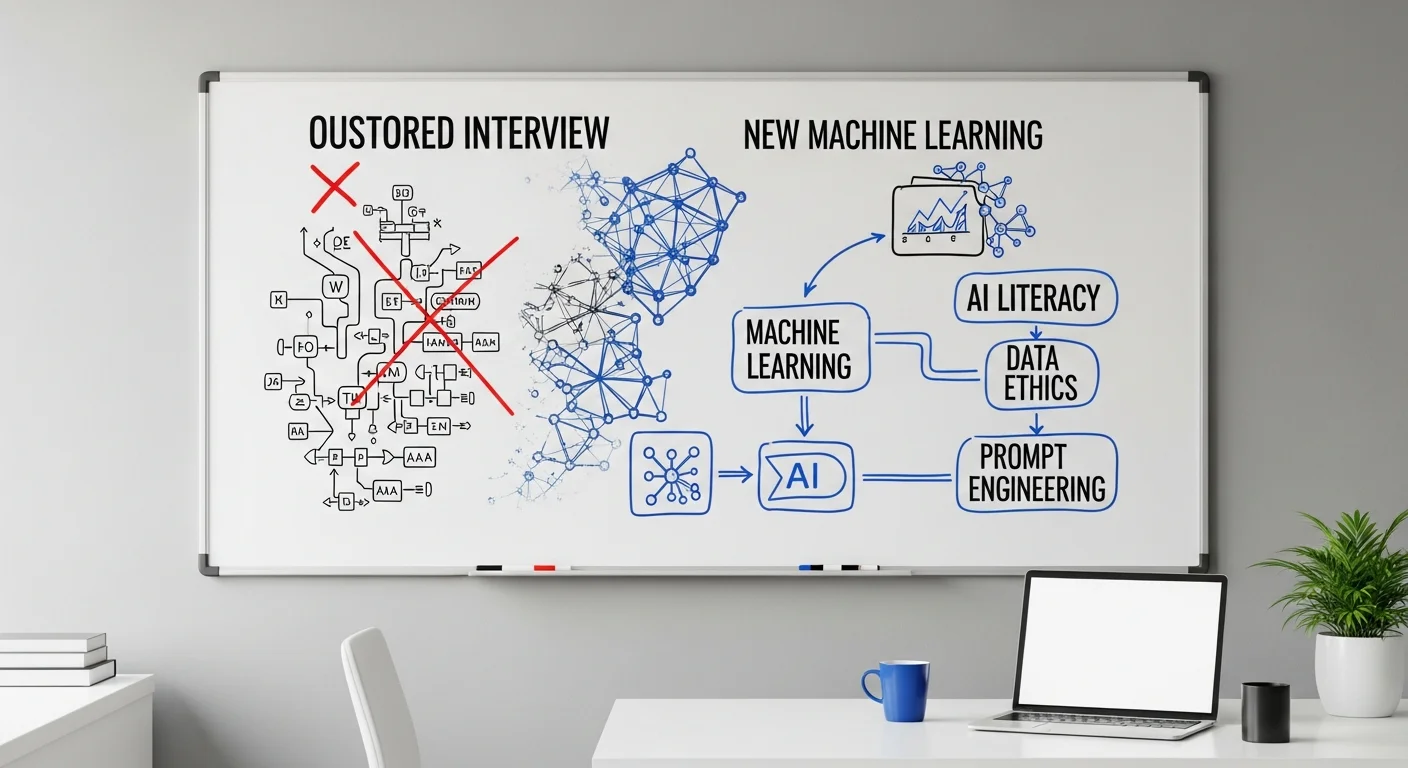
- 1.AI fluency is now a top hiring priority, interviews assess prompt engineering and AI tool integration (Microsoft, 2025)
- 2.Take-home assessments evolved from algorithmic puzzles to real-world projects (Interview Query, 2025)
- 3.72% of companies using AI assessments report significant reduction in cheating (We Create Problems, 2026)
- 4.52% of talent leaders plan to deploy autonomous AI agents in recruiting by 2026 (HireHunch, 2026)
72%
AI in Assessments
52%
Using AI Agents
50%
Faster Hiring
87%
Teams Using AI Dev
The Shift Away from Algorithmic Puzzles
According to Interview Query, take-home assessments didn't disappear, they evolved into real-world projects. Amanda Richardson, CEO of CoderPad, calls it 'The death of algorithmic take-homes, replaced by project-based ones.'
Candidates are now asked to extend small apps, analyze real datasets, or simulate product scenarios involving AI. The focus has shifted from arriving at a perfect answer to demonstrating decision-making, adaptability, and effective use of tools under realistic conditions.
As one industry expert noted: '2026 won't be the year technical interviews disappear. It will be the year they finally start reflecting reality.'
AI Literacy as a Core Hiring Criterion
According to Microsoft's 2025 Work Trend Index, AI fluency is now a top hiring priority. Future technical interviews will assess AI literacy as a core engineering skill, including:
- Prompt engineering. How well a candidate frames prompts for AI tools
- AI code evaluation. Ability to evaluate AI-generated code for correctness, security, and style
- Debugging AI output. Identifying and fixing errors in AI suggestions
- Integration skills. How to integrate AI into broader solutions and workflows
With 87% of teams currently using AI in their development process, and 55% of developers using their own AI tools without company safeguards, the transformation is already here.
New Assessment Formats
According to We Create Problems, by 2026, candidates can expect adaptive assessments, instant scoring, strict plagiarism detection, and AI-driven behavior analysis. The new formats include:
- Project-based take-homes. Extend real apps or analyze actual datasets (replacing LeetCode-style problems)
- Live AI-assisted coding. Demonstrate ability to work effectively WITH AI tools, not just without them
- System design with AI. Design systems that incorporate AI components appropriately
- Time-boxed problem solving. Task-driven, time-bound challenges in controlled environments
- Skills verification. Automated testing of specific competencies rather than resume screening
Source: HireHunch, 2026
Anti-Cheating Measures
According to We Create Problems, 72% of companies using AI coding assessments report that real-time detection of copied code and plagiarism prevention algorithms have significantly reduced cheating in technical tests.
- 65% of AI interview tools feature code similarity detection
- 80% of recruiters say AI tools can automatically flag unusual behavior during coding challenges
- Adaptive questioning. AI adjusts difficulty based on responses, making answer-sharing less effective
- Behavior analysis. Monitoring for patterns indicating unauthorized assistance
The irony: AI is both the reason interviews are changing (candidates can use it to cheat) and the solution (companies use AI to detect cheating). The result is more sophisticated, harder-to-game assessments.
How to Prepare for 2026 Tech Interviews
According to HireHunch, 2026 marks the decline of résumé-based filtering. High-growth teams now anchor hiring decisions around skills-first approaches. Here's how to prepare:
- Master AI tools. Practice using Copilot, Claude, and other AI coding assistants effectively, not just prompting
- Build real projects. Portfolio work matters more than ever when algorithmic puzzles decline
- Practice evaluating AI code. Learn to spot errors, security issues, and style problems in AI-generated code
- Develop system design skills. Modern interviews emphasize architecture and decision-making
- Focus on communication. Explaining your thought process matters as much as the solution
- Stay honest. Anti-cheating measures are sophisticated. Authenticity is your best strategy
Related Articles
Related Degrees
Frequently Asked Questions
Sources
AI interview statistics and anti-cheating data
Take-home assessment evolution analysis
2026 recruiting trends and AI agent deployment
AI fluency as hiring priority

Taylor Rupe
Co-founder & Editor (B.S. Computer Science, Oregon State • B.A. Psychology, University of Washington)
Taylor combines technical expertise in computer science with a deep understanding of human behavior and learning. His dual background drives Hakia's mission: leveraging technology to build authoritative educational resources that help people make better decisions about their academic and career paths.